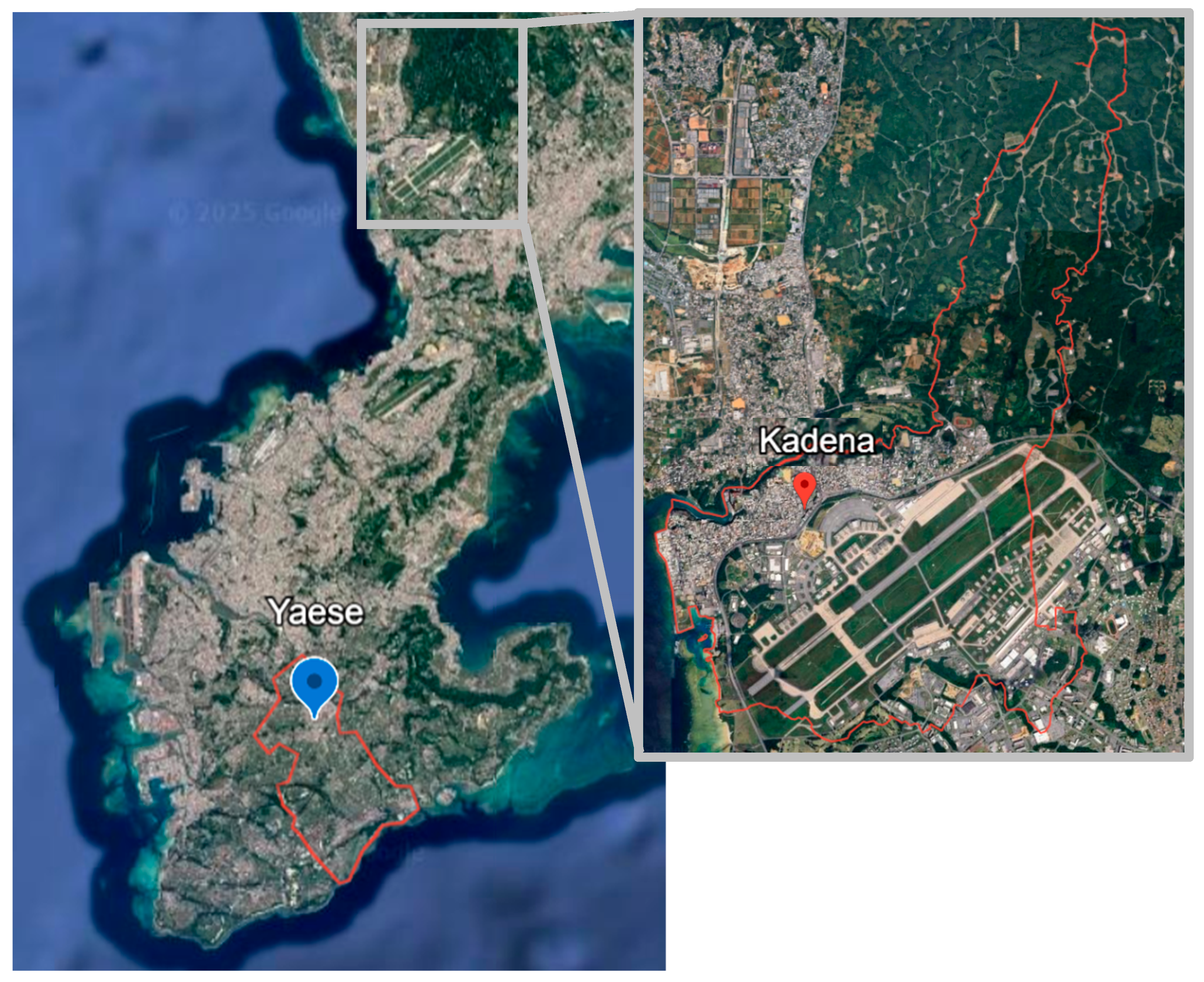
Association of Military Aircraft Noise Exposure with Mental Well-Being and Sleep Disturbance near a Military Air Base in Okinawa, Japan: An Ecological Study


Abstract
1. Introduction
2. Materials and Methods
2.1. Study Design, Site, and Sampling Procedures
2.2. Data Collection
2.3. Variables and Measurements
2.4. Statistical Analysis
2.5. Ethical Considerations
3. Results
3.1. Participant Characteristics
3.2. Bivariate Analysis of Mental Well-Being
3.3. Bivariate Analysis of Sleep Disturbance
3.4. Multivariate Analysis of Mental Well-Being
3.5. Multivariate Analysis of Sleep Disturbance
4. Discussion
5. Conclusions
Supplementary Materials
Author Contributions
Funding
Institutional Review Board Statement
Informed Consent Statement
Data Availability Statement
Acknowledgments
Conflicts of Interest
References
- International Civil Aviation Organization. Global Trends in Aircraft Noise. Available online: https://www.icao.int/environmental-protection/global-trends-aircraft-noise (accessed on 30 October 2025).
- Basner, M.; McGuire, S. WHO Environmental Noise Guidelines for the European Region: A Systematic Review on Environmental Noise and Effects on Sleep. Int. J. Environ. Res. Public Health 2018, 15, 519. [Google Scholar] [CrossRef]
- Kempen, E.V.; Casas, M.; Pershagen, G.; Foraster, M. WHO Environmental Noise Guidelines for the European Region: A Systematic Review on Environmental Noise and Cardiovascular and Metabolic Effects: A Summary. Int. J. Environ. Res. Public Health 2018, 15, 379. [Google Scholar] [CrossRef] [PubMed]
- Clark, C.; Paunovic, K. WHO Environmental Noise Guidelines for the European Region: A Systematic Review on Environmental Noise and Cognition. Int. J. Environ. Res. Public Health 2018, 15, 285. [Google Scholar] [CrossRef]
- Guski, R.; Schreckenberg, D.; Schuemer, R. WHO Environmental Noise Guidelines for the European Region: A Systematic Review on Environmental Noise and Annoyance. Int. J. Environ. Res. Public Health 2017, 14, 1539. [Google Scholar] [CrossRef]
- Nieuwenhuijsen, M.J.; Ristovska, G.; Dadvand, P. WHO Environmental Noise Guidelines for the European Region: A Systematic Review on Environmental Noise and Adverse Birth Outcomes. Int. J. Environ. Res. Public Health 2017, 14, 1252. [Google Scholar] [CrossRef]
- Hegewald, J.; Schubert, M.; Freiberg, A.; Romero Starke, K.; Augustin, F.; Riedel-Heller, S.G.; Zeeb, H.; Seidler, A. Traffic Noise and Mental Health: A Systematic Review and Meta-Analysis. Int. J. Environ. Res. Public Health 2020, 17, 6175. [Google Scholar] [CrossRef] [PubMed]
- Yokoshima, S.; Morinaga, M.; Tsujimura, S.; Shimoyama, K.; Morihara, T. Representative Exposure-Annoyance Relationships Due to Transportation Noises in Japan. Int. J. Environ. Res. Public Health 2021, 18, 10935. [Google Scholar] [CrossRef] [PubMed]
- Jacuzzi, G.; Kuehne, L.M.; Harvey, A.; Hurley, C.; Wilbur, R.; Seto, E.; Olden, J.D. Population health implications of exposure to pervasive military aircraft noise pollution. J. Expo. Sci. Environ. Epidemiol. 2025, 35, 91–103. [Google Scholar] [CrossRef] [PubMed]
- Ministry of Defense. List of Defense-Related Facilities of the U.S. Military in Japan. Available online: https://www.mod.go.jp/j/presiding/law/drone/list_zaibeigun.html (accessed on 30 October 2025).
- Kadena Town. Kadena Town and the Base. Available online: https://www.town.kadena.okinawa.jp/english/n3614.html (accessed on 30 October 2025).
- Okinawa Prefectural Government. A Report on the Aircraft Noise as a Public Health Problem in Okinawa. 1999. Available online: https://www.researchgate.net/publication/282018786_A_Report_on_the_Aircraft_Noise_as_a_Public_Health_Problem_in_Okinawa#full-text (accessed on 30 October 2025).
- Miyakita, T.; Matsui, T.; Ito, A.; Tokuyama, T.; Hiramatsu, K.; Osada, Y.; Yamamoto, T. Population-based questionnaire survey on health effects of aircraft noise on residents living around US airfields in the Ryukyus—Part 1: An analysis of 12 scale scores. J. Sound Vib. 2002, 250, 129–137. [Google Scholar] [CrossRef]
- Kadena Town. Results of Interview Survey to Investigate the Damages Caused by Base. Available online: https://www.town.kadena.okinawa.jp/info/c5dde5763a834e164b47aca52853d9b9369f6071.pdf (accessed on 30 October 2025).
- Okinawa Prefectural Government; Department of Environmental Affairs; Environmental Preservation Division. Summary of Aircraft Noise Measurement Results, Kadena Air Base and Futenma Air Station. 2025. Available online: https://www.pref.okinawa.jp/_res/projects/default_project/_page_/001/036/097/r06_02_kadena.pdf (accessed on 30 October 2025).
- Okinawa Prefectural Government; Department of Environmental Affairs; Environmental Preservation Division. Summary of Aircraft Noise Measurement Results, Kadena Air Base and Futenma Air Station. 2023. Available online: https://www.pref.okinawa.jp/_res/projects/default_project/_page_/001/022/831/2_r4_kadena.pdf (accessed on 30 October 2025).
- Okinawa Prefectural Government; Department of Environmental Affairs; Environmental Preservation Division. Summary of Aircraft Noise Measurement Results, Kadena Air Base and Futenma Air Station. 2021. Available online: https://www.pref.okinawa.jp/_res/projects/default_project/_page_/001/004/431/r2_kadena.pdf (accessed on 30 October 2025).
- Awata, S.; Bech, P.; Koizumi, Y.; Seki, T.; Kuriyama, S.; Hozawa, A.; Ohmori, K.; Nakaya, N.; Matsuoka, H.; Tsuji, I. Validity and utility of the Japanese version of the WHO-Five Well-Being Index in the context of detecting suicidal ideation in elderly community residents. Int. Psychogeriatr. 2007, 19, 77–88. [Google Scholar] [CrossRef]
- Awata, S.; Bech, P.; Yoshida, S.; Hirai, M.; Suzuki, S.; Yamashita, M.; Ohara, A.; Hinokio, Y.; Matsuoka, H.; Oka, Y. Reliability and validity of the Japanese version of the World Health Organization-Five Well-Being Index in the context of detecting depression in diabetic patients. Psychiatry Clin. Neurosci. 2007, 61, 112–119. [Google Scholar] [CrossRef]
- Hajime, I.; Hiroki, I.; Yuko, Y.; Yukie, M.; Takao, S.; Hideyo, Y.; Shuichi, A. Normative data for the Japanese version of the World Health Organization-Five Well-Being Index (WHO-5-J) among Japanese community-dwelling older adults. Jpn. J. Gerontol. 2014, 36, 330–339. [Google Scholar] [CrossRef]
- World Health Organization. The World Health Organization-Five Well-Being Index (WHO-5). CC-BY-NC-SA 3.0 IGO. Available online: https://cdn.who.int/media/docs/default-source/mental-health/who-5_english-original4da539d6ed4b49389e3afe47cda2326a.pdf?sfvrsn=ed43f352_11&download=true (accessed on 30 October 2025).
- Topp, C.W.; Østergaard, S.D.; Søndergaard, S.; Bech, P. The WHO-5 Well-Being Index: A Systematic Review of the Literature. Psychother. Psychosom. 2015, 84, 167–176. [Google Scholar] [CrossRef]
- Okajima, I.; Nakajima, S.; Kobayashi, M.; Inoue, Y. Development and validation of the Japanese version of the Athens Insomnia Scale. Psychiatry Clin. Neurosci. 2013, 67, 420–425. [Google Scholar] [CrossRef] [PubMed]
- Soldatos, C.R.; Dikeos, D.G.; Paparrigopoulos, T.J. Athens Insomnia Scale: Validation of an instrument based on ICD-10 criteria. J. Psychosom. Res. 2000, 48, 555–560. [Google Scholar] [CrossRef] [PubMed]
- Soldatos, C.R.; Dikeos, D.G.; Paparrigopoulos, T.J. The diagnostic validity of the Athens Insomnia Scale. Journal of Psychosomatic Research 2003, 55, 263–267. [Google Scholar] [CrossRef]
- Basner, M.; Babisch, W.; Davis, A.; Brink, M.; Clark, C.; Janssen, S.; Stansfeld, S. Auditory and non-auditory effects of noise on health. Lancet 2014, 383, 1325–1332. [Google Scholar] [CrossRef] [PubMed]
- Eze, I.C.; Foraster, M.; Schaffner, E.; Vienneau, D.; Pieren, R.; Imboden, M.; Wunderli, J.-M.; Cajochen, C.; Brink, M.; Röösli, M.; et al. Incidence of depression in relation to transportation noise exposure and noise annoyance in the SAPALDIA study. Environ. Int. 2020, 144, 106014. [Google Scholar] [CrossRef]
- Hahad, O.; Kuntic, M.; Al-Kindi, S.; Kuntic, I.; Gilan, D.; Petrowski, K.; Daiber, A.; Münzel, T. Noise and mental health: Evidence, mechanisms, and consequences. J. Expo. Sci. Environ. Epidemiol. 2025, 35, 16–23. [Google Scholar] [CrossRef]
- Morinaga, M.; Sakuma, T.; Kawai, K.; Makino, K. Aircraft noise annoyance around military airfields in Japan. In Proceedings of the INTER-NOISE 2016, Hamburg, Germany, 21–24 August 2016. [Google Scholar]
- Shukla, M.; Patel, J.C.; Nayak, D.; Shukla, M.; Chakravarti, S.; Kapoor, N. Evaluating the Effects of Aircraft Noise on Hearing and Physiological Indicators: A Study of Military Personnel Using iTRAQ Proteomics and Cognitive Assessments; Cold Spring Harbor Laboratory: Laurel Hollow, NY, USA, 2024. [Google Scholar]
- Seidler, A.; Hegewald, J.; Seidler, A.L.; Schubert, M.; Wagner, M.; Dröge, P.; Haufe, E.; Schmitt, J.; Swart, E.; Zeeb, H. Association between aircraft, road and railway traffic noise and depression in a large case-control study based on secondary data. Environ. Res. 2017, 152, 263–271. [Google Scholar] [CrossRef]
- Lawton, R.N.; Fujiwara, D. Living with aircraft noise: Airport proximity, aviation noise and subjective wellbeing in England. Transp. Res. Part D Transp. Environ. 2016, 42, 104–118. [Google Scholar] [CrossRef]
- Fujiwara, D.; Lawton, R.N.; MacKerron, G. Experience sampling in and around airports. Momentary subjective wellbeing, airports, and aviation noise in England. Transp. Res. Part D Transp. Environ. 2017, 56, 43–54. [Google Scholar] [CrossRef]
- Yen, H.-Y.; Liao, Y.; Huang, W.-H. Household physical activity and subjective well-being: An international comparison among East Asian older adult populations. Arch. Gerontol. Geriatr. 2024, 117, 105220. [Google Scholar] [CrossRef] [PubMed]
- Kim, S.J.; Chai, S.K.; Lee, K.W.; Park, J.B.; Min, K.B.; Kil, H.G.; Lee, C.; Lee, K.J. Exposure-Response Relationship Between Aircraft Noise and Sleep Quality: A Community-based Cross-sectional Study. Osong Public Health Res. Perspect. 2014, 5, 108–114. [Google Scholar] [CrossRef] [PubMed]
- Rojek, M.; Wojciechowska, W.; Januszewicz, A.; Czarnecka, D.; Skalski, P.; Rajzer, M. The relation of nocturnal exposure to aircraft noise and aircraft noise-induced insomnia with blood pressure. Pol. Arch. Intern. Med. 2020, 131, 33–41. [Google Scholar] [CrossRef]
- Perron, S.; Tétreault, L.-F.; King, N.; Plante, C.; Smargiassi, A. Review of the effect of aircraft noise on sleep disturbance in adults. Noise Health 2012, 14, 58–67. [Google Scholar] [CrossRef] [PubMed]
- Smith, M.G.; Cordoza, M.; Basner, M. Environmental Noise and Effects on Sleep: An Update to the WHO Systematic Review and Meta-Analysis. Environ. Health Perspect. 2022, 130, 76001. [Google Scholar] [CrossRef]
- Bech, P.; Olsen, L.R.; Kjoller, M.; Rasmussen, N.K. Measuring well-being rather than the absence of distress symptoms: A comparison of the SF-36 Mental Health subscale and the WHO-Five well-being scale. Int. J. Methods Psychiatr. Res. 2003, 12, 85–91. [Google Scholar] [CrossRef]
- Heun, R.; Bonsignore, M.; Barkow, K.; Jessen, F. Validity of the five-item WHO Well-Being Index (WHO-5) in an elderly population. Eur. Arch. Psychiatry Clin. Nuerosci. 2001, 251, 27–31. [Google Scholar] [CrossRef]
- Ito, K.; Inagaki, H.; Okamura, T.; Shimokado, K.; Awata, S. Factors associated with mental health well-being of urban community-dwelling elders in Japan: Comparison between subjects with and without long-term care insurance certification. Nihon Ronen Igakkai Zasshi 2012, 49, 82–89. [Google Scholar] [CrossRef]
- Suzuki, M.; Suzuki, N.; Sakurada, K.; Tsuchiya, N.; Ueno, Y.; Konta, T. Insomnia symptoms and related factors in a community-based population: The Yamagata Cohort study. Heliyon 2024, 10, e28228. [Google Scholar] [CrossRef] [PubMed]
- Song, J.; Zhou, S.; Zou, D.; Kwan, M.P.; Cai, J.; Lu, J. Non-linear associations between noise level and people’s short-term noise annoyance in different activity contexts. Environ Res 2024, 260, 119772. [Google Scholar] [CrossRef] [PubMed]


| Characteristics | n | % | ||
|---|---|---|---|---|
| Residential community | No-exposure | 155 | 39.3 | |
| Low-exposure | 108 | 27.4 | ||
| High-exposure | 131 | 33.2 | ||
| Sex | Male | 174 | 44.2 | |
| Female | 220 | 55.8 | ||
| Age range (years) | ≤20 s | 20 | 5.1 | |
| 30 s | 23 | 5.8 | ||
| 40 s | 55 | 14.0 | ||
| 50 s | 64 | 16.2 | ||
| 60 s | 93 | 23.6 | ||
| 70 s | 100 | 25.4 | ||
| ≥80 s | 39 | 9.9 | ||
| Employment type (n = 392) | Regular employee | 88 | 22.4 | |
| Housewife/husband | 80 | 20.4 | ||
| Retiree | 80 | 20.4 | ||
| Part-time job | 65 | 16.6 | ||
| Self-employed | 40 | 10.2 | ||
| Others | 39 | 9.9 | ||
| Number of household members (n = 390) | 1 | 32 | 8.2 | |
| 2 | 140 | 35.9 | ||
| 3 | 105 | 26.9 | ||
| ≥4 | 113 | 29.0 | ||
| Perceived economic situation | Very comfortable | 6 | 1.5 | |
| Comfortable | 36 | 9.1 | ||
| So-so | 245 | 62.2 | ||
| Difficult | 78 | 19.8 | ||
| Very difficult | 29 | 7.4 | ||
| Hearing ability | No hearing difficulty | 270 | 68.5 | |
| Hearing difficulty | 124 | 31.5 | ||
| Use of hearing aids (n = 124) | No | 110 | 88.7 | |
| Yes | 14 | 11.3 | ||
| History of insomnia/other sleep problems (n = 388) | No | 309 | 79.6 | |
| Yes | 79 | 20.4 | ||
| Under treatment/observation (n = 74) | No | 47 | 63.5 | |
| Yes | 27 | 36.5 | ||
| Use of sleep medicines/supplements (n = 391) | No | 338 | 86.4 | |
| Yes | 53 | 13.6 | ||
| Perceived level of noise (n = 391) | Very noisy | 105 | 26.9 | |
| Noisy | 79 | 20.2 | ||
| Slightly noisy | 85 | 21.7 | ||
| Not bother | 75 | 19.2 | ||
| Feel nothing/No aircraft noise | 47 | 12.0 | ||
| Hours of stay at/near home per day (n = 380) | <6 h | 28 | 7.4 | |
| ≥6 and <12 h | 69 | 18.2 | ||
| ≥12 and <18 h | 113 | 29.7 | ||
| ≥18 and ≤24 h | 170 | 44.7 | ||
| Time of going to bed (n = 391); Median (interquartile range) | 22:30 (21:30, 23:30) | |||
| Time of waking up (n = 391); Median (interquartile range) | 6:00 (5:30, 6:30) | |||
| Napping (n = 390) | No | 212 | 54.4 | |
| Yes | 178 | 45.6 | ||
| Coffee/tea consumption after 4 p.m. (n = 389) | No | 190 | 48.8 | |
| Yes | 199 | 51.2 | ||
| Frequency of alcohol consumption per week (n = 392) | Do not drink | 252 | 64.3 | |
| 1 to 3 times | 72 | 18.4 | ||
| 4 times or more | 68 | 17.3 | ||
| Smoking (n = 392) | No | 350 | 89.3 | |
| Yes | 42 | 10.7 | ||
| Physical activities (>40 min) per day (n = 390) | No | 125 | 32.1 | |
| Yes | 265 | 67.9 | ||
| Housing type (n = 393) | Single-family home | 359 | 91.3 | |
| Apartment | 34 | 8.7 | ||
| Years of residence; median (interquartile range) | 22 (11, 37) | |||
| Chronic illnesses (n = 388) | Absent | 145 | 37.4 | |
| Present | 243 | 62.6 | ||
| Chronic diseases/health condition * | Hypertension | 150 | ||
| Cardiovascular diseases | 74 | |||
| Chronic pain | 65 | |||
| Endocrinology disease | 41 | |||
| Hearing loss | 23 | |||
| Respiratory disease | 20 | |||
| Chronic itching | 17 | |||
| Depression/mood disorders | 18 | |||
| Others | 41 | |||
| Daily habits within one hour before going to bed * | Watching TV | 266 | ||
| Using a smartphone/PC | 151 | |||
| Relaxing | 112 | |||
| Drinking alcohol | 55 | |||
| Eating | 35 | |||
| Smoking | 17 | |||
| Exercising | 10 | |||
| Bathing | 7 | |||
| Others | 18 | |||
| Characteristics | Poor Well-Being | Moderate Well-Being | p-Value | |||
|---|---|---|---|---|---|---|
| n | % | n | % | |||
| Residential community | ||||||
| No-exposure | 34 | 21.9 | 121 | 78.1 | ||
| Low-exposure | 39 | 36.1 | 69 | 63.9 | ||
| High-exposure | 50 | 38.2 | 81 | 61.8 | 0.005 | |
| Sex | ||||||
| Male | 54 | 31.0 | 120 | 69.0 | ||
| Female | 69 | 31.4 | 151 | 68.6 | 1.000 | |
| Age | ||||||
| ≤49 years | 31 | 31.6 | 67 | 68.4 | ||
| 50–69 years | 50 | 31.8 | 107 | 68.2 | ||
| ≥70 years | 42 | 30.2 | 97 | 69.8 | 0.961 | |
| Employment type (n = 392) | ||||||
| Regular employee | 28 | 31.8 | 60 | 68.2 | ||
| Housewife/husband | 34 | 42.5 | 46 | 57.5 | ||
| Retirement | 22 | 27.5 | 58 | 72.5 | ||
| Part-time job | 17 | 26.2 | 48 | 73.8 | ||
| Self-employed | 9 | 22.5 | 31 | 77.5 | ||
| Others | 11 | 28.2 | 28 | 71.8 | 0.199 | |
| Household members (n = 390) | ||||||
| 1 | 7 | 21.9 | 25 | 78.1 | ||
| 2 | 44 | 31.4 | 96 | 68.6 | ||
| ≥3 | 69 | 31.7 | 149 | 68.3 | 0.569 | |
| Perceived economic situation | ||||||
| Comfortable/Very comfortable | 9 | 21.4 | 33 | 78.6 | ||
| So-so | 69 | 28.2 | 176 | 71.8 | ||
| Difficult/Very difficult | 45 | 42.1 | 62 | 57.9 | 0.014 | |
| Hearing ability | ||||||
| No hearing difficulty | 65 | 24.1 | 205 | 75.9 | ||
| Hering difficulty | 58 | 46.8 | 66 | 53.2 | < 0.001 | |
| Chronic illnesses (n = 388) | ||||||
| Absent | 34 | 23.4 | 111 | 76.6 | ||
| Present | 89 | 36.6 | 154 | 63.4 | 0.007 | |
| Sleep medicine/supplements (n = 391) | ||||||
| No | 100 | 29.6 | 238 | 70.4 | ||
| Yes | 22 | 41.5 | 31 | 58.5 | 0.110 | |
| Perceived level of noise (n = 390) | ||||||
| Very noisy/Noisy/Slightly noisy | 102 | 38.1 | 166 | 61.9 | ||
| Not bothered/Feel nothing/No aircraft noise | 21 | 17.2 | 101 | 82.8 | <0.001 | |
| Daily hours at/near home (n = 380) | ||||||
| <18 h | 66 | 31.4 | 144 | 68.6 | ||
| ≥18 h | 56 | 32.9 | 114 | 67.1 | 0.825 | |
| Napping (n = 390) | ||||||
| No | 60 | 28.3 | 152 | 71.7 | ||
| Yes | 63 | 35.4 | 115 | 64.6 | 0.155 | |
| Coffee/tea consumption (n = 389) | ||||||
| No | 58 | 30.5 | 132 | 69.5 | ||
| Yes | 63 | 31.7 | 136 | 68.3 | 0.827 | |
| Alcohol consumption (n = 392) | ||||||
| Do not drink | 85 | 33.7 | 167 | 66.3 | ||
| Drink | 38 | 27.1 | 102 | 72.9 | 0.211 | |
| Smoking (n = 392) | ||||||
| Yes | 12 | 28.6 | 30 | 71.2 | ||
| No | 111 | 31.7 | 239 | 68.3 | 0.729 | |
| Physical activities per day (n = 390) | ||||||
| No | 54 | 43.2 | 71 | 56.8 | ||
| Yes | 69 | 26.0 | 196 | 74.0 | 0.001 | |
| Housing type (n = 393) | ||||||
| Single-family home | 105 | 29.2 | 254 | 70.8 | ||
| Apartment | 17 | 50.0 | 17 | 50.0 | 0.019 | |
| Characteristics | Sleeping Disturbance | Non-Sleeping Disturbance | p-Value | |||
|---|---|---|---|---|---|---|
| n | % | n | % | |||
| Residential community | ||||||
| No-exposure | 45 | 29.0 | 110 | 71.0 | ||
| Low-exposure | 50 | 46.3 | 58 | 53.7 | ||
| High-exposure | 61 | 46.6 | 70 | 53.4 | 0.003 | |
| Sex | ||||||
| Male | 66 | 37.9 | 108 | 62.1 | ||
| Female | 90 | 40.9 | 130 | 59.1 | 0.604 | |
| Age | ||||||
| ≤49 years | 35 | 35.7 | 63 | 64.3 | ||
| 50–69 years | 69 | 43.9 | 88 | 56.1 | ||
| ≥70 years | 52 | 37.4 | 87 | 62.6 | 0.352 | |
| Employment type (n = 392) | ||||||
| Regular employee | 31 | 35.2 | 57 | 64.8 | ||
| Housewife/husband | 39 | 48.8 | 41 | 51.3 | ||
| Retirement | 32 | 40.0 | 48 | 60.0 | ||
| Part-time job | 26 | 40.0 | 39 | 60.0 | ||
| Self-employed | 16 | 40.0 | 24 | 60.0 | ||
| Others | 10 | 25.6 | 29 | 74.4 | 0.246 | |
| Household members (n = 390) | ||||||
| 1 | 11 | 34.4 | 21 | 65.6 | ||
| 2 | 58 | 41.4 | 82 | 58.6 | ||
| ≥3 | 85 | 39.0 | 133 | 61.0 | 0.748 | |
| Perceived economic situation | ||||||
| Comfortable/Very comfortable | 15 | 35.7 | 27 | 64.3 | ||
| So-so | 82 | 33.5 | 163 | 66.5 | ||
| Difficult/Very difficult | 59 | 55.1 | 48 | 44.9 | 0.001 | |
| Hearing ability | ||||||
| No hearing difficult | 95 | 35.2 | 175 | 64.8 | ||
| Hearing difficulty | 61 | 49.2 | 63 | 50.8 | 0.011 | |
| Chronic illnesses (n = 388) | ||||||
| Absent | 46 | 31.7 | 99 | 68.3 | ||
| Present | 110 | 45.3 | 133 | 54.7 | 0.010 | |
| Sleep medicine/supplements (n = 391) | ||||||
| No | 120 | 35.5 | 218 | 64.5 | ||
| Yes | 35 | 66.0 | 18 | 34.0 | <0.001 | |
| Perceived level of noise (n = 390) | ||||||
| Very noisy/Noisy/Slightly noisy | 134 | 50.0 | 134 | 50.0 | ||
| Not bothered/Feel nothing/No aircraft noise | 22 | 18.0 | 100 | 82.0 | <0.001 | |
| Daily hours at/near home (n = 380) | ||||||
| <18 h | 83 | 39.5 | 127 | 60.5 | ||
| ≥18 h | 71 | 41.8 | 99 | 58.2 | 0.658 | |
| Napping (n = 390) | ||||||
| No | 82 | 38.7 | 130 | 61.3 | ||
| Yes | 73 | 41.0 | 105 | 59.0 | 0.678 | |
| Coffee/tea consumption (n = 389) | ||||||
| No | 76 | 40.0 | 114 | 60.0 | ||
| Yes | 78 | 39.2 | 121 | 60.8 | 0.918 | |
| Alcohol consumption (n = 392) | ||||||
| Do not drink | 102 | 40.5 | 150 | 59.5 | ||
| Drink | 54 | 38.6 | 86 | 61.4 | 0.747 | |
| Smoking (n = 392) | ||||||
| No | 140 | 40.0 | 210 | 60.0 | ||
| Yes | 16 | 38.1 | 26 | 61.9 | 0.869 | |
| Physical activities per day (n = 390) | ||||||
| No | 47 | 37.6 | 78 | 62.4 | ||
| Yes | 108 | 40.8 | 157 | 59.2 | 0.581 | |
| Housing type (n = 393) | ||||||
| Single-family home | 140 | 39.0 | 219 | 61.0 | ||
| Apartment | 15 | 44.1 | 19 | 55.9 | 0.585 | |
| Characteristics | Model 1 | Model 2 | |||
|---|---|---|---|---|---|
| AOR * | 95% CI † | AOR * | 95% CI † | ||
| Residential community | |||||
| No-exposure | 1.00 | Reference | 1.00 | Reference | |
| Low-exposure | 2.04 | 1.18–3.52 | 1.94 | 1.05–3.56 | |
| High-exposure | 2.20 | 1.31–3.70 | 1.84 | 1.05–3.23 | |
| Sex | |||||
| Male | 1.00 | Reference | 1.00 | Reference | |
| Female | 0.98 | 0.63–1.52 | 1.20 | 0.75–1.92 | |
| Age | |||||
| ≤49 years | 1.00 | Reference | 1.00 | Reference | |
| 50–69 years | 1.06 | 0.61–1.83 | 1.00 | 0.54–1.84 | |
| ≥70 years | 0.94 | 0.54–1.67 | 0.67 | 0.33–1.33 | |
| Perceived economic situation | |||||
| Comfortable/very comfortable | 1.00 | Reference | |||
| So-so | 1.30 | 0.56–3.02 | |||
| Difficult/very difficult | 2.30 | 0.94–5.60 | |||
| Hearing ability | |||||
| No hearing difficulty | 1.00 | Reference | |||
| Hearing difficulty | 2.62 | 1.56–4.42 | |||
| Chronic illnesses | |||||
| Absent | 1.00 | Reference | |||
| Present | 1.96 | 1.14–3.36 | |||
| Physical activities | |||||
| No | 1.00 | Reference | |||
| Yes | 0.39 | 0.24–0.64 | |||
| Characteristics | Model 1 | Model 2 | |||
|---|---|---|---|---|---|
| AOR * | 95% CI † | AOR * | 95% CI † | ||
| Residential community | |||||
| No-exposure | 1.00 | Reference | 1.00 | Reference | |
| Low-exposure | 2.18 | 1.30–3.66 | 2.04 | 1.16–3.59 | |
| High-exposure | 2.16 | 1.32–3.52 | 1.98 | 1.17–3.35 | |
| Sex | |||||
| Male | 1.00 | Reference | 1.00 | Reference | |
| Female | 1.10 | 0.73–1.67 | 1.12 | 0.72–1.76 | |
| Age | |||||
| ≤49 years | 1.00 | Reference | 1.00 | Reference | |
| 50–69 years | 1.50 | 0.89–2.55 | 1.44 | 0.81–2.56 | |
| ≥70 years | 1.09 | 0.63–1.88 | 0.82 | 0.43–1.57 | |
| Perceived economic situation | |||||
| Comfortable/very comfortable | 1.00 | Reference | |||
| So-so | 0.73 | 0.36–1.51 | |||
| Difficult/very difficult | 1.87 | 0.86–4.09 | |||
| Hearing ability | |||||
| No hearing difficulty | 1.00 | Reference | |||
| Hearing difficulty | 1.34 | 0.81–2.22 | |||
| Chronic illnesses | |||||
| Absent | 1.00 | Reference | |||
| Present | 1.64 | 0.99–2.71 | |||
| Sleep medicines/supplements | |||||
| Used | 1.00 | Reference | |||
| Not used | 2.95 | 1.54–5.64 | |||
Disclaimer/Publisher’s Note: The statements, opinions and data contained in all publications are solely those of the individual author(s) and contributor(s) and not of MDPI and/or the editor(s). MDPI and/or the editor(s) disclaim responsibility for any injury to people or property resulting from any ideas, methods, instructions or products referred to in the content. |
© 2025 by the authors. Licensee MDPI, Basel, Switzerland. This article is an open access article distributed under the terms and conditions of the Creative Commons Attribution (CC BY) license.
Share and Cite
Maekawa, Y.; Nonaka, D.; Kawamoto, S.; Maeda, Y.; Toyama, Y. Association of Military Aircraft Noise Exposure with Mental Well-Being and Sleep Disturbance near a Military Air Base in Okinawa, Japan: An Ecological Study. Int. J. Environ. Res. Public Health 2026, 23, 54. https://doi.org/10.3390/ijerph23010054
Maekawa Y, Nonaka D, Kawamoto S, Maeda Y, Toyama Y. Association of Military Aircraft Noise Exposure with Mental Well-Being and Sleep Disturbance near a Military Air Base in Okinawa, Japan: An Ecological Study. International Journal of Environmental Research and Public Health. 2026; 23(1):54. https://doi.org/10.3390/ijerph23010054
Chicago/Turabian StyleMaekawa, Yuka, Daisuke Nonaka, Sae Kawamoto, Yukako Maeda, and Yuko Toyama. 2026. "Association of Military Aircraft Noise Exposure with Mental Well-Being and Sleep Disturbance near a Military Air Base in Okinawa, Japan: An Ecological Study" International Journal of Environmental Research and Public Health 23, no. 1: 54. https://doi.org/10.3390/ijerph23010054
APA StyleMaekawa, Y., Nonaka, D., Kawamoto, S., Maeda, Y., & Toyama, Y. (2026). Association of Military Aircraft Noise Exposure with Mental Well-Being and Sleep Disturbance near a Military Air Base in Okinawa, Japan: An Ecological Study. International Journal of Environmental Research and Public Health, 23(1), 54. https://doi.org/10.3390/ijerph23010054