Travel-Associated Melioidosis in Non-Endemic Regions: A Systematic Review and Meta-Analysis

 ,
,  , , , ,
Abstract
1. Introduction
2. Materials and Methods
2.1. Protocol and Registration
2.2. Search Strategies
2.3. Eligibility Criteria
2.4. Data Extraction
2.5. Risk of Bias Assessment
2.6. Statistical Analysis
3. Results
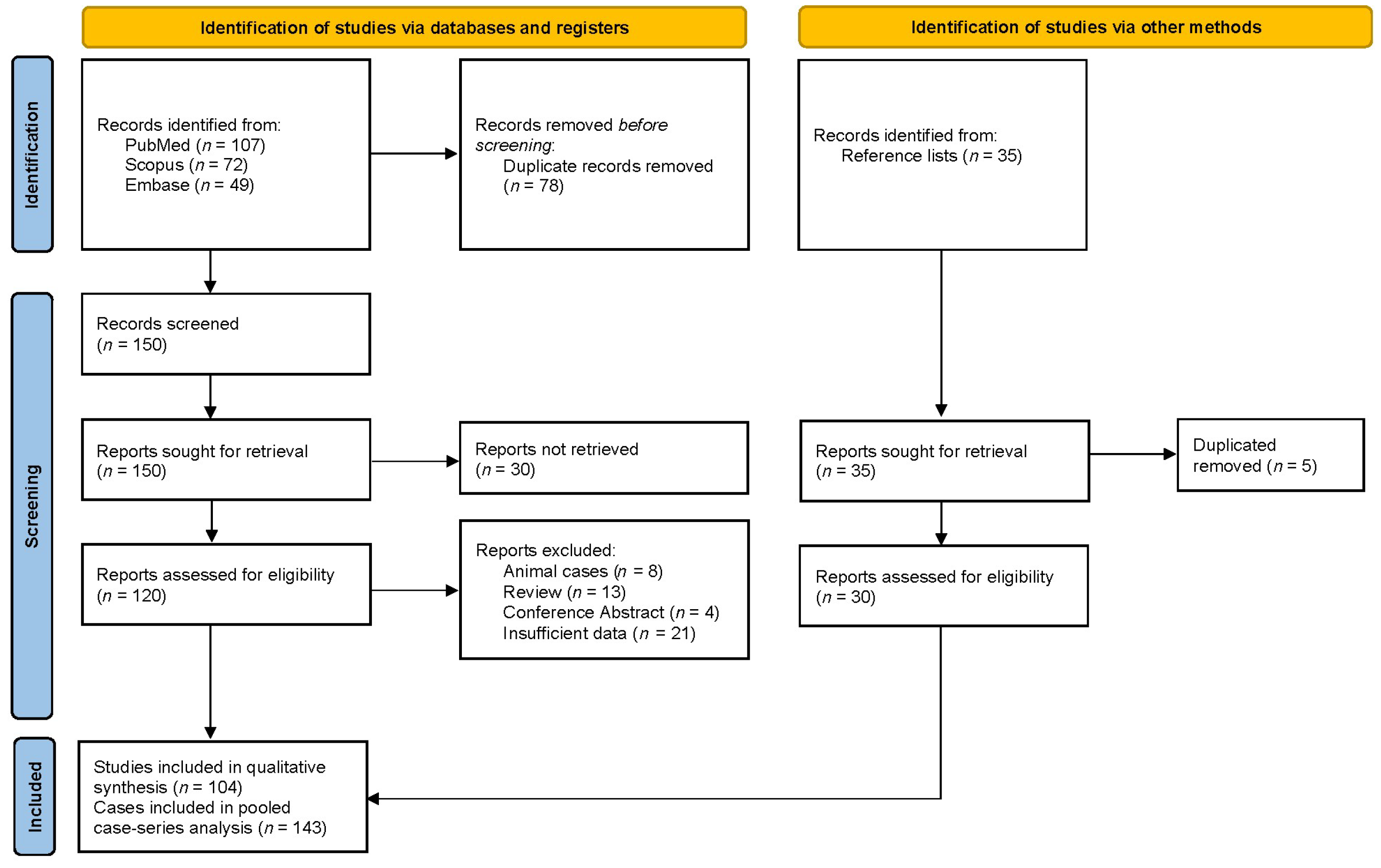
3.1. Included Studies
3.2. Study Characteristics
3.3. Origin of Infection
3.4. Demographic Characteristics
3.5. Risk Factors
3.6. Clinical Manifestations
3.7. Clinical Outcomes
3.8. Subgroup Analyses
3.9. Regression Analyses
4. Discussion
5. Conclusions
Supplementary Materials
Author Contributions
Funding
Institutional Review Board Statement
Informed Consent Statement
Data Availability Statement
Acknowledgments
Conflicts of Interest
Abbreviations
| CI | Confidential interval |
| OR | Odd ratio |
| SD | Standard deviation |
References
- Gassiep, I.; Armstrong, M.; Norton, R. Human melioidosis. Clin. Microbiol. Rev. 2020, 33, e00006-19. [Google Scholar] [CrossRef] [PubMed]
- Meumann, E.; Limmathurotsakul, D.; Dunachie, S.J.; Wiersinga, W.; Currie, B.J. Burkholderia pseudomallei and melioidosis. Nat. Rev. Microbiol. 2023, 21, 706–719. [Google Scholar] [CrossRef] [PubMed]
- Wiersinga, W.J.; Virk, H.S.; Torres, A.G.; Currie, B.J.; Peacock, S.J.; Dance, D.A.B.; Limmathurotsakul, D. Melioidosis. Nat. Rev. Dis. Primers 2018, 4, 17107. [Google Scholar] [CrossRef] [PubMed]
- Currie, B. Melioidosis and Burkholderia pseudomallei: Progress in epidemiology, diagnosis, treatment and vaccination. Curr. Opin. Infect. Dis. 2022, 35, 441–448. [Google Scholar] [CrossRef]
- Zheng, W.; Kuang, S.; Zhong, C.; Zhou, J.; Long, W.; Xiao, S.; Wu, B. Risk factors for melioidosis mortality and epidemics: A multicentre, 10-year retrospective cohort study in northern Hainan. Infect. Dis. Ther. 2023, 12, 459–478. [Google Scholar] [CrossRef]
- Le Tohic, S.; Montana, M.; Koch, L.; Curti, C.; Vanelle, P. A review of melioidosis cases imported into Europe. Eur. J. Clin. Microbiol. Infect. Dis. 2019, 38, 1395–1408. [Google Scholar] [CrossRef]
- Karunanayake, P. Melioidosis: Clinical aspects. Clin. Med. 2022, 22, 6–8. [Google Scholar] [CrossRef]
- Chaowagul, W.; Suputtamongkol, Y.; Dance, D.A.B.; Rajchanuvong, A.; Pattara-arechachai, J.; White, N.J. Relapse in melioidosis: Incidence and risk factors. J. Infect. Dis. 1993, 168, 1181–1185. [Google Scholar] [CrossRef]
- Smith, S.; Marquardt, T.; Jennison, A.V.; D’aDdona, A.; Stewart, J.; Yarwood, T.; Ho, J.; Binotto, E.; Harris, J.; Fahmy, M.; et al. Clinical manifestations and genomic evaluation of melioidosis outbreak among children after sporting event, Australia. Emerg. Infect. Dis. 2023, 29, 2332–2341. [Google Scholar] [CrossRef]
- Keragala, K.A.R.; Gunathilaka, M.G.R.S.S.; Senevirathna, R.W.K.M.; Jayaweera, J. Efficacy and safety of co-trimoxazole in eradication phase of melioidosis; systematic review. Ann. Clin. Microbiol. Antimicrob. 2023, 22, 65. [Google Scholar] [CrossRef]
- Kim, S.W.; Kwon, G.-Y.; Kim, B.; Kwon, D.; Shin, J.; Bae, G.-R. Imported melioidosis in South Korea: A case series with a literature review. Osong. Public Health Res. Perspect. 2015, 6, 396–398. [Google Scholar] [CrossRef] [PubMed]
- Norman, F.; Chen, L.H. Travel-associated melioidosis: A narrative review. J. Travel Med. 2023, 30, taad039. [Google Scholar] [CrossRef]
- Menon, R.; Baby, P.; Anil Kumar, V.; Surendran, S.; Pradeep, M.; Rajendran, A.; Suju, G.; Ashok, A. Risk factors for mortality in melioidosis: A single-centre, 10-year retrospective cohort study. Sci. World J. 2021, 2021, 8154810. [Google Scholar] [CrossRef] [PubMed]
- Page, M.J.; McKenzie, J.E.; Bossuyt, P.M.; Boutron, I.; Hoffmann, T.C.; Mulrow, C.D.; Shamseer, L.; Tetzlaff, J.M.; Akl, E.A.; Brennan, S.E. The PRISMA 2020 statement: An updated guideline for reporting systematic reviews. BMJ 2021, 372, n71. [Google Scholar] [CrossRef] [PubMed]
- Aardema, H.; Luijnenburg, E.M.; Salm, E.F.; Bijlmer, H.A.; Visser, C.E.; van ‘t Wout, J.W. Changing epidemiology of melioidosis? A case of acute pulmonary melioidosis with fatal outcome imported from Brazil. Epidemiol. Infect. 2005, 133, 871–875. [Google Scholar] [CrossRef]
- Alhatmi, H.; Alharbi, A.; Bosaeed, M.; Aldosary, O.; Aljohani, S.; Alalwan, B.; Alsaeedi, A.; Almahmoud, S.; Alothman, A. Melioidosis: Case reports of confirmed Burkholderia pseudomallei in Saudi Arabia. J. Infect. Public Health 2020, 13, 824–826. [Google Scholar] [CrossRef]
- Allen, R.K.A. Melioidosis: A cause of pneumonia to suspect in travellers back from Oceania. Rev. Mal. Respir. 2002, 19, 807–808. Available online: https://www.scopus.com/inward/record.uri?eid=2-s2.0-0036911266&partnerID=40&md5=0dc81b4dc102056d55dcf4c929fed90f (accessed on 11 July 2024).
- AlShati, M.H.; Joshi, R.M. A 42-year-old farmer from Bangladesh with respiratory failure, septic arthritis, and multiple cavitating consolidations. Chest 2014, 146, e56–e59. [Google Scholar] [CrossRef]
- Arakawa, M.; Mitsui, T.; Miki, R.; Yabuuchi, E. Chronic melioidosis: A report of the first case in Japan. J. Jpn. Assoc. Infect. Dis. 1993, 67, 154–162. [Google Scholar] [CrossRef]
- Arya, A.; Shaikh, H.; Weber, D.; Pettengill, M.; Moss, S. Fever in a returning traveler: A case and literature review of melioidosis. IDCases 2021, 26, e01340. [Google Scholar] [CrossRef]
- Auvens, C.; Neuwirth, C.; Piroth, L.; Blot, M. Infected aneurysm after returning from Southeast Asia: Think Burkholderia pseudomallei! BMJ Case Rep. 2019, 12, e228856. [Google Scholar] [CrossRef]
- Badran, S.; Pedersen, T.I.; Roed, C.; Lunding, S.; Birk, N.; Vestergaard, H.; Røder, B.; Lillelund, H.K.; Kurtzhals, J.A.; Kemp, M.; et al. Imported melioidosis in Danish travellers: A diagnostic challenge. Scand. J. Infect. Dis. 2010, 42, 445–449. [Google Scholar] [CrossRef] [PubMed]
- Barry, M.; Dada, H.; Barry, M.; Almohaya, A.; Aldrees, A. Unusual presentation of melioidosis in a returning traveler. IDCases 2020, 20, e00809. [Google Scholar] [CrossRef] [PubMed]
- Beeker, A.; Van de Stadt, K.D.; Bakker, K. Melioidosis. Neth. J. Med. 1999, 54, 76–79. [Google Scholar] [CrossRef] [PubMed]
- Birnie, E.; Savelkoel, J.; Reubsaet, F.; Roelofs, J.; Soetekouw, R.; Kolkman, S.; Cremers, A.L.; Grobusch, M.P.; Notermans, D.W.; Wiersinga, W.J. Melioidosis in travelers: An analysis of Dutch melioidosis registry data 1985–2018. Travel Med. Infect. Dis. 2019, 32, 101461. [Google Scholar] [CrossRef]
- Bodilsen, J.; Vammen, S.; Fuursted, K.; Hjort, U. Mycotic aneurysm caused by Burkholderia pseudomallei in a previously healthy returning traveller. BMJ Case Rep. 2014, 2014, bcr2013202824. [Google Scholar] [CrossRef]
- Borgherini, G.; Poubeau, P.; Paganin, F.; Picot, S.; Michault, A.; Thibault, F.; Berod, C.A. Melioidosis: An Imported Case from Madagascar. J. Travel Med. 2006, 13, 318–320. [Google Scholar] [CrossRef]
- Bouvy, J.J.; Degener, J.E.; Stijnen, C.; Gallee, M.P.; van der Berg, B. Septic melioidosis after a visit to Southeast Asia. Eur. J. Clin. Microbiol. 1986, 5, 655–656. [Google Scholar] [CrossRef]
- Bremmelgaard, A.; Bygbjerg, I.; Høiby, N. Microbiological and Immunological Studies in a Case of Human Melioidosis Diagnosed in Denmark. Scand. J. Infect. Dis. 1982, 14, 271–275. [Google Scholar] [CrossRef]
- Brill, D.R.; Shoop, J.D. Sensitivity of radionuclide isotope brain scan in cerebral melioidosis: Case report. J. Nucl. Med. 1977, 18, 987–989. [Google Scholar]
- Cahn, A.; Koslowsky, B.; Nir-Paz, R.; Temper, V.; Hiller, N.; Karlinsky, A.; Gur, I.; Hidalgo-Grass, C.; Heyman, S.N.; Moses, A.E.; et al. Imported melioidosis, Israel, 2008. Emerg. Infect. Dis. 2009, 15, 1809–1811. [Google Scholar] [CrossRef] [PubMed]
- Carlson, P.; Seppänen, M. Melioidosis presenting as urinary tract infection in a previously healthy tourist. Scand. J. Infect. Dis. 2000, 32, 92–93. [Google Scholar] [CrossRef] [PubMed]
- Chagla, Z.; Aleksova, N.; Quirt, J.; Emery, J.; Kraeker, C.; Haider, S. Melioidosis in a returned traveller. Can. J. Infect. Dis. Med. Microbiol. 2014, 25, 225–226. [Google Scholar] [CrossRef] [PubMed]
- Chan, C.K.; Hyland, R.H.; Leers, W.D.; Hutcheon, M.A.; Chang, D. Pleuropulmonary melioidosis in a Cambodian refugee. Can. Med. Assoc. J. 1984, 131, 1365–1367. [Google Scholar]
- Christini, A.; King, E. Neck mass in a returning traveler. JAMA 2012, 308, 2142–2143. [Google Scholar] [CrossRef]
- Corral, D.M.; Coates, A.L.; Yau, Y.C.; Tellier, R.; Glass, M.; Jones, S.M.; Waters, V.J. Burkholderia pseudomallei infection in a cystic fibrosis patient from the Caribbean: A case report. Can. Respir. J. 2008, 15, 237–239. [Google Scholar] [CrossRef]
- Cuadros, J.; Gil, H.; Miguel, J.D.; Marabé, G.; Gómez-Herruz, T.A.; Lobo, B.; Marcos, R.; Anda, P. Case report: Melioidosis imported from West Africa to Europe. Am. J. Trop. Med. Hyg. 2011, 85, 282–284. [Google Scholar] [CrossRef]
- Demar, M.; Ferroni, A.; Dupont, B.; Eliaszewicz, M.; Bourée, P. Suppurative epididymo-orchitis and chronic prostatitis caused by Burkholderia pseudomallei: A case report and review. J. Travel Med. 2005, 12, 108–112. [Google Scholar] [CrossRef]
- Demas, A.; Labbé, F.; Vandendriessche, A.; Langlois, V. Focal pachymeningitis in a returning traveler: Don’t forget melioidosis. IDCases 2023, 33, e01834. [Google Scholar] [CrossRef]
- Donahue, M.A.; Newcomb, G.; Spinella, S.; Prasad, P.; Liesveld, J.; Egan, C.T.; Smith, G.L.; Newman, A.P.; Bower, W.A.; Blaney, D.D. CNS melioidosis in a traveler returning from Cabo, Mexico. Open Forum Infect. Dis. 2019, 6, ofz005. [Google Scholar] [CrossRef]
- Duplessis, C.; Maguire, J.D. Melioidosis masquerading as community-acquired pneumonia: A case report demonstrating efficacy of intrapleural fibrinolytic therapy. J. Travel Med. 2009, 16, 74–77. [Google Scholar] [CrossRef]
- Ezzedine, K.; Malvy, D.; Steels, E.; De Dobbeeler, G.; Struelens, M.; Jacobs, F.; Heenen, M. Imported melioidosis with an isolated cutaneous presentation in a 90-year-old traveller from Bangladesh. Bull. Soc. Pathol. Exot. 2007, 100, 22–25. [Google Scholar] [PubMed]
- Frangoulidis, D.; Schwab, D.; Scholz, H.; Tomaso, H.; Hogardt, M.; Meyer, H.; Splettstoesser, W.D.; Pohle, F.K. ‘Imported’ melioidosis in Germany: Relapse after 10 years. Trans. R. Soc. Trop. Med. Hyg. 2008, 102, S40–S41. [Google Scholar] [CrossRef] [PubMed]
- Garas, G.; Ifeacho, S.; Millard, R.; Tolley, N. Melioidosis and the vacuum-assisted closure device: A rare cause of a discharging neck wound, and a new approach to management. J. Laryngol. Otol. 2010, 124, 1021–1024. [Google Scholar] [CrossRef] [PubMed]
- Gauthier, J.; Gérôme, P.; Defez, M.; Neulat-Ripoll, F.; Foucher, B.; Vitry, T.; Crevon, L.; Valade, E.; Thibault, F.M.; Biot, F.V. Melioidosis in Travelers Returning from Vietnam to France. Emerg. Infect. Dis. 2016, 22, 1671–1673. [Google Scholar] [CrossRef]
- Gétaz, L.; Abbas, M.; Loutan, L.; Schrenzel, J.; Iten, A.; Simon, F.; Decosterd, A.; Studer, R.; Sudre, P.; Michel, Y.; et al. Fatal acute melioidosis in a tourist returning from Martinique Island, November 2010. EuroSurveill 2011, 16, 19758. [Google Scholar] [CrossRef]
- Gottschalk, C.; Stojković, M.; Zange, S.; Wolf, P.; Klein, J.A.F. A case of pulmonary melioidosis in Germany: A rare differential diagnosis in returning travelers from South-East Asia. Infection 2024, 52, 1671–1676. [Google Scholar] [CrossRef]
- Guilleminault, L.; Holstein, A.; Azzouz, M.; Favelle, O.; Lanotte, P.; Diot, P. Tropical pneumonia: Pulmonary melioidosis. (Une pneumonie exotique à ne pas méconnaitre: La mélioïdose pulmonaire.). Rev. Med. Interne 2010, 31, e4–7. [Google Scholar] [CrossRef]
- Gulati, U.; Nanduri, A.C.; Juneja, P.; Kaufman, D.; Elrod, M.G.; Kolton, C.B.; Gee, J.E.; Garafalo, K.; Blaney, D.D. Case Report: A Fatal Case of Latent Melioidosis Activated by COVID-19. Am. J. Trop. Med. Hyg. 2022, 106, 1170–1172. [Google Scholar] [CrossRef]
- Guzmán-Gómez, L.; Agudo Bilbao, M.; Peiro-Callizo, E.; Salas, C. Melioidosis imported from Colombia to Spain. (Melioidosis importada desde Colombia a España). Enferm. Infecc. Microbiol. Clin. 2015, 33, 214–216. [Google Scholar] [CrossRef]
- Gylfe, Å.; Cajander, S.; Wahab, T.; Angelin, M. [Melioidosis, an important diagnosis in the severely ill traveler] (Melioidos – en viktig diagnos vid svår sjukdom efter utlandsresa.). Lakartidningen 2017, 114, 1–3. [Google Scholar]
- Hassanein, M.M.; Croall, J.; Ewins, D.L.; Worth, R.C. An unusual cause of diabetic ketoacidosis and fulminant septicaemia. Diabet. Med. 2003, 20, 242–244. [Google Scholar] [CrossRef] [PubMed]
- Hesstvedt, L.; Wilhelmsen, M.; Mengshoel, A.T.; Dyrhol-Riise, A.M. Two Norwegian patients with melioidosis presenting with bacteraemia and splenic and prostatic abscesses. J. Travel Med. 2011, 18, 418–421. [Google Scholar] [CrossRef] [PubMed]
- Heyse, A.M.; Dierick, J.; Vanhouteghem, H.; Ameye, F.; Baert, D.; Burvenich, P.; Wauters, G. A case of imported melioidosis presenting as prostatitis. Infection 2003, 31, 60–62. [Google Scholar] [CrossRef]
- Hong, Y.M.; Kim, B.S.; Park, S.M.; Park, J.C.; Lee, B.H.; Cho, H.M. A Case of Prostatic Abscess due to Burkholderia pseudomallei. Korean J. Med. 2011, 81, 7. [Google Scholar]
- Ja Young, S.; Ki Tae, K.; Eun Jung, C.; Jong Pil, P.; Do Young, S.; Je Chul, L.; Chull Hee, C. Fatal melioidosis in a tourist returning from Cambodia. Korean J. Med. 2009, 77, 246–250. [Google Scholar]
- Jabbar, Z.; Han, T.M.; Gagan, F. Expect the unexpected: Pleuro-pulmonary melioidosis in a renal transplant recipient. Transpl. Infect. Dis. 2013, 15, E40–E43. [Google Scholar] [CrossRef]
- Jane, L.; Crowe, A.; Daffy, J.; Gock, H. Burkholderia pseudomallei osteomyelitis: An unusual cause of fever in a returned traveller. Australas. Med. J. 2012, 5, 141–143. [Google Scholar] [CrossRef]
- Jenkins, D.R.; Lewis, A.M.; Strachan, C.J. Imported melioidosis in a British native. J. Infect. 1990, 21, 221–222. [Google Scholar] [CrossRef]
- Katanami, Y.; Kutsuna, S.; Horino, A.; Hashimoto, T.; Mutoh, Y.; Yamamoto, K.; Takeshita, N.; Hayakawa, K.; Kanagawa, S.; Kato, Y. A fatal case of melioidosis with pancytopenia in a traveler from Indonesia. J. Infect. Chemother. 2017, 23, 241–244. [Google Scholar] [CrossRef]
- Koch, F.W.; Zöller, M.; Pankow, W.; Kohl, F.V.; Küchler, R. Acute septic course of mellioidosis (Pseud. pseudomallei infection) after a visit to Thailand. Dtsch. Med. Wochenschr. 1997, 122, 122–126. [Google Scholar] [CrossRef] [PubMed]
- Kong, Z.; Fang, Y.; Zhang, M.; Hong, J.; Tan, Z.; Yuan, Z.; Zhu, F.; Mao, X.; Jin, Z.; Zhu, Y.; et al. Melioidosis acquired by a traveler from Papua New Guinea. Travel Med. Infect. Dis. 2016, 14, 267–270. [Google Scholar] [CrossRef] [PubMed]
- Kraaijenbrink, B.V.C.; Rozemeijer, W.; Frerichs, F.C.P.; Wagenaar, J.F.P. Uw diagnose? Tijdschr. Infect. 2018, 13, 2. [Google Scholar]
- Kunishima, H.; Seki, R.; Iwabuchi, T.; Nakamura, T.; Ishida, N.; Takagi, T.; Shimada, J. Case of melioidosis associated with acute empyema and cellulitis of the leg. Nihon Naika Gakkai Zasshi J. Jpn. Soc. Intern. Med. 1999, 88, 1101–1103. [Google Scholar] [CrossRef][Green Version]
- Lee, S.C.; Ling, T.S.; Chen, J.C.; Huang, B.Y.; Sheih, W.B. Melioidosis with adrenal gland abscess. Am. J. Trop. Med. Hyg. 1999, 61, 34–36. [Google Scholar] [CrossRef][Green Version]
- Lee, S.W.; Yi, J.; Joo, S.I.; Kang, Y.A.; Yoon, Y.S.; Yim, J.J.; Yoo, C.G.; Han, S.K.; Shim, Y.S.; Kim, E.C.; et al. A case of melioidosis presenting as migrating pulmonary infiltration: The first case in Korea. J. Korean Med. Sci. 2005, 20, 139–142. [Google Scholar] [CrossRef]
- Lee, Y.-L.; Lee, S.S.-J.; Tsai, H.-C.; Chen, Y.-S.; Wann, S.-R.; Kao, C.-H.; Liu, Y.-C. Pyogenic Liver Abscess Caused by Burkhoderia pseudomallei in Taiwan. J. Formos. Med. Assoc. 2006, 105, 689–693. [Google Scholar] [CrossRef]
- Leeuwenburgh, I.V.K.P.; Verburg, G.P.; Driessen, J.T.N.; Stijnen, P.J. Melioidosis. Ned. Tijdschr. Geneeskd. 2002, 146, 3. [Google Scholar]
- Leth, S.; Wang, M.; Deutch, S. Melioidosis in a Danish tourist returning from North-eastern Thailand. Ugeskr. Laeger 2014, 176, V12120748. [Google Scholar]
- Li, S.; He, Y.; Mao, Y.; Liu, J.; Xu, W.; Qian, S.; Wang, Q. Enhancing Diagnosis and Treatment Adjustments for Travelers Infected with Burkholderia pseudomallei: A Case Report—Beijing Municipality, China, June 2023. China CDC Wkly. 2024, 6, 614–616. [Google Scholar] [CrossRef]
- Lim, K.; McShane, L.; Rees, M.; Muhi, S. Cerebral melioidosis in an immunocompromised traveller: An argument for prevention. J. Travel Med. 2021, 28, taaa187. [Google Scholar] [CrossRef]
- Lim, R.S.; Flatman, S.; Dahm, M.C. Sinonasal melioidosis in a returned traveller presenting with nasal cellulitis and sinusitis. Case Rep. Otolaryngol. 2013, 2013, 920352. [Google Scholar] [CrossRef] [PubMed]
- Maccanti, O.; Pardelli, R.; Tonziello, A.; Gracci, G.; Vivaldi, I.; Bolognesi, L.; Pantini, C.; Sani, S. Melioidosis in a traveller from Thailand: Case report. J. Chemother. 2004, 16, 404–407. [Google Scholar] [CrossRef] [PubMed]
- Mandjee, A. Infection à Burkholderia pseudomalleï au retour d’un voyage dans le Sud-est asiatique. Méd. Mal. Infect. 2005, 35, 88–90. [Google Scholar] [CrossRef]
- Martin de Frémont, G.; Gominet, M.; Bousquet, A.; Gervaise, A.; Andriamanantena, D.; Ficko, C. Burkholderia pseudomallei: Prostatic abscesses in an AIDS patient back from Cameroon. Aids 2019, 33, 1403–1404. [Google Scholar] [CrossRef] [PubMed]
- Meckenstock, R.; Therby, A.; Marque-Juillet, S.; Monnier, S.; Khau, D.; Pangon, B.; Greder-Belan, A. Cutaneous melioidosis in adolescent returning from Guadeloupe. Emerg. Infect. Dis. 2012, 18, 359–360. [Google Scholar] [CrossRef]
- Meraj, S.; Rodenberg, B.; Thannum, S.; Sheley, J.; Foreman, J. Persistent Burkholderia pseudomallei bacteremia in a Filipino immigrant to the United States: A case report. Trop. Med. Infect. Dis. 2019, 4, 20. [Google Scholar] [CrossRef]
- Mickail, N.; Klein, N.C.; Cunha, B.A.; Schoch, P.A. Melioidosis breast abscesses. J. Infect. 2012, 64, 434–435. [Google Scholar] [CrossRef]
- Minassian, M.A.; Gage, A.; Price, E.; Sefton, A.M. Imipenem for the treatment of melioidosis. Int. J. Antimicrob. Agents 1999, 12, 263–265. [Google Scholar] [CrossRef]
- Morelli, F.; Smeets, L.; Hobijn, M.; Boom, H. Melioidosis and renal failure in a Dutch man after a trip to Gambia. Neth. J. Med. 2015, 73, 296–298. [Google Scholar]
- Morosini, M.I.; Quereda, C.; Gil, H.; Anda, P.; Núñez-Murga, M.; Cantón, R.; López-Vélez, R. Melioidosis in traveler from Africa to Spain. Emerg. Infect. Dis. 2013, 19, 1656–1659. [Google Scholar] [CrossRef] [PubMed]
- Nieminen, T.; Vaara, M. Burkholderia pseudomallei infections in Finnish tourists injured by the December 2004 tsunami in Thailand. EuroSurveill 2005, 10, E050303.4. [Google Scholar] [CrossRef] [PubMed]
- O’Sullivan, B.P.; Torres, B.; Conidi, G.; Smole, S.; Gauthier, C.; Stauffer, K.E.; Glass, M.B.; Gee, J.E.; Blaney, D.; Smith, T.L. Burkholderia pseudomallei infection in a child with cystic fibrosis: Acquisition in the western hemisphere. Chest 2011, 140, 239–242. [Google Scholar] [CrossRef] [PubMed]
- Panginikkod, S.; Ramachandran, A.; Bollimunta, P.; Habibi, R.; Kumar Arjal, R.; Gopalakrishnan, V. Burkholderia Aortic Aneurysm: A Case Report and Review of the Literature. Case Rep. Infect. Dis. 2017, 2017, 6206395. [Google Scholar] [CrossRef]
- Park, S.Y.; Kang, C.-I.; Joo, E.-J.; Ha, Y.E.; Ki, C.-S.; Lee, N.Y.; Chung, D.R.; Peck, K.R.; Song, J.-H. Septicemic Melioidosis Presenting as Head and Neck Abscesses. Infect. Chemother. 2012, 44, 315–318. [Google Scholar] [CrossRef]
- Patil, C.; Mangalagiri, N.; Ajmera, P.; Kumar Ks, P.; Reddy, H. A Case Report of Whitmore’s Disease: A True Masquerader. Cureus 2024, 16, e52409. [Google Scholar] [CrossRef]
- Peetermans, W.E.; Van Wijngaerden, E.; Van Eldere, J.; Verhaegen, J. Melioidosis Brain and Lung Abscess After Travel to Sri Lanka. Clin. Infect. Dis. 1999, 28, 921–922. [Google Scholar] [CrossRef]
- Pelerito, A.; Nunes, A.; Coelho, S.; Piedade, C.; Paixão, P.; Cordeiro, R.; Sampaio, D.; Vieira, L.; Gomes, J.P.; Núncio, S. Burkholderia pseudomallei: First case of melioidosis in Portugal. IDCases 2016, 3, 10–11. [Google Scholar] [CrossRef]
- Riecke, K.; Wagner, S.; Eller, J.; Lode, H.; Schaberg, T. Pulmonary melioidosis in a German Southeast Asia tourist: History and clinical findings. Pneumologie 1997, 51, 499–502. [Google Scholar]
- Rossi, B.; Epelboin, L.; Jauréguiberry, S.; Lecso, M.; Roos-Weil, D.; Gabarre, J.; Grenier, P.A.; Bricaire, F.; Caumes, E. Melioidosis and hairy cell leukemia in 2 travelers returning from Thailand. Emerg. Infect. Dis. 2013, 19, 503–505. [Google Scholar] [CrossRef]
- Rueda Guzmán, A.; Slesak, G.; Fleck, R.; Ignatius, R.; Oehme, R.; Schäfer, J. Chronic skin ulcer in a 24-year-old man after a journey to Southeast Asia. Internist 2017, 58, 859–862. [Google Scholar] [CrossRef] [PubMed]
- Saïdani, N.; Griffiths, K.; Million, M.; Gautret, P.; Dubourg, G.; Parola, P.; Brouqui, P.; Lagier, J.C. Melioidosis as a travel-associated infection: Case report and review of the literature. Travel Med. Infect. Dis. 2015, 13, 367–381. [Google Scholar] [CrossRef] [PubMed]
- Salam, A.P.; Khan, N.; Malnick, H.; Kenna, D.T.; Dance, D.A.; Klein, J.L. Melioidosis acquired by traveler to Nigeria. Emerg. Infect. Dis. 2011, 17, 1296–1298. [Google Scholar] [CrossRef] [PubMed]
- Sauerwein, R.W.; Lammers, J.-W.; Horrevorts, A.M. Ceftazidime Monotherapy for Pulmonary Melioidosis in a Traveler Returning from Thailand. Chest 1992, 101, 555–557. [Google Scholar] [CrossRef][Green Version]
- Schindler, N.; Calligaro, K.D.; Dougherty, M.J.; Diehl, J.; Modi, K.H.; Braffman, M.N. Melioidosis presenting as an infected intrathoracic subclavian artery pseudoaneurysm treated with femoral vein interposition graft. J. Vasc. Surg. 2002, 35, 569–572. [Google Scholar] [CrossRef][Green Version]
- Schultze, D.; Müller, B.; Bruderer, T.; Dollenmaier, G.; Riehm, J.M.; Boggian, K. A traveller presenting with severe melioidosis complicated by a pericardial effusion: A case report. BMC Infect. Dis. 2012, 12, 242. [Google Scholar] [CrossRef]
- Schwarzmaier, A.; Riezinger-Geppert, F.; Schober, G.; Karnik, R.; Valentin, A. Fulminant septic melioidosis after a vacation in Thailand. Wien. Klin. Wochenschr. 2000, 112, 892–895. [Google Scholar]
- Seok, H.-J.; Kim, J.-I.; Lee, J.-H.; Choo, E.-J.; Kwak, Y.-G.; Jang, S.; Kim, N.-J.; Kim, Y.-S.; Woo, J.-H.; Ryu, J. A case of septicemia and septic pneumonia due to Burkholderia pseudomallei. Infect. Chemother. 2004, 36, 114–117. Available online: http://journal.icjournal.org/articles/view.php?code=ava&year=2004&vol=36&no=2&page=114 (accessed on 11 June 2024).
- Shaaban, H.; Hallit, R.; Slim, J.; Sree, A.; Sensakovic, J.W. Reactivation of latent melioidosis presenting with acute pyelonephritis and bacteremia. Avicenna J. Med. 2014, 4, 20–21. [Google Scholar] [CrossRef]
- Shrestha, N.; Adhikari, M.; Pant, V.; Baral, S.; Shrestha, A.; Basnyat, B.; Sharma, S.; Sherchand, J.B. Melioidosis: Misdiagnosed in Nepal. BMC Infect. Dis. 2019, 19, 176. [Google Scholar] [CrossRef]
- Silbermann, M.H.; Gyssens, I.C.; Endtz, H.P.; Kuijper, E.J.; van der Meer, J.T. Two patients with recurrent melioidosis after prolonged antibiotic therapy. Scand. J. Infect. Dis. 1997, 29, 199–201. [Google Scholar] [CrossRef] [PubMed]
- Singh, M.; Mahmood, M. Melioidosis: The great mimicker. J. Community Hosp. Intern. Med. Perspect. 2017, 7, 245–247. [Google Scholar] [CrossRef] [PubMed]
- Snijders, S.L.; Meis, J.F.; Dofferhoff, A.S. Melioidosis: The importance of a detailed medical history, including recent travels. Ned. Tijdschr. Voor Geneeskd. 2010, 154, A279. [Google Scholar]
- Starzacher, A.K.; Knappik, M.; Schönfeld, N.; Bauer, T.; Kaiser, D.; Tönnies, M.; Pfannschmidt, J.; Wagner, S.; Rüssmann, H. Case Report: Eine Melioidose in Berlin. Pneumologie 2014, 68, P103. [Google Scholar] [CrossRef]
- Subran, B.; Ackermann, F.; Watin-Augouard, L.; Rammaert, B.; Rivoisy, C.; Vilain, D.; Canzi, A.M.; Kahn, J.E. Melioidosis in a European traveler without comorbidities: A case report and literature review. Int. J. Infect. Dis. 2013, 17, e781–e783. [Google Scholar] [CrossRef]
- Svensson, E.; Welinder-Olsson, C.; Claesson, B.A.; Studahl, M. Cutaneous melioidosis in a Swedish tourist after the tsunami in 2004. Scand J. Infect. Dis 2006, 38, 71–74. [Google Scholar] [CrossRef]
- Tamtami, N.A.; Khamis, F.; Al-Jardani, A. Imported Case of Melioidosis in Oman: Case Report. Oman Med. J. 2017, 32, 62–65. [Google Scholar] [CrossRef]
- Tan Boun, K.; Biron, F.; Chidiac, C.; Ferry, T. Imported melioidosis in France revealed by a cracking abdominal mycotic aortic aneurysm in a 61-year-old man. BMJ Case Rep. 2012, 2012, bcr2012006839. [Google Scholar] [CrossRef]
- Teo, L.; Tay, Y.K.; Mancer, K.J. Cutaneous melioidosis. J. Eur. Acad. Dermatol. Venereol. 2006, 20, 1322–1324. [Google Scholar] [CrossRef]
- Torrens, J.K.; McWhinney, P.H.M.; Tompkins, D.S. A deadly thorn: A case of imported melioidosis. Lancet 1999, 353, 1016. [Google Scholar] [CrossRef]
- Visca, P.; Cazzola, G.; Petrucca, A.; Braggion, C. Travel-associated Burkholderia pseudomallei infection (Melioidosis) in a patient with cystic fibrosis: A case report. Clin. Infect. Dis. 2001, 32, e15–e16. [Google Scholar] [CrossRef][Green Version]
- Wall, R.A.; Mabey, D.C.W.; Corrah, P.T.; Peters, L. A case of melioidosis in West Africa. J. Infect. Dis. 1985, 152, 424–425. [Google Scholar] [CrossRef] [PubMed]
- Weissert, C.; Dollenmaier, G.; Rafeiner, P.; Riehm, J.; Schultze, D. Burkholderia pseudomallei misidentified by automated system. Emerg. Infect. Dis. 2009, 15, 1799–1801. [Google Scholar] [CrossRef] [PubMed]
- Wilks, D.; Jacobson, S.K.; Lever, A.M.L.; Farrington, M. Fatal melioidosis in a tourist returning from Thailand. J. Infect. 1994, 29, 87–90. [Google Scholar] [CrossRef] [PubMed]
- Wooten, M.D.; Panwalker, A.P. Septic arthritis caused by Burkholderia pseudomallei: Case report and review of the literature. J. Clin. Rheumatol. 2001, 7, 242–247. [Google Scholar] [CrossRef]
- Yazdanpanah, Y.; Lemaire, X.; Senneville, E.; Delcey, V.; Viget, N.; Ajana, F.; Dubreuil, L.; Mouton, Y. Melioidotic Osteomyelitis of the Femur Occurring in a Traveler. J. Travel Med. 2002, 9, 53–54. [Google Scholar] [CrossRef][Green Version]
- Zong, Z.; Wang, X.; Deng, Y.; Zhou, T. Misidentification of Burkholderia pseudomallei as Burkholderia cepacia by the VITEK 2 system. J. Med. Microbiol. 2012, 61, 1483–1484. [Google Scholar] [CrossRef]
- Pennino, F.; Fiorilla, C.; Sorrentino, M.; Armonia, U.; Parisi, A.; Mirizzi, P.D.; Di Lillo, M.; De Silva, O.; Montuori, P.; Triassi, M.; et al. Investigating Awareness Regarding Travel-Related Infectious Disease Prevention in a Metropolitan Area. Trop. Med. Infect. Dis. 2023, 8, 476. [Google Scholar] [CrossRef]
- Hinjoy, S.; Hantrakun, V.; Kongyu, S.; Kaewrakmuk, J.; Wangrangsimakul, T.; Jitsuronk, S.; Saengchun, W.; Bhengsri, S.; Akarachotpong, T.; Thamthitiwat, S.; et al. Melioidosis in Thailand: Present and Future. Trop. Med. Infect. Dis. 2018, 3, 38. [Google Scholar] [CrossRef]
- Sriwapee, K.; Kenaphoom, S.; Ruangchai, N.; Insumran, Y.; Pawala, T.; Jumroenpat, P.; Kaewlamai, S. Thailand as a World Top Tourism Destination: Balancing Growth with Environmental and Cultural Preservation. Int. J. Multidiscip. Manag. Tour. 2025, 9, 113–136. [Google Scholar] [CrossRef]
- Limmathurotsakul, D.; Golding, N.; Dance, D.A.; Messina, J.P.; Pigott, D.M.; Moyes, C.L.; Rolim, D.B.; Bertherat, E.; Day, N.P.; Peacock, S.J.; et al. Predicted global distribution of Burkholderia pseudomallei and burden of melioidosis. Nat. Microbiol. 2016, 1, 15008. [Google Scholar] [CrossRef]
- Thimmappa, P.Y.; Vasishta, S.; Ganesh, K.; Nair, A.S.; Joshi, M.B. Neutrophil (dys) function due to altered immuno-metabolic axis in type 2 diabetes: Implications in combating infections. Hum. Cell 2023, 36, 1265–1282. [Google Scholar] [CrossRef]


| Category | Sub-Category/Country | n (%) or Description |
|---|---|---|
| Study Characteristics | Study type—Case reports | 97 (93.3%) |
| Study type—Case series | 7 (6.7%) | |
| Publication years | 1977–2024 | |
| 1977–1999 | 18 | |
| 2000–2010 | 32 | |
| 2011–2020 | 47 | |
| 2021–2024 | 7 | |
| Patients per study | Median 1 (range 1–3) | |
| Country of Diagnosis | Netherlands | 30 (21%) |
| France | 14 (10%) | |
| United States | 13 (9%) | |
| South Korea | 10 (7%) | |
| Denmark | 8 (6%) | |
| United Kingdom | 8 (6%) | |
| Germany | 7 (5%) | |
| Finland | 5 (3%) | |
| Australia | 4 (3%) | |
| China | 3 (2%) | |
| Others | 41 (28%) | |
| Origin of Infection | Thailand | 56 (39%) |
| Malaysia | 8 (6%) | |
| Vietnam | 7 (5%) | |
| Philippines | 4 (3%) | |
| India | 4 (3%) | |
| Indonesia | 4 (3%) | |
| Bangladesh | 4 (3%) | |
| Cambodia | 4 (3%) | |
| Myanmar | 4 (3%) | |
| Other: Southeast Asia | 12 (8%) | |
| Others (by region) | 36 (25%) (Africa, Americas/Caribbean, Oceania, and Middle East; see Supplementary File S1 for full details) | |
| Demographics | Mean age | 50.6 ± 16.3 (range 6–90) |
| Male | 112 (78.3%) | |
| Female | 31 (21.7%) | |
| Risk factors | Diabetes mellitus | 40 (28%) |
| Clinical manifestations | Pulmonary | 47 (32.9%) |
| Sepsis | 39 (27.3%) | |
| Cutaneous | 18 (12.6%) | |
| Abdominal | 5 (3.5%) | |
| Osteoarticular | 2 (1.4%) | |
| Other */unspecified | 32 (22.4%) | |
| Outcomes | Mortality | 18 (12.6%) |
| Relapse | 10 (7.0%) |
| Variable | Mortality n/N (%) | p-Value | Relapse n/N (%) |
|---|---|---|---|
| Overall | 18/143 (12.6%) | – | 10/143 (7.0%) |
| Sex | |||
| Male | 15/112 (13.3%) | 0.76 † | – |
| Female | 3/31 (9.7%) | – | |
| Diabetes mellitus | |||
| Yes | 6/40 (15.0%) | 0.79 ‡ | – |
| No | 12/103 (11.7%) | – | |
| Clinical presentation | |||
| Sepsis | 9/39 (23.1%) | 0.37 † | – |
| Non-sepsis | 9/104 (8.7%) | – |
| Predictor | OR (95% CI) | p-Value |
|---|---|---|
| Age (per year) | 0.997 (0.966–1.029) | 0.85 |
| Male sex | 1.08 (0.32–4.54) | 0.91 |
| Diabetes mellitus | 1.20 (0.40–3.35) | 0.73 |
| Sepsis (vs. other) | 3.81 (0.37–519.0) | 0.31 |
Disclaimer/Publisher’s Note: The statements, opinions and data contained in all publications are solely those of the individual author(s) and contributor(s) and not of MDPI and/or the editor(s). MDPI and/or the editor(s) disclaim responsibility for any injury to people or property resulting from any ideas, methods, instructions or products referred to in the content. |
© 2025 by the authors. Licensee MDPI, Basel, Switzerland. This article is an open access article distributed under the terms and conditions of the Creative Commons Attribution (CC BY) license.
Share and Cite
Thanasai, J.; Phongphithakchai, A.; Chatatikun, M.; Laklaeng, S.-n.; Tangpong, J.; Wongyikul, P.; Phinyo, P.; Khemla, S.; Chittamma, A.; Klangbud, W.K. Travel-Associated Melioidosis in Non-Endemic Regions: A Systematic Review and Meta-Analysis. Int. J. Environ. Res. Public Health 2026, 23, 36. https://doi.org/10.3390/ijerph23010036
Thanasai J, Phongphithakchai A, Chatatikun M, Laklaeng S-n, Tangpong J, Wongyikul P, Phinyo P, Khemla S, Chittamma A, Klangbud WK. Travel-Associated Melioidosis in Non-Endemic Regions: A Systematic Review and Meta-Analysis. International Journal of Environmental Research and Public Health. 2026; 23(1):36. https://doi.org/10.3390/ijerph23010036
Chicago/Turabian StyleThanasai, Jongkonnee, Atthaphong Phongphithakchai, Moragot Chatatikun, Sa-ngob Laklaeng, Jitbanjong Tangpong, Pakpoom Wongyikul, Phichayut Phinyo, Supphachoke Khemla, Anchalee Chittamma, and Wiyada Kwanhian Klangbud. 2026. "Travel-Associated Melioidosis in Non-Endemic Regions: A Systematic Review and Meta-Analysis" International Journal of Environmental Research and Public Health 23, no. 1: 36. https://doi.org/10.3390/ijerph23010036
APA StyleThanasai, J., Phongphithakchai, A., Chatatikun, M., Laklaeng, S.-n., Tangpong, J., Wongyikul, P., Phinyo, P., Khemla, S., Chittamma, A., & Klangbud, W. K. (2026). Travel-Associated Melioidosis in Non-Endemic Regions: A Systematic Review and Meta-Analysis. International Journal of Environmental Research and Public Health, 23(1), 36. https://doi.org/10.3390/ijerph23010036