

Emotional and Physical Symptoms Following Intimate Partner Violence Victimization in the United States: Implications for Law and Public Health Policy

 ,
,  and
and
Highlights
- Intimate partner violence (IPV) is linked to ongoing emotional and physical symptoms that last a month or more after the victimization event.
- IPV involving injury, particularly incidents where the survivor was “knocked unconscious,” a proxy for probable traumatic brain injury (pTBI), significantly contributes to long-term symptomatology.
- By linking incident-level IPV victimization to specific emotional and physical symptoms, we quantified how injury severity and pTBI significantly increase symptom risk.
- Our findings highlight disparities across sex and race/ethnicity, emphasizing the need for coordinated, trauma- and shame-informed public health responses across medical, social service, and legal systems to better identify, support, and protect IPV survivors.
- Practitioners should integrate routine screening for emotional and physical symptoms, with particular attention to injured survivors and those reporting loss of consciousness.
- Policymakers and legal actors must recognize how these symptoms affect survivors’ ability to seek legal remedies and develop trauma- and shame-informed interventions that reduce harm and strengthen support.
Abstract
1. Introduction
2. Materials and Methods
Analytic Strategy
3. Results
4. Discussion
4.1. Implications for Proactive Public Health Policy to Support IPV Survivors
4.2. Limitations
5. Conclusions
Supplementary Materials
Author Contributions
Funding
Institutional Review Board Statement
Informed Consent Statement
Data Availability Statement
Conflicts of Interest
Abbreviations
| IPV | Intimate partner violence |
| NCVS | National Crime Victimization Survey |
| BJS | Bureau of Justice Statistics |
| PTSD | Post-traumatic stress disorder |
| OR | Odds ratio |
References
- Campbell, J.C. Health Consequences of Intimate Partner Violence. Lancet 2002, 359, 1331–1336. [Google Scholar] [CrossRef]
- Carlyle, K.E.; Guidry, J.P.D.; Dougherty, S.A.; Burton, C.W. Intimate Partner Violence on Instagram: Visualizing a Public Health Approach to Prevention. Health Educ. Behav. 2019, 46, 90S–96S. [Google Scholar] [CrossRef]
- Decker, M.R.; Wilcox, H.C.; Holliday, C.N.; Webster, D.W. An Integrated Public Health Approach to Interpersonal Violence and Suicide Prevention and Response. Public Health Rep. 2018, 133, 65S–79S. [Google Scholar] [CrossRef] [PubMed]
- Inslicht, S.S.; Marmar, C.R.; Neylan, T.C.; Metzler, T.J.; Hart, S.L.; Otte, C.; McCaslin, S.E.; Larkin, G.L.; Hyman, K.B.; Baum, A. Increased Cortisol in Women with Intimate Partner Violence-Related Posttraumatic Stress Disorder. Psychoneuroendocrinology 2006, 31, 825–838. [Google Scholar] [CrossRef] [PubMed]
- Tjaden, P.; Thoennes, N. Extent, Nature, and Consequences of Intimate Partner Violence: Findings from the National Violence Against Women Survey; U.S. Department of Justice, Office of Justice Programs, National Institute of Justice: Washington, DC, USA, 2000.
- Plichta, S.B. Intimate Partner Violence and Physical Health Consequences: Policy and Practice Implications. J. Interpers. Violence 2004, 19, 1296–1323. [Google Scholar] [CrossRef] [PubMed]
- Martin, S.L.; Macy, R.J.; Sullivan, K.; Magee, M.L. Pregnancy-Associated Violent Deaths: The Role of Intimate Partner Violence. Trauma Violence Abus. 2007, 8, 135–148. [Google Scholar] [CrossRef]
- Davidov, D.M.; Larrabee, H.; Davis, S.M. United States Emergency Department Visits Coded for Intimate Partner Violence. J. Emerg. Med. 2015, 48, 94–100. [Google Scholar] [CrossRef]
- Khurana, B.; Hines, D.A.; Johnson, B.A.; Bates, E.A.; Graham-Kevan, N.; Loder, R.T. Injury Patterns and Associated Demographics of Intimate Partner Violence in Men Presenting to U.S. Emergency Departments. Aggress. Behav. 2022, 48, 298–308. [Google Scholar] [CrossRef]
- Simmons, S.B.; Knight, K.E.; Menard, S. Long-Term Consequences of Intimate Partner Abuse on Physical Health, Emotional Well-Being, and Problem Behaviors. J. Interpers. Violence 2018, 33, 539–570. [Google Scholar] [CrossRef]
- Schollenberger, J.; Campbell, J.; Sharps, P.W.; O’Campo, P.; Gielen, A.C.; Dienemann, J.; Kub, J. African American HMO Enrollees: Their Experiences with Partner Abuse and Its Effect on Their Health and Use of Medical Services. Violence Against Women 2003, 9, 599–618. [Google Scholar] [CrossRef]
- Wilbur, L.; Higley, M.; Hatfield, J.; Surprenant, Z.; Taliaferro, E.; Smith, D.J.; Paolo, A. Survey Results of Women Who Have Been Strangled While in an Abusive Relationship. J. Emerg. Med. 2001, 21, 297–302. [Google Scholar] [CrossRef]
- Kendall-Tackett, K.A. Inflammation, Cardiovascular Disease, and Metabolic Syndrome as Sequelae of Violence Against Women: The Role of Depression, Hostility, and Sleep Disturbance. Trauma Violence Abus. 2007, 8, 117–126. [Google Scholar] [CrossRef]
- Leserman, J.; Drossman, D.A. Relationship of Abuse History to Functional Gastrointestinal Disorders and Symptoms: Some Possible Mediating Mechanisms. Trauma Violence Abus. 2007, 8, 331–343. [Google Scholar] [CrossRef] [PubMed]
- Camp, A.R. From Experiencing Abuse to Seeking Protection: Examining the Shame of Intimate Partner Violence. UC Irvine Rev. 2022, 13, 103. [Google Scholar] [CrossRef]
- Vil, N.M.S.; Carter, T.; Johnson, S. Betrayal Trauma and Barriers to Forming New Intimate Relationships Among Survivors of Intimate Partner Violence. J. Interpers. Violence 2021, 36, NP3495–NP3509. [Google Scholar] [CrossRef] [PubMed]
- Villa, G.; Spena, P.R.; Marcomini, I.; Poliani, A.; Rosa, D.; Maculotti, D.; Manara, D.F. Factors Influencing the Feeling of Shame in Individuals with Incontinence: The INCOTEST Study. Kontakt 2025, 27, 97–102. [Google Scholar] [CrossRef]
- Njagi, D.M.; Njoroge, M.W.; Musau, J.N. Shame, Fear, and Stigma: Understanding Psychosocial Barriers to Help Seeking Behavior among Female Survivors of IPV in Nairobi County. Univ. J. 2025, 7, 15–29. [Google Scholar] [CrossRef]
- İnan, E. The Relations Between Parental Attitudes, Guilt, Shame, and Self-Compassion and Differentiation of Guilt-Prone and Shame-Prone Individuals in Terms of Their Responses and Expectations: A Mixed Study. Ph.D. Thesis, Middle East Technical University, Ankara, Turkey, 2016. [Google Scholar]
- Karen, R.M. Shame and Guilt as the Treatment Focus in Posttraumatic Stress Disorder: A Meta-Analysis. Ph.D. Thesis, The Union for Experimenting Colleges and Universities, Cincinnati, OH, USA, 1988. [Google Scholar]
- MacLaren, J. The Impact of Shame and Racial-Ethnic Heritage on Help-Seeking Decisions for Survivors of Intimate Partner Violence. Ph.D. Thesis, California State University, Long Beach, CA, USA, 2024. [Google Scholar]
- Stubbs, A.; Szoeke, C. The Effect of Intimate Partner Violence on the Physical Health and Health-Related Behaviors of Women: A Systematic Review of the Literature. Trauma Violence Abus. 2022, 23, 1157–1172. [Google Scholar] [CrossRef]
- Brien, A.B.; Ma, C.M.; Berner, L.B.; So, M.S. Homelessness & Adverse Childhood Experiences: The Health and Behavioral Health Consequences of Childhood Trauma; National Health Care for the Homeless Council: Nashville, TN, USA, 2019. [Google Scholar]
- Ortiz-Rodriguez, Y. Help-Seeking Latina Victims of Domestic Violence and the Programs That Serve Them in New York City. Ph.D. Thesis, City University of New York (CUNY), New York, NY, USA, 2016. [Google Scholar]
- U.S. Department of Justice, Bureau of Justice Statistics. National Crime Victimization Survey, 2022 [data set]. In-ter-university Consortium for Political and Social Research (ICPSR 38588). 2024. Available online: https://bjs.ojp.gov/programs/ncvs (accessed on 5 August 2025). [CrossRef]
- Wheeler, A.P.; Piquero, A.R. Using Victimization Reporting Rates to Estimate the Dark Figure of Crime: A Case Study of Domestic Violence. Crime Delinq. 2025, 00111287251359210. [Google Scholar] [CrossRef]
- Fisk, A. Prosecution of Domestic Violence Cases: The Practical Effects of the Ruling in Davis v. Washington, 126 S. Ct. 2266 (2006). Univ. Ill. Law Rev. 2007, 32, 251. [Google Scholar]
- Vargas, E.W.; Hemenway, D. Emotional and Physical Symptoms after Gun Victimization in the United States, 2009–2019. Prev. Med. 2021, 143, 106374. [Google Scholar] [CrossRef] [PubMed]
- R Core Team. R: A Language and Environment for Statistical Computing. Version 4.3.2 (2023-10-31 ucrt). R Foundation for Statistical Computing: Vienna, Austria, 2023. [Google Scholar]
- Lumley, T. Survey: Analysis of Complex Survey Samples 2023. J. Stat. Softw. 2004, 9, 1–19. [Google Scholar]
- Harrell, F.E., Jr. R Package. Version 6.9-0. Rms: Regression Modeling Strategies. Springer: New York, NY, USA, 2023. Available online: https://cran.r-project.org/package=rms (accessed on 14 September 2025).
- Wickham, H.; François, R.; Henry, L.; Müller, K.; Vaughan, D. Dplyr: A Grammar of Data Manipulation (R Package Version 1.1.4). 2023. Available online: https://cran.r-project.org/package=dplyr (accessed on 14 September 2025).
- Wickham, H.; Chang, W.; Pedersen, T.; Takahashi, K.; Wilke, C.; Woo, K. Ggplot2: Create Elegant Data Visualisations Using the Grammar of Graphics (R Package Version 3.5.2). 2024. Available online: https://cran.r-project.org/package=ggplot2 (accessed on 14 September 2025).
- Golding, J.M. Intimate Partner Violence as a Risk Factor for Mental Disorders: A Meta-Analysis. J. Fam. Violence 1999, 14, 99–132. [Google Scholar] [CrossRef]
- Hullenaar, K.L.; Rowhani-Rahbar, A.; Rivara, F.P.; Vavilala, M.S.; Baumer, E.P. Victim–Offender Relationship and the Emotional, Social, and Physical Consequences of Violent Victimization. Am. J. Prev. Med. 2022, 62, 763–769. [Google Scholar] [CrossRef]
- Orpinas, P.; Choi, Y.J.; Han, J.-Y.; Chen, Y.; Ahn, K. Survivors of Intimate Partner Violence: Barriers to Seeking Help Among Asian Immigrants. J. Evid.-Based Soc. Work 2025, 1–16. [Google Scholar] [CrossRef]
- Black, M.C. Intimate Partner Violence and Adverse Health Consequences: Implications for Clinicians. Am. J. Lifestyle Med. 2011, 5, 428–439. [Google Scholar] [CrossRef]
- Dube, S.R.; Anda, R.F.; Felitti, V.J.; Edwards, V.J.; Croft, J.B. Adverse Childhood Experiences and Personal Alcohol Abuse as an Adult. Addict. Behav. 2002, 27, 713–725. [Google Scholar] [CrossRef]
- Esopenko, C.; Jain, D.; Adhikari, S.P.; Dams-O’Connor, K.; Ellis, M.; Haag, H.L.; Hovenden, E.S.; Keleher, F.; Koerte, I.K.; Lindsey, H.M.; et al. Intimate Partner Violence-Related Brain Injury: Unmasking and Addressing the Gaps. J. Neurotrauma 2024, 41, 2219–2237. [Google Scholar] [CrossRef]
- Houry, D.; Sachs, C.J.; Feldhaus, K.M.; Linden, J. Violence-Inflicted Injuries: Reporting Laws in the Fifty States. Ann. Emerg. Med. 2002, 39, 56–60. [Google Scholar] [CrossRef]
- Haag, H.L.; Jones, D.; Joseph, T.; Colantonio, A. Battered and Brain Injured: Traumatic Brain Injury Among Women Survivors of Intimate Partner Violence—A Scoping Review. Trauma Violence Abus. 2022, 23, 1270–1287. [Google Scholar] [CrossRef]
- Lahav, Y.; Avidor, S.; Gafter, L.; Lotan, A. A Double Betrayal: The Implications of Institutional Betrayal for Trauma-Related Symptoms in Intimate Partner Violence Survivors. Am. J. Orthopsychiatry 2025. ahead of print. [Google Scholar] [CrossRef]
- Serrano-Montilla, C.; Lozano, L.M.; Alonso-Ferres, M.; Valor-Segura, I.; Padilla, J.-L. Understanding the Components and Determinants of Police Attitudes Toward Intervention in Intimate Partner Violence Against Women: A Systematic Review. Trauma Violence Abus. 2023, 24, 245–260. [Google Scholar] [CrossRef]
- Isman, K.; Giorgi, S.; Ellis, J.; Huhn, A.S.; Liu, T.; Curtis, B. Perceived Stigma and Its Impact on Substance Use Disorder and Mental Health, OSF Preprints. 2024. Available online: https://files.osf.io/v1/resources/8am9g_v1/providers/osfstorage/66c60138dfca3285bedbe417?action=download&direct&version=1 (accessed on 14 September 2025).



| Characteristic | Level | Denom N (unwtd) | Denom N (wtd) | Emotional N (unwtd) | Emotional N (wtd) | Emotional % (wtd) | Physical N (unwtd) | Physical N (wtd) | Physical % (wtd) |
|---|---|---|---|---|---|---|---|---|---|
| Overall | All | 3012 | 7,650,471 | 2186 | 5,403,579 | 70.6 | 1737 | 4,098,268 | 53.6 |
| Age | Under 19 | 302 | 1,027,762 | 185 | 617,999 | 60.1 | 119 | 379,341 | 36.9 |
| 19–39 | 1693 | 4,410,926 | 1227 | 3,141,339 | 71.2 | 976 | 2,380,037 | 54.0 | |
| 40–59 | 883 | 1,969,251 | 670 | 1,464,416 | 74.4 | 559 | 1,194,755 | 60.7 | |
| 60+ | 134 | 242,533 | 104 | 179,825 | 74.1 | 83 | 144,134 | 59.4 | |
| Race | Asian/PI | 56 | 155,529 | 46 | 126,607 | 81.4 | 43 | 112,920 | 72.6 |
| Black | 469 | 1,331,715 | 346 | 931,464 | 69.9 | 261 | 624,699 | 46.9 | |
| Hispanic | 492 | 1,304,346 | 357 | 933,534 | 71.6 | 270 | 648,830 | 49.7 | |
| White | 2290 | 5,609,273 | 1650 | 3,940,214 | 70.2 | 1314 | 3,048,489 | 54.3 | |
| Multiracial | 145 | 428,951 | 102 | 307,380 | 71.7 | 82 | 226,389 | 52.8 | |
| Sex | Male | 668 | 1,800,398 | 372 | 949,016 | 52.7 | 237 | 558,707 | 31.0 |
| Female | 2344 | 5,850,073 | 1814 | 4,454,563 | 76.1 | 1500 | 3,539,560 | 60.5 | |
| Highest Level of Education | HS diploma | 1273 | 3,297,484 | 908 | 2,298,845 | 69.7 | 704 | 1,705,277 | 51.7 |
| >HS diploma | 1720 | 4,311,041 | 1260 | 3,065,499 | 71.1 | 1019 | 2,366,506 | 54.9 | |
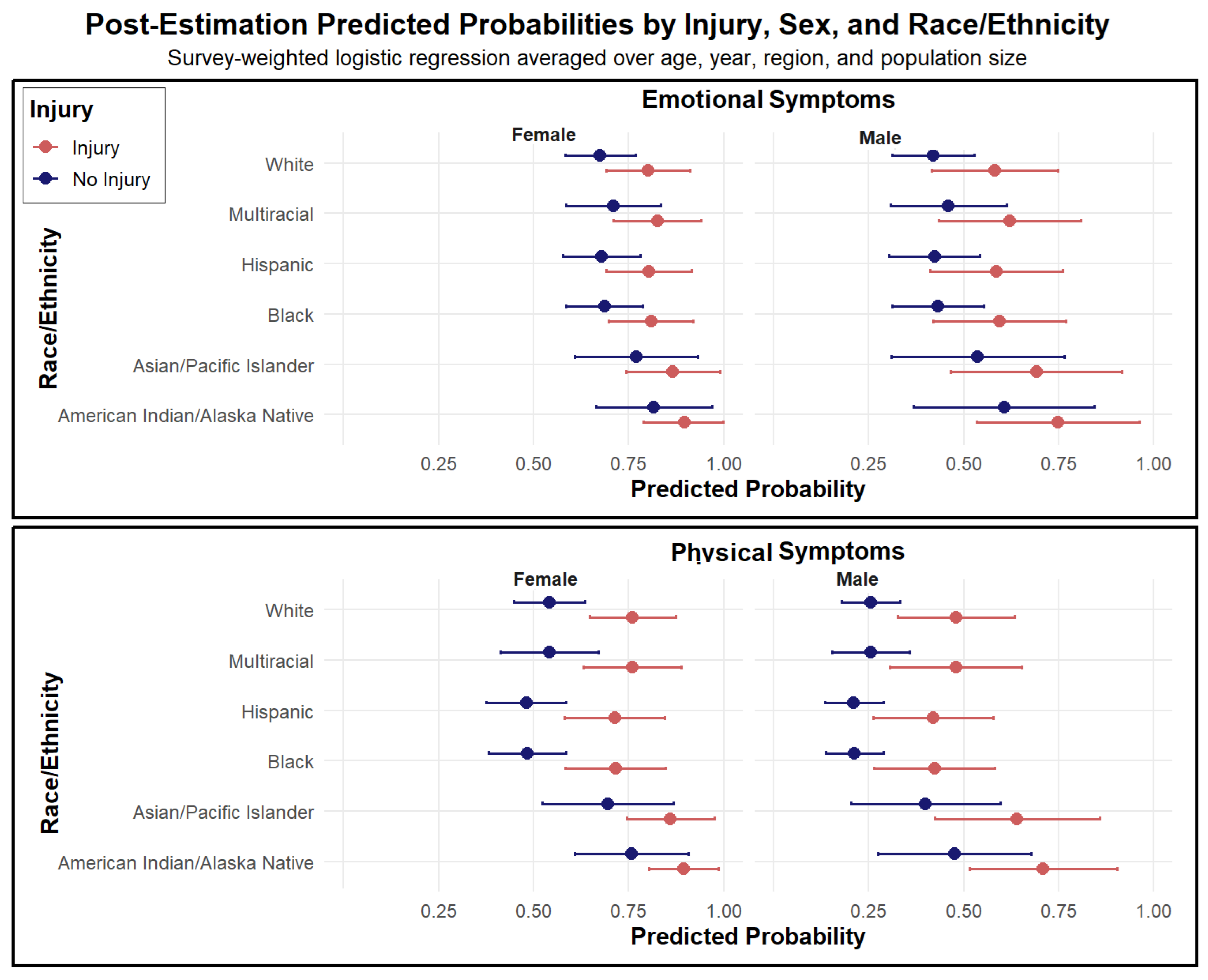
| Injury | No | 2882 | 7,315,829 | 2076 | 5,126,300 | 70.1 | 1639 | 3,853,717 | 52.7 |
| Yes | 130 | 334,642 | 110 | 277,279 | 82.9 | 98 | 244,551 | 73.1 | |
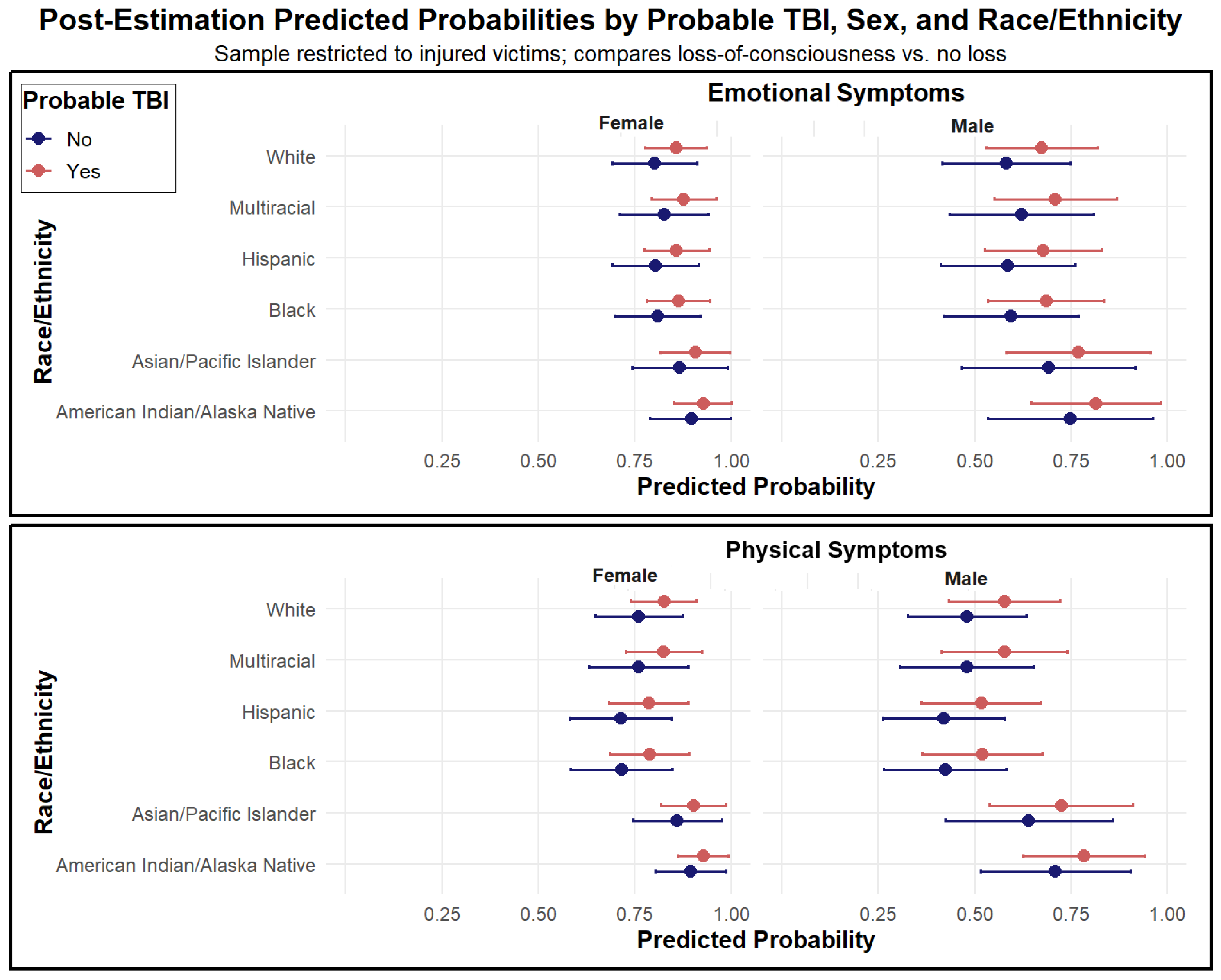
| Potential TBI | No | 701 | 1,767,487 | 474 | 1,127,035 | 63.8 | 353 | 793,874 | 44.9 |
| Yes | 2311 | 5,882,984 | 1712 | 4,276,544 | 72.7 | 1384 | 3,304,394 | 56.2 | |
| Region | Midwest | 914 | 1,988,216 | 668 | 1,398,200 | 70.3 | 541 | 1,072,526 | 53.9 |
| South | 1008 | 2,720,715 | 716 | 1,875,129 | 68.9 | 567 | 1,458,077 | 53.6 | |
| West | 720 | 1,841,674 | 528 | 1,317,647 | 71.5 | 425 | 1,005,487 | 54.6 | |
| Northeast | 370 | 1,099,866 | 274 | 812,603 | 73.9 | 204 | 562,178 | 51.1 | |
| Population Size | Under 50 K | 1852 | 4,612,312 | 1340 | 3,235,453 | 70.1 | 1073 | 2,492,963 | 54.1 |
| 50 K–250 K | 631 | 1,630,186 | 477 | 1,193,815 | 73.2 | 387 | 931,333 | 57.1 | |
| Over 250 K | 529 | 1,407,973 | 369 | 974,312 | 69.2 | 277 | 673,971 | 47.9 | |
| Police Report | No | 1336 | 3,271,726 | 932 | 2,191,525 | 67.0 | 768 | 1,709,629 | 52.3 |
| Yes | 1626 | 4,258,017 | 1229 | 3,151,614 | 74.0 | 949 | 2,343,983 | 55.0 |
| Reporting ≥ 1 Emotional Symptom | Reporting ≥ 1 Physical Symptom | |||||
|---|---|---|---|---|---|---|
| Predictor | Odds Ratio | CI Low | CI High | Odds Ratio | CI Low | CI High |
| — | — | — | — | — | — | — |
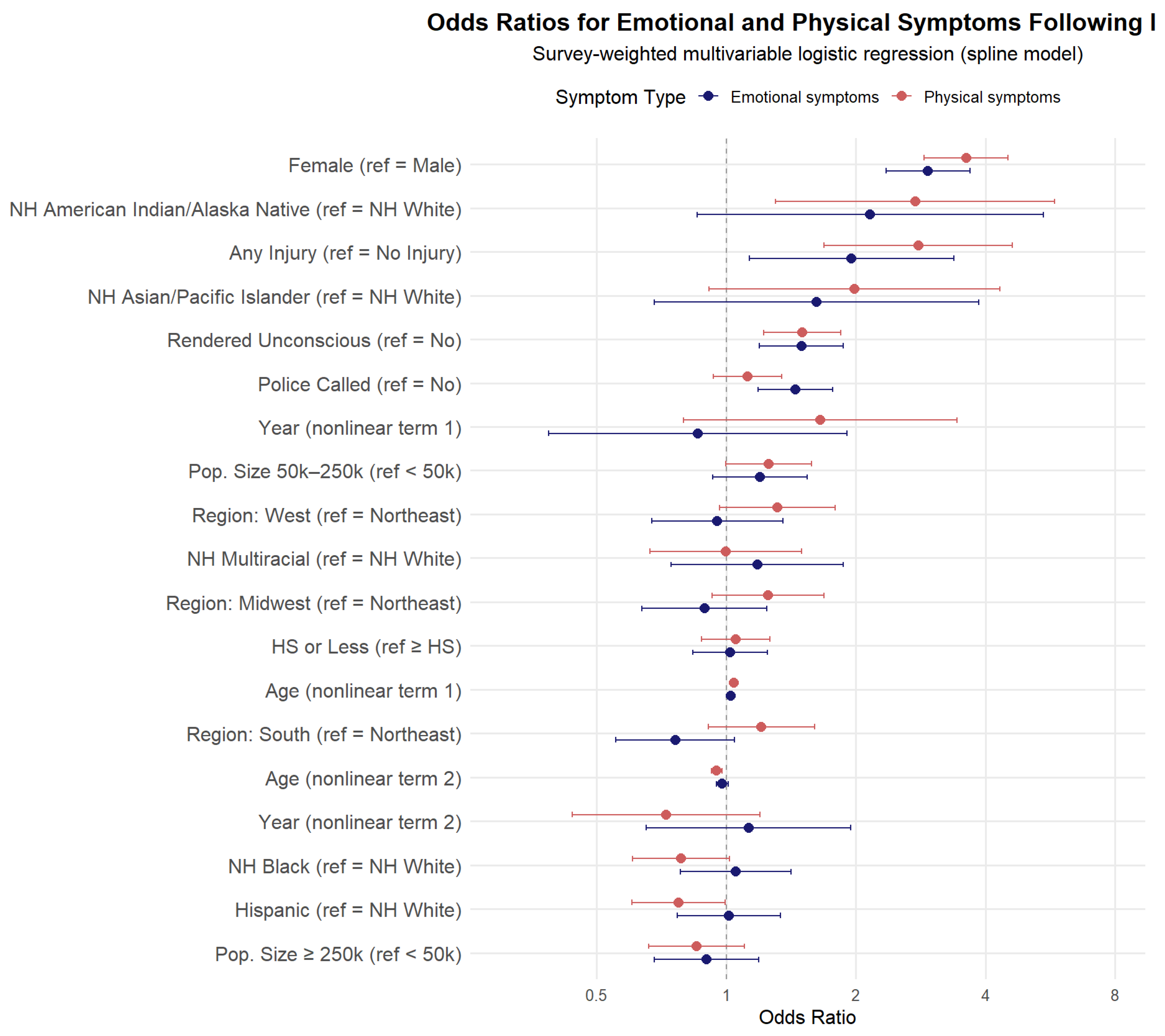
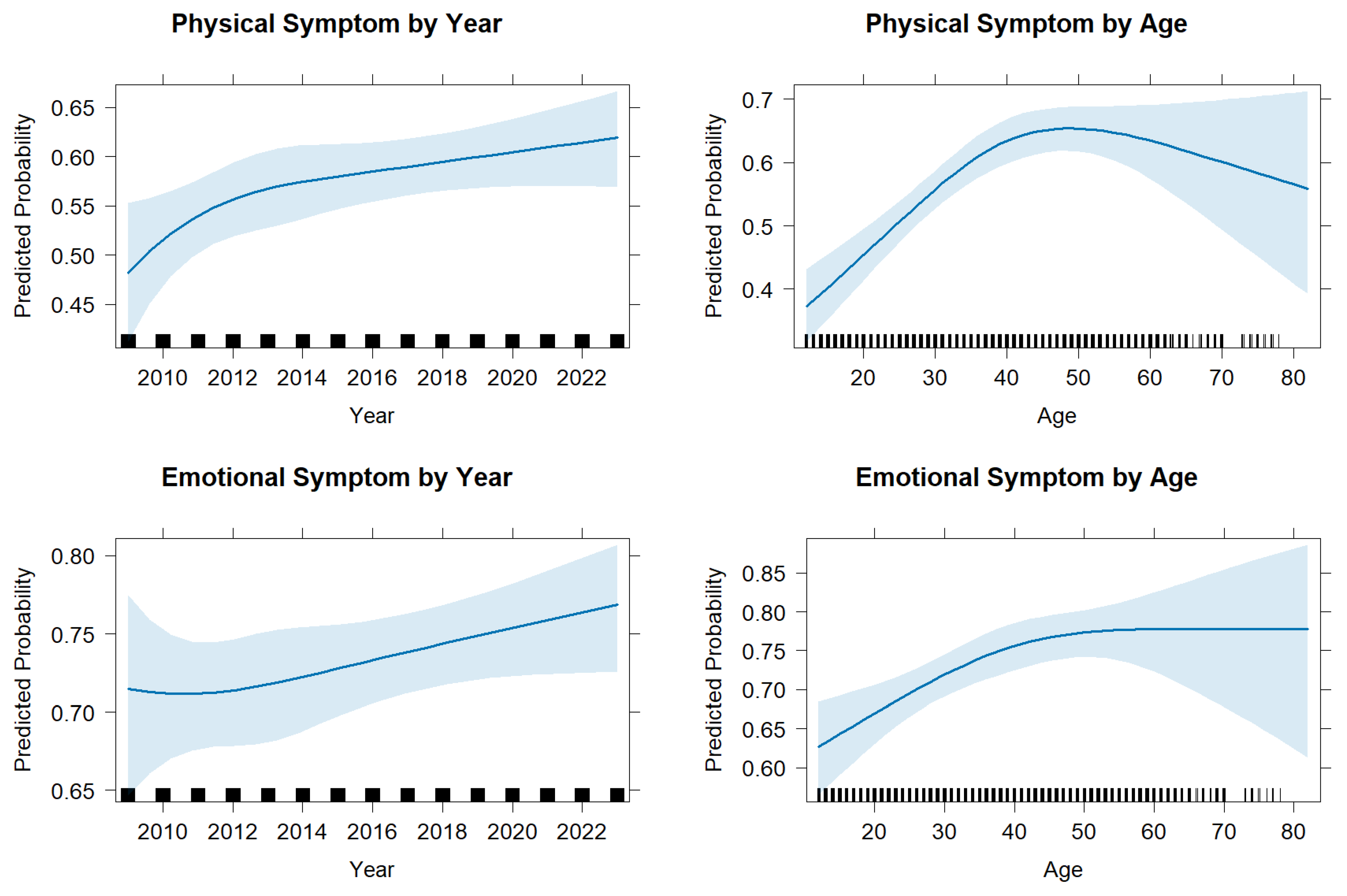
| Age (trend 1: 25–40) | 1.024 | 1.010 | 1.038 | 1.043 | 1.029 | 1.056 |
| Age (trend 2: 40–65) | 0.979 | 0.949 | 1.010 | 0.951 | 0.925 | 0.977 |
| Year (trend 1: 1999–2007) | 0.859 | 0.387 | 1.906 | 1.653 | 0.795 | 3.437 |
| Year (trend 2: 2007–2015) | 1.127 | 0.653 | 1.944 | 0.725 | 0.439 | 1.197 |
| Any Injury (Yes vs. No) | 1.955 | 1.132 | 3.376 | 2.794 | 1.687 | 4.627 |
| Female (Yes vs. No) | 2.943 | 2.352 | 3.681 | 3.610 | 2.887 | 4.515 |
| American Indian/Alaska Native (Yes vs. No) | 2.162 | 0.857 | 5.458 | 2.748 | 1.303 | 5.798 |
| Asian/Pacific Islander (Yes vs. No) | 1.620 | 0.680 | 3.858 | 1.986 | 0.913 | 4.319 |
| Black (Yes vs. No) | 1.054 | 0.784 | 1.415 | 0.786 | 0.607 | 1.017 |
| Hispanic (Yes vs. No) | 1.014 | 0.769 | 1.337 | 0.776 | 0.605 | 0.996 |
| Multiracial (Yes vs. No) | 1.182 | 0.745 | 1.874 | 0.998 | 0.666 | 1.497 |
| HS or Less (Yes vs. No) | 1.022 | 0.836 | 1.249 | 1.054 | 0.878 | 1.265 |
| Unconscious (Yes vs. No) | 1.495 | 1.196 | 1.869 | 1.503 | 1.221 | 1.849 |
| Population Size: 50 k–250 k | 1.200 | 0.932 | 1.545 | 1.254 | 0.997 | 1.577 |
| Population Size: ≥250 k | 0.900 | 0.680 | 1.192 | 0.853 | 0.660 | 1.104 |
| Police Called (Yes vs. No) | 1.448 | 1.187 | 1.768 | 1.121 | 0.934 | 1.346 |
| Region: Midwest | 0.890 | 0.637 | 1.244 | 1.252 | 0.929 | 1.688 |
| Region: South | 0.762 | 0.555 | 1.046 | 1.208 | 0.908 | 1.608 |
| Region: West | 0.953 | 0.671 | 1.355 | 1.316 | 0.966 | 1.793 |
Disclaimer/Publisher’s Note: The statements, opinions and data contained in all publications are solely those of the individual author(s) and contributor(s) and not of MDPI and/or the editor(s). MDPI and/or the editor(s) disclaim responsibility for any injury to people or property resulting from any ideas, methods, instructions or products referred to in the content. |
© 2025 by the authors. Licensee MDPI, Basel, Switzerland. This article is an open access article distributed under the terms and conditions of the Creative Commons Attribution (CC BY) license (https://creativecommons.org/licenses/by/4.0/).
Share and Cite
Barboza-Salerno, G.E.; Shockley McCarthy, K.; Harrington, T.; Watson-Grace, A. Emotional and Physical Symptoms Following Intimate Partner Violence Victimization in the United States: Implications for Law and Public Health Policy. Int. J. Environ. Res. Public Health 2025, 22, 1829. https://doi.org/10.3390/ijerph22121829
Barboza-Salerno GE, Shockley McCarthy K, Harrington T, Watson-Grace A. Emotional and Physical Symptoms Following Intimate Partner Violence Victimization in the United States: Implications for Law and Public Health Policy. International Journal of Environmental Research and Public Health. 2025; 22(12):1829. https://doi.org/10.3390/ijerph22121829
Chicago/Turabian StyleBarboza-Salerno, Gia Elise, Karla Shockley McCarthy, Taylor Harrington, and Amy Watson-Grace. 2025. "Emotional and Physical Symptoms Following Intimate Partner Violence Victimization in the United States: Implications for Law and Public Health Policy" International Journal of Environmental Research and Public Health 22, no. 12: 1829. https://doi.org/10.3390/ijerph22121829
APA StyleBarboza-Salerno, G. E., Shockley McCarthy, K., Harrington, T., & Watson-Grace, A. (2025). Emotional and Physical Symptoms Following Intimate Partner Violence Victimization in the United States: Implications for Law and Public Health Policy. International Journal of Environmental Research and Public Health, 22(12), 1829. https://doi.org/10.3390/ijerph22121829