


Research on the Maturity Evaluation Model of Enterprise Safety Culture

Abstract
:1. Introduction
2. Method
2.1. Expert Scoring Method
- (1)
- The selected experts should be highly authoritative and representative. The experts should be professors in the field of security, enterprise security managers, and government security supervisors. They should have a high professional level, familiarity with development trends in the safety field, and have been engaged in the safety field for more than 5 years.
- (2)
- Experts should have a good understanding of the enterprise situation and indicator system. Before grading, the grading expert should understand the meaning of each indicator and the grading criteria.
- (3)
- The number of experts should be appropriate, with a minimum of 10.
2.2. Grey Fuzzy Comprehensive Evaluation Method
3. Establishment of Evaluation Index System
3.1. Index System Construction
3.2. Determination of Index Weight
3.2.1. Initial Weight
3.2.2. Influence Weight
- (1)
- Impact matrix
- (2)
- Influence weight
3.2.3. Correction Function
4. Maturity Level Division of Evaluation Model
- (1)
- Original level
- (2)
- Starting level
- (3)
- Developing level
- (4)
- Completion level
- (5)
- Leading level
5. Construction of Evaluation Standard Model
5.1. Building of Standard Comprehensive Evaluation Matrix
5.1.1. Standard Initial Matrix
5.1.2. Standard Comprehensive Evaluation Matrix
5.2. Building of Standard Mathematical Model
5.3. Level Correspondence of Safety Culture Maturity
6. Case Study
6.1. Safety Culture Maturity Evaluation
6.1.1. Determination of Index Weight Vector
6.1.2. Building of Comprehensive Evaluation Matrix
6.1.3. Results of Analysis of Safety Culture Maturity Level
6.2. Evaluation Results and Discussion
7. Discussion
7.1. Safety Culture Maturity Model
7.2. Research Implications
7.3. Limitations and Future Research Directions
8. Conclusions
- (1)
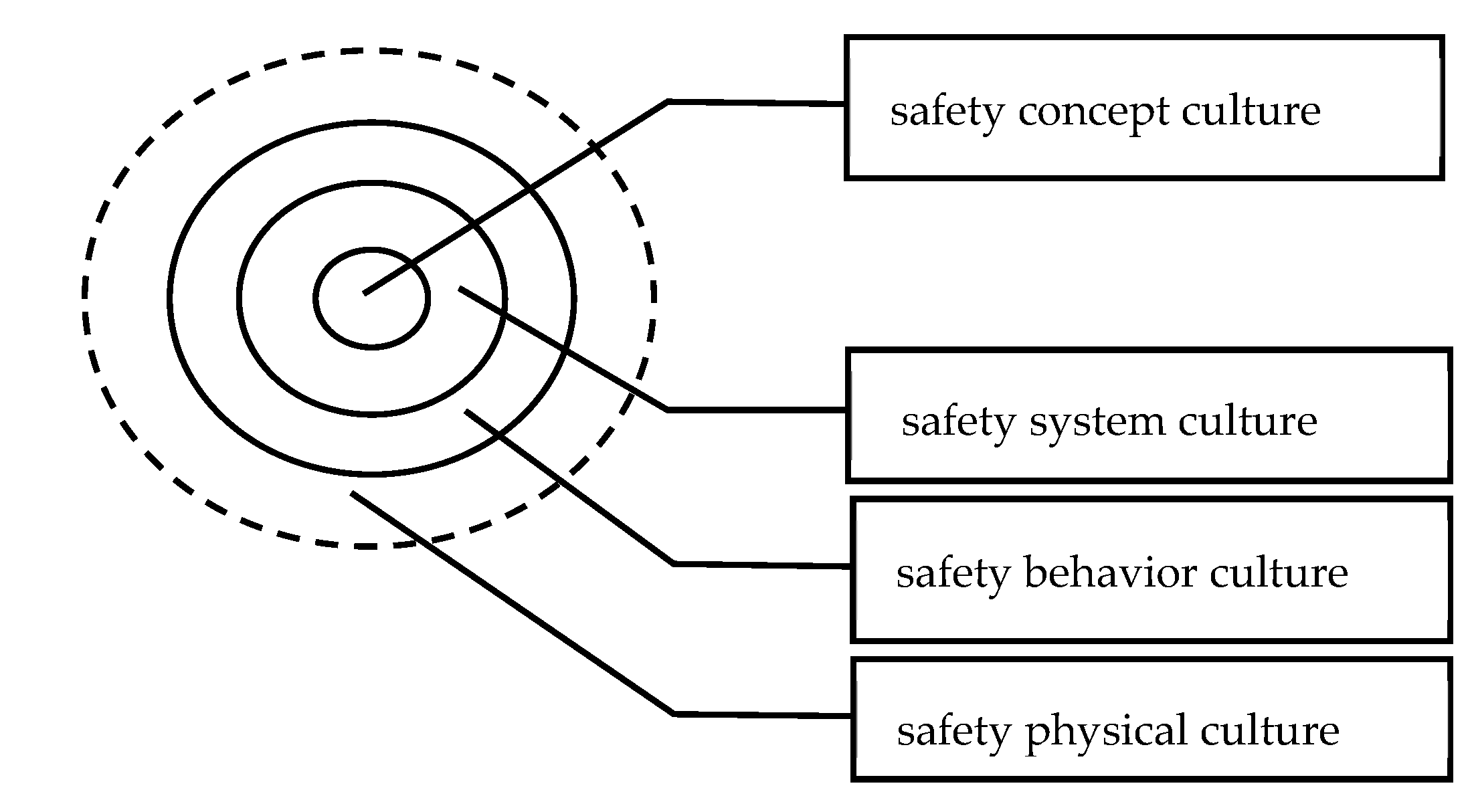
- Based on safety culture hierarchy, the index system of the safety culture maturity evaluation model was designed from the four dimensions of safety concept, system, behavior, and physical culture. The initial and influence weights of the index were determined by the expert scoring method and the influence weight of the index was determined by the influence matrix, thereby modifying the initial weight and obtaining the final index weight.
- (2)
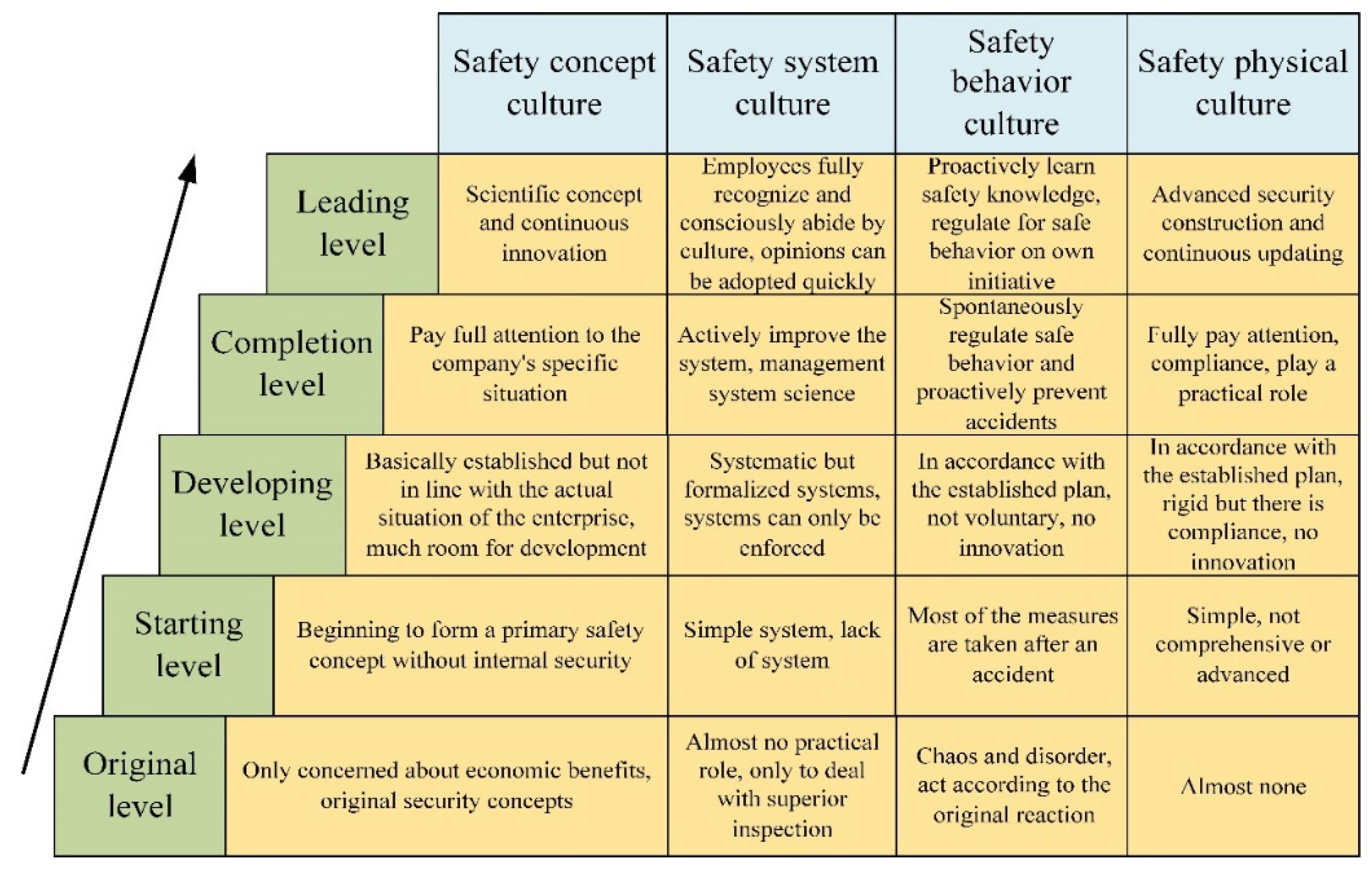
- The maturity level of safety culture was constructed and the maturity level of enterprise safety culture was divided into original level, starting level, development level, completion level, and leading level.
- (3)
- The grey fuzzy comprehensive evaluation method was used to evaluate the maturity of enterprise safety culture. An innovative method of constructing a standard evaluation model was used. The relationship between the output of the model and the maturity level of safety culture was established.
- (4)
- Taking an enterprise to be evaluated as an example, this paper introduced the evaluation steps and application of the evaluation results, supplying a systematic measurement index and scientific evaluation method for enterprise safety culture evaluation.
Author Contributions
Funding
Institutional Review Board Statement
Informed Consent Statement
Data Availability Statement
Acknowledgments
Conflicts of Interest
References
- Cai, M.; Gong, S.; Li, X. Technique of Human Error Failure Analysis Based on Analytic Hierarchy Process. J. Saf. Sci. Technol. 2008, 2, 74–77. [Google Scholar]
- Kumar, P.; Gupta, S.; Agarwal, M.; Singh, U. Categorization and Standardization of Accidental Risk-Criticality Levels of Human Error to Develop Risk and Safety Management Policy. Saf. Sci. 2016, 85, 88–98. [Google Scholar] [CrossRef]
- Hobbs, A.; Williamson, A. Associations Between Errors and Contributing Factors in Aircraft Maintenance. Hum. Factors 2003, 45, 186–201. [Google Scholar] [CrossRef] [PubMed]
- Chen, H.; Qi, H.; Long, R.; Zhang, M. Research on 10-Year Tendency of China Coal Mine Accidents and the Characteristics of Human Factors. Saf. Sci. 2012, 50, 745–750. [Google Scholar] [CrossRef]
- Naghavi, Z.; Mortazavi, S.B.; Hajizadeh, E. Exploring the Contributory Factors of Confined Space Accidents Using Accident Investigation Reports and Semistructured Interviews. Saf. Health Work. 2019, 10, 305–313. [Google Scholar] [CrossRef]
- Li, W.C.; Harris, D.; Yu, C.S. Rout es to Failure: Analysis of 41 Civil Aviation Accidents from the Republic of China Using the Human Factors Analysis and Classification System. Accid. Anal. Prev. 2008, 40, 426–434. [Google Scholar] [CrossRef]
- Silbey, S.S. Taming Prometheus: Talk About Safety and Culture. Annu. Rev. Sociol. 2009, 35, 341–369. [Google Scholar] [CrossRef]
- IAEA. Safety culture. In Safety Series No. 75-INSAG-4; International Atomic Energy Agency: Vienna, Austria, 1991. [Google Scholar]
- Fu, G.; Li, C.; Xing, G.; Guan, Z. Investigations into the Impacts of Enterprise Safety Culture and its Quantitative Measuring. China Saf. Sci. J. 2009, 19, 86–92. (In Chinese) [Google Scholar]
- Fu, G.; Wang, X.; Li, Y. On the 24Model add the application of its causative codes to the analysis of the related accidents. J. Saf. Environ. 2017, 17, 1003–1008. (In Chinese) [Google Scholar]
- Fu, G.; Yang, C.; Yin, W.; Dong, J. Extended version of behavior-based accident causation “2–4” model. J. China Coal Soc. 2014, 39, 994–999. (In Chinese) [Google Scholar]
- Arezes, P.M.; Sérgio Miguel, A. The role of safety culture in safety performance measurement. Meas. Bus. Excell. 2003, 7, 20–28. [Google Scholar] [CrossRef]
- Cooper, P.D. Towards a model of safety culture. Saf. Sci. 2000, 36, 111–136. [Google Scholar] [CrossRef]
- Xu, M.; Zhang, S.; Zhou, J.; Liu, G.; Wang, J.; Ren, Z.; Wang, S. Research on evaluation index systems of safety culture in a oil and gas field company. J. Saf. Sci. Technol. 2013, 9, 166–171. (In Chinese) [Google Scholar]
- Hackos, T.J. Publications Process Maturity Model: Key Practices for an Effective Organization. Soc. Tech. Commun. Annu. Conf. 1996, 104–108. [Google Scholar]
- Deng, J.; Ye, S.; Zheng, X. The Survey of CMM (the Capability Maturity Model). Appl. Res. Comput. 2002, 7, 6–9. (In Chinese) [Google Scholar]
- Lowe, D.E.; Cox, G.M. Implementing the Capability Maturity Model for Software Development. Hewlett-Packard J. 1996, 47, 6–14. [Google Scholar]
- Ke, Z.; Zhang, Z.; Lv, Y. Organize the Project Management Maturity Model; China Publishing House of Electronics Industry: Beijing, China, 2006. (In Chinese) [Google Scholar]
- Fleming, M. Safety Culture Maturity Model; UK Hse Offshore Technology Report Oto: Norwich, UK, 2000. [Google Scholar]
- Goncalves Filho, A.P.; Waterson, P. Maturity models and safety culture: A critical review. Saf. Sci. 2018, 105, 192–211. [Google Scholar] [CrossRef]
- Goncalves Filho, A.P.; Andrade, J.C.; de Oliveira Marinho, M.M. A safety culture maturity model for petrochemical companies in Brazil. Saf. Sci. 2010, 48, 615–624. [Google Scholar] [CrossRef]
- Zheng, X.; Li, H.; Mao, Y. Application of safety culture maturity model in construction enterprises. China Saf. Sci. J. 2011, 6, 88. (In Chinese) [Google Scholar]
- Yang, W.T.; Gao, J.D.; Gu, H.H.; Yang, X. Construction of urban safety culture system. Chin. J. Saf. Sci. 2022, 32, 17–22. (In Chinese) [Google Scholar]
- Bisbey, T.M.; Kilcullen, M.P.; Thomas, E.J.; Ottosen, M.J.; Tsao, K.; Salas, E. Safety Culture: An Integration of Existing Models and a Framework for Understanding Its Development. Hum. Factors 2019, 63, 88–110. [Google Scholar] [CrossRef] [PubMed]
- Zhang, F. Research on safety culture maturity of subway operation companies. J. N. China Inst. Sci. Technol. 2015, 12, 88–93. (In Chinese) [Google Scholar]
- Ngwenyama, O.; Nielsen, P.A. Competing Values in Software Process Improvement: An Assumption Analysis of CMM From an Organizational Culture Perspective. IEEE Trans. Eng. Manag. 2003, 50, 100–112. [Google Scholar] [CrossRef]
- Li, Y.; Chen, X. Research on traffic safety evaluation of intersections based on hierarchical analysis and expert scoring method. Chin. Civ. Hous. (Low. J.) 2014, 5, 245–248. (In Chinese) [Google Scholar]
- Bu, G.; Zhang, Y. Grey fuzzy comprehensive evaluation based on grey fuzzy relation. Syst. Eng. Theory Pract. 2002, 22, 141–144. (In Chinese) [Google Scholar]
- Su, H.; Wang, J. A grey fuzzy comprehensive evaluation model. Syst. Eng. Electron. 1997, 7, 48–51. (In Chinese) [Google Scholar]
- Wang, J.; Wang, G. Multi—Index fuzzy comprehensive evaluation. J. Kunming Univ. Sci. Technol. (Nat. Sci. Ed.) 1998, 23, 69–71. (In Chinese) [Google Scholar]
- Li, F.; Xu, D. Application of Grey Correlation Analysis Method in Economic Benefit Evaluation of Coal Mine Enterprises. Zhongzhou Coal 1994, 5, 11–12. (In Chinese) [Google Scholar]
- Zeng, F. Grey Relational Degree Comprehensive Evaluation Method of Coal Enterprise Management Level. Hebei Coal 2000, 2, 55–56. (In Chinese) [Google Scholar]
- Turner, B.A. The development of a safety culture. Chem. Ind. 1991, 7, 241–243. (In Chinese) [Google Scholar]
- He, Y.; Zhang, J.; Bao, Y. Design of nuclear safety culture indicators based on SMART. Electr. Power 2004, 37, 85–87. (In Chinese) [Google Scholar]
- Fang, D.; Wu, H. Development of a Safety Culture Interaction (SCI) model for construction projects. Saf. Sci. 2013, 57, 138–149. [Google Scholar] [CrossRef]
- Majumdar, H.A. Metro railway safety: An analysis of accident precursors. Saf. Sci. 2012, 50, 1535–1548. [Google Scholar]
- Lu, W.; Tang, Y. Cultivation of nuclear safety culture in Guangdong nuclear power station (GNPS). Chin. J. Nucl. Sci. Eng. 2004, 24, 205–210. (In Chinese) [Google Scholar]
- Liu, G.; Zhou, Y.; Zhang, X. Weight calculation of safety indexes on the open-pit coal mine comprehensive. Opencast Min. Technol. 2019, 34, 73–76. (In Chinese) [Google Scholar]
- Fleming, M. Safety Culture Maturity Model. Health Saf. Exec. 2001, 49. [Google Scholar]
- IAEA. Safety Culture in Nuclear Installations: Guidance for Use in the Enhancement of Safety Culture; International Atomic Energy Agency: Vienna, Austria, 2002. [Google Scholar]

| Primary Indicator | Secondary Indicator | Tertiary Indicator | Index Definition |
|---|---|---|---|
| Safety concept culture A | Safety commitment A10 | Safety development goals and prospects A11 | The enterprise has clear safety development goals, specific guidelines, and implements them in daily work arrangements. The current safety level of the enterprise matches its production scale and has the prospect of sustainable development. |
| Safety mission and tasks A12 | The enterprise clarifies the safety mission, tasks, and safety responsibilities that should be assumed in the industry and society. All personnel must clearly define their own safety missions and can accomplish safety tasks spontaneously. | ||
| Full safety commitment A13 | The company’s safety commitment is complete and accurate in content, emotionally unique and universal, and disseminated in a timely and effective manner. It is appealing. All personnel of the enterprise know and agree with the company’s safety commitment, psychologically recognize the importance of safety, and consciously abide by safety regulations. | ||
| Safety attitude A20 | Safety values A21 | The enterprise can correctly handle the relationship between safety and production efficiency, has a correct understanding of the meaning of safety, and the decision-making layer has a consistent understanding of safety. The company has implemented safe production processes on its own initiative, rather than due to outside pressure. | |
| Safety responsibility A22 | All employees of the company believe that safety benefits themselves, the company, their families, and society and voluntarily assume their responsibilities in the safe development of the enterprise. | ||
| Safety concept A30 | Safety importance A31 | The enterprise values and maximizes safety. Safety is regarded as the first factor when allocating time, personnel, equipment, and funds. All personnel in the enterprise give priority to safety-related work. | |
| Safety management concept A32 | The company has scientific and advanced safety management concepts that are in line with its actual production conditions and has slogans, systems, and documents that match these concepts. All personnel deeply understand the concept of safety management and implement it in actual production. | ||
| Safety system culture B00 | Safety management B10 | Management agency settings B11 | The enterprise creates a separate safety management organization and is equipped with human and material resources in accordance with the regulations to ensure that it independently performs its duties of safety management and is responsible for full-time personnel. The decision-making level of the enterprise has a person responsible for safety management, clarifying the powers and responsibilities of the safety management organization and conforming to the actual production safety of the enterprise in terms of institutional setup and personnel arrangement. |
| Division of management powers and responsibilities B12 | The enterprise has reasonable management rights and responsibilities, and there are clear divisions of powers and responsibilities within the safety management organization. | ||
| Safety information exchange B13 | The enterprise establishes an internal safety information base, including safety management, safety knowledge, accident statistics, etc., and updates and improves it in a timely manner. It has specialized agencies responsible for communicating and disseminating safety information and has a stable platform and carrier for safe information management and dissemination. The company can achieve timely and active communication of safety information, and the safety instructions of superiors can be communicated efficiently. The safety suggestions and reports of employees can also be fed back to the superiors in an active, timely, and unrestricted manner. Externally, the enterprise and the government, society, industry, and family members of employees have good safety information exchange. | ||
| Safety training and assessment B14 | The company regularly conducts safety training for all employees, sets and updates the training content according to the actual situation of the enterprise, and arranges scientific and reasonable training hours with rich and effective training methods. The company conducts safety assessments on all employees on a regular basis and has corresponding reward and punishment measures for the assessment results. Each position has corresponding assessment requirements. | ||
| Safety culture construction B15 | The enterprise has a corresponding safety culture construction, regularly holds safety culture activities, and carries out safety production publicity. The enterprise establishes a sound safety culture assessment system, conducts self-evaluation of corporate safety culture on a regular basis, and regularly assesses and improves safety culture construction work based on the results of self-evaluation. | ||
| Safety investment B16 | The enterprise, in accordance with regulations, invests a certain proportion of personnel, funds, equipment, and other resources in safety and makes reasonable allocations. There are corresponding documents and institutions to ensure the investment and use of resources in safety. | ||
| Safety system B20 | Establishment of the system B21 | The enterprise establishes scientific and reasonable safety systems within it, including a safety responsibility system, safety management system, and safety operation specifications. The establishment and improvement of the safety systems has a scientific process, and the established system reflects the advanced safety management concept and is integrated with the actual enterprise. | |
| Implementation of safety regulations and standards B22 | The enterprise collects and organizes the applicable safety regulations and standards in a timely manner and strictly abides by the national and industry-related safety laws and regulations to improve its safety system and guide its safe production. | ||
| Implementation of the system B23 | The enterprise’s safety system has clear provisions and strict implementation. Each safety system has a mechanism for specific implementation feedback. All employees in the company can voluntarily and actively comply with the safety system. | ||
| Safety behavior culture C00 | Decision layer behavior C10 | Professional knowledge level C11 | The decision-making level has the corresponding level of safety knowledge, clarifies relevant safety laws and regulations, consciously learns advanced safety concepts, performs excellently in safety assessment, and is a good example for all employees of the company. |
| Establish a responsibility system C12 | The decision-making level participates in the establishment of a safety responsibility system and clarifies the safety responsibilities of each part. | ||
| Responsible performance C13 | The decision-making layer earnestly fulfils its own safety responsibilities in terms of safety training, safety investment, personnel setting, system establishment, etc., and strictly abide by the principle of safety first. | ||
| Guiding subordinates C14 | The decision-making layer constantly increases its own level of safety knowledge, sets an example for its subordinates, and guides its subordinates to pay attention to safety from an ideological point of view and to be safe in behavior. | ||
| Management behavior C20 | Professional knowledge level C21 | Management has the corresponding level of safety knowledge; clarifies relevant safety laws, regulations and policies; consciously learns advanced safety concepts; and performs excellently in safety assessment. Among them, full-time safety management personnel have professional safety capabilities and qualifications. | |
| Responsible performance C22 | Management earnestly fulfills its own safety responsibilities in implementing safety systems, doing a good job in the safety management of the enterprise, and improving the enterprise’s safety performance. | ||
| Guiding subordinates C23 | Management certifies the safety quality of employees, goes to the site to supervise and guide the safety behavior of employees, and regularly organizes employee safety training. | ||
| Employee behavior C30 | Professional knowledge level C31 | Employees have the corresponding level of safety knowledge, clarify relevant safety production rules and regulations, have the level of safety production knowledge required by the enterprise, and perform excellently in safety assessment. | |
| Responsible performance C32 | Employees earnestly perform their job duties, master post-safety skills, ensure their own safe operation, have professional hazard identification and emergency response capabilities, and can supervise and protect the safety of others. | ||
| Behavioral habit C33 | Employees have good safety behaviors, such as strict compliance with safety systems, active communication of safety information with others, awareness of teamwork, the discovery of hidden dangers and accidents, consciously learning of various safety knowledge, earnest completion of safety training, and active participation in safety culture construction activities, etc. | ||
| Safety performance and rewards and punishments C34 | The enterprise establishes and continuously improves its scientific and fair safety performance and reward and punishment system. Under the premise of balancing spiritual and material rewards, it selects effective safety performance incentives and has positive effects on employees’ safety behavior improvement. | ||
| Safety physical culture D00 | Device D10 | Safety quality of equipment D11 | The equipment procurement, replacement, and configuration of the enterprise are documented and require safety qualifications that are consistent with the actual production of the enterprise, and the relevant certificates are complete. Employees are familiar with the safe use of the equipment and clarify processes for handling faulty equipment. |
| Equipment safety maintenance D12 | The company regularly checks the safety and quality of the equipment and repairs or replaces equipment that has failed inspection. | ||
| Establishment of emergency system D13 | The enterprise establishes a timely and effective automated emergency system to ensure that equipment failures can be detected in time and ensure the safety of personnel and other equipment within the enterprise. Employees are trained in emergency response and can calmly handle accidents. | ||
| Visualization on site D20 | Safety alert sign setting D21 | The enterprise posts safety warning signs in accordance with relevant laws and regulations and regularly checks to ensure that the signs are fully intact and undamaged. | |
| Intuitive safety information display D22 | The company presents color and visual safety information in the locations where it is relevant, such as differences in color on a thermometer to indicate the temperature. The company visually and intuitively shows employees the safety requirements and information for each position to ensure safe operation by employees. | ||
| Tools and protective equipment D30 | Safety equipment D31 | The company is equipped with tools with safety protection functions, regularly inspects and maintains the tools used by employees, and employees are proficient in the safe use of tools. | |
| Use of safety equipment D32 | The company arranges comfortable and safe protective equipment for employees according to regulations and fully considers the individual needs of employees, such as different types of gloves and masks. | ||
| Promotional display D40 | Display mode D41 | The enterprise uses a variety of presentation methods to promote safety knowledge, such as banners, posters, bulletin boards, and electronic displays. | |
| Display content D42 | The company’s display content is rich and has educational significance, such as national laws and regulations, on-site operational safety procedures, and advanced personal deeds of corporate safety. The company regularly updates the display content, which is in line with the company’s safety culture and safe production practices. | ||
| Place of display D43 | The company has a suitable display location that does not affect normal production work and is noticed by employees. | ||
| Business environment D50 | Working environment D51 | The company has a good working environment to ensure the health and wellbeing of employees. The work area is regularly cleaned. The equipment is neatly arranged. The employees have sufficient working space that meets the requirements of national laws and regulations. | |
| Rest environment D52 | The company is equipped with comfortable and clean staff quarters, canteens, safety training areas, cultural and sports activities areas, etc. The equipment and building area of each division is in line with the actual number of employees in it, with good greening in the plant area. |
| Implication | Most Important | Important | More Important | Slightly Important | Unimportant |
|---|---|---|---|---|---|
| points | 5 | 4 | 3 | 2 | 1 |
| Maturity Level | Original Level | Starting Level | Developing Level | Completion Level | Leading Level |
|---|---|---|---|---|---|
| Indicator score interval | 1 | 2 | 3 | 4 | 5 |
| Index Set | |
|---|---|
| Safety culture | Y = {y1, y2, y3, y4} |
| Safety concept culture A | YA = {yA1, yA2, yA3, yA4, yA5, yA6, yA7} |
| Safety system culture B | YB = {yB1, yB2, yB3, yB4, yB5, yB6, yB7, yB8, yB9} |
| Safety behavior culture C | YC = {yC1, yC2, yC3, yC4, yC5, yC6, yC7, yC8, yC9, yC10, yC11} |
| Safety physical culture D | YD = {yD1, yD2, yD3, yD4, yD5, yD6, yD7, yD8, yD9, yD10, yD11, yD12} |
| Maturity Level | Original Level | Starting Level | Developing Level | Completion Level | Leading Level |
|---|---|---|---|---|---|
| Results of the Model | [0.33,0.40) | [0.40,0.50) | [0.50,0.67) | [0.67,1.000) | 1.000 |
| Index Set | |
|---|---|
| Safety culture | Y = {2.575, 3.328, 2.818, 3.085} |
| Safety concept culture A | YA = {3, 3, 2, 3, 2, 3, 2} |
| Safety system culture B | YB = {4, 3, 2, 4, 3, 3, 4, 4, 3} |
| Safety behavior culture C | YC = {3, 3, 2, 3, 4, 3, 3, 2, 2, 3, 3} |
| Safety physical culture D | YD = {3, 4, 3, 3, 3, 4, 3, 2, 3, 2, 4, 3} |
| Score | Level | |
|---|---|---|
| Safety culture maturity | 0.494 | Starting level |
| Maturity of safety concept culture | 0.458 | Starting level |
| Maturity of safety system culture | 0.564 | Developing level |
| Maturity of safety behavior culture | 0.488 | Starting level |
| Maturity of safety physical culture | 0.526 | Developing level |
Disclaimer/Publisher’s Note: The statements, opinions and data contained in all publications are solely those of the individual author(s) and contributor(s) and not of MDPI and/or the editor(s). MDPI and/or the editor(s) disclaim responsibility for any injury to people or property resulting from any ideas, methods, instructions or products referred to in the content. |
© 2023 by the authors. Licensee MDPI, Basel, Switzerland. This article is an open access article distributed under the terms and conditions of the Creative Commons Attribution (CC BY) license (https://creativecommons.org/licenses/by/4.0/).
Share and Cite
Pei, J.; Liu, L.; Chi, Y.; Yu, C. Research on the Maturity Evaluation Model of Enterprise Safety Culture. Int. J. Environ. Res. Public Health 2023, 20, 2664. https://doi.org/10.3390/ijerph20032664
Pei J, Liu L, Chi Y, Yu C. Research on the Maturity Evaluation Model of Enterprise Safety Culture. International Journal of Environmental Research and Public Health. 2023; 20(3):2664. https://doi.org/10.3390/ijerph20032664
Chicago/Turabian StylePei, Jingjing, Lu Liu, Ying Chi, and Chengyang Yu. 2023. "Research on the Maturity Evaluation Model of Enterprise Safety Culture" International Journal of Environmental Research and Public Health 20, no. 3: 2664. https://doi.org/10.3390/ijerph20032664
APA StylePei, J., Liu, L., Chi, Y., & Yu, C. (2023). Research on the Maturity Evaluation Model of Enterprise Safety Culture. International Journal of Environmental Research and Public Health, 20(3), 2664. https://doi.org/10.3390/ijerph20032664

