


Environmental Qualities That Enhance Outdoor Play in Community Playgrounds from the Perspective of Children with and without Disabilities: A Scoping Review



Abstract
1. Introduction
2. Materials and Methods
2.1. Identify the Research Question (Stage 1)
2.2. Identifying Relevant Studies (Stage 2)
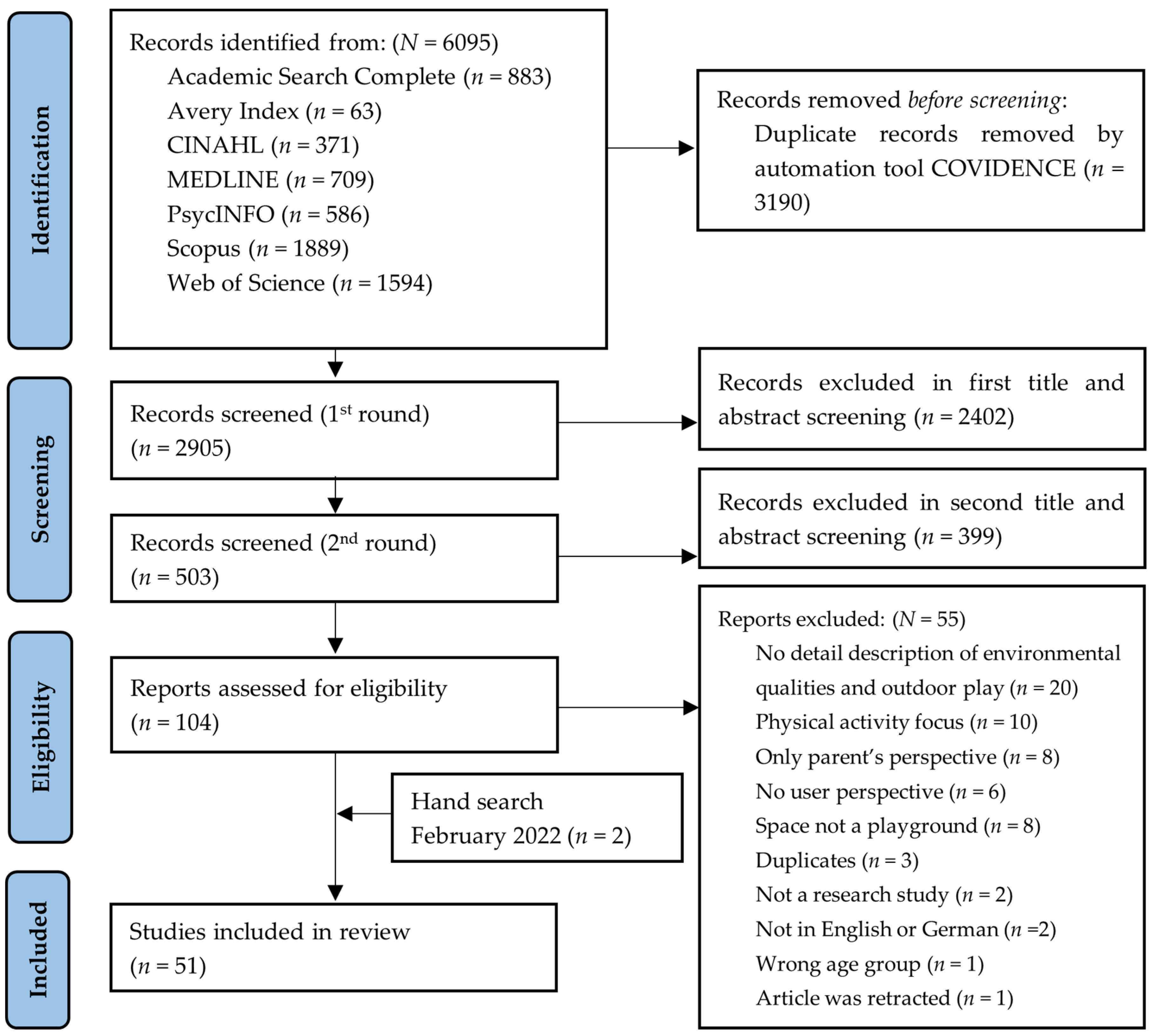
2.3. Study Selection (Stage 3)
2.4. Charting and Analysing the Data (Stage 4)
2.5. Collecting, Summarizing, and Reporting the Results (Stage 5)
3. Results
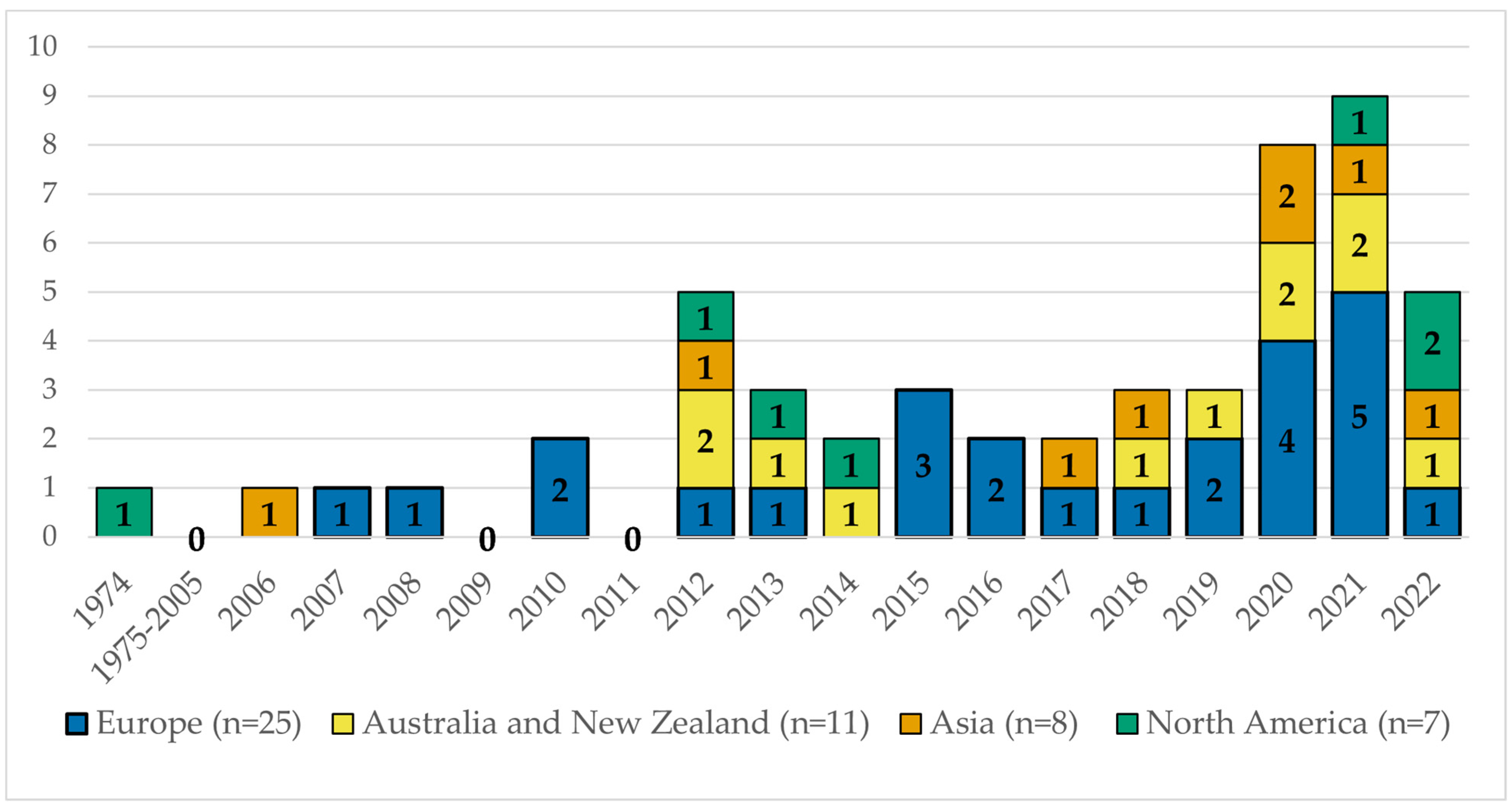
3.1. Descriptive Numerical Analysis of Included Studies
Playground and Participant Characteristics
3.2. Findings from Qualitative Content Analysis
3.2.1. We Seek More Intense Play Experiences
3.2.2. We Want to Make Our Own Choices about What to Play
3.2.3. We Value Both Playing with and away from Children and Adults
3.2.4. We Want to Belong to Our Playgrounds
3.2.5. We Desire Fun
4. Discussion
4.1. Physical, Social and Atmospheric Affordances for Outdoor Play
4.2. Adult’s Role in Outdoor Play Provision
4.3. Strengths and Limitations
4.4. Future Research
5. Conclusions
Author Contributions
Funding
Institutional Review Board Statement
Informed Consent Statement
Data Availability Statement
Acknowledgments
Conflicts of Interest
Appendix A

| Study Location of Data Collection | Aim | Study Design | Methodology | Participants Sample | Playgrounds Sample | |
|---|---|---|---|---|---|---|
| Adult Population (n, Sex, Age Range of the Children, Disabilities of Children if Applicable) | Type of Playground (n) | Urban/ Suburban/ Rural | ||||
| [113] van Engelen (2021) The Netherlands | To explore facilitators, barriers and solutions influencing the participation of children with physical disabilities in Dutch outdoor playgrounds, from parents’ and professionals’ perspectives. | Qual | Descriptive qualitative | n = 57 Fathers n = 1, Mothers n = 16 Parents from 4–12 y children Physical disabilities Professionsals (n = 40) | N/A | N/A |
| [118] Bekci (2021) Turky | To examine the concerns of parents on their children and the effect of environmental factors on children | Quant | Survey | n = missing Parents from 0–14 y children | Missing type (n = missing) | Urban |
| [119] Luo (2022) China | To study how public space (playgrounds) influences parents’ engagement with their young children. | Qual | Etnography | n = missing | Public playgrounds | Urban |
| [112] Prellwitz and Skär (2016) Sweden | To describe parents’ perceptions of the ways playgrounds affect the participation of their children with disabilities in play activities. | Qual | Descriptive qualitative | n = 18 Male n = 6, Female n = 12 Parents from 7–12 y children Cognitive disability (n = 4) Autism (n = 2) Visual impairment (n = 6) Motor impairment (n = 6) | Public and school playground (n = missing) | Rural |
| [120] Qiao (2021) China | To identify the consumer preferences of parents in the presence, location, form, operational features, safety requirements, and comfort of children’s playgrounds. | Quant | Survey | n = 1030 Male n = 422, Female n= 608 Parents from 3–9 y children | Public playground (n = missing) | Urban |
| [121] Stanton-Chapman & Schmidt (2017) United States of America | To survey and interview caregivers of children with disabilities (ages 2–5 years) to obtain their input as to whether current playground equipment meets their child’s needs | Mixed | Survey | n = 149 Male n = 25, Female n = 106 Parents, grandparents, and foster parents of 2–5-year-old children Specific language impairments Developmental delay Autism Orthopaedic impairment Intellectual disability Other health impairments Behaviour disorder Hearing impairment Learning disability | missing type (n = missing) | Missing |
| [33] Sterman et al., (2019) | To understand outdoor play decision-making for children with disabilities from the perspectives and interactions of: local government and families of primary school-aged children with disabilities. | Qual | Case study | n = 11 Mothers (n = 5) Local park officials (n = 4) Children and disability advocates (n = 2) Parents of 5–12-year-old children Multiple disabilities Development delay = 2 Autism n = 3 Intellectual disability n = 3 Hearing loss n = 1 Heart impairment n = 1 | Public Playgrounds (n = missing) | Urban |
| [122] Black and Ollerton (2021) | To explore whether Livvi’s Place, an inclusive playspace in Port Macquarie, Australia, met the principles and values articulated in Australia’s early childhood learning framework: Belonging, Being, and Becoming, and, more specifically, if the playspace was meeting its goal of social inclusion | Quant | Survey | n = 166 Parents (n = 16 children with disabilities) Parents (n = 150 no children with disabilities) Sex missing Parents of 0–14-year-old children | Public playground n = 2 | Urban |
Appendix B
| Study Location of Data Collection | Study Methods | Methodology | Participants Sample | Playground Sample | ||
|---|---|---|---|---|---|---|
| Children Population (n, Age Range, Sex, Disabilities If Applicable) | Adult Population (Role, n) | Type of Playground (n) | Urban/ Suburban/ Rural | |||
| [75] Aminpour et al., (2020) Australia | Qual | Qualitative descriptive | an = 228 (8–10 years) Sex is missing | N/A | School playground (naturalized) n = 3 | Urban |
| [76] Aminpour, (2021) Australia | Qual | Qualitative descriptive | an = 228 (8–10 years) Sex is missing | N/A | School playground (naturalized) n = 3 | Urban |
| [102] Birkner et al., (2021) Germany | Mixed | Descriptive qualitative and quantitative | n = 17 (2–14 years) Male n = 1 Female n = 16 | Parents n = 29 | N/A | N/A |
| [51] Bourke and Sargisson, (2014) New Zealand | Quant | Case study | n = 1534 * (0–14 years) Male n = 763, Female n = 771 | Park manager n = 2 | Public playground n = 1 | Suburban |
| [77] Burke, (2012) Australia | Qual | Case study | n = 72 (6–10 years) Male n = 42 Female n = 30 Diagnosis: intellectual impairment, balance difficulty, muscle weakness motor impairment, autism | N/A | Public playground n = missing | Missing |
| [84] Caro et al., (2016) The Netherlands | Qual | Participatory qualitative study | n = 18 (9–12 years) Male n= 8 Female n= 10 | N/A | School playground n = 3 | Urban |
| [91] Cetken-Aktas and Sevimli-Celik (2022) Turkey | Qunat | No information | n = 102 (5–6 years) Male n = 55 Female n = 47 | N/A | School playground (Early childcare) n = 6) | Missing |
| [52] Chen et al., (2020) China | Qual | Case study | n= 11 (4–7 years) Male n = missing Female n = missing | Parents n = 20 | Public Playground n = 8 | Urban |
| [101] Czalczynska-Podolska, (2014) USA | Quant | Case Study | n = 2217 * (2–12 years) Male n = 1028 Female n = 1184 | N/A | Public Playground n = 10 | Suburban |
| [93] Dyment and O’Connell, (2013) Australia | Quant | No information | n= 2361 * (years: missing) Male n= 1350, Female n = 1011 | N/A | School playground (Early childcare setting) n = 4 | Missing |
| [53] Fahy et al., (2021) Ireland | Qual | Ethnography | n = 5 (6–9 years) Male n= 5, Female n = 1 Diagnosis: autism | Teacher n = 3 | School and public playground n = missing | Rural |
| [81] Goodenough et al., (2021) United Kingdom | Qual | Ethnography | n = 12 (7–10 years) Male n= missing, Female n = missing | N/A | Public adventure playground n = 1 | Missing |
| [54] Hayward et al., (1974) USA | Mixed | No information | n = 91 in interview n = missing observation (years: missing) Male n= missing, Female n= missing | N/A | Public traditional, contemporary, and adventure playground n = 3 | Missing |
| [55] Horton & Kraftl, (2018) United Kingdome | Mixed | No information | n = 1243 survey n= 151 observation (5–13 years) Male n = 693, Female n = 730 | N/A | Public playground n = 3 | Urban |
| [95] James et al., (2022) Canada | Quant | Naturalistic observational | n = 1332 * (0–13 years) Male n = 51.82%, Female n = 48.20% Diagnosis: (n = 1 observation) mobility impairment | N/A | Public playground (inclusive) n = 1 | Missing |
| [56] Jansson and Persson, (2010) Sweden | Qual | Case study | bn = 141 (6–11 years) Male n= missing, Female n= missing | Parents n = 51 Teacher n = 10 | Public playground N = 24 | Rural |
| [78] Jansson et al., (2016) Sweden | Qual | Case study | n = 16 (10–11 years) Male n = 5, Female n = 11 | N/A | Public playground (and park) n= 10 | Suburban |
| [57] Jansson, (2008) Sweden | Qual | Case study | bn = 141 (6–11 years) Male n= missing, Female n= missing | N/A | Public playground n = 24 | Rural |
| [58] Jansson, (2010) Sweden | Qual | Case study | bn = 141 (6–11 years) Male n= missing, Female n= missing | Parents n = 51 Teachers n = 10 | Public playground n = 24 | Rural |
| [59] Jansson, (2015) Sweden | Qual | Case study | bn = 141 (6–11 years) Male n= missing, Female n= missing | Local Park worker n = missing | Public playground n = 24 | Rural |
| [60] Jeanes and Magee, (2012) United Kingdome | Qual | Case study | n = 19 (4–12 years) Male n= missing, Female n = missing Disabilities: visual impairment, deafness, autism, Down syndrome | Parents n = 14 | School playground n = 1 | Urban |
| [79] Khan et al., (2020) Bangladesh | Qual | Participatory case study | n = 29 (8–12 years) Male n = 13, Female n= 16 | Teacher n = 9 Parents n = 5 | School playground n = 1 | Rural |
| [92] Lerstrup & Konijnendijk van den Bosch, (2017) Denmark | Qual | Ethnography | n = 49 (3–6 years) Male n= missing, Female n= missing | N/A | School playground (Early childcare) n = 2 | Rural |
| [94] Loebach and Cox (2022) USA | Quant | No information | n = 693 * (0–8 years) Male n = 406, Female n = 287 | N/A | Public playground in a museeum (naturalized) n = 1 | Urban |
| [87] Luchs and Fikus, (2013) Germany | Quant | No information | n = 59 (5–6 years) Male n = 33, Female n = 26 | N/A | School playground n = 2 | Urban |
| [61] Lynch et al., (2020) Ireland | Qual | Case study | n = 12 (3–11 years) Male n = 5, Female n = 7 Diagnosis: ASD (n = 2); Down syndrome; (n = 1); mobility impairment (n = 1); visual impairment (n = 1) | Mother n = 6 Father n = 2 Grandparent n = 2 | Public playground (and park) n = 5 | Urban |
| [62] Min and Lee, (2006) Korea | Mixed | Case study | n= 91 (7–12 years) Male n = 62, Female n = 29 | N/A | Public playground n = 16 | Urban |
| [63] Moore et al., (2021) Australia | Qual | Case study | n = 6 (4–5 years) Male n = 2, Female n = 4 | N/A | School playground (Early childcare) n = 2 | Suburban |
| [83] Nasar and Holloman, (2013) USA | Quant | No information | n = 304 (9–11 years) Male n = 160, Female n = 143 Sex unknown n = 1 | Mother n = 58 Father n = 16 Unknown n = 1 | Public playground n = 14 | Urban |
| [64] Norðdahl and Einarsdóttir, (2015) Iceland | Qual | No information | n = 16 (4–9 years) Male n = 8, Female n = 8 | Teacher n = 5 Principals n = 2 | School playground n = 2 | Suburban |
| [65] Nunma and Kanki, (2021) Thailand | Mixed | No information | n = 58 (5–11 years) Male n = missing, Female n = missing | N/A | Public playground (Under motorway) n = 7 | Urban |
| [96] Obee et al., (2020) Norway | Qual | No information | n = 38 (3–5 years) Male n = 6, Female n = 5 Missing sex: n = 27 | N/A | School playground n = 1 | Missing |
| [66] Pitsikali and Parnell, (2019) Greece | Qual | Ethnography | n = missing (missing years) Male n = missing, Female n = missing | Mother, Father, Nanny, Grandparents n = missing | Public playground and piazza n = 3 | Urban |
| [67] Prellwitz and Skär, (2007) Sweden | Qual | Qualitative descriptive | n = 20 (7–12 years) Male n = 11, Female n = 9 | N/A | Public and school playground n = missing | Rural |
| [88] Refshauge et al., (2015) Denmark | Qual | Case study | n = 96 survey (0–12 years) Male n = 44, Female n = 52 n = 152 * Male n = 97, Female n = 55 | Adults n = 48 (survey) Adults n = 60 | Public playground (laboratory) n = 1 | Suburban |
| [68] Ripat and Becker, (2012) Canada | Qual | Qualitative descriptive | n = 9 (7–15 years) Male n = 3, Female n = 6 Diagnosis: mobility restrictions | Fathers n = 4 Mothers n = 8 Caregiver with disability n = 2 Teacher n = 1 | N/A | N/A |
| [69] Sanderud et al., (2020) Norway | Qual | Ethnography | n = 20 (3–6 years) Male n = missing, Female n = missing | N/A | School playground (naturalized) n = 1 | Suburban |
| [97] Sandseter et al., (2020) Norway | Quant | No Information | cn = 86 (3–6 years) Male n = 44, Female n = 42 | N/A | School playground (Early childcare) n = 8) | Missing |
| [98] Sandseter et al., (2021) Norway | Quant | No Information | cn = 86 (3–6 years) Male n = 44, Female n = 42 | N/A | School playground (Early childcare) n = 8) | Missing |
| [89] Sargisson and McLean, (2012) New Zeeland | Mixed | Cross-sectional | n = 4597 * (0–10+ years) Male n = missing, Female n = missing | N/A | Public playground n = 44 | Urban, Suburban and Rural |
| [73] Stanton-Chapman and Schmidt, (2021) USA | Mixed | Case study | n = 6 (4–5 years) Male n = 3, Female n = 3 | N/A | Public and school playground n = 2 | Urban |
| [74] Stettler et al., (2022) Switzerland | Qual | Secondary qualitative content analasis | dn = 5 (9–12 years) Male n = 4, Female n = 1 Diagnosis: Cerebral Pasly | N/A | Public playground (inclusive) n = 1 | Missing |
| [82] Tandoğan, (2017) Turkey | Qual | No information | n = 27 (5–10 years) Male n = 15, Female n = 12 | N/A | N/A | Urban |
| [80] Truong and Mahon, (2012) Thailand | Qual | No information | n = 23 (8–12 years) Male n = 12, Female n = 11 | N/A | Public playground (community centre) n = 1 | Missing |
| [70] Veitch et al., (2020) Australia | Qual | Qualitative descriptive | n = 30 (8–12 years) Male n = 14, Female n = 16 | N/A | Public playground (and park) n = 9 | Urban |
| [100] Veitch et al. (2021) Austrailia | Quant | Cross-sectional | n = 252 (8–12 years) Male n = 105, Female n = 147 | N/A | N/A | Urban |
| [99] Wang et al., (2018) China | Quant | Cross-sectional | n = 247 (4–6 years) Male n = missing, Female n = missing | Parents n = 236 | Public playground N/A | Urban |
| [71] Ward, (2018) Australia | Mixed | Participatory | n = 82 (3–9 years) Male n = missing, Female n = missing | N/A | Public playground (by shopping mall) n = 1 | Urban |
| [72] Wenger et al., (2021) Switzerland | Qual | Qualitative descriptive | dn = 32 (7–12 years) Male n = 23, Female n = 9 Diagnosis: motor impairment, visual impairment, autism, intellectual disability, developmental disability | N/A | Public playground (inclusive) n = 6 | Urban and Suburban |
| [90] Wishart et al., (2019) Australia | Quant | No information | n = 50 (4–5 years) Male n = missing, Female n = missing | N/A | School playground n = 2 | Urban |
| [85] Yates and Oates, (2019) United Kingdome | Qual | Participatory case study | n = 60 (6–7 years) Male n = missing, Female n = missing | N/A | Public playground n = 2 | Rural |
References
- United Nations UN Convention on the Rights of the Child (UNCRC). Available online: https://www.unicef.org.au/united-nations-convention-on-the-rights-of-the-child (accessed on 23 June 2022).
- United Nations Committee on the Rights of the Child. General Comment No. 17 (2013) on the Right of the Child to Rest, Leisure, Play, Recreational Activities, Cultural Life and the Arts (Art. 31). Available online: https://www.refworld.org/docid/51ef9bcc4.html (accessed on 14 December 2021).
- Wray, A.; Martin, G.; Ostermeier, E.; Medeiros, A.; Little, M.; Reilly, K.; Gilliland, J. Physical Activity and Social Connectedness Interventions in Outdoor Spaces among Children and Youth: A Rapid Review. Health Promot. Chronic Dis. Prev. Can. 2020, 40, 104–115. [Google Scholar] [CrossRef] [PubMed]
- Vincent, L.; Openden, D.; Gentry, J.; Long, L.; Matthews, N. Promoting Social Learning at Recess for Children with ASD and Related Social Challenges. Behav. Anal. Pract. 2018, 11, 19–33. [Google Scholar] [CrossRef] [PubMed]
- Flores, F.; Rodrigues, L.; Copetti, F.; Lopes, F.; Cordovil, R. Affordances for Motor Skill Development in Home, School, and Sport Environments: A Narrative Review. Percept. Mot. Skills 2019, 126, 366–388. [Google Scholar] [CrossRef] [PubMed]
- Farmer, V.L.; Williams, S.M.; Mann, J.I.; Schofield, G.; McPhee, J.C.; Taylor, R.W. The Effect of Increasing Risk and Challenge in the School Playground on Physical Activity and Weight in Children: A Cluster Randomised Controlled Trial (PLAY). Int. J. Obes. 2017, 41, 793–800. [Google Scholar] [CrossRef]
- Lester, S.; Russell, W. Turning the World Upside Down: Playing as the Deliberate Creation of Uncertainty. Children 2014, 1, 241–260. [Google Scholar] [CrossRef]
- Goodley, D.; Runswick-Cole, K. Emancipating Play: Dis/Abled Children, Development and Deconstruction. Disabil. Soc. 2010, 25, 499–512. [Google Scholar] [CrossRef]
- Wood, E. New Directions in Play: Consensus or Collision? Education 3–13 2007, 35, 309–320. [Google Scholar] [CrossRef]
- Brown, T.; Lynch, H. Children’s Play–Work Occupation Continuum: Play-Based Occupational Therapy, Play Therapy and Playwork. Can. J. Occup. Ther. 2022, 000841742211301. [Google Scholar] [CrossRef]
- Lester, S.; Russell, W. Play for a Change: Play, Policy and Practice: A Review of Contemporary Perspectives: Summary Report; National Children’s Bureau: London, UK, 2008; ISBN 978-1-905818-40-2. [Google Scholar]
- Burke, J. Just for the Fun of It: Making Playgrounds Accessible to All Children. World Leis. J. 2013, 55, 83–95. [Google Scholar] [CrossRef]
- Moore, A.; Lynch, H. Accessibility and Usability of Playground Environments for Children under 12: A Scoping Review. Scand. J. Occup. Ther. 2015, 22, 331–344. [Google Scholar] [CrossRef]
- Sterman, J.; Naughton, G.; Froude, E.; Villeneuve, M.; Beetham, K.; Wyver, S.; Bundy, A. Outdoor Play Decisions by Caregivers of Children with Disabilities: A Systematic Review of Qualitative Studies. J. Dev. Phys. Disabil. 2016, 27, 931–957. [Google Scholar] [CrossRef]
- Van Heel, B.F.; van den Born, R.J.G.; Aarts, M.N.C. Everyday Childhood Nature Experiences in an Era of Urbanisation: An Analysis of Dutch Children’s Drawings of Their Favourite Place to Play Outdoors. Child. Geogr. 2022, 1–16. [Google Scholar] [CrossRef]
- Lynch, H. Patterns of Activity of Irish Children Aged Five to Eight Years: City Living in Ireland Today. J. Occup. Sci. 2009, 16, 44–49. [Google Scholar] [CrossRef]
- Loebach, J.; Gilliland, J. Child-Led Tours to Uncover Children’s Perceptions and Use of Neighborhood Environments. Child. Youth Environ. 2010, 20, 52–90. [Google Scholar]
- Little, H.; Eager, D. Risk, Challenge and Safety: Implications for Play Quality and Playground Design. Eur. Early Child. Educ. Res. J. 2010, 18, 497–513. [Google Scholar] [CrossRef]
- Loebach, J.; Gilliland, J. Examining the Social and Built Environment Factors Influencing Children’s Independent Use of Their Neighborhoods and the Experience of Local Settings as Child-Friendly. J. Plan. Educ. Res. 2019, 42, 0739456X19828444. [Google Scholar] [CrossRef]
- Nicholson, J.; Kurnik, J.; Jevgjovikj, M.; Ufoegbune, V. Deconstructing Adults’ and Children’s Discourse on Children’s Play: Listening to Children’s Voices to Destabilise Deficit Narratives. Early Child Dev. Care 2015, 185, 1569–1586. [Google Scholar] [CrossRef]
- Finney, R.; Atkinson, C. Children’s Views about Factors Affecting Access to Home, School and Community Play. Int. J. Play 2020, 9, 439–456. [Google Scholar] [CrossRef]
- Moore, A.; Lynch, H. Understanding a Child’s Conceptualisation of Well-Being through an Exploration of Happiness: The Centrality of Play, People and Place. J. Occup. Sci. 2018, 25, 124–141. [Google Scholar] [CrossRef]
- Moore, A.; Lynch, H.; Boyle, B. Can Universal Design Support Outdoor Play, Social Participation, and Inclusion in Public Playgrounds? A Scoping Review. Disabil. Rehabil. 2022, 44, 3304–3325. [Google Scholar] [CrossRef]
- Woolley, H.; Lowe, A. Exploring the Relationship between Design Approach and Play Value of Outdoor Play Spaces. Landsc. Res. 2013, 38, 53–74. [Google Scholar] [CrossRef]
- Rasmussen, K. Places for Children—Children’s Places. Childhood 2004, 11, 155–173. [Google Scholar] [CrossRef]
- Jansson, M.; Ramberg, U. Implementation and Effects of User Participation in Playground Management: A Comparative Study of Two Swedish Municipalities. Manag. Leis. 2012, 17, 1–13. [Google Scholar] [CrossRef]
- Gallerani, D.G.; Besenyi, G.M.; Wilhelm Stanis, S.A.; Kaczynski, A.T. “We Actually Care and We Want to Make the Parks Better”: A Qualitative Study of Youth Experiences and Perceptions after Conducting Park Audits. Prev. Med. 2017, 95, S109–S114. [Google Scholar] [CrossRef] [PubMed]
- Wenger, I.; Prellwitz, M.; Lundström, U.; Lynch, H.; Schulze, C. Designing Inclusive Playgrounds in Switzerland: Why Is It so Complex? Child. Geogr. 2022, 1–15. [Google Scholar] [CrossRef]
- Dunn, K.; Moore, M. Developing Accessible Play Space in the UK: A Social Model Approach. Child. Youth Environ. 2005, 15, 332–354. [Google Scholar]
- Lynch, H.; Moore, A.; Prellwitz, M. From Policy to Play Provision: Universal Design and the Challenges of Inclusive Play. Child. Youth Environ. 2018, 28, 12. [Google Scholar] [CrossRef]
- Moore, A.; Lynch, H.; Boyle, B. A National Study of Playground Professionals Universal Design Implementation Practices. Landsc. Res. 2022, 47, 611–627. [Google Scholar] [CrossRef]
- Prellwitz, M.; Tamm, M.; Lindqvist, R. Are Playgrounds in Norrland (Northern Sweden) Accessible to Children with Restricted Mobility? Scand. J. Disabil. Res. 2001, 3, 56–68. [Google Scholar] [CrossRef]
- Sterman, J.J.; Naughton, G.A.; Bundy, A.C.; Froude, E.; Villeneuve, M.A. Planning for Outdoor Play: Government and Family Decision-Making. Scand. J. Occup. Ther. 2019, 26, 484–495. [Google Scholar] [CrossRef]
- Woolley, H. Now Being Social: The Barrier of Designing Outdoor Play Spaces for Disabled Children. Child. Soc. 2013, 27, 448–458. [Google Scholar] [CrossRef]
- Olsen, H.M.; Dieser, R.B. I Am Hoping You Can Point Me in the Right Direction Regarding Playground Accessibility: A Case Study of a Community Which Lacked Social Policy toward Playground Accessibility. World Leis. J. 2012, 54, 269–279. [Google Scholar] [CrossRef]
- Van Melik, R.; Althuizen, N. Inclusive Play Policies: Disabled Children and Their Access to Dutch Playgrounds. Tijdschr. Voor Econ. Soc. Geogr. 2022, 113, 117–130. [Google Scholar] [CrossRef]
- Brown, D.M.Y.; Ross, T.; Leo, J.; Buliung, R.N.; Shirazipour, C.H.; Latimer-Cheung, A.E.; Arbour-Nicitopoulos, K.P. A Scoping Review of Evidence-Informed Recommendations for Designing Inclusive Playgrounds. Front. Rehabil. Sci. 2021, 2, 664595. [Google Scholar] [CrossRef]
- Fernelius, C.L.; Christensen, K.M. Systematic Review of Evidence-Based Practices for Inclusive Playground Design. Child. Youth Environ. 2017, 27, 78. [Google Scholar] [CrossRef]
- Jerebine, A.; Fitton-Davies, K.; Lander, N.; Eyre, E.L.J.; Duncan, M.J.; Barnett, L.M. “All the Fun Stuff, the Teachers Say, ‘That’s Dangerous!’” Hearing from Children on Safety and Risk in Active Play in Schools: A Systematic Review. Int. J. Behav. Nutr. Phys. Act. 2022, 19, 72. [Google Scholar] [CrossRef]
- Moore, A.; Boyle, B.; Lynch, H. Designing for Inclusion in Public Playgrounds: A Scoping Review of Definitions, and Utilization of Universal Design. Disabil. Rehabil. Assist. Technol. 2022, 1–13. [Google Scholar] [CrossRef]
- Moore, A.; Boyle, B.; Lynch, H. Designing Public Playgrounds for Inclusion: A Scoping Review of Grey Literature Guidelines for Universal Design. Child. Geogr. 2022, 1–17. [Google Scholar] [CrossRef]
- Arksey, H.; O’Malley, L. Scoping Studies: Towards a Methodological Framework. Int. J. Soc. Res. Methodol. 2005, 8, 19–32. [Google Scholar] [CrossRef]
- Munn, Z.; Pollock, D.; Khalil, H.; Alexander, L.; Mclnerney, P.; Godfrey, C.M.; Peters, M.; Tricco, A.C. What Are Scoping Reviews? Providing a Formal Definition of Scoping Reviews as a Type of Evidence Synthesis. JBI Evid. Synth. 2022, 20, 950–952. [Google Scholar] [CrossRef]
- Peters, M.; Godfrey, C.; McInerney, P.; Munn, Z.; Trico, A.; Khalil, H. Chapter 11: Scoping Reviews. In JBI Manual for Evidence Synthesis; Aromataris, E., Munn, Z., Eds.; JBI: Long Beach, CA, USA, 2020; ISBN 978-0-648-84880-6. [Google Scholar]
- Levac, D.; Colquhoun, H.; O’Brien, K.K. Scoping Studies: Advancing the Methodology. Implement. Sci. 2010, 5, 69. [Google Scholar] [CrossRef]
- Morgenthaler, T.; Lynch, H.; Pentland, D.; Schulze, C. Environmental Qualities of Public Playgrounds from the User Perspective: A Scoping Review Protocol. Available online: https://osf.io/um7cd/ (accessed on 9 December 2022).
- Covidence Systematic Review Software; Cochrane Library: Chichester, UK, 2021.
- Hong, Q.N.; Pluye, P.; Bujold, M.; Wassef, M. Convergent and Sequential Synthesis Designs: Implications for Conducting and Reporting Systematic Reviews of Qualitative and Quantitative Evidence. Syst. Rev. 2017, 6, 61. [Google Scholar] [CrossRef]
- Graneheim, U.H.; Lundman, B. Qualitative Content Analysis in Nursing Research: Concepts, Procedures and Measures to Achieve Trustworthiness. Nurse Educ. Today 2004, 24, 105–112. [Google Scholar] [CrossRef]
- ATLAS.ti Scientific Software Development GmbH. ATLAS.ti, version 22; ScienceSoft, Software Development Company: McKinney, TX, USA, 2022. [Google Scholar]
- Bourke, T.M.; Sargisson, R.J. A Behavioral Investigation of Preference in a Newly Designed New Zealand Playground. Am. J. Play 2014, 6, 370–391. [Google Scholar]
- Chen, C.; Yuan, Z.; Zhu, H. Playing, Parenting and Family Leisure in Parks: Exploring Emotional Geographies of Families in Guangzhou Children’s Park, China. Child. Geogr. 2020, 18, 463–476. [Google Scholar] [CrossRef]
- Fahy, S.; Delicâte, N.; Lynch, H. Now, Being, Occupational: Outdoor Play and Children with Autism. J. Occup. Sci. 2021, 28, 114–132. [Google Scholar] [CrossRef]
- Hayward, D.G.; Rothenberg, M.; Beasley, R. Children’s Play and Urban Playground Environments: A Comparison of Traditional, Contemporary, and Adventure Playground Types. Environ. Behav. 1974, 6, 131–168. [Google Scholar] [CrossRef]
- Horton, J.; Kraftl, P. Three Playgrounds: Researching the Multiple Geographies of Children’s Outdoor Play. Environ. Plan. Econ. Space 2018, 50, 214–235. [Google Scholar] [CrossRef]
- Jansson, M.; Persson, B. Playground Planning and Management: An Evaluation of Standard-Influenced Provision through User Needs. Urban For. Urban Green. 2010, 9, 33–42. [Google Scholar] [CrossRef]
- Jansson, M. Children’s Perspectives on Public Playgrounds in Two Swedish Communities. Child. Youth Environ. 2008, 18, 88–109. [Google Scholar] [CrossRef]
- Jansson, M. Attractive Playgrounds: Some Factors Affecting User Interest and Visiting Patterns. Landsc. Res. 2010, 35, 63–81. [Google Scholar] [CrossRef]
- Jansson, M. Children’s Perspectives on Playground Use as Basis for Children’s Participation in Local Play Space Management. Local Environ. 2015, 20, 165–179. [Google Scholar] [CrossRef]
- Jeanes, R.; Magee, J. ‘Can We Play on the Swings and Roundabouts?’: Creating Inclusive Play Spaces for Disabled Young People and Their Families. Leis. Stud. 2012, 31, 193–210. [Google Scholar] [CrossRef]
- Lynch, H.; Moore, A.; Edwards, C.; Horgan, L. Advancing Play Participation for All: The Challenge of Addressing Play Diversity and Inclusion in Community Parks and Playgrounds. Br. J. Occup. Ther. 2020, 83, 107–117. [Google Scholar] [CrossRef]
- Min, B.; Lee, J. Children’s Neighborhood Place as a Psychological and Behavioral Domain. J. Environ. Psychol. 2006, 26, 51–71. [Google Scholar] [CrossRef]
- Moore, D.; Morrissey, A.-M.; Robertson, N. ‘I Feel like I’m Getting Sad There’: Early Childhood Outdoor Playspaces as Places for Children’s Wellbeing. Early Child Dev. Care 2021, 191, 933–951. [Google Scholar] [CrossRef]
- Norðdahl, K.; Einarsdóttir, J. Children’s Views and Preferences Regarding Their Outdoor Environment. J. Adventure Educ. Outdoor Learn. 2015, 15, 152–167. [Google Scholar] [CrossRef]
- Nunma, P.; Kanki, K. Playing under the Flyover in Bangkok from the Children’s Point of View. J. Asian Archit. Build. Eng. 2021, 21, 865–883. [Google Scholar] [CrossRef]
- Pitsikali, A.; Parnell, R. The Public Playground Paradox: ‘Child’s Joy’ or Heterotopia of Fear? Child. Geogr. 2019, 17, 719–731. [Google Scholar] [CrossRef]
- Prellwitz, M.; Skär, L. Usability of Playgrounds for Children with Different Abilities. Occup. Ther. Int. 2007, 14, 144–155. [Google Scholar] [CrossRef] [PubMed]
- Ripat, J.; Becker, P. Playground Usability: What Do Playground Users Say? Occup. Ther. Int. 2012, 19, 144–153. [Google Scholar] [CrossRef]
- Sanderud, J.R.; Gurholt, K.P.; Moe, V.F. ‘Winter Children’: An Ethnographically Inspired Study of Children Being-and-Becoming Well-Versed in Snow and Ice. Sport Educ. Soc. 2020, 25, 960–971. [Google Scholar] [CrossRef]
- Veitch, J.; Flowers, E.; Ball, K.; Deforche, B.; Timperio, A. Exploring Children’s Views on Important Park Features: A Qualitative Study Using Walk-along Interviews. Int. J. Environ. Res. Public. Health 2020, 17, 4625. [Google Scholar] [CrossRef]
- Ward, K. What’s in a Dream? Natural Elements, Risk and Loose Parts in Children’s Dream Playspace Drawings. Australas. J. Early Child. 2018, 43, 34–42. [Google Scholar] [CrossRef]
- Wenger, I.; Schulze, C.; Lundström, U.; Prellwitz, M. Children’s Perceptions of Playing on Inclusive Playgrounds: A Qualitative Study. Scand. J. Occup. Ther. 2021, 28, 136–146. [Google Scholar] [CrossRef]
- Stanton-Chapman, T.L.; Schmidt, E.L. How Do the Children Play? The Influence of Playground Type on Children’s Play Styles. Front. Psychol. 2021, 12, 703940. [Google Scholar] [CrossRef]
- Stettler, S.; Haas, M.; Wenger, I.; Egger, S.; Schulze, C. “Alles Ist Möglich!”—Das Spielerleben Con Kindern Mit Zerebralparese Auf Einem Inklusiven Spielplatz [“Anything Is Possible!”—Play Experaince of Children with Cerebral Palsy on an Inclusive Playground]. Ergoscience 2022, 17, 54–61. [Google Scholar] [CrossRef]
- Aminpour, F.; Bishop, K.; Corkery, L. The Hidden Value of In-between Spaces for Children’s Self-Directed Play within Outdoor School Environments. Landsc. Urban Plan. 2020, 194, 103683. [Google Scholar] [CrossRef]
- Aminpour, F. The Physical Characteristics of Children’s Preferred Natural Settings in Australian Primary School Grounds. Urban For. Urban Green. 2021, 62, 127163. [Google Scholar] [CrossRef]
- Burke, J. ‘Some Kids Climb up; Some Kids Climb down’: Culturally Constructed Play-Worlds of Children with Impairments. Disabil. Soc. 2012, 27, 965–981. [Google Scholar] [CrossRef]
- Jansson, M.; Sundevall, E.; Wales, M. The Role of Green Spaces and Their Management in a Child-Friendly Urban Village. Urban For. Urban Green. 2016, 18, 228–236. [Google Scholar] [CrossRef]
- Khan, M.; Bell, S.; McGeown, S.; Silveirinha de Oliveira, E. Designing an Outdoor Learning Environment for and with a Primary School Community: A Case Study in Bangladesh. Landsc. Res. 2020, 45, 95–110. [Google Scholar] [CrossRef]
- Truong, S.; Mahon, M. Through the Lens of Participatory Photography: Engaging Thai Children in Research about Their Community Play Centre. Int. J. Play 2012, 1, 75–90. [Google Scholar] [CrossRef]
- Goodenough, A.; Waite, N.; Wright, N. Place as Partner: Material and Affective Intra-Play between Young People and Trees. Child. Geogr. 2021, 19, 225–240. [Google Scholar] [CrossRef]
- Tandoğan, O. Çizimleri Ile Çocuklarin Ideal Okul Bahçelerinin Değerlendirilmesi [An assessment of Children’s Ideal Schoolyards through Their Drawings]. Int. Refereed J. Des. Archit. 2017, 11, 21–40. [Google Scholar] [CrossRef]
- Nasar, J.L.; Holloman, C.H. Playground Characteristics to Encourage Children to Visit and Play. J. Phys. Act. Health 2013, 10, 1201–1208. [Google Scholar] [CrossRef]
- Caro, H.; Altenburg, T.; Dedding, C.; Chinapaw, M. Dutch Primary Schoolchildren’s Perspectives of Activity-Friendly School Playgrounds: A Participatory Study. Int. J. Environ. Res. Public. Health 2016, 13, 526. [Google Scholar] [CrossRef]
- Yates, E.; Oates, R. Young Children’s Views on Play Provision in Two Local Parks: A Research Project by Early Childhood Studies Students and Staff. Childhood 2019, 26, 491–508. [Google Scholar] [CrossRef]
- Clark, A. Transforming Children’s Spaces: Children’s and Adults’ Participation in Designing Learning Environments; Taylor & Francis Group: London, UK, 2010; ISBN 978-0-203-85758-8. [Google Scholar]
- Luchs, A.; Fikus, M. A Comparative Study of Active Play on Differently Designed Playgrounds. J. Adventure Educ. Outdoor Learn. 2013, 13, 206–222. [Google Scholar] [CrossRef]
- Refshauge, A.D.; Stigsdotter, U.K.; Lamm, B.; Thorleifsdottir, K. Evidence-Based Playground Design: Lessons Learned from Theory to Practice. Landsc. Res. 2015, 40, 226–246. [Google Scholar] [CrossRef]
- Sargisson, R.J.; McLean, I.G. Children’s Use of Nature in New Zealand Playgrounds. Child. Youth Environ. 2012, 22, 144–163. [Google Scholar] [CrossRef]
- Wishart, L.; Cabezas-Benalcázar, C.; Morrissey, A.-M.; Versace, V.L. Traditional vs. Naturalised Design: A Comparison of Affordances and Physical Activity in Two Preschool Playscapes. Landsc. Res. 2019, 44, 1031–1049. [Google Scholar] [CrossRef]
- Cetken-Aktas, S.; Sevimli-Celik, S. Play Preferences of Preschoolers According to the Design of Outdoor Play Areas. Early Child. Educ. J. 2022, 1–16. [Google Scholar] [CrossRef]
- Lerstrup, I.; Konijnendijk van den Bosch, C. Affordances of Outdoor Settings for Children in Preschool: Revisiting Heft’s Functional Taxonomy. Landsc. Res. 2017, 42, 47–62. [Google Scholar] [CrossRef]
- Dyment, J.; O’Connell, T.S. The Impact of Playground Design on Play Choices and Behaviors of Pre-School Children. Child. Geogr. 2013, 11, 263–280. [Google Scholar] [CrossRef]
- Loebach, J.; Cox, A. Playing in ‘The Backyard’: Environmental Features and Conditions of a Natural Playspace Which Support Diverse Outdoor Play Activities among Younger Children. Int. J. Environ. Res. Public. Health 2022, 19, 12661. [Google Scholar] [CrossRef]
- James, M.E.; Jianopoulos, E.; Ross, T.; Buliung, R.; Arbour-Nicitopoulos, K.P. Children’s Usage of Inclusive Playgrounds: A Naturalistic Observation Study of Play. Int. J. Environ. Res. Public. Health 2022, 19, 13648. [Google Scholar] [CrossRef]
- Obee, P.; Sandseter, E.B.H.; Harper, N.J. Children’s Use of Environmental Features Affording Risky Play in Early Childhood Education and Care. Early Child Dev. Care 2020, 191, 2607–2625. [Google Scholar] [CrossRef]
- Sandseter, E.B.H.; Storli, R.; Sando, O.J. The Dynamic Relationship between Outdoor Environments and Children’s Play. Education 3–13 2020, 50, 97–110. [Google Scholar] [CrossRef]
- Sandseter, E.B.H.; Sando, O.J.; Kleppe, R. Associations between Children’s Risky Play and ECEC Outdoor Play Spaces and Materials. Int. J. Environ. Res. Public. Health 2021, 18, 3354. [Google Scholar] [CrossRef]
- Wang, X.; Woolley, H.; Tang, Y.; Liu, H.; Luo, Y. Young Children’s and Adults’ Perceptions of Natural Play Spaces: A Case Study of Chengdu, Southwestern China. Cities 2018, 72, 173–180. [Google Scholar] [CrossRef]
- Veitch, J.; Ball, K.; Rivera, E.; Loh, V.; Deforche, B.; Timperio, A. Understanding Children’s Preference for Park Features That Encourage Physical Activity: An Adaptive Choice Based Conjoint Analysis. Int. J. Behav. Nutr. Phys. Act. 2021, 18, 133. [Google Scholar] [CrossRef] [PubMed]
- Czalczynska-Podolska, M. The Impact of Playground Spatial Features on Children’s Play and Activity Forms: An Evaluation of Contemporary Playgrounds’ Play and Social Value. J. Environ. Psychol. 2014, 38, 132–142. [Google Scholar] [CrossRef]
- Birkner, L.; Menek, L.; Eitel, C. The way to play—Spielplatzentwurf für ein Klinik-Außengelände für Kinder zwischen 1.5 und 14 Jahren [The way to play—Playground design for a clinic outdoor area for children between 1.5 and 14 years]. Ergoscience 2021, 16, 3–11. [Google Scholar] [CrossRef]
- Heft, H. Affordances of Children’s Environments: A Functional Approach to Environmental Description. Child. Environ. Q. 1988, 5, 29–37. [Google Scholar] [CrossRef]
- Kyttä, M. Affordances of Children’s Environments in the Context of Cities, Small Towns, Suburbs and Rural Villages in Finland and Belarus. J. Environ. Psychol. 2002, 22, 109–123. [Google Scholar] [CrossRef]
- Gibson, J.J. The Ecological Approach to Visual Perception; Lawrence Erlbaum Associates, Inc.: Hillsdale, NJ, USA, 1979. [Google Scholar]
- Sandseter, E.B.H. Categorising Risky Play—How Can We Identify Risk-taking in Children’s Play? Eur. Early Child. Educ. Res. J. 2007, 15, 237–252. [Google Scholar] [CrossRef]
- Brunelle, S.; Herrington, S.; Coghlan, R.; Brussoni, M. Play Worth Remembering: Are Playgrounds Too Safe? Child. Youth Environ. 2016, 26, 17. [Google Scholar] [CrossRef]
- Gill, T. The Benefits of Children’s Engagement with Nature: A Systematic Literature Review. Child. Youth Environ. 2014, 24, 10. [Google Scholar] [CrossRef]
- Lund Fasting, M.; Høyem, J. Freedom, Joy and Wonder as Existential Categories of Childhood—Reflections on Experiences and Memories of Outdoor Play. J. Adventure Educ. Outdoor Learn. 2022, 1–14. [Google Scholar] [CrossRef]
- Cosco, N.; Moore, R. Creating Inclusive Naturalized Outdoor Play Environments. Available online: https://www.child-encyclopedia.com/outdoor-play/according-experts/creating-inclusive-naturalized-outdoor-play-environments (accessed on 26 July 2022).
- Horton, J. Disabilities, Urban Natures and Children’s Outdoor Play. Soc. Cult. Geogr. 2017, 18, 1152–1174. [Google Scholar] [CrossRef]
- Prellwitz, M.; Skär, L. Are Playgrounds a Case of Occupational Injustice? Experiences of Parents of Children with Disabilities. Child. Youth Environ. 2016, 26, 28. [Google Scholar] [CrossRef]
- Van Engelen, L.; Ebbers, M.; Boonzaaijer, M.; Bolster, E.A.M.; van der Put, E.A.H.; Bloemen, M.A.T. Barriers, Facilitators and Solutions for Active Inclusive Play for Children with a Physical Disability in the Netherlands: A Qualitative Study. BMC Pediatr. 2021, 21, 369. [Google Scholar] [CrossRef] [PubMed]
- Woodgate, R.L.; Gonzalez, M.; Demczuk, L.; Snow, W.M.; Barriage, S.; Kirk, S. How Do Peers Promote Social Inclusion of Children with Disabilities?A Mixed-Methods Systematic Review. Disabil. Rehabil. 2020, 42, 2553–2579. [Google Scholar] [CrossRef]
- Lundy, L. ‘Voice’ Is Not Enough: Conceptualising Article 12 of the United Nations Convention on the Rights of the Child. Br. Educ. Res. J. 2007, 33, 927–942. [Google Scholar] [CrossRef]
- Checkoway, B. What Is Youth Participation? Child. Youth Serv. Rev. 2011, 33, 340–345. [Google Scholar] [CrossRef]
- Lundy, L. In Defence of Tokenism? Implementing Children’s Right to Participate in Collective Decision-Making. Childhood 2018, 25, 340–354. [Google Scholar] [CrossRef]
- Bekci, B. The Effect of Environmental Factors on Children from the Viewpoint of Parents. Int. J. Archit. Plan. 2021, 9, 155–172. [Google Scholar] [CrossRef]
- Luo, X. Protecting and Scaffolding: How Parents Facilitate Children’s Activities in Public Space in Urban China. ECNU Rev. Educ. 2022, 5, 242–257. [Google Scholar] [CrossRef]
- Qiao, S. Organizing Play Spaces for Children in China’s Megalopolises: Preferences and Requirements of Parents. Early Child Dev. Care 2021, 191, 1590–1601. [Google Scholar] [CrossRef]
- Stanton-Chapman, T.L.; Schmidt, E.L. Caregiver Perceptions of Inclusive Playgrounds Targeting Toddlers and Preschoolers with Disabilities: Has Recent International and National Policy Improved Overall Satisfaction? J. Res. Spec. Educ. Needs 2017, 17, 237–246. [Google Scholar] [CrossRef]
- Black, R.; Ollerton, J. Playspace Users’ Experience of a Socially Inclusive Playspace: The Case Study of Livvi’s Place, Port Macquarie, New South Wales, Australia. World Leis. J. 2021, 64, 3–22. [Google Scholar] [CrossRef]
| Concepts | Search Terms |
|---|---|
| Playground | playground * OR playscap * OR playspac * OR “play spac *” OR “play area *” |
| Environment | buil * OR design * OR provi * OR natur * OR outdoor OR inclusive |
| Population | child * OR kid * OR caregiver * OR parent * OR mother * OR father * OR famil * |
| Inclusion Criteria | Exclusion Criteria |
|---|---|
| The primary focus is on public playgrounds built for the purpose of play, including playgrounds in community environments such as parks and schools. | Spaces used for play but not built for the purpose of play (e.g., forest areas used for play, studies concerning community neighbourhoods) |
| Studies that consider environmental qualities and outdoor play | Studies that only investigate environmental qualities (e.g., accessibility) and do not relate environmental qualities to outdoor play |
| Studies about outdoor play considering play for the sake of play | Studies about outdoor play for other means: (1) health reasons (e.g., outdoor play for physical activity), (2) learning, (3) restoration, (4) social interaction, or (5) interventions |
| Studies with populations of children and youth between 0 and 12 years, with and/or without disability. | Studies only addressing children and youth populations older than 12 years of age. Studies addressing only family caregiver (parents, legal guardians) and expert perspectives (e.g., teachers, landscape architects, playground providers, health professionals) |
| A primary peer-reviewed study including qualitative, quantitative, and mixed methods | Not a primary research study (e.g., opinion pieces, editorials, systematic reviews, methodological papers, historical papers, papers concerning measurement development, conference proceedings) |
| Written in English or German | Languages other than English or German |
| Methods | Study Reference Number | n |
|---|---|---|
| Verbal accounts | ||
| Semi-structured interviews | [51,52,53,54,55,56,57,58,59,60,61,62,63,64,65,66,67,68,69,70,71,72,73] | 23 |
| Secondary analysis of semi structured interviews | [74] | 1 |
| Focus groups | [56,57,58,59,75,76,77,78,79,80] | 10 |
| Walk-along talks | [55,61,63,64,70,75,76,78,80,81] | 10 |
| Play along | [69] | 1 |
| Creative methods | ||
| Children’s drawings | [53,63,71,79,80,82] | 6 |
| Playground model creation | [63,79,80,81] | 4 |
| Picture sorting | [53,83] | 2 |
| Scrapbooking | [77] | 1 |
| Children taking pictures | [63,77,80] | 3 |
| Referred to participatory methods | [79,80,84,85] | 3 |
| Referred to Mosaic approach [86] | [53,63,77,85] | 4 |
| Observational methods | ||
| Systematic observation (including behavior mapping) | [51,54,62,73,75,76,87,88,89,90,91] | 11 |
| Unsystematic observation | [52,53,58,65,66,69,72,77,92] | 9 |
| Observation using instruments | [83,91,93,94,95] | 5 |
| Systematic video observation | [96,97,98] | 3 |
| Unsystematic video observation | [92] | 1 |
| Taking photographs (by researcher) | [51,52,53,56,58,59,62,63,65,69,75,76,78,81,89,90,92,96] | 18 |
| Auditing playgrounds | [61,91] | 2 |
| Field notes | [51,52,53,56,62,66,69,72,78,81,87,92,93,96] | 14 |
| Questionnaires/Surveys | [52,55,56,65,88,99,100] | 7 |
| Theme | Play Experience | Relation to the Physical Environment | Relation to the Social Environment |
|---|---|---|---|
| We seek more intense play experiences | Intense play including faster and slower, longer, heavier, deeper, bumpier, curvier further, and more elevated play | Provide a great diversity of intense and novel play opportunities. | |
| We want to make our own choices about what to play | Finding suitable challenges | Provide a range from easy to complex play opportunities. | |
| Using the environment flexibly | Permission to exploit play opportunities of the provided physical environment. | ||
| Having moments to unfold own play | Uninterrupted moments for play (having the space). | Uninterrupted moments for play (having adult permission). | |
| We value both playing with and away from children and adults | Playing with children | Consider social-physical qualities such as multi-player equipment, proximity placement of play equipment, and space qualities such as small spaces. | Availability of peers and friends that children can relate to. |
| Playing with adults | Supportive adults that know when to play with the child and when not to intercede. | ||
| Being away from children and adults | Social-physical qualities such as a variety of spaces allowing not to be seen. | Understandable adult-created rules. Possibilities to flee adult surveillance. | |
| We want to belong to our playgrounds | Feeling connected with the playground | Location of playgrounds in own community. | Knowing the space and people, having social opportunities. |
| Feeling welcome and safe | An accessible, usable, well-maintained playground with fences to protect against dangerous situations. | No othering practices. Opportunities to participate in changes made to the playground. Knowing the people. | |
| An aesthetic and beautiful playground | Colorful provision. Provide both: built and natural provision. Well-maintained playgrounds. Consider sensory qualities like noise and smells. | ||
| We desire fun | The experience of fun | The experience of fun was a central experience for children that were found within all other themes and physical and social environments | |
| Intense Play Experience | Relation to the Physical Environmental Affordances |
|---|---|
| Great heights, including high swinging, high climbing, elevated balancing, jumping down/up/far/high, high constructions | Play equipment that was larger in size and more elevated was found in swings, crossing bridges, as well as jumping, climbing, and balancing opportunities that elevated [54,61,70,88]. Landscape features that were longer and steeper [64,69,90,96]. Jumping down from high points [59,96] or jumping elevated far distances [92], jumping on built environment structures at great heights [96], or jumping really high on trampolines [84]. Climbing play associated with heights was expressed by children with and without disabilities as climbing as high as possible [57,59,61,72,92,100]. Constructing was related to accessing material that allowed forms to be built as high as possible [92,96]. Kicking a ball high up in the air [66]. |
| Reaching the highest point is a desirable challenge and an opportunity to have an outlook | Play equipment that offered several ways (e.g., climbing net, steps, ramp) to the highest point that is reachable for children regardless of their abilities [56,60,67,76,81,96]. |
| Great speed, including fast swinging and feeling the wind, fast sliding, fast seesawing, fast running, fast zip-lining, fast rolling down, fast driving | Taller, bigger, or longer play equipment or longer, steeper slopes that provided more speed [53,58,61,70,71,78,92,98,100]. Smooth surfaces that allowed fast driving and sliding (e.g., with wheelchairs, scooters, or bikes) [64,72]. A person who is pushing the child fast, spinning, and swinging [53]. |
| Bumpier sliding | Waved slides [56], sledding over bumps [69]. |
| Heavier carrying | Bigger and heavier play objects are transported and moved around [92]. |
| Enjoyment in going slower | Hammocks that allow slow swinging and daydreaming [81,92]. |
| Digging deeper | Material property allowing digging [59,92]. |
| Other environmental aspects affording intense play | Surfaces properties that are uneven, irregular, very smooth, icy, or frosty when children engage in balance, climbing, or slide/gliding [69,90,92,94,96]. Having possibilities for diverse sensory play, including getting messy [84,94], tactile play through touching natural materials [68,76,78] walking barefoot [78,88], tasting herbs, fruits, vegetables, ice, and snow [69,76,78], smelling flowers [78,79], watching spinning objects [53,68], and creating sounds with music instruments [53] or natural elements (crackling dry leaves) [78]. Having possibilities to combine or mix multiple materials, for example, sand play in combination with water, natural loose materials, or manufactured play objects [80,89,90,91,94,101]. |
| Examples of combined intense play experiences | A tall swing that also spins [57]. A slide that additional to great length also incorporates waves to provide a bumpier slide down [56]. A tall swing allowing for swinging fast and jumping off at the right moment [73,88]. A slope with a self-built hump out of snow allows for sliding faster and jumping further [69]. A biking path incorporating a big bump allows for moving up and down quickly [63]. |
| Examples of novel qualities of playgrounds | Newly furnished playgrounds [56,89,92], inclusive play equipment and playgrounds [72,95], natural surroundings and landscape features [58,78,81], themed play equipment e.g., animal-themed [71,77], real climbing trees [78,92,100] and real rocks or boulders [71,89,93], creeks (human constructed) [94] tree houses [81], larger playground with provision of natural loose materials that kept children’s interest for longer periods [54,69,92,94], large obstacles courses [100], provision of play objects and equipment that could be formed and shaped by children [84,94], and weather conditions and seasonal changes providing additional affordances [64,69,76,81,92,96]. |
Disclaimer/Publisher’s Note: The statements, opinions and data contained in all publications are solely those of the individual author(s) and contributor(s) and not of MDPI and/or the editor(s). MDPI and/or the editor(s) disclaim responsibility for any injury to people or property resulting from any ideas, methods, instructions or products referred to in the content. |
© 2023 by the authors. Licensee MDPI, Basel, Switzerland. This article is an open access article distributed under the terms and conditions of the Creative Commons Attribution (CC BY) license (https://creativecommons.org/licenses/by/4.0/).
Share and Cite
Morgenthaler, T.; Schulze, C.; Pentland, D.; Lynch, H. Environmental Qualities That Enhance Outdoor Play in Community Playgrounds from the Perspective of Children with and without Disabilities: A Scoping Review. Int. J. Environ. Res. Public Health 2023, 20, 1763. https://doi.org/10.3390/ijerph20031763
Morgenthaler T, Schulze C, Pentland D, Lynch H. Environmental Qualities That Enhance Outdoor Play in Community Playgrounds from the Perspective of Children with and without Disabilities: A Scoping Review. International Journal of Environmental Research and Public Health. 2023; 20(3):1763. https://doi.org/10.3390/ijerph20031763
Chicago/Turabian StyleMorgenthaler, Thomas, Christina Schulze, Duncan Pentland, and Helen Lynch. 2023. "Environmental Qualities That Enhance Outdoor Play in Community Playgrounds from the Perspective of Children with and without Disabilities: A Scoping Review" International Journal of Environmental Research and Public Health 20, no. 3: 1763. https://doi.org/10.3390/ijerph20031763
APA StyleMorgenthaler, T., Schulze, C., Pentland, D., & Lynch, H. (2023). Environmental Qualities That Enhance Outdoor Play in Community Playgrounds from the Perspective of Children with and without Disabilities: A Scoping Review. International Journal of Environmental Research and Public Health, 20(3), 1763. https://doi.org/10.3390/ijerph20031763

