


Public Perceptions of Climate Change and Health—A Cross-Sectional Survey Study


Abstract
1. Introduction
- How does the public perceive the overall relevance of climate change?
- How does the public perceive the risks and health consequences associated with climate change?
- What are individual and collective options for action against climate change?
2. Materials and Methods
2.1. Study Design
2.2. Study Population
2.3. Survey
- five items on demographic variables;
- four items on overall perceptions of climate change;
- seven items on suspected or perceived risks and health consequences associated with climate change;
- eight items on individual and collective options for action against climate change.
2.4. Ethical Approval and Consent to Participate
2.5. Data Analysis
3. Results
4. Discussion
5. Conclusions
Author Contributions
Funding
Institutional Review Board Statement
Informed Consent Statement
Data Availability Statement
Acknowledgments
Conflicts of Interest
References
- Watts, N.; Amann, M.; Arnell, N.; Ayeb-Karlsson, S.; Beagley, J.; Belesova, K.; Boykoff, M.; Byass, P.; Cai, W.; Campbell-Lendrum, D.; et al. The 2020 report of The Lancet Countdown on health and climate change: Responding to converging crises. Lancet 2021, 397, 129–170. [Google Scholar] [CrossRef]
- Watts, N.; Amann, M.; Arnell, N.; Ayeb-Karlsson, S.; Belesova, K.; Boykoff, M.; Byass, P.; Cai, W.; Campbell-Lendrum, D.; Capstick, S.; et al. The 2019 report of The Lancet Countdown on health and climate change: Ensuring that the health of a child born today is not defined by a changing climate. Lancet 2019, 394, 1836–1878. [Google Scholar] [CrossRef]
- Intergovernmental Panel on Climate Change (IPCC). Climate Change 2022: Impacts, Adaption and Vulnerability; Cambridge University Press: Cambridge, UK, 2022. [Google Scholar]
- Steffen, W.; Richardson, K.; Rockström, J.; Cornell, S.E.; Fetzer, I.; Bennett, E.M.; Sörlin, S. Planetary boundaries: Guiding human development on a changing planet. Science 2015, 347, 1259855. [Google Scholar] [CrossRef] [PubMed]
- Ripple, W.J.; Wolf, C.; Gregg, J.W.; Levin, K.; Rockström, J.; Newsome, T.M.; Lenton, T.M. World Scientists’ Warning of a Climate Emergency 2022. BioScience 2022, 72, 1149–1155. [Google Scholar] [CrossRef]
- Romanello, M.; Di Napoli, C.; Drummond, P.; Green, C.; Kennard, H.; Lampard, P.; Scamman, D.; Arnell, N.; Ayeb-Karlsson, S.; Ford, L.B.; et al. The 2022 report of the Lancet Countdown on health and climate change: Health at the mercy of fossil fuels. Lancet 2022, 400, 1619–1654. [Google Scholar] [CrossRef]
- Maibach, E.W.; Kreslake, J.M.; Roser-Renouf, C.; Rosenthal, S.; Feinberg, G.; Leiserowitz, A.A. Do Americans Understand That Global Warming Is Harmful to Human Health? Evidence From a National Survey. Ann. Glob. Health 2015, 81, 396–409. [Google Scholar] [CrossRef] [PubMed]
- Parise, I. A brief review of global climate change and the public health consequences. Aust. J. Gen. Pract. 2018, 47, 451–456. [Google Scholar] [CrossRef] [PubMed]
- Parker, C.L.; Wellbery, C.E.; Mueller, M. The Changing Climate: Managing Health Impacts. Am. Fam. Physician 2019, 100, 618–626. [Google Scholar]
- World Health Organization. Climate Change and Health. Available online: https://www.who.int/news-room/fact-sheets/detail/climate-change-and-health (accessed on 28 November 2022).
- Karliner, J.; Slotterback, S.; Arup Boyd, R.; Ashby, B.; Steele, K. Health Care Without Harm. Health Care’s Climate Footprint—How the health sector contributes to the global climate crisis and opportunities for action. Available online: https://noharm-global.org/sites/default/files/documents-files/5961/HealthCaresClimateFootprint_092319.pdf (accessed on 28 November 2022).
- Storz, M.A. A Practical Guide for Physicians and Health Care Workers to Reduce Their Carbon Footprint in Daily Clinical Work. Perm. J. 2018, 22, 17–145. [Google Scholar] [CrossRef]
- Mezger, N.C.S.; Thöne, M.; Wellstein, I.; Schneider, F.; Litke, N.; Führer, A.G.; Clar, C.; Kantelhardt, E.J. Climate protection in practices—Current status, motivation and challenges in outpatient care. Z. Evid. Fortbild. Qual. Gesundhwes 2021, 166, 44–54. (In German) [Google Scholar] [CrossRef]
- Minogue, V.; Wells, B. Managing resources and reducing waste in healthcare settings. Nurs. Stand. 2016, 30, 52–60. [Google Scholar] [CrossRef] [PubMed]
- Nicolet, J.; Mueller, Y.; Paruta, P.; Boucher, J.; Senn, N. What is the carbon footprint of primary care practices? A retrospective life-cycle analysis in Switzerland. Environ. Health 2022, 21, 3. [Google Scholar] [CrossRef] [PubMed]
- Berger, N.; Lindemann, A.K.; Böl, G.F. Public perception of climate change and implications for risk communication. Bundesgesundheitsblatt 2019, 62, 612–619. (In German) [Google Scholar] [CrossRef]
- Akerlof, K.; Debono, R.; Berry, P.; Leiserowitz, A.; Roser-Renouf, C.; Clarke, K.-L.; Rogaeva, A.; Nisbet, M.C.; Weathers, M.R.; Maibach, E.W. Public perceptions of climate change as a human health risk: Surveys of the United States, Canada and Malta. Int. J. Environ. Res. Public Health 2010, 7, 2559–2606. [Google Scholar] [CrossRef] [PubMed]
- de Freitas, C. Public and patient participation in health policy, care and research. Porto. Biomed. J. 2017, 2, 31–32. [Google Scholar] [CrossRef]
- Hsieh, H.F.; Shannon, S.E. Three approaches to qualitative content analysis. Qual. Health Res. 2005, 15, 1277–1288. [Google Scholar] [CrossRef]
- Amuasi, J.H.; Lucas, T.; Horton, R.; Winkler, A.S. Reconnecting for our future: The Lancet One Health Commission. Lancet 2020, 395, 1469–1471. [Google Scholar] [CrossRef]
- Moser, S.C. Communicating climate change: History, challenges, process and future directions. WIREs Climate Chang. 2010, 1, 31–53. [Google Scholar] [CrossRef]
- Moser, S.C. Reflections on climate change communication research and practice in the second decade of the 21st century: What more is there to say? WIREs Climate Chang. 2016, 7, 345–369. [Google Scholar] [CrossRef]
- Michaels, D.; Monforton, C. Manufacturing uncertainty: Contested science and the protection of the public’s health and environment. Am. J. Public Health 2005, 95 (Suppl. S1), S39–S48. [Google Scholar] [CrossRef]
- Mccright, A.M.; Dunlap, R.E. Challenging Global Warming as a Social Problem: An Analysis of the Conservative Movement’s Counter-claims. Soc. Probl. 2014, 47, 499–522. [Google Scholar] [CrossRef]
- Visschers, V.H.M. Public Perception of Uncertainties Within Climate Change Science. Risk Anal. 2018, 38, 43–55. [Google Scholar] [CrossRef] [PubMed]
- Festinger, L. A Theory of Cognitive Dissonance; Standord University Press: Stanford, CA, USA, 1957. [Google Scholar]
- Klein, J.; McColl, G. Cognitive dissonance: How self-protective distortions can undermine clinical judgement. Med. Educ. 2019, 53, 1178–1186. [Google Scholar] [CrossRef] [PubMed]
- Loughnan, S.; Bastian, B.; Haslam, N. The Psychology of Eating Animals. Curr. Dir. Psychol. Sci. 2014, 23, 104–108. [Google Scholar] [CrossRef]
- McGrath, A. Dealing with dissonance: A review of cognitive dissonance reduction. Soc. Personal. Psychol. Compass 2017, 11, e12362. [Google Scholar] [CrossRef]
- Deutsche Allianz Klimawandel und Gesundheit (KLUG). Gemeinsam Handeln Für KLIMA und Gesundheit: Aufklärung Und Agendasetting. Available online: https://www.klimawandel-gesundheit.de/aufklarung-und-agendasetting/ (accessed on 28 November 2022).
- André, H.; Holguera, J.G.; Depoux, A.; Pasquier, J.; Haller, D.M.; Rodondi, P.-Y.; Schwarz, J.; Senn, N. Talking about Climate Change and Environmental Degradation with Patients in Primary Care: A Cross-Sectional Survey on Knowledge, Potential Domains of Action and Points of View of General Practitioners. Int. J. Environ. Res. 2022, 19, 4901. [Google Scholar] [CrossRef] [PubMed]
- Boland, T.M.; Temte, J.L. Family Medicine Patient and Physician Attitudes Toward Climate Change and Health in Wisconsin. Wilderness Environ. Med. 2019, 30, 386–393. [Google Scholar] [CrossRef]
- Moniz, M.A.; Daher, D.V.; Sabóia, V.M.; Ribeiro, C.R.B. Environmental health: Emancipatory care challenges and possibilities by the nurse. Rev. Bras. Enferm. 2020, 73, e20180478. [Google Scholar] [CrossRef]
- Crowley, R.; Daniel, H.; Cooney, T.G.; Engel, L.S.; Health, Public Policy Committee of the American College of Physicians. Envisioning a Better U.S. Health Care System for All: Coverage and Cost of Care. Ann. Intern. Med. 2020, 172 (Suppl. S2), S7–S32. [Google Scholar] [CrossRef]
- Veidis, E.M.; Myers, S.S.; Almada, A.A.; Golden, C.D. A call for clinicians to act on planetary health. Lancet 2019, 393, 2021. [Google Scholar] [CrossRef]

| Variable | n | % | |
|---|---|---|---|
| Sex | Female | 503 | 72.2 |
| Male | 190 | 27.3 | |
| Diverse | 4 | 0.6 | |
| Age group (years) | 11–24 | 17 | 2.7 |
| 25–39 | 113 | 16.2 | |
| 40–54 | 209 | 30.0 | |
| 55–64 | 204 | 29.3 | |
| 65–74 | 123 | 17.6 | |
| >75 | 31 | 4.4 | |
| Marital status | Single | 163 | 23.4 |
| Married | 408 | 58.5 | |
| Widowed | 32 | 4.6 | |
| Divorced | 83 | 11.9 | |
| Registered partnership | 10 | 1.4 | |
| Registered partner deceased | 0 | 0.0 | |
| Registered partnership terminated | 1 | 0.1 | |
| Highest educational degree | No school/leaving qualification | 2 | 0.3 |
| Lower secondary school | 64 | 9.2 | |
| Secondary school | 180 | 25.8 | |
| Higher secondary school | 222 | 31.9 | |
| University | 229 | 32.9 | |
| Living area | Rural community (<5000 inhabitants) | 198 | 28.4 |
| Small town (5000–20,000 inhabitants) | 194 | 27.8 | |
| Medium-sized city (20,000–100,000 inhabitants) | 129 | 18.5 | |
| Major city (≥100,000 inhabitants) | 176 | 25.3 | |
| Variable | Strongly Agree/Very Concerned (%) | Agree/Concerned (%) | Neutral (%) | Disagree/Not Concerned (%) | Strongly Disagree/Not at All Concerned (%) |
|---|---|---|---|---|---|
| To what extent do you agree with the following statements? | |||||
| Human-induced climate change exists * (N = 697) | 62.8 | 22.5 | 9.0 | 2.6 | 3.0 |
| Climate change has an impact on human health (N = 668) | 54.2 | 28.6 | 10.8 | 3.6 | 2.8 |
| The following groups are affected by climate change: | |||||
| Global population (N = 658) | 80.2 | 14.1 | 2.9 | 1.4 | 1.4 |
| European population (N = 590) * | 64.6 | 24.1 | 8.5 | 1.7 | 1.2 |
| German population (N = 590) | 61.2 | 21.0 | 13.9 | 2.9 | 1.0 |
| Myself (N = 594) | 53.2 | 21.0 | 19.4 | 4.9 | 1.5 |
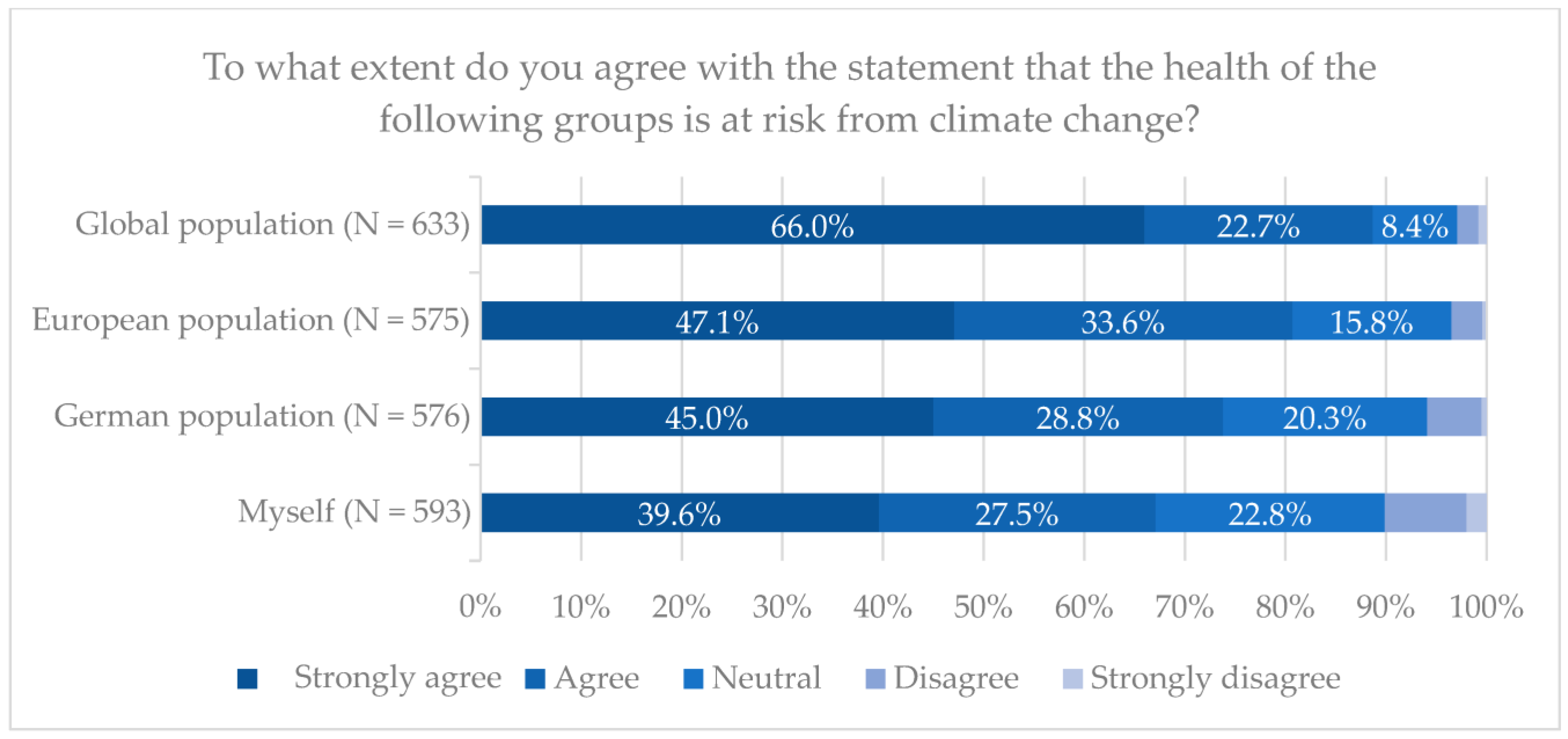
| The health of the following groups is at risk due to climate change: | |||||
| Global population (N = 633) | 66.0 | 22.7 | 8.4 | 2.1 | 0.8 |
| European population (N = 575) * | 47.1 | 33.6 | 15.8 | 3.1 | 0.3 |
| German population (N = 576) | 45.0 | 28.8 | 20.3 | 5.4 | 0.5 |
| Myself (N = 593) | 39.6 | 27.5 | 22.8 | 8.1 | 2.0 |
| To what extent are you concerned about: | |||||
| Climate change (N = 666) | 40.7 | 35.0 | 19.1 | 3.6 | 1.6 |
| The health consequences of climate change (N = 632) | 31.0 | 38.9 | 23.8 | 5.4 | 0.9 |
| To what extent are you concerned about the following risks of climate change? | |||||
| More frequent occurrence of extreme weather events (e.g., heat waves, droughts, particulate matter) (N = 664) * | 56.0 | 29.8 | 9.6 | 3.0 | 1.5 |
| More frequent occurrence of storms and floods (N = 665) * | 51.6 | 35.2 | 8.6 | 3.3 | 1.4 |
| Higher concentration of air pollution (e.g., ozone, particulate matter) (N = 662) * | 36.7 | 34.4 | 20.4 | 6.3 | 2.1 |
| Increased contamination of water bodies with pathogens (e.g., blue-green algae) (N = 666) | 33.9 | 33.8 | 21.6 | 8.6 | 2.1 |
| Increased exposure of food to pathogens (e.g., salmonella) (N = 658) | 24.8 | 30.4 | 26.3 | 13.5 | 5.0 |
| Spread of allergenic plant species (e.g., ragweed) (N = 659) * | 23.8 | 28.7 | 30.3 | 12.4 | 4.7 |
| Spread of allergenic animal species (e.g., oak processionary moth) (N = 654) | 28.3 | 30.7 | 27.4 | 10.1 | 3.5 |
| Spread of insects carrying pathogens (e.g., dengue fever, Zika infection, West Nile fever, malaria) (N = 664) | 34.3 | 36.4 | 18.2 | 8.4 | 2.6 |
| Variable | Yes (%) | No (%) |
|---|---|---|
| Which factors do you consider relevant to climate change and its health risks? (N = 648) | ||
| Thermal stress due to heat | 65.3 | 34.7 |
| Extreme weather events (e.g., heat, storms, precipitation) | 87.8 | 12.2 |
| Increased occurrence of pollutants (e.g., ozone, particulate matter) | 52.9 | 47.1 |
| Increased UV radiation | 56.0 | 44.0 |
| Increased and prolonged occurrence of allergens | 33.0 | 67.0 |
| Propagation and spread of pathogen-carrying animals | 51.9 | 48.1 |
| Problems with the supply and quality of drinking water | 74.2 | 25.8 |
| Food hygiene problems | 28.4 | 71.6 |
| Degradation of bathing water quality | 24.5 | 75.5 |
| Rising sea levels | 66.8 | 33.2 |
| Social conflict | 60.6 | 39.4 |
| Which health risks do you perceive as connected to climate change? (N = 648) | ||
| Accidents and death from extreme weather events (e.g., heat, cold, storms, landslides) | 61.6 | 38.4 |
| Skin cancer | 51.7 | 48.3 |
| Respiratory diseases | 51.2 | 48.8 |
| Allergies | 39.6 | 42.6 |
| Infectious diseases | 56.2 | 43.8 |
| Psychological trauma | 38.6 | 61.4 |
| Other | 9.0 | 91.0 |
| Have you already experienced health changes connected to climate change? (N = 627) | ||
| Yes | 114 | 18.2 |
| No | 340 | 54.2 |
| Perhaps | 173 | 27.6 |
| If yes, what are those health changes? (N = 114) | ||
| Accidents and their consequences | 3 | 2.6 |
| Infectious diseases | 20 | 17.5 |
| Cancer | 10 | 8.8 |
| Malnutrition | 3 | 2.6 |
| Psychological trauma | 19 | 16.7 |
| Allergies (e.g., new entrants, increases or extensions) | 63 | 55.3 |
| Respiratory diseases | 41 | 36.0 |
| Other (e.g., allergic reactions, circulation problems) | 40 | 35.1 |
| Category (Examples) | Can Personally Contribute (N) | Does Personally Contribute (N) |
|---|---|---|
| Mobility (less car driving, more bicycling, more electric mobility, greater use of public transportation) | 291 | 252 |
| Resource management (thrifty/cautious/sensible use of energy, water and other resources) | 195 | 139 |
| Food procurement (preference for regional and seasonal food, preference for food with an organic certification, avoidance of food waste, self-supply) | 179 | 124 |
| Nutrition (less consumption of meat and animal products, adoption of a vegetarian and vegan diet, less consumption of processed food) | 160 | 110 |
| Handling of waste (package-free shopping, waste separation, recycling, consciousness of microplastics) | 153 | 99 |
| Consumption (upcycling, shopping second-hand, buying fewer items/clothes, minimalism, prolonged use of electronics) | 134 | 76 |
| Travel (no/less air travel, no/fewer cruises, vacations by train in Europe/regionally) | 97 | 67 |
| Use of renewable energy sources (modernisation/renovation of residential properties, use of photovoltaic plants, use of green electricity) | 61 | 89 |
| Biodiversity (insect-friendly planting, renaturation, tree planting, no/less use of pesticides) | 50 | 42 |
| Involvement and donations (participation in politics/projects, voting, support for non-governmental organisations) | 24 | 17 |
| Sensitisation and education (talking about climate change locally, acting as a good example, talking to kids about climate change) | 22 | 10 |
| Other (no fireworks, overall emissions savings, adaptation of lifestyle habits) | 36 | 13 |
| Category (Examples) | Can City/Council Contribute (n) | Does City/Council Contribute (n) |
|---|---|---|
| Traffic and mobility (more/better/safer bikeways, expansion of public transportation, car-free cities, more charging stations, car sharing, speed limits, greater traffic control) | 242 | 63 |
| Modernisation and extension of renewable energy sources (photovoltaic plants on public buildings, benefits for private reconstruction, standards for building extensions) | 141 | 32 |
| Green spaces and planting (more tree planting, less logging, more parks, more community gardens, more conservation areas, renaturation, green roofing) | 139 | 25 |
| Sustainable construction (less impervious surfaces, eco-friendly building regulations, fewer parking spaces, regulations for rockeries) | 71 | 11 |
| Resource saving (public lighting, public fountains and sprinkler installations, incentives to save resources [e.g., CO2 taxes], bans and bids) | 62 | 12 |
| Education, sensitisation, consultation and inclusion (information in schools and kindergartens, public campaigns, more frequent referendums) | 47 | 7 |
| Food procurement and the promotion of regional offers (regulations for food prices [e.g., price increases for meat products and price decreases for regional vegetables], regulations to prohibit waste) | 29 | 0 |
| Support for projects and initiatives (demonstrations, days of action, litter clean-up events, funding for eco-friendly companies) | 27 | 16 |
| Waste and packaging (prohibitions/taxes on plastics, more public waste bins, incentives for waste avoidance, recycling) | 23 | 5 |
| Adjustment of climate change and anticipatory action (preparations for heat waves, more shaded places in cities, flood prevention, secure water supplies) | 21 | 3 |
| Adaptation of cultural offerings and living spaces (river bathing, playgrounds, drinking water fountains) | 19 | 2 |
| Agriculture (reserve areas, promotion of sustainable processes and organic cultivation, improvement of animal welfare) | 11 | 1 |
| Adaptation of consumption (promotion of second-hand stores, incentives and legal framework for less consumption, adaptation of food in canteens) | 8 | 2 |
| Other (sanctions for non–eco-friendly industries and companies, improvement of air quality, hiring of personnel responsible for climate protection in administration) | 23 | 4 |
Disclaimer/Publisher’s Note: The statements, opinions and data contained in all publications are solely those of the individual author(s) and contributor(s) and not of MDPI and/or the editor(s). MDPI and/or the editor(s) disclaim responsibility for any injury to people or property resulting from any ideas, methods, instructions or products referred to in the content. |
© 2023 by the authors. Licensee MDPI, Basel, Switzerland. This article is an open access article distributed under the terms and conditions of the Creative Commons Attribution (CC BY) license (https://creativecommons.org/licenses/by/4.0/).
Share and Cite
van Baal, K.; Stiel, S.; Schulte, P. Public Perceptions of Climate Change and Health—A Cross-Sectional Survey Study. Int. J. Environ. Res. Public Health 2023, 20, 1464. https://doi.org/10.3390/ijerph20021464
van Baal K, Stiel S, Schulte P. Public Perceptions of Climate Change and Health—A Cross-Sectional Survey Study. International Journal of Environmental Research and Public Health. 2023; 20(2):1464. https://doi.org/10.3390/ijerph20021464
Chicago/Turabian Stylevan Baal, Katharina, Stephanie Stiel, and Peter Schulte. 2023. "Public Perceptions of Climate Change and Health—A Cross-Sectional Survey Study" International Journal of Environmental Research and Public Health 20, no. 2: 1464. https://doi.org/10.3390/ijerph20021464
APA Stylevan Baal, K., Stiel, S., & Schulte, P. (2023). Public Perceptions of Climate Change and Health—A Cross-Sectional Survey Study. International Journal of Environmental Research and Public Health, 20(2), 1464. https://doi.org/10.3390/ijerph20021464

