


The STress-And-Coping suppoRT Intervention (START) for Chinese Women Undergoing Abortion: A Randomized Controlled Trial Protocol

Abstract
:1. Introduction
- Determine the feasibility of the START intervention according to eligibility, recruitment, intervention delivery, and retention data;
- Evaluate the acceptability of the START intervention among participants based on the Theoretical Framework of Acceptability (TFA) of Health Care Interventions;
- Test the preliminary efficacy of the START intervention on women’s depression symptoms, coping behaviors, self-efficacy, perceived support levels, intimate relationship satisfaction, post-abortion personal growth, and abortion relevant outcomes compared with women receiving standard abortion care.
2. Materials and Methods
2.1. Setting
2.2. Participants
2.3. Interventions
2.4. Outcomes
2.4.1. Feasibility Outcomes
- Proportion of women who meet the eligibility criteria
- Proportion of eligible women who are recruited
- Proportion of recruited women who receive the allocated intervention to which they are randomized
- Withdrawal or loss to follow-up rate
- Missing data rate
2.4.2. Acceptability Outcomes
2.4.3. Effectiveness Outcomes
Depression
Coping Behaviours
Self-Efficacy
Perceived Social Support
Post-Abortion Growth
Abortion Related Outcomes
2.5. Sample Size
2.6. Recruitment and Consent
2.7. Assignment and Blinding
2.8. Data Collection
2.9. Data Analysis
2.10. Protocol Modifications
3. Discussion
4. Conclusions
Author Contributions
Funding
Institutional Review Board Statement
Informed Consent Statement
Data Availability Statement
Acknowledgments
Conflicts of Interest
References
- Bearak, J.; Popinchalk, A.; Ganatra, B.; Moller, A.-B.; Tunçalp, Ö.; Beavin, C.; Kwok, L.; Alkema, L. Unintended pregnancy and abortion by income, region, and the legal status of abortion: Estimates from a comprehensive model for 1990–2019. Lancet Glob. Health 2020, 8, e1152–e1161. [Google Scholar] [CrossRef]
- WHO and UNICEF. Global Strategy for Women’s, Children’s and Adolescent’s Health 2016–2030; World Health Organization: Geneva, Switzerland, 2016; pp. 4–103. [Google Scholar]
- United Nations General Assembly. Transforming Our World: The 2030 Agenda for Sustainable Development; United Nations: New York, NY, USA, 2015. [Google Scholar]
- World Health Organization. Clinical Practice Handbook for Safe Abortion; WHO Library Cataloguing: Geneva, Switzerland, 2014. [Google Scholar]
- National Collaborating Centre for Mental Health. Induced Abortion and Mental Health: A Systematic Review of the Mental Health Outcomes of Induced Abortion, Including Their Prevalence and Associated Factors; Royal College of Psychiatrists: London, UK, 2011. [Google Scholar]
- Biggs, M.A.; Upadhyay, U.D.; McCulloch, C.E.; Foster, D.G. Women’s mental health and well-being 5 years after receiving or being denied an abortion: A prospective, longitudinal cohort study. JAMA Psychiatry 2017, 74, 169–178. [Google Scholar] [CrossRef] [PubMed]
- Rocca, C.H.; Samari, G.; Foster, D.G.; Gould, H.; Kimport, K. Emotions and decision rightness over five years following an abortion: An examination of decision difficulty and abortion stigma. Soc. Sci. Med. 2020, 248, 112704. [Google Scholar] [CrossRef] [PubMed]
- Pratt, R.; Stephenson, J.; Mann, S. What influences contraceptive behaviour in women who experience unintended pregnancy? A systematic review of qualitative research. J. Obstet. Gynaecol. 2014, 34, 693–699. [Google Scholar]
- Barraza Illanes, P.; Calvo-Frances, F. Predictors of personal growth in induced abortion. Psicothema 2018, 30, 370–375. [Google Scholar]
- American Psychological Association. Report of the Task Force on Mental Health and Abortion; Task Force on Mental Health and Abortion: Washington, DC, USA, 2008. [Google Scholar]
- Cohen, S.; Wills, T.A. Stress, social support, and the buffering hypothesis. Psychol. Bull. J. 1985, 98, 310–357. [Google Scholar] [CrossRef]
- Wethington, E.; Glanz, K.; Schwartz, M.D. Stress, Coping, and Health Behavior. In Health Behavior: Theory, Research, and Practice, 5th ed.; Jossey-Bass: San Francisco, CA, USA, 2015; pp. 223–242. [Google Scholar]
- Qian, J.L.; Pan, P.E.; Wu, M.W.; Zheng, Q.; Sun, S.W.; Liu, L.; Sun, Y.P.; Yu, X.Y. The experiences of nurses and midwives who provide surgical abortion care: A qualitative systematic review. J. Adv. Nurs. 2021, 103, 3644–3656. [Google Scholar] [CrossRef]
- Wang, N.; Allen, J.; Gamble, J.; Creedy, D.K. Nonpharmacological interventions to improve the psychological well-being of women accessing abortion services and their satisfaction with care: A systematic review. Nurs. Health Sci. 2020, 22, 854–867. [Google Scholar] [CrossRef]
- National Health Commitee of China. China Healthcare Statistic Yearbook; China Medical University Press: Beijing, China, 2020. [Google Scholar]
- Zhang, Q.; Wang, N.; Hu, Y.; Creedy, D.K. Prevalence of stress and depression and associated factors among women seeking a first-trimester induced abortion in China: A cross-sectional study. Reprod Health 2022, 19, 64. [Google Scholar] [CrossRef]
- Craig, P.; Dieppe, P.; Macintyre, S.; Michie, S.; Nazareth, I.; Petticrew, M. Developing and evaluating complex interventions: The new Medical Research Council guidance. BMJ 2008, 337, 1–6. [Google Scholar] [CrossRef] [Green Version]
- O’Connor, A.; Blewitt, C.; Nolan, A.; Skouteris, H. Using Intervention Mapping for child development and wellbeing programs in early childhood education and care settings. Eval. Program Plan. 2018, 68, 57–63. [Google Scholar] [CrossRef] [PubMed]
- Wang, N.; Zhu, X.; Elder, E.; Allen, J.; Creedy, D.; Gamble, J. Developing a theory-informed intervention for Chinese women undergo abortion using an intervention mapping approach: The STress-And-coping suppoRT (START) intervention. Midwifery, 2021; in press. [Google Scholar]
- Eldridge, S.M.; Chan, C.L.; Campbell, M.J.; Bond, C.M.; Hopewell, S.; Thabane, L.; Lancaster, G.A. CONSORT 2010 statement: Extension to randomised pilot and feasibility trials. BMJ 2016, 355, i5239. [Google Scholar] [CrossRef] [PubMed] [Green Version]
- Begg, C.; Cho, M.; Eastwood, S.; Horton, R.; Moher, D.; Olkin, I.; Pitkin, R.; Rennie, D.; Schulz, K.F.; Simel, D. Improving the quality of reporting of randomized controlled trials: The CONSORT statement. JAMA 1996, 276, 637–639. [Google Scholar] [CrossRef]
- Chan, A.-W.; Tetzlaff, J.M.; Altman, D.G.; Laupacis, A.; Gøtzsche, P.C.; Krleža-Jerić, K.; Hróbjartsson, A.; Mann, H.; Dickersin, K.; Berlin, J.A. SPIRIT 2013 statement: Defining standard protocol items for clinical trials. Ann. Intern. Med. 2013, 158, 200–207. [Google Scholar] [CrossRef] [Green Version]
- Hoffmann, T.C.; Glasziou, P.P.; Boutron, I.; Milne, R.; Perera, R.; Moher, D.; Altman, D.G.; Barbour, V.; Macdonald, H.; Johnston, M. Better reporting of interventions: Template for intervention description and replication (TIDieR) checklist and guide. BMJ 2014, 348, g1687. [Google Scholar] [CrossRef] [Green Version]
- Sekhon, M.; Cartwright, M.; Francis, J.J. Acceptability of healthcare interventions: An overview of reviews and development of a theoretical framework. BMC Health Serv. Res. 2017, 17, 88. [Google Scholar] [CrossRef] [Green Version]
- Löwe, B.; Kroenke, K.; Herzog, W.; Gräfe, K. Measuring depression outcome with a brief self-report instrument: Sensitivity to change of the Patient Health Questionnaire (PHQ-9). J. Affect. Disord. 2004, 81, 61–66. [Google Scholar] [CrossRef]
- Wang, J. DSM-5 Severity Measure for Depression for Adult—Chinese Version 2021. Available online: https://www.mhealthu.com/index.php/list_liangbiao/120/267?page=3 (accessed on 2 January 2021).
- Carver, C.S. You want to measure coping but your protocol’too long: Consider the brief cope. Int. J. Behav. Med. 1997, 4, 92–100. [Google Scholar] [CrossRef]
- Lafarge, C.; Mitchell, K.; Fox, P. Posttraumatic growth following pregnancy termination for fetal abnormality: The predictive role of coping strategies and perinatal grief. Anxiety Stress Coping 2017, 30, 536–550. [Google Scholar] [CrossRef]
- Ngai, F.W. Relationships between menopausal symptoms, sense of coherence, coping strategies, and quality of life. Menopause 2019, 26, 758–764. [Google Scholar] [CrossRef] [PubMed]
- Han, Y.; Hu, D.; Liu, Y.; Lu, C.; Luo, Z.; Zhao, J.; Lopez, V.; Mao, J. Coping styles and social support among depressed Chinese family caregivers of patients with esophageal cancer. Eur. J. Oncol. Nurs. 2014, 18, 571–577. [Google Scholar] [CrossRef] [PubMed]
- Sherer, M.; Maddux, J.E.; Mercandante, B.; Prentice-Dunn, S.; Jacobs, B.; Rogers, R.W. The self-efficacy scale: Construction and validation. Psychol. Rep. 1982, 51, 663–671. [Google Scholar] [CrossRef]
- Zhang, J.X.; Schwarzer, R. Measuring optimistic self-beliefs: A Chinese adaptation of the General Self-Efficacy Scale. Psychol. Int. J. Psychol. Orient 1995, 38, 174–181. [Google Scholar]
- Sherbourne, C.D.; Stewart, A.L. The MOS social support survey. Soc. Sci. Med. 1991, 32, 705–714. [Google Scholar] [CrossRef]
- Johnson, M.D.; Nguyen, L.; Anderson, J.R.; Liu, W.; Vennum, A. Pathways to romantic relationship success among Chinese young adult couples: Contributions of family dysfunction, mental health problems, and negative couple interaction. J. Soc. Pers. Relatsh. 2015, 32, 5–23. [Google Scholar] [CrossRef]
- Cann, A.; Calhoun, L.G.; Tedeschi, R.G.; Taku, K.; Vishnevsky, T.; Triplett, K.N.; Danhauer, S.C. A short form of the Posttraumatic Growth Inventory. Anxiety Stress Coping 2010, 23, 127–137. [Google Scholar] [CrossRef]
- Liu, Y.; Li, Y.; Chen, L.; Li, Y.; Qi, W.; Yu, L. Relationships between family resilience and posttraumatic growth in breast cancer survivors and caregiver burden. Psychooncology 2018, 27, 1284–1290. [Google Scholar] [CrossRef]
- Hajnasiri, H.; Behbodimoghddam, Z.; Ghasemzadeh, S.; Ranjkesh, F.; Geranmayeh, M. The study of the consultation effect on depression and anxiety after legal abortion. Iran. J. Psychiatr. Nurs. 2016, 4, 64–72. [Google Scholar]
- Khodakarami, B.; Mafakheri, B.; Shobeiri, F.; Soltanian, A.; Mohagheghi, H. The Effect of Fordyce Happiness Cognitive-Behavioral Counseling on the Anxiety and Depression of Women with Spontaneous Abortion. J. Pharm. Sci. Res. 2017, 9, 2335–2341. [Google Scholar]
- Moshki, M.; Baloochi Beydokhti, T.; Cheravi, K. The effect of educational intervention on prevention of postpartum depression: An application of health locus of control. J. Clin. Nurs. 2014, 23, 2256–2263. [Google Scholar] [CrossRef] [PubMed]
- Efird, J. Blocked randomization with randomly selected block sizes. Int. J. Environ. Res. Public Health 2011, 8, 15–20. [Google Scholar] [CrossRef] [PubMed] [Green Version]
- Field, A. Discovering Statistics Using IBM SPSS Statistics; Sage: Newcastle upon Tyne, UK, 2013. [Google Scholar]
- Elo, S.; Kyngas, H. The qualitative content analysis process. J. Adv. Nurs. 2008, 62, 107–115. [Google Scholar] [CrossRef] [PubMed]
- O’Cathain, A.; Hoddinott, P.; Lewin, S.; Thomas, K.; Young, B.; Adamson, J.; Jansen, Y.; Mills, N.; Moore, G.; Donovan, J. Maximising the impact of qualitative research in feasibility studies for randomised controlled trials: Guidance for researchers. Trials 2015, 16, O88. [Google Scholar] [CrossRef]
- Bowen, D.J.; Kreuter, M.; Spring, B.; Cofta-Woerpel, L.; Linnan, L.; Weiner, D.; Bakken, S.; Kaplan, C.P.; Squiers, L.; Fabrizio, C.; et al. How We Design Feasibility Studies. Am. J. Prev. Med. 2009, 36, 452–457. [Google Scholar] [CrossRef] [Green Version]
- Slack, M.K.; Draugalis, J.R., Jr. Establishing the internal and external validity of experimental studies. Am. J. Health-Syst. Pharm. 2001, 58, 2173–2181. [Google Scholar] [CrossRef] [Green Version]
- Rocca, C.H.; Kimport, K.; Gould, H.; Foster, D.G. Women’s emotions one week after receiving or being denied an abortion in the United States. Perspect. Sex. Reprod. Health 2013, 45, 122–131. [Google Scholar] [CrossRef]
- Global Action; Center for Effective. A review of behavioral economics in reproductive health. In CEGA White Papers; University of California: Berkeley, CA, USA, 2015; pp. 4–43. [Google Scholar]

| TIDieR Item | Intervention Group | Control Group |
|---|---|---|
| The START intervention | Standard abortion care |
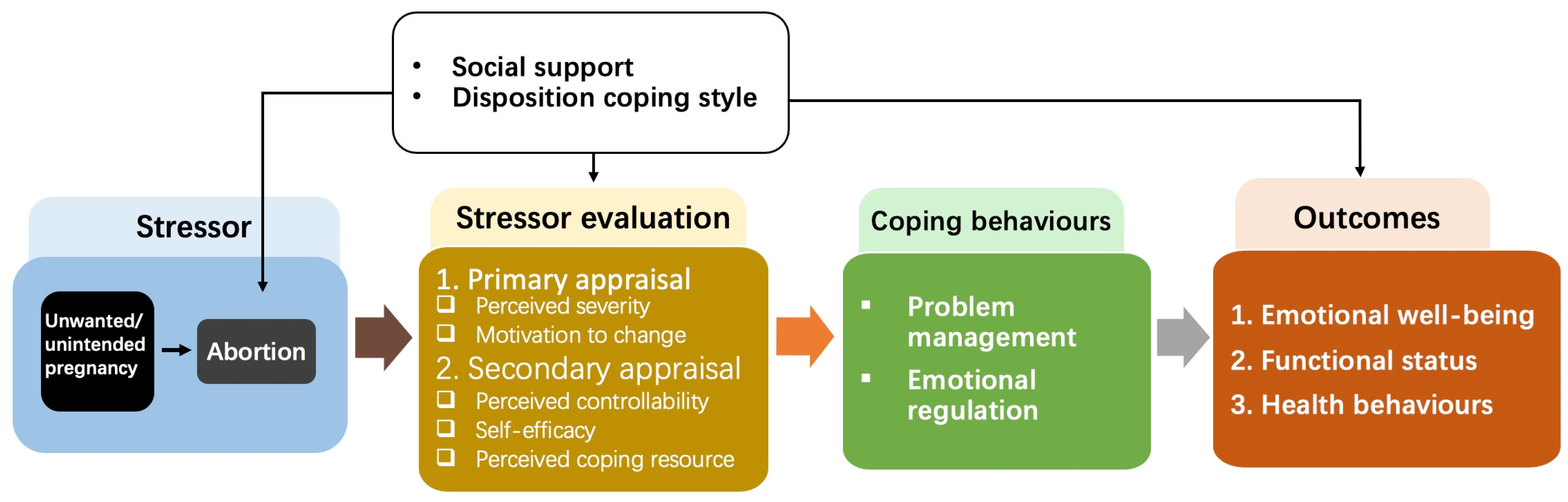
| Based on the Transactional Model of Stress and Coping, the START intervention intends to help women cope with abortion experience by addressing the specific stressors they face in the Chinese context, hence promoting well-being | N/A |
| Consultation, an information booklet, a WeChat-based public profile page, and a hotline | N/A |
| All participants allocated to the intervention group will be offered a 30-min face-to-face consultation. The consultation includes a brief introduction of the public profile page, Q&A, and offering emotional support and information on available coping resources. A printed information booklet will be provided during the consultation. Meanwhile, by scan the QR code, participants will be endowed with unlimited access to the public profile page till the closure of the project. A hotline will also be offered. | (1) prior abortion consultation on informed choice of pregnancy; (2) abortion preparation education on abortion practice, and steps involved; (3) a brief discharge education session on warning signs of potential complications and post-abortion contraception; and (4) a regular 2-week post-abortion appointment to determine the completion of the abortion. |
| The consultation, information booklet, and managing the public profile page will be carry out by the primary researcher who is a qualified abortion counsellor. Hotline will be answered by a registered nurse who has more than 10 years clinical experience in abortion care. | Prior abortion consultation and post-abortion exam-by doctors Abortion preparation and discharge education-by nurses |
| Consultation (face to face) Information booklet (hard copy) Public profile page (internet) Hotline (telephone) | Face to face |
| Consultation (the consultation room) Information booklet (the consultation room) Public profile page (WeChat based) Hotline (telephone-base) | Health centre facilities |
| Consultation (after women made their abortion appointment, 30 min) Information booklet (during the consultation, one copy to take home) Public profile page (from the consultation, unlimited access until the closure of the project) Hotline (from the consultation, available during workhours) | Prior abortion consultation—at women’s first appointment (10–20 min); Abortion preparation education—after women made their abortion appointment (5–10 min); post-abortion education—before women are discharged (10 min); The post-abortion exam—2 weeks after abortion |
| Participants in the intervention group will receive the same intervention | N/A |
| Cannot be reported until the study is complete | N/A |
| The research nurse and reception nurses involved in the trial will be trained initially. A researcher logbook will be kept recording intervention delivery of each participant. Adherence to the intervention will be assessed by participants self-reported usage info collected during follow-ups | N/A |
| Cannot be reported until the study is complete | N/A |
| Categories | Themes | Example Items |
|---|---|---|
| Abortion | Facts about abortion |
|
| Different types of abortion |
| |
| Q&A |
| |
| Aftercare and follow-up examination |
| |
| Intimate Relationship | A healthy relationship |
|
| Identify and deal with a dangerous relationship |
| |
| About sex |
| |
| Available Coping Resources | Coping with abortion experience |
|
| Taking care your emotions |
| |
| Cope with IPV or sexual violence experience |
|
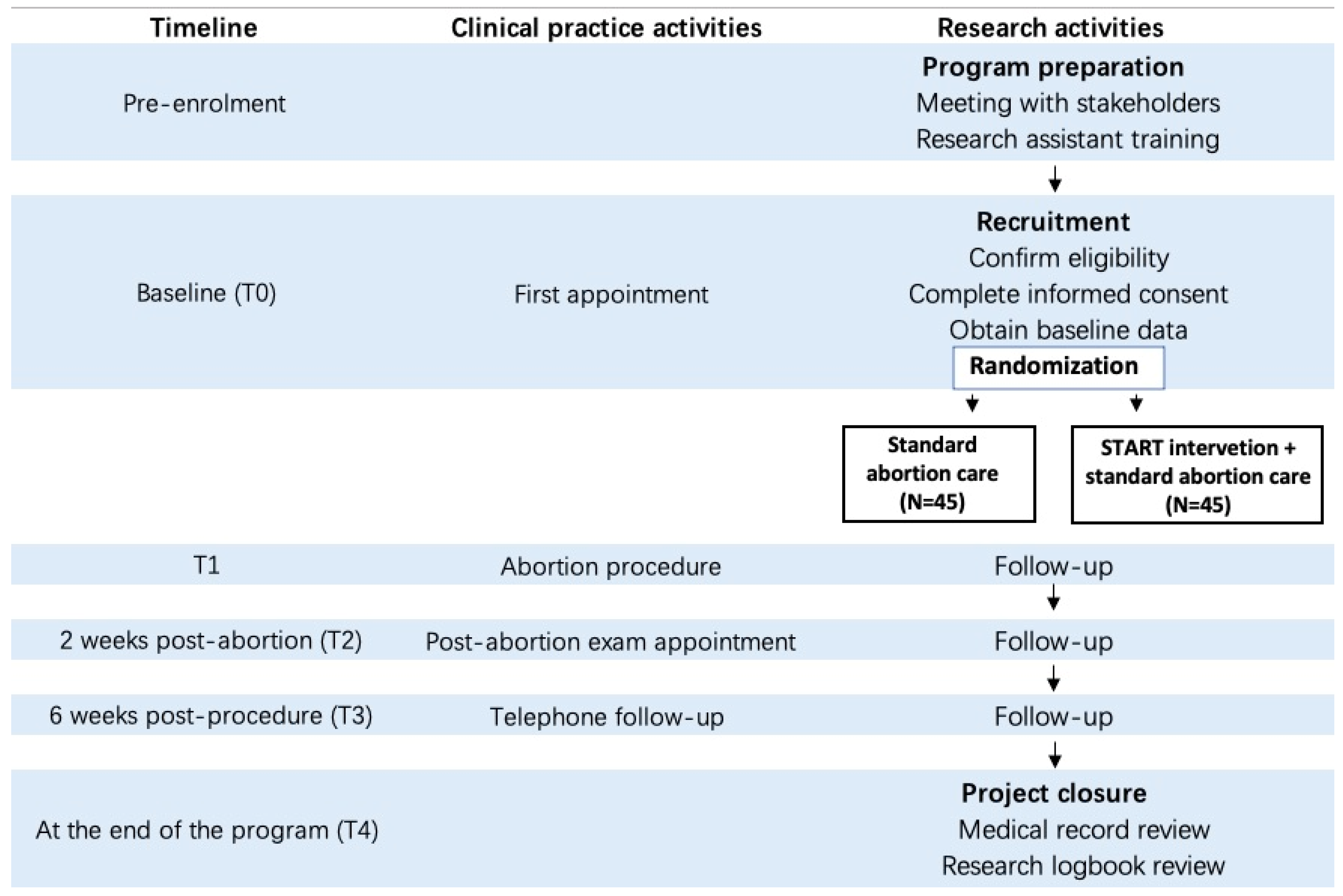
| Concept (What) | Time (When) | Method (Who, Where, and How) | Measure (by What) | Method of Analysis |
|---|---|---|---|---|
| Participant characteristics | T-0 | Primary researcher, at the clinic, face to face | Self-design questionnaire on sociodemographic characteristics, health history, and current gestation |
|
| Feasibility outcomes | ||||
| Eligibility | T-0 | Reception nurses, at the clinic, face to face | Eligibility screening checklist |
|
| Intervention delivery | T-4 | Primary researcher, at clinic facilities, researcher logbook review | Feasibility indexes include intervention fidelity, retention rate, and missing data rate |
|
| Acceptability outcomes | ||||
| Acceptability | T-3 | Primary researcher; at clinic facilities, telephone-interview | Self-design questionnaire including closed-ended and open-ended questions | Quantitative data
|
| Effectiveness outcomes | ||||
| Depression | T-0, -1, -2, -3 | Primary researcher (T0, 3) and nurse coordinator (T-1, -2); at clinic facilities; face to face (T-0, -1, -2) and by telephone (T-3) | SMD-A |
|
| Perceived support | T-0, -1, -2, -3 | As above | MOS-SSS |
|
| Intimate relationship | T-0, -1, -2, -3 | As above | CSI-4 |
|
| Coping behaviours | T-0, -2, -3 | As above | CBCI |
|
| Self-efficacy | T-0, -2, -3 | As above | GSE-10 |
|
| Post-abortion growth | T-2, -3 | As above | PTGI-SF |
|
| Abortion outcomes | T-3 | As above | Self-design questions |
|
Publisher’s Note: MDPI stays neutral with regard to jurisdictional claims in published maps and institutional affiliations. |
© 2022 by the authors. Licensee MDPI, Basel, Switzerland. This article is an open access article distributed under the terms and conditions of the Creative Commons Attribution (CC BY) license (https://creativecommons.org/licenses/by/4.0/).
Share and Cite
Wang, N.; Zhu, X.; Gamble, J.; Elder, E.; Allen, J.; Creedy, D.K. The STress-And-Coping suppoRT Intervention (START) for Chinese Women Undergoing Abortion: A Randomized Controlled Trial Protocol. Int. J. Environ. Res. Public Health 2022, 19, 6611. https://doi.org/10.3390/ijerph19116611
Wang N, Zhu X, Gamble J, Elder E, Allen J, Creedy DK. The STress-And-Coping suppoRT Intervention (START) for Chinese Women Undergoing Abortion: A Randomized Controlled Trial Protocol. International Journal of Environmental Research and Public Health. 2022; 19(11):6611. https://doi.org/10.3390/ijerph19116611
Chicago/Turabian StyleWang, Na, Xiu Zhu, Jenny Gamble, Elizabeth Elder, Jyai Allen, and Debra K. Creedy. 2022. "The STress-And-Coping suppoRT Intervention (START) for Chinese Women Undergoing Abortion: A Randomized Controlled Trial Protocol" International Journal of Environmental Research and Public Health 19, no. 11: 6611. https://doi.org/10.3390/ijerph19116611
APA StyleWang, N., Zhu, X., Gamble, J., Elder, E., Allen, J., & Creedy, D. K. (2022). The STress-And-Coping suppoRT Intervention (START) for Chinese Women Undergoing Abortion: A Randomized Controlled Trial Protocol. International Journal of Environmental Research and Public Health, 19(11), 6611. https://doi.org/10.3390/ijerph19116611

