

The Effectiveness of Attachment Security Priming in Improving Positive Affect and Reducing Negative Affect: A Systematic Review

Abstract
1. Introduction
Attachment Security Priming and Affect
2. Method
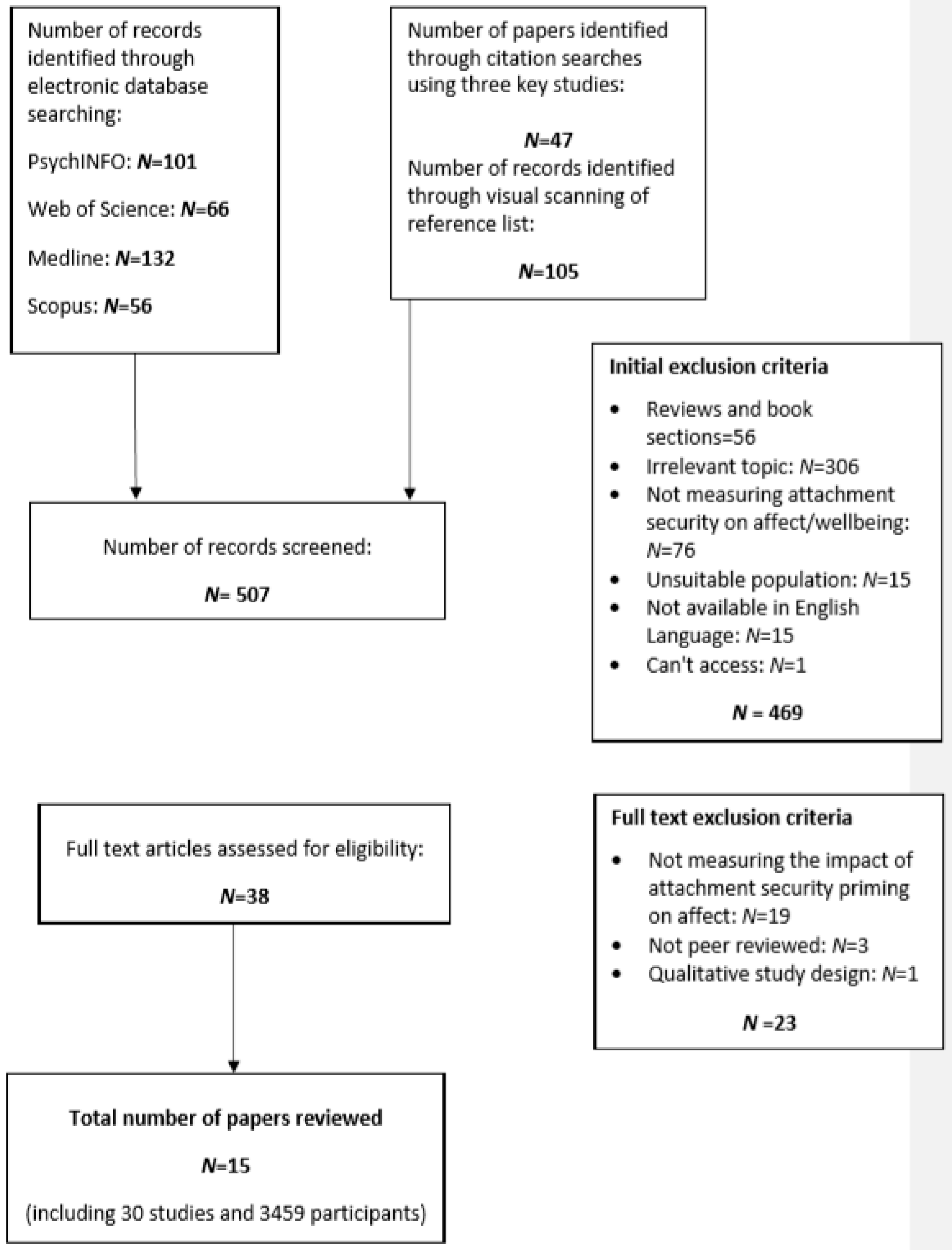
2.1. Literature Search
2.2. Screening Process
2.3. Inclusion and Exclusion Criteria
2.4. Structure and Framework of Review
3. Results
3.1. Research Methodology
3.2. Results by Type of Prime: Subliminal Primes
3.3. Results by Type of Prime: Supraliminal Primes
3.4. Combining Subliminal and Supraliminal Priming Methods
3.5. Quality Assessment
3.6. Highest Rated Studies
4. Discussion
4.1. Strengths of the Literature
4.2. Limitations of the Literature
4.3. Future Research
5. Conclusions
Author Contributions
Funding
Conflicts of Interest
References
- Ainsworth, M.D.S.; Blehar, M.C.; Waters, E.; Wall, S. Patterns of Attachment: Assessed in the Strange Situation and at Home; Erlbaum: Hillsdale, MI, USA, 1978. [Google Scholar]
- Baldwin, M.W.; Keelan, J.P.R.; Fehr, B.; Enns, V.; Koh-Rangarajoo, E. Social-cognitive conceptualization of attachment working models: Availability and accessibility effects. J. Personal. Soc. Psychol. 1996, 71, 94. [Google Scholar] [CrossRef]
- Bowlby, J. Attachment and Loss, Voleme 1: Attachment; Basic Books: New York, NY, USA, 1969. [Google Scholar]
- Brennan, K.A.; Clark, C.L.; Shaver, P.R. Self-report measurement of adult attachment: An integrative overview. In Attachment Theory and Close Relationships; Simpson, J.A., Rholes, W.S., Eds.; Guilford Press: New York, NY, USA, 1998; pp. 46–76. [Google Scholar]
- Mikulincer, M.; Shaver, P.R. Attachment in Adulthood: Structure, Dynamics, and Change, 2nd ed.; Guilford Press: New York, NY, USA, 2016. [Google Scholar]
- Bowlby, J. Attachment and Loss, Volume 2: Separation; Basic Books: New York, NY, USA, 1973. [Google Scholar]
- Kobak, R.R.; Sceery, A. Attachment in late adolescence: Working models, affect regulation, and representations of self and others. Child Dev. 1988, 59, 135. [Google Scholar] [CrossRef]
- Simpson, J.A. Influence of attachment styles on romantic relationships. J. Personal. Soc. Psychol. 1990, 59, 971. [Google Scholar] [CrossRef]
- Torquati, J.C.; Raffaelli, M. Daily experiences of emotions and social contexts of securely and insecurely attached young adults. J. Adolesc. Res. 2004, 19, 740–758. [Google Scholar] [CrossRef] [Scilit]
- Collins, N.L.; Read, S.J. Adult attachment, working models, and relationship quality in dating couples. J. Personal. Soc. Psychol. 1990, 58, 644. [Google Scholar] [CrossRef]
- Collins, N.L.; Read, S.J. Cognitive representations of attachment: The structure and function of working models. In Advances in Personal Relationships: Attachment Processes in Adulthood; Bartholomew, K., Perlman, D., Eds.; Jessica Kingsley Publishers: London, UK, 1994; pp. 53–92. [Google Scholar]
- Greenwald, A.G.; Draine, S.C.; Abrams, R.L. Three cognitive markers of unconscious semantic activation. Science 1996, 273, 1699–1702. [Google Scholar] [CrossRef] [Scilit] [PubMed]
- Carnelley, K.B.; Rowe, A.C. Repeated priming of attachment security influences later views of self and relationships. Pers. Relatish. 2007, 14, 307–320. [Google Scholar] [CrossRef] [Scilit]
- Mikulincer, M.; Shaver, P.R. Boosting attachment security to promote mental health, prosocial values, and inter-group tolerance. Psychol. Inq. 2007, 18, 139–156. [Google Scholar] [CrossRef] [Scilit]
- Gillath, O.; Shaver, P.R.; Mikulincer, M. An attachment-theoretical approach to compassion and altruism. In Compassion: Conceptualisations, Research and Use in Psychotherapy; Gilbert, P., Ed.; Brunner-Routledge: London, UK, 2005; pp. 121–147. [Google Scholar]
- Liao, R.; Wang, S.; Zhang, P.; Zhou, Y.; Liu, X. Effect of priming with attachment security on positive affect among individuals with depression. Soc. Behav. Personal. Int. J. 2017, 45, 331–338. [Google Scholar] [CrossRef] [Scilit]
- Mikulincer, M.; Gillath, O.; Halevy, V.; Avihou, N.; Avidan, S.; Eshkoli, N. Attachment theory and reactions to others’ needs: Evidence that activation of the sense of attachment security promotes empathic responses. J. Personal. Soc. Psychol. 2001, 81, 1205–1224. [Google Scholar] [CrossRef]
- Rowe, A.; Carnelley, K.B. Attachment style differences in the processing of attachment relevant-information: Primed-style effects on recall, interpersonal expectations, and affect. Pers. Relatish. 2003, 10, 59–75. [Google Scholar] [CrossRef] [Scilit]
- Posner, J.; Russell, J.A.; Peterson, B.S. The circumplex model of affect: An integrative approach to affective neuroscience, cognitive development, and psychopathology. Dev. Psychopathol. 2005, 17, 715–734. [Google Scholar] [CrossRef] [Scilit] [PubMed]
- Pressman, S.D.; Cohen, S. Does positive affect influence health? Psychol. Bull. 2005, 131, 925. [Google Scholar] [CrossRef] [Scilit] [PubMed]
- Crawford, J.R.; Henry, J.D. The Positive and Negative Affect Schedule (PANAS): Construct validity, measurement properties and normative data in a large non-clinical sample. Br. J. Clin. Psychol. 2004, 43, 245–265. [Google Scholar] [CrossRef] [Scilit] [PubMed]
- Carnelley, K.B.; Otway, L.J.; Rowe, A.C. The effects of attachment priming on depressed and anxious mood. Clin. Psychol. Sci. 2016, 4, 433–450. [Google Scholar] [CrossRef] [Scilit]
- Otway, L.J.; Carnelley, K.B.; Rowe, A.C. Texting “boosts” felt security. Attach. Hum. Dev. 2014, 16, 93–101. [Google Scholar] [CrossRef] [Scilit]
- Stupica, B.; Brett, B.E.; Woodhouse, S.S.; Cassidy, J. Attachment security priming decreases children’s physiological response to threat. Child Dev. 2017, 90, 1254–1271. [Google Scholar] [CrossRef] [Scilit]
- Bryant, R.A.; Chan, I. Activating attachment representations during memory retrieval modulates intrusive traumatic memories. Conscious. Cogn. 2017, 55, 197–204. [Google Scholar] [CrossRef] [Scilit]
- McGuire, A.B.; Gillath, O.; Jackson, Y.; Ingram, R. Attachment security priming as a potential intervention for depressive symptoms. J. Soc. Clin. Psychol. 2018, 37, 44–68. [Google Scholar] [CrossRef] [Scilit]
- Carnelley, K.B.; Bejinaru, M.M.; Otway, L.; Baldwin, D.S.; Rowe, A.C. Effects of repeated attachment security priming in outpatients with primary depressive disorders. J. Affect. Disord. 2018, 234, 201–206. [Google Scholar] [CrossRef] [Scilit]
- Cassidy, J.; Shaver, P.R.; Mikulincer, M.; Lavy, S. Experimentally induced security influences responses to psychological pain. J. Soc. Clin. Psychol. 2009, 28, 463–478. [Google Scholar] [CrossRef] [Scilit]
- Selcuk, E.; Zayas, V.; Günaydin, G.; Hazan, C.; Kross, E. Mental representations of attachment figures facilitate recovery following upsetting autobiographical memory recall. J. Personal. Soc. Psychol. 2012, 103, 362–378. [Google Scholar] [CrossRef] [Scilit] [PubMed]
- Hudson, N.W.; Fraley, R.C. Moving toward greater security: The effects of repeatedly priming attachment security and anxiety. J. Res. Personal. 2018, 74, 147–157. [Google Scholar] [CrossRef] [Scilit]
- Canterberry, M.; Gillath, O. Neural evidence for a multifaceted model of attachment security. Int. J. Psychophysiol. 2012, 88, 232–240. [Google Scholar] [CrossRef] [Scilit]
- Dutton, D.G.; Lane, R.A.; Koren, T.; Bartholomew, K. Secure base priming diminishes conflict-based anger and anxiety. PLoS ONE 2016, 11, e0162374. [Google Scholar] [CrossRef] [Scilit]
- Mikulincer, M.; Hirschberger, G.; Nachmias, O.; Gillath, O. The affective component of the secure base schema: Affective priming with representations of attachment security. J. Personal. Soc. Psychol. 2001, 81, 305–321. [Google Scholar] [CrossRef]
- Downs, S.H.; Black, N. The feasibility of creating a checklist for the assessment of the methodological quality both of randomised and non-randomised studies of health care interventions. J. Epidemiol. Commun. Health 1998, 52, 377–384. [Google Scholar] [CrossRef] [Scilit]
- Bartz, J.A.; Lydon, J.E. Close relationships and the working self-concept: Implicit and explicit effects of priming attachment on agency and communion. Personal. Soc. Psychol. Bull. 2004, 30, 1389–1401. [Google Scholar] [CrossRef] [Scilit]
- Bretherton, I.; Ridgeway, D.; Cassidy, J. Assessing internal working models of the attachment relationship. Attach. Presch. Years Theory Res. Interv. 1990, 273, 308. [Google Scholar]
- Mikulincer, M.; Florian, V.; Tolmacz, R. Attachment styles and fear of personal death: A case study of affect regulation. J. Personal. Soc. Psychol. 1990, 58, 273. [Google Scholar] [CrossRef]
- Carnelley, K.B.; Pietromonaco, P.R.; Jaffe, K. Depression, working models of others, and relationship functioning. J. Personal. Soc. Psychol. 1994, 66, 127. [Google Scholar] [CrossRef]
- McNair, D.M.; Lorr, M.; Droppleman, L.F. Profile of Mood States; Educational and Industrial Testing Service: San Diego, CA, USA, 1971. [Google Scholar]
- Quirin, M.; Kazén, M.; Kuhl, J. When nonsense sounds happy or helpless: The implicit positive and negative affect test (IPANAT). J. Personal. Soc. Psychol. 2009, 97, 500. [Google Scholar] [CrossRef] [Scilit] [PubMed]
- Luke, M.A.; Sedikides, C.; Carnelley, K. Your love lifts me higher! The energizing quality of secure relationships. Personal. Soc. Psychol. Bull. 2012, 38, 721–733. [Google Scholar] [CrossRef] [Scilit]
- Cohen, J. A power primer. Psychol. Bull. 1992, 112, 155–159. [Google Scholar] [CrossRef]
- Kotrlik, J.W.; Williams, H.A. The incorporation of effect size in information technology, learning, information technology, learning, and performance research and performance research. Inf. Technol. Learn. Perform. J. 2003, 21, 1–7. [Google Scholar]
- Miles, J.; Shevlin, M. Applying Regression and Correlation: A Guide for Students and Researchers; Sage: London, UK, 2001. [Google Scholar]
- Redick, T.S.; Shipstead, Z.; Wiemers, E.A.; Melby-Lervåg, M.; Hulme, C. What’s working in working memory training? An educational perspective. Educ. Psychol. Rev. 2015, 27, 617–633. [Google Scholar] [CrossRef] [Scilit]
- Temple, R.; Ellenberg, S.S. Medicine and public issues. Ann. Int. Med. 2000, 133, 455–463. [Google Scholar] [CrossRef] [Scilit]
- Rosenman, R.; Tennekoon, V.; Hill, L.G. Measuring bias in self-reported data. Int. J. Behav. Healthc. Res. 2011, 2, 320. [Google Scholar] [CrossRef] [Scilit]
- Bartholomew, K.; Horowitz, L.M. Attachment styles among young adults: A test of a four-category model. J. Personal. Soc. Psychol. 1991, 61, 226–244. [Google Scholar] [CrossRef]
- Joordens, S.; Becker, S. The long and short of semantic priming effects in lexical decision. J. Exp. Psychol. Learn. Mem. Cogn. 1997, 23, 1083–1105. [Google Scholar] [CrossRef]
- Wheeldon, L.R.; Smith, M.C. Phrase structure priming: A short-lived effect. Lang. Cognit. Proc. 2003, 18, 431–442. [Google Scholar] [CrossRef] [Scilit]
- Brown, A.S. Single and multiple test repetition priming in implicit memory. Memory 1996, 4, 159–174. [Google Scholar] [CrossRef] [Scilit] [PubMed]
- MacNeil, B.M.; Lopes, V.A.; Minnes, P.M. Anxiety in children and adolescents with Autism Spectrum Disorders. Res. Autism Spectr. Disord. 2009, 3, 1–21. [Google Scholar] [CrossRef] [Scilit]
- Sadler, K.; Vizard, T.; Ford, T.; Marcheselli, F.; Pearce, N.; Mandalia, J.D.; McManus, S. Mental Health of Children and Young People in England. 2017. Available online: https://gss.civilservice.gov.uk/wp- (accessed on 13 February 2019).

| Authors & Date | Country | Population | Design & Prime Type | ASP Intervention | Main Affect Findings | Interaction with Attachment | Effect Size |
|---|---|---|---|---|---|---|---|
| Bryant & Chan (2017) [25] | UK | 75 university students Age: M = 19.25 56 females, 19 males | Experimental, Between-subject Supraliminal priming Attachment security prime vs. control (positive prime) | Mental imagery task 3 min duration | Participants with low avoidant attachment style who received the secure prime reported less distress than those who received the control prime. This pattern was not found for participants with a high avoidant attachment style. | Attachment style moderated the effects of the prime as the findings showed that individuals with a high avoidant attachment style were not impacted by the prime. | Personal distress η2 = 0.18; η2 = 0.19 (Large) Positive affect η2 = 0.11 (Medium) |
| Carnelley & Rowe (2007) [13] | UK | 64 university students Age: 18–55 (M = 21.18) 46 females, 18 males | Experimental, Between-subject Supraliminal priming Attachment security prime vs. control (neutral prime) | Mental imagery and written task 10 min duration Primed on 3 occasions across 3 days | Repeated priming of attachment security resulted in more positive self-views and less attachment anxiety at Time 5 compared to Time 1. Those primed with neutral primes showed no change with time. | Attachment dimensions did not moderate the effects of the prime for self-views. | Positive self-views ηp2 = 0.25 (Large) |
| Carnelley, Otway, & Rowe (2016) [22] (a) Study 1 | UK | 144 university students Age: 18–50 (M = 20.1) 127 females, 17 males | Experimental, Between-subject Supraliminal priming Attachment security prime vs. anxious prime; avoidant prime; control (neutral prime) | Mental imagery and written task 10 min duration | Anxious-primed participants reported higher depressed mood than secure-primed participants. Avoidant-primed and anxious-primed participants reported higher anxious mood compared to secure-primed participants. Secure-primed participants did not report significantly lower anxious or depressed mood than neutral-primed participants. | Attachment dimensions did not moderate the effects of the prime. | Depressed mood η2 = 0.21 (Large) Anxious mood η2 = 0.22 (Large) |
| Carnelley, Otway, & Rowe (2016) [22] (b) Study 2 | UK | 81 university students Age: 18–33 (M = 20.32) 70 females, 11 males | Experimental, Between-subject Supraliminal priming Attachment security prime vs. control (neutral prime) | Mental imagery and written task 10 min duration for initial prime 3 min duration for 3 subsequent primes | Secure primed participants reported lower anxious mood post-prime and one day later compared with neutral-primed participants. Secured-primed participants reported marginally lower depressed mood post-prime and one day later compared to neutral-primed participants. | Attachment dimensions did not moderate the effects of the prime. | Anxious mood 11% of the variance (Medium) |
| McGuire, Gillath, Jackson, & Ingram (2018) [26] (a) Study 1 | US | 125 college students Age: 18–47 (M = 19.6) 71 females, 54 males | Experimental, Mixed methods Supraliminal and Subliminal priming Attachment security prime vs. control (neutral prime) |
| Participants exposed to the security primes reported a greater decrease in depressive symptoms compared to participants exposed to neutral primes. | Attachment dimensions did not moderate the effects of the prime, although attachment anxiety was significantly associated with depressive symptoms. | N/A |
| McGuire, Gillath, Jackson, & Ingram (2018) [26] (b) Study 2 | US | 69 adolescents from high school/youth centre. Age: 13–19 (M = 15.6) 39 females, 30 males | Experimental, Between-subject Supraliminal priming Attachment security prime vs. control (neutral prime) |
| Adolescents who were repeatedly exposed over two weeks to security primes showed lower depression symptoms than participants exposed to neutral primes. | Attachment dimensions did not moderate the effects of the prime, although attachment anxiety was significantly associated with depressive symptoms. | N/A |
| Stupica, Woodhouse, Brett, & Cassidy (2017) [24] | US | 90 school children Age: 6–7 (M = 6.95) 42 females, 48 males | Experimental, Between-subject Subliminal priming Attachment security prime vs. controls (happy prime; neutral prime) | Computer picture presentation which included subliminal picture priming Primes presented for 24 milliseconds | Secure priming decreased physiological responses (electrodermal activity, vagal augmentation, fearful facial expressions) to threat compared to control conditions. There were no priming effects associated with children’s self-reported fear. | Attachment dimensions did not moderate the effects of the prime, although securely attached children had lower physiological responses to fear. There were no attachment effects associated with children’s self-reported fear. | Electrodermal activity d = 1.79; d = 1.84 (Large) Respiratory sinus arrhythmia d = 1.95; d = 3.40 (Large) Fearful facial expressions d = 15.00; d = 15.92 (Large) |
| Rowe & Carnelley (2003) [18] | UK | 160 university students Age: 17–42 (M = 20.5) 121 females, 39 males | Experimental, Between-subject Supraliminal priming Attachment security prime vs. avoidant prime and anxious prime | Mental imagery and written task 10 min duration | Primed secures reported more positive affect and less negative affect compared to the other primed attachment style groups | Attachment dimensions did not moderate the effects of the prime. | N/A |
| Mikulincer, Gillath, Halevy, Avihou, Avidan, & Eshkoli (2001) [17] (a) Study 1 | Israel | 69 university students. Age: 20–40 (Mdn = 24) 44 females, 25 females | Experimental, Between-subject Supraliminal priming Attachment security prime vs. controls (positive-affect prime; neutral prime) | Reading an interpersonal script related to attachment security Duration unspecified | Priming attachment security and positive-affect led to lower ratings of personal distress compared to the neutral priming. There was not a significant difference in personal distress between secure prime group and positive-affect group. | Attachment anxiety had a significant unique effect on personal distress; the higher the attachment anxiety the higher the reported distress. Main effect of avoidance and all the interactions were not significant. | Personal distress 28% of variance (Large) |
| Mikulincer, Gillath, Halevy, Avihou, Avidan, & Eshkoli (2001) [17] (b) Study 2 | Israel | 60 university students Age: 17–39 (Mdn = 24) 31 females, 29 males | Experimental, Between-subject Supraliminal and Subliminal priming Attachment security prime vs. controls (positive-affect prime; neutral prime) | 1. Subliminal exposure of prime images. Duration unspecified 2. Reading a distressing interpersonal script. Duration unspecified | Attachment security priming and positive-affect priming led to lower passive identification (sorrow-related emotions) ratings compared to neutral priming. There was not a significant difference in personal distress between secure prime group and positive-affect group. | Attachment anxiety had a significant unique effect on personal distress; the higher the attachment anxiety the higher the reported distress. Main effect of avoidance and all the interactions were not significant. | Passive identification 20% of variance (Large) |
| Mikulincer, Gillath, Halevy, Avihou, Avidan, & Eshkoli (2001) [17] (c) Study 3 | Israel | 60 university students Age: 19–30 (Mdn = 23) 34 females, 26 males | Experimental, Between-subject Subliminal priming Attachment security prime vs. controls (positive -affect prime; neutral prime) | Computerised lexical decision task which included rapid subliminal presentation of prime words. | Attachment security priming led to lower ratings of personal distress compared to neutral priming. Security priming also led to lower personal distress than positive-affect priming. | Attachment anxiety had a significant unique effect on personal distress; the higher the attachment anxiety the higher the reported distress. Main effect of avoidance and all the interactions were not significant. | Personal distress 33% of variance (Large) |
| Mikulincer, Gillath, Halevy, Avihou, Avidan, & Eshkoli (2001) [17] (d) Study 4 | Israel | 72 university students Age: 20–37 (Mdn= 24) 37 females, 35 males | Experimental, Between-subject Subliminal priming Attachment security prime vs. controls (positive-affect prime; neutral prime) | Computerised autobiographical memory task which included subliminal picture priming. Duration unspecified. | There was not a significant difference in accessibility to personal distress memories between secure prime, positive-affect prime and neutral prime groups. | Attachment anxiety had a significant unique effect on personal distress; the higher the attachment anxiety, the higher the accessibility of personal distress memories. Main effect of avoidance and all the interactions were not significant. | Personal distress 10% 0f variance (Medium) |
| Mikulincer, Gillath, Halevy, Avihou, Avidan, & Eshkoli (2001) [17] (e) Study 5 | Israel | 150 university students Age: 18–27 (Mdn = 23) 66 females, 84 males | Experimental, Between-subject Supraliminal priming Attachment security prime vs. attachment anxiety, attachment avoidance, positive-affect, neutral | Two mental imagery tasks 2 min durations | The priming of attachment security led to lower personal distress than the priming of attachment anxiety. Priming attachment anxiety led to higher personal distress than the priming of avoidance. | Attachment anxiety had a significant unique effect on personal distress; the higher the attachment anxiety the higher the reported distress. Main effect of avoidance and all the interactions were not significant. | Personal distress 34% of variance (Large) |
| Liao, Wang, Zhang, Zhou, & Xiangping (2017) [16] | China | 105 university students Age: 17–27 (M = 20.3) 70 females, 35 males | Quasi-experimental, Between-subject Supraliminal priming Attachment security prime (no control) | Mental imagery and written task 10 min duration Primed once | Individuals with dependent depression experienced greater positive affect after priming. There was no significant change in positive affect after priming for individuals with self-critical depression. | Not tested | N/A |
| Carnelley, Bejinaru, Otway, & Baldwin (2018) [27] | UK | 48 adults with depressive disorder Age: 18–76 (M = 50.9) 29 females, 19 males | Experimental, Between-subject Supraliminal priming Attachment security prime vs. control (neutral prime) | Mental imagery task and written task 10 min duration for initial prime 3 min duration for subsequent primes on 3 consecutive days | Secure priming had a greater impact on reducing symptoms of anxiety and depression in comparison to the control prime, though the differences were only significant at Time 4 (third and last text prime). | Not tested on anxiety and depression. | Depression ηp2 = 0.10 (Medium) Anxiety ηp2 = 0.13 (Medium) |
| Cassidy, Shaver, Mikulincer, & Lavy (2009) [28] | US | 70 university students 17–25 (Mdn = 19) 51 females, 19 males | Experimental, Between-subject Subliminal priming Attachment security prime vs. control (neutral prime) | Computerised cognitive categorization task which included subliminal priming of words. Prime presented for 22 milliseconds | Attachment security priming influenced the participants responses to psychological pain (operationalised in terms of hurt feelings) in different ways depending on global attachment style (see interaction with attachment). Overall, security priming was able to reduce some maladaptive responses to psychological pain (e.g., over-engagement and under-engagement with negative emotions) within insecurely-attached individuals. | Avoidant attachment was associated with a tendency to dismiss hurtful events, inhibit expressions of distress and react hostilely in the neutral prime condition, and it was associated with greater openness to pain in the security prime condition. Attachment anxiety was associated with more intense feelings of rejection, more crying and more negative emotions in the neutral prime condition, but interactions were generally non-significant within the security prime condition. | Rejected feelings 23.5% of variance (Large) Negative emotions 32.1% of variance (Large) Positive emotions 5.8% of variance (Small) |
| Selcuk, Zayas, Günaydin, Hazan, & Kross (2012) [29] (a) Study 1 | US | 123 university students Age: M = 20 105 females, 18 males | Experimental, Mixed design Supraliminal priming Attachment security prime vs. control (acquaintance prime) | Mental imagery task 20 s at a time | Priming participants with attachment security after recalling an upsetting memory led to significantly lower negative affect in comparison to neutral priming (recovery hypothesis). Priming participants before an upsetting memory recall did not result in significant differences between the security prime and neutral prime conditions (buffering hypothesis). | Individuals high on attachment avoidance showed less affective recovery as a result of priming the mental representation of an attachment figure. Higher attachment anxiety towards one’s mother was associated with smaller recovery effects (although not statistically significant). | Negative affect ηp2 = 0.22 (Large) |
| Selcuk, Zayas, Günaydin, Hazan, & Kross (2012) [29] (b) Study 2 | US | 139 university students Age: M = 20 105 females, 34 males | Experimental, Mixed design Supraliminal priming Attachment security prime vs. control (stranger prime) | Exposure to photograph of mother 90 s at a time | Priming participants with attachment security after recalling an upsetting memory led to significantly lower negative affect in comparison to neutral priming (recovery hypothesis). Priming participants before an upsetting memory recall did not result in significant differences between the security prime and neutral prime conditions (stranger; buffering hypothesis). | Individuals high in attachment avoidance showed less affective recovery as a result of priming the attachment figure. Higher attachment anxiety towards one’s mother was associated with smaller recovery effects (although not statistically significant). | Negative affect ηp2 = 0.37 (Large) |
| Selcuk, Zayas, Günaydin, Hazan, & Kross (2012) [29] (c) Study 3 | US | 57 members of heterosexual romantic couples Age: M = 21 29 females,28 males | Experimental, Within-subject Supraliminal priming Attachment security prime vs. control (stranger prime) | Exposure to photograph of romantic partner 90 s at a time | Priming participants with attachment security after recalling an upsetting memory led to significantly lower negative affect in comparison to neutral priming (recovery hypothesis). After recalling the upsetting memory, participants in the secure prime condition showed lower negative thinking compared to control condition. | Individuals high in attachment avoidance showed less affective recovery as a result of priming the attachment figure. | Negative affect ηp2 = 1.21 (Large) |
| Hudson & Fraley (2018) [30] | US | 133 university students Age: M = 20.15 92 females, 41 males | Experimental. Between-subject Supraliminal priming Attachment security prime vs. anxious prime; control (no prime) | Mental imagery and written tasks Duration unspecified Primed once a week for over 16 weeks | There was no significant improvement in emotional wellbeing over the course of 4 months for either the security prime condition or the attachment anxiety prime condition. | Attachment dimensions did not moderate the effect of the prime on wellbeing. | N/A |
| Canterberry & Gillath (2012) [31] | US | 30 men and women Age: 18–24 (M = 21.4) 15 females, 15 males | Experimental, Within-subject Supraliminal and Subliminal priming Attachment security prime vs. insecure attachment prime vs. control (neutral prime) | Event-related computerised priming task which included being primed with words. Implicit prime presented for 2 milliseconds Explicit prime presented for 500 milliseconds | Supraliminal security priming led to higher liking ratings for the images compared to insecurity or neutral primes. No significant differences were found for subliminal priming. Attachment security priming activated unique brain areas related to affect. | Attachment dimensions did not moderate the effects of the prime. | Positive affect ηp2 = 0.22 (Large) |
| Dutton, Lane, Koren, & Bartholomew (2016) [32] (a) Study 1 | Canada | 686 university students Age: 18–59 (M = 20.4) 505 females, 181 males | Experimental, Between-subject Subliminal priming Attachment security prime vs. controls (distraction prime; no prime) | Exposure to prime images after listening to audio recordings of interpersonal conflict. Duration unspecified | The attachment security priming group reported significantly lower anger and anxiety scores compared to the control groups. | Not tested | N/A |
| Dutton, Lane, Koren, & Bartholomew (2016) [32] (b) Study 2 | US | 278 internet sample Age: 18–16 (M = 34.6) 163 females, 115 males | Experimental, Between-subject Subliminal priming Attachment security prime vs. controls (smiling man; cold mother; no prime) | Exposure to prime images after listening to audio recordings of interpersonal conflict, with two additional controls. Duration unspecified | The attachment security priming group reported significantly lower anger and anxiety scores compared to the control groups. | Not tested. | N/A |
| Mikuliner, Hirschberger, Nachmias, & Gillath (2001) [33] (a) Study 1 | Israel | 106 university students Age: 21–31 (Mdn = 24) 79 females, 27 males | Experimental, Between-subject Subliminal and Supraliminal priming Attachment security prime (baby and mother) vs. controls (positive affect prime; neutral prime; control prime) | Rated Chinese ideographs whilst being primed by pictures. Supraliminal prime presented for 500 milliseconds Subliminal prime presented for 10 milliseconds | In the subliminal trials, attachment security priming and positive-affect primes led to higher liking ratings compared to neutral or no primes. No significant difference was found between security primes and positive-affect primes. There were no significant differences between prime groups in the supraliminal trials. | Attachment dimensions did not moderate the effect of the primes. | Positive affect ηp2 = 0.07 (Medium) |
| Mikuliner, Hirschberger, Nachmias, & Gillath (2001) [33] (b) Study 2 | Israel | 45 university students Age: 19–32 (Mdn = 22) 33 females, 12 males | Experimental, Within-subject Subliminal priming Attachment security primes (baby and mother; baby prime; mother prime) vs. controls (positive-affect prime; neutral prime) | Rated Chinese ideographs whilst being subliminally primed by pictures. Subliminal prime presented for 10 milliseconds | ‘Baby and mother’ security primes and positive affect primes led to higher liking ratings compared to neutral primes, baby primes and mother primes. | Attachment dimensions did not moderate the effect of the primes. | Positive affect ηp2 = 0.15 (Large) |
| Mikuliner, Hirschberger, Nachmias, & Gillath (2001) [33] (c) Study 3 | Israel | 40 university students Age: 20–32 (Mdn = 23) 29 females, 11 males | Experimental, Within-subject Subliminal priming Attachment security prime (baby and mother; young couple prime; old couple) vs. controls (positive prime; neutral prime) | Rated Chinese ideographs whilst being subliminally primed by pictures. Subliminal prime presented for 10 milliseconds | All security primes and positive affect prime led to higher liking ratings compared to neutral prime. No significant differences were found between any of the attachment security primes. | Attachment dimensions did not moderate the effect of the primes. | Positive affect ηp2 = 0.18 (Large) |
| Mikuliner, Hirschberger, Nachmias, & Gillath (2001) [33] (d) Study 4 | Israel | 42 university students Age: 19–35 (Mdn = 22) 31 females, 11 males | Experimental, Within-subject Subliminal priming Attachment security prime (attachment figure) vs. controls (close person; known person; unknown person) | Rated Chinese ideographs whilst being subliminally primed by names. Subliminal prime presented for 10 milliseconds | Attachment security priming led to higher liking ratings compared to all control primes. No significant difference was found between control primes. | Attachment dimensions did not moderate the effect of the primes. | Positive affect ηp2 = 0.16 (Large) |
| Mikuliner, Hirschberger, Nachmias, & Gillath (2001) [33] (e) Study 5 | Israel | 150 university students Age: 20–39 (Mdn = 24) 94 females, 56 males | Experimental, Between-subject Subliminal priming Attachment security prime vs. controls (positive affect; neutral; no prime) | Rated Chinese ideographs whilst being subliminally primed by words and picture. Two different contexts were induced: neutral and threat conditions. Subliminal prime presented for 10 milliseconds | In the neutral context, attachment security primes and positive affect primes led to higher liking ratings than neutral primes or no primes. In the threat context, attachment security priming led to higher liking ratings than all control primes (including positive-affect). | Attachment dimensions did not moderate the effect of the primes. | Positive affect ηp2 = 0.14 (Large) |
| Mikuliner, Hirschberger, Nachmias, & Gillath (2001) [33] (f) Study 6 | Israel | 88 university students Age: 20–35 (Mdn = 24) 53 females, 35 males | Experimental, Between-subject Subliminal priming Attachment security prime vs. controls (positive affect; neutral; no prime) | Rated Chinese ideographs after the subliminal presentation of picture primes. Two different contexts were induced: no feedback condition and failure condition. Subliminal prime presented for 10 milliseconds | In the no feedback condition, attachment security and positive affect primes led to higher liking ratings that neutral and no picture primes. In the failure condition, attachment security priming led to higher liking ratings compared to all the control primes (including positive-affect). | There was a significant main effect for attachment anxiety; individuals with high levels of attachment anxiety reported lower liking ratings than individuals who scored low in attachment anxiety. The main effect for avoidance and the remaining interactions were not significant. | Positive affect ηp2 = 0.13 (Large) |
| Mikuliner, Hirschberger, Nachmias, & Gillath (2001) [33] (g) Study 7 | Israel | 100 university students Age: 20–35 (Mdn = 24) 72 females, 28 males | Experimental, Between-subject Subliminal priming Attachment security prime vs. controls (positive affect; neutral; no prime) | Rated Chinese ideographs after the subliminal presentation of picture primes. Two different contexts were induced: neutral and visualisation of a separation. 1. Mental imagery and written task 3 min duration 2. Rated Chinese ideographs after the subliminal presentation of picture primes Subliminal prime presented for 10 milliseconds | In the neutral condition, attachment security prime and positive affect prime led to higher liking ratings than neutral or no picture primes. In the separation episode, attachment security priming led to higher liking ratings compared to all control primes (including positive-affect). | Attachment dimensions moderated the effect of the prime following the visualisation of a separation episode. Attachment dimensions did not moderate the effects of the prime in the neutral context. | Positive affect ηp2 = 0.18 (Large) |
© 2020 by the authors. Licensee MDPI, Basel, Switzerland. This article is an open access article distributed under the terms and conditions of the Creative Commons Attribution (CC BY) license (http://creativecommons.org/licenses/by/4.0/).
Share and Cite
Rowe, A.C.; Gold, E.R.; Carnelley, K.B. The Effectiveness of Attachment Security Priming in Improving Positive Affect and Reducing Negative Affect: A Systematic Review. Int. J. Environ. Res. Public Health 2020, 17, 968. https://doi.org/10.3390/ijerph17030968
Rowe AC, Gold ER, Carnelley KB. The Effectiveness of Attachment Security Priming in Improving Positive Affect and Reducing Negative Affect: A Systematic Review. International Journal of Environmental Research and Public Health. 2020; 17(3):968. https://doi.org/10.3390/ijerph17030968
Chicago/Turabian StyleRowe, Angela C., Emily R. Gold, and Katherine B. Carnelley. 2020. "The Effectiveness of Attachment Security Priming in Improving Positive Affect and Reducing Negative Affect: A Systematic Review" International Journal of Environmental Research and Public Health 17, no. 3: 968. https://doi.org/10.3390/ijerph17030968
APA StyleRowe, A. C., Gold, E. R., & Carnelley, K. B. (2020). The Effectiveness of Attachment Security Priming in Improving Positive Affect and Reducing Negative Affect: A Systematic Review. International Journal of Environmental Research and Public Health, 17(3), 968. https://doi.org/10.3390/ijerph17030968

