

Does Active Design Influence Activity, Sitting, Wellbeing and Productivity in the Workplace? A Systematic Review


Abstract
1. Introduction
2. Materials and Methods
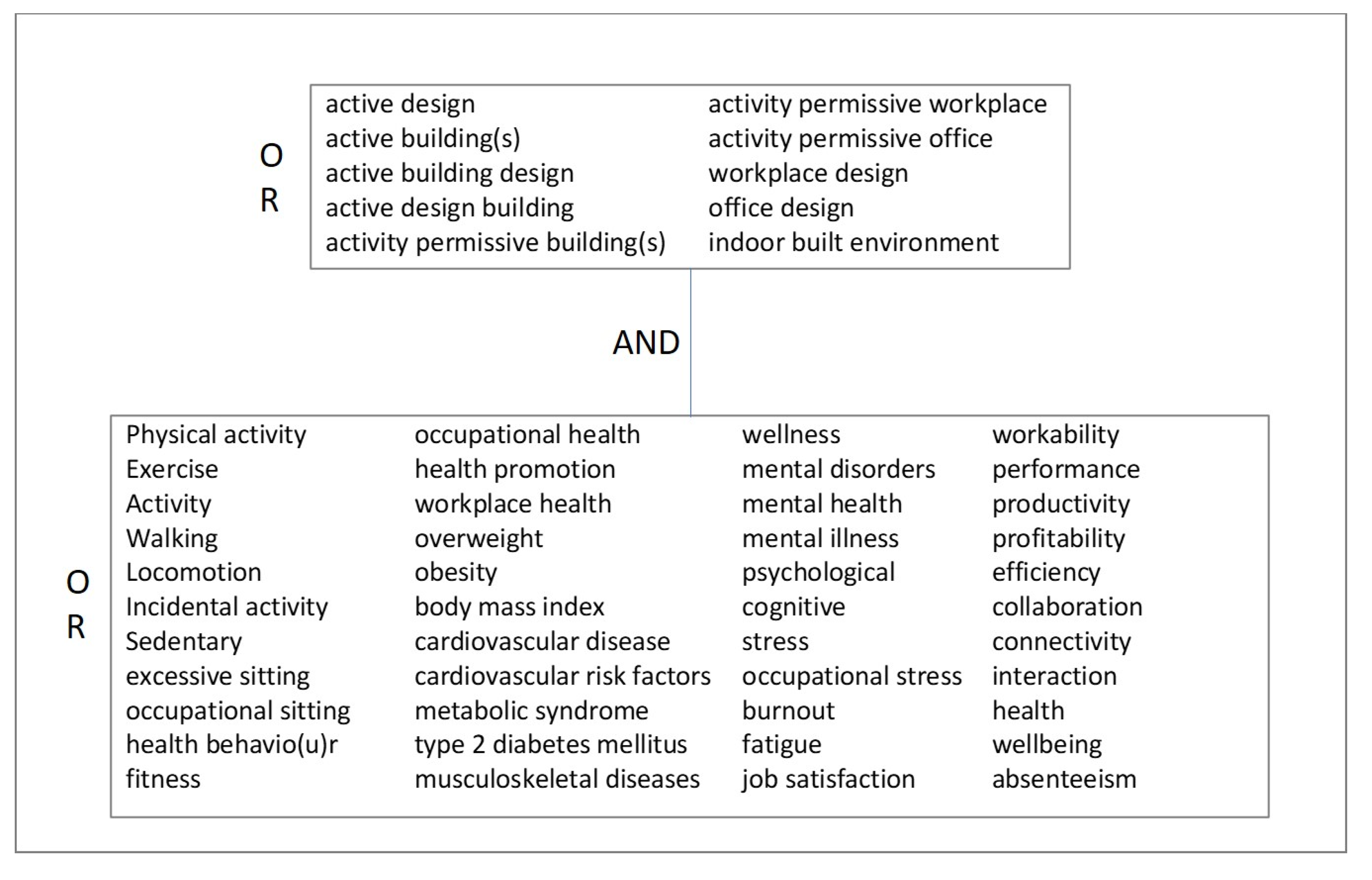
2.1. Search Strategy
2.2. Inclusions and Exclusions
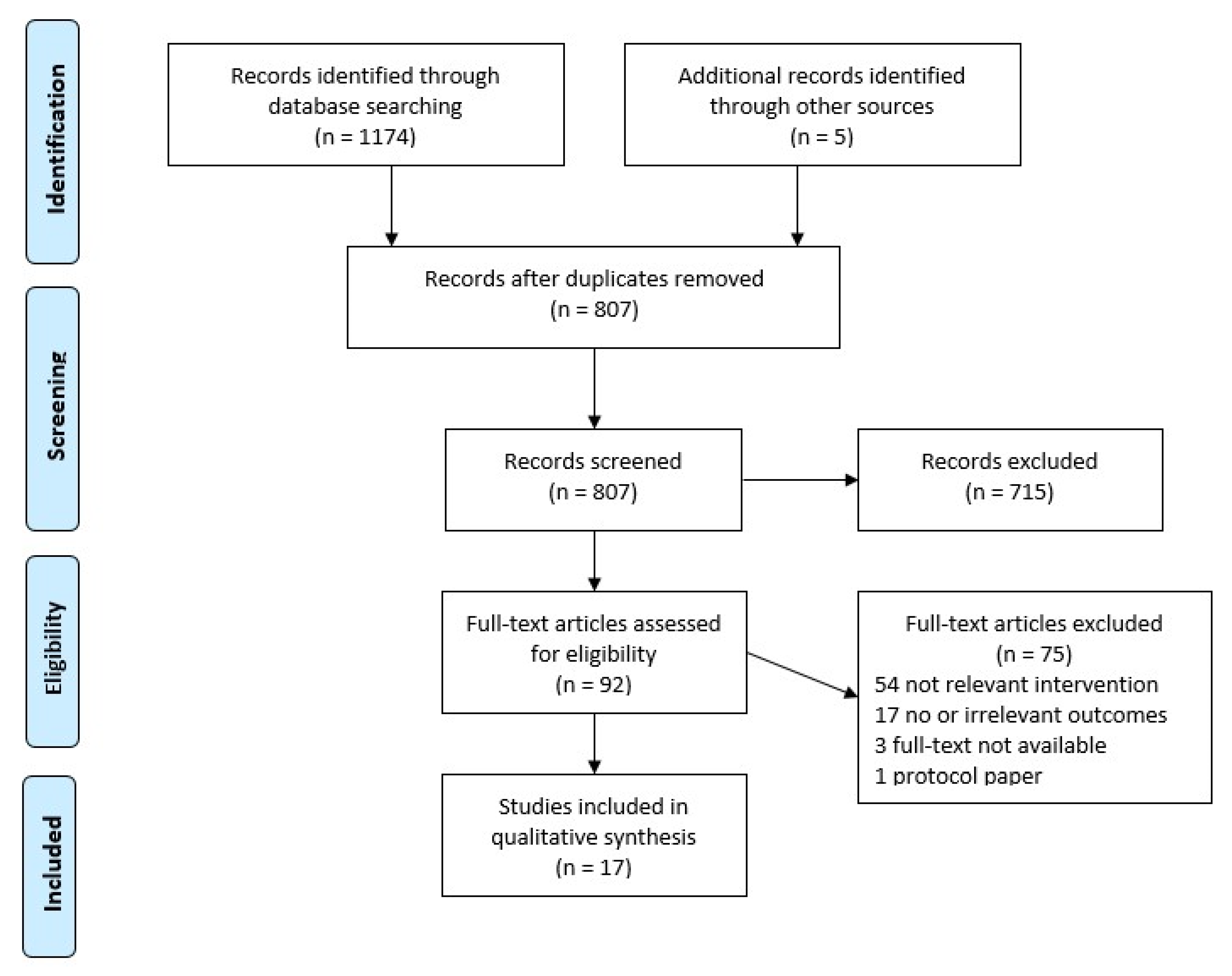
2.3. Screening
3. Results
3.1. Types of Studies
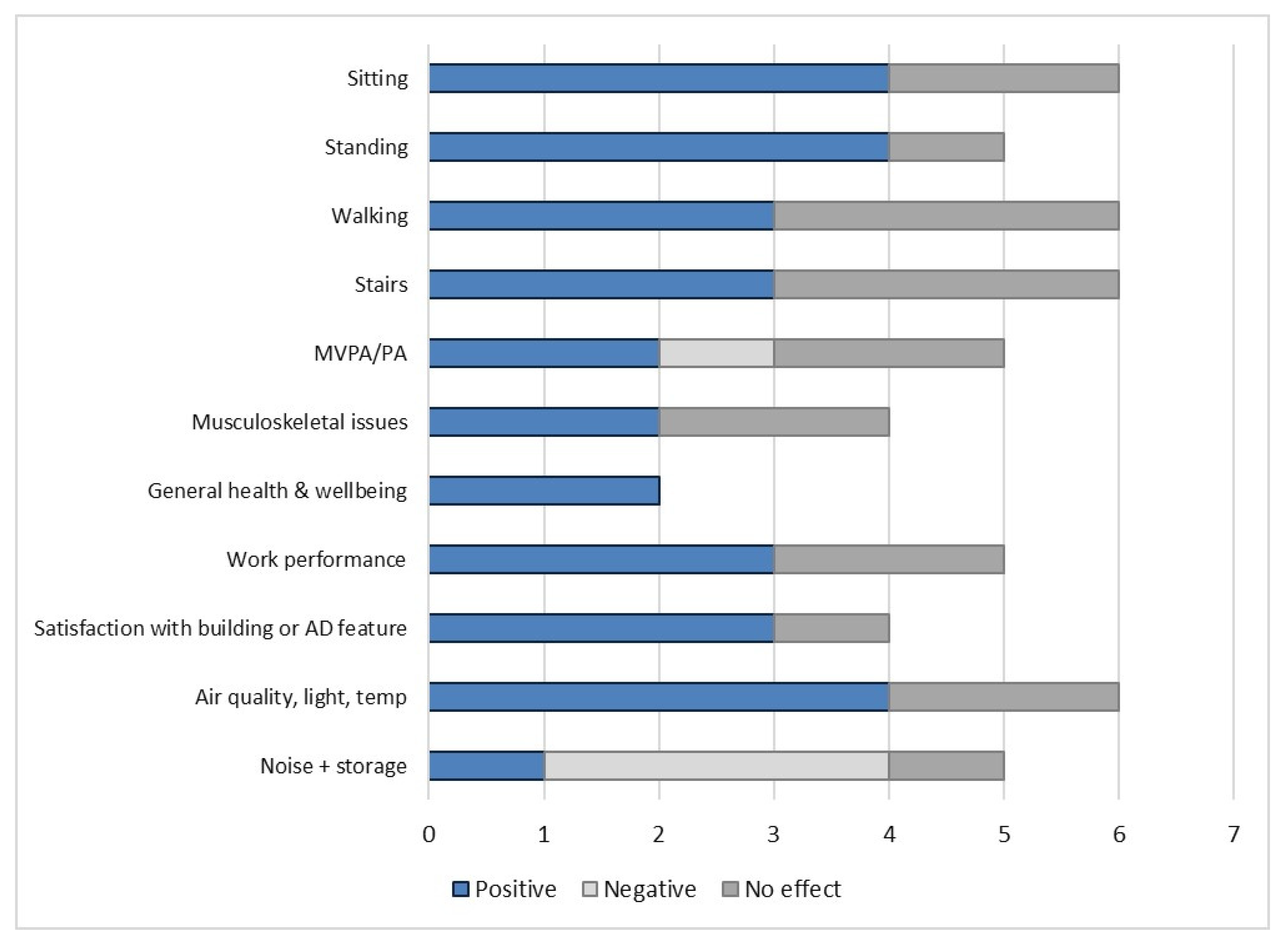
3.2. Outcomes
3.2.1. Sitting and Standing
3.2.2. Physical Activity
3.2.3. Musculoskeletal Effects
3.2.4. Work Performance and Health
3.2.5. Perceptions of the Workplace Environment
4. Discussion
4.1. Strengths and Limitations
4.2. Recommendations for Future Research
5. Conclusions
Supplementary Materials
Funding
Conflicts of Interest
References
- Australian Institute of Health and Welfare. Australia’s Health 2018; Australian Institute of Health and Welfare: Canberra, Australia, 2018.
- World Health Organization. Global Action Plan on Physical Activity 2018–2030: More Active People for a Healthier World; World Health Organization: Geneva, Switzerland, 2018. [Google Scholar]
- Ding, D.; Lawson, K.D.; Kolbe-Alexander, T.L.; Finkelstein, E.A.; Katzmarzyk, P.T.; van Mechelen, W.; Pratt, M. Lancet Physical Activity Series 2 Executive Committee. The economic burden of physical inactivity: A global analysis of major non-communicable diseases. Lancet 2016, 388, 1311–1324. [Google Scholar] [CrossRef]
- Bauman, A.E.; Chau, J.Y.; Ding, D.; Bennie, J. Too Much Sitting and Cardio-Metabolic Risk: An Update of Epidemiological Evidence. Curr. Cardiovasc. Risk Rep. 2013, 74, 293–298. [Google Scholar] [CrossRef]
- Giles-Corti, B.; Vernez-Moudon, A.; Reis, R.; Turrell, G.; Dannenberg, A.L.; Badland, H.; Foster, S.; Lowe, M.; Sallis, J.F.; Stevenson, M. City planning and population health: A global challenge. Lancet 2016, 388, 2912–2924. [Google Scholar] [CrossRef]
- Buckley, J.P.; Hedge, A.; Yates, T.; Copeland, R.J.; Loosemore, M.; Hamer, M.; Bradley, G.; Dunstan, D.W. The sedentary office: An expert statement on the growing case for change towards better health and productivity. Br. J. Sports Med. 2015, 49, 1357–1362. [Google Scholar] [CrossRef] [PubMed]
- Straker, L.; Dunstan, D.; Gilson, N.; Healy, G. Sedentary Work: Evidence on an Emergent Work Health and Safety Issue. Available online: https://www.safeworkaustralia.gov.au/system/files/documents/1702/literature-review-of-the-hazards-of-sedentary-work.pdf (accessed on 12 June 2019).
- Quintiliani, L.; Sattelmair, J.; Activity, P.; Sorensen, G. The Workplace as a Setting for Interventions to Improve Diet and Promote Physical Activity. World Health Organization. Available online: https://www.dphu.org/uploads/attachements/books/books_991_0.pdf (accessed on 23 October 2020).
- Goldgruber, J.; Ahrens, D. Effectiveness of workplace health promotion and primary prevention interventions: A review. Thai J. Public Health 2010, 18, 75–88. [Google Scholar] [CrossRef]
- Active Design Guidelines. 2010. Available online: https://www1.nyc.gov/assets/planning/download/pdf/plans-studies/active-design-guidelines/adguidelines.pdf (accessed on 12 December 2019).
- The City of New York. Active Design Guidelines: Promoting Physical Activity and Health in Design. 2010. Available online: https://activelivingresearch.org/active-design-guidelines-promoting-physical-activity-and-health-design (accessed on 10 December 2019).
- National Institute for Health and Care Excellence. Physical Activity and the Environment; National Institute for Health and Care Excellence: London, UK, 2014. [Google Scholar]
- Sport England. Active Design: Planning for Health and Wellbeing through Sport and Physical Activity. Public Health England. 2015. Available online: https://sportengland-production-files.s3.eu-west-2.amazonaws.com/s3fs-public/spe003-active-design-published-october-2015-email-2.pdf (accessed on 12 June 2019).
- Heart Foundation. Healthy Active By Design. 2015, pp. 22–24. Available online: https://www.healthyactivebydesign.com.au (accessed on 10 October 2019).
- Sallis, J.F.; Cervero, R.B.; Ascher, W.; Henderson, K.A.; Kraft, M.K.; Kerr, J. An Ecological Approach To Creating Active Living Communities. Annu. Rev. Public Health 2006, 27, 297–322. [Google Scholar] [CrossRef]
- Sallis, J.; Owen, N. Health Behavior and Health Education: Theory, Research, and Practice; Glanz, K., Rimer, B., Viswanath, K., Eds.; Jossey-Bass: San Francisco, CA, USA, 1996; pp. 403–424. [Google Scholar]
- Wicker, A.W. An Introduction to Ecological Psychology; Brooks/Cole Publishing Company: Pacific Grove, CA, USA, 1979. [Google Scholar]
- Marteau, T.M.; Hollands, G.J.; Fletcher, P.C. Changing Human Behavior to Prevent Disease: The Importance of Targeting Automatic Processes. Science 2012, 337, 1492–1495. [Google Scholar] [CrossRef]
- Hofmann, W.; Friese, M.; Wiers, R.W. Impulsive versus reflective influences on health behavior: A theoretical framework and empirical review. Health Psychol. Rev. 2008, 2, 111–137. [Google Scholar] [CrossRef]
- Marteau, T.M.; Ogilvie, D.; Roland, M.; Suhrcke, M.; Kelly, M.P. Judging nudging: Can nudging improve population health? BMJ 2011, 342, 228. [Google Scholar] [CrossRef]
- National Heart Lung and Blood Institute. Quality Assessment Tool for Before-After (Pre-Post) Studies with No Control Group. Available online: https://www.nhlbi.nih.gov/health-topics/study-quality-assessment-tools (accessed on 6 June 2019).
- National Heart Lung and Blood Institute. Quality Assessment Tool for Observational Cohort and Cross-Sectional Studies. Available online: https://www.nhlbi.nih.gov/health-pro/guidelines/in-develop/cardiovascular-risk-reduction/tools/cohort (accessed on 6 June 2019).
- Inalhan, G.; Brown, Z.; Cole, R.J.; Robinson, J.; Dowlatabadi, H. Evaluating user experience in green buildings in relation to workplace culture and context. Facilities 2010, 28, 225–238. [Google Scholar]
- Creagh, R.; McGann, S.; Tye, M.; Jancey, J.; Babb, C. Green Star is not a physical activity star. Facilities 2017, 35, 81–98. [Google Scholar] [CrossRef]
- Engelen, L.; Dhillon, H.M.; Chau, J.Y.; Hespe, D.; Bauman, A.E. Do active design buildings change health behaviour and workplace perceptions? Occup. Med. (Lond.) 2016, 66, 408–411. [Google Scholar] [CrossRef] [PubMed]
- Engelen, L.; Chau, J.; Bohn-Goldbaum, E.; Young, S.; Hespe, D.; Bauman, A. Is Active Design changing the workplace? A natural pre-post experiment looking at health behaviour and workplace perceptions. Work 2017, 56, 229–237. [Google Scholar] [CrossRef] [PubMed]
- Eyler, A.A.; Hipp, A.; Valko, C.A.; Ramadas, R.; Zwald, M. Can building design impact physical activity? A natural experiment. J. Phys. Act. Health 2018, 15, 355–360. [Google Scholar] [CrossRef] [PubMed]
- Gorman, E.; Ashe, M.C.; Dunstan, D.W.; Hanson, H.M.; Madden, K.; Winkler, E.A.H.; McKay, H.A.; Healy, G.A. Does an “activity-permissive” workplace change office workers’ sitting and activity time? PLoS ONE 2013, 8, e76723. [Google Scholar] [CrossRef] [PubMed]
- McGann, S.; Creagh, R.; Tye, M.; Jancey, J.; Blackford, K. Stationary in the office: Emerging themes for active buildings. Archit. Sci. Rev. 2014, 57, 260–270. [Google Scholar] [CrossRef]
- Bassett, D.; Browning, R.; Conger, S.; Wolff-Hughes, D.; Flynn, J. Architectural Design and Physical Activity: An Observational Study of Staircase and Elevator Use in Different Buildings. J. Phys. Act. Health 2013, 10, 556–562. [Google Scholar] [CrossRef]
- Dell, T. The Life of the Lab: Creating Collaborative Workspaces for Scientists. The University of Michigan. 2012. Available online: https://deepblue.lib.umich.edu/handle/2027.42/94036 (accessed on 2 December 2018).
- Hua, Y.; Loftness, V.; Heerwagen, J.H.; Powell, K.M. Relationship Between Workplace Spatial Settings and Occupant-Perceived Support for Collaboration. Environ. Behav. 2011, 43, 807–826. [Google Scholar] [CrossRef]
- Mcgann, S.; Creagh, R.; Tye, M.; Jancey, J.; Pages-Oliver, R.; James, H. Stairway to Health: An Analysis for Workplace Stairs Design and Use. 2015. Available online: http://anzasca.net/wp-content/uploads/2015/12/022_McGann_Creagh_Tye_Jancey_Pages-Oliver_James_ASA2015.pdf (accessed on 3 December 2018).
- Nicoll, G.; Zimring, C. Effect of innovative building design on physical activity. J. Public Health Policy 2009, 30, 111–123. [Google Scholar] [CrossRef]
- Rassia, S.T.; Alexiou, A.; Baker, N.V. Impacts of office design characteristics on human energy expenditure: Developing a “kINESIS” model. Energy Syst. 2011, 2, 33–44. [Google Scholar] [CrossRef]
- Ruff, R.R.; Rosenblum, R.; Fischer, S.; Meghani, H.; Adamic, J.; Lee, K.K. Associations between building design, point-of-decision stair prompts, and stair use in urban worksites. Prev. Med. 2014, 60, 60–64. [Google Scholar] [CrossRef] [PubMed]
- Gilson, N.D.; Burton, N.W.; van Uffelen, J.G.Z.; Brown, W.J. Occupational sitting time: Employees? perceptions of health risks and intervention strategies. Health Promot. J. Aust. 2011, 22, 38–43. [Google Scholar] [CrossRef] [PubMed]
- Hadgraft, N.T.; Healy, G.N.; Owen, N.; Winkler, E.A.H.; Lynch, B.M.; Sethi, P.; Eakin, E.G.; Moodie, M.; LaMontagne, A.D.; Wiesner, G.; et al. Office workers’ objectively assessed total and prolonged sitting time: Individual-level correlates and worksite variations. Prev. Med. Rep. 2016, 4, 184–191. [Google Scholar] [CrossRef] [PubMed]
- Jancey, J.M.; McGann, S.; Creagh, R.; Blackford, K.D.; Howat, P.; Tye, M. Workplace building design and office-based workers’ activity: A study of a natural experiment. Aust. N. Z. J. Public Health 2016, 40, 78–82. [Google Scholar] [CrossRef] [PubMed]
- Foley, B.; Engelen, L.; Gale, J.; Bauman, A.; Mackey, M. Sedentary Behavior and Musculoskeletal Discomfort Are Reduced When Office Workers Trial an Activity-Based Work Environment. J. Occup. Environ. Med. 2016, 58, 1. [Google Scholar] [CrossRef] [PubMed]
- Womersley, L.; May, S. Sitting Posture of Subjects With Postural Backache. J. Manip. Physiol. Ther. 2006, 29, 213–218. [Google Scholar] [CrossRef]
- Dole, C.; Schroeder, R.G. The impact of various factors on the personality, job satisfaction and turnover intentions of professional accountants. Manag. Audit. J. 2001, 16, 234–245. [Google Scholar] [CrossRef]
- American Society of Interior Designers. Design Impact Lives. Available online: https://www.asid.org/ (accessed on 2 June 2019).
- Candido, C.; Marzban, S.; Haddad, S.; Mackey, M.; Loder, A. Designing healthy workspaces: Results from Australian certified open-plan offices. Facilities 2020. [Google Scholar] [CrossRef]
- Engelen, L.; Chau, J.; Young, S.; Mackey, M.; Jeyapalan, D.; Bauman, A. Is activity-based working impacting health, work performance and perceptions? A systematic review. Build. Res. Inf. 2019, 12, 1–12. [Google Scholar] [CrossRef]
- Horr, Y.A.; Arif, M.; Kaushik, A.; Mazroei, A.; Katafygiotou, M.; Elsarrag, E. Occupant productivity and office indoor environment quality: A review of the literature. Build. Environ. 2016, 105, 369–389. [Google Scholar] [CrossRef]
- Saelens, B.E.; Handy, S.L. Built environment correlates of walking: A review. Med. Sci. Sports Exerc. 2008, 40, 550–566. [Google Scholar] [CrossRef] [PubMed]
- Fayard, A.L.; Weeks, J. Affordances for practice. Inf. Organ. 2014, 24, 236–249. [Google Scholar] [CrossRef]

| Study, Country | N | Exposure(s)/Intervention(s) and Descriptions | Major Findings |
|---|---|---|---|
| Pre–Post Studies | |||
| Brown et al. (2010), Canada [23] | 145 | Office workers moving from an older building to new “green” interaction-focused building with health and fitness facilities. Observational descriptive data on old and new buildings provided. | Workers perceived their health to have improved post-move, and cited provision of a workplace gym and sense of increased emphasis on wellbeing as reasons. There were reported improvements in comfort and productivity, mainly related to better environmental conditions. |
| Creagh et al. (2017), Australia [24] | 42 | Adult office workers at quasi-governmental peak body organisation moving from a 1980s building to a purpose-built 5-star Green Star Building. The organisation’s wellness committee had been part of the design process. | Increase in self-reported feeling of energy, overall health and satisfaction with the overall building in the new building. Small reduction in accelerometer-measured sedentary time (84.9–79.7%) and corresponding increase in light physical activity (11.2–17.0%) in the new building. No change in MVPA was observed. Discussion of environmental factors that support and inhibit physical activity. |
| Engelen et al. (2016), Australia [25] | 21 | Adult university staff moving from several older buildings into one new building, designed using Active Design principles. Exposures assessed via building audit. | Workers sat less and stood more (average of 1.2 h per day less sitting), but there were no changes in walking or stair climbing. Workers reported less back pain, but productivity was unchanged. |
| Engelen et al. (2017), Australia [26] | 62 | Adult university staff moving from several older buildings into one new building, designed using Active Design principles, with longer and attractive walking routes to centralised facilities, naturally-lit open central staircase and bicycle storage and showers. Exposures assessed via building audit (observational and measurement data). | Workers sat less and stood more in the new building (approximately 2.5 h per week less sitting), but there were no changes in walking or stair climbing. Workers reported less back pain, more motivation and were more satisfied with their environment and connectivity. Sleep and productivity were unchanged. |
| Eyler et al. (2018), United States [27] | 166; 89 | Adult university staff moving or not moving from existing building into new building and control participants in a different building where no change took place. The new building had large, open and centrally located stair wells; sit/stand desks; end-of-trip facilities; and centralised printing and rubbish facilities. | Increase in self-reported sit/stand workstations (27.9–65.8%); change facilities (25–50.4%) and support for PA (33.9–47.0%). No change was seen in self-reported PA. Although the objective measures showed increases in energy expenditure and step counts from pre to post in the Movers, significant increases were also measured in the Non-movers and the control participants. |
| Gorman et al. (2013), Canada [28] | 24 | Adult workers in a physical activity academic research centre, moving from an older building into a new purpose-built building designed to support movement, including glass staircases, centralised and vertically integrated facilities. Observational descriptive data on old and new buildings provided. | Workers spent more time standing and less time sitting in the new building, but there were no significant changes in walking, body composition, health, work performance or satisfaction measures. |
| Jancey et al. (2016), Australia [29] | 42 | Adult office workers moving from 1970s building to new “activity-permissive” purpose-built building, with more accessible circulation routes, attractive central open staircase and further walking distances to centralised amenities, such as print room, toilets, kitchen. Exposures assessed via building audit. | Workers spent less daily work time sitting down and more time standing up in the new building, and, on average, took more steps each day. Time spent doing moderate or vigorous activity did not change post move, with no changes in stair use. Average duration of sedentary bouts actually increased. |
| Cross-Sectional Analytic Mixed-Method Studies | |||
| Bassett et al. (2013), United States [30] | Employees and visitors to three buildings on a university campus, where buildings had different stair, elevator and lobby design characteristics. Observational descriptive data on building design provided. | Far greater proportions of people used stairs in the two buildings which had centrally located, attractive, well-lit and accessible staircases, compared with those in the building with central elevator bank and closed fire stairs located further from lobby entrance. | |
| Dell et al. (2012), United States [31] | Researchers, laboratory technicians and students working in two university science buildings. Space Syntax Analysis used to quantitatively assess spatial features of each building in addition to qualitative descriptions of layout and spatial features. | Workers were more likely to move within their building if spaces were more integrated, particularly via well-designed corridors. Social interaction, which may be critical to collaboration, is supported by having access to shared break and laboratory equipment areas. Use of shared spaces is facilitated by placing them near integrated corridors to increase accessibility and visibility. | |
| Hua et al. (2011), United States [32] | 308 | Office workers in 11 buildings (10 federal workplaces and 1 research building) engaging in their typical workplace activities over the study period. Five workstations and six floor plan variables were measured for spatial analysis. | Office floor-plan spatial characteristics are more important than workstation characteristics in predicting perceptions of support for collaboration among workers. Locating kitchens and print/copy areas in centralised hubs some distance away from workstations can reduce distractions and improve perceptions of both informal and planned collaboration. |
| McGann et al. (2015), Australia [33] | 99 | University staff working in one of three buildings, built in either the 1970s, 1980s or 1990s. Relevant features of newest building included open and well-lit staircases and centralised facilities, compared to fire-stairs in older buildings. Architectural audit provided exposure information. | Workers in the newest building (with more attractive and accessible stairs) spent more time engaged in moderate-vigorous activity during the workday than those in the two older buildings, presumed to be largely due to increased stair use. |
| Nicoll et al. (2009), United States [34] | 299 | Office workers in a 13-storey government building with one skip–stop elevator vertical circulation core (elevator stopping every 3rd floor for able-bodied workers, with adjacent open stairwell) and one traditional elevator circulation core with adjacent enclosed fire stairwell. Descriptive data regarding building design elements provided. | The open staircase adjacent to the skip-stop elevator was used 33 times more than the fire stairs adjacent to the traditional elevator. However, one quarter of building occupants were dissatisfied with the skip-stop system, and there was an unexpected rise in the number of people identifying as disabled upon relocating to the building with the skip-stop system. Interviews identified that installation of skip–stop systems required deviation from normal building codes and security issues may occur with an open continuous stairwell if one building houses multiple companies. |
| Rassia et al. (2011), United Kingdom [35] | 423 | Office workers in six offices, observed going about their typical daily tasks over a 2-week period. Indoor office layout data collected via observations and measurements. | Office workers frequently visit kitchens and print rooms. An increase in workstation-to-kitchen distance will not discourage kitchen use but distance will negatively influence trips to the print room. Trips to toilets, managers’ offices and meeting rooms occur at the same frequency irrespective of office layout. The presence of larger windows, allowing more natural light and outside views, at a given destination will encourage movement to that destination. Intra-office distances longer than 50 m, and stair travel beyond two flights are likely to discourage walking. Decreasing the speed of elevators and distance from workstation to stairs may increase stair use. |
| Ruff et al. (2014), United States [36] | 1348 | Employees from 14 office buildings in New York City. Exposure measures consisted of qualitative observational and quantitative measurement data on stairwell and lobby design spatial characteristics. | Office workers were more likely to use stairwells that were naturally lit and those that had greater visibility from the entrance lobby. Workers were less likely to use stairs when they worked on a higher floor or if the stairs were located further from the lobby entrance. |
| Qualitative Studies | |||
| Gilson et al. (2011), Australia [37] | 24 | Government office workers from city and regional locations. Descriptive data on office environments obtained via focus groups. | Workers were open to ideas around centralising printers and bins in hubs located further away from workstations, and would be willing to walk further to get coffee or use the toilet, including accessing bathrooms located up or down stairs. Barriers to moving more in the office included inaccessible stairwells, concerns about productivity and loss of concentration, and workplace culture where being away from a desk may be seen in a negative light. |
| Hadgraft et al. (2016), Australia [38] | 20 | Employees and managers from a range of industries in office-based settings where formal sitting reduction strategies had not been employed. Descriptive data on office environments provided by authors and generated through semi-structured interviews. | Centralised facility hubs (printing/copying, rubbish bins, kitchens) did not always encourage more worker movement, and may have a paradoxical effect, whereby workers save up print/copy jobs to avoid walking regularly to the facility, and collect mounds of rubbish by their desks during the day, taking this to the bins room once a day or every few days. Managers identified need for strong business case to support sitting reduction strategies. |
| McGann et al. (2014), Australia [29] | 90 | Local government employees continuing their usual work in an older style office building. Spatial characteristics gathered by observation and architectural floor-plan review. | Workers move primarily to be with others, to access food or drink, and to complete paperwork tasks, such as printing and photocopying. Workplace culture was a facilitator of movement. Barriers to movement and stair-use include lack of easy-to-navigate circulation routes through the office, inappropriate footwear, safety concerns, physical barriers such as aggressive signage on closed fire stair doors. |
Publisher’s Note: MDPI stays neutral with regard to jurisdictional claims in published maps and institutional affiliations. |
© 2020 by the author. Licensee MDPI, Basel, Switzerland. This article is an open access article distributed under the terms and conditions of the Creative Commons Attribution (CC BY) license (http://creativecommons.org/licenses/by/4.0/).
Share and Cite
Engelen, L. Does Active Design Influence Activity, Sitting, Wellbeing and Productivity in the Workplace? A Systematic Review. Int. J. Environ. Res. Public Health 2020, 17, 9228. https://doi.org/10.3390/ijerph17249228
Engelen L. Does Active Design Influence Activity, Sitting, Wellbeing and Productivity in the Workplace? A Systematic Review. International Journal of Environmental Research and Public Health. 2020; 17(24):9228. https://doi.org/10.3390/ijerph17249228
Chicago/Turabian StyleEngelen, Lina. 2020. "Does Active Design Influence Activity, Sitting, Wellbeing and Productivity in the Workplace? A Systematic Review" International Journal of Environmental Research and Public Health 17, no. 24: 9228. https://doi.org/10.3390/ijerph17249228
APA StyleEngelen, L. (2020). Does Active Design Influence Activity, Sitting, Wellbeing and Productivity in the Workplace? A Systematic Review. International Journal of Environmental Research and Public Health, 17(24), 9228. https://doi.org/10.3390/ijerph17249228


