Review

In Utero Exposure to Particulate Air Pollution during Pregnancy: Impact on Birth Weight and Health through the Life Course

by
Susanne Steinle
1,
Helinor J. Johnston
2,
Miranda Loh
1,
William Mueller
1,
Sotiris Vardoulakis
1,3,
Kraichat Tantrakarnapa
4 and
John W. Cherrie
1,2,*
1
Institute of Occupational Medicine, Research Avenue North, Edinburgh EH14 4AP, UK
2
Institute of Biological Chemistry, Biophysics and Bioengineering, School of Engineering and Physical Sciences, Heriot Watt University, Riccarton, Edinburgh EH14 4AS, UK
3
National Centre for Epidemiology and Population Health, Research School of Population Health, Australian National University, Canberra ACT 2601, Australia
4
Department of Social and Environmental Medicine, Faculty of Tropical Medicine, MAHIDOL University, 420/6 Ratchawithi Road, Ratchathewi, Bangkok 10400, Thailand
*
Author to whom correspondence should be addressed.
Int. J. Environ. Res. Public Health 2020, 17(23), 8948; https://doi.org/10.3390/ijerph17238948

Submission received: 25 September 2020 / Revised: 5 November 2020 / Accepted: 25 November 2020 / Published: 1 December 2020
(This article belongs to the Section Environmental Health)

Abstract

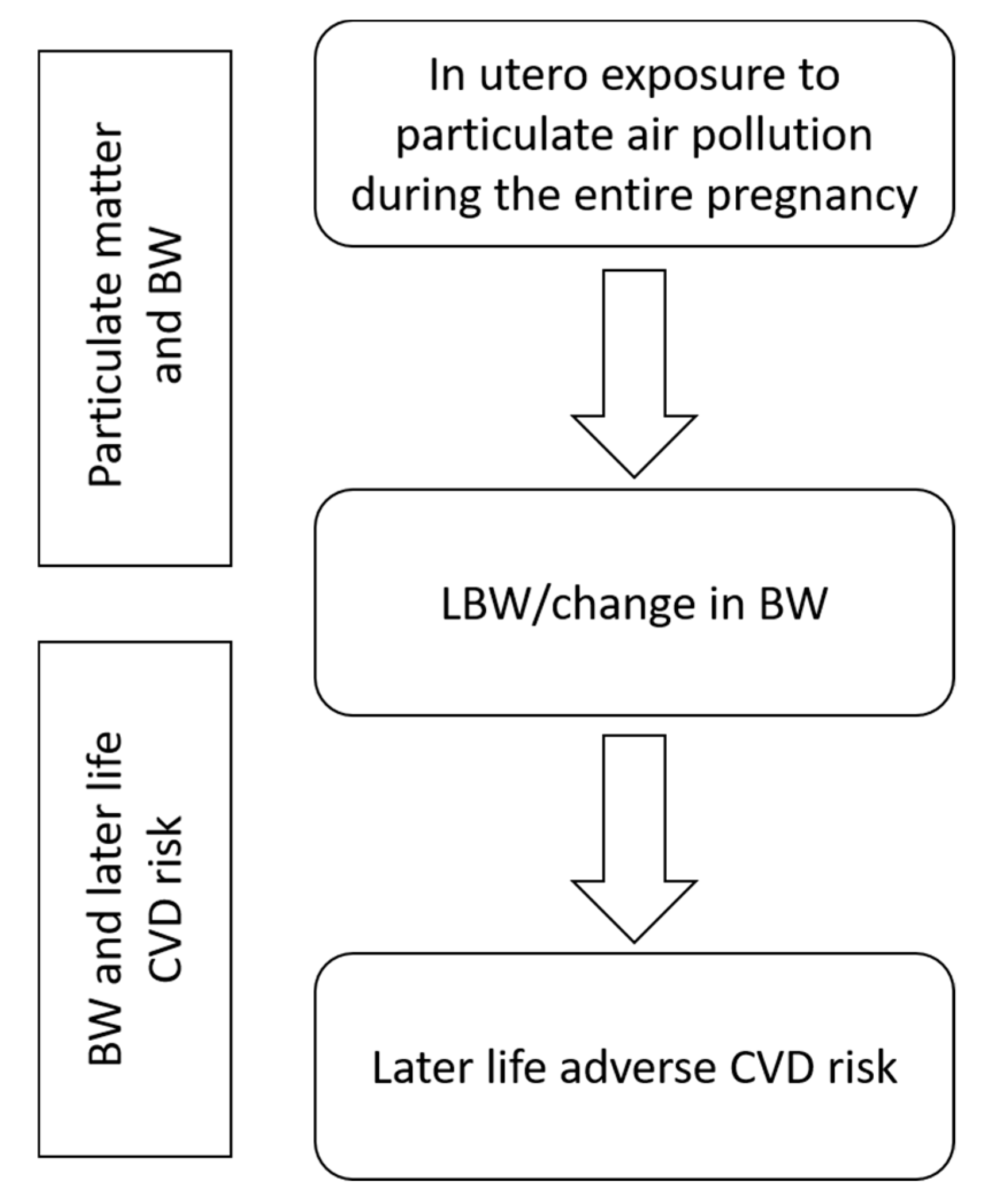
In high-income countries, and increasingly in lower- and middle-income countries, chronic non-communicable diseases (NCDs) have become the primary health burden. It is possible that in utero exposure to environmental pollutants such as particulate matter (PM) may have an impact on health later in life, including the development of NCDs. Due to a lack of data on foetal growth, birth weight is often used in epidemiologic studies as a proxy to assess impacts on foetal development and adverse birth outcomes since it is commonly recorded at birth. There are no research studies with humans that directly link PM exposure in utero to birth weight (BW) and subsequently, the effects of lower BW on health outcomes in old age. It is, however, plausible that such associations exist, and it is thus important to assess the potential public health impacts of PM across the life course, and it is plausible to use birth weight as an indicator of risk. We therefore split this narrative review into two parts. In the first part, we evaluated the strength of the evidence on the impact of PM exposure during the entire pregnancy on birth weight outcomes in ten meta-analyses. In the second part, we reviewed the literature linking lower birth weight to childhood and adult chronic cardiovascular disease to explore the potential implications of PM exposure in utero on health later in life. Within the reviewed meta-studies on birth weight, there is sufficient evidence that PM pollution is associated with lower birth weight, i.e., the majority of meta-studies found statistically significant reductions in birth weight. From the second part of the review, it is evident that there is good evidence of associations between lower birth weight and subsequent cardiovascular disease risk. It is thus plausible that in utero exposure to PM is associated with lower birth weight and persisting biological changes that could be associated with adverse health effects in adulthood. Based on the reviewed evidence, however, the magnitude of later life cardiovascular health impacts from in utero exposure and its impact on BW are likely to be small compared to health effects from exposure to particulate air pollution over a whole lifetime.
Keywords: birth weight; LBW; health risk; air pollution; particulate matter; NCD birth weight; LBW; health risk; air pollution; particulate matter; NCD