

Next Article in Journal
Ecological Compensation Strategy for SDG-Based Basin-Type National Parks: A Case Study of the Baoxing Giant Panda National Park
Next Article in Special Issue
Design and Pilot Implementation of an Electronic Health Record-Based System to Automatically Refer Cancer Patients to Tobacco Use Treatment
Previous Article in Journal
Knowledge, Attitudes and Expectations of Physicians with Respect to Palliative Care in Ecuador: A Qualitative Study
Previous Article in Special Issue
The Emergence of a Sustainable Tobacco Treatment Program across the Cancer Care Continuum: A Systems Approach for Implementation at the University of California Davis Comprehensive Cancer Center
Article

Tobacco Dependence Treatment in Oncology: Initial Patient Clinical Characteristics and Outcomes from Roswell Park Comprehensive Cancer Center

1
Roswell Park Comprehensive Cancer Center, Buffalo, NY 14263, USA
2
Fralin Biomedical Research Institute at VTC, Roanoke, VA 24016, USA
*
Author to whom correspondence should be addressed.
Int. J. Environ. Res. Public Health 2020, 17(11), 3907; https://doi.org/10.3390/ijerph17113907

Received: 6 April 2020 / Revised: 11 May 2020 / Accepted: 22 May 2020 / Published: 31 May 2020
(This article belongs to the Special Issue Tobacco Use and Treatment among Cancer Survivors)
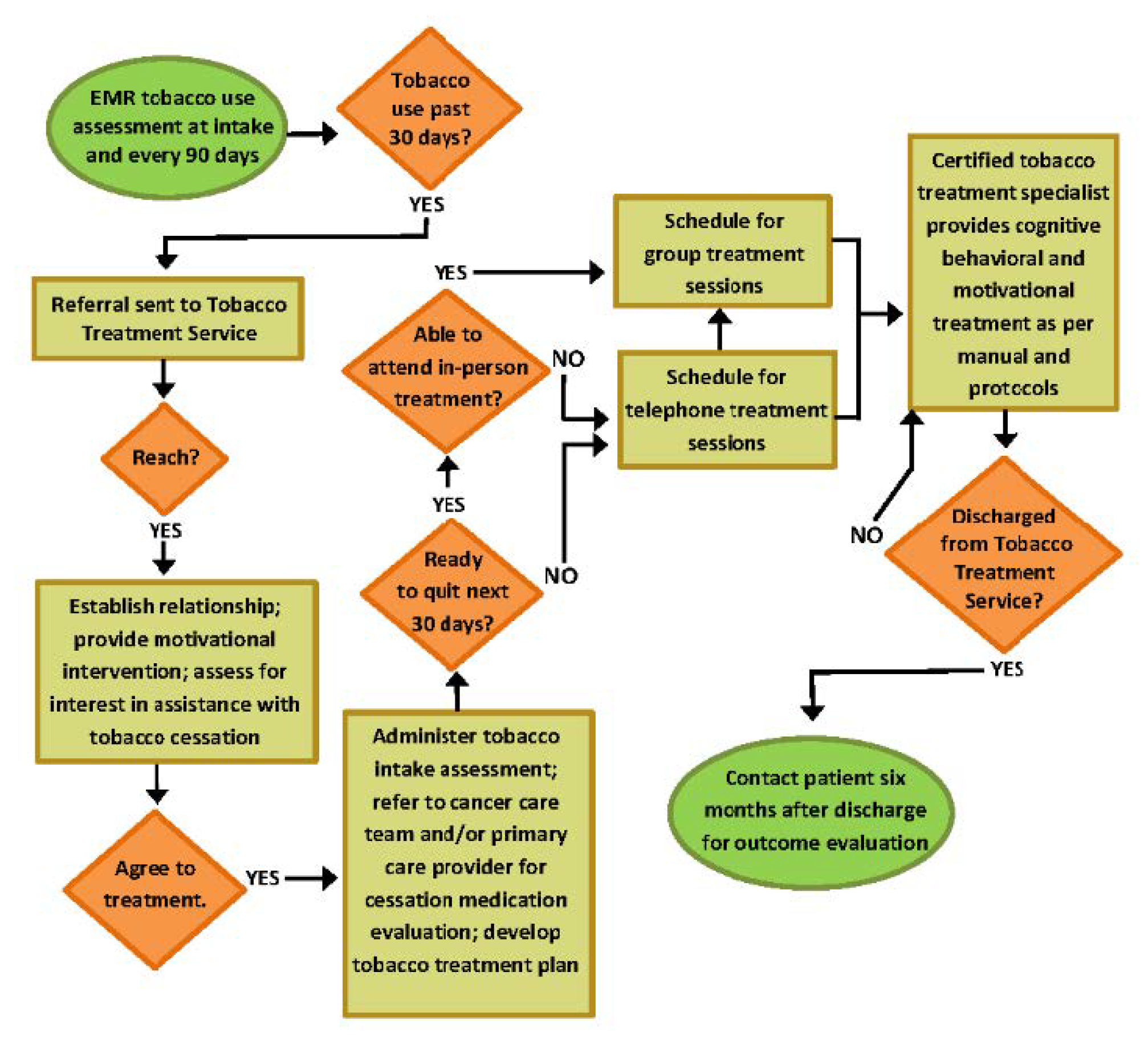
Despite the importance of smoking cessation to cancer care treatment, historically, few cancer centers have provided treatment for tobacco dependence. To address this gap, the National Cancer Institute (NCI) launched the Cancer Center Cessation Initiative (C3i). As part of this effort, this study examined implementation outcomes in a cohort of cancer survivors (CSs) who smoked cigarettes in the first year of an ongoing process to develop and implement a robust Tobacco Treatment Service at Roswell Park Comprehensive Cancer Center. We provide a comprehensive description of the new tobacco use assessment and referral process, and of the characteristics of cancer survivors who agreed to treatment including traditional tobacco-related psychosocial and cancer treatment-related characteristics and novel characteristics such as delay discounting rates. We also examine characteristic differences among those who agreed to treatment between those who attended and those who did not attend treatment. As the new tobacco assessment was implemented, the number of referrals increased dramatically. The mean number of treatment sessions attended was 4.45 (SD = 2.98) and the six-month point prevalence intention to treat abstinence rate among those who attended was 22.7%. However, only 6.4% agreed to treatment and 4% attended at least one treatment session. A large proportion of cancer survivors who agreed to treatment were women, of older age, of lower socioeconomic status (SES), and who had high levels of depressive symptomology. The findings demonstrate that the implementation of system changes can significantly improve the identification of cancer survivors who use tobacco and are referred to tobacco use treatment. Among those who attend, treatment is effective. However, the findings also suggest that a systematic assessment of barriers to engagement is needed and that cancer survivors may benefit from additional treatment tailoring. We present plans to address these implementation challenges. Systematic electronic medical record (EMR)-sourced referral to tobacco treatment is a powerful tool for reaching cancer survivors who smoke, but more research is needed to determine how to enhance engagement and tailor treatment processes. View Full-Text
Keywords: cancer survivors; smoking; tobacco dependence; cognitive behavioral treatment cancer survivors; smoking; tobacco dependence; cognitive behavioral treatment
Show Figures

Figure 1

MDPI and ACS Style

Sheffer, C.E.; Stein, J.S.; Petrucci, C.; Mahoney, M.C.; Johnson, S.; Giesie, P.; Carl, E.; Krupski, L.; Tegge, A.N.; Reid, M.E.; Bickel, W.K.; Hyland, A. Tobacco Dependence Treatment in Oncology: Initial Patient Clinical Characteristics and Outcomes from Roswell Park Comprehensive Cancer Center. Int. J. Environ. Res. Public Health 2020, 17, 3907. https://doi.org/10.3390/ijerph17113907
AMA Style

Sheffer CE, Stein JS, Petrucci C, Mahoney MC, Johnson S, Giesie P, Carl E, Krupski L, Tegge AN, Reid ME, Bickel WK, Hyland A. Tobacco Dependence Treatment in Oncology: Initial Patient Clinical Characteristics and Outcomes from Roswell Park Comprehensive Cancer Center. International Journal of Environmental Research and Public Health. 2020; 17(11):3907. https://doi.org/10.3390/ijerph17113907

Chicago/Turabian Style

Sheffer, Christine E., Jeffrey S. Stein, Cara Petrucci, Martin C. Mahoney, Shirley Johnson, Pamela Giesie, Ellen Carl, Laurie Krupski, Allison N. Tegge, Mary E. Reid, Warren K. Bickel, and Andrew Hyland. 2020. "Tobacco Dependence Treatment in Oncology: Initial Patient Clinical Characteristics and Outcomes from Roswell Park Comprehensive Cancer Center" International Journal of Environmental Research and Public Health 17, no. 11: 3907. https://doi.org/10.3390/ijerph17113907

Find Other Styles
Note that from the first issue of 2016, MDPI journals use article numbers instead of page numbers. See further details here.

Article Access Map by Country/Region

1
Back to TopTop