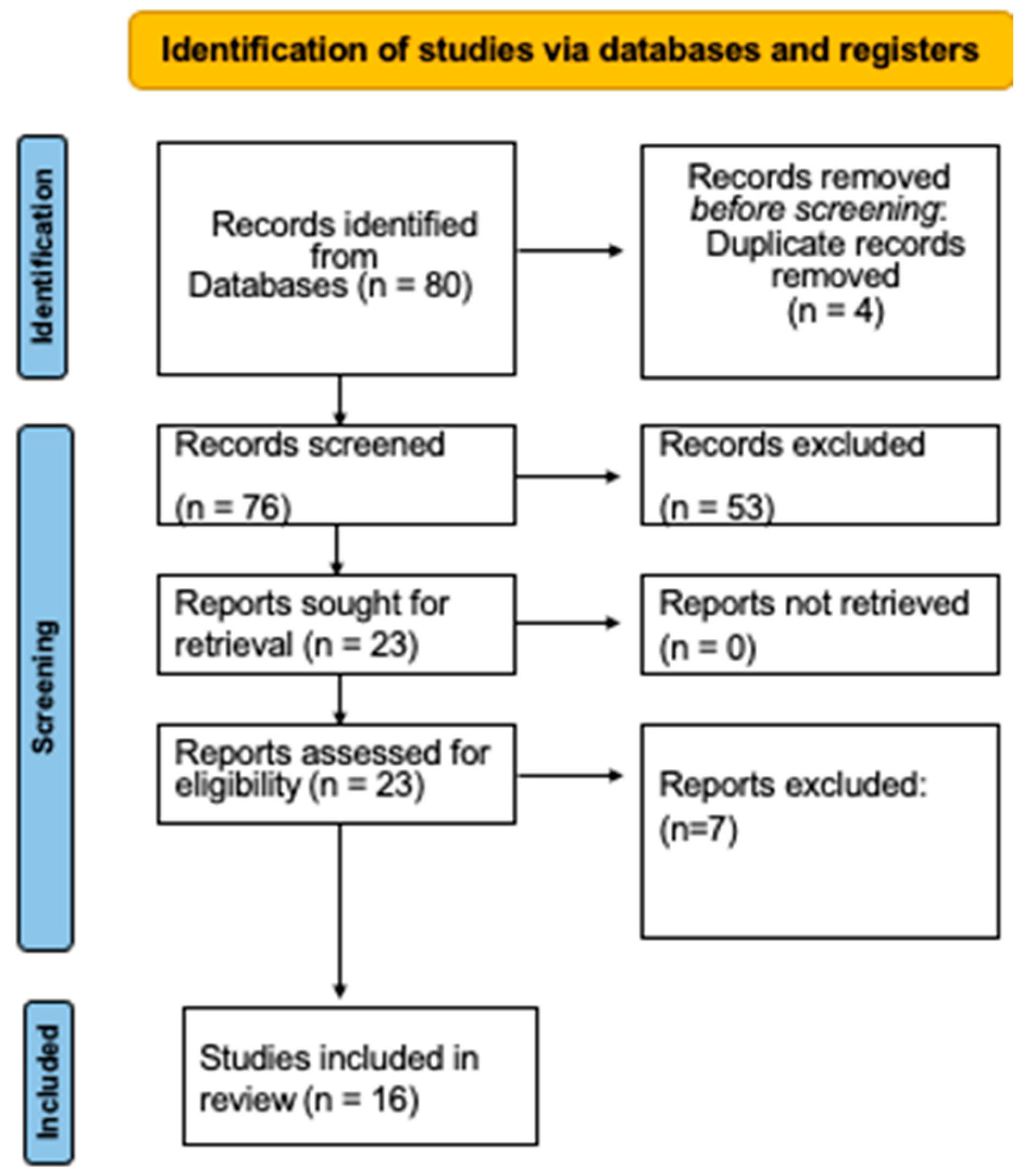
Applications of Lab on a Chip in Antimicrobial Susceptibility of Staphylococcus aureus: A Systematic Review



Abstract
:1. Introduction
2. Materials and Methods
2.1. Search Approach
2.2. Selection Criteria
2.3. Question
2.4. Review Course
2.5. Data Compilation
2.6. Risk of Bias
3. Results
4. Discussion
Future Perspective
- Point-of-Care Diagnostics: lab-on-a-chip devices are likely to become integral for point-of-care diagnostics. They can enable rapid and accurate testing at or near the patient’s location, reducing the need for centralized laboratories and providing quicker results for timely decision-making in emergency situations and routine healthcare [47].
- Personalized Medicine: lab-on-a-chip technology could play a crucial role in personalized medicine by allowing for the rapid and cost-effective analysis of an individual’s genetic makeup, enabling tailored treatment plans and medication choices based on a patient’s unique genetic profile [49].
- Early Disease Detection: The sensitivity and specificity of lab-on-a-chip devices make them ideal for early disease detection. They can detect biomarkers associated with diseases like cancer, diabetes, and infectious diseases at their earliest stages, increasing the chances of successful treatment and reducing healthcare costs [47].
- Remote Monitoring: Miniaturized sensors and microfluidic devices can be integrated into wearable or implantable devices, facilitating continuous monitoring of patients’ health parameters. This real-time data can be sent to healthcare providers, enabling proactive interventions and better management of chronic conditions [50].
- Drug Development: lab-on-a-chip technology can streamline drug development processes by allowing for high-throughput screening of potential drug candidates and the study of their effects on cells or tissues. This can accelerate the development of new drugs and therapies [51].
- Global Health Impact: In resource-limited settings and developing countries, lab-on-a-chip devices can provide affordable and accessible diagnostic tools for diseases, helping to address global health challenges [52].
- Advanced Imaging and Analysis: Future lab-on-a-chip systems may incorporate advanced imaging and analysis techniques, such as artificial intelligence and machine learning, to enhance the accuracy and speed of diagnoses and data interpretation [53].
5. Conclusions
Author Contributions
Funding
Institutional Review Board Statement
Informed Consent Statement
Data Availability Statement
Acknowledgments
Conflicts of Interest
References
- Aslam, B.; Khurshid, M.; Arshad, M.I.; Muzammil, S.; Rasool, M.; Yasmeen, N.; Shah, T.; Chaudhry, T.H.; Rasool, M.H.; Shahid, A.; et al. Antibiotic Resistance: One Health One World Outlook. Front. Cell. Infect. Microbiol. 2021, 11, 771510. [Google Scholar] [CrossRef] [PubMed]
- Ferri, M.; Ranucci, E.; Romagnoli, P.; Giaccone, V. Antimicrobial resistance: A global emerging threat to public health systems. Crit. Rev. Food Sci. Nutr. 2017, 57, 2857–2876. [Google Scholar] [CrossRef] [PubMed]
- Uddin, T.M.; Chakraborty, A.J.; Khusro, A.; Zidan, B.R.M.; Mitra, S.; Bin Emran, T.; Dhama, K.; Ripon, K.H.; Gajdács, M.; Sahibzada, M.U.K.; et al. Antibiotic resistance in microbes: History, mechanisms, therapeutic strategies and future prospects. J. Infect. Public Health 2021, 14, 1750–1766. [Google Scholar] [CrossRef] [PubMed]
- Hernando-Amado, S.; Coque, T.M.; Baquero, F.; Martínez, J.L. Defining and combating antibiotic resistance from One Health and Global Health perspectives. Nat. Microbiol. 2019, 4, 1432–1442. [Google Scholar] [CrossRef] [PubMed]
- Tacconelli, E.; Carrara, E.; Savoldi, A.; Harbarth, S.; Mendelson, M.; Monnet, D.L.; Pulcini, C.; Kahlmeter, G.; Kluytmans, J.; Carmeli, Y.; et al. WHO Pathogens Priority List Working Group. Discovery, research, and development of new antibiotics: The WHO priority list of antibiotic-resistant bacteria and tuberculosis. Lancet Infect. Dis. 2018, 18, 318–327. [Google Scholar] [CrossRef] [PubMed]
- Guo, Y.; Song, G.; Sun, M.; Wang, J.; Wang, Y. Prevalence and Therapies of Antibiotic-Resistance in Staphylococcus aureus. Front. Cell. Infect. Microbiol. 2020, 10, 107. [Google Scholar] [CrossRef] [PubMed]
- Silva-de-Jesus, A.C.; Ferrari, R.G.; Panzenhagen, P.; Conte-Junior, C.A. Staphylococcus aureus biofilm: The role in disseminating antimicrobial resistance over the meat chain. Microbiology 2022, 168, 001245. [Google Scholar]
- Lewis, N.; Leaptrot, D.; Witt, E.; Smith, H.; Hebden, J.N.; Wright, M.O. Health Care-Associated Infections Studies Project: An American Journal of Infection Control and National Healthcare Safety Network Data Quality Collaboration Case Study—Laboratory-Identified Event Reporting Validation. Am. J. Infect Control. 2023, 51, 1172–1174. [Google Scholar] [CrossRef]
- Sydnor, E.R.; Perl, T.M. Hospital epidemiology and infection control in acute-care settings. Clin. Microbiol. Rev. 2011, 24, 141–173. [Google Scholar] [CrossRef]
- Leekha, S.; Terrell, C.L.; Edson, R.S. General principles of antimicrobial therapy. Mayo Clin. Proc. 2011, 86, 156–167. [Google Scholar] [CrossRef]
- Braykov, N.P.; Morgan, D.J.; Schweizer, M.L.; Uslan, D.Z.; Kelesidis, T.; A Weisenberg, S.; Johannsson, B.; Young, H.; Cantey, J.; Srinivasan, A.; et al. Assessment of empirical antibiotic therapy optimisation in six hospitals: An observational cohort study. Lancet Infect. Dis. 2014, 14, 1220–1227. [Google Scholar] [CrossRef] [PubMed]
- Renner, L.D.; Zan, J.; Hu, L.I.; Martinez, M.; Resto, P.J.; Siegel, A.C.; Torres, C.; Hall, S.B.; Slezak, T.R.; Nguyen, T.H.; et al. Detection of ESKAPE Bacterial Pathogens at the Point of Care Using Isothermal DNA-Based Assays in a Portable Degas-Actuated Microfluidic Diagnostic Assay Platform. Appl. Environ. Microbiol. 2017, 83, e02449-16. [Google Scholar] [CrossRef] [PubMed]
- Balouiri, M.; Sadiki, M.; Ibnsouda, S.K. Methods for in vitro evaluating antimicrobial activity: A review. J. Pharm. Anal. 2016, 6, 71–79. [Google Scholar] [CrossRef] [PubMed]
- Pérez-Rodríguez, S.; García-Aznar, J.M.; Gonzalo-Asensio, J. Microfluidic devices for studying bacterial taxis, drug testing and biofilm formation. Microb. Biotechnol. 2022, 15, 395–414. [Google Scholar] [CrossRef] [PubMed]
- Bodor, A.; Bounedjoum, N.; Vincze, G.E.; Kis, E.; Laczi, K.; Bende, G.; Szilágyi, Á.; Kovács, T.; Perei, K.; Rákhely, G. Challenges of unculturable bacteria: Environmental perspectives. Rev. Environ. Sci. Biotechnol. 2020, 19, 1–22. [Google Scholar] [CrossRef]
- Lebeaux, D.; Chauhan, A.; Rendueles, O.; Beloin, C. From in vitro to in vivo Models of Bacterial Biofilm-Related Infections. Pathogens 2013, 2, 288–356. [Google Scholar] [CrossRef] [PubMed]
- Postek, W.; Pacocha, N.; Garstecki, P. Microfluidics for antibiotic susceptibility testing. Lab. Chip. 2022, 22, 3637–3662. [Google Scholar] [CrossRef]
- Kaprou, G.D.; Bergšpica, I.; Alexa, E.A.; Alvarez-Ordóñez, A.; Prieto, M. Rapid Methods for Antimicrobial Resistance Diagnostics. Antibiotics 2021, 10, 209. [Google Scholar] [CrossRef]
- Lee, W.B.; Chien, C.C.; You, H.L.; Kuo, F.C.; Lee, M.S.; Lee, G.B. An integrated microfluidic system for antimicrobial susceptibility testing with antibiotic combination. Lab Chip 2019, 19, 2699–2708. [Google Scholar] [CrossRef]
- Boedicker, J.Q.; Li, L.; Kline, T.R.; Ismagilov, R.F. Detecting bacteria and determining their susceptibility to antibiotics by stochastic confinement in nanoliter droplets using plug-based microfluidics. Lab Chip 2008, 8, 1265–1272. [Google Scholar] [CrossRef]
- Hou, H.W.; Bhattacharyya, R.P.; Hung, D.T.; Han, J. Direct detection and drug-resistance profiling of bacteremias using inertial microfluidics. Lab Chip 2015, 15, 2297–2307. [Google Scholar] [CrossRef] [PubMed]
- Sun, H.; Liu, Z.; Hu, C.; Ren, K. Cell-on-hydrogel platform made of agar and alginate for rapid, low-cost, multidimensional test of antimicrobial susceptibility. Lab Chip 2016, 16, 3130–3138. [Google Scholar] [CrossRef] [PubMed]
- Moher, D.; Liberati, A.; Tetzlaff, J.; Altman, D.G.; PRISMA Group. Preferred reporting items for systematic reviews and meta-analyses: The PRISMA Statement. Open Med. 2009, 3, e123–e130. [Google Scholar] [PubMed]
- Ehsani, S.; Mandich, M.A.; El-Bialy, T.H.; Flores-Mir, C. Frictional resistance in self-ligating orthodontic brackets and conventionally ligated brackets: A systematic review. Angle Orthod. 2009, 79, 592–601. [Google Scholar] [CrossRef] [PubMed]
- Lee, W.B.; Chien, C.C.; You, H.L.; Kuo, F.C.; Lee, M.S.; Lee, G.B. Rapid antimicrobial susceptibility tests on an integrated microfluidic device for precision medicine of antibiotics. Biosens. Bioelectron. 2021, 176, 112890. [Google Scholar] [CrossRef] [PubMed]
- Huang, H.-K.; Cheng, H.-W.; Liao, C.-C.; Lin, S.-J.; Chen, Y.-Z.; Wang, J.-K.; Wang, Y.-L.; Huang, N.-T. Bacteria encapsulation and rapid antibiotic susceptibility test using a microfluidic microwell device integrating surface-enhanced Raman scattering. Lab Chip 2020, 20, 2520–2528. [Google Scholar] [CrossRef] [PubMed]
- Srinivasan, A.; Torres, N.S.; Leung, K.P.; Lopez-Ribot, J.L.; Ramasubramanian, A.K. nBioChip, a Lab-on-a-Chip Platform of Mono- and Polymicrobial Biofilms for High-Throughput Downstream Applications. mSphere 2017, 2, e00247-17. [Google Scholar] [CrossRef]
- Abeyrathne, C.D.; Huynh, D.H.; Mcintire, T.W.; Nguyen, T.C.; Nasr, B.; Zantomio, D.; Chana, G.; Abbott, I.; Choong, P.; Catton, M.; et al. Lab on a chip sensor for rapid detection and antibiotic resistance determination of Staphylococcus aureus. Analyst 2016, 141, 1922–1929. [Google Scholar] [CrossRef]
- Hou, Z.; An, Y.; Hjort, K.; Hjort, K.; Sandegren, L.; Wu, Z. Time lapse investigation of antibiotic susceptibility using a microfluidic linear gradient 3D culture device. Lab Chip 2014, 14, 3409–3418. [Google Scholar] [CrossRef]
- Choi, J.; Jung, Y.-G.; Kim, J.; Kim, S.; Jung, Y.; Na, H.; Kwon, S. Rapid antibiotic susceptibility testing by tracking single cell growth in a microfluidic agarose channel system. Lab Chip 2013, 13, 280–287. [Google Scholar] [CrossRef]
- Kalashnikov, M.; Lee, J.C.; Campbell, J.; Sharon, A.; Sauer-Budge, A.F. A microfluidic platform for rapid, stress-induced antibiotic susceptibility testing of Staphylococcus aureus. Lab Chip 2012, 12, 4523–4532, Erratum in Lab Chip 2013, 13, 4890. [Google Scholar] [CrossRef] [PubMed]
- Wistrand-Yuen, P.; Malmberg, C.; Fatsis-Kavalopoulos, N.; Lübke, M.; Tängdén, T.; Kreuger, J. A Multiplex Fluidic Chip for Rapid Phenotypic Antibiotic Susceptibility Testing. mBio 2020, 11, e03109-19. [Google Scholar] [CrossRef] [PubMed]
- Spencer, D.C.; Paton, T.F.; Mulroney, K.T.; Inglis, T.J.J.; Sutton, J.M.; Morgan, H. A fast impedance-based antimicrobial susceptibility test. Nat. Commun. 2020, 11, 5328. [Google Scholar] [CrossRef] [PubMed]
- Yi, Q.; Cai, D.; Xiao, M.; Nie, M.; Cui, Q.; Cheng, J.; Li, C.; Feng, J.; Urban, G.; Xu, Y.C.; et al. Direct antimicrobial susceptibility testing of bloodstream infection on SlipChip. Biosens. Bioelectron. 2019, 135, 200–207. [Google Scholar] [CrossRef] [PubMed]
- Sun, H.; Chan, C.W.; Wang, Y.; Yao, X.; Mu, X.; Lu, X.; Zhou, J.; Cai, Z.; Ren, K. Reliable and reusable whole polypropylene plastic microfluidic devices for a rapid, low-cost antimicrobial susceptibility test. Lab Chip 2019, 19, 2915–2924. [Google Scholar] [CrossRef] [PubMed]
- Kang, W.; Sarkar, S.; Lin, Z.S.; McKenney, S.; Konry, T. Ultrafast Parallelized Microfluidic Platform for Antimicrobial Susceptibility Testing of Gram Positive and Negative Bacteria. Anal. Chem. 2019, 91, 6242–6249. [Google Scholar] [CrossRef] [PubMed]
- Hou, Z.; An, Y.; Wu, Z. Dynamic Antibiotic Susceptibility Test via a 3D Microfluidic Culture Device. Methods Mol. Biol. 2017, 1572, 365–377. [Google Scholar] [PubMed]
- Malmberg, C.; Yuen, P.; Spaak, J.; Cars, O.; Tängdén, T.; Lagerbäck, P. A Novel Microfluidic Assay for Rapid Phenotypic Antibiotic Susceptibility Testing of Bacteria Detected in Clinical Blood Cultures. PLoS ONE 2016, 11, e0167356. [Google Scholar] [CrossRef]
- CLSI. Methods for Dilution Antimicrobial Susceptibility Tests for Bacteria that Grow Aerobically; CLSI Document M07-A11; Clinical and Laboratory Standards Institute: Wayne, PA, USA, 2018. [Google Scholar]
- Desmet, S.; Verhaegen, J.; Glupzcynski, Y.; Van Eldere, J.; Melin, P.; Goossens, H.; Piérard, D.; Declercq, P.; Lagrou, K.; Boel, A.; et al. Development of a national EUCAST challenge panel for antimicrobial susceptibility testing. Clin. Microbiol. Infect. 2016, 22, 704–710. [Google Scholar] [CrossRef]
- Halldorsson, S.; Lucumi, E.; Gómez-Sjöberg, R.; Fleming, R.M.T. Advantages and challenges of microfluidic cell culture in polydimethylsiloxane devices. Biosens. Bioelectron. 2015, 63, 218–231. [Google Scholar] [CrossRef]
- You, J.B.; Lee, B.; Choi, Y.; Lee, C.-S.; Peter, M.; Im, S.G.; Lee, S.S. Nanoadhesive layer to prevent protein absorption in a poly(dimethylsiloxane) microfluidic device. Biotechniques 2020, 69, 404–409. [Google Scholar] [CrossRef] [PubMed]
- Daniel, F.; Kesterson, D.; Lei, K.; Hord, C.; Patel, A.; Kaffenes, A.; Congivaram, H.; Prakash, S. Application of Microfluidics for Bacterial Identification. Pharmaceuticals 2022, 15, 1531. [Google Scholar] [CrossRef] [PubMed]
- Ardila, C.M.; Jiménez-Arbeláez, G.A.; Vivares-Builes, A.M. Potential Clinical Application of Organs-on-a-Chip in Periodontal Diseases: A Systematic Review of In Vitro Studies. Dent. J. 2023, 11, 158. [Google Scholar] [CrossRef] [PubMed]
- Subramanian, S.; Huiszoon, R.C.; Chu, S.; Bentley, W.E.; Ghodssi, R. Microsystems for biofilm characterization and sensing—A review. Biofilm 2019, 2, 100015. [Google Scholar] [CrossRef] [PubMed]
- Ezrre, S.; Reyna, M.A.; Anguiano, C.; Avitia, R.L.; Márquez, H. Lab-on-a-Chip Platforms for Airborne Particulate Matter Applications: A Review of Current Perspectives. Biosensors 2022, 24, 191. [Google Scholar] [CrossRef] [PubMed]
- Zhuang, J.; Yin, J.; Lv, S.; Wang, B.; Mu, Y. Advanced “lab-on-a-chip” to detect viruses—Current challenges and future perspectives. Biosens. Bioelectron. 2020, 163, 112291. [Google Scholar] [CrossRef] [PubMed]
- Cunha, M.L.; da Silva, S.S.; Stracke, M.C.; Zanette, D.L.; Aoki, M.N.; Blanes, L. Sample Preparation for Lab-on-a-Chip Systems in Molecular Diagnosis: A Review. Anal. Chem. 2022, 94, 41–58. [Google Scholar] [CrossRef]
- Ingber, D.E. Human organs-on-chips for disease modelling, drug development and personalized medicine. Nat. Rev. Genet. 2022, 23, 467–491. [Google Scholar] [CrossRef]
- Zhang, C.; Su, Y.; Hu, S.; Jin, K.; Jie, Y.; Li, W.; Nathan, A.; Ma, H. An Impedance Sensing Platform for Monitoring Heterogeneous Connectivity and Diagnostics in Lab-on-a-Chip Systems. ACS Omega. 2020, 5, 5098–5104. [Google Scholar] [CrossRef]
- Weigl, B.H.; Bardell, R.L.; Cabrera, C.R. Lab-on-a-chip for drug development. Adv. Drug. Deliv. Rev. 2003, 55, 349–377. [Google Scholar] [CrossRef]
- Gebauer, A.; Schmidt, S.; Hoffmann, W. Status and perspective of lab-on-a-chip systems for common diseases: A systematic review from 2003 to 2013. Pers. Med. 2016, 13, 71–91. [Google Scholar] [CrossRef]
- Vargas-Ordaz, E.J.; Gorelick, S.; York, H.M.; Liu, B.; Halls, M.L.; Arumugam, S.; Neild, A.; de Marco, A.; Cadarso, V.J. Three-dimensional imaging on a chip using optofluidics light-sheet fluorescence microscopy. Lab Chip 2021, 21, 2945–2954. [Google Scholar] [CrossRef]
- Peter, H.; Wienke, J.; Bier, F.F. Lab-on-a-Chip Multiplex Assays. Methods Mol. Biol. 2017, 1546, 283–294. [Google Scholar]
- Schulz, M.; Calabrese, S.; Hausladen, F.; Wurm, H.; Drossart, D.; Stock, K.; Sobieraj, A.M.; Eichenseher, F.; Loessner, M.J.; Schmelcher, M.; et al. Point-of-care testing system for digital single cell detection of MRSA directly from nasal swabs. Lab Chip 2020, 20, 2549–2561. [Google Scholar] [CrossRef]

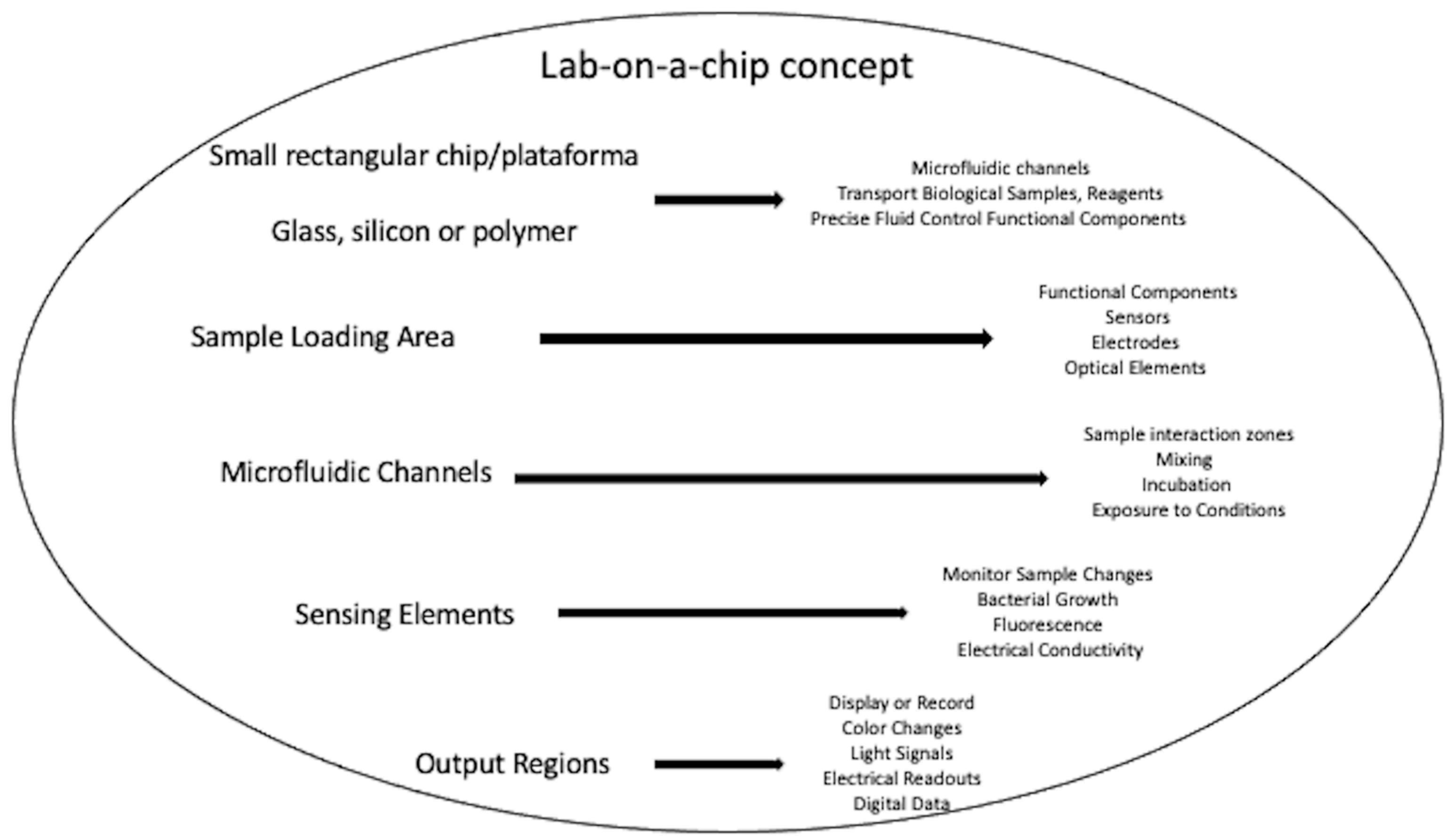

| Authors, Publication Date | Materials and Sensors Used | Culture and Growing Conditions | Antibiotics and MIC | Main Results |
|---|---|---|---|---|
| Lee et al. 2021 [25] | The chip consisted of two polydimethylsiloxane layers (air channel and liquid channel layers) and a glass substrate. | Methicillin-resistant S. aureus was inoculated and adjusted to ~108 colony-forming units/mL with saline solution. The bacteria suspension was then fine-tuned to the tested concentration in a colorimetric media containing brain heart infusion broth supplemented with an oxidation/reduction dye. | Antibiotics: Ceftazidime, meropenem, vancomycin, gentamicin, and linezolid. MIC: The MIC values of the tested antibiotics were determined by standard broth microdilution procedures as described in the Clinical & Laboratory Standards Institute guidelines. | Time spent: The entire liquid operation, including uniform sample distribution, antibiotics of 2-fold serial dilutions, and multiple-drug combinations for on-chip antimicrobial susceptibility tests, could be automatically completed within 10 min. |
| Spencer et al. 2020 [33] | Photolithography and wafer bonding were used to create microfluidic chips. | Clinical breakpoints were based on epidemiological cut-off values extracted from bacterial culture collections and established antibiotic concentrations that allow MIC test results to be used to identify bacterial isolates (EUCAST v10). | Antibiotic: Cefoxitin MIC: The MIC of an antibiotic was calculated by measuring the electrical response of the same isolate when exposed to varied antibiotic concentrations. The electrical MIC calculated using iFAST was compared to the MIC calculated with traditional broth micro-dilution. | Time spent: In a 30-min incubation window, the recorded electrical features reflect the phenotypic response of the bacteria to the method of action of a certain antibiotic. |
| Wistrand-Yuen et al. 2020 [32] | A microfluidic chip was created using three-dimensional (3D) printed molds for polydimethylsiloxane casting and a 3D printed chip holder with an integrated reservoir cover. | The EUCAST Development Laboratory provided all bacterial strains. S. aureus isolates (n = 10) with varying degrees of sensitivity to the drugs tested were utilized. Cation-adjusted Müller-Hinton broth and MH-II agar were used to culture all strains. | Antibiotics: Gentamicin, ofloxacin, and tetracycline. MIC: According to the EUCAST, the antibiotic doses employed in the studies in the source solutions for gradient creation were 2.5-fold greater than the clinical breakpoints for resistance for the tested antibiotic against the tested specimen in each case. | Time spent: Within 2 to 4 h, stable MIC values were achieved, and the results indicated categorical agreement with reference MIC values established by broth microdilution in 86% of the instances. |
| Huang et al. 2020 [26] | Both the microwell and microchannel devices were made with the help of the soft lithography technique. | S. aureus was transfected with the green fluorescent protein for fluorescent imaging to verify the effectiveness of the bacterium trapping. Bacteria were first re-solubilized in 5 mL of Mueller Hinton Broth and cultured in an orbital shaking incubator. | Antibiotic: Chloramphenicol. MIC: The study from the Clinical & Laboratory Standards Institute states that the chosen antibiotic concentration was the required concentration to identify resistant bacteria. | Time spent: the Microwell-surface-enhanced Raman scattering system demonstrated a 2-h antibiotic susceptibility test on susceptible and resistant S. aureus. |
| Lee et al. 2019 [19] | Polymethylmethacrylate molds of an air channel layer and a liquid channel layer were microfabricated by a computer-numerical-control engraving machine. | The isolated bacteria were inoculated in saline solution for the antimicrobial susceptibility testing assay and then adjusted with a nephelometer to 0.5 McFarland turbidity standards. The bacteria suspension was then diluted to 106 CFU mL−1 with the pH-dependent colorimetric broth. | Antibiotics: Vancomycin, gentamicin, and linezolid. MIC: Tests with methicillin-resistant S. aureus were conducted using vancomycin and linezolid, whereas Gram-negative bacteria were treated with gentamicin. The tested antibiotics’ MIC values were calculated using conventional broth dilution techniques in accordance with the Clinical & Laboratory Standards Institute recommendations (CLSI). | Time spent: The ability of this integrated microfluidic system to not only provide MIC values for two antibiotics within the same incubation time (24 h) but also increase seven reaction chambers (from 5 to 12) on a single chip may improve the throughput for antimicrobial susceptibility testing of a single drug and the operational flexibility for clinicians. |
| Yi et al. 2019 [34] | The integrated dielectrophoresis (DEP)-antimicrobial susceptibility testing SlipChip device was created. | S. aureus ATCC 6538P without exogenous plasmid was employed as the bacterial strain. Single colonies of these strains were injected into 5 mL of Mueller-Hinton broth (CAMHB) for overnight culture at 37 °C from cation-adjusted CAMHB agar plates. | Antibiotics: ampicillin, moxifloxacin, cephalothin, and meropenem. MIC: The entropy-based image analysis method was used to estimate bacterial antimicrobial susceptibility. The bright-field images were separated into matrices of 20 20-pixel segments, which correspond to the size of a few bacterial cells. | Time spent: After a positive blood culture, this inexpensive gadget can provide reliable antimicrobial susceptibility testing values to clinicians within 3–8 h, allowing for early antimicrobial medication administration. |
| Sun et al. 2019 [35] | 3-D-shaped channel design built with the help of computer simulation. | S. aureus (ATCC 29213) was tested on the polypropylene chip, and the results were compared to testing on the polydimethylsiloxane chip. | Antibiotics: Ampicillin, gentamicin, tetracycline, and erythromycin. MIC: The MIC values of the various antibiotics were determined using CLSIS data. | Time spent: This technology enables the reliable tracking of individual cells and the acquisition of antimicrobial susceptibility testing data in 1–3 h. |
| Kang et al. 2019 [36] | Photolithography of the SU-8 master template, soft lithography of the polydimethylsiloxane replicas, and plasma bonding of the device to microscope slides. | Trypticase Soy Agar/Broth was used to cultivate S. aureus (ATCC 29213). The bacteria samples were prepared according to ATCC methods. Concentration of 20% glycerol stock. Stocks were kept at −80 °C. | Antibiotics: oxacillin and tetracycline. MIC: The MIC of antibiotics in droplets was calculated when there was a low or no increase in bacterial quantity in droplets and a significant delay in the bacteria’s average doubling time to 2 h or more. | Time spent: This method is substantially faster than typical antimicrobial susceptibility testing (30 min versus 16–24 h). |
| Hou et al. 2017 [37] | The device’s fundamental structure consists of a chamber and two channels that link to both sides of it. | S. aureus SH1000 was isolated and cultivated for 18 h in 5 mL of LB broth. Mueller-Hinton broth medium containing approximately 1.0 108 CFU/mL of each type of bacterium strain was combined with 1% low melting temperature agarose. | Antibiotic: Vancomycin. MIC: The MIC was calculated using 90% growth inhibition (on a grayscale, 75 and larger). As reference studies, CLSI Protocol MIC determination and Etest were performed. | Time spent: The chip method saves a significant amount of time and labor because experiments can be completed in 4 h, and findings may be examined in real-time. |
| Srinivasan et al. 2017 [27] | The nBioChip is printed robotically, handled carefully, then scanned with a typical microarray reader. | S. aureus strain UAMS 1 frozen stock was subcultured onto tryptic soy agar plates and propagated in 10 mL of tryptic soy broth at 37 °C in an orbital shaker. A 100-μL volume of the overnight liquid culture was subcultured into 10 mL of tryptic soy broth for 3 h to capture cells in the log phase. | Antibiotics: Vancomycin, clindamycin, ciprofloxacin, tobramycin sulfate, methicillin, and linezolid. MIC: The antibiotics were all diluted to a maximum concentration of 100 g/mL in phosphate-buffered saline. The antimicrobial susceptibility assays required additional dilutions to be done in phosphate-buffered saline. | Time spent: It was shown that the susceptibility profiles for the four medications were noticeably different at 6-, 12-, 18-, or 24-h following exposure. In contrast to vancomycin, which had a much steeper response curve, the biofilms responded to ciprofloxacin, clindamycin, and linezolid more gradually. |
| Malmberg et al. 2016 [38] | CellDirector 3D is a cell-based assay that employs microfluidics to produce a linear gradient of chemicals via diffusion through a microscale test chamber. | S. aureus (vancomycin susceptible), S. aureus ATCC 29213, and heteroresistant vancomycin-intermediate S. aureus ATCC 700698 were used. Before the trials, all strains were kept at −80 °C and streaked on Mueller-Hinton II blood agar plates. | Antibiotic: Vancomycin. MIC: The CellDirector 3D test was initially evaluated using S. aureus vancomycin susceptible and heteroresistant vancomycin-intermediate S. aureus, defined as MIC 2 mg/L but with a subpopulation with MIC > 2 mg/L). Etest’s MIC determination was carried out in accordance with the manufacturer’s instructions. | Time spent: The time to probable readout was between 2 and 5 h. The microfluidic assay under consideration has the potential to give rapid and accurate MICs utilizing samples from positive clinical blood cultures. |
| Abeyrathne et al. 2016 [28] | Laser ablation lithography was used to create and design interdigitated electrodes. | Reference strains of S. aureus that were both methicillin-susceptible (ATCC 25923) and resistant (ATCC 33591) were used. The bacterial strains were grown for 18 h at 37 °C in Luria broth. | Antibiotics: Flucloxacillin MIC: In Luria broth media, different flucloxacillin concentrations were created. In a closed petri dish, 20 μL of the antibiotic solution was put on filter papers that were 1 mm × 1 mm in size. | Time spent: A lab on a chip demonstrated the ability to detect S. aureus in a sample in under an hour. |
| Hou et al. 2014 [29] | A 3D microfluidic culture system was placed above an inverted optical microscope equipped with a phase contrast condenser. | S. aureus SH1000 bacteria were the strains used. From Lysogeny broth agar plates, single colonies were selected and cultivated in 5 mL of Lysogeny broth medium for 5–6 h, or until the OD595 reached 0.3–0.4. | Antibiotics: Ampicillin, spectinomycin, tetracycline, and vancomycin. MIC: The MIC was determined by the Clinical & Laboratory Standards Institute protocol and by the Etest in accordance with the supplier’s instructions to compare this on-chip test with conventional static techniques. | Time spent: The entire procedure, including data analysis, took 2.5–4 h. High-resolution growth curves were produced from the same analysis. |
| Choi et al. 2013 [30] | Polydimethylsiloxane was used to create the microfluidic agarose channel chip, and polydimethylsiloxane-coated glass was used to assemble it. | A common Clinical & Laboratory Standards Institute bacteria (S. aureus ATCC 29213) was combined with agarose to validate the microfluidic agarose channel technology. The bacteria were subcultured in a new cation-adjusted Mueller-Hinton broth medium for one hour. | Antibiotics: Amikacin, norfloxacin, gentamicin, and tetracycline. MIC: According to the MIC range of the Clinical & Laboratory Standards Institute, six channels were chosen to test six different antibiotic concentrations. | Time spent: The full antimicrobial susceptibility test procedure lasts 3–4 h, and the results are equally accurate to the Clinical & Laboratory Standards Institute’s traditional antimicrobial susceptibility test results. |
| Kalashnikov et al. 2012 [31] | A polydimethylsiloxane layer was placed on top of an epoxy-coated glass slide to construct the microfluidic channels. | Methicillin-resistant or methicillin-susceptible clinically relevant S. aureus strains were used. S. aureus strains ST22, ST80, SF8300, TCH959, and other meticillin-resistant S. aureus strains were investigated. | Antibiotics: methicillin and oxacillin. MIC: The S. aureus MIC value of 60 ng/mL, obtained from the prototype strains using conventional microdilution broth methods, was almost 100 times lower than this lysostaphin concentration. Rates of killing for the bacterial samples in the presence and absence of oxacillin were assessed. | Time spent: A metric was developed to distinguish between susceptible and resistant staphylococci based on normalized fluorescence levels following 60 min of exposure to stress and antibiotics using model susceptible and resistant S. aureus strains. |
| Boedicker et al. 2008 [20] | Devices made of polydimethylsiloxane with channel widths between 200 and 800 μm were created. | S. aureus ATCC# 25923 and S. aureus ATCC# 43300 cells were obtained from ATCC. Using Miller’s Luria-Bertani medium formulation, which contains 30% glycerol, stock solutions of the cells were created and kept at −80 °C. | Antibiotics: Ampicillin, oxacillin, cephalosporin, cefoxitin, levofloxacin, vancomycin, and erythromycin. MIC: According to the British Society for Antimicrobial Chemotherapy procedures for antimicrobial susceptibility testing, antibiotics were tested at the breakpoint concentration. | Time spent: In less than 7 h, a bacterial sample’s thorough functional characterization was completed. Additionally, it was shown that a bacterium in a 1 nL plug could be found in as short as 2 h. Volume after a single bacterium was contained and examined in plugs. |
| Study | * Design | ** Measures | *** Analysis Statistical | Clinical Significance | Total |
|---|---|---|---|---|---|
| Lee et al. 2021 [25] | 4 | 3 | 4 | 1 | 12 |
| Spencer et al. 2020 [33] | 4 | 3 | 4 | 1 | 12 |
| Wistrand-Yuen et al. 2020 [32] | 4 | 3 | 4 | 1 | 12 |
| Huang et al. 2020 [26] | 4 | 3 | 4 | 1 | 12 |
| Lee et al. 2019 [19] | 4 | 3 | 4 | 1 | 12 |
| Yi et al. 2019 [34] | 4 | 3 | 4 | 1 | 12 |
| Sun et al. 2019 [35] | 4 | 3 | 4 | 1 | 12 |
| Kang et al. 2019 [36] | 4 | 3 | 4 | 1 | 12 |
| Hou et al. 2017 [37] | 4 | 3 | 4 | 1 | 12 |
| Srinivasan et al. 2017 [27] | 4 | 3 | 4 | 1 | 12 |
| Malmberg et al. 2016 [38] | 4 | 3 | 4 | 1 | 12 |
| Abeyrathne et al. 2016 [28] | 4 | 3 | 4 | 1 | 12 |
| Hou et al. 2014 [29] | 4 | 3 | 4 | 1 | 12 |
| Choi et al. 2013 [30] | 4 | 3 | 4 | 1 | 12 |
| Kalashnikov et al. 2012 [31] | 4 | 4 | 5 | 1 | 14 |
| Boedicker et al. 2008 [20] | 4 | 3 | 4 | 1 | 12 |
Disclaimer/Publisher’s Note: The statements, opinions and data contained in all publications are solely those of the individual author(s) and contributor(s) and not of MDPI and/or the editor(s). MDPI and/or the editor(s) disclaim responsibility for any injury to people or property resulting from any ideas, methods, instructions or products referred to in the content. |
© 2023 by the authors. Licensee MDPI, Basel, Switzerland. This article is an open access article distributed under the terms and conditions of the Creative Commons Attribution (CC BY) license (https://creativecommons.org/licenses/by/4.0/).
Share and Cite
Ardila, C.M.; Zuluaga-Gómez, M.; Vivares-Builes, A.M. Applications of Lab on a Chip in Antimicrobial Susceptibility of Staphylococcus aureus: A Systematic Review. Medicina 2023, 59, 1719. https://doi.org/10.3390/medicina59101719
Ardila CM, Zuluaga-Gómez M, Vivares-Builes AM. Applications of Lab on a Chip in Antimicrobial Susceptibility of Staphylococcus aureus: A Systematic Review. Medicina. 2023; 59(10):1719. https://doi.org/10.3390/medicina59101719
Chicago/Turabian StyleArdila, Carlos M., Mateo Zuluaga-Gómez, and Annie Marcela Vivares-Builes. 2023. "Applications of Lab on a Chip in Antimicrobial Susceptibility of Staphylococcus aureus: A Systematic Review" Medicina 59, no. 10: 1719. https://doi.org/10.3390/medicina59101719
APA StyleArdila, C. M., Zuluaga-Gómez, M., & Vivares-Builes, A. M. (2023). Applications of Lab on a Chip in Antimicrobial Susceptibility of Staphylococcus aureus: A Systematic Review. Medicina, 59(10), 1719. https://doi.org/10.3390/medicina59101719