Efficacy and Safety of Newly Diagnosed Multiple Myeloma Combination Therapies: A Systematic Review Integrating Network Meta-Analysis and Real-World Vigilance Study

 ,
,
Abstract
1. Introduction
2. Results
2.1. Results of Network Meta-Analysis
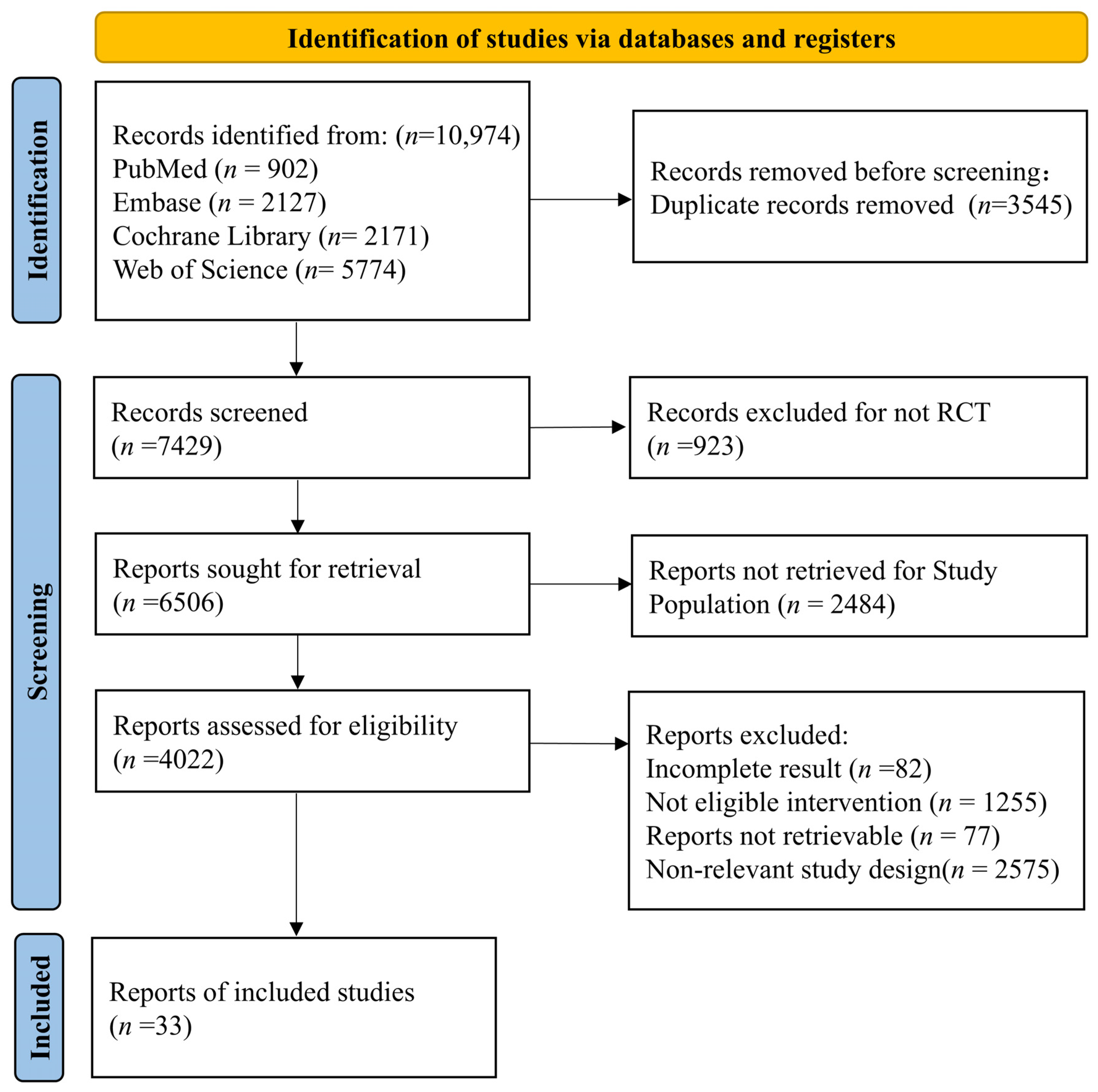
2.1.1. Study Overview and Patient Characteristics
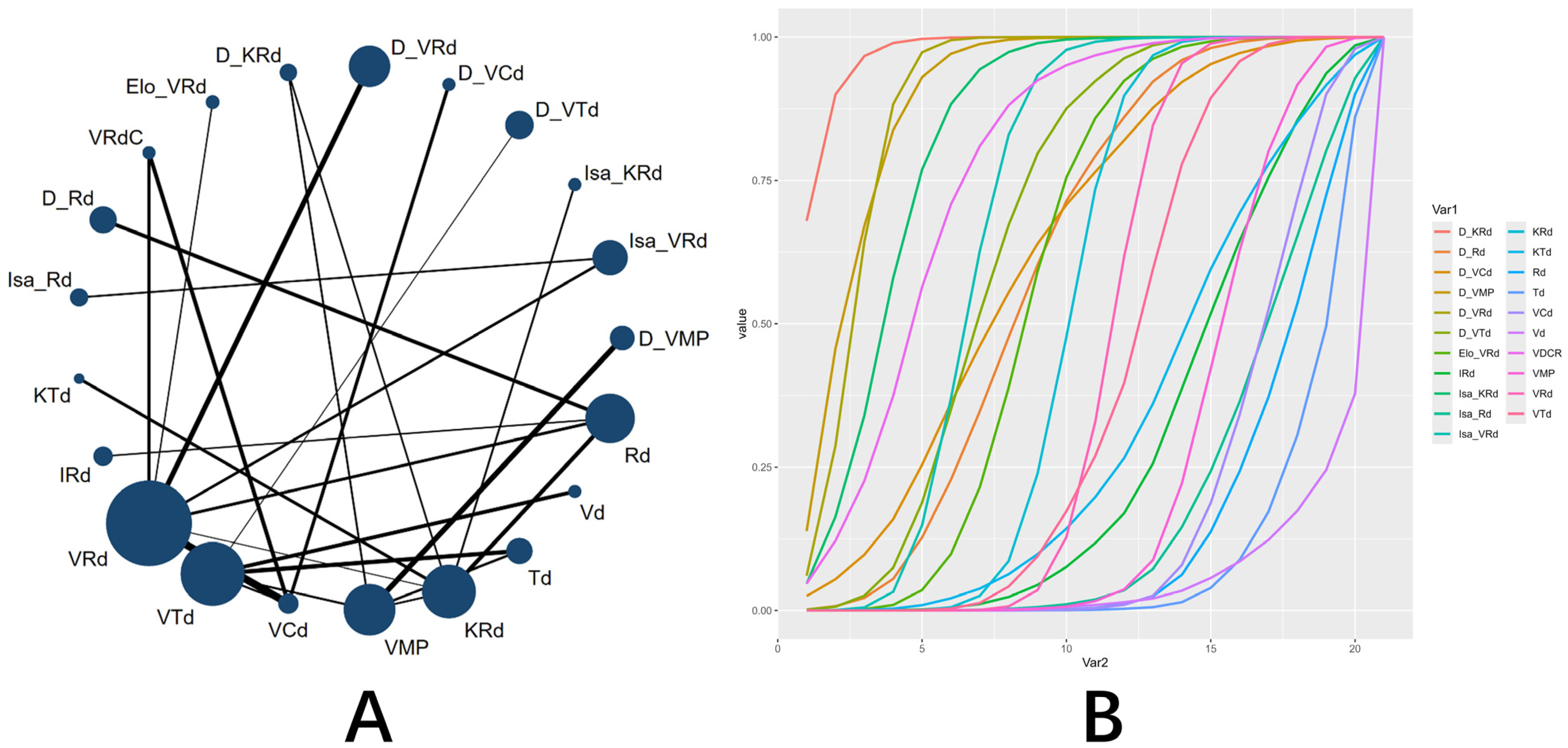
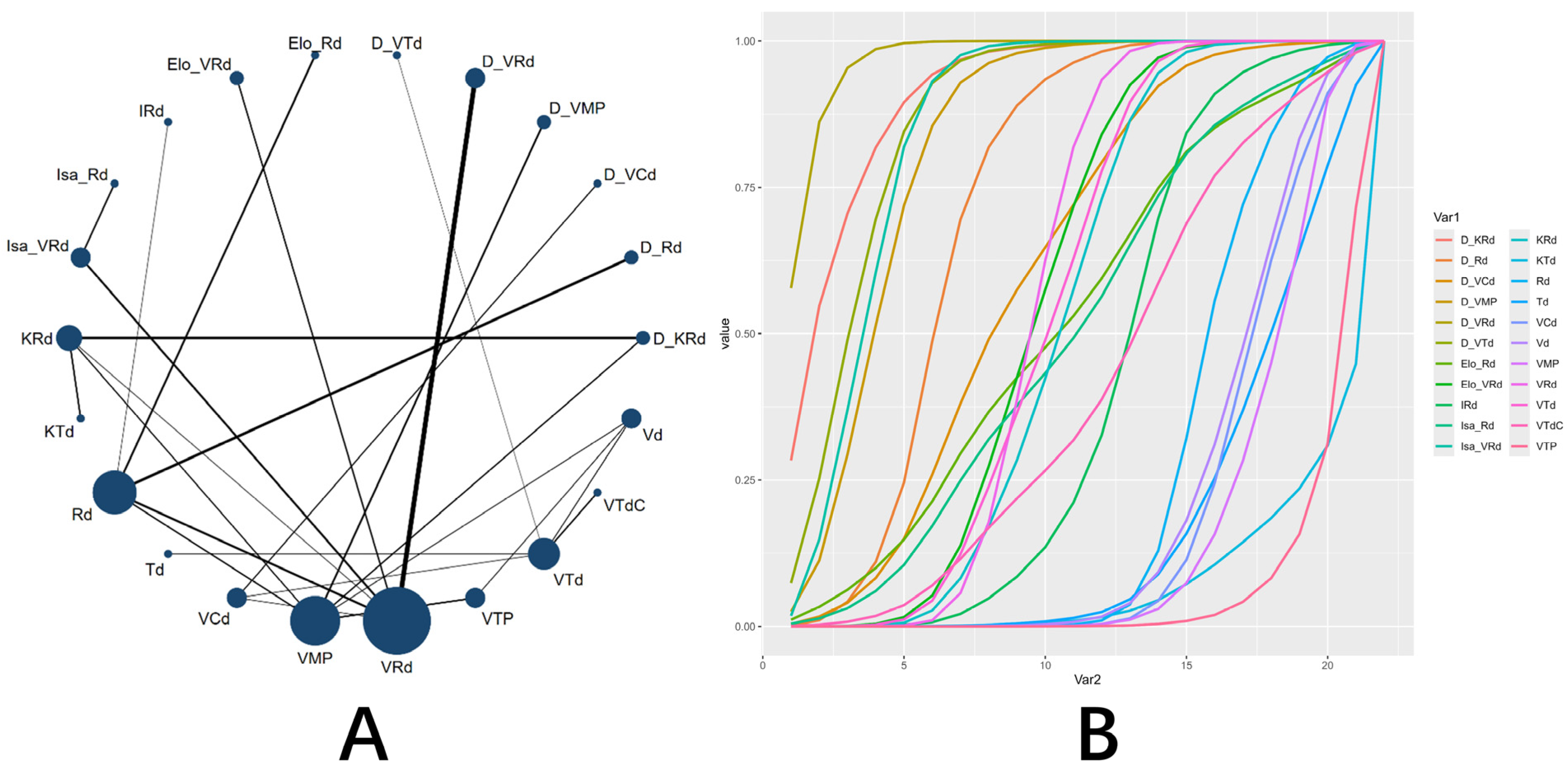
2.1.2. Primary Efficacy Outcomes
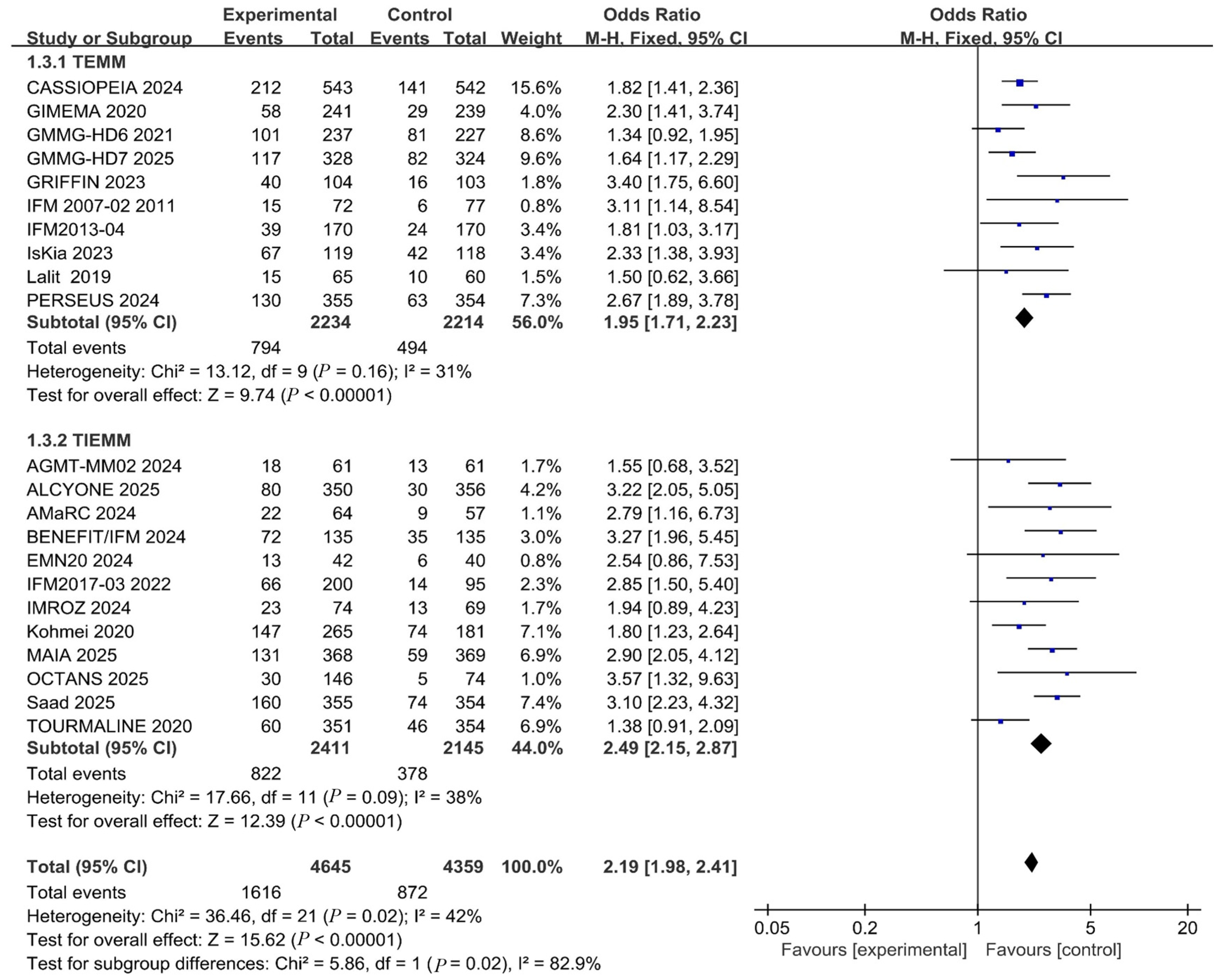
2.1.3. Other Efficacy Outcomes and Subgroup Analyses
2.1.4. Safety Outcomes
2.2. Real-World Pharmacovigilance Study Results
2.2.1. Report Characteristics and System Organ Class (SOC) Distribution
2.2.2. High-Frequency and Strong-Signal AEs
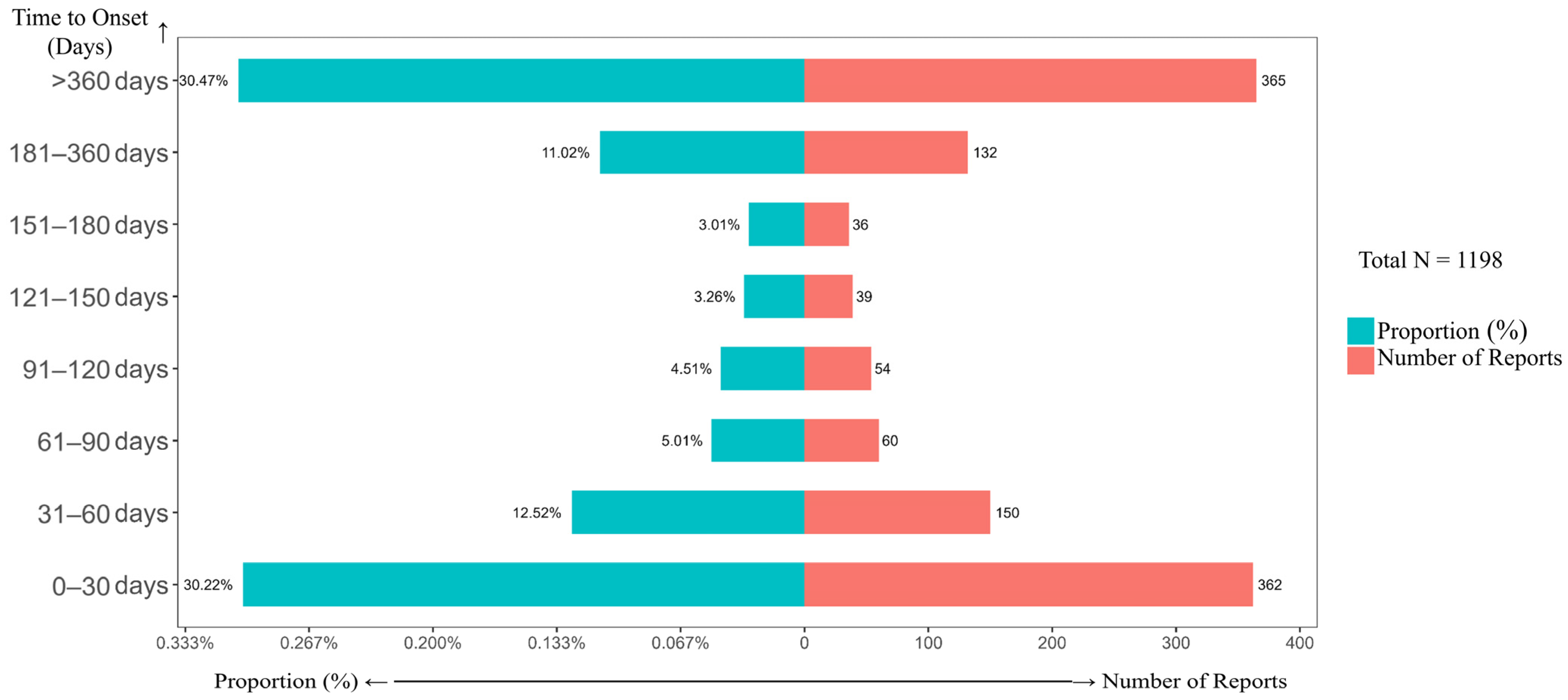
2.2.3. Temporal Distribution and Label Comparison
3. Discussion
4. Materials and Methods
4.1. Network Meta-Analysis
4.1.1. Literature Search Strategy
4.1.2. Inclusion and Exclusion Criteria
4.1.3. Data Extraction and Quality Assessment
4.1.4. Statistical Analysis
4.2. Signal Generation
4.2.1. Data Source
4.2.2. Data Acquisition and Preprocessing
4.2.3. Disproportionality Analysis
5. Conclusions
Supplementary Materials
Author Contributions
Funding
Institutional Review Board Statement
Informed Consent Statement
Data Availability Statement
Acknowledgments
Conflicts of Interest
Abbreviations
| AE | Adverse Event |
| CR | Complete Response |
| FAERS | FDA Adverse Event Reporting System |
| NMA | Network Meta-Analysis |
| ORR | Objective Response Rate |
| OS | Overall Survival |
| PFS | Progression-Free Survival |
| SOC | System Organ Class |
| SUCRA | Surface Under the Cumulative Ranking Curve |
References
- Jung, S.-H.; Koh, Y.; Kim, M.K.; Kim, J.S.; Moon, J.H.; Min, C.-K.; Yoon, D.H.; Yoon, S.-S.; Lee, J.-J.; Hong, C.M.; et al. Correction: Evidence-based Korean guidelines for the clinical management of multiple myeloma: Addressing 12 key clinical questions. Blood Res. 2025, 60, 23. [Google Scholar] [CrossRef]
- Mian, H.; Costa, L.J. Maintenance therapy in the era of quadruplets for multiple myeloma: When, what, and for how long? Am. J. Hematol. 2025, 100, 1483–1485. [Google Scholar] [CrossRef]
- Zhang, H.; Yao, Y.; Zhang, X.; Ji, X.; Wu, T.; Wang, J.; Fang, Y. Time trends in multiple myeloma incidence and mortality across the BRICS from 1992 to 2021 and projection to 2046. BMC Public Health 2025, 25, 1765. [Google Scholar] [CrossRef]
- Morè, S.; Corvatta, L.; Manieri, V.M.; Morsia, E.; Poloni, A.; Offidani, M. Novel immunotherapies and combinations: The future landscape of multiple myeloma treatment. Pharmaceuticals 2023, 16, 1628. [Google Scholar] [CrossRef]
- Wu, H.; Cai, Z.; Liu, W.; Wang, Z.; Qiu, B.; Liu, W.; Zhuang, W. Long-term trends and projections of multiple myeloma across three continents: A comparative study of China, the United States of America, the Russian Federation, England and France (1990–2036). Cancer Med. 2025, 14, e70999. [Google Scholar] [CrossRef] [PubMed]
- Gay, F.; Marchetti, E.; Bertuglia, G. Multiple myeloma unpacked. Hematol. Oncol. 2025, 43, e70067. [Google Scholar] [CrossRef]
- Portuguese, A.J.; Banerjee, R.; Chen, G.; Reddi, S.; Cowan, A.J. Novel treatment options for multiple myeloma. JCO Oncol. Pract. 2025, 21, 950–961. [Google Scholar] [CrossRef]
- Anderson, K.C.; Alsina, M.; Atanackovic, D.; Biermann, J.S.; Chandler, J.C.; Costello, C.; Djulbegovic, B.; Fung, H.C.; Gasparetto, C.; Godby, K.; et al. Multiple myeloma, version 2.2016. J. Natl. Compr. Canc. Netw. 2015, 13, 1398–1435. [Google Scholar] [CrossRef]
- Kumar, S.K.; Callander, N.S.; Alsina, M.; Atanackovic, D.; Biermann, J.S.; Castillo, J.; Chandler, J.C.; Costello, C.; Faiman, M.; Fung, H.C.; et al. NCCN guidelines® insights multiple myeloma, version 3.2018 featured updates to the NCCN guidelines. J. Natl. Compr. Canc. Netw. 2018, 16, 11–20. [Google Scholar] [CrossRef] [PubMed]
- Kumar, S.K.; Callander, N.S.; Adekola, K.; Anderson, L.; Baljevic, M.; Campagnaro, E.; Castillo, J.J.; Chandler, J.C.; Costello, C.; Efebera, Y.; et al. Multiple myeloma, version 3.2021. J. Natl. Compr. Canc. Netw. 2020, 18, 1685–1717. [Google Scholar] [CrossRef] [PubMed]
- Rajkumar, S.V. Multiple myeloma: 2016 update on diagnosis, risk-stratification, and management. Am. J. Hematol. 2016, 91, 720–734. [Google Scholar] [CrossRef]
- Mai, E.K.; Bertsch, U.; Pozek, E.; Fenk, R.; Besemer, B.; Hanoun, C.; Schroers, R.; von Metzler, I.; Hänel, M.; Mann, C.; et al. Isatuximab, lenalidomide, bortezomib, and dexamethasone induction therapy for transplant-eligible newly diagnosed multiple myeloma: Final part 1 analysis of the gmmg-hd7 trial. J. Clin. Oncol. 2025, 43, 1279–1288. [Google Scholar] [CrossRef]
- Sonneveld, P.; Dimopoulos, M.A.; Boccadoro, M.; Quach, H.; Ho, P.J.; Beksac, M.; Hulin, C.; Antonioli, E.; Leleu, X.; Mangiacavalli, S.; et al. Daratumumab, bortezomib, lenalidomide, and dexamethasone for multiple myeloma. N. Engl. J. Med. 2024, 390, 301–313. [Google Scholar] [CrossRef]
- Moreau, P.; Hulin, C.; Perrot, A.; Arnulf, B.; Belhadj, K.; Benboubker, L.; Zweegman, S.; Caillon, H.; Caillot, D.; Avet-Loiseau, H.; et al. Bortezomib, thalidomide, and dexamethasone with or without daratumumab and followed by daratumumab maintenance or observation in transplant-eligible newly diagnosed multiple myeloma: Long-term follow-up of the cassiopeia randomised controlled phase 3 trial. Lancet Oncol. 2024, 25, 1003–1014. [Google Scholar] [CrossRef] [PubMed]
- Gay, F.; Roeloffzen, W.; Dimopoulos, M.A.; Rosinol, L.; van der Klift, M.; Mina, R.; Rocafiguera, A.O.; Katodritou, E.; Wu, K.L.; Otero, P.R.; et al. Results of the phase iii randomized iskia trial: Isatuximab-carfilzomib-lenalidomide-dexamethasone vs carfilzomib-lenalidomide-dexamethasone as pre-transplant induction and post-transplant consolidation in newly diagnosed multiple myeloma patients. Blood 2023, 142, 4. [Google Scholar] [CrossRef]
- Dimopoulos, M.A.; Terpos, E.; Boccadoro, M.; Moreau, P.; Mateos, M.-V.; Zweegman, S.; Cook, G.; Engelhardt, M.; Delforge, M.; Hajek, R.; et al. EHA-EMN evidence-based guidelines for diagnosis, treatment and follow-up of patients with multiple myeloma. Nat. Rev. Clin. Oncol. 2025, 22, 680–700. [Google Scholar] [CrossRef]
- Kumar, S.K.; Callander, N.S.; Adekola, K.; Anderson, L.D.; Baljevic, M.; Baz, R.; Campagnaro, E.; Costello, C.; D′Angelo, C.; Derman, B.; et al. NCCN guidelines® insights: Multiple myeloma, version 1.2025. J. Natl. Compr. Canc. Netw. 2025, 23, 132–140. [Google Scholar] [CrossRef]
- Rouse, B.; Chaimani, A.; Li, T. Network meta-analysis: An introduction for clinicians. Intern. Emerg. Med. 2017, 12, 103–111. [Google Scholar] [CrossRef]
- Subeesh, V.; Maheswari, E.; Singh, H.; Beulah, T.E.; Swaroop, A.M. Novel adverse events of iloperidone: A disproportionality analysis in US Food and Drug Administration Adverse Event Reporting System (FAERS) database. Curr. Drug Saf. 2019, 14, 21–26. [Google Scholar] [CrossRef] [PubMed]
- Voorhees, P.M.; Sborov, D.W.; Laubach, J.; Kaufman, J.L.; Reeves, B.; Rodriguez, C.; Chari, A.; Silbermann, R.; Costa, L.J.; Anderson, L.D.; et al. Addition of daratumumab to lenalidomide, bortezomib, and dexamethasone for transplantation-eligible patients with newly diagnosed multiple myeloma (GRIFFIN): Final analysis of an open-label, randomised, phase 2 trial. Lancet Haematol. 2023, 10, e825–e837. [Google Scholar] [CrossRef] [PubMed]
- Kumar, L.; Chellapuram, S.K.; Sahoo, R.; Gupta, R. VRd versus VCd as induction therapy for newly diagnosed multiple myeloma: A phase III, randomized study. Clin. Lymphoma Myeloma Leuk. 2019, 19, e361. [Google Scholar] [CrossRef]
- Moreau, P.; Hulin, C.; Macro, M.; Caillot, D.; Chaleteix, C.; Roussel, M.; Garderet, L.; Royer, B.; Brechignac, S.; Tiab, M.; et al. VTD is superior to VCD prior to intensive therapy in multiple myeloma: Results of the prospective IFM2013-04 trial. Blood 2016, 127, 2569–2574. [Google Scholar] [CrossRef]
- Ludwig, H.; Greil, R.; Masszi, T.; Spicka, I.; Shpilberg, O.; Hajek, R.; Dmoszynska, A.; Paiva, B.; Vidriales, M.; Esteves, G.; et al. Bortezomib, thalidomide and dexamethasone, with or without cyclophosphamide, for patients with previously untreated multiple myeloma: 5-year follow-up. Br. J. Haematol. 2015, 171, 344–354. [Google Scholar] [CrossRef]
- Tacchetti, P.; Pantani, L.; Patriarca, F.; Petrucci, M.T.; Zamagni, E.; Dozza, L.; Galli, M.; Di Raimondo, F.; Crippa, C.; Boccadoro, M.; et al. Bortezomib, thalidomide, and dexamethasone followed by double autologous haematopoietic stem-cell transplantation for newly diagnosed multiple myeloma (GIMEMA-MMY-3006): Long-term follow-up analysis of a randomised phase 3, open-label study. Lancet Haematol. 2020, 7, e861–e873. [Google Scholar] [CrossRef] [PubMed]
- Moreau, P.; Avet-Loiseau, H.; Facon, T.; Attal, M.; Tiab, M.; Hulin, C.; Doyen, C.; Garderet, L.; Randriamalala, E.; Araujo, C.; et al. Bortezomib plus dexamethasone versus reduced-dose bortezomib, thalidomide plus dexamethasone as induction treatment before autologous stem cell transplantation in newly diagnosed multiple myeloma. Blood 2011, 118, 5752–5758. [Google Scholar] [CrossRef] [PubMed]
- Kumar, S.K.; Jacobus, S.J.; Cohen, A.D.; Weiss, M.; Callander, N.; Singh, A.K.; Parker, T.L.; Menter, A.; Yang, X.; Parsons, B.; et al. Carfilzomib or bortezomib in combination with lenalidomide and dexamethasone for patients with newly diagnosed multiple myeloma without intention for immediate autologous stem-cell transplantation (ENDURANCE): A multicentre, open-label, phase 3, randomised, controlled trial. Lancet Oncol. 2020, 21, 1317–1330. [Google Scholar] [PubMed]
- Durie, B.G.M.; Hoering, A.; Abidi, M.H.; Rajkumar, S.V.; Epstein, J.; Kahanic, S.P.; Thakuri, M.; Reu, F.; Reynolds, C.M.; Sexton, R.; et al. Bortezomib with lenalidomide and dexamethasone versus lenalidomide and dexamethasone alone in patients with newly diagnosed myeloma without intent for immediate autologous stem-cell transplant (SWOG S0777): A randomised, open-label, phase 3 trial. Lancet 2017, 389, 519–527. [Google Scholar] [CrossRef]
- Usmani, S.Z.; Hoering, A.; Ailawadhi, S.; Sexton, R.; Lipe, B.; Hita, S.F.; Valent, J.; Rosenzweig, M.; Zonder, J.A.; Dhodapkar, M.; et al. Bortezomib, lenalidomide, and dexamethasone with or without elotuzumab in patients with untreated, high-risk multiple myeloma (SWOG-1211): Primary analysis of a randomised, phase 2 trial. Lancet Haematol. 2021, 8, e45–e54. [Google Scholar] [CrossRef]
- D’Agostino, M.; Antonioli, E.; Gamberi, B.; Bruno, B.; Derudas, D.; Tosi, P.; Fazio, F.; Mazza, R.; Ronconi, S.; Corradini, P.; et al. Carfilzomib-lenalidomide-dexamethasone (KRD) vs lenalidomide-dexamethasone (RD) in newly diagnosed fit or intermediate-fit multiple myeloma patients ineligible for autologous stem-cell transplantation: Analysis of sustained undetectable minimal residual disease (MRD) in the phase III EMN20 trial. Blood 2023, 142, 205. [Google Scholar]
- Usmani, S.Z.; Facon, T.; Hungria, V.; Bahlis, N.J.; Venner, C.P.; Braunstein, M.; Pour, L.; Martí, J.M.; Basu, S.; Cohen, Y.C.; et al. Daratumumab plus bortezomib, lenalidomide and dexamethasone for transplant-ineligible or transplant-deferred newly diagnosed multiple myeloma: The randomized phase 3 CEPHEUS trial. Nat. Med. 2025, 31, 1195–1202. [Google Scholar] [CrossRef]
- Mateos, M.V.; San-Miguel, J.; Cavo, M.; Suzuki, K.; Jakubowiak, A.; Knop, S.; Doyen, C.; Lucio, P.; Nagy, Z.; Pour, L.; et al. Bortezomib, melphalan, and prednisone with or without daratumumab in transplant-ineligible patients with newly diagnosed multiple myeloma (ALCYONE): Final analysis of an open-label, randomised, multicentre, phase 3 trial. Lancet Oncol. 2025, 26, 596–608. [Google Scholar] [CrossRef]
- Fu, W.; Bang, S.M.; Huang, H.; Kim, K.; Li, W.; An, G.; Lee, J.-J.; Cai, Z.; Jin, J.; Wang, Y.; et al. Daratumumab, bortezomib, melphalan, and prednisone versus bortezomib, melphalan, and prednisone alone in transplant-ineligible Asian patients with newly diagnosed multiple myeloma: Final analysis of the phase 3 OCTANS study. Ann. Hematol. 2025, 104, 515–525. [Google Scholar] [CrossRef] [PubMed]
- Facon, T.; Moreau, P.; Weisel, K.; Goldschmidt, H.; Usmani, S.Z.; Chari, A.; Plesner, T.; Orlowski, R.Z.; Bahlis, N.; Basu, S.; et al. Daratumumab/lenalidomide/dexamethasone in transplant-ineligible newly diagnosed myeloma: MAIA long-term outcomes. Leukemia 2025, 39, 942–950. [Google Scholar] [CrossRef]
- Mollee, P.; Reynolds, J.; Janowski, W.; Quach, H.; Campbell, P.; Gibbs, S.; Lee, S.; Lee, E.; Taylor, K.; Cochrane, T.; et al. Daratumumab, cyclophosphamide, bortezomib, and dexamethasone for transplant-ineligible myeloma: AMaRC 03-16. Blood Adv. 2024, 8, 3721–3730. [Google Scholar] [CrossRef] [PubMed]
- Ludwig, H.; Melchardt, T.; Sormann, S.; Schreder, M.; Andel, J.; Hartmann, B.; Tinchon, C.; Zojer, N.; Gunsilius, E.; Podar, K.; et al. Randomized comparison between KTD and KRD induction therapy followed by maintenance therapy with K or observation in transplant-ineligible patients with newly diagnosed multiple myeloma. Am. J. Hematol. 2024, 99, 1008–1011. [Google Scholar] [CrossRef]
- Leleu, X.P.; Hulin, C.; Lambert, J.; Bobin, A.; Manier, S.; Perrot, A.; Jaccard, A.; Montes, L.; Karlin, L.; Godmer, P.; et al. Phase 3 randomized study of isatuximab (isa) plus lenalidomide and dexamethasone (Rd) with bortezomib versus isaRd in patients with newly diagnosed transplant ineligible multiple myeloma (NDMM TI). J. Clin. Oncol. 2024, 42, 7501. [Google Scholar] [CrossRef]
- Bringhen, S.; D’Agostino, M.; Giuliani, N.; Attucci, I.; Zambello, R.; Ronconi, S.; Vincelli, I.D.; Allegra, A.; Leonardi, G.; Rossi, G.; et al. Bortezomib-melphalan-prednisone (VMP) vs. lenalidomide-dexamethasone (Rd) in transplant-ineligible real-life multiple myeloma patients: Updated results of the randomized phase IV REAL MM trial. Blood 2022, 140, 1814–1816. [Google Scholar] [CrossRef]
- Manier, S.; Corre, J.; Hulin, C.; Laribi, K.; Araujo, C.; Pica, G.-M.; Touzeau, C.; Godmer, P.; Slama, B.; Karlin, L.; et al. A dexamethasone sparing-regimen with daratumumab and lenalidomide in frail patients with newly-diagnosed multiple myeloma: Efficacy and safety analysis of the phase 3 IFM2017-03 trial. Blood 2022, 140, 1369–1370. [Google Scholar] [CrossRef]
- Facon, T.; Venner, C.P.; Bahlis, N.J.; Leleu, X. Ixazomib plus lenalidomide-dexamethasone (IRd) vs. placebo-Rd for newly diagnosed multiple myeloma (NDMM) patients not eligible for autologous stem cell transplant: The double-blind, placebo-controlled, phase 3 TOURMALINE-MM2 trial. Clin. Lymphoma Myeloma Leuk. 2020, 20, S307–S308. [Google Scholar] [CrossRef]
- Mai, E.K.; Salwender, H.J.; Bertsch, U.; Miah, K.; Kunz, C.; Hielscher, T.; Schub, N.; Merz, M.; Scheid, C.; Keller, A.; et al. Subgroup analysis on response to induction therapy with bortezomib, lenalidomide and dexamethasone with or without elotuzumab for newly-diagnosed, transplant-eligible multiple myeloma. HemaSphere 2021, 5, e453. [Google Scholar]
- Mateos, M.V.; Oriol, A.; Martínez-López, J.; Teruel, A.I.; López de la Guía, A.; López, J.; Bengoechea, E.; Pérez, M.; Martínez, R.; Palomera, L.; et al. GEM2005 trial update comparing VMP/VTP as induction in elderly multiple myeloma patients: Do we still need alkylators? Blood 2014, 124, 1887–1893. [Google Scholar] [CrossRef] [PubMed]
- Niesvizky, R.; Flinn, I.; Rifkin, R.M.; Essell, J.; Gaffar, Y.; Warr, T.; Neuwirth, R.; Ba-Mancini, A.; Zhu, Y.; Niculescu, L.; et al. Efficacy and safety of three bortezomib-based induction and maintenance regimens in previously untreated, transplant-ineligible multiple myeloma (MM) patients (pts): Final results from the randomized, phase 3b, US community-based UPFRONT study (NCT00507416). Blood 2013, 122, 1966. [Google Scholar]
- Mateos, M.-V.; Paiva, B.; Cedena Romero, M.T.; Puig, N.; Sureda Balari, A.M.; Oriol, A.; Ocio, E.M.; Rosiñol, L.; González-Montes, Y.; Bargay, J.J.; et al. GEM2017FIT trial: Induction therapy with bortezomib-melphalan and prednisone (VMP) followed by lenalidomide and dexamethasone (Rd) versus carfilzomib, lenalidomide and dexamethasone (KRd) plus/minus daratumumab (D), 18 cycles, followed by consolidation and maintenance therapy with lenalidomide and daratumumab: Phase III, multicenter, randomized trial for elderly fit newly diagnosed multiple myeloma (NDMM) patients aged between 65 and 80 years. Blood 2023, 142, 209. [Google Scholar]
- Kumar, S.; Flinn, I.; Richardson, P.G.; Hari, P.; Callander, N.; Noga, S.J.; Stewart, A.K.; Turturro, F.; Rifkin, R.; Wolf, J.; et al. Randomized, multicenter, phase 2 study (EVOLUTION) of combinations of bortezomib, dexamethasone, cyclophosphamide, and lenalidomide in previously untreated multiple myeloma. Blood 2012, 119, 4375–4382. [Google Scholar] [CrossRef]
- Rosiñol, L.; Oriol, A.; Teruel, A.I.; Hernández, D.; López-Jiménez, J.; de la Rubia, J.; Granell, M.; Besalduch, J.; Palomera, L.; González, Y.; et al. Superiority of bortezomib, thalidomide, and dexamethasone (VTD) as induction pretransplantation therapy in multiple myeloma: A randomized phase 3 PETHEMA/GEM study. Blood 2012, 120, 1589–1596. [Google Scholar] [CrossRef]
- Mookerjee, A.; Gupta, R.; Jasrotia, S.; Sahoo, R.; Kumar, R.; Thulkar, S.; Sharma, O.D.; Kumar, L. Bortezomib, lenalidomide and low-dose dexamethasone (VRd) versus lenalidomide and low-dose dexamethasone (LD) for newly-diagnosed multiple myeloma- a randomized phase III study-interim results. Clin. Lymphoma Myeloma Leuk. 2017, 17, e5–e6. [Google Scholar] [CrossRef]
- Facon, T.; Dimopoulos, M.A.; Leleu, X.P.; Beksac, M.; Pour, L.; Hájek, R.; Liu, Z.; Minarik, J.; Moreau, P.; Romejko-Jarosinska, J.; et al. Isatuximab, bortezomib, lenalidomide, and dexamethasone for multiple myeloma. N. Engl. J. Med. 2024, 391, 1597–1609. [Google Scholar] [CrossRef]
- Kubo, K.; Hori, M.; Ohta, K.; Handa, H.; Hatake, K.; Matsumoto, M.; Hagiwara, S.; Ohashi, K.; Nakaseko, C.; Suzuki, K.; et al. Elotuzumab plus lenalidomide and dexamethasone for newly diagnosed multiple myeloma: A randomized, open-label, phase 2 study in Japan. Int. J. Hematol. 2020, 111, 65–74. [Google Scholar] [CrossRef]
- Rajkumar, S.V. Multiple myeloma: 2022 update on diagnosis, risk stratification, and management. Am. J. Hematol. 2022, 97, 1086–1107. [Google Scholar] [CrossRef]
- Overdijk, M.B.; Jansen, J.H.M.; Nederend, M.; van Bueren, J.J.L.; Groen, R.W.J.; Parren, P.W.H.I.; Leusen, J.H.W.; Boross, P. The therapeutic CD38 monoclonal antibody daratumumab induces programmed cell death via Fcγ receptor-mediated cross-linking. J. Immunol. 2016, 197, 807–813. [Google Scholar] [CrossRef]
- Krejcik, J.; Casneuf, T.; Nijhof, I.S.; Verbist, B.; Bald, J.; Plesner, T.; Syed, K.; Liu, K.; van de Donk, N.W.C.J.; Weiss, B.M.; et al. Daratumumab depletes CD38+ immune regulatory cells, promotes T-cell expansion, and skews T-cell repertoire in multiple myeloma. Blood 2016, 128, 384–394. [Google Scholar] [CrossRef]
- van de Donk, N.; Usmani, S.Z. CD38 antibodies in multiple myeloma: Mechanisms of action and modes of resistance. Front. Immunol. 2018, 9, 2134. [Google Scholar] [CrossRef] [PubMed]
- Díaz-Tejedor, A.; Lorenzo-Mohamed, M.; Puig, N.; García-Sanz, R.; Mateos, M.V.; Garayoa, M.; Paíno, T. Immune system alterations in multiple myeloma: Molecular mechanisms and therapeutic strategies to reverse immunosuppression. Cancers 2021, 13, 1353. [Google Scholar] [CrossRef]
- Radocha, J.; van de Donk, N.; Weisel, K. Monoclonal antibodies and antibody drug conjugates in multiple myeloma. Cancers 2021, 13, 1571. [Google Scholar] [CrossRef] [PubMed]
- Martin, T.G.; Corzo, K.; Chiron, M.; Velde, H.V.; Abbadessa, G.; Campana, F.; Solanki, M.; Meng, R.; Lee, H.; Wiederschain, D.; et al. Therapeutic opportunities with pharmacological inhibition of CD38 with isatuximab. Cells 2019, 8, 1522. [Google Scholar] [CrossRef]
- Lokhorst, H.M.; Plesner, T.; Laubach, J.P.; Nahi, H.; Gimsing, P.; Hansson, M.; Minnema, M.C.; Lassen, U.; Krejcik, J.; Palumbo, A.; et al. Targeting CD38 with daratumumab monotherapy in multiple myeloma. N. Engl. J. Med. 2015, 373, 1207–1219. [Google Scholar] [CrossRef]
- Cornell, R.F.; Ky, B.; Weiss, B.M.; Dahm, C.N.; Gupta, D.K.; Du, L.; Carver, J.R.; Cohen, A.D.; Engelhardt, B.G.; Garfall, A.L.; et al. Prospective study of cardiac events during proteasome inhibitor therapy for relapsed multiple myeloma. J. Clin. Oncol. 2019, 37, 1946. [Google Scholar] [CrossRef] [PubMed]
- Muchtar, E.; Gertz, M.A.; Magen, H. A practical review on carfilzomib in multiple myeloma. Eur. J. Haematol. 2016, 96, 564–577. [Google Scholar] [CrossRef]
- van de Donk, N.W.; Janmaat, M.L.; Mutis, T.; Lammerts van Bueren, J.J.; Ahmadi, T.; Sasser, A.K.; Lokhorst, H.M.; Parren, P.W.H.I. Monoclonal antibodies targeting CD38 in hematological malignancies and beyond. Immunol. Rev. 2016, 270, 95–112. [Google Scholar] [CrossRef]
- Vassilopoulos, S.; Vassilopoulos, A.; Kalligeros, M.; Shehadeh, F.; Mylonakis, E. Cumulative incidence and relative risk of infection in patients with multiple myeloma treated with anti-CD38 monoclonal antibody-based regimens: A systematic review and meta-analysis. Open Forum Infect. Dis. 2022, 9, 574. [Google Scholar] [CrossRef]
- He, W.; Wang, Y.; Chen, K. A real-world pharmacovigilance study of FDA Adverse Event Reporting System events for diazepam. Front. Pharmacol. 2024, 15, 1278442. [Google Scholar] [CrossRef] [PubMed]
- Hu, Y.; Bai, Z.; Tang, Y.; Liu, R.; Zhao, B.; Gong, J.; Mei, D. Fournier gangrene associated with sodium-glucose cotransporter-2 inhibitors: A pharmacovigilance study with data from the U.S. FDA Adverse Event Reporting System. J. Diabetes Res. 2020, 1, 3695101. [Google Scholar] [CrossRef] [PubMed]
- Tian, X.J.; Chen, L.; Gai, D.; He, S.J.; Jiang, X.; Zhang, N. Adverse event profiles of PARP inhibitors: Analysis of spontaneous reports submitted to FAERS. Front. Pharmacol. 2022, 13, 851246. [Google Scholar] [CrossRef]
- Jiao, X.F.; Pu, L.; Lan, S.; Li, H.; Zeng, L.; Wang, H.; Zhang, L. Adverse drug reaction signal detection methods in spontaneous reporting system: A systematic review. Pharmacoepidemiol. Drug Saf. 2024, 33, e5768. [Google Scholar] [CrossRef] [PubMed]



| Study | Year | Intervention | Control | TE/TIE | N | Age | %F | Outcomes |
|---|---|---|---|---|---|---|---|---|
| GMMG-HD7 | 2024 | Isa_VRd | VRd | TE | 660 | 60 | 37.5 | ①②③④⑥⑦⑧⑨⑩ |
| CASSIOPEIA | 2024 | D_VTd | VTd | TE | 1085 | 58 | 41.5 | ①②③④⑤⑥⑦⑧⑨⑩ |
| PERSEUS | 2024 | D_VRd | VRd | TE | 709 | 60 | 41.3 | ①②③④⑥⑦⑧⑨⑩ |
| GRIFFIN | 2023 | D_VRd | VRd | TE | 207 | 60 | 43 | ①②③④⑤⑥⑦⑧⑨⑩ |
| IsKia | 2023 | Isa_KRd | KRd | TE | 302 | 61 | NA | ①②③⑥⑦⑧⑨⑩ |
| Lalit | 2019 | VRd | VCd | TE | 125 | 58 | 41.6 | ①②③④⑤⑥⑦⑧⑨⑩ |
| IFM2013-04 | 2016 | VTd | VCd | TE | 340 | 59 | 38 | ②③④⑤⑥⑦⑧⑨⑩ |
| Heinz | 2015 | VTdC | VTd | TE | 98 | 57 | 48 | ①②④⑤⑥⑦⑧⑨⑩ |
| GIMEMA | 2020 | VTd | Td | TE | 480 | 58 | 42.5 | ①②③④⑤⑥⑦⑧⑨⑩ |
| IFM2007-02 | 2011 | Vd | VTd | TE | 199 | 57 | 42.2 | ①②③④⑤⑥⑦⑧⑨⑩ |
| ENDURANCE | 2020 | KRd | VRd | TE | 1087 | 65 | 41 | ①②③④⑤⑦⑧⑨⑩ |
| SWOG S0777 | 2017 | VRd | Rd | TIE | 525 | 63 | 46 | ①②④⑤⑥⑦⑧⑨⑩ |
| SWOG-1211 | 2021 | Elo_VRd | VRd | TIE | 100 | 66 | 40 | ①②④⑤⑥⑦⑧⑨⑩ |
| EMN20 | 2023 | Rd | KRd | TIE | 82 | 73 | NA | ①②③⑤⑦⑧⑩ |
| Saad | 2025 | D_VRd | VRd | TIE | 395 | 70 | 49.8 | ①②③④⑤⑥⑦⑧⑨⑩ |
| ALCYONE | 2025 | D_VMP | VMP | TIE | 706 | 71 | 54 | ①②③④⑤⑥⑦⑧⑨⑩ |
| OCTANS | 2025 | D_VMP | VMP | TIE | 220 | 70 | 40 | ①②③④⑤⑥⑦⑧⑨⑩ |
| MAIA | 2025 | D_Rd | Rd | TIE | 737 | 73 | 32 | ①②③④⑤⑥⑦⑧⑨⑩ |
| AMaRC 03-16 | 2024 | D_VCd | VCd | TIE | 121 | 75 | 31 | ①②③④⑤⑥⑦⑧⑨⑩ |
| AGMT-MM02 | 2024 | KTd | KRd | TIE | 122 | 75 | NA | ①②③④⑤⑦⑧⑨⑩ |
| BENEFIT/IFM | 2024 | Isa_VRd | Isa_Rd | TIE | 270 | 70 | 46 | ①②③④⑤⑥⑦⑧⑩ |
| REAL | 2023 | Rd | VMP | TIE | 231 | 77 | NA | ①②④⑤⑥⑦⑧⑨⑩ |
| IFM2017-03 | 2022 | D_Rd | Rd | TIE | 295 | 68 | NA | ①②③④⑤⑥⑦⑧⑨⑩ |
| TOURMALINE | 2020 | IRd | Rd | TIE | 705 | 73 | NA | ①②③④⑤⑥⑦⑧⑨⑩ |
| GMMG-HD6 | 2021 | Elo _VRd | VRd | TE | 559 | 59 | NA | ①②③④⑤⑥⑦⑧⑨⑩ |
| GEM2005 | 2014 | VTP | VMP | TIE | 260 | 73 | 50 | ①②④⑤⑥⑦⑧⑨⑩ |
| UPFRONT | 2013 | VTd\VMP | Vd | TIE | 502 | 73 | 39 | ①②④⑥⑦⑧⑨⑩ |
| GEM2017FIT | 2023 | KRd\D_KRd | VMP | TIE | 462 | 72 | 39 | ①②③④⑤⑥⑦⑧⑨⑩ |
| EVOLUTION | 2012 | VRdC VRd | VCd | TIE | 140 | 61 | 43.6 | ①②③⑥⑦⑧⑨⑩ |
| PETHEMA/GEM | 2012 | VTd | Td\VMP | TE | 386 | 57 | 39 | ①②③⑥⑦⑧⑨⑩ |
| Mookerjee | 2017 | VRd | Rd | TIE | 144 | 56 | 32.5 | ①②③④⑤⑥⑦⑧⑨⑩ |
| IMROZ | 2024 | Isa_VRd | VRd | TIE | 446 | NA | NA | ①②③④⑤⑥⑦⑧⑨⑩ |
| Kohmei | 2020 | Elo_Rd | Rd | TIE | 82 | 73 | 34.1 | ②④⑤⑥⑦⑧⑩ |
| Adverse Event (PT) | Case Count | ROR (95%Cl) | IC (IC025) |
|---|---|---|---|
| Peripheral neuropathy | 236 | 1.43 (1.26–1.63) | 0.5 (0.31) |
| Neutropenia | 220 | 1.95 (1.71–2.24) | 0.94 (0.74) |
| Infectious pneumonia | 217 | 0.83 (0.72–0.95) | −0.27 (−0.47) |
| Fatigue | 208 | 0.6 (0.53–0.69) | −0.7 (−0.91) |
| Diarrhea | 198 | 0.56 (0.48–0.64) | −0.82 (−1.03) |
| Anemia | 178 | 1.97 (1.7–2.29) | 0.95 (0.73) |
| Thrombocytopenia | 169 | 2.03 (1.74–2.37) | 1 (0.77) |
| Rash | 161 | 0.84 (0.72–0.98) | −0.25 (−0.48) |
| Infusion-related reaction | 142 | 6.26 (5.28–7.43) | 2.55 (2.3) |
| Sepsis | 103 | 1.94 (1.6–2.37) | 0.94 (0.65) |
| Polyneuropathy | 91 | 9.35 (7.53–11.62) | 3.08 (2.77) |
| Febrile neutropenia | 87 | 3.03 (2.45–3.76) | 1.56 (1.25) |
| Acute kidney injury | 81 | 2.03 (1.63–2.54) | 1 (0.68) |
| White blood cell count decreased | 75 | 0.53 (0.42–0.66) | −0.9 (−1.24) |
| Pancytopenia | 67 | 1.72 (1.35–2.2) | 0.77 (0.41) |
| Infection | 67 | 1.05 (0.82–1.34) | 0.07 (−0.28) |
| Herpes zoster | 61 | 2.37 (1.83–3.05) | 1.22 (0.84) |
| Urinary tract infection | 55 | 0.87 (0.67–1.14) | −0.19 (−0.58) |
| Atrial fibrillation | 53 | 1.2 (0.91–1.57) | 0.26 (−0.14) |
| Neutrophil count decreased | 53 | 1.32 (1.01–1.73) | 0.39 (0) |
| System Organ Class (SOC) | Signal Count | Proportion (%) | Unlabeled Signals Count |
|---|---|---|---|
| Blood and lymphatic system disorders | 721 | 28.57 | 0 |
| Nervous system disorders | 408 | 16.16 | 5 |
| Infections and infestations | 277 | 10.97 | 3 |
| General disorders and administration site conditions | 174 | 6.89 | 4 |
| Injury, poisoning, and procedural complications | 142 | 5.63 | 0 |
| Renal and urinary disorders | 118 | 4.68 | 4 |
| Metabolism and nutrition disorders | 105 | 4.16 | 3 |
| Skin and subcutaneous tissue disorders | 94 | 3.72 | 5 |
| Respiratory, thoracic, and mediastinal disorders | 88 | 3.49 | 4 |
| Gastrointestinal disorders | 59 | 2.34 | 4 |
| Investigations | 59 | 2.34 | 5 |
| Hepatobiliary disorders | 57 | 2.26 | 5 |
| Neoplasms benign, malignant, and unspecified (incl cysts and polyps) | 56 | 2.22 | 4 |
| Musculoskeletal and connective tissue disorders | 52 | 2.06 | 3 |
| Immune system disorders | 51 | 2.02 | 4 |
| Cardiac disorders | 27 | 1.07 | 5 |
| Psychiatric disorders | 20 | 0.79 | 3 |
| Vascular disorders | 16 | 0.63 | 3 |
| Total | 2524 | 100.00 | 64 |
Disclaimer/Publisher’s Note: The statements, opinions and data contained in all publications are solely those of the individual author(s) and contributor(s) and not of MDPI and/or the editor(s). MDPI and/or the editor(s) disclaim responsibility for any injury to people or property resulting from any ideas, methods, instructions or products referred to in the content. |
© 2025 by the authors. Licensee MDPI, Basel, Switzerland. This article is an open access article distributed under the terms and conditions of the Creative Commons Attribution (CC BY) license.
Share and Cite
Liu, Y.; Zhang, Y.; Yang, W.; Du, H.; Sun, S.; Li, Z.; Zong, D. Efficacy and Safety of Newly Diagnosed Multiple Myeloma Combination Therapies: A Systematic Review Integrating Network Meta-Analysis and Real-World Vigilance Study. Pharmaceuticals 2026, 19, 18. https://doi.org/10.3390/ph19010018
Liu Y, Zhang Y, Yang W, Du H, Sun S, Li Z, Zong D. Efficacy and Safety of Newly Diagnosed Multiple Myeloma Combination Therapies: A Systematic Review Integrating Network Meta-Analysis and Real-World Vigilance Study. Pharmaceuticals. 2026; 19(1):18. https://doi.org/10.3390/ph19010018
Chicago/Turabian StyleLiu, Yanjun, Ying Zhang, Wenhui Yang, Haoyan Du, Shijie Sun, Zuojing Li, and Dongsheng Zong. 2026. "Efficacy and Safety of Newly Diagnosed Multiple Myeloma Combination Therapies: A Systematic Review Integrating Network Meta-Analysis and Real-World Vigilance Study" Pharmaceuticals 19, no. 1: 18. https://doi.org/10.3390/ph19010018
APA StyleLiu, Y., Zhang, Y., Yang, W., Du, H., Sun, S., Li, Z., & Zong, D. (2026). Efficacy and Safety of Newly Diagnosed Multiple Myeloma Combination Therapies: A Systematic Review Integrating Network Meta-Analysis and Real-World Vigilance Study. Pharmaceuticals, 19(1), 18. https://doi.org/10.3390/ph19010018