You are currently viewing a new version of our website. To view the old version click .
Sensors
  • Article
  • Open Access

24 February 2009

A New Method for Node Fault Detection in Wireless Sensor Networks

Institute of Information and Control, Hangzhou Dianzi University, 310018, P.R. China
This article belongs to the Special Issue Wireless Sensor Technologies and Applications

Abstract

Wireless sensor networks (WSNs) are an important tool for monitoring distributed remote environments. As one of the key technologies involved in WSNs, node fault detection is indispensable in most WSN applications. It is well known that the distributed fault detection (DFD) scheme checks out the failed nodes by exchanging data and mutually testing among neighbor nodes in this network., but the fault detection accuracy of a DFD scheme would decrease rapidly when the number of neighbor nodes to be diagnosed is small and the node's failure ratio is high. In this paper, an improved DFD scheme is proposed by defining new detection criteria. Simulation results demonstrate that the improved DFD scheme performs well in the above situation and can increase the fault detection accuracy greatly.

1. Introduction

Wireless sensor networks (WSNs) are composed of massive, small and low-cost sensor nodes deployed in a monitoring region, forming a multi-hop self-organized network system through wireless communication. The target is to cooperatively sense, collect and process the information about objects in the coverage area, and then send it to the observer for processing and analyzing. It is a system with multi-functional and low energy consumption (see [1-4]).
Failed nodes may decrease the quality of service (Qos) of the entire WSN. It is important and necessary to study the fault detection methods for nodes in WSNs for the following reasons [5-6]:
  • Massive low-cost sensor nodes are often deployed in uncontrollable and hostile environments. Therefore, failure in sensor nodes can occur more easily than in other systems;
  • The applications of WSNs are being widened. WSNs are also deployed in some occasions such as monitoring of nuclear reactor where high security is required. Fault detection for sensor nodes in this specified application is of great importance;
  • It is troublesome and not practical to manually examine whether the nodes are functioning normally;
  • Correct information cannot be obtained by the control center because failed nodes would produce erroneous data. Moreover, it may result in collapse of the whole network in serious cases;
  • Nodes are usually battery-powered and the energy is limited, so it is common for faults to occur due to battery depletion.
WSN node faults are usually due to the following causes: the failure of modules (such as communication and sensing module) due to fabrication process problems, environmental factors, enemy attacks and so on; battery power depletion; being out of the communication range of the entire network.
The node status in WSNs can be divided into two types [7-8]: normal and faulty. Faulty in turn can be “permanent” or “static”. The so-called “permanent” means failed nodes will remain faulty until they are replaced, and the so-called “static” means new faults will not generated during fault detection. In [7,9], node faults of WSNs can be divided into two categories: hard and soft. The so-called “hard fault” is when a sensor node cannot communicate with other nodes because of the failure of a certain module (e.g., communication failure due to the failure of the communication module, energy depletion of node, being out of the communication range of entire mobile network because of the nodes' moving and so on). The so-called “soft fault” means the failed nodes can continue to work and communicate with other nodes (hardware and software of communication module are normal), but the data sensed or transmitted is not correct.
The remainder of the paper is organized as follows: In Section 2, related works in the area of fault detection in WSNs is reviewed. In Section 3, the DFD node fault detection scheme is introduced and the theory and realization of improved DFD node fault detection scheme is described in detail. The advantages and disadvantages of the two schemes are also analyzed. Simulation examples compare the fault detection accuracy of the two schemes with different network sizes, average number of neighbor nodes and failure ratios in Section 4. The paper is concluded in Section 5.

3. Theory and Realization of Improved DFD Fault Detection Scheme

3.1. Terms

Several terms used in this paper are explained as follows:
Fault detection accuracy: when determining the status of a node with a certain node fault detection scheme, the result can be divided into four cases which are: diagnosing the normal node (the node whose actual status is normal) as normal, the faulty node (the node whose actual status is faulty) as faulty, the normal node as faulty and the faulty node as normal. The sum of the probability of the two former cases is called fault detection accuracy.
Node's failure ratio: the probability of a node's failure in sensor network.
Neighbor node: The two nodes are neighbor nodes if the distance between them is within a single-hop's communication scope. The set of all neighbors of node Si is Neighbor (Si) and the total number of neighbors of node Si is noted as Num(Neighbor (Si)).

3.2. DFD Node Fault Detection Scheme

DFD node fault detection scheme proposed by Jinran Chen determines the status of node by testing among neighbor nodes mutually. For two neighbor nodes Si and Sj, a test result Cij is produced by the data (such as temperature) sensed by each of them. The data at the moment t should be very close to each other because they are near, and the difference d ij t between this data should not exceed a certain threshold θ1; besides, at another moment t+1, the difference of the data of the two neighbor nodes is d ij t + 1, and the difference of d ij t + 1 and d ij t is Δ d ij t which should not exceed a certain threshold θ2. If one of these two conditions is not met, at least one of Si and Sj is determined as a failure, and the test result Cij = 1, otherwise Cij = 0. For any node Si, its test result with each node in Neighbor(Si) can be obtained. If there are more than Num ( Neighbor ( S i ) ) / 2 nodes whose test results are 1 in Neighbor(Si), then the initial detection status Ti of node Si is possibly faulty (LT), otherwise, it may be possibly normal (LG). Thus, initial detection status of each node Si in the network is available.
For any node Sj in Neighbor(Si), its actual status may be normal or faulty, so it may be not correct to determine the initial detection status of Si by the test result Cij which cannot be used to verify the status of Si. When the initial detection status of all nodes in the network is obtained, the following detection criterion is used for any node Si: for the nodes in Neighbor(Si) whose initial detection status is LG, subtract the number of nodes whose test result with Si is 0 from the number of nodes whose test result is 1. If the result is not less than Num ( Neighbor ( S i ) ) / 2, then the status of Si is normal, otherwise, the status of Si is faulty.

3.3. Improved DFD Node Fault Detection Scheme

From the realization of DFD node fault detection scheme, for a normal node Snormal, if the number of its neighbor nodes with initial detection status of LG is less than Num ( Neighbor ( S normal ) ) / 2, then Snormal is misdiagnosed as faulty, reducing the fault detection accuracy. The conditions of diagnosing the normal node as “normal” are too harsh in DFD node fault detection scheme. Besides, the node fault accuracy of DFD scheme will decrease rapidly when there are not many neighbors of the nodes to be diagnosed or the node's failure ratio of network is high.
The improved DFD node fault detection scheme proposed in this paper changes the detection criterion of DFD scheme as follows: for any node Si and the nodes in Neighbor(Si) whose initial detection status is LG, if the nodes whose test result with Si is 0 are not less than the nodes whose test result is 1, then the status of Si is normal (GD), otherwise, the status of Si is faulty (FT).
Improved DFD scheme takes the following steps:
  • For node Si and any node Sj in Neighbor(Si), set Cij as 0 and calculate d ij t.
    • If | d ij t | > θ 1, set Cij as 1 and turn to the next node in Neighbor(Si);
    • If | d ij t | θ 1, calculate Δ d ij t. If | Δ d ij t | > θ 2, set Cij as 1 and turn to the next node in Neighbor(Si);
    • Repeat above steps until the test results of each node in Neighbor(Si) with Si are all obtained.
  • If S j Neighbor ( S i ) C ij < Num ( Neighbor ( S i ) ) / 2,set initial detection status Ti of Si as possibly normal (LG), otherwise Ti is possibly faulty (LT).
  • Num(Neighbor(Si)T-LG) is the number of neighbor nodes of Si whose initial detection status is LG. If ( S j Neighbor ( S i ) and T j = LG C ij ) < Num ( Neighbor ( S i ) T j = LG ) / 2, set the status of Si as normal (GD), otherwise it's faulty (FT).
  • If there are no neighbor nodes of Si whose initial detection status is LG, and if the initial detection status Ti of Si is LG, then set the status of Si as normal (GD), otherwise as faulty (FT).
  • Check whether detection of the status of all nodes in network is completed or not. If it has been completed, then exit. Otherwise, repeat steps of (I), (II), (III) and (IV).
From the steps of improved DFD scheme, the status of node Si can also be correctly determined by improved DFD scheme when the number of nodes in Neighbor(Si) whose initial detection status is LG is small (node's failure ratio of network is high). Improved DFD scheme also can be applied in the sensor network where the neighbors of the nodes to be diagnosed are less.
We suppose the node's failure ratio is p and the average number of neighbors of each node is k. Set the probability of initially diagnosing the actual faulty (FT) node as possibly faulty (LT) is Pflf, the actual normal (GD) node as possibly faulty (LT) is Pglf, actual faulty (FT) node as possibly normal (LG) is Pflg, and the actual normal (GD) node as possibly normal (LG) is Pglg, then:
P flf = p i = 0 m 1 C k i ( 1 p ) k i p i
P glf = ( 1 p ) j = 0 m 1 C k j ( 1 p ) j p k j
P flg = p j = 0 m 1 C k j ( 1 p ) j p k j
P glg = ( 1 p ) i = 0 m 1 C k i ( 1 p ) k i p i
Where, m = { k / 2 + 1 , k is even ( k + 1 ) / 2 , k is odd. In formula (1) and (4), i is the number of failed nodes in the neighbors of the node to be diagnosed. According to the detection criterion of DFD scheme, the faulty nodes (normal nodes) can be initially diagnosed as possibly faulty (possibly normal) when i is not larger than half of the number of neighbors of the node to be diagnosed which is m-1. Simultaneously, in formula (2) and (3), j is the number of normal nodes in the neighbors of the node to be diagnosed. According to the detection criterion of DFD scheme, the normal nodes (faulty nodes) will be initially diagnosed as possibly faulty (possibly normal) when j is not larger than half of the number of neighbors of the node to be diagnosed which is m-1.
In improved DFD scheme, the possibility of diagnosing the actual faulty node as normal is:
P FG = p x = 1 k C k x ( y = 0 n 1 C x y P glg y P flg x y ) ( a = 0 k x C k x a P glf a P flf k x a ) + P flg ( a = 0 k C k a P glf a P flf k a )
The possibility of diagnosing the actual normal node as faulty is:
P GF = ( 1 p ) x = 1 k C k x ( y = 0 n 1 C x y P glg y P flg x y ) ( a = 0 k x C k x a P glf a P flf k x a )   + P glf ( a = 0 k C k a P glf a P flf k a )
The possibility of diagnosing the actual normal node as normal is:
P GG = ( 1 p ) x = 1 k C k x ( z = 0 n 1 C x z P glg x z P flg z ) ( a = 0 k x C k x a P glf a P flf k x a ) + P glg ( a = 0 k C k a P glf a P flf k a )
The possibility of diagnosing the actual faulty node as faulty is:
P FF = p x = 1 k C k x ( z = 0 n 1 C x z P glg x z P flg z ) ( a = 0 k x C k x a P glf a P flf k x a ) + P flf ( a = 0 k C k a P glf a P flf k a )
where, n = { x / 2 + 1 , x is even ( x + 1 ) / 2 , x is odd. In formulas (5) to (8), x is the number of nodes in the neighbors of the node to be diagnosed which is initially diagnosed as possibly normal (LG). In formulas (5) and (6), y is the number of actual normal (GD) nodes initially diagnosed as possibly normal (LG) in x nodes. According to the detection criterion of the improved DFD scheme, mistakes will be made to the detection of status of nodes when y is not larger than half of x, n-1. Simultaneously, in formulas (7) and (8), z is the number of actual faulty (FT) nodes initially diagnosed as possibly normal (LG) in x nodes. According to the detection criterion of the improved DFD scheme, the actual status can be diagnosed only when z is not larger than half of x, n-1. In formulas (5) to (8), the item at the right of plus sign is the probability of diagnosing the status of nodes by improved DFD scheme when there is no neighbor of the node to be diagnosed which is initially diagnosed as possibly normal (LG).
From formulas (7) and (8), the fault detection accuracy of improved DFD scheme is:
P improved DFD = P GG + P FF
The fault detection accuracy of DFD scheme is:
P DFD = 1 p x = m k C k x ( l = 0 t 1 C x l P glg l P flg x l ) ( b = 0 k x C k x b P glf b P flf k x b ) + ( 1 p ) x = m k C k x ( l = 0 t 1 C x l P glg x l P flg l ) ( b = 0 k x C k x b P glf b P flf k x b )
where, t = { ( x m ) / 2 + 1 , x m is even ( x m + 1 ) / 2 , x m is odd. x is the number of nodes in the neighbors of the node to be diagnosed which is initially diagnosed as possibly normal (LG). DFD can diagnose the actual normal (GD) node as normal only when x is larger than half of the number of neighbors of the node to be diagnosed which is m-1. ( 1 p ) x = m k C k x ( l = 0 t 1 C x l P glg x l P flg l ) ( b = 0 k x C k x b P glf b P flf k x b ) is the possibility of diagnosing the actual normal (GD) node as normal (GD) by DFD scheme. 1 p x = m k C k x ( l = 0 t 1 C x l P glg l P flg x l ) ( b = 0 k x C k x b P glf b P flf k x b ) means the possibility of diagnosing the actual faulty (FT) node as faulty by DFD scheme.
For different number of neighbor nodes k and nodes' failure ratio p, the fault detection accuracy of DFD and improved DFD scheme calculated by formulas (1)(10) are shown in Tables 1 and 2, respectively, from which we can see that the fault detection accuracy of the two schemes decrease with the decreasing of k and increasing of p. For the same k and p, the fault detection accuracy of improved DFD scheme is obviously higher than DFD scheme. Besides, improved DFD scheme can also keep high fault detection accuracy even with high node's failure ratio and small average number of neighbor nodes.
Table 1. Fault detection accuracy of DFD scheme.
Table 2. Fault detection accuracy of improved DFD scheme.

4. Simulation Examples

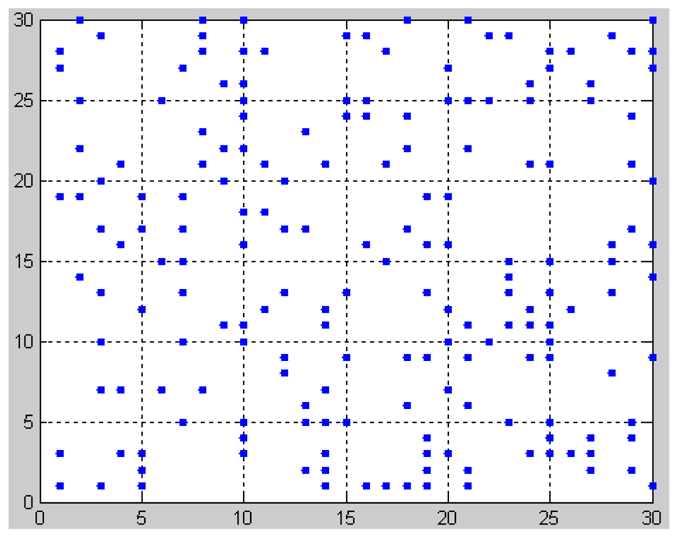
The improved DFD scheme will be applied in a real wireless sensor network system. It is expensive to run schemes on the hardware of the system, so the feasibility and accuracy of the schemes should be verified before being applied. Therefore, simulation becomes the best alternative way of testing, evaluating and verifying. We programmed the DFD scheme and improved DFD scheme using Visual C++ and Matlab. We compared the change of fault detection accuracy of the two schemes with varying node failure ratios for different average numbers of neighbor nodes. Two hundred nodes are randomly deployed in the network, as shown in Figure 1.
Figure 1. The sensor network with 200 randomly deployed nodes.
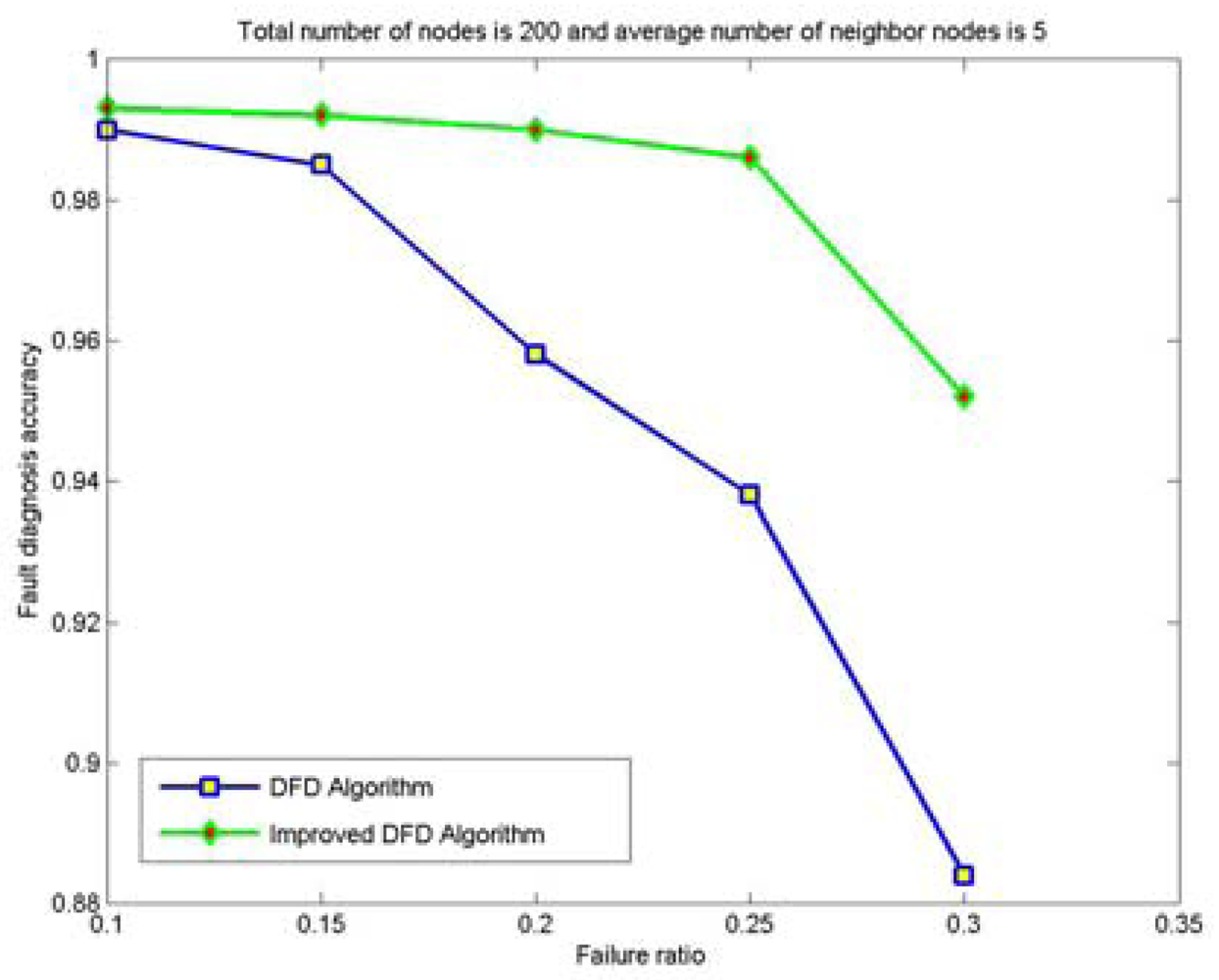
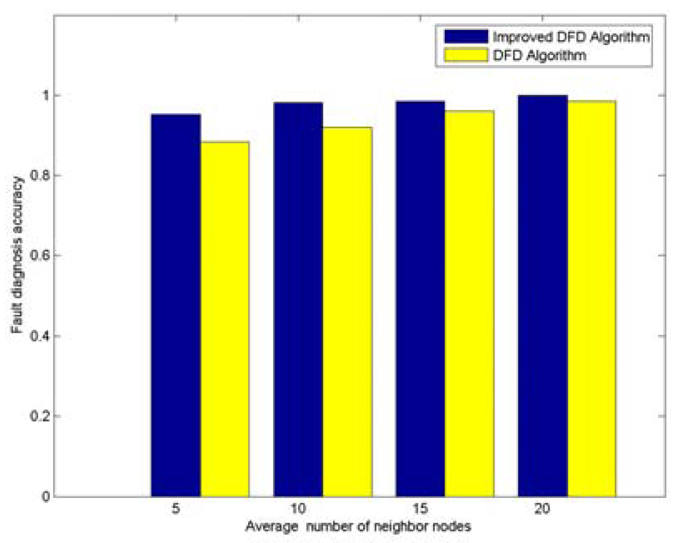
With 200 randomly deployed nodes, the node fault detection accuracy trend with various average numbers of neighbor nodes is shown in Figure 2. The node failure ratio is taken to be 0.3. It can be seen that the fault detection accuracy of DFD and improved DFD scheme increase with the increasing of average number of neighbor nodes, and the improved DFD scheme outperforms the DFD scheme. Similarly, the trend of node fault detection accuracy with various node failure ratios is also analyzed when 200 nodes are randomly deployed and the average numbers of neighbor nodes is 5. Figure 3 indicates that the fault detection accuracy of the DFD and the improved DFD scheme decreases with the increase in the node failure ratio and the improved DFD scheme also outperforms the DFD scheme.
Figure 2. The trend of node fault detection accuracy with various average numbers of neighbor nodes when 200 nodes are deployed and the node's failure ratio is 0.3.
Figure 3. The trend of node fault detection accuracy with various node failure ratios when 200 nodes are randomly deployed and the average numbers of neighbor nodes is 5.
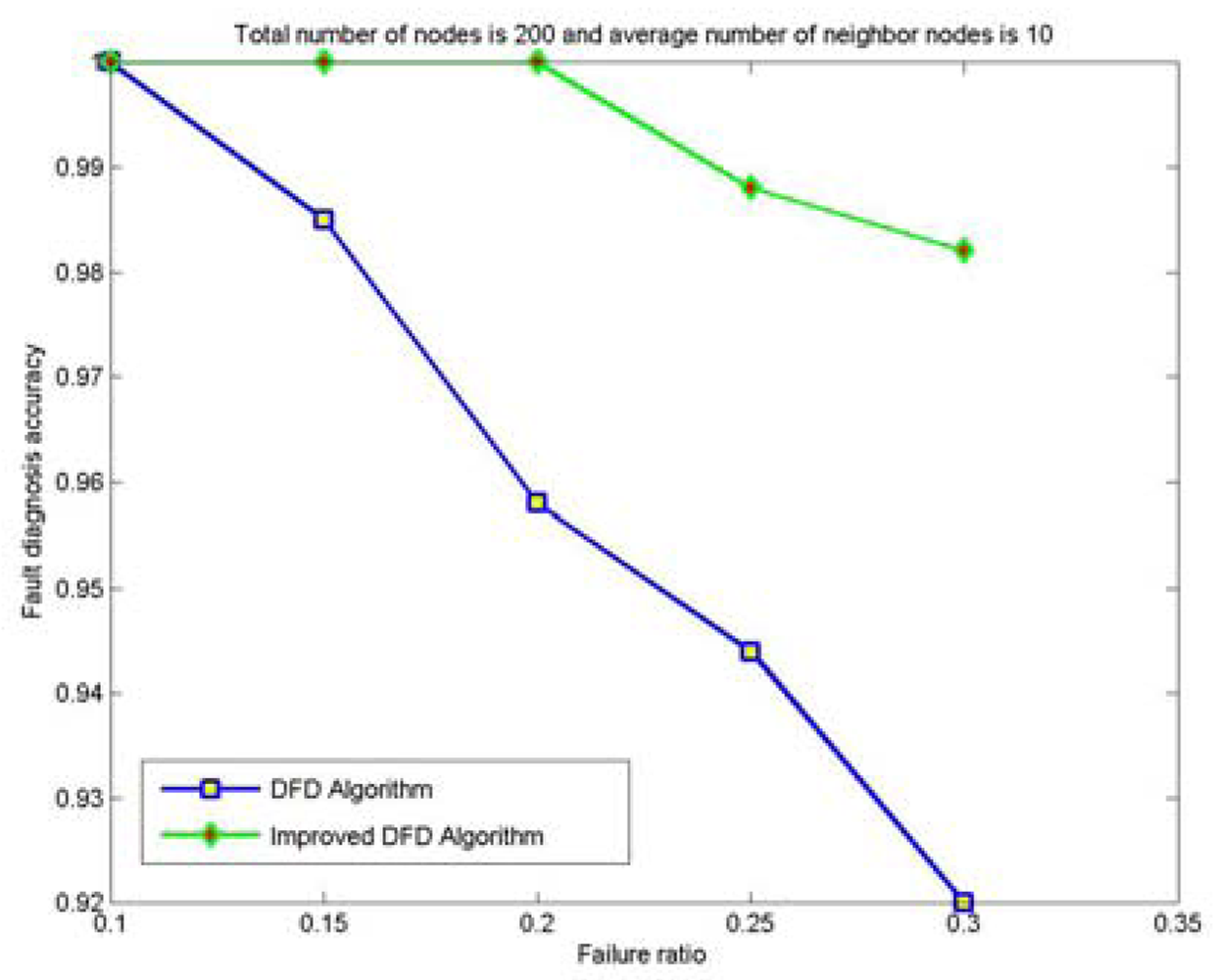
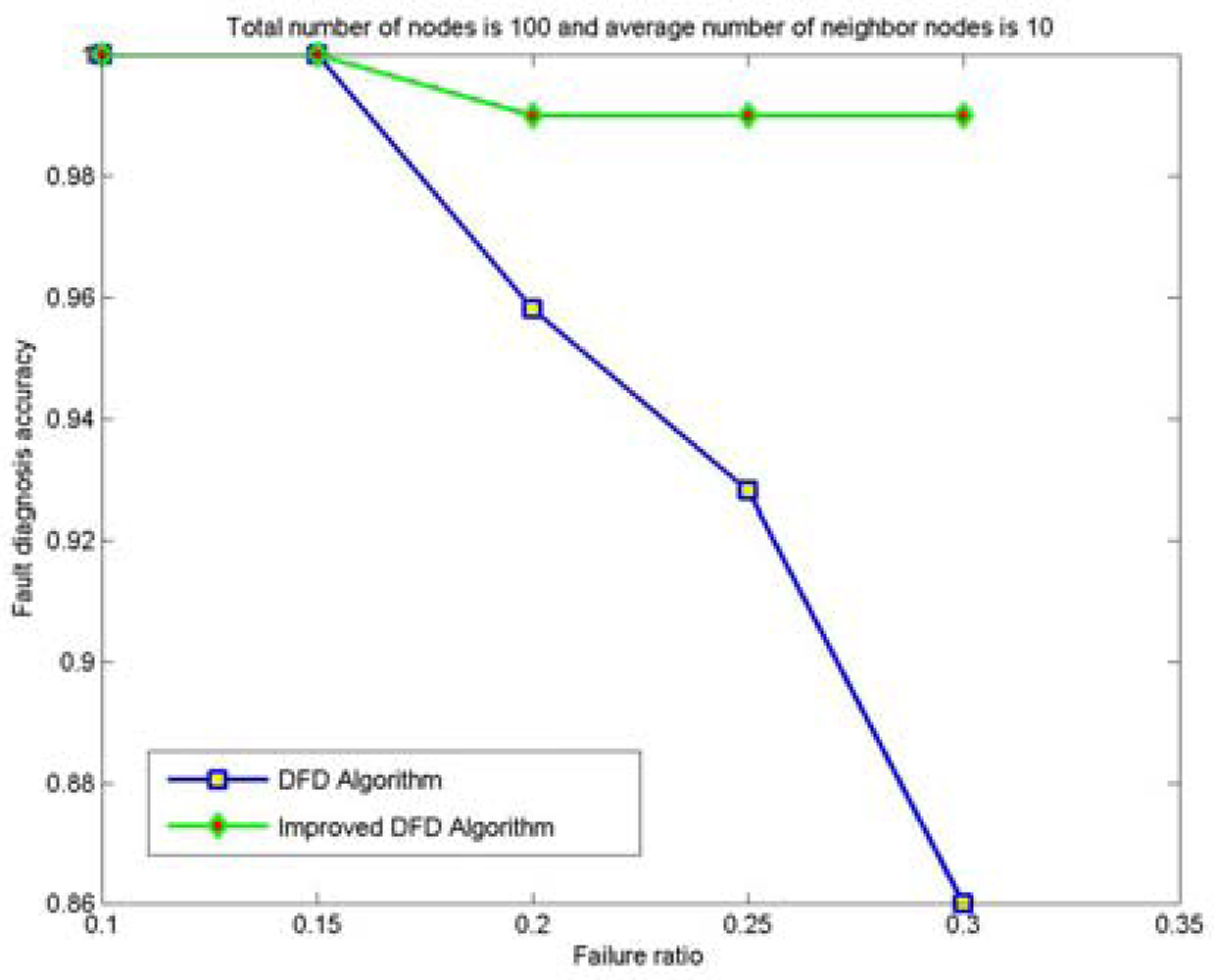
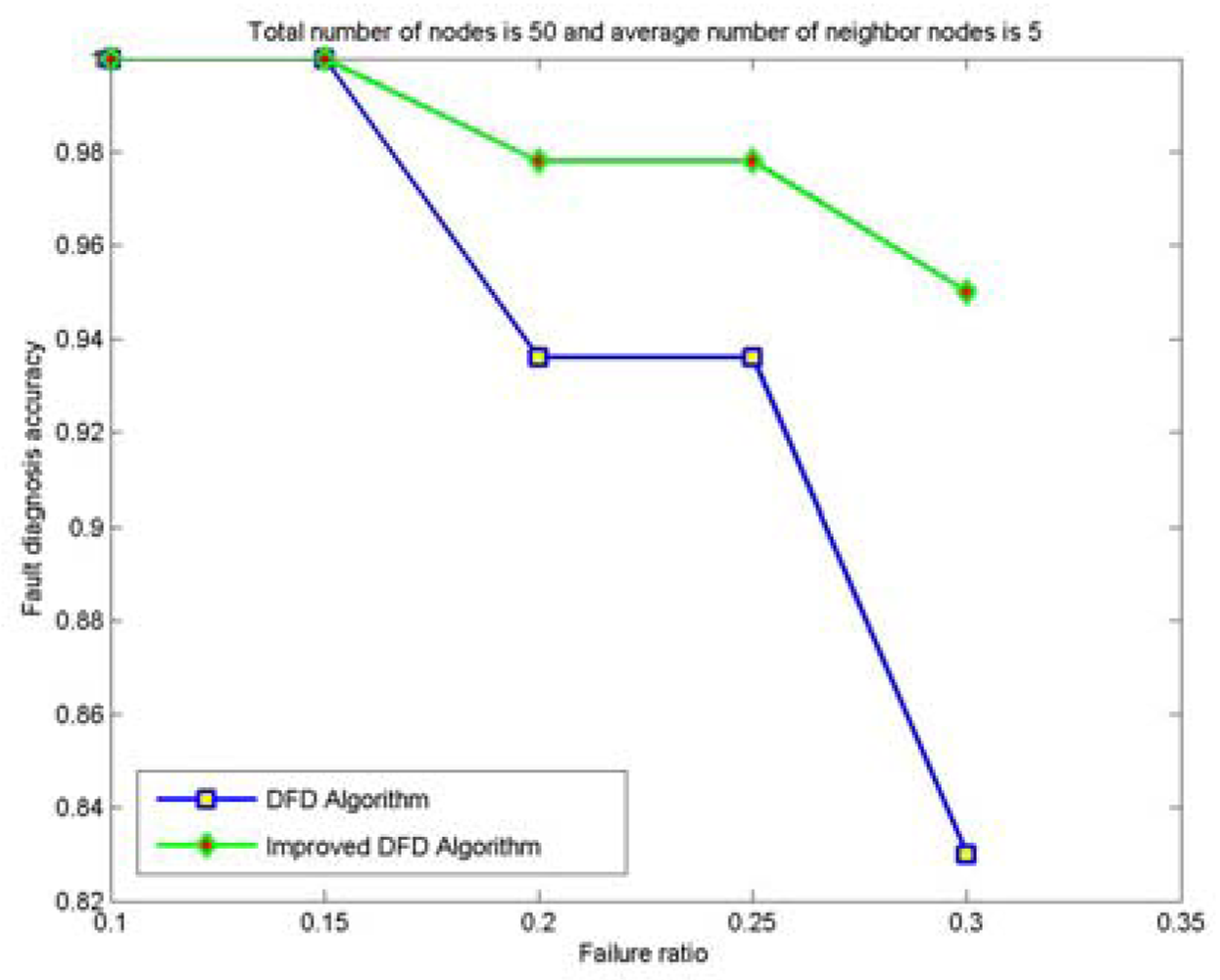
The node fault detection accuracy of the DFD and the improved DFD scheme for different network size is also analyzed and compared. Figures 4 to 7 show the trend of node fault detection accuracy with various node failure ratios with different total number of nodes deployed and average number of neighbor nodes. Figure 4 shows the situation when 200 nodes are deployed and the average number of neighbor nodes is 10. Figure 5, 6 and 7 display the situations with 100 nodes deployed and 10 average neighbor nodes, 200 nodes deployed and 5 average neighbor nodes, and 50 nodes deployed and 5 average neighbor nodes, respectively.
Figure 4. The node fault detection accuracy with various node failure ratios when 200 nodes are randomly deployed and the average numbers of neighbor nodes is 10.
Figure 7. The node fault detection accuracy with various node failure ratios when 50 nodes are randomly deployed and the average numbers of neighbor nodes is 5.
Figure 5. The node fault detection accuracy with various node failure ratios when 100 nodes are randomly deployed and the average numbers of neighbor nodes is 10.
Figure 6. The node fault detection accuracy with various node failure ratios when 200 nodes are randomly deployed and the average numbers of neighbor nodes is 5.
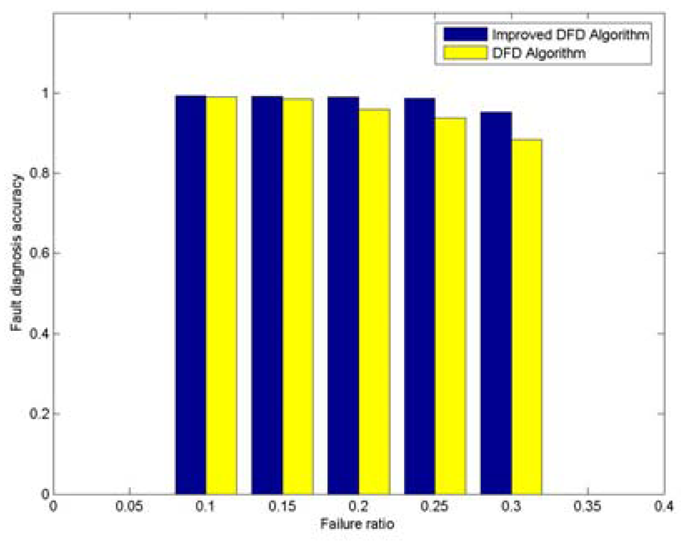
From Figured 4 to 7, we can see that for the same total number of nodes deployed, the average number of neighbor nodes and the nodes' failure ratio, the improved DFD scheme distinctly outperforms the DFD scheme. The fault detection accuracy of the DFD scheme sharply decreases with an increase of the nodes' failure ratio. However, the improved DFD scheme retains a high fault detection accuracy.
Comparing Figure 4 to Figure 5 and Figure 6 to Figure 7, we can see that node fault detection accuracy of both schemes decreases with the reduction of network size with same average number of neighbor nodes and node failure ratios. The improved DFD scheme performs better than the DFD scheme for node fault detection.
In Figure 7, the node fault detection accuracy of the DFD scheme was reduced to 83%, while the improved DFD scheme can remain above 94%, when the total number of nodes is 50, average number of neighbor nodes is 5 and the node failure ratio is 30%. It indicates that the improved DFD scheme can be better applied to smaller scale wireless sensor networks with less neighbor nodes.
Therefore, compared with the DFD scheme, the improved DFD scheme greatly increases the node fault detection accuracy and high fault detection accuracy can be obtained even with high node failure ratios and small average number of neighbor nodes.

5. Conclusions

For the node whose actual status is normal, if the number of nodes which is initially diagnosed as possibly normal (LG) in its neighbor nodes is less than half of the total neighbor nodes, the DFD node fault detection scheme will misdiagnose the normal node as faulty. Modification is made to the detection criterion of DFD scheme and an improved DFD scheme is proposed to address this shortcoming. Simulation results show that the fault detection accuracy of the improved DFD scheme outperforms the DFD scheme for different average numbers of neighbor nodes and node failure ratios. The improved DFD scheme can also be applied to wireless sensor networks where there are less neighbor nodes and the node failure ratio is higher.

Acknowledgments

This paper is supported by the National Natural Science Foundation of China (NSFC60604024), the Key Science and Technology Plan Program of Science and Technology Department of ZheJiang Province (2008C23097), the Scientific Research Plan Program of Education Department of Zhejiang Province (20060246) and the Sustentation Plan Program of Youth Teacher in University of Zhejiang Province (ZX060221).

References and Notes

  1. Sun, L.M.; Li, J.Z.; Chen, Y.; Zhu, H.S. Wireless Sensor Networks; Tsinghua Publishing House: Beijing, China, 2005. [Google Scholar]
  2. Akyildiz, I.F.; Su, W.; Sankarasubramaniam, Y; Cayirci, E. Wireless sensor networks: a survey. Comput. Networks 2002, 38, 393–422. [Google Scholar]
  3. Feng, Xia. QoS Challenges and opportunities in wireless sensor/actuator networks. Sensors 2008, 8, 1099–1110. [Google Scholar]
  4. Xia, F.; Tian, Y.C.; Li, Y.J.; Sun, Y.X. Wireless sensor/actuator network design for mobile control applications. Sensors 2007, 7, 2157–2173. [Google Scholar]
  5. Chen, J.R.; Kher, S.; Somani, A. Distributed fault detection of wireless sensor networks. Proceedings of the International Conference on Mobile Computing and Networkings, Los Angeles, CA, USA; ACM: New York, USA, 2006; pp. 65–72. [Google Scholar]
  6. Koushanfar, F.; Potkonjak, M.; Sangiovanni-Vincentelli, A. On-line fault detection of sensor measurements. In Proceedings ofthe IEEE, Sensors; IEEE Press: Toronto, 2003; Volume 2, pp. 22–24. [Google Scholar]
  7. Chessa, S.; Santi, P. Comparison based system level fault diagnosis in Ad hoc networks. Proceedings ofIEEE 20th Symp. on Reliable Distributed Systems (SRDS), New Orleans; IEEE Press, 2001; pp. 257–266. [Google Scholar]
  8. Chessa, S.; Santi, P. Crash faults identification in wireless sensor networks. Comput. Commun. 2002, 25, 1273–1282. [Google Scholar]
  9. Elhadef, M.; Boukerche, A; Elkadiki, H. Performance analysis of a distributed comparison based self-diagnosis protocol for wireless ad hoc networks. Proceedings of the 9th ACM International Symposium on Modeling analysis and simulation of wireless and mobile system, NY, USA; ACM, 2006; pp. 165–172. [Google Scholar]
  10. Gao, J.L.; Xu, Y.J.; Li, X.W. Weighted-median based distributed fault detection for wireless sensor networks. J. Softw. 2007, 18, 1208–1217. [Google Scholar]
  11. Wang, T.Y.; Chang, L.Y.; Dun, D.R.; Wu, J.Y. Distributed fault-tolerant detection via sensor fault detection in sensor networks. Proceedings of the IEEE 10th International Conference on Information Fusion, Quebec, Canada; 2007; pp. 1–6. [Google Scholar]
  12. Krishnamachari, B.; Iyengar, S. Distributed Bayesian algorithms for fault-tolerant event region detection in wireless sensor networks. IEEE Trans. Comput. 2004, 53, 241–250. [Google Scholar]
  13. Wang, P.; Zheng, J.; Li, C. An Agreement-Based Fault Detection Mechanism for Under Water Sensor Networks. Proceedings of the Global Telecommunications Conference, Washington, DC; 2007; pp. 1195–1200. [Google Scholar]
  14. Luo, X.; Dong, M.; Huang, Y. On distributed fault-tolerant detection in wireless sensor networks. IEEE Trans. Comput. 2006, 55, 58–70. [Google Scholar]
  15. Lee, M.H.; Choi, Y.H. Fault detection of wireless sensor networks. Comput. Commun. 2008, 31, 3469–3475. [Google Scholar]
  16. Nakamura, E.F.; Figueiredo, C.M.S.; Nakamura, F.G.; Loureiro, A.A.F. Diffuse: A topology building engine for wireless sensor networks. Signal Processing 2007, 87, 2991–3009. [Google Scholar]
  17. Nakamura, E.F.; Loureiro, A.A.F.; Frery, A.C. Information fusion for wireless sensor networks: Methods, models, and classifications. ACM Comput. 2007, 39. No. 9. [Google Scholar]
Article Metrics

Citations

Article Access Statistics

Multiple requests from the same IP address are counted as one view.