You are currently viewing a new version of our website. To view the old version click .
Sensors
  • Article
  • Open Access

24 October 2008

Impact of Link Unreliability and Asymmetry on the Quality of Connectivity in Large-scale Sensor Networks


,
,
,
and
1
State Key Laboratory of Industrial Control Technology, Zhejiang University, China / 38, Zheda Road 310027, Hangzhou, Zhejiang Province, China
2
LORIA-Nancy University, Villers-lès-Nancy, France / Campus Scientifique, B.P. 239 - 54506 Vandoeuvre-lès-Nancy, France
*
Author to whom correspondence should be addressed.
This article belongs to the Section Chemical Sensors

Abstract

Connectivity is a fundamental issue in research on wireless sensor networks. However, unreliable and asymmetric links have a great impact on the global quality of connectivity (QoC). By assuming the deployment of nodes a homogeneous Poisson point process and eliminating the border effect, this paper derives an explicit expression of node non-isolation probability as the upper bound of one-connectivity, based on an analytical link model which incorporates important parameters such as path loss exponent, shadowing variance of channel, modulation, encoding method etc. The derivation has built a bridge over the local link property and the global network connectivity, which makes it clear to see how various parameter impact the QoC. Numerical results obtained further confirm the analysis and can be used as reference for practical design and simulation of wireless ad hoc and sensor networks. Besides, we find giant component size a good relaxed measure of connectivity in some applications that do not require full connectivity.

1. Introduction and Motivation

Considerable studies have discussed the issues such as the capacity [1] and multi-hop routing [2-4] in wireless ad hoc and sensor networks, among which connectivity is a fundamental property to be preserved and also provides design reference for upper-layer protocols. For example, we have to decide a minimum node density to ensure global connectivity and provide route diversity in routing decisions; when we do node sleep scheduling to save energy, the connectivity of active nodes has to be maintained and satisfy the application's QoS requirement.
Pioneering works [5-8] dealing with network connectivity are mostly based on a simplistic Boolean model with the assumption that two nodes are connected if and only if their distance is less than a deterministic transmission radius. Unfortunately, the real low-power wireless links are unreliable and asymmetric, suffering from severe propagation impairments such as path loss, multi-path fading and shadowing, which have great impact on the global QoC. A few papers have dealt with connectivity of ad hoc networks in the presence of channel randomness, fading and shadowing [9-11]. Important to our work is the contribution in [9], studying the node isolation probability, from which, under the assumption of dense networks, an approximation of one-connectivity probability can be obtained. In our paper, we adopt an analytical link model which best matches Mica2 Mote's [12] real link state. Through an in-depth derivation, local property of individual links is connected to the global network connectivity. We have shown through both analysis and simulation how various parameters impact the QoC in wireless sensor networks.
The rest of the paper is organized as follows. Section 2 provides a short overview of both wireless link model and network connectivity issue. The detailed analysis of node isolation probability under an analytical link model is presented in Section 3. In Section 4 we do extensive simulations to evaluate the analysis in Section 3 and also discuss the impact of various parameters on the global QoC. Finally we conclude the paper in Section 5 and point out the future direction.

3. Network Connectivity Analysis

3.1. Node Spatial Distribution

Suppose the sensor nodes are scattered from the air and the process resembles Poisson arrival in a service queue. Thus we use a homogeneous Poisson point process with intensity λ to model the spatial distribution of the nodes. This process is defined as follows [26]:

Definition 1

Consider a measure space (X, Σ, μ), where μ is a σ-finite measure. A Poisson Point Process (P. P. P.) with intensity λ is a collection of random variables N(A, ω), A ∈ Σ, ω ∈ Ω, defined on a probability space (Ω, , P) such that:
  • N(·, ω) is a counting measure on (X, Σ) for each ω ∈ Ω.
  • N(A, ·) is the number of nodes in subarea A which follows Poisson distribution with mean λ(A):
    P ( N ( A ) = k ) = λ k k ! e λ ( A ) , all A
    with an expected value E(N) = λ(A) = ρ(A) ‖A‖, ρ(A) and ‖A‖ are node density and size of subarea A respectively.
  • If A1, A2, … are disjoint sets then N(A1), N(A2), … are independent random variables:
    P ( N ( A 1 ) = k 1 N ( A 2 ) = k 2 N ( A n ) = k n ) = i = 1 n P ( N ( A i ) = k i )
If ρ is constant over the entire infinitely large area, the process is homogeneous. In other words, the outcome of N only depends on ‖A‖ but not on its particular location or shape. Note that a homogenous Poisson point process can be regarded as a case of uniform distribution of k nodes in area A, as k and ‖A‖ tends to infinity but the density ρ = k/‖A‖ remains constant.

3.2. Node Non-Isolation Probability

We consider an arbitrary subarea A of an infinite plane. In random graph theory [26], connectivity is defined as follows:

Definition 2

A graph is said to be k-connected if for each pair of nodes there exist at least k mutually independent paths connecting them. In other words, a graph is k-connected if and only if there is no set of k-1 nodes whose removal would disconnect the graph.
Our focus will first be on one-connectivity. Higher orders of connectivity will be discussed in the future work. We are interested in the critical density ρ, at which the network A is one-connected a.s. In this section, we derive necessary condition for the network to be one-connected. We denote P(I) as the isolation probability, which is the probability that a randomly chosen node has no neighbors at all. The probability that none of the nodes in A is isolated, denoted by P(̄T) can be the upper bound for the probability that the network is one-connected [9, 27], denoted by P(C). Thus we have:
P ( C ) P ( I ¯ )
ρ ( P ( C ) = p ) ρ ( P ( I ¯ ) = p )
Equation (3) is obvious. Equation (4) means under the same network configuration, we need higher node density to reach one-connectivity with probability p than to reach node non-isolation with the same probability. We assume the isolation of different nodes in A to be independent events and the number of nodes in A is large, i.e. λ ≥ 100. The conditional probability of non-isolation is give by:
P ( I ¯ | N = k ) = ( 1 P ( I ) ) k
Thus the unconditional non-isolation probability can be written as:
P ( I ¯ ) = k = 1 P ( I ¯ N = k ) P ( N = k ) = k = 1 ( 1 P ( I ) ) k λ k k ! e λ = e P ( I ) λ k = 1 ( ( 1 P ( I ) ) λ ) k k ! e ( 1 P ( I ) ) λ = e P ( I ) λ
Since P(I) is the probability that a randomly chosen node has no neighbors, we denote D to be the number of neighbors of a node, which is also called node degree. Note that D also follows Poisson distribution according to (1) and let the expected value of D be D0. Hence P(I) can be calculated as:
P ( I ) = P ( D = 0 ) = e D 0
In the following, we calculate the mean node degree D0. Let L(i, j) denote the event that there is a link between node i and node j. The distance between the two nodes is known as s(i, j). Given the distance, the probability for L(i, j) is denoted by P(L|s). D0 can be calculated by integrating ρP(L|s) over the whole plane:
D 0 = ρ 0 2 π 0 P ( s ) sds d ϕ = 2 π ρ 0 P ( s ) sds
Plugging (7) (8) to (6), we have:
P ( I ¯ ) = exp ( ρ A exp ( 2 π ρ ξ ) )
where ξ = 0 P ( s ) sds. Let the left hand side of (9) be p, then the density ρ satisfies the following equation:
ρ e 2 π ρ ξ = ln p A
The solution of the equation is
ρ ( P ( I ¯ ) = p ) = 1 2 π ξ Lambertw ( 2 π ξ ln p A )
where Lambertw(x) is the solution w of equation w·exp(w)=x. Finally, the problem has transformed to the analysis of ξ and P(L|s). In other words, the study on global network connectivity has turned into the analysis of local link probability.

3.3. Link Probability Analysis

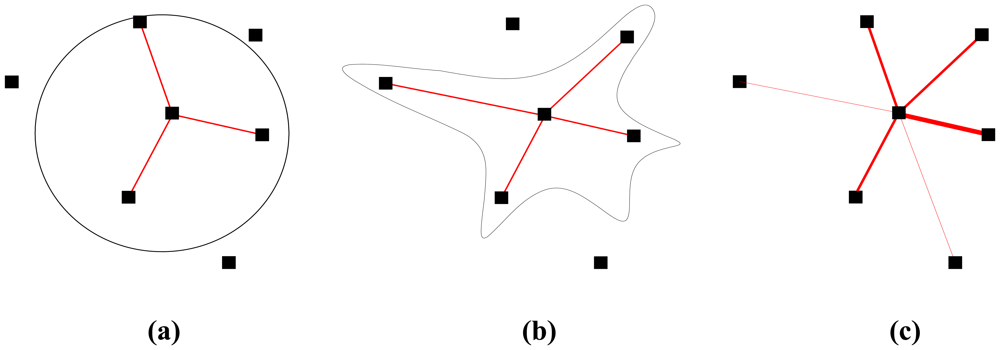
Depending on different radio link model, the link probability P(L|s) is of different values. For Boolean model, either disk or irregular shape as shown in Figure 1(a) and Figure 1(b), P(L|s) is a logical function, equal to either 0 or 1 depending on the communication range. Hence,
ξ = π r 2 ρ
where r is the real communication radius or equivalent radius for Boolean disk model and Boolean shadowing model. For probabilistic model as shown in Figure 1(c), P(L|s) is not deterministic 0 or 1, but defined as the packet reception rate (PRR) ψ over a period of time τ. In practice, ψ can be estimated over a moving time window. However, we can use it in simulation as a stationary variable to indicate the probability of instant link success or failure.
Empirical studies have shown that the lognormal shadowing model provides more accurate multipath channel models than other models like Nakagami and Rayleigh models [13]. According to this model, the received power Pr in dB is given by:
P r ( s ) = P t PL ( s 0 ) 10 η log 10 ( s s 0 ) + N ( 0 , σ )
where Pt is the output power, η is the path loss exponent, N(0,σ) is a Gaussian random variable with mean 0 and variance σ2, and PL(s0) is the power decay for the reference distance s0. σ can be high in the case of severe signal fluctuations due to irregularities in the surrounding of the receiver and transmitter's antennas.
(13) does not include anisotropic properties of the radio. To incorporate it, we add a coefficient Ki to represent the difference in path loss in different directions. (13) can be modified as :
P r ( s ) = P t ( PL ( s 0 ) + 10 η log 10 ( s s 0 ) ) × K i + N ( 0 , σ ) K i = { 1 if i = 0 K i 1 ± rand DOI if 0 < i < 360 and i N DOI = 0.01821
DOI represents the degree of irregularity. The reference value is suggested by [16] to be 0.01821, which is measured using Mica2 mote. We can generate 360 values for 360 different directions. However, to make the simplicity, we just adopt 4 directions in the simulation.
For a modulation method M and encoding method E, the PRR ψ is defined as a function of bit-error rate βM, while βM is a function of SNR γ. Takeing Manchester encoding for example:
φ ( γ ) = ( 1 β M ( γ ) ) 8 ( 2 f h )
where f is the frame size (preamble, payload and CRC), h is the preamble (both in bytes). The value of βM depends on modulation, and more generally on transmitting and receiving techniques (diversity, equalization, etc.). Here we take non-coherent FSK for example, which is the default modulation scheme in Mica2 Mote. Expressions for βM is:
β M = 1 2 e γ 2 , γ = 10 γ d B / 10
Plugging (16) into (15), we have:
Ψ ( γ ) = ( 1 1 2 e γ 2 ) 8 ( 2 f h )
The SNR γ can be obtained from (14) and is given by:
γ d B ( s ) = P r ( s ) P n
where Pn is the noise floor which depends on both the radio and the environment. Considering an ambient temperature of 27°C and no interference signals, the noise floor is −115 dB [13]. Note that γ in (18) can also be regarded as a Gaussian random variable N(μ(s),σ) with mean μ(s) and variance σ2, where μ(s) is given by:
μ ( s ) = P t ( PL ( s 0 ) + 10 η log 10 ( s s 0 ) ) K i P n
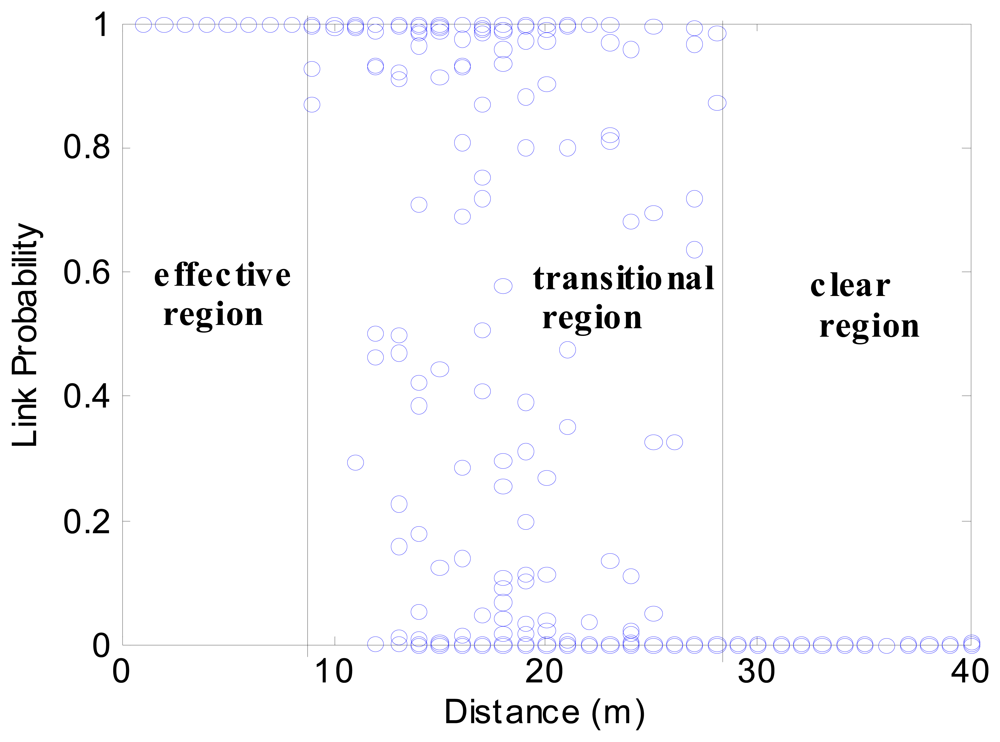
According to (19) and (17), given the distance and some related parameters, the PRR can be calculated. Figure 2 shows the analytical model of PRR to distance in one direction. It is clear that there is a large transitional region, in which the PRR is unstable. With the following definitions, we can further outline the transitional region.
Figure 2. Analytical PRR to distance, obtained from (19) and (17), Pt=-5 dB, η=3, σ=3.3, f=50 Byte, h=2 Byte.

Definition 3

If the link between two nodes has a high probability (>ph) of having high PRR (>ξh), then the two nodes are strongly connected. The upper bound of the connected range is sl.

Definition 4

If the link between two nodes has a high probability (>ph) of having low PRR (<ξl), then the two nodes are almost disconnected. The lower bound of the disconnected range is sh.
According to definition 3 and definition 4, the region between sl and sh is the transitional region, as illustrated in Figure 2. This agrees with empirical observations in [2, 28]. The existence of this region has been explained in [13], which is the joint effect of non-perfect-threshold receiver, noisy environment and multi-path effects.
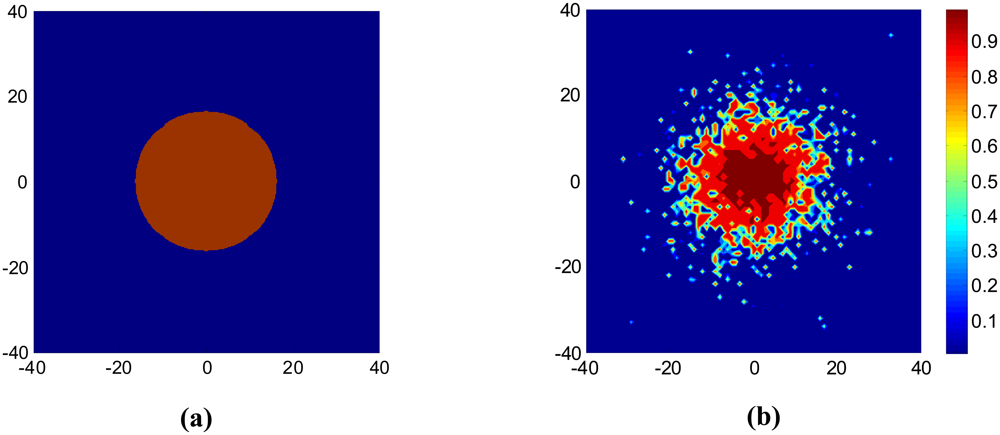
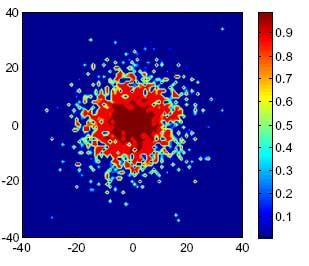
With consideration of different pass loss and shadow fading along different direction, we draw contour plot of the reception rate for a node located at the center of the region. Figure 3 shows the difference of the communication area of a Boolean disk model and a shadowing fading model. Figure 3(b) captures the real characteristic of wireless link and shows spatial irregularity as the empirical results in [14].
Figure 3. Contour plot for different link models. (a) Boolean disk model. (b) Log-normal shadowing based probabilistic model.
To calculate P(), the value of ξ is crucial. As depicted in Figure 2, it is difficult to derive a continuous function for P(L|s). Instead, we calculate the expected value of P, denoted as E(P). Thus, ξ can be written as:
ξ = 0 P ( L s ) sds 0 Ψ ( γ ) f ( γ s ) s d γ d s
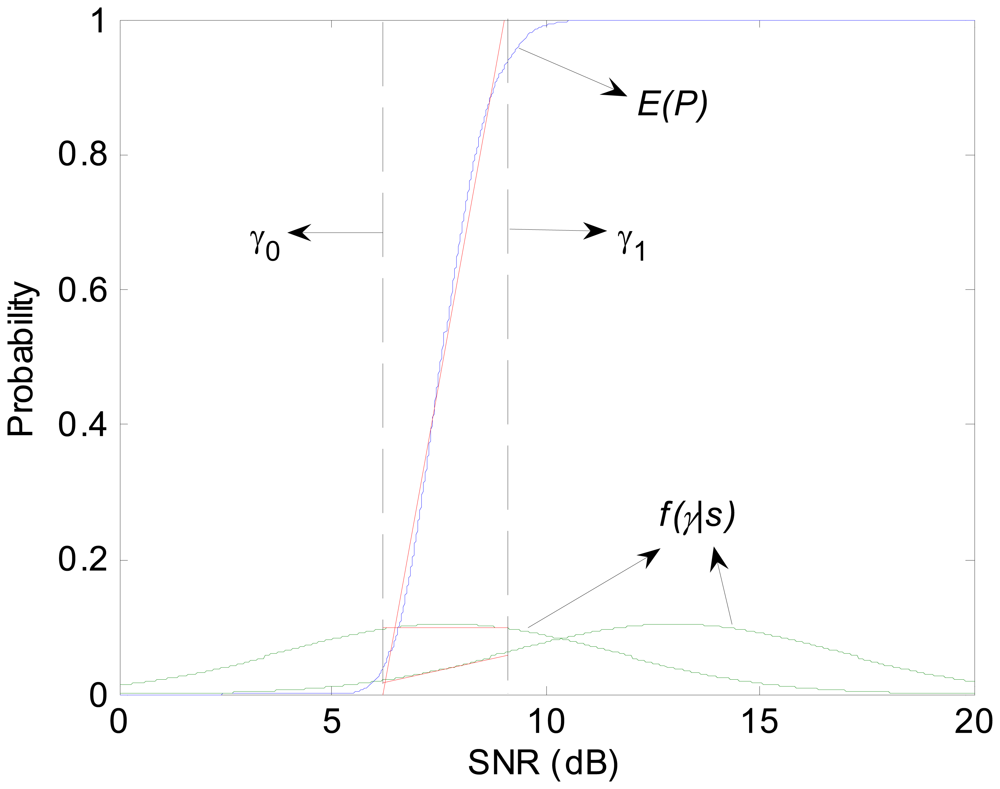
where f(γ|s) represents the probability density function of SNR. According to (17), we draw the PRR as a function of γ. As the power-law relationship entails a sharp threshold, linear approximation turns available. Ψ(γ) can be approximated as the following piecewise linear functions:
Ψ ( γ ) = { 0 γ γ 0 k φ γ + b φ γ 0 < γ < γ 1 1 γ γ 1 k φ = 0.9 0.1 γ 1 γ 0 , b φ = 0.1 γ 1 0.9 γ 0 γ 1 γ 0 γ 0 = Ψ 1 ( 0.1 ) , γ 1 = Ψ 1 ( 0.9 )
where γ0 and γ1 represent the receiver's range of threshold.
Similarly, f(γ|s) can also be evaluated by linear approximation since the interval [γ0, γ1] is relatively narrow compared with [μ-4σ, μ+4σ].
f ( γ s ) = k f ( s ) γ + b f ( s ) , γ [ γ 0 , γ 1 ] k f ( s ) = f ( γ 1 s ) f ( γ 0 s ) γ 1 γ 0 , b f ( s ) = f ( γ 0 s ) γ 1 f ( γ 1 s ) γ 0 γ 1 γ 0
Figure 4 shows the approximation procedure for Ψ(σ) and f(y|s). Finally, ξ can be approximated by:
ξ = 0 Ψ ( γ ) f ( γ s ) s d γ d s 0 γ 0 Ψ ( γ ) f ( γ s ) s d γ d s 0 ( γ 0 γ 1 ( k φ γ + b φ ) ( k f ( s ) γ + b f ( s ) ) d γ + ( 1 Φ ( γ 1 μ ( s ) σ ) ) ) sds 0 d h γ 0 γ 1 ( k φ γ + b φ ) ( k f ( s ) γ + b f ( s ) ) s d γ d s + 0 d h ( 1 Φ ( γ 1 μ ( s ) σ ) ) ) sds
where Φ(·) is the cdf of SNR and μ is given by (19). In fact, the upper bound of the integration can be any value lager than sh. The approximation deviation by lowering the integration upper bound from ∞ to sh can be tolerated.
Figure 4. The procedure of linear approximation for Ψ(γ) and f(γ|s).
In the following, we will use simulations to verify the theoretical analysis.

4. Simulation Results and Discussion

In this section, various simulations are conducted to validate the analytical results and show how different parameters impact the network connectivity. n nodes are distributed in a square area A, following homogeneous Poisson point process. The transmission power is the same for each node. Analytical results are obtained under the assumption that the plane is infinite, in which there are no border nodes. However in simulation we cannot find such a plane. To approach the theoretical assumption, the best way is to eliminate the border effects. To avoid the border effect, we use a wraparound distance model (also called cyclic distance model) instead of usual Euclidean distance model. A node at the border of A is considered as being close to the nodes on the opposite border of A. Thus it can establish links via the borderline to these nodes. We perform simulations with the increase of node density ρ while changing other related parameters. For each unique setting, we repeat simulation runs independently 500 times and finally evaluate the average performance. In the resulting graph for each run, we check the analytical and real node isolation probability, one-connectivity probability, largest component size and giant component probability.
For different applications, the requirement of QoC can be different. For example, a surveillance sensor system with one sink node requires the network to be one-connected so as to collect data from any node in the network. However to detect or track an intrusion [29, 30], it is required that only the nodes around the intrusion connect to the sink. Therefore it is argued that for some use of sensor networks, one-connectivity is a too stringent condition and giant component is suggested as a measure of connectivity instead. In classical random graph G(n,p) [26], every pair of a set of n vertices is chosen to be an edge with probability p. The behavior of the size of the largest component in G when p=c/n for c near 1 receives most interests in the field. For c<1 the size of the largest component is O(logn) a.s.; for c=1 the size of the largest component is Θ(n2/3) a.s.; for c>1 the size of the largest component is a.s. Θ(n) and the second largest component is a.s. O(logn). When c>1, the largest component, whose order is much larger than any other component, is commonly referred to as the giant component. Such random graphs are fundamental and useful for modeling problems in many applications. Although the link model adopted in our paper is quite different from classical one, we can still use the concept of giant component. In our simulation, if half of the nodes in the network are connected, a giant component is formed. This definition actually agrees with the third case (c>1) of the above description in random graph theory. It should be note that we use the following notation in the analysis above: f = O ( g ) if lim sup n f ( n ) g ( n ) < + ; f=Θ(g) if f=O(g) and g=O(f).
To determine the probability of giant component and one-connectivity of a wireless ad hoc network graph, a simple flooding algorithm can be adopted. A random node is tagged at first, and then its neighbors are tagged, which subsequently continue to tag their untagged neighbors, until the corresponding cluster is completely formed. The procedure is repeated for all the untagged nodes until all the nodes in the graph are tagged. By definition, if the size of the largest cluster found is larger than ½n, the giant component exists. For an ad hoc sensor network to be one-connected, the size of the largest component should equal to the total number of nodes in the network. Theoretically, there is another way to obtain the ratio of one-connectivity network by using Laplacian matrix. Let G=(V, E) be a graph on vertex with vertices V and edges E. The Laplacian matrix of a graph G with N nodes is an N×N matrix L(G)=D(G)-A(G), where D(G) is the diagonal matrix of vertex degrees, D(G)=diag(d(νi)), νiV; A(G) is the adjacent matrix of G. The eigenvalues of L(G) are called the Laplacian eigenvalues, which are all real and nonnegative. The set of all N Laplacian eigenvalues λ1≥λ2≥…≥λN-1≥0=λN is called the Laplacian spectrum of a graph G.

Theorem 1

If the graph G has C connected components, then L(G) has exactly C zero eigenvalues (other eigenvalues are positive). Based on Theorem 1, the graph is one-connected if L(G) possesses only one zero eigenvalue. The probability for one-connectivity is estimated from a representative sample of ad hoc sensor networks' connectivity graph as the ratio between one-connected graph and all sample graphs.
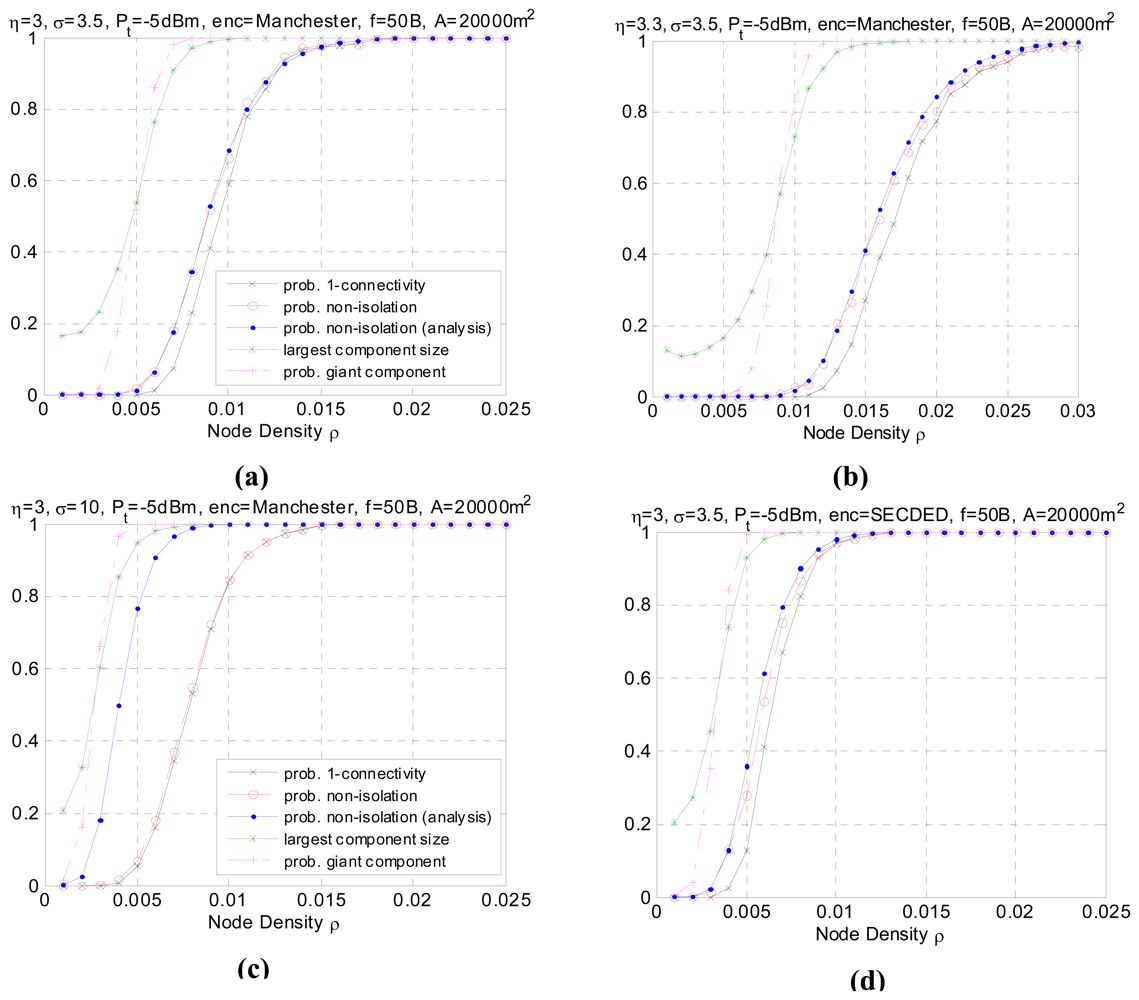
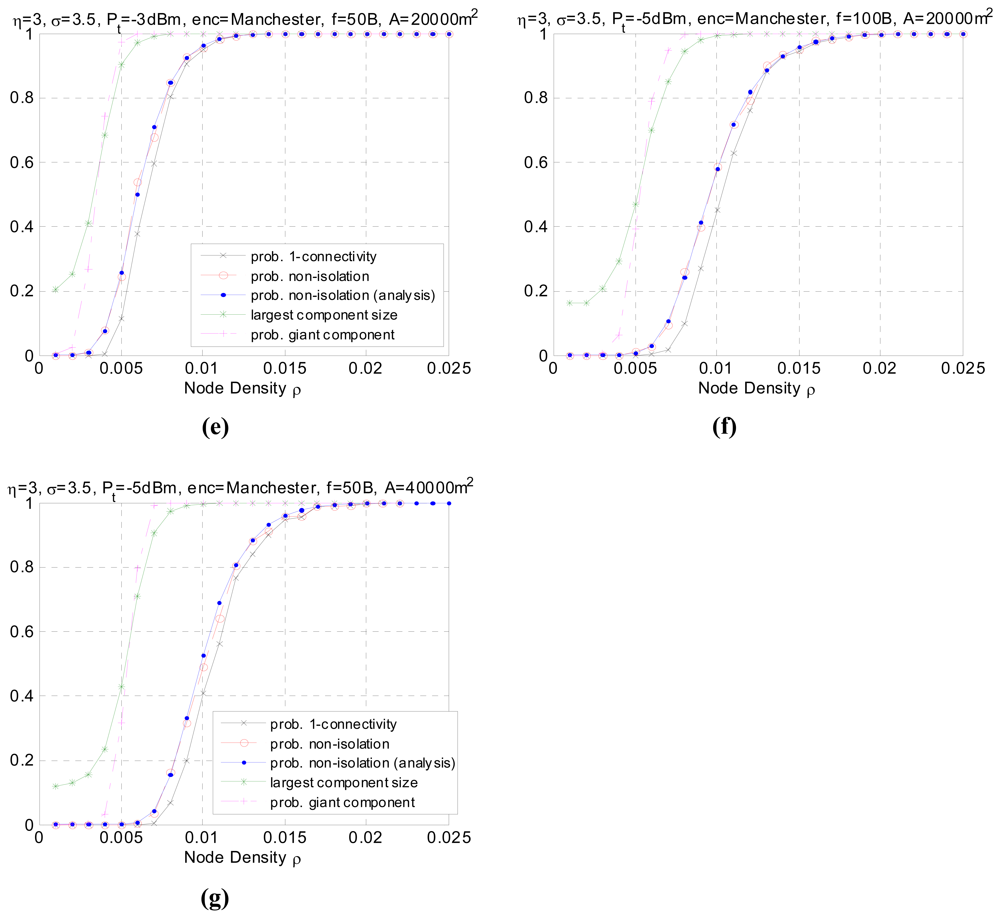
Figure 5 shows the simulated results. Each subplot corresponds to a different configuration. Figure 5(a) serves as a benchmark for comparison. The critical node densities in different scenarios are reported in Table 1. Through comparing and analyzing the 7 groups of simulated data, we draw the following conclusions and give the explanations.
Figure 5. Simulated results for different settings. (a) Benchmark. (b) Change path loss exponent η. (c) Changing shadowing variance σ. (d) Change encoding method E. (e) Change transmission power Pt. (f) Change frame size f. (g) Changing area size ‖A‖.
Table 1. Critical density for giant component, one-connectivity and non-isolation under different settings, comparison of analytical and simulation results.
  • In all simulation cases, as the node density increases, the network graph becomes denser and the transition from low connectivity to nearly full connected or appearance of giant component is quite sharp over a small range of ρ. The phenomenon consists with the results in [22] which uses the theory of continuum percolation. No matter what kind of radio link model adopted, either Boolean disk model or more realistic model with fading and shadowing, the phenomenon of phase transition exists, which gives us a tool for analyzing and determining resource efficient regime of operation for wireless sensor networks. For example, following the settings in Figure 5(a), it tells us that for the nodes with identical transmission power, distributed in an area of 20000 m2 according to homogeneous Poisson process, the node density must be higher than 0.007 to form giant component and higher than 0.0125 to reach one-connectivity. The density threshold is an energy- efficient point of operation, in that to the left of this threshold the network is disconnected with high probability, and to the right of this threshold, additional energy expenditure results in a negligible increase in the high probability of connectivity.
  • In all simulation cases, the non-isolation probability serves as the upper bound for probability of one-connectivity. Generally, the difference between the two probabilities is non-negligible. However as node density increases, the two probabilities converge to 1. This result agrees with inequality (3). With respect to critical node density, this means that
    ρ ( P ( C ) = p ) = ρ ( P ( I ¯ ) = p ) + δ , δ > 0. As p 1 , δ 0.
    For p=90%, the critical node densities for each setting are listed in Table 1. It is observed that when the shadowing effect σ is of a large value (σ=10), the difference δ becomes very small over the whole node density range. This can be explained by the fact that as σ increases, the increase in long links and the decrease in short links have reduced the correlation between links. As a result, the geometric random graph behavior approaches generic random graph behavior and the probability of one-connectivity approaches the probability of non-isolation.
  • It should be noted that, the analytical performance of non-isolation probability closely matches the real non-isolation probability in different settings except when σ is large (σ=10), as shown in Figure 5(c). This is also reflected in Table 1 with minor difference between the simulating and analytical critical density for P() except when σ=10. In some related papers [10-11], it is argued that a large value of σ helps the network to be connected because the number of added long links is larger than the number of removed short links. However, it should be note that the network also suffers severe link asymmetry as the shadowing variance increases. The analytical approach has underestimated the asymmetry problem, which leads to an overestimate of network connectivity. In practical, the analytical values have to be calibrated with certain asymmetry coefficient to match the simulated data. Besides, in practice, some realistic issue like antenna diversity, battery power difference etc. will also cause link asymmetry and is more complicated to simulate. We will leave it as future work.
  • Comparing Figure 5(b) with Figure 5(a), we can see that the path loss decreases the connectivity of the network. The reason is obvious since the higher η, the faster the decay of the signal strength, resulting in a shortened transmission range. The simulated result agrees with the analytical one. Similar is Figure 5(e) and 5(g) compared with Figure 5(a). As the transmission power increases, the average transmission range also increases accordingly, thus a lower node density is sufficient to make the network connected with the same high probability, as shown in Table 1. The giant component probability shows consistent tendency.
  • Figure 5(d) shows the impact of a different encoding scheme. The connectivity is better using SECDED encoding than Manchester encoding. This result is due to the error correction capabilities of SECDED, which comes at a cost of energy efficiency (encoding ratio 1:3) while Manchester does not provide error correction and the encoding ratio is 1:2. Simulated results for different encoding schemes agree with the expected analytical behavior.
  • Figure 5(f) shows the connectivity performance as the packet size is doubled. It can be observed that the performance merges to 1 at a slightly higher node density. The impact of packet size on the global connectivity is not obvious compared to other parameters.
  • The impact of area size ‖A‖ on the connectivity is straightforward. As the sub-area size gets larger, to reach the global connectivity requires higher node density. The quantity can be estimated via Equation (10). However, to form a giant component, the probability has not been affected by the area size ‖A‖.
In summary, a higher transmission power, larger shadowing variance and more complicated encoding method can improve the network connectivity. However, it is energy inefficient to sacrifice the transmission power for better QoC unconditionally; higher shadowing variance σ2 can increase the chance of link asymmetry and typically comes with a higher path loss exponent η; complicated encoding method consumes more system resource (energy, memory space etc.) and takes more time. With reference to the improvement space of each parameter, one should better balance the connectivity performance and the sacrifices of resource and energy. Other techniques such as collaborative radio [31] and multiple antennas [10], although effective in theory to improve global connectivity, need more detailed infrastructure design and proof of their effectiveness in practice. In all simulation cases, we find that the giant component probability converges to 1 much faster than one-connectivity. In some applications, a few isolated nodes or small clusters outside the giant component do not change the overall performance. In that case, a lower node density is sufficient for operation. Besides, the largest component size is also an alternative of connectivity measurement. It not only provides information about the network is one-connected or not, but also the fraction of the connected part. Thus a random size of largest component can be designated satisfying different requirement of QoC.

5. Conclusions and Future Work

In this paper, we have presented an analytical procedure of calculating the node non-isolation probability based on a generalized radio link model in wireless sensor networks. The non-isolation probability is the upper bound of one-connectivity probability. We use a combination of analytical and simulation-based methods to study the impact of various parameters on the connectivity behavior. The results can be applied for practical design and simulation in wireless ad hoc and sensor networks. For example, given the environmental and node configuration, we can determine the minimum density needed to achieve a one-connected network or less strictly, form a giant component, according to different requirement of QoC.
Several issues remain for future work in this area. First, this paper only focus on the connectivity in the spatial domain, it is also interesting to study the temporal dynamics of wireless connectivity. For more challenging dynamic environment, statistics of time-varying links are required; second, the giant component size needs further analytical study. It is important if an explicit expression could be derived for the giant component probability or largest component size; third, this paper assumes the node distribution follows homogeneous Poisson point process. However, in many real-world scenarios, the nodes are in an inhomogeneous distribution. Bettstetter et al. in [32] has proposed an algorithm to create random inhomogeneous distribution. We believe the more generalized distribution model will lead to more convinced analytical and numerical results. Fourth, it will be interesting if we incorporate the context of MAC layer, say IEEE 802.15.4, so that connectivity is more information based than pure physical link. Finally, k-connectivity is a more generalized measure of global connectivity and provides more redundancy for routing choice. In other words, one-connectivity is just a special case for k-connectivity. Some analysis has been conducted in [33], but still need further investigation. The procedure may find some similarities, but the result is of greater generality.

Acknowledgments

This work is supported by Natural Science Foundation of China under grants No. 60773181, No. 60873223; the National High-Tech Research and Development Plan of China under Grant No. 2007AA041406, 2006AA01Z218; Shanghai Science and Technology R&D Program under Grant No. 07DZ15012.

References

  1. Gupta, P.; Kumar, P.R. The capacity of wireless networks. IEEE Tran. Inf. Theo. 2000, 46, 388–404. [Google Scholar]
  2. Woo, A.; Tong, T.; Culler, D. Taming the underlying challenges of reliable multihop routing in sensor networks. Proceedings of the ACM Conference on Embedded Networked Sensor Systems(SenSys), Los Angeles, California, USA; 2003; pp. 14–27. [Google Scholar]
  3. Li, Y.; Chen, C.S.; Song, Y.Q.; Wang, Z.; Sun, Y. A two-hop based real-time routing protocol for wireless sensor networks. Proceedings of the IEEE International Workshop on Factory Communication Systems (WFCS), Dresden, Germany; 2008; pp. 1–10. [Google Scholar]
  4. Chen, C.S.; Li, Y.; Song, Y.Q. Exploring geographic routing in using k-hop information for wireless sensor networks. Proceedings of the International Conference on Communications and Networking in China (CHINACOM), Hangzhou, China; 2008; pp. 1–6. [Google Scholar]
  5. Gupta, P.; Kumar, P.R. Critical power for asymptotic connectivity in wireless networks. In Stochastic Analysis, Control, Optimization and Applications: A Volume in Honor of W.H. Fleming.; McEneaney, William M., Yin, G. George, Zhang, Qing., Eds.; Birkhäuser: Boston, 1998; pp. 547–566. [Google Scholar]
  6. Dousse, O.; Thiran, P.; Hasler, M. Connectivity in ad-hoc and hybrid networks. Proceedings of the IEEE Computer Communications (INFOCOM), Miami, USA; 2005; pp. 1079–1088. [Google Scholar]
  7. Bettstetter, C. On the connectivity of ad hoc networks. Comput. J. 2004, 47, 432–447. [Google Scholar]
  8. Xue, F.; Kumar, PR. The number of neighbors needed for connectivity of wireless networks. Wirel. Netw. 2004, 10, 169–181. [Google Scholar]
  9. Bettstetter, C.; Hartmann, C. Connectivity of wireless multihop networks in a shadow fading environment. Wirel. Netw. 2005, 11, 571–579. [Google Scholar]
  10. Hekmat, R.; Mieghem, V.P. Connectivity in wireless ad-hoc networks with a lognormal radio model. Mob. Netw. Appl. 2006, 11, 351–360. [Google Scholar]
  11. Miorandi, D.; Altman, E. Coverage and connectivity of ad hoc networks presence of channel randomness. Proceedings of the IEEE INFOCOM, Miami, USA; 2005; pp. 491–502. [Google Scholar]
  12. Mica2 datasheet. http://www.crossbow.com.
  13. Zuniga, M.; Krishnamachari, B. Analyzing the transitional region in low-power wireless links. the Proceedings of the IEEE Sensor and Ad Hoc Communications and Networks (SECON), Santa Clara, California, USA; 2004; pp. 517–526. [Google Scholar]
  14. Franceschetti, M.; Booth, L.; Bruck, J.; Cook, M.; Meester, R. Percolation in multi-hop wireless networks.; Technical Report UCB/ERL M03/18; EECS Department University of California: Berkeley, 2003. [Google Scholar]
  15. Cerpa, A.; Wong, JL.; Kuang, L.; Potkojak, M.; Estrin, D. Statistical Model of lossy links in wireless sensor networks. Proeedings of the IEEE /ACM Symposium on Information Processing in Sensor Networks (IPSN), Los Angeles, California, USA; 2005; pp. 81–88. [Google Scholar]
  16. Zhou, G.; He, T.; Krishnamurthy, S.; Stankovic, JA. Models and solutions for radio irregularity in wireless sensor networks. ACM Trans. Sens. Netw. 2003, 2, 221–262. [Google Scholar]
  17. Ganesan, D.; Krishnamachari, B.; Woo, A.; Culler, D.; Estrin, D.; Wicker, S. Complex behavior at scale: An experimental study of low-power wireless sensor networks. In Technical Report CSD- TR 02-0013; UCLA: Los Angeles, California, February 2002. [Google Scholar]
  18. Lal, D.; Manjeshwar, A.; Herrmann, F.; Uysal-Biyikoglu, E.; Keshavarzian, A. Measurement and characterization of link quality metrics in energy constrained wireless sensor networks. Proceedings of the IEEE Global Telecommunications Conference (GLOBECOM), San Francisco, USA; 2003; pp. 446–452. [Google Scholar]
  19. Leskovec, J.; Sarkar, P.; Guestrin, C. Modeling link qualities in a sensor network. Proceedings of the SIKDD at multi-conference IS, Ljubljana, Slovenia; 2005. [Google Scholar]
  20. Cheng, Y.C.; Robertazzi, T.G. Critical connectivity phenomena in multihop radio models. IEEE Trans. Commun. 1989, 37, 770–777. [Google Scholar]
  21. Ingmar, G.; Wolfram, K.; Rudolf, S.; Martin, G. Continuum percolation of wireless ad hoc communication networks. Stat. Mech. Appl. 2003, 325, 577–600. [Google Scholar]
  22. Krishnamachari, B.; Wicker, SB.; Béjar, R. Phase transition phenomena in wireless ad-hoc networks. Proceedings of IEEE GLOBECOM, San Antonio, Texas, USA; 2001; pp. 2921–2925. [Google Scholar]
  23. Dousse, O.; Baccelli, F.; Thiran, P. Impact of interferences on the connectivity in ad hoc networks. IEEE/ACM Trans. Netw. 2005, 13, 425–436. [Google Scholar]
  24. Miorandi, D.; Altman, E. Connectivity in one-dimensional ad hoc networks: a queueing theoretical approach. Wirel. Netw. 2006, 12, 573–587. [Google Scholar]
  25. Cavalcanti, D.; Agrawal, D.; Kelner, J.; Sadok, D. Exploiting the small-world effect to increase connectivity in wireless ad hoc networks. Proceedings of the International Conference on Telecommunications (ICT), Fortaleza, Brazil; 2004; pp. 388–393. [Google Scholar]
  26. Bollobás, B. Random graphs, 2nd Edition ed; Cambridge University Press: Cambridge, 2001. [Google Scholar]
  27. Gorce, J-M.; Zhang, R.; Parvery, H. Impact of radio links unreliability on the connectivity of wireless sensor networks. EURASIP J. Wirel. Commun. Netw. 2007. [Google Scholar] [CrossRef]
  28. Xia, F.; Tian, Y.-C.; Li, Y.; Sun, Y. Wireless sensor/actuator network design for mobile control applications. Sensors 2007, 7, 2157–2173. [Google Scholar]
  29. Dousse, O.; Tavoularis, C.; Tiran, P. Delay of intrusion detection in wireless sensor networks. Proceedings of the ACM Symposium on Mobile Ad hoc Networking and Computing (MobiHoc), Florence, Italy; 2006; pp. 155–165. [Google Scholar]
  30. Wang, X.; Wang, S.; Bi, D.; Ma, J. Distributed peer-to-peer target tracking in wireless sensor networks. Sensors 2007, 7, 1001–1027. [Google Scholar]
  31. Song, S.; Goeckel, D.; Towsley, D. Collaboration improves the connectivity of wireless networks. Proceedings of the IEEE INFOCOM, Barcelona, Spain; 2006; pp. 1–11. [Google Scholar]
  32. Bettstetter, C.; Gyarmati, M.; Schilcher, U. An inhomogeneous spatial node distribution and its stochastic properties. Proceedings of the ACM International Symposium on Modeling, Analysis and Simulation of Wireless and Mobile Systems (MSWiM), Chania, Greece; 2007; pp. 400–404. [Google Scholar]
  33. Lili, Z.; Boon-Hee, S. k-Connectivity in shadowing wireless multi-hop networks. Proceedings of the IEEE GLOBECOM, San Francisco, USA; 2006; pp. 1–4. [Google Scholar]

Article Metrics

Citations

Article Access Statistics

Multiple requests from the same IP address are counted as one view.