Robust Low-Complexity WMMSE Precoding Under Imperfect CSI with Per-Antenna Power Constraints

Abstract
1. Introduction
- We extend the classical WMMSE framework to handle per-antenna power constraints (PAPCs) by introducing a diagonal dual regularization. A diminishing-step projected dual ascent is used to update the per-antenna Lagrange multipliers, and a final row-wise feasibility projection is applied to eliminate any residual PAPC violations. This design keeps all additional variables local to the BS and yields a PAPC-feasible precoder.
- We develop a Woodbury-based reformulation of the transmit update that trades the classical inversion for an symmetric positive-definite (SPD) solve built from a block-diagonal surrogate weight. This reduces the dominant per-iteration complexity in the massive-MIMO regime , while retaining a numerically stable Cholesky/LDL implementation.
- We propose a robust low-complexity WMMSE (RLC-WMMSE) update that blends the classical WMMSE precoder with its low-complexity surrogate through an adaptive mixing factor driven by the per-iteration MSE variation. Together with an Armijo-type adaptive damping rule, this hybrid scheme stabilizes the iterations when updates are computed on but performance is evaluated on the true channels , and enforces sufficient ascent of the monitored WSR in practice.
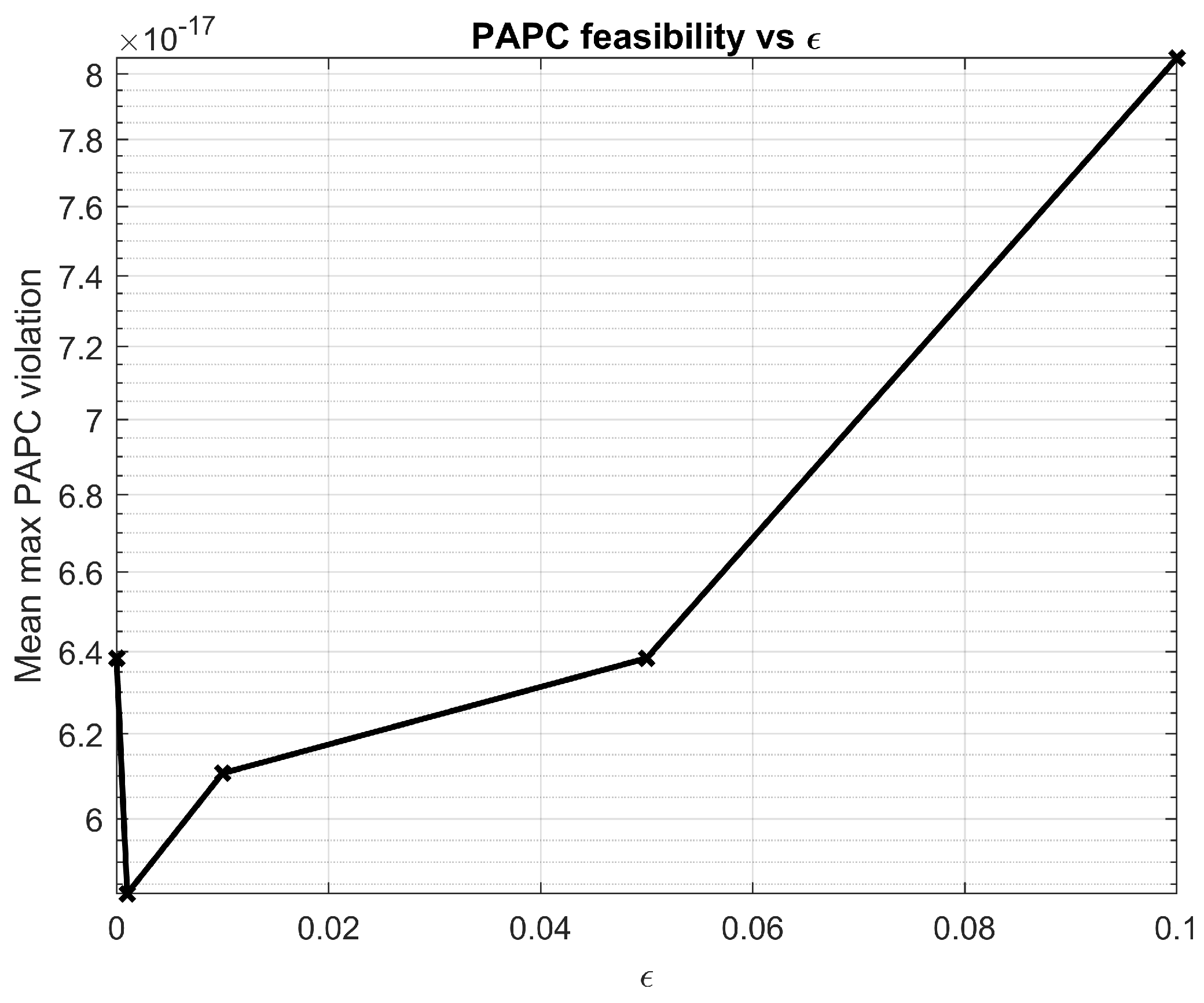
- Simulation results indicate that the proposed RLC-WMMSE becomes cheaper per iteration than classical WMMSE once for typical system dimensions. In addition, for the PAPC dual loop, we establish a feasibility bound of the form , quantifying how the expected PAPC violation decays with the number of outer iterations T.
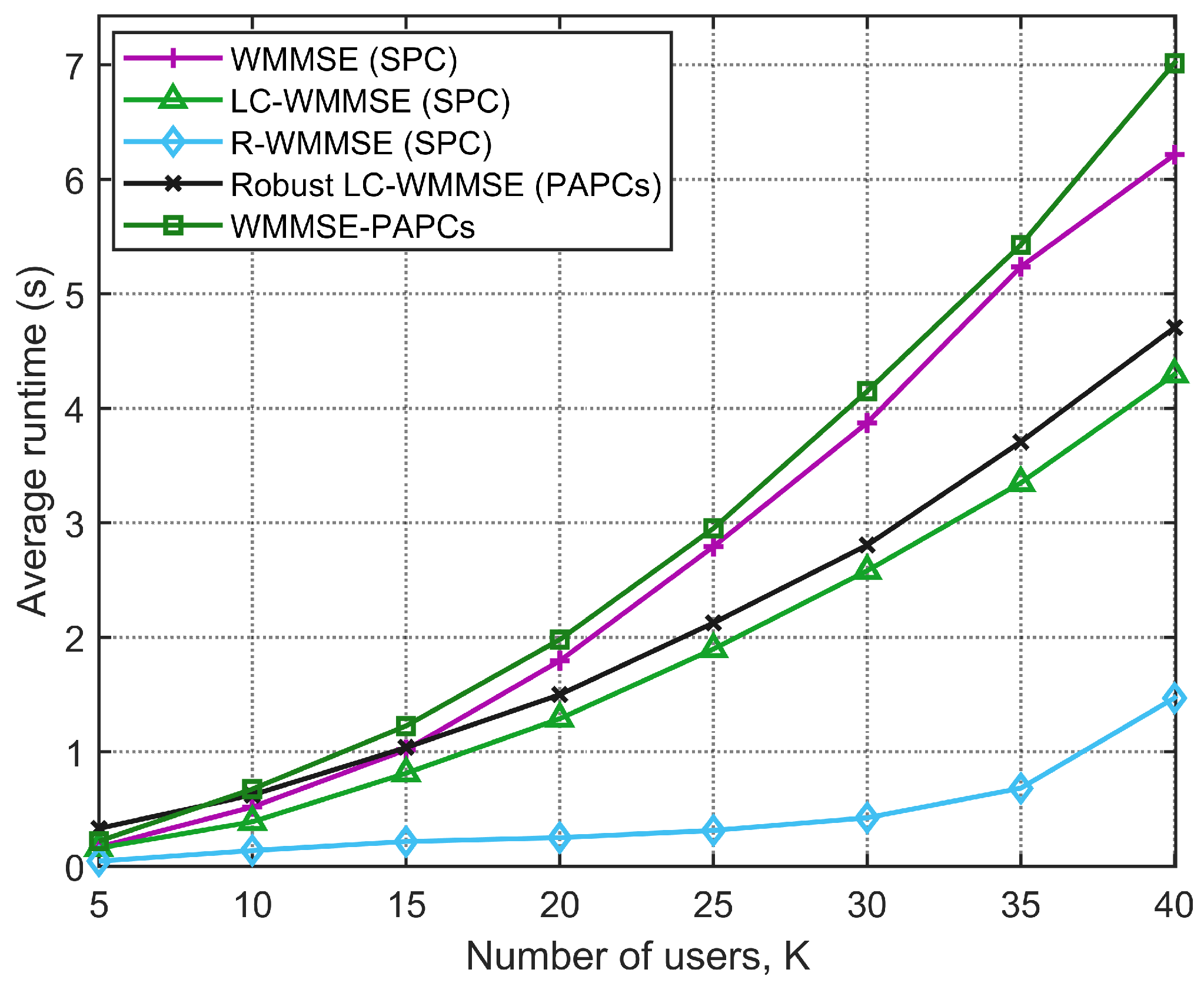
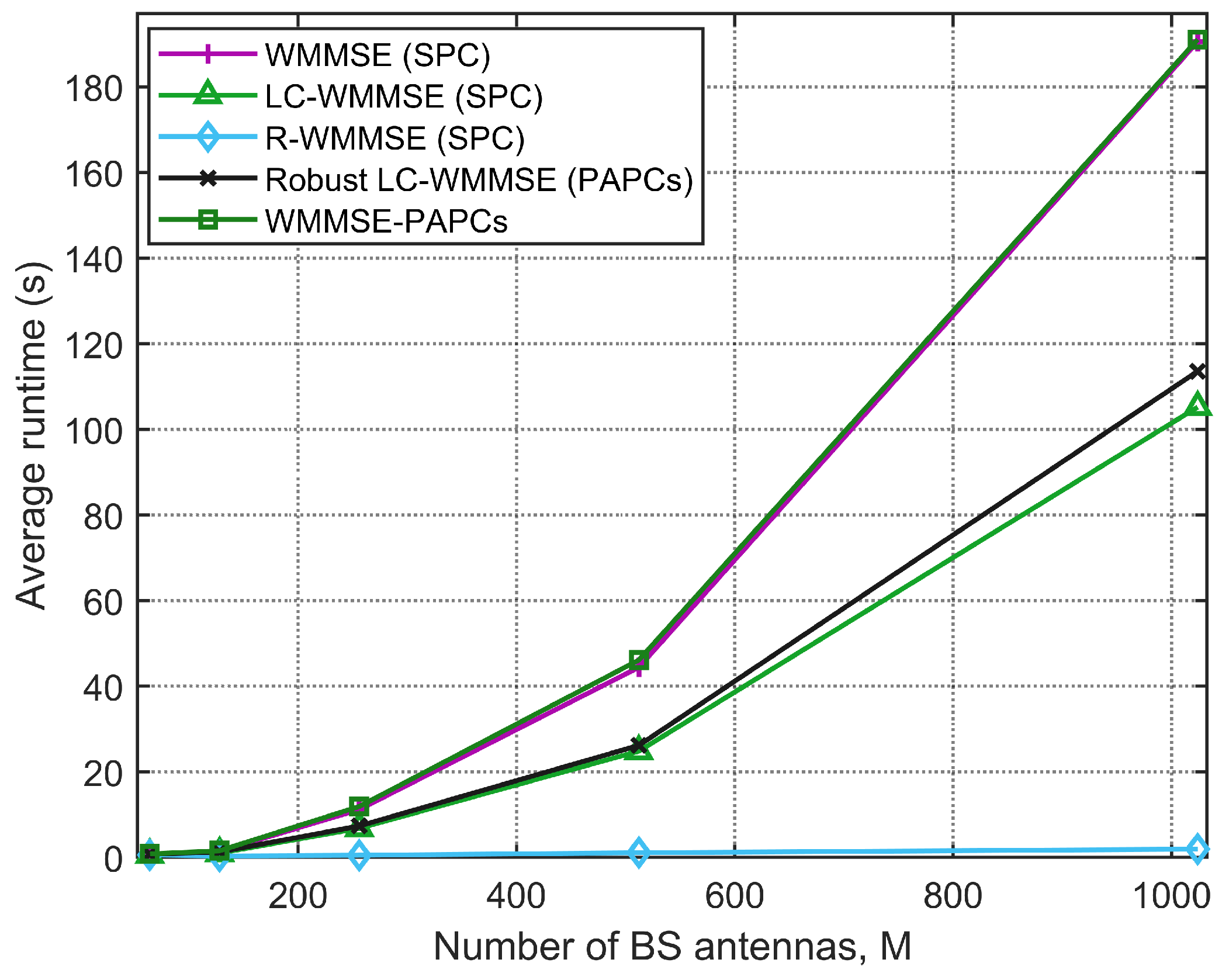
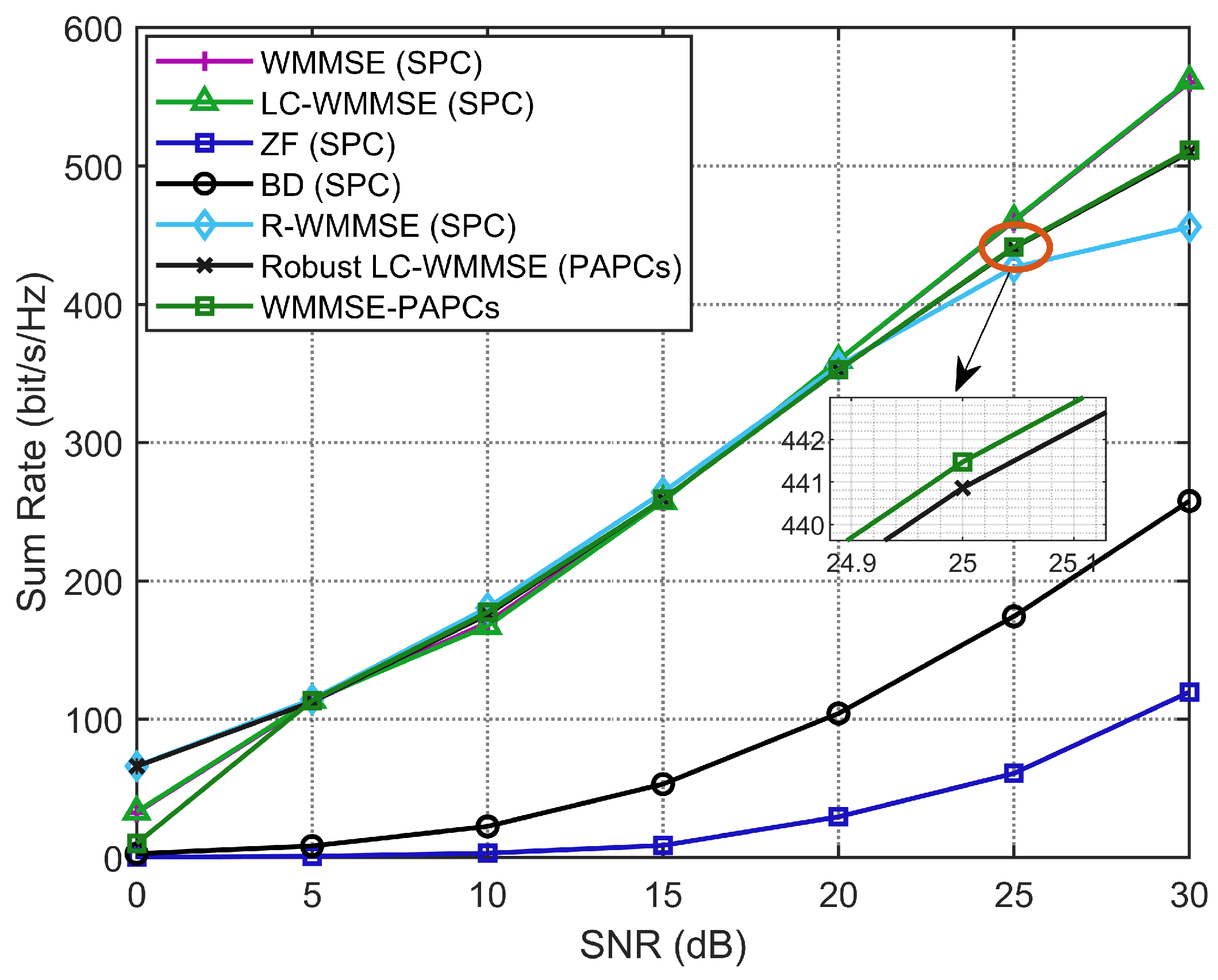
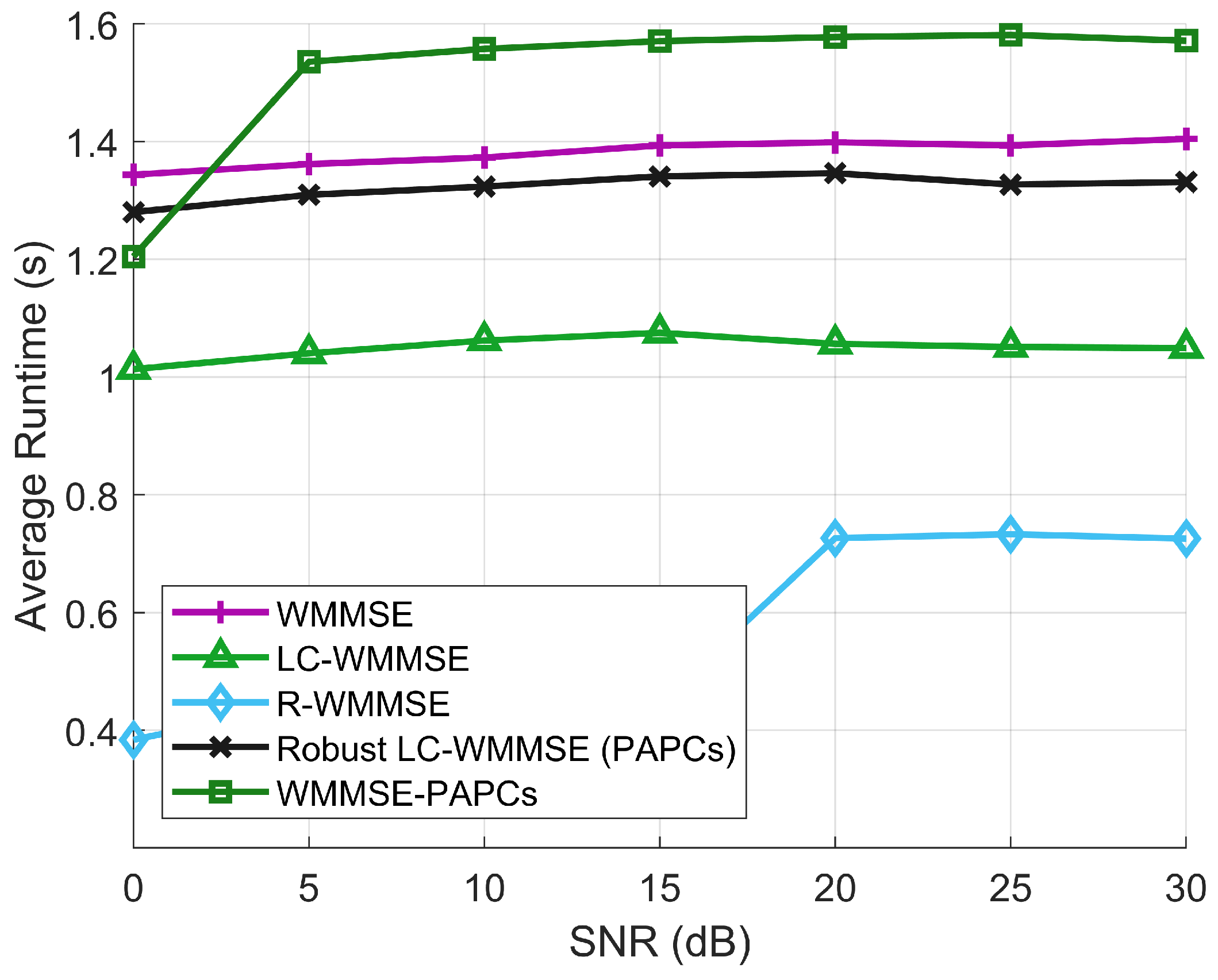
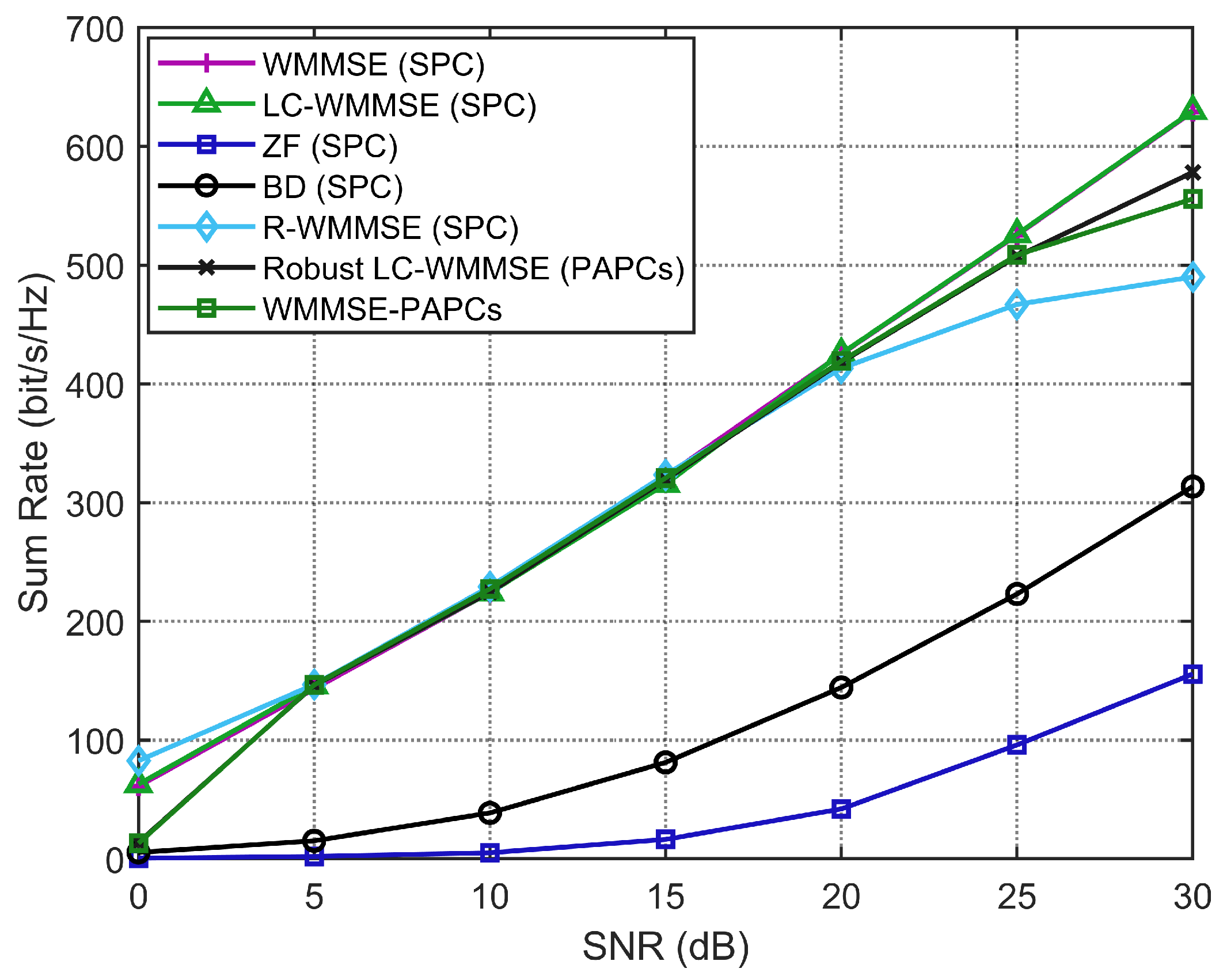
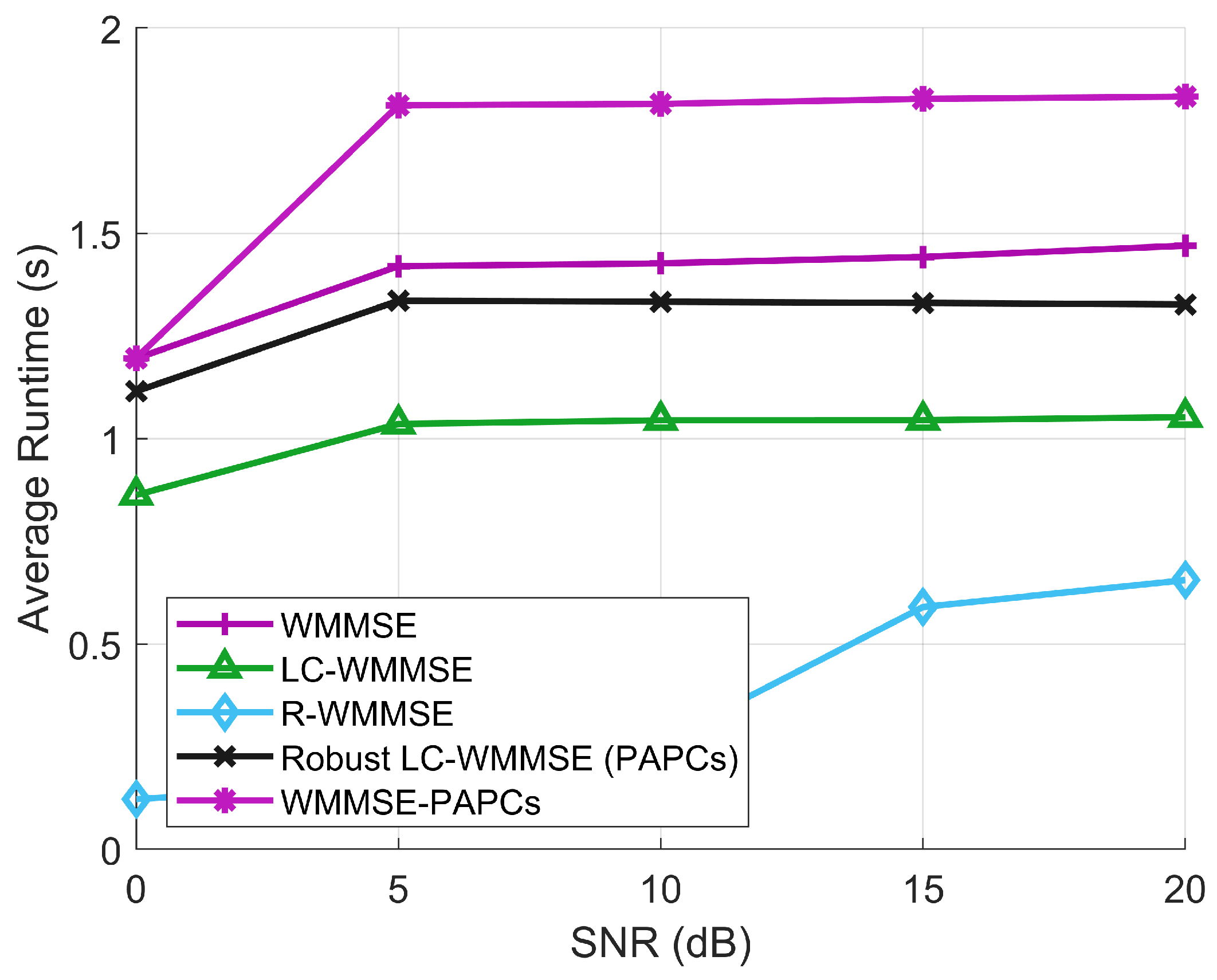
- Through Monte Carlo simulations with both Kronecker-correlated channels and i.i.d. Rayleigh fading, and under various CSI mismatch levels, we show that the proposed RLC-WMMSE achieves near-identical WSR to the WMMSE-PAPCs benchmark while maintaining negligible PAPC violations. At the same time, it exhibits favorable runtime scaling with M and clear speedups over classical WMMSE in the large-array regime.
2. System Model and Problem Formulation
2.1. Downlink System Model
2.2. Problem Formulation with Imperfect CSI and PAPCs
3. Proposed Robust LC-WMMSE Algorithm
3.1. The Classical WMMSE Algorithm
3.2. Proposed RLC-WMMSE
The RLC-WMMSE Algorithm Problem Reformulation
- Update the hybrid transmit precoder: At iteration t, we construct by convexly combining the classical WMMSE precoder and the LC precoder as follows:where is an adaptive switch:with a small smoothing constant (we use unless stated otherwise). When is large (far from a fixed point), favors ; near convergence, it gradually shifts to the LC update to save time.Diagonal weight and Woodbury build.We approximate the full WMMSE weight by its diagonal,which preserves positive-definiteness while removing inter-stream couplings. Using and , we form the block diagonal matrixand stack the channels horizontally,PAPC enforcement via diagonal dual regularization.Under per-antenna power constraints, we replace the global Frobenius normalization by a diagonal dual regularization. At iteration t, construct and from the current as in (27) and (28). LetWith these, the LC step inverts an SPD matrix (via Cholesky) instead of an system, yielding the usual Woodbury speedup when . For a dual vector , defineand choose so that each antenna satisfies the PAPC , . A lightweight projected dual ascent that works well in practice iswith denoting projection onto and . If a tiny residual remains after the inner loop, apply the row-wise safety projectionThe row scaling in (31) is not an ad-hoc post-processing; it is the exact row-wise Euclidean projection onto the PAPC-feasible set , since the constraints decouple across rows. Concretely, for any , is obtained by . Thus, every iterate is feasible (up to numerical tolerance), and Armijo acceptance is evaluated on the projected (feasible) iterate.
- Adaptive Damping with Robust PAPCs: To stabilize the outer iterations under CSI mismatch, we adopt the adaptive damping mechanism originally proposed for the LC-WMMSE algorithm in [25] and extend it to the robust PAPC setting. Let denote the estimated WSR evaluated on the imperfect CSI . At iteration t, we measure the change in the estimated WSR asWe then choose a mixing factorwhere and typical values are , , and . Let denote the undamped precoder returned by the robust LC-WMMSE (RLC) update at iteration t. The damped update isOptionally, we apply a short Armijo backtracking (up to a few trials) on to enforce monotone ascent of the estimated objective, i.e., . This schedule reduces the step size when the iterate is far from stationarity (large ) and allows larger steps near convergence. Final performance is always reported as on the true channel for fairness.
3.3. Proposed RLC-WMMSE Updates Precoder with PAPCs and Imperfect CSI
- Receive Filter Update : At iteration t, the receive filter for user k iswhere the BS transmit covariance from the previous iterate is . The matrix inside the inverse is Hermitian positive-definite, so Equation (35) is well posed.
- Transmit Precoder Update : Using the block-diagonal matrix and the stacked channel (both defined earlier), the Woodbury step gives the LC precoder in closed form aswith and . This moves the inversion from size M to size , yielding per-iteration cost instead of when .
PAPC Enforcement (Replaces SPC Rescaling)
3.4. Convergence and Feasibility Analysis
3.5. Computational Complexity Analysis
| Algorithm 1 Robust low-complexity WMMSE (RLC-WMMSE) precoding. |
|
3.5.1. PAPC (RLC-WMMSE) Effect
3.5.2. Practical Implementation and Latency Considerations
3.6. Implementation Considerations and Signaling Overhead Analysis
4. Simulations and Results
4.1. Simulation Setup
4.2. Robust Low-Complexity (RLC-WMMSE) Performance Under Correlated Channels
4.3. Robustness to Channel Estimation Errors
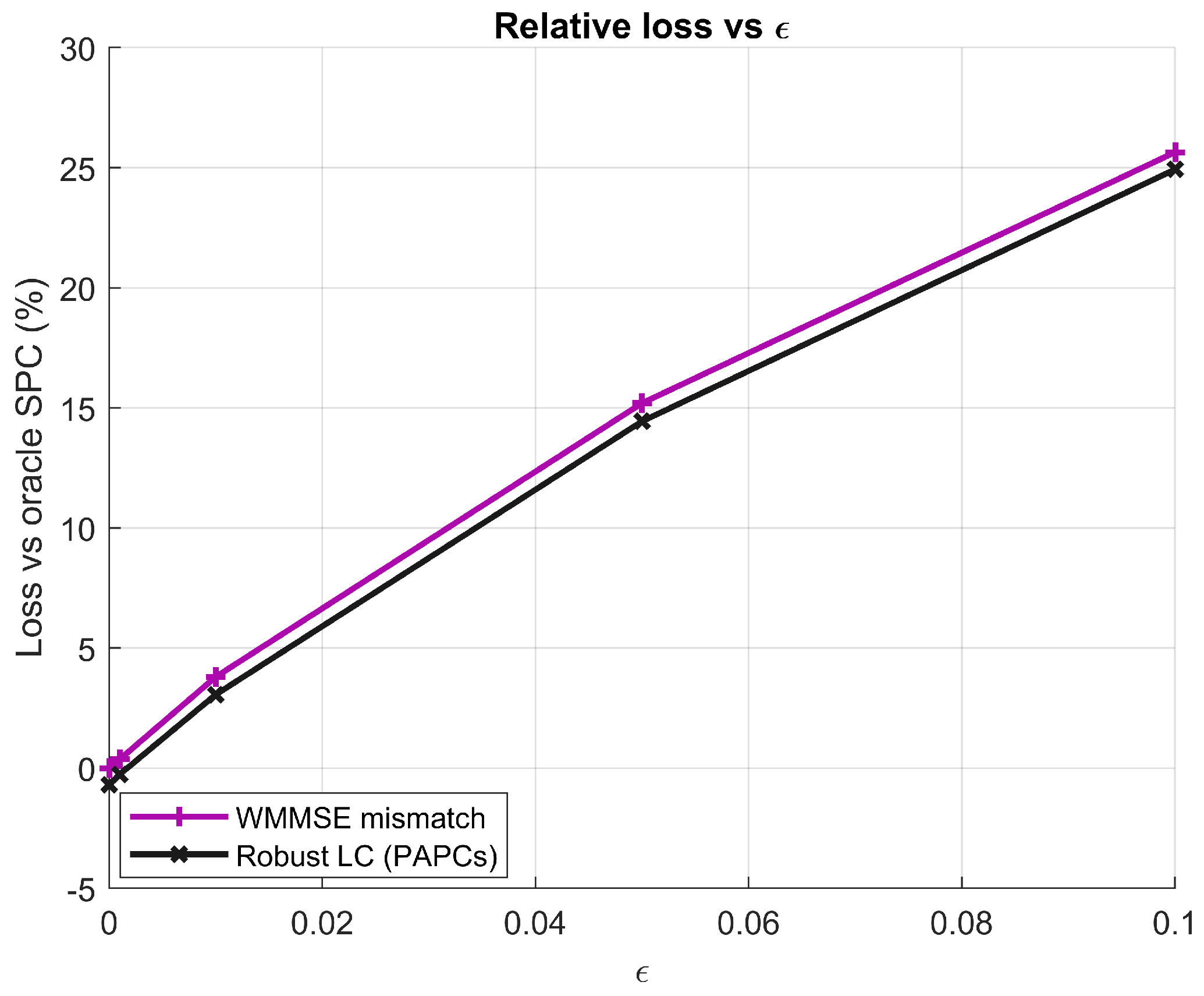
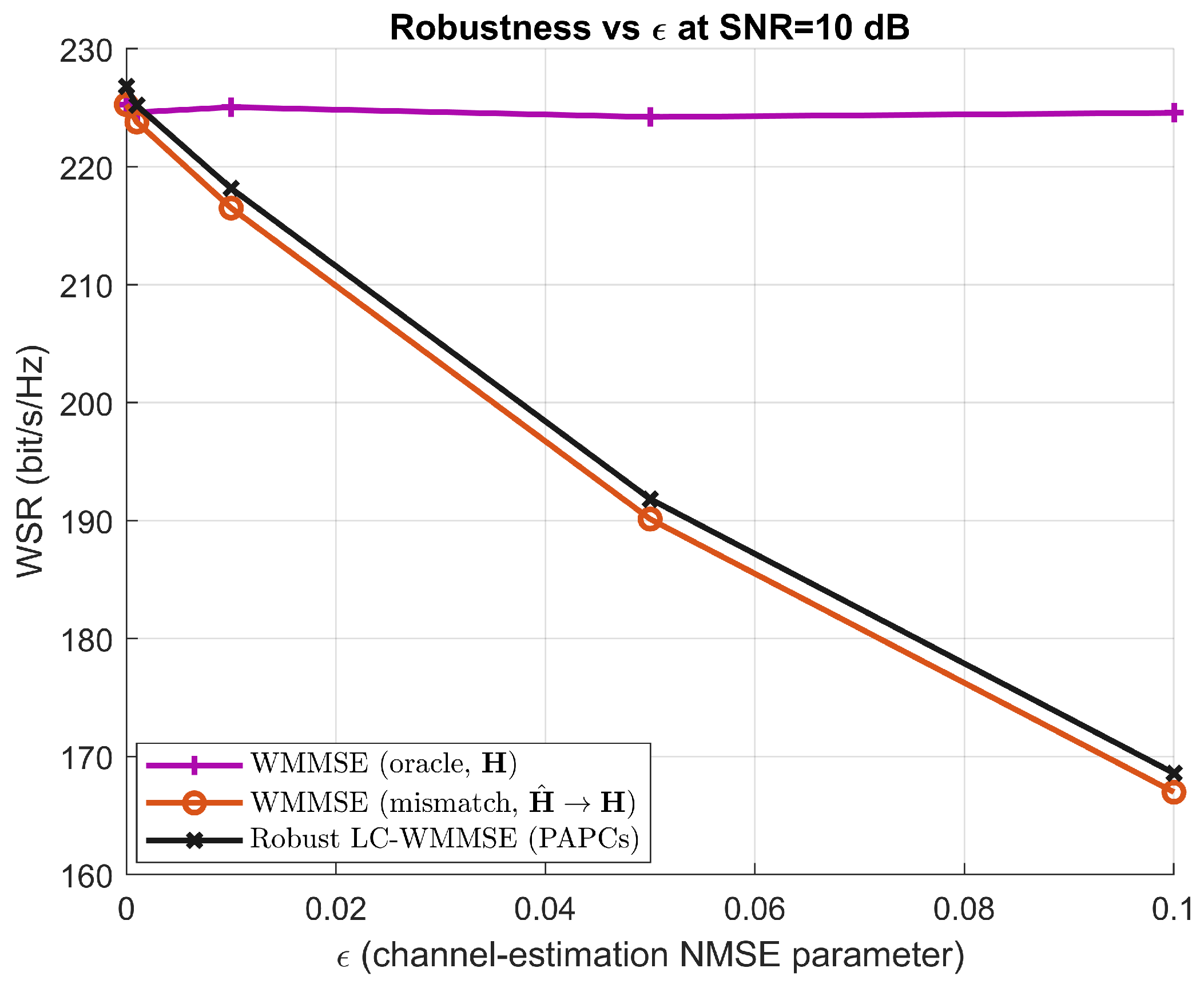
- WMMSE (oracle, ): The classical WMMSE algorithm with a sum-power constraint, which has perfect knowledge of and serves as an upper bound.
- WMMSE (mismatch, ): The classical WMMSE algorithm that designs the precoder using the imperfect CSI , while the achieved weighted sum-rate is always evaluated on the true channels .
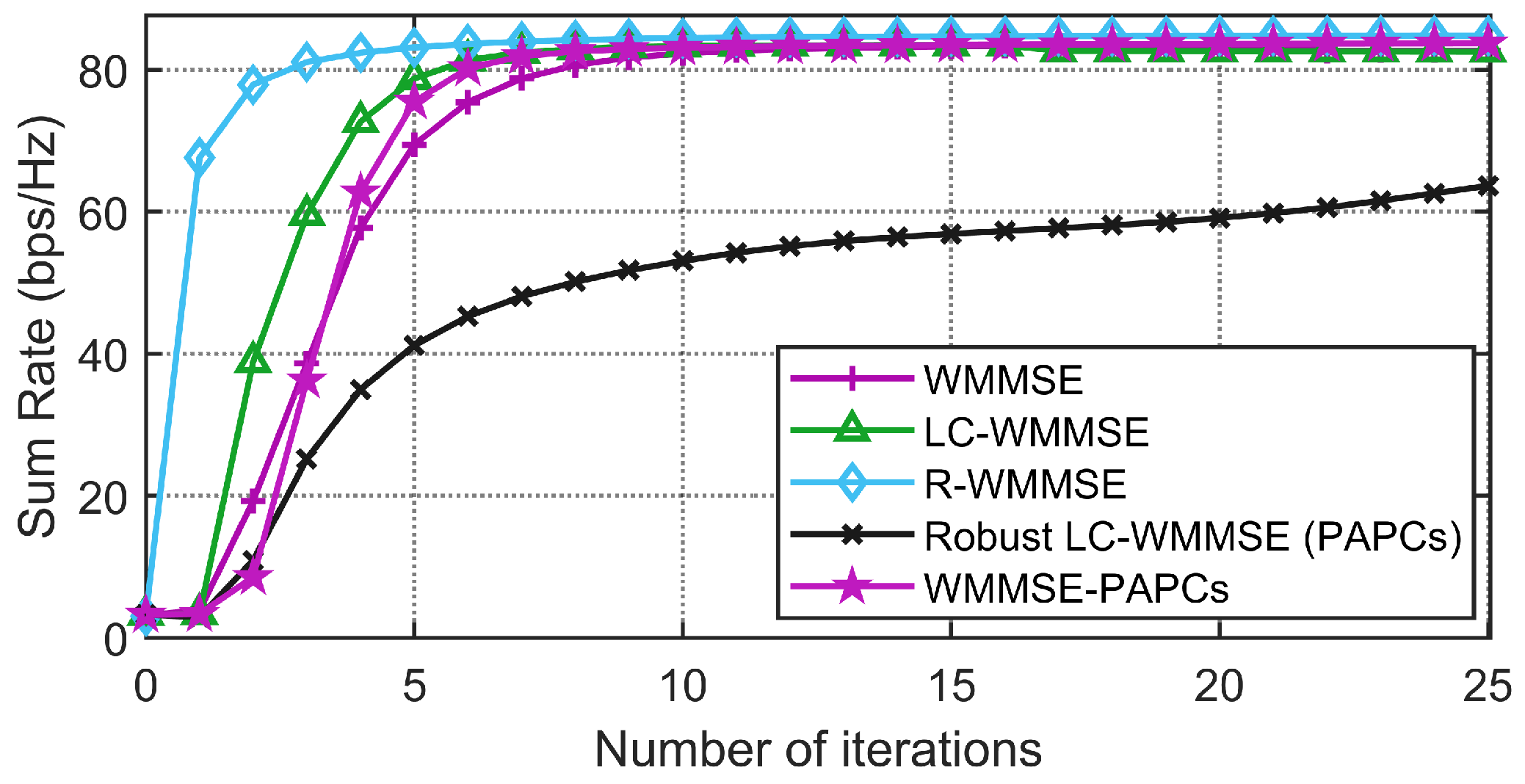
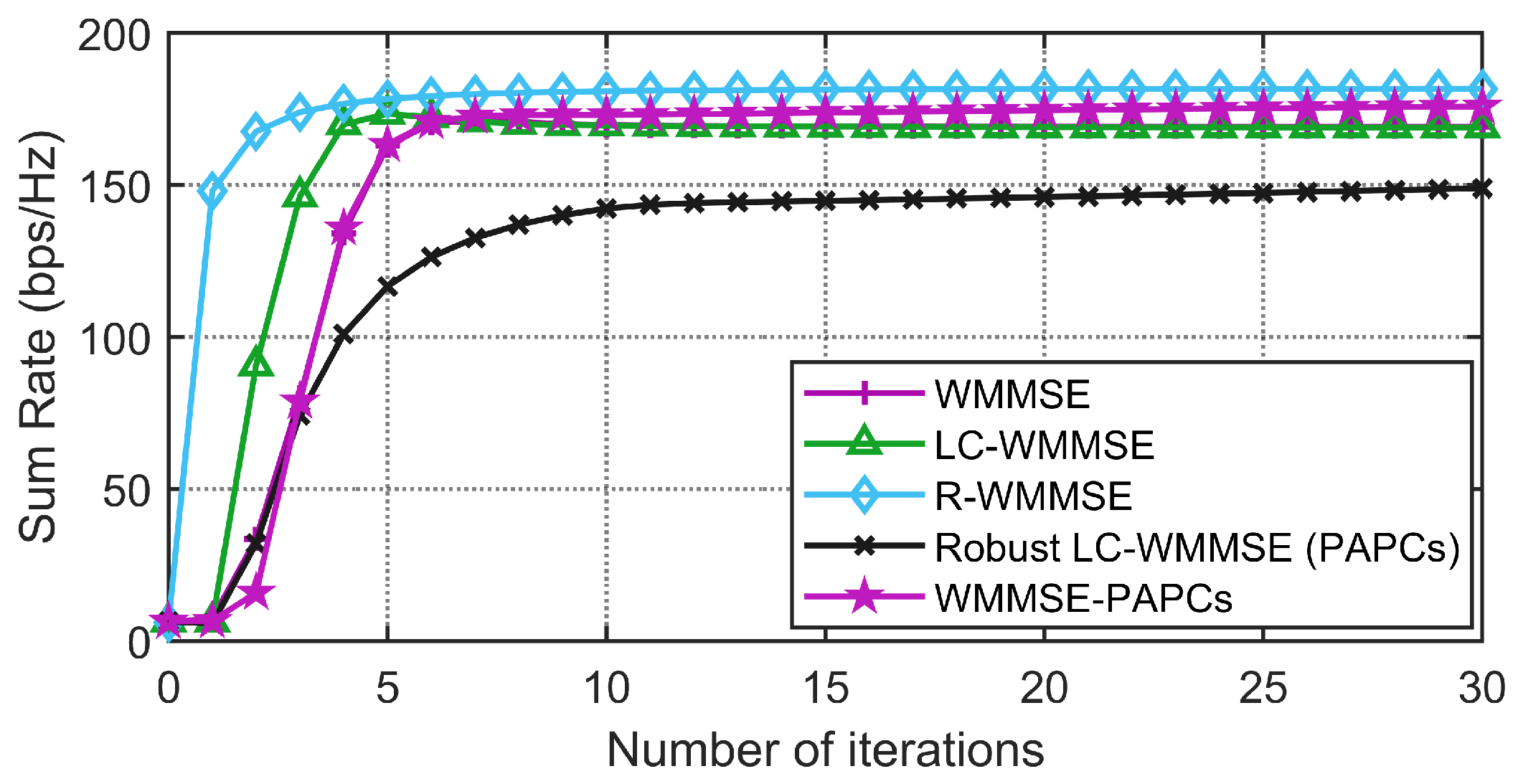
- Robust LC-WMMSE (PAPCs): The proposed low-complexity LC-WMMSE algorithm with per-antenna power constraints, which updates all variables using only and is also evaluated on the true channels .
4.4. Performance Under i.i.d. Rayleigh
5. Conclusions
Author Contributions
Funding
Institutional Review Board Statement
Informed Consent Statement
Data Availability Statement
Acknowledgments
Conflicts of Interest
References
- Wang, M.; Gao, F.; Jin, S.; Lin, H. An Overview of Enhanced Massive MIMO with Array Signal Processing Techniques. IEEE J. Sel. Top. Signal Process. 2019, 13, 886–901. [Google Scholar] [CrossRef]
- Marzetta, T.L.; Larsson, E.G.; Yang, H.; Ngo, H.Q. Fundamentals of Massive MIMO; Cambridge University Press: Cambridge, UK, 2016. [Google Scholar]
- Pereira de Figueiredo, F.A. An Overview of Massive MIMO for 5G and 6G. IEEE Lat. Am. Trans. 2022, 20, 931–940. [Google Scholar] [CrossRef]
- Zhang, J.; Björnson, E.; Matthaiou, M.; Ng, D.W.K.; Yang, H.; Love, D.J. Prospective Multiple Antenna Technologies for Beyond 5G. IEEE J. Sel. Areas Commun. 2020, 38, 1637–1660. [Google Scholar] [CrossRef]
- Li, Q.C.; Niu, H.; Papathanassiou, A.T.; Wu, G. 5G Network Capacity: Key Elements and Technologies. IEEE Veh. Technol. Mag. 2014, 9, 71–78. [Google Scholar] [CrossRef]
- Peng, M.; Sun, Y.; Li, X.; Mao, Z.; Wang, C. Recent Advances in Cloud Radio Access Networks: System Architectures, Key Techniques, and Open Issues. IEEE Commun. Surv. Tutor. 2016, 18, 2282–2308. [Google Scholar] [CrossRef]
- Sohrabi, F.; Nuzman, C.; Du, J.; Yang, H.; Viswanathan, H. Energy-Efficient Flat Precoding for MIMO Systems. IEEE Trans. Signal Process. 2025, 73, 795–810. [Google Scholar] [CrossRef]
- Choi, H.; Swindlehurst, A.L.; Choi, J. WMMSE-Based Rate Maximization for RIS-Assisted MU-MIMO Systems. IEEE Trans. Commun. 2024, 72, 5194–5208. [Google Scholar] [CrossRef]
- Albreem, M.A.; Juntti, M.; Shahabuddin, S. Massive MIMO Detection Techniques: A Survey. IEEE Commun. Surv. Tutor. 2019, 21, 3109–3132. [Google Scholar] [CrossRef]
- Xu, Y.; Larsson, E.G.; Jorswieck, E.A.; Li, X.; Jin, S.; Chang, T.H. Distributed Signal Processing for Extremely Large-Scale Antenna Array Systems: State-of-the-Art and Future Directions. IEEE J. Sel. Top. Signal Process. 2025, 19, 304–330. [Google Scholar] [CrossRef]
- Shi, J.; Wang, W.; Yi, X.; Gao, X.; Li, G.Y. Deep Learning-Based Robust Precoding for Massive MIMO. IEEE Trans. Commun. 2021, 69, 7429–7443. [Google Scholar] [CrossRef]
- Lu, A.A.; Gao, X.; Zhong, W.; Xiao, C.; Meng, X. Robust Transmission for Massive MIMO Downlink with Imperfect CSI. IEEE Trans. Commun. 2019, 67, 5362–5376. [Google Scholar] [CrossRef]
- Shi, J.; Lu, A.A.; Zhong, W.; Gao, X.; Li, G.Y. Robust WMMSE Precoder with Deep Learning Design for Massive MIMO. IEEE Trans. Commun. 2023, 71, 3963–3976. [Google Scholar] [CrossRef]
- Yu, W.; Lan, T. Transmitter Optimization for the Multi-Antenna Downlink with Per-Antenna Power Constraints. IEEE Trans. Signal Process. 2007, 55, 2646–2660. [Google Scholar] [CrossRef]
- Lee, S.R.; Kim, J.S.; Moon, S.H.; Kong, H.B.; Lee, I. Zero-Forcing Beamforming in Multiuser MISO Downlink Systems Under Per-Antenna Power Constraint and Equal-Rate Metric. IEEE Trans. Wirel. Commun. 2013, 12, 228–236. [Google Scholar] [CrossRef]
- Li, B.; Wu, C.Z.; Dam, H.H.; Cantoni, A.; Teo, K.L. A Parallel Low Complexity Zero-Forcing Beamformer Design for Multiuser MIMO Systems Via a Regularized Dual Decomposition Method. IEEE Trans. Signal Process. 2015, 63, 4179–4190. [Google Scholar] [CrossRef]
- Jang, J.; Jeon, S.W.; Chae, H.; Cha, H.S.; Kim, D.K. Low Complexity Zeroforcing Precoder Design Under Per-Antenna Power Constraints. IEEE Commun. Lett. 2015, 19, 1556–1559. [Google Scholar] [CrossRef]
- Pham, T.M.; Farrell, R.; Dooley, J.; Dutkiewicz, E.; Nguyen, D.N.; Tran, L.N. Efficient Zero-Forcing Precoder Design for Weighted Sum-Rate Maximization With Per-Antenna Power Constraint. IEEE Trans. Veh. Technol. 2018, 67, 3640–3645. [Google Scholar] [CrossRef]
- Chen, C.W.; Tsai, W.C.; Wong, S.S.; Teng, C.F.; Wu, A.Y. WMMSE-Based Alternating Optimization for Low-Complexity Multi-IRS MIMO Communication. IEEE Trans. Veh. Technol. 2022, 71, 11234–11239. [Google Scholar] [CrossRef]
- Zhao, X.; Lu, S.; Shi, Q.; Luo, Z.Q. Rethinking WMMSE: Can Its Complexity Scale Linearly with the Number of BS Antennas? IEEE Trans. Signal Process. 2023, 71, 433–446. [Google Scholar] [CrossRef]
- Liu, Y.F.; Dai, Y.H.; Luo, Z.Q. Coordinated Beamforming for MISO Interference Channel: Complexity Analysis and Efficient Algorithms. IEEE Trans. Signal Process. 2011, 59, 1142–1157. [Google Scholar] [CrossRef]
- Luo, Z.Q.; Zhang, S. Dynamic Spectrum Management: Complexity and Duality. IEEE J. Sel. Top. Signal Process. 2008, 2, 57–73. [Google Scholar] [CrossRef]
- Shi, Q.; Razaviyayn, M.; Luo, Z.Q.; He, C. An Iteratively Weighted MMSE Approach to Distributed Sum-Utility Maximization for a MIMO Interfering Broadcast Channel. IEEE Trans. Signal Process. 2011, 59, 4331–4340. [Google Scholar] [CrossRef]
- Bertsekas, D.P. Nonlinear Programming. J. Oper. Res. Soc. 1997, 48, 334. [Google Scholar] [CrossRef]
- Sen, V.; Deng, H.; Xu, X.; Shen, M. A Hybrid Low-Complexity WMMSE Precoder with Adaptive Damping for Massive Multi-User Multiple-Input Multiple- Output Systems. Sensors 2025, 25, 6827. [Google Scholar] [CrossRef] [PubMed]
- Björnson, E.; Sanguinetti, L.; Wymeersch, H.; Hoydis, J.; Marzetta, T.L. Massive MIMO is a reality—What is next?: Five promising research directions for antenna arrays. Digit. Signal Process. 2019, 94, 3–20. [Google Scholar] [CrossRef]
- Adhikary, A.; Nam, J.; Ahn, J.Y.; Caire, G. Joint Spatial Division and Multiplexing—The Large-Scale Array Regime. IEEE Trans. Inf. Theory 2013, 59, 6441–6463. [Google Scholar] [CrossRef]
- Shi, Q.; Xu, W.; Wu, J.; Song, E.; Wang, Y. Secure Beamforming for MIMO Broadcasting with Wireless Information and Power Transfer. IEEE Trans. Wirel. Commun. 2015, 14, 2841–2853. [Google Scholar] [CrossRef]
- Budhu, J.; Grbic, A. Fast and Accurate Optimization of Metasurfaces with Gradient Descent and the Woodbury Matrix Identity. IEEE Trans. Antennas Propag. 2023, 71, 7679–7683. [Google Scholar] [CrossRef]
- Dahrouj, H.; Yu, W. Coordinated beamforming for the multicell multi-antenna wireless system. IEEE Trans. Wirel. Commun. 2010, 9, 1748–1759. [Google Scholar] [CrossRef]
- Parfait, T.; Kuang, Y.; Jerry, K. Performance analysis and comparison of ZF and MRT based downlink massive MIMO systems. In Proceedings of the 2014 Sixth International Conference on Ubiquitous and Future Networks (ICUFN), Shanghai, China, 8–11 July 2014; pp. 383–388. [Google Scholar] [CrossRef]
- Spencer, Q.; Swindlehurst, A.; Haardt, M. Zero-forcing methods for downlink spatial multiplexing in multiuser MIMO channels. IEEE Trans. Signal Process. 2004, 52, 461–471. [Google Scholar] [CrossRef]



| R-WMMSE | LC-WMMSE | RLC-WMMSE (Proposed) | |
|---|---|---|---|
| Principle | Randomized sketching | Structure exploitation (Woodbury + ) | Robust structure exploitation (Woodbury + + dual PAPCs) |
| Update size | Compressed (sketched domain) | SPD solve | SPD solve with dual variables |
| CSI/constraints | Perfect CSI, SPC | Perfect CSI, SPC | Imperfect CSI (stochastic mismatch), PAPCs |
| Dominant cost | Sketch products + small SPD solve | Build + SPD solve | LC cost + short dual loop (J inner steps) |
| Error source | Sketching bias/variance | Neglect of off-diagonals in | Diagonal surrogate + inexact dual PAPC enforcement |
| Notation | Meaning |
|---|---|
| M | Number of BS transmit antennas |
| N | Number of receive antennas per user |
| K | Number of users |
| Number of streams for user k | |
| Total number of streams | |
| True downlink channel from BS to user k | |
| Estimated channel for user k (imperfect CSI) | |
| Channel estimation error for user k with | |
| Estimation NMSE parameter in the stochastic CSI model | |
| Precoder for user k | |
| Stacked precoder (all users) | |
| Data symbol vector for user k | |
| Transmit signal at the BS | |
| Received signal at user k | |
| AWGN at user k | |
| Noise power (per receive antenna) | |
| Total transmit power budget under SPC | |
| Per-antenna power budgets (PAPCs) | |
| Feasible precoder set satisfying the per-antenna power constraints | |
| MMSE receive filter for user k | |
| Weight matrix for user k | |
| MSE matrix for user k | |
| Diagonal weight surrogate used in LC/RLC branch | |
| BS transmit covariance matrix | |
| Stacked true channel | |
| Stacked estimated channel | |
| Block-diagonal weight matrix (LC/RLC branch) | |
| RHS factor for LC/RLC Woodbury update (true channel) | |
| RHS factor for classical WMMSE update | |
| Stacked Gram matrix | |
| Quadratic WMMSE transmit matrices at iteration t | |
| Dual variables for PAPCs at iteration t | |
| PAPC-regularized diagonal matrix in the classical branch | |
| Identity matrices of sizes M, N, and | |
| Standard matrix operators (diagonal, block-diagonal, trace) | |
| Classical WMMSE precoder at iteration t | |
| LC-WMMSE (Woodbury) precoder at iteration t | |
| Robust LC-WMMSE (with PAPCs and imperfect CSI) precoder at iteration t | |
| Hybrid switching factor at iteration t | |
| Adaptive damping factor at iteration t | |
| Weighted sum-rate at iteration t (bps/Hz) | |
| J | Number of dual inner steps |
| Variant | Final WSR (bps/Hz) | (Iterations) |
|---|---|---|
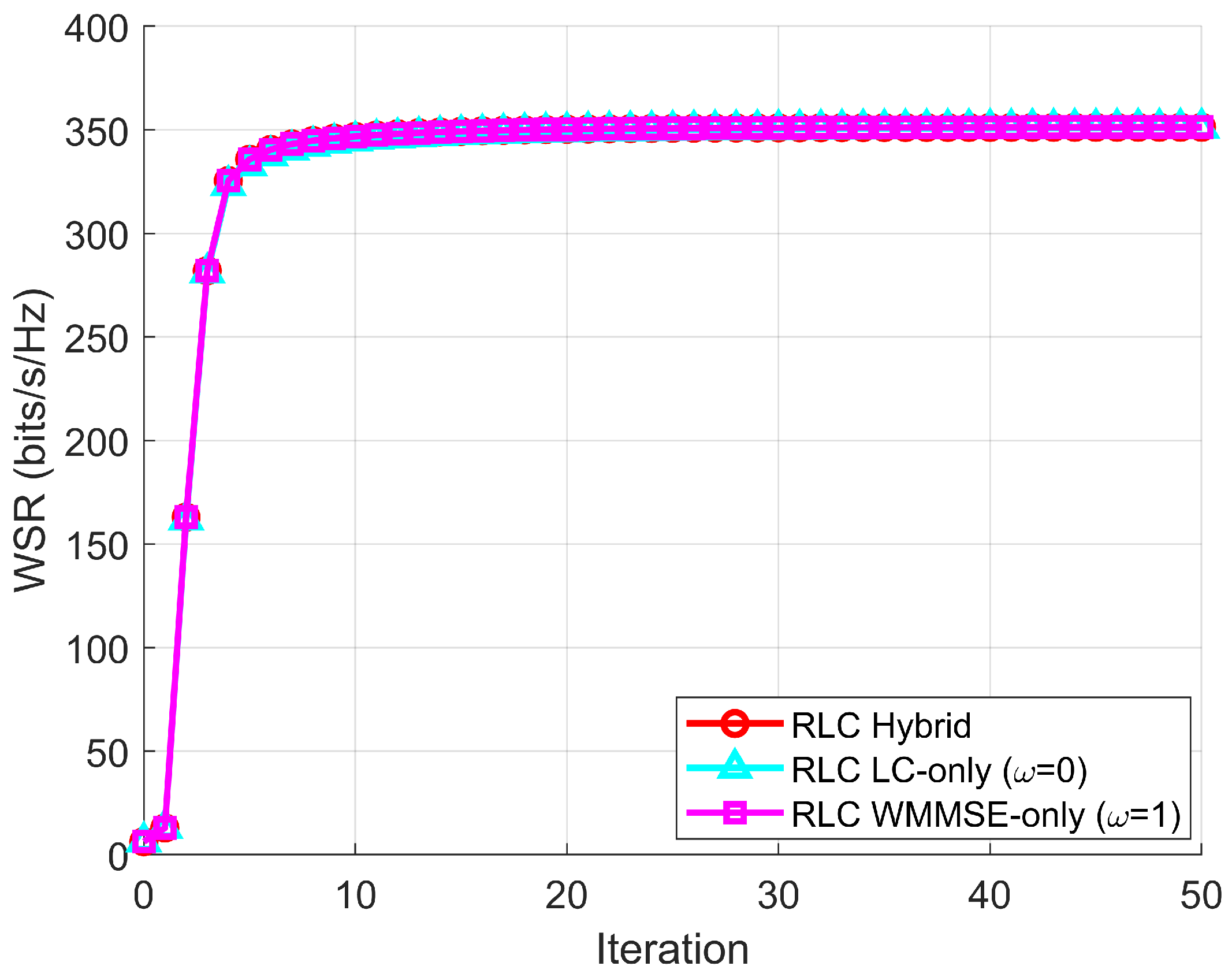
| RLC Hybrid | 351.25 | 12 |
| RLC LC-only () | 350.95 | 15 |
| RLC WMMSE-only () | 351.29 | 12 |
| Operation | Classical WMMSE | LC-WMMSE (SPC) | RLC-WMMSE (PAPC) |
|---|---|---|---|
| Precoder solve | same as LC + dual | ||
| Per-user factorizations | |||
| Gram products (, ) | |||
| Hybrid switch | – | ||
| Adaptive damping | – | ||
| Total (dominant) |
Disclaimer/Publisher’s Note: The statements, opinions and data contained in all publications are solely those of the individual author(s) and contributor(s) and not of MDPI and/or the editor(s). MDPI and/or the editor(s) disclaim responsibility for any injury to people or property resulting from any ideas, methods, instructions or products referred to in the content. |
© 2025 by the authors. Licensee MDPI, Basel, Switzerland. This article is an open access article distributed under the terms and conditions of the Creative Commons Attribution (CC BY) license.
Share and Cite
Guo, Z.; Sen, V.; Deng, H. Robust Low-Complexity WMMSE Precoding Under Imperfect CSI with Per-Antenna Power Constraints. Sensors 2026, 26, 159. https://doi.org/10.3390/s26010159
Guo Z, Sen V, Deng H. Robust Low-Complexity WMMSE Precoding Under Imperfect CSI with Per-Antenna Power Constraints. Sensors. 2026; 26(1):159. https://doi.org/10.3390/s26010159
Chicago/Turabian StyleGuo, Zijiao, Vaskar Sen, and Honggui Deng. 2026. "Robust Low-Complexity WMMSE Precoding Under Imperfect CSI with Per-Antenna Power Constraints" Sensors 26, no. 1: 159. https://doi.org/10.3390/s26010159
APA StyleGuo, Z., Sen, V., & Deng, H. (2026). Robust Low-Complexity WMMSE Precoding Under Imperfect CSI with Per-Antenna Power Constraints. Sensors, 26(1), 159. https://doi.org/10.3390/s26010159