
Robust Access Control for Secure IoT Outsourcing with Leakage Resilience


Abstract
1. Introduction
1.1. Motivation
1.2. Contributions
- This paper introduces a secure outsourcing access control model with leakage resilience to be used in the IoT environment, which takes advantage of attribute-based encryption in the access control.
- This paper designs efficient mechanisms to protect the access control scheme against potential information leakage when data and access policies are outsourced to third-party cloud or fog computing providers.
- This paper optimizes the computational and communication overheads of the access control scheme to accommodate the resource-constrained IoT devices by leveraging techniques such as offline/online encryption and decryption outsourcing.
1.3. Acronyms and Notations
1.4. Organization
2. Related Work
3. System Model and Security Requirements
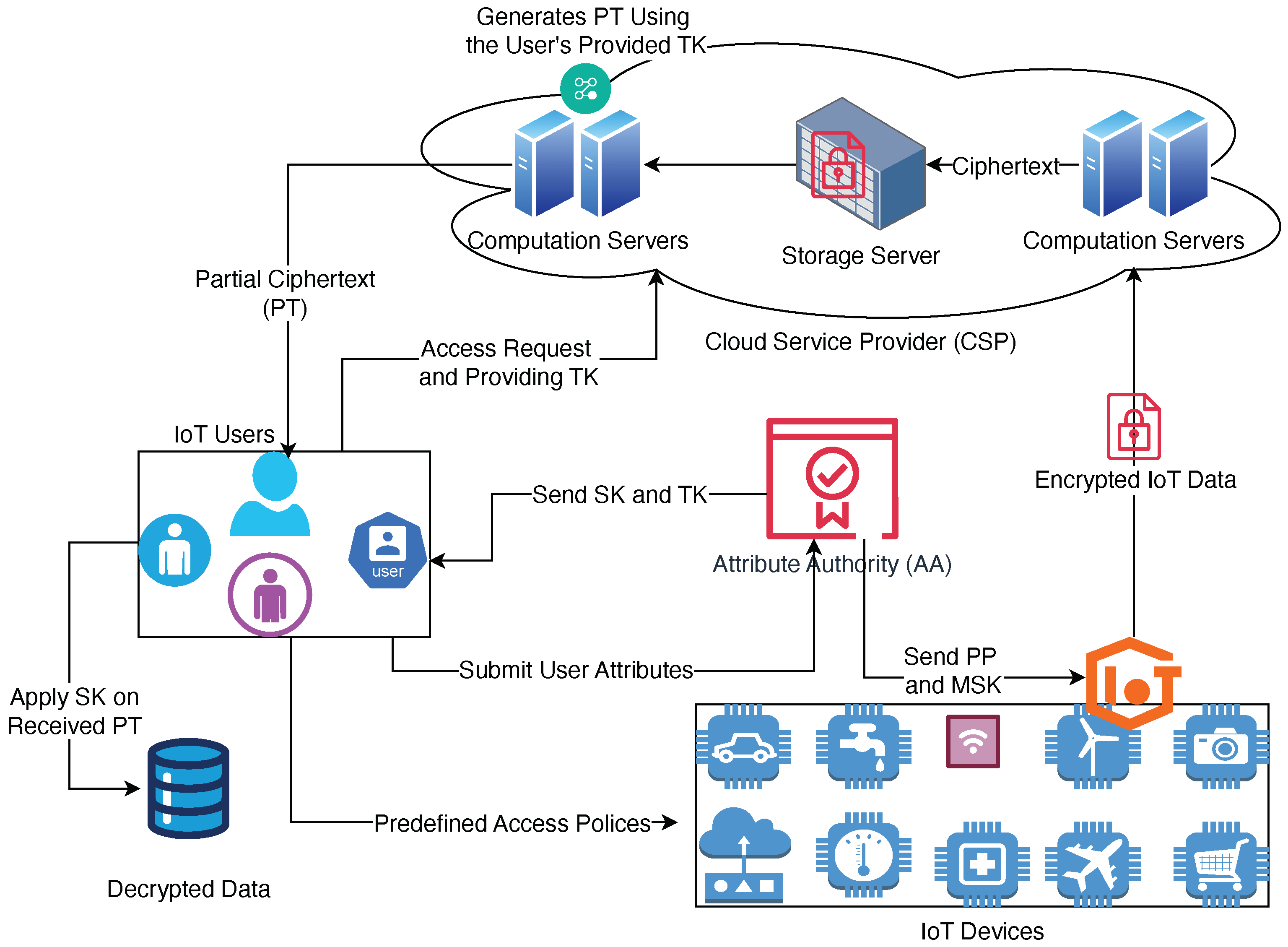
3.1. System Architecture
- Attribute Authority ()
- The is a trusted entity responsible for managing and distributing cryptographic keys and user attributes.
- It generates the Master Secret Key (), Public Parameter (), user-specific Secret Keys (), and Transformation Keys ().
- The ensures that the attributes assigned to each user align with their access privileges.
- Security Role: Ensures attribute integrity and prevents unauthorized attribute assignment.
- Cloud Service Provider ()
- The provides storage and computational resources for encrypted IoT data.
- It handles ciphertext storage and performs partial decryption operations on behalf of IoT devices using .
- Security Role: Operates as an honest-but-curious entity, meaning it follows protocol specifications but may attempt to infer information from stored or processed data.
- IoT Devices
- IoT devices (e.g., sensors, actuators, and smart cameras) collect and generate sensitive data.
- Due to limited computational power and energy constraints, IoT devices outsource intensive cryptographic computations to the .
- Security Role: Encrypt data before transmission, ensuring that sensitive information remains secure during storage and processing.
- IoT Users
- IoT users are authorized individuals or systems that need access to specific IoT data.
- They possess user-specific issued by the Attribute Authority.
- Users download partially decrypted ciphertext from the and perform final decryption locally to retrieve plaintext data.
- Security Role: Ensure private key confidentiality and verify the correctness of decryption results.
3.2. Workflow Overview
- System Initialization:
- The generates () and the (), which are distributed appropriately.
- Key Generation:
- The generates user-specific and based on their attribute sets.
- Data Encryption:
- IoT devices encrypt collected data using and predefined access policies.
- Encrypted data (ciphertext) are then uploaded to the for storage.
- Partial Decryption by the :
- Upon receiving a decryption request, the uses the associated with the user to perform partial decryption and generates a Partial Ciphertext ().
- Final Decryption by IoT User:
- The IoT user downloads the and applies their to retrieve the plaintext message.
3.3. Security Assumptions
- Trusted Attribute Authority: The is considered fully trusted and will not deviate from protocol specifications.
- Honest-but-Curious CSP: The follows the protocol honestly but may attempt to infer sensitive information from stored ciphertexts and access policies.
- Secure Communication Channels: All communication between entities (e.g., IoT devices, , , and IoT users) occurs over secure communication channels protected by standard encryption protocols (e.g., TLS).
- Device Integrity: IoT devices are assumed to be secure against unauthorized access, though side-channel attack resilience is implemented as an added layer of security.
3.4. Security Goals
- Fine-grained Access Control: The scheme should support flexible and fine-grained access control, where access policies can be defined based on multiple attributes of IoT users.
- Leakage Resilience: The scheme should be resilient against potential information leakage when the access control data and policies are outsourced to the cloud service provider.
- Efficiency: The scheme should be computationally efficient for resource-constrained IoT devices by offloading the heavyweight cryptographic operations to the cloud service provider.
- Verifiability: The IoT users should be able to verify the correctness of the decryption results returned by the cloud service provider.
3.5. Technical Challenges
- Designing a fine-grained attribute-based access control mechanism that can be efficiently outsourced to the cloud.
- Incorporating leakage-resilient techniques to secure the access control data confidentiality and policies when they are outsourced.
- Reducing the computational and communication overheads of the access control scheme to accommodate the resource-constrained IoT devices.
- Ensuring the verifiability of the decryption results returned by the cloud service provider.
4. Scheme Preliminaries
- Composite order Bilinear GroupsThe first composite order bilinear groups were introduced by Dan et al. [54]. This scheme randomly selects groups of order with different prime numbers , , and . Let G express the composite order group. Let , , and express the three subgroups with order , , and , respectively. The bilinear map with computable non-degenerate is characterized by the following properties:
- –
- Non-degenetate:
- –
- Bilinear:
To see this, if g generates G, belongs to , belongs to , and belongs to . , and , . - Vector NotationChoose G. Then, is defined as follows:where and
5. Model Definition and Security Model
5.1. Model Definition
- : This algorithm accepts (security parameter) as input and generates the (public parameters) and the (master secret key) as output.
- : It accepts and the as inputs. It then generates the (secret key) of the user and the transformation key .
- : This algorithm accepts the , the access structure and the message M as inputs and then generates the ciphertext .
- : The decryption algorithm contains the partial decryption algorithm on the cloud server and the decryption algorithm on the client side.
- –
- : The algorithm accepts , which is associated with the and the transformation key as inputs, and then outputs the partial ciphertext .
- –
- : The algorithm inputs the partial ciphertext and the user’s private key and outputs the message M.
5.2. Security Model
- Setup: The B process the to obtain the and the . Then, the will be sent to the adversary A. The challenger also initializes an empty set D, where , and an empty table T, where (I represents a handle counter and represents the transformation key).
- Phase 1: A can repeat the upcoming inquiries to B.
- –
- : A submits an attribute S to B to obtain the transformation key . B calls the to obtain the and the . B sets and stores the entry in T. Finally, is returned to the adversary.
- –
- : When the ith exists in the table T, B can obtain the entry , and return to A. When no such entry exists, the algorithm will be terminated. Finally, B sets .
- Challenge: A sends a challenge access structure , where the attribute set S in T is not satisfied with it, and two messages with the equal length to the challenger. The challenger randomly selects the two messages under to encrypt; it then sends to A.
- Phase 2: It is the same phase 1 with the following restriction:
- –
- The attribute set whose private key will be asked is not satisfied with .
- –
- A unable to request for decrypting of and .
- Guess: The adversary outputs his guess .
6. Scheme Construction
6.1. System Setup
6.2. Key Generation
6.3. Data Encryption
6.4. Data Decryption
7. Security Analysis
7.1. Unbreakable DLP
7.2. Resilience Against Side-Channel Attacks
- Outsourced Decryption: The most computationally expensive cryptographic operations, including bilinear pairing and modular exponentiation, are offloaded to cloud servers. This significantly reduces the number of resource-intensive computations performed on IoT devices, thereby minimizing the attack surface for side-channel adversaries.
- Constant-Time Algorithms: The cryptographic algorithms used in the proposed scheme have been implemented in a constant-time manner, ensuring that execution time does not vary with input values. This eliminates timing-based side-channel vulnerabilities.
- Transformation Key Isolation: The transformation key, used during the outsourced decryption phase, ensures that sensitive intermediate results are not exposed directly to the IoT device. Even if partial information is leaked from the IoT device, the master secret key remains secure, and the plaintext cannot be reconstructed without the transformation key and private key.
- Randomization of Intermediate States: During the key generation and decryption phases, random noise is added to the intermediate computation states, making it infeasible for adversaries to deduce meaningful patterns from observed emissions or power traces.
7.3. Resilience Against Master Secret Key Leakage
7.4. Resistance to Collusion Attacks
7.5. Resistance to Replay Attacks
8. Performance Analysis
8.1. Evaluation Metrics
- Encryption Time: Measures the time required to encrypt a plaintext message under an attribute-based access policy.
- Decryption Time: Measures the time taken to decrypt ciphertext and retrieve plaintext, including both partial decryption (outsourced to ) and final decryption (on IoT users’ side).
- Ciphertext Size: Represents the size of the encrypted data, directly impacting communication overhead.
- Computational Overhead: Evaluates the computational burden on IoT devices, which is critical given their resource constraints.
- Scalability: Assesses the performance impact when the number of attributes and users increases.
8.2. Comparative Analysis
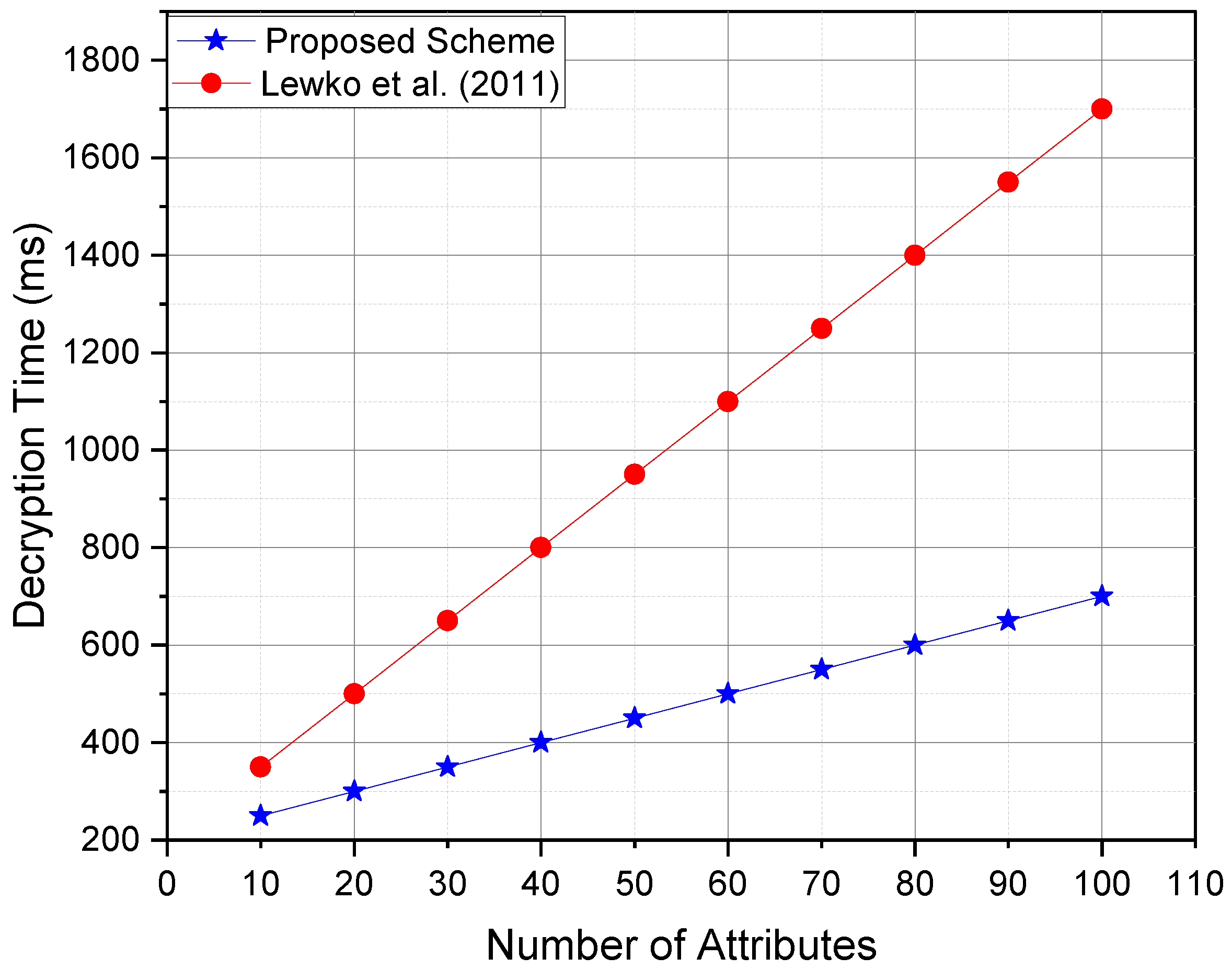
- Decryption Time: The proposed scheme significantly reduced decryption time on IoT devices by outsourcing the most computationally intensive operations to the cloud server. In contrast, Lewko et al.’s scheme imposed a high computational burden on IoT devices during decryption.
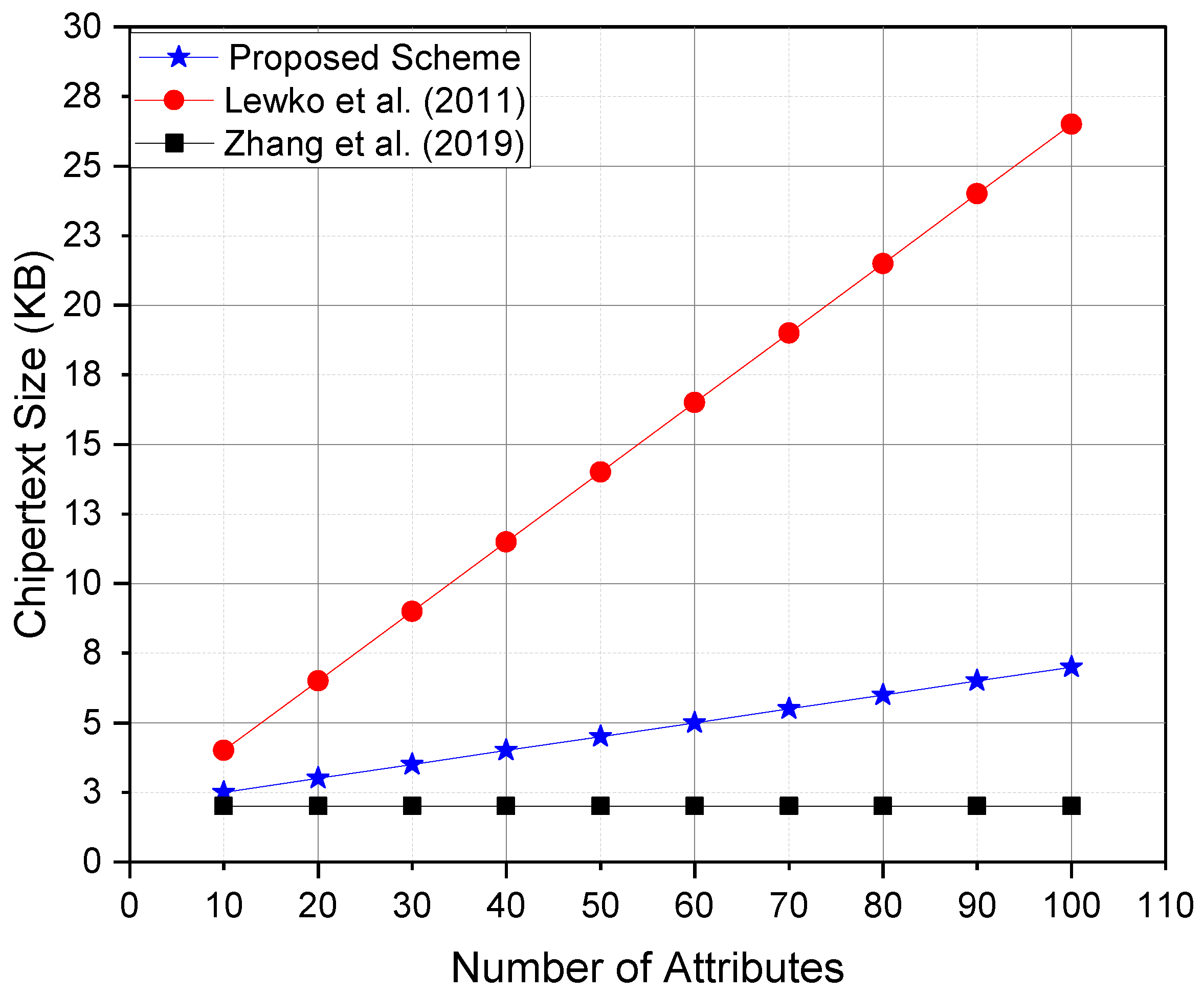
- Ciphertext Size: Zhang et al.’s scheme achieved constant ciphertext size, which minimized communication overhead. However, it came at the cost of higher complexity in encryption. The proposed scheme maintained a good balance between compact ciphertexts and efficient encryption.
- Computational Overhead: Both the proposed scheme and Zhang et al.’s scheme exhibited low computational overhead on IoT devices, making them suitable for resource-constrained environments.
- Scalability: The proposed scheme is highly scalable due to its efficient attribute management and outsourced computation design, which ensures minimal performance degradation as the number of users and attributes increases.
8.3. Experimental Results
- The proposed scheme demonstrated a significantly lower decryption time as the number of attributes increased thanks to the partial decryption outsourced to .
- In Lewko et al.’s scheme, the decryption time scaled linearly with the number of attributes, causing performance degradation on the IoT devices.
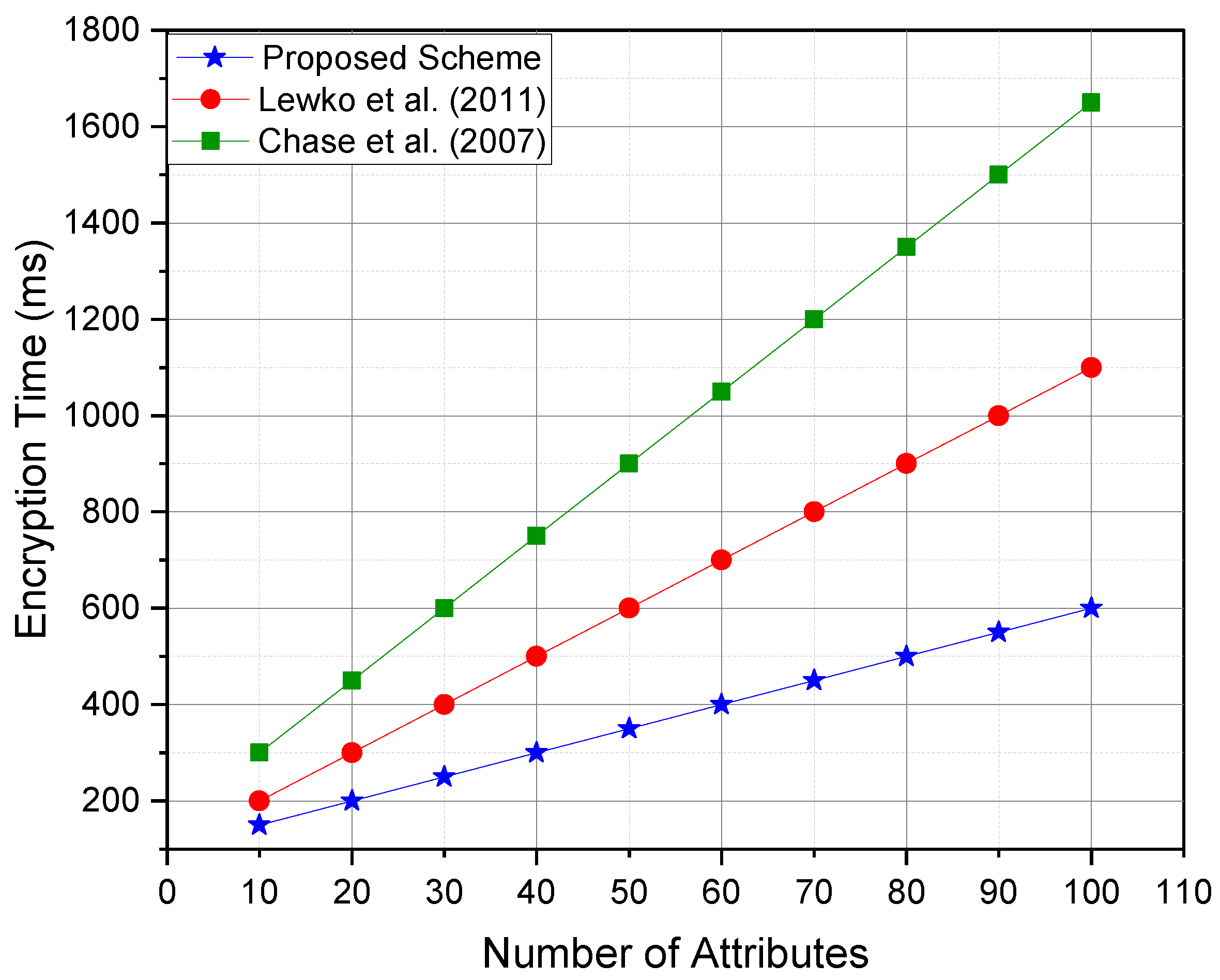
- The encryption time in the proposed scheme was moderate, and it remained competitive with Lewko et al.’s and Zhang et al.’s schemes.
- Chase et al.’s scheme exhibited higher encryption times, limiting its suitability for real-time IoT applications.
- Zhang et al.’s scheme achieved a constant ciphertext size, while the proposed scheme maintained compact ciphertexts with a slight increase as attributes grew.
- Lewko et al.’s ciphertext size grew significantly with more attributes, increasing storage and communication overhead.
9. Conclusions
Funding
Data Availability Statement
Acknowledgments
Conflicts of Interest
Nomenclature and Abbreviations
| Symbol/Acronym | Description |
| Acronyms | |
| ABE | Attribute-Based Encryption |
| AA | Attribute Authority |
| CSP | Cloud Service Provider |
| IoT | Internet of Things |
| DLP | Discrete Logarithm Problem |
| CP-ABE | Ciphertext Policy Attribute-Based Encryption |
| Notations | |
| Security Parameter | |
| U | Universal Attribute Set |
| Master Secret Key | |
| Public Parameters | |
| Secret Key | |
| Transformation Key | |
| A | Access Structure (matrix) |
| Mapping from Attributes to Rows of A | |
| Ciphertext | |
| Partial Ciphertext | |
| Generators of Composite-Order Groups | |
| Bilinear Pairing | |
| s | Random Secret Shared in the Sccess Structure |
| Random vector used in Encryption | |
| z | Random Value used in Key Generation |
| M | Plaintext Message |
References
- Zolfaghari, B.; Yazdinejad, A.; Dehghantanha, A.; Krzciok, J.; Bibak, K. The Dichotomy of Cloud and IoT: Cloud-Assisted IoT from a Security Perspective. arXiv 2022, arXiv:2207.01590. [Google Scholar]
- Cook, J.; ur Rehman, S.; Khan, M.A. Security and Privacy for Low Power IoT Devices on 5G and Beyond Networks: Challenges and Future Directions. IEEE Access 2023, 11, 39295–39317. [Google Scholar] [CrossRef]
- Farman, H.; Jan, B.; Javed, H.; Ahmad, N.; Iqbal, J.; Arshad, M.; Ali, S. Multi-criteria based zone head selection in Internet of Things based wireless sensor networks. Future Gener. Comput. Syst. 2018, 87, 364–371. [Google Scholar] [CrossRef]
- Huang, X.; Craig, P.; Lin, H.; Yan, Z. SecIoT: A security framework for the Internet of Things. Secur. Commun. Netw. 2015, 9, 3083–3094. [Google Scholar] [CrossRef]
- Bate, K.O.; Kumar, N.; Khatri, S.K. Framework for authentication and access control in IoT. In Proceedings of the 2017 2nd International Conference on Telecommunication and Networks (TEL-NET), Noida, India, 10–11 August 2017. [Google Scholar] [CrossRef]
- Alshehri, A.H.; Sandhu, R. Access Control Models for Cloud-Enabled Internet of Things: A Proposed Architecture and Research Agenda. In Proceedings of the 2016 IEEE 2nd International Conference on Collaboration and Internet Computing (CIC), Pittsburgh, PA, USA, 1–3 November 2016. [Google Scholar] [CrossRef]
- Carlin, A.; Hammoudeh, M.; Aldabbas, O. Defence for distributed denial of service attacks in cloud computing. Procedia Comput. Sci. 2015, 73, 490–497. [Google Scholar] [CrossRef]
- Belguith, S. Enhancing data security in cloud computing using a lightweight cryptographic algorithm. In Proceedings of the 11th International Conference on Autonomic and Autonomous Systems, Rome, Italy, 24–29 May 2015. [Google Scholar]
- Li, F.; Rahulamathavan, Y.; Conti, M.; Rajarajan, M. Robust access control framework for mobile cloud computing network. Comput. Commun. 2015, 68, 61–72. [Google Scholar] [CrossRef]
- Raptis, T.P.; Passarella, A.; Conti, M. Data Management in Industry 4.0: State of the Art and Open Challenges. IEEE Access 2019, 7, 97052–97093. [Google Scholar] [CrossRef]
- Bertin, E.; Hussein, D.; Sengul, C.; Frey, V. Access control in the Internet of Things: A survey of existing approaches and open research questions. Ann. Telecommun. 2019, 74, 375–388. [Google Scholar] [CrossRef]
- Bethencourt, J.; Sahai, A.; Waters, B. Ciphertext-Policy Attribute-Based Encryption. In Proceedings of the 2007 IEEE Symposium on Security and Privacy, Berkeley, CA, USA, 20–23 May 2007. [Google Scholar] [CrossRef]
- Goswami, P.; Faujdar, N.; Debnath, S.; Khan, A.K.; Singh, G. Investigation on storage level data integrity strategies in cloud computing: Classification, security obstructions, challenges and vulnerability. J. Cloud Comput. 2024, 13, 45. [Google Scholar] [CrossRef]
- Luqman, A.; Mahesh, R.; Chattopadhyay, A. Privacy and Security Implications of Cloud-Based AI Services: A Survey. arXiv 2024, arXiv:2402.00896. [Google Scholar] [CrossRef]
- Gorasia, N.; Srikanth, R.; Doshi, N.; Rupareliya, J. Improving Security in Multi Authority Attribute Based Encryption with Fast Decryption. Procedia Comput. Sci. 2016, 79, 632–639. [Google Scholar] [CrossRef][Green Version]
- Zhang, X.; Wu, F.; Wang, Y.; Zhao, W.; Wang, W. Multi-authority attribute-based encryption scheme with constant-size ciphertexts and user revocation. Concurr. Comput. Pract. Exp. 2018, 31, e4678. [Google Scholar] [CrossRef]
- Bursztein, E.; Invernizzi, L.; Kral, K.; Moghimi, D.; Picod, J.M.; Zhang, M.Y. Generic Attacks against Cryptographic Hardware through Long-Range Deep Learning. arXiv 2023, arXiv:2306.07249. [Google Scholar] [CrossRef]
- Green, M.; Hohenberger, S.; Waters, B. Outsourcing the decryption of ABE ciphertexts. In Proceedings of the 20th USENIX Security Symposium (USENIX Security 11), San Francisco, CA, USA, 8–12 August 2011. [Google Scholar]
- Roman, R.; Zhou, J.; Lopez, J. On the features and challenges of security and privacy in distributed internet of things. Comput. Netw. 2013, 57, 2266–2279. [Google Scholar] [CrossRef]
- Ma, Y.; Ma, R.; Lin, Z.; Zhang, R.; Cai, Y.; Wu, W.; Wang, J. Improving Age of Information for Covert Communication With Time-Modulated Arrays. IEEE Internet Things J. 2024, 12, 1718–1731. [Google Scholar] [CrossRef]
- Zhang, R.; Cheng, L.; Wang, S.; Lou, Y.; Gao, Y.; Wu, W.; Ng, D.W.K. Integrated Sensing and Communication with Massive MIMO: A Unified Tensor Approach for Channel and Target Parameter Estimation. IEEE Trans. Wirel. Commun. 2024, 23, 8571–8587. [Google Scholar] [CrossRef]
- Chen, J.; Ma, H. Efficient decentralized attribute-based access control for cloud storage with user revocation. In Proceedings of the 2014 IEEE International Conference on Communications (ICC), Sydney, Australia, 10–14 June 2014. [Google Scholar] [CrossRef]
- Yang, K.; Jia, X.; Ren, K. Attribute-based fine-grained access control with efficient revocation in cloud storage systems. In Proceedings of the 8th ACM SIGSAC Symposium on Information, Computer and Communications Security, Berlin, Germany, 4–8 November 2013. [Google Scholar] [CrossRef]
- Zhang, Q.; Li, Y.; Yuan, J.; Gan, Y.; Luo, X. Access Control Based on Ciphertext Attribute Authentication and Threshold Policy for the Internet of Things. Sensors 2019, 19, 5237. [Google Scholar] [CrossRef]
- Xu, S.; Yang, G.; Mu, Y.; Liu, X. A secure IoT cloud storage system with fine-grained access control and decryption key exposure resistance. Future Gener. Comput. Syst. 2019, 97, 284–294. [Google Scholar] [CrossRef]
- Sowmiya, M.; Adimoolam, M. Secure cloud storage model with hidden policy attribute based access control. In Proceedings of the 2014 International Conference on Recent Trends in Information Technology, Chennai, India, 10–12 April 2014. [Google Scholar] [CrossRef]
- Myint, P.W.W.; Hlaing, S.Z.; Htoon, E.C. A Policy Revocation Scheme for Attributes-based Encryption. In Proceedings of the 10th International Conference on Advances in Information Technology, Bangkok, Thailand, 10–13 December 2018. [Google Scholar] [CrossRef]
- Deng, H.; Qin, Z.; Wu, Q.; Guan, Z.; Yin, H. Revocable Attribute-Based Data Storage in Mobile Clouds. IEEE Trans. Serv. Comput. 2022, 15, 1130–1142. [Google Scholar] [CrossRef]
- Yu, Z.; Au, M.H.; Xu, Q.; Yang, R.; Han, J. Towards leakage-resilient fine-grained access control in fog computing. Future Gener. Comput. Syst. 2018, 78, 763–777. [Google Scholar] [CrossRef]
- Tseng, Y.; Wu, J.; Huang, S.; Tsai, T. Leakage-resilient outsourced revocable certificateless signature with a cloud revocation server. Inf. Technol. Control 2020, 49, 464–481. [Google Scholar] [CrossRef]
- Das, A.K.; Wazid, M.; Yannam, A.R.; Rodrigues, J.J.P.C.; Park, Y.H. Provably Secure ECC-Based Device Access Control and Key Agreement Protocol for IoT Environment. IEEE Access 2019, 7, 55382–55397. [Google Scholar] [CrossRef]
- Miorandi, D.; Sicari, S.; Pellegrini, F.D.; Chlamtac, I. Internet of Things: Vision, Applications and Research Challenges. Ad Hoc Netw. 2012, 10, 1497–1516. [Google Scholar] [CrossRef]
- Deng, H.; Wu, Q.; Qin, B.; Mao, J.; Liu, X.; Zhang, L.; Shi, W. Who Is Touching My Cloud. In Computer Security, Proceedings of the 19th European Symposium on Research in Computer Security, Wroclaw, Poland, 7–11 September 2014; Springer: Cham, Switzerland, 2014. [Google Scholar] [CrossRef]
- Yang, Y.; Zheng, X.; Guo, W.; Liu, X.; Chang, V. Privacy-Preserving Smart IoT-based Healthcare Big Data Storage and Self-Adaptive Access Control System. Inf. Sci. 2019, 479, 567–592. [Google Scholar] [CrossRef]
- Zeng, Z.; Zhang, J. Based on the role of internet of things security in the management of enterprise human resource information leakage. Wirel. Commun. Mob. Comput. 2021, 2021, 5936390. [Google Scholar] [CrossRef]
- Cheng, R.; Wu, K.; Su, Y.; Li, W.; Cui, W.; Tong, J. An Efficient ECC-Based CP-ABE Scheme for Power IoT. Processes 2021, 9, 1176. [Google Scholar] [CrossRef]
- Belguith, S.; Kaaniche, N.; Hammoudeh, M.; Dargahi, T. PROUD: Verifiable Privacy-Preserving Outsourced Attribute Based SignCryption Supporting Access Policy Update for Cloud Assisted IoT Applications. Future Gener. Comput. Syst. 2020, 111, 899–918. [Google Scholar] [CrossRef]
- Liu, L.; Wang, H.; Zhang, Y. Secure iot data outsourcing with aggregate statistics and fine-grained access control. IEEE Access 2020, 8, 95057–95067. [Google Scholar] [CrossRef]
- Miao, S.; Zhang, X.; Liu, Z. Fine-grained access control mechanism of energy internet. Wuhan Univ. J. Nat. Sci. 2022, 27, 231–239. [Google Scholar] [CrossRef]
- Yu, S.; Wang, C.; Ren, K.; Lou, W. Achieving Secure, Scalable, and Fine-Grained Data Access Control in Cloud Computing. In Proceedings of the IEEE Conference on Computer Communications, San Diego, CA, USA, 14–19 March 2010. [Google Scholar] [CrossRef]
- Meligy, A.; Diab, H.; Torky, M. An Access Control Model for Avoiding Outsourcing Risks. Int. J. Comput. Appl. 2012. [Google Scholar] [CrossRef]
- Zhang, L.; Gao, X.; Mu, Y. Secure data sharing with lightweight computation in e-health. IEEE Access 2020, 8, 209630–209643. [Google Scholar] [CrossRef]
- Hao, J.; Huang, C.; Ni, J.; Rao, H.; Xian, M.; Shen, X. Fine-grained data access control with attribute-hiding policy for cloud-based iot. Comput. Netw. 2019, 153, 1–10. [Google Scholar] [CrossRef]
- Xu, Z.; Zhang, S.; Han, H.; Dong, X.; Zhang, Z.; Wang, H.; Tian, W. Blockchain-aided searchable encryption-based two-way attribute access control research. Secur. Commun. Netw. 2022, 2022, 2410455. [Google Scholar] [CrossRef]
- Nguyen, K.T.; Oualha, N.; Laurent, M. Securely Outsourcing the Ciphertext-Policy Attribute-Based Encryption. World Wide Web 2017, 21, 169–183. [Google Scholar] [CrossRef]
- Pal, S.; Hitchens, M.; Varadharajan, V.; Rabehaja, T. Policy-based access control for constrained healthcare resources in the context of the internet of things. J. Netw. Comput. Appl. 2019, 139, 57–74. [Google Scholar] [CrossRef]
- Riad, K. Multi-Authority Trust Access Control for Cloud Storage. In Proceedings of the 4th IEEE International Conference on Cloud Computing and Intelligence Systems (CCIS), Beijing, China, 17–19 August 2016; pp. 429–433. [Google Scholar] [CrossRef]
- Riad, K. Revocation Basis and Proofs Access Control for Cloud Storage Multi-Authority Systems. In Proceedings of the 3rd IEEE International Conference on Artificial Intelligence and Pattern Recognition (AIPR), Lodz, Poland, 19–21 September 2016; pp. 118–127. [Google Scholar] [CrossRef]
- Riad, K. Blacklisting and Forgiving Coarse-grained Access Control for Cloud Computing. Int. J. Secur. Appl. 2016, 10, 187–200. [Google Scholar] [CrossRef]
- Riad, K.; Yan, Z. Multi-Factor Synthesis Decision-Making for Trust-Based Access Control on Cloud. Int. J. Coop. Inf. Syst. 2017, 26, 1–33. [Google Scholar] [CrossRef]
- Nannipieri, P.; Crocetti, L.; Di Matteo, S.; Fanucci, L.; Saponara, S. Hardware Design of an Advanced-Feature Cryptographic Tile within the European Processor Initiative. IEEE Trans. Comput. 2023, 1–14. [Google Scholar] [CrossRef]
- Bernstein, D.J.; Lange, T. Post-quantum cryptography. Nature 2017, 549, 188–194. [Google Scholar] [CrossRef]
- Campagna, M.; LaMacchia, B.; Ott, D. Post Quantum Cryptography: Readiness Challenges and the Approaching Storm. arXiv 2021, arXiv:2101.01269. [Google Scholar]
- Dan, B.; Goh, E.J.; Nissim, K. Evaluating 2-DNF formulas on ciphertexts. In Theory of Cryptography, Proceedings of the Second Theory of Cryptography Conference, TCC 2005, Cambridge, MA, USA, 10–12 February 2005; Springer: Berlin/Heidelberg, Germany, 2005; pp. 325–341. [Google Scholar]
- Lewko, A.; Rouselakis, Y.; Waters, B. Achieving leakage resilience through dual system encryption. In Theory of Cryptography, Proceedings of the 8th Theory of Cryptography Conference, TCC 2011, Providence, RI, USA, 28–30 March 2011; Springer: Berlin/Heidelberg, Germany, 2011; pp. 70–88. [Google Scholar]
- Chase, M. Multi-authority Attribute Based Encryption. In Theory of Cryptography, Proceedings of the 4th Theory of Cryptography Conference, TCC 2007, Amsterdam, The Netherlands, 21–24 February 2007; Vadhan, S.P., Ed.; Springer: Berlin/Heidelberg, Germany, 2007; pp. 515–534. [Google Scholar]
- Zhang, Y.; Li, J.; Yan, H. Constant Size Ciphertext Distributed CP-ABE Scheme with Privacy Protection and Fully Hiding Access Structure. IEEE Access 2019, 7, 47982–47990. [Google Scholar] [CrossRef]


| Scheme | Encryption Time | Decryption Time | Ciphertext Size | Computational Overhead (IoT) | Scalability |
|---|---|---|---|---|---|
| Proposed Scheme | Moderate | Low | Compact | Low | High |
| Lewko et al. [55] | Moderate | High | Large | High | Moderate |
| Chase et al. [56] | High | High | Moderate | High | Moderate |
| Zhang et al. [57] | Low | Moderate | Constant | Low | Moderate |
Disclaimer/Publisher’s Note: The statements, opinions and data contained in all publications are solely those of the individual author(s) and contributor(s) and not of MDPI and/or the editor(s). MDPI and/or the editor(s) disclaim responsibility for any injury to people or property resulting from any ideas, methods, instructions or products referred to in the content. |
© 2025 by the author. Licensee MDPI, Basel, Switzerland. This article is an open access article distributed under the terms and conditions of the Creative Commons Attribution (CC BY) license (https://creativecommons.org/licenses/by/4.0/).
Share and Cite
Riad, K. Robust Access Control for Secure IoT Outsourcing with Leakage Resilience. Sensors 2025, 25, 625. https://doi.org/10.3390/s25030625
Riad K. Robust Access Control for Secure IoT Outsourcing with Leakage Resilience. Sensors. 2025; 25(3):625. https://doi.org/10.3390/s25030625
Chicago/Turabian StyleRiad, Khaled. 2025. "Robust Access Control for Secure IoT Outsourcing with Leakage Resilience" Sensors 25, no. 3: 625. https://doi.org/10.3390/s25030625
APA StyleRiad, K. (2025). Robust Access Control for Secure IoT Outsourcing with Leakage Resilience. Sensors, 25(3), 625. https://doi.org/10.3390/s25030625