You are currently viewing a new version of our website. To view the old version click .
Sensors
  • Article
  • Open Access

17 January 2025

Improving Industrial Quality Control: A Transfer Learning Approach to Surface Defect Detection

,
,
,
and
1
Centre of Mechanical Technology and Automation (TEMA), Department of Mechanical Engineering, University of Aveiro, 3810-193 Aveiro, Portugal
2
Intelligent Systems Associate Laboratory (LASI), 4800-058 Guimarães, Portugal
3
Institute of Electronics and Informatics Engineering of Aveiro (IEETA), Department of Electronics, Telecommunications and Informatics, University of Aveiro, 3810-193 Aveiro, Portugal
*
Authors to whom correspondence should be addressed.
This article belongs to the Section Industrial Sensors

Abstract

To automate the quality control of painted surfaces of heating devices, an automatic defect detection and classification system was developed by combining deflectometry and bright light-based illumination on the image acquisition, deep learning models for the classification of non-defective (OK) and defective (NOK) surfaces that fused dual-modal information at the decision level, and an online network for information dispatching and visualization. Three decision-making algorithms were tested for implementation: a new model built and trained from scratch and transfer learning of pre-trained networks (ResNet-50 and Inception V3). The results revealed that the two illumination modes employed widened the type of defects that could be identified with this system, while maintaining its lower computational complexity by performing multi-modal fusion at the decision level. Furthermore, the pre-trained networks achieved higher accuracies on defect classification compared to the self-built network, with ResNet-50 displaying higher accuracy. The inspection system consistently obtained fast and accurate surface classifications because it imposed OK classification on models trained with images from both illumination modes. The obtained surface information was then successfully sent to a server to be forwarded to a graphical user interface for visualization. The developed system showed considerable robustness, demonstrating its potential as an efficient tool for industrial quality control.

1. Introduction

The technological advances in the industrial sector have significantly boosted the automation of the manufacturing process [1]. However, quality control still remains highly dependent on human intervention, whose subjectivity and inconsistencies might not guarantee the same quality standard for each product [2]. Painted surfaces, for instance, are quite prone to the occurrence of defects, that usually increase substantially in size as additional paint layers are applied. Previous reports have shown that human inspection failed to detect around 80% of minor defects on the painted surfaces of car parts [3]. This faulty quality monitoring can impact both customer satisfaction and production costs [4,5]. Hence, replacing this manual inspection for an automated detection system able to detect these surface defects would not only improve the monitoring’s accuracy and efficiency, but also increase the overall industry’s profitability [5].
Vision-based inspection systems in combination with deep learning (DL) algorithms have proven to be highly effective in the automotive industrial sector for defect detection on the surfaces of car bodies [2,3,4,6]. Given the reflective nature of these surfaces, most vision-based inspection systems employ deflectometry-based illumination for defect detection [2,4,7]. Despite its potential, the use of a single illumination strategy might not be sufficient for the detection of all surface defects, so the combination/fusion of the information retrieved from images with multiple illumination techniques has been reported with tremendous success [8,9]. Once this information is acquired and processed, it is fed to DL algorithms, such as convolutional neural networks (CNNs), for feature extraction and decision-making regarding defect detection and classification. In this instance, the classification process can be performed by either using a CNN built and trained from scratch, or by employing transfer leaning (TL) of a pre-trained CNN on large standard datasets [10,11]. While the self-built CNNs might enjoy more unique architectures and provide a better understanding of the data given the more accurate dataset, training a new network is time-consuming and it requires large datasets and constant parameter optimization [10]. On the other hand, transfer learning (TL) of a pre-trained CNN requires minimal efforts in building, training, and implementing the network, while allowing for the customization of the top layers for an improved performance in small datasets [12,13]. Since many CNN architectures can be subjected to pre-training for surface defect detection applications, the selection of the most suitable CNN should be based on their accuracy, required computational resources, and learning speed [14].
Heating devices, such as water heaters (electric and gas), boilers, and heat pumps, usually require a paint coating for aesthetic and protection purposes. Despite the extensive vision-based deep learning reports for surface defect detection, to the best of the authors’ knowledge, only a few reports applied this technology to the heating products [15]. The components of these products usually have different topographical features (specular and diffuse) that require a detection system with different illumination modes to effectively identify all possible defects on their surface. Hence, in the present work, an automatic vision inspection system was proposed for the detection and classification of defects on the painted surfaces of heating devices, which included the following: (1) an image acquisition module for dataset generation employing two illumination strategies (bright field and deflectometry-based lighting), (2) DL models for defect detection and classification with decision-level fusion, (3) painted surface information dispatching to a designed server, and (4) image graphical display. Regarding the feature extraction and decision-making performed by the DL models, two approaches were compared: (1) a CNN built and trained from scratch; and (2) TL of two pre-trained CNN architectures—ResNet-50 and Inception V3. At this point, the proposed system will not only provide a more enriched dataset in terms of variety given the wider detectable defect categories, but also an improved prediction accuracy regarding the status of the painted surfaces.

3. Proposed Methodology

3.1. Image Acquisition and Processing

3.1.1. Experimental Setup

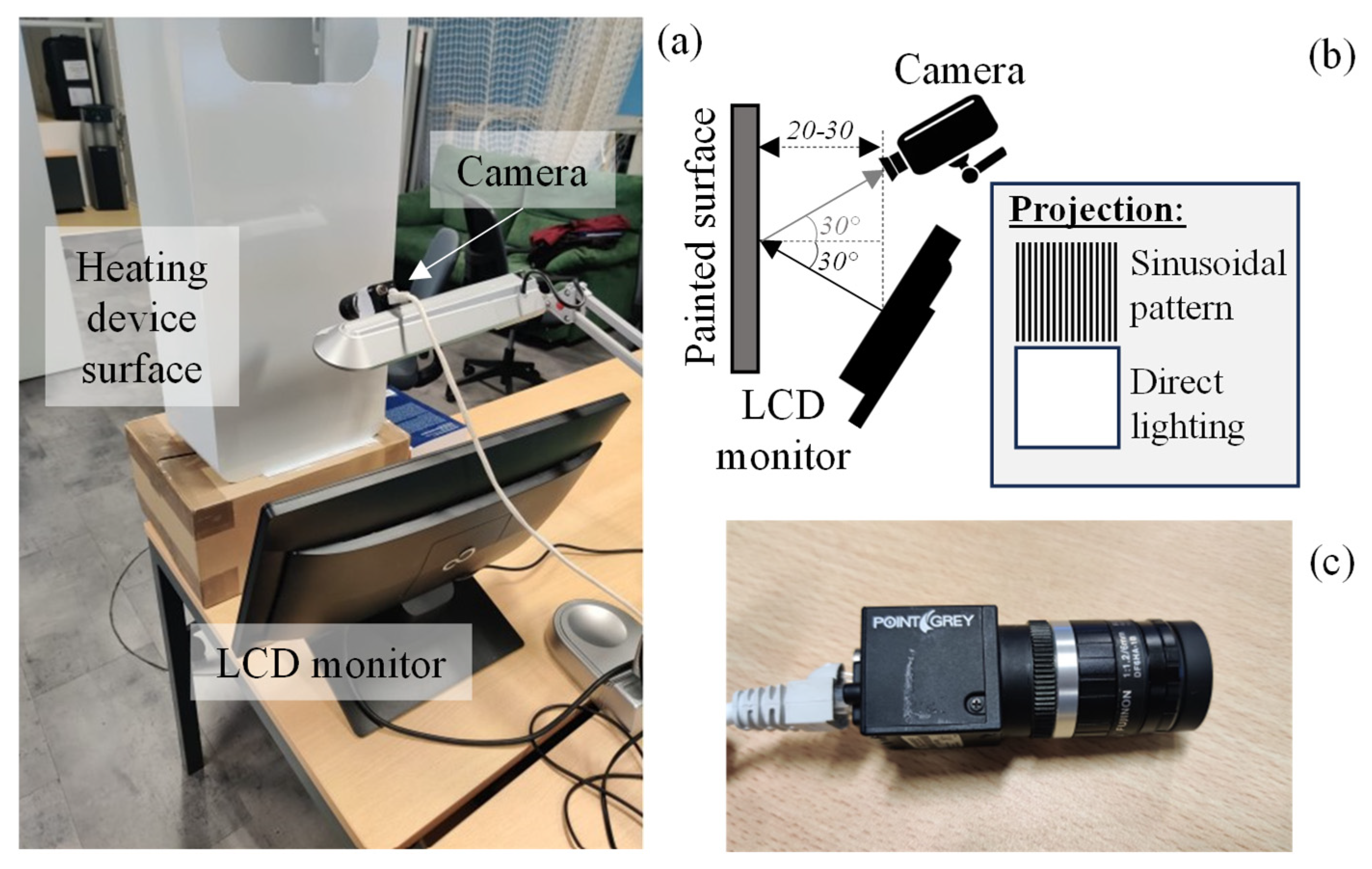
The experimental setup employed for image acquisition is depicted in Figure 1a and illustrated in Figure 1b. The liquid crystal display (LCD) monitor (21’’) provided two illumination modes: (1) structured illumination, by projecting a sinusoidal pattern; and (2) bright field illumination, by projecting a white screen. The camera then captured the imagens using both illumination modes in an alternate manner. The employed camera (BFLY-PGE-05S2C-CS, Point Grey Research Inc., Richmond, Canada), shown in Figure 1c, had a C-mount Fujinon lens with a fixed focal length of 6 mm for 1/2” sensors, that allowed for the capture of images with a resolution of 808 × 608. Image acquisition was powered via POE (Power over Ethernet) and performed using SpinView (Spinnaker SDK v. 1.27.0. 48). The selected configuration maintained the camera aligned with the LCD monitor at a distance between 20 (minimum) and 30 (maximum) centimeters from the painted surface, and at a 30° angle from the normal of the surface, resulting in a clearer projection with a more uniform lighting throughout the surface.
Figure 1. Experimental setup (a) and the respective schematic representation highlighting the two illumination modes used and the acquisition parameters (distance and angles) (b), and the camera employed (c). Distances are depicted in centimeters.

3.1.2. Generation of the Sinusoidal Patterns

The sinusoidal patterns (Figure 1b) were generated in mathematical software Matlab, version R2021b, using the function (1), where I corresponds to captured image intensity (0 or 1), B to the ambient light intensity, A to the pattern’s amplitude, f to its frequency, and θ to its phase.
I(x) = B + A · cos(2πf x + θ)
The frequency controlled the thickness of the strips, while the phase shifted the pattern in X or Y direction [4]. Two frequencies were used to generate patterns with different numbers of stripes: 0.8 Hz for 20 stripes, and 1.6 Hz for 40 stripes. The θ was 0 for both frequencies tested.

3.1.3. Dataset Generation

Images of defective (NOK) and non-defective (OK) surfaces were captured with a resolution of 808 × 608, using the configuration detailed in Section 3.1.1. for both illumination modes. It should be emphasized that the image acquisition was performed on several occasions with significant variations in environmental lighting conditions attributed to daylight variations and weather (sunny and cloudy days) in order to replicate daylight variations visible in an indoor industrial complex. Furthermore, in order to scan the entire surface of the heating device, manual steering was necessary in order to capture images of all surfaces.
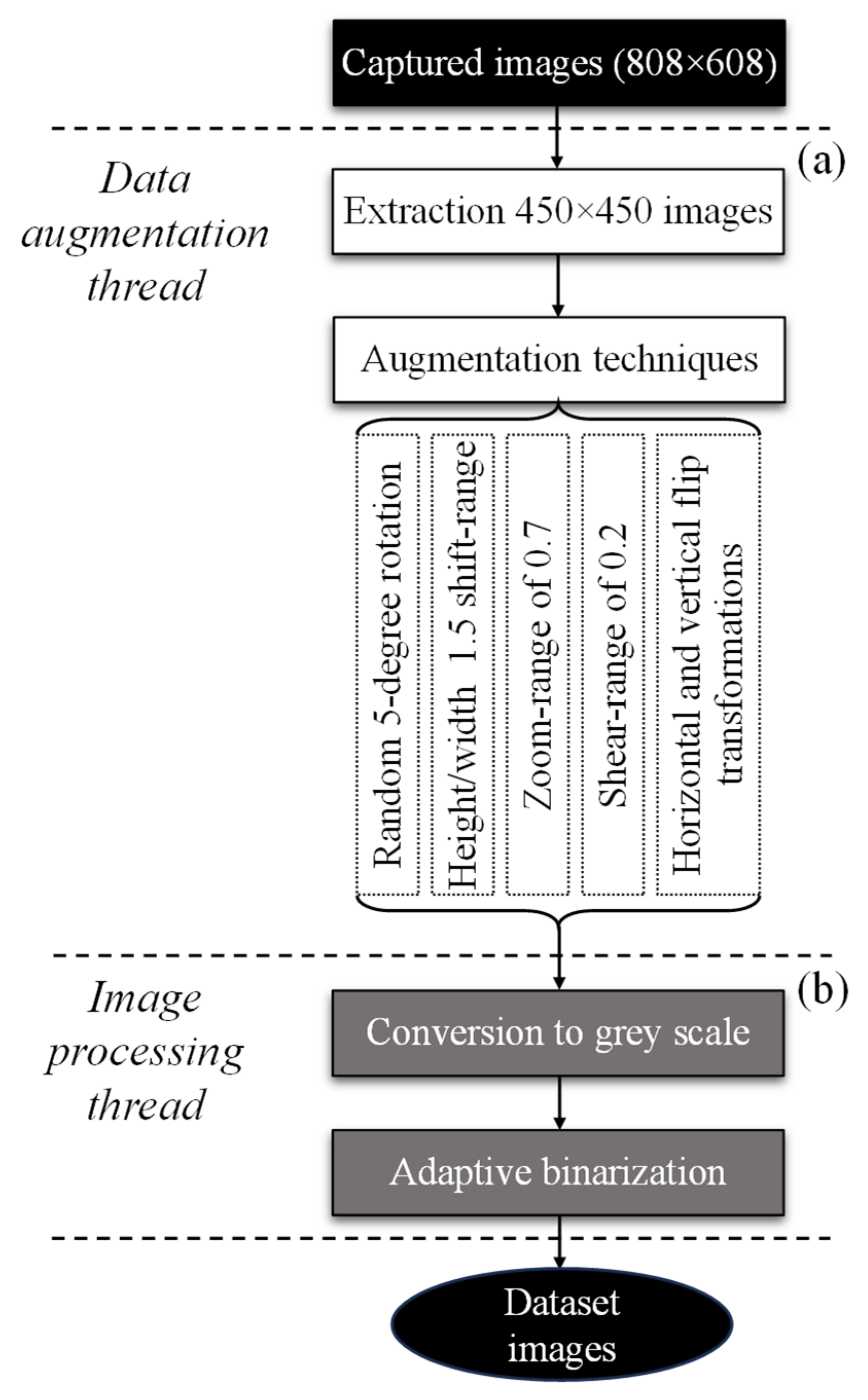
The defect categories included scratches, dents, and spots with lack of paint. A detailed flowchart of the steps performed for the dataset generation is displayed in Figure 2.
Figure 2. Data augmentation (a) and image processing (b) threads performed on the captured images.
Given the low availability of painted samples (with and without defects), two strategies were employed to augment the dataset to 500 images per defect category (Figure 2a): (1) four sub-images with 450 × 450 were extracted from the original 808 × 608 images using the GIMP software; and (2) several data augmentation techniques were then performed on the extracted sub-images, including a random 5-degree rotation, height and width shift-range of 1.5, zoom-range of 0.7, shear-range of 0.2, and horizontal and vertical flip transformations. Besides increasing the size of the dataset, these data augmentations also prevented data overfitting and improved the overall performance of the CNNs [10].
Afterwards, the images were subjected to processing through the conversion RGB to grey scale and the application of adaptive binarization to reduce the effect of the environmental lighting (Figure 2b). It should be emphasized that images obtained via bright field illumination were not subjected to processing.
From the total dataset generated, 80% of the images were used for training and the remaining 20% for testing. It should be emphasized that models were trained using images acquired with both illumination modes.

3.2. Feature Extraction and Classification Using Convolutional Neural Networks

All training and classification employed open sourced Keras framework with TensorFlow backend, implemented on a computer with an Intel®core i7 processor, a RAM memory of 8 GB, and a NVIDIA Geforce 930MX graphic card.

3.2.1. Approach 1: Self-Built CNN

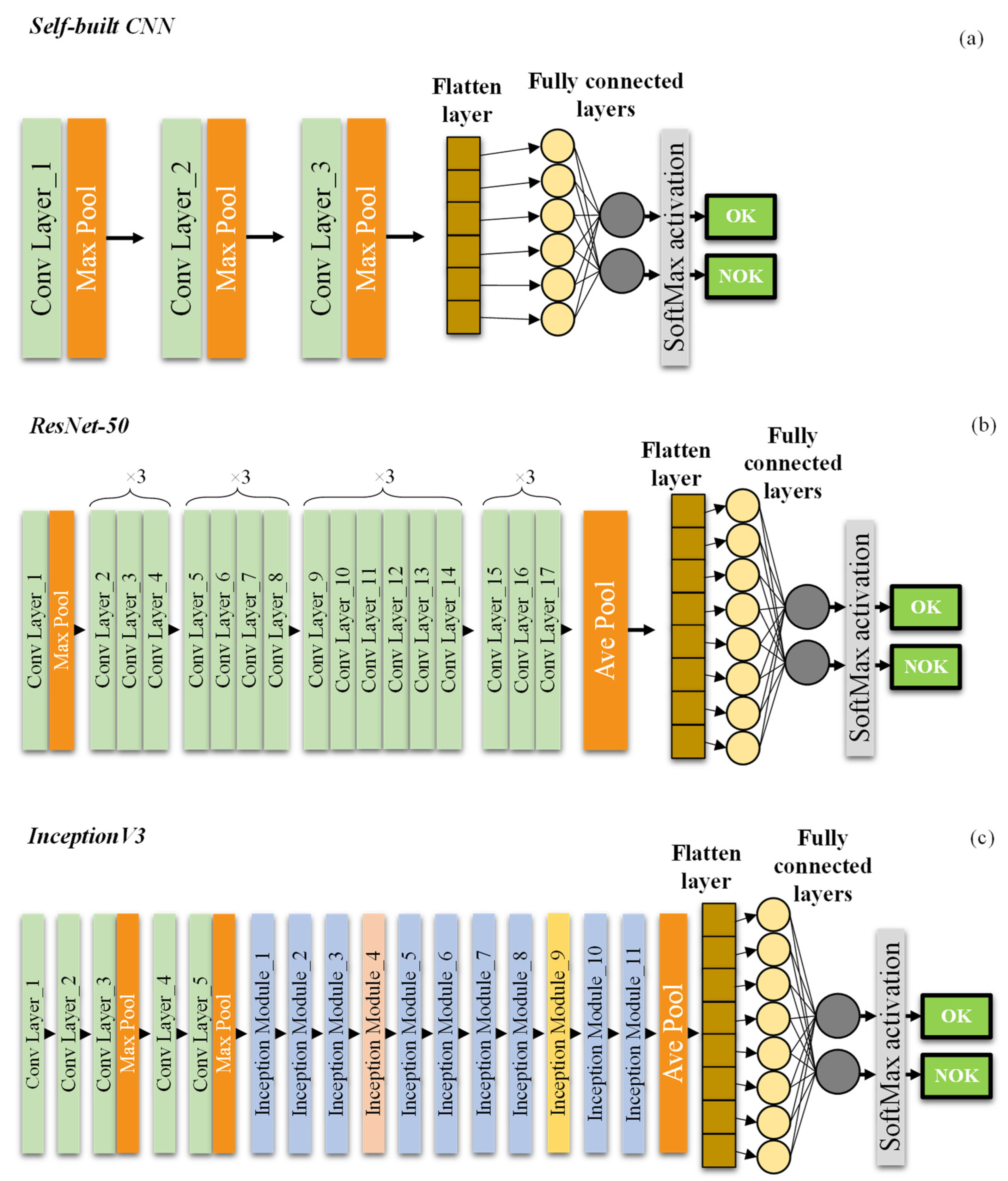
The first approach consisted in the construction and training of a new and lightweight CNN from scratch. This network consisted of: (1) 3 CLs; (2) 3 max PL; (3) 1 flatten layer; and (4) 2 FCL. Every CL contained 32 filters with size of 3 × 3 and ReLu AFs. The first FCL consisted of 128 neurons and ReLu AFs, while the second FCL possessed 2 neurons and softmax AF to obtain two outputs of probability for OK or NOK classes, as depicted in Figure 3a. It should be noted that the CNNs’ default input image size was 450 × 450. This network was trained with an epoch value of 250.
Figure 3. CNNs architectures employed: self-built (a), ResNet-50 (b), and Inception V3 (c).

3.2.2. Approach 2: Pre-Trained CNNs

The second approach entailed the TL and fine-tunning of two common pre-trained CNNs: ResNet-50 and Inception V3. These networks have been trained on at least one million images from the ImageNet and have over 23 million trainable parameters [43]. The input image size of these pre-trained CNNs was also 450 × 450.
ResNet-50 is a residual network with 50 layers stacked on top of each other, comprising 48 CLs, 1 max PL, and 1 average PL. The last block of the network was fine-tuned with 1 FCL with 1024 neurons and 1 final FCL with only 2 neurons and softmax AF to obtain OK or NOK classes, as shown in Figure 3b. This network was trained with an epoch value of 300.
Inception V3 is a 48 layer-deep CNN architecture with inception modules that contain several convolutional and pooling layers in parallel to reduce the number of parameters. The last block of the network was fine-tuned with 1 global average PL, 1 FCL with 1024 neurons, and 1 final FCL with 2 neurons and softmax AF to obtain OK or NOK classes, as displayed in Figure 3c. This network was trained with an epoch value of 400.

3.3. Automation of the Defect Detection Process

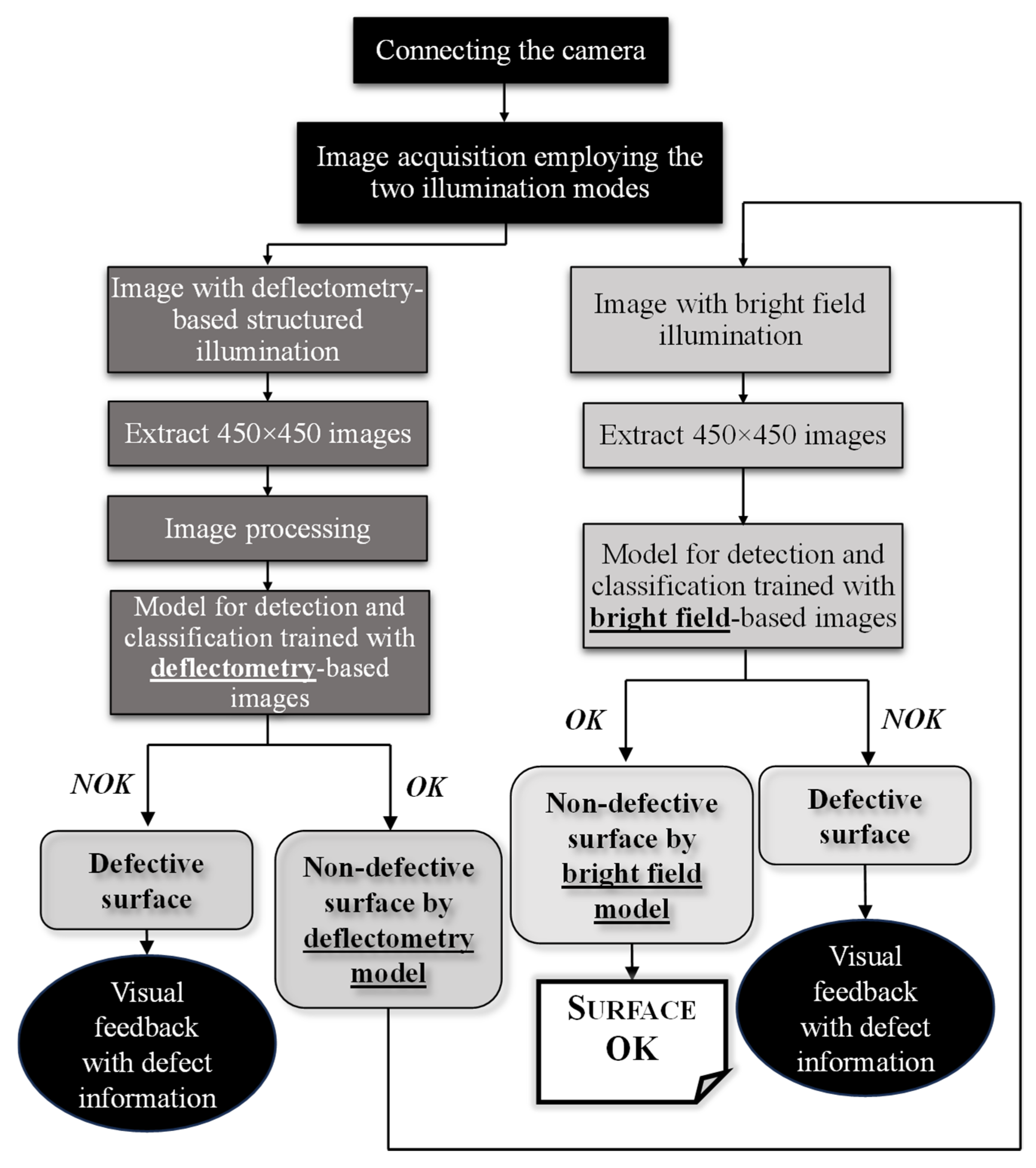
A Python-based algorithm was designed to automatize the entire defect detection and classification system, from the image acquisition to the predicted decision of the developed CNNs. The detailed flowchart is shown in Figure 4. Image acquisition and display were performed automatically in 5 s intervals employing both illumination modes. Smaller images with 450 × 450 pixels size were extracted from the images obtained with deflectometry-based structured illumination, and then processed to be input to the CNNs trained with the dataset of pattern-containing images. The detection module generated an output of OK or NOK surfaces, and the classification module identified the defect categories (scratches or dents). Once a surface was deemed OK using images with the sinusoidal pattern, a new algorithm cycle was performed employing images of the same surface illuminated with bright field. Since no processing was necessary for these images, images proceeded immediately from 450 × 450 extraction to the CNNs trained with dataset obtained with bright field illumination, in order to assess whether defects derived from lack of paint were detected.
Figure 4. Flowchart detailing the steps of the automatic defect detection algorithm.
It should be emphasized that this algorithm applied a decision-level fusion of the classification outputs, so for a painted surface to be classified as OK, its images should be submitted to CNNs trained with images of both illumination modes and obtain an OK classification on both. A confidence interval of 90% was required for the acceptance of a defect classification, given the overlap between the four subimages extracted from the original image.
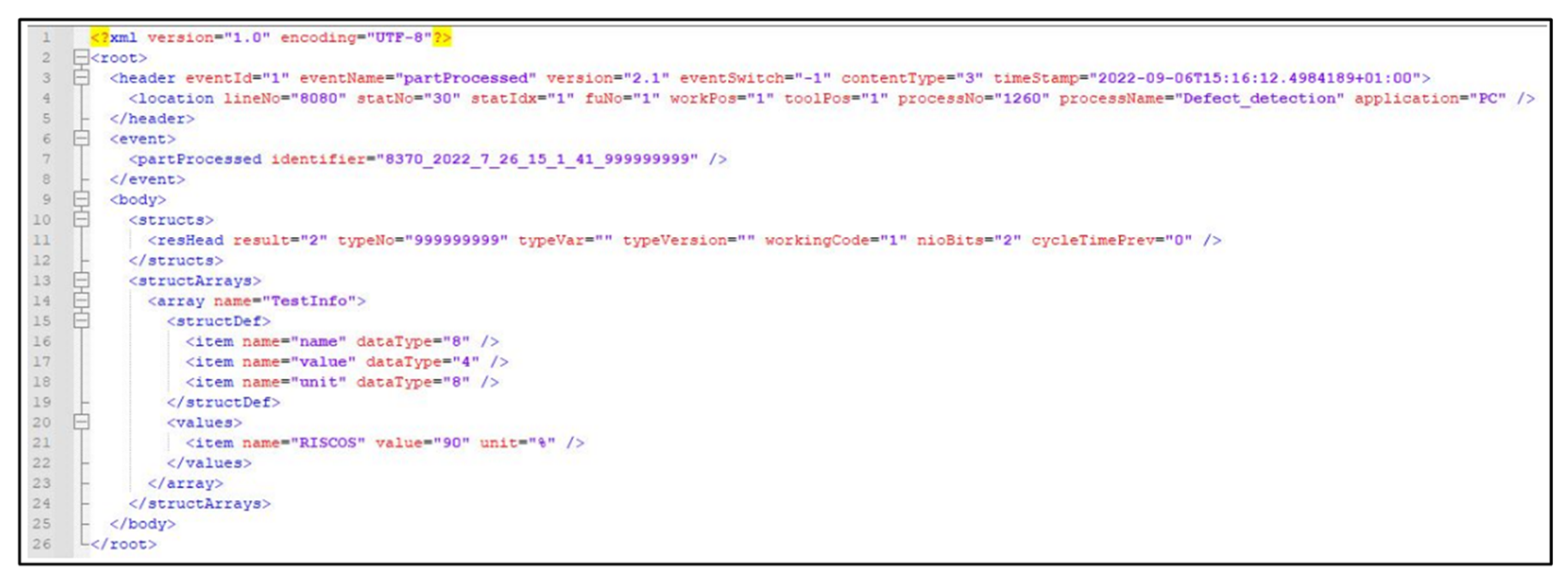
Once the classification was performed, the information regarding the status and identification of the painted surface was sent via telegram to an existing manufacturing execution system (MES), implemented in the university, in order to simulate the industrial MES employed in an industrial sector. For a correct reception by MES, these telegrams exhibited a pre-defined general structure including: a header in the initial part of the message, where the name of the process (Defect_detection), eventName, timeStamp, location (specified the source of the information, such as production line and workstation) (Figure 5 on line 3 to 5); the element event, used to identify the part to which the information is related employing the 8370_YEAR_MONTH_DAY_HOUR_MIN_SEC_999999999 as the identifier nomenclature (Figure 5 on line 6 to 8); resHead structure, that contained the classification information, 1 if OK and 2 if NOK, followed the defect category employing nioBits in the case of NOK, defined as 2code of defect category (a list with defect categories codes for nioBits match was previously imported to MES in a CSV file, identifying 1 as code to scratches, 2 to lack of paint, 3 to dents) (Figure 5 on line 11); and additional information about the defect, such as the defect designation and accuracy of the model’s classification (Figure 5 on line 13 to 24).
Figure 5. Telegram to be sent to MES.
Afterwards, MES forwarded the telegram’s information to a graphical user interface (GUI). The GUI was also developed in Python, using a tkinter package, identifying the following parameters: identifier number of the painted surface, the image that was classified, the classification OK or the defect category, the total of already classified parts, date and time.

4. Results and Discussion

In this work, an automatic vision inspection system was developed for the detection and classification of defects on the painted surfaces of heating devices, performing image acquisition, processing, and decision-making regarding the status of those surfaces in an automated fashion. It should be emphasized that, despite being tested and optimized for the painted surfaces of heating devices and their different topographical features (specular and diffuse), this automatic system can be easily configured and optimized for any other painted surface, such as surfaces of cars, airplanes, or any other household appliance.

4.1. Dataset Acquisition and Generation

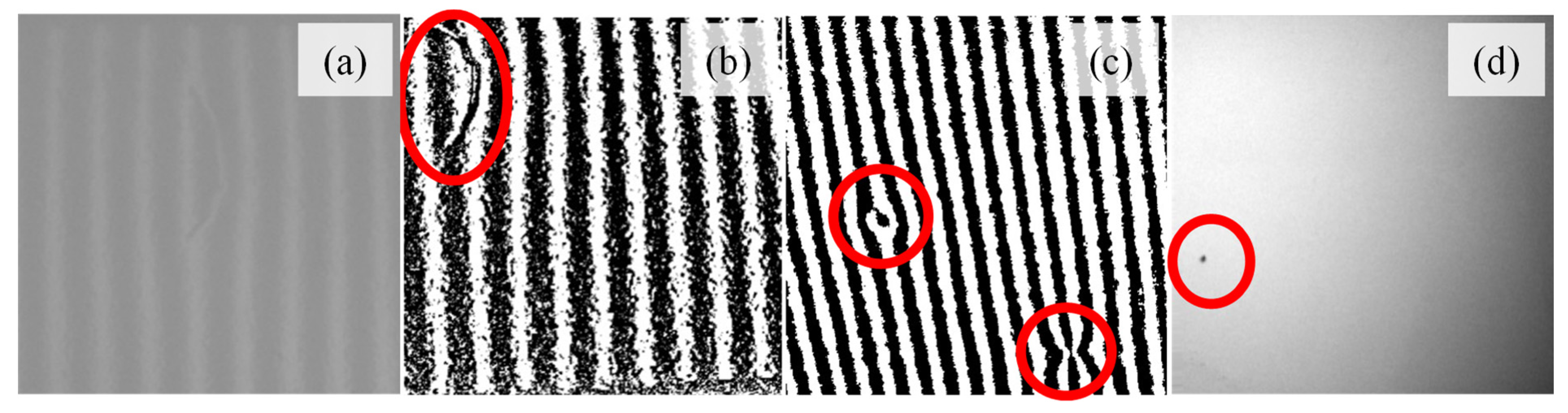
Environmental lighting was not controlled, in this experimental setup, to better approximate the lighting conditions observed in an industrial setting. In this instance, without proper containment of the acquisition setup, daylight variations could affect the light intensity in the captured images and alter the performance of the detection system. Indeed, as observed in Figure 6a, the low contrast observed in this image due to the interference of the environmental lighting hindered the immediate localization of the scratch. Nevertheless, the processing algorithm applied counteracted this effect, by generating high-contrast areas in the images containing sinusoidal patterns that, ultimately, facilitated the visualization of the defects, as seen in Figure 6b,c. Still, if containment is required for industrial implementation, tunnels such as those reported by Armesto et al., Molina et al., and Chang et al. could be considered [2,3,6].
Figure 6. Image from the painted surfaces before (a) and after processing for scratches (b) and dents (c). Image from the painted surfaces with spots with lack of paint (d). The defects are highlighted by the red circles.
The application of the two illumination modes—deflectometry-based structured illumination and bright field—was quite successful in the detection of all defects categories, despite their significantly different characteristics and sizes. Indeed, the deflectometry-based illumination was appropriate for the detection of defects with three-dimensional features such as scratches and dents in specular surfaces such as those obtained after the painting process, due to the distortion of the reflected pattern (Figure 6b,c) [2,4]. Conversely, defects derived from the lack of paint, which were much smaller (<0.5 mm), generate different superficial textures that were more easily detected using bright field (Figure 6d). In fact, using deflectometry-based illumination in this instance could trigger incorrect classifications, on the cases that the spots without paint appear in the black stripes of the sinusoidal patterns [18]. A similar multi-modal concept was previously reported by Guan et al. [7]. However, unlike Guan et al. that employed a feature-level fusion, a decision-level fusion method was applied in this work. This method not only preserved all the features extracted from the images retrieved using each illumination mode, but also significantly reduced the computational complexity of the final model by only fusing at the classification stage instead of fusing at the extraction stage [21]. Furthermore, this method is also compatible with real-time monitoring, which is essential for its implementation in an industrial inspection system, where time efficiency is required for increased industrial productivity.
Another important aspect of the image acquisition module is its ability to scan the entire surface of the heating device. In this work, however, a manual steering of the device was performed to expose all surfaces to the camera–monitor combo. Contemplating a totally automatic inspection process, a robotic arm, such as those reported by Akhtar et al. and Mao et al., should be considered [4,44].

4.2. Performance of the Defect Detection and Classification Models

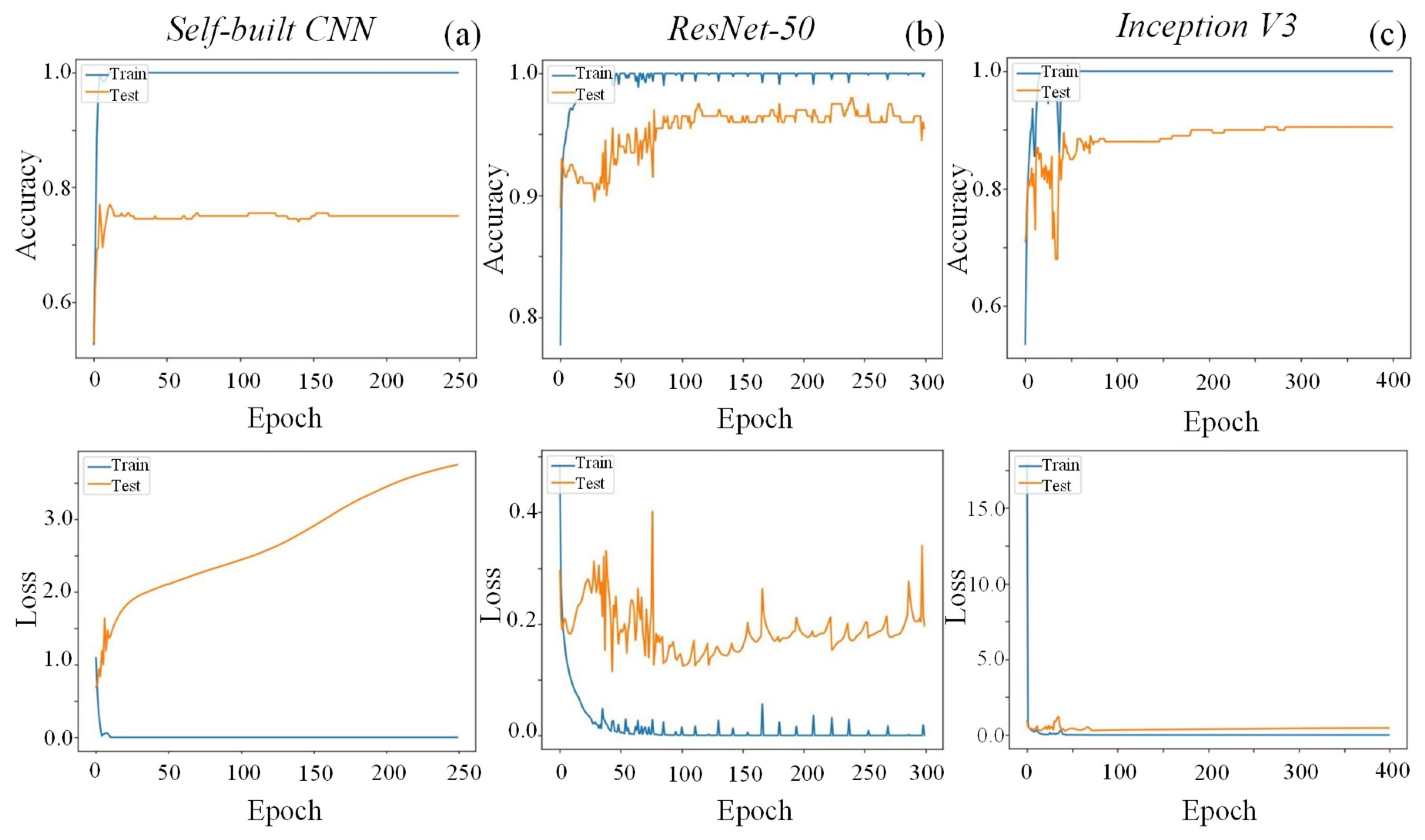
Firstly, the most efficient CNN for the detection and classification of defects in the painted surfaces was assessed for one of the defect categories—scratches, and the results are displayed in Figure 7. The self-built network achieved only 75% of accuracy and substantial loss throughout the 250 epochs (Figure 7a). In fact, when tested with images not used for training, this network prompted several incorrect predictions. Furthermore, this model exhibited a large gap between its training and testing losses’ curves, suggesting a possible overfitting problem. Similar results have been reported for models built from scratch [10,13], which can be attributed to the small dataset available for both training and testing in this work. As previously referred, given that defect occurrences are quite rare in most industrial sectors, the constitution of a sizable dataset is challenging, leading to problems of overfitting and unbalanced data [29,36,45]. TL and fine-tuning of pre-trained models were employed in this work to overcome this limitation. These pre-trained networks have shown higher prediction accuracy and possess more robust detection abilities than self-built CNNs [13,46], which was in fact confirmed in this work. Indeed, the fine-tuning of pre-trained CNNs considerably improved the outputs, with ResNet-50 and Inception V3 reaching around 95% and 90% of accuracy, respectively (Figure 7b,c). Furthermore, both models achieved their maximum accuracy values quite quickly within the iteration time (between 10 and 50 epochs), and they remained rather stable up to 300 epochs. These trends have already been reported for similar detection systems [10,11]. The superiority of pre-trained ResNet-50 for defect detection and classification has already been reported, and it has been attributed to its residual blocks, which significantly reduce the problems of vanishing gradients with increasing network’s depth, preventing overfitting and increasing the robustness of the model [47]. Hence, given its better performance, ResNet-50 was selected for defect detection and classification of the remaining defects.
Figure 7. Accuracy (upper) and losses (lower) of the self-built CNN (a), ResNet-50 (b), and Inception V3 (c) during training and testing for scratch’s defect category, employing sinusoidal patterns with 20 stripes.
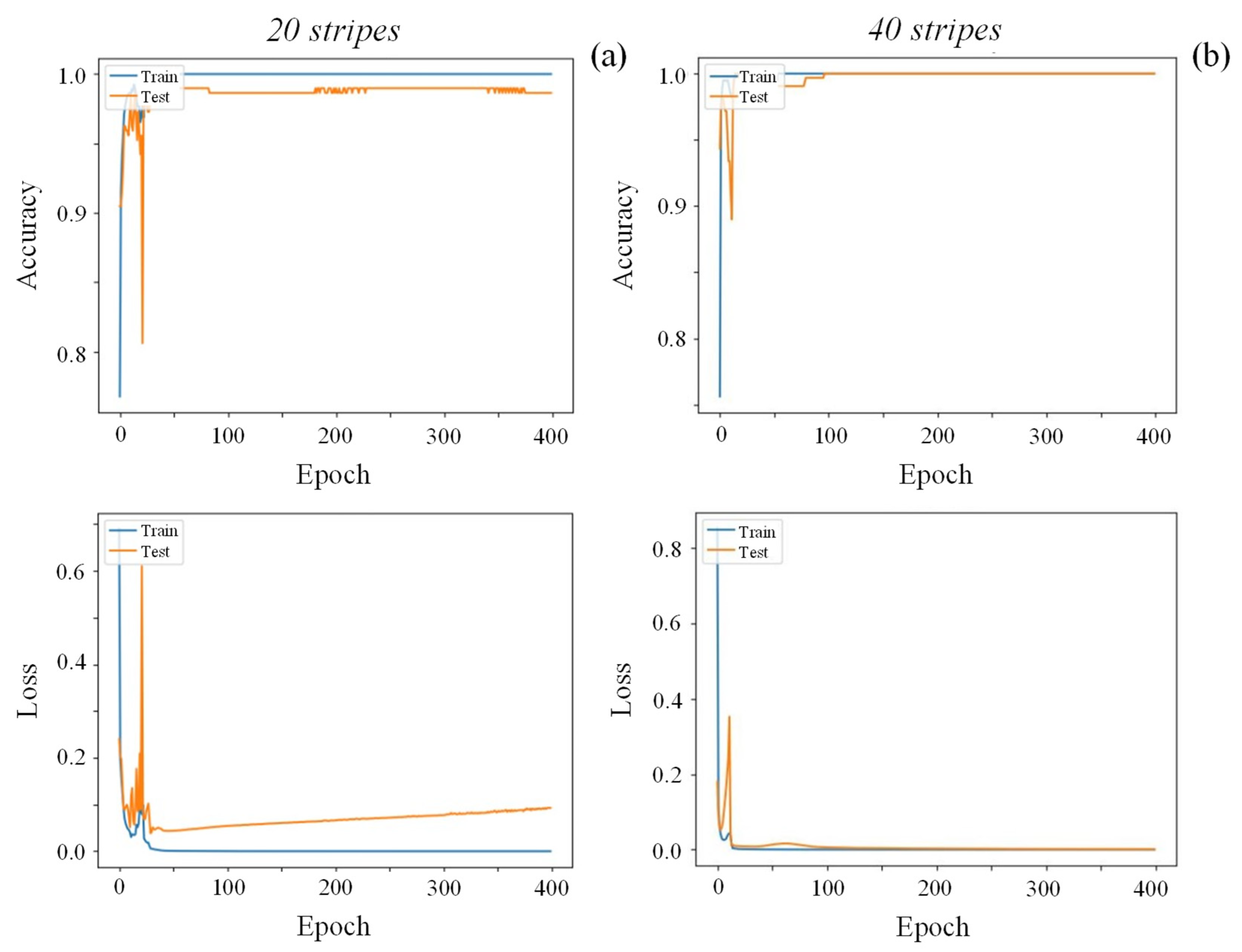
Besides the type of CNN, the effect of different projected patterns on the detection and classification of the defects—in this particular case, dents—was also assessed by employing sinusoidal patterns with different stripe widths: 20 or 40 stripes in the same area. At this point, an improved model’s performance using thinner stripes was expected as it expanded the range of defect sizes that could be identified, as reported by Macher et al. [48]. This was confirmed by the evolution of the accuracy and losses of the model shown in Figure 8, that revealed a test’s accuracy improvement from 98 to 100% and considerable loss reduction and convergency by decreasing the stripes’ width.
Figure 8. Accuracy (upper) and losses (lower) of ResNet-50 during training and testing using sinusoidal patterns with 20 (a) and 40 (b) stripes for the dent defect category.
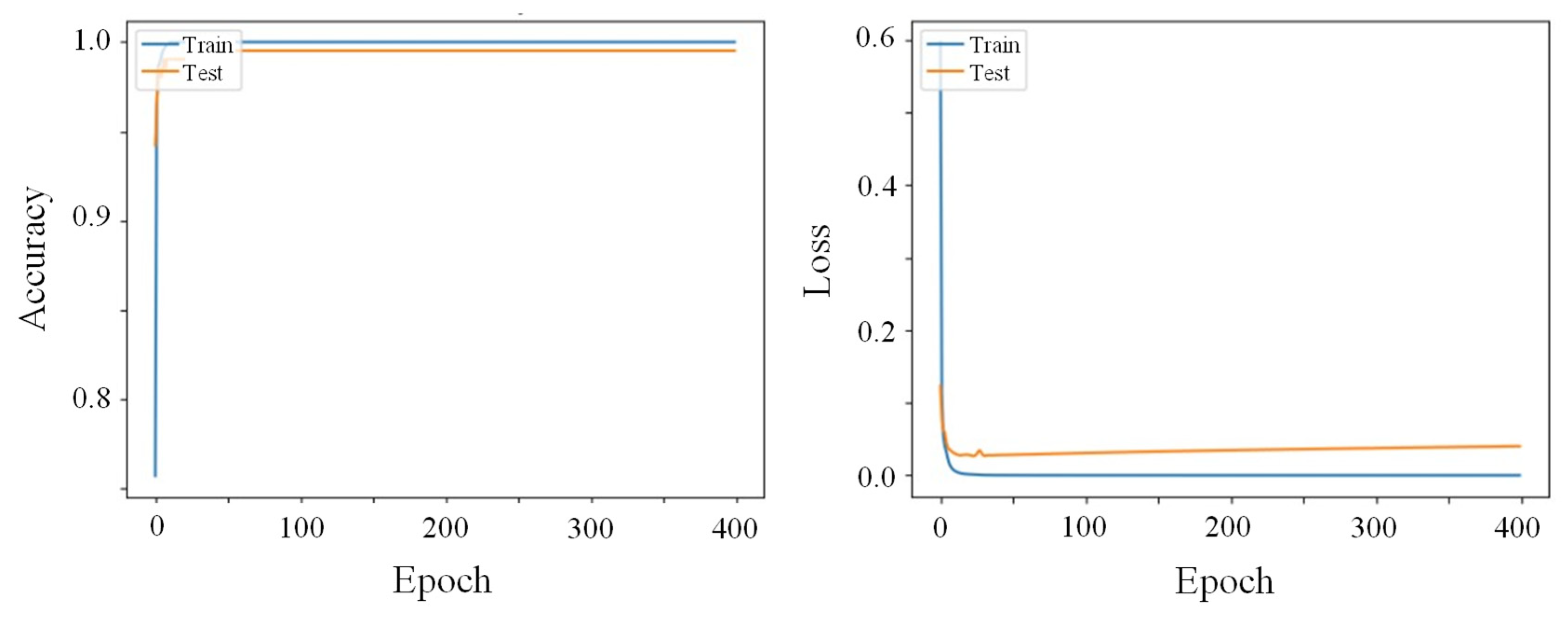
Regarding defects derived from lack of paint, whose results are shown in Figure 9, the model’s test performance reached 99% of accuracy with reduced loss after 400 epochs.
Figure 9. Accuracy and loss of the pre-trained ResNet-50 model during training and testing for the lack of paint defect category.
Overall, ResNet-50 performed well for the detection of all defect categories, with testing accuracies higher than 95%. Still, the network’s improvements should be performed, particularly regarding scratches detection and classification given its lowest accuracy and higher loss. In this instance, a reduction in the stripe width should be considered to enhance the model’s performance.

4.3. Performance of the Automatic Detection and Classification System

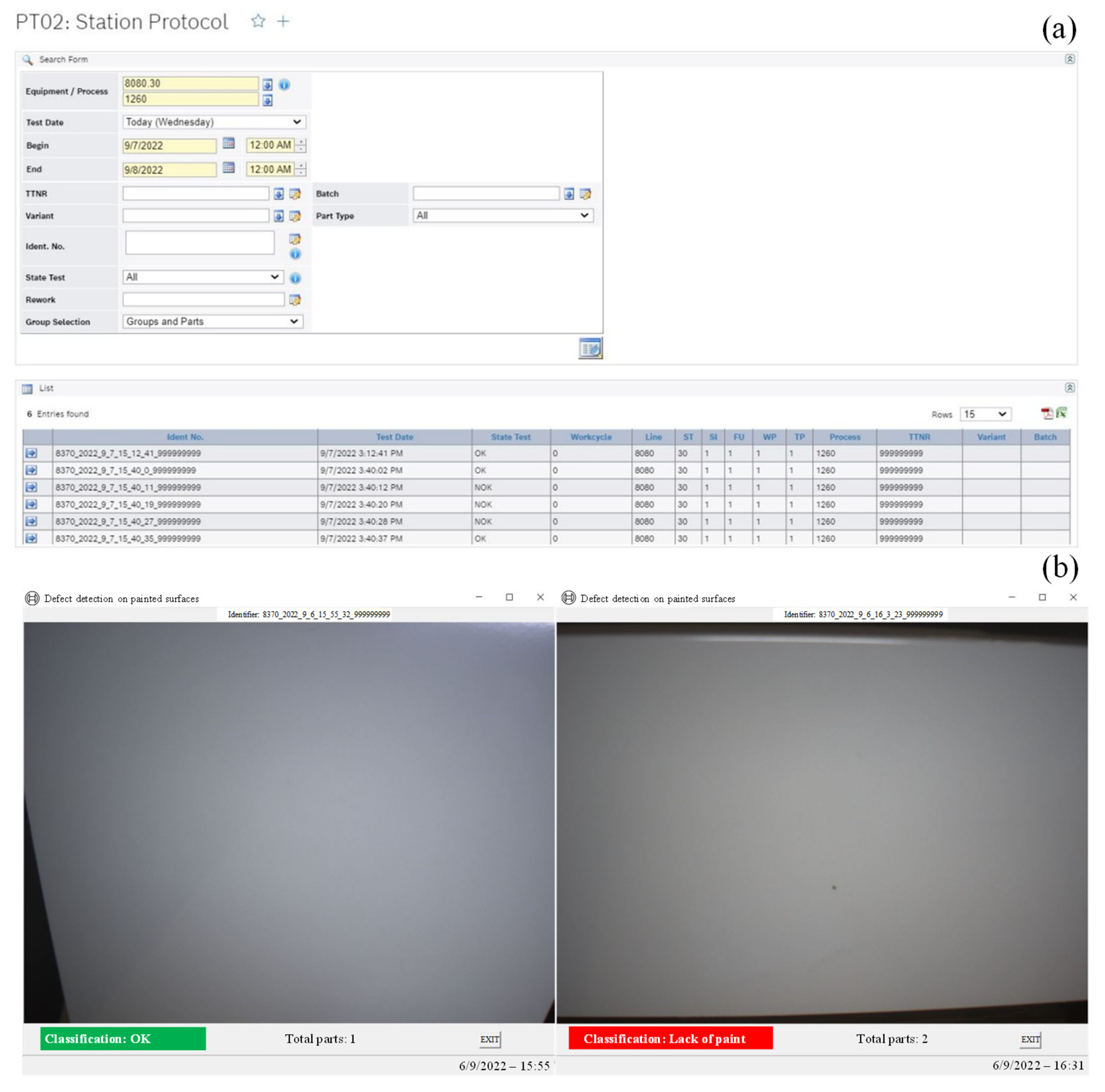
Given the real-time monitoring and classification required in an industrial inspection setting, the detection and classification system should be not only fast, but also accurate in its predictions [2,49]. In this work, once captured images were input into the models and the CNN was launched, defect classification was obtained in less than one second, which is suitable for an industrial implementation. Indeed, given their lower computational complexity, decision-level fusion models are quite adaptable for real-time applications and have a strong fault tolerance [21]. This defect information was then converted into a telegram and successfully sent to the MES server almost instantaneously without any errors. This was confirmed by reception of the telegrams on the implemented MES, exhibiting three OK and three NOK classifications, as shown in Figure 10a, indicating that three surfaces were defect-free while the following surfaces were NOK.
Figure 10. Telegram reception by the implemented MES (a), GUI for a surface OK and NOK due to lack of paint (b).
This information was then forwarded to the GUI. Figure 10b exhibit OK and NOK classifications of painted surfaces derived from light projection modes due to lack of paint. Similar visual interfaces have been developed for inspection systems [15,44]. In an industrial scenery, this GUI is highly significant, as it provides the information of painted surface status to the operators, that ultimately determines whether the product can continue in the production line or whether it needs to be removed and repainted or discarded.
All in all, the obtained results demonstrated the robustness and quickness of the developed inspection systems, from the image acquisition to the visualization through GUI, demonstrating its potential for implementation for industrial quality control of the painted surfaces. Despite all this, optimization of certain aspects of this system is still required to further improve its robustness. Concerning the dataset, it needs to be improved in terms of quality, with more captured images of defective and non-defective surfaces to accommodate each defect’s features’ real variations, and in terms of size, given that 500 images is still a small dataset for these models. Additionally, implementation of this system in an industrial painting line will be considered in the future.

5. Conclusions

An automatic inspection system was successfully developed for defect detection and classification on painted surfaces of heating devices, whose components exhibit different topographical features, requiring different illumination modes during acquisition. This system comprised deflectometry and bright light-based image acquisition for dataset generation, DL algorithms for defect detection and classification, surface’s information shipping to a MES server, and a final visual interface for defect information display. Three CNNs were tested: a lightweight CNN built and trained from scratch, and two fine-tuned pre-trained CNNs, ResNet-50, and Inception V3. From the experimental results, the following conclusions can be drawn:
  • The two illumination modes of the image acquisition module significantly widened the type of defects that could be identified with this system, while maintaining its computational complexity by performing multi-modal fusion at the decision level.
  • Pre-trained networks performed better than the self-built networks, with ResNet-50 exhibiting the best performance in terms of accuracy (higher than 95%) and speed for all defect categories.
  • Decreasing the sinusoidal pattern’s stripe’s width substantially improved ResNet-50’s accuracy and error convergency when applied for dented painted surfaces.
  • The entire sequence of the inspection system allowed for a fast (less than 1 s) and correct detection of all defect categories by imposing OK classification on models trained with images derived from both illumination modes: sinusoidal pattern and bright field.
  • The overall painted surface information was readily and correctly sent to the MES server, via telegram, which then forwarded it to a GUI.
All these conclusions validate the robustness and quickness of the system, proving that its implementation in the heating industrial sector would be an efficient tool for quality control of painted surfaces of heating devices.

Author Contributions

Conceptualization, N.L. and J.P.S.; formal analysis, Â.S.; funding acquisition, A.C.; investigation, M.P.; methodology, M.P.; project administration, A.C.; resources, A.C. and J.P.S.; validation, M.P.; supervision, N.L. and J.P.S.; writing—original draft preparation, Â.S.; writing—review and editing, A.C., N.L. and J.P.S. All authors have read and agreed to the published version of the manuscript.

Funding

This research was developed in the scope of the project “Agenda ILLIANCE” [C644919832-00000035 | Project nº 46], financed by PRR—Plano de Recuperação e Resiliência under the Next Generation EU from the European Union. This work was also supported by Fundação para a Ciência e Tecnologia I.P. (FCT, IP) through the projects UIDB/00481/2020 and UIDP/00481/2020.

Data Availability Statement

Datasets generated during the current study are available from the corresponding author on reasonable request.

Acknowledgments

The authors would like to acknowledge Bosch Thermotechnology from Aveiro for supplying the defective and non-defective heating devices’ painted surfaces.

Conflicts of Interest

The authors declare that they have no known competing financial interests or personal relationships that could have appeared to influence the work reported in this paper.

References

  1. Imad, M.; Hopkins, C.; Hosseini, A.; Yussefian, N.Z.; Kishawy, H.A. Intelligent Machining: A Review of Trends, Achievements and Current Progress. Int. J. Comput. Integr. Manuf. 2022, 35, 359–387. [Google Scholar] [CrossRef]
  2. Molina, J.; Solanes, J.E.; Arnal, L.; Tornero, J. On the Detection of Defects on Specular Car Body Surfaces. Robot. Comput. Integr. Manuf. 2017, 48, 263–278. [Google Scholar] [CrossRef]
  3. Armesto, L.; Tornero, J.; Herraez, A.; Asensio, J. Inspection System Based on Artificial Vision for Paint Defects Detection on Cars Bodies. In Proceedings of the 2011 IEEE International Conference on Robotics and Automation, Shanghai, China, 9–13 May 2011; pp. 1–4. [Google Scholar]
  4. Akhtar, S.; Tandiya, A.; Moussa, M.; Tarry, C. An Efficient Automotive Paint Defect Detection System. Adv. Sci. Technol. Eng. Syst. 2019, 4, 171–182. [Google Scholar] [CrossRef][Green Version]
  5. Liong, S.T.; Zheng, D.; Huang, Y.C.; Gan, Y.S. Leather Defect Classification and Segmentation Using Deep Learning Architecture. Int. J. Comput. Integr. Manuf. 2020, 33, 1105–1117. [Google Scholar] [CrossRef]
  6. Chang, F.; Dong, M.; Liu, M.; Wang, L.; Duan, Y. A Lightweight Appearance Quality Assessment System Based on Parallel Deep Learning for Painted Car Body. IEEE Trans. Instrum. Meas. 2020, 69, 5298–5307. [Google Scholar] [CrossRef]
  7. Guan, J.; Fei, J.; Li, W.; Jiang, X.; Wu, L.; Liu, Y.; Xi, J. Defect Classification for Specular Surfaces Based on Deflectometry and Multi-Modal Fusion Network. Opt. Lasers Eng. 2023, 163, 107488. [Google Scholar] [CrossRef]
  8. Puente León, F.; Kammel, S. Inspection of Specular and Painted Surfaces with Centralized Fusion Techniques. Measurement 2006, 39, 536–546. [Google Scholar] [CrossRef]
  9. Zhang, Y.; Sidibé, D.; Morel, O.; Mériaudeau, F. Deep Multimodal Fusion for Semantic Image Segmentation: A Survey. Image Vis. Comput. 2021, 105, 104042. [Google Scholar] [CrossRef]
  10. Berwo, M.A.; Fang, Y.; Mahmood, J.; Yang, N.; Liu, Z.; Li, Y. FAECCD-CNet: Fast Automotive Engine Components Crack Detection and Classification Using ConvNet on Images. Appl. Sci. 2022, 12, 9713. [Google Scholar] [CrossRef]
  11. Ma, G.; Yu, L.; Yuan, H.; Xiao, W.; He, Y. A Vision-Based Method for Lap Weld Defects Monitoring of Galvanized Steel Sheets Using Convolutional Neural Network. J. Manuf. Process 2021, 64, 130–139. [Google Scholar] [CrossRef]
  12. Singh, S.A.; Kumar, A.S.; Desai, K.A. Comparative Assessment of Common Pre-Trained CNNs for Vision-Based Surface Defect Detection of Machined Components. Expert. Syst. Appl. 2023, 218, 119623. [Google Scholar] [CrossRef]
  13. Venkatesh, S.N.; Sugumaran, V. A Combined Approach of Convolutional Neural Networks and Machine Learning for Visual Fault Classification in Photovoltaic Modules. Proc. Inst. Mech. Eng. O. J. Risk Reliab. 2022, 236, 148–159. [Google Scholar] [CrossRef]
  14. Trofimov, A.G.; Bogatyreva, A.A. A Method of Choosing a Pre-Trained Convolutional Neural Network for Transfer Learning in Image Classification Problems. In Proceedings of the Advances in Neural Computation, Machine Learning, and Cognitive Research III: Neuroinformatics 2019, Dolgoprudny, Moscow Region, Russia, 7–11 October 2019; pp. 263–270. [Google Scholar]
  15. Semitela, Â.; Ferreira, A.; Completo, A.; Lau, N.; Santos, J.P. Detecting and Classifying Defects on the Surface of Water Heaters: Development of an Automated System. Proc. Inst. Mech. Eng. Part. E J. Process Mech. Eng. 2024. [Google Scholar] [CrossRef]
  16. Malamas, E.N.; Petrakis, E.G.M.; Zervakis, M.; Petit, L.; Legat, J.-D. A Survey on Industrial Vision Systems, Applications and Tools. Image Vis. Comput. 2003, 21, 171–188. [Google Scholar] [CrossRef]
  17. Ren, Z.; Fang, F.; Yan, N.; Wu, Y. State of the Art in Defect Detection Based on Machine Vision. Int. J. Precis. Eng. Manuf. Green Technol. 2022, 9, 661–691. [Google Scholar] [CrossRef]
  18. Mullany, B.; Savio, E.; Haitjema, H.; Leach, R. The Implication and Evaluation of Geometrical Imperfections on Manufactured Surfaces. CIRP Ann. 2022, 71, 717–739. [Google Scholar] [CrossRef]
  19. Li, Z.; Yao, Y.; Wen, R.; Liu, Q. Dual-Modal Illumination System for Defect Detection of Aircraft Glass Canopies. Sensors 2024, 24, 6717. [Google Scholar] [CrossRef]
  20. Peng, X.; Kong, L.; Han, W.; Wang, S. Multi-Sensor Image Fusion Method for Defect Detection in Powder Bed Fusion. Sensors 2022, 22, 8023. [Google Scholar] [CrossRef] [PubMed]
  21. Hu, Z.; Jing, Y.; Wu, G. Decision-Level Fusion Detection Method of Visible and Infrared Images under Low Light Conditions. EURASIP J. Adv. Signal Process 2023, 2023, 38. [Google Scholar] [CrossRef]
  22. Cong, T.; Yongshun, L.; Hua, Y.; Xing, Y.; Yuan, L. Decision-Level Fusion Detection for Infrared and Visible Spectra Based on Deep Learning. Infrared Laser Eng. 2019, 48, 626001. [Google Scholar] [CrossRef]
  23. Rawat, W.; Wang, Z. Deep Convolutional Neural Networks for Image Classification: A Comprehensive Review. Neural Comput. 2017, 29, 2352–2449. [Google Scholar] [CrossRef] [PubMed]
  24. Zhou, Q.; Chen, R.; Huang, B.; Xu, W.; Yu, J. DeepInspection: Deep Learning Based Hierarchical Network for Specular Surface Inspection. Measurement 2020, 160, 107834. [Google Scholar] [CrossRef]
  25. Namatēvs, I. Deep Convolutional Neural Networks: Structure, Feature Extraction and Training. Inf. Technol. Manag. Sci. 2018, 20, 40–47. [Google Scholar] [CrossRef]
  26. Taye, M.M. Theoretical Understanding of Convolutional Neural Network: Concepts, Architectures, Applications, Future Directions. Computation 2023, 11, 52. [Google Scholar] [CrossRef]
  27. Purwono, P.; Ma’arif, A.; Rahmaniar, W.; Fathurrahman, H.I.K.; Frisky, A.Z.K.; Haq, Q.M. ul Understanding of Convolutional Neural Network (CNN): A Review. Int. J. Robot. Control. Syst. 2023, 2, 739–748. [Google Scholar] [CrossRef]
  28. Luo, C.; Li, X.; Wang, L.; He, J.; Li, D.; Zhou, J. How Does the Data Set Affect CNN-Based Image Classification Performance? In Proceedings of the 5th International Conference on Systems and Informatics (ICSAI), Nanjing, China, 10–12 November 2018; pp. 361–366. [Google Scholar]
  29. Le, X.; Mei, J.; Zhang, H.; Zhou, B.; Xi, J. A Learning-Based Approach for Surface Defect Detection Using Small Image Datasets. Neurocomputing 2020, 408, 112–120. [Google Scholar] [CrossRef]
  30. Yosinski, J.; Clune, J.; Bengio, Y.; Lipson, H. How Transferable Are Features in Deep Neural Networks? In Proceedings of the 28th Annual Conference on Neural Information Processing Systems; Ghahramani, Z., Weinberger, K.Q., Cortes, C., Lawrence, N.D., Welling, M., Eds.; Neural Information Processing Systems Foundation: Montreal, QC, Canada, 2014; pp. 3320–3328. [Google Scholar]
  31. Safonova, A.; Ghazaryan, G.; Stiller, S.; Main-Knorn, M.; Nendel, C.; Ryo, M. Ten Deep Learning Techniques to Address Small Data Problems with Remote Sensing. Int. J. Appl. Earth Obs. Geoinf. 2023, 125, 103569. [Google Scholar] [CrossRef]
  32. Weiss, K.; Khoshgoftaar, T.M.; Wang, D. A Survey of Transfer Learning. J. Big Data 2016, 3, 9. [Google Scholar] [CrossRef]
  33. Tulbure, A.-A.; Tulbure, A.-A.; Dulf, E.-H. A Review on Modern Defect Detection Models Using DCNNs—Deep Convolutional Neural Networks. J. Adv. Res. 2022, 35, 33–48. [Google Scholar] [CrossRef] [PubMed]
  34. Cong, S.; Zhou, Y. A Review of Convolutional Neural Network Architectures and Their Optimizations. Artif. Intell. Rev. 2023, 56, 1905–1969. [Google Scholar] [CrossRef]
  35. Alzubaidi, L.; Zhang, J.; Humaidi, A.J.; Al-Dujaili, A.; Duan, Y.; Al-Shamma, O.; Santamaría, J.; Fadhel, M.A.; Al-Amidie, M.; Farhan, L. Review of Deep Learning: Concepts, CNN Architectures, Challenges, Applications, Future Directions. J. Big Data 2021, 8, 53. [Google Scholar] [CrossRef] [PubMed]
  36. Zhang, L.; Bian, Y.; Jiang, P.; Zhang, F. A Transfer Residual Neural Network Based on ResNet-50 for Detection of Steel Surface Defects. Appl. Sci. 2023, 13, 5260. [Google Scholar] [CrossRef]
  37. EL Ghadoui, M.; Mouchtachi, A.; Majdoul, R. Smart Defect Detection Using Transfer Learning in Injection Molding: A Comparative Exploration Study of Deep Learning Architectures. Int. J. Adv. Manuf. Technol. 2024, 133, 625–639. [Google Scholar] [CrossRef]
  38. He, K.; Zhang, X.; Ren, S.; Sun, J. Deep Residual Learning for Image Recognition. In Proceedings of the IEEE Computer Society Conference on Computer Vision and Pattern Recognition, Las Vegas, NV, USA, 26 June–1 July 2016; IEEE Computer Society: Washington, DC, USA, 2016; pp. 770–778. [Google Scholar]
  39. Park, H.; Kang, Y.S.; Choi, S.-K.; Park, H.W. Quality Evaluation Modeling of a DED-Processed Metallic Deposition Based on ResNet-50 with Few Training Data. J. Intell. Manuf. 2024. [Google Scholar] [CrossRef]
  40. Kiran, G.U.; Gajula, S.; Sravanthi, A.; Srilakshmi, V.; Veditha, T.; Reddy, D.V. Inception V3 Model-Based Approach for Detecting Defects on Steel Surfaces. In Proceedings of the 2024 2nd International Conference on Intelligent Data Communication Technologies and Internet of Things (IDCIoT), Bengaluru, India, 4–6 January 2024; pp. 331–335. [Google Scholar]
  41. Merino, I.; Azpiazu, J.; Remazeilles, A.; Sierra, B. 3D Convolutional Neural Networks Initialized from Pretrained 2D Convolutional Neural Networks for Classification of Industrial Parts. Sensors 2021, 21, 1078. [Google Scholar] [CrossRef] [PubMed]
  42. Qayyum, W.; Ehtisham, R.; Bahrami, A.; Camp, C.; Mir, J.; Ahmad, A. Assessment of Convolutional Neural Network Pre-Trained Models for Detection and Orientation of Cracks. Materials 2023, 16, 826. [Google Scholar] [CrossRef]
  43. Victor Ikechukwu, A.; Murali, S.; Deepu, R.; Shivamurthy, R.C. ResNet-50 vs VGG-19 vs Training from Scratch: A Comparative Analysis of the Segmentation and Classification of Pneumonia from Chest X-Ray Images. Glob. Transit. Proc. 2021, 2, 375–381. [Google Scholar] [CrossRef]
  44. Mao, W.-L.; Chiu, Y.-Y.; Lin, B.-H.; Wang, C.-C.; Wu, Y.-T.; You, C.-Y.; Chien, Y.-R. Integration of Deep Learning Network and Robot Arm System for Rim Defect Inspection Application. Sensors 2022, 22, 3927. [Google Scholar] [CrossRef] [PubMed]
  45. Wang, X.; Gao, S.; Guo, J.; Wang, C.; Xiong, L.; Zou, Y. Deep Learning-Based Integrated Circuit Surface Defect Detection: Addressing Information Density Imbalance for Industrial Application. Int. J. Comput. Intell. Syst. 2024, 17, 29. [Google Scholar] [CrossRef]
  46. Singh, S.A.; Desai, K.A. Automated Surface Defect Detection Framework Using Machine Vision and Convolutional Neural Networks. J. Intell. Manuf. 2022, 34, 1995–2011. [Google Scholar] [CrossRef]
  47. Razavi, M.; Mavaddati, S.; Koohi, H. ResNet Deep Models and Transfer Learning Technique for Classification and Quality Detection of Rice Cultivars. Expert. Syst. Appl. 2024, 247, 123276. [Google Scholar] [CrossRef]
  48. Macher, J.; Gruber, D.P.; Altenbuchner, T.; Pacher, G.A.; Berger, G.R.; Friesenbichler, W. Detection of Visually Perceptible Sink Marks on High Gloss Injection Molded Parts by Phase Measuring Deflectometry. Polym. Test. 2014, 34, 42–48. [Google Scholar] [CrossRef]
  49. Liu, J.; Guo, F.; Gao, H.; Li, M.; Zhang, Y.; Zhou, H. Defect Detection of Injection Molding Products on Small Datasets Using Transfer Learning. J. Manuf. Process 2021, 70, 400–413. [Google Scholar] [CrossRef]
Disclaimer/Publisher’s Note: The statements, opinions and data contained in all publications are solely those of the individual author(s) and contributor(s) and not of MDPI and/or the editor(s). MDPI and/or the editor(s) disclaim responsibility for any injury to people or property resulting from any ideas, methods, instructions or products referred to in the content.

Article Metrics

Citations

Article Access Statistics

Multiple requests from the same IP address are counted as one view.