You are currently viewing a new version of our website. To view the old version click .
Sensors
  • Article
  • Open Access

19 March 2024

5G Indoor Positioning Error Correction Based on 5G-PECNN

,
,
,
,
,
and
1
China Unicom Smart City Research Institute, Beijing 100102, China
2
Academy for Network and Communications of CETC, Shijiazhuang 050081, China
*
Author to whom correspondence should be addressed.
This article belongs to the Topic Artificial Intelligence in Navigation

Abstract

With the development of the mobile network communication industry, 5G has been widely used in the consumer market, and the application of 5G technology for indoor positioning has emerged. Like most indoor positioning techniques, the propagation of 5G signals in indoor spaces is affected by noise, multipath propagation interference, installation errors, and other factors, leading to errors in 5G indoor positioning. This paper aims to address these issues by first constructing a 5G indoor positioning dataset and analyzing the characteristics of 5G positioning errors. Subsequently, we propose a 5G Positioning Error Correction Neural Network (5G-PECNN) based on neural networks. This network employs a multi-level fusion network structure designed to adapt to the error characteristics of 5G through adaptive gradient descent. Experimental validation demonstrates that the algorithm proposed in this paper achieves superior error correction within the error region, significantly outperforming traditional neural networks.

1. Introduction

In outdoor environments, GPSs (Global Positioning Systems) can provide high-precision positioning services [1]. However, within indoor environments, satellite positioning signals are often blocked, making it challenging to obtain positioning information through satellites. Consequently, indoor positioning technologies [2] such as Wi-Fi [3,4], Bluetooth [5], UWB [6], and 5G positioning [7] have emerged. Nevertheless, the field of indoor positioning still faces several unresolved issues. For instance, there exist numerous standards for indoor positioning technologies, resulting in a lack of a unified specification system. Moreover, the deployment costs of equipment are high, leading to increased operation and maintenance expenses. Utilizing 5G equipment, originally deployed for communication purposes, for positioning can potentially address these challenges effectively.
Amid the rapid development of the mobile network communication industry, the widespread adoption of 5G in the consumer market has notably addressed the indoor coverage issue by deploying cost-effective and adaptable 5G base stations [8]. Leveraging the advantages of the communication network, indoor positioning technology efficiently harnesses 5G signals to enable indoor positioning functionality, eliminating the need for redundant positioning network deployments. The amalgamation of 5G base stations with indoor positioning technology maximizes the utilization of the communication network [9,10,11]. Reference [12] utilized 5G signal millimeter-wave technology for precise positioning, leveraging Device-to-Device (D2D) communication technology to enhance collaborative positioning capabilities. It employed reinforcement learning methods to select the appropriate positioning approach for each signal, achieving centimeter-level localization accuracy. Reference [13] employed 5G positioning reference signals to estimate path delays and achieve receiver time synchronization, enabling precise localization through time-of-arrival (TOA) methods.
Although 5G technology has made significant advances in positioning compared to previous technologies, we still face the challenges of positioning errors in practical applications. These errors may stem from various complex factors, including but not limited to signal multipath effects, building obstructions, weather conditions, and more. These factors negatively impact the accuracy of 5G positioning, making it essential to delve into the mechanisms behind positioning errors and explore effective correction methods to enhance the reliability and precision of 5G positioning services.
In this article, a backpropagation neural network for 5G positioning error correction is proposed based on an adaptive global gradient descent algorithm. The method aims to correct errors generated in indoor environments during 5G positioning. This research primarily focuses on the following scenario: In indoor scenarios, corrections are applied to positioning coordinates with errors generated by existing 5G positioning methods, such as AOA [14] positioning, utilizing available information. This approach is taken when it is not possible to obtain measurement information, such as signal propagation time or angles, through closed-source devices, making it challenging to enhance the positioning accuracy further. The goal is to achieve rapid positioning and direct correction using existing methods and devices.
The main contributions made by the content studied in this paper are as follows:
(1)
We analyzed a dataset constructed for indoor scenarios to identify the primary characteristics causing 5G positioning errors in indoor environments.
(2)
Addressing non-linear features such as noise and multipath interference prevalent in indoor scenarios affecting 5G positioning errors, we introduced a neural network-based 5G positioning error correction network. The network effectively reduces the positioning error.
(3)
In response to the causes of errors in indoor scenarios, we enhanced and optimized neural networks. We proposed a multi-level fusion network structure based on adaptive gradient descent. The network structure effectively prevents falling into local optima in this scenario.
The rest of the paper is organized as follows. Section 2 introduces the principles of 5G NR positioning, related research on wireless signal positioning error correction, and relevant methods for positioning error correction. Section 3, based on the AOA positioning principle, presents a dataset from real-world scenarios and analyzes the characteristics of 5G positioning errors in that environment. Section 4 describes the research on the 5G-PECNN algorithm, improvements to the designed model, and details of algorithm optimization methods. Section 5 demonstrates experimental testing of the designed 5G-PECNN algorithm using the dataset and analyzes and discusses the algorithm’s performance. Section 6 summarizes the article and discusses the advantages and limitations of this approach and future work.

3. Preliminaries

The challenge in this study lies in achieving a mapping from positioning coordinates with error information to corrected coordinates without access to crucial information such as angle-of-arrival (AOA) data or propagation time, while being limited to closed-source devices that only provide measured terminal coordinates and true coordinates. To address this challenge, it is necessary to start from the principles of positioning, explore spatial signal characteristics, and understand the relationship between error features and location as well as the relationship with measured coordinates. Subsequently, an error correction model needs to be established to achieve the mapping from positioning coordinates with error information to corrected coordinates.
Firstly, therefore, we analyze the 5G positioning method based on AOA and the error generation model. Next, we introduce the dataset collected from real-world scenarios and then analyze the error characteristics of the dataset based on the error model.

3.1. AOA Localization Principles and Error Models

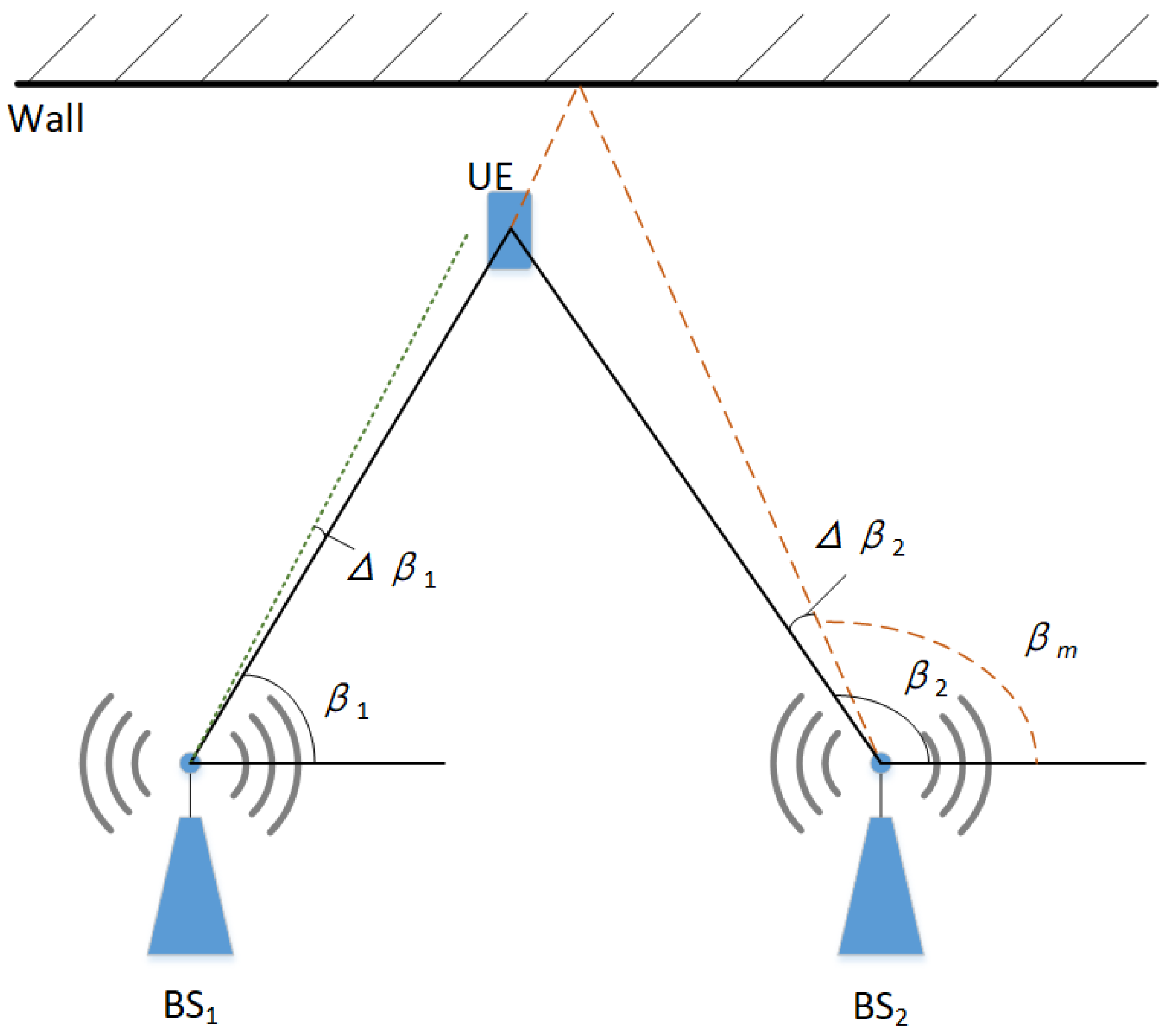
The AOA positioning technique utilizes the built-in antenna array at the receiving end of the base station, denoted as BSi, to capture the azimuthal angle of the electromagnetic wave transmitted from the user terminal ( U E ). This information is used to formulate the tangent function equation, as depicted in Figure 1. The coordinates of the base station B S 1 are ( x 1 , y 1 ) , the coordinates of the base station B S 2 are ( x 2 , y 2 ) , and the coordinates of U E are ( X , Y ) . Without considering the noise and the multipath influence, the measured angle of arrival of the base station B S 1 is β 1 , and the angle of arrival of the base station B S 2 is β 2 , which can be obtained by the trigonometric function Equation (1):
tan β 1 = y 1 Y x 1 X
tan β 2 = y 2 Y x 2 X
Figure 1. Schematic diagram of AOA localization, where the black line is the normal signal propagation, the green dashed line is the noise interference schematic, and the orange dashed line is the multipath influence schematic.
Combining the two equations, the horizontal and vertical coordinates of the user’s U E are obtained as:
X = y 2 y 1 + x 1 tan β 1 x 2 tan β 2 tan β 1 tan β 2
Y = y 2 tan β 1 y 1 tan β 2 + tan β 1 tan β 2 x 1 x 2 tan β 1 tan β 2
However, in the indoor signal propagation process, it is necessary to consider the influence of noise and multipath propagation on the signal. This leads to errors in the positioning results. Taking the analysis of the relationship between the measured coordinates and the true coordinates as an example of individual noise interference and individual multipath propagation interference, it is assumed that the measured arrival angle β 1 at base station B S 1 will have an error Δ β 1 due to noise interference. The multipath signal arrival angle β m at base station B S 2 results in an error Δ β 2 relative to the true arrival angle β 2 . The measured coordinates X m e a s u r e d and Y m e a s u r e d obtained in this way are shown in Equations (5) and (6).
X m e a s u r e d = y 2 y 1 + x 1 tan β 1 ± Δ β 1 x 2 tan β m ± Δ β 2 tan β 1 ± Δ β 1 tan β m ± Δ β 2
Y m e a s u r e d = y 2 tan β 1 ± Δ β 1 y 1 tan β 2 ± Δ β 2 + tan β 1 ± Δ β 1 tan β 2 ± Δ β 2 x 1 x 2 tan β 1 ± Δ β 1 tan β 2 ± Δ β 2
By comparing Equations (3) and (5), it can be concluded that there is a certain correlation between the true coordinates X of the UE and X m e a s u r e d , and there exists a rather complex mapping relationship. That is, X m e a s u r e d can be expressed as a function of X, Δ β 1 , and Δ β 2 , as shown in Equation (7).
X m e a s u r e d = f X , Δ β 1 , Δ β 2
In relatively static indoor scenarios, the noise and multipath effects at a particular location are correlated with the position of the terminal, i.e., Δ β 1 and Δ β 2 can be expressed as functions associated with X and Y. Substituting this into Equation (7), we obtain Equation (8).
X m e a s u r e d = f X , Y
Similarly, Y m e a s u r e d can be obtained as shown in Equation (9).
Y m e a s u r e d = g X , Y
Combining Equations (8) and (9), the mapping relationship between ( X m e a s u r e d , Y m e a s u r e d ) and (X, Y) can be obtained as shown in Equation (10).
X m e a s u r e d , Y m e a s u r e d = h X , Y
According to Equation (10), the mapping relationship between (X, Y) and ( X m e a s u r e d , Y m e a s u r e d ) can be derived as shown in Equation (11).
X , Y = p X m e a s u r e d , Y m e a s u r e d
In theory, the derivation process from Equations (7)–(11) is achievable, and according to Equation (11), it is possible to easily calculate the true coordinates from the measured coordinates. However, in practice, the derivation process from Equations (7)–(11) is extremely complex, and the mapping function of noise with respect to coordinates is nearly impossible to represent accurately with an exact function. In situations where the mapping relationship between the two is known to exist but is challenging to directly express, neural networks excel at solving such problems. By modeling with neural networks, training through regression, and fitting the relationship in Equation (11), an approximation of the mapping relationship shown in Equation (11) can be obtained. This aims to achieve the goal of deducing the true coordinates from the measured coordinates, thus reducing positioning errors.

3.2. 5G Indoor Positioning Dataset

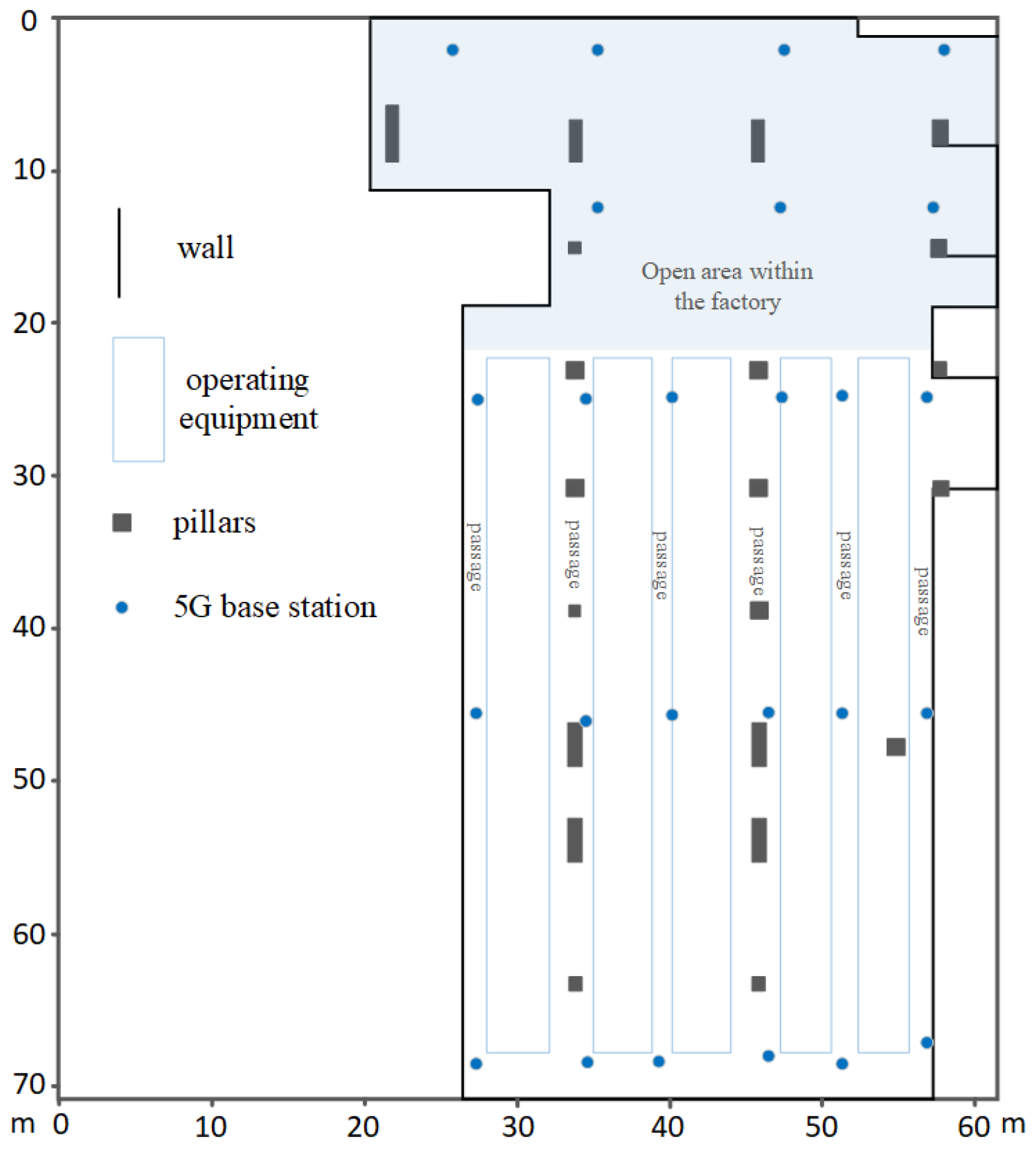
The plan view of the working room within the factory area is illustrated in Figure 2, depicting the layout of the 5G base stations. At each location, point within the working area, 5G signal data are collected, and the measured coordinates are determined using the angle-of-arrival (AOA) localization algorithm, as in Equations (5) and (6). Simultaneously, these measured coordinates are compared with the real coordinates, forming the database of AOA-measured and real coordinates. This process results in a dataset comprising 16,300 items.
Figure 2. Schematic plan of the plant workspace; the blue point is the 5G base station. All areas are within the factory’s working space. The light-blue area represents the open space inside the factory. The blue rectangle below indicates operational equipment, with an aisle in the middle for pedestrian passage.
The study utilizes commercially deployed 5G base stations by Chinese operators, conducting experiments using common smartphones. The 5G base stations are assumed to be approximately 3 m in height. Within the factory premises, open areas are spaced at intervals of 3 to 4.2 m, while aisle areas are spaced at 3 m intervals to avoid equipment and collect data. There are a total of 163 measurement points, evenly distributed throughout the entire factory area. Terminals are placed at the test points, mounted on smartphone stands at a height of approximately 1.5 m above the ground. The sampling frequency is 1 Hz, with 100 samples taken at each sampling point. All sample data include a sampling timestamp, measured terminal coordinates ( X m e a s u r e d , Y m e a s u r e d ), and actual terminal coordinates ( X r e a l , Y r e a l ).
In direct line-of-sight conditions without any other electromagnetic interference, the positioning error of the terminal obtained through the AOA localization method is less than 0.5 m. However, in real-world scenarios, the positioning error varies depending on the environment at different locations, showing different rates of increase. Please refer to the subsequent discussion for the analysis of positioning errors in each area.
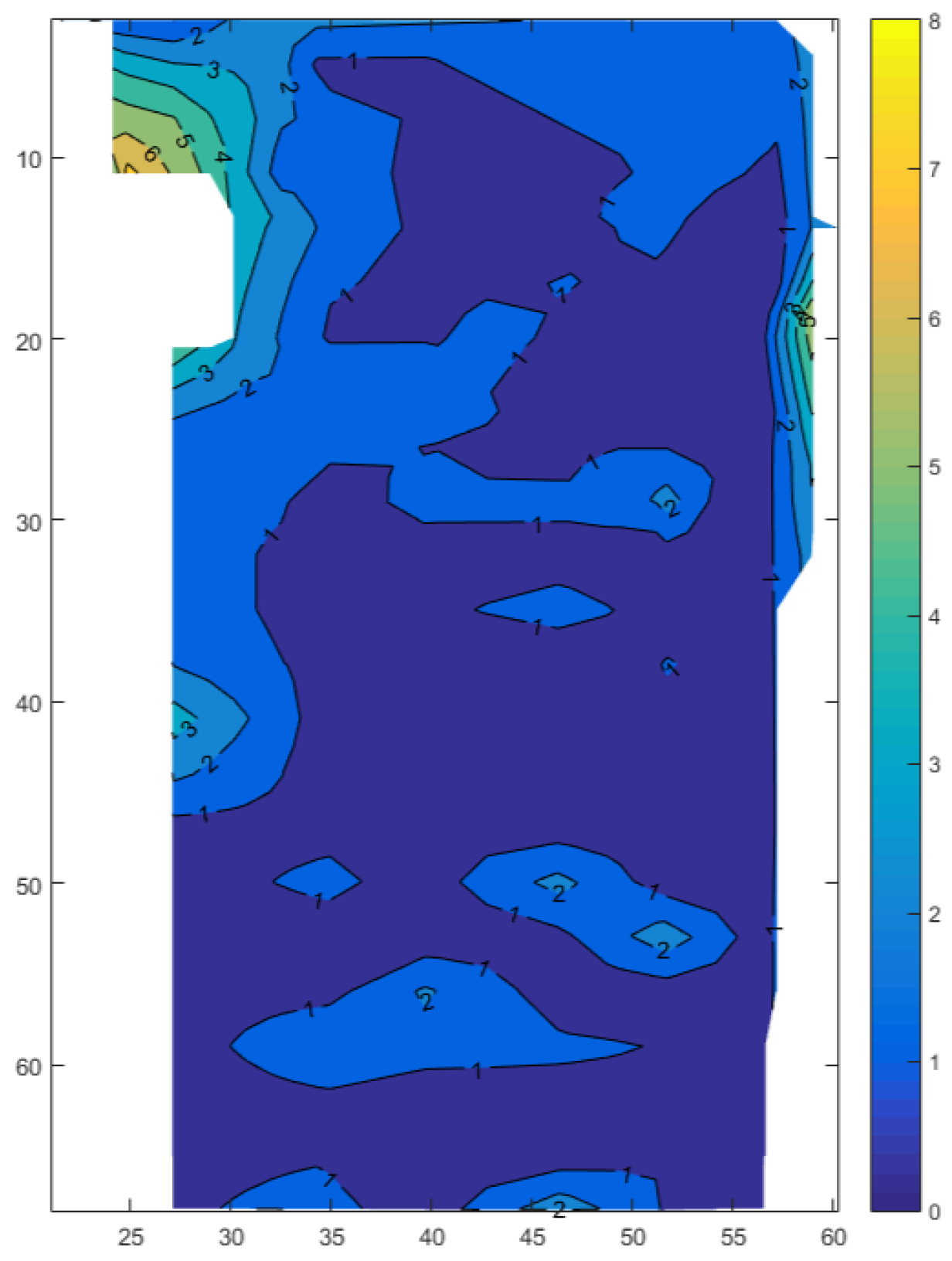
We calculate the Euclidean distance as the measurement error according to the real coordinates and the measured coordinates in the dataset and obtain the error contour map of the indoor working area as shown in Figure 3. Figure 3 shows the 2D positioning results, where the horizontal and vertical axes represent the true coordinates inside the factory. The contour lines in the figure indicate the error values of the measured coordinates at corresponding positions.
Figure 3. Contour plot of the error of the measurement results at various locations in the indoor work area. The numbers on the contour lines represent positioning errors, and areas with the same color indicate the same range of positioning errors.
The horizontal and vertical axes represent the x-coordinate and y-coordinate, respectively, and the contour lines of different colors represent the errors of different values.
From Figure 3, it is evident that positioning measurement errors are more pronounced in the corners of the work area and near the walls. This is primarily attributed to multipath effects and increased noise around the wall corners.
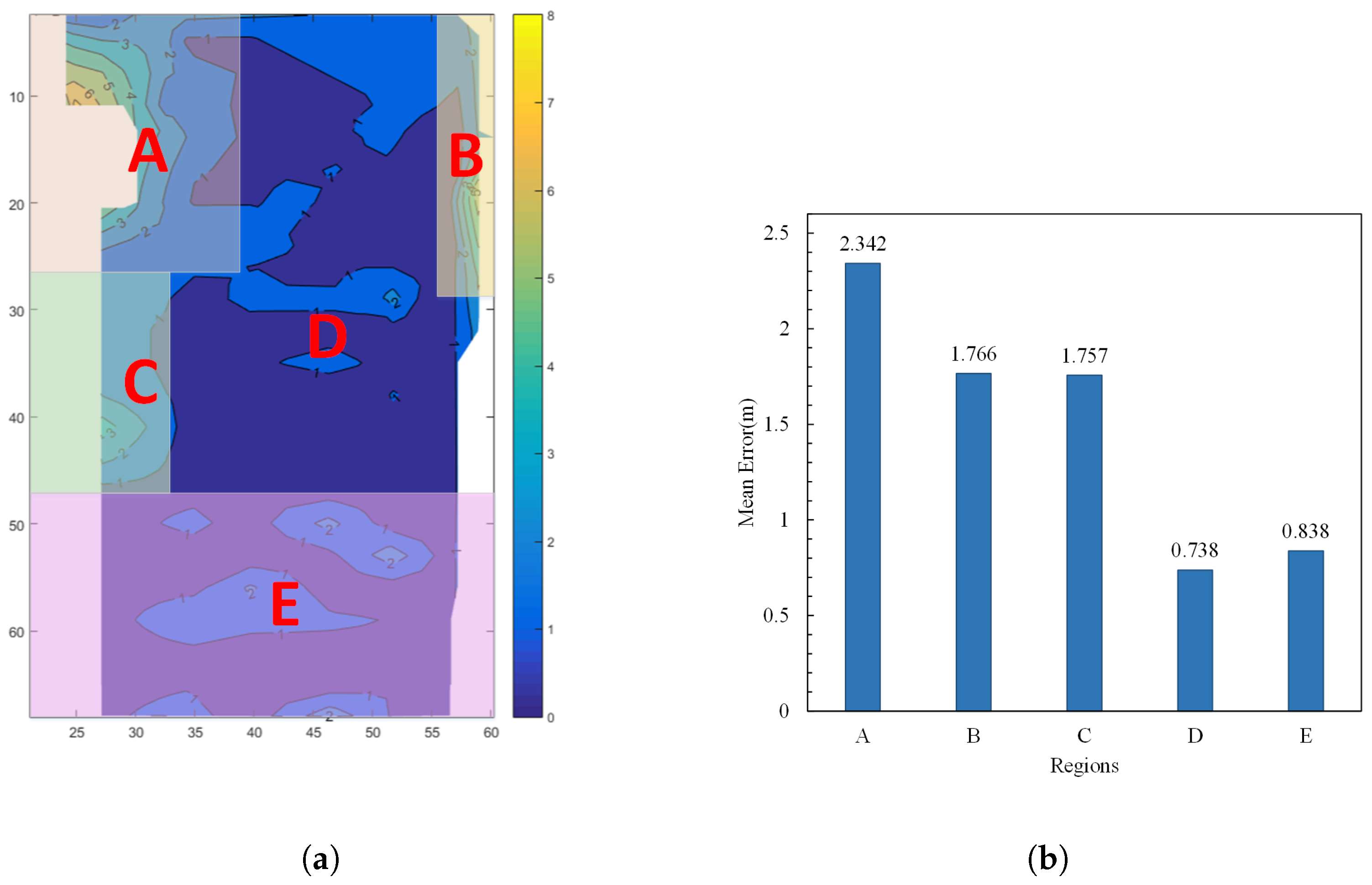
Based on the features presented in the error contour map, we have divided the entire workspace into five regions: A, B, C, D, and E, as shown in Figure 4a. The average positioning errors for each region are depicted in the bar chart in Figure 4b.
Figure 4. Schematic diagram of partitions and bar chart of average errors. (a) Schematic diagram of work area zones. The regions labeled A–E represent five distinct areas delineated in the study. (b) Bar chart of average errors in each region.
According to Figure 4b, it can be observed that the average positioning errors in regions A, B, and C are significantly higher than in other areas. Particularly, in region A, which is located in the corner of the wall, the signal features are more complex, leading to larger positioning errors under various interferences. In regions B and C, based on the AOA positioning error model, it is known that positioning errors are often caused by factors such as multipath propagation and noise. The proposed model will focus on correcting these error factors.
In the subsequent step, this paper will delve into an analysis of the error sources based on positioning principles. Following this analysis, a novel positioning correction algorithm will be proposed.

4. Methods

Regression analysis [41] is a statistical analysis method for determining interdependent quantitative relationships between two or more variables, and the correction from measured to real coordinates is a typical regression problem. Neural networks [39,42,43] have typical nonlinear mapping capabilities to solve regression problems. This section describes the research on the 5G-PECNN algorithm, improvements to the designed model, and details of algorithm optimization methods.

4.1. 5G Positioning Error Correction Neural Network

A neural network can be trained and learned from data to establish relationships between input and output variables without the need for an explicit mathematical model. The network has an input layer, an output layer, and several hidden layers. Each layer contains several neurons, and information transfer between neurons is realized through weights and activation functions [44]. The neural network has obvious advantages in solving complex regression prediction problems with discretized data and has good performance in localization error correction [45].
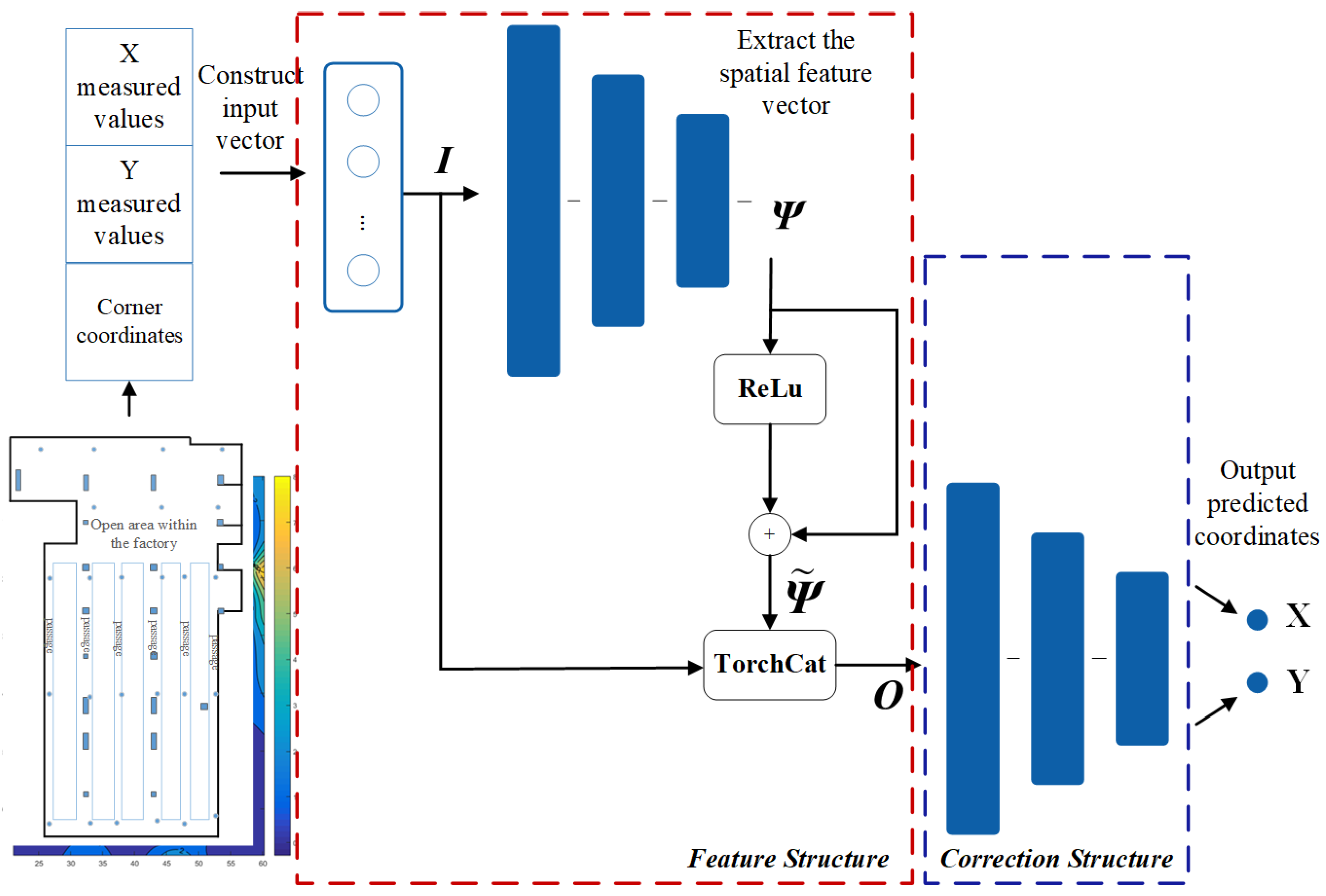
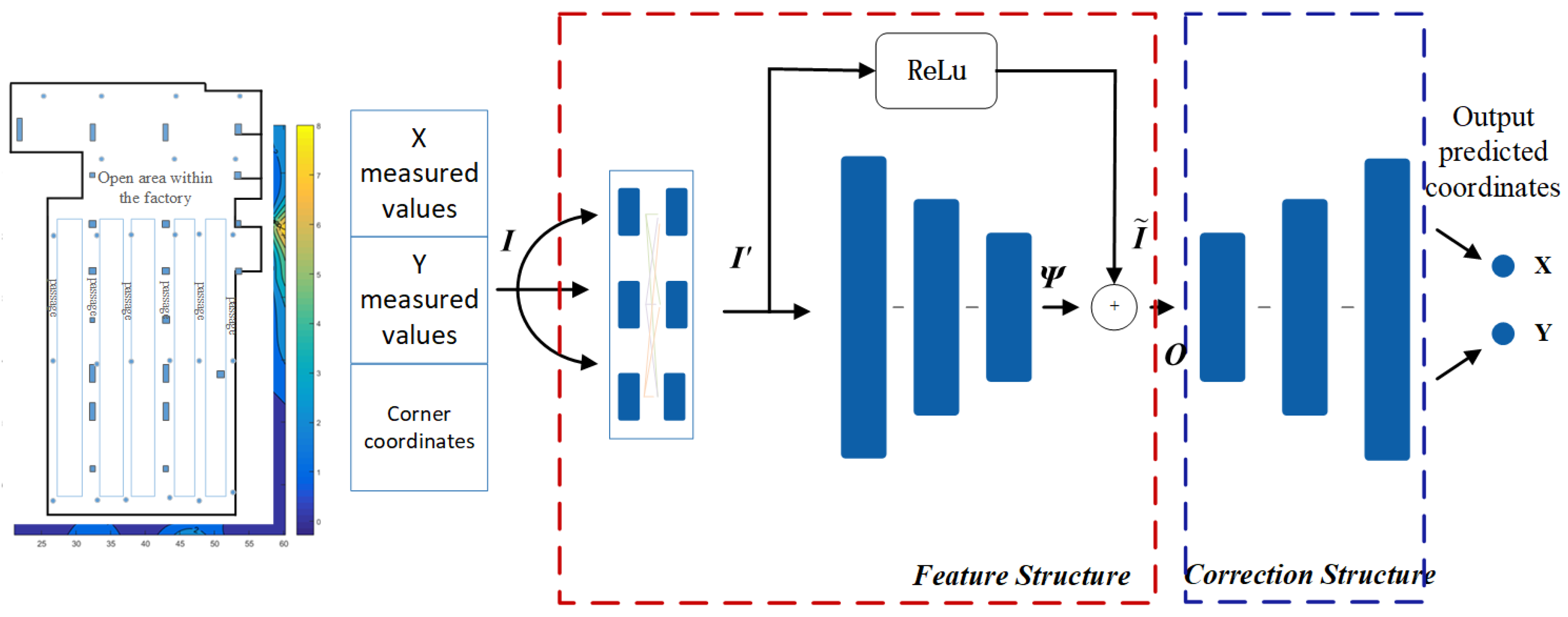
Based on the constructed 5G positioning dataset and error characteristics, a neural network model is established as illustrated in Figure 5, referred to as model A. The input layer comprises estimated coordinates and coordinates of corners within the indoor working area. In this input layer, apart from the estimated coordinates, the coordinates of corners are simultaneously fed into the neural network. As indicated in Figure 3, significant noise and multipath effects are observed at the corners and along the walls, resulting in considerable positioning errors in these locations. Therefore, the coordinates of corners are utilized as factors mapping to error-related elements that are inputted into the neural network. This forms a multi-dimensional input vector using both the estimated coordinates and the coordinates of corners.
Figure 5. The schematic diagram of the constructed neural network model A. The three connected blue rectangles represent the hidden layers of the network. In the Feature structure, the numbers of neurons in the hidden layers are 16, 8, and 4, respectively, while in the Correction structure, they are 30, 16, and 8, respectively.
As shown in Figure 5, the structure within the red dashed box of model A is the spatial signal feature extraction structure. The input tensor is the constructed input tensor I . The three rounded rectangular bars represent hidden layers constructed by neurons, and the neurons in multiple hidden layers are interconnected to form a neural network structure used to extract the spatial feature tensor Ψ . The tensor Ψ ˜ , obtained through residual propagation, is fused with tensor I to construct tensor O through tensor fusion. Tensor O , serving as the input tensor fused with spatial signal features and error information, is passed into the error correction structure. The error correction model fits the spatial signal features and error information, outputting the corrected coordinates. As shown in Equation (12), where g(x) represents the correction effect of the correction structure.
x , y = g I | | Ψ ˜ = g I | | Ψ + f Re L U Ψ
In the process of forward propagation, initially, spatial signal characteristics are extracted and learned through a feedforward neural network to construct a spatial signal propagation model. The extracted spatial feature vector undergoes residual operations and is fused with the input estimated coordinates, creating a tensor fusion. This fused tensor is then fed into the error correction network to analyze and learn from the fused spatial signal features and the contained error information, subsequently correcting the estimated coordinates. The output layer represents the corrected user terminal coordinates. During the training phase, the output layer comprises the actual coordinates of the user terminal, aiming to establish a correction model from the estimated coordinates to the real coordinates.
Model A employs two regular pyramid structures, while model B incorporates two symmetric pyramid structures. A comparison of their effectiveness is conducted to evaluate their respective performance. Based on the improvement of model A, the optimized model B is obtained, as illustrated in Figure 6. Through repeated studies, it was found that by extracting partition features from the input tensor I to obtain tensor I , performing residual propagation in one direction to obtain tensor I ˜ , and passing it into a hidden layer to extract spatial feature tensor Ψ in another direction, the tensor Ψ is fused with tensor I ˜ to construct tensor O . Tensor O , as the input vector fused with spatial signal features and error information, is passed into the error correction structure. The error correction model fits spatial signal features and error information, outputting the corrected error coordinates. In the correction structure, inverting the number of neurons in the hidden layer can better expand the fused spatial signal features and error information, forming correction factors to correct coordinates containing errors, resulting in a better correction effect. As shown in Equation (13), where g(x) represents the correction effect of the correction structure.
x , y = g I ˜ | | Ψ = g f Re L U I | | Ψ
Figure 6. The schematic diagram of the constructed neural network model B. The three connected blue rectangles represent the hidden layers of the network. In the Feature structure, the numbers of neurons in the hidden layers are 16, 8, and 4, respectively, while in the Correction structure, they are 6, 8, and 16, respectively.
The ReLU function is selected as the activation function during training (Equation (14)) to reduce the model computation and avoid overfitting and gradient disappearance
f Re L U x = max 0 , x
The MSE (mean squared error) function was chosen as the loss function of the model (Equation (15)).
M S E = 1 n n = 1 n y i y ^ i 2
In Equation (15), n represents the number of samples in the testing set. y i ( i = 1 , 2 , , n ) denotes the actual values for the ‘i-th’ sample, and y ^ i ( i = 1 , 2 , , n ) represents the predicted values for the ‘i-th’ sample. The mean squared error (MSE) is a measure where a smaller value indicates that the model’s prediction errors are also smaller.
After repeated experimental validation to adjust the model structure, the 5G localization error correction network is obtained.

4.2. Adaptive Global Gradient Descent Algorithm

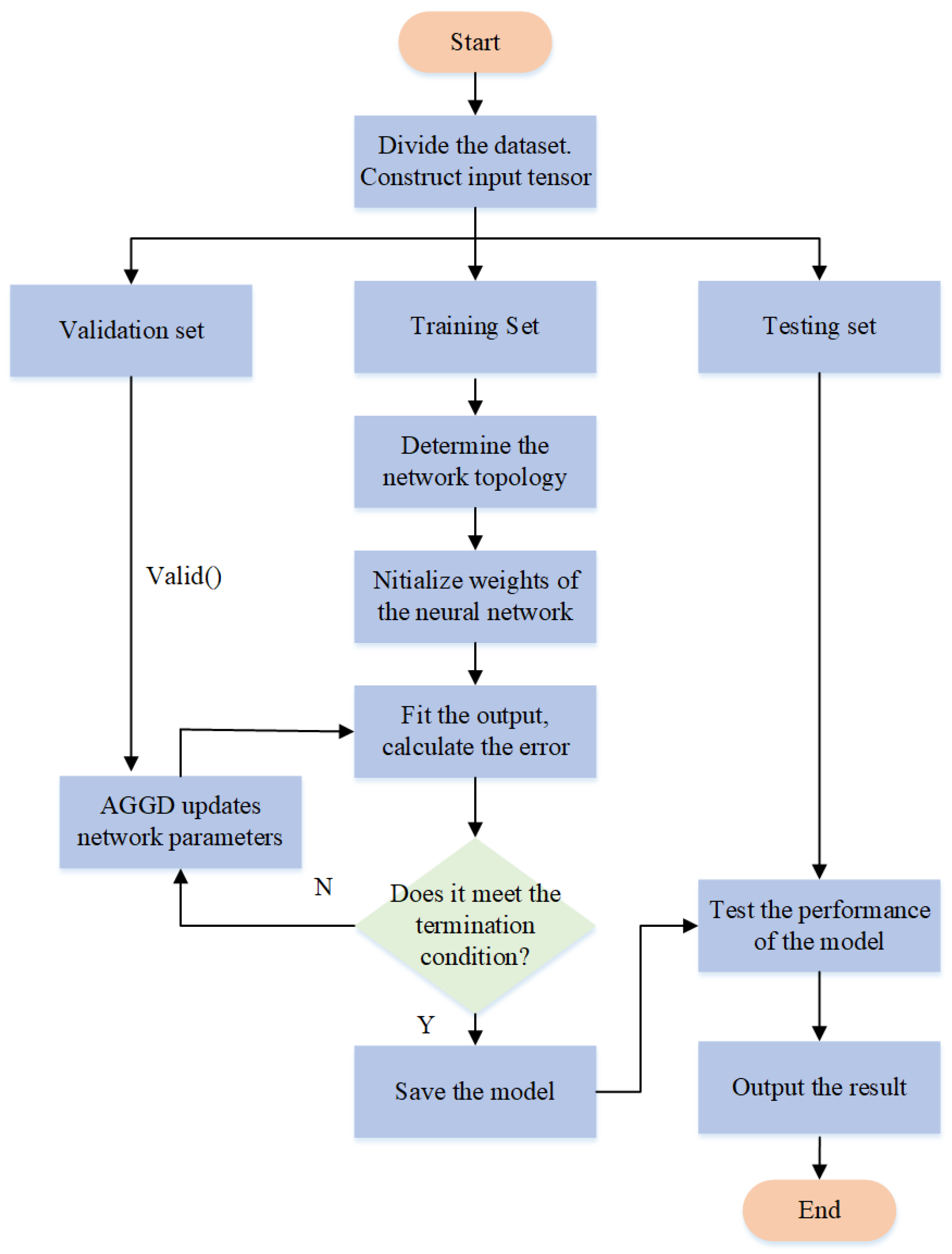
In general, the solution for neural network models involves descending along the negative gradient direction [36,46]. Due to the random initialization of initial weights and thresholds, neural network models are prone to becoming stuck in local minimums and failing to achieve global optimal solutions. This often leads to poorer predictive performance, larger errors, and, in our experimental environment, an inclination towards local minimums resulting in outputting local mean coordinates. To prevent the model from being trapped in local optimal solutions, this paper introduces a Positioning Error Correction Neural Network for 5G (5G-PECNN) based on an Adaptive Global Gradient Descent (AGGD) algorithm. The algorithm’s workflow is depicted in Figure 7.
Figure 7. Algorithm Flowchart of the 5G Positioning Error Correction Neural Network based on an Adaptive Global Gradient Descent Algorithm.
Firstly, the dataset is randomly shuffled, and 20% is randomly selected as the test set, 20% as the validation set, and 60% as the training set. The training set is used for model training. During the training process, the model’s network topology is determined, the neural network weights are initialized, and then the iterative training process begins. In each epoch, the pre-built model predicts output results, compares them with the ground truth to calculate the output loss. The training continues until the termination conditions are met. The AGGD algorithm is employed to update network parameters, with the validation set used to verify the model’s performance and prevent overfitting. Once the termination conditions are met, the trained model is saved, and the test set is used to evaluate the model’s performance, producing the test results.
This paper proposes using a network parameter updating method based on AGGD, replacing the direct loss backpropagation and parameter updating method in neural networks, effectively avoiding the model from falling into local mean-value minimum solutions. The network parameter updating method based on AGGD is depicted in Algorithm 1.
Algorithm 1: pseudo code of AGGD
1 Tensor W 0 , Tensor L 0
2Parameters:  W 0 : Weight Parameters of Neural Network Nodes in the Previous Training Epoch; L 0 : Loss Values of the Neural Network for the Previous n Training Epochs.
3Operation: The algorithm is based on the Pytorch framework, please refer to Pytorch [47] for related torch operations.
4Output: W: Weight Parameters of Neural Network Nodes in this Training Epoch.
5def AGGD(self, W 0 , L 0 ):
6  # Initialization
7  W = W 0
8  optimizer = torch.optim.Adam(model.parameters(), lr = 0.0004)
9  yPred = model(x)  #Predict output using previous generation weights
10  l = torch.nn.MSE(yPred, yReal)
11
   y P r e d V a r i a n c e = 1 m n i = 1 n j = 1 m y i P r e d M e a n yPred 2 , y P r e d i yPred
12  L = L 0 .append(l)
13   L v a r i a n c e = 1 n i n l i M e a n L 2 , l i L
14  # Update network weights
15   f l a g = c o u n t 150 & l > 0.006 & L v a r i a n c e < 0.1 & y P r e d V a r i a n c e < 0.2
16  if flag:
17     W = t o r c h . r a n d o m . i n i t W e i g h t W 0 w h i l e W = W 0
18    count = 0
19    L = []
20  else:
21    optimizer.zero_grad()
22    loss.backward()
23    count += 1
24    valid()
In general scenarios, optimization gradient descent algorithms like AdaGrad and Adam can reduce the probability of falling into local optima to some extent. However, in different scenarios, it is still possible to encounter local optima, necessitating the consideration of specific situations in the studied scenario to help escape local optima and find global optima. In the context of this paper, during the training process, there is a certain probability of falling into the mean solution of certain coordinates at some locations, causing the loss value to become trapped in a local optimum. Therefore, it is necessary to first determine whether a local optimum has been reached and then escape it.
In this scenario, it is determined that when the training iteration is greater than or equal to a certain threshold, the loss value is greater than a certain threshold, and the variance of the loss value is less than a certain threshold, it represents a stable situation where the loss value reaches a local minimum, indicating convergence to a local minimum. At this point, if the variance of the inferred coordinates (yPred) is less than a certain threshold, it indicates that the algorithm has converged to a local minimum. Here, l represents the loss value for each epoch, y P r e d represents the inferred coordinates, y P r e d V a r i a n c e represents the variance of the inferred coordinates, L v a r i a n c e represents the variance of the loss value, c o u n t represents the iteration count, and f l a g indicates whether a local minimum has been reached.
When it is determined that a local minimum has been reached, the model escapes from the local optimum by randomly shuffling the network weights, leading to an increase in the loss value. If the condition for reaching a local minimum is not met, the Adam gradient descent algorithm is employed.
Therefore, existing gradient descent algorithms focus more on optimizing the descent process during gradient descent to achieve rapid descent. The method proposed in this paper is based on the special characteristics of the scenario, by adding criteria to determine whether a local optimum has been reached. When the existing algorithm fails to escape from the local optimum, it shuffles the model weights and then searches for the global optimum using the existing gradient descent algorithm. The improvement to existing gradient descent algorithms lies primarily in adding criteria for determining whether a local optimum has been reached, which are suitable for specific scenarios, and escaping from local optima by shuffling model weights.

5. Results and Discussion

Based on the dataset prepared in Section 3, the performance of the designed 5G-PECNN algorithm will be tested.

5.1. Experimental Environment and Dataset Division

The dataset containing 16,300 data points of measured and real coordinates is randomly disrupted, 20% of it is selected as a test set to test the application effect of the algorithm, and the rest is used as a training set to train the 5G-PECNN model. A total of 25% of the training set is used as a validation set to validate the iterative effect of the model during the training process and is not involved in the gradient descent. The hardware environment for training and testing includes an Intel i7-11800H CPU, 32 GB of memory, and an RTX3060 Laptop GPU, all running on the Windows 10 operating system. The software environment comprises Python version 3.8.17, PyTorch version 1.8.2, and CUDA version 11.1.

5.2. Test Results and Analysis

The Euclidean distance from the coordinates of the predicted point to the coordinates of the real point is chosen as the error evaluation standard when the test results are evaluated, i.e., the smaller the Euclidean distance represents the closer the predicted results are to the real coordinates, and the smaller the error is. The Euclidean distance is shown in Equation (16).
d = i = 1 2 x i y i 2
where x i denotes the predicted coordinates and y i denotes the true coordinates.
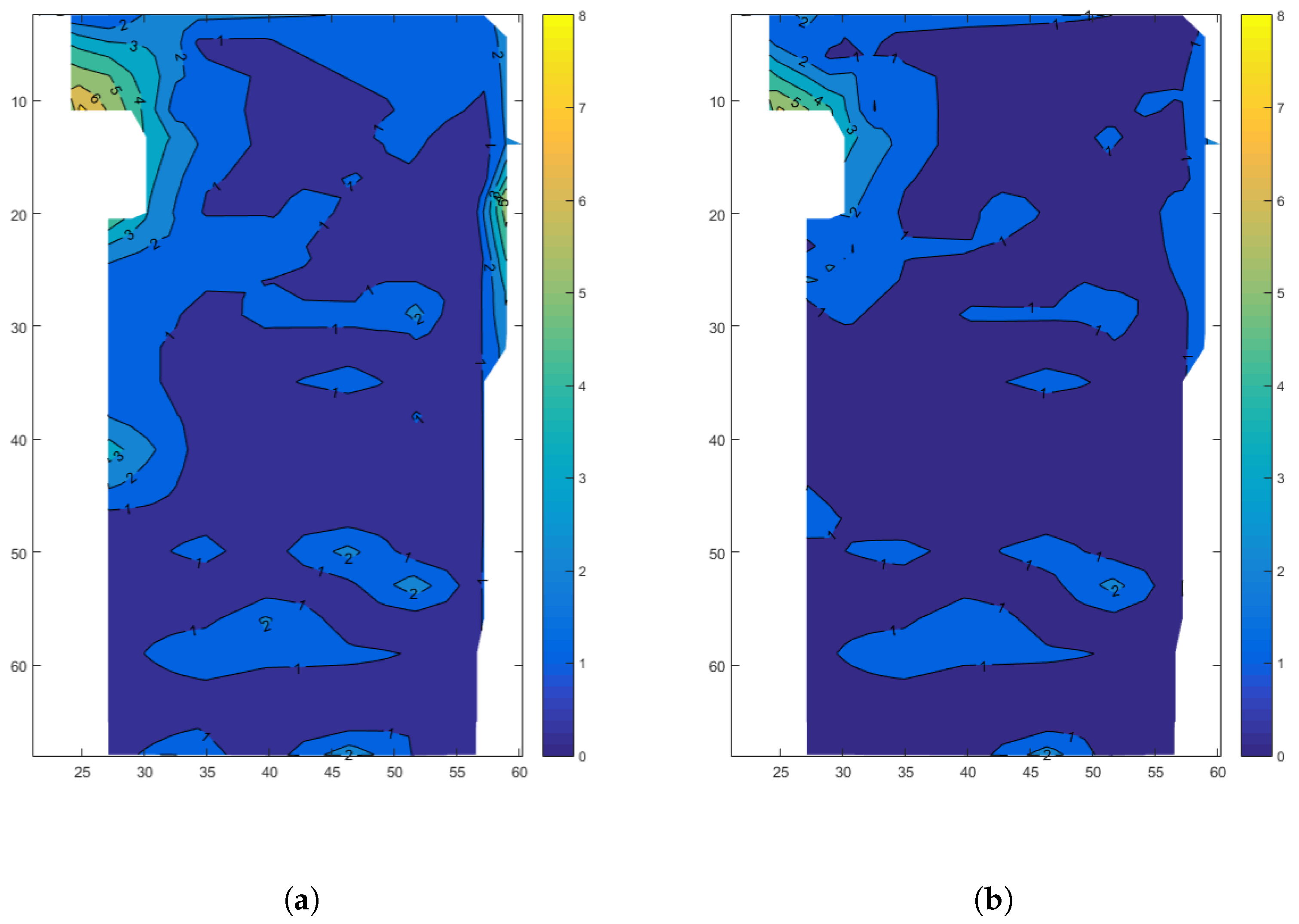
Its overall position mapping error distribution is shown as Figure 8, with the original data on the left and the error-corrected data of the 5G-PECNN model B on the right. The mean values of the errors before and after the error correction are 1.2 m and 0.934 m, respectively.
Figure 8. Overall test effect diagram. (a) Original error distribution. (b) Corrected error distribution.
Comparing the original error distribution and the corrected error distribution in Figure 8, it can be observed that significant positioning errors occur around the corners and near the walls within the working area. These errors primarily result from multipath effects and increased noise around the corners. In these specific areas, the 5G-PECNN (5G positioning error correction neural network) model B shows a significant error correction effect.
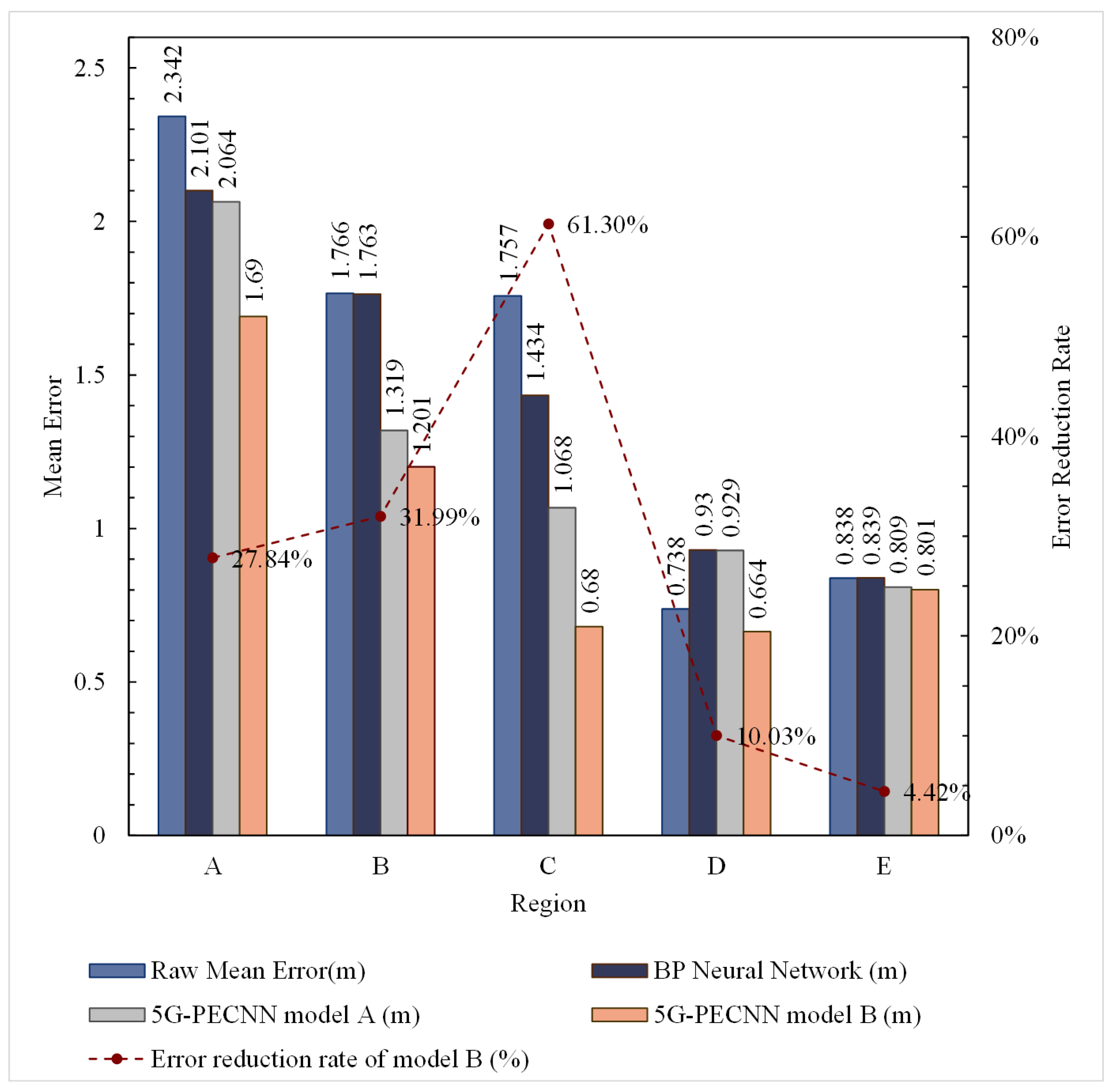
To further analyze the correction performance of 5G-PECNN, we evaluated the correction effect in each area according to the workspace division shown in Figure 4a. The results are presented in Table 1 and Figure 9.
Table 1. 5G-PECNN partition error correction effect.
Figure 9. Performance comparison chart for different models in different regions.
Based on Table 1 and Figure 9, the traditional backpropagation neural network (BPNN) only exhibits some correction effects in areas A and C, but its impact is not significant in other regions. It is evident that the 5G-PECNN model A exhibits a more notable positioning correction effects in Regions B and C. It shows a certain level of correction in Region A, but the correction effect in Region E is not distinct. Moreover, the error correction in Region D has a negative impact. Analysis of Regions D and E indicates that these areas are vast open spaces with minimal signal noise and fewer multipath interferences. Due to fewer factors contributing to positioning errors that can be corrected by model A, its efficacy in these regions is suboptimal, leading to ineffective or even increased positioning errors. After excluding the data from Region D, the average error decreased by 37.4% after the comprehensive positioning error correction in other regions. Consequently, model A demonstrates effective correction results in areas with noise and multipath interferences like corners and walls.
In response to the performance of model A, model B has made improvements to the feature structure of model A. Firstly, the input vector was optimized for extracting regional feature tensors. The extracted tensor was then fused with the spatial signal feature tensor output by the feature structure. This allows for better fitting of spatial signal features. In the correction structure, inverting the number of neurons in the hidden layer can better expand the fused spatial signal features and error information, forming correction factors to correct coordinates containing errors, resulting in a better correction effect.
As shown in Table 1 and Figure 9, model B achieved significant error correction effects in areas A, B, and C. The error reduction rates are 27.84%, 31.99%, and 61.30%, respectively. For regions D and E, which originally had smaller average errors, model B also achieved some correction effects without expanding the errors. Constrained by the inherent performance of 5G signals in achieving positioning accuracy, the positioning accuracy corrected by the 5G-PECNN constructed by model B is already sufficiently excellent.
In conclusion, the 5G-PECNN constructed by model B has achieved the best error correction results.

6. Conclusions

In this paper, the advantages and trends of using 5G signals for positioning in indoor environments with signal obstruction, such as GPS, are first introduced. The paper analyzes the problems in 5G positioning and presents the practical issues addressed in this study. Subsequently, the research explores the principles of 5G positioning, 5G NR positioning, related studies on wireless signal positioning error correction, and relevant methods for positioning error correction. Based on the analysis above, the paper starts from the principles of 5G angle-of-arrival (AOA) positioning and analyzes the impact of noise and multipath interference in the spatial propagation of 5G signals on positioning results. Addressing the resulting positioning errors, the paper introduces a 5G Positioning Error Correction Neural Network (5G-PECNN) based on an Adaptive Global Gradient Descent Algorithm. Validation of the 5G-PECNN’s correction effectiveness was conducted using a dataset constructed from data collected in the working area. Experimental results demonstrate that the 5G-PECNN exhibits effective correction in positioning results, particularly in areas with noise and multipath interferences such as corners and walls. In areas with significant multipath interference and high signal noise, the positioning errors have been reduced by 27.84% in corners and by 31.99% and 61.30% along the walls. The corrected positioning results of 5G-PECNN approach the accuracy of 5G positioning in an interference-free environment.
However, this method has certain limitations. Since this method focuses on correcting the coordinates output by closed-source devices that cannot obtain signal propagation time, angles, and other information, the correction effect is subject to certain restrictions. In future research, open-source devices will be used in combination with signal geometric information, signal strength information, etc., to correct positioning coordinates, aiming to achieve higher accuracy.

Author Contributions

Conceptualization, S.Y. and Q.Z.; methodology, S.Y., L.H. and H.Y.; software, X.W. and T.W.; validation, S.Y., L.H. and H.Y.; writing—original draft preparation, S.L.; writing—review and editing, S.Y. All authors have read and agreed to the published version of the manuscript.

Funding

This project has been supported by the National Key Research and Development Program of China (No. 2021YFB1407002).

Institutional Review Board Statement

Not applicable.

Data Availability Statement

The data used to support the findings of this study are included in this article.

Acknowledgments

We thank anonymous reviewers for their useful comments.

Conflicts of Interest

The authors declare no conflicts of interest.

Abbreviations

The following abbreviations are used in this manuscript:
5G5th-Generation Mobile Communication Technology
GPSGlobal Positioning System
GNSSGlobal Navigation Satellite System
5G NR5th-generation New Radio
TOATime of Arrival
TDOATime Difference of Arrival
AOAAngle of Arrival
RSSIReceived Signal Strength Indication
CSIChannel State Information
RSRPReference Signal Received Power
RSRQReference Signal Quality
5G-PECNNPositioning Error Correction Neural Network for 5G
AGGDAdaptive Global Gradient Descent
BPBackpropagation Neural Network
ReLURectified Linear Unit
MSEMean squared error

References

  1. Elsheikh, M.; Iqbal, U.; Noureldin, A.; Korenberg, M. The Implementation of Precise Point Positioning (PPP): A Comprehensive Review. Sensors 2023, 23, 8874. [Google Scholar] [CrossRef]
  2. Kim Geok, T.; Zar Aung, K.; Sandar Aung, M.; Thu Soe, M.; Abdaziz, A.; Pao Liew, C.; Hossain, F.; Tso, C.P.; Yong, W.H. Review of Indoor Positioning: Radio Wave Technology. Appl. Sci. 2021, 11, 279. [Google Scholar] [CrossRef]
  3. Liu, F.; Liu, J.; Yin, Y.; Wang, W.; Hu, D.; Chen, P.; Niu, Q. Survey on WiFi-based indoor positioning techniques. IET Commun. 2020, 14, 1372–1383. [Google Scholar] [CrossRef]
  4. Cao, H.; Wang, Y.; Bi, J.; Zhang, Y.; Yao, G.; Feng, Y.; Si, M. LOS compensation and trusted NLOS recognition assisted WiFi RTT indoor positioning algorithm. Expert Syst. Appl. 2024, 243, 122867. [Google Scholar] [CrossRef]
  5. Pau, G.; Arena, F.; Gebremariam, Y.E.; You, I. Bluetooth 5.1: An Analysis of Direction Finding Capability for High-Precision Location Services. Sensors 2021, 21, 3589. [Google Scholar] [CrossRef]
  6. Mahmoud, E.; Petteri, M.; Janne, K.; Petri, V.; Ahm, S.; Timo, M.; Mohammed, E.; Heidi, K. Precision Positioning for Smart Logistics Using Ultra-Wideband Technology-Based Indoor Navigation: A Review. IEEE Access 2022, 10, 44413–44445. [Google Scholar]
  7. Mogyorósi, F.; Revisnyei, P.; Pašić, A.; Papp, Z.; Törös, I.; Varga, P.; Pašić, A. Positioning in 5G and 6G Networks—A Survey. Sensors 2022, 22, 4757. [Google Scholar] [CrossRef]
  8. Ruan, Y.; Chen, L.; Zhou, X.; Liu, Z.; Liu, X.; Guo, G.; Chen, R. iPos-5G: Indoor Positioning via Commercial 5G NR CSI. IEEE Internet Things J. 2023, 10, 8718–8733. [Google Scholar] [CrossRef]
  9. Chen, L.; Zhou, X.; Chen, F.; Yang, L.-L.; Chen, R. Carrier Phase Ranging for Indoor Positioning with 5G NR Signals. IEEE Internet Things J. 2022, 13, 10908–10919. [Google Scholar] [CrossRef]
  10. Geng, Z.; Yang, J.; Guo, Z.; Cao, H.; Leonidas, L. Research on Fingerprint and Hyperbolic Fusion Positioning Algorithm Based on 5G Technology. Electronics 2022, 11, 2405. [Google Scholar] [CrossRef]
  11. Liu, Z.; Chen, L.; Zhou, X.; Jiao, Z.; Guo, G.; Chen, R. Machine Learning for Time-of-Arrival Estimation with 5G Signals in Indoor Positioning. IEEE Internet Things J. 2023, 10, 9782–9795. [Google Scholar] [CrossRef]
  12. Ghazaleh, K.; Ruotsalainen, L. Cooperative Localization Utilizing Reinforcement Learning for 5G Networks. arXiv 2021, arXiv:2108.10222. [Google Scholar]
  13. Chengming, J.; Ian, B.; Kai, Z.; Wee Peng, T.; Keck Voon, L. 5G Positioning Using Code-Phase Timing Recovery. In Proceedings of the 2021 IEEE Wireless Communications and Networking Conference (WCNC), Nanjing, China, 29 March–1 April 2021; pp. 1–7. [Google Scholar]
  14. Zheng, Y.; Sheng, M.; Liu, J.; Li, J. Exploiting AoA Estimation Accuracy for Indoor Localization: A Weighted AoA-Based Approach. IEEE Wirel. Commun. Lett. 2019, 8, 65–68. [Google Scholar] [CrossRef]
  15. Deng, Z.; Wu, J.; Wang, S.; Zhang, M. Indoor Localization with a Single Access Point Based on TDoA and AoA. Wirel. Commun. Mob. Comput. 2022, 2022, 9526532. [Google Scholar] [CrossRef]
  16. Ruan, Y.; Chen, L.; Zhou, X.; Guo, G.; Chen, R. Hi-Loc: Hybrid Indoor Localization via Enhanced 5G NR CSI. IEEE Trans. Instrum. Meas. 2022, 71, 5502415. [Google Scholar] [CrossRef]
  17. Qiao, L.; Xuewen, L.; Minmin, L.; Shahrokh, V. Indoor Localization Based on CSI Fingerprint by Siamese Convolution Neural Network. IEEE Trans. Veh. Technol. 2021, 70, 12168–12173. [Google Scholar]
  18. Celik, G.; Celebi, H. TOA positioning for uplink cooperative NOMA in 5G networks. Phys. Commun. 2019, 36, 100812. [Google Scholar] [CrossRef]
  19. del Peral-Rosado, J.; Gunnarsson, F.; Dwivedi, S.; Razavi, S.; Renaudin, O.; López-Salcedo, J.; Seco-Granados, G. Exploitation of 3D City Maps for Hybrid 5G RTT and GNSS Positioning Simulations. In Proceedings of the ICASSP 2020—2020 IEEE International Conference on Acoustics, Speech and Signal Processing (ICASSP), Virtual, 4–8 May 2020; pp. 9205–9209. [Google Scholar]
  20. Schmidt, R. Multiple emitter location and signal parameter estimation. IEEE Trans. Antennas Propag. 1986, 34, 276–280. [Google Scholar] [CrossRef]
  21. Huang, X.; Guo, Y. Frequency-Domain AoA Estimation and Beamforming with Wideband Hybrid Arrays. IEEE Trans. Wirel. Commun. 2011, 10, 2543–2553. [Google Scholar] [CrossRef]
  22. Hu, A.; Lv, T.; Gao, H.; Zhang, Z.; Yang, S. An ESPRIT-Based Approach for 2-D Localization of Incoherently Distributed Sources in Massive MIMO Systems. IEEE J. Sel. Top. Signal Process. 2014, 8, 996–1011. [Google Scholar] [CrossRef]
  23. Inoue, M.; Hayashi, K.; Hui, G.; Mori, H.; Nabetani, T. A DOA Estimation Method with Kronecker Subspace for Coherent Signals. IEEE Commun. Lett. 2018, 22, 2306–2309. [Google Scholar] [CrossRef]
  24. Huang, H.; Yang, J.; Huang, H.; Song, Y.; Gui, G. Deep Learning for Super-Resolution Channel Estimation and DOA Estimation Based Massive MIMO System. IEEE Trans. Veh. Technol. 2018, 67, 8549–8560. [Google Scholar] [CrossRef]
  25. Han, S.; Li, Y.; Meng, W.; He, C. A New High Precise Indoor Localization Approach Using Single Access Point. In Proceedings of the GLOBECOM 2017—2017 IEEE Global Communications Conference, Singapore, 4–8 December 2017; pp. 1–5. [Google Scholar]
  26. Li, Y.; Zhang, Z.; Wu, L.; Dang, J.; Liu, P. 5G Communication Signal Based Localization with a Single Base Station. In Proceedings of the 2020 IEEE 92nd Vehicular Technology Conference, Virtual, 18 November–16 December 2020; pp. 1–5. [Google Scholar]
  27. Wang, W.; Zhang, W. Joint Beam Training and Positioning for Intelligent Reflecting Surfaces Assisted Millimeter Wave Communications. IEEE Trans. Wirel. Commun. 2021, 20, 6282–6297. [Google Scholar] [CrossRef]
  28. Nagah Amr, M.; ELAttar, H.M.; Abd El Azeem, M.H.; El Badawy, H. An Enhanced Indoor Positioning Technique Based on a Novel Received Signal Strength Indicator Distance Prediction and Correction Model. Sensors 2021, 21, 719. [Google Scholar] [CrossRef]
  29. Liu, Q.; Bai, X.; Gan, X.; Yang, S. Lora RTT ranging characterization and indoor positioning system. Wirel. Commun. Mob. Comput. 2021, 2021, 5529329. [Google Scholar] [CrossRef]
  30. Sosnin, S.; Artyom, L.; Alexey, K. DL-AOD Positioning Algorithm for Enhanced 5G NR Location Services. In Proceedings of the 2021 International Conference on Indoor Positioning and Indoor Navigation (IPIN), Lloret de Mar, Spain, 29 November–2 December 2021. [Google Scholar]
  31. Han, C.; Xue, S.; Long, L.; Xiao, X. Research on Inertial Navigation and Environmental Correction Indoor Ultra-Wideband Ranging and Positioning Methods. Sensors 2024, 1, 261. [Google Scholar] [CrossRef]
  32. Long, K.; Nsalo Kong, D.F.; Zhang, K.; Tian, C.; Shen, C. A CSI-based indoor positioning system using single UWB ranging correction. Sensors 2021, 21, 6447. [Google Scholar] [CrossRef]
  33. Kumar, U.A. Comparison of neural networks and regression analysis: A new insight. Expert Syst. Appl. 2005, 29, 424–430. [Google Scholar] [CrossRef]
  34. Lian-Suo, W.; Hua, L.; Di, W.; Yuan, G. Clock synchronization error compensation algorithm based on BP neural network model. Acta Phys. Sin. 2021, 70, 114203. [Google Scholar]
  35. Wang, H.; Hong, M.; Hong, Z. Research on BP Neural Network Recommendation Model Fusing User Reviews and Ratings. IEEE Access 2021, 9, 86728–86738. [Google Scholar]
  36. Wang, W.; Zhu, Q.; Wang, Z.; Zhao, X.; Yang, Y. Research on Indoor Positioning Algorithm Based on SAGA-BP Neural Network. IEEE Sens. J. 2022, 22, 3736–3744. [Google Scholar] [CrossRef]
  37. Kanhere, A.; Shubh, G.; Akshay, S.; Grace, G. Improving gnss positioning using neural-network-based corrections. NAVIGATION J. Inst. Navig. 2022, 69, 548. [Google Scholar] [CrossRef]
  38. Dai, P.; Wang, S.; Xu, T.; Li, M.; Gao, F.; Xing, J.; Yao, L. Efficient Localization Algorithm with UWB Ranging Error Correction Model based Genetic Algorithm-Ant Colony Optimization-Backpropagation Neural Network. IEEE Sens. J. 2023, 23, 29906–29918. [Google Scholar] [CrossRef]
  39. Cheng, C.; Wang, T.-P.; Huang, Y.-F. Indoor positioning system using artificial neural network with swarm intelligence. IEEE Access 2020, 8, 84248–84257. [Google Scholar] [CrossRef]
  40. Shang, J.; Ziyang, Y. Study in CSI Correction Localization Algorithm with DenseNet. IEICE Trans. Commun. 2022, 105, 76–84. [Google Scholar] [CrossRef]
  41. Beale, C.; Lennon, J.; Yearsley, J.; Brewer, M.; Elston, D. Regression analysis of spatial data. Ecol. Lett. 2010, 13, 246–264. [Google Scholar] [CrossRef]
  42. Hamid, M.; Nitin, K. Optimizing artificial neural network-based indoor positioning system using genetic algorithm. Int. J. Digit. Earth 2013, 6, 158–184. [Google Scholar]
  43. Chin, W.L.; Hsieh, C.C.; Shiung, D.; Jiang, T. Intelligent Indoor Positioning Based on Artificial Neural Networks. IEEE Netw. 2020, 34, 164–170. [Google Scholar] [CrossRef]
  44. Mok, E.; Cheung, B.K.S. An Improved Neural Network Training Algorithm for Wi-Fi Fingerprinting Positioning. ISPRS Int. J. Geo-Inf. 2013, 2, 854–868. [Google Scholar] [CrossRef]
  45. Lu, E.H.-C.; Ciou, J.-M. Integration of Convolutional Neural Network and Error Correction for Indoor Positioning. ISPRS Int. J. Geo-Inf. 2020, 9, 74. [Google Scholar] [CrossRef]
  46. Xue, Y.; Wang, Y.; Liang, J. A self-adaptive gradient descent search algorithm for fully-connected neural networks. Neurocomputing 2022, 478, 70–80. [Google Scholar] [CrossRef]
  47. PyTorch Documentation. Available online: https://pytorch.org/docs/1.8.1/ (accessed on 26 March 2021).
Disclaimer/Publisher’s Note: The statements, opinions and data contained in all publications are solely those of the individual author(s) and contributor(s) and not of MDPI and/or the editor(s). MDPI and/or the editor(s) disclaim responsibility for any injury to people or property resulting from any ideas, methods, instructions or products referred to in the content.

Article Metrics

Citations

Article Access Statistics

Multiple requests from the same IP address are counted as one view.