Abstract
In recent years, one-bit quantization has attracted widespread attention in the field of direction-of-arrival (DOA) estimation as a low-cost and low-power solution. Many researchers have proposed various estimation algorithms for one-bit DOA estimation, among which atomic norm minimization algorithms exhibit particularly attractive performance as gridless estimation algorithms. However, current one-bit DOA algorithms with atomic norm minimization typically rely on approximating the trace function, which is not the optimal approximation and introduces errors, along with resolution limitations. To date, there have been few studies on how to enhance resolution under the framework of one-bit DOA estimation. This paper aims to improve the resolution constraints of one-bit DOA estimation. The log-det heuristic is applied to approximate and solve the atomic norm minimization problem. In particular, a reweighted binary atomic norm minimization with noise assumption constraints is proposed to achieve high-resolution and robust one-bit DOA estimation. Finally, the alternating direction method of multipliers algorithm is employed to solve the established optimization problem. Simulations are conducted to demonstrate that the proposed algorithm can effectively enhance the resolution.
1. Introduction
Direction-of-arrival (DOA) estimation plays an important role in various fields, such as wireless communications, radar, and sonar systems, as it enables the localization and tracking of targets [1,2]. However, most DOA estimation methods typically rely on high-resolution analog-to-digital converters (ADCs), which are costly and power-intensive [3]. In many modern applications, such as large-scale antenna arrays [4,5], the deployment of high-resolution ADCs is prohibitively expensive. As a result, one-bit quantization has gained considerable attention as a low-cost, low-power solution for DOA estimation [3].
There has been extensive research on the use of one-bit ADCs for DOA estimation. Sparse arrays with one-bit quantizers are found to be as good as uniform linear arrays (ULAs) with unquantized data, and it has been proven that with one-bit quantization, nested and coprime arrays can still resolve more signal sources than the number of sensors, provided that the signals are uncorrelated [6]. The reduction in spectral efficiency due to low-precision ADCs is acceptable, when operating at a low-to-moderate signal-to-noise ratio (SNR) with plentiful bandwidth [7], and the Cramér–Rao bound (CRB) of the one-bit signal is times the CRB of the unquantized signal [8,9]. However, one-bit quantization still poses challenges. Due to the fact that one-bit signals only preserve the sign information and the relationship between the covariance of the unquantized signal and the covariance of the one-bit quantized signals is non-linear [10], many DOA estimation algorithms based on covariance analysis suffer from significant performance degradation.
To avoid the aforementioned problems, sparse recovery algorithms are introduced in one-bit DOA estimation [11,12,13,14,15,16,17]. Sparse recovery algorithms use the inherent sparsity of signals in the spatial domain, and do not require knowledge of the covariance matrices [18]. The sparse recovery algorithms also offer the advantages of low-snapshot estimation and robustness to correlated signals [19]. The binary iterative hard thresholding algorithm is extended to the complex-valued multi-snapshot case, which is well suited for DOA estimation scenarios with multiple antenna elements and limited snapshots [11]. An improved fixed-point continuation reconstruction algorithm is developed to enable its application of one-bit complex-valued signal DOA estimation [12]. The one-bit DOA estimation problem is also transformed into a maximum likelihood-based optimization problem with a row-sparse matrix, incorporating an norm regularization term to enhance the estimation accuracy [17]. Besides the above grid-based sparse recovery algorithms, gridless DOA estimation methods are also proposed through the exploration of atomic norm minimization (ANM) in [20,21,22,23,24] to avoid the grid mismatch issue.
ANM methods treat DOA estimation as a sparse reconstruction problem using a continuous, infinite dictionary, and recover the DOAs by solving a semidefinite programming (SDP) problem. Reference [13] first applies binary ANM (BANM) to the one-bit measurements, and proposes a dual polynomial approach to achieve continuous frequency estimation. The frequencies can be estimated in the continuous frequency domain, overcoming the grid mismatch issue in frequency estimation. A BANM DOA estimation method based on sparse linear arrays is also proposed, and the alternating direction method of multipliers (ADMM) is utilized to accelerate the implementation [14]. An algorithm based on accelerated proximal gradients to solve the BANM optimization problem is developed in [15]. However, these methods use the trace function to approximate the rank function, which is a loose approximation and exhibits a discrepancy, similar to the difference between the -norm and the -norm [22], which limits the achievable resolution due to the poorer fitting performance [25].
To improve the resolution of existing gridless one-bit DOA estimation, the binary atomic -norm minimization problem is built and approximated in this paper by the log-det heuristic instead of the trace function approximation. In particular, our contributions are highlighted as follows:
- To achieve higher resolution than the atomic norm, we develop a new optimization model that combines the atomic norm with a regularization term for the sign consistency of one-bit received signals, representing a generalization of atomic norm minimization in a one-bit environment.
- We incorporate a noise constraint into the proposed optimization model, significantly reducing the impact of noise on the atomic norm and thereby enhancing the robustness of the optimization model.
- Rank approximation and the majority minimization (MM) principle are utilized to transform the formulated NP-hard optimization model into a convex optimization problem. Additionally, we derive the solution steps using the alternating direction method of multipliers (ADMM) algorithm.
The content of the paper is arranged as follows. Section 2 introduces the model of one-bit signal, and the principle of atomic norm minimization algorithm is also presented. In Section 3, the robust reweighted binary atomic norm minimization optimization method is proposed. Section 4 derives the solution of the ADMM algorithm for the proposed optimization problem, and provides the detailed algorithmic steps. Section 5 presents the numerical simulations and Section 6 discusses the results. Section 7 concludes the paper.
2. Materials and Methods
2.1. One-Bit DOA Signal Model
Consider a linear array with M omnidirectional antennas that receives K () independent narrowband far-field signals. The observed signal of the array at time t can be expressed as
where
and and represent the signal vector and the noise vector, respectively. L is the number of snapshots. The noise is an independent identically distributed complex Gaussian circularly symmetric distribution with zero-mean and variance . The steering matrix is given by
which is composed of the steering vectors for , and denotes DOA of K uncorrelated signals. In the ULA, the steering vector of the k-th signal can be represented as
where the spatial frequency is given by
d denotes the spacing between the adjacent antennas, and denotes the wavelength of the signal.
To introduce a one-bit quantized signal, the complex sign function is defined as
where and denote the real and imaginary parts of x, respectively, and represents the sign function for real numbers, which is defined as
After one-bit quantization, the received signal can be represented as
For simplicity of notation, is represented as . Equations (1) and (4) can be rewritten for the multi-snapshot case as
where
and represent the signal matrix and the noise matrix, respectively, and represent the input and output of the one-bit ADC, respectively. This work aims to improve the resolution of the estimated DOAs from the one-bit observations .
2.2. Atomic Norm Minimization
The atomic norm minimization algorithm, as a sparse recovery algorithm, can achieve gridless DOA estimation. It leverages the principle of the Vandermonde decomposition of Toeplitz covariance matrices [26], and seeks the minimal combination of atomic sets within the continuous dictionary to effectively estimate the DOAs of a uniform linear array. Compared to grid-based DOA estimation algorithms, it can avoid the grid mismatch issue.
The atomic set of atomic norm minimization under the continuous frequency domain can be constructed as
Let the noise-free signal model of the array be expressed as
It is clear from (8) that can be represented as the smallest number of atoms in the atomic set , denoted by
The ANM algorithm aims to solve the following optimization problem , which can be characterized as a rank minimization problem [27]
where denotes the Toeplitz transformation of the vector
The conventional solution of the atomic- norm is relaxed into the conevx atomic- norm
which indicates that model (12) can be reformulated as an SDP problem
It can be observed that (13) approximates the rank norm in (10) using the trace norm, which is a loose approximation. However, the trace norm is suboptimal. It can be understood that the trace norm is the -norm of the eigenvalues of , and the -norm is known to have a limited resolving capability [25]. Consequently, to achieve a high-resolution gridless one-bit DOA estimation, the next section will introduce a robust reweighted binary atomic norm minimization (robust RBANM) method by employing the log-det heuristic that better fits the rank function and considers the presence of noise.
3. Proposed Method
The BANM algorithm considers the sign consistency between and , and uses linear constraints as the fidelity term. To achieve high resolution, we employ the atomic norm which has no limited resolution. Then, the optimization problem with one-bit atomic norm involving the linear constraints is given as
where is the regularization parameter, and is the normalization constraint which can reduce the optimization search space.
The linear constraints have certain robustness to noise; however, the -norm is more sensitive to data than the -norm, and using only the atomic -norm and the linear constraints on and may lead to inaccurate estimates. Therefore, to achieve a more robust high-resolution one-bit DOA estimation, the influence of noise should be considered. It is obvious that the one-bit ADC input and output maintain sign consistency in the presence of noise
where and represent the real and imaginary parts of , respectively, and and represent the real and imaginary parts of , respectively. The ⊙ symbol denotes the Hadamard product, and represents a matrix with all elements equal to 0.
Based on the assumption of noise, the noise constraints can be reformulated as
With the consistency between and the sign of , the one-bit atomic norm optimization problem is formulated as
According to (10), the newly established one-bit atomic norm optimization problem (18) can be transformed into a rank minimization problem
As studied in [28,29], the log-det heuristic can better approximate the rank function
where represents the eigenvalue vector of , and is the m-th largest eigenvalue of . The parameter can avoid and being . The smaller becomes, approaches .
Define two parameters , . The first four constraints in (19) can be approximated by solving the optimization
To reduce the number of variables, by replacing with and eliminating the variable , we can also solve the following optimization
Motivated by the log-det heuristic (20) and positive semidefinite transformation (22), (19) can be rewritten as
The optimization problem (23) is a non-convex problem. Since is smooth over the positive semidefinite cone, local minimization methods can be used to minimize it. The common algorithm employed is the MM algorithm. The principle of the MM algorithm is to construct a majorant function, which is an upper bound of the objective function, and in each iteration step, the majorant function is minimized to obtain the next iteration point. A commonly used majorant function is the first-order Taylor expansion of the original objective function.
The term can be approximated as
Let and remove the constant term. The optimization problem at the th iteration can be rewritten as
The robust RBANM DOA estimation optimization problem is established. The approach to solve this optimization problem is introduced in the following section.
4. Alternating Direction Method of Multipliers (ADMM) for the Proposed Method
In this section, the ADMM algorithm is employed to solve the optimization problem (25). ADMM is a computational method for solving convex optimization problems with separable structures. It has a fast processing speed and good convergence performance. The fundamental principle underlying the ADMM algorithm is to optimize the original variables in an alternating manner by constructing an augmented Lagrangian function. The augmented Lagrangian function of (25) can be written as
where is the Lagrangian multiplier and is a penalty parameter, and an auxiliary variable is newly introduced
Then, the updating iterations are as follows
where is set as the lth iteration of the inner loop and (ℓ) is set as the ℓth iteration of the outer loop to discriminate the iteration of inner loop and outer loop.
Let and be partitioned as
where , , , , and , , , , ,. and represent the real part and imaginary part of , and and represent the real part and imaginary part of . Taking the derivative of (26) with respect to each parameter yields
where is the Toeplitz adjoint operator, is the operator that calculates the sum of the diagonal elements of matrix.
Let (34) and (35) be equal to zero. Then, we have
where represents the unit vector with the first element equal to 1 and the remaining elements to 0. is the first element of . Substitute (41) into (40), and let (36)–(38) be equal to zero. The variables in (28) are given as
where represents the operator of the positive semidefinite cone. The operator decomposes the matrix eigenvalues and sets all negative eigenvalues to zero, which forces the matrix onto the positive definite cone. The variable in (41) can be updated with the closed form as below
where is an operator that sets negative values to 0 and leaves non-negative values unchanged. Let (39) be equal to zero; with the constraint that is a positive semidefinite matrix, it can be calculated by
The iterative formula for can be written as
By iterative optimization, existing algorithms such as MUSIC, root-MUSIC, and rotation-invariance methods can utilize the pseudo-covariance to estimate DOAs.
5. Results
In this section, the proposed robust RBANM is compared with existing methods, such as one-bit MUSIC [30] and BANM [13,14]. Additionally, to demonstrate the robustness of the proposed algorithm, the noiseless one-bit atomic norm, i.e., the optimization problem (14), is also compared with the proposed method, and it is referred to as RBANM here. To ensure consistency, all four algorithms utilize the MUSIC algorithm for DOA estimation. The estimates obtained from BANM, RBANM, and robust RBANM are used to perform eigendecomposition, extract the noise subspace, and apply the MUSIC algorithm to obtain the spectrum, while the one-bit MUSIC algorithm utilizes the quantized signal covariance to obtain the spectrum. For the BANM, RBANM, and robust RBANM algorithms, the iterative process is terminated when the Frobenius norm of the difference between two consecutive estimates is less than . The initial value of is set to 1, and then a strategy is adopted that, in each iteration, until is reached. The regularization parameter is set to 1. The signals , are set to have equal energy. The signal-to-noise ratio (SNR) is defined as
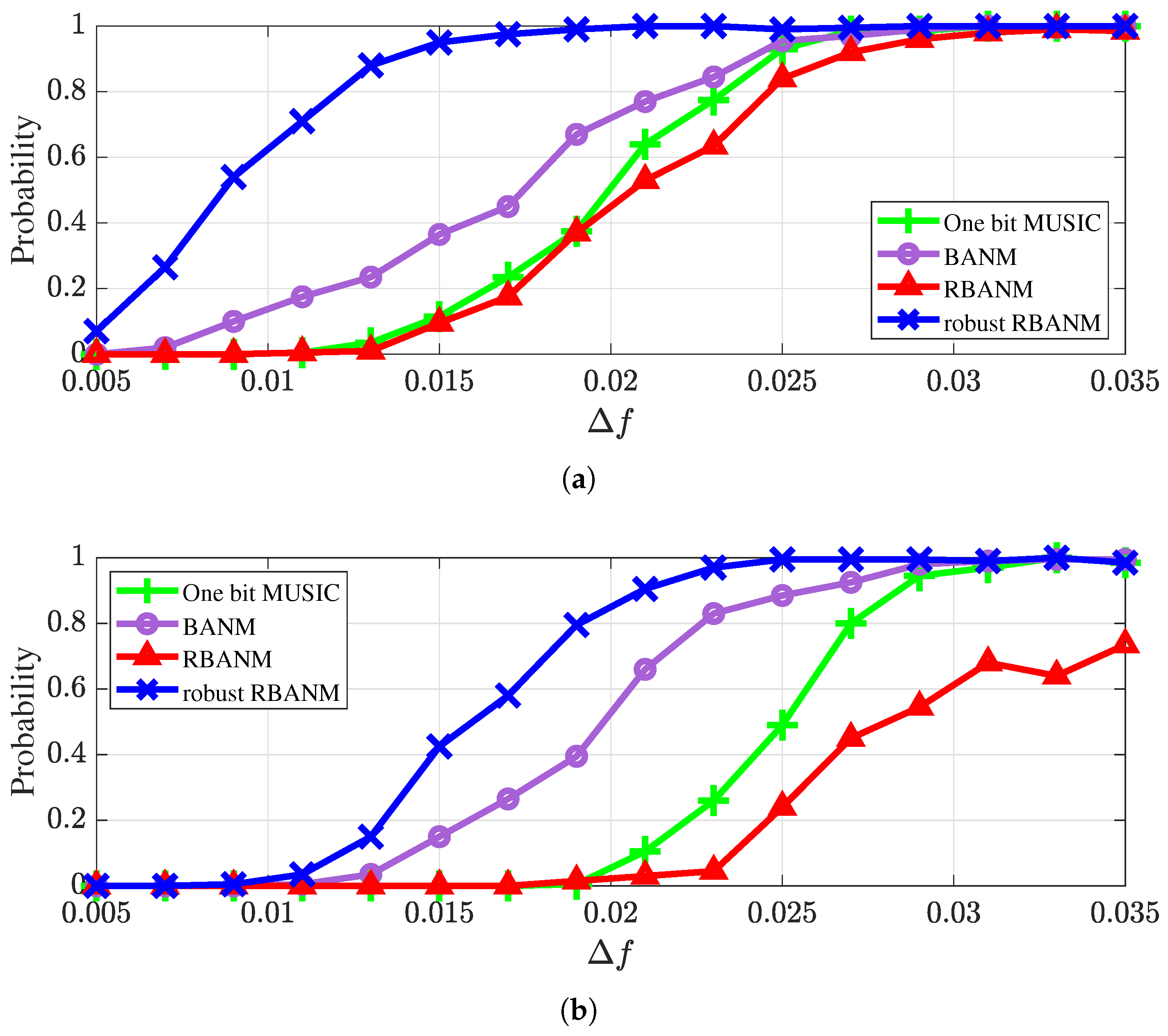
First, the identification probabilities of the four algorithms with different spatial frequency separation under a different number of signals with snapshots are shown in Figure 1. The signal identification criterion is that the DOA estimates from the four methods are within . If all signals are correctly estimated, the trial is counted as 1, otherwise 0. The results are averaged over 500 Monte Carlo trials. The simulation environment is a ULA with sensors, and SNR is set to 10 dB. Figure 1a illustrates the identification probabilities in the case of two signals, where the spatial frequencies of the signals are and , respectively. It can be seen that the proposed robust RBANM algorithm consistently has the highest identification probability, achieving a probability of 1 when is greater than 0.021, while MUSIC and BANM reach an identification probability of 1 when is greater than 0.029. Figure 1b illustrates the identification probabilities in the case of three signals, where the spatial frequencies of the signals are , , and , respectively. It can be seen that the robust RBANM algorithm achieves an identification probability of 1 when is greater than 0.025, while MUSIC and BANM reach an identification probability of 1 when is greater than 0.033.
Figure 1.
The identification probabilities with different spatial frequency separation under , , and SNR dB. (a) In the case of two signals at 0.1 and 0.1 + . (b) In the case of three signals at 0.1, 0.1 + , and 0.1 + 2.
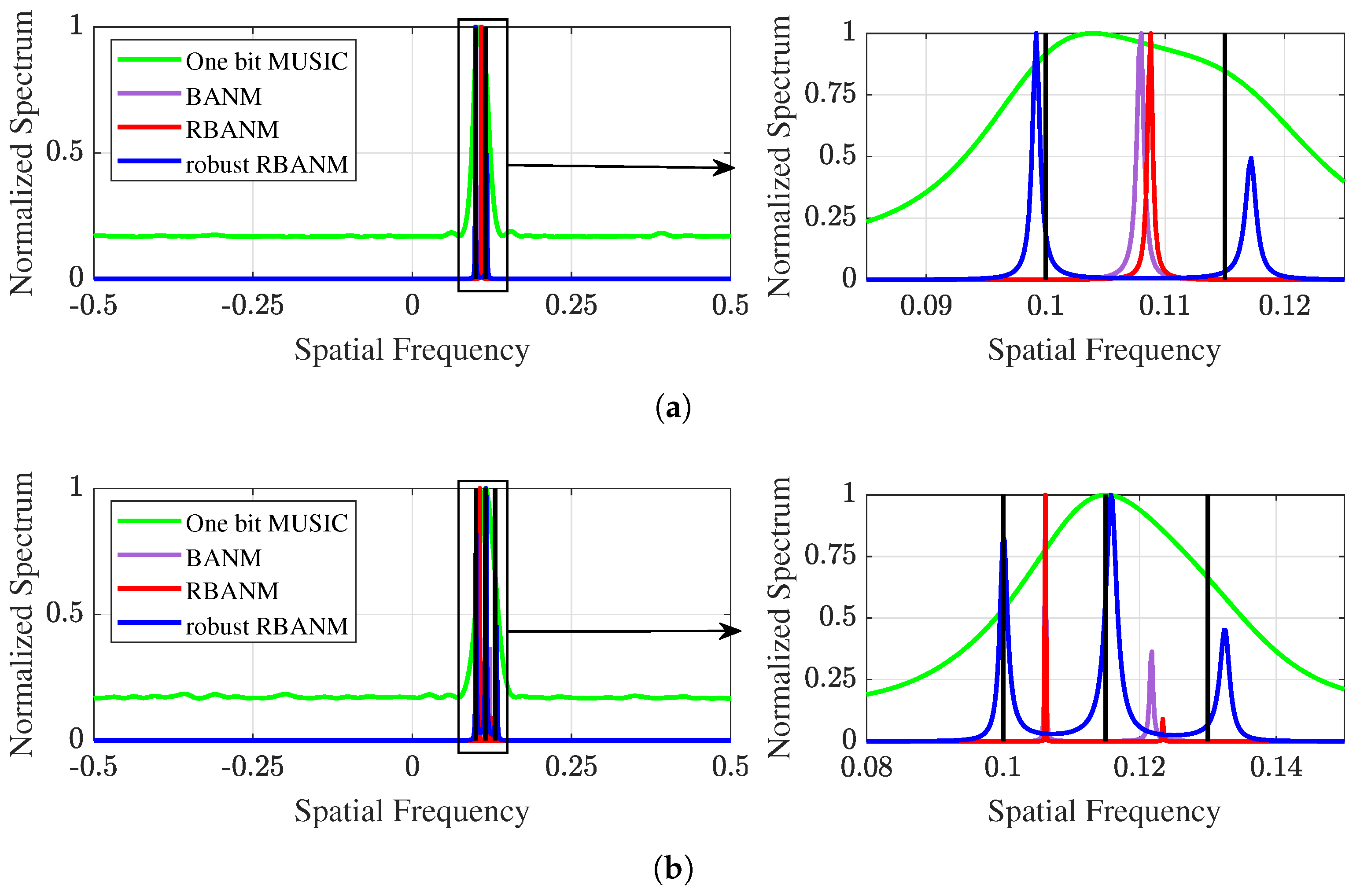
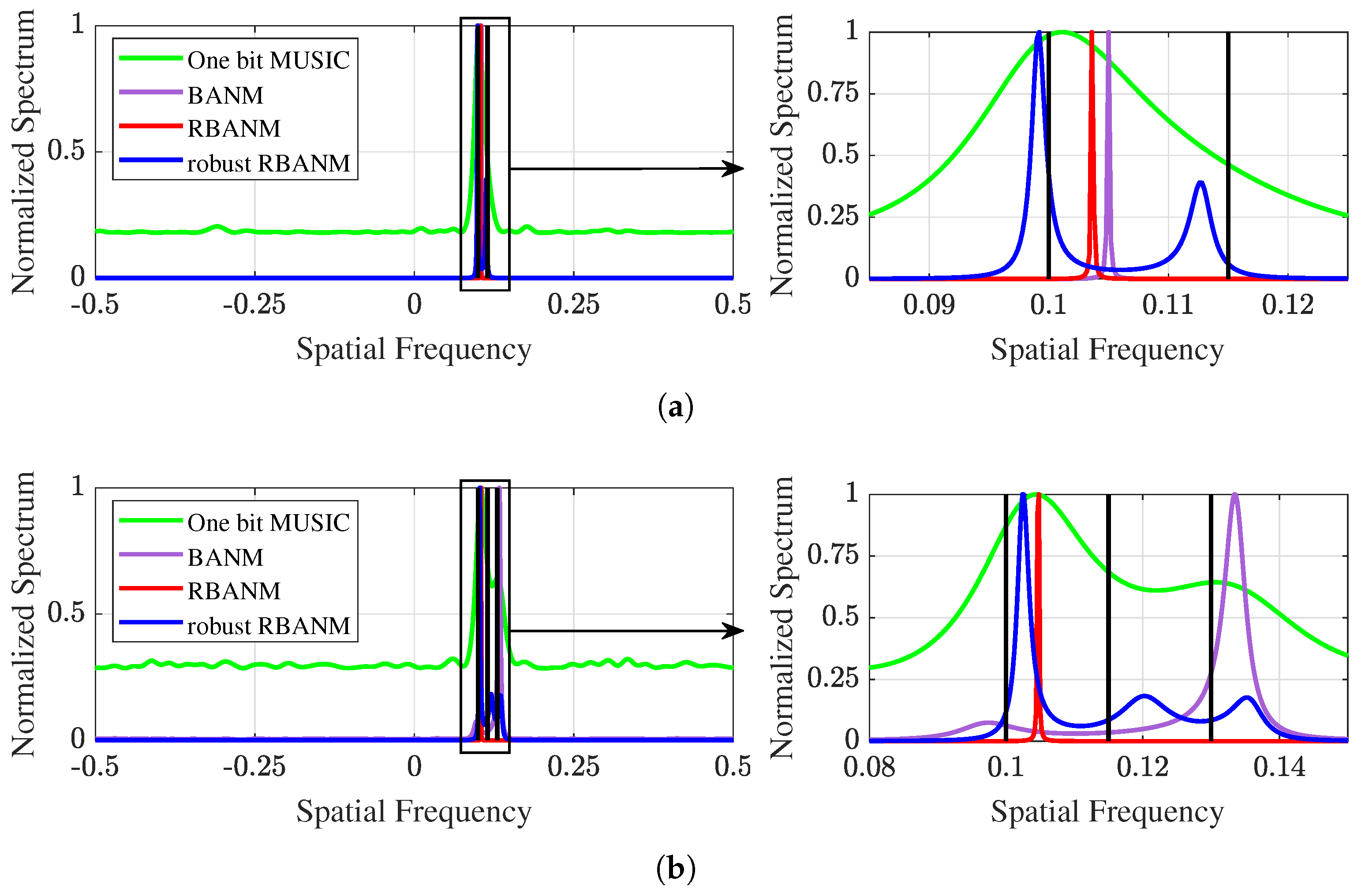
Then, Figure 2 presents two illustrative examples corresponding to Figure 1a and Figure 1b, respectively. The black vertical lines indicate the true signal directions. Figure 2a shows the spectrum obtained by the four algorithms when the two signals are located at 0.1 and 0.115. The proposed robust RBANM successfully identifies the two signals at , while the other algorithms cannot. Figure 2b provides an example where the proposed algorithm successfully identifies the three signals with spatial frequencies at 0.1, 0.115, and 0.13, while the other algorithms fail to completely distinguish the three signals. It can be observed that the robust RBANM algorithm can clearly generate three distinct peaks, while BANM only generates two peaks, and the other two algorithms generate only one peak. Similar examples are shown in Figure 3. All simulation conditions are the same, except for SNR = 5 dB. It can be observed from Figure 3 that even at low SNR, the robust RBANM algorithm is still able to estimate the signals.
Figure 2.
Two illustrative examples with , , and SNR dB. (a) The signals are at and . The left spectrum is shown on the interval , while the right is shown on . (b) The signals are at 0.1, 0.115, and 0.13. The left spectrum is shown on the interval , while the right is shown on .
Figure 3.
Two illustrative examples with , , and SNR dB. (a) The signals are at and . The left spectrum is shown on the interval , while the right is shown on . (b) The signals are at 0.1, 0.115, and 0.13. The left spectrum is shown on the interval , while the right is shown on .
Finally, the performance of the proposed algorithm under different signal-to-noise ratios and array element numbers is shown in Figure 4 and Figure 5. Additionally, algorithms that combine maximum likelihood with the norm [17] and the CBIHT algorithm [11] are added for performance comparison.
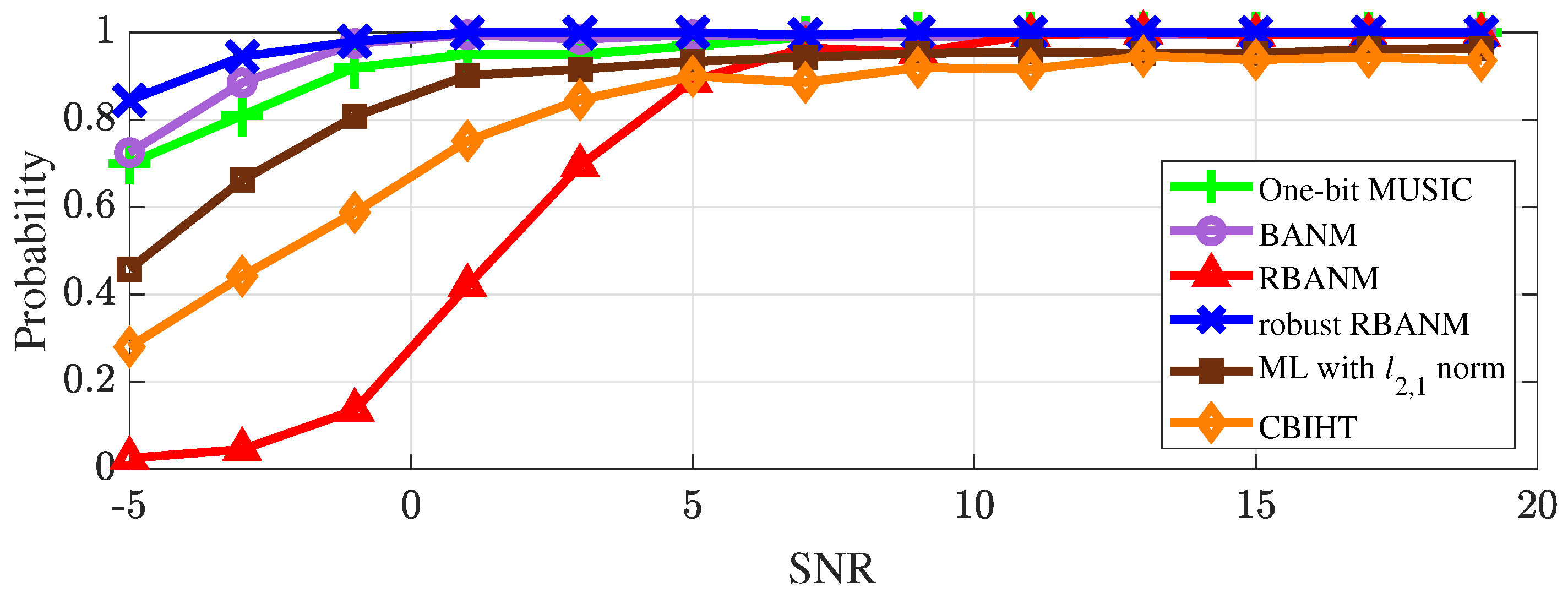
Figure 4.
The identification probability of the four algorithms under different SNRs with and . The signals are at .
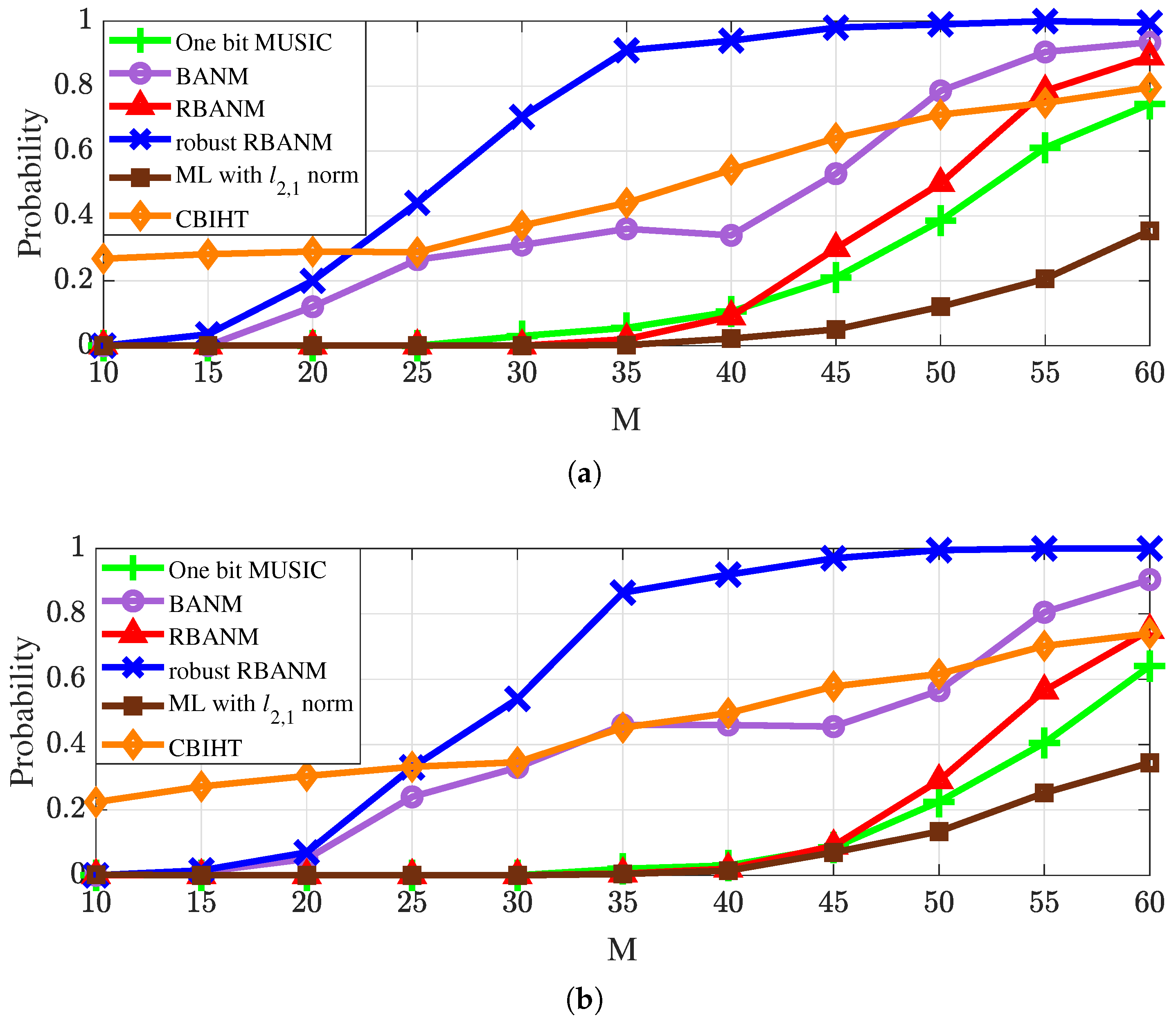
Figure 5.
The identification probabilities under a different number of sensors M with . The signals are at . (a) SNR dB. (b) SNR dB.
Figure 4 presents the robustness of the four algorithms under different SNRs, and shows the identification probabilities of the four algorithms when the two signals are located at 0.1 and 0.13. The results are averaged over 500 Monte Carlo trials. It can be seen that all algorithms, except for RBANM, achieve the identification probabilities of 0.7 for the two signals when SNR is above 1 dB. In contrast, RBANM is affected by noise and can hardly accurately detect the signals at −5 dB SNR, and it can only completely identify the two signals when SNR reaches 11 dB.
Figure 5 presents the identification probabilities under a different number of sensors M. The simulation condition set as snapshots and the signals are at . The SNRs of Figure 5a and Figure 5b are set as 10 dB and 5 dB, respectively. The results are averaged over 500 Monte Carlo trials. As shown in Figure 5, all algorithms can achieve higher detection probabilities by increasing the number of sensors, while the proposed robust RBANM consistently maintains the highest identification probability when the number of sensors M is more than 25.
6. Discussion
This paper proposes a high-resolution and robust binary atomic norm minimization algorithm. The proposed algorithm is compared to several recent one-bit DOA studies in Section 5, considering the detection performance under different signal spatial frequency separations, varying signal-to-noise ratios, and different numbers of sensors.
It can be observed that the proposed algorithm achieves high-resolution and robust estimation, significantly improving the resolution capability compared to BANM. Furthermore, as shown in Figure 3b and Figure 5a, it maintains good detection performance even at lower SNRs. For instance, in the noisy environment with an SNR of 5 dB, with sensors, the algorithm accurately identifies signals with a spatial frequency difference of 0.015, while the other algorithms fail to identify them.
However, the proposed algorithm involves nested iterations, resulting in higher computational complexity. In future work, we will seek alternatives to the ADMM algorithm or solutions that avoid nested iterations.
7. Conclusions
In this paper, a novel approach for high-resolution and robust one-bit DOA estimation is proposed. This method has two significant advantages. First, the proposed method achieves high-resolution DOA estimation by using the log-det heuristic instead of the conventional atomic norm minimization, which may lead to inaccurate estimates, to approximate the binary atomic norm minimization problem, compared to the existing BANM algorithm. Second, by adding a noise constraint, the proposed method improves robustness against noise sensitivity inherent in atomic norm methods, resulting in more reliable DOA estimation. Simulation results demonstrate the effectiveness of the proposed method.
Author Contributions
Conceptualization, R.L.; methodology, R.L.; writing—original draft preparation, R.L.; writing—review and editing, J.Y., Z.D., X.L. and K.T.; supervision, J.Y. and W.S.; funding acquisition, J.Y. and W.S. All authors have read and agreed to the published version of the manuscript.
Funding
This research was funded by the National Natural Science Foundation of China under grant numbers 62001229, 62101260, and 62101264; the Natural Science Foundation of Jiangsu Province under grant numbers BK20210334 and BK20230915; the China Postdoctoral Science Foundation under grant number 2020M681604; and the Jiangsu Province Postdoctoral Science Foundation under grant number 2020Z441.
Institutional Review Board Statement
Not applicable.
Informed Consent Statement
Not applicable.
Data Availability Statement
The original contributions presented in the study are included in the article, further inquiries can be directed to the corresponding author.
Conflicts of Interest
The authors declare no conflicts of interest.
Abbreviations
The following abbreviations are used in this manuscript:
| ADC | Analog-to-Digital Converter |
| ADMM | Alternating Direction Method of Multipliers |
| ANM | Atomic Norm Minimization |
| BANM | Binary Atomic Norm Minimization |
| DOA | Direction-Of-Arrival |
| MM | Majorization Minimization |
| MUSIC | MUltiple SIgnal Classification |
| RBANM | Reweighted Binary Atomic Norm Minimization |
| SDP | SemiDefinite Programming |
| SNR | Signal-to-Noise Ratio |
| ULA | Uniform Linear Array |
References
- Dey, N.; Ashour, A.S. Direction of Arrival Estimation and Localization of Multi-Speech Sources; Springer: Berlin/Heidelberg, Germany, 2018. [Google Scholar]
- Ho, T.; McWhirter, J.; Nehorai, A.; Nickel, U.; Ottersten, B.; Steinberg, B.; Stoica, P.; Viberg, M.; Zhu, Z. Radar Array Processing; Springer Science & Business Media: Berlin/Heidelberg, Germany, 2013; Volume 25. [Google Scholar]
- Walden, R.H. Analog-to-digital converter survey and analysis. IEEE J. Sel. Areas Commun. 1999, 17, 539–550. [Google Scholar] [CrossRef]
- Lu, L.; Li, G.Y.; Swindlehurst, A.L.; Ashikhmin, A.; Zhang, R. An overview of massive MIMO: Benefits and challenges. IEEE J. Sel. Top. Signal Process. 2014, 8, 742–758. [Google Scholar] [CrossRef]
- Ruan, N.; Wang, H.; Wen, F.; Shi, J. DOA estimation in B5G/6G: Trends and challenges. Sensors 2022, 22, 5125. [Google Scholar] [CrossRef] [PubMed]
- Liu, C.L.; Vaidyanathan, P. One-bit sparse array DOA estimation. In Proceedings of the 2017 IEEE International Conference on Acoustics, Speech and Signal Processing (ICASSP), New Orleans, LA, USA, 5–9 March 2017; pp. 3126–3130. [Google Scholar]
- Singh, J.; Dabeer, O.; Madhow, U. On the limits of communication with low-precision analog-to-digital conversion at the receiver. IEEE Trans. Commun. 2009, 57, 3629–3639. [Google Scholar] [CrossRef]
- Mezghani, A.; Nossek, J.A. Analysis of Rayleigh-fading channels with 1-bit quantized output. In Proceedings of the 2008 IEEE International Symposium on Information Theory, Toronto, ON, Canada, 6–11 July 2008; pp. 260–264. [Google Scholar]
- Stoica, P.; Shang, X.; Cheng, Y. The Cramér–Rao bound for signal parameter estimation from quantized data [Lecture Notes]. IEEE Signal Process. Mag. 2021, 39, 118–125. [Google Scholar] [CrossRef]
- Bar-Shalom, O.; Weiss, A.J. DOA estimation using one-bit quantized measurements. IEEE Trans. Aerosp. Electron. Syst. 2002, 38, 868–884. [Google Scholar] [CrossRef]
- Stöckle, C.; Munir, J.; Mezghani, A.; Nossek, J.A. 1-bit direction of arrival estimation based on compressed sensing. In Proceedings of the 2015 IEEE 16th International Workshop on Signal Processing Advances in Wireless Communications (SPAWC), Stockholm, Sweden, 28 June–1 July 2015; pp. 246–250. [Google Scholar]
- Huang, X.; Xiao, P.; Liao, B. One-bit direction of arrival estimation with an improved fixed-point continuation algorithm. In Proceedings of the 2018 10th International Conference on Wireless Communications and Signal Processing (WCSP), Hangzhou, China, 18–20 October 2018; pp. 1–4. [Google Scholar]
- Zhou, C.; Zhang, Z.; Liu, F.; Li, B. Gridless compressive sensing method for line spectral estimation from 1-bit measurements. Digit. Signal Process. 2017, 60, 152–162. [Google Scholar] [CrossRef]
- Wei, Z.; Wang, W.; Dong, F.; Liu, Q. Gridless one-bit direction-of-arrival estimation via atomic norm denoising. IEEE Commun. Lett. 2020, 24, 2177–2181. [Google Scholar] [CrossRef]
- Tang, W.G.; Jiang, H.; Zhang, Q. One-bit gridless DOA estimation with multiple measurements exploiting accelerated proximal gradient algorithm. Circuits Syst. Signal Process. 2022, 41, 1100–1114. [Google Scholar] [CrossRef]
- Feng, L.; Huang, L.; Li, Q.; He, Z.Q.; Chen, M. An off-grid iterative reweighted approach to one-bit direction of arrival estimation. IEEE Trans. Veh. Technol. 2023, 72, 8134–8139. [Google Scholar] [CrossRef]
- Chen, M.; Li, Q.; Li, X.P.; Huang, L.; Rihan, M. One-Bit DoA Estimation for Deterministic Signals Based on ℓ2,1-Norm Minimization. IEEE Trans. Aerosp. Electron. Syst. 2024, 60, 2438–2444. [Google Scholar] [CrossRef]
- Marques, E.C.; Maciel, N.; Naviner, L.; Cai, H.; Yang, J. A review of sparse recovery algorithms. IEEE Access 2018, 7, 1300–1322. [Google Scholar] [CrossRef]
- Malioutov, D.; Cetin, M.; Willsky, A.S. A sparse signal reconstruction perspective for source localization with sensor arrays. IEEE Trans. Signal Process. 2005, 53, 3010–3022. [Google Scholar] [CrossRef]
- Bhaskar, B.N.; Tang, G.; Recht, B. Atomic norm denoising with applications to line spectral estimation. IEEE Trans. Signal Process. 2013, 61, 5987–5999. [Google Scholar] [CrossRef]
- Yang, Z.; Xie, L. Enhancing sparsity and resolution via reweighted atomic norm minimization. IEEE Trans. Signal Process. 2015, 64, 995–1006. [Google Scholar] [CrossRef]
- Wu, X.; Zhu, W.P.; Yan, J. A high-resolution DOA estimation method with a family of nonconvex penalties. IEEE Trans. Veh. Technol. 2018, 67, 4925–4938. [Google Scholar] [CrossRef]
- Sheng, S.; Chen, P.; Yao, Y.; Wu, L.; Chen, Z. Atomic network-based DOA estimation using low-bit ADC. Electronics 2021, 10, 738. [Google Scholar] [CrossRef]
- Jia, T.; Liu, H.; Gao, C.; Yan, J. Bayesian Direction of Arrival Estimation using Atomic Norm Minimization with Prior Knowledge. IEEE Trans. Aerosp. Electron. Syst. 2024; early access. 1–32. [Google Scholar] [CrossRef]
- Fernandez-Granda, C. Super-resolution of point sources via convex programming. Inf. Inference J. IMA 2016, 5, 251–303. [Google Scholar] [CrossRef]
- Yang, Z.; Xie, L. Exact joint sparse frequency recovery via optimization methods. IEEE Trans. Signal Process. 2016, 64, 5145–5157. [Google Scholar] [CrossRef]
- Tang, G.; Bhaskar, B.N.; Shah, P.; Recht, B. Compressed sensing off the grid. IEEE Trans. Inf. Theory 2013, 59, 7465–7490. [Google Scholar] [CrossRef]
- Fazel, M.; Hindi, H.; Boyd, S.P. Log-det heuristic for matrix rank minimization with applications to Hankel and Euclidean distance matrices. In Proceedings of the 2003 American Control Conference, Denver, CO, USA, 4–6 June 2003; Volume 3, pp. 2156–2162. [Google Scholar]
- Shen, L.; Suter, B.W. One-bit compressive sampling via ℓ0 minimization. EURASIP J. Adv. Signal Process. 2016, 2016, 1–16. [Google Scholar] [CrossRef]
- Huang, X.; Liao, B. One-bit MUSIC. IEEE Signal Process. Lett. 2019, 26, 961–965. [Google Scholar] [CrossRef]
Disclaimer/Publisher’s Note: The statements, opinions and data contained in all publications are solely those of the individual author(s) and contributor(s) and not of MDPI and/or the editor(s). MDPI and/or the editor(s) disclaim responsibility for any injury to people or property resulting from any ideas, methods, instructions or products referred to in the content. |
© 2024 by the authors. Licensee MDPI, Basel, Switzerland. This article is an open access article distributed under the terms and conditions of the Creative Commons Attribution (CC BY) license (https://creativecommons.org/licenses/by/4.0/).