


Abstract
In this paper, we investigate the three-stage, wavelength–space–wavelength switching fabric architecture for nodes in elastic optical networks. In general, this switching fabric has r input and output switches with wavelength-converting capabilities and one center-stage space switch that does not change the spectrum used by a connection. This architecture is most commonly denoted by the WSW1 (r, n, k) switching network. We focus on this switching fabric serving simultaneous connection routing. Such routing takes place mostly in synchronous packet networks, where packets for switching arrive at the inputs of a switching network at the same time. Until now, only switching fabrics with up to three inputs and outputs have been extensively investigated. Routing in switching fabrics of greater capacity is estimated based on routing in switches with two or three inputs and outputs. We now improve the results for the switching fabrics with four inputs and outputs and use these results to estimate routing in the switching fabric with an arbitrary number of inputs and outputs. We propose six routing algorithms based on matrix decomposition for simultaneous connection routing. For the proposed routing algorithms, we derive criteria under which they always succeed. The proposed routing algorithms allow the construction of nonblocking switching fabrics with a lower number of wavelength converters and the reduction of the overall switching fabric cost.
1. Introduction
We can observe that in recent years elastic optical networks (EONs) are becoming more popular as a potential alternative to the rapidly growing popularity of optical networks. An example of this is the significant shift of ICT services to the new form, instead of dedicated fixed services. Software as a service (SaaS), function as a service (FaaS), infrastructure as a service (IaaS), and platform as a service (PaaS) are demonstrations of this new form [1,2,3]. Common features of these services include availability on demand, great scalability, adaptability, and flexibility [4,5]. This approach is reflected in the progress of data-transmission technologies and networks. For decades, optical domain technologies have been widely utilized in access and core networks, including wavelength division multiplexing (WDM), coarse WDM (CWDM), and dense WDM (DWDM). These technologies have significant limits in terms of scalability and flexibility. The International Telecommunication Union (ITU) has overcome the problem of defined fixed frequency grids by changing to a format that allows small sections of the optical spectrum to be selected and operated [6,7]. The concept of frequency slot units (FSUs) as an updated form of spectrum granularity was provided by this new bandwidth-allocation model. Aside from having a very small granularity (specified by [8] FSU is set to 12.5 GHz, 6.25 GHz, or smaller in width), this model has another feature. Any number of FSUs can be used in an optical connection, as long as the sum of the FSUs remains below the full spectrum and the FSUs are adjacent. In EONs, such a connection is a paradigm (known as the m-slot connection) [4,5,9,10]. A new switching fabric architecture is required for optical switching networks to create many different flexible paths that support a novel bandwidth-allocation model [4,5,9,11,12,13,14,15].
Basic information about the EON operation, including switch architectures and switching fabric functions, can be found in [16,17]. The problem of routing and spectrum allocation in EONs at the network level is surveyed in [18], while the spectrum fragmentation problems and management approaches were treated in [19]. In [20], the authors evaluated the performance of EONs when spectrum conversion is introduced in intermediate switches. The nonblocking two-stage switching fabrics with multirate connections and conversion in both stages were considered in [21,22]. The authors of [23] present the simulation studies of elastic optical switching fabrics based on the three-stage Clos switching fabric. They evaluated the loss probability for various traffic classes offered in a single optical network node. The multicast connections and wide-sense nonblocking conditions in optical WDM networks are considered in [24]. Finally, elastic optical switches are also considered for use in data center networks, where various architectures and nonblocking conditions were considered in [25,26,27].
In many papers that discuss the nonblocking properties of switching fabrics, space–wavelength–space (SWS) and wavelength–space–wavelength (WSW) are the two identified architectures. There are three stages in each architecture. One switch (SWS1/WSW1) or more than one switch (SWS2/WSW2) in the intermediate stage are the two categories of each architecture when classified in terms of the number of center-stage switches [12,13,14,15,25,28,29,30,31,32]. In the end, setting up a connection path by using the routing algorithm is one of the most important aspects. Two patterns are used to examine four node architectures employing waveband converters for EONs, according to allocation and distribution in [11]. In [9], a switching node model is introduced that was found to meet the requirements of EONs as WSW switching fabrics. Similarly, the SWS1 and SWS2 architectures for flexible optical switching networks are described in [12]. The two WSW architectures (WSW1, WSW2) in [13], are investigated due to the lower number of FSUs in the interstage links, which can be provided by using more than one switch in the center stage (WSW2s). In [15], the authors considered the WSW1 switching fabric with 2, 3 and more input/output links and proposed seven routing algorithms.
In this paper, we define and illustrate the operation of six routing algorithms and derive sufficient conditions under which the proposed algorithms always end with success. The analysis shows that only three of the six algorithms are necessary for further study, and the required number of frequency slots in the interstage link can be smaller than that required in [15]. The construction cost, which is determined by the wavelength converters number, reflects this. As a result, the cost of building the switching nodes by using our proposed algorithm is less than the cost of constructing the switching nodes by using some of the previously published algorithms. Consequently, our algorithm succeeds if, for , each interstage link contains only FSUs, while it requires FSUs, in [15]. In the case of switching fabrics with , it means that the proposed work is new and improved. A demonstration of the general formula and a detailed analysis of the proposed algorithm are included in the subsequent sections of the paper.
2. Rearrangeable Switching Fabric Architecture and Operation
2.1. Switching Fabric Architecture
In this work, we consider the switching fabric architecture with (see Figure 1) that consists of three stages. The first and last stages comprise r Bandwidth-Variable Wavelength-Converting Switch (BV-WBCSs), represented as and (where ), respectively. Only one Bandwidth-Variable Wavelength-Selective Space Switch (BV-WSSS) with r inputs and r outputs constitutes the center stage. There are r interstage links between every stage. routes the connections, i.e., the connections that may use m subsequent FSUs (where one FSU represents 12.5 GHz of spectrum). BV-WBCS operates on connections and alters the spectrum of an connection from the spectrum of m FSUs at the input of BV-WBCS to another spectrum of m FSUs at the output.
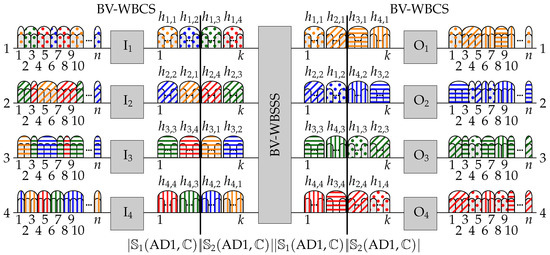
Figure 1.
A general architecture of and connections processing.
The role of BV-WSSS is to switch an connection in the space domain without spectrum conversion capability. In [25], the internal structures of BV-WBCS and BV-WSSS are shown. The inputs and outputs are numbered from 1 to r. In the same way, and are indexed. FSUs in the input fibers entering and in the output fibers leaving are numbered from 1 to n, while FSUs in the interstage links are numbered from 1 to k.
2.2. A New Connection Processing
The switching fabric operates in two domains: space and frequency. Let us assume that is nonblocking in the space domain, where BV-WSSS is a nonblocking switching fabric. Taking into account the state of the switching fabric shown in Figure 1, it should be noted that all connections that exist at the input of each are marked by the same pattern, while connections that appear at the output of each are distinguished by the same color. There is only one connection path between an input and an output of there—a set of interstage links and a set of switching elements, such as , , and . With the exception of , all of these paths are disjoint, making the nonblocking switching fabric in the space domain. However, if we consider the location of a particular connection in the frequency domain, we can locate connections that block each other. An m-slot connection from the input switch that uses FSUs numbered x to to the output switch with assigned slots y to is indicated by . When frequency slot indices are not important, we will use the notation ; when we want to indicate only the switches that participate in a connection, we use the notation .
For example, the connection that demands slot 6 at input 1 blocks the connection that occupies slots 4–6 at input 3, since both connections are directed to (i.e., they use the same slot in the link between and ). The red connections at inputs 1 and 2 (which occupy slots 7 and 8) are also connected to the same output switch , so they block each other. and eliminate the blocking situations in , i.e., connections in the blocking state are relocated to different frequency slots. We should mention that the operation of elastic optical networks imposes a connection , which must use adjacent FSUs. This operation is shown in Figure 1. aggregates all connections from input i to output j in the links between and (and between and ) to the set of connections indicated as . The function of is to move connections that correspond to a specific to the requested position at the output of .
In this work, we employ the simultaneous connection model, that is, a model in which requests arrive at the input of the system at the same time and a set of compatible connections is set up simultaneously. Two connections are compatible if they use disjoint sets of FSUs in the input and/or output links. For example, the connections and are not compatible, since they both request slot 5 at output port 2. We assume that all FSUs in the input and output links are occupied by connections; that is, we have the maximum set of compatible connections. Although such a situation in real systems is uncommon, we can study all connection permutations in our analysis by including dummy connections, i.e., connections that use all free FSUs in the input and output links.
3. Control Algorithms
3.1. State Matrix
Let the maximum set of compatible connections be represented by , and be a set of all connections in . In the considered switching fabric, the first and the last sections contain wavelength converters. This helps to simplify the analysis of the state of , since it is not necessary to analyze all the connections established in but only the sum of the bandwidth units occupied between any pair (, ). That is, we need to find relationships between the elements of the Cartesian product , which can be easily represented in the form of a matrix . This matrix, denoted by , is defined in the following way [15],
where
According to (2), element represents the aggregated spectrum of all connections . The matrix property is as follows,
i.e., in every individual input/output link, there are n FSUs. represents for switching fabrics, and
3.2. FSUs Assignment Algorithms for WSW1(4, n, r) Switching Fabrics
The objective of this section is to describe how FSUs should be assigned to the connections in the switching fabrics. In a space-division switching fabric, a connection path, i.e., a set of resources used by a given connection, is composed of swithching elements (SEs) and interstage links (ILs) used by the connection. When two connections must use the same IL at the same time, one of these connections is blocked. In an EON switching fabric there is another dimension, wavelength. In this case, the connection path is determined not only by a set of SEs and ILs, but also by a set of FSUs on a given IL. To find two blocking connections, it is necessary to determine not only whether the connection paths of these two connections use the same IL(ILs), but also whether they use at least one common FSU.
The process of assigning FSUs to connection paths so that they do not block each other can be implemented in a way similar to that proposed in [15]. However, in the considered switching fabric, the problem is much more complex, due to the larger number of inputs and outputs, resulting in a larger number of possible permutations. We propose six distinct FSUs assignment algorithms, denoted as , , , , , and . Then, we try to find the best one, or a group of them, for which the number k of required FSUs in ILs will be the lowest, yet allowing the realization of all possible sets of compatible connections [33].
The main idea of all proposed algorithms is to divide all FSUs in ILs into two subsets, in which we will establish connections corresponding to different . Of course, the wavelength intervals of FSUs used for the connections represented by at the input port may be different from those assigned to these connections in ILs. The wavelength shift is the task of BV-WBCSs, from which the outermost sections are constructed. To determine the conditions under which all possible can be realized in (that is, it is RNB, as shown in [33]), we have to find the required value of k in each IL as the maximum value of the sum of the number of FSUs in both subsets.
To proceed with the description of the assignment algorithms, we have to add an important assumption about . Each set of compatible connections in is represented by a different state of the matrix . We can reduce the number of states considered, assuming that is equal to or greater than the rest of the elements in . Similarly, is equal to or greater than the other elements, except for those in row 1 and column 1 [34]. Finally, is equal to or greater than all the remaining elements in from rows 1 and 2 and elements from column 1 and 2. This property can be written as
This assumption does not change the FSUs assignment process or the final result, but simplifies the explanation of the algorithms, their structure, and operation. If the criteria in (5) are not satisfied, the input and/or output stages, represented as rows and/or columns in the matrix , should be modified by rearranging. For example, if the element is greater than , is replaced with and with , which makes become .
To make it possible for each algorithm to assign FSUs to connections, we introduce the concept of subregions and critical pairs. The rows and columns of the matrix represent the inputs and outputs of , respectively. Two elements located in the same row/column represent connections from/to the same input/output, and cannot occupy the same FSUs in ILs. Otherwise, the connections represented by one of these elements are blocked. For example, the connections represented by and may use the same set of FSUs since they come from and go to different outer stage switches. We call such elements “matched”. On the other hand, the connections represented by and have to use different FSUs, as they are directed to the same output switch, and we call them “mismatched”. Let us divide the elements of each row and each column into two pairs of elements, creating four groups of four elements each.
Definition 1.
Let represent in switching fabric working under algorithm , where . Each algorithm divides into four disjoint subsets called quarters (denoted as , where ). Each consists of four elements , which form two pairs of matched elements.
The way each algorithm assigns elements to quarters is shown in Figure 2. In each assignment, we can find pairs of ’s that are not in the same columns or rows. We surround these pairs with the same type of line and the same color, and the corresponding connections can occupy the same set of FSUs in ILs (elements matched). In contrast, ’s surrounded by different line types always share the same rows or columns, i.e., they are mismatched (having to occupy disjoint sets of FSUs in ILs). For instance, in the quarters and contain , , , and , , , and , respectively; these quarters are matched. In , elements and , as well as and , are matched, while and , as well as and , or and , as well as and , are mismatched. When assigning slots, there will be no conflict between connections when mismatched quarters use disjoint sets of FSUs. Such mismatched quarters will be called “subregions”.
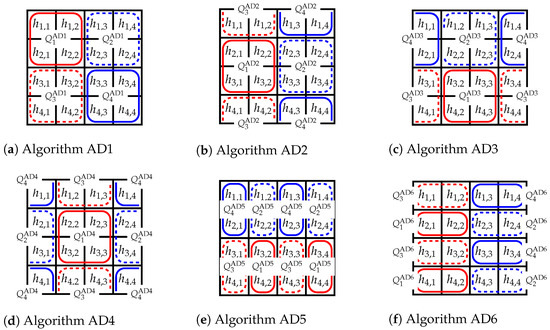
Figure 2.
Division of the matrix into quarters in algorithms –.
Definition 2.
Two mismatched quarters obtained in by the algorithm are called subregions. The subregions are denoted as ADx.j, where and .
The divisions of elements into subregions for algorithms , , and are shown in Figure 3. Each of the four rectangles surrounding the matrix consists of a quarter surrounded by a solid line and a quarter surrounded by a dashed line (see Figure 3). When we have subregions determined by , we have to divide the set of FSUs in ILs into two subsets, and ; slots in each subset will be used for connections represented in different quarters in subregions. As a result, the total number of FSUs in ILs for algorithm , denoted by is determined by the sum of slots needed in and , that is,
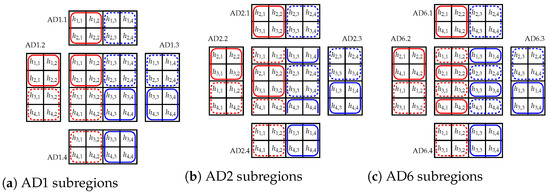
Figure 3.
Division of into subregions by Algorithms , , and .
Any can be realized by using when we maximize (6) through all s, that is, when
The connections shown in Figure 1 are set by using , and the set of FSUs in each IL is divided into subsets and by bold vertical lines.
As we have divided into subregions, we will now show how the algorithms assign FSUs to connections. We discuss here only to limit the length of the paper; the assignment procedure for the other algorithms can be easily derived by analogy. First, we consider the connections represented by elements in and , and the FSUs assigned to these connections will form the set . The connections in and are matched, so they can use the same set of FSUs in ILs from and numbered from 1 to ;. Similarly, the connections in and are matched, so they can use the same set of FSUs in ILs from and and are numbered from 1 to ;. The connections in and are also matched, but are mismatched with connections in and ; therefore, they can use FSUs from to + and from to +. The same approach can be used for the connections in and —that is, they can use FSUs from to + and from to +. As a result, we have already assigned a FSUs and ; ; ; from property (3) and . Next, we have to consider the connections represented by elements in and , and the FSUs assigned to these connections will form the set . By analogy, this set will contain FSUs numbered from to ; where ; } and ; }.
The is listed as Algorithm 1, and the detailed assignment of FSUs is shown in Table 1. Similar procedures and tables can be obtained for algorithms from to by comparing presented in Figure 2b–f with that obtained for (Figure 2a), and by comparing how FSUs are assigned to elements of in Table 1.
| Algorithm 1: () |
Data: Result: FSUs assigned to connections in
|

Table 1.
Assignment of FSUs to connections by .
3.3. The Maximum Number of FSUs in the Algorithms
We now determine the maximum number of FSUsto be occupied by each pair of mismatched quarters; that is, we derive the maximum values for (7) for each algorithm. The number of FSUs required by each and each depends on the elements of surrounded by solid and dashed lines, respectively. Similarly, as in the description of the algorithms, we provide a detailed analysis for and present the final equations for the remaining algorithms. From Table 1, we obtain
and
In general, each element of each pair in (8) and (9) can be greater. Therefore, we must consider all the cases to determine the maximum needed value of k. When the first sums in (8) and (9) are greater, we choose the maximum between pairs (;), (;), (;), and (;). The elements in these pairs form the subregion AD1.1 (see Figure 3a). In the subregions ADx.1 and ADx.4, quarters are placed horizontally (H), while in ADx.2 and ADx.3, quarters are placed vertically (V). The elements with maximum values in the subregions can be located in four scenarios: HH, HV, VH, and VV (see Figure 4), while in each scenario we have four cases denoted by (a), (b), (c), and (d). These cases for scenario HH in AD1.1 are presented in Figure 5.
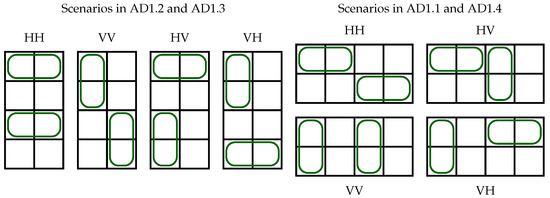
Figure 4.
Location of elements with the maximum value in horizontally (H) and vertically (V) stacked quarters.
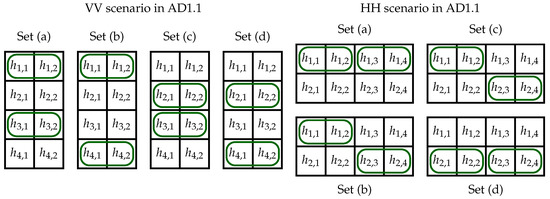
Figure 5.
Four cases with maximum values of elements in VV and HH scenarios in AD1.1.
In the equations listed in Appendix A, we provide the results for the possible maximum values of Equation (7) for all the scenarios and cases for . When creating these formulas, we take into account the properties (3) and (5). Here we explain two cases. In the AD1.1 scenario HH and case (a) , , , and are the maximum values. This means that , and this sum is equal to n (3). In the same scenario, but in case (c), we have and . The maximum value of can be n. However, since we get and Since , the maximum value of + = n − , i.e., . As the result, = .
The listed equations give the maximum values of k for a given subregion, scenario, and case. Now, we have to find for which of these equations k reaches the highest value through all possible s, that is
When we look at Table 2, where we included the results of all subregions, scenarios, and cases for algorithms , , and , we can conclude that n ≤ ≤ . This means that there are s for which we can realize all connections in less than slots, but there are also cases where requires slots. However, when we need slots for in the algorithm , we may need less than slots when using another algorithm, for example or . The results of these algorithms are also included in Table 2. We omit and , because the arrangement of elements in is similar to the transpose of , and the arrangement of elements in is similar to the transpose of ; moreover, the results for these algorithms are exactly the same as for and , respectively. The problem of finding the best value of k when all the algorithms are used is the subject of the next section.
Table 2.
Algorithm scenarios comparison.
4. The New Algorithm and RNB Conditions
The results of allocating FSUs to connections by algorithms – vary widely. The question is which algorithm should be used to minimize the number of required FSUs in ILs, yet make it possible to realize any . This minimum value of k makes the rearrangeable and is given by the following formula:
As stated in the previous section, we have and ; therefore, we can exclude and from (11). When we compared the results for , , and (see Table 2) with the results for , we concluded that for any we had ; therefore, we could also exclude from (11). Consequently, we finally obtain
where is given as Algorithm 2.
| Algorithm 2: () |
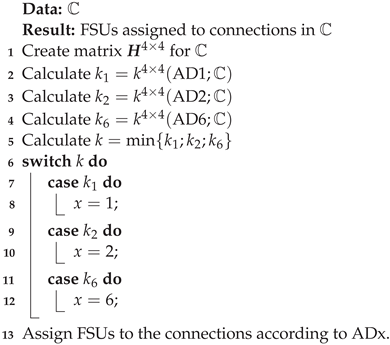 |
We explain the idea of performance by means of the example presented in Figure 6. This example shows two matrices representing connections in two switching fabrics, and (see Figure 6a,b). In Figure 6a, we have (n is even) and when we use to assign FSUs, we need slots. This maximum value is obtained for the subregion AD1.3, scenario VV, and case (c) (see Table 2) for which . However, when we use for the same subregion, scenario and case, we see that these connections can be realized by using only slots. For , we also have slots. However, this number of slots is not sufficient to realize connections in other the subregions by or . Both algorithms need 6 FSUs for subregions AD2.2 and AD6.2. On the other hand, there may be other connection patterns, for which and need more FSUs. We see this in Table 2 since for AD2.3, VV scenario and case (c), the maximum number of required k is but for AD6.3—only . Similarly, we can analyze Figure 6b, where we have (n is odd). For , we need FSUs, while and can fit connections in FSUs. The role of is to determine, for a given , which of the algorithms , , or requires the fewest number of FSUs in ILs, and to use this algorithm for assigning slots to connections.
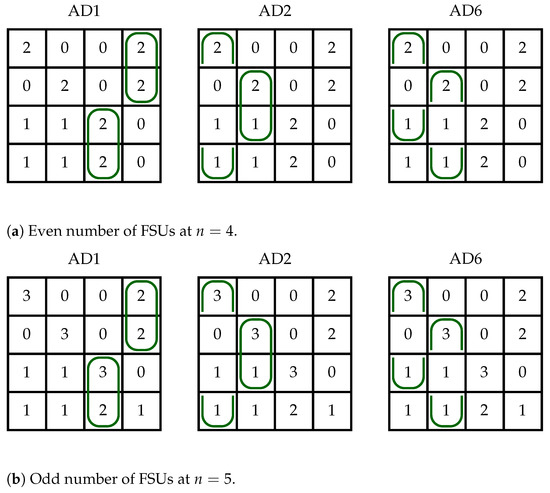
Figure 6.
Example of applying and instead of to achieve lower value for k.
The question now is what the minimum number of required FSUs in ILs is sufficient to ensure that always ends with success for any . The answer to this question is given in the following theorem.
Theorem 1.
The switching fabric is RNB for m-slot connections, , and when under the algorithm if
Proof.
In , for a given , we check for which of the algorithms , , or we need the lowest number of FSUs. Then, these minimum values calculated for each must be maximized (see (12)). We can find the better algorithm by calculating the number of FSUs for each algorithm in each subregion for each scenario and case. These values are shown in Table 3, which we obtained from Table 2. We see that the maximum value in this table is ; therefore, this number of FSUs is sufficient to realize all possible compatible connection patterns. □
Table 3.
Algorithm scenarios.
5. Comparisons and Numerical Results
Algorithm gives the best results of all the algorithms proposed in this paper. Now, we compare this algorithm with the algorithms CA6 and CA7 proposed in [15]. We first consider the switching fabric. The values of are compared in Table 4 and plotted in Figure 7. As for the CA6, allows reducing the number of FSUs in ILs by more than 16%. In case of CA7, this reduction is greater than 40%. For instance, when (a typical value for band C in optical fibers when frequency slot is 25 GHz wide), CA6 requires 320 FSUs, CA7—448 FSUs, while finishes with success when there are only 266 FSUs in ILs. This is illustrated in Table 4 and Figure 7, where and [15]. Those previously developed algorithms (CA6, CA7) are based on the analysis of and ; however, is developed based on the analysis of , which delivers the most optimal and efficient result represented by the lowest number of FSUs in ILs. In addition, both algorithms CA6 and CA7 are multiplied by the factor of , and , respectively, which results in multiplication by 2 in case of . That would affect the overall result to be multiplied by a factor of 2, which eventually leads to an increase of the number of FSUs in ILs. Hence, and , which means that both algorithms give greater value than . Therefore, we notice that , when applied for , yields a better result than previously published algorithms. For instance, = 8, where = 10 and = 14.
Table 4.
Comparison of presented in [15] and required by Theorem 1.
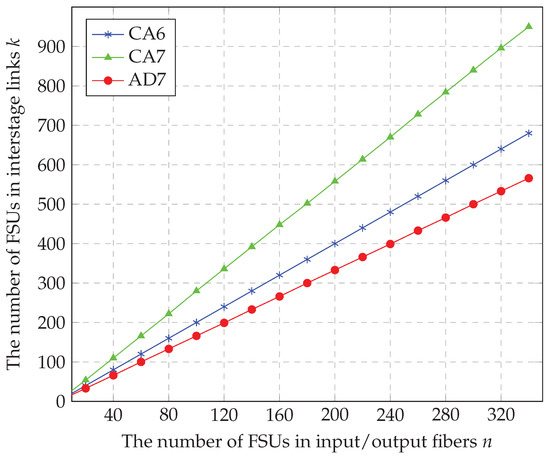
Figure 7.
Comparison of presented in [15] and required by Theorem 1.
When , we compare some results for 8, 16 and 32 and selected values of n. FSUs are assigned to connections by dividing into submatrices , similar to what is proposed in [15], and by using for each submatrix. The number of FSUs in ILs is calculated in this case by the following equation:
The results are compared in Table 5 with and [15], where and . We can see that , when employed for , outperforms all the algorithms published. For example, when we get and , where . This shows how yields better results when compared with other previously known algorithms.
Table 5.
Comparison of presented in [15] and required by Theorem 1.
In addition, as we illustrated previously, CA6 and CA7 are developed based on the analysis of and , respectively, where is developed based on the analysis of . Therefore, when it comes to finding the number of FSUs in ILs, each algorithm is multiplied by a factor representing the value of r, i.e., algorithm CA6 is multiplied by a factor of , algorithm CA6 is multiplied by a factor of , and algorithm is multiplied by a factor of donated as . In case of , the factor for CA6, CA7, and , respectively, will be (4, 3, and 2); similarly for the factor will be (8, 6, and 4), and finally, for the factor will be (16, 11, and 8). Accordingly, as r increases, the factor difference between algorithms increases, which can cause CA7 to have a lower number of FSUs in ILs than CA6 (see in Table 5).
We compared the proposed algorithm result with other results presented in [15]. We also investigated the results presented in [27] and found that they were not better than that presented in [15]. For instance, when , , and , the algorithms in [27] achieves , and . Furthermore, SNB derived in [13] requires even more FSUs than that presented in [15], as , where . Similarly, the WNB proposed in [35] is not better than [15]. Therefore, it is sufficient to compare result for the proposed algorithms to the best-known result to date.
Finally, we should mention that the algorithm is very simple. The complexity of the algorithm is determined mainly by matrix preparation and rearranging such that the property (3) is fulfilled. When the matrix is given, chooses the final algorithm to assign FSUs to connections in time, and then the selected algorithm assigns slots by using a fixed table. For this assignment is given in Table 1.
6. Conclusions
In this paper, we proposed seven algorithms for assigning frequency slots to connections in switching fabrics serving multislot connections. Algorithms to are based on matrix decomposition, while uses all the algorithms mentioned before. For a given connection pattern, it uses those algorithms that require the fewest frequency slots. This approach was previously proposed in [15] but was limited to switching fabrics with . When , the number of slot assignment patterns increases rapidly, and many more cases must be analyzed to find the number of frequency slots, which ensures that the algorithms always end with success. The number that makes rearrangeably nonblocking is given in Theorem 1. Algorithm improves the previously known results by more than 16% or even 40%, depending on which algorithm is used. We also extrapolated the number of required frequency slots for switching fabrics with . In this case, the proposed algorithm also outperforms the previously known algorithms. It should be noted that the proposed solutions provide sufficient conditions for RNB. The necessity is not shown; this means that there is still place for other algorithms, which reduces the number of required frequency slots. However, we know that this number cannot be lower than [15].
In this work, k is the only parameter we can use to obtain RNB conditions. When we have these conditions, we can consider how much power or how many elements the switching fabric needs. However, the number of tunable wavelength converters is rather determined by the switching fabric capacity and architecture (r switches in the input/output stages, one switch in the center stage). Therefore, k is more important since it determines the range of required converters. Moreover, the complexity of the algorithm is very low, since we have to calculate the result according to three simple algorithms from the algorithm (12), as shown in (2), and use that with the lowest result. Then FSUs are assigned to connections by using the assignment given for each algorithm, such as in Table 1. The most time-consuming task is to prepare the matrix from the set of connections and sort it in such a way that conditions (3) and (5) are fulfilled.
Author Contributions
E.A.: conceptualization, methodology, investigation, formal analysis, writing—original draft preparation, visualization; M.Ż.: conceptualization, methodology, formal analysis, writing—original draft preparation, visualization, supervision; W.K.: writing—review and editing. All authors have read and agreed to the published version of the manuscript.
Funding
The work was financed from the funds of the Ministry of Science and Higher Education for year 2023 (0313/SBAD/1310).
Institutional Review Board Statement
Not applicable.
Informed Consent Statement
Not applicable.
Conflicts of Interest
The authors declare no conflict of interest. The funders had no role in the design of the study; in the collection, analyses, or interpretation of data; in the writing of the manuscript, or in the decision to publish the results.
Abbreviations
The following abbreviations are used in this manuscript:
| BV-WBCS | Bandwidth-Variable Wavelength-Converting Switch, |
| BV-WSSS | Bandwidth-Variable Wavelength-Selective Space Switch, |
| CWDM | Coarse Wavelength Division Multiplexing, |
| DWDM | Dense Wavelength Division Multiplexing, |
| EON | Elastic Optical Network, |
| FaaS | Function as a Service, |
| FSU | Frequency Slot Unit, |
| HH | Horizontal–Horizontal scenario, |
| HV | Horizontal–Vertical scenario, |
| IaaS | Infrastructure as a Service, |
| ICT | Information and Computing Technology, |
| PaaS | Platform as a Service, |
| RNB | Rearrangeable Non-Blocking, |
| SWS | Space–Wavelength–Space, |
| WDM | Wavelength Division Multiplexing, |
| WSW | Wavelength–Space–Wavelength, |
| VH | Vertical–Horizontal scenario, |
| VV | Vertical–Vertical scenario, |
Appendix A. Calculation for Subregions
In the following Section A.1, Section A.2, Section A.3 and Section A.4, we provide the equations we used for considerations included in Section 3.3. All scenarios and cases for contain at least the result for the possible maximum values of Equation (7). In order to make it easier to understand how we obtained the results, for almost all cases, we added the dependencies that result from the properties defined by the Formulas (3) and (5). Obvious cases have been omitted.
Appendix A.1. Subregion AD1.1
| Scenario HH set (a): | |
| Scenario HH set (b): | |
| Scenario HH set (c): | |
| Scenario HH set (d): | |
| Scenario VV set (a): | |
| Scenario VV set (b): | |
| Scenario VV set (c): | |
| Scenario VV set (d): | |
| Scenario VH set(a): | |
| Scenario VH set (b): | |
| Scenario VH set (c): | |
| Scenario VH set (d): | |
| Scenario HV set (a): | |
| Scenario HV set (b): | |
| Scenario HV set (c): | |
| Scenario HV set (d): | |
Appendix A.2. Subregion AD1.2
| Scenario HH set (a): | |
| Scenario HH set (b): | |
| Scenario HH set (c): | |
| Scenario HH set (d): | |
| Scenario VV set (a): | |
| Scenario VV set (b): | |
| Scenario VV set (c): | |
| Scenario VV set (d): | |
| Scenario VH set (a): | |
| Scenario VH set (b): | |
| Scenario VH set (c): | |
| Scenario VH set (d): | |
| Scenario HV set (a): | |
| Scenario HV set (b): | |
| Scenario HV set (c): | |
| Scenario HV set (d): | |
Appendix A.3. Subregion AD1.3
| Scenario HH set (a): | |
| Scenario HH set (b): | |
| Scenario HH set (c): | |
| Scenario HH set (d): | |
| Scenario VV set (a): | |
| Scenario VV set (b): | |
| Scenario VV set (c): | |
| = | |
| Scenario VV set (d): | |
| Scenario VH set (a): | |
| Scenario VH set (b): | |
| Scenario VH set (c): | |
| Scenario VH set (d): | |
| Scenario HV set (a): | |
| Scenario HV set (b): | |
| Scenario HV set (c): | |
| Scenario HV set (d): | |
Appendix A.4. Subregion AD1.4
| Scenario HH set (a): | |
| Scenario HH set (b): | |
| Scenario HH set (c): | |
| Scenario HH set (d): | |
| Scenario VV set (a): | |
| Scenario VV set (b): | |
| Scenario VV set (c): | |
| Scenario VV set (d): | |
| Scenario VH set (a): | |
| Scenario VH set (b): | |
| Scenario VH set (c): | |
| Scenario VH set (d): | |
| Scenario HV set (a): | |
| Scenario HV set (b): | |
| Scenario HV set (c): | |
| Scenario HV set(d): | |
References
- Prajapati, A.G.; Sharma, S.J.; Badgujar, V.S. All About Cloud: A Systematic Survey. In Proceedings of the 2018 International Conference on Smart City and Emerging Technology (ICSCET), Mumbai, India, 5 January 2018; pp. 1–6. [Google Scholar] [CrossRef]
- Kächele, S.; Spann, C.; Hauck, F.J.; Domaschka, J. Beyond IaaS and PaaS: An Extended Cloud Taxonomy for Computation, Storage and Networking. In Proceedings of the 2013 IEEE/ACM 6th International Conference on Utility and Cloud Computing, Dresden, Germany, 9–12 December 2013; pp. 75–82. [Google Scholar] [CrossRef]
- Miyachi, C. What is “Cloud”? It is time to update the NIST definition? IEEE Cloud Comput. 2018, 5, 6–11. [Google Scholar] [CrossRef]
- Jinno, M.; Takara, H.; Kozicki, B.; Tsukishima, Y.; Sone, Y.; Matsuoka, S. Spectrum-efficient and scalable elastic optical path network: Architecture, benefits, and enabling technologies. IEEE Commun. Mag. 2009, 47, 66–73. [Google Scholar] [CrossRef]
- López, V.; Velasco Esteban, L. Elastic Optical Networks: Architectures, Technologies, and Control; Springer Publishing Company, Incorporated: Cham, Switzerland, 2016. [Google Scholar] [CrossRef]
- Farrel, A.; King, D.; Li, Y.; Zhang, F. Generalized Labels for the Flexi-Grid in Lambda Switch Capable (LSC) Label Switching Routers; Seties Number 7699; RFC: Fremont, CA, USA, 2015. [Google Scholar] [CrossRef]
- ITU-T. ITU-T Recommendation G.694.1. Spectral Grids for WDM Applications: DWDM Frequency Grid; International Telecommunication Union (ITU): Geneva, Switzerland, 2020. [Google Scholar]
- ITU-T. Spectral Grids for WDM Applications DWDM Frequency Grid; Technical Report; International Telecommunication Union-Telecommunication Standardization Secton; International Telecommunication Union (ITU): Geneva, Switzerland, 2020. [Google Scholar]
- Chen, Y.; Li, J.; Zhu, P.; Niu, L.; Xu, Y.; Xie, X.; He, Y.; Chen, Z. Demonstration of Petabit scalable optical switching with subband-accessibility for elastic optical networks. In Proceedings of the 2014 OptoElectronics and Communication Conference, OECC 2014 and Australian Conference on Optical Fibre Technology, ACOFT 2014, Melbourne, VIC, Australia, 6–10 July 2014; pp. 350–351. [Google Scholar]
- Kabaciński, W.; Rajewski, R.; Al-Tameemi, A. Rearrangeable 2×2 elastic optical switch with two connection rates and spectrum conversion capability. Photonic Netw. Commun. 2020, 39, 78–90. [Google Scholar] [CrossRef]
- Ping, Z.; Juhao, L.; Bingli, G.; Yongqi, H.; Zhangyuan, C.; Hequan, W. Comparison of node architectures for elastic optical networks with waveband conversion. China Commun. 2013, 10, 77–87. [Google Scholar] [CrossRef]
- Danilewicz, G.; Kabaciński, W.; Rajewski, R. Strict-sense nonblocking space-wavelength-space switching fabrics for elastic optical network nodes. J. Opt. Commun. Netw. 2016, 8, 745–756. [Google Scholar] [CrossRef]
- Kabaciński, W.; Michalski, M.; Rajewski, R. Strict-Sense Nonblocking W-S-W Node Architectures for Elastic Optical Networks. J. Light. Technol. 2016, 34, 3155–3162. [Google Scholar] [CrossRef]
- Danilewicz, G. Asymmetrical Space-Conversion-Space SCS1 Strict-Sense and Wide-Sense Nonblocking Switching Fabrics for Continuous Multislot Connections. IEEE Access 2019, 7, 107058–107072. [Google Scholar] [CrossRef]
- Kabaciński, W.; Al-Tameemie, A.; Rajewski, R. Necessary and Sufficient Conditions for the Rearrangeability of WSW1 Switching Fabrics. IEEE Access 2019, 7, 18622–18633. [Google Scholar] [CrossRef]
- Chadha, D. Optical WDM Networks: From Static to Elastic Networks; John Wiley & Sons, Inc.: Hoboken, NJ, USA, 2019; pp. 1–373. [Google Scholar] [CrossRef]
- Chatterjee, B.C.; Oki, E. Elastic Optical Networks: Fundamentals, Design, Control, and Management; CRC Press: Boca Raton, FL, USA, 2020. [Google Scholar] [CrossRef]
- Chatterjee, B.C.; Sarma, N.; Oki, E. Routing and Spectrum Allocation in Elastic Optical Networks: A Tutorial. IEEE Commun. Surv. Tutorials 2015, 17, 1776–1800. [Google Scholar] [CrossRef]
- Chatterjee, B.C.; Ba, S.; Oki, E. Fragmentation Problems and Management Approaches in Elastic Optical Networks: A Survey. IEEE Commun. Surv. Tutor. 2018, 20, 183–210. [Google Scholar] [CrossRef]
- Kitsuwan, N.; Pavarangkoon, P.; Chatterjee, B.C.; Oki, E. Performance of elastic optical network with allowable spectrum conversion at intermediate switches. In Proceedings of the 2017 19th International Conference on Transparent Optical Networks (ICTON), Girona, Spain, 2–6 July 2017; pp. 3–6. [Google Scholar] [CrossRef]
- Lin, B.C. Nonblocking Multirate 2-Stage Networks. IEEE Commun. Lett. 2018, 22, 716–719. [Google Scholar] [CrossRef]
- Kabaciński, W.; Rajewski, R. Wide-Sense Nonblocking Converting-Converting Networks with Multirate Connections. Sensors 2022, 22, 6217. [Google Scholar] [CrossRef]
- Głąbowski, M.; Ivanov, H.; Leitgeb, E.; Sobieraj, M.; Stasiak, M. Simulation studies of elastic optical networks based on 3-stage Clos switching fabric. Opt. Switch. Netw. 2020, 36, 100555. [Google Scholar] [CrossRef]
- Sabrigiriraj, M.; Karthik, R. Wide-sense nonblocking multicast in optical WDM networks. Clust. Comput. 2019, 22, s13021–s13026. [Google Scholar] [CrossRef]
- Kabaciński, W.; Michalski, M.; Rajewski, R.; Żal, M. Optical Datacenter Networks with Elastic Optical Switches. In Proceedings of the IEEE International Conference on Communications, Paris, France, 21–25 May 2017. [Google Scholar] [CrossRef]
- Ohta, S. Meta-Slot Schemes to Enhance Nonblocking Elastic Optical Switching Networks. In Proceedings of the 2019 International Conference on Advanced Technologies for Communications (ATC), Hanoi, Vietnam, 17–19 October 2019; pp. 252–257. [Google Scholar] [CrossRef]
- Lin, B.C. Rearrangeable nonblocking conditions for four elastic optical data center networks. Appl. Sci. 2020, 10, 7428. [Google Scholar] [CrossRef]
- Rajewski, R.; Kabaciński, W.; Al-Tameemi, A. Combinatorial Properties and Defragmentation Algorithms in WSW1 Switching Fabrics. Int. J. Electron. Telecommun. 2020, 66, 99–105. [Google Scholar] [CrossRef]
- Danilewicz, G. Supplement to “Asymmetrical Space-Conversion Space SCS1 Strict-Sense and Wide-Sense Nonblocking Switching Fabrics for Continuous Multislot Connections”—The SCS2 Switching Fabrics Case. IEEE Access 2019, 7, 167577–167583. [Google Scholar] [CrossRef]
- Lin, B.C. Rearrangeable W-S-W elastic optical networks generated by graph approaches: Erratum. IEEE/OSA J. Opt. Commun. Netw. 2019, 11, 282–284. [Google Scholar] [CrossRef]
- Lin, B. New upper bound for a rearrangeable non-blocking WSW architecture. IET Commun. 2019, 13, 3425–3433. [Google Scholar] [CrossRef]
- Lin, B.C. Rearrangeable and Repackable S-W-S Elastic Optical Networks for Connections with Limited Bandwidths. Appl. Sci. 2020, 10, 1251. [Google Scholar] [CrossRef]
- Abuelela, E.; Żal, M. A New Control Algorithms for Simultaneous Connections Routing in Elastic Optical Networks. In Proceedings of the 2021 IEEE 22nd International Conference on High Performance Switching and Routing (HPSR), IEEE, Paris, France, 7–10 June 2021; pp. 1–5. [Google Scholar]
- Al-Tameemi, A. Simultaneous Connections Routing in Wavelength-Space-Wavelength Elastic Optical Switching Fabrics. Ph.D, Thesis, Poznan University of Technology, Poznan, Poland, 2020. [Google Scholar]
- Kabaciński, W.; Abdulsahib, M. Wide-Sense Nonblocking Converting-Space-Converting Switching Node Architecture Under XsVarSWITCH Control Algorithm. IEEE/ACM Trans. Netw. 2020, 28, 1550–1561. [Google Scholar] [CrossRef]
Disclaimer/Publisher’s Note: The statements, opinions and data contained in all publications are solely those of the individual author(s) and contributor(s) and not of MDPI and/or the editor(s). MDPI and/or the editor(s) disclaim responsibility for any injury to people or property resulting from any ideas, methods, instructions or products referred to in the content. |
© 2023 by the authors. Licensee MDPI, Basel, Switzerland. This article is an open access article distributed under the terms and conditions of the Creative Commons Attribution (CC BY) license (https://creativecommons.org/licenses/by/4.0/).