You are currently viewing a new version of our website. To view the old version click .
Sensors
  • Article
  • Open Access

22 January 2023

Multiple Attention Mechanism Enhanced YOLOX for Remote Sensing Object Detection

,
and
1
Xi’an Institute of Optics and Precision Mechanics, Chinese Academy of Sciences, Xi’an 710119, China
2
University of Chinese Academy of Sciences, Beijing 100049, China
*
Author to whom correspondence should be addressed.
This article belongs to the Special Issue Machine Learning in Robust Object Detection and Tracking

Abstract

The object detection technologies of remote sensing are widely used in various fields, such as environmental monitoring, geological disaster investigation, urban planning, and military defense. However, the detection algorithms lack the robustness to detect tiny objects against complex backgrounds. In this paper, we propose a Multiple Attention Mechanism Enhanced YOLOX (MAME-YOLOX) algorithm to address the above problem. Firstly, the CBAM attention mechanism is introduced into the backbone of the YOLOX, so that the detection network can focus on the saliency information. Secondly, to identify the high-level semantic information and enhance the perception of local geometric feature information, the Swin Transformer is integrated into the YOLOX’s neck module. Finally, instead of GIOU loss, CIoU loss is adopted to measure the bounding box regression loss, which can prevent the GIoU from degenerating into IoU. The experimental results of three publicly available remote sensing datasets, namely, AIBD, HRRSD, and DIOR, show that the algorithm proposed possesses better performance, both in relation to quantitative and qualitative aspects.

1. Introduction

Object detection aims to find the position and size of all relevant objects in the image. Remote sensing images contain sensitive objects, such as vehicles, aircraft, buildings, and forests. Recently, remote sensing images have been developed towards higher spatial, spectral, and temporal resolutions, which greatly enriches the information of remote sensing images. How to use this remote sensing information more effectively has become a core issue in technology applications.
Remote sensing object detection is an essential application of remote sensing [1] information. It is widely used in various fields, such as land use and cover statistics, environmental monitoring, geological disaster investigation, Geographic Information System updates, precision agriculture urban planning, military defense, etc. In recent years, technologies, such as the watershed segmentation algorithm [2], visual saliency algorithm [3], canny edge detection algorithm [4], and classification algorithm based on SVM [5], have been applied to the object detection of RGB images and have achieved good results against simple backgrounds. However, in optical remote sensing imaging, the shooting angle is not horizontal, and most captured objects are tiny. The remote sensing imaging process is also easily affected by complex background factors, such as light intensity, shooting time, and weather. As a result, detection accuracy and speed become worse when the above object detection methods are applied to remote sensing images. With the widespread use of deep learning methods in object detection, the accuracy of object detection has been dramatically improved. Currently, object detection techniques are mainly divided into two categories.
The first category is two-stage algorithms, mainly represented by the R-CNN series, mainly including R-CNN [6], Fast R-CNN [7], and Faster R-CNN [8]. The above two-stage object detection algorithms have high accuracy, but run slow. Lin Na et al. [9] used the idea of hollow residual convolution to extract shallow features. They fused the shallow information with deep features, which effectively improved the detection accuracy of aircraft in remote sensing images. Yao Yanqing et al. [10] used a dual-scale feature fusion module to alleviate the loss of deep information and effectively improve the detection ability of multi-scale remote sensing objects. Zhang Xiaoya et al. [11] proposed a remote sensing-based object detection algorithm with a multi-stage cascade architecture, enhancing both the detection tasks of the horizontal frame and the rotating frame. According to the characteristics of different types of aircraft, such as the size scale not being fixed, Dong Yongfeng et al. [12] proposed an object detection method based on Mask RCNN. Dai Yuan et al. [13] proposed remote sensing image object detection based on an improved rotation region generation network. This method was improved based on Faster R-CNN. The test results in the DOTA dataset show that this algorithm improves detection accuracy. The above methods all adopt a two-stage convolution neural network algorithm and have good accuracy; however, the detection efficiency is low, and it is not suitable for mobile terminals.
The second category is single-stage algorithms, represented by the YOLO series, such as YOLO [14], YOLOv2 [15], YOLOv3 [16], YOLOv4 [17], and YOLOX [18]. These single-stage detection algorithms only use one convolutional neural network to locate and directly classify all objects, reducing the step of generating region proposals. Based on YOLOv3, Zhang Yu et al. [19] proposed a multi-scale feature densely connected remote sensing object detection model, YOLO-RS, which retained more feature information in the image and improved the information interaction between feature layers of different scales. Zhang Tianjun et al. [20] proposed improving the remote sensing image aircraft object detection method based on YOLOv4. This method greatly improves the detection accuracy of UCAS-AOD and RSOD public remote sensing datasets, which is conducive to the rapid detection of remote sensing image aircraft objects in actual industrial scenes. Lang Lei et al. [21] proposed a lightweight remote sensing image object detection model based on YOLOX Tiny based on YOLOX, evaluating the effectiveness of the algorithm on the public remote sensing image object detection dataset DIOR, and the test results proved the method’s improved detection accuracy. In addition, compared with two-stage object detection algorithms, the detection speed of one-stage algorithms is greatly improved.
The above object detection algorithms are all improvements based on convolutional neural networks. Although convolutional neural networks can effectively extract local information, their ability to obtain global context information is limited. Based on the self-attention mechanism, Transformer [22] retains enough spatial information for object detection through the multi-head self-attention module, which is beneficial to improve the detection performance of tiny objects. Compared with CNN, Transformer obtains global features from shallow layers and contains more spatial information. Transformer has superior performance in parallel computing in the current hardware environment (GPU). However, when used on remote sensing images with large-scale changes and uneven distribution of object sizes, Transformer faces a large amount of calculation, and the real-time performance is poor. In 2021, Liu et al. proposed the Swin Transformer architecture [23], built by replacing the standard multi-head self-attention (MSA) module in the Transformer block with a shifted window-based module, while keeping other layers unchanged. Swin Transformer is hierarchically produced to solve multi-scale problems and provide dimensional information on each scale. Swin Transformer uses shifted windows to allow interaction between adjacent windows, which expands the receptive field, improves efficiency, and reduces computational complexity. Based on Swin Transformer, Xu et al. [24] proposed a Local Perception Swin Transformer (LPSW) to explore remote sensing object detection and instance segmentation to enhance the network’s local perception ability and improve the detection accuracy of small-scale objects.
Although there have been a great number of studies regarding object detection for remote sensing images, the detection algorithms still lack the robustness to detect tiny objects against complex backgrounds.
Therefore, in this paper we propose a Multiple Attention Mechanism Enhanced YOLOX [25] (MAME-YOLOX) algorithm to address the above problem. The main contributions are threefold:
(1)
We introduce the CBAM [26] attention mechanism into the backbone of the YOLOX, so that the detection network can focus on the saliency information.
(2)
Based on the idea of the self-attention mechanism, the Swin Transformer is also integrated in the YOLOX’s neck module. This module is used to identify the high-level semantic information and enhance the perception of local geometric feature information.
(3)
Instead of GIOU loss, CIoU loss [27] is adopted to measure the bounding box regression loss, which can prevent the GIoU from degenerating into IoU. This design can improve the accuracy of the predicted bounding box.
The remaining sections of this paper are organized as follows. The related works are reviewed in Section 2. The proposed method is described in Section 3. Section 4 shows the experiment and analysis. Finally, we present the conclusion in Section 5.

3. The Proposed Method

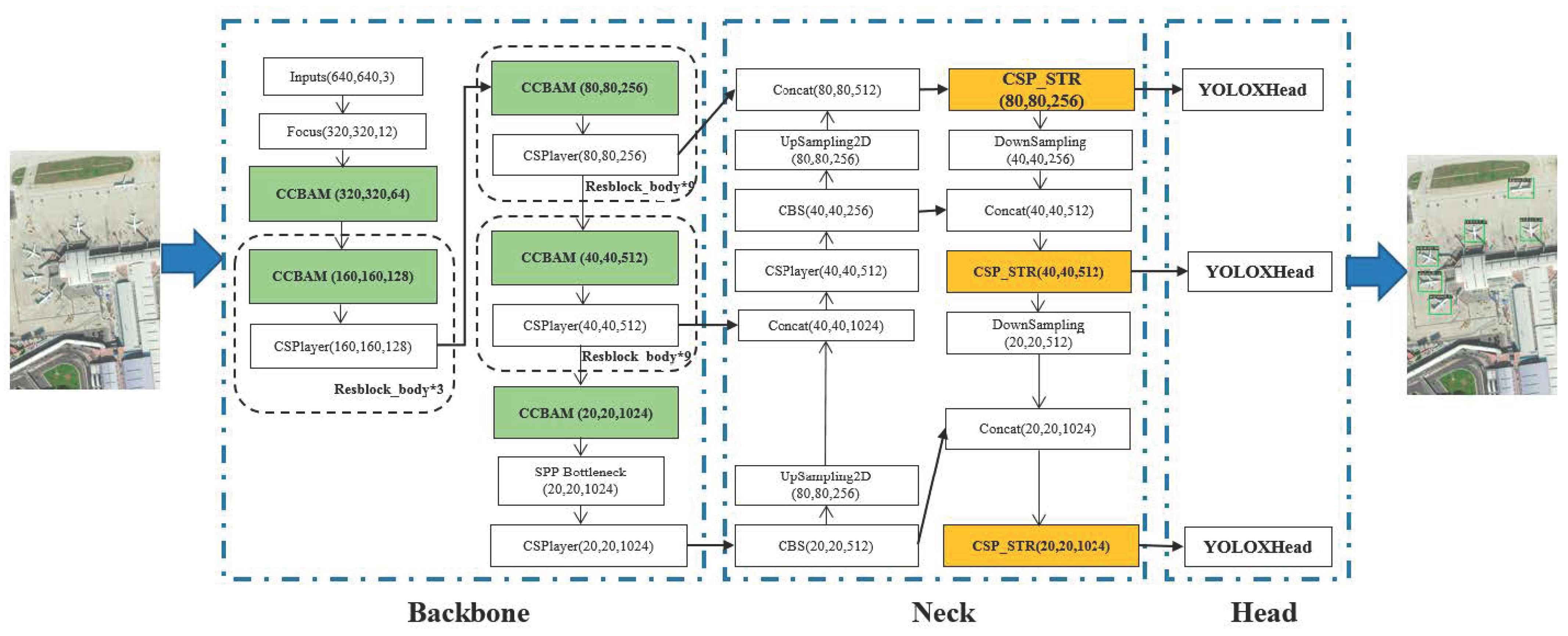
In this section, we introduce the proposed Multiple Attention Mechanism Enhanced YOLOX (MAME-YOLOX) algorithm. The proposed MAME-YOLOX mainly contains three contributions. Firstly, we introduce the CBAM attention mechanism into the backbone of the YOLOX, so that the detection network can focus on the saliency information. Secondly, based on the idea of the self-attention mechanism, the Swin Trans-former is incorporated into the YOLOX’s neck module. Thirdly, instead of GIOU loss, the CIoUloss is adopted to measure the bounding box regression loss, which can prevent the GIoU from degenerating into IoU. The architecture of the improved YOLOX is shown in Figure 4.
Figure 4. The architecture of the improved YOLOX.

3.1. CBAM Enhanced Feature Extraction

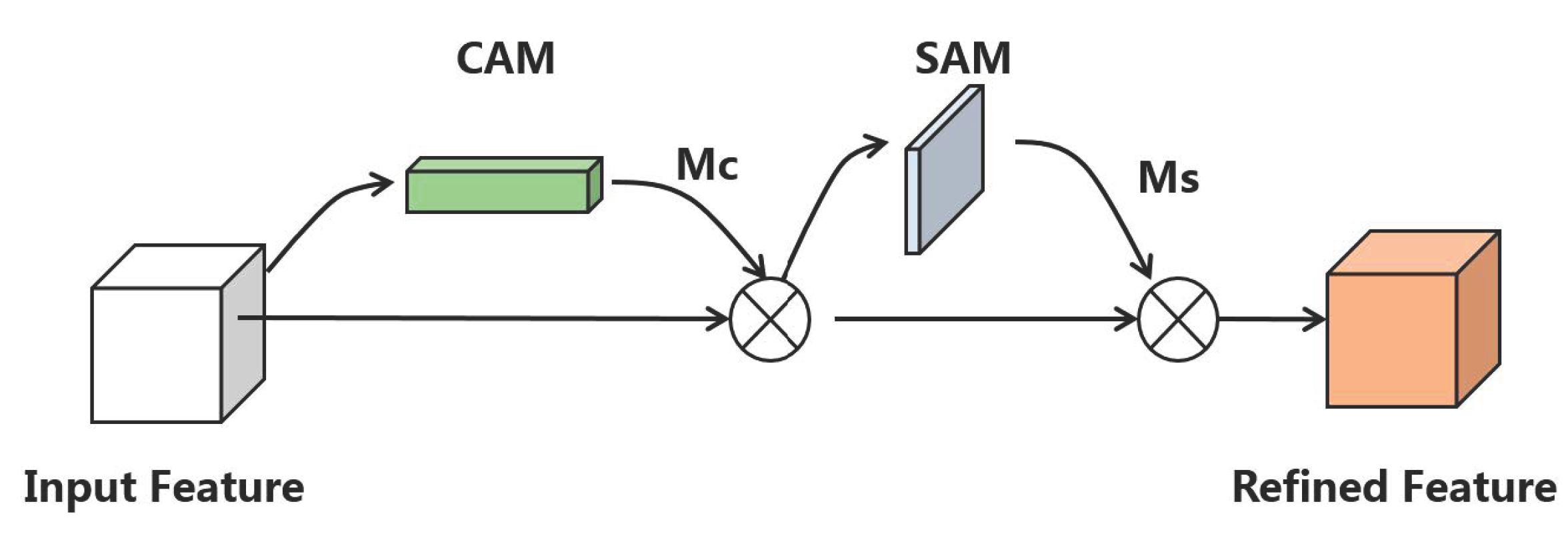
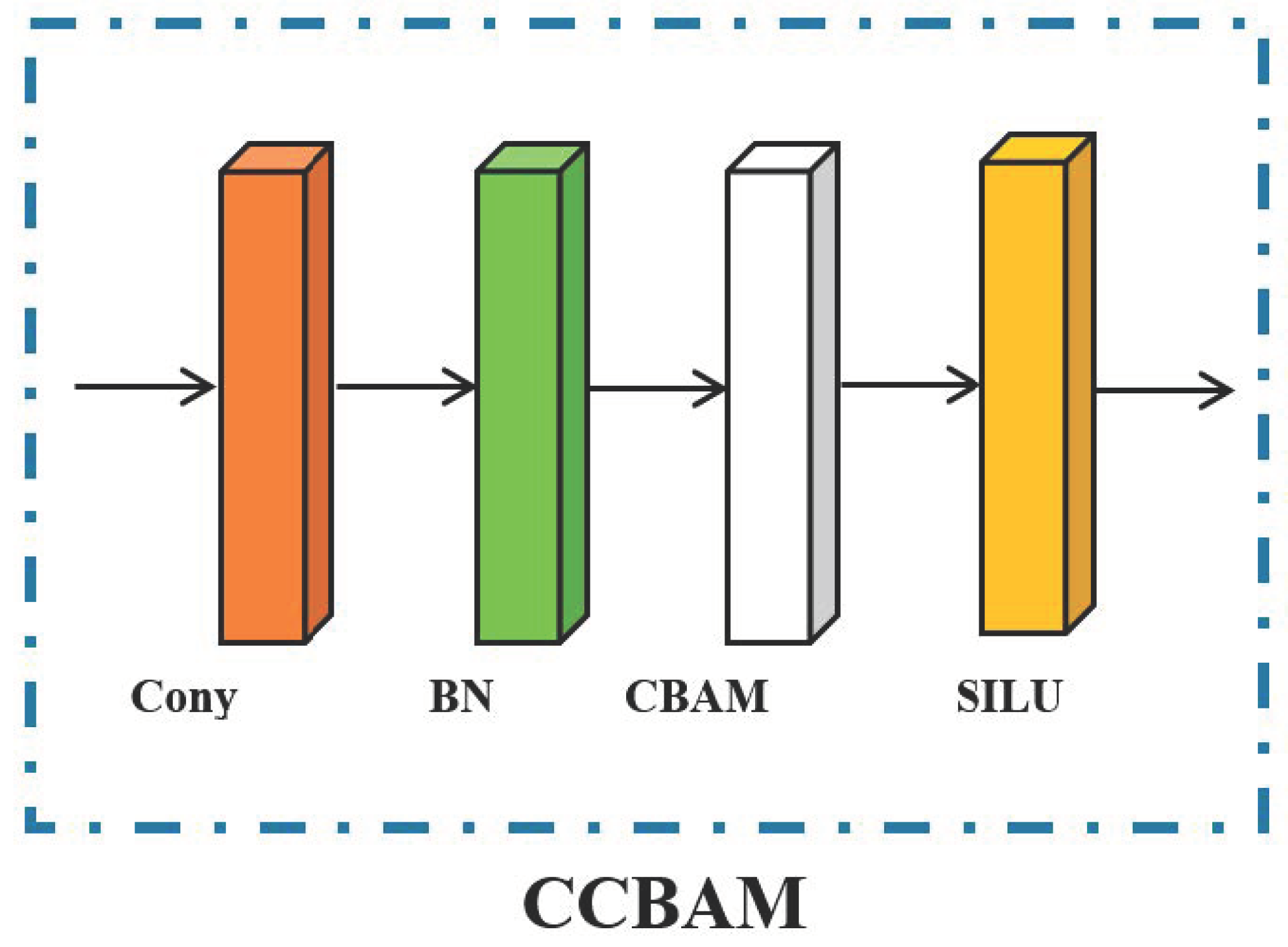
Due to the complex background of the remote sensing image itself, in the process of multiple convolution operations, the iterations of the background will generate a large amount of redundant information, which conceals the valuable information of the image, resulting in a decrease in average precision. Therefore, this paper introduces the CBAM (Convolution Block Attention Module) attention mechanism into the convolutional block of the backbone of YOLOX, which can reduce the redundant information of the fully connected layer and enable the detection network to be more concerned about the locations that need attention. Moreover, it dramatically improves the accuracy of object detection and recognition, especially the precision of small objects. The architecture of the CCBAM is shown in Figure 5.
Figure 5. The architecture of the CCBAM.

3.2. Self-Attention Enhanced Feature Representation

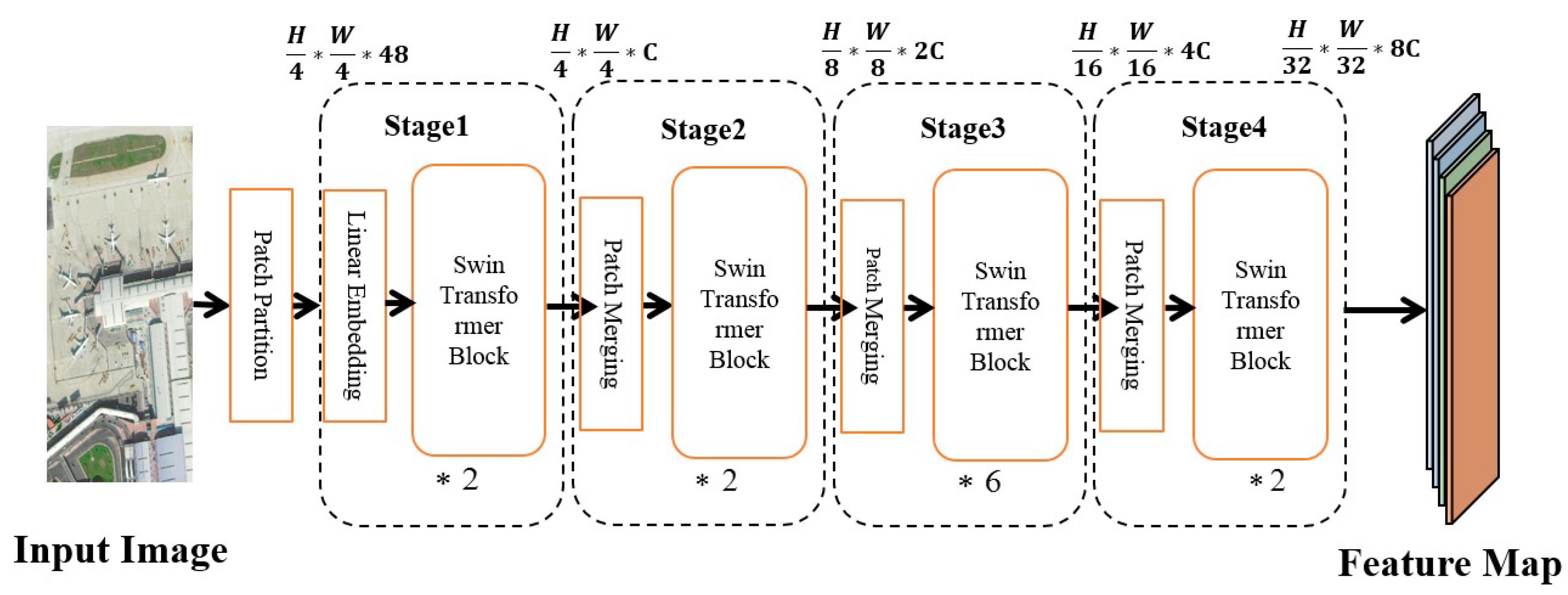
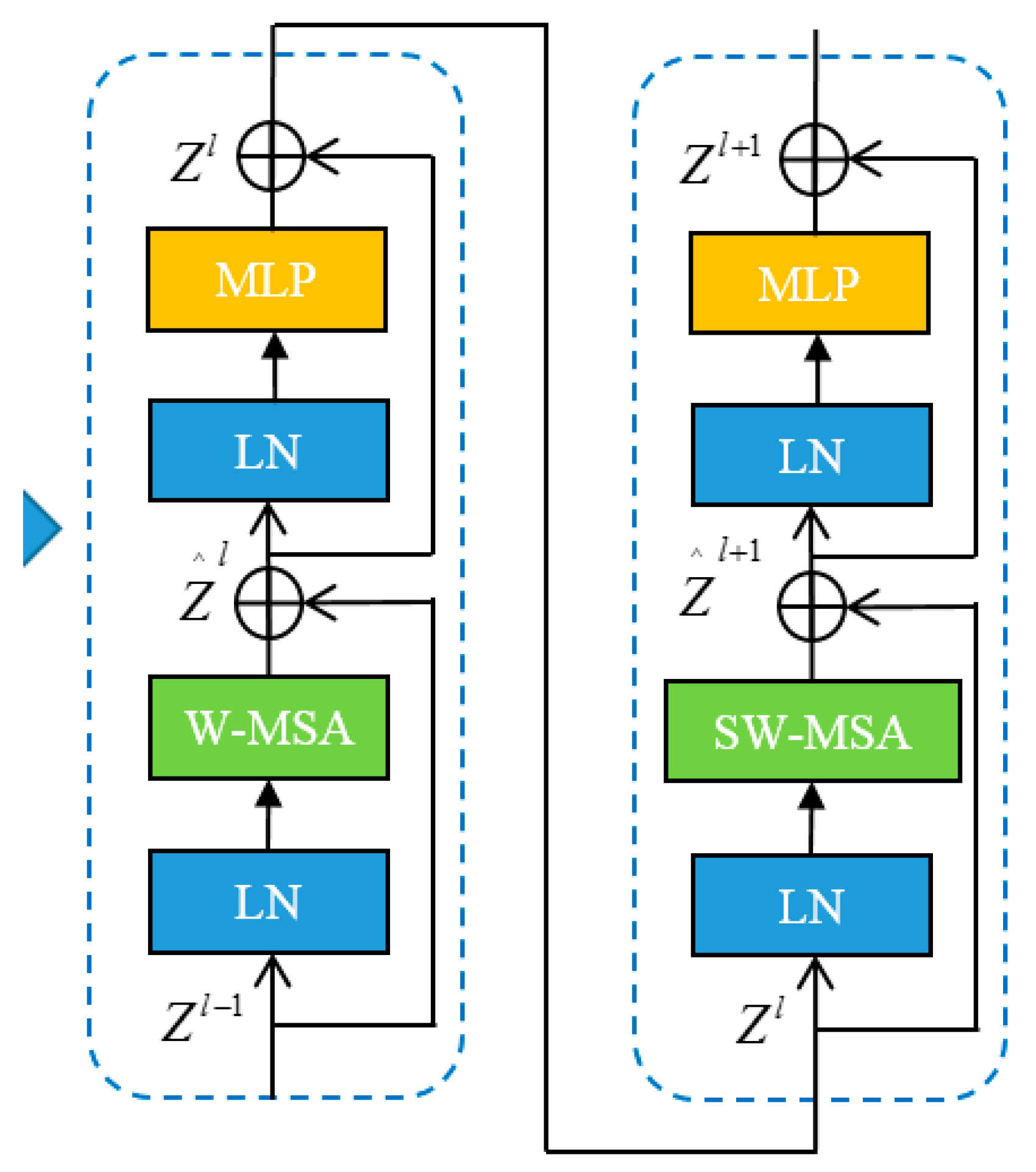
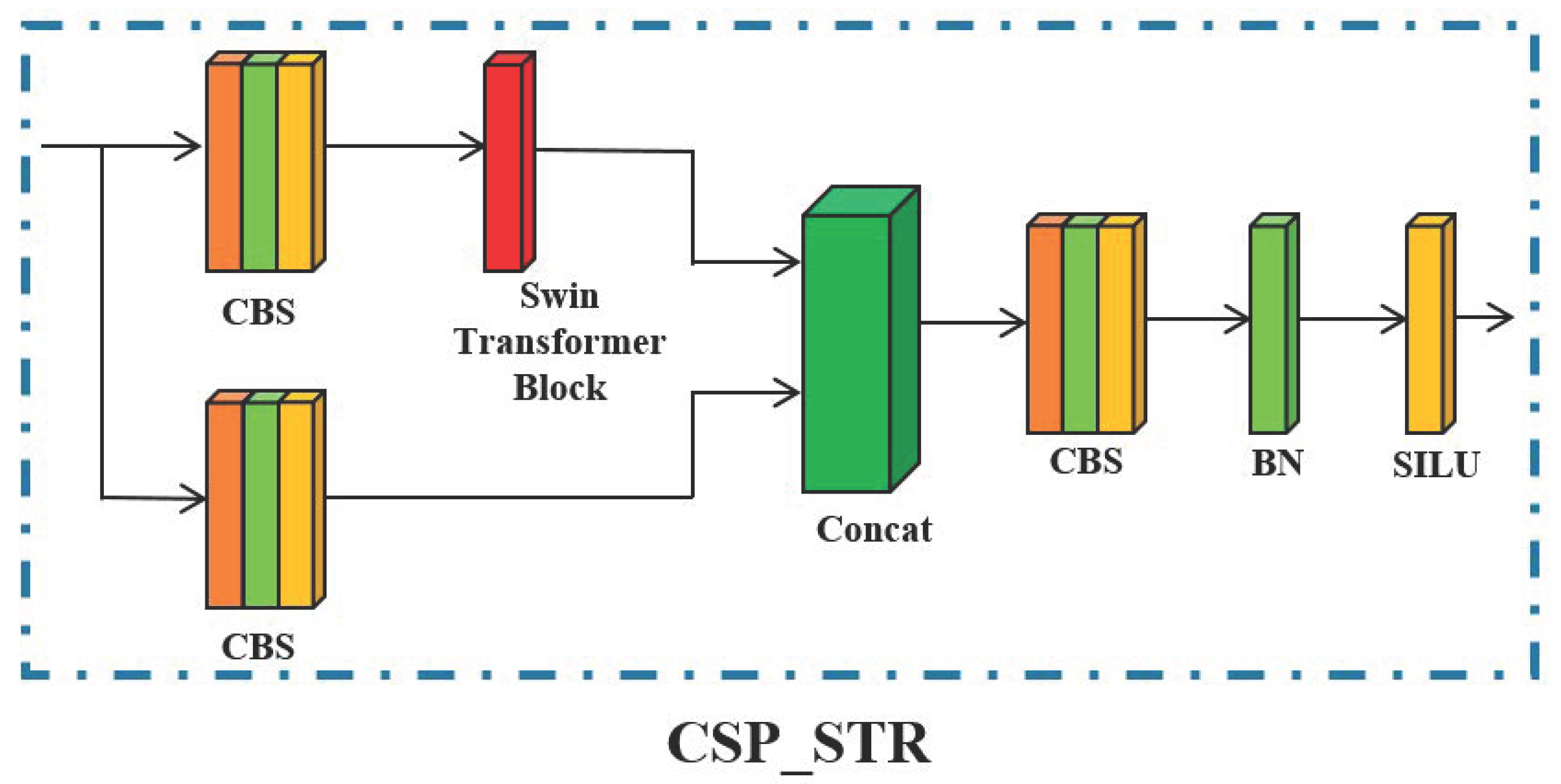
Due to the dense objects in remote sensing images, with the deepening of the net-work and multiple convolution operations, most of the feature information of small objects is lost in the high-level feature map, which is prone to missed and false detections. The Swin Transformer uses a multi-head self-attention module to enhance the semantic information and feature representation of small objects in remote sensing images, which can strengthen the local perception ability of the network and improve the detection accuracy of small-scale objects. Compared with the traditional Transformer, the amount of calculation is significantly minimal. Therefore, the Swin Transformer module idea is introduced into the feature fusion of YOLOX’s neck. The YOLOX’s neck is based on CSP architecture. On this basis, we introduced the Swin Transformer into the CSP, which is called CSP_STR. The architecture of the CSP_STR module after introducing the Swin Transformer into the neck feature fusion network of YOLOX is shown as Figure 6.
Figure 6. The architecture of the CSP_STR module.
The CSP_STR controls the computing area in each window by dividing local windows to realize cross-window information interaction, reduces computational complexity and network computation, and enhances the semantic information and feature representation of small objects.

3.3. Loss Function

The CIOU loss is used as the regression loss function of the bounding box, which solves the problem of GIOU degenerating into IOU. The definition of CIOU loss is shown in Equations (12)–(14).
C I O U = 1 I O U + p 2 ( b 1 + b 2 ) c 2 + α v
α = v ( 1 I O U ) + v
v = 4 π 2 ( arctan w b 1 h b 1 arctan w b 2 h b 2 ) 2
where b 1 is the center point of the prediction box, b 2 is the center point of the ground truth, and c is the diagonal distance of the smallest box covering the two frames. CIOU loss considers the Euclidean distance between the prediction and the ground truth. When the prediction is inside the ground truth, the position of the prediction is different, and the position of its center is also different, and CIOU loss can be calculated. w b 1 , h b 1 , w b 2 , and h b 2 are the width and height of the prediction box and the ground truth box, respectively. By introducing v , the aspect ratio between the predicted box and the object box is also taken into account when the centers of the two boxes coincide, which makes the positioning frame more accurate and improves detection accuracy. In addition, the classification loss of the proposed method is cross entropy (CE).

4. Experimental Results and Analysis

4.1. Datasets

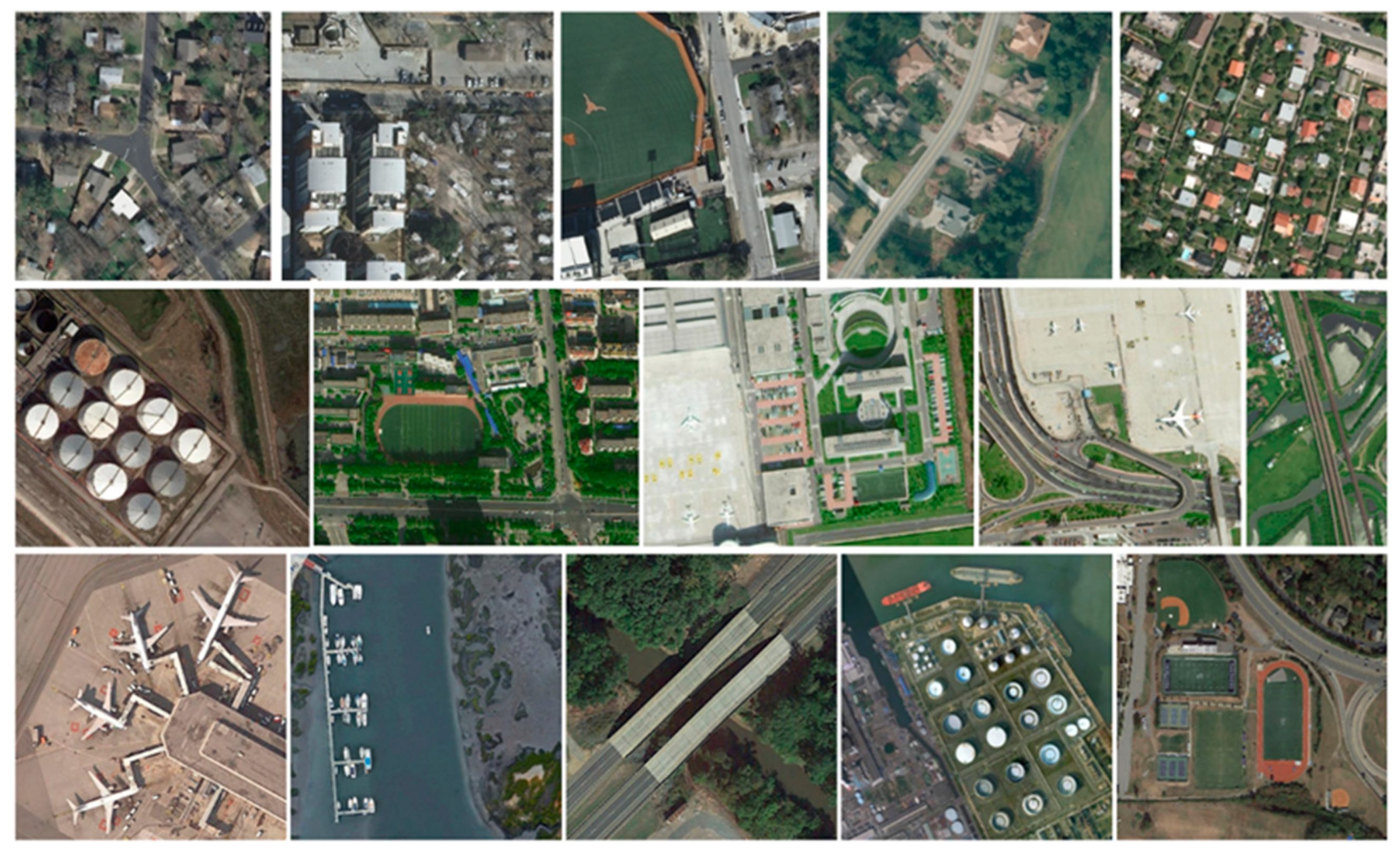
Three publicly available object-detection datasets of remote sensing images, namely DIOR [34], HRRSD [35], and AIBD [36], are used to evaluate the proposed methods in the experiments. Some examples of DIOR, HRRSD, and AIBD are shown as Figure 7.
Figure 7. Sample images for three datasets. The first row’s dataset is AIBD, the second row’s dataset is HRRSD, and the third row’s dataset is DIOR.
The AIBD dataset is dedicated to self-annotation for building detection tasks. AIBD was proposed for the first time in a category containing a single object: buildings. The sample size is 500 × 500, and there are 11,571 samples in total, the same number as the annotation files. Based on the COCO dataset standard, buildings are classified into large, medium, and small. The numbers of large, medium, and small instances are 16,824, 121,515, and 51,977, respectively. They are distinguished from each other by different colors with vastly different backgrounds. The number of pixels of buildings ranges from tens to hundreds of thousands. The geometric shapes of these building instances are diverse, including irregular shapes, such as U-shapes, T-shapes, and L-shapes. The raw data of AIBD are from the Inria aerial image data, accessible on 1 August 2020, mainly for se-mantic segmentation; training sets and test sets were selected from five cities. For each city, about 81 square kilometers of regions and 36 image blocks were selected. The training and test sets contained 180 image patches covering 405 km2. The resolution of each image block was 5000 × 5000, and the geographic resolution was 0.3 m.
The HRRSD dataset was released by the University of Chinese Academy of Sciences in 2019. The dataset contains 21,761 images sampled from Google Earth and Baidu Maps, and the spatial resolution of these images ranges from 0.15 to 1.2 m. The dataset contains 55,740 instances covering 13 different object categories. These categories are airplanes, baseball fields, intersections, surface fields, basketball courts, bridges, ships, storage tanks, ports, parking lots, tennis courts, T-junctions, and vehicles. The biggest highlight of this dataset is that it has balanced samples under the category that cannot be used, and each category has nearly 4000 samples. In addition, the sample count of the training subset of this dataset is 5401, and the sample counts of the validation and test subsets are 5417 and 10943, respectively. The “training values” subset is the combination of the training and validation subsets.
The DIOR dataset is a large-scale benchmark dataset mainly used for object detection in remote sensing images. Northwestern Polytechnical University in China released DIOR through sampling on Google Earth. The dataset contains 23,463 images, 20 object classes, and 192,472 instances. The 20 object categories include airplanes, baseball fields, basketball courts, airports, bridges, chimneys, highway service areas, dams, highway tollbooths, ground track fields, seaports, golf courses, flyovers, stadiums, storage tanks, ships, tennis courts, vehicles, railway stations, and windmills. The dataset image size is 800 × 800, with a spatial resolution from 0.5 to 30 m. This dataset has four salient features: (1) it contains a large number of object instances and images, (2) a variety of different object scales, and (3) different weather, imaging conditions, seasons, etc., and (4) it has high intra-class diversity and inter-class similarity.
In this paper, the percentage of the training set, validation set, and test set of the DIOR dataset is 0.25, 0.25, and 0.5, respectively. The training set and verification set in the other two datasets, HRRSD and AIBD, are jointly used for model training.

4.2. Evaluation Metrics

In this paper, the mAP (mean average precision) and mAP_50 are selected as the main indicators of the experimental results. The evaluation metrics used are from the standard COCO metric set. We also choose mAP_75, mAP_s, mAP_m, and mAP_l as the evaluation indicators of the experimental results. mAP_50 and mAP_75 indicate the accuracy, with a threshold value of 0.5 and 0.75, respectively. mAP_s demonstrates that the average accuracy of the object is small (smaller than 322); mAP_m represents that the average accuracy is at a medium level (between 322 and 962); and mAP_l expresses that the average accuracy is large (bigger than 962). mAP is an indicator for measuring recognition accuracy in object detection, and is the average of AP for multiple categories. mAP is defined in Equation (15).
m A P = q = 1 Q A v e P ( q ) Q
where Q represents the category set of object detection and A v e P ( q ) is the average accuracy rate of the object under the calculation category. Precision-recall (PR) is calculated as shown in Equations (16) and (17).
P r e c i s i o n = T P T P + F P
Recall = T P T P + F N
where true positive (TP) represents the number of positive samples that are correctly predicted as positive. True negative (TN) represents the number of negative samples that are correctly predicted as negative. False positive (FP) represents the number of negative samples that are incorrectly predicted as positive. False negative (FN) represents the number of positive samples that are incorrectly predicted as negative.
In addition, the TP, TN, FP, and FN of object detection are derived by the IOU (intersection over union). The IOU measures the overlap rate between two regions within the object detection range, as shown in Equation (18).
I O U = a r e a ( B p B g t ) a r e a ( B p B g t )
where IOU represents the overlapping area between the predicted bounding box B p and the true bounding box B g t divided by the union area of the two. The predicted bounding boxes are classified as true or false by comparing the IOU with a given threshold T. If IOU ≥ T, it is considered true. If the contrary, the detection is considered false.

4.3. Experimental Setups

The competitive algorithms include Faster R-CNN [37], RetinaNet [38], SSD512 [39], YOLOv3 [16], and YOLOX [18]. Among them, Faster R-CNN is a typical representative of two-stage methods, while RetinaNet, SSD512, YOLOv3, and YOLOX are representative of single-stage methods. In the three datasets for which we visualized test results, the true cases (TPs), false positive cases (FPs), and false negative cases (FNs) are represented by green boxes, red boxes, and yellow boxes, respectively. The parameter settings of the competitive algorithms are summarized in Table 1.
Table 1. The parameter settings of the competitive algorithms.
The methods used in the comparison experiment are based on the MMdetection platform (https://github.com/open-mmlab/mmdetection, accessed on 21 October 2022). The host computer for model training consists of four graphical processors of Nvidia GeForce RTX 2080.

4.4. Experimental Analysis

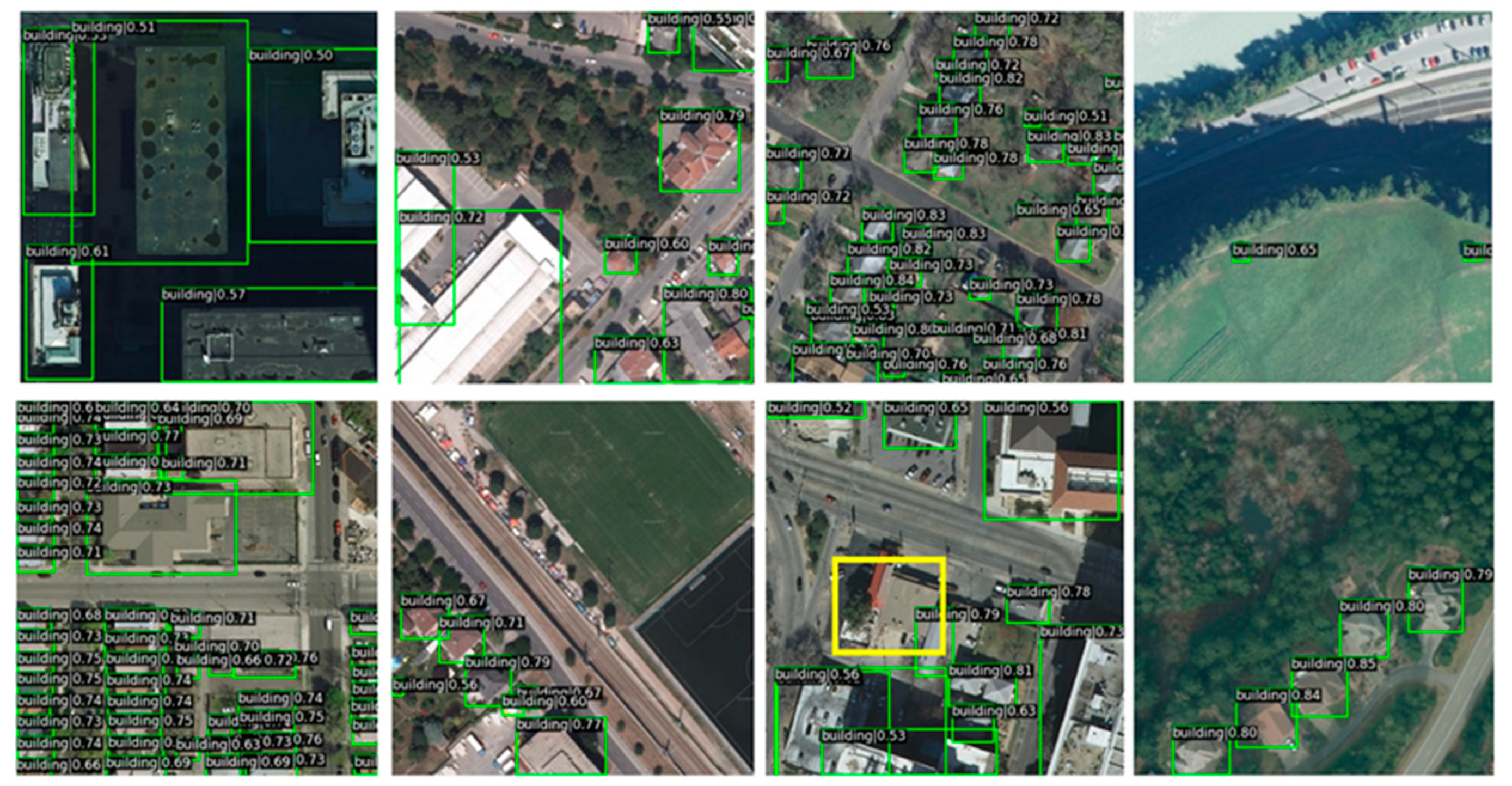
Firstly, the improved algorithm proposed in this paper is compared with the object detection algorithm mentioned above in the AIBD dataset. The visualized test results are shown in Figure 8.
Figure 8. The AIBD dataset’s visualized test results using different algorithms.
In Figure 8, although AIBD is a building object detection dataset containing a single category, the intra-category differences are very large. It can be seen that the apparent characteristics of buildings greatly vary, whether for common rectangular buildings or for buildings with irregular shapes. However, the overall test result of MAME-YOLOX is satisfactory. The yellow rectangular box is the object of the undetected building, which is a false negative (FNs). Because the color of the building is very similar to the surrounding roads, the edge features are not clear.
The quantitative comparison experiment results of the AIBD dataset are shown in Table 2 and Table 3. Table 2 presents algorithm, backbone, mAP, and mAP_50 values. Table 3 presents the mAP_75, mAP_s, mAP_m, and mAP_l values.
Table 2. Comparative experimental results of different algorithms on the AIBD dataset.
Table 3. Comparative experimental results of different algorithms on the AIBD dataset.
From Table 2, we can clearly see MAME-YOLOX has the best effect on the two main indicators of mAP and mAP_50, which are 0.479 and 0.848, respectively. Moreover, from Table 2, we can see for different object sizes; MAME-YOLOX’s mAP_m indicator is optimal. The second-best results of mAP and mAP_50 were obtained by YOLOX, which are 0.467 and 0.832, respectively. Compared with the YOLOX algorithm, MAME-YOLOX’s overall mAP value increased by 1.8%, while the mAP_50 value increased by 1.7%.
Secondly, the improved algorithm proposed in this paper is compared with the object detection algorithm mentioned above in the HRRSD dataset, which has 13 object categories. The visualized test results are shown in Figure 9.
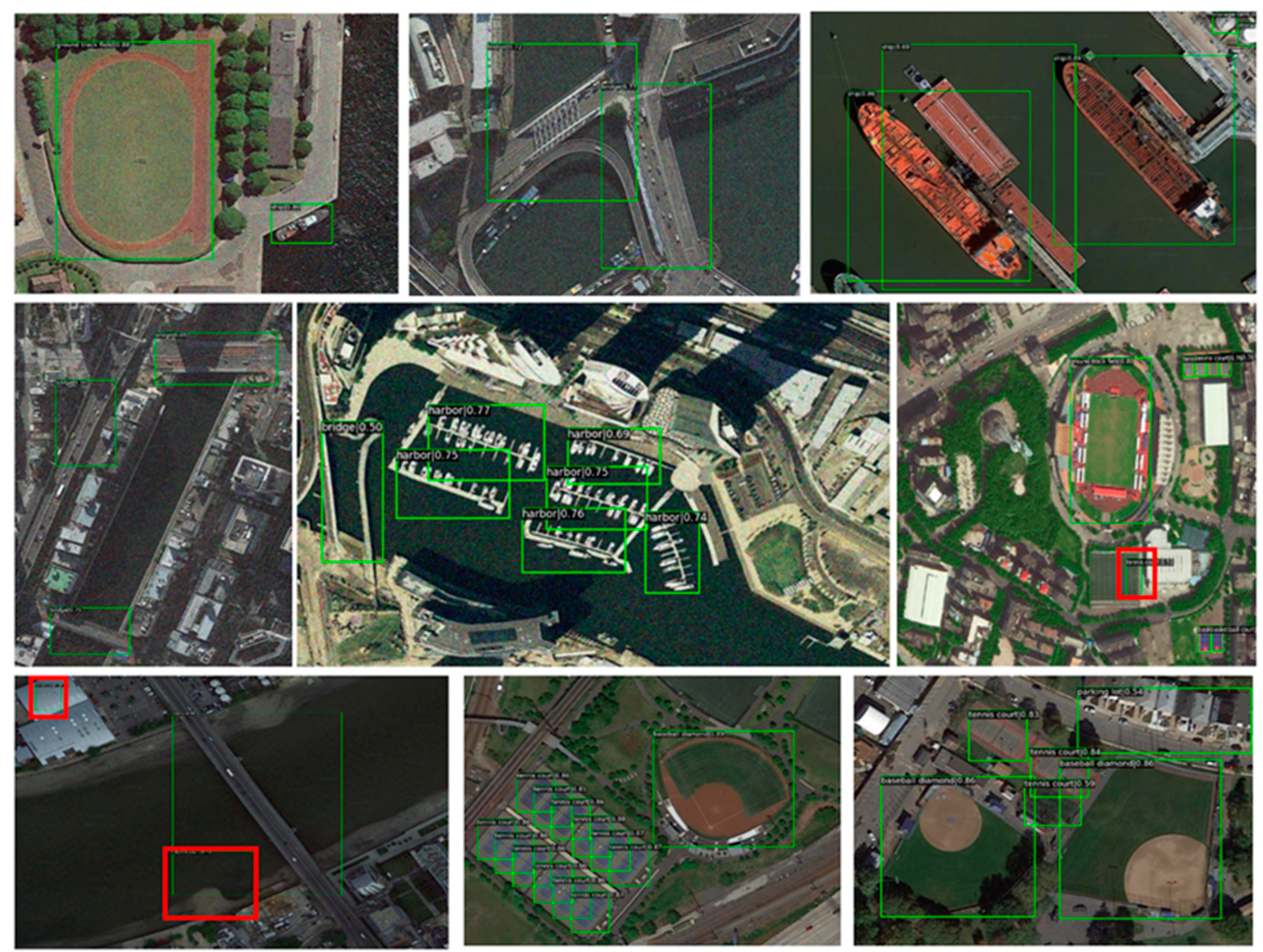
Figure 9. The HRRSD dataset’s visualized test results using different algorithms.
In Figure 9, we can see most of the objects of the HRRSD dataset have obvious features, such as apparent texture and color, and the size of the object is large. However, information-rich high-score images also have the problems of small differences between categories, large differences within categories, and it being difficult to unify semantics. Therefore, the red rectangular boxes in Figure 9 are all examples of false negative detections. Among them, the first one is that the highway is wrongly detected as a bridge. From the visual observation, its foreground and background information is very similar to the bridge. In the second red rectangle, the road turntable is mistakenly detected as a storage tank. If the context information of the object image is fully considered, the object should not be mistakenly detected. The quantitative comparison experiment results on HRRSD datasets are shown in Table 4 and Table 5. Table 4 presents the algorithm, backbone, mAP, and mAP_50 value. Table 5 presents the mAP_75, mAP_s, mAP_m, and mAP_l values.
Table 4. Comparative experimental results of different algorithms on HRRSD dataset.
Table 5. Comparative experimental results of different algorithms on HRRSD dataset.
From Table 4, it can be seen that Faster R-CNN obtained the best mAP and mAP_50 indicator results, at 0.561 and 0.888, respectively. MAME-YOLOX ranks second, and the results are 0.549 and 0.862, respectively. However, our algorithm processing speed is better than that of Faster R-CNN. Compared with the YOLOX algorithm, MAME-YOLOX’s overall mAP value increased by 1.4%, while the mAP_50 value increased by 1.6%.
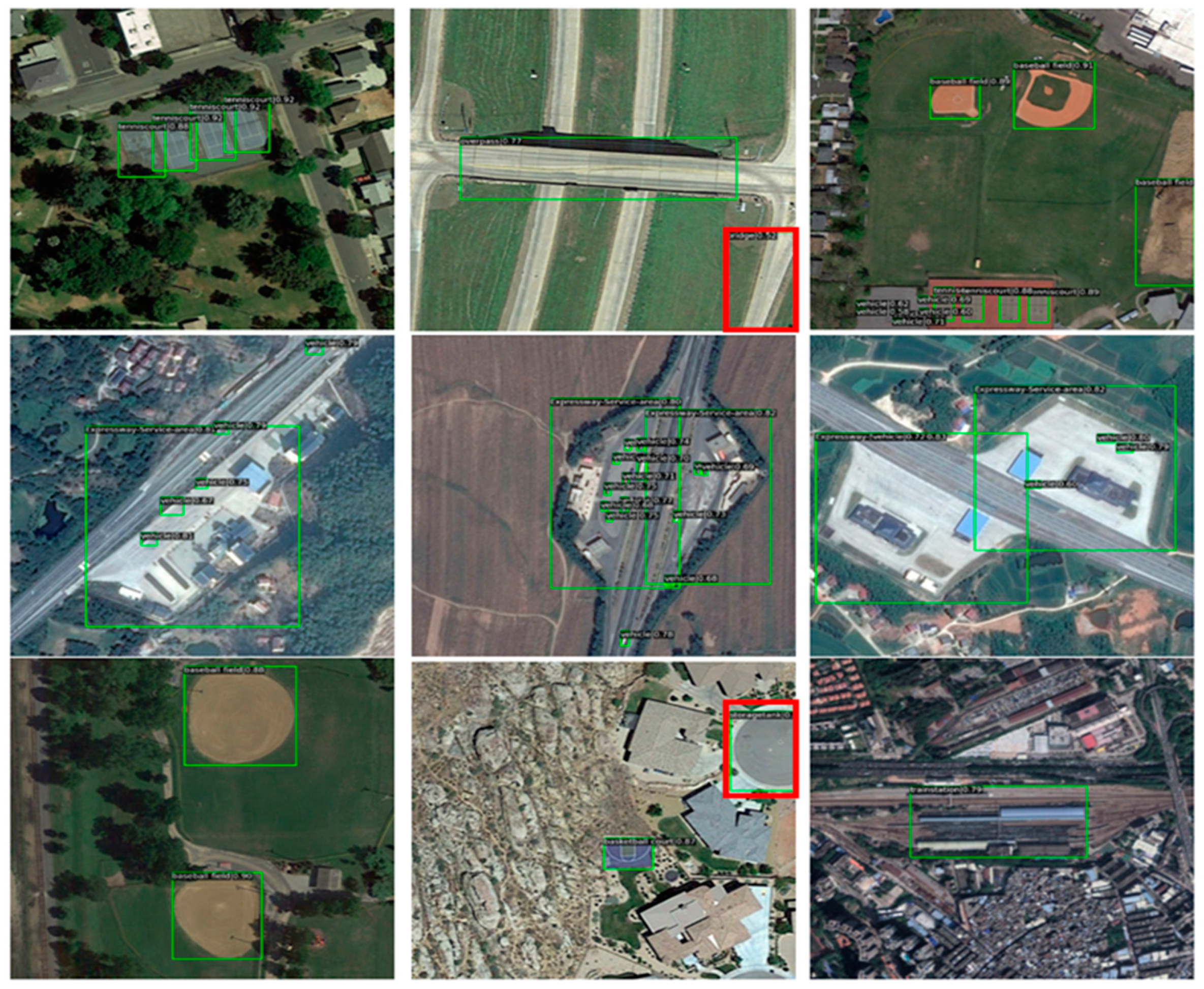
Thirdly, the improved algorithm proposed in this paper is compared with the object detection algorithm mentioned above in the DIOR dataset. The visualized test results are shown in Figure 10.
Figure 10. The DIOR dataset’s visualized test results using different algorithms.
The DIOR dataset contains 20 object categories, and in Figure 10 we can see that when the object instance has the characteristics of a small size and a dense appearance, such as vehicles, ports may be detected by mistake. However, objects with relatively fixed appearance features, such as aircrafts and tanks, are rarely detected by mistake or omitted. The quantitative comparison experiment results of the DIOR dataset are shown in Table 6 and Table 7. Table 6 provides the algorithm, backbone, mAP, and mAP_50 value. Table 7 presents the mAP_75, mAP_s, mAP_m, and mAP_l values.
Table 6. Comparative experimental results of different algorithms on the DIOR dataset.
Table 7. Comparative experimental results of different algorithms on the DIOR dataset.
From Table 6, we can see MAME-YOLOX obtains the optimal mAP indicator, 0.501, and the optimal mAP_50 indicator, 0.772, respectively. Second place is obtained by the SSD512 algorithm, where the mAP result is 0.497 and mAP_50 is 0.759. Compared with the YOLOX algorithm, MAME-YOLOX’s overall mAP value increased by 3.2%, while the mAP_50 value increased by 3.4%.
The ablation experiments on the AIBD, HRRSD, and DIOR datasets are shown in Table 8, Table 9 and Table 10, respectively.
Table 8. The ablation experiments on the AIBD dataset.
Table 9. The ablation experiments on the HRRSD dataset.
Table 10. The ablation experiments on the DIOR dataset.
The experimental results demonstrate that the architecture of the proposed method is effective and achieves better results. For example, the mAP and mAP_50 of the MAME-YOLOX are 0.273 and 0.472, respectively, being better than those of the YOLOX, YOLOX + SwinTrans., and YOLOX + CBAM. The SwinTrans. module and CBAM module are all beneficial to improve the performance; however, the MAME-YOLOX achieves the best results.
From the qualitative visualization examples of the three datasets, the proposed framework in this paper fits more closely with the remote sensing object to be detected. At the same time, this method can detect some small remote sensing objects that are not easy to find, which reduces the missed detection rate of small objects to a certain extent, and thus improves the detection accuracy of remote sensing objects. MAME-YOLOX is a very promising method, which has a strong ability for object detection in remote sensing images. It is not only applicable to datasets of multiple object categories, but also applicable to datasets of single object categories.


5. Conclusions

Aiming at detection robustness for tiny objects against complex backgrounds, in this paper, we proposed a Multiple Attention Mechanism Enhanced YOLOX (MAME-YOLOX) algorithm. Firstly, the CBAM attention mechanism was introduced into the convolution block of YOLOX’s backbone to reduce the redundant information. This mechanism could improve the detection accuracy. Secondly, the idea of the Swin Transformer was integrated into the feature fusion of YOLOX’s neck to enhance the global perception for small objects. This design produced a better fitting effect on small objects. Finally, we used CIoU loss to replace the GIOU loss as the regression loss of the bounding box, enhancing the accuracy of object detection. The experimental results showed that the mAP of the MAME-YOLOX improved the original YOLOX by 1.8, 1.4, and 3.2% on the three datasets, AIBD, HRRSD, and DIOR, respectively. This demonstrated the effectiveness of MAME-YOLOX for remote sensing object detection.
In the future, we will explore lightweight feature extraction networks and simplify the network architecture.

Author Contributions

Funding acquisition, C.M. and W.G.; investigation, C.S., C.M. and W.G.; methodology, C.S. and C.M.; supervision, C.M.; validation, C.S.; writing—original draft, C.S.; writing—review and editing, C.S. All authors have read and agreed to the published version of the manuscript.

Funding

This work was supported by the Strategic Priority Program on Space Science (III) Chinese Academy of Science (CAS) Program, grant number XDA15020604.

Institutional Review Board Statement

Not applicable.

Data Availability Statement

Not applicable.

Acknowledgments

We thank the Laboratory of Space Optics Technology.

Conflicts of Interest

The authors declare no conflict of interest.

References

  1. Gao, T.; Duan, J.; Fan, Q. Remote sensing image object detection based on improved RFBNet algorithm. J. Jilin Univ. (Sci. Ed.) 2021, 59, 1188–1198. [Google Scholar]
  2. Haris, K.; Efstratiadis, S.N.; Maglaveras, N.; Katsaggelos, A.K. Hybrid image segmentation using watersheds and fast region merging. IEEE Trans. Image Process. 1998, 7, 1684–1699. [Google Scholar] [CrossRef] [PubMed]
  3. Yan, Q.; Xu, L.; Shi, J.; Jia, J. Hierarchical saliency detection. In Proceedings of the IEEE Conference on Computer Vision and Pattern Recognition (CVPR), Portland, OR, USA, 23–28 June 2013; pp. 1155–1162. [Google Scholar]
  4. Harris, C.; Stephens, M. A Combined Corner and Edge Detector. In Proceedings of the 4th Alvey Vision Conference, Manchester, UK, 31 August–2 September 1988; pp. 147–151. [Google Scholar]
  5. Cortes, C.; Vapnik, V. Support-vector networks. Mach. Learn. 1995, 20, 273–297. [Google Scholar] [CrossRef]
  6. Girshick, R.; Donahue, J.; Darrell, T.; Malik, J. Rich feature hierarchies for accurate object detection and semantic segmentation. In Proceedings of the IEEE Conference on Computer Vision and Pattern Recognition, Lake City, UT, USA, 23–28 June 2014; pp. 580–587. [Google Scholar]
  7. Girshick, R. Fast R-CNN. In Proceedings of the 2015 IEEE International Conference on Computer Vision (ICCV), Santiago, Chile, 7–13 December 2015; pp. 1440–1448. [Google Scholar]
  8. Ren, S.; He, K.; Girshick, R.; Sun, J. Faster R-CNN: Towards real-Time object detection with region proposal networks. IEEE Trans. Pattern Anal. Mach. Intell. 2017, 39, 1137–1149. [Google Scholar] [CrossRef]
  9. Lin, N.; Feng, L.; Zhang, X. Remote sensing image aircraft detection based on optimized Faster-RCNN. Remote Sens. Technol. Appl. 2021, 36, 275–284. [Google Scholar]
  10. Yao, Y.Q.; Cheng, G.; Xie, X.X. Optical remote sensing image object detection based on multi-resolution feature fusion. Natl. Remote Sens. Bull. 2021, 25, 1124–1137. [Google Scholar]
  11. Zhang, X.; Li, C.; Xu, J.; Jin, X.; Zhen, C.; Jian, Y. Cascaded object detection algorithm in remote sensing imagery. J. Comput. Aided Des. Comput. Graph. 2021, 33, 1524–1531. [Google Scholar]
  12. Dong, Y.; Ji, C.; Wang, P.; Feng, Z. Aircraft detection algorithm of optical remote sensing image based on depth learning. J. Laser Optoelectron. Prog. 2020, 57, 041007-1–041007-7. [Google Scholar] [CrossRef]
  13. Dai, Y.; Yi, B.; Xiao, J.; Lei, J.; Tong, L.; Cheng, Z. Remote sensing image target detection based on improved rotation region generation network. J. Acta Opt. Sin. 2020, 40, 0111020-1–0111020-11. [Google Scholar]
  14. Redmon, J.; Divvala, S.; Girshick, R.; Farhadi, A. You only look once: Unified, real-time object detection. In Proceedings of the 2016 IEEE Conference on Computer Vision and Pattern Recognition, Las Vegas, NV, USA, 27–30 June 2016; pp. 779–788. [Google Scholar]
  15. Redmon, J.; Farhadi, A. YOLO9000: Better, faster, stronger. In Proceedings of the 2017 IEEE Conference on Computer Vision and Pattern Recognition, Honolulu, HI, USA, 21–26 July 2017; pp. 6517–6525. [Google Scholar]
  16. Farhadi, A.; Redmon, J. YOLOv3: An incremental improvement. In Proceedings of the IEEE Conference on Computer Vision and Pattern Recognition, Salt Lake City, UT, USA, 18–22 June 2018; pp. 1804–2767. [Google Scholar]
  17. Shi, S.; Guo, C.; Jiang, L.; Wang, Z.; Shi, J.; Wang, X.; Li, H. YOLOv4: Optimal speed and accuracy of object detection. In Proceedings of the IEEE Conference on Computer Vision and Pattern Recognition, Seattle, WA, USA, 13–19 June 2020; pp. 2–7. [Google Scholar]
  18. Ge, Z.; Liu, S.; Wang, F.; Li, Z.; Sun, J. YOLOX: Exceeding YOLO series in 2021. arXiv 2021, arXiv:2107.08430. [Google Scholar]
  19. Zhang, Y.; Yang, H.; Liu, X. Object detection in remote sensing image based on multi-scale feature dense connection. J. China Acad. Electron. Sci. 2019, 14, 530–536. [Google Scholar]
  20. Zhang, T.; Liu, H.; Li, S. Improved YOLOv4 for aircraft object detection from remote sensing images. J. Electron. Opt. Control. 2022. Available online: https://kns.cnki.net/kcms/detail/41.1227.TN.20220824.1534.014.html (accessed on 18 October 2022).
  21. Lang, L.; Liu, K.; Wang, D. Lightweight remote sensing image object detection model based on YOLOX tiny. J. Laser Optoelectron. Prog. 2022. Available online: https://kns.cnki.net/kcms/detail/31.1690.TN.20220713.1320.244.html (accessed on 20 October 2022).
  22. Vaswani, A.; Shazeer, N.; Parmar, N.; Uszkoreit, J.; Jones, L.; Gomez, A.N.; Kaiser, Ł.; Polosukhin, I. Attention is all you need. Neural Inf. Process. Systems. 2017, 5998–6008. [Google Scholar] [CrossRef]
  23. Liu, Z.; Lin, Y.; Cao, Y.; Hu, H.; Wei, Y.; Zhang, Z.; Lin, S.; Guo, B. Swin transformer: Hierarchical vision transformer using shifted windows. In Proceedings of the IEEE/CVF International Conference on Computer Vision (ICCV), Montreal, Canada, 11–17 October 2021; pp. 10012–10022. [Google Scholar]
  24. Xu, X.; Feng, Z.; Cao, C.; Li, M.; Wu, J.; Wu, Z.; Shang, Y.; Ye, S. An improved Swin transformer-based model for remote sensing object detection and instance segmentation. Remote Sens. 2021, 13, 4779. [Google Scholar] [CrossRef]
  25. Liu, C.; Xie, N.; Yang, X.; Chen, R.; Chang, X.; Zhong, R.Y.; Peng, S.; Liu, X. A Domestic Trash Detection Model Based on Improved YOLOX. Sensors 2022, 22, 6186. [Google Scholar] [CrossRef] [PubMed]
  26. Zhang, Z.X.; Wang, M.W. Convolutional neural network with convolutional block attention module for finger vein recognition. arXiv 2022, arXiv:2202.06673. [Google Scholar]
  27. Zheng, Z.-H.; Wang, P.; Liu, W. Distance-IoU loss: Faster and better learning for bounding box regression. In Proceedings of the AAAI Conference on Artificial Intelligence (AAAI), Honolulu, HI, USA, 27 January–1 February 2019. [Google Scholar]
  28. Han, G.; Li, T.; Li, Q.; Zhao, F.; Zhang, M.; Wang, R.; Yuan, Q.; Liu, K.; Qin, L. Improved Algorithm for Insulator and Its Defect Detection Based on YOLOX. Sensors 2022, 22, 6974. [Google Scholar] [CrossRef]
  29. Lin, T.Y.; Goyal, P.; Girshick, R.; He, K.; Dollár, P. Feature pyramid networks for object detection. In Proceedings of the 2017 IEEE Conference on Computer Vision and Pattern Recognition (CVPR), Venice, Italy, 22–29 October 2017; pp. 936–944. [Google Scholar]
  30. Woo, S.; Hwang, S.; Kweon, I.S. StairNet: Top-down semantic aggregation for accurate one shot detection. In Proceedings of the 2018 IEEE Winter Conference on Applications of Computer Vision, Salt Lake City, UT, USA, 18–23 June 2018; pp. 1093–1102. [Google Scholar]
  31. Zheng, Z.; Wang, P.; Ren, D.; Liu, W.; Ye, R.; Hu, Q.; Zuo, W. Enhancing geometric factors in model learning and inference for object detection and instance segmentation. IEEE Trans. Cybern. 2022, 52, 8574–8586. [Google Scholar] [CrossRef]
  32. Woo, S.; Park, J.; Lee, J.; Kweon, I.S. CBAM: Convolutional Block Attention Module. In Proceedings of the 15th European Conference Computer Vision, ECCV, Munich, Germany, 8–14 September 2018; Volume 11211, pp. 3–19. [Google Scholar]
  33. Xu, W.; Zhang, C.; Wang, Q.; Dai, P. FEA-Swin: Foreground Enhancement Attention Swin Transformer Network for Accurate UAV-Based Dense Object Detection. Sensors 2022, 22, 6993. [Google Scholar] [CrossRef]
  34. Li, K.; Wan, G.; Cheng, G.; Meng, L.; Han, J. Object detection in optical remote sensing images: A survey and a new benchmark. ISPRS J. Photogramm. Remote Sens. 2020, 159, 296–307. [Google Scholar] [CrossRef]
  35. Zhang, Y.; Yuan, Y.; Feng, Y.; Lu, X. Hierarchical and Robust Convolutional Neural Network for Very High-Resolution Remote Sensing Object Detection. IEEE Trans. Geosci. Remote Sens. 2019, 57, 5535–5548. [Google Scholar] [CrossRef]
  36. Liu, K.; Jiang, Z.; Xu, M.; Perc, M.; Li, X. Tilt Correction Toward Building Detection of Remote Sensing Images. IEEE J. Sel. Top. Appl. Earth Obs. Remote Sens. 2021, 14, 5854–5866. [Google Scholar] [CrossRef]
  37. Ren, Y.; Zhu, C.R.; Xiao, S.P. Object Detection Based on Fast/Faster RCNN Employing Fully Convolutional Architectures. Math. Probl. Eng. 2018, 2018, 1–7. [Google Scholar] [CrossRef]
  38. Lin, T.Y.; Goyal, P.; Girshick, R.; He, K.; Dollár, P. Focal Loss for Dense Object Detection. IEEE Trans. Pattern Anal. Mach. Intell. 2020, 42, 318–327. [Google Scholar] [CrossRef]
  39. Liu, W.; Anguelov, D.; Erhan, D.; Szegedy, C.; Reed, S.E.; Fu, C.Y.; Berg, A.C. SSD: Single Shot MultiBox Detector. In Proceedings of the European Conference Computer Vision, ECCV, Amsterdam, The Netherlands, 11–14 October 2016; Volume 9905, pp. 21–37. [Google Scholar]
Disclaimer/Publisher’s Note: The statements, opinions and data contained in all publications are solely those of the individual author(s) and contributor(s) and not of MDPI and/or the editor(s). MDPI and/or the editor(s) disclaim responsibility for any injury to people or property resulting from any ideas, methods, instructions or products referred to in the content.

Article Metrics

Citations

Article Access Statistics

Multiple requests from the same IP address are counted as one view.