You are currently viewing a new version of our website. To view the old version click .
Sensors
  • Article
  • Open Access

9 January 2023

Automatic Verification and Execution of Cyber Attack on IoT Devices
,
,
and
1
Department of Information Security and Communication Technology, Norwegian University of Science and Technology, 2815 Gjøvik, Norway
2
Institute for Energy Technology, Os alle 5, 1777 Halden, Norway
*
Author to whom correspondence should be addressed.
These authors contributed equally to this work.
This article belongs to the Special Issue Validation Methods in IoT Systems: Security, Performance and Safety

Abstract

Internet of Things (IoT) devices are becoming a part of our daily life; from health monitors to critical infrastructure, they are used everywhere. This makes them ideal targets for malicious actors to exploit for nefarious purposes. Recent attacks like the Mirai botnet are just examples in which default credentials were used to exploit thousands of devices. This raises major concerns about IoT device security. In this work, we aimed to investigate security of IoT devices through performing automatic penetration test on IoT devices. A penetration test is a way of detecting security problems, but manually testing billions of IoT devices is infeasible. This work has therefore examined autonomous penetration testing on IoT devices. In recent studies, automated attack execution models were developed for modeling automated attacks in cyber ranges. We have (1) investigated how such models can be applied for performing autonomous IoT penetration testing. Furthermore, we have (2) investigated if some well known and severe Wi-Fi related vulnerabilities still exist in IoT devices. Through a case study, we have shown that the such models can be used to model and design autonomous penetration testing agents for IoT devices. In addition, we have demonstrated that well-known vulnerabilities are present in deployed and currently sold products used in IoT devices, and that they can be both autonomously revealed through our developed system.

1. Introduction

Penetration testing describes the attempt of hacking a computer system in order to uncover potential vulnerabilities and thus assess its level of security. Because a penetration test is mostly done manually, it is costly and time-consuming, and the results will depend on the incline and expertise of the tester. A fully automatic penetration test would be fast, inexpensive, and deterministic. In addition, it would be highly useful for training purposes in a cyber range [1]. However, existing research has proven autonomous penetration testing to be a complex task and especially challenging for devices in the Internet of Things (IoT) domain.
Researchers [2] have developed a new modeling plan to subdivide the task of autonomously attacking and defending systems in a cyber range network. In the study, they demonstrated how agents on both sides could employ the modeling plan with a selected number of offensive and defensive tactics. This research aims to expand and investigate the capabilities of autonomous attack agents created in the work of Yamin & Katt [2] by both introducing new types of attacks and using the agents to automate penetration testing on IoT devices. This work will try to expand the capabilities and usability of the attacking agent. This will be done by employing the modeling plan on an exploit, targeting a vulnerability in an IoT device. Finally, the new attack agent is tested on running IoT devices and is compared with current automated vulnerability scanners and exploitation systems.
In this paper, we will first share the background and related work to the IoT threat landscape. Continuing that, we will provide details of the case study environment in which a manual cyber attack on IoT devices is performed and share its results. Moving forward, we will present the system design for automated attack and verification on IoT devices. We will then discuss the results and conclude the article.

3. Case Study and Environment

A laptop with the Kali Linux operating system was used as a basis of the attacks. Kali Linux is an open-source Debian based distribution of Linux, made as a platform that can facilitate advanced security audits and penetration tests [67]. Several software tools, including those used in the final developed python script, come preinstalled with Kali Linux. In addition, the distribution has a number of word lists containing commonly used passwords, which were employed to crack the WiFi keys.

3.1. Hardware

In addition to the hardware presented by a regular laptop itself, a few additional requirements must be satisfied for the attack to succeed. Most importantly, a wireless NIC capable of being set to “monitor” mode is required. This NIC will serve as an interface from which most of the steps in the Python script will be launched. In the final step of the client takeover, another NIC is required to run the rogue AP. While this could be run on the wireless card with monitoring capabilities, this card is used to kill the connection between the original AP and the client while the rogue AP is running. The laptop used was a “Lenovo ThinkPad T430 2349-EH9” with a Intel Core i5-3320M 2.60GHz CPU, and an Intel Centrino Advanced-N 6205 Dual Band NIC. The additional external USB NIC was a Linksys AE1200.

3.2. Software

All software used in the Python program, including the Python libraries, which were mostly from the Python Standard library, comes preinstalled with Kali Linux. The following is an overview of the software tools used.

3.2.1. The Aircrack-ng Suite

Aircrack-ng is a suite of programs written in shell code that can be used to test the security of the most common encryption methods used in Wi-Fi today. The suite is a free, open-source, terminal run set of tools that is continuously maintained and utilized. The suite consists of several tools including Airmon-ng, Airodump-ng, Aireplay-ng, Aircrack-ng, and more. The tools can be used together to perform various actions including hardware analysis, packet monitoring and injection on the wireless interface, and performing brute-force and dictionary attacks against WEP and WPA-PSK encryption keys. It can also spoof an AP, and trick a client computer into connecting to its own rogue AP imitating the target Wi-Fi. The specific tools mentioned above were those of the Aircrack suite used in this project. Below is a description of their applications in the scope of this project.

3.2.2. Airmon-ng

This tool gathers and displays information about the computer network cards, interfaces, and network processes. It can change the mode of the computer wireless cards to "monitor" mode which enables them to read and inject packets on the air, regardless of their source and destination. It can also kill the running network process that may interfere with the wireless interfaces while they are used by other tools. While it is not essential to run for most of the other tools to work, it creates a more stable foundation for them to operate on.

3.2.3. Airodump-ng

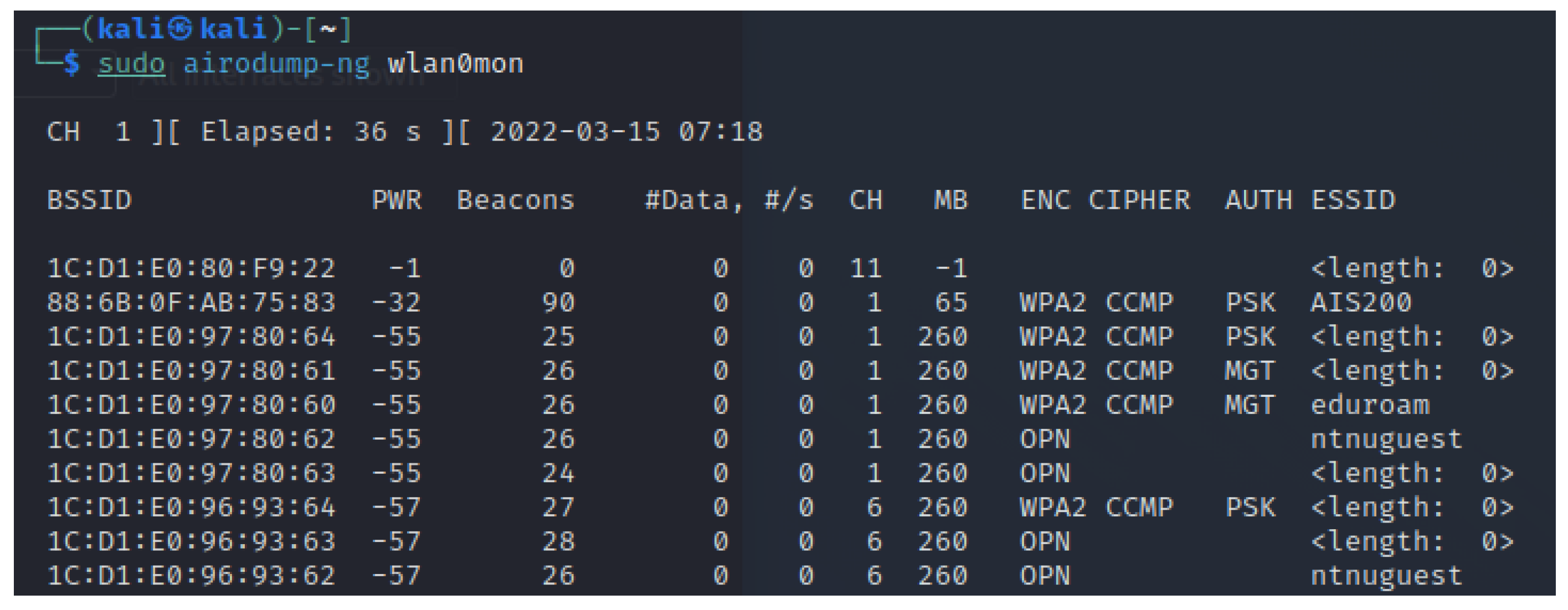
When wireless cards are operating in monitor mode, Airodump-ng is capable of sniffing any packets transmitted within range over the air interface. As a baseline, this can be used to get an overview over all APs and probes in the area. The information gathered on each node will include the ESSID, the BSSID, the encryption scheme, the channel on which it operates, its relative signal strength, and its connected stations. Airodump can also be configured to narrow its scope to a single AP and its clients, for instance, to capture initialization vectors or WPA handshakes. The captured data is displayed in the terminal as shown in Figure 3, or can be written to files.
Figure 3. Airodump-ng running in terminal.

3.2.4. Aireplay-ng

Aireplay-ng can be used to inject packets and spoof their source. One particular useful application in the scope of our project is to transmit deauthentication packets to clients. These packets claims to be from their connected AP, resulting in the clients dropping their connection. By continuously transmitting these packets, the client will not be able to reconnect with the AP, effectively executing a DOS attack. If no further deauthentication packets are transmitted, the clients will attempt to reestablish their connection through a new authentication process. During this process, a wireless sniffer like Airodump-ng may capture the handshake.

3.2.5. Aircrack-ng

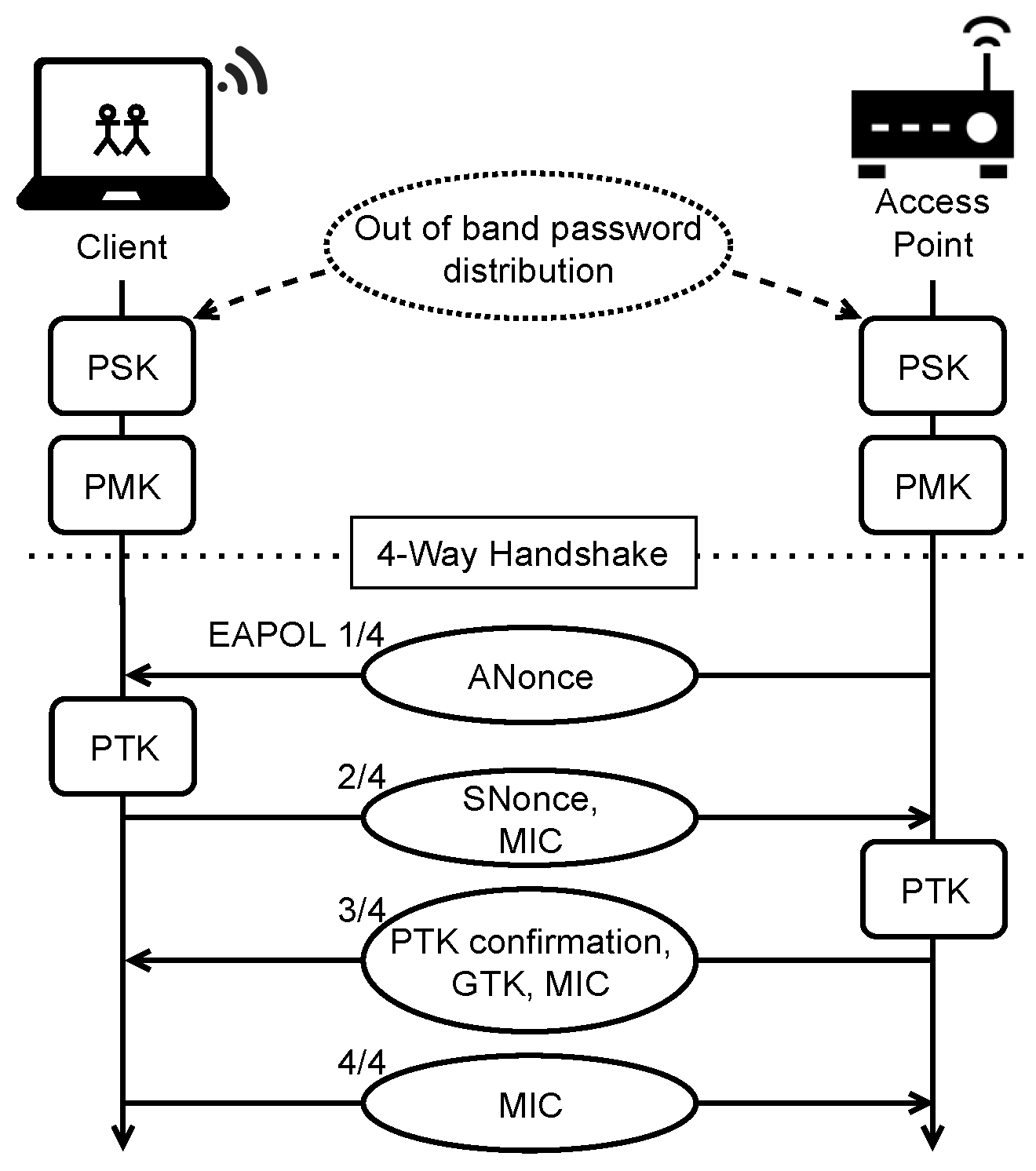
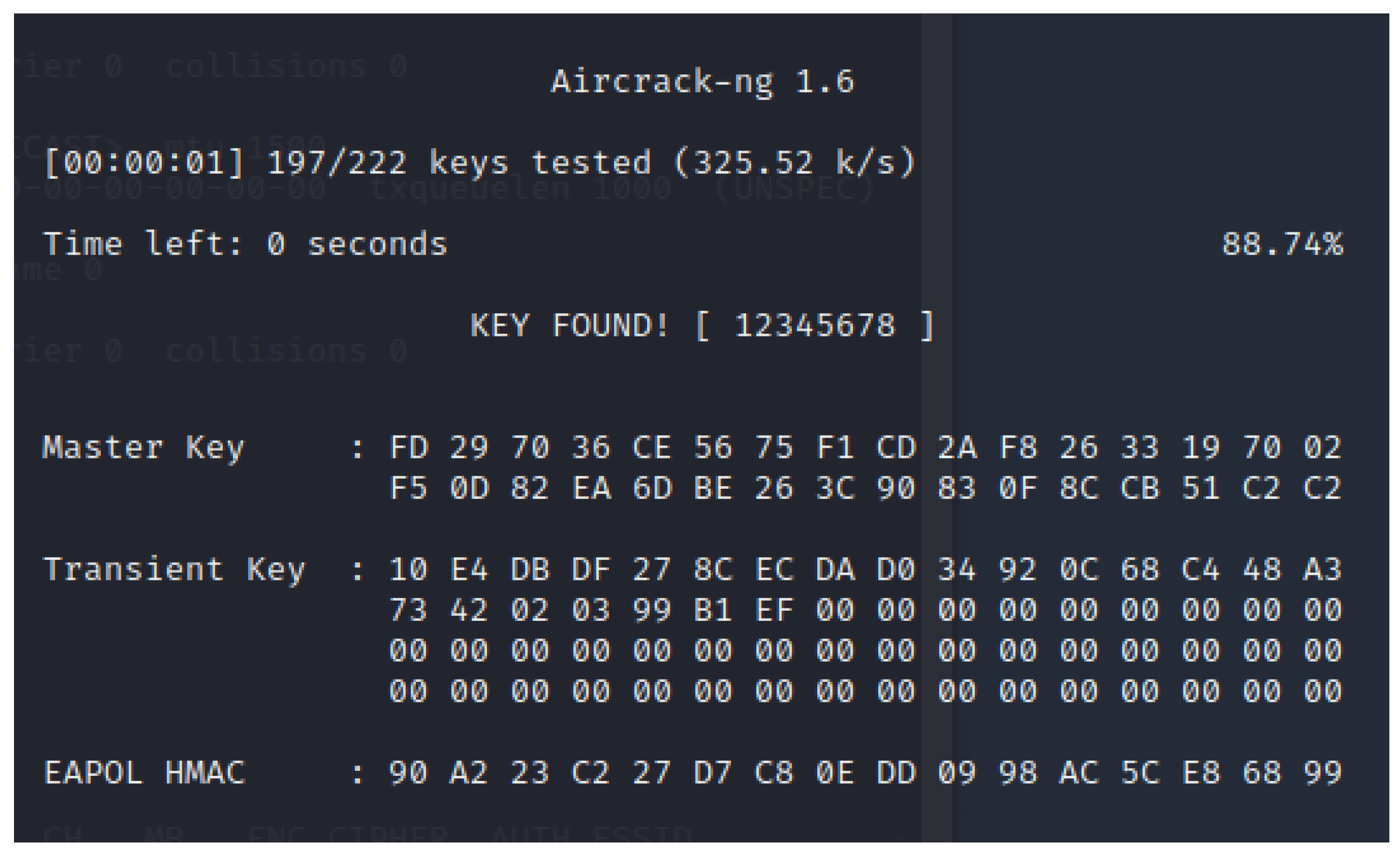
With the same name as the tool suite itself, Aircrack-ng is used to crack WEP and WPA-PSK encryption keys. To retrieve WEP keys, several methods can be used. In terms of cracking a WPA-PSK key, Aircrack can use information captured from the four-way handshake, along with the BSSID of the AP. With this data, the tool performs a dictionary attack, testing several thousand keys each second, and outputs its result in the terminal or to a file. When a WPA2 is cracked, the output will look similar to the screenshot shown in Figure 4.
Figure 4. Aircrack-ng cracking a WPA2 key.

3.2.6. Hostapd

Hostapd, or “Host Access Point Daemon”, enables communication between various 802.11 wireless access points when operating in Host AP mode [68]. It allows us to run our own AP from a wireless NIC with the name, encryption scheme, and password that we specify, in addition to numerous other parameters Airbase-ng may seem to be a sufficient tool for this purpose. Unfortunately, it is unable to host a functional WPA2 encrypted AP.. The daemon reads its configuration from a text file specified upon launch. This tool allows us to create a rogue AP that resembles the target AP enough that the client will unknowingly reconnect to it if the original connection is temporarily lost.

3.3. Target IoT Device

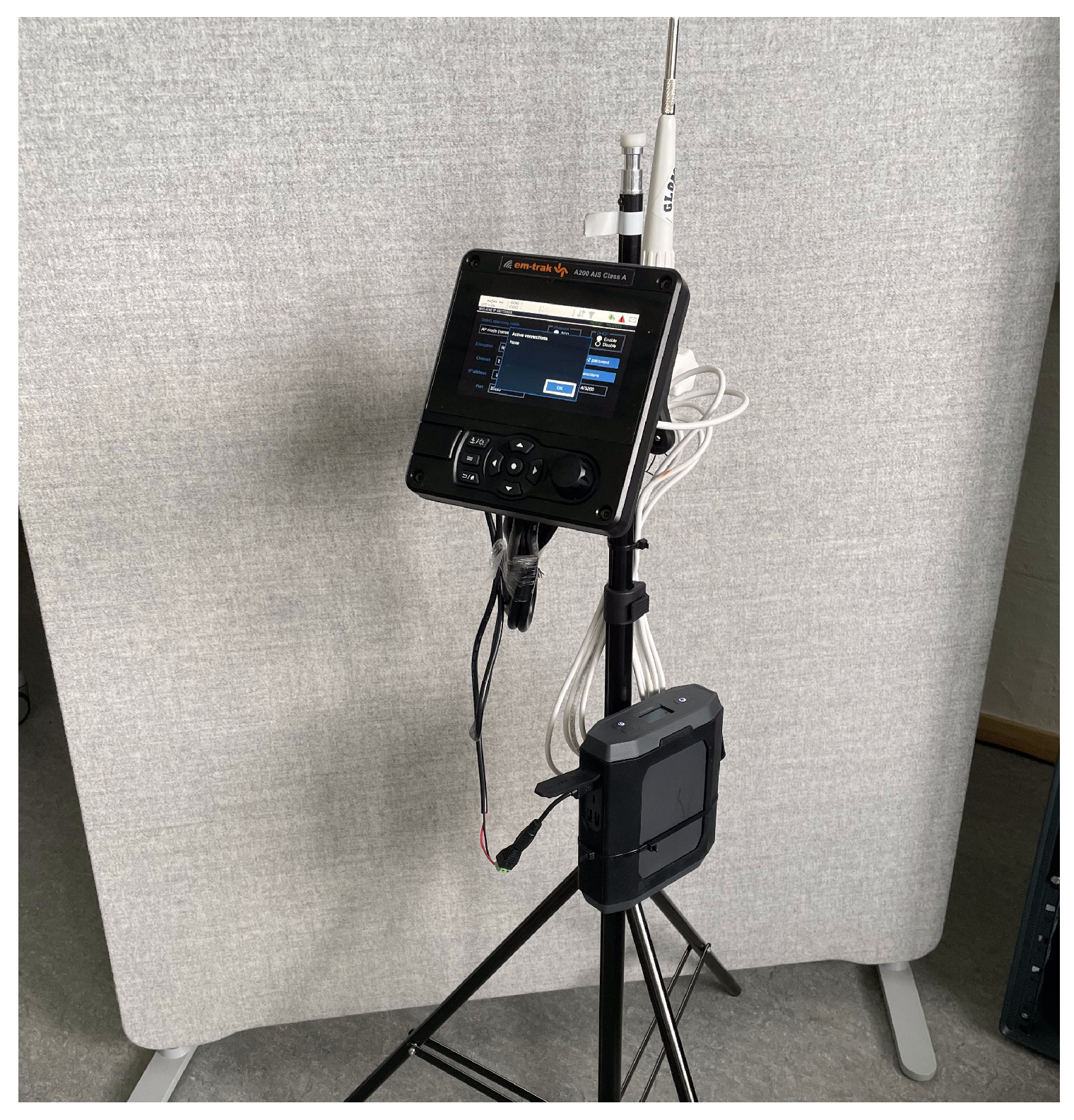
The IoT device used in the project is the AIS displayed in Figure 5. It is the A200 AIS Class A produced by Em-Trak [69]. An AIS is a autonomous monitoring and tracking system that communicates positional data and vessel information with nearby harbors and ships [70]. The AIS makes an operator able to see the location of other vessels in vicinity, aiding with navigation and collision avoidance. It is used on larger ships and utilities ashore like VTS for tracking, monitoring, and identification. The AIS transmits data continuously and is required by international treaties to be installed and operational for larger vessels.
Figure 5. The A200 connected to a battery and a VHF antenna.
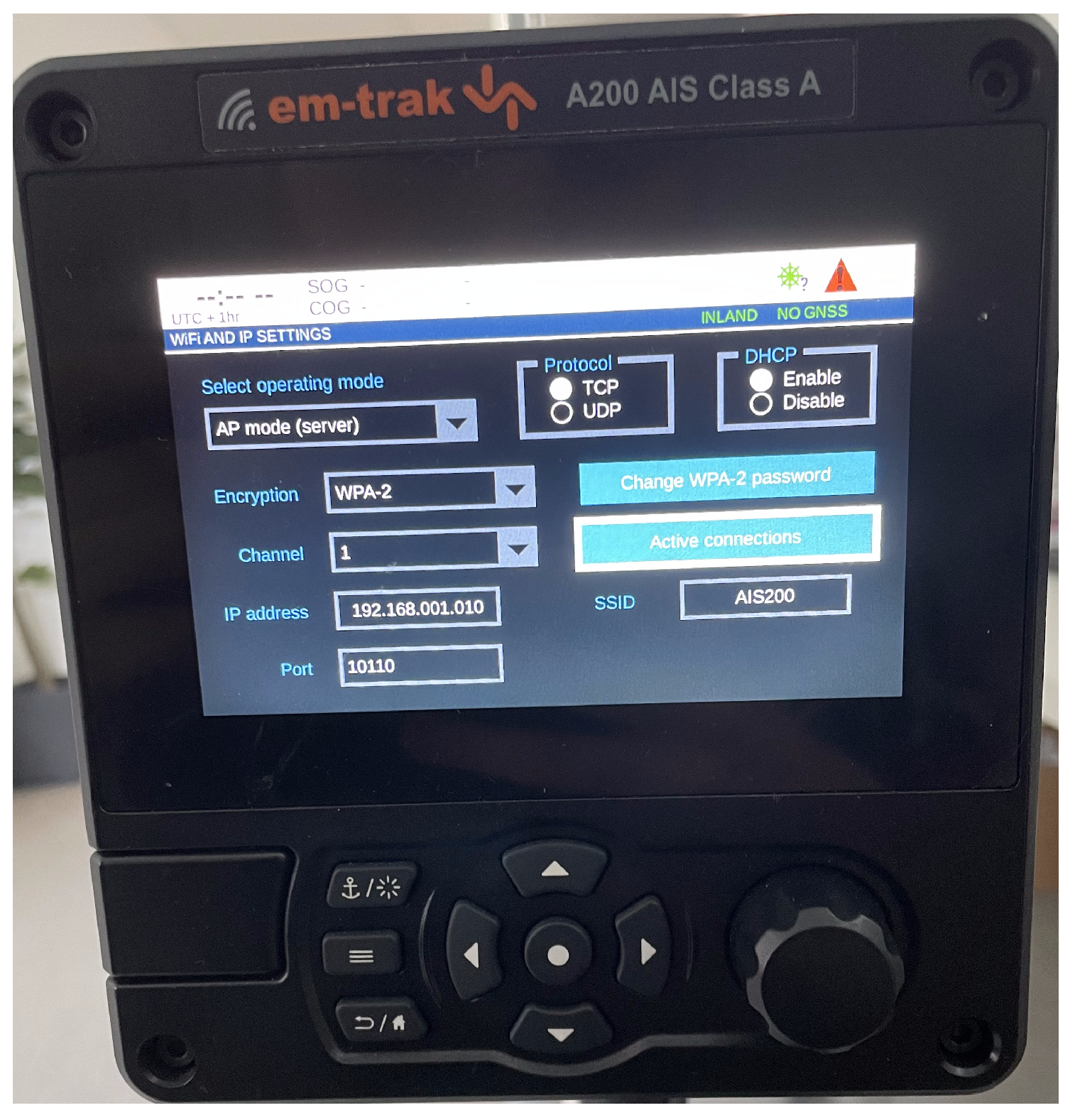
When mounted on a ship, the A200 AIS is connected to several sensors on the ship along with a VHF antenna for communication with other AIS systems. It has a wireless NIC which it uses to run its own Wi-Fi AP. The Wi-Fi configuration menu is displayed in Figure 6. From there, the user can set the ESSID, choose internet protocol, select channel, and more. A ship operator can access and read data from the device by connecting to it with a laptop, tablet or similar device. The data is transmitted using NMEA 0183 messages which are continuously sent to all clients on the network. To read the NMEA messages, the client needs some kind of chart plotter software. There are many alternatives, but OpenCPN was used for this project [71]. The connection is protected with WPA2 Personal by default, which is the highest level of encryption the device supports. There is no password complexity validation.
Figure 6. The Wi-Fi settings menu in A200.
The Em-Trak A200 AIS Class A is an expensive AIS device used for larger vessels like freight and passenger ships and is priced at almost £2000 [69]. The tested device is the current version in production and market, shipped with a three year global warranty. Thus, we can expect this model to be operative in its current state in many years to come.

3.4. Physical Setup

In the facilities of the NCR we set up the testing environment. The A200 device was enabled in Wi-Fi mode with an Apple MacBook running the operating system MacOS Monterey as the client. They were located one meter apart from each other, with no physical objects between them. The laptop with Kali Linux was placed about one meter away from both the A200 and the MacBook. The AP options were left as displayed in Figure 6, which are the default values.
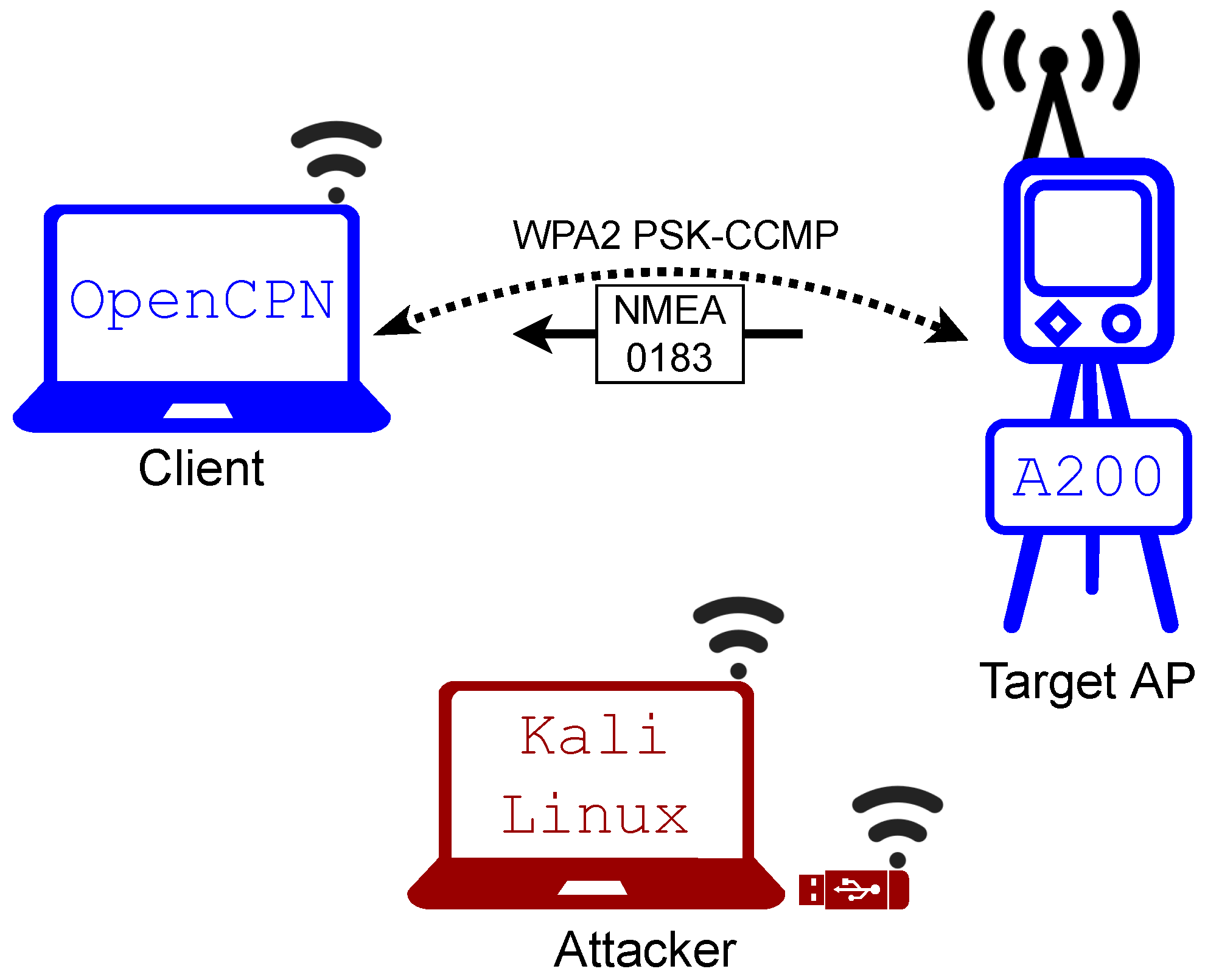
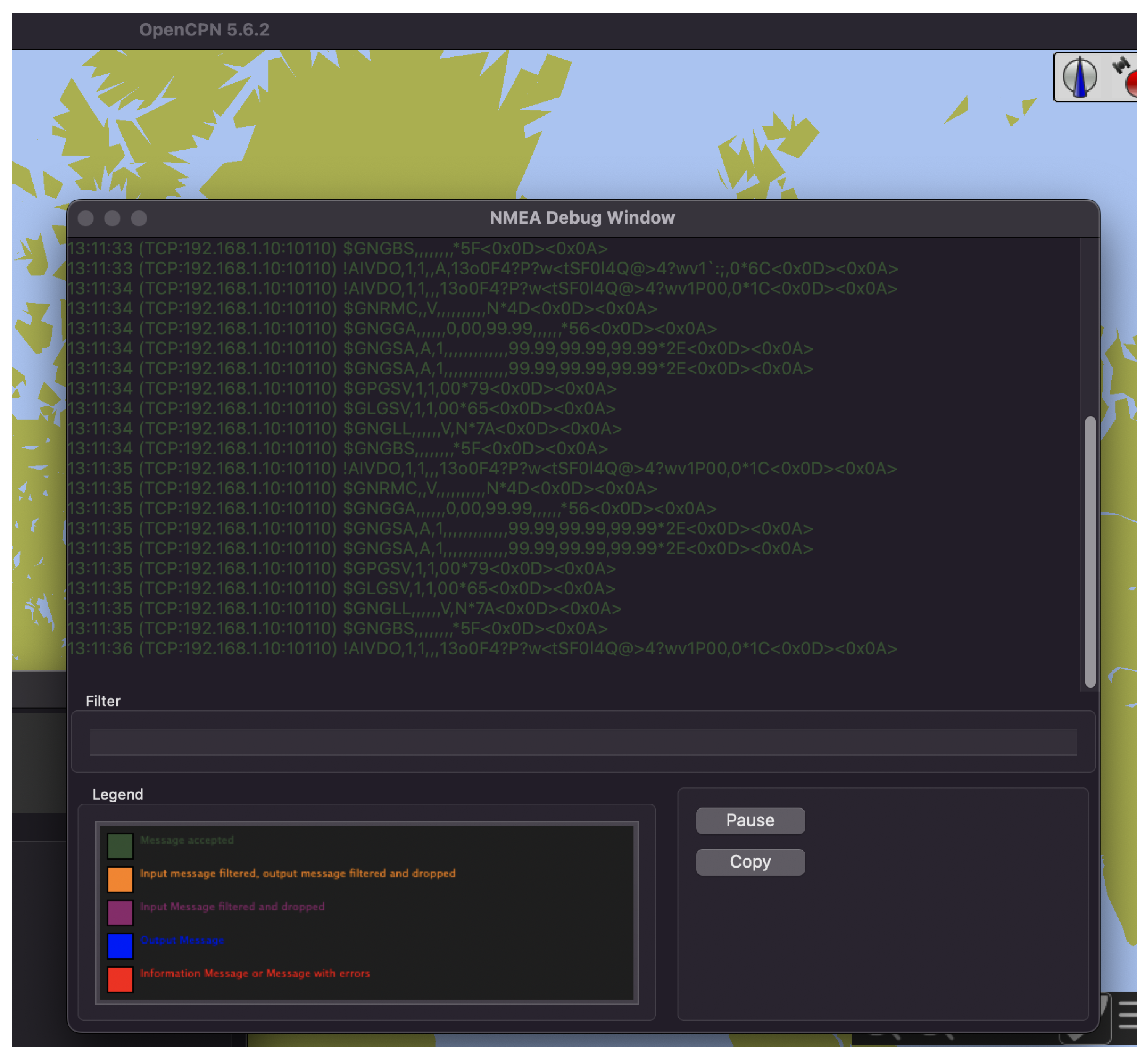
Because the AIS was not connected to all of its sensors, the messages that it transmitted had no geographical data that could be displayed in the chart plotter. However, the debug window within OpenCPN displays all received NMEA messages, which was sufficient to prove the wireless connection and possible interruptions. Figure 7 displays a diagram of the case study setup, while Figure 8 shows the debug window of OpenCPN while receiving packets over a Wi-Fi connection.
Figure 7. Diagram of the case study setup.
Figure 8. OpenCPN debug window with received NMEA packets.

4. Manual Attack Results

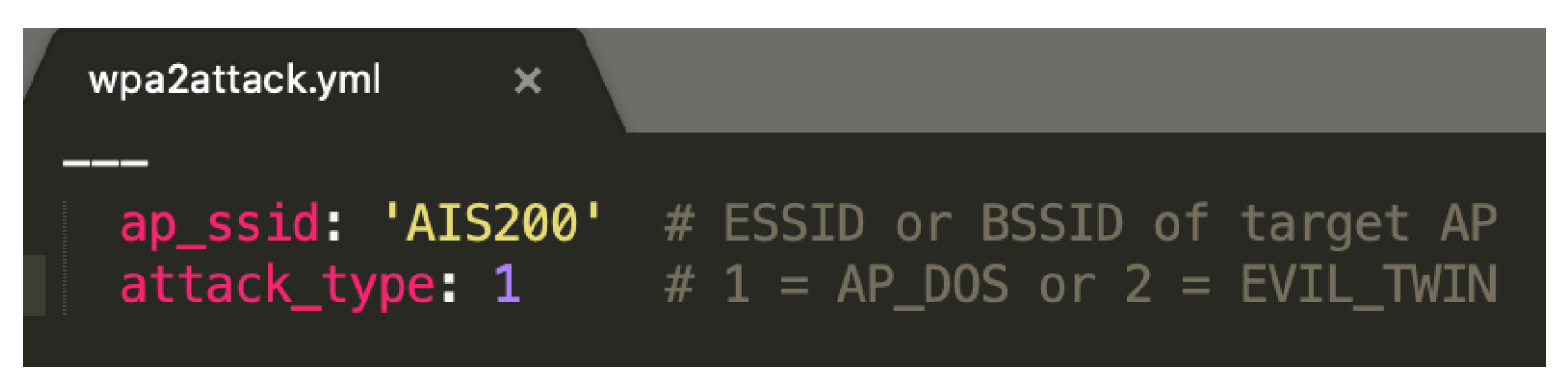
To launch an attack, the agent must know the ESSID or BSSID of the target AP. This information is provided using a YAML file. Figure 9 displays the contents of a YAML file for launching a DOS attack on a network named “AIS200”. Below are the results of each attack.
Figure 9. YAML file for a DoS attack.

4.1. Attack 1: DoS

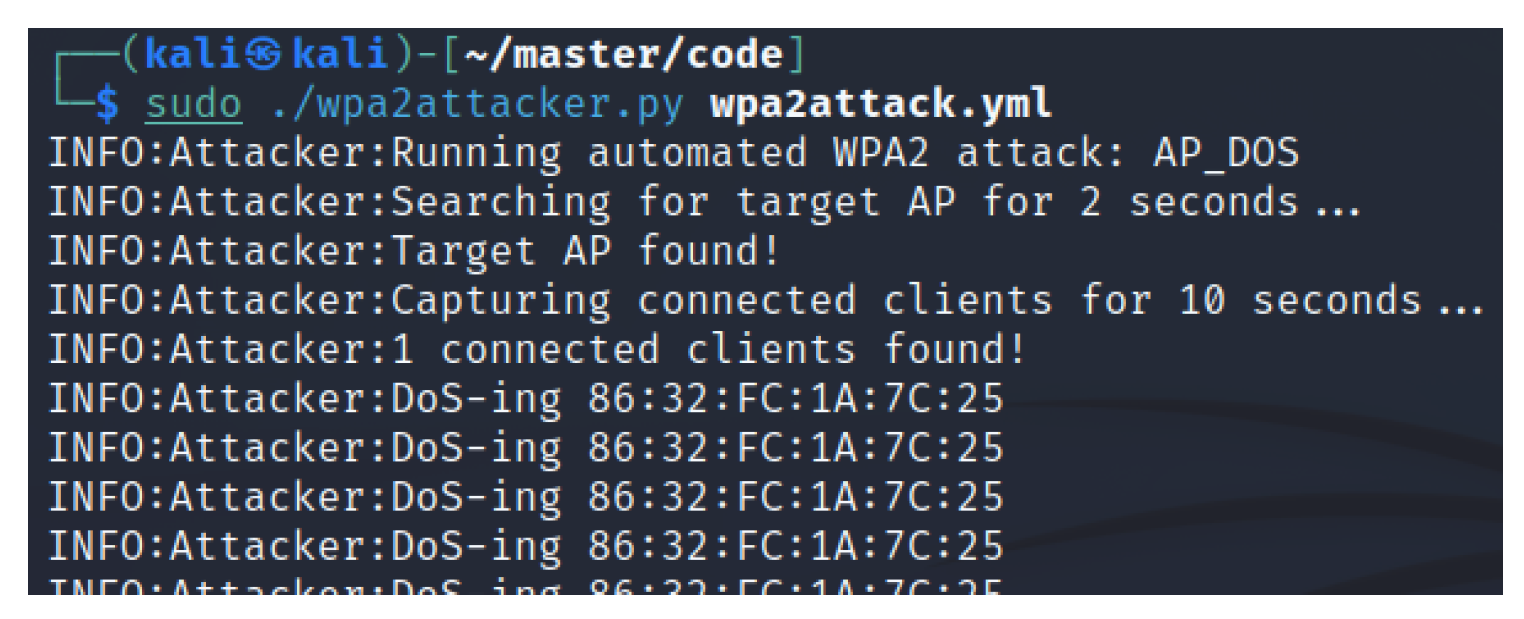
The MacBook was connected to the A200 AP as described in Section 3.4, continuously receiving NMEA 0183 packets every second which were interpreted using OpenCPN. The ESSID of the network was “AIS200”, which is the default setting, and the client had the BSSID “86:32:FC:1A:7C:25”. The DOS attack was launched and sustained for 45 s, with the terminal output displayed in Figure 10. The agent used 18 s to gather the information required to launch the attack, resulting in a complete program run time of 1 min and 3 s. In Figure 11, we can see a sudden time gap between received NMEA packets of 53 s. The additional 8 s comes from the time it took for the client to reestablish its connection.
Figure 10. Performing the DoS attack.
Figure 11. DoS attack in OpenCPN debug window.

4.2. Attack 2: Evil Twin

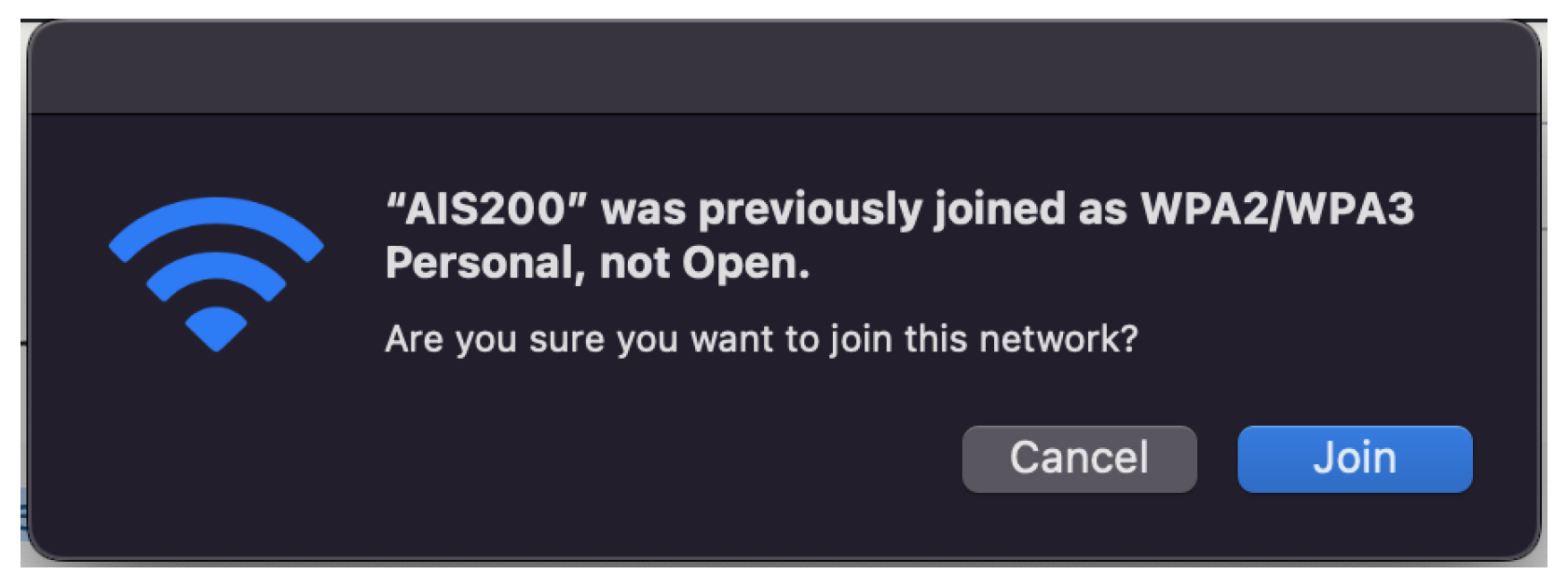
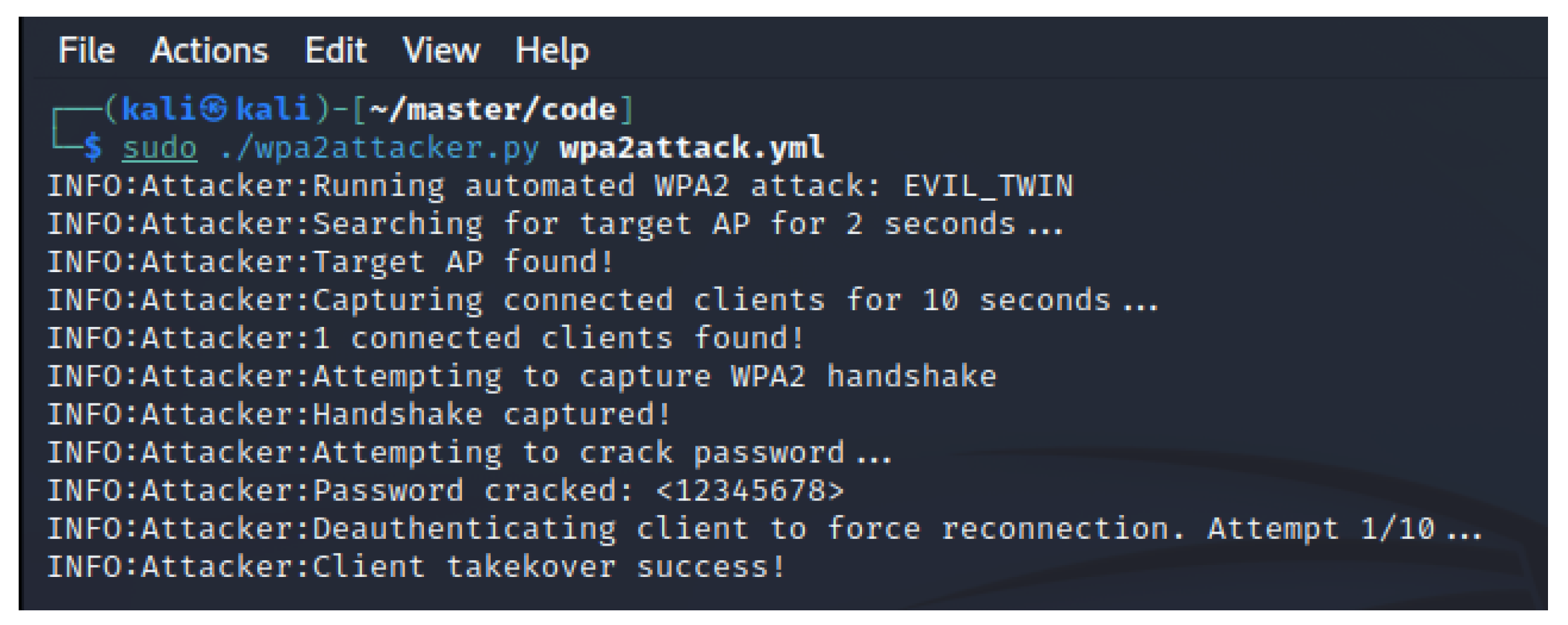
Again, we followed the setup previously described. The network ESSID remained unchanged, but the client BSSID was “8C:85:90:61:1F:1A” for this experiment. “12345678” was used as the network encryption password. As seen in Figure 12, the agent was able to successfully impersonate the A200 AP and trick the client into connecting to it. The reconnection was done automatically and transparently by the client MacBook operating system without interaction from the user. When running the attack in verbose mode, we can see the client connection in the debug logging messages as displayed in Figure 13. The command for deauthenticating the client using Aireplay-ng is also visible in the screenshot. The run time from start to client connection takeover was 39 s. A notable variable considering the result is the time it took to crack the password. Aircrack-ng used less than one second to find “12345678” in the provided wordlist. This due to the size of the wordlist, which contained less than 200 words. A discussion of this matter is found in Section 7.
Figure 12. Performing the Evil Twin attack.
Figure 13. Debug view of Evil Twin connection.

5. System Design for Automated Attacks

Two similar attacks on the A200 IoT device were designed and implemented. Both are based on vulnerabilities in the WPA2 encryption scheme, targeting the network layer of the device. We have chosen these attacks because they affect all implementations of Wi-Fi using WPA2, and can be performed without extensive knowledge, expertise, or equipment. This Section will describe the attacks, define their EP models, and verify them using TLA+ and the TLC Model Checker. Finally, the verified design is implemented in Python.

5.1. The Attack Procedure

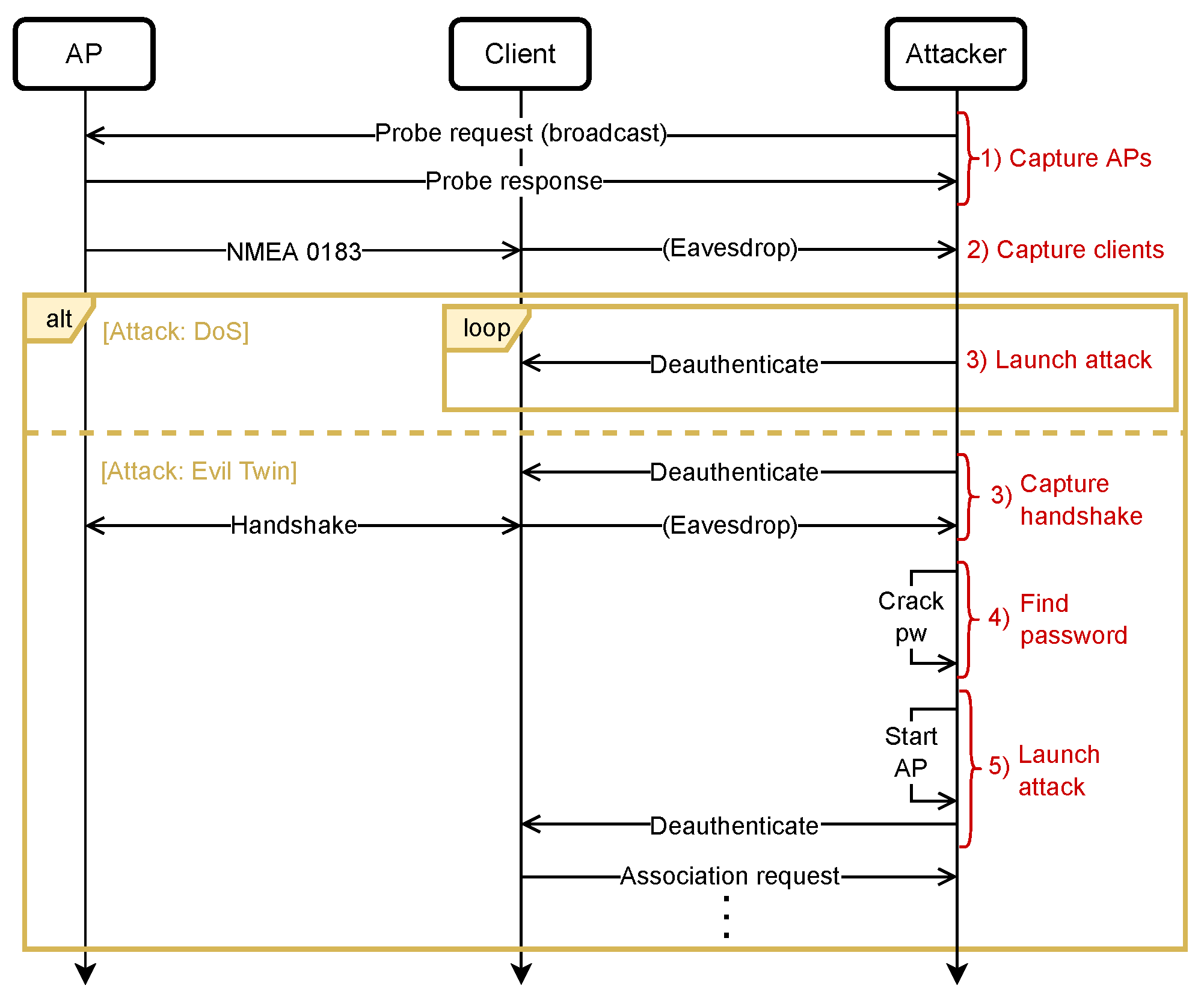
The first attack is a DOS attack using deauthentication frames, and the second is an Evil Twin attack. Figure 14 displays a sequence diagram of the two attacks. As evident from the diagram, the first two steps in both procedures are equal.
Figure 14. Sequence diagram of DOS and Evil Twin attack.
  • Attack 1: DOS
    • Capture APs
      First, the agent will capture all APs within range. This can be done within a couple of seconds using Airodump-ng but should be performed on a monitoring network interface. To change the mode of NIC, the agent will use Airmon-ng.
    • Capture clients
      If the target AP is found in previous step, the agent will capture the clients connected to the AP using Airodump-ng. Depending on the traffic on the network, this may take few more seconds than capturing the APs.
    • Launch attack
      Provided that there are clients on the network, the agent should perform the DOS attack. Each client will continuously receive deauthentication frames that appear to be from the AP, withholding them from the reconnecting.
  • Attack 2: Evil Twin
    • Capture handshake
      This step involves capturing the handshake process between a client and the AP. By deauthenticating the client using Aireplay-ng, the agent can capture the handshake upon reconnection using Airodump-ng.
    • Find password
      The password can be cracked using a dictionary attack if the nonces of the handshake was captured in the previous step. To perform the dictionary attack, Aircrack-ng will be used.
    • Launch attack
      If the password is cracked, the agent will spoof the network of the target AP using Hostapd. When deauthenticating the client again using Aireplay-ng, the client should automatically reconnect to the Evil Twin AP if its signal strength is stronger than that of the true AP.

5.2. EP Models of Attacks

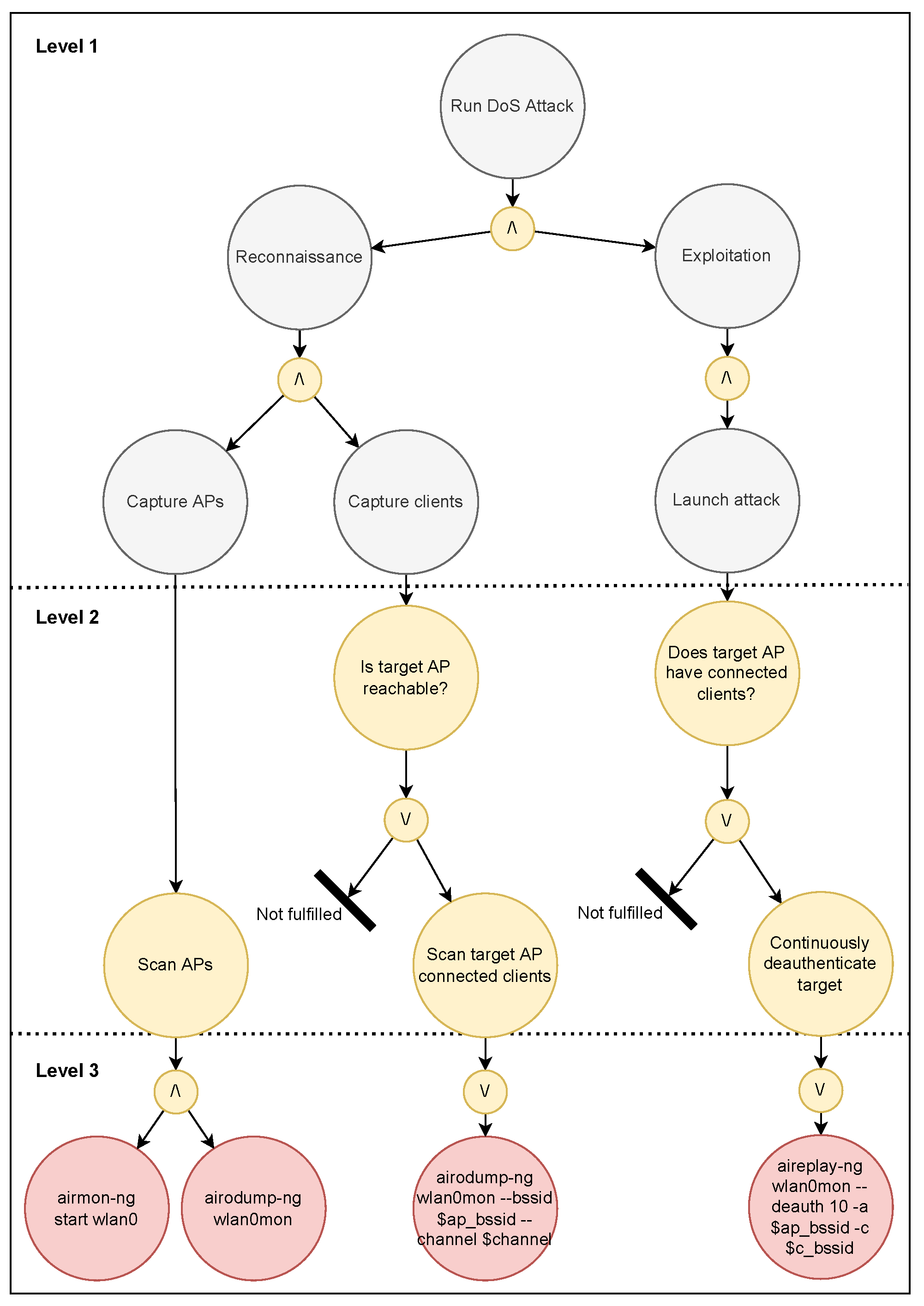
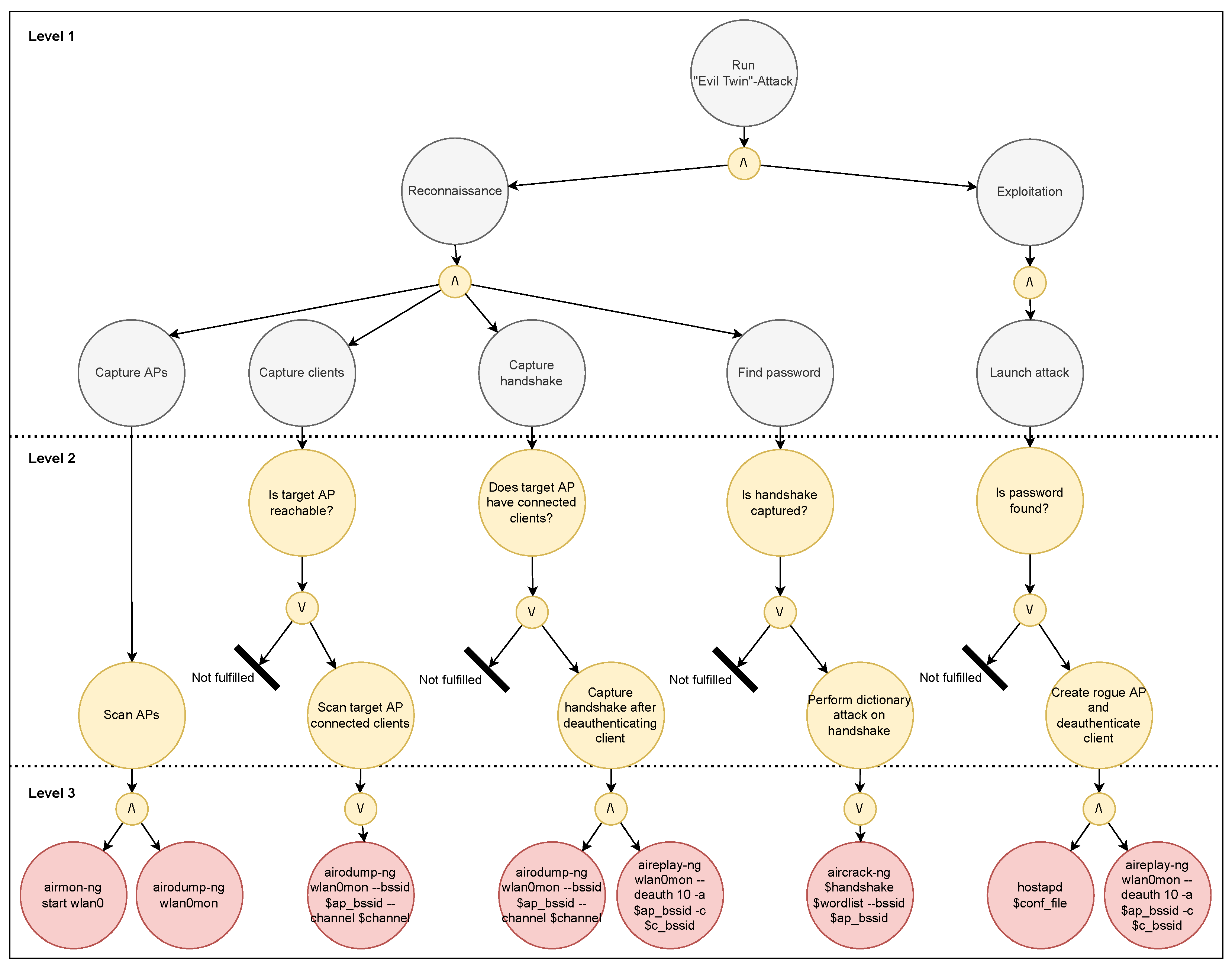
The attack was performed through an agent that was designed based on the EP modeling discussed in Section 2.4. The diagrams displaying the high level abstraction of the DOS and Evil Twin attack models are shown in Figure 15 and Figure 16, respectively. When running the attack, the agent should analyze the main goal, which is either Evil Twin or DOS, and then attempt to fulfill the subgoals subsequently read from left to right in the model. Because both attacks involve sequential tasks where either a plan is fulfilled or the program terminates, this specific EP model is relatively simple with a single condition in the second level of each subgoal.
Figure 15. EP model of the DOS attack.
Figure 16. EP model of the Evil Twin attack.

6. System Implementation and Formal Verification

In the work of Yamin and Katt, Datalog [2] was used for formal modeling and verification of the EP. In this work, TLA+ were chosen as the formal language because it presents an approach that is based on theoretical mathematics and is thus more expressive. While Datalog is a language mainly used for database querying capable of verifying models, TLA+ was designed for modeling hardware and software at an abstract level [45,72]. Furthermore, a software called TLA+ Toolbox provides both the TLC Model Checker which can verify the formal model, as well the possibility to create state transition diagram of the results.
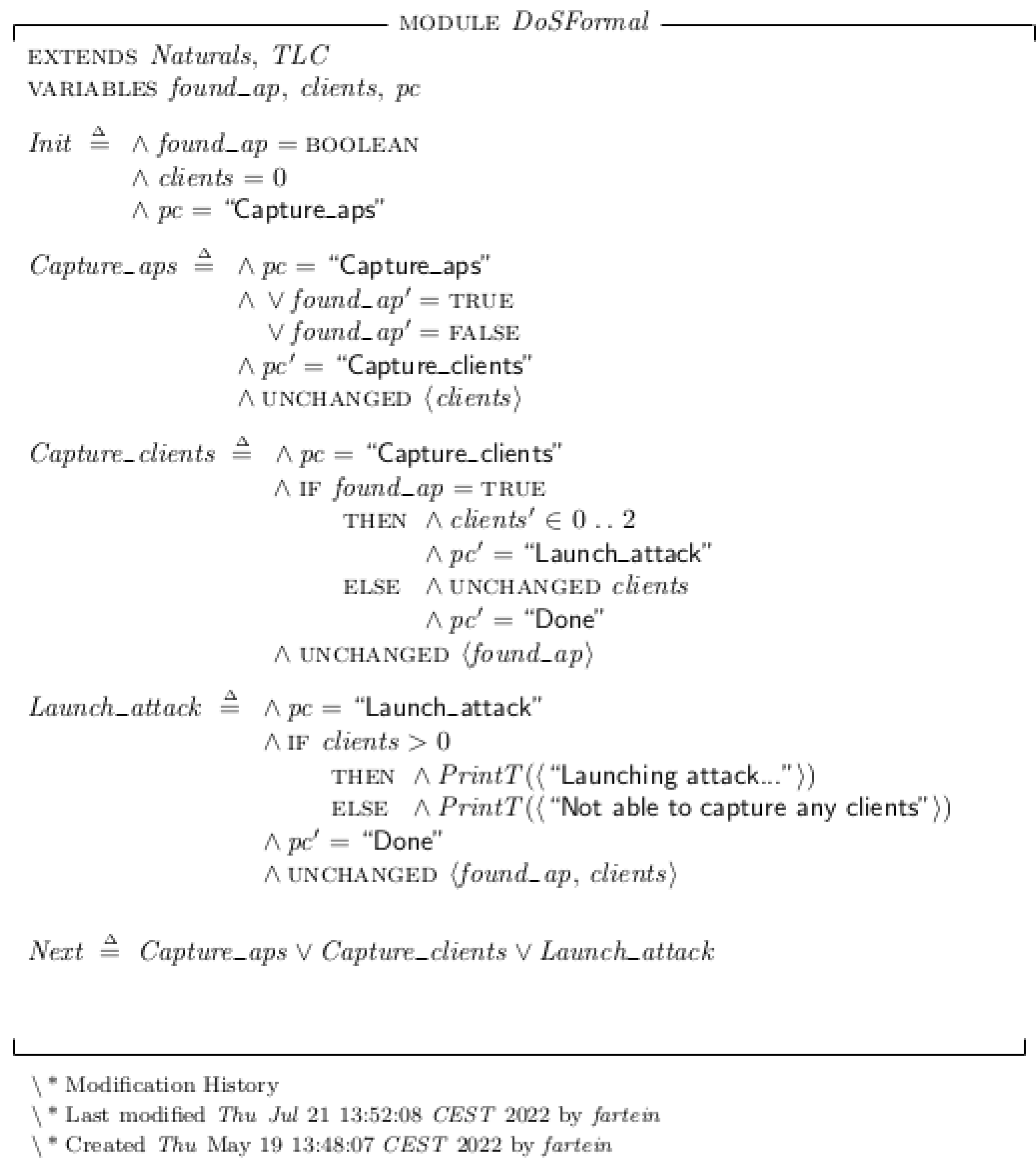
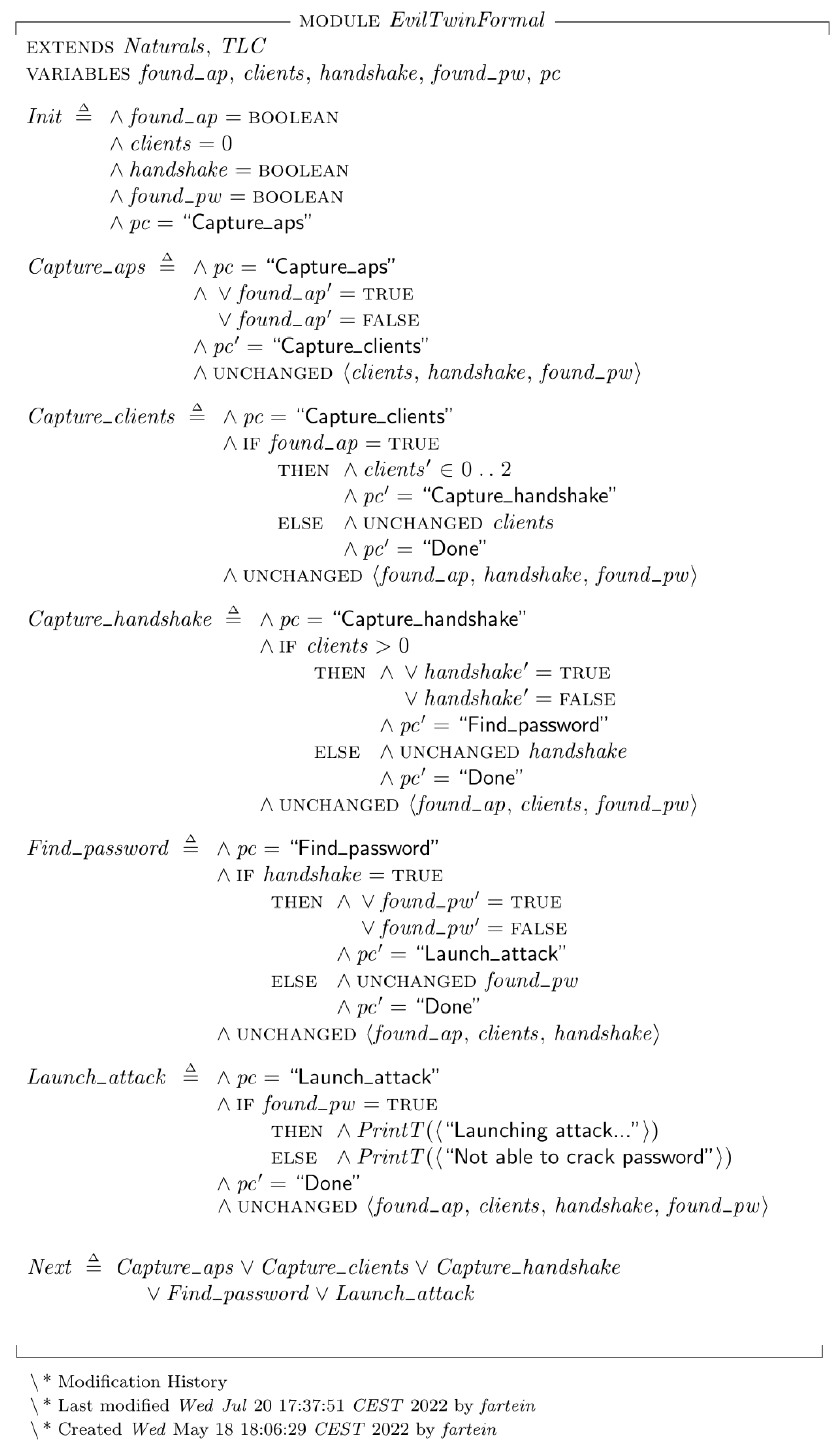
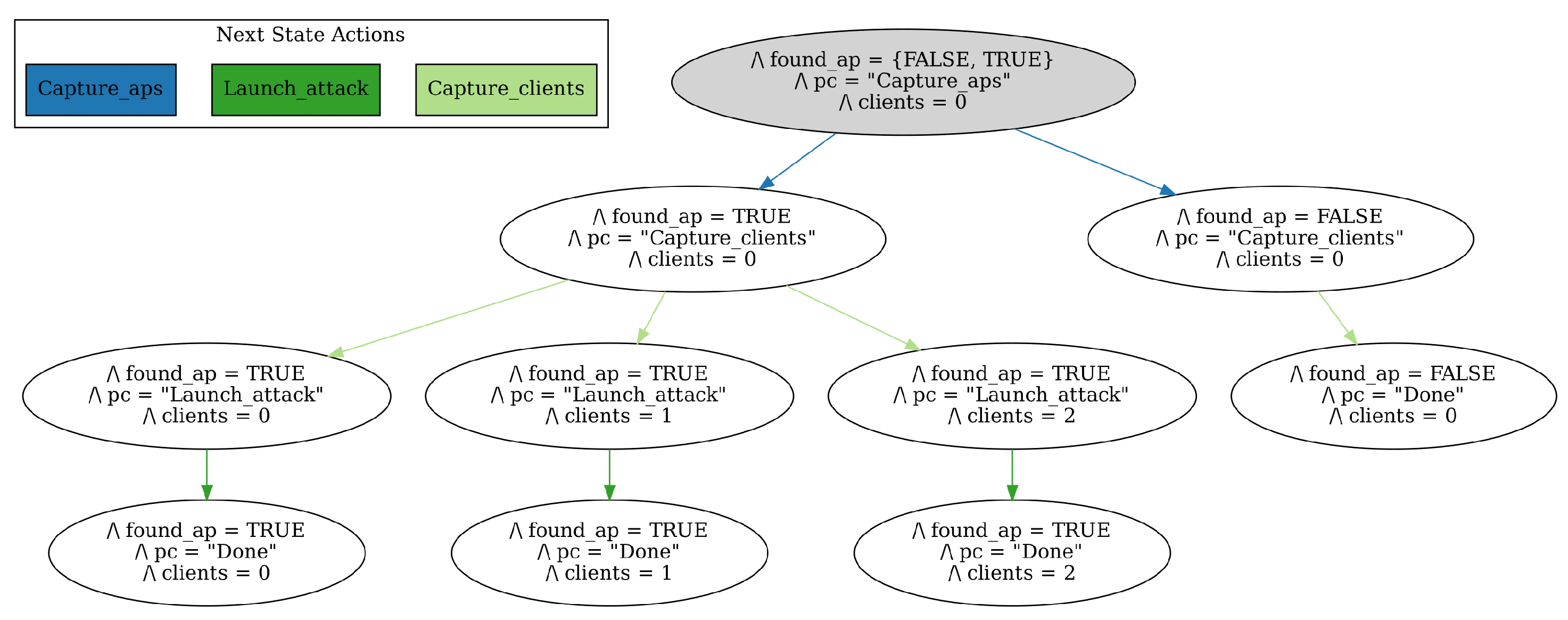
The model complexity for a single Evil Twin attack in this setup is trivial to the point where the formal model verification is practically unnecessary. However, its value becomes evident in complex systems where one or more agents are capable of performing many different attacks and intelligently choosing between them based on the reconnaissance phase. The formal models of the attacks written in TLA+ are presented in Figure 17 and Figure 18. Each next-state relation definition within the specification translates to a subgoal branch of the EP model. The actions represented by the bottom node within the second layer of the model defines the variable changes of the state. For instance, the “Capture clients” subgoal node in Figure 16 is described by the next-state relation “ C a p t u r e _ c l i e n t s ” in Figure 18. Within this relation definition, the condition “Is target AP reachable” of the EP model is tested by the operation “ I F f o u n d _ a p = T R U E ”. If this is found true, the action “Scan target AP connected clients” is performed by giving the variable “ c l i e n t s ” an integer from 0 to 2, indicating the number of captured connected clients The max limit of clients should in theory be equal to the maximum number of possible clients connected to the AP but was set to 2 because it would limit the state diagram to where it was possible to display within the thesis. During testing, we also set the limit to 100 devices to ensure that the validity of the model did not change.
Figure 17. The formal specification of the DOS attack EP model written in TLA+.
Figure 18. The formal specification of the Evil Twin attack EP model written in TLA+.
The level three commands of the EP model is not described by the specification, but by the abstraction defined in the action node of the level above. This corresponds to the TLA+ concept of abstracting the functionality and conforms to explaining whats of the system, leaving the hows to the lower level code implementation. In the final state of an EP where the last plan and subgoal was fulfilled, the specification prints “Launching attack…” to illustrate a successful run. In the cases where the plan was successful until the very last state but failed the last condition, the specification prints either “Not able to crack password” or “Not able to capture any clients” to indicate that the plan was not fulfilled.
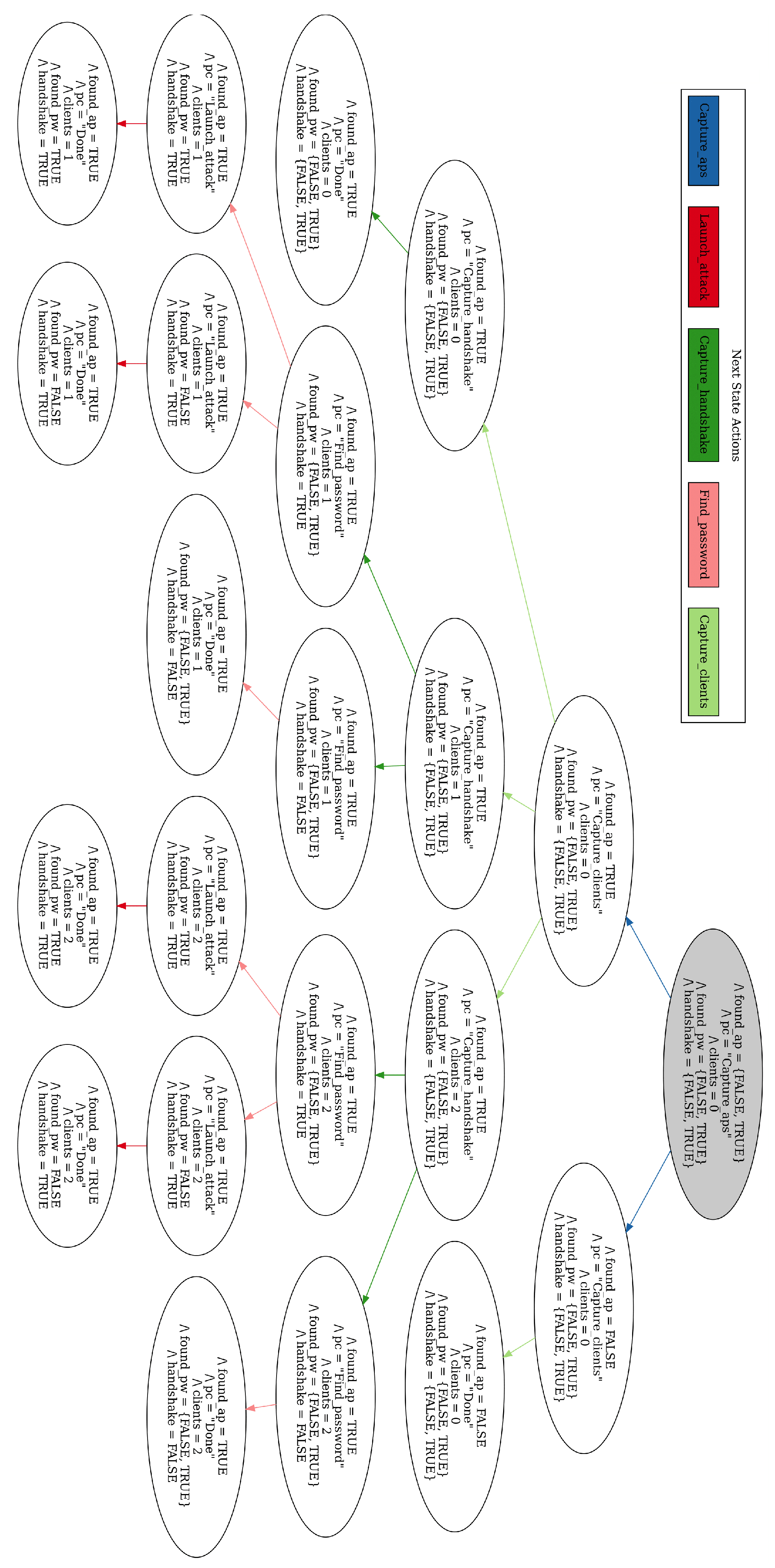
First, we wanted to formally verify that the logic of the TLA+ specifications, and consequently, the EP models and agent decision making processes, were not flawed. This includes situations were the program terminates without reached a “Done” state, or where it enters an infinite loop. Second, we wanted to verify that the final states of the models could be theoretically reached. For verification, we used the TLC Model Checker. The model checker was able to compile and run the specifications without errors, which ensures there are no logical flaw in the specifications. We could see from both the printed output of the model and generated state transition diagrams that the final states were reachable. The state transition diagrams for the DOS and Evil Twin attacks are displayed in Figure 19 and Figure 20, respectively. When running model checker for the DOS attack, the following output was produced:
Figure 19. State transition diagram showing all possible states of the DOS attack EP model.
Figure 20. State transition diagram showing all possible states of the Evil Twin attack EP model.
  • <<“Launching attack…”>>
  • <<“Not able to capture any clients”>>
  • <<“Launching attack…”>>
These strings represent the final three possible states seen in the corresponding state diagram where the agent found the target AP. There are three of them because there are three possible values for the number of clients found in the previous state. The states in which the model found one or two clients were able to launch the attack while the third did not. Thus, the specifications and EP models were verified.

6.1. Implementation

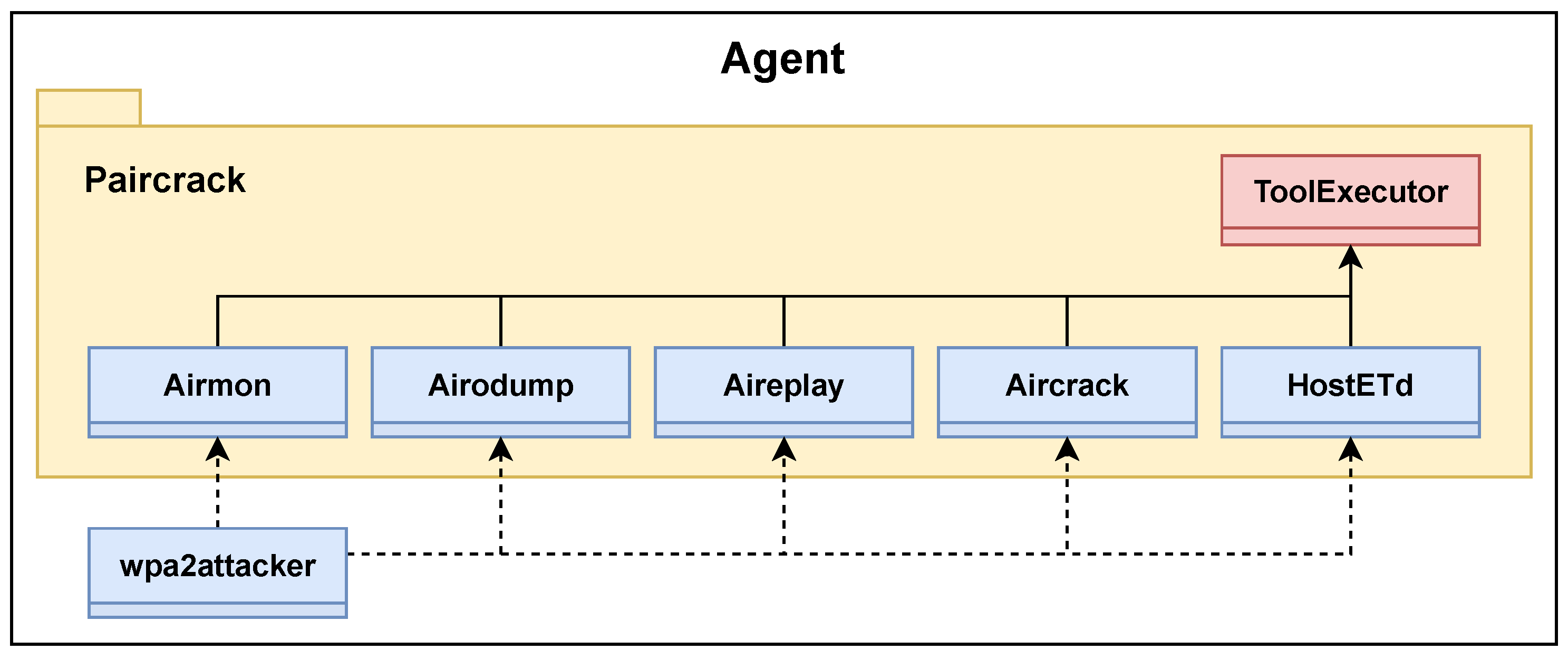
The agent was implemented in Python 3.10. An essential part of the program is the Subprocess module from the Python Standard library [73]. The module was used to create and communicate with the processes running the software tools presented in Section 3.2. To ensure modifiability and applicability in other implementations, the program was written with high modularity following an object oriented approach. Figure 21 shows a simple class diagram of the program.
Figure 21. Class diagram of the agent.

6.1.1. Tool Interface

A custom package named Paircrack was created and used as an interface between the agent decision making process and the software tools used. Each class within the package corresponds to a tool from the Aircrack-Ng suite or HostAPd. Because of common functionality between the package classes, an abstract class named ToolExecutor was created. Most importantly, this class runs and interprets the outputs of the individual tool processes. In Algorithm 1, the function for scanning and capturing APs is presented. This function uses the helper function “_capture” which calls the “run” function of the ToolExecutor class. All classes in the Paircrack package call the “run” function to start its processes. A part of this function which uses the Subprocess module is displayed in Algorithm 2. Because some processes run until they are manually interrupted, like those started by Airodump-Ng, a process timeout ensures their eventual termination.
A Python package for running Aircrack-Ng programs named  Pyrcrack [74] already exists, and it serves many of the purposes we have implemented in Paircrack. While originally intended to be used as the tool interface and foundation for the agent, the package was discarded due to limited documentation and difficulties of use. Pyrcrack is still under development, which may make it applicable in future generations of the agent. The custom Paircrack package used in this project has some features inspired by Pyrcrack.
Algorithm 1. The function for capturing all APs within range.
def capture_aps(self, interface : str, proc_timeout=2) -> str:
    “““Captures all access points within range
 
    Parameters
    ----------
    interface : str
        Interface to capture packets on
    proc_timeout : int, optional
        Amount of seconds to run the capture, by default 2
 
    Returns
    -------
    str
        filepath to xml file containing AP data
    “““
 
    self.logger.debug(’Capturing all APs...’)
    fsuffix = []
    flags = {
        ’--write-interval’: ’1’,
        ’--output-format’: ’netxml’}
    return self._capture(interface, fsuffix, flags, proc_timeout)
Algorithm 2. Part of the “run” function within the abstract ToolExecutor class.
self.logger.debug(f’Running command: <{command}>’)
if self.verbose:
    self.logger.debug(f’\tkeywords: <{proc_flags}>’)
 
try:
    output = subprocess.run(command, **proc_flags)
except subprocess.TimeoutExpired as e:
    self.logger.debug(f’Process timout’)
    return True
else:
    if self.verbose:
        self.logger.debug(f’Captured stdout: <{output.stdout[:-1]}>’)
        self.logger.debug(f’Captured stderr: <{output.stderr}>’)
    return output

6.1.2. Agent Decision Making

The agent decision making process discussed in Section 5.2 was implemented in the class wpa2attacker. This class creates instances of the classes within the Paircrack package, and use their functionality to execute the actions described in the EP model. To determine what type of attack to run, i.e., DOS or Evil Twin, the attack type is given as program input in a YAML file. This file also contains a string that can be either the BSSID or the ESSID of the target AP. The YAML file is the only input required for the agent to run either attack. Providing the initial configuration data in a YAML file is, for compatibility reasons, conducted with the framework and setup first created in the work of Yamin and Katt by matching the interface with that of the autonomous agents on which this work is based.

7. Discussion

The case study was performed in a controlled environment. Because of this, we will address some important factors the could change the results of the Evil Twin attack if performed in a realistic scenario.

7.1. Network Interface Range

A potential limitation of the attack efficiency comes from the distance between attacker, client, and AP. The client will only connect to the rogue AP if the AP signal strength is stronger than that of the authentic AP. If the signal strength of the impersonated network is weaker, the client will simply reconnect its original AP. Unless the attacking device is onboard the ship, it is likely to be further away from the client than the AIS is. On the other hand, this issue can be addressed by either jamming the authentic AP [75], or increasing the strength of the wireless signal [76]. In this work, an old and simple network adapter was used to host the rogue AP. Even in its default signal strength configuration, the client is connected to it. With a new and better adapter, the wireless signal strength would be stronger, which could be further increased by modifying the signal strength.

7.2. Time to Crack Network Password

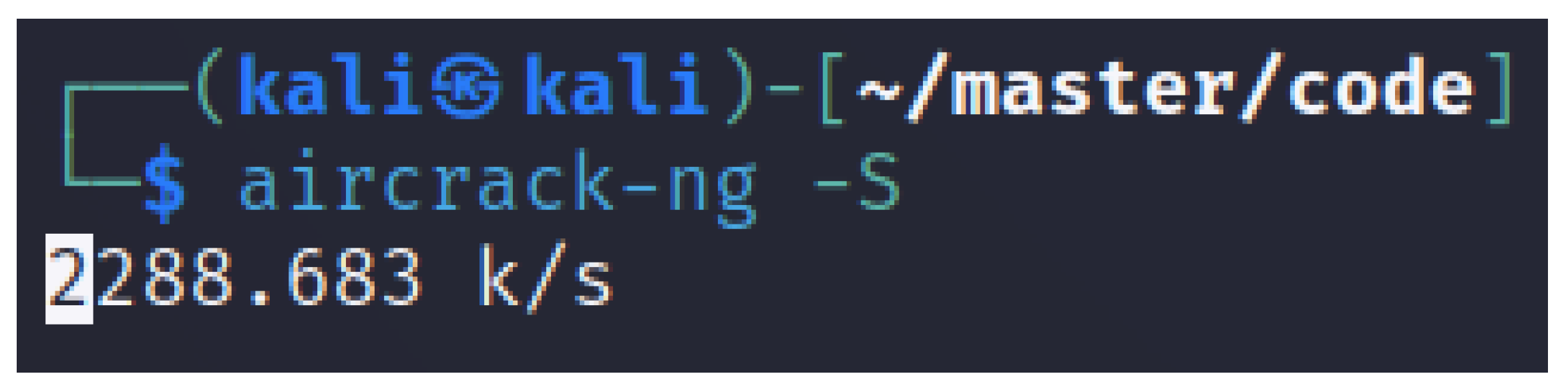
In the case study, we used a wordlist with 200 words where we knew the AP (Access Point) password was one of them. Because of this, the time it took to crack the password was less than one second, which would certainly not be the case in a real scenario. The number of keys tested per second on the case study computer using Aircrack-ng amounts to approximately 2300. Testing the cracking speed on desktop computer with an AMD Ryzen 5 3600 6-Core processor, we saw an increase to about 22,500 keys per second. However, these numbers could be outperformed by software tool for hash cracking called Hashcat using GPU acceleration. According to a speed test on Hashcat using GPU services provided by Google Cloud, the tool can test 1.1 million WPA2 keys per second when running on Nvidia-Tesla-a100 [77]. Using these password cracking speeds to calculate the time it takes to exhaust different wordlists, we get the results as presented in Table 1. By using the Aircrack-ng on the Kali Linux machine, a wordlist with the same size as the famous “rockyou.txt” can be exhausted within minutes. Even a random eight integer password is feasible to crack. However, Aircrack-ng would not be able to crack a random password of integers and letters of eight characters. By using Hashcat, attacks on wordlists with millions of passwords or even random letter passwords would be possible as indicated in Figure 22 and Figure 23.
Table 1. Comparison of key test speeds on different wordlists using Aircrack-ng and Hashcat.
Figure 22. Aircrack-ng password cracking speed on Kali Linux machine.
Figure 23. Aircrack-ng password cracking speed on the desktop computer.

7.3. Comparison with Similar Systems

In 2018, researchers [16] proposed the idea of automated penetration testing of IoT devices. They discussed the general threats faced by IoT devices and ran a simulation to validate those threats. There initial results were useful; however, they required experimental validation in real IoT environment. In 2020, researchers [25] performed a study in which they performed penetration testing on real IoT devices. They proposed a general methodology to develop test cases for penetration testing IoT devices and planned to automate the test cases in future studies. Similarly, in a recent 2022 study [78], researchers proposed an expert system that takes IoT infrastructure details as an input and suggest a threat model and a penetration testing plan. A penetration tester then can utilize the plan to systematically test the IoT infrastructure. Comparing to the above mentioned work in our study we first formally model and verify different IoT threats and then automatically execute the attack on IoT devices with minimal human involvement.

8. Conclusions

In this work, we investigated vulnerabilities in IoT devices. We developed an autonomous agent whose decision-making process was based on the EP model. The agent decisions models were verified using the formal language TLA+. By successfully launching the two attacks in a case study involving a currently employed IoT device, we have demonstrated that the EP model can be used to automate penetration testing. The results indicated that the agents were not only able to put the target device out of service but also spoof the connection to the client. Only considering the fact that we could easily and automatically kill all wireless connections to the device proves its security to be inadequate. As mentioned, the device is used on large vessels like yachts, cruise ships, and freight ships, and international maritime law requires it to be operative at all times. Hourly docking fees, labor, and maintenance costs are high for these kinds of ships. If the navigational device is put out of service for only a few hours, the associated extra costs can amount to thousands of dollars, not to mention that many of these ships are considered critical infrastructure. The particular device tested is a high end, off-the-shelf product with three year warranty, and may be employed for many more years as discussed in Section 2.1.3.
Furthermore, by being able to make the client automatically and transparently connect to a rogue AP, the issue increases in severity. In the case of AIS devices, sending fake GPS data can lead to collisions with harbors, underwater reefs, or other ships. The connection can also be misused to send malware or in other ways attack the client. In the case of routers or other devices providing Internet access, the connection can be used for MITM attacks. As IoT devices are used in anything from private homes to critical infrastructure, the fact that many of them are using insecure methods of communication and may continue to do so for several years to come should be an alarming conclusion. As we have discussed and seen, WPA2 is inherently vulnerable. To mitigate the vulnerabilities presented in this work, Wi-Fi networks should utilize the more secure WPA3. If WPA2 must be used for compatibility or other reasons, strong password policies should be employed. As displayed in Table 1, if the password length is sufficiently long and hard to guess, it is infeasible to crack, even with cloud provided GPU accelerated hash cracking tools.
As attackers develop new methods to compromise systems, automated penetration testing tools will need to evolve to identify and exploit these new vulnerabilities. At the same time, automated testing tools will need to be updated to identify and defend against new attack methods. Automated penetration testing tools may be integrated with other security tools and processes, such as vulnerability management, incident response, and compliance management. Automated tools may use machine learning and artificial intelligence to improve their ability to identify and exploit vulnerabilities, leading to greater integration with other security tools and processes.

Author Contributions

Conceptualization, M.M.Y.; methodology, M.M.Y.; software, F.L.F.; validation, F.L.F. and M.M.Y.; formal analysis, F.L.F.; investigation, F.L.F.; resources, B.K.; data curation, F.L.F.; writing—original draft preparation, F.L.F.; writing—review and editing, F.L.F., M.M.Y., A.S. and B.K.; visualization, F.L.F.; supervision, M.M.Y. and B.K.; project administration, B.K. All authors have read and agreed to the published version of the manuscript.

Funding

This research is funded by ASCERT project No. 329062.

Institutional Review Board Statement

Not applicable.

Data Availability Statement

Not applicable.

Acknowledgments

The researchers would like to acknowledge the valuable contributions of Ahmed Waleed Amro, who provided access to relevant hardware and provided valuable feedback.

Conflicts of Interest

The authors declare no conflict of interest.

Abbreviations

The following abbreviations are used in this manuscript:
AESAdvanced Encryption Standard
AIArtificial Intelligence
AISAutomatic Identification System
APAccess Point
APTAdvanced Persistent Threat
BDIBelief–Desire–Intention
BSSIDBasic SSID
CCMPCounter Mode with Cipher Block Chaining Message Authentication Code Protocol
DDoSDistributed Denial of Service
DoSDenial of Service
DSRDesign Science Research
EAPOLExtensible Authentication Protocol over LAN
EPExecution Plan
ESSIDExtended SSID
GPSGlobal Positioning System
GTKGroup Temporal Key
IDSIntrusion Detection Systems
IEEEInstitute of Electrical and Electronics Engineers
IGTKIntegrity Group Temporal Key
IIoTIndustrial Internet of Things
IoMTInternet of Medical Things
IoTInternet of Things
IPSIntrusion Protection Systems
LANLocal Area Network
MICMessage Integrity Code
MitMMan-in-the-Middle
NCRNorwegian Cyber Range
NICNetwork Interface Card
NMEANational Marine Electronics Association
PMKPairwise Master Key
PSKPreshared Key
PTESPenetration Testing Execution Standard
PTKPairwise Transient Key
RLReinforcement Learning
SSIDService Set Identifier
VHFVery High Frequency
VTSVessel Traffic Services
WEPWired Equivalent Privacy
WLANWireless LAN
WPAWi-Fi Protected Access

References

  1. Yamin, M.M.; Katt, B.; Gkioulos, V. Cyber ranges and security testbeds: Scenarios, functions, tools and architecture. Comput. Secur. 2020, 88, 101636. [Google Scholar] [CrossRef]
  2. Yamin, M.M.; Katt, B. Use of cyber attack and defense agents in cyber ranges: A case study. Comput. Secur. 2022, 122, 102892. [Google Scholar] [CrossRef]
  3. Samonas, S.; Coss, D. The CIA strikes back: Redefining confidentiality, integrity and availability in security. J. Inf. Syst. Secur. 2014, 10. [Google Scholar]
  4. Leavitt, N. Researchers fight to keep implanted medical devices safe from hackers. Computer 2010, 43, 11–14. [Google Scholar] [CrossRef]
  5. Hernandez, G.; Arias, O.; Buentello, D.; Jin, Y. Smart nest thermostat: A smart spy in your home. In Proceedings of the Black Hat Briefings USA 2015, Online, 5–6 August 2014. [Google Scholar]
  6. This Hacker Showed How a Smart Lightbulb Could Leak Your Wi-Fi Password. 2013. Available online: https://www.vice.com/en/article/kzdwp9/this-hacker-showed-how-a-smart-lightbulb-could-leak-your-wi-fi-password (accessed on 7 September 2022).
  7. Antonakakis, M.; April, T.; Bailey, M.; Bernhard, M.; Bursztein, E.; Cochran, J.; Durumeric, Z.; Halderman, J.A.; Invernizzi, L.; Kallitsis, M.; et al. Understanding the Mirai Botnet. In Proceedings of the 26th USENIX Security Symposium (USENIX Security 17), USENIX Association, Vancouver, BC, Canada, 16–18 August 2017; pp. 1093–1110. [Google Scholar]
  8. Hack Forums Post. 2016. Available online: https://hackforums.net/showthread.php?tid=5420472 (accessed on 7 September 2022).
  9. Mirai GitHub Upload. 2016. Available online: https://github.com/jgamblin/Mirai-Source-Code (accessed on 7 September 2022).
  10. Kolias, C.; Kambourakis, G.; Stavrou, A.; Voas, J. DDoS in the IoT: Mirai and other botnets. Computer 2017, 50, 80–84. [Google Scholar] [CrossRef]
  11. Cyber-Security Threats, Actors, and Dynamic Mitigation. 2013. Available online: https://books.google.no/books?hl=en&lr=&id=FXUhEAAAQBAJ&oi=fnd&pg=PP1&dq=iot+threat+actors&ots=nZm_msDCoq&sig=qkLTNyCLkKEr646Z2MTTfjRPxqU&redir_esc=y#v=onepage&q&f=false (accessed on 7 September 2022).
  12. Advanced Persistent Threat (APT). 2022. Available online: https://www.imperva.com/learn/application-security/apt-advanced-persistent-threat/ (accessed on 7 September 2022).
  13. Costin, A.; Zaddach, J. Iot malware: Comprehensive survey, analysis framework and case studies. BlackHat USA 2018, 1, 1–9. [Google Scholar]
  14. Jamali, J.; Bahrami, B.; Heidari, A.; Allahverdizadeh, P.; Norouzi, F. Towards the Internet of Things; Springer: Berlin/Heidelberg, Germany, 2020. [Google Scholar]
  15. IoT Architecture. 2020. Available online: https://www.zibtek.com/blog/iot-architecture/ (accessed on 7 September 2022).
  16. Chu, G.; Lisitsa, A. Penetration testing for internet of things and its automation. In Proceedings of the 2018 IEEE 20th International Conference on High Performance Computing and Communications; IEEE 16th International Conference on Smart City; IEEE 4th International Conference on Data Science and Systems (HPCC/SmartCity/DSS), Exeter, UK, 28–30 June 2018; pp. 1479–1484. [Google Scholar]
  17. Hossain, M.M.; Fotouhi, M.; Hasan, R. Towards an analysis of security issues, challenges, and open problems in the internet of things. In Proceedings of the 2015 IEEE World Congress on Services, New York, NY, USA, 27 June–2 July 2015; pp. 21–28. [Google Scholar]
  18. Rose, C. The Security Implications of the Internet of Things. J. Cybersecur. Res. (JCR) 2017, 2, 1–4. [Google Scholar] [CrossRef]
  19. Bacudio, A.G.; Yuan, X.; Chu, B.T.B.; Jones, M. An overview of penetration testing. Int. J. Netw. Secur. Its Appl. 2011, 3, 19. [Google Scholar] [CrossRef]
  20. Office of Chief Information Officer, US Department of the Interior. 2022. Available online: https://www.doi.gov/ocio/customers/penetration-testing/ (accessed on 7 September 2022).
  21. Stiawan, D.; Idris, M.Y.; Abdullah, A.H.; Aljaber, F.; Budiarto, R. Cyber-Attack Penetration Test and Vulnerability Analysis. Int. J. Online Eng. 2017, 13. [Google Scholar] [CrossRef]
  22. Shanley, A.; Johnstone, M.N. Selection of Penetration Testing Methodologies: A Comparison and Evaluation. Ph.D Thesis, SRI Security Research Institute, Edith Cowan University, Perth, WA, Australia, 2015. [Google Scholar]
  23. Penetration Testing Execution Standard. 2009. Available online: http://www.pentest-standard.org/index.php/Main_Page (accessed on 7 September 2022).
  24. Chen, C.K.; Zhang, Z.K.; Lee, S.H.; Shieh, S. Penetration testing in the iot age. Computer 2018, 51, 82–85. [Google Scholar] [CrossRef]
  25. Johari, R.; Kaur, I.; Tripathi, R.; Gupta, K. Penetration Testing in IoT Network. In Proceedings of the 2020 5th International Conference on Computing, Communication and Security (ICCCS), Patna, India, 14–16 October 2020; pp. 1–7. [Google Scholar]
  26. Rak, M.; Salzillo, G.; Romeo, C. Systematic IoT Penetration Testing: Alexa Case Study. In Proceedings of the ITASEC, Ancona, Italy, 4–7 February 2020; pp. 190–200. [Google Scholar]
  27. Yadav, G.; Paul, K.; Allakany, A.; Okamura, K. IoT-PEN: An E2E penetration testing framework for IoT. J. Inf. Process. 2020, 28, 633–642. [Google Scholar] [CrossRef]
  28. Cisco. What is Wi-Fi. 2022. Available online: https://www.cisco.com/c/en/us/products/wireless/what-is-wi-fi-6.html (accessed on 7 September 2022).
  29. Understanding the Network Terms SSID, BSSID, and ESSID. 2018. Available online: https://www.juniper.net/documentation/en_US/junos-space-apps/network-director4.0/topics/concept/wireless-ssid-bssid-essid.html (accessed on 7 September 2022).
  30. Reddy, B.I.; Srikanth, V. Review on wireless security protocols (WEP, WPA, WPA2 & WPA3). Int. J. Sci. Res. Comput. Sci. Eng. Inf. Technol. 2019, 28–35. [Google Scholar]
  31. Moissinac, K.; Ramos, D.; Rendon, G.; Elleithy, A. Wireless encryption and WPA2 weaknesses. In Proceedings of the 2021 IEEE 11th Annual Computing and Communication Workshop and Conference (CCWC), Las Vegas, NV, USA, 27–30 January 2021; pp. 1007–1015. [Google Scholar]
  32. Tsitroulis, A.; Lampoudis, D.; Tsekleves, E. Exposing WPA2 security protocol vulnerabilities. Int. J. Inf. Comput. Secur. 2014, 6, 93–107. [Google Scholar] [CrossRef]
  33. Sofi, M.A. Bluetooth Protocol in Internet of Things (IoT), Security Challenges and a Comparison with Wi-Fi Protocol: A Review. Int. J. Eng. Tech. Res. 2016, 5, 461–467. [Google Scholar]
  34. Mathews, M.; Hunt, R. Evolution of wireless LAN security architecture to IEEE 802.11 i (WPA2). In Proceedings of the Fourth IASTED Asian Conference on Communication Systems and Networks, AsiaCSN, Phuket, Thailand, 2–4 April 2007; Volume 7, pp. 292–297. [Google Scholar]
  35. IEEE Computer Society LAN/MAN Standards Committee. IEEE Std 802.11i-2004; IEEE Standard for Information Technology-Telecommunications and Information Exchange between Systems-Local and Metropolitan Area Networks-Specific Requirements-Part 11: Wireless LAN Medium Access Control (MAC) and Physical Layer (PHY) Specifications: Amendment 6: Medium Access Control (MAC) Security Enhancements. IEEE Computer Society LAN/MAN Standards Committee: New York, NY, USA, 2004; pp. 1–190. [CrossRef]
  36. Radivilova, T.; Hassan, H.A. Test for penetration in Wi-Fi network: Attacks on WPA2-PSK and WPA2-enterprise. In Proceedings of the 2017 International Conference on Information and Telecommunication Technologies and Radio Electronics (UkrMiCo), Odesa, Ukraine, 11–15 September 2017; pp. 1–4. [Google Scholar]
  37. Etta, V.O.; Sari, A.; Imoize, A.L.; Shukla, P.K.; Alhassan, M. Assessment and Test-case Study of Wi-Fi Security through the Wardriving Technique. Mob. Inf. Syst. 2022, 2022, 7936236. [Google Scholar] [CrossRef]
  38. Maráczi, M. Wardriving in Eger. In Proceedings of the 2019 IEEE 13th International Symposium on Applied Computational Intelligence and Informatics (SACI), Timisoara, Romania, 29–31 May 2019; pp. 000127–000130. [Google Scholar]
  39. Valchanov, H.; Edikyan, J.; Aleksieva, V. A study of Wi-Fi security in city environment. In Proceedings of the IOP Conference Series: Materials Science and Engineering; IOP Publishing: Bristol, UK, 2019; Volume 618, p. 012031. [Google Scholar]
  40. Kristiyanto, Y.; Ernastuti, E. Analysis of deauthentication attack on ieee 802.11 connectivity based on iot technology using external penetration test. CommIT (Commun. Inf. Technol.) J. 2020, 14, 45–51. [Google Scholar] [CrossRef]
  41. Bauer, K.; Gonzales, H.; McCoy, D. Mitigating evil twin attacks in 802.11. In Proceedings of the 2008 IEEE International Performance, Computing and Communications Conference, Austin, TX, USA, 7–9 December 2008; pp. 513–516. [Google Scholar]
  42. Yamin, M.M. Modelling and Analyzing Attack-Defense Scenarios for Cyber-Ranges. Ph.D. Thesis, Norwegian University of Science and Technology, Trondheim, Norway, 2022. [Google Scholar]
  43. Hierons, R.M.; Bogdanov, K.; Bowen, J.P.; Cleaveland, R.; Derrick, J.; Dick, J.; Gheorghe, M.; Harman, M.; Kapoor, K.; Krause, P.; et al. Using formal specifications to support testing. Acm Comput. Surv. (CSUR) 2009, 41, 1–76. [Google Scholar] [CrossRef]
  44. Bourgois, M. Advantages of Formal Specifications: A Case Study of Replication in Lotus Notes. In Formal Methods for Open Object-Based Distributed Systems; Najm, E., Stefani, J.B., Eds.; Springer: Boston, MA, USA, 1997; pp. 231–244. [Google Scholar] [CrossRef]
  45. A High-Level View of TLA+. 1997. Available online: http://lamport.azurewebsites.net/tla/high-level-view.html (accessed on 7 September 2022).
  46. Kulik, T.; Dongol, B.; Larsen, P.G.; Macedo, H.D.; Schneider, S.; Tran-Jørgensen, P.W.; Woodcock, J. A survey of practical formal methods for security. Form. Asp. Comput. 2022, 34, 1–39. [Google Scholar] [CrossRef]
  47. Krichen, M. Improving Formal Verification and Testing Techniques for Internet of Things and Smart Cities. In Mobile Networks and Applications; Springer: Berlin/Heidelberg, Germany, 2019; pp. 1–12. [Google Scholar]
  48. Nmap. 1997. Available online: https://nmap.org (accessed on 7 September 2022).
  49. SQLmap. 2006. Available online: https://sqlmap.org (accessed on 7 September 2022).
  50. Metasploit. 2003. Available online: https://www.metasploit.com/ (accessed on 7 September 2022).
  51. Nessus. 2005. Available online: https://www.tenable.com/products/nessus (accessed on 7 September 2022).
  52. Caldwell, S. Training an Autonomous Pentester with Deep RL. In Proceedings of the Strange Loop Conference 2021, Strange Loop, St. Louis, MO, USA, 1–2 October 2021. [Google Scholar]
  53. Schwartz, J.; Kurniawati, H. Autonomous penetration testing using reinforcement learning. arXiv 2019, arXiv:1905.05965. [Google Scholar]
  54. Zennaro, F.M.; Erdodi, L. Modeling penetration testing with reinforcement learning using capture-the-flag challenges: Trade-offs between model-free learning and a priori knowledge. arXiv 2020, arXiv:2005.12632. [Google Scholar]
  55. Hu, Z.; Beuran, R.; Tan, Y. Automated penetration testing using deep reinforcement learning. In Proceedings of the 2020 IEEE European Symposium on Security and Privacy Workshops (EuroS&PW), Genoa, Italy, 7–11 September 2020; pp. 2–10. [Google Scholar]
  56. Tran, K.; Akella, A.; Standen, M.; Kim, J.; Bowman, D.; Richer, T.; Lin, C.T. Deep hierarchical reinforcement agents for automated penetration testing. arXiv 2021, arXiv:cs.AI/2109.06449. [Google Scholar]
  57. Krichen, M.; Alroobaea, R. A new model-based framework for testing security of iot systems in smart cities using attack trees and price timed automata. In Proceedings of the 14th International Conference on Evaluation Of Novel Approaches to Software Engineering, Crete, Greece, 4–5 May 2019; pp. 570–577. [Google Scholar]
  58. Wideł, W.; Audinot, M.; Fila, B.; Pinchinat, S. Beyond 2014: Formal Methods for Attack Tree–based Security Modeling. ACM Comput. Surv. (CSUR) 2019, 52, 1–36. [Google Scholar] [CrossRef]
  59. Saxena, S.; Bhushan, B.; Ahad, M.A. Blockchain based solutions to secure IoT: Background, integration trends and a way forward. J. Netw. Comput. Appl. 2021, 181, 103050. [Google Scholar] [CrossRef]
  60. Rathee, G.; Balasaraswathi, M.; Chandran, K.P.; Gupta, S.D.; Boopathi, C. A secure IoT sensors communication in industry 4.0 using blockchain technology. J. Ambient. Intell. Humaniz. Comput. 2021, 12, 533–545. [Google Scholar] [CrossRef]
  61. Verma, S.; Kawamoto, Y.; Kato, N. A network-aware Internet-wide scan for security maximization of IPV6-enabled WLAN IoT devices. IEEE Internet Things J. 2020, 8, 8411–8422. [Google Scholar] [CrossRef]
  62. Vanhoef, M.; Piessens, F. Key reinstallation attacks: Forcing nonce reuse in WPA2. In Proceedings of the 2017 ACM SIGSAC Conference on Computer and Communications Security, Dallas, TX, USA, 30 October–3 November 2017; pp. 1313–1328. [Google Scholar]
  63. Vanhoef, M. Fragment and Forge: Breaking Wi-Fi Through Frame Aggregation and Fragmentation. In Proceedings of the 30th USENIX Security Symposium, USENIX Association, Boston, MA, USA, 10–12 August 2021. [Google Scholar]
  64. D3Ext. WiFi Exploitation Framework. 2022. Available online: https://github.com/D3Ext/WEF (accessed on 7 September 2022).
  65. v1s1t0r. Airgeddon. 2022. Available online: https://github.com/v1s1t0r1sh3r3/airgeddon (accessed on 7 September 2022).
  66. Wifiphisher. 2017. Available online: https://wifiphisher.org/ (accessed on 7 September 2022).
  67. What is Kali Linux. 2022. Available online: https://www.kali.org/docs/introduction/what-is-kali-linux/ (accessed on 7 September 2022).
  68. Hostapd. 2022. Available online: https://man.openbsd.org/hostapd.8 (accessed on 7 September 2022).
  69. A200 AIS Class A. 2022. Available online: https://em-trak.com/products-a200/ (accessed on 7 September 2022).
  70. Automatic Identification System (AIS): Integrating and Identifying Marine Communication Channels. 2021. Available online: https://www.marineinsight.com/marine-navigation/automatic-identification-system-ais-integrating-and-identifying-marine-communication-channels/ (accessed on 7 September 2022).
  71. OpenCPN. 2022. Available online: https://www.opencpn.org/ (accessed on 7 September 2022).
  72. Ceri, S.; Gottlob, G.; Tanca, L. What you always wanted to know about Datalog(and never dared to ask). IEEE Trans. Knowl. Data Eng. 1989, 1, 146–166. [Google Scholar] [CrossRef]
  73. Subprocess Management. 2022. Available online: https://docs.python.org/3/library/subprocess.html (accessed on 7 September 2022).
  74. Pyrcrack Python Package. 2020. Available online: https://github.com/XayOn/pyrcrack (accessed on 7 September 2022).
  75. Bellardo, J.; Savage, S. 802.11 {Denial-of-Service} Attacks: Real Vulnerabilities and Practical Solutions. In Proceedings of the 12th USENIX Security Symposium (USENIX Security 03), Washington, DC, USA, 4–8 August 2003. [Google Scholar]
  76. What is Wi-Fi. 2017. Available online: https://hackingvision.com/2017/02/18/increasing-wifi-tx-power-signal-strength-in-linux/ (accessed on 7 September 2022).
  77. GPU Accelerated Password Cracking in the Cloud: Speed and Cost-Effectiveness. 2021. Available online: https://systemoverlord.com/2021/06/05/gpu-accelerated-password-cracking-in-the-cloud.html (accessed on 7 September 2022).
  78. Rak, M.; Salzillo, G.; Granata, D. ESSecA: An automated expert system for threat modelling and penetration testing for IoT ecosystems. Comput. Electr. Eng. 2022, 99, 107721. [Google Scholar] [CrossRef]
Disclaimer/Publisher’s Note: The statements, opinions and data contained in all publications are solely those of the individual author(s) and contributor(s) and not of MDPI and/or the editor(s). MDPI and/or the editor(s) disclaim responsibility for any injury to people or property resulting from any ideas, methods, instructions or products referred to in the content.

Article Metrics

Citations

Article Access Statistics

Multiple requests from the same IP address are counted as one view.