


Abstract
As Mobile Communication and Internet Systems (MCIS) have rapidly developed, security issues related to MCIS have become increasingly important. Therefore, the development and research of security technologies for mobile communication and internet systems are actively being conducted. Hash-Based Signature (HBS) uses a hash function to construct a digital signature scheme, where its security is guaranteed by the collision resistance of the hash function used. To provide sufficient security in the post-quantum environment, the length of hash should be satisfied for the security requirement. Modern HBS can be classified into stateful and stateless schemes. Two representative stateful and stateless HBS are eXtended Merkle Signature Scheme(XMSS) and SPHINCS, respectively. In this paper, we propose two HBS schemes: K-XMSS and K-SPHINCS, which replace internal hash functions of XMSS and SPHINCS with Korean cryptography algorithms. K-XMSS is a stateful signature, while K-SPHINCS is its stateless counterpart. We showcase the reference implementation of K-XMSS and K-SPHINCS employing Lightweight Secure Hash (LSH) and two hash functions based on block ciphers (i.e., CHAM and LEA) as the internal hash function. In addition, K-XMSS and K-SPHINCS using Advanced Vector Extensions 2 (AVX2) have been provided, demonstrating that they can be optimized for better performance using advanced implementation techniques than previous approaches.
1. Introduction
Recently, Internet technologies and mobile communication have made rapid progress [1]. However, this technological revolution has created various security threats to ensure the reliability and safety of MCIS [2,3,4,5,6]. In order to prevent these security threats, research is being actively conducted to propose a digital signature protocol that has been proven to be safe and efficient using hash functions that have been implemented in mobile devices [7]. Additionally, emerging technologies such as Quantum Computing, and Generative Artificial Intelligence(AI) are creating new complex security challenges. As a result, research on MCIS security, including new technologies, is actively being conducted.
HBS [8] schemes guarantee the security with collision resistance of the hash function used. HBS schemes are signature schemes that rely solely on the existence of a secure one-way function (i.e., hash function). HBS schemes were developed in the 1970s by Lamport [9] and extended by Merkle [10]. As the threat to quantum computers increases, interest in the field is also on the rise. The hash function can respond to the threat of quantum computers by increasing the output length [11]. Shor algorithm [12] is an algorithm capable of efficient prime factorization, and Grover algorithm [13] has strong search capabilities. For this reason, HBS schemes have attracted attention, and XMSS has proven the feasibility of HBS. Recently, stateless SPHINCS [14], a variant of XMSS that does not need to maintain state, has been proposed. For the the American National Institute of Standards and Technology (NIST) Post-Quantum Cryptography(PQC) standardization project [15], SPHINCS, an improved version of SPHINCS, has been proposed. SHA2, SHAKE, and HARAKA hash functions were used in the implementation of XMSS and SPHINCS. In this paper, we show variants of XMSS and SPHINCS (i.e., K-XMSS and K-SPHINCS) by replacing the current hash function setting with Korean cryptography algorithms (i.e., LSH hash function and hash function based on Korean block ciphers). Korean cryptography algorithm means to a cryptography algorithm developed in Korea and designated as a Korean standard.
The remainder of this paper is structured as follows. Section 2 describes XMSS, SPHINCS, and hash function based on block cipher. Section 3 describes the proposed implementation method. Section 4 shows the performance comparison of XMSS and K-XMSS, and the performance comparison of SPHINCS and K-SPHINCS. Finally, Section 5 describes the conclusion of this work and future plan.
1.1. Contributions
1.1.1. First Implementation Korean Version of XMSS and SPHINCS
To the best of our knowledge, this is the first trial to implement Korean version of hash-based cryptography schemes with Korean hash functions. The original XMSS produces HBS through the use of SHA2 and SHAKE hash functions. The original SPHINCS produces HBS using the SHA2, SHAKE, and HARAKA hash functions. In response, we proposed to generate HBS using Korean hash functions (i.e., CHAM, LEA and LSH). As the result of evaluation performance, LSH showed the best performance among Korean hash functions in K-XMSS and K-SPHINCS. In addition, K-XMSS and K-SPHINCS using AVX2 have been provided, demonstrating that they can be optimized for better performance using advanced implementation techniques such as NEON. Our Implementation is available in the public domain at https://github.com/minjoo97/K-XMSS-K-SPHINCS-project (accessed on 21 August 2023).
1.1.2. Hash Function Based on Korean Block Cipher
We implemented a hash function using Korean block ciphers. Tandem DM scheme was applied to use the Korean block cipher as a hash function. Tandem DM can generate a hash value having a length of -bit by applying a block cipher algorithm using an m-bit block length and a -bit key length. In this approach, we implemented hash functions using Korean block ciphers by applying CHAM and LEA Korean block ciphers.
1.2. Extended Version of MobiSec’22
The work presented in Mobisec’22 is revisited in this paper. K-XMSS and K-SPHINCS utilizing reference c was presented in https://www.mobisec2022 [16] (accessed on 21 August 2023). In this paper, K-XMSS and K-SPHINCS showed that AVX2 can utilize advanced implementation techniques to optimize for better performance using advanced implementation techniques such as NEON.
2. Related Works
2.1. eXtended Merkle Signature Scheme (XMSS)
XMSS [17] is a stateful HBS scheme based on the Merkle Signature Scheme (MSS) [18], and uses WOTS [19] as the main building block. XMSS uses one key pair (i.e., private key and public key), and the tree height is H. XMSS can generate up-to signatures, which is illustrated on Figure 1. To ensure the security of XMSS, the used key pair (i.e., WOTS key) should not be used again.
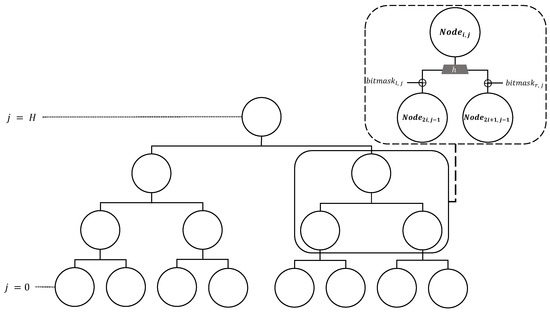
Figure 1.
Tree structure of XMSS; H is height of the tree; Bitmask is chosen uniformly at random from .
Definitions of parameters used in XMSS are given in Table 1.

Table 1.
Symbols of XMSS parameters.
2.1.1. Winternitz One Time Signature (WOTS)
WOTS scheme [18,20] efficiently signs the message digest. The private key is used for signing, where the key should not be used again. In other words, it is infeasible to sign more than one message using a single private key. The signature size of WOTS is smaller than Lamport OTS [9], because the message digest is signed at the same time. WOTS is based on security against collision resistance of one-way hash function. In the signature of WOTS, w representing the number of bits to be signed, is used as a number of 2 or more. The signature key consists of a randomly selected l-bit string of length n, where l is computed as Equation (1). Equation (1) is calculated based on the selected w.
The m-bit message M is based on w, and the checksum C for the message is calculated as Equation (2).
2.1.2. Winternitz One Time Signature Plus (WOTS)
WOTS [19] is a descendent of WOTS scheme. WOTS increases the security by adding a random value, r, as shown in the process of applying the one-way function h in the Winternitz one-time signature technique. The function chain of WOTS is expressed by the following Equation (4). Unlike WOTS, WOTS is based on the security against secondary pre-image resistance.
XMSS uses a Merkle hash tree of height h and a binary L-tree of height to reduce the size of the public key. Two trees are used to reduce WOTS verification keys to one XMSS public key. The overall structure can be found in Figure 2. The public key of WOTS obtained using WOTS as described above constructs the leaf of the L-tree, which is an unbalanced binary tree. If there is no power of 2 leaves, a node without a right sibling is moved up until it becomes a right sibling of another node. In the case of the L-tree, the same structure as in Figure 1 is used. However, a bitmask different from that of the Merkle tree is used. The upper leaf node of the L-tree created in this way becomes the lower leaf node of the Merkle hash tree. As a result, the root node of the Merkle tree becomes the final XMSS public key. The bit length of this XMSS public key is , the signature length of XMSS is , and the private key of XMSS is less than .
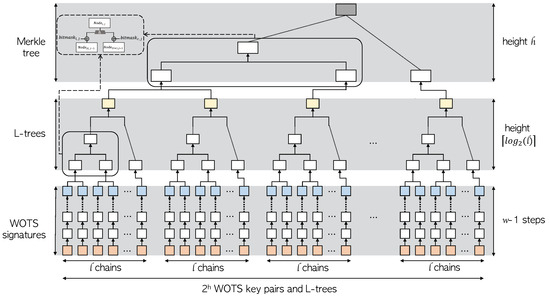
Figure 2.
Structure of XMSS; Orange block indicates WOTS signature key, blue block indicates WOTS public key, yellow block indicates L-tree root, and gray block indicates XMSS public key.
2.2. SPHINCS
SPHINCS [21] is a stateless hash-based signature framework that improves the speed and signature size of SPHINCS [14]. The main contribution of SPHINCS is the introduction of FORS (i.e., few-time signature scheme). The second contribution is the method of selecting leaf nodes. SPHINCS uses functions with cryptographic properties and each parameter is defined as follows:
- h, d: parameters of Hyper-Tree
- b, k: parameters of FORS
- w: parameter of Winternitz
SPHINCS with specific parameters (n = 192, h = 51, d = 17, b = 7, k = 45, and w = 16) showed 25% shorter signatures and 1.7× faster signature routines than those of SPHINCS. The structure of SHPINCS is shown in Figure 3. SPHINCS is a hyper-tree of height h and consists of d tree. The height of each tree is , where d is involved in the signature time and the signature size. In a hyper-tree, layer has a single tree and layer has trees. The root of the layer tree is signed using the WOTS key pair in the layer tree. Key pairs of Layer 0 WOTS are used to sign the FORS public key. Internal values are determined through seed and bitmask, and the entire structure is not computed. For this reason, it is referred to as a “virtual structure”. More information on SPHINCS can be found in [21].
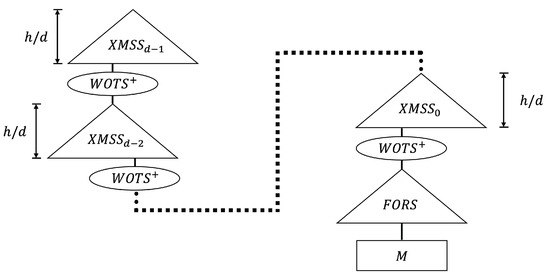
Figure 3.
Overview of SPHINCS structure.
2.2.1. FORS: Forest of Random Subsets
SPHINCS defines and uses FORS, a few-time signature improved from HORST [21]. FORS is defined in terms of integer k, and is used to sign -bit string. The private key of FORS consists of random bit values and is divided by k set of t values. Overall, it is deterministically derived from SK.seed using the pseudo-random function(PRF) and the key address of the hypertree. To obtain the FORS public key, k binary hash trees are constructed on the set of private key elements. Each t value is used as a leaf node and k binary hash trees with height a are created. Figure 4 shows the hash tree of FORS with and for message (100 010 011 001 110 111). FORS uses H, which is addressed using the location of the FORS key pair and the location of the function call within the tree. With WOTS, the root node compresses using the Tweakable hash function (). is an efficient function that maps -bit message M to -bit hash value MD using a function key of public parameter P and tweak T, and is expressed as Equation (5). The FORS public key is an n-bit value. The signing process of FORS is as follows. Given a message of bits, the k string of a bits is extracted. This bit string k has the index of each single leaf node of FORS. The signature consists of these nodes (indexes) and authentication paths (See Figure 4).
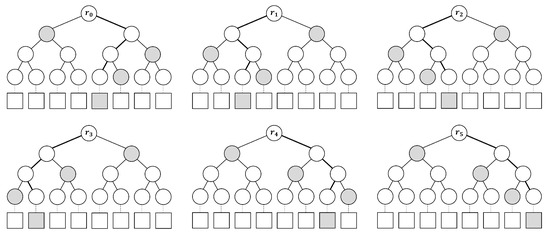
Figure 4.
Hash tree of FORS with and for message {100 010 011 001 110 111}.
The verifier validates the public key by reconstructing the root using the certification path. Since the public key is used as a message, it is implicitly verified with the WOTS signature.
2.2.2. XMSS
XMSS [22] is an extension of XMSS. The original XMSS scheme has a disadvantage in key generation. When the height (H) of the tree exceeds 20, the execution time could be slow. To accelerate the performance, XMSS uses a multi-layered XMSS tree called a hyper-tree. A hyper-tree consists of 2 or more XMSS trees, and all XMSS trees have the same height. The tree of the lowest layer of the hyper-tree is used to sign the actual message. The rest of the tree is used to sign the root node of the XMSS tree in each layer.
2.3. Hash Function
The hash function is used by XMSS and SPHINCS to construct the signature schemes. In this subsection, we briefly describe the LSH hash function and another hash function based on Korean block cipher [23].
2.3.1. LSH Hash Function
LSH is a high-speed hash function developed in Korea that generates a hash value through initialization, compression, and completion processes. The initialization process padding the message and separating the message by the size of the block. The compression process digests the message through message expansion, addition, mixing, and word-by-word circulation functions. The completion process outputs the result of the compression process as a hash value of a specific length. Figure 5 shows the operating structure of LSH.
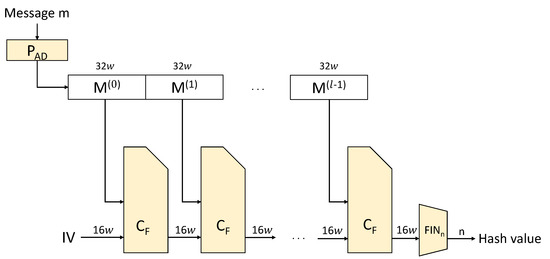
Figure 5.
Structure of LSH hash function.
2.3.2. Hash Function Based on Block Cipher
An iterated hash function is determined by an easily computable function h(·,·). The function h is called hash round function. The input message is divided into block sizes, and the hash round function calculates the next hash value using the divided message block and the previous hash value. The number of iterations of the hash round function is repeated by the number of message blocks to obtain the final hash value. Equation (6) is a modification of the iterative hash function.
Hash function based on block cipher uses a block cipher algorithm instead of a hash round function [24]. Several structures have been proposed to output the desired length of hash. We utilized the Tandem DM structure to implement hash functions using block ciphers. Tandem DM structure applies a block cipher algorithm using a key length of -bit when the block length is m-bit, and the output hash length is -bit. Figure 6 shows the Tandem DM Scheme.
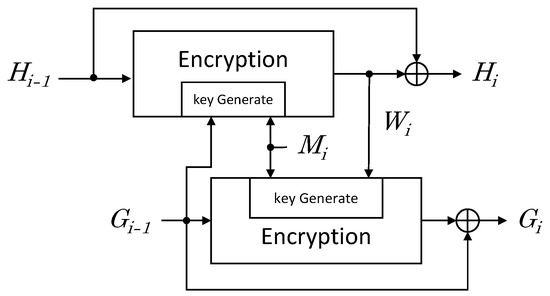
Figure 6.
-bit hash round function based on m-bit block cipher with -bit key.
In each iteration, two m-bit values (G and H) are computed from the previous values H and G and from an m-bit message block M as follows:
In this paper, LEA and CHAM block cipher algorithms were used for the hash round function.
- LEA Block Cipher LEA is a lightweight block cipher developed in Korea in 2013 to provide confidentiality not only in high-speed environments (e.g., big data and cloud), but also in lightweight environments, (e.g., IoT devices and mobile devices) [25]. The algorithm structure of LEA uses the ARX structure, and encryption proceeds by dividing the input block into four 32-bit. The ARX structure uses Addition, Rotation, and XOR operations.
- CHAM Block Cipher CHAM is a lightweight block cipher announced in ICISC’17 [26]. Subsequently, the revised version of the CHAM Block cipher was announced in ICISC’19 [27]. The revised CHAM differs from the original CHAM only in the number of rounds, and the other specifications are identical. The CHAM has different operations of odd rounds and even rounds. The CHAM of the generalized 4-branch Feistel structure is based on ARX operations.
3. Proposed Method
3.1. Hash Function Based on Block Cipher
In this paper, we construct hash function based on the Tandem DM scheme and utilize LEA and CHAM as the underlying block ciphers. Tandem DM scheme and block ciphers are described in Section 2.3. Algorithm 1 is a description for Figure 6.
The process of Algorithm 1 is as follows. The message received as input is divided into block size to proceed by the number of iterations. The iteration is repeated by the message length divided by the block size. In this paper, the message length is assumed to be a multiple of the block size. Lines 4 and 7 perform key initialization. In line 4, for the upper bit and for the lower bit are used as a key. In line 7, for the upper bit and W for the lower bit are used as a key. The initialized key generates a roundkey to be used for encryption through the function. Then, and generate an encrypted value through an function, and finally XOR with W and . If the CHAM and LEA algorithms are applied to the function and function, hash values can be obtained through LEA and CHAM block ciphers.
| Algorithm 1 Tandem DM scheme of hash function based on block cipher |
| Input: M (Message), (Message Length) Output: Hash value
|
3.2. K-XMSS
In this paper, we replaced the hash functions used in the original XMSS to Korean cryptography algorithms. We developed the code based on the basic C reference provided by [28].
Since XMSS has a tree height of h (10, 16, and 20), which determines the number of signatures with one key pair, K-XMSS adopted same parameters and structures utilized in XMSS. LSH provides the value of n only for 256 and 512. The hash function based on CHAM and LEA provides the value of n only for 256. In other words, Korean hash functions do not support the n value of 192, in K-XMSS. K-XMSS is performed on security parameters n of 256 and 512. Since the Winternitz parameter w of the original XMSS is fixed to 16, the value of w is also fixed to 16.
Functions used in K-XMSS are organized as follows:
- F: Key encryption hash function; F accepts and returns byte strings of length n using keys of length n.
- H: Encryption hash function; H accepts n-byte keys and byte strings with a length of and returns an n-byte string.
- H: Encryption hash function; H accepts -byte keys and byte strings of arbitrary length and returns n-byte strings.
- PRF: Pseudo-random function; PRF has an n-byte key and a 32-byte index as input and generates pseudo-random value (length n).
- toByte(x, n): n-byte string contains a binary representation of x (in the order of big-endian bytes);
Parameters used in K-XMSS are organized as follows:
- KEY: Keys with length in bytes.
- M: Strings with length in bytes.
For the setting, K-XMSS uses Equations (10)–(12) for LSH-256, CHAM, and LEA, respectively. For the setting, K-XMSS use Equation (13) for LSH-512.
3.2.1. K-XMSS_LSH256
Following equation describes LSH256 function for K-XMSS.
3.2.2. K-XMSS_CHAM
Following equation describes CHAM function for K-XMSS.
3.2.3. K-XMSS_LEA
Following equation describes LEA function for K-XMSS.
3.2.4. K-XMSS_LSH512
Following equation describes LSH512 function for K-XMSS.
3.3. K-SPHINCS
Similar to XMSS, we changed the hash functions used in the existing SPHINCS to Korean hash functions). Notations used in K-SPHINCS are organized as follows:
Functions used in K-SPHINCS are organized:
- H: Additional key hash function that can handle messages of arbitrary length.
- PRF: Pseudo-random function for generating pseudo-random keys.
- PRF: Using PRF to generate randomness for message compression.
- F: Second-preimage resistant, undetectable one-way function;
- H: Second-preimage resistant hash function;
- T: Weakable hash functions of the form mapping an -byte message M to an n-byte hash value md;
Parameters used in K-SPHINCS are organized:
- R: Random values generated based on messages and SK.prf
- PK.seed: Public seed which is part of the SPHINCS public key.
- PK.root: Top root node which is part of the SPHINCS public key.
- ADRS: 32-byte value representing an address in five defined structures.
- SK.prf: As one of the private key elements, the value used to deterministically generate a randomized value for a randomized message hash.
- Optrand: Value added when making the value of R optionally non-deterministic.
We set the hash function parameters (i.e., n, h, d, k, w) used in SPHINCS to be the same in K-SPHINCS. LSH is applicable to 256 and 512-bit outputs, and CHAM and LEA are applicable to 256-bit outputs. For this reason, we implement it based on hash function-256. K-SPHINCS uses Equations (14)–(16) for LSH-256, CHAM, and LEA, respectively.
3.3.1. K-SPHINCSLSH256
Following equation describes LSH256 function for K-SPHINCS.
3.3.2. K-SPHINCSCHAM256
Following equation describes CHAM256 function for K-SPHINCS.
3.3.3. K-SPHINCSLEA256
Following equation describes LEA256 function for K-SPHINCS.
4. Evaluation
The implementation was evaluated on a MacBook Pro 16 with the Intel i7-9750H processor, which can be clocked up to 2.6 GHz. Implementation is carried out on the Xcode framework, and compiled using the compile option -O3 (i.e., fastest).
4.1. K-XMSS vs. XMSS
XMSS was evaluated using test/speed.c included in the basic C reference code provided by [28]. K-XMSS was evaluated on the same setting by changing existing hash functions to Korean hash functions. The performance evaluation of original XMSS and proposed K-XMSS can be shown in Table 2 and Table 3.
Table 2.
Original XMSS and K-XMSS evaluation on Intel processors. Algorithm indicates XMSS-[Hash function]_[10]_[256]. (mid: median, avg: average, cc: clock cycle).
Table 3.
Original XMSS and K-XMSS evaluation on Intel processors. Algorithm indicates XMSS-[Hash function]_[10]_[512]. (mid: median, avg: average, cc: clock cycle).
The performance evaluation of optimized K-XMSS using AVX2 can be shown in Table 4. In XMSS, the smallest of the heights is 10. Therefore, K-XMSS performed only for tree height h of 10, which determines the number of messages that can be signed with one key pair. As described in Section 3.2, only 256 and 512 are provided for the security parameter n of the Korean hash functions. Therefore, n of K-XMSS is 256 and 512, the comparison target XMSS was also measured only for n values of 256 and 512.
Table 4.
Optimized K-XMSS evaluation using AVX2 on Intel processors. Algorithm indicates XMSS-[Hash function]_[10]_[n in bits]. (mid: median, avg: average, cc: clock cycle).
Among Korean Hash Functions, it was confirmed that LSH was significantly faster than other hash ciphers. Furthermore, it has been confirmed that LSH_10_256 is about 3 times faster than SHA2_10_256, and achieves performance similar to SHAKE_10_256. LSH_10_512 has been confirmed to be approximately three times faster than SHA2_10_512 and SHAKE_10_512. In addition, it has been demonstrated that K-XMSS can be optimized for better performance by utilizing advanced implementation techniques through AVX2.
Table 5 is a performance measurement table of Dilithium selected as the NIST PQC standard [29]. Compared to XMSS & K-XMSS, it can be seen that the performance of Dilithium is excellent.
Table 5.
Evaluation Crystals-Dilithium on Intel Core-i7 6600U (Skylake) [30]. (cc: clock cycle).
4.2. K-SPHINCS vs. SPHINCS
We evaluated the performance by replacing hash functions (i.e., SHAKE, SHA, and HARAKA) used in the SPHINCS with the Korean hash functions (i.e., CHAM, LSH, and LSH).
SPHINCS was evaluated based on the simple code of PQClean project (https://csrc.nist.gov/Projects/post-quantum-cryptography accessed on 21 August 2023) [15], K-SPHINCS was evaluated by changing the hash function to a Korean hash function (i.e., LSH, CHAM, and LEA) for the same code. In the case of the original SPHINCS, the same comparison was made based on [Hash function]_[256]. The performance evaluation of orginal SPHINCS & K-SPHINCS can be shown in Table 6. And the performance evaluation of optimized K-SPHINCS using AVX2 can be shown in Table 7.
Table 6.
Original SPHINCS and K-SPHINCS evaluation on Intel processors. Algorithm indicates SPHINCS-[Hash function]-256f-simple. (avg: average, mid: median, cc: clock cycle).
Table 7.
Optimized K-SPHINCS evaluation using AVX2 evaluation on Intel processors. Algorithm indicates SPHINCS-[Hash function]_[n in bits]. (avg: average, mid: median, cc: clock cycle).
Among Korean hash functions, it was confirmed that LSH was significantly faster than other hash ciphers. Furthermore, it has been confirmed that LSH_256 achieves performance similar to SHA2 and is about times faster than SHAKE and HARAKA. In addition, it has been demonstrated that K-SPHINCS can be optimized for better performance by utilizing advanced implementation techniques through AVX2.
Since K-XMSS and K-SHPINCS adopted XMSS and SHPINCS as quantum-resistant encryption standards, it is judged to provide sufficient security in the Post-Quantum environment. Compared to SPHINCS & K-SPHINCS, it can be seen that the performance of Dilithium is excellent.
Table 8 is performace of XMSS, K-XMSS. SHPINCS, and SHPINCS.
Table 8.
Performance public key, private key, and signature size. It can be confirmed that K-XMSS and K-SHPINCS have the same size as the original version.
5. Conclusions
We proposed K-XMSS, K-SHPINCS, which changed the hash functions of XMSS and SHPINCS (i.e., SHA2, SHAKE, and HARAKA) to Korean hash functions (i.e., LSH, CHAM, and LEA). In particular, we used Korean block ciphers (i.e., CHAM and LEA) by changing them into hash functions. Finally, we evaluated the proposed K-XMSS and K-SPHINCS. Internal hash functions used in K-XMSS and K-SPHINCS used reference codes from LSH. However, there was no code implemented for hash functions based on block ciphers CHAM and LEA. Therefore, in this paper, we used the CHAM and LEA hash function reference-C code we implemented. As the result of the performance evaluation, it was confirmed that among Korean hash functions, LSH was significantly faster than other hash ciphers(i.e., CHAM and LEA). In K-XMSS, it has been confirmed that LSH_10_256 is about 3 times faster than SHA2_10_256. In K-SPHINCS, it has been confirmed that LSH_256 achieves performance similar to SHA2. In addition, it has been demonstrated that K-XMSS and K-SPHINCS can be optimized for better performance by utilizing advanced implementation techniques through AVX2. Therefore, K-XMSS and K-SPHINCS can be further optimized by adopting the optimal implementation code such as NEON. Since K-XMSS and K-SHPINCS adopted XMSS and SHPINCS as quantum-resistant encryption standards, it is judged to provide sufficient security in the Post-Quantum environment. Currently, since the proposed technique is based on the reference code, performance is low when encryption except for LSH is applied. Therefore, as the future work, we propose K-XMSS and K-SPHINCS, which adopt the optimal implementation code using NEON.
Author Contributions
Software, M.S. and S.E.; writing—original draft, M.S.; writing—review and editing, G.S., Y.Y., W.K. and H.S.; supervision, H.S. All authors have read and agreed to the published version of the manuscript.
Funding
This work was supported by Institute for Information & communications Technology Promotion (IITP) grant funded by the Korea government (MSIT) (No. 2018-0-00264, Research on Blockchain Security Technology for IoT Services, 40%) and this work was supported by Institute of Information & communications Technology Planning & Evaluation (IITP) grant funded by the Korea government (MSIT) (No. 2022-0-00627, Development of Lightweight BIoT technology for Highly Constrained Devices, 40%) and this work was supported by Institute for Information & communications Technology Planning & Evaluation (IITP) grant funded by the Korea government (MSIT) (<Q|Crypton>, No. 2019-0-00033, Study on Quantum Security Evaluation of Cryptography based on Computational Quantum Complexity, 10%) and this work was supported by the National Research Foundation of Korea (NRF) grant funded by the Korea government (MSIT) (No. NRF-2020R1F1A1048478, 10%).
Data Availability Statement
Not applicable.
Conflicts of Interest
The authors declare no conflict of interest.
References
- Wang, C.X.; You, X.; Gao, X.; Zhu, X.; Li, Z.; Zhang, C.; Wang, H.; Huang, Y.; Chen, Y.; Haas, H.; et al. On the road to 6G: Visions, requirements, key technologies and testbeds. IEEE Commun. Surv. Tutor. 2023, 25, 905–974. [Google Scholar] [CrossRef]
- Liao, B.; Ali, Y.; Nazir, S.; He, L.; Khan, H.U. Security analysis of IoT devices by using mobile computing: A systematic literature review. IEEE Access 2020, 8, 120331–120350. [Google Scholar] [CrossRef]
- Fu, Z.; Liu, M.; Qin, Y.; Zhang, J.; Zou, Y.; Yin, Q.; Li, Q.; Duan, H. Encrypted Malware Traffic Detection via Graph-based Network Analysis. In Proceedings of the 25th International Symposium on Research in Attacks, Intrusions and Defenses, Limassol, Cyprus, 26–28 October 2022; pp. 495–509. [Google Scholar]
- Kadhim, A.N.; Sadkhan, S.B. Security Threats in Wireless Network Communication-Status, Challenges, and Future Trends. In Proceedings of the 2021 International Conference on Advanced Computer Applications (ACA), Maysan, Iraq, 25–26 July 2021; pp. 176–181. [Google Scholar]
- Rao, S.P.; Chen, H.Y.; Aura, T. Threat modeling framework for mobile communication systems. Comput. Secur. 2023, 125, 103047. [Google Scholar] [CrossRef]
- Yang, P.; Xiao, Y.; Xiao, M.; Li, S. 6G wireless communications: Vision and potential techniques. IEEE Netw. 2019, 33, 70–75. [Google Scholar] [CrossRef]
- Lizama-Pérez, L.A.; Montiel-Arrieta, L.J.; Hernández-Mendoza, F.S.; Lizama-Servín, L.A.; Simancas-Acevedo, E. Public hash signature for mobile network devices. Ing. Investig. Y Tecnol. 2019, 20. [Google Scholar] [CrossRef]
- Buchmann, J.; Dahmen, E.; Szydlo, M. Hash-based digital signature schemes. In Post-Quantum Cryptography; Bernstein, D.J., Buchmann, J., Dahmen, E., Eds.; Springer: Berlin/Heidelberg, Germany, 2009; pp. 35–93. [Google Scholar] [CrossRef]
- Lamport, L. Constructing Digital Signatures from a One-Way Function. Technical Report, Citeseer. 1979. Available online: https://www.microsoft.com/en-us/research/uploads/prod/2016/12/Constructing-Digital-Signatures-from-a-One-Way-Function.pdf (accessed on 21 August 2023).
- Merkle, R.C. A certified digital signature. In Proceedings of the Conference on the Theory and Application of Cryptology; Springer: New York, NY, USA, 1989; pp. 218–238. [Google Scholar]
- Feynman, R.P. Simulating physics with computers. In Feynman and Computation; CRC Press: Boca Raton, FL, USA, 2018; pp. 133–153. [Google Scholar]
- Shor, P.W. Polynomial-time algorithms for prime factorization and discrete logarithms on a quantum computer. SIAM Rev. 1999, 41, 303–332. [Google Scholar] [CrossRef]
- Grover, L.K. A fast quantum mechanical algorithm for database search. In Proceedings of the Twenty-Eighth Annual ACM Symposium on Theory of Computing, Philadelphia, PA, USA, 22–24 May 1996; pp. 212–219. [Google Scholar]
- Bernstein, D.J.; Hopwood, D.; Hülsing, A.; Lange, T.; Niederhagen, R.; Papachristodoulou, L.; Schneider, M.; Schwabe, P.; Wilcox-O’Hearn, Z. SPHINCS: Practical stateless hash-based signatures. In Proceedings of the Annual International Conference on the Theory and Applications of Cryptographic Techniques; Springer: Berlin/Heidelberg, Germany, 2015; pp. 368–397. [Google Scholar]
- NIST PQC Project. Available online: https://csrc.nist.gov/Projects/post-quantum-cryptography (accessed on 21 August 2023).
- MobiSec’22. Available online: https://www.manuscriptlink.com/society/kiisc/conference/mobisec2022 (accessed on 21 August 2023).
- Buchmann, J.; Dahmen, E.; Hülsing, A. XMSS-a practical forward secure signature scheme based on minimal security assumptions. In Proceedings of the International Workshop on Post-Quantum Cryptography, Taipei, Taiwan, 29 November–2 December 2011; Springer: Berlin/Heidelberg, Germany, 2011; pp. 117–129. [Google Scholar]
- Merkle, R.C. A digital signature based on a conventional encryption function. In Proceedings of the Conference on the Theory and Application of Cryptographic Techniques; Springer: Berlin/Heidelberg, Germany, 1987; pp. 369–378. [Google Scholar]
- Hülsing, A. W-OTS+–shorter signatures for hash-based signature schemes. In Proceedings of the International Conference on Cryptology in Africa, Cairo, Egypt, 22–24 June 2013; Springer: Berlin/Heidelberg, Germany, 2013; pp. 173–188. [Google Scholar]
- Even, S.; Goldreich, O.; Micali, S. On-line/off-line digital signatures. J. Cryptol. 1996, 9, 35–67. [Google Scholar] [CrossRef]
- Bernstein, D.J.; Hülsing, A.; Kölbl, S.; Niederhagen, R.; Rijneveld, J.; Schwabe, P. The SPHINCS+ signature framework. In Proceedings of the 2019 ACM SIGSAC Conference on Computer and Communications Security, London, UK, 11–15 November 2019; pp. 2129–2146. [Google Scholar]
- Hülsing, A.; Rausch, L.; Buchmann, J. Optimal parameters for XMSS MT. In Proceedings of the International Conference on Availability, Reliability, and Security, Regensburg, Germany, 2–6 September 2013; Springer: Berlin/Heidelberg, Germany, 2013; pp. 194–208. [Google Scholar]
- Kim, D.C.; Hong, D.; Lee, J.K.; Kim, W.H.; Kwon, D. LSH: A new fast secure hash function family. In Proceedings of the International Conference on Information Security and Cryptology, Seoul, Republic of Korea, 3–5 December 2014; Springer: Cham, Switzerland, 2014; pp. 286–313. [Google Scholar]
- Preneel, B.; Govaerts, R.; Vandewalle, J. Hash functions based on block ciphers: A synthetic approach. In Proceedings of the Annual International Cryptology Conference, Santa Barbara, CA, USA, 22–26 August 1993; Springer: Berlin/Heidelberg, Germany, 1993; pp. 368–378. [Google Scholar]
- Hong, D.; Lee, J.K.; Kim, D.C.; Kwon, D.; Ryu, K.H.; Lee, D.G. LEA: A 128-bit block cipher for fast encryption on common processors. In Proceedings of the International Workshop on Information Security Applications, Jeju Island, Republic of Korea, 19–21 August 2013; Springer: Cham, Switzerland, 2013; pp. 3–27. [Google Scholar]
- Koo, B.; Roh, D.; Kim, H.; Jung, Y.; Lee, D.G.; Kwon, D. CHAM: A family of lightweight block ciphers for resource-constrained devices. In Proceedings of the International Conference on Information Security and Cryptology, Seoul, Republic of Korea, 29 November–1 December 2017; Springer: Cham, Switzerland, 2017; pp. 3–25. [Google Scholar]
- Roh, D.; Koo, B.; Jung, Y.; Jeong, I.W.; Lee, D.G.; Kwon, D.; Kim, W.H. Revised version of block cipher CHAM. In Proceedings of the International Conference on Information Security and Cryptology, Seoul, Republic of Korea, 4–6 December 2019; Springer: Cham, Switzerland, 2019; pp. 1–19. [Google Scholar]
- Hülsing, A.; Butin, D.; Gazdag, S.L.; Rijneveld, J.; Mohaisen, A. XMSS: EXtended Merkle Signature Scheme. RFC 8391, IRTF. 2018. Available online: https://datatracker.ietf.org/doc/html/rfc8391 (accessed on 21 August 2023).
- Ducas, L.; Kiltz, E.; Lepoint, T.; Lyubashevsky, V.; Schwabe, P.; Seiler, G.; Stehlé, D. Crystals-dilithium: A lattice-based digital signature scheme. IACR Trans. Cryptogr. Hardw. Embed. Syst. 2018, 2018, 238–268. [Google Scholar] [CrossRef]
- Crystals-Dilithium. Available online: https://pq-crystals.org/dilithium/index.shtml (accessed on 21 August 2023).
Disclaimer/Publisher’s Note: The statements, opinions and data contained in all publications are solely those of the individual author(s) and contributor(s) and not of MDPI and/or the editor(s). MDPI and/or the editor(s) disclaim responsibility for any injury to people or property resulting from any ideas, methods, instructions or products referred to in the content. |
© 2023 by the authors. Licensee MDPI, Basel, Switzerland. This article is an open access article distributed under the terms and conditions of the Creative Commons Attribution (CC BY) license (https://creativecommons.org/licenses/by/4.0/).