Abstract
Distributed space time frequency coding (DSTFC) schemes address problems of performance degradation encountered by cooperative broadband networks operating in highly mobile environments. Channel state information (CSI) acquisition is, however, impractical in such highly mobile environments. Therefore, to address this problem, designers focus on incorporating differential designs with DSTFC for signal recovery in environments where neither the relay nodes nor destination have CSI. Traditionally, unitary matrix-based differential designs have been used to generate the differentially encoded symbols and codeword matrices. Unitary based designs are suitable for cooperative networks that utilize the amplify-and-forward protocol where the relay nodes are typically required to forego differential decoding. In considering other scenarios where relay nodes are compelled to differentially decode and re-transmit information signals, we propose a novel co-efficient vector differential distributed quasi-orthogonal space time frequency coding (DQSTFC) scheme for decode-and-forward cooperative networks. Our proposed space time frequency coding scheme relaxes the need for constant channel gain in the temporal and frequency dimensions over long symbol periods; thus, performance degradation is reduced in frequency-selective and time-selective fading environments. Simulation results illustrate the performance of our proposed co-efficient vector differential DQSTFC scheme under different channel conditions. Through pair-wise error probability analysis, we derive the full diversity design criteria for our code.
1. Introduction
The fundamental idea behind space–time–frequency (STF) coding in cooperative networks is to provide a scheme through which spatial, temporal, and frequency coding is exploited. This has led to the design of distributed space–time–frequency coding (DSTFC) schemes. In DSTFC schemes, elements of the codeword matrices are simultaneously transmitted via relay nodes across multiple orthogonal frequency-division multiplexing (OFDM) time slots and frequency sub-carriers. The principal objective is to design a coding scheme that mitigates the performance degradation experienced by distributed space time coding–orthogonal frequency division multiplexing (DSTC-OFDM) schemes and distributed space–frequency coding (DSFC) schemes in severe time-selective and frequency-selective fading channels, respectively. Furthermore, in the DSTC-OFDM schemes of [1,2,3] and the DSFC schemes of [4,5,6,7,8], for example, the channel gain on adjacent OFDM [9,10] time slots and frequency sub-carriers, respectively, is assumed to remain quasi-static to facilitate signal recovery at the destination. This assumption is impractical when signals with long symbol duration are transmitted or in cases involving large numbers of cooperating nodes. However, in the scheme proposed by this study, it is shown that DSTFC can be designed to mitigate this problem by simultaneously transmitting across OFDM time-slots and frequency sub-carriers. Therefore, this ensures that the requirement for constant channel gain in the temporal and frequency dimensions is more relaxed.
In order to implement cooperation in multi-hop networks generally, the most popular relaying protocols currently being used are the Decode-and-Forward (DF) [11,12] and Amplify-and-Forward (AF) [13,14] protocols. In the bid to cater for highly mobile environments where the nodes are unable to acquire channel state information (CSI), research efforts have been focused on the implementation of differential schemes for data transmission in non-coherent cooperative networks [15]. For example, a randomized differential scheme was proposed for a partially coherent cooperative network in [11] where the destination has partial CSI as opposed to full CSI. In other words, the source node is assumed to have CSI for the source–relay link while that of the relay–destination link cannot be acquired. The research in [16] provides the differential strategy for non-constant modulus constellations whereby the differential procedure is dependent on both amplitude and phase transitions. Furthermore, in their work, they focused on the reduction of the computational complexity of the differential procedure. Similarly, the studies carried out in [15,17,18] consider differential orthogonal coding schemes where neither the relays nor the destination are able to acquire CSI.
Fundamentally, when differential strategies are incorporated with coding schemes, a principal aspect is how to generate the differentially encoded symbols and, subsequently, the transmission matrix (at the source and relay nodes, respectively) in such a manner that would ensure their recovery at the destination without the need for CSI. Differential strategies can be implemented in cooperative networks through the utilisation of differential unitary matrix design as adopted by the authors in all the aforementioned works [17,19,20,21,22]. In contrast to existing works in the literature [23], differential strategies can also be implemented in cooperative networks through the use of a differential co-efficient vector design, which is being proposed in this study. It is evident from [17,24,25] that differential distributed space time frequency coding (DSTBC) schemes adopting the unitary matrix design are amenable to the AF protocol. This is because the relay nodes are generally required to forego CSI acquisition such that differential decoding is only performed at the destination. However, in contrast, for practical scenarios where the relay nodes are compelled to differentially decode and re-transmit information signals received from the source node, the co-efficient vector design is better suited. The co-efficient vector design reflects its utilisation specifically for applications like Adhoc and sensor networks that require inherent data correlation at intermediate nodes. The integration of differential schemes with DSTFC in broadband networks is even more challenging because of the presence of multiple paths in frequency-selective fading channels and multiple broadcast phases between the source and destination.
Furthermore, all the aforementioned works employ orthogonal codes and are thus only capable of providing full code-rate and full diversity for a maximum of two-relay cooperative networks. In order to cater for high data rate in cooperative networks, our proposed scheme employs rotated constellation quasi-orthogonal codes, which achieves full code-rate for any number of relay nodes. In addition, we show how the quasi-orthogonal codes are constructed from a proper choice of constellation sets. Moreover, the full mapping scheme and differential recipe for utilizing co-efficient vectors in cooperative networks are presented.
Motivated by all the aforementioned, we propose co-efficient vector differential distributed quasi-orthogonal space–time–frequency coding (DQSTFC) for cooperative networks. This study thus aims to make the following contributions:
- Due to the involvement of multiple broadcast phases in cooperative networks, our proposal of designing the STF codes at the source node aims to simplify the operation of relay nodes. Here, the codewords are carefully distributed in the temporal and frequency dimensions to relax the assumption that the channel is quasi-static in the time and frequency domains for long symbol periods;
- We provide a systematic construction of full rate quasi-orthogonal codes that can exploit full STF diversity and non-coherent signal detection. The full differential procedure using our proposed co-efficient vector design is also provided in this work. Through pair-wise error probability analysis, we derive the necessary conditions for our code to achieve full STF diversity while the coding gain is maximized as much as possible;
- The simulation carried out also provides an analytical study of the performance of our co-efficient vector differential DQSTFC scheme in frequency-selective fading and time-selective fading environments. We also compare and distinguish between the unitary matrices and co-efficient vector designs in terms of Bit Error Rate (BER) performance thus highlighting the robustness of our proposed non-coherent scheme against highly selective fading environments. In addition, we generalize the co-efficient vector design to cooperative networks with four, six, and eight relay nodes.
The remaining part of this paper is organised as follows: Section 2 presents the cooperative system and channel models and showing how the STF codes are designed at the source node and the relay nodes. Furthermore, Section 3 covers the differential encoding and decoding procedure using our proposed co-efficient vector design while Section 4 presents the pair-wise error probability analysis. Finally, Section 5 presents some simulation results and Section 6 contains the conclusion.
Notation: A bold-face upper case letter denotes a matrix while a bold-face lower case letter denotes a vector; ,, denote conjugate, transpose, and conjugate-transpose, respectively; denotes the Hadamard product or entry-wise product of the matrices and ; denotes the Kronecker product of the matrices and ; is a trace function; and represent expectation and variance of a random variable, respectively; denotes the Frobenius norm of the matrix ; denotes the absolute value of ; stands for the determinant of ; denotes an diagonal matrix with diagonal entries denotes the largest integer smaller than ; is an identity matrix; and finally, superscript gives the dimension of a complex matrix.
2. Distributed Space–Time–Frequency Coding
2.1. System Model
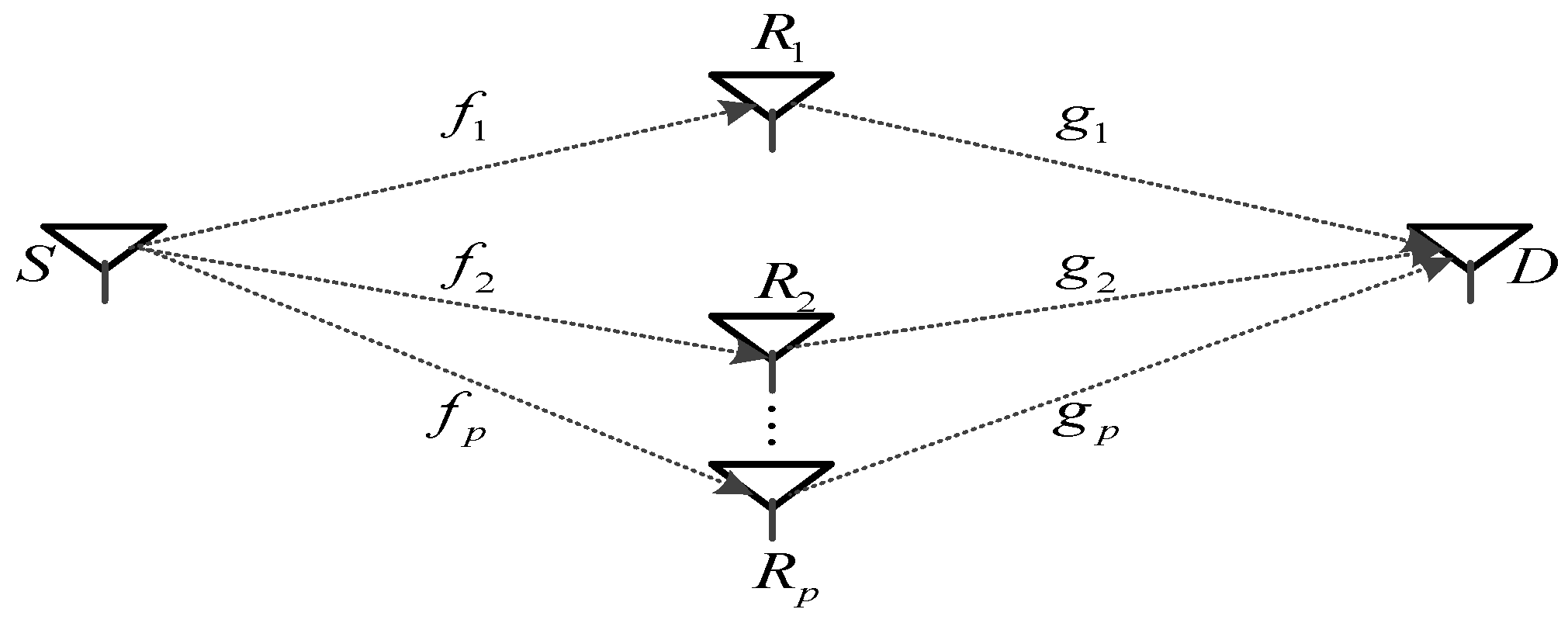
The cooperative network consists of a source node, a destination node, and relay nodes as shown in Figure 1. Each node is equipped with a single antenna, which is used for both transmission and reception. The transmission from the source node to the destination is divided into the ‘transmit’ and ‘cooperate’ stages. In the ‘transmit’ stage, the source node sends information signals to the cooperating relay nodes while in the ‘cooperate’ stage, the source node keeps silent and the cooperating relay nodes decode and forward the information signals to the destination. We address the problem of differential encoding and decoding where the relay nodes and the destination are unable to acquire CSI. Our investigation in this work is carried out under the assumption of perfect inter-relay synchronization. It is noteworthy that the use of cyclic prefix can provide robustness against synchronization errors at the relays. This benefit, which is owed to the employment of OFDM transmission, is applicable to our proposed DQSFC scheme. This assumption is, however, critical in practice due to the distributive nature of relays in space. Asynchronous transmission of the relays may result in degradation in diversity gain. Specifically, the impact of synchronization errors have been studied in [26] based on analytical and simulation results. Unlike STF coding in multiple-antenna systems, STF coding in cooperative networks must be implemented in two distinct stages, namely coding at the source node and coding at the relay nodes. We first describe how the coded data is designed at the source node.
Figure 1.
-relay Cooperative Network.
2.2. Space Time Frequency Coding at the Source Node
The cooperative system is based on OFDM modulation with sub-carriers and OFDM time slots. At the source node, a stream of modulated symbols, , are generated from an constellation. The symbols are simultaneously distributed across sub-carriers and OFDM time slots. In the frequency dimension, the sub-carriers are grouped into blocks. Similarly, in the temporal dimension, the OFDM time slots are grouped into blocks. Thus, each block, is of length , where and denote the number of frequency sub-carriers and time slots, respectively, per block. Based on this, the coded source node data is constructed:
where and zeros are padded into if is not an integer multiple of The coded source node data can be viewed as a concatenation of information symbols in the temporal and frequency dimensions since the elements of are stacked simultaneously unto adjacent data sub-carriers and OFDM time slots. Assuming the system is perfectly synchronized in the time and frequency domains, the data vector transmitted by the source node in the kth block can be written as , where denotes the ith symbol transmitted on the sub-carrier within the OFDM time slot. Since the source node transmits the data vector to relay nodes simultaneously across OFDM time slots and frequency sub-carriers, then the source node code is capable of achieving a diversity of order at each relay node. The criteria for achieving this diversity order will be clarified further on in this paper. The elements of are normalized such that .
2.3. Multipath Channel Model
The channel at the tth OFDM time slot between the source node and the pth relay node is described by the impulse response vector . Similarly, the channel at the tth OFDM time slot between the pth relay node and the destination is described by the impulse response vector , where and denote the number of independent channel taps on the source–relay link and relay–destination link, respectively. The multipath fading channel between the source node and the relay node is modelled as . Similarly, the multipath fading channel between the relay node and the destination is modelled as , where the complex amplitudes and are assumed to be independent zero-mean complex Gaussian random variables with variances and respectively. The delay of the path is denoted by and while is the Dirac delta function.
2.4. Space Time Frequency Coding at the Relay Nodes
If the data vector generated by the source node is of the form , where denotes average transmit-power, the signal received at the relay node in the block after cyclic prefix (CP) removal and fast Fourier transform (FFT) demodulation is given in vector form by:
where , is the channel gain at the nth sub-carrier of the pth relay node during the tth time slot, and is the zero-mean complex Gaussian noise vector with covariance . The multipath fading channel between the source node and the relay node is modelled as , . The average signal-to-noise ratio (SNR) of the channel between the source node and the pth relay node is given by .
The procedures through which the STF codes are constructed at the relay nodes are described below. Given that the pth relay node receives in (2), it differentially decodes the received signal and obtains , where is the differentially decoded version of the source node signal . The differential procedure is explained in the next section. In our STF coding scheme, we configure the pth relay node to forward a subset of the decoded signal , which we define as , while the remaining symbols are discarded. Note that denotes the ith symbol transmitted by the pth relay node on the nth sub-carrier of the tth OFDM time slot in the kth block. Based on this, the received signal at the pth relay node can be rewritten as follows:
where , and . In our DQSTFC scheme, the relay nodes are designed to construct quasi-orthogonal signal matrices at the destination. In order to achieve this, each pth relay node is equipped with a unitary matrix , which we refer to as the ‘relay matrix’. The relay matrix is a matrix of 1 s and 0 s, which enable the relay nodes to generate codewords with a quasi-orthogonal structure at the destination. The structure of the relay matrix is given in Sections 3 and 4 of [27] for cooperative networks with different number of relay nodes. Specifically, it is assumed that relay nodes are programmed to multiply their relay matrix by the decoded signal while the remaining relay nodes are programmed to multiply their relay matrix by the conjugate of the received signal . Thus, in the kth block, the pth relay node transmits a vector given by:
Since each pth relay node transmits the data vector to the destination on sub-carriers/time slots, then all the relay nodes can jointly achieve a diversity of order at the destination.
Assuming the relay nodes are synchronized at symbol level such that the nodes can transmit simultaneously, the signal received at the destination in the block after CP removal and FFT demodulation is given by:
where , , and is the zero-mean complex Gaussian noise term with covariance . The frequency response of the channel at the nth sub-carrier between the pth relay node and the destination during the tth time slot is denoted by . The average SNR of the channel between the relay node and the destination is given by . Substituting for in (4), (5) becomes:
The signal received at the destination in the kth block can be written in compact form as:
where , , , , , , and ,.
The quasi-orthogonal channel matrix captures the channel coefficients between the relay nodes and the destination. Here, it is assumed that the channel coefficient between the relay nodes and the destination remain quasi-static, at least, across adjacent OFDM time slots and adjacent frequency sub-carriers. Therefore, this means that the channel is constant during the transmission of symbols, that is, is constant for . Thus, the requirement for constant channel gain during the transmission of symbols is relaxed across time slots and sub-carriers. Further on, this paper will show the robustness of our scheme under certain fading conditions in comparison to STBC-OFDM and SFBC schemes where the channel coefficients are required to remain constant across slots and sub-carriers, respectively, during the transmission of symbols.
The matrix that is generated at the destination by the relay nodes is a quasi-orthogonal signal matrix containing either complex information symbols or their conjugates . Thus, in (7) can be rewritten as , where is the pth column of . In other words, the pth relay node transmits the pth column vector of . In order to recover information symbols at the destination without CSI, two consecutive quasi-orthogonal signal matrices and must be received at the destination in the kth block and (k + 1)th block, respectively. The first signal matrix is termed the ‘reference’ quasi-orthogonal matrix because it is only required for differential decoding and, thus, contains no valid data while the subsequent quasi-orthogonal signal matrix conveys the valid data. From the structure of , it is clear that the codeword guarantees one complex-valued symbol per time slot/per sub-carrier use when the relay nodes transmit to the destination, which is referred to here as a full code rate.
3. Co-Efficient Vector Differential Procedure
3.1. Co-Efficient Vector Generator
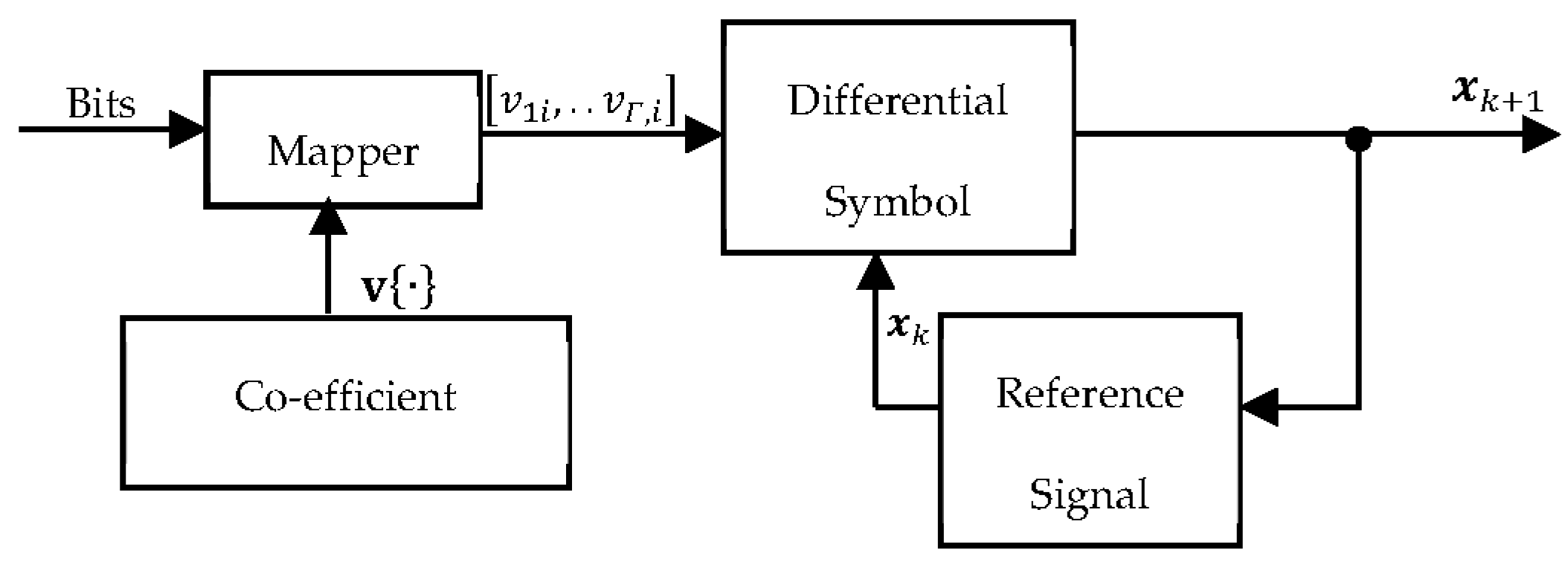
Our proposed co-efficient vector differential procedure is explained in this section. The design typically comprises three sub-systems, including the co-efficient vector generator, the mapper, and the feedback sub-system as illustrated in Figure 2. Given input bits, the source node constructed a length co-efficient vector set given by The co-efficient vector set was made up of unit-length distinct vectors ; was the spectral efficiency. Then, a pseudo-random one-to-one mapping scheme was defined for any -PSK signal constellation such that the input bits were mapped onto . Note that was the constellation size. The input bits arriving at the encoder in the block were used to select the corresponding vector from the co-efficient vector set . In other words, the co-efficient vector selected from was exclusively dependent on the input bits generated and the pseudo-random one-to-one mapping scheme . Given any random set of input bits, the selected co-efficient vector could be written as . The elements of , given by , represented the valid transmitted information symbols that had to be recovered at the destination without CSI.
Figure 2.
Co-efficient Vector Differential Encoder.
This section may be divided by subheadings. It should provide a concise and precise description of the experimental results, their interpretation, and the experimental conclusions that can be drawn.
3.2. Quasi-Orthogonal Code Construction
We now show how the elements of the co-efficient vector were rotated to ensure quasi-orthogonality. Given that the stream of input bits were mapped into symbols denoted by , the symbols were then combined as , , , and so on. Let , where was a Hadamard matrix, the information symbols were then constructed as and . Thus, were mapped onto a signal constellation of size while were mapped onto a signal constellation , which was a rotated version of The rotation angles of the information symbols ensured that the codes achieve full diversity, see Chapter 5 of [28] for further explanation on constellation rotation.
3.3. Differential Encoding Using Co-Efficient Vectors
The STF coded data vector to be transmitted by the source node in the (k + 1)th block was generated from the STF coded data vector transmitted by the source node in the kth block. We first discussed how the data vector in the (k + 1)th block was generated using the co-efficient vector and the information signals transmitted in the kth block. The first step was for the source node to compute the data vector for the (k + 1)th block using the transmitted information signals in the kth block and the selected co-efficient vector as follows:
where and was the ‘reference’ quasi-orthogonal signal matrix that was generated by the relay nodes in the kth block. It was assumed that the source node had prior knowledge of the relay matrices . The source node also knew ; hence, it could compute in (8). Then, finally, using in (8), the source node constructed the data vector ; note that represented the original symbols while were replicas of the original symbols, which would be forwarded by the relay nodes.
The selected coefficient vector could be represented using (9), such that given all the possible outcomes of , there existed corresponding coefficient vectors. In other words, there was a one-to-one mapping between the coefficient vectors and the input bits. Note that there was no difference between the differentially encoded symbols generated by our co-efficient vector design in (8) and those generated by the unitary matrices design in [29,30] for example.
Provided that the differential scheme was designed such that all nodes in the network have prior knowledge of the co-efficient vector set and the mapping scheme , the relay nodes could simply recover the elements of the co-efficient vector set using (10) and then using (8) for differential encoding:
where was the signal received at the pth relay node in the block. The differential decoding protocol employed by our scheme relied on the assumption that the channel co-efficients remain unchanged for transmissions in consecutive blocks; in other words, . In our proposed scheme, the relay nodes only recovered the elements of the co-efficient vector set as implemented in (10), without recovering the original information bits. This approach ensured that the computational complexity of the encoder was reduced because the relay nodes avoided the mapper block and co-efficient vector generator block in Figure 2. To be precise, the number of comparisons at each relay node was reduced by . This issue is further explained in the simulation section.
We continue our discussion on differential encoding at the relay nodes by illustrating how the co-efficient vector design was implemented with - constellations for relays. Note that we assumed that the relay nodes could perfectly compute the elements of the coefficient vector set. Considering an - modulation scheme with spectral efficiency , the encoder at each relay node generated modulated signals from information bits. Let the set of recovered information bits at the encoder be given as , and the co-efficient vector set is computed as: . Thus, the mapping scheme for each set of information bits to a co-efficient vector set was defined by:
3.4. Differential Decoding Using Co-Efficient Vectors
Similar to (7), the received signal matrix in the (k + 1)th block was given by:
where , , , , , , , and . As far as the destination was concerned, consecutive quasi-orthogonal signal matrices and had been received in two consecutive transmission blocks and based on (7) and (12). The received signals at the destination could thus be rewritten as:
Using the signals received in (13) in the kth block and (k + 1)th block, respectively, the estimate of the elements of the co-efficient vector could be recovered pairwisely at the destination without CSI. For example, for a cooperative network with relay nodes and , in order to recover , we first obtained the quasi-orthogonal signal and channel matrices for two consecutive transmission blocks as follows:
where and , were quasi-orthogonal signal and channel matrices, respectively. The ith information signal transmitted by the source node, through the pth relay node on the nth sub-carrier during the tth OFDM time slot, was denoted by , and captured the channel gain on the nth sub-carrier during tth OFDM time slot between the relay node and the destination. Since it was assumed that the channel was constant during the transmission of symbols, was therefore constant for ; similarly, was constant for since all the cooperating relay nodes transmitted identical information signals. Thus, it could be implied that and . Based on this, we computed:
where was the signal power, and was a self-interference parameter. Similarly, was the channel power, and was a self-interference parameter. The elements of the co-efficient vector were then recovered as follows:
Similarly,
where was the noise, , and , and we referred to and as the differential decoding parameters required to recover . The differential decoding parameters were computed at the destination as:
This implied that and since . It was thus obvious from (18) that the scheme did not require CSI to recover . The non-coherent recovery of rather depended on consecutively received signals in the kth block and (k + 1)th block. Once and were computed at the destination using (18), the information signals in (14) to (17) can be recovered pair-wisely. Obviously, all the decision signals were only a function of a pair of input signals, which existed with dissimilar constellation angles. This offered the possibility of decoding in pairs. We could decide for each pair of recovered symbols independently using a pair-wise least square decoder as follows:
The pair-wise least square decoder performed an exhaustive search over all possible combination of constellation points to determine the pair of signals that minimized the terms in (19) and (20). This decoding was equivalent to finding the minimum Euclidean distance between the noisy received signals and the known constellation points.
The resultant elements of the co-efficient vector in (19) and (20) could be interpreted as noisy versions of elements of the scaled co-efficient vector set. The scaling, and however, have a negligible effect on the geometry of the detection region. Since all the elements of the co-efficient vector set had equal lengths, the destination selected the closest co-efficient vector to from as the detector output. Then, inverse mapping was applied to recover the information bits. The complexity of this process was equivalent to since this was the number of constellation points to be examined.
The pairwise detection algorithm described so far for could be used for any cooperative network with relays . The only difference in design was in the structure of the channel matrix and . In this case, the path gain between the pth relay node and the destination was set to zero. In other words, the design for a 3-relay network could be achieved from the design for a 4-relay network simply by setting the path gain between the 4th relay and the destination to zero. Similarly, cooperative networks with five, six, and seven relays could derive their designs from the design for 8-relay networks.
4. Pairwise Error Probability Analysis
We then proceeded to develop sufficient conditions based on the PEP analysis for our code to achieve full diversity of order while the coding gain was maximized as much as possible. Since each of the blocks contained arbitrary symbols, which were independently distributed across the relay nodes, only a single block k our PEP analysis, which was valid for any . It was assumed that the path gains and were independent for different transmission paths such that the relay nodes form spatially uncorrelated channels between the source node and the destination. Thus, information symbols are simultaneously distributed in the spatial, temporal, and frequency dimensions. Based on this, and the analysis of [31], the achievable diversity order of our code could be determined as the product of the number of relay nodes, the rank of the temporal correlation matrix, and the number of delay paths, when sufficient conditions were reached. These conditions were discussed below.
The frequency response vector between the source node and the relay nodes was denoted by . Similarly, the frequency response vector between the relay nodes and the destination was . The correlation matrix of the channel frequency response could be found as . Unlike the case of multiple antenna systems, the cooperative network had the ‘transmit’ and ‘cooperate’ stages; thus, could be decomposed as . It can easily be shown that , , and were full rank based on the following:
where and , and was the sub-carrier spacing. From (23), if and were unitary matrices (valid if all and fall within the sampling instances of the relay nodes and destination respectively [31], then and have full rank. Furthermore, based on the theorem in Section 1.2.4 of [32], which stated that; if and were positive definite, then was itself a positive definite (full rank correlation matrix), , , and could thus be verified as positive definite (full rank correlation matrices).
Since it was established that had full rank, we then proceeded to discuss the criteria in order to achieve maximum diversity. Statistically independent samples of the source-relay channel were defined as . Similarly, statistically independent samples of the relay–destination channel were defined as . Under the assumption that all and were independent identically distributed complex Gaussian variables, it could be implied that . For any block, the STF codeword could be viewed as a collection of symbols transmitted across time/frequency slots by relay nodes. Based on this, the consecutively received signals at the destination in the block and block could be rewritten as (24) under the constraint that the sub-channel gain of adjacent transmission blocks was almost constant.
where , , , , , , , , . Using the following notations:
and the recursion
We could write:
The conditional probability density function of the receive signal matrix was:
where was the covariance matrix of , denoted the trace function, and was the average SNR of the received signal given as . Thus, the non-coherent ML decoder was given by:
Substituting into in (24) and using , we had , where . The non-coherent ML decoder could thus be simplified as:
where was the Frobenius norm. The Chernoff bound on the PEP of mistaking by could be given as [33].
where and were two distinct codewords, and was used to get the tightest bound. By simple algebraic manipulation (29) could be simplified as
Since the relay nodes in our scheme linearly processed their received signals, our achievable diversity order was bounded by and where was the rank of the channel temporal correlation matrix. Thus, targeting maximum diversity order was chosen. Other values of may be desirable, for example, when targeting minimum decoding complexity or when high SNR is considered. It could be deduced from (30) that for all values of , if or similarly if had full rank, then our scheme would achieve a diversity order of . At high SNR, the term in (30) could be further bounded as (31), where was selected to get the tightest bound [27].
From (31), it was observed that the performance of our code was determined by , and . It has already been established that had full rank; thus, our scheme would achieve maximum diversity strictly on the condition that and had full rank. Since of our main focus was to maximise diversity whilst ensuring maximum coding gain, the code had to be designed such that had full rank over all possible pairwise errors. When maximum diversity was achieved, had full rank; the coding gain was only determined by and . In order to maximize the coding gain, the first step was to provide uncorrelated channels such that was maximized. For the second step, we considered the diversity product , which measured the quality of the code given as where achieved maximum diversity. Thus, the coding gain was maximized when we maximized under the constraint that: and .
5. Performance Evaluation
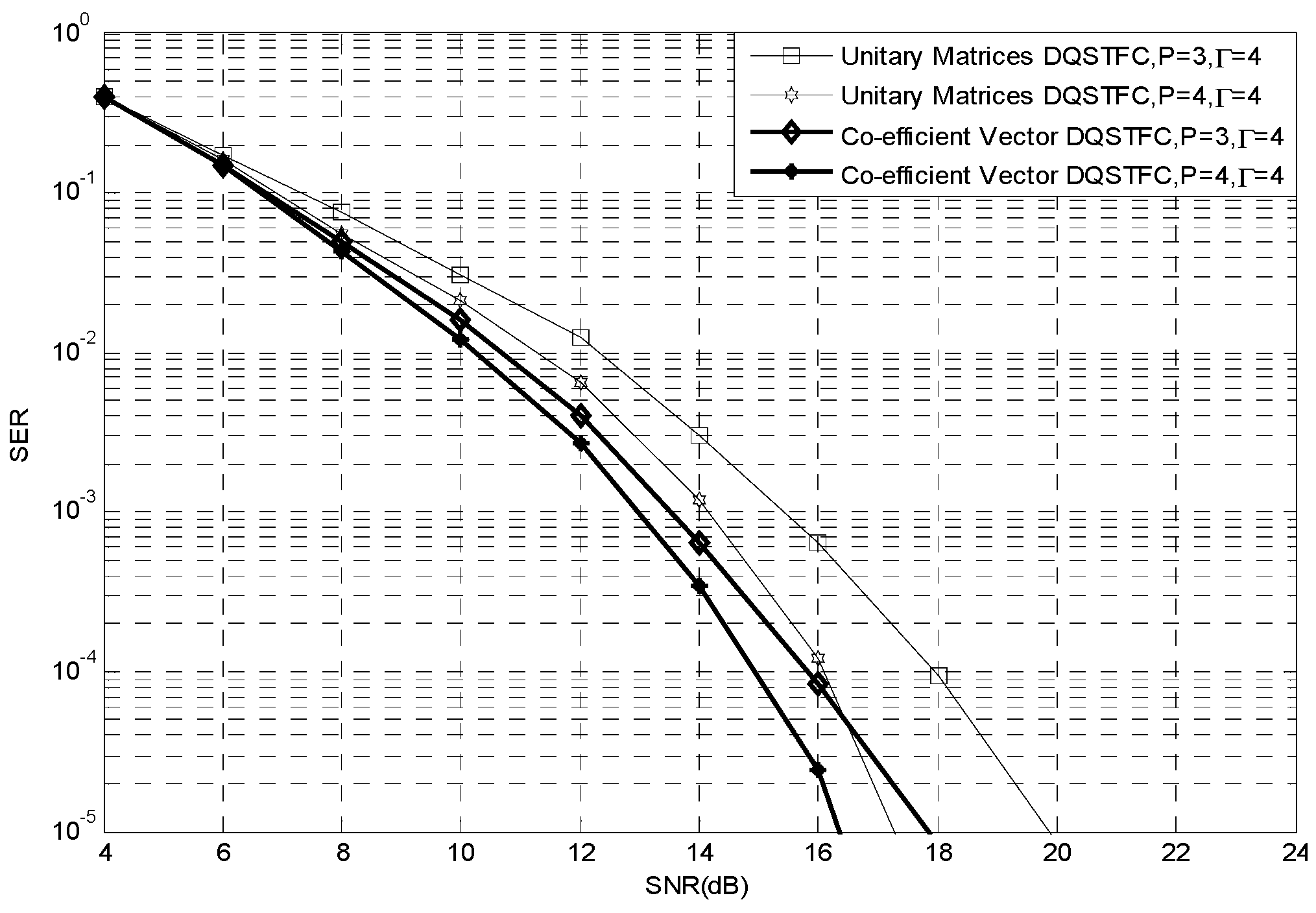
The performance of the co-efficient vector differential DQSTBC scheme with cooperating relay nodes over severely fading multi-path channels is evaluated via simulation. The fading is assumed to vary identically during the transmission of at least two consecutive information blocks. Here, it is assumed that the cooperating nodes [34,35,36] and the destination are unable to acquire CSI. Thus, they recover the transmitted bits from consecutively received signals. We set and to form the basis for comparing the BER performance of our co-efficient vector design with that of the unitary matrices design. So far in this study, our literature search for a differential DQSTFC scheme for comparison has been unsuccessful. We thus independently simulate the differential DQSTFC scheme using the unitary matrices design and the co-efficient vector design. Also compared is the differential orthogonal scheme of [29], where the unitary matrix design is utilized, with the co-efficient vector based differential orthogonal scheme. A similar DQSTFC scheme is also independently simulated for cooperating nodes in coherent networks that can acquire perfect CSI. The results for are presented in Figure 3.
Figure 3.
Comparison of Unitary Matrices and Co-efficient Vector Designs.
From the results of the simulated schemes, it is evident that, compared to the unitary matrices AF protocol, the performance of the differential DF scheme using co-efficient vectors is slightly better than that obtained using unitary matrices in the low SNR region while the performance improves significantly in the high SNR region. For example, at BER, the performance gain is about 1.2 dB.
A notable difference between the designs is observed in terms of the computation complexity of the decoder at the relay nodes and the destination. For designs utilizing unitary matrices, a simple pairwise decoder recovers the information bits at the relays and the destination by conducting comparisons, is the number of bits. In contrast, designs utilizing co-efficient vectors rely on an exhaustive search over all possible elements of the co-efficient vector. The most complex method is to perform a full search over all possible combinations in the co-efficient vector set. This equates to comparisons to recover the elements of the co-efficient vector set, with a further comparisons required for mapping and inverse mapping at the encoder and decoder, respectively. It is thus clear that the decoding complexity limitation of the co-efficient vector based design is due to the constellation size. To counter this, suitable optimum detection schemes, such as those proposed in [37,38], which are independent of constellation size, can be utilized.
Next, we analyse the performance of our proposed scheme in frequency-selective and time-selective channels. Specifically, we set our simulation parameters for different Doppler frequencies ranging from to and different root mean square delay spreads between and , the Doppler frequencies correspond to mobile speeds between 22 km/h and 108 km/h. For the quasi-orthogonal codes, the rotation angles are set to , where is the constellation size.
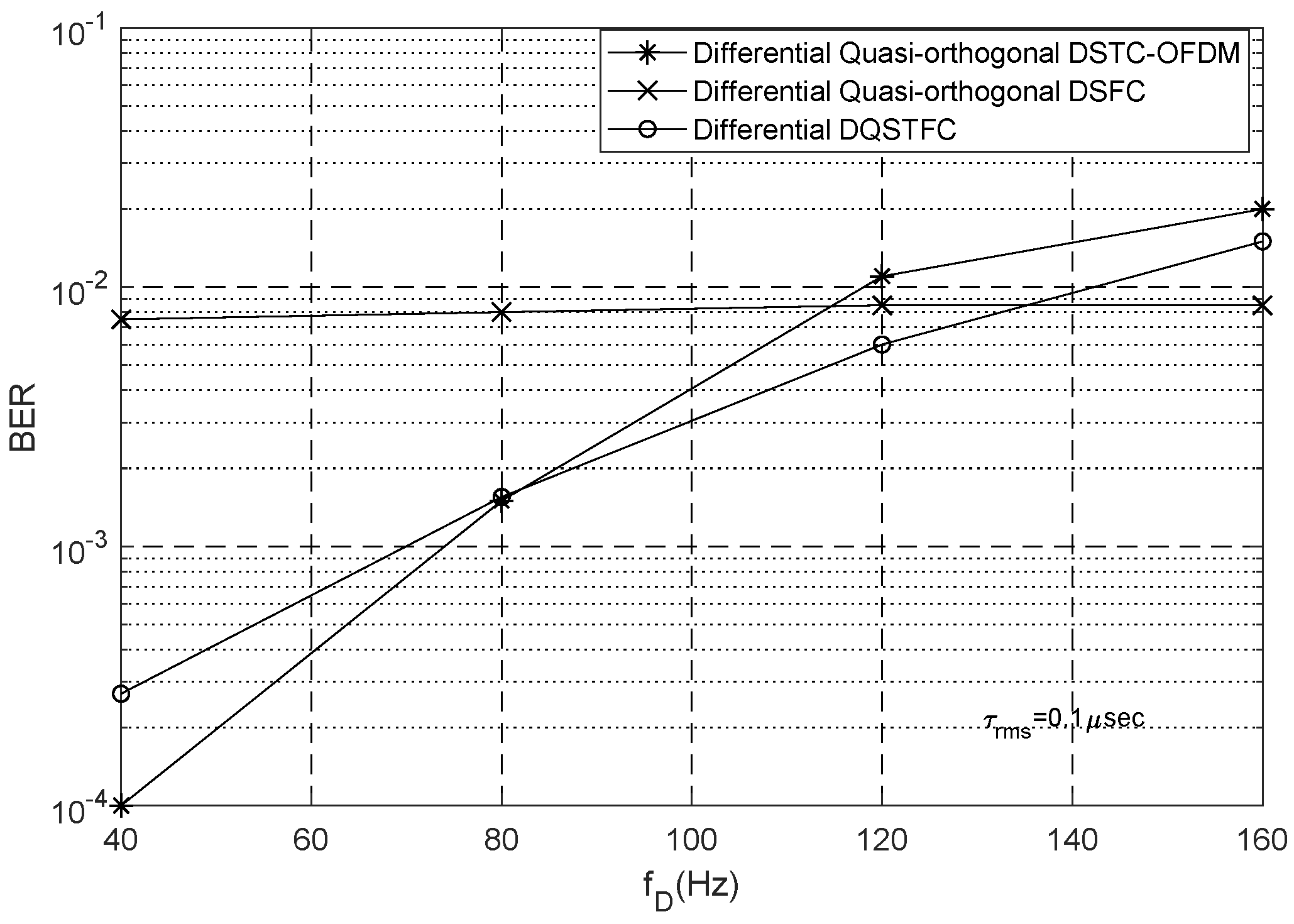
For different channel conditions, the performance of our proposed differential DQSTFC scheme is compared with the differential quasi-orthogonal DSTC-OFDM and DSFC schemes (whose parameters are simulated in our environment). We study the effects of Doppler spread and delay spread on the aforementioned coding schemes using different simulation parameters. We first set to a low value of such that the effect of delay spread is negligible. To study the influence of Doppler spread, we investigate BER performance at different Doppler frequencies. The SNR is fixed at , the symbols are chosen from a constellation, and all the coding schemes have the same transmission rate of 2 bits/s/Hz.
From Figure 4, it can be seen that for values of between and , the BER performance of our proposed differential DQSTFC scheme is better than that of the differential quasi-orthogonal DSTC-OFDM and DSFC schemes. This is because at such values of the coherence time and coherence bandwidth of the channel are large enough to satisfy the requirements of constant channel gain across adjacent time slots and adjacent subcarriers. The BER performance of DSTC-OFDM is better than that of our proposed scheme only at values of below . At such values of , the coherence time is large, and can be satisfied. Thus, DSTC-OFDM schemes, which require constant channel gain in the temporal dimension for the entire duration of symbols, have the best BER performance. When the Doppler spread increases and is between and , the coherence time reduces and can no longer be satisfied; however, the coherence time is still large enough to satisfy . Thus, the BER performance of DSTC-OFDM degrades beyond that of our proposed scheme. When the Doppler spread is severe and is above , coding in the temporal dimension introduces a significant amount of inter-symbol interference; thus, our proposed scheme and the DSTC-OFDM scheme experience performance degradation. However, the BER performance of the DSFC scheme is better in this situation because the delay spread is low and the coherence bandwidth is large enough to satisfy . Thus, DSFC schemes that require constant channel gain in the frequency dimension for the entire duration of symbols has the best BER performance. In contrast with DSTC-OFDM and DSFC schemes, where the requirements for constant channel gain must be satisfied for the entire duration of symbols, our scheme only requires constant channel gain during the transmission of symbols. Therefore, we can conclude that for cooperative networks operating in environments where CSI cannot be acquired, our proposed scheme is robust against a practical range of Doppler spread.
Figure 4.
Co-efficient Vector DQSTFC in Frequency Selective Fading Channels.
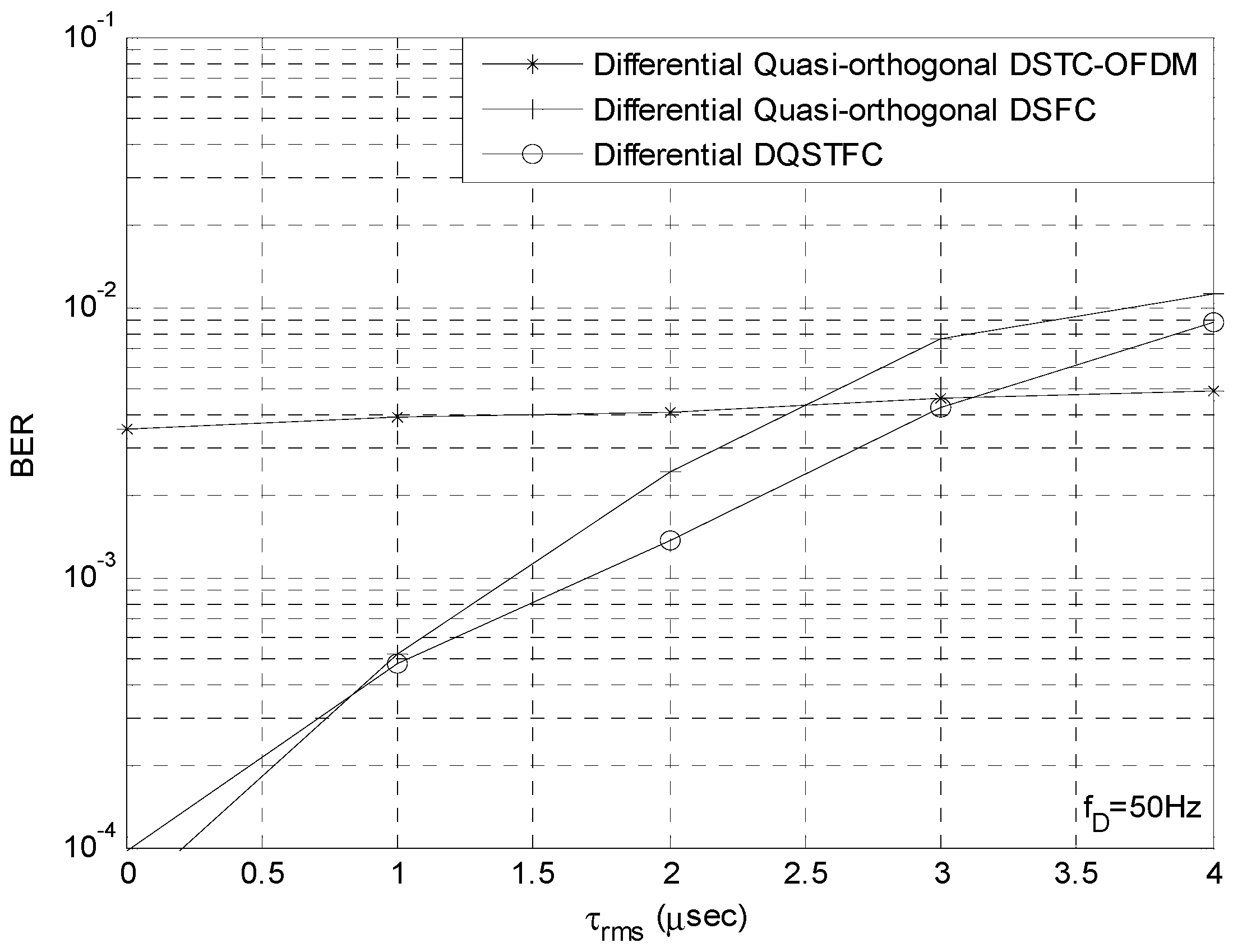
We then set to a fixed value of such that the influence of Doppler spread is low and compare the performance of all the aforementioned coding schemes at different levels of delay spread. The SNR is fixed at , and all the coding schemes have identical transmission rate of 2 bits/s/Hz. From Figure 5, we observe that our proposed scheme outperforms the other coding schemes when the value of is between and . This is because at such values, the coherence time and coherence bandwidth of the channel is large enough to satisfy the requirements of constant channel gain across adjacent time slots and adjacent sub-carriers. When the delay spread is low and is below , the coherence bandwidth is large and can be satisfied. Thus, DSFC schemes that require constant channel gain across sub-carriers outperform the DSTC-OFDM scheme and our proposed DQSTFC scheme. When the delay spread increases, the coherence bandwidth reduces and can no longer be satisfied; however, can still be satisfied. Thus, our proposed scheme exhibits improved BER performance compared to the DSFC scheme. When is higher than , the coherence bandwidth is very low such that coding in the frequency dimension introduces inter-carrier interference; thus, the BER performance of our proposed scheme and the DSFC scheme degrade significantly. In this condition, however, DSTC-OFDM outperforms the other schemes.
Figure 5.
Performance comparison between proposed Co-efficient Vector DQSTFC, DSTC-OFDM and DSFC in Time Selective Fading Channels.
6. Conclusions
As opposed to traditional unitary matrix-based differential designs amenable to the AF cooperative protocol, we propose co-efficient vector based differential designs for DF cooperative networks where the relay nodes are required to differentially decode and re-transmit information signals. We employ full rate full diversity quasi-orthogonal codes to meet the demands of high data rate transmission. We present the generalized STF mapping scheme and differential recipe for utilizing co-efficient vectors in cooperative networks with any number of relays. Through PEP analysis, we derive sufficient design criteria for our scheme to achieve full spatial, temporal, and frequency diversity. Using simulation results, we compare and contrast the unitary matrices and co-efficient vector designs in terms of computational complexity and BER performance.
From the results, it is evident that, compared to the unitary matrices AF protocol, the performance of the differential DF scheme using co-efficient vectors is slightly better than that obtained using unitary matrices in the low SNR region while the performance improves significantly in the high SNR region. For example, at BER, the performance gain is about 1.2 dB. Additionally, it can be seen that for values of between and the BER performance of our proposed differential DQSTFC scheme is better than that of the differential quasi-orthogonal DSTC-OFDM and DSFC schemes.
We then study the performance of our differential DQSTFC scheme in severe multipath fading conditions. When is higher than , the coherence bandwidth is very low, such that coding in the frequency dimension introduces inter-carrier interference; thus, the BER performance of our proposed scheme and the DSFC scheme degrade significantly. In this condition, however, DSTC-OFDM outperforms the other schemes.
Future Work
The reconfigurable intelligent surface (RIS) technology has generated considerable interest due to its advantages of low cost, easy deployment, and high controllability [39,40,41]. To further attempt to improve the performance of our proposed co-efficient vector differential DQSTFC scheme under different channel conditions, a RIS-assisted differential DQSTFC scheme will be investigated.
Author Contributions
Validation, G.O.; Formal analysis, N.N.; Investigation, O.S.; Supervision, Y.S. All authors have read and agreed to the published version of the manuscript.
Funding
This research received no external funding. The APC was funded by the School of Physics, Engineering and Computer Science (SPECS), University of Hertfordshire, College Lane Campus, Hatfield AL10 9AB, UK.
Institutional Review Board Statement
Not applicable.
Informed Consent Statement
Not applicable.
Data Availability Statement
Data sharing not applicable.
Conflicts of Interest
The authors declare no conflict of interest.
References
- Avendi, M.R.; Jafarkhani, H. Differential Distributed Space-Time Coding with Imperfect Synchronization in Frequency-Selective Channels. IEEE Trans. Wirel. Commun. 2015, 14, 1811–1822. [Google Scholar] [CrossRef][Green Version]
- Rajan, G.S.; Rajan, B.S. Leveraging coherent distributed space-time codes for noncoherent communication in relay networks via training. IEEE Trans. Wirel. Commun. 2009, 8, 683–688. [Google Scholar] [CrossRef]
- Muhaidat, S.; Ho, P.; Uysal, M. Distributed Differential Space-Time Coding for Broadband Cooperative Networks. In Proceedings of the VTC Spring 2009—IEEE 69th Vehicular Technology Conference, Barcelona, Spain, 26–29 April 2009; IEEE: Piscataway, NI, USA, 2009. [Google Scholar]
- Wang, H.; Xia, X.-G.; Yin, Q. Distributed space-frequency codes for cooperative communication systems with multiple carrier frequency offsets. IEEE Trans. Wirel. Commun. 2009, 8, 1045–1055. [Google Scholar] [CrossRef]
- Wei, Z.; Yabo, L.; Xiang-Gen, X.; Ching, P.C.; Ben Letaief, K. Distributed Space-Frequency Coding for Cooperative Diversity in Broadband Wireless Ad Hoc Networks. IEEE Trans. Wirel. Commun. 2008, 7, 995–1003. [Google Scholar]
- Xu, C.; Rajashekar, R.; Ishikawa, N.; Sugiura, S.; Hanzo, L. Single-RF Index Shift Keying Aided Differential Space–Time Block Coding. IEEE Trans. Signal Process. 2018, 66, 773–788. [Google Scholar] [CrossRef]
- Qu, F.; Wang, Z.; Yang, L. Differential Orthogonal Space-Time Block Coding Modulation for Time-Variant Underwater Acoustic Channels. IEEE J. Ocean. Eng. 2016, 42, 188–198. [Google Scholar] [CrossRef]
- Xiao, L.; Xiao, Y.; Yang, P.; Liu, J.; Li, S.; Xiang, W. Space-Time Block Coded Differential Spatial Modulation. IEEE Trans. Veh. Technol. 2017, 66, 8821–8834. [Google Scholar] [CrossRef]
- Li, J.; Zhang, Z.; Wang, Y.; He, B.; Zheng, W.; Li, M. Deep Learning-Assisted OFDM Channel Estimation and Signal Detection Technology. IEEE Commun. Lett. 2023, 27, 1347–1351. [Google Scholar] [CrossRef]
- Harkat, H.; Monteiro, P.; Gameiro, A.; Guiomar, F.; Farhana Thariq Ahmed, H. A Survey on MIMO-OFDM Systems: Review of Recent Trends. Signals 2022, 3, 359–395. [Google Scholar] [CrossRef]
- Nguyen, H.X.; Tran, N.N.; Nguyen, H.T. Performance analysis of adaptive decode-and-forward relaying in noncoherent cooperative networks. EURASIP J. Wirel. Commun. Netw. 2013, 2013, 281. [Google Scholar] [CrossRef][Green Version]
- Shao, Y.; Wang, L.; Xue, Y. Distributed Alamouti Protocol for Full-Duplex Decode-and-Forward Relaying Networks. IEEE Commun. Lett. 2022, 26, 182–186. [Google Scholar] [CrossRef]
- Wang, F.; Xu, J.; Lau, V.K.N.; Cui, S. Amplify-and-Forward Relaying for Hierarchical Over-the-Air Computation. IEEE Trans. Wirel. Commun. 2022, 21, 10529–10543. [Google Scholar] [CrossRef]
- Simpson, O.; Abdulkadir, Y.; Sun, Y.; Chi, B. Relay-Based Cooperative Spectrum Sensing with Improved Energy Detection in Cognitive Radio. In Proceedings of the 2015 10th International Conference on Broadband and Wireless Computing, Communication and Applications (BWCCA), Krakow, Poland, 4–6 November 2015; pp. 227–231. [Google Scholar]
- Owojaiye, G.; Delestre, F.; Sun, Y. Quasi-Orthogonal Space-Frequency Coding in Non-Coherent Cooperative Broadband Networks. IEEE Trans. Commun. 2014, 62, 1218–1229. [Google Scholar] [CrossRef]
- Kyung Soo, W.; Kyu In, L.; Jong Ho, P.; Kyung Won, P.; Won Young, Y.; Yong Soo, C. A DSFBC-OFDM for a Next Generation Broadcasting System with Multiple Antennas. IEEE Trans. Broadcast. 2007, 53, 539–546. [Google Scholar] [CrossRef]
- Kiran, T.; Rajan, B.S. Partially-coherent distributed space-time codes with differential encoder and decoder. IEEE J. Sel. Areas Commun. 2007, 25, 426–433. [Google Scholar] [CrossRef]
- Abdulkadir, Y.; Simpson, O.; Nwanekezie, N.; Sun, Y. Space-time opportunistic interference alignment in cognitive radio networks. In Proceedings of the 2016 IEEE Wireless Communications and Networking Conference, Doha, Qatar, 3–6 April 2016; pp. 1–6. [Google Scholar]
- Jin, G.; Aubry, A.; De Maio, A.; Wang, R.; Wang, W. Quasi-Orthogonal Waveforms for Ambiguity Suppression in Spaceborne Quad-Pol SAR. IEEE Trans. Geosci. Remote Sens. 2022, 60, 5204617. [Google Scholar] [CrossRef]
- Xiao, L.; Chen, D.; Hemadeh, I.; Xiao, P.; Jiang, T. Generalized Space Time Block Coded Spatial Modulation for Open-Loop Massive MIMO Downlink Communication Systems. IEEE Trans. Commun. 2020, 68, 6858–6871. [Google Scholar] [CrossRef]
- Sanchis Borras, C.; Molina-Garcia-Pardo, J.-M.; Rubio, L.; Pascual-Garcia, J.; Penarrocha, V.M.R.; Llacer, L.J.; Reig, J. Millimeter Wave MISO-OFDM Transmissions in an Intra-Wagon Environment. IEEE Trans. Intell. Transp. Syst. 2021, 22, 4899–4908. [Google Scholar] [CrossRef]
- Niu, Z.; Xiao, L.; Ma, W.; Peng, M.; Jiang, T. Generalized Space-Time Architecture for Ambient Backscatter Communication. IEEE Trans. Commun. 2023, 71, 1912–1925. [Google Scholar] [CrossRef]
- Slaney, A.; Sun, Y. Space-time coding for wireless communications: An overview. IEEE Proc. Commun. 2006, 153, 509. [Google Scholar] [CrossRef][Green Version]
- Owojaiye, G. Design and Performance Analysis of Distributed Space Time Coding Schemes for Cooperative Wireless Networks. Ph.D. Thesis, University of Hertfordshire, Hatfield, UK, 2012. [Google Scholar]
- Abdulkadir, Y.; Simpson, O.; Nwanekezie, N.; Sun, Y. A differential space-time coding scheme for cooperative spectrum sensing in cognitive radio networks. In Proceedings of the 2015 IEEE 26th Annual International Symposium on Personal, Indoor, and Mobile Radio Communications (PIMRC), Hong Kong, China, 30 August–2 September 2015; pp. 1386–1391. [Google Scholar]
- Amor, S.B.; Affes, S.; Bellili, F.; Vilaipornsawai, U.; Zhang, L.; Zhu, P. Multi-Node ML Time and Frequency Synchronization for Distributed MIMO-Relay Beamforming over Time-Varying Flat-Fading Channels. IEEE Trans. Commun. 2019, 67, 2702–2715. [Google Scholar] [CrossRef]
- Jing, Y.; Jafarkhani, H. Using Orthogonal and Quasi-Orthogonal Designs in Wireless Relay Networks. IEEE Trans. Inf. Theory 2007, 53, 4106–4118. [Google Scholar] [CrossRef]
- Jafarkhani, H. Space-Time Coding; Cambridge University Press: Cambridge, UK, 2005. [Google Scholar]
- Jing, Y.; Jafarkhani, H. Distributed differential space-time coding for wireless relay networks. IEEE Trans. Commun. 2008, 56, 1092–1100. [Google Scholar] [CrossRef]
- Susinder Rajan, G.; Sundar Rajan, B. Algebraic distributed differential space-time codes with low decoding complexity. IEEE Trans. Wirel. Commun. 2008, 7, 3962–3971. [Google Scholar] [CrossRef]
- Weifeng, S.; Safar, Z.; Liu, K.J.R. Towards maximum achievable diversity in space, time, and frequency: Performance analysis and code design. IEEE Trans. Wirel. Commun. 2005, 4, 1847–1857. [Google Scholar] [CrossRef]
- Bhatia, R. Positive Definite Matrices; Princeton University Press: Princeton, NJ, USA, 2009. [Google Scholar]
- Qian, M.; Tepedelenlioglu, C.; Zhiqiang, L. Differential space-time-frequency coded OFDM with maximum multipath diversity. IEEE Trans. Wirel. Commun. 2005, 4, 2232–2243. [Google Scholar] [CrossRef]
- Simpson, O.; Sun, Y. Robust Statistics Evidence Based Secure Cooperative Spectrum Sensing for Cognitive Radio Networks. In Proceedings of the 2020 International Wireless Communications and Mobile Computing (IWCMC), Limassol, Cyprus, 15–19 June 2020; pp. 1733–1739. [Google Scholar]
- Abdulkadir, Y.; Simpson, O.; Sun, Y. Interference Alignment for Cognitive Radio Communications and Networks: A Survey. J. Sens. Actuator Netw. 2019, 8, 50. [Google Scholar] [CrossRef]
- Simpson, O.; Sun, Y. Efficient evidence-based decision fusion scheme for cooperative spectrum sensing in cognitive radio networks. Trans. Emerg. Telecommun. Technol. 2020, 31, e3901. [Google Scholar] [CrossRef]
- Ayanoglu, E.; Larsson, E.G.; Karipidis, E. Computational Complexity of Decoding Orthogonal Space-Time Block Codes. IEEE Trans. Commun. 2011, 59, 936–941. [Google Scholar] [CrossRef]
- Wang, X.; Mow, W.H. Decoding and Convergence Analysis for Distributed Low Density Lattice Codes. In Proceedings of the 2021 17th International Symposium on Wireless Communication Systems (ISWCS), Berlin, Germany, 6–9 September 2021; pp. 1–6. [Google Scholar]
- Shlezinger, N.; Alexandropoulos, G.C.; Imani, M.F.; Eldar, Y.C.; Smith, D.R. Dynamic Metasurface Antennas for 6G Extreme Massive MIMO Communications. IEEE Wirel. Commun. 2021, 28, 106–113. [Google Scholar] [CrossRef]
- Nwufo, C.; Sun, Y.; Simpson, O.; Cao, P. Secrecy Energy Efficiency Maximization in Multi-RIS-Aided SWIPT Wireless Network. In Proceedings of the 2023 IEEE 97th Vehicular Technology Conference (VTC2023-Spring), Florence, Italy, 20–23 June 2023; IEEE: Piscataway, NI, USA, 2023. [Google Scholar]
- Tsiftsis, T.A.; Valagiannopoulos, C.; Liu, H.; Boulogeorgos, A.-A.A.; Miridakis, N.I. Metasurface-Coated Devices: A New Paradigm for Energy-Efficient and Secure 6G Communications. IEEE Veh. Technol. Mag. 2022, 17, 27–36. [Google Scholar] [CrossRef]
Disclaimer/Publisher’s Note: The statements, opinions and data contained in all publications are solely those of the individual author(s) and contributor(s) and not of MDPI and/or the editor(s). MDPI and/or the editor(s) disclaim responsibility for any injury to people or property resulting from any ideas, methods, instructions or products referred to in the content. |
© 2023 by the authors. Licensee MDPI, Basel, Switzerland. This article is an open access article distributed under the terms and conditions of the Creative Commons Attribution (CC BY) license (https://creativecommons.org/licenses/by/4.0/).