Innovative Hybrid Approach for Masked Face Recognition Using Pretrained Mask Detection and Segmentation, Robust PCA, and KNN Classifier


Abstract
1. Introduction
1.1. Motivation
1.2. Contribution
- Reduced accuracy: Face detection systems use machine learning algorithms to identify and track faces. When a face is partially or fully covered by a mask, the system may not be able to accurately identify the face, leading to reduced accuracy in the detection process.
- False positives and negatives: In some cases, face detection systems may mistake a mask for a face or may fail to detect a face that is partially covered by a mask. This can lead to false positives or negatives, which can compromise the accuracy of the system.
- Need for retraining: Face detection systems that were trained on unmasked faces may not perform well when faced with masked faces. To accurately detect faces that are partially or fully covered by masks, the system may need to be retrained using data that includes masked faces. This can be time-consuming and resource intensive.
- Dependence on other features: In some cases, face detection systems may rely on other features, such as the shape of the head or the position of the eyes, to accurately identify faces. When a face is partially or fully covered by a mask, these other features may not be visible, making it more difficult for the system to accurately identify the face.
- Privacy concerns: The use of face detection systems, particularly in public spaces, can raise privacy concerns. When individuals are wearing masks, the system may not be able to accurately identify them, which can lead to concerns about government surveillance and tracking.
- Limitations in low-light conditions: Face detection systems may also be limited in low-light conditions, particularly when individuals are wearing masks. This can make it difficult for the system to accurately detect and track faces, leading to reduced performance and increased false positives.
- Adaptation to different mask types: There are many different types of masks available, including surgical masks, cloth masks, and N95 masks. Each type of mask may present different challenges for face detection systems, which may need to be adapted to detect faces that are partially or fully covered by different types of masks.
- Impact on system performance: When a face detection system is faced with many masked faces, the performance of the system may be impacted. This can lead to slower processing times, increased false positives, and reduced accuracy.
1.3. Paper Organization
2. Related Work
3. Methodology
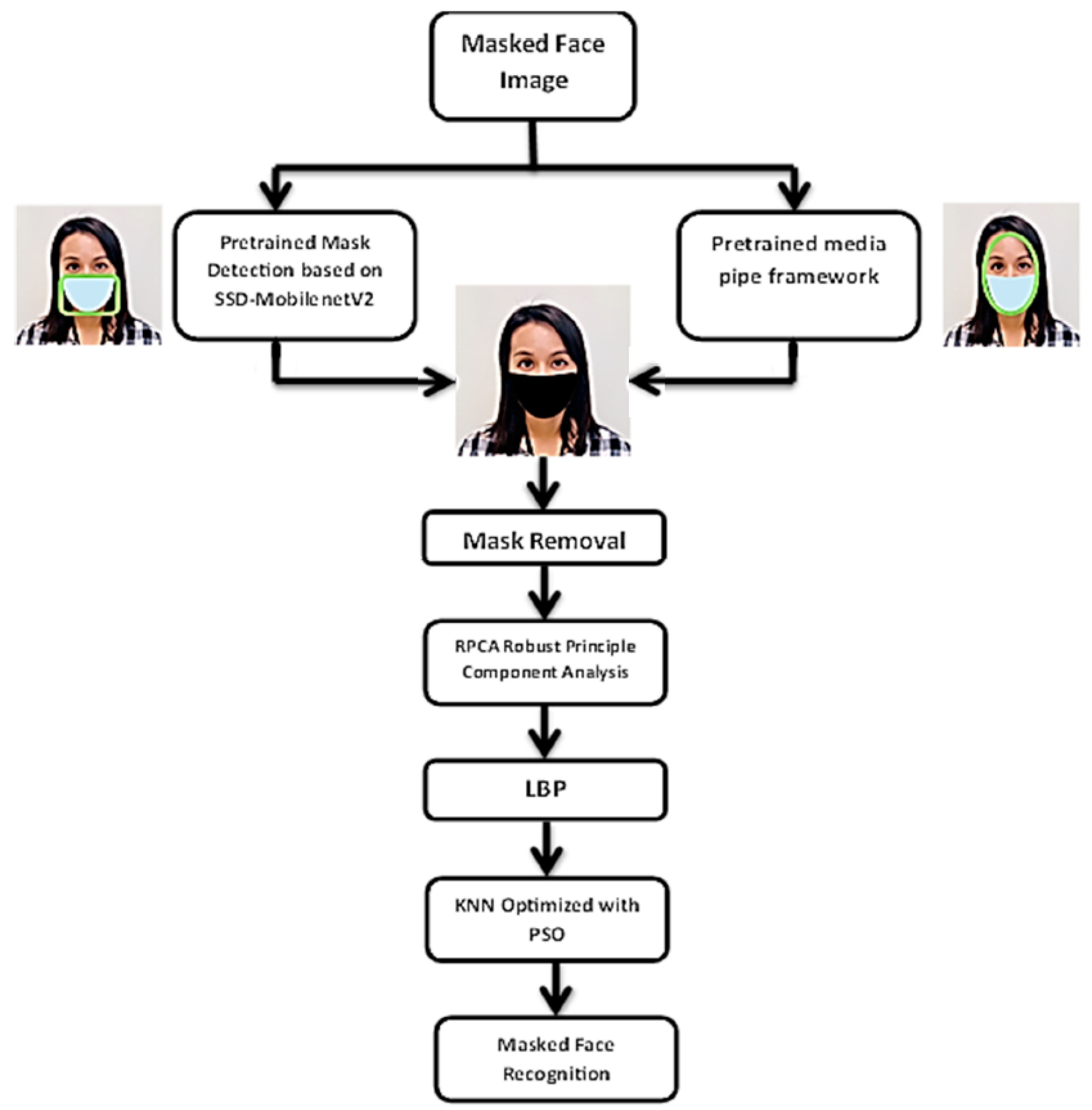
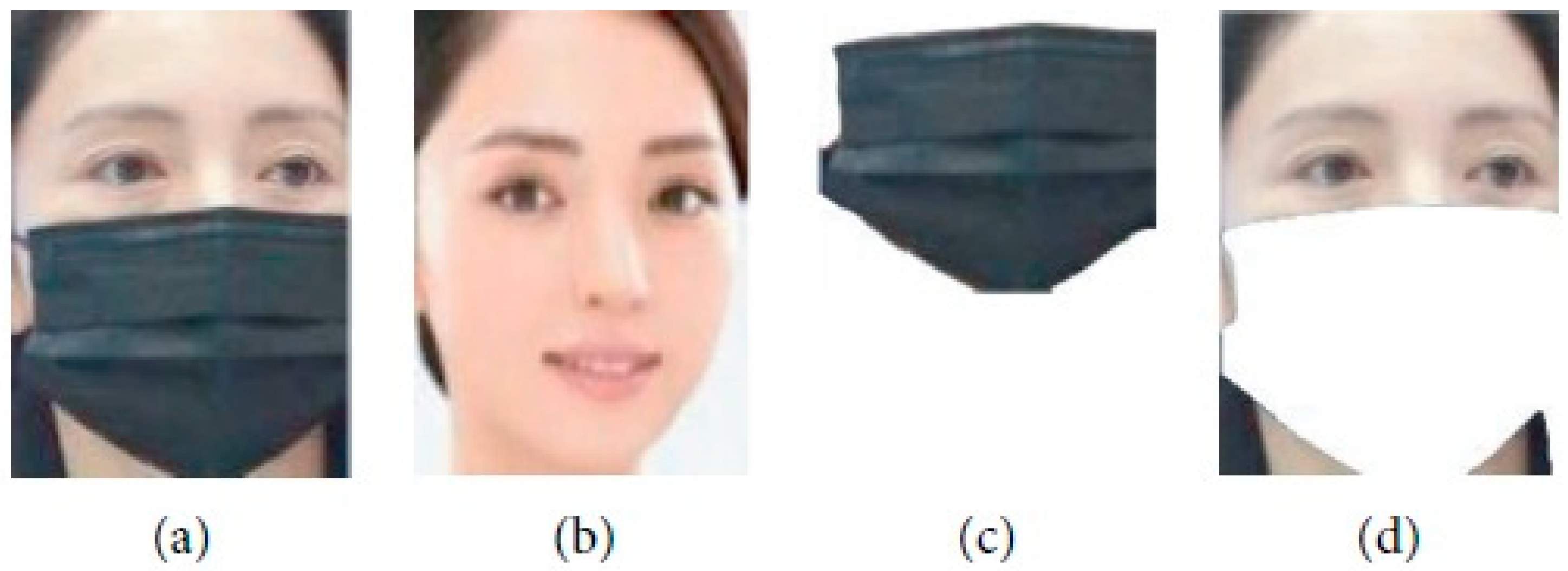
- Mask Detection: A pretrained ssd-MobileNetV2 model is utilized to detect the presence and location of masks on a face. This deep-learning-based approach effectively identifies whether a person is wearing a mask or not.
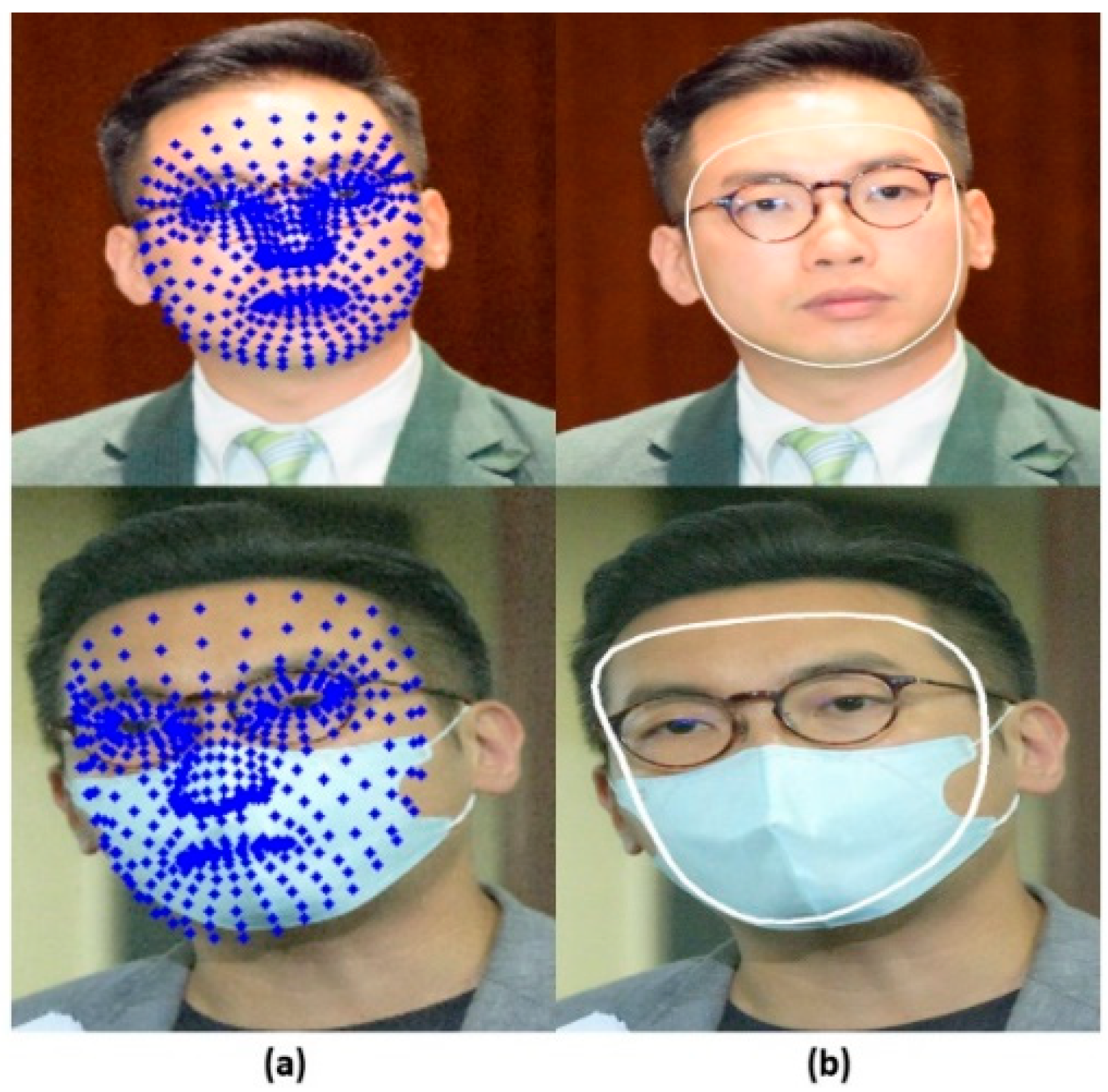
- Landmark and Oval Face Detection: Landmark and oval face detection techniques are employed to identify key facial features. This step helps in precisely localizing facial landmarks and obtaining a better representation of the face.
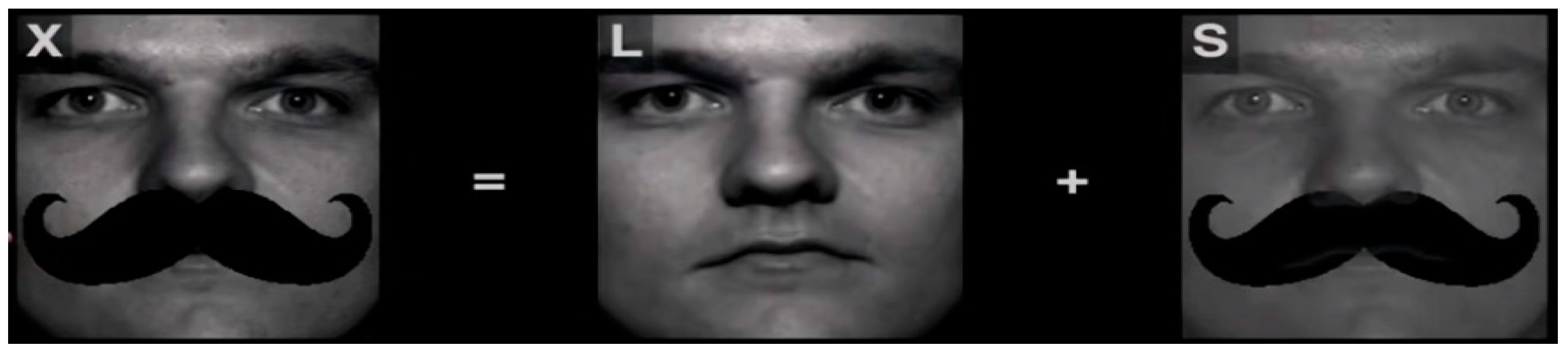
- Robust Principal Component Analysis (RPCA): RPCA is utilized to separate occluded and non-occluded components of an image. By extracting the non-occluded components, the proposed method becomes more reliable in identifying faces with masks, as it focuses on the visible facial features.
- Optimization using Particle Swarm Optimization (PSO): To enhance the performance of the proposed method, particle swarm optimization (PSO) is employed. PSO optimizes both the KNN features and the number of k (nearest neighbors) for KNN, resulting in improved accuracy and robustness.
| Step 1: Input Masked Face Image. Step 2: Run Pretrained Mask Detection and Landmark Detection. 2.1: Mask Segmentation and Conversion to Black Pixels. Step 3: Prepare, input data set and set the parameter. Step 4: Normalize the Data. Step 5: Initialize arrays for feature vectors and labels. Step 6: Use Robust PCA for dimension reduction. Step 7: Extract features using LBP. 7.1: Convert binary feature selection vector to logical indexing vector. Step 8: Split the data into training and testing sets. Step 9: Use PSO in feature selection. 9.1: Define the fitness function for PSO-KNN. Step 10: Use PSO in optimizing the number of k. Step 11: Use PSO-KNN for face recognition with optimized k value. Step 12: Evaluate the performance of the PSO-KNN classifier. 12.1: Train KNN classifier using training data and optimized k. 12.2: Test the classifier. |
- Triangulation: This method involves using two cameras to measure the distance to an object. The cameras are placed at a known distance from each other and are pointed at the object. By comparing the position of the object in the two camera images, the distance can be calculated using triangulation.
- Time-of-flight: This method involves emitting a signal, such as a laser or infrared light, from the camera towards the object and measuring the time it takes for the signal to bounce back. The distance can be calculated by multiplying the time of flight by the speed of light.
- Stereo vision: This method uses two cameras placed a known distance apart to create a 3D image of the scene. By comparing the difference in position of an object in the two camera images, the distance to the object can be calculated.
- Structured light: This method involves projecting a pattern of light onto the object and measuring the distortion of the pattern caused by the object’s surface. The distance can be calculated by analyzing the distortion of the pattern.
- Focus: This method involves adjusting the focus of the camera lens until the object is in sharp focus. The distance can be calculated by using the known focal length of the lens and the distance from the lens to the image sensor.
3.1. Deep-Learning-Based Mask Detection and Face Oval Detection
- It is lightweight and efficient, meaning it has fewer parameters and operations than other models, which reduces memory and power consumption. It can achieve real-time inference (30 frames per second) even on mobile devices.
- It employs depthwise separable convolutions, which are a type of convolution that divides the standard convolution into two steps: a depthwise convolution that applies a single filter to each input channel, and a pointwise convolution that combines the outputs of the depthwise convolution. This reduces the number of computations and parameters by a factor of 8 to 9.
- It utilizes inverted residual blocks, which are a type of residual block that have thin bottleneck layers at the input and output, and a thick expansion layer in the middle. This allows the network to learn more complex features with fewer parameters and computations.
- It is one-stage, meaning it directly outputs the bounding boxes and class labels without using any intermediate steps, such as region proposals or feature pyramids. This makes it faster and simpler than two-stage models, such as Faster R-CNN or Mask R-CNN.
3.2. Robust Principal Component Analysis
3.3. K-Nearest Neighborhood Algorithm and Particle Swarm Optimization (PSO) for Face Recognition
4. Experimental Settings and Results
4.1. Experimental Settings
4.2. Experimental Results and Discussion
4.3. Execution Time Results
5. Discussion
- The combination of deep learning and traditional computer vision techniques achieves state-of-the-art performance.
- The mask detection and facial feature localization improve robustness to occlusion.
- The use of RPCA to separate occluded and non-occluded features is effective for masked face recognition.
- Optimizing the KNN parameters using PSO further boosts the accuracy.
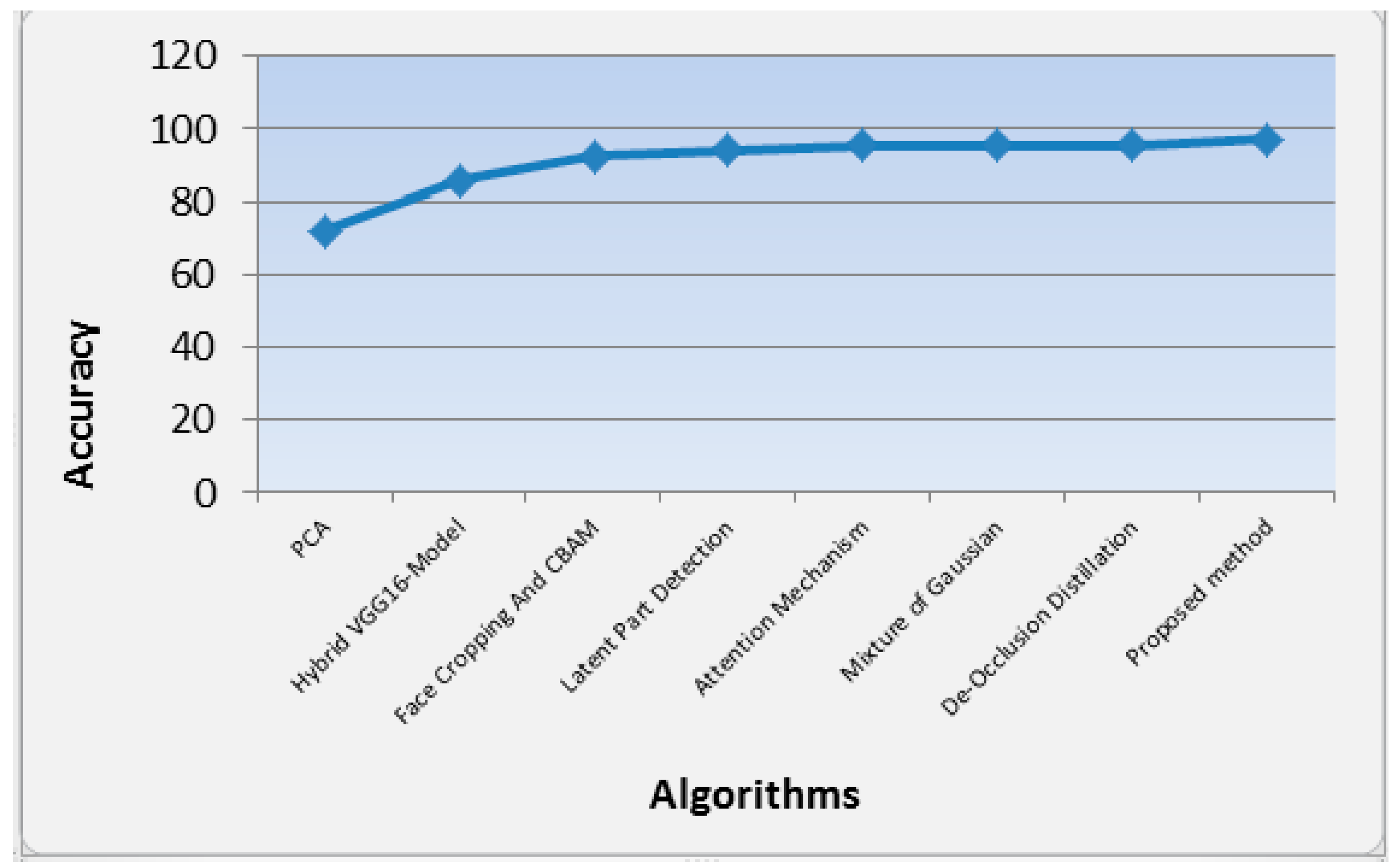
- The 97% recognition rate significantly outperforms existing methods.
- The proposed method represents an important advancement for masked face recognition.
- The approach is potentially applicable to real-world scenarios where face masks are common.
- The methodology can be extended to other types of facial occlusion.
- The techniques are generalizable and could be applied to other computer vision tasks.
- The approach provides a foundation for future research on masked face recognition.
6. Limitations
- The method relies on a data set of individuals wearing different types of masks. The performance may degrade for novel mask types not present in the data set. Collecting a more comprehensive masked face data set could help address this.
- The accuracy may be sensitive to mask placement, facial poses, and lighting conditions. Collecting a more diverse data set that covers more mask variations, poses, and conditions could help improve robustness.
- The method has only been evaluated on still images and may not generalize well to video. Extending the method to video-based masked face recognition could enable real-world applications.
- The computational cost of combining multiple deep learning and computer vision techniques may be high. Methods for optimizing efficiency could be explored to enable on-device applications.
- The ability to handle occlusion from other objects has not been evaluated.
7. Future work
8. Conclusions
Author Contributions
Funding
Institutional Review Board Statement
Informed Consent Statement
Data Availability Statement
Conflicts of Interest
References
- Jain, A.; Bolle, R.; Pankanti, S. Introduction to Biometrics; Springer: Boston, MA, USA, 1996. [Google Scholar]
- Hariri, W. Efficient masked face recognition method during the COVID-19 pandemic. Signal Image Video Process. 2022, 16, 605–612. [Google Scholar] [CrossRef]
- Farkhod, A.; Abdusalomov, A.B.; Mukhiddinov, M.; Cho, Y.-I. Development of Real-Time Landmark-Based Emotion Recognition CNN for Masked Faces. Sensors 2022, 22, 8704. [Google Scholar] [CrossRef]
- Hemathilaka, S.; Aponso, A. A comprehensive study on occlusion invariant face recognition under face mask occlusion. arXiv 2022, arXiv:2201.09089. [Google Scholar] [CrossRef]
- Jeevan, G.; Zacharias, G.C.; Nair, M.S.; Rajan, J. An empirical study of the impact of masks on face recognition. Pattern Recognit. 2022, 122, 108308. [Google Scholar] [CrossRef]
- Neto, P.C.; Pinto, J.R.; Boutros, F.; Damer, N.; Sequeira, A.F.; Cardoso, J.S. Beyond masks: On the generalization of masked face recognition models to occluded face recognition. IEEE Access 2022, 10, 86222–86233. [Google Scholar] [CrossRef]
- Sasirekha, K.; Thangavel, K. Optimization of K-nearest neighbor using particle swarm optimization for face recognition. Neural Comput. Appl. 2019, 31, 7935–7944. [Google Scholar]
- Zhao, W.; Zhu, X.; Shi, H.; Zhang, X.-Y.; Lei, Z. Consistent Sub-Decision Network for Low-Quality Masked Face Recognition. IEEE Signal Process. Lett. 2022, 29, 1147–1151. [Google Scholar] [CrossRef]
- Koklu, M.; Cinar, I.; Taspinar, Y.S. CNN-based bi-directional and directional long-short term memory network for determination of face mask. Biomed. Signal Process. Control 2022, 71, 103216. [Google Scholar] [CrossRef]
- Adhikarla, E.; Davison, B.D. Face mask detection on real-world Webcam images. In Proceedings of the Conference on Information Technology for Social Good, Rome, Italy, 9–11 September 2021; pp. 139–144. [Google Scholar]
- Ding, F.; Peng, P.; Huang, Y.; Geng, M.; Tian, Y. Masked face recognition with latent part detection. In Proceedings of the 28th ACM International Conference on Multimedia, Seattle, WA, USA, 12–16 October 2020; pp. 2281–2289. [Google Scholar]
- Vu, H.N.; Nguyen, M.H.; Pham, C. Masked face recognition with convolutional neural networks and local binary patterns. Appl. Intell. 2022, 52, 5497–5512. [Google Scholar] [CrossRef]
- Aswal, V.; Tupe, O.; Shaikh, S.; Charniya, N.N. Single camera masked face identification. In Proceedings of the 2020 19th IEEE International Conference on Machine Learning and Applications (ICMLA), Miami, FL, USA, 14–17 December 2020; pp. 57–60. [Google Scholar]
- Kocacinar, B.; Tas, B.; Akbulut, F.P.; Catal, C.; Mishra, D. A real-time cnn-based lightweight mobile masked face recognition system. IEEE Access 2022, 10, 63496–63507. [Google Scholar] [CrossRef]
- Qi, C.; Yang, L. Face recognition in the scene of wearing a mask. In Proceedings of the 2020 International Conference on Advance in Ambient Computing and Intelligence (ICAACI), Ottawa, ON, Canada, 12–13 September 2020; pp. 77–80. [Google Scholar]
- Singh, S.; Ahuja, U.; Kumar, M.; Kumar, K.; Sachdeva, M. Face mask detection using YOLOv3 and faster R-CNN models: COVID-19 environment. Multimed. Tools Appl. 2021, 80, 19753–19768. [Google Scholar] [CrossRef]
- Zhu, R.; Yin, K.; Xiong, H.; Tang, H.; Yin, G. Masked face detection algorithm in the dense crowd based on federated learning. Wirel. Commun. Mob. Comput. 2021, 2021, 8586016. [Google Scholar]
- Jignesh Chowdary, G.; Punn, N.S.; Sonbhadra, S.K.; Agarwal, S. Face mask detection using transfer learning of inceptionv3. In Proceedings of the Big Data Analytics: 8th International Conference, BDA 2020, Sonepat, India, 15–18 December 2020; Proceedings 8. pp. 81–90. [Google Scholar]
- Loey, M.; Manogaran, G.; Taha, M.H.N.; Khalifa, N.E.M. A hybrid deep transfer learning model with machine learning methods for face mask detection in the era of the COVID-19 pandemic. Measurement 2021, 167, 108288. [Google Scholar]
- Suresh, K.; Palangappa, M.; Bhuvan, S. Face mask detection by using optimistic convolutional neural network. In Proceedings of the 2021 6th International Conference on Inventive Computation Technologies (ICICT), Coimbatore, India, 20–22 January 2021; pp. 1084–1089. [Google Scholar]
- Lodh, A.; Saxena, U.; Motwani, A.; Shakkeera, L.; Sharmasth, V.Y. Prototype for integration of face mask detection and person identification model—COVID-19. In Proceedings of the 2020 4th International Conference on Electronics, Communication and Aerospace Technology (ICECA), Coimbatore, India, 5–7 November 2020; pp. 1361–1367. [Google Scholar]
- Rusli, M.H.; Sjarif, N.N.A.; Yuhaniz, S.S.; Kok, S.; Kadir, M.S. Evaluating the masked and unmasked face with LeNet algorithm. In Proceedings of the 2021 IEEE 17th International Colloquium on Signal Processing & Its Applications (CSPA), Langkawi, Malaysia, 5–6 March 2021; pp. 171–176. [Google Scholar]
- Saleh, N.A.; Ertunç, H.M.; Saleh, R.A.; Rassam, M.A. A simple mask detection model based on a multi-layer perception neural network. In Proceedings of the 2021 International Conference of Technology, Science and Administration (ICTSA), Taiz, Yemen, 22–24 March 2021; pp. 1–5. [Google Scholar]
- Wu, G. Masked face recognition algorithm for a contactless distribution cabinet. Math. Probl. Eng. 2021, 2021, 5591020. [Google Scholar]
- Ullah, N.; Javed, A.; Ghazanfar, M.A.; Alsufyani, A.; Bourouis, S. A novel DeepMaskNet model for face mask detection and masked facial recognition. J. King Saud Univ.-Comput. Inf. Sci. 2022, 34, 9905–9914. [Google Scholar] [CrossRef]
- Habib, S.; Alsanea, M.; Aloraini, M.; Al-Rawashdeh, H.S.; Islam, M.; Khan, S. An Efficient and Effective Deep Learning-Based Model for Real-Time Face Mask Detection. Sensors 2022, 22, 2602. [Google Scholar]
- Farman, H.; Khan, T.; Khan, Z.; Habib, S.; Islam, M.; Ammar, A. Real-time face mask detection to ensure COVID-19 precautionary measures in the developing countries. Appl. Sci. 2022, 12, 3879. [Google Scholar]
- Freud, E.; Di Giammarino, D.; Stajduhar, A.; Rosenbaum, R.S.; Avidan, G.; Ganel, T. Recognition of masked faces in the era of the pandemic: No improvement despite extensive natural exposure. Psychol. Sci. 2022, 33, 1635–1650. [Google Scholar] [CrossRef]
- Song, Z.; Nguyen, K.; Nguyen, T.; Cho, C.; Gao, J. Spartan Face Mask Detection and Facial Recognition System. Healthcare 2022, 10, 87. [Google Scholar] [CrossRef]
- Kwak, N.; Kim, D. Study On Masked Face Detection And Recognition using transfer learning. Int. J. Adv. Cult. Technol. (IJACT) 2022, 10, 294–301. [Google Scholar]
- Peng, H.; Xing, Z.; Liu, X.; Gao, Z.; He, H. Toward masked face recognition: An effective facial feature extraction and refinement model in multiple scenes. Expert Syst. 2023, 40, e13166. [Google Scholar]
- Ge, Y.; Liu, H.; Du, J.; Li, Z.; Wei, Y. Masked face recognition with convolutional visual self-attention network. Neurocomputing 2023, 518, 496–506. [Google Scholar] [CrossRef] [PubMed]
- Golwalkar, R.; Mehendale, N. Masked-face recognition using deep metric learning and FaceMaskNet-21. Appl. Intell. 2022, 52, 13268–13279. [Google Scholar] [CrossRef]
- Yuan, G.; Zheng, H.; Dong, J. MSML: Enhancing Occlusion-Robustness by Multi-Scale Segmentation-Based Mask Learning for Face Recognition. In Proceedings of the AAAI Conference on Artificial Intelligence, Virtual, 22 February–1 March 2022; pp. 3197–3205. [Google Scholar]
- Huang, B.; Wang, Z.; Wang, G.; Jiang, K.; Han, Z.; Lu, T.; Liang, C. PLFace: Progressive learning for face recognition with mask bias. Pattern Recognit. 2023, 135, 109142. [Google Scholar] [CrossRef]
- Fang, M.; Damer, N.; Kirchbuchner, F.; Kuijper, A. Real masks and spoof faces: On the masked face presentation attack detection. Pattern Recognit. 2022, 123, 108398. [Google Scholar] [CrossRef]
- Shatnawi, M.; Almenhali, N.; Alhammadi, M.; Alhanaee, K. Deep learning approach for masked face identification. Int. J. Adv. Comput. Sci. Appl. 2022, 13, 296–305. [Google Scholar] [CrossRef]
- Pann, V.; Lee, H.J. Effective attention-based mechanism for masked face recognition. Appl. Sci. 2022, 12, 5590. [Google Scholar]
- Oumina, A.; El Makhfi, N.; Hamdi, M. Control the COVID-19 pandemic: Face mask detection using transfer learning. In Proceedings of the 2020 IEEE 2nd International Conference on Electronics, Control, Optimization and Computer Science (ICECOCS), Kenitra, Morocco, 2–3 December 2020; pp. 1–5. [Google Scholar]
- Lugaresi, C.; Tang, J.; Nash, H.; McClanahan, C.; Uboweja, E.; Hays, M.; Zhang, F.; Chang, C.-L.; Yong, M.G.; Lee, J. Mediapipe: A framework for building perception pipelines. arXiv 2019, arXiv:1906.08172. [Google Scholar]
- Abdi, H.; Williams, L.J. Principal component analysis. Wiley Interdiscip. Rev. Comput. Stat. 2010, 2, 433–459. [Google Scholar]
- Candès, E.J.; Li, X.; Ma, Y.; Wright, J. Robust principal component analysis? J. ACM (JACM) 2011, 58, 11. [Google Scholar] [CrossRef]
- Tubishat, M.; Alswaitti, M.; Mirjalili, S.; Al-Garadi, M.A.; Rana, T.A. Dynamic butterfly optimization algorithm for feature selection. IEEE Access 2020, 8, 194303–194314. [Google Scholar] [CrossRef]
- Dalkiran, M. LFW Simulated Masked Face Dataset; Kaggle: San Francisco, CA, USA, 2020; pp. 1–8. [Google Scholar]
- Ejaz, M.S.; Islam, M.R.; Sifatullah, M.; Sarker, A. Implementation of principal component analysis on masked and non-masked face recognition. In Proceedings of the 2019 1st International Conference on Advances in Science, Engineering and Robotics Technology (ICASERT), Dhaka, Bangladesh, 3–5 May 2019; pp. 1–5. [Google Scholar]
- Nieto-Rodriguez, A.; Mucientes, M.; Brea, V.M. System for medical mask detection in the operating room through facial attributes. In Proceedings of the Pattern Recognition and Image Analysis: 7th Iberian Conference, IbPRIA 2015, Santiago de Compostela, Spain, 17–19 June 2015; Proceedings 7. pp. 138–145. [Google Scholar]
- Samaria, F.S.; Harter, A.C. Parameterisation of a stochastic model for human face identification. In Proceedings of the 1994 IEEE Workshop on Applications of Computer Vision, Sarasota, FL, USA, 5–7 December 1994; pp. 138–142. [Google Scholar]
- Sikha, O.; Bharath, B. VGG16-random Fourier hybrid model for masked face recognition. Soft Comput. 2022, 26, 12795–12810. [Google Scholar] [CrossRef]
- Li, Y.; Guo, K.; Lu, Y.; Liu, L. Cropping and attention based approach for masked face recognition. Appl. Intell. 2021, 51, 3012–3025. [Google Scholar] [CrossRef]
- Yi, D.; Lei, Z.; Liao, S.; Li, S.Z. Learning face representation from scratch. arXiv 2014, arXiv:1411.7923. [Google Scholar]
- Lane, L. Nist finds flaws in facial checks on people with covid masks. Biom. Technol. Today 2020, 2020, 2. [Google Scholar]
- Taigman, Y.; Yang, M.; Ranzato, M.A.; Wolf, L. Deepface: Closing the gap to human-level performance in face verification. In Proceedings of the IEEE Conference on Computer Vision and Pattern Recognition, Columbus, OH, USA, 23–28 June 2014; pp. 1701–1708. [Google Scholar]




| Study | Method | Drawbacks | Advantages |
|---|---|---|---|
| Optimization of K-nearest neighbor using particle swarm optimization for face recognition | KNN classifier with PSO feature selection | - High computational cost—Sensitive to noise and outliers | - Simple and easy to implement—Robust to variations in pose, expression, and illumination |
| Consistent Sub-Decision Network for Low-Quality Masked Face Recognition | CNN with sub-decision network and consistency loss | - Requires large-scale training data—May not generalize well to unseen masks | - Improves the quality of masked face features—Enhances the consistency between masked and unmasked faces |
| Face mask detection on real-world Webcam images | CNN with transfer learning from ImageNet | - Limited by the quality of webcam images—May not detect masks with complex patterns or colors | - Fast and accurate on webcam images—Can be easily deployed on web applications |
| Masked face recognition with latent part detection | CNN with latent part detection module | - Depends on the accuracy of part detection—May fail on heavily occluded faces | - Learns discriminative features for each facial part—Adapts to different types of masks |
| Masked face recognition with convolutional neural networks and local binary patterns | CNN with LBP feature extraction | - Requires manual alignment of face images—LBP features may lose some information | - Combines global and local features—Robust to illumination changes |
| Single camera masked face identification | CNN with Siamese network and triplet loss | - Needs a large number of triplets for training—May suffer from hard negative mining problem | - Learns a similarity metric for face matching—Reduces the intra-class variations |
| A real-time cnn-based lightweight mobile masked face recognition system | MobileNetV2 with SSD for mask detection and ArcFace for face recognition | - Prone to false positives or negatives in mask detection—May not work well on low-resolution images | - Lightweight and efficient for mobile devices—Achieves high accuracy on masked faces |
| [Face recognition in the scene of wearing a mask] | CNN with mask removal module and attention mechanism | - Relies on the quality of mask removal—May introduce artifacts or distortions in the reconstructed faces | - Recovers the occluded facial regions—Focuses on the important facial features |
| [Face mask detection using YOLOv3 and faster R-CNN models: COVID-19 environment] | YOLOv3 and Faster R-CNN for mask detection | - YOLOv3 may have lower precision than Faster R-CNN—Faster R-CNN may have lower speed than YOLOv3 | - Both models have high recall and accuracy for mask detection—Both models can handle multiple faces in an image |
| [Masked face detection algorithm in the dense crowd based on federated learning] | Federated learning with CNN for mask detection | - Requires secure and reliable communication among devices—May have privacy or security risks in data sharing | - Reduces the data transmission cost and latency—Preserves the data privacy and sovereignty |
| [Face mask detection using transfer learning of inceptionv3] | InceptionV3 with transfer learning from ImageNet for mask detection | - Needs fine-tuning for different data sets or domains—May overfit or underfit the data depending on the parameters | - Exploits the pre-trained weights from ImageNet—Captures complex features with multiple filters |
| [A hybrid deep transfer learning model with machine learning methods for face mask detection in the era of the COVID-19 pandemic] | VGG16 with transfer learning and SVM or KNN for mask detection | - VGG16 is a large and complex model that may be slow or memory-intensive—SVM or KNN may not be optimal for high-dimensional features | - Leverages the transfer learning from VGG16—Combines deep learning and machine learning methods |
| [Face mask detection by using optimistic convolutional neural network] | CNN with dropout and batch normalization for mask detection | - Dropout may reduce the effective capacity of the model—Batch normalization may introduce extra computation or complexity | - Optimizes the model performance and generalization—Prevents overfitting and accelerates convergence |
| [Prototype for integration of face mask detection and person identification model–COVID-19] | CNN with MobileNetV2 for mask detection and ResNet50 for face recognition | - MobileNetV2 may have lower accuracy than other models—ResNet50 may have lower speed than other models | - Integrates mask detection and face recognition in one system—Uses lightweight and powerful models for both tasks |
| [Evaluating the masked and unmasked face with LeNet algorithm] | LeNet with data augmentation for face recognition | - LeNet is a simple and shallow model that may not capture complex features—Data augmentation may not be sufficient to handle large variations | - Suitable for small and low-resolution images—Improves the data diversity and robustness |
| [A simple mask detection model based on a multi-layer perception neural network] | MLP with ReLU activation and softmax output for mask detection | - MLP is a basic and linear model that may not learn non-linear features—MLP may have high bias or variance depending on the number of layers or neurons | - Easy to implement and train—Has low computational cost and complexity |
| [Masked face recognition algorithm for a contactless distribution cabinet] | CNN with mask segmentation and feature fusion for face recognition | - Requires accurate segmentation of masks from faces—May have difficulty in fusing features from different sources | - Segments the masks from the faces to reduce occlusion—Fuses the features from masked and unmasked regions |
| [Control the COVID-19 pandemic: Face mask detection using transfer learning] | CNN with transfer learning from VGG19 for mask detection | - VGG19 is a large and complex model that may be slow or memory-intensive—Transfer learning may not adapt well to new data sets or domains | - Exploits the pre-trained weights from VGG19—Achieves high accuracy on mask detection |
| Reference | Data Set | Method | Recognition Type | Val. Acc. |
|---|---|---|---|---|
| Ejaz et al. [45] | ORL Face [47] | PCA | Masked | 72% |
| Sikha et al. [48] | Masked Georgia tech face data set | A hybrid VGG16-Random Fourier deep learning model | Masked | 85.9% |
| Li et al. [49] | Webface, AR, Yela B, LFW | Face cropping and CBAM | Masked | 92.6% |
| Ding et al. [11] | CASIA-WebFace [50] | Latent Part Detection | Masked | 94% |
| Wu [24] | RMFRD and SMFRD databases of Wuhan University | Attention mechanism | Masked | 95.3% |
| Rodriguez et al. [46] | N/A | Mixture of Gaussian | Masked | 95.4% |
| Lane et al. [51] | Celeb-A, LFW, AR | De-occlusion distillation | Masked | 95.4% |
| Proposed method | LFW-SMFD [44] and real data set | Deep learning, PCA, and KNN | Masked | 97% |
| Reference | Data Set | Method | Recognition Type | Val. Acc. |
|---|---|---|---|---|
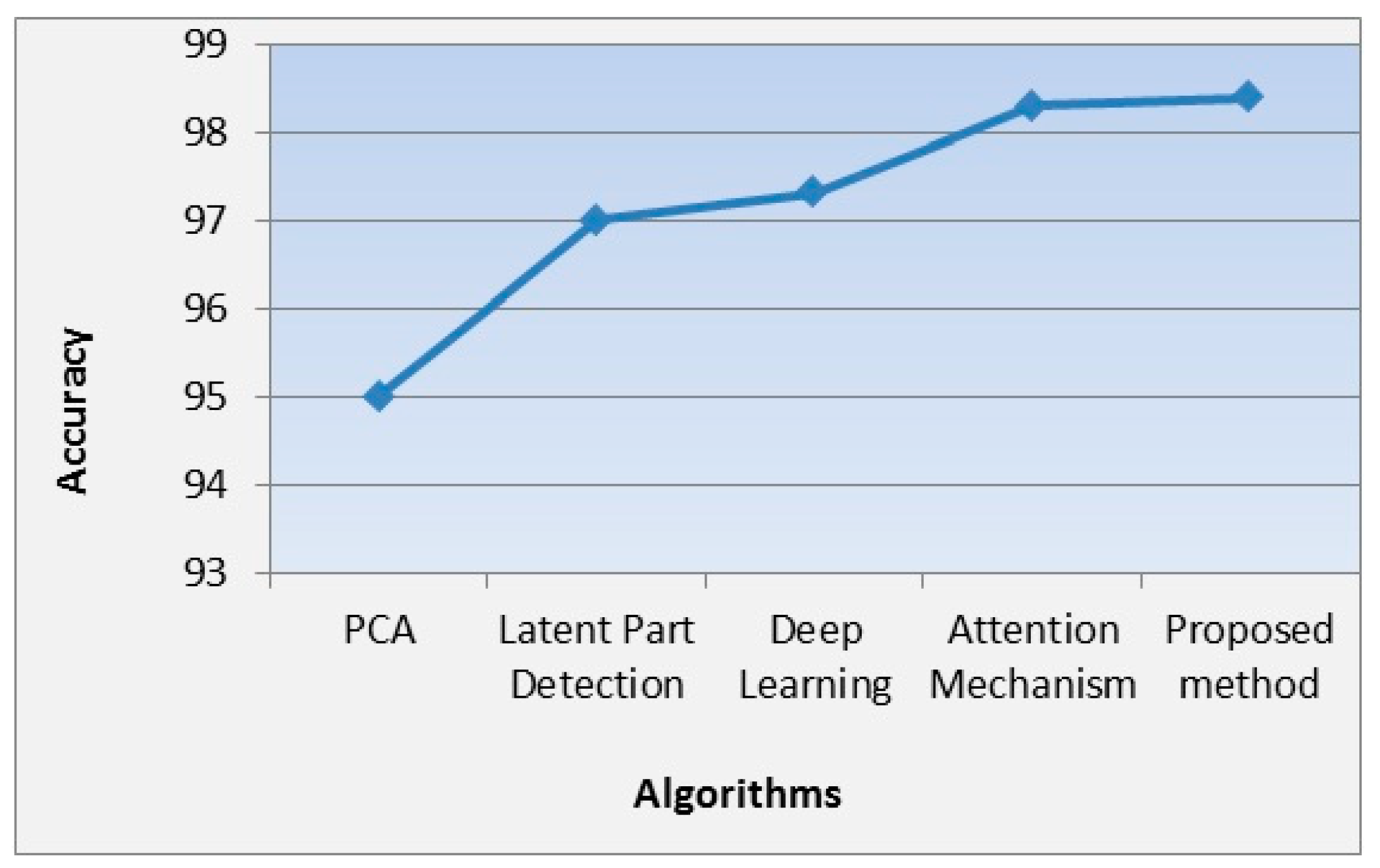
| Ejaz et al. [45] | ORL Face [47] | PCA | Unmasked | 95% |
| Ding et al. [11] | CASIA-WebFace [50] | Latent Part Detection | Unmasked | 97% |
| DeepFace [52] | LFW | deep learning | Unmasked | 97.3% |
| Wu [24] | RMFRD and SMFRD databases of Wuhan University | Attention mechanism | Unmasked | 98.3% |
| Proposed method | LFW-SMFD [44] and real data set | Hybrid method using deep learning, PCA, and KNN | Unmasked | 98.4% |
| Parameter | Value |
|---|---|
| Swarm size | 50 |
| Inertia weight | 1 |
| Personal learning coefficient | 1.5 |
| Global learning coefficient | 2.0 |
| Type of Features | KNN Acc. | PSO-KNN Acc. |
|---|---|---|
| Actual features | 89% | 93% |
| GA | 94% | 96% |
| PSO | 95% | 98% |
Disclaimer/Publisher’s Note: The statements, opinions and data contained in all publications are solely those of the individual author(s) and contributor(s) and not of MDPI and/or the editor(s). MDPI and/or the editor(s) disclaim responsibility for any injury to people or property resulting from any ideas, methods, instructions or products referred to in the content. |
© 2023 by the authors. Licensee MDPI, Basel, Switzerland. This article is an open access article distributed under the terms and conditions of the Creative Commons Attribution (CC BY) license (https://creativecommons.org/licenses/by/4.0/).
Share and Cite
Eman, M.; Mahmoud, T.M.; Ibrahim, M.M.; Abd El-Hafeez, T. Innovative Hybrid Approach for Masked Face Recognition Using Pretrained Mask Detection and Segmentation, Robust PCA, and KNN Classifier. Sensors 2023, 23, 6727. https://doi.org/10.3390/s23156727
Eman M, Mahmoud TM, Ibrahim MM, Abd El-Hafeez T. Innovative Hybrid Approach for Masked Face Recognition Using Pretrained Mask Detection and Segmentation, Robust PCA, and KNN Classifier. Sensors. 2023; 23(15):6727. https://doi.org/10.3390/s23156727
Chicago/Turabian StyleEman, Mohammed, Tarek M. Mahmoud, Mostafa M. Ibrahim, and Tarek Abd El-Hafeez. 2023. "Innovative Hybrid Approach for Masked Face Recognition Using Pretrained Mask Detection and Segmentation, Robust PCA, and KNN Classifier" Sensors 23, no. 15: 6727. https://doi.org/10.3390/s23156727
APA StyleEman, M., Mahmoud, T. M., Ibrahim, M. M., & Abd El-Hafeez, T. (2023). Innovative Hybrid Approach for Masked Face Recognition Using Pretrained Mask Detection and Segmentation, Robust PCA, and KNN Classifier. Sensors, 23(15), 6727. https://doi.org/10.3390/s23156727