


Abstract
Principal component analysis (PCA) is a dimensionality reduction method that has identified significant differences in older adults’ motion analysis previously not detected by the discrete exploration of biomechanical variables. This systematic review aims to synthesize the current evidence regarding PCA use in the study of movement in older adults (kinematics and kinetics), summarizing the tasks and biomechanical variables studied. From the search results, 1685 studies were retrieved, and 19 studies were included for review. Most of the included studies evaluated gait or quiet standing. The main variables considered included spatiotemporal parameters, range of motion, and ground reaction forces. A limited number of studies analyzed other tasks. Further research should focus on the PCA application in tasks other than gait to understand older adults’ movement characteristics that have not been identified by discrete analysis.
1. Introduction
The older adult population, those with age above 60 years, will increase in the coming decades in Europe [1]. Accounting for almost half of the total health costs [2], the aging population will increase the burden on healthcare services [3] expressed through an estimated increase from 3% to 4% in gross domestic product from 2004 to 2050 [4].
Biological aging can be defined as the progressive loss of function and represents a constant decrease in multisystemic capacity [5,6,7] that can be expressed in changes in movement patterns in various tasks [8]. Different biomechanical analyses have been associated with fall risk in older people, such as the displacement of the center of pressure in the standing position [9], decreased speed, stride length, and single limb support time in gait [10]. Other movement modifications were identified due to the aging process, such as decreased lumbar range of motion [11] during sit-to-stand, an indicator of functional independence in daily life [12]. However, because these findings have been obtained from discrete approaches, such as descriptive statistics and statistical inference based on only some parameters of the waveform [10,11], there is a consistent risk of information loss [13]. Additionally, other clinical measures assessed by classical psychometric procedures may have led to dubious conclusions [14], while others discarded several parts of the information and required a greater number of trials from participants before drawing conclusions [15]. Advanced multivariate analysis and machine learning methods have been applied to fully translate the complexity of the interactions between the variables [13]. Principal component analysis (PCA) is a multivariate statistical technique that reduces the volume of data to a smaller number, considering all the information captured [16,17]. PCA uses an orthogonal transformation to represent sets of potentially correlated variables with principal components (PC) that are linearly uncorrelated and are ranked so that the first PC has the largest possible variance. Accordingly, the PCs with the largest variance are selected to represent the correlated variables, resulting in a smaller volume of data, eliminating intercorrelations, and maintaining the ability to retain the majority of the information contained in the data initially obtained [16,18]. In the biomechanics context, PCA has become a useful method for analyzing a set of temporal waveforms of human motion data [17], and has been applied to the coordination of complex movement in different tasks of the upper [19] and lower limbs [20], population ages [21,22], and conditions [23,24,25]. Moreover, age-related changes in neuromuscular control, kinematics, and muscle function during gait identified by PCA were previously not detected by motion analysis through discrete variables [26]. Phinyomark et al., studying the biomechanical features of running gait data associated with iliotibial band syndrome, compared the results provided by discrete variables with the PCA. The authors suggest that care must be taken when selecting features of gait waveforms for both identification and discrimination of between-group differences for injured and non-injured runners [27]. Deluzio and Astephen first applied the PCA as a data reduction tool, as well as a preliminary step for further analysis to determine differences between the osteoarthritis and the control groups. The authors found that the discriminative features of the gait waveforms were the amplitude of the knee flexion moment, the range of motion of the knee flexion angle, the magnitude of the knee flexion moment during early stance, and the magnitude of the knee adduction moment during stance [28].
Currently, to the best of our knowledge, only one review addressed the degree of freedom and dimensional properties of gait task and the application of the PCA in a non-structured review [29]. However, it only addresses the gait task without specifying the population. Accordingly, this systematic review aims to synthesize current evidence regarding the study of the older adult’s movement (kinematics and kinetics) according to a PCA, compared to younger adults, summarizing the tasks and biomechanical variables studied. As a secondary aim, the instruments used to assess the tasks and biomechanical variables will be reported.
2. Materials and Methods
This systematic review was carried out according to the Preferred reporting items for systematic reviews and meta-analyses (PRISMA) statement 2020 [30], and was registered on the PROSPERO (International Prospective Register of Ongoing Systematic Reviews) platform with the registration number CRD42022329200 (https://www.crd.york.ac.uk/prospero/display_record.php?RecordID=329200, accessed on 23 October 2022).
2.1. Eligibility Criteria
According to the PICOS strategy, the criteria defined for inclusion of the studies were: population, older adults aged 60 years or over, living in the community; exposure, studies that applied the PCA in the biomechanical analysis of the movements of older adults; movement analysis associated with the aging process; comparator, young adults (less than 60 years); outcomes, tasks and biomechanical variables (kinematics and kinetics) and, if described, the instruments used to collect the biomechanical data; study design, observational studies (cross-sectional and longitudinal). As exclusion criteria, it was decided to exclude the studies if their participants were institutionalized (or if the data from institutionalized participants could not be separated from community-dwelling ones) or if the participants presented some major pathology with repercussions on the performance of movement, such as stroke or Parkinson disease (or if the data from participants with these conditions could not be separated from the complete study sample). The search was restricted to the studies published in the Portuguese and English languages, that were available in the last 20 years.
2.2. Selection and Data Collection Process
The studies were searched using three databases: MEDLINE (PubMed), Scopus and Web of Science (Supplementary Materials). Specific search algorithms were elaborated for each database, as described in the Table 1 for Pubmed and for the other two databases in the Supplementary Materials. Each concept was searched according to the database search instructions, using the MeSH terms and synonyms. Two reviewers independently assessed the studies’ titles and abstracts in the identification phase. Then, in the screening phase, the same reviewers assessed the full texts. Disagreements about whether a study should be included were resolved if there was an oversight of information on the part of one of the reviewers or by discussion, consulting a third reviewer in the cases of different interpretation of studies content. The two reviewers used a pre-defined table to extract data from the included studies.

Table 1.
PICO framework strategy and search algorithm used in Medline (Pubmed) database. (* After a word, a truncation symbol (wildcard) to retrieve plurals or varying endings, # Truncation symbol for one character).
2.3. Assessment of Methodologic Quality
The study design of the included studies is observational, and as there is no gold standard of risk of bias (ROB) tools for observational studies, different tools have been used in previous systematic reviews [31]. The most commonly used ROB tools are the Newcastle-Ottawa Scale (NOS) and the Downs & Black scale [31]. Downs & Black scale was found to be fairly comprehensive; easy to use and clear descriptions of how to score items [32]. The scale has good test-retest reliability (r = 0.88), good interobserver reliability (r = 0.75) and a high internal consistency (KR-20:0.89) [33]. Accordingly, it was decided to evaluate the ROB of articles included in this review by two reviewers. As in the previous processes, the differences between the two reviewers were solved by consulting a third reviewer. The Downs & Black instrument consists of 27 items that assess the quality of the study, including data reporting, external validity, internal validity (bias), internal validity (confounders) and power [33]. In this study, a modified version of the Downs & Black scale, adapted by Rollo et al., 2020, was used, in which the authors removed 10 items (8, 13–15, 17, 19, and 21–24) from the original scale, because they were considered not relevant for the analysis of observational studies. In addition, the authors modified the items (4, 5, 9, 26 and 27) and created two new items, one of which describes the criteria of internal validity and the other is related to the power of study [34]. The modified Downs & Black scale is then composed of 19 items, and the possible score on each item is 0 or 1. The maximum possible score is 19 points (all positive signs), with a higher score indicating higher quality [34].
Scores were given corresponding quality levels: excellent (18–19), good (14–17), fair (10–13), or poor (≤9) [34,35].
3. Results
The initial search was completed on 12 May 2022. From the 1685 results obtained in the data search, 306 duplicates were removed and seven studies were retracted by the automated tools. After the screening and posterior full-text analysis, 19 studies [36,37,38,39,40,41,42,43,44,45,46,47,48,49,50,51,52,53,54] were included in narrative analysis (Figure 1).
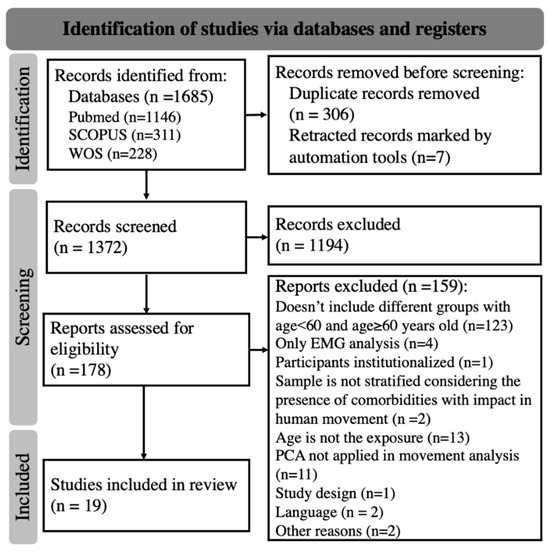
Figure 1.
Systematic review PRISMA 2020 flow diagram.
3.1. Characterization of the Included Studies
The identification, main purpose and conclusions of the 19 included studies is presented in Table 2. The publication year of each study varied between 2002 [50] and 2021 [37,49], and out of the nineteen studies, eighteen were cross-sectional, and one classified themselves as a retrospective cohort [39]. The study’s sample size ranged from 14 [46] to 239 [54] participants, constituting a total of 1281 participants. The older group sample size ranged from seven [46] to 127 [54] participants. The mean age of the older adults group ranged from 63, 7 years old [49] to 79, 43 years old [46], while the younger groups’ age ranged between 4.8 years [38] to 55,1 years old [54] (Table 3). Six studies did not present any information regarding the gender of the participants [36,40,41,44,47,53]. The mean percentage of female participants was 56.9% across the studies that reported this information. Moreover, there was one study that only included participants of the male gender [50], and one study that only included female participants [51].
Table 2.
The identification, main purpose and conclusions of the included studies.
Table 3.
Included studies’ characterization, specifically, the study identification, sample size, mean age, and percentage of females, the tasks, variables, instruments and description of the PCA use in the study.
Most of the included studies reported age-related differences between groups (n = 13) [37,39,40,41,42,44,45,46,47,48,51,53,54]. To understand if age had effects on the balance and coordination of movement, six studies were carried out [37,40,41,44,45,51]. Two included studies focused on the study of upper limbs [42,46]. Age-related differences were also reported by Boyer & Andriacchi, 2016 Reid et al., 2010, Rosenblum et al., 2020, Wu et al., 2007, and Zhou et al. 2020 when studying gait under different conditions. Also assessing gait under different conditions, five studies [36,38,49,50,52] found no age differences in intralimb coordination [36], segmental covariation [38], overall gait strategy [49], sagittal knee muscle moment curves [50], and in the regularity of whole-body movements [52].
3.2. Tasks Assessed in Included Studies
Eleven studies assessed the gait task. Five studies assessed the task in treadmill under perturbed conditions [36,48], different speeds [38,41], and dual tasking [52], while the other six studies assessed the overground gait [39,43,49,50,53,54]. Three studies assessed upright standing in unperturbed [44] and perturbed conditions [40,51]. The remaining five articles assessed different tasks, such as stepping [37], preparing a cup of tea and a letter [42], grasping an object placed at the ground from a standing position [45], climbing stairs [47], and during maximal voluntary contraction of fingers [46] (Figure 2).
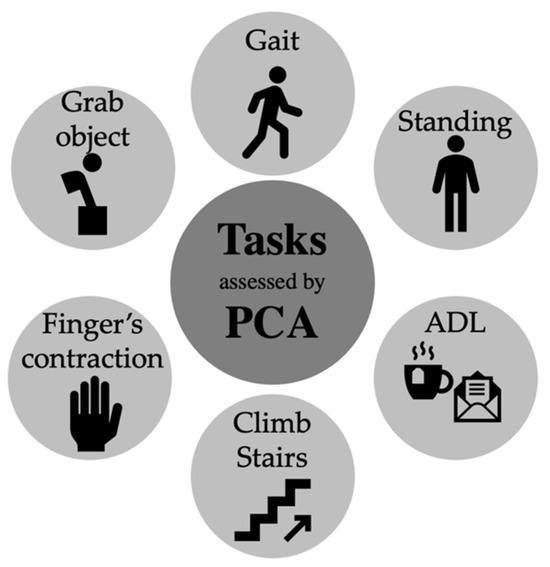
Figure 2.
Summary of the older adults movement tasks analyzed and processed by PCA (ADL: Activity of daily living; PCA: Principal component analysis).
3.3. Variables Assessed in Included Studies
The spatial-temporal parameters [36,41,42,43,45,48,49,50,52,53,54], the range of motion (ROM) of lower limbs joints [36,38,39,40,41,43,47,49,51,53], and the ground reaction forces (GRF) [37,39,41,43,45,49,50] were the most assessed variables (Figure 3). Beyond these three variables the following variables have also been considered: calculation of moment [45,46,50], strength related variables [37,46,47], center of mass (CM) [40,51], center of pressure (CoP) [45,51], marker trajectory [37,52]; mechanics and energetics variables [38], joint velocity [44]; and multi scale entropy, cross-sample entropy, frequency variability, and maximal Lyapunov exponent [54].
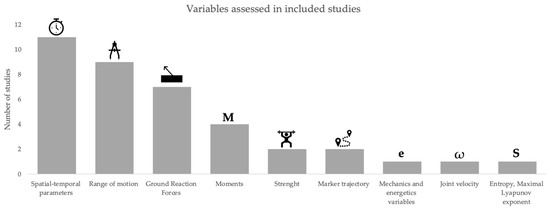
Figure 3.
Summary of the older adults movement variables processed by PCA.
3.4. Movement Analisys Instruments
For the movement capture and analysis, optoelectronic systems were used in all articles except two [46,54], where an inertial system [54] and force plates were used [46]. Among the seventeen studies that used optoelectronic systems, eight described the number of cameras used for capturing the movement [36,38,39,41,42,45,51,52]. The number of cameras used ranged from one [41] to twelve [52]. Force platforms were used in ten of the studies [37,39,41,43,45,47,48,49,50,51], in which six were studies that assessed gait [39,41,43,48,49,50] and the other four were related to stepping [37], stair climbing [47], and standing in the upright position [45,51].
3.5. The Use of PCA in Data Processing and/or Analysis
PCA was applied to extract features from several waveforms data [36,37,38,39,40,41,42,43,44,45,46,47,48,49,50,52]. The functional PCA was used in one of the included studies to produce a measure of variability across an entire curve captured as a small subset of functional principal components [51], and Kernel-based PCA was used in two studies, in one for nonlinear feature extraction and the evaluation of its effect on a subsequent classification in combination with learning algorithms (support vector machines) [53], and in the other for dimensionality data reduction for support vector machine classification [54].
3.6. Methodological Quality Assessment
The methodological quality assessment score, according to the Downs & Black scale, ranged from ten [36,40] to 16 [49] and is presented in Table 4. The average score of the articles included is approximately 12.79 points, the fair level. Seven studies [37,39,43,47,48,49,52] (36.8%) obtained a good classification and the remaining twelve (63.2%) obtained a fair classification. In general, the articles revealed very similar “Reporting” and “Internal validity” values, but only one scored in the “Power” section, while none scored in the “External validity” section.
Table 4.
Methodological quality assessment according to modified Downs & Black scale.
4. Discussion
This systematic review aimed to summarize the tasks and biomechanical variables studied when PCA was applied in the study of the older adult population’s movement compared with younger adults. The results of the systematic search reinforce the need to gather this information as this method has been widely used, mainly in Europe (n = 7) and North America (n = 8), and more than half of the included studies (n = 11) were published in the last decade.
The study’s sample size ranged from 14 [46] to 239 [54] participants. In the literature, there is no agreement over the recommended sample size for the use of PCA, and the ratio between sample size and variables assessed. Guadagnoli and Velicer indicated that absolute minimum sample sizes, rather sample sizes as a function of the number of variables, are more relevant [55]. More recently, Osborne and Costello stated that both should be taken into consideration to avoid errors of interference, indicating that the best outcomes occur in analyses where large numbers of sample size and high ratios are present [56]. Because there is no simple method for calculating sample size in PCA [57], Comfrey and Lee (1992) cited by Osborne and Costello [56] suggested that “the adequacy of sample size might be evaluated very roughly on the following scale: 50–very poor; 100–poor; 200–fair; 300–good; 500–very good; 1000 or more–excellent”. In the present review, 11 of the 19 articles included have fewer than 50 participants, so interpretation of their results should take that into consideration.
The most assessed task was the gait, with five studies assessing the task on a treadmill [36,38,41,48,52], while the other six studies assessed the overground gait [39,43,49,50,53,54]. Older adults’ mobility can be influenced by multiple physiological and psychological factors [58], and other tasks as the balance should be assessed considering that its integrity is essential for activities of daily living efficacy [59]. Accordingly, only three studies assessed upright standing [40,44,51], all expressing promising results. Other activities, such as stair descent, which is regarded as one of the most difficult activities for older adults [60], are important to be assessed and processed in a broader context. In this review, only one study aimed to compare the gait patterns between young and older adults during stair climbing [47]. Therefore, there is a need to explore other tasks with the PCA approach. There are other activities, such as complex upper extremity-based manual activities of daily living tasks, in this review only assessed by Gulde et al. [42] which are still pending movement analyses based on kinematic markers [61], and consequently exploration by multivariate analysis.
Because gait was the most assessed task, the most assessed variables were related to the spatial-temporal parameters [36,41,42,43,45,48,49,50,52,53,54], and the ROM of lower limbs joints [36,38,39,40,41,43,47,49,51,53]. However, as stated by Richards, in gait, for example, the knee angular velocity has been shown to exhibit more sensitivity than the knee flexion angles and timing parameters alone [62]. As the joint angular velocity was only assessed by Liu et al. [44], it is necessary to explore different variables to better comprehend gait differences between older and younger adults.
PCA reduces the volume of data to a smaller number, and the visualization and statistical analysis of the new variables created, the principal components, can help to find similarities and differences between samples [16,63]. PCA was applied to extract features from several waveforms data [36,37,38,39,40,41,42,43,44,45,46,47,48,49,50,52]. In particular, PCA was used to analyze the angular covariance of the lower limb joints [38,40,41], extract space-time and kinematic data from gait [39,49], reduce the size of the data [37,47], and to assess motor coordination [36,42,44,45,52]. Additionally, the potential for PCA to uncover differences between groups was highlighted in three studies [43,48,50]. Accordingly, different applications of PCA were used within the included studies. Other studies used PCA variations, including functional PCA [51], and Kernel-based PCA [53,54]. Several included studies reported findings that were not possible by discrete analysis. Therefore, there is a need for the application of PCA in other tasks to understand older adult movement characteristics that have not been identified by discrete analysis. Cumbes and Azema proposed using the PCA to find feature patterns related to the autonomy–disability level, assessed by a disability scale, of elderly persons living in nursing homes [64]. In a longitudinal study, Shin et al. aimed to group diseases classified by the International Classification of Diseases using the PCA to extract comorbidity patterns and found that the principal component 1, which included diabetes, heart disease, and hypertension, was associated with an increased hazard ratio of mortality [65]. Some authors have already studied the kinematics of gait to cluster older adults with and without specific conditions [28,66,67]. The PCA clustering could be applied to kinematic and kinetic data of different daily performance tasks of community-dwelling older adults to cluster the autonomy–disability level and mortality. Early identification of those with disabilities and/or specific conditions could allow the introduction of prevention programs promoting older adults’ independence.
The results of this systematic review should be analyzed considering that three databases were searched. However, the three databases chosen include a broader range of indexed studies. Another limitation of this review may be the lack of inclusion of studies in languages other than English and Portuguese. A wider language criterion could increase the number of included studies as multivariate analysis has been used worldwide.
Taking into account that the vast majority of studies applied PCA to the analysis of tasks such as gait, as stated previously, it is necessary to develop studies that would investigate other tasks, including other daily life activities. In the upcoming studies, it is also necessary to include larger sample sizes in order to fully take advantage of the potential of multivariate analysis. Furthermore, other structured reviews and meta-analyses aiming to understand the role of PCA in the biomechanical analysis of older adults, differentiating between individuals with diseases or conditions and healthy ones [28,66,67], would be beneficial, as the evidence in these topics grows.
5. Conclusions
The aim of this systematic review was to gather the current information related to the use of the PCA method in the study of movement in the older adult population. Accordingly, PCA has been applied globally, mainly in the study of gait and orthostatic position. The main variables assessed were spatiotemporal parameters, the range of motion of lower limb joints, and ground reaction forces. PCA was mostly used to analyze the angular covariance of the lower limb joints, extract space-time and kinematic data from gait, reduce the size of the data, and assess motor coordination. A limited number of studies analyzed other tasks. Therefore, considering the potential of multivariate analysis, further research should focus on the PCA application in tasks other than gait to understand older adults’ movement characteristics that have not been identified by discrete analysis.
Supplementary Materials
The following supporting information can be downloaded at: https://www.mdpi.com/1424-8220/23/1/205/s1. Figure S1: Specific search algorithm for Scopus; Figure S2: Specific search algorithm for Web of Science; Figure S3: Specific search algorithm for Pubmed.
Author Contributions
Conceptualization, J.M., A.S.P.S., and R.S.; methodology, J.M., B.S., H.F., A.S.P.S., and R.S.; software, B.S., H.F., and J.M.; validation, J.M., A.S.P.S., and R.S.; formal analysis, J.M., B.S., H.F., A.S.P.S., and R.S.; investigation, B.S, H.F., and J.M.; resources, J.M., A.S.P.S., and R.S.; data curation, J.M., A.S.P.S., and R.S.; writing—original draft preparation, B.S., H.F., and J.M.; writing—review and editing, A.S.P.S. and R.S.; visualization, J.M., A.S.P.S., and R.S.; supervision, A.S.P.S. and R.S.; project administration, J.M.; funding acquisition, J.M., A.S.P.S., and R.S. All authors have read and agreed to the published version of the manuscript.
Funding
This research was funded by Fundação para a Ciência e Tecnologia (FCT), NORTE 2020, and European Social Fund of European Union, grant number 2020.05356.BD and through R&D Units funding (UIDB/05210/2020), Fundação para a Ciência e Tecnologia (FCT), Portugal and the European Union.
Institutional Review Board Statement
Not applicable.
Informed Consent Statement
Not applicable.
Data Availability Statement
Not applicable.
Conflicts of Interest
The authors declare no conflict of interest.
Correction Statement
This article has been republished with a minor correction to the existing affiliation 1. This change does not affect the scientific content of the article.
References
- European Union Eurostat. Ageing Europe—Looking at the Lives of Older People in the EU; Population and Social Conditions, Statistical Books; Publications Office of the European Union: Luxembourg, 2020. [Google Scholar] [CrossRef]
- Kalseth, J.; Halvorsen, T. Health and care service utilisation and cost over the life-span: A descriptive analysis of population data. BMC Health Serv. Res. 2020, 20, 435. [Google Scholar] [CrossRef] [PubMed]
- European Union. The 2021 Ageing Report Economic and Budgetary Projections for the EU Member States (2019–2070); Publications Office of the European Union: Luxembourg, 2021. [Google Scholar] [CrossRef]
- Tinker, A. The social implications of an ageing population. Introduction. Mech. Ageing Dev. 2002, 123, 729–735. [Google Scholar] [CrossRef] [PubMed]
- Adams, J.M.; White, M. Biological ageing: A fundamental, biological link between socio-economic status and health? Eur. J. Public Health 2004, 14, 331–334. [Google Scholar] [CrossRef] [PubMed]
- Ganea, R.; Paraschiv-Ionescu, A.; Büla, C.; Rochat, S.; Aminian, K. Multi-parametric evaluation of sit-to-stand and stand-to-sit transitions in elderly people. Med. Eng. Phys. 2011, 33, 1086–1093. [Google Scholar] [CrossRef] [PubMed]
- Salzman, B. Gait and balance disorders in older adults. Am. Fam. Physician 2010, 82, 61–68. [Google Scholar] [PubMed]
- Seidler, R.D.; Bernard, J.A.; Burutolu, T.B.; Fling, B.W.; Gordon, M.T.; Gwin, J.T.; Kwak, Y.; Lipps, D.B. Motor Control and Aging: Links to Age-Related Brain Structural, Functional, and Biochemical Effects. Neurosci. Biobehav. Rev. 2010, 34, 721–733. [Google Scholar] [CrossRef]
- Howcrof, J.; Lemaire, E.; Kofman, J.; McIlroy, W. Elderly Fall Risk Prediction Using Static Posturography. PLoS ONE 2017, 12, e0172398. [Google Scholar] [CrossRef]
- Herssens, N.; Verbecque, E.; Hallemans, A.; Vereeck, L.; Rompaey, V.V.; Saeys, W. Do Spatiotemporal Parameters and Gait Variability Differ Across the Lifespan of Healthy Adults? A Systematic Review. Gait Posture 2018, 64, 181–190. [Google Scholar] [CrossRef]
- Kuo, Y.; Tully, E.; Galea, M. Kinematics of Sagittal Spine and Lower Limb Movement in Healthy Older Adults During Sit-To-Stand From Two Seat Heights. Spine 2010, 35, E1–E7. [Google Scholar] [CrossRef]
- Dall, P.M.; Kerr, A. Frequency of the sit to stand task: An observational study of free-living adults. Appl. Ergon. 2010, 41, 58–61. [Google Scholar] [CrossRef]
- Phinyomark, A.; Petri, G.; Ibáñez-Marcelo, E.; Osis, S.; Ferber, R. Analysis of Big Data in Gait Biomechanics: Current Trends and Future Directions. J. Med. Biol. Eng. 2018, 38, 244–260. [Google Scholar] [CrossRef] [PubMed]
- Pellicciari, L.; Piscitelli, D.; Caselli, S.; La Porta, F. A Rasch analysis of the Conley Scale in patients admitted to a general hospital. Disabil. Rehabil. 2019, 41, 2807–2816. [Google Scholar] [CrossRef] [PubMed]
- Benson, L.C.; Cobb, S.C.; Hyngstrom, A.S.; Keenan, K.G.; Luo, J.; O’Connor, K.M. A Principal Components Analysis Approach to Quantifying Foot Clearance and Foot Clearance Variability. J. Appl. Biomech. 2019, 35, 116–122. [Google Scholar] [CrossRef] [PubMed]
- Kirkwood, R.N.; Resende, R.A.; Magalhães, C.M.; Gomes, H.A.; Mingoti, S.A.; Sampaio, R.F. Application of principal component analysis on gait kinematics in elderly women with knee osteoarthritis. Braz. J. Phys. Ther. 2011, 15, 52–58. [Google Scholar] [CrossRef][Green Version]
- Brandon, S.; Graham, R.; Almosnino, S.; Sadler, E.; Stevenson, J.; Deluzio, K. Interpreting Principal Components in Biomechanics: Representative Extremes and Single Component Reconstruction. J. Electromyogr. Kinesiol. 2013, 23, 1304–1310. [Google Scholar] [CrossRef]
- Zhang, Z.; Castelló, A. Principal components analysis in clinical studies. Ann. Transl. Med. 2017, 5, 351. [Google Scholar] [CrossRef]
- Mollazadeh, M.; Aggarwal, V.; Thakor, N.V.; Schieber, M.H. Principal components of hand kinematics and neurophysiological signals in motor cortex during reach to grasp movements. J. Neurophysiol. 2014, 112, 1857–1870. [Google Scholar] [CrossRef]
- Quan, W.; Zhou, H.; Xu, D.; Li, S.; Baker, J.S.; Gu, Y. Competitive and Recreational Running Kinematics Examined Using Principal Components Analysis. Healthcare 2021, 9, 1321. [Google Scholar] [CrossRef]
- Malloggi, C.; Zago, M.; Galli, M.; Sforza, C.; Scarano, S.; Tesio, L. Kinematic patterns during walking in children: Application of principal component analysis. Hum. Mov. Sci. 2021, 80, 102892. [Google Scholar] [CrossRef]
- Sadeghi, H.; Prince, F.; Sadeghi, S.; Labelle, H. Principal component analysis of the power developed in the flexion/extension muscles of the hip in able-bodied gait. Med. Eng. Phys. 2000, 22, 703–710. [Google Scholar] [CrossRef]
- Dillmann, U.; Holzhoffer, C.; Johann, Y.; Bechtel, S.; Gräber, S.; Massing, C.; Spiegel, J.; Behnke, S.; Bürmann, J.; Louis, A.K. Principal Component Analysis of gait in Parkinson’s disease: Relevance of gait velocity. Gait Posture 2014, 39, 882–887. [Google Scholar] [CrossRef] [PubMed]
- Milovanović, I.; Popović, D.B. Principal component analysis of gait kinematics data in acute and chronic stroke patients. Comput. Math. Methods Med. 2012, 2012, 649743. [Google Scholar] [CrossRef] [PubMed]
- Federolf, P.A.; Boyer, K.A.; Andriacchi, T.P. Application of principal component analysis in clinical gait research: Identification of systematic differences between healthy and medial knee-osteoarthritic gait. J. Biomech. 2013, 46, 2173–2178. [Google Scholar] [CrossRef] [PubMed]
- Schloemer, S.; Thompson, J.; Silder, A.; Thelen, D.; Siston, R. Age-Related Differences in Gait Kinematics, Kinetics, and Muscle Function: A Principal Component Analysis. Ann. Biomed. Eng. 2017, 45, 695–710. [Google Scholar] [CrossRef]
- Phinyomark, A.; Osis, S.T.; Kobsar, D.; Hettinga, B.A.; Leigh, R.; Ferber, R. Biomechanical Features of Running Gait Data Associated with Iliotibial Band Syndrome: Discrete Variables Versus Principal Component Analysis. In Proceedings of the XIV Mediterranean Conference on Medical and Biological Engineering and Computing 2016, Paphos, Cyprus, 31 March–2 April 2016; pp. 580–585. [Google Scholar]
- Deluzio, K.J.; Astephen, J.L. Biomechanical features of gait waveform data associated with knee osteoarthritis: An application of principal component analysis. Gait Posture 2007, 25, 86–93. [Google Scholar] [CrossRef] [PubMed]
- Wang, X.; O’Dwyer, N.; Halaki, M. A review on the coordinative structure of human walking and the application of principal component analysis. Neural Regen. Res. 2013, 8, 662–670. [Google Scholar] [CrossRef] [PubMed]
- Page, M.J.; McKenzie, J.E.; Bossuyt, P.M.; Boutron, I.; Hoffmann, T.C.; Mulrow, C.D.; Shamseer, L.; Tetzlaff, J.M.; Akl, E.A.; Brennan, S.E.; et al. The PRISMA 2020 statement: An updated guideline for reporting systematic reviews. Syst. Rev. 2021, 10, 89. [Google Scholar] [CrossRef] [PubMed]
- Mamikutty, R.; Aly, A.S.; Marhazlinda, J. Selecting Risk of Bias Tools for Observational Studies for a Systematic Review of Anthropometric Measurements and Dental Caries among Children. Int. J. Environ. Res. Public Health 2021, 18, 8623. [Google Scholar] [CrossRef]
- Deeks, J.; Dinnes, J.; D’Amico, R.; Sowden, A.; Sakarovitch, C.; Song, F.; Petticrew, M.; Altman, D. Evaluating non-randomised intervention studies. Health Technol. Assess. 2003, 7, iii–x. [Google Scholar] [CrossRef]
- Downs, S.H.; Black, N. The feasibility of creating a checklist for the assessment of the methodological quality both of randomised and non-randomised studies of health care interventions. J. Epidemiol. Community Health 1998, 52, 377–384. [Google Scholar] [CrossRef]
- Rollo, S.; Antsygina, O.; Tremblaya, M.S. The whole day matters: Understanding 24-hour movement guideline adherence and relationships with health indicators across the lifespan. J. Sport Health Sci. 2020, 9, 493–510. [Google Scholar] [CrossRef] [PubMed]
- Hooper, P.; Jutai, J.W.; Strong, G.; Russell-Minda, E. Age-related macular degeneration and low-vision rehabilitation: A systematic review. Can. J. Ophthalmol. J. Can. D’ophtalmol. 2008, 43, 180–187. [Google Scholar] [CrossRef] [PubMed]
- Aprigliano, F.; Martelli, D.; Tropea, P.; Pasquini, G.; Micera, S.; Monaco, V. Aging does not affect the intralimb coordination elicited by slip-like perturbation of different intensities. J. Neurophysiol. 2017, 118, 1739–1748. [Google Scholar] [CrossRef] [PubMed]
- Armstrong, D.P.; Pretty, S.P.; Weaver, T.B.; Fischer, S.L.; Laing, A.C. Application of Principal Component Analysis to Forward Reactive Stepping: Whole-body Movement Strategy Differs as a Function of Age and Sex. Gait Posture 2021, 89, 38–44. [Google Scholar] [CrossRef] [PubMed]
- Bleyenheuft, C.; Detrembleur, C. Kinematic covariation in pediatric, adult and elderly subjects: Is gait control influenced by age? Clin. Biomech. 2012, 27, 568–572. [Google Scholar] [CrossRef] [PubMed]
- Boyer, K.A.; Andriacchi, T.P. The Nature of Age-Related Differences in Knee Function during Walking: Implication for the Development of Knee Osteoarthritis. PLoS ONE 2016, 11, e0167352. [Google Scholar] [CrossRef]
- de Freitas, P.B.; Knight, C.A.; Barela, J.A. Postural reactions following forward platform perturbation in young, middle-age, and old adults. J. Electromyogr. Kinesiol. 2010, 20, 693–700. [Google Scholar] [CrossRef]
- Dewolf, A.H.; Meurisse, G.M.; Schepens, B.; Willems, P.A. Effect of walking speed on the intersegmental coordination of lower-limb segments in elderly adults. Gait Posture 2019, 70, 156–161. [Google Scholar] [CrossRef]
- Gulde, P.; Schmidle, S.; Aumüller, A.; Hermsdörfer, J. The effects of speed of execution on upper-limb kinematics in activities of daily living with respect to age. Exp. Brain Res. 2019, 237, 1383–1395. [Google Scholar] [CrossRef]
- Kobayashi, Y.; Hobara, H.; Heldoorn, T.A.; Kouchi, M.; Mochimaru, M. Age-independent and age-dependent sex differences in gait pattern determined by principal component analysis. Gait Posture 2016, 46, 11–17. [Google Scholar] [CrossRef]
- Liu, C.H.; Lee, P.; Chen, Y.L.; Yen, C.W.; Yu, C.W. Study of Postural Stability Features by Using Kinect Depth Sensors to Assess Body Joint Coordination Patterns. Sensors 2020, 20, 1291. [Google Scholar] [CrossRef] [PubMed]
- Paizis, C.; Papaxanthis, C.; Berret, B.; Pozzo, T. Reaching beyond arm length in normal aging: Adaptation of hand trajectory and dynamic equilibrium. Behav. Neurosci. 2008, 122, 1361–1370. [Google Scholar] [CrossRef] [PubMed]
- Park, J.; Sun, Y.; Zatsiorsky, V.M.; Latash, M.L. Age-related changes in optimality and motor variability: An example of multifinger redundant tasks. Exp. Brain Res. 2011, 212, 1–18. [Google Scholar] [CrossRef] [PubMed]
- Reid, S.M.; Graham, R.B.; Costigan, P.A. Differentiation of Young and Older Adult Stair Climbing Gait Using Principal Component Analysis. Gait Posture 2010, 31, 197–203. [Google Scholar] [CrossRef] [PubMed]
- Rosenblum, U.; Kribus-Shmiel, L.; Zeilig, G.; Bahat, Y.; Kimel-Naor, S.; Melzer, I.; Plotnik, M. Novel methodology for assessing total recovery time in response to unexpected perturbations while walking. PLoS ONE 2020, 15, e0233510. [Google Scholar] [CrossRef]
- Rowe, E.; Beauchamp, M.K.; Astephen Wilson, J. Age and sex differences in normative gait patterns. Gait Posture 2021, 88, 109–115. [Google Scholar] [CrossRef]
- Sadeghi, H.; Prince, F.; Zabjek, K.F.; Sadeghi, S.; Labelle, H. Knee flexors/extensors in gait of elderly and young able-bodied men (II). Knee 2002, 9, 55–63. [Google Scholar] [CrossRef]
- Slaboda, J.C.; Lauer, R.T.; Keshner, E.A. Continuous visual field motion impacts the postural responses of older and younger women during and after support surface tilt. Exp. Brain Res. 2011, 211, 87–96. [Google Scholar] [CrossRef][Green Version]
- Verrel, J.; Lövdén, M.; Schellenbach, M.; Schaefer, S.; Lindenberger, U. Interacting effects of cognitive load and adult age on the regularity of whole-body motion during treadmill walking. Psychol. Aging 2009, 24, 75–81. [Google Scholar] [CrossRef]
- Wu, J.; Wang, J.; Liu, L. Feature extraction via KPCA for classification of gait patterns. Hum. Mov. Sci. 2007, 26, 393–411. [Google Scholar] [CrossRef]
- Zhou, Y.; Romijnders, R.; Hansen, C.; Campen, J.V.; Maetzler, W.; Hortobágyi, T.; Lamoth, C.J.C. The detection of age groups by dynamic gait outcomes using machine learning approaches. Sci. Rep. 2020, 10, 4426. [Google Scholar] [CrossRef] [PubMed]
- Guadagnoli, E.; Velicer, W.F. Relation of sample size to the stability of component patterns. Psychol. Bull. 1988, 103, 265–275. [Google Scholar] [CrossRef] [PubMed]
- Osborne, J.W.; Costello, A.B. Sample size and subject to item ratio in principal components analysis. Pract. Assess. Res. Eval. 2004, 9, 11. [Google Scholar] [CrossRef]
- Saccenti, E.; Timmerman, M.E. Approaches to Sample Size Determination for Multivariate Data: Applications to PCA and PLS-DA of Omics Data. J. Proteome Res. 2016, 15, 2379–2393. [Google Scholar] [CrossRef] [PubMed]
- Soubra, R.; Chkeir, A.; Novella, J.L. A Systematic Review of Thirty-One Assessment Tests to Evaluate Mobility in Older Adults. BioMed Res. Int. 2019, 2019, 1354362. [Google Scholar] [CrossRef]
- Nnodim, J.O.; Yung, R.L. Balance and its Clinical Assessment in Older Adults—A Review. J. Geriatr. Med. Gerontol. 2015, 1, 003. [Google Scholar] [CrossRef]
- Singhal, K.; Kim, J.; Casebolt, J.; Lee, S.; Han, K.H.; Kwon, Y.H. Kinetic comparison of older men and women during walk-to-stair descent transition. Gait Posture 2014, 40, 600–604. [Google Scholar] [CrossRef]
- Schmidle, S.; Gulde, P.; Herdegen, S.; Böhme, G.-E.; Hermsdörfer, J. Kinematic analysis of activities of daily living performance in frail elderly. BMC Geriatr. 2022, 22, 244. [Google Scholar] [CrossRef]
- Richards, J. The Comprehensive Textbook of Clinical Biomechanics, 2nd ed.; Elsevier: Amsterdam, The Netherlands, 2018. [Google Scholar]
- Groth, D.; Hartmann, S.; Klie, S.; Selbig, J. Principal components analysis. Methods Mol. Biol. 2013, 930, 527–547. [Google Scholar] [CrossRef]
- Combes, C.; Azema, J. Clustering using principal component analysis applied to autonomy–disability of elderly people. Decis. Support Syst. 2013, 55, 578–586. [Google Scholar] [CrossRef]
- Shin, J.; Lee, K.S.; Kim, J.H. Predicting Old-age Mortality Using Principal Component Analysis: Results from a National Panel Survey in Korea. Medicina 2020, 56, 360. [Google Scholar] [CrossRef] [PubMed]
- Tsuchida, W.; Kobayashi, Y.; Inoue, K.; Horie, M.; Yoshihara, K.; Ooie, T. Kinematic characteristics during gait in frail older women identified by principal component analysis. Sci. Rep. 2022, 12, 1676. [Google Scholar] [CrossRef] [PubMed]
- Lukšys, D.; Jatužis, D.; Kaladytė-Lokominienė, R.; Bunevičiūtė, R.; Sawicki, A.; Griškevičius, J. Differentiation of Gait Using Principal Component Analysis and Application for Parkinson’s Disease Monitoring. In Proceedings of the 2018 International Conference BIOMDLORE, Bialystok, Poland, 28–30 June 2018; pp. 1–4. [Google Scholar]
Disclaimer/Publisher’s Note: The statements, opinions and data contained in all publications are solely those of the individual author(s) and contributor(s) and not of MDPI and/or the editor(s). MDPI and/or the editor(s) disclaim responsibility for any injury to people or property resulting from any ideas, methods, instructions or products referred to in the content. |
© 2022 by the authors. Licensee MDPI, Basel, Switzerland. This article is an open access article distributed under the terms and conditions of the Creative Commons Attribution (CC BY) license (https://creativecommons.org/licenses/by/4.0/).