1. Introduction
Underwater optical wireless communication (UOWC) has received substantial research interest as an efficient transmission technology for a wide range of underwater applications such as surveillance and oceanic monitoring. Many wireless data transmission techniques faced limitations while communicating underwater, including acoustic waves and radio-frequency (RF) signals. An acoustic-based underwater communication has many drawbacks such as high latency, low data rates, and high attenuation. The situation was not much different when using RF in underwater communication scenarios [
1,
2]. An acoustic-based underwater communication has many drawbacks such as high latency, low data rates, high bit error rates, and high attenuation. In addition, it severely suffers from malicious attacks. This is due to the fact that acoustic communication channels are uniquely designed for networks used on land; they require more sophisticated security mechanisms [
3]. The situation was not much different when using RF in underwater communication scenarios [
1]. The underwater RF communications suffers from high power consumption, high latency, and incompatibility between high speed and long distance. The appropriate alternative to overcome these drawbacks was to go to the use of optical waves to communicate underwater due to its advantages over its counterparts such as low latency, high data rate, and high security when operating in the wavelength range of 450 nm to 550 nm [
4,
5,
6]. Despite these advantages, the UOWC system suffers from harsh turbulence that prompted the researchers to search for a statistical distribution model to effectively describe the underwater turbulence. In [
5], a unified exponential-generalized Gamma (EGG) model that perfectly characterizes underwater channel fading was experimentally derived.
Based on the aforementioned defects resulting from the use of RF in underwater communication, the communication between the on-land and the underwater end terminals was not applicable. Therefore, the integration between RF and UOWC communication systems via relay has become indispensable [
7,
8,
9,
10,
11,
12]. In [
7,
8], the authors measured the performance of a mixed RF-UOWC transmission systems in terms of outage probability (
), average bit error rate, and ergodic capacity (
) for different systems models. In [
9,
10], the authors measured the secrecy performance of a mixed RF-UOWC system where an eavesdropper tried to intercept RF communications. The authors in [
11] study the performance of a dual-hop RF-UWOC transmission system in terms of
and bit error rate under both fixed and variable gain relaying schemes in which different detection techniques are derived. The performance analysis of a decode-and-forward (DF) based triple hop radio frequency free space optical communication-underwater optical communication (RF-FSO-UWOC) system was discussed with closed-form expressions for
and bit-error-rate in [
12].
NOMA is a spectrum access technique that has an improving impact on the spectrum efficiency of communication systems, which is considered an optimal solution for underwater internet of things (UIoT) for enabling the communication of a higher number of underwater sensors. NOMA enables simultaneous transmission of multiplexed user data using the same resources (time/frequency/code). Power domain (PD) NOMA is the most common type of NOMA, where the multiplexing is performed by assigning different power levels for the multiplexed messages based on the power allocation factor parameter at the transmitter, while the receiver needs to perform successive interference cancellation (SIC) operation to separate the messages [
13,
14,
15]. Authors in [
16,
17,
18] investigated the performance of NOMA assisted underwater optical communication system in terms of coverage probability and system
. In [
15], the authors considered a NOMA-based dual-hop hybrid RF-power line communication system in terms of
and
. Additionally, they proved the superiority of NOMA-based system over the OMA-based one.
Hybrid communication systems, where transmission propagates through different environments, are currently attracting a lot of attention. In this paper, to enhance the spectral efficiency, we propose a downlink NOMA-based dual-hop hybrid RF-UOWC system, where the source exploits NOMA to convey two messages intended for two underwater destinations in presence of imperfect SIC. To the best of our knowledge, none of the previous work in the literature has studied hybrid RF–underwater based on NOMA as a spectrum access technique. The authors in [
15] have investigated the performance of a wireless/power-line communication system, while our work investigates another hybrid system where the relay works as an intermediate node between wireless and underwater mediums. There are a lot of differences between them in terms of the field of application of the two systems. Our proposed system can find applications in many underwater applications, such as offshore oil field exploration, oceanic monitoring, and data collection. On the other hand, the system in [
15] may find applications in situations where the signals suffer from penetration loss within buildings and factories. In [
15], the PLC link was assumed to undergo lognormal distribution with Bernoulli Gaussian noise, including both background and impulsive noise components, while this work investigated UOWC channels that are characterized by EGG fading with AWGN.
The main contributions of this paper can be summarized as follows. (1) We derived a new closed-form and asymptotic expressions for the and , assuming that the wireless channel is characterized by Rayleigh fading with an additive white Gaussian noise (AWGN) and the UOWC links are characterized by EGG fading with AWGN. (2) We analyzed the diversity order of the OPs. (3) We proposed and solved a power allocation optimization problem to obtain an outage-optimal power allocation factor. (4) We validated the analytical derivations through Monte-Carlo simulations for varying underwater scenarios of air bubbles level () under thermally uniform and temperature gradient UOWC channels, then we analyzed the impact of system parameters on the system performance. (5) Finally, we carried out a comparison between the proposed system with an OMA-based benchmark system.
The rest of the paper is organized as follows, the system model is introduced in
Section 2. The performance of the considered system is analytically evaluated by deriving the
and
in
Section 3 and
Section 4, respectively. The proposed power allocation algorithm is provided in
Section 5. Analytical and simulation results are discussed and compared with a benchmark system in
Section 6. Finally, conclusions are provided in
Section 7.
2. System Model
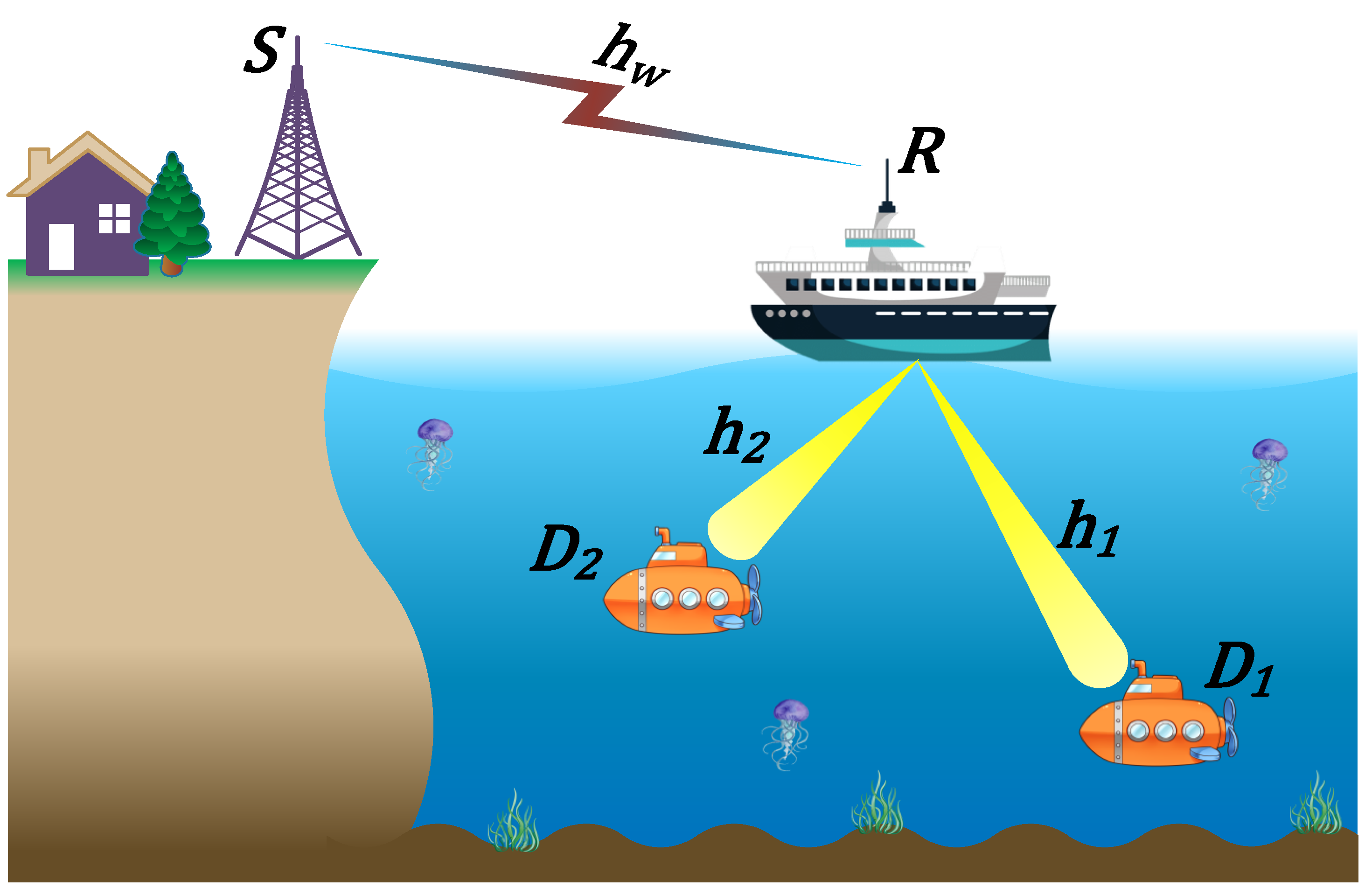
In this paper, we propose a downlink NOMA-based dual-hop hybrid RF-UOWC system depicted in
Figure 1, where the source (
S) is equipped with an RF interface that aims to communicate with two destinations (
and
) equipped with UOWC interface via an intermediate decode and forward relay (
R). The relay has an RF interface to receive from
S and then transmit to
and
through the UOWC interface, where
is the far or weak user and
is the near or strong user. Such a scenario can find applications in many areas in the UIoT [
19] (e.g., offshore oil field exploration, oceanic monitoring, and data collection). The
S-
R channel (
) is assumed to be a RF channel characterized by Rayleigh fading with AWGN and the
R-
channels (
) are assumed to be UOWC channels characterized by EGG fading with AWGN, where
.
For the sake of improving the spectral efficiency, we assume that S and R adopt PD-NOMA for multiplexing their messages. The communication is initiated at S by multiplexing the two messages and intended for and , respectively. The S-to-R message is , where is the total transmitted power at S and is the NOMA power allocation factor for at S. Without loss of generality, we assume that and . The received message at R through the RF link is , where the expectation of RF channels gain is , d is the S-to-R link distance, v is the RF channel path-loss exponent, and represents AWGN with . Utilizing NOMA concept, R decodes first, then applies the SIC operation, which is assumed to be imperfect, to decode . So, the signal-to-interference-plus noise ratios (SINRs) for decoding and are expressed as and , respectively, where , and is the residual power factor of the imperfect SIC.
In the second phase,
R retransmits the received messages over the UOWC channels that are characterized by independent but not necessarily identical mixture EGG distribution [
5]. The relay multiplexes the detected messages using PD-NOMA again, such that
, where
is the total transmitted power at
R and
is the NOMA power allocation factor for
at
R. Without loss of generality,
and
. The received message at
through the UOWC link
is
, where
is the EEG fading of UOWC channel from
R-to-
with expectation
,
is responsivity that is considered to be unity, and
represents AWGN with
. Utilizing NOMA concept,
decodes
first. So, the SINR for decoding
at
is expressed as
where
.
The received message at through the UOWC link is , where is the EEG fading of UOWC channel from R-to- with expectation . Following the NOMA principle, decodes first and then applies the SIC operation, which is assumed to be imperfect, to decode . So, the SINRs for decoding and are expressed as and .
Channels Distributions: We assume that the UOWC links
and
are characterized by the EGG distribution [
5], which models the underwater turbulence fading resulting from air bubbles and gradient of temperature in an effective manner. EGG is a weighted combination of the exponential and generalized Gamma distributions, it effectively matches the experimental results obtained under different scenarios of channel impairments of UOWC. A closed-form expression for the cumulative distribution function (CDF) of EGG distribution is given as [
5]
where
represents the mixture ratio between exponential and generalized Gamma distributions,
is the exponential distribution scale parameter of the exponential distribution,
are the parameters associated with generalized Gamma distribution, and
is the Mejier-G function [
20]. According to the receiver detection method, heterodyne detection
or intensity modulation/direct detection (IM/DD)
, the electrical signal to noise ratio (SNR) is
where
is the average SNR of the UOWC links. We assume that
, thus
. The values of
for different scenarios of air bubbles under thermally uniform and gradient-based UOWC channels are experimentally obtained in [
5] (
Table 1 and
Table 2). Finally, the RF-links
undergo a Rayleigh fading with AWGN noise, therefore
follows an exponential distribution whose CDF is given as
6. Results and Discussion
In this section, we provide a detailed discussion on the derived metrics of the proposed system under varying conditions of air bubbles for both fresh/salty and thermally uniform waters under heterodyne or IM/DD detection techniques to gain more insight and highlight some conclusions. The correctness of the obtained analysis is verified via a Monte-Carlo simulation with
samples. Throughout this section, we used the distribution parameters provided in
Table 1 and
Table 2. Unless otherwise mentioned, the system parameters are set to
,
,
bits/sec/Hz, and
bits/sec/Hz;
is the normalized distance with respect to the cell radius, and
,
, and
. In the following, we denote “Ana” as the analytical result, “Asym” as an asymptotic result, and “Sim” as Monte-Carlo simulation results.
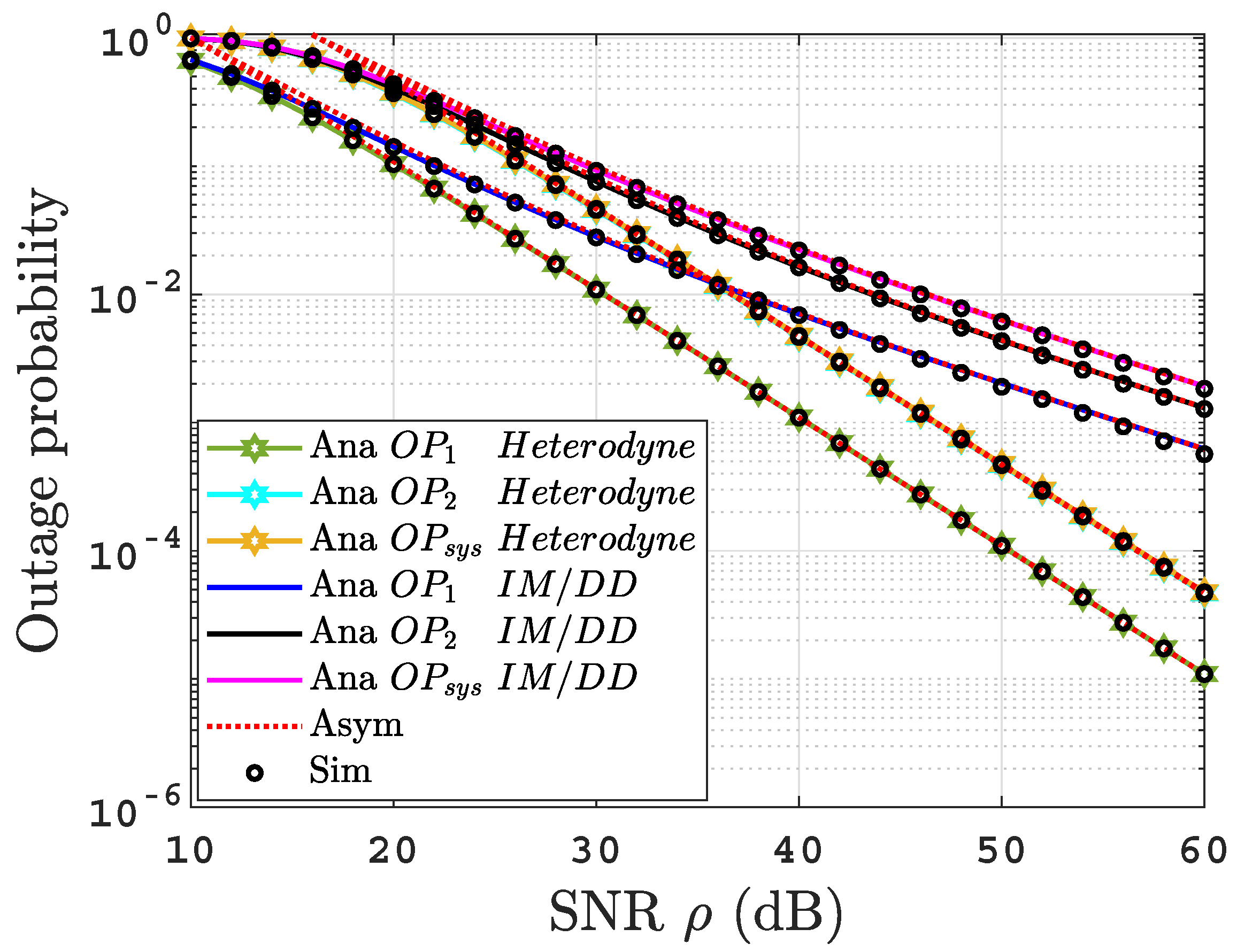
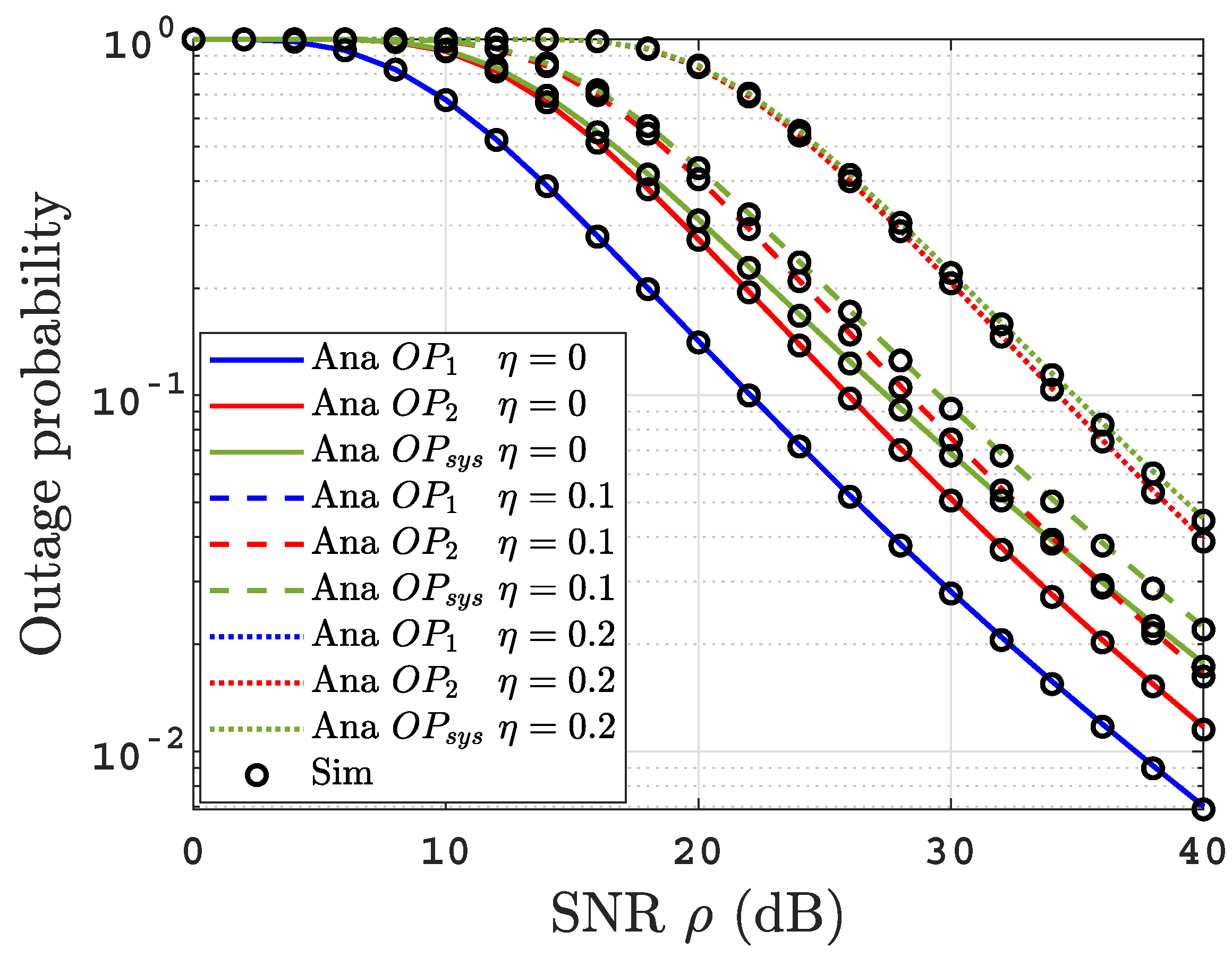
Figure 2 presents the outage probability for the proposed system under uniform temperature salty water for both IM/DD and heterodyne techniques. As expected, it can be deduced that the
significantly improve when heterodyne detection is implemented compared to IM/DD. This result is due to the ability of the heterodyne receiver to overcome the UOWC link’s turbulence effects, while this leads to a more complex receiver compared to IM/DD receiver. For example, the
of
is achieved at
dB under the heterodyne receiver and
dB using the IM/DD receiver. It is remarkable that the analytical and the simulation results are a match, which validates our analytical derivations. Additionally, they match the asymptotic curves at high SNR regime. In addition, to validate the
derived in
Section 3.5, we can observe that for heterodyne detection
, the
at
dB and
at
dB; therefore, the
falls with a slope of
. Following the same procedure for IM/DD, we can observe that the
at
dB while
at
dB, so the
falls with a slope of
. These results are consistent with the diversity order
.
Figure 3 depicts the
for the proposed system under uniform temperature salty water with varying air bubbles levels
and
L/min. It is clear that the increase in the level of air bubbles leads to a degradation in the
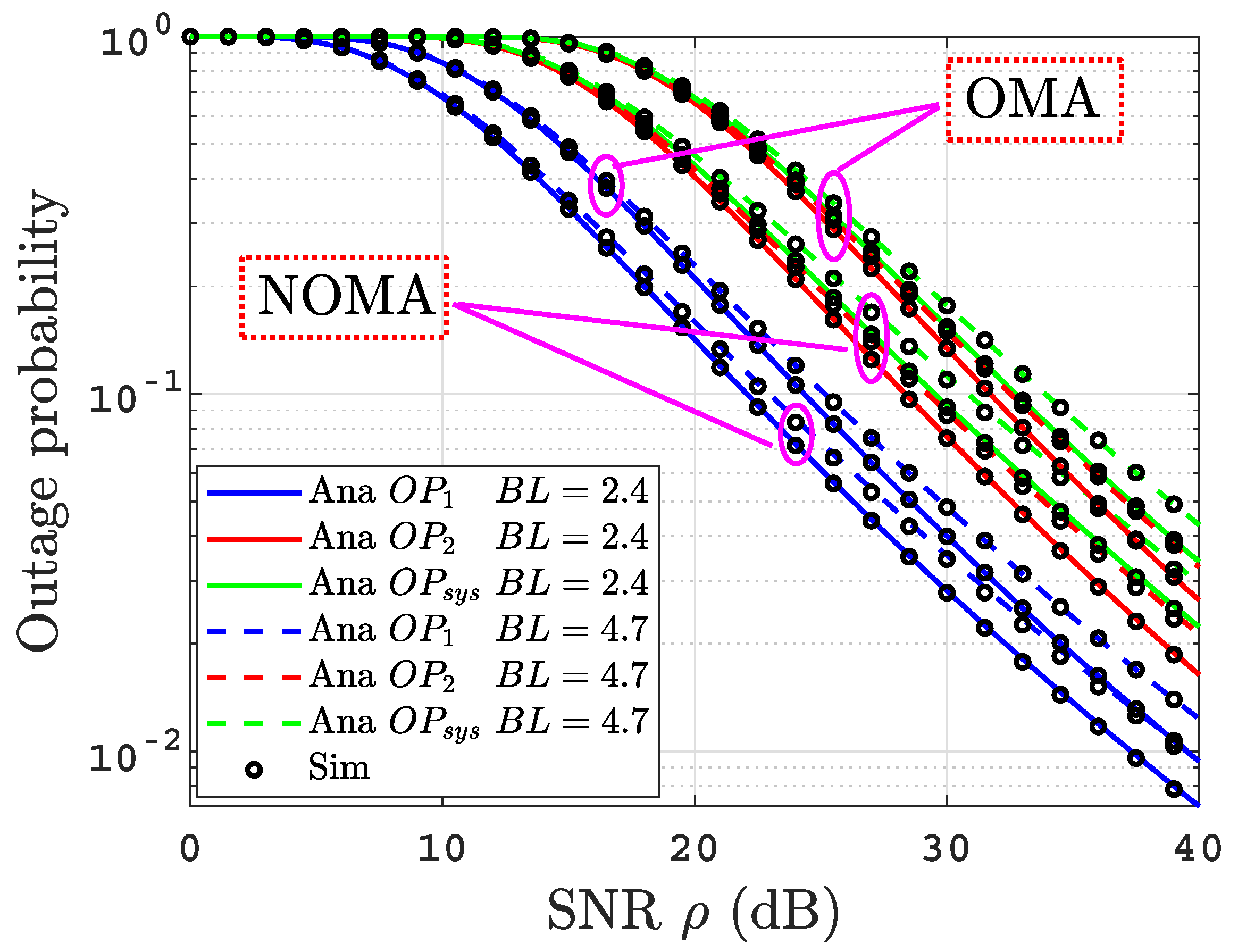
performance. This is due to the rise of the water turbulence. To evaluate the performance of the proposed system in this work, we compared its performance with a benchmark scheme: the OMA-based dual-hop hybrid RF-UOWC system.
Figure 3 provides the comparison between the proposed NOMA-based system versus the OMA-based system under the same system settings. According to the figure, the proposed system outperforms the benchmark in terms of
performance. This is due to the fact that the NOMA technique is more spectral efficient than the OMA technique.
Figure 4 illustrates the influence of the residual power factor of imperfect SIC on
performance of the proposed system under uniform thermally salty water at
L/min utilizing three varying levels of
. We can see that the
performance degrades by increasing
while the best performance is achieved with the perfect SIC scenario (
). This is due to the fact that an increase in
leads to a higher interference level, hence the SINRs
and
decrease while decoding the near user message. However, the SINRs
,
, and
are not affected by changing
.
Furthermore,
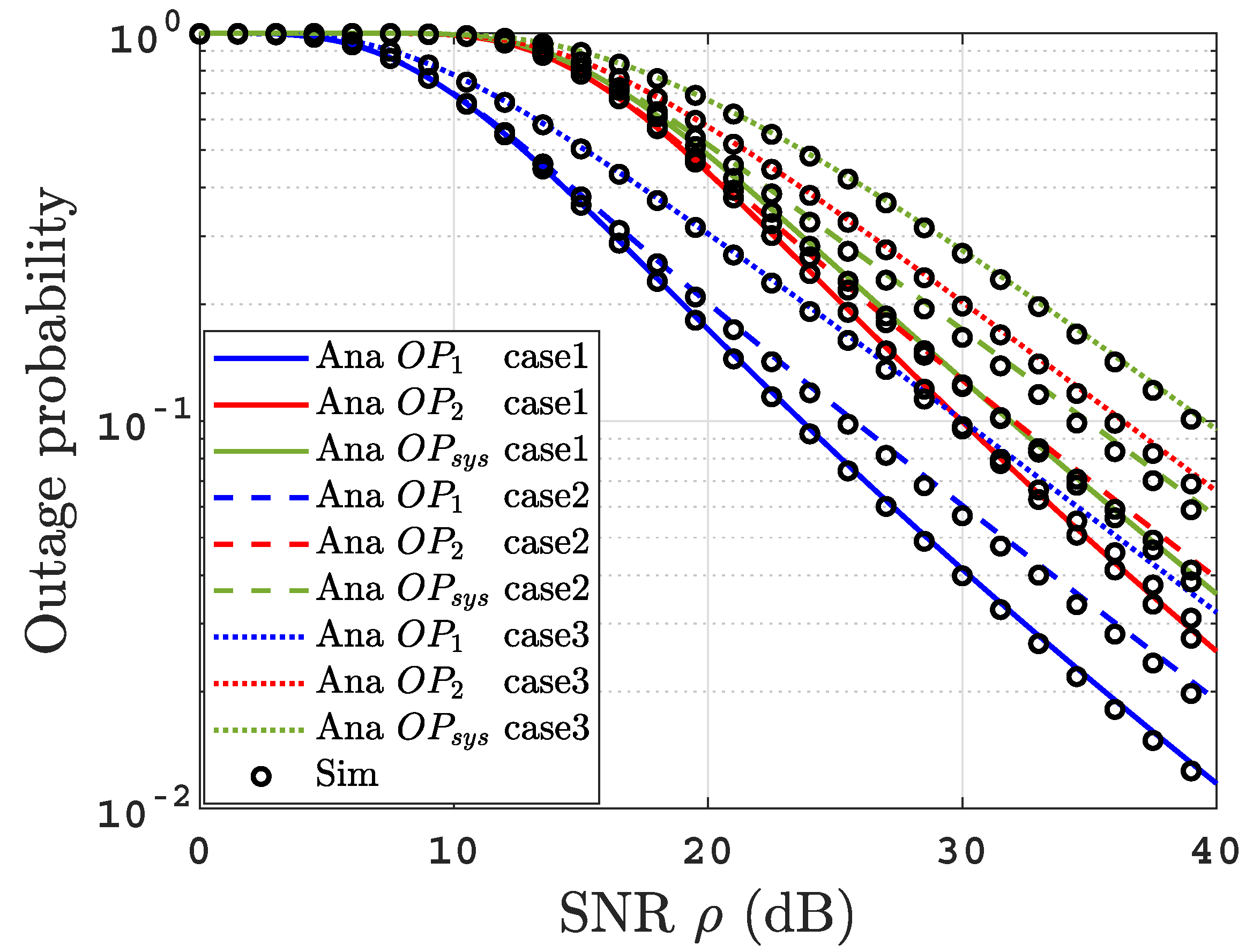
Figure 5 depicts the temperature gradient (
) and air bubbles level effect on the
performance. This figure investigated three different scenarios. We set
and
in case1,
and
in case2, and
and
in case3. It is clear that the higher the level of the air bubbles and/or the temperature gradient, the stronger the turbulence, leading to a
performance deterioration.
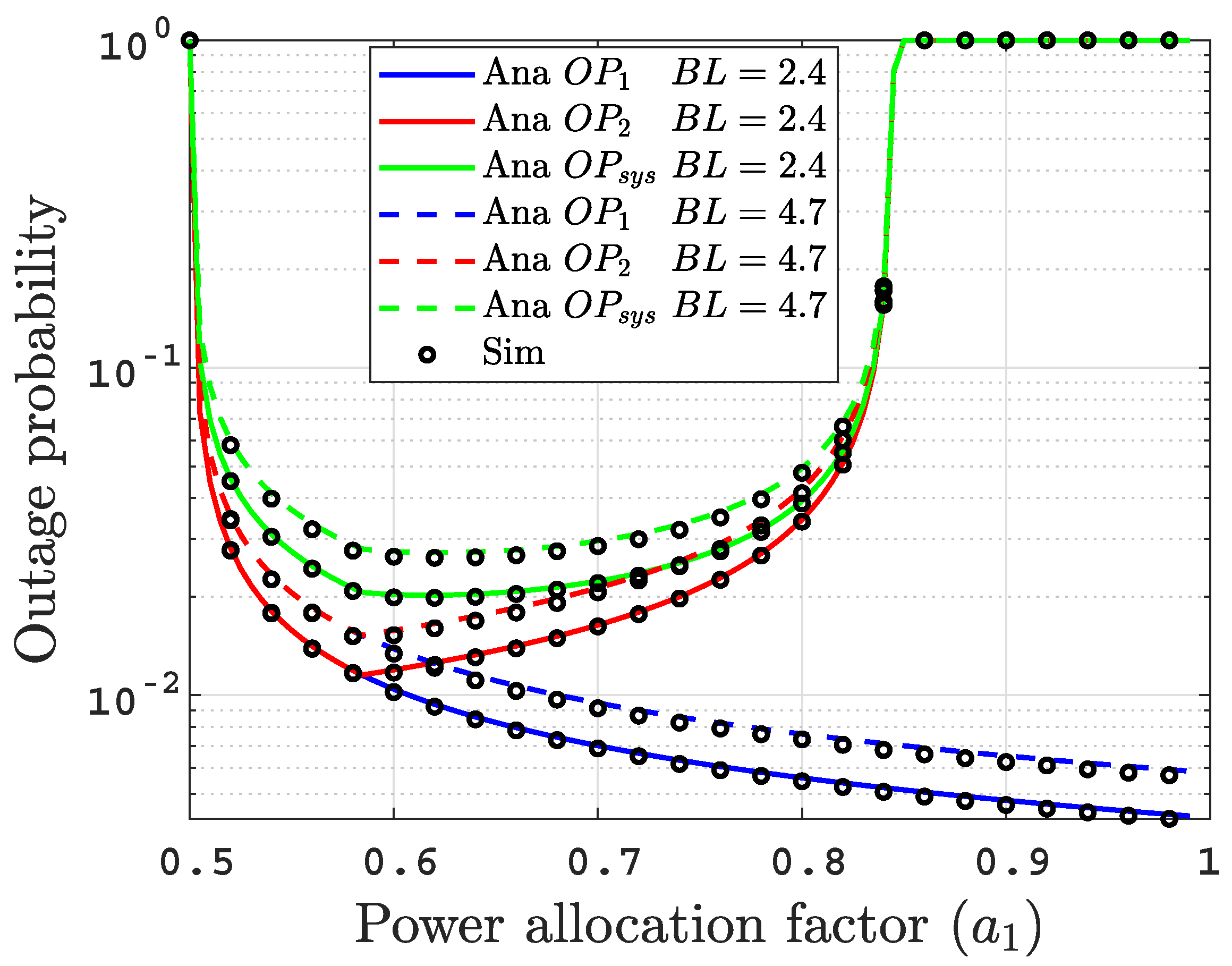
Figure 6 demonstrates the influence of the power allocation factor
, which varies from
to
, on the
performance with
dB in two varying air bubble levels of
and
L/min. We can observe that the
enhances with the increase in
due to the increase of its own message power. On the other hand, the
witnesses an improvement at first with
increase as
needs to decode
first before decoding its own message
. However, with the continuous increase in
, an inflection point is reached since increasing
means decreasing the allocated power for
message (
) that degrades the
. Finally, the
follows the same trend as
with a bit increase. Additionally, this figure graphically proves the convexity of the optimization problem in (
29).
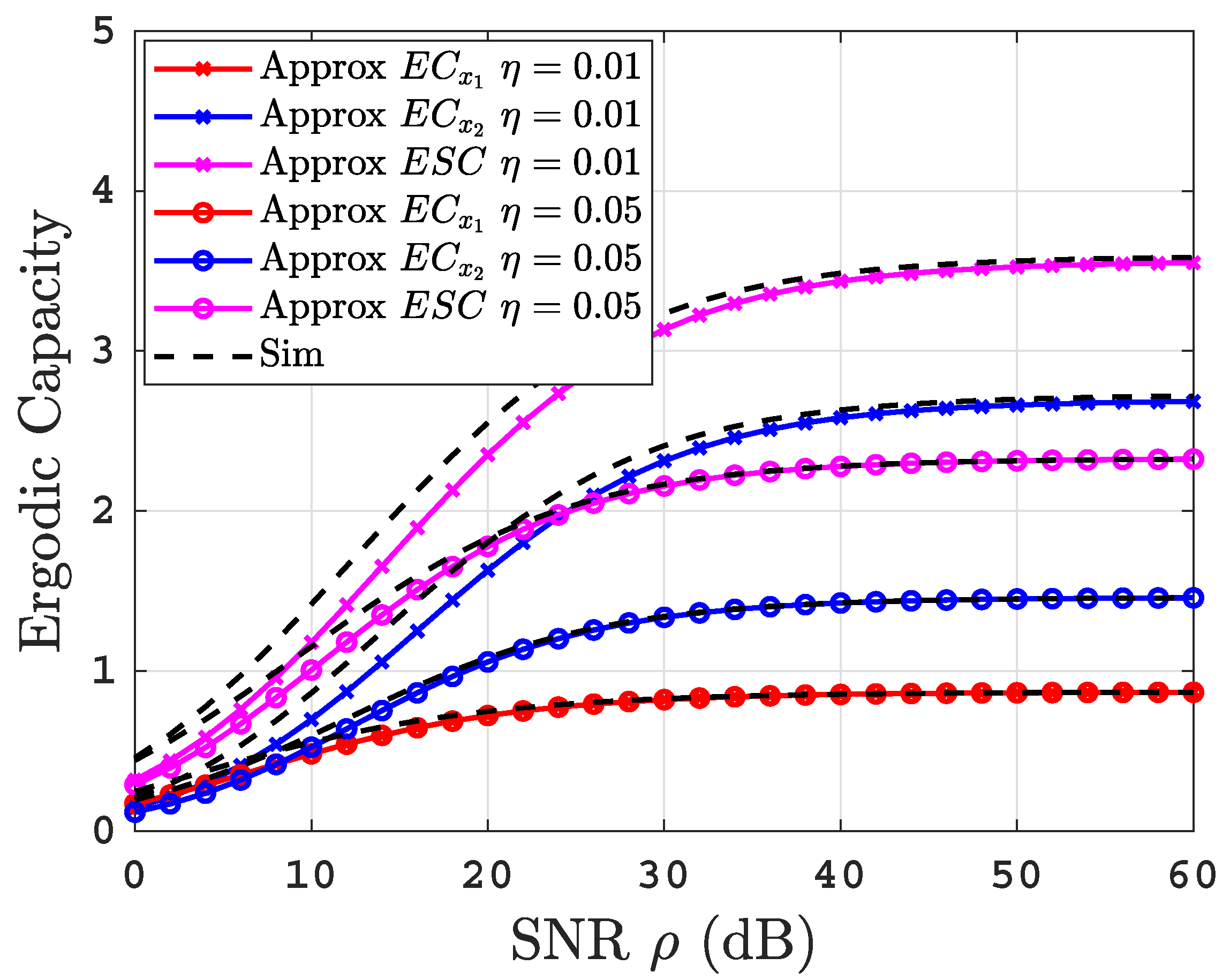
Figure 7 illustrates the influence of the residual power factor of imperfect SIC on
performance of the proposed system under uniform thermally salty water at
L/min where
and
. We can see that the
and
performance degrades by increasing
. This is due to the fact that an increase in
leads to a higher interference level at the decoding process of
. On the other hand, the
performance is not affected by changing
. The figure also shows a perfect agreement between the simulation and the obtained analytical results at high SNR with a small deviation at low SNR. This deviation is due to the usage of the tight approximated expression for the CDF of the EGG distributions at high SNR.
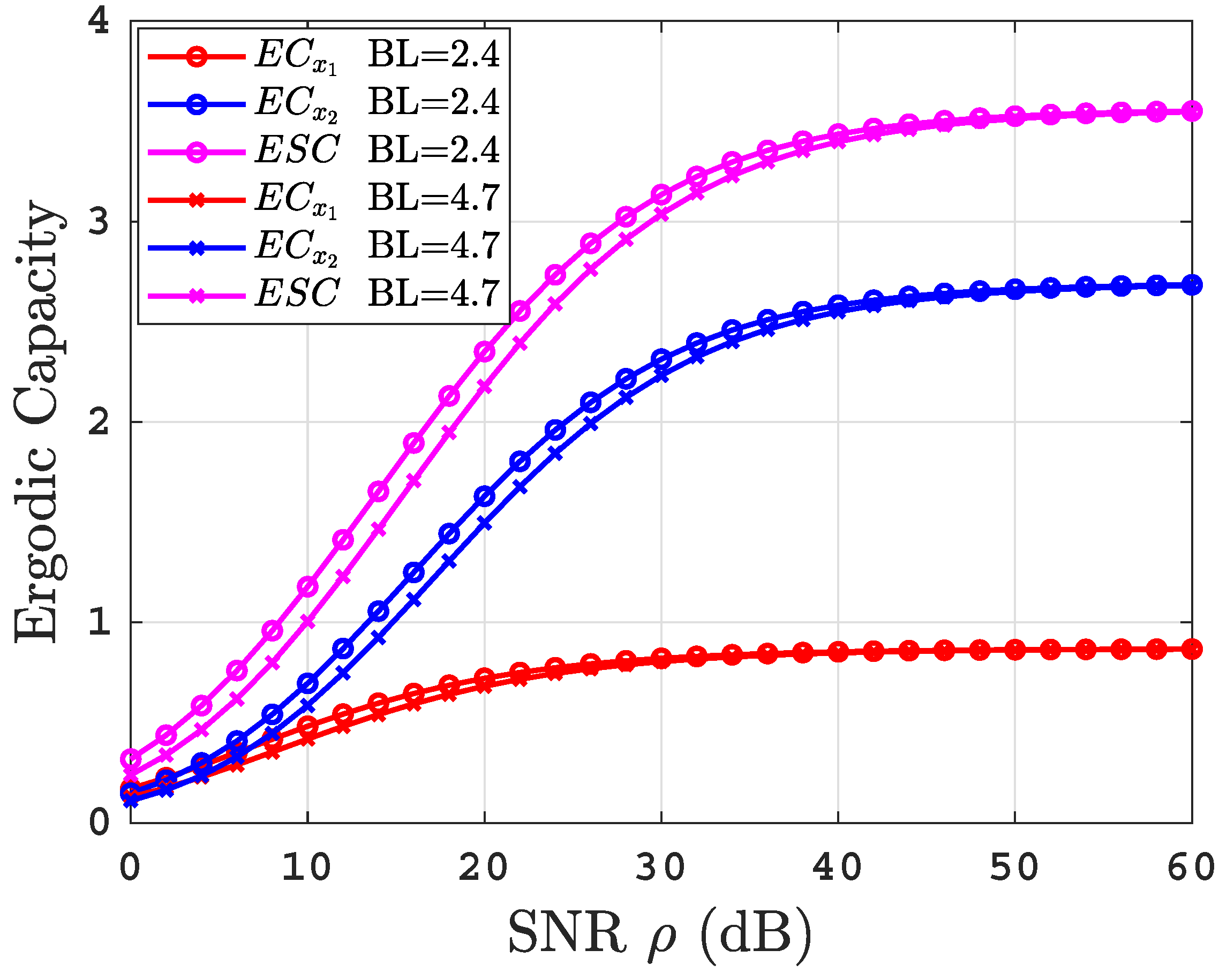
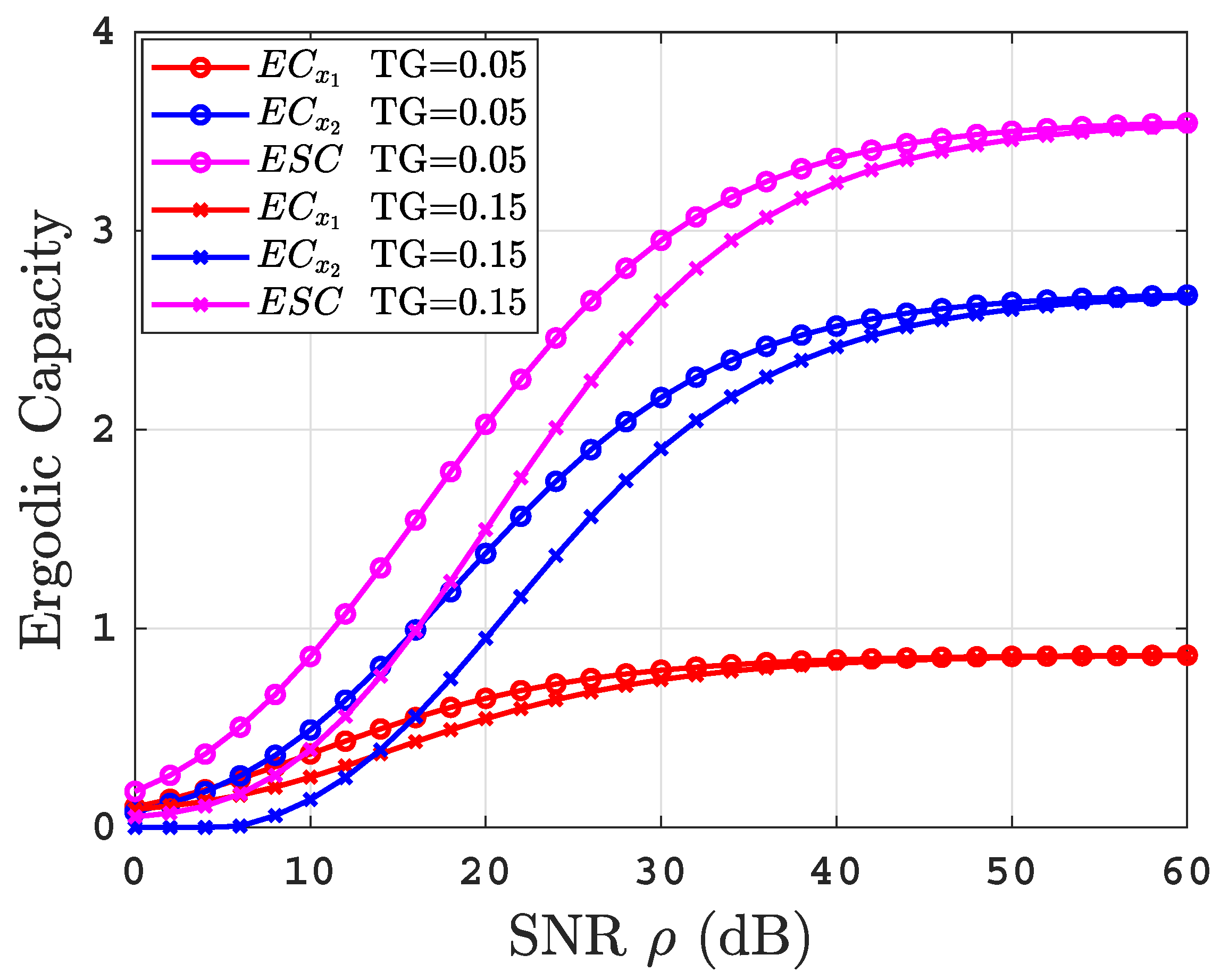
Figure 8 illustrates the
for the proposed system under uniform temperature salty water with two air bubble levels of
and
L/min. It is clear that the increase in the level of air bubbles leads to a deterioration in the
performance; this is due to the increase in water turbulence.
Moreover,
Figure 9 shows the effect of
on the
performance in salty water under the air bubbles level
L/min. The figure investigated two different values of
. It is obvious that the higher the level of the temperature gradient, the stronger the turbulence, leading to a
performance degradation. From
Figure 8 and
Figure 9, we can conclude that the effect of the variation in water turbulence (
,
) is negligible at the high SNR regime.
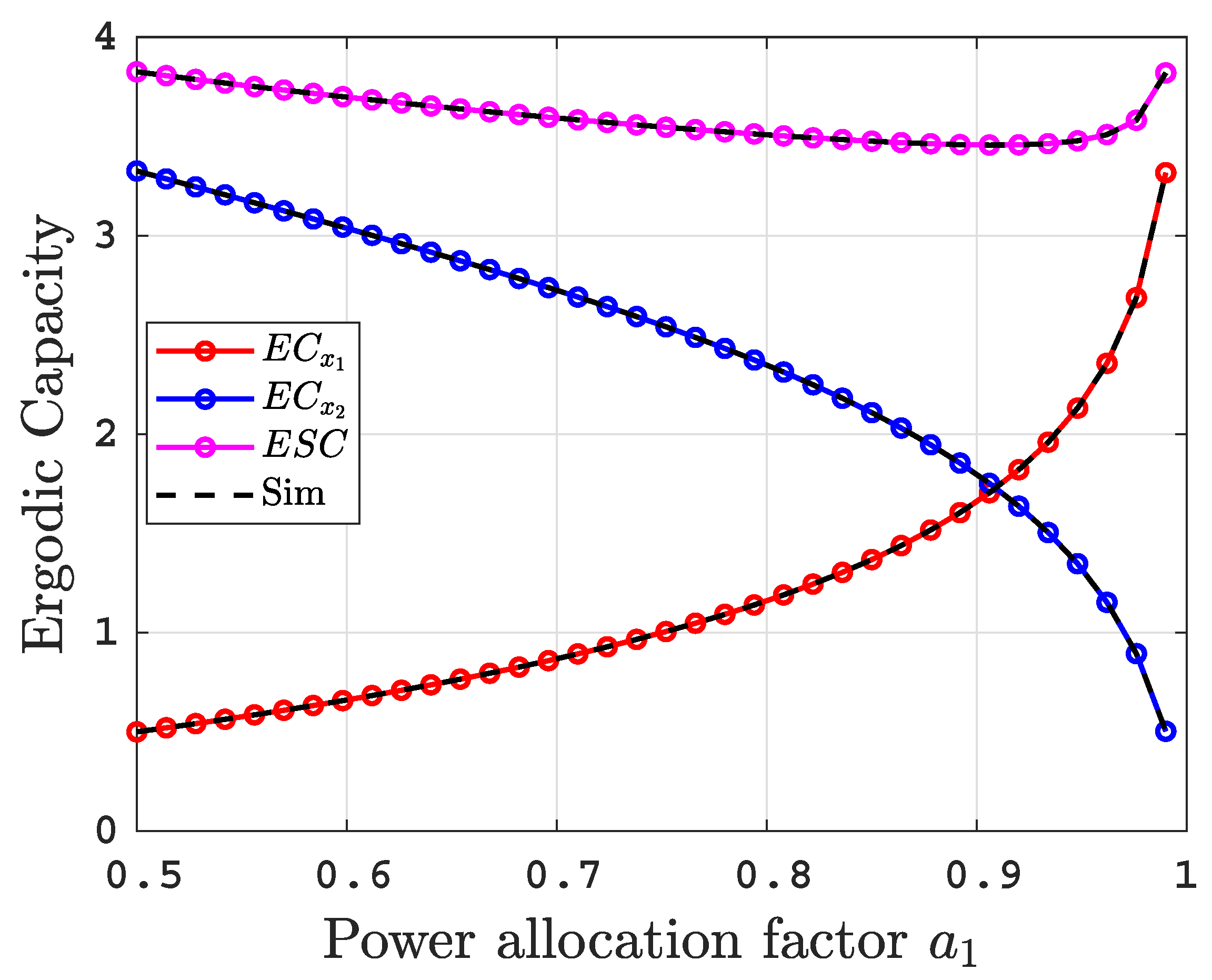
Figure 10 demonstrates the influence of the power allocation factor
, which varies from
to
, on the
performance to gain insight into the effectiveness and the fairness with
dB, under uniform temperature salty water with
. We can see that
increases as
increases because the higher power allocation factor means a higher SINRs
,
, and
, but
drops as power allocation factor increases because the SINRs
and
degrade. Furthermore, we can see that
is approximately constant over the entire range of the power allocation factor, which is owing to the fact that the rate of increase in
is approximately the same as the rate of decline in
.




 ,
,