1. Introduction
Source localization technology is an essential part of many fields, including rescue operation, resource exploration, intelligent transportation, and underwater detection [
1,
2,
3,
4]. Initially, typical localization methods, such as time of arrival (TOA) [
5,
6], angle of arrival (AOA) [
7,
8], and frequency difference of arrival (FDOA) [
9,
10] are always performed in a two-step mechanism. The intermediate parameters containing information regarding the source position are estimated first, such that the source position can be determined by methods that are based on the geometric relationship between the parameters. Nevertheless, the two-step algorithm cannot perform optimally, due to the inevitable information loss between the two steps. Moreover, a sharp decline in accuracy will be caused if parameter matching errors occur in multiple source scenarios.
To circumvent these problems in the two-step framework, a new one, called direct position determination (DPD), is first proposed in [
11]. As its name suggests, the DPD algorithm is performed by processing the raw received signals to determine the source position. Thus, it skips the step of intermediate parameter estimation and takes the correlation among different received signals into account. The research results in [
11] show that much higher accuracy can be achieved by DPD algorithms, compared with two-step algorithms, especially under low signal-to-noise ratio (SNR) conditions.
As the information associated with the source position cannot be completely ignored in DPD, a series of DPD algorithms based on different information types have been proposed. The information regarding TOA and AOA was considered in [
11], where the maximum likelihood (ML) estimator was established, and multidimensional search was required for the determination of the source position. Though superior performance can be obtained, this algorithm is impractical, in the case of multiple sources, because of its high complexity. To cope up with this, a decoupled algorithm was proposed in [
12], and the alternating projection algorithm was adopted in [
13]. Besides, the subspace data fusion (SDF) DPD algorithm was proposed in [
14], which can handle the problems of multiple sources better than the ML algorithm. It was actually an extension of the multiple signal classification (MUSIC) [
15] algorithm. Except for the information regarding TOA and AOA, the information of FDOA can be also considered in the DPD algorithm. In [
16], a ML estimator that contained the time difference of arrival (TDOA) and FDOA was designed, and its high computation load was avoided by the particle filter method. Different from the situation of moving receivers in [
16], a moving source was considered in [
17]. The delay and Doppler information were exploited in [
17], and a new multiple particle filter algorithm was proposed to cope with the difficulty of estimating multiple parameters.
The above DPD algorithms were all designed for general Gaussian signals, while some research has demonstrated that an improved accuracy can be achieved if the specific properties of the source signals are considered. In [
18,
19], the DPD algorithms for the orthogonal frequency division multiplexing (OFDM) signals were proposed, where the ML estimator was exploited, and their superiority over the general algorithms was verified. Besides, some attempts at the DPD algorithms for non-circular (NC) signals have also been made. An improved SDF DPD algorithm for NC signals was proposed in [
20], and its complexity was reduced by devising a Newton-type iterative method. Hereafter, some sparse arrays, such as nested array (NA) [
21] and coprime array [
22], were employed to obtain a larger array aperture, higher degrees of freedom (DOF), and higher accuracy [
23,
24,
25]. In addition to the OFDM and NC signals, the properties of cyclo-stationary signals [
26] can also be considered in the DPD algorithm.
Signals in the real world are always nonstationary, but locally stationary, such as speech and audio signals. These types of signals are called quasi-stationary signals (QSS), and they have stable second-order statistical properties within a short period of time and differ from any other frame [
27]. To the best of our knowledge, none of the existing literature on DPD algorithms has considered and exploited the features of QSS. In this paper, which was inspired by related research regarding the direction of arrival (DOA) for QSS [
27,
28,
29], the SDF DPD algorithm of QSS (QSS-SDF-DPD) for NAs is derived first. Moreover, the dimension-reduced matrix in the Khatri–Rao subspace method [
29] is modified, and the unitary transformation [
30,
31] is adopted, so that the real-valued QSS-SDF-DPD (R-QSS-SDF-DPD) algorithm with a lower computational burden is proposed. We summarize the following contributions of this paper:
The features of QSS are considered in the DPD model for NAs, where the cost function is constructed by combining the Khatri–Rao subspace and SDF methods, and the QSS-SDF-DPD algorithm is derived.
The original dimension-reduced matrix is modified, and the unitary transformation method is exploited for the purpose of releasing the computational burden; then, the R-QSS-SDF-DPD algorithm is proposed.
Apart from the given Cramer-Rao bound (CRB), the complexity analysis, summary of advantages, superiority of the R-QSS-SDF-DPD algorithm in terms of computational complexity, maximum number of identifiable sources, localization accuracy, and sources resolution is confirmed by some simulation experiments.
The remaining parts of this paper are organized as follows.
Section 2 presents the system model of QSS-DPD for NAs. The proposed algorithm, which contains the Khatri–Rao subspace method for NA and matrix reconstruction for complexity reduction, is derived in
Section 3, and a summary is given at the end.
Section 4 provides the CRB, complexity analysis, and advantages of the proposed algorithm. Then, some relevant simulation results are shown in
Section 5. The last section draws some conclusions on the paper.
Notation: Throughout the paper, the upper-case bold character and upper-case one are used to represent a matrix and vector, respectively, and a variable is denoted with a lower-case character. and represent the operation of taking the magnitude and Euclidean norm of a vector, respectively. , , , , and represent the operation of expectation, vectorization, diagonalization, block diagonalization, and taking the real part, respectively. and represent the operation of the Kronecker and Khatri–Rao products, respectively. and represent the complex number set and real number set with dimension , respectively. The operation of inverse, conjugate, transpose, and conjugate transpose are represented by , , , and , respectively. represents the operation of arcsine. , , , and represent the identity matrix, row-flipped form of the identity matrix, vector with all zeros, and vector with all ones.
2. System Model
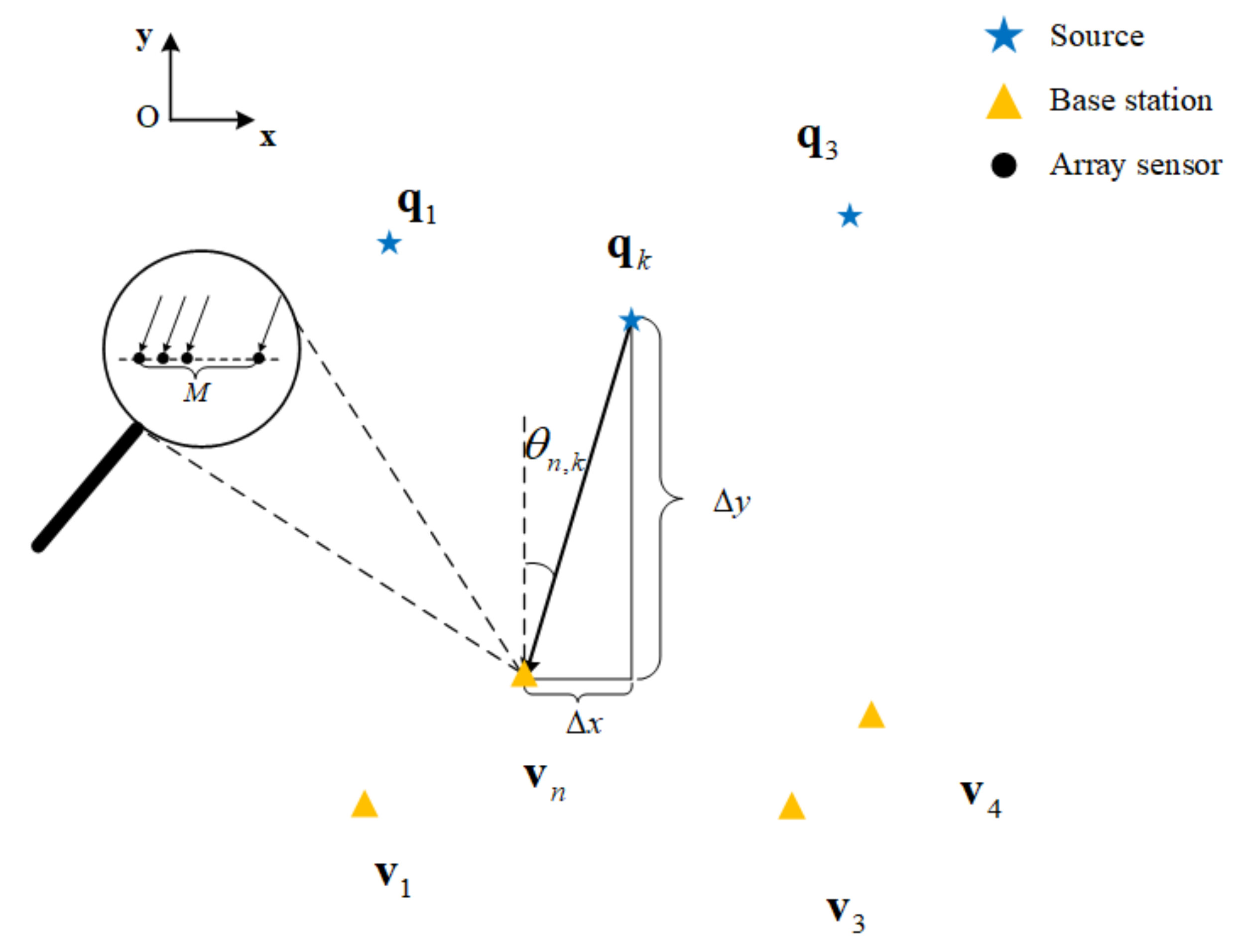
Consider the two-dimension scenario presented in
Figure 1, where the
(it is assumed to be known, as it can be estimated by some methods [
32,
33,
34,
35]) far-field narrowband uncorrelated sources are intercepted by
base stations, which are equipped with a NA. As the location of the base stations are known, assume they are located at
, and the sources are located at
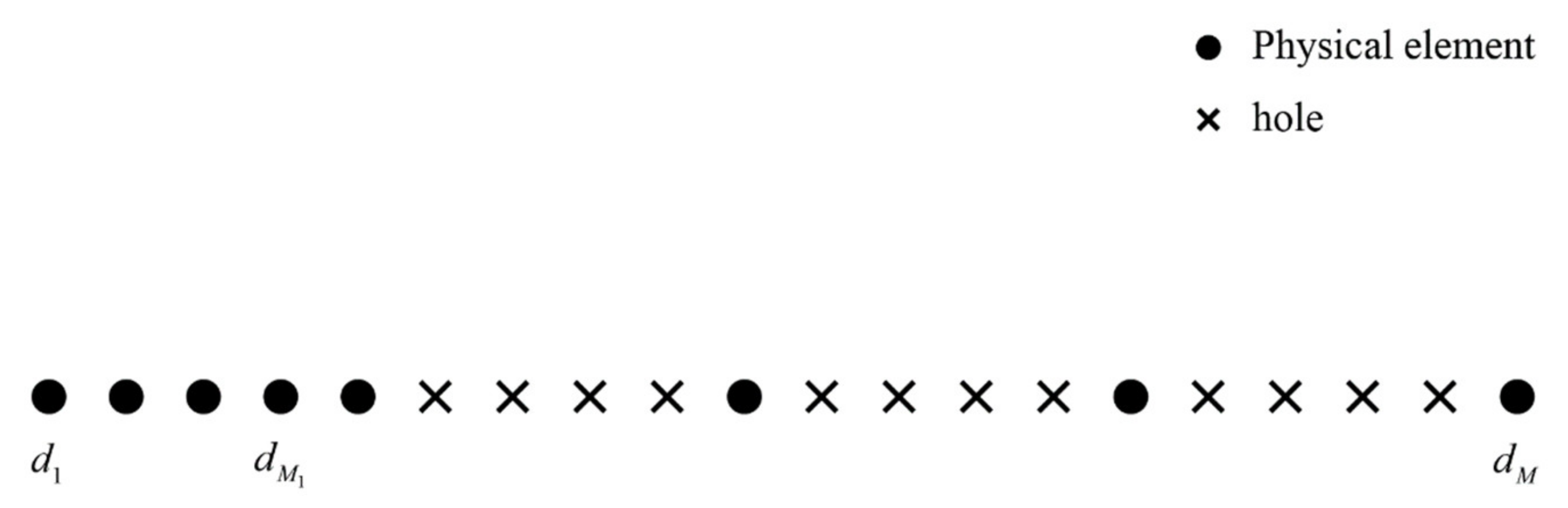
. The specific structure of the
element NA that is exploited in this scenario is shown in
Figure 2, where the first and second levels consist of
and
elements (
), respectively. The place of all physical array elements can be included in a set
, given by [
21]:
where
denotes the unit adjacent spacing.
Assume the
source is impinging on the
base station from
; then, the received signal vector intercepted by the
base station at the
sampling time can be presented by [
14]:
where
denotes the steering vector of
, which is the DOA from the
source to the
base station,
,
is the signal wavelength,
represents the envelope of
source incident on the
base station, and
is the Gaussian white noise vector.
For the sake of derivation, rewrite Equation (2), in the form of matrix, as [
13]:
where:
Considering that the source signals conform to the properties of QSS [
36,
37,
38], we assume
contains
frames of signals, and each frame source signal
contains
snapshots (
); then,
satisfies [
27]:
Then, the
frame received signals of the
base station, which can be expressed as:
where
denotes the
frame source signal matrix, and
is the corresponding additive noise.
According to Equations (8) and (9), a local covariance matrix can be defined by [
27]:
where
denotes the local source covariance matrix of the
frame, and
is the spatial noise covariance.
According to Property 1 in [
27], the vectorization of
in Equation (10) can be expressed as:
where
is a real-value vector consisting of the diagonal elements in
.
Interestingly, a new received signal vector
is obtained, whose steering matrix is
and noise vector is
. By stacking the vectorization forms of all local covariance matrices, the new received signal matrix
is obtained:
where
is the new signal matrix.
Based on Assumption A4 in [
27], the covariance of the source signal is time-varying. Therefore,
can be treated as a new incoherent source signal matrix with
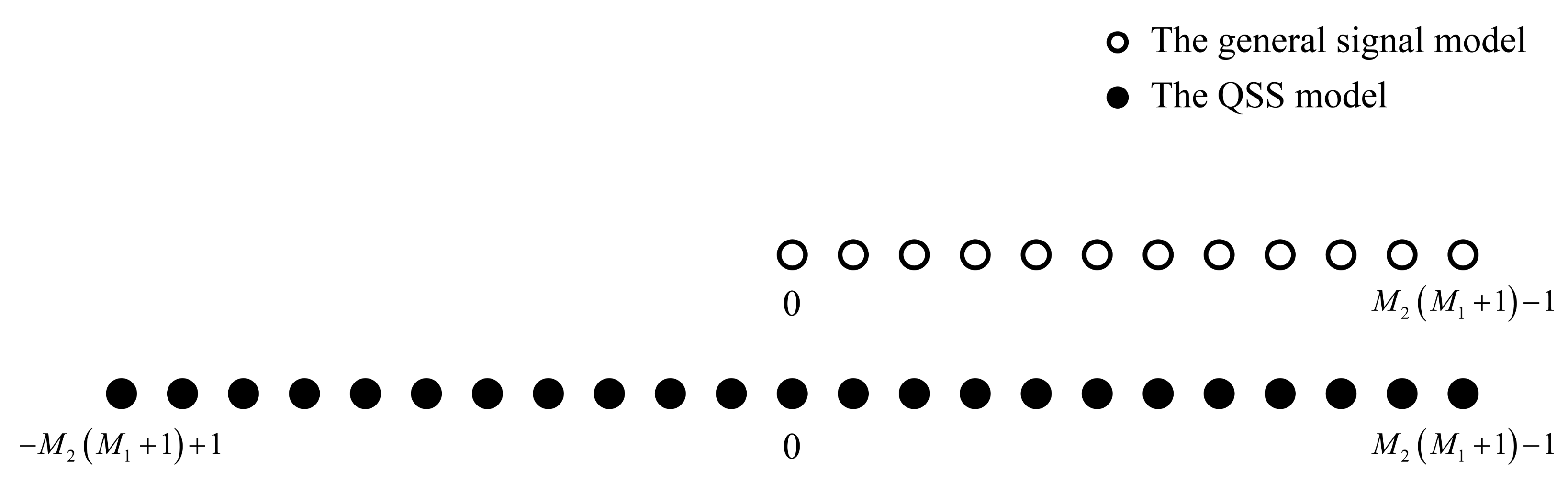
snapshots. Note that this is different from the general case, where the virtualization of the received signal makes the signals coherent, and some decoherence operations should be performed. In contrast, that problem does not occur in this paper, and the advantages of high DOF and large aperture can be fully preserved. As shown in
Figure 3, we compare the DOF of the general signal model (the spatial smoothing method in [
21] is adopted to overcome the coherent signal problem that is caused by the virtualization) and QSS model in this paper. Obviously, the QSS model has approximately twice as many DOF as the general signal model.
Define an orthogonal projector matrix
, when post-multiplying
by it, the unknown noise in Equation (12) can be eliminated, and the new noise-eliminated received signal matrix
can be given by [
27]:
According to Assumption A5 in [
27],
is a full row-rank matrix if
, which means
. Note that
is non-singular, and
is a full row-rank matrix. The noise subspace can be obtained after performing singular value decomposition (SVD) on
or eigenvalue decomposition (EVD) on its covariance matrix, so that the SDF algorithm [
14] can be exploited to estimate the source positions.
However, some direct processing on is time-consuming. To avoid this problem, the R-QSS-SDF-DPD will be proposed in the next section.
3. The Proposed Algorithm
In this section, the derivation process of the QSS-SDF-DPD and its modified real-valued version (R-QSS-SDF-DPD) are given in detail, including the Khatri–Rao subspace method for NA and matrix reconstruction for complexity reduction.
3.1. Khatri–Rao Subspace Method for NA
For a uniform linear array (ULA) with
elements, the new steering matrix
can be characterized as [
27]:
where:
denotes the dimension-reduced virtual array steering matrix, and
denotes the virtual steering vector of
, which is the DOA of the
source.
However, due to the discontinuity between the two-level elements of the NA, Equation (14) cannot be directly applied to it. To overcome this difficulty, a transformation should be applied to the original array steering matrix .
For the two-level NA exploited in this paper, a total of
consecutive distinct elements can be obtained after the operation of Khatri–Rao product
. If we take the non-negative part of them as the virtual ULA, then the original NA can be treated as a subset of the virtual ULA, and their array steering matrices scarify [
29]:
where
is the selection matrix, and
is a vector with 1 at the
entry and 0 elsewhere [
29].
represents the array steering matrix of the virtual ULA, and
represents the corresponding steering vector of the
source.
Substitute Equations (16) and (14) into Equation (13); then,
can be rewritten as [
29]:
where
is the dimension-reduced matrix with the form of Equation (15),
denotes the dimension-reduced virtual array steering matrix with the form of
in Equation (14), and its
column vector
represents the corresponding steering vector with the form of
in
.
According to the definition of
and
, they are both column orthogonal, so
is also column orthogonal, which is easy to verify [
29]. Define
, and the dimension of
can be reduced after a linear transformation, which is given by [
29]:
where
is the dimension-reduced, noise-eliminated received signal matrix, and
is the dimension-reduced matrix. As presented in Equation (18), the dimension of the original received signal matrix is reduced from
to
.
It can be seen from Equation (18) that a virtual noise-eliminated received signal matrix
is obtained, whose array steering matrix is
and source signal matrix is
. Therefore, the covariance matrix of the dimension-reduced, noise-eliminated received signal matrix
can be calculated by:
After the eigenvalue decomposition of
, we obtain the corresponding signal subspace
and noise subspace
, which are given by:
where
and
denote the diagonal matrices made up of the maximum
eigenvalues and remaining ones, respectively. The corresponding eigenvectors form
and
, respectively.
Hence, according to the SDF algorithm in [
14], the spectrum function of the QSS-SDF-DPD algorithm for NAs
can be constructed by:
where
is the position of search grid point in the search area
, and
represents the steering vector of
for the
base station, which has the same form as
in
. After finding the maximum
points of Equation (21), all source positions can be estimated.
3.2. Matrix Reconstruction for Complexity Reduction
Note that high complexity cannot be avoided during the peak search process of
, due to the existence of
and lots of complex-valued multiplications. For the purpose of releasing the computational burden, the dimension-reduced matrix will be modified, and the unitary transformation method [
30,
31] will be adopted.
It can be observed from Equation (18) that, if we pre-multiply
by
, we can obtain:
where
is the modified, dimension-reduced, noise-eliminated received signal matrix, and
is the modified dimension-reduced matrix.
Interestingly and coincidentally, for the NA,
is equal to the Equation (9) in [
39], which is expressed by:
where
represents the position difference between
and
, and
represents the number of pairs
, whose difference
is equal to
.
According to Equation (22), can be treated as a modified noise-eliminated received signal matrix, whose array steering matrix is and source signal matrix is . Note that, compared with the virtual array steering matrix before modification, is eliminated, which means the matrix would be removed from . Thus, it partially reduces the computational burden.
As the virtual array configuration forming
is centrosymmetric, the unitary transformation method [
30,
31] can be directly adopted.
Define the unitary matrix by [
30]:
Then, a real-valued matrix
can be obtained by the unitary transformation given by:
Correspondingly, a real-valued covariance matrix
can be expressed by:
Hence, after performing eigenvalue decomposition on
, we obtain:
where
is the real-valued signal subspace made up of eigenvectors corresponding to the largest
eigenvalues,
is the real-valued noise subspace made up of the remaining eigenvectors, and
are eigenvalues of
; the first
ones form the diagonal matrix
, and the last
ones form the diagonal matrix
.
Finally, fuse all the real-value noise subspace of all base stations, and the spectrum function of R-QSS-SDF-DPD algorithm for NAs
can be expressed by:
where
is the real-valued peak search steering vector. Then, find the maximum
points of
, and take the corresponding coordinate positions as the estimates of all source positions.
3.3. Summary of The Proposed Algorithm
As a summary, the main steps of the QSS-SDF-DPD and R-QSS-SDF-DPD algorithms are listed below, where the first six steps belong to the former, and the last four ones belong to the latter.
Step 1: Calculate the covariance matrix of the received signal for each frame by Equation (10).
Step 2: Construct the vectorization forms of all , and stack them together to obtain the new received signal matrix by Equation (12).
Step 3: Eliminate the unknown noise, according to Equation (13).
Step 4: Obtain the original dimension-reduced, noise-eliminated received signal matrix by Equation (18).
Step 5: Calculate the covariance matrix of by Equation (19), and obtain the noise subspace matrix by Equation (20).
Step 6: Construct the original spectrum function of QSS-SDF-DPD by Equation (21), and estimate all source positions by finding the maximum points.
Step 7: Modify the dimension-reduced matrix to obtain the modified noise-eliminated received signal matrix according to Equation (22).
Step 8: Obtain the real-valued matrix , according to Equation (25).
Step 9: Calculate the real-valued covariance matrix by Equation (26), and obtain the real-valued noise subspace matrix by Equation (27).
Step 10: Construct the spectrum function of R-QSS-SDF-DPD by Equation (28), and estimate all source positions by finding the maximum points.
5. Simulation Results
We compare the estimated performance of the SDF-DPD, QSS-SDF-DPD, and R-QSS-SDF-DPD algorithms by calculating the root mean square error (RMSE), as defined by:
where
denotes the number of Monte Carlo simulation experiments, and
denotes the estimate of
in the
simulation experiment.
is set to be 1000 in all the following simulation experiments, unless a special statement is given.
Besides, in order to compare the resolution of algorithms, the resolving probability
[
41] is defined by:
where
is the number of simulation experiments in which the two sources are successfully distinguished. In this section, two sources are placed parallel to the x-axis, one of them is fixed at
, while the abscissa of the other
is adjusted, where
denotes the distance of the two sources. For each simulation experiment, if the locations of two sources are estimated and satisfy
(
and
are the estimated abscissa of the two sources), then this simulation experiment passes; otherwise, it fails.
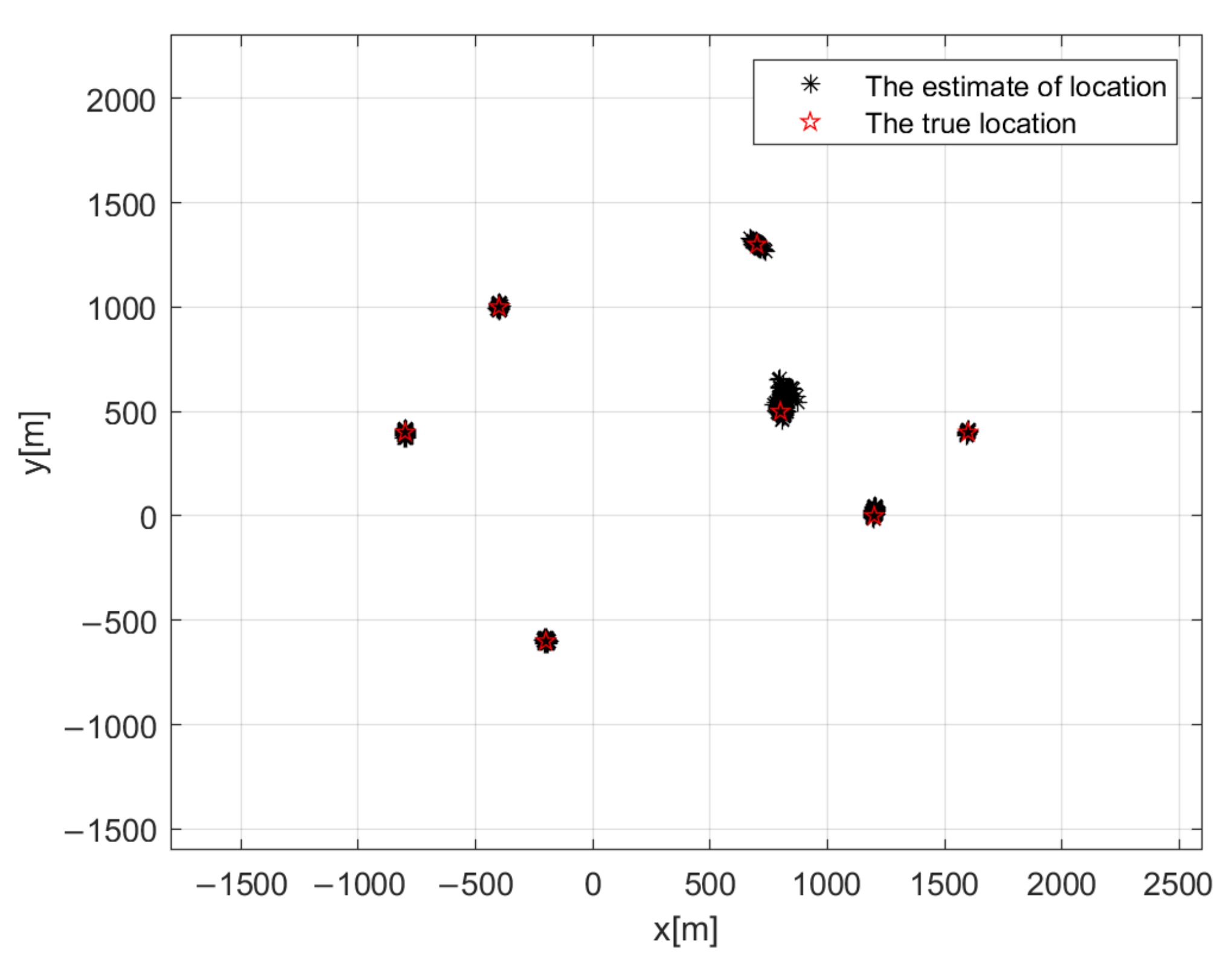
Simulation 1: To verify the feasibility of the proposed R-QSS-SDF-DPD algorithm, the scatter plot is shown in
Figure 5. In this simulation, the number of sources is
, and they are located at
,
,
,
,
,
, and
; the number of base stations is
, and they are located at
,
,
, and
. The structure of NA is
,
, SNR is 5 dB, and the number of frames is
; each frame consists of
snapshots, and the number of Monte Carlo simulation experiments is
. As demonstrated in
Figure 5, the proposed algorithm can estimate all source positions, even when
, which proves the first advantage that was mentioned in
Section 4.3. Besides, the feasibility of the R-QSS-SDF-DPD algorithm, in regard to estimate accuracy, is also confirmed.
Simulation 2:
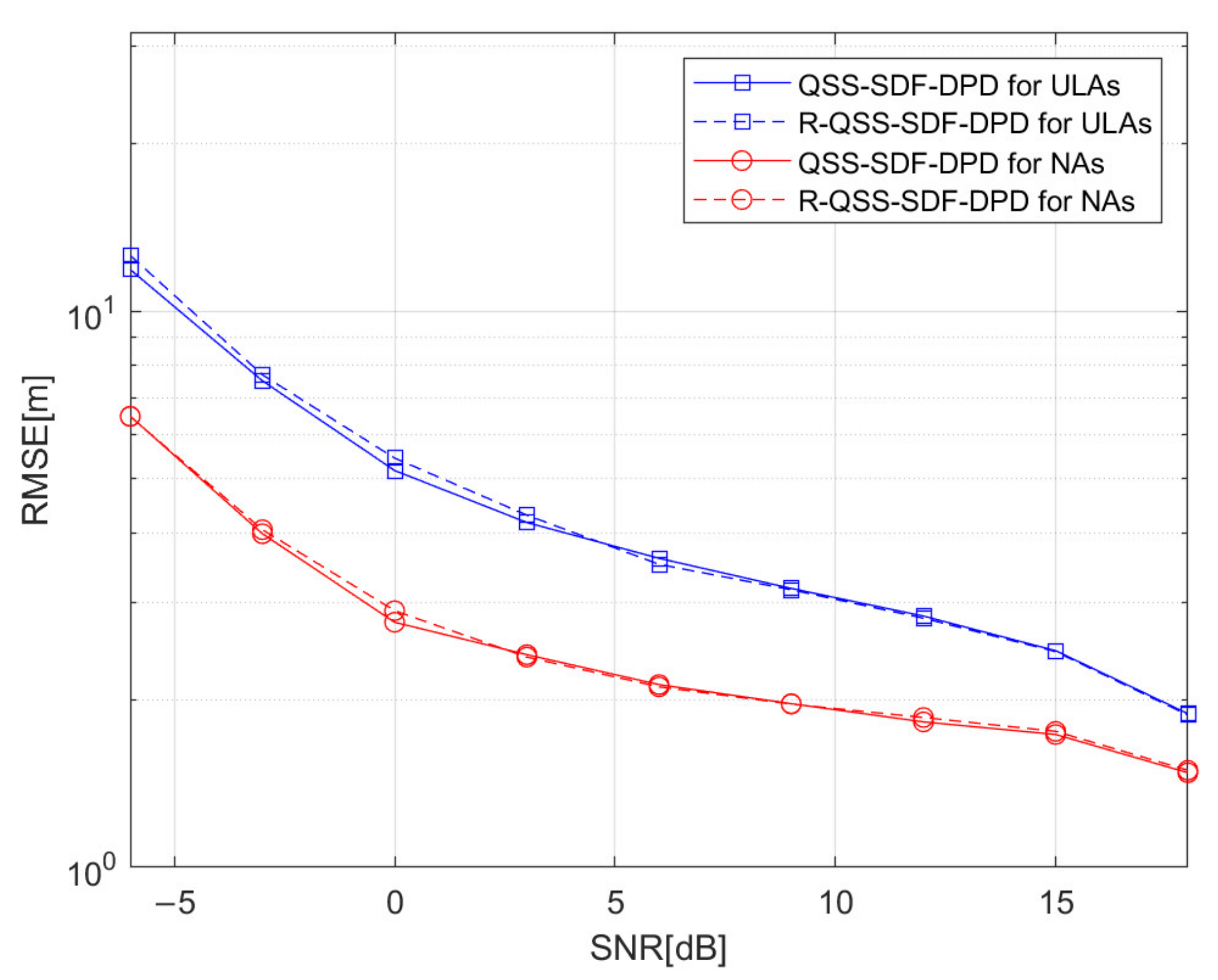
Figure 6 depicts the RMSE performance of algorithms versus SNR, where the R-QSS-SDF-DPD algorithm is compared to its version before matrix reconstruction (QSS-SDF-DPD). Here, we consider two conditions, where ULA and NA are deployed. The number of sources is set to
,
, and
; the number of base stations is
,
,
, and
. The structure of array is
for ULA, and
,
for NA. The number of frames is
, each frame consists of
snapshots, and the SNR varies from −6 dB to 18 dB.
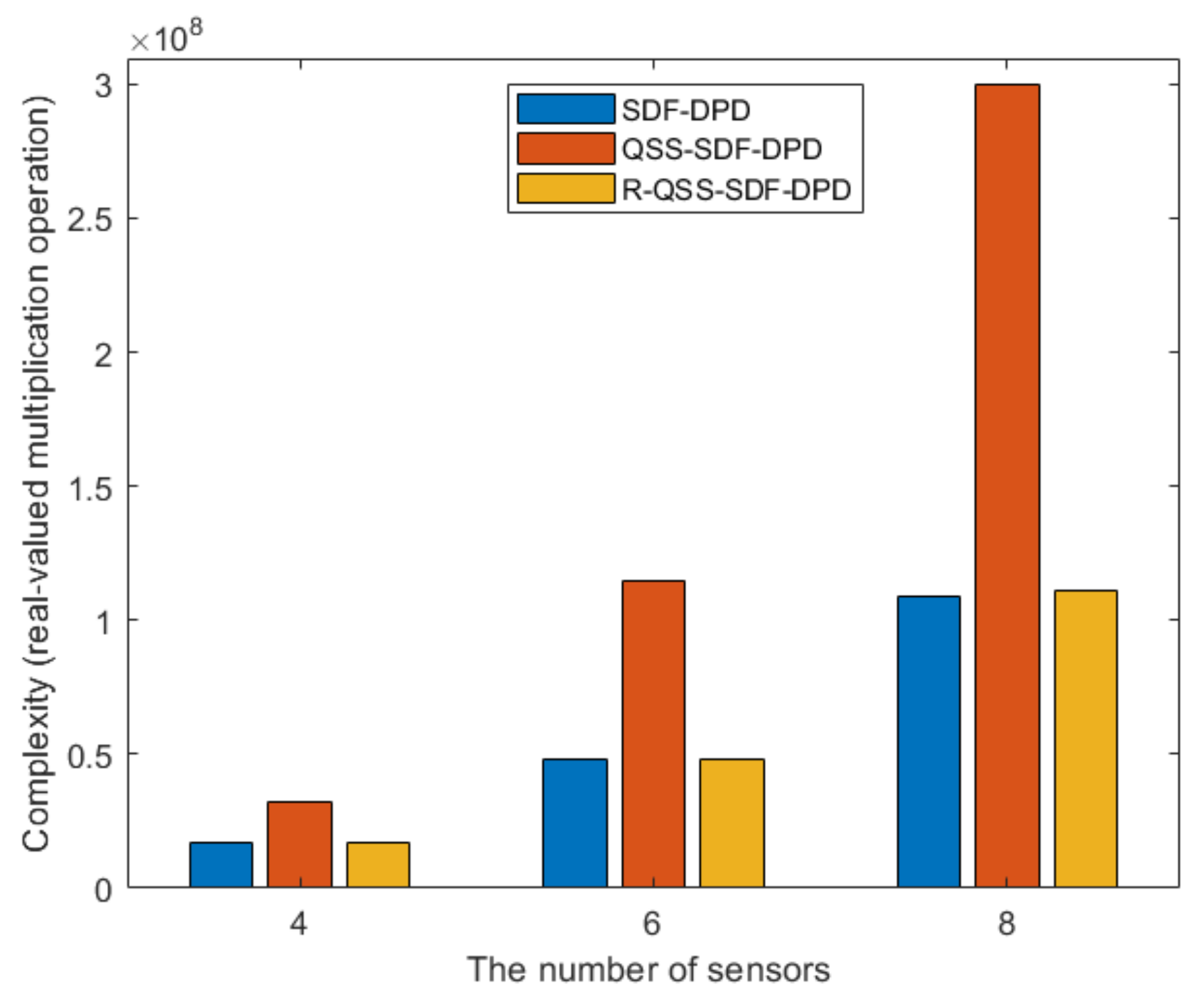
Figure 6 presents the results, in which the R-QSS-SDF-DPD algorithm performs almost the same as the QSS-SDF-DPD algorithm, but its complexity is much lower (as shown in
Figure 4). It means the proposed algorithm is more efficient, and more suitable for practical scenarios.
Simulation 3:
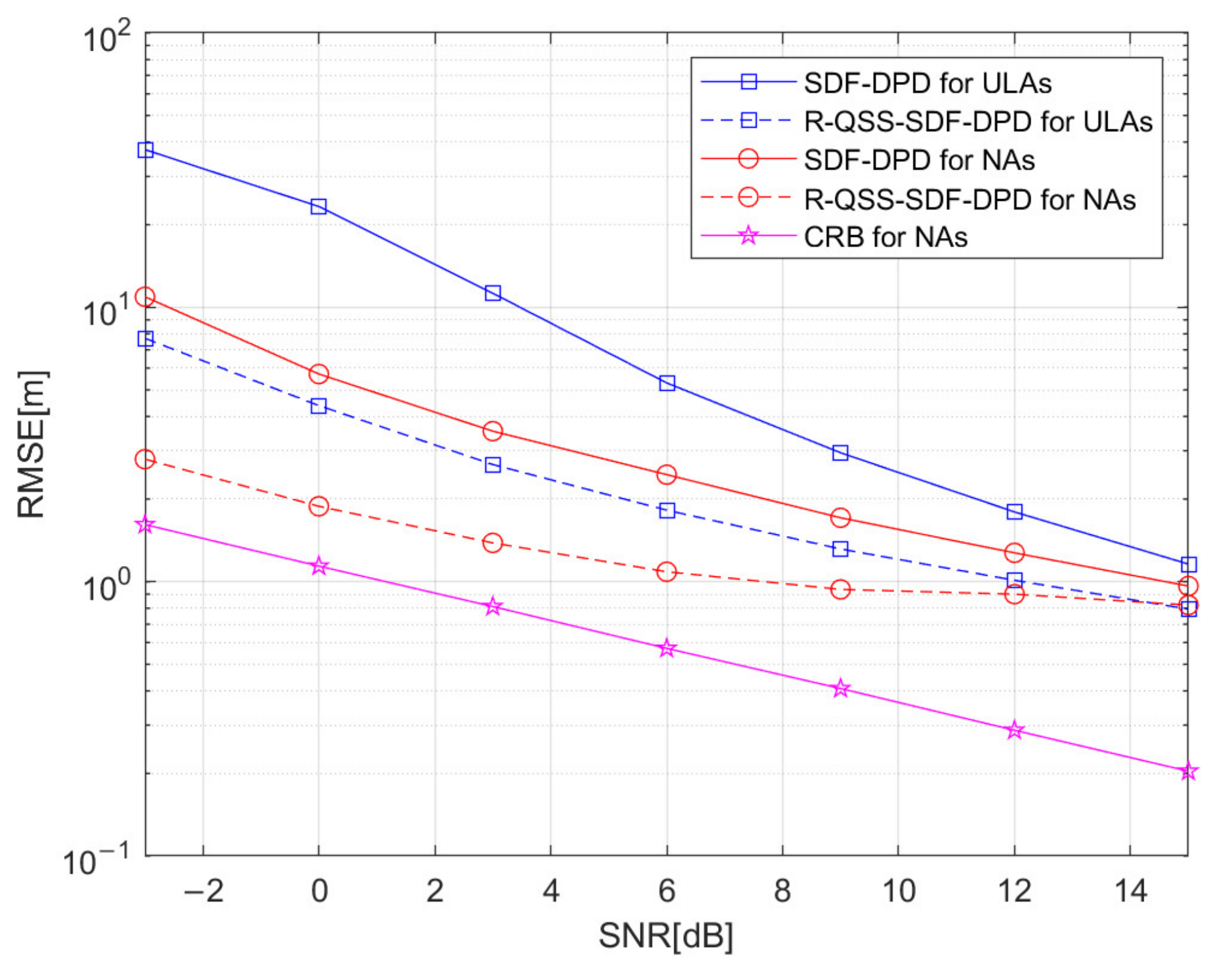
Figure 7 depicts the RMSE performance of algorithms versus SNR, where the R-QSS-SDF-DPD algorithm is compared with the SDF-DPD algorithm which ignores the features of QSS. In this simulation experiment, the number of sources is
,
, and
; the number of base stations is
,
,
, and
. The structure of the array is
for ULA and
,
for NA; the number of frames is
, each frame consists of
snapshots, and the SNR varies from −3 dB to 15 dB. The results, depicted in
Figure 7, corroborate that the R-QSS-SDF-DPD algorithm outperforms the SDF-DPD algorithm, whether ULA or NA is deployed. In particular, the R-QSS-SDF-DPD algorithm for NAs is the closest to the CRB, which benefits from the utilization of the QSS features, though a slightly higher complexity has been brought (according to
Figure 4).
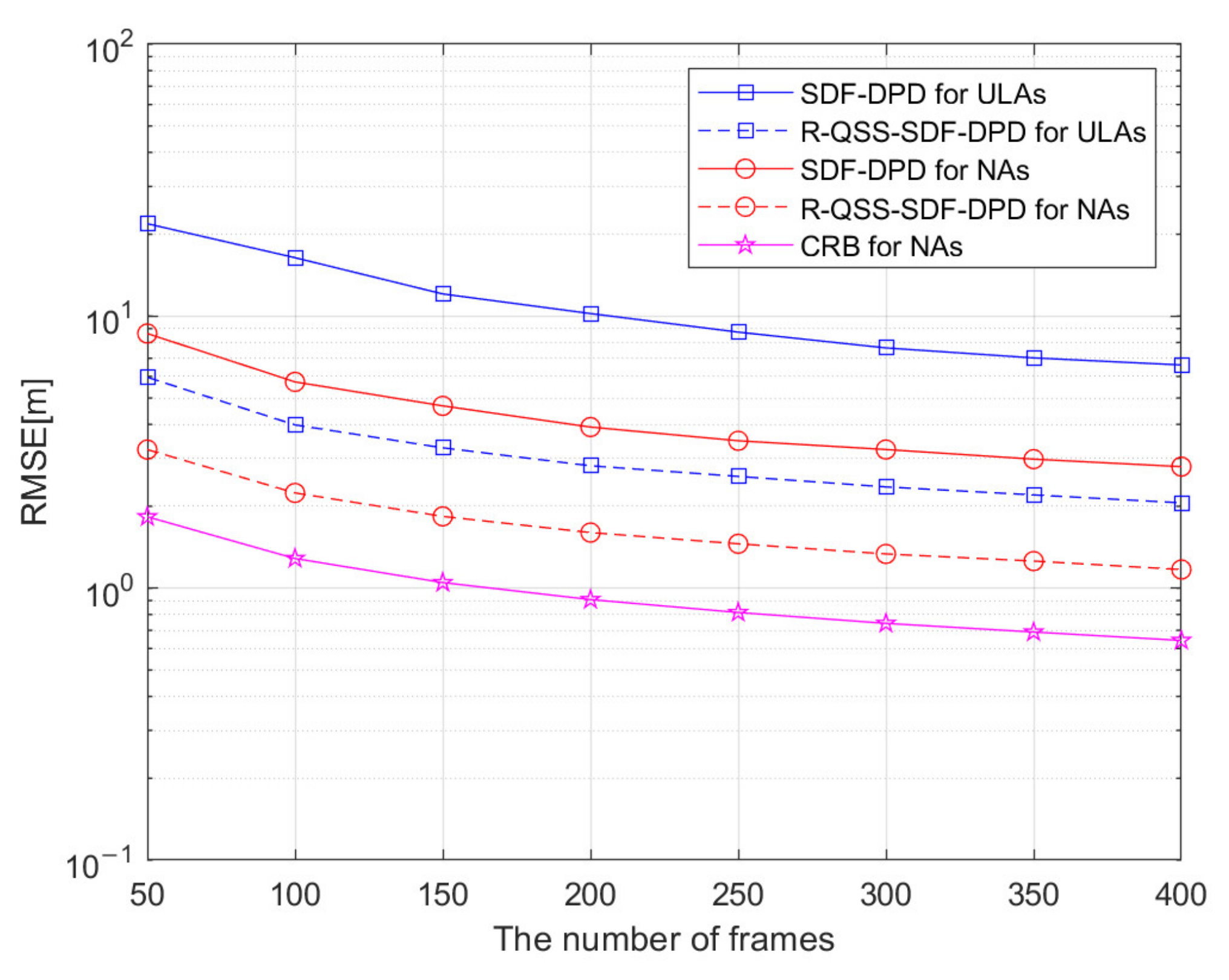
Simulation 4: Different from the last simulation, the function of RMSE versus the number of frames
is adopted in this simulation experiment. Except for the SNR, which is set to be 5 dB and with
varying from 50 to 400, the other parameters are the same as in simulation 3. As presented in
Figure 8, it can be found that all algorithms are positively affected by the number of frames, and the R-QSS-SDF-DPD algorithm always outperforms the SDF-DPD algorithm, which is consistent with the results in simulation 3.
Simulation 5:
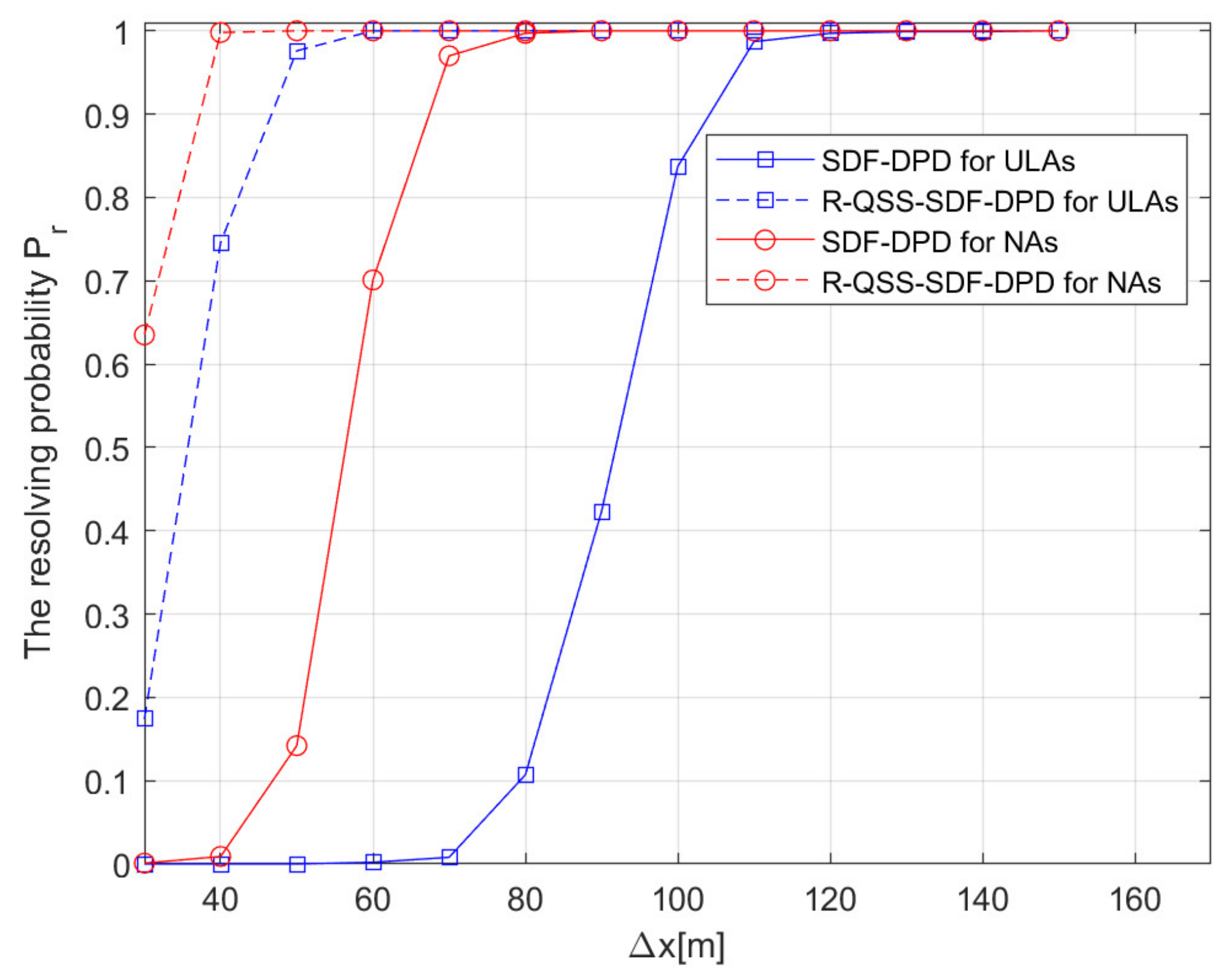
Figure 9 evaluates the resolving probability versus the distance between the two sources (
). The SNR is assumed to be 0 dB, and the number of frames is
, each frame consists of
snapshots; source 1 is located at
, and the other one is located at
, where
varies from 30 m to 150 m. The other parameters are the same as in simulation 3. The result in
Figure 9 demonstrates that the resolving probability of the R-QSS-SDF-DPD algorithm for NAs reaches 100% when
is only 50 m, while the SDF-DPD algorithm for NAs reaches 100% when
is 90 m. Obviously, the advantage of the R-QSS-SDF-DPD algorithm, in terms of sources resolution, has been verified.