Abstract
The demand of devices for safe mobility of blind people is increasing with advancement in wireless communication. Artificial intelligent devices with multiple input and output methods are used for reliable data estimation based on maximum probability. A model of a smart home for safe and robust mobility of blind people has been proposed. Fuzzy logic has been used for simulation. Outputs from the internet of things (IoT) devices comprising sensors and bluetooth are taken as input of the fuzzy controller. Rules have been developed based on the conditions and requirements of the blind person to generate decisions as output. These outputs are communicated through IoT devices to assist the blind person or user for safe movement. The proposed system provides the user with easy navigation and obstacle avoidance.
1. Introduction
The implementation of public health awareness has reduced the blindness cases due to diseases. But unfortunately, the rate of blindness in elderly people is high and increasing. These people need devices to assist them in navigation. This has increased the demand for assistive devices for navigation and orientation. The tools that are already available cannot provide all the information for safe mobility [1,2,3]. Vision substitution devices include three categories to improve blind people’s mobility. Each category slightly differs in features and actions from the other. The first category includes travel aids, which are the electronic devices that provide the user with information about the surroundings. This information helps the user develop a mental map for safe mobility. The second category includes orientation-based aids that provide the user with mobility instructions in unfamiliar places by defining and tracing the best route. Electronic devices in the third category are the position-based locators that use the global positioning system (GPS) technology to precisely locate the user. According to the needs of the user, the system or devices must have fast processing, large coverage with increased range detection of static and dynamic obstacles, and capacity to work equally well in day and night [4].
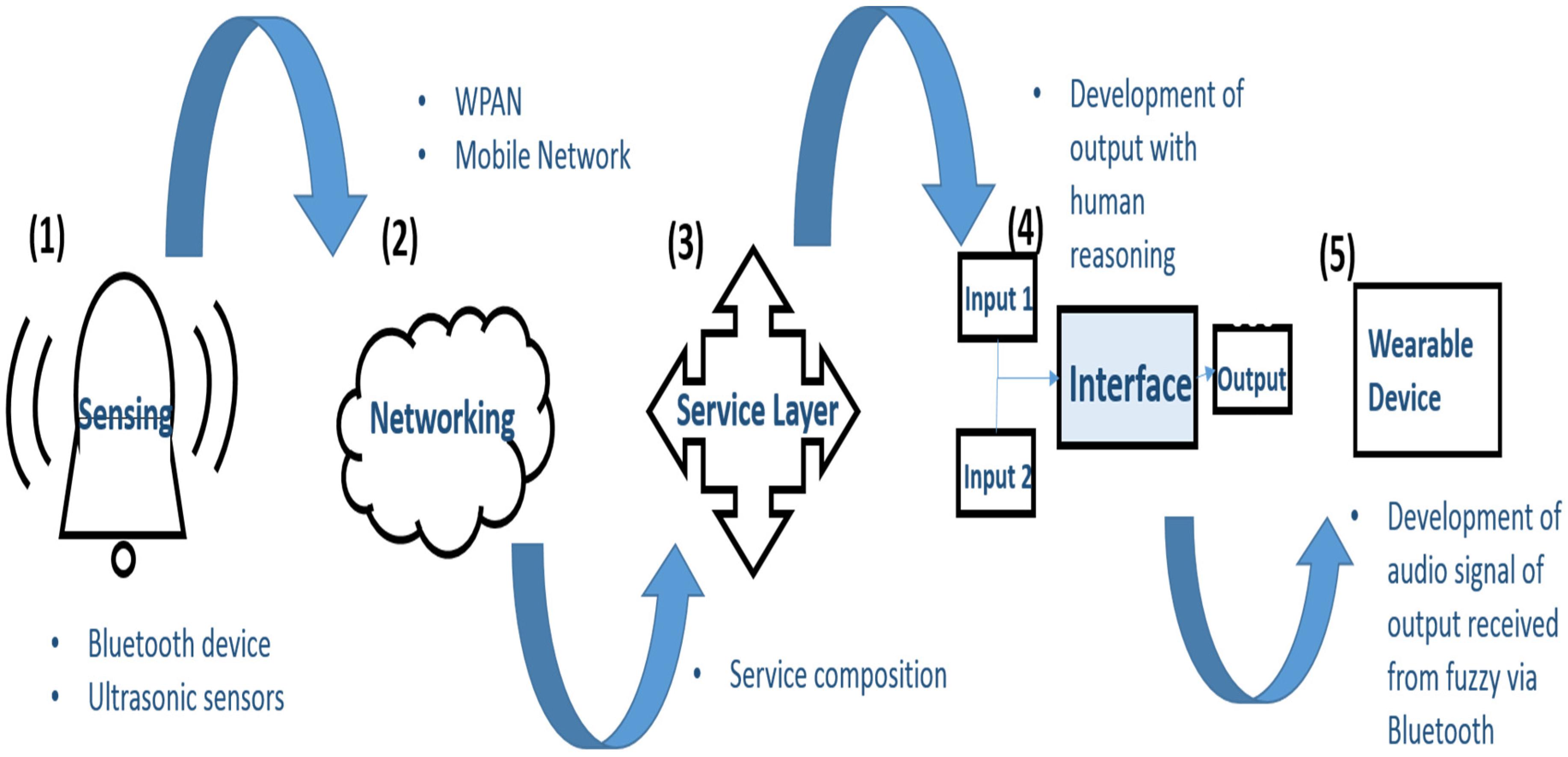
In the present era, wireless communication with wireless channels is a rapidly growing branch of technology. However, with such an emerging field, fast technological advances and developments are essential. Modern communication provides a wide range of services including data, voice, and multimedia, but the main issue in the communication field is to improve channel capacity. The channel capacity without interrupting the service quality can be enhanced by using multiple input and multiple output methods. It is one of the latest technologies and the estimation of data with this technology is done on the basis of maximum probability [5,6,7,8]. Bluetooth technology and ultrasonic sensors can be used in modern technology with the ability to communicate along with direct access to the fixed infrastructure. The sensors can sense any obstacles or deviations that may be static or dynamic. With the help of a navigation system, the target can be located easily [9]. Utilization of IoT-based devices has various advantages to be used in emerging technologies. Efficacy, compatibility, and consistency on a global scale result in the success of IoT. A combination of various technologies along with software can result in a hybrid system with applications in various fields of interest in communication [10,11].
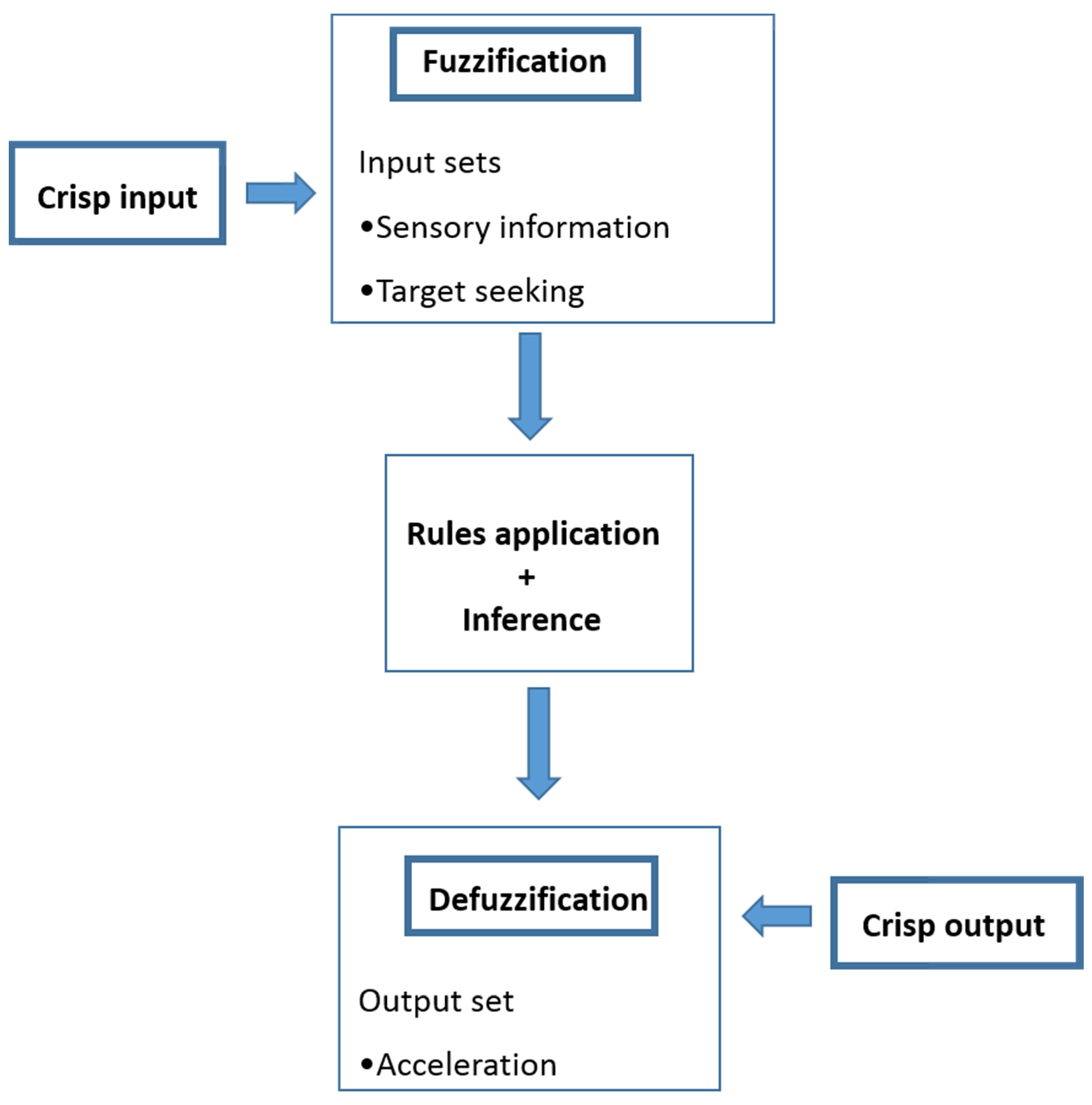
In behavior-based navigation, each behavior develops sensory information and transforms it into a response. The problem with such a system is that several commands may be produced simultaneously with multiple behaviors, which may cause the system to fail, while fuzzy control systems are based on IF-THEN rules [12]. The implementation of fuzzy-based methods in the case of adaptive techniques provides the fast convergence and reduced complexity in conditions that are nonlinear and vary with time. A fuzzy approach is highly suitable for the incorporation of human expert knowledge to balance already-available numerical data. Amongst several artificial intelligence techniques, fuzzy logic is considered a useful tool in the navigation control system for its linguistic terms and reliable decision-making capability without precise information of the surroundings. It utilizes human reasoning and decision making for reliable navigation in a dynamic environment with unknown obstacles [12,13]. Two factors are crucial for the safe mobility of blind people, which are path tracking and obstacle avoidance. Fuzzy logic can be used for the development of such systems.
A variety of studies have been carried out on fuzzy logic to develop path tracking for vehicles, adjust speed and direction of vehicles according to present and future path information, designing and implementation of path tracking in indoor environment, autonomous path following, obstacle avoidance by taking distance, and change in distance from the obstacle as input parameters. The output parameter in these cases is the speed of the obstacle. A comparison of obstacle avoidance by mobile robots with Sugeno and Mamdani fuzzy logic controller have also been reported. Additionally, for obstacle detection, ultrasonic as well as infrared (IR) sensors have been widely used in literature. IR sensors are based on sound sensor and cannot operate under dark condition, whereas ultrasonic sensors have linear output characteristics and can detect all types of obstacles [14,15,16,17,18,19,20,21,22].
In this research work, the crucial parameters for the safe mobility of blind people have been considered using an IoT-based system for a smart home model. Using fuzzy logic controller, a reliable device for obstacle avoidance, whether static or dynamic, along with target tracking has been proposed. Fuzzy-based simulation has been verified with Mamdani model calculations for result comparisons and optimizations.
3. Simulation and Results
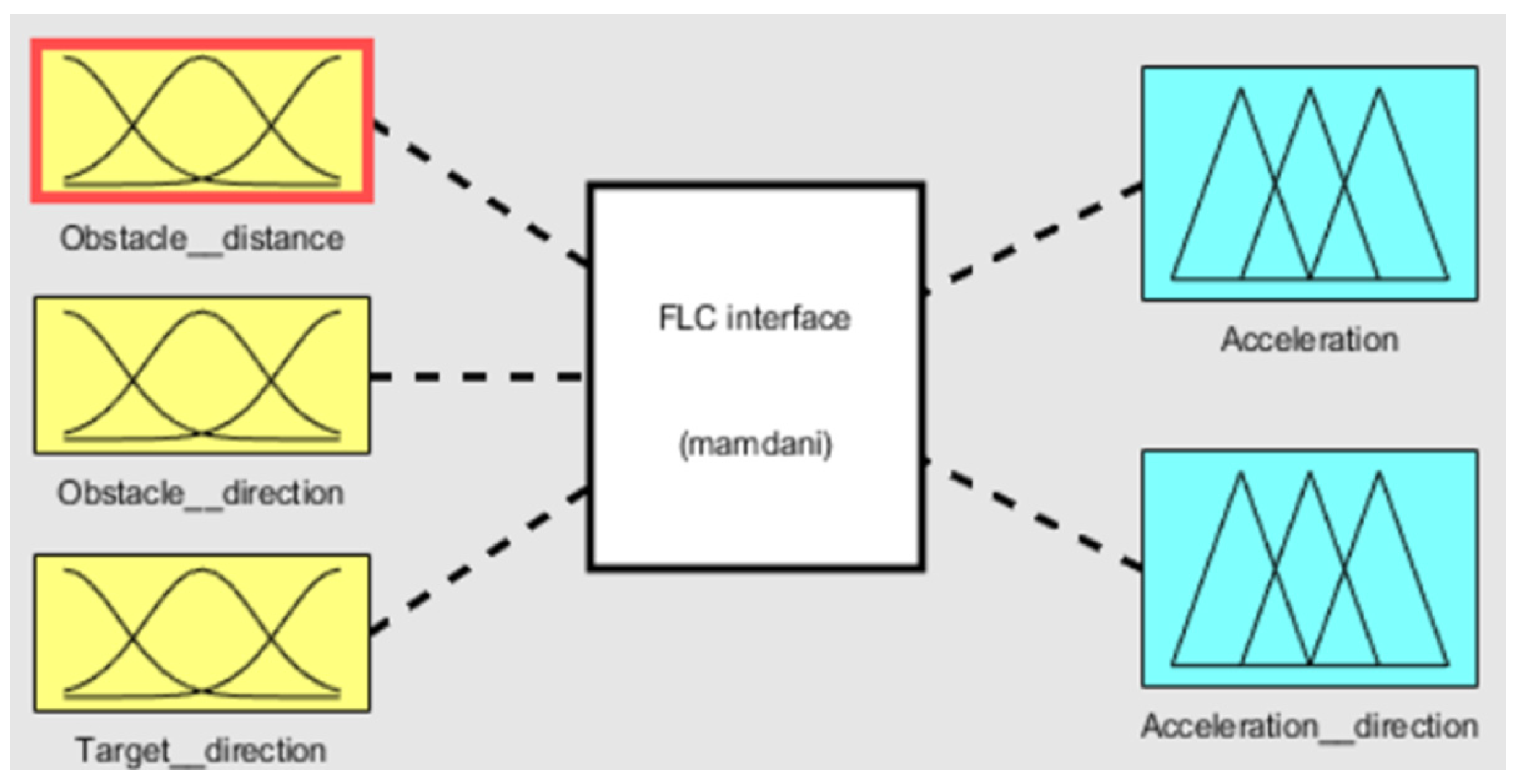
Three parameters are selected as input variables with two corresponding outputs. Obstacle distance, obstacle direction, and target direction are the three inputs in the FLC interface with acceleration and direction of acceleration as output. Figure 4 shows the fuzzy interface using Mamdani’s model [25] with input and output parameters.
Figure 4.
Fuzzy interface with three inputs and two outputs.
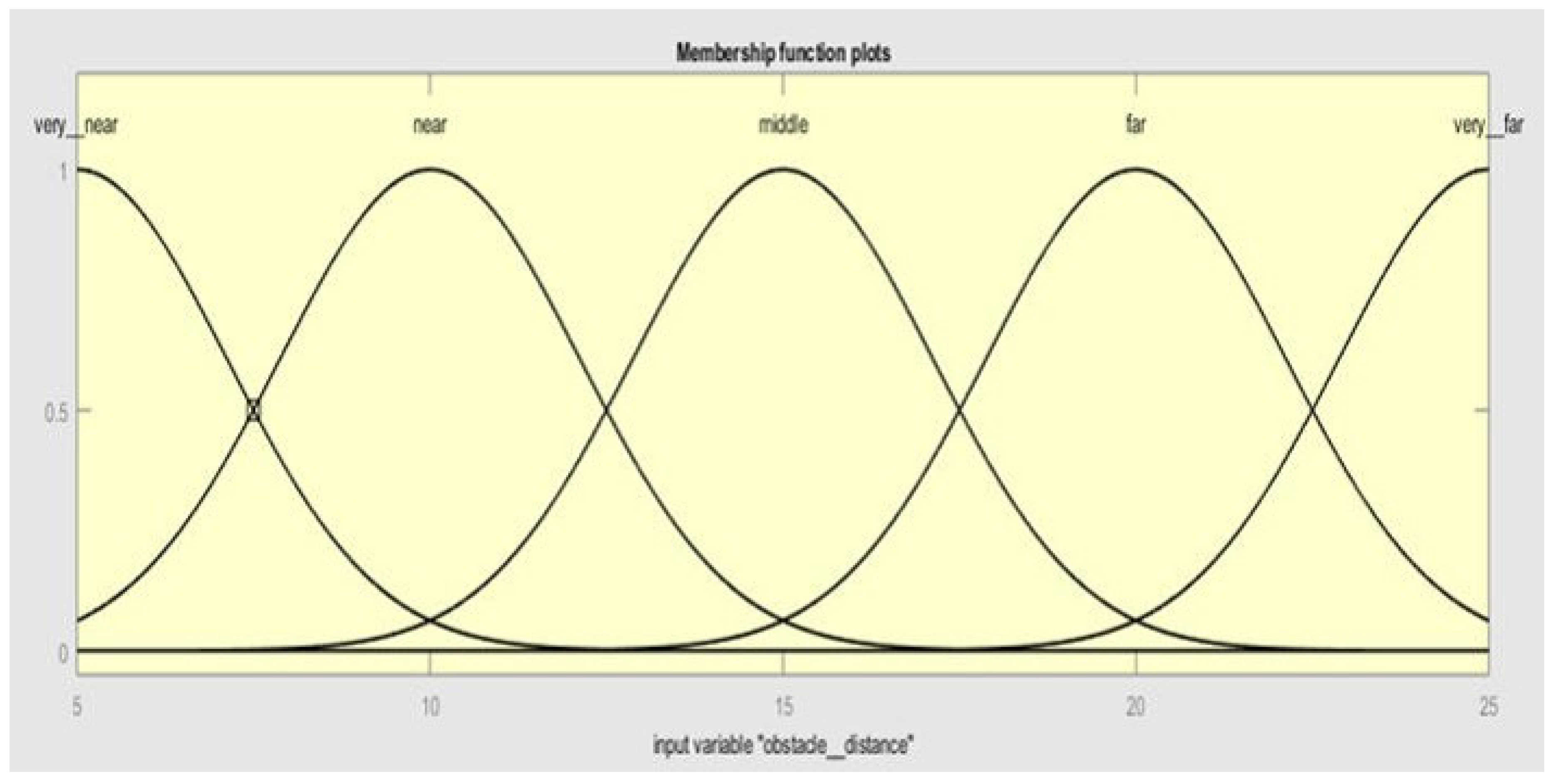
Five membership functions are selected for obstacle distance. As shown in Figure 5, the membership functions are very__near, near, middle, far, and very__far.
Figure 5.
Membership functions for input 1 (obstacle distance).
First of all, the location of the user is determined and then the distance from obstacles and targets will be calculated. The values for the inputs are given by Equation (5).
where represents the distance between two points, is the change in the coordinate, and is the change in the coordinate.
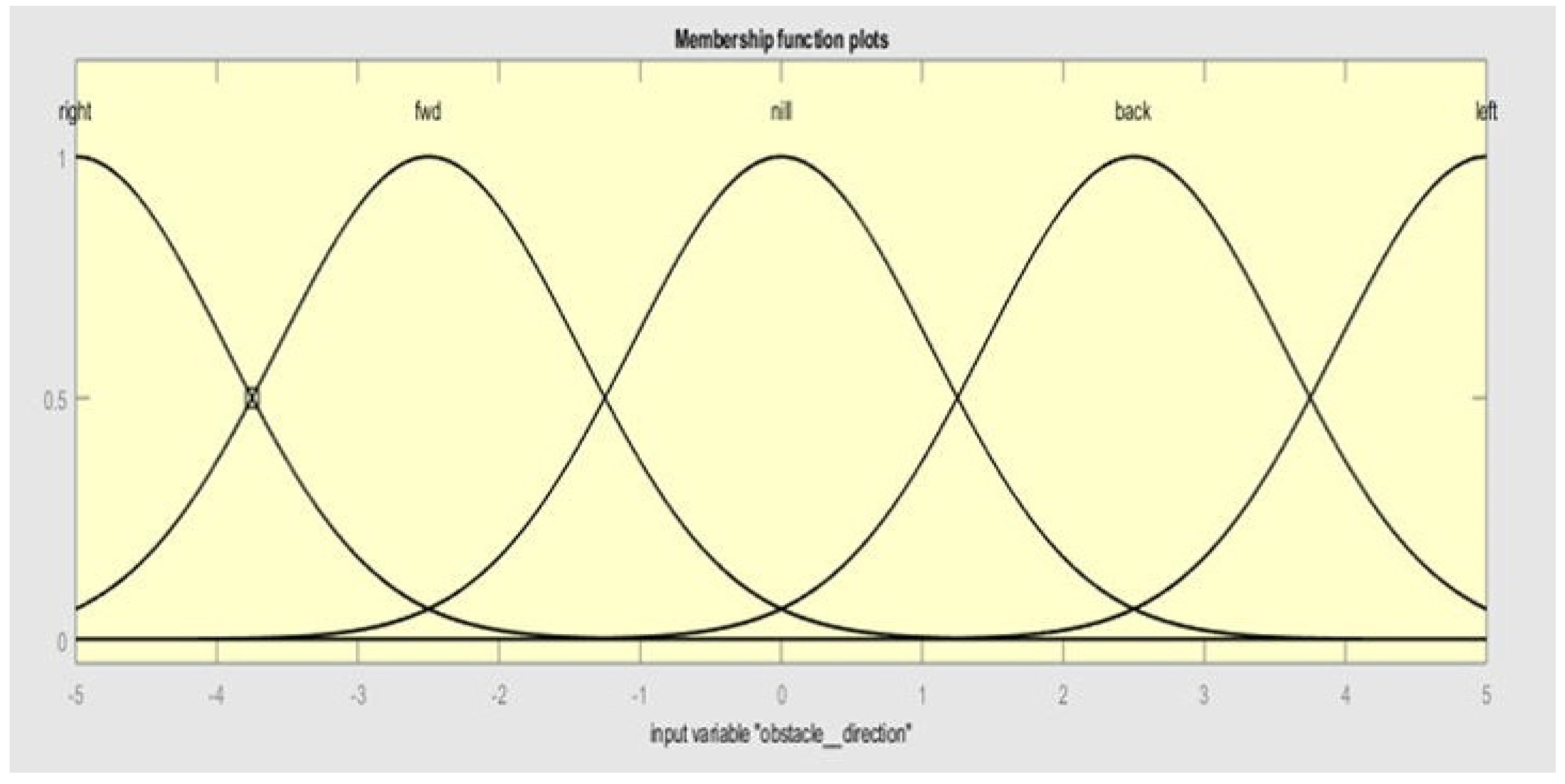
OR, AND, and NOT connectives are normally used for fuzzy compound preposition. OR represents union, AND represents intersection, and NOT is complement. If variables for obstacle distance, obstacle direction, target direction, acceleration, and acceleration direction are represented by OD, ODir, TD, A, and AD, then the preposition for fuzzy is represented by T: OD × ODir × TD = A, AD. Similarly five membership functions of input 2 (obstacle direction) are right, fwd, nill, back, and left, as shown in Figure 6.
Figure 6.
Membership functions of input 2 (obstacle direction).
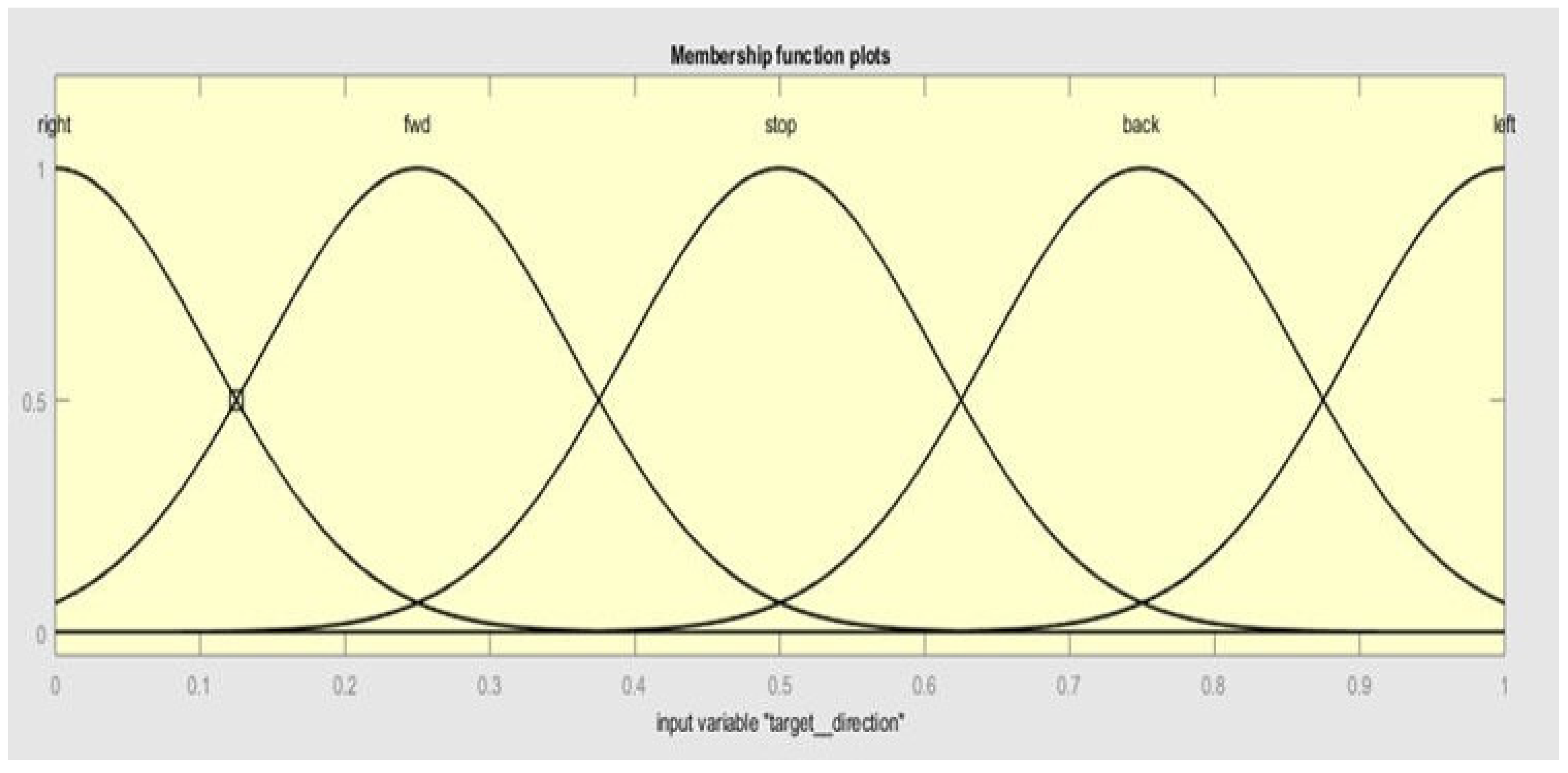
Finally, for input 3 (target direction), the membership functions are taken as right, fwd, stop, back, and left, as shown in Figure 7.
Figure 7.
Membership functions of input 3 (target direction).
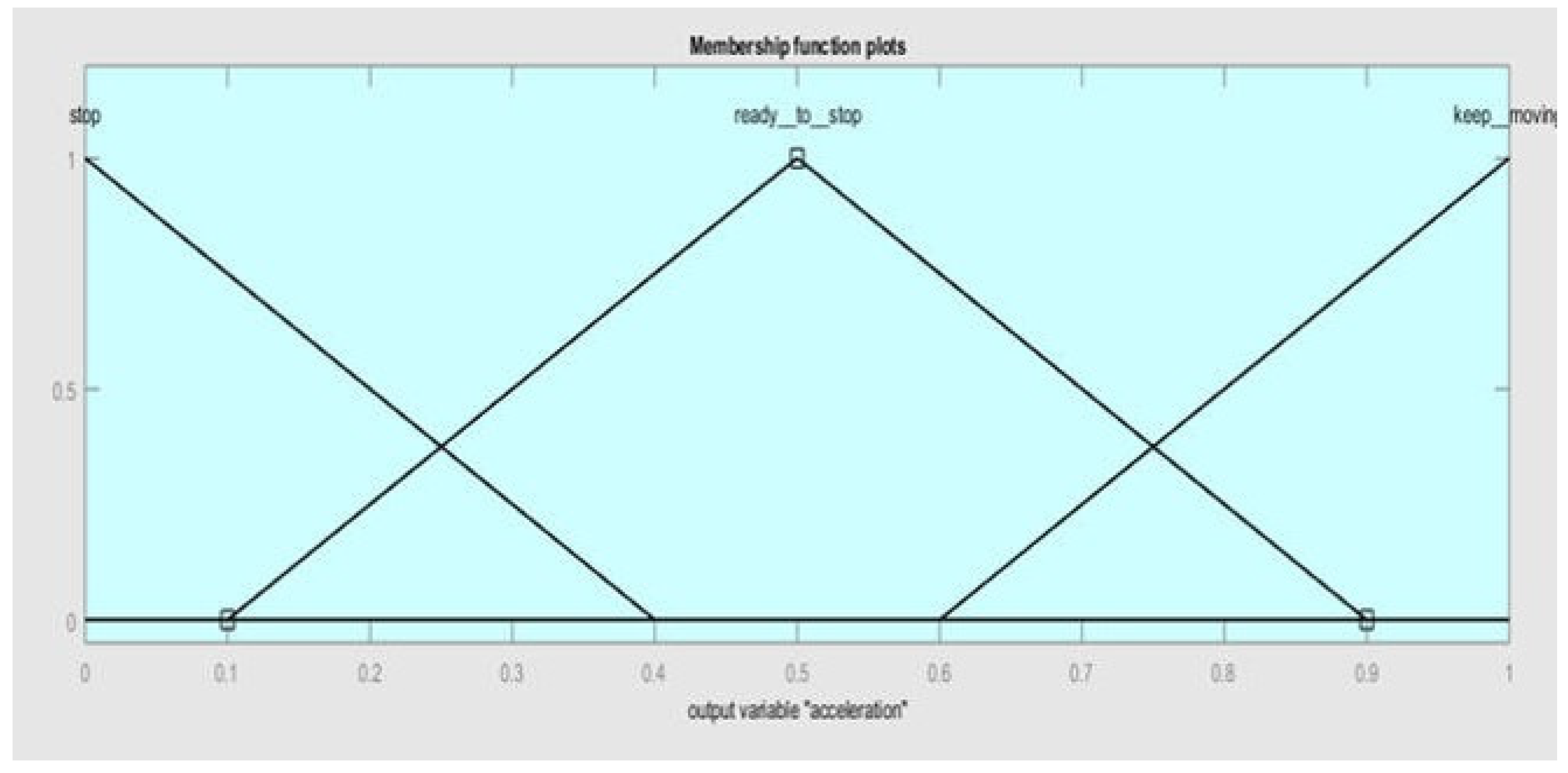
The membership functions for output 1 (acceleration) are stop, ready__to__stop, and keep__moving, as shown in Figure 8.
Figure 8.
Membership functions of output 1 (acceleration).
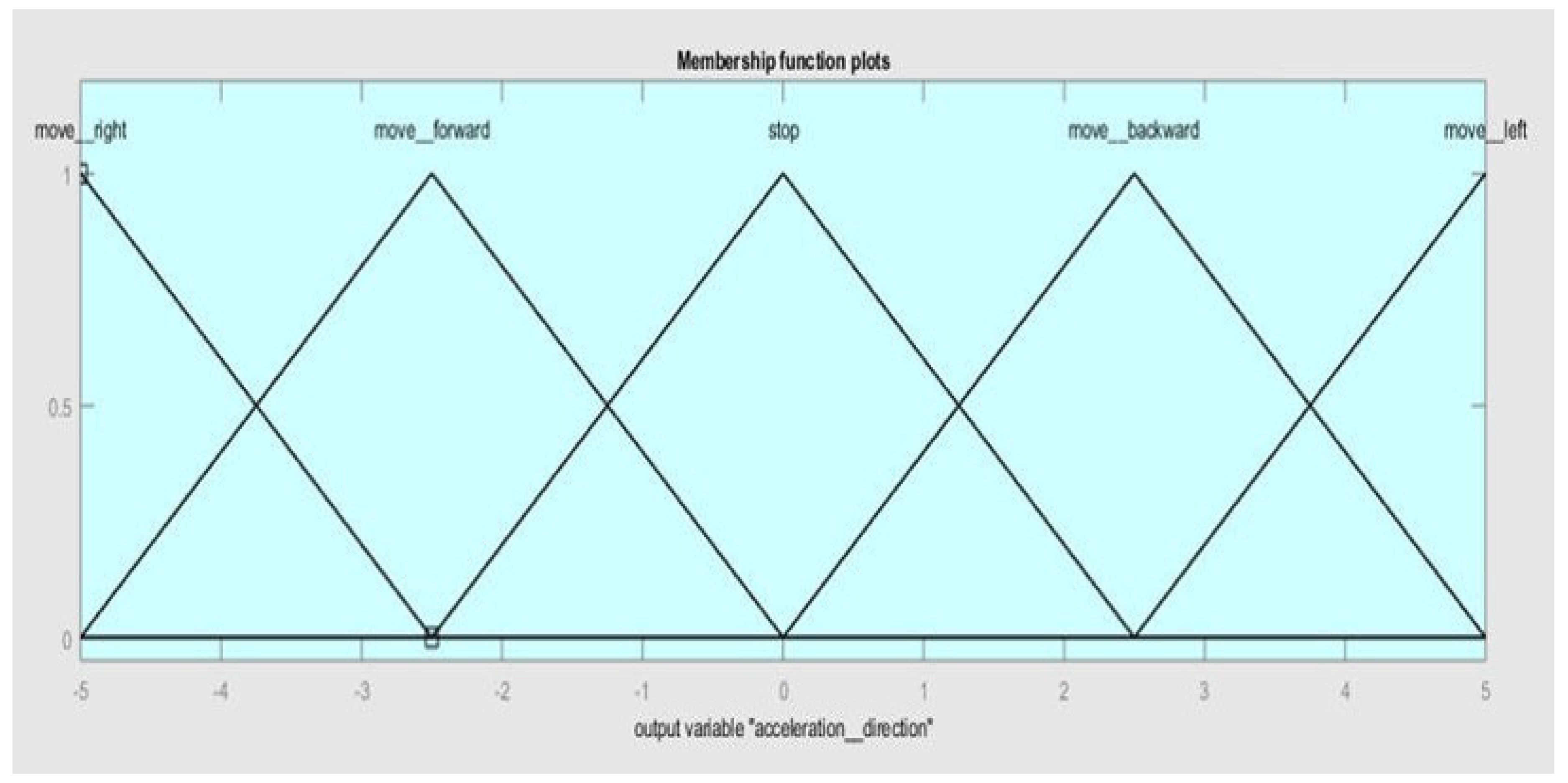
Finally, the membership functions for output 2 (acceleration direction) are move__right, move__forward, stop, move__backward, and move__left, as given in Figure 9.
Figure 9.
Membership functions of output 2 (acceleration direction).
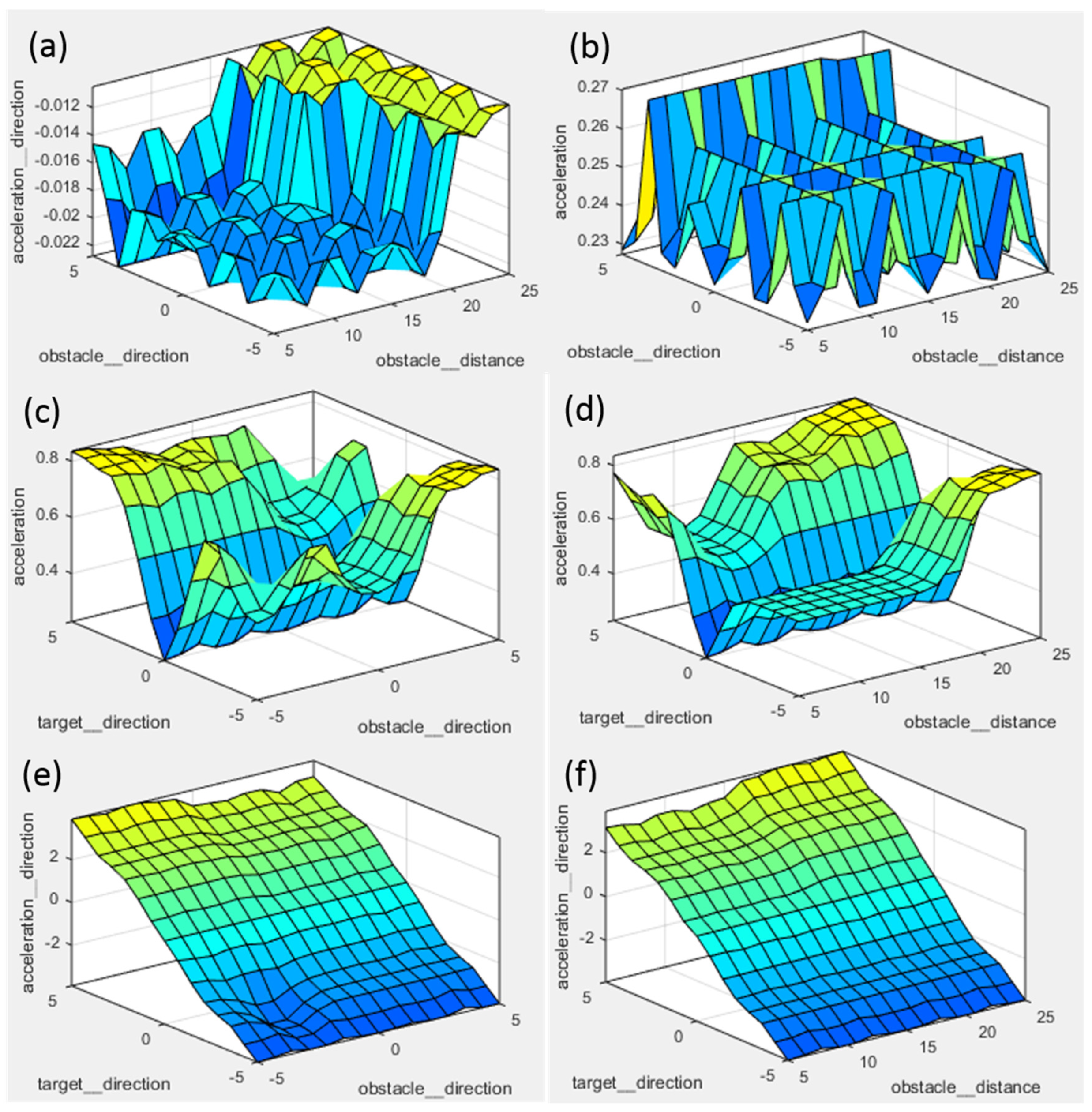
As all three inputs have five membership functions, therefore, the rules for the output generated will be calculated as 5 × 5 × 5 = 125 using the Mamdani model formula. Therefore, 125 rules are generated using an IF and THEN formulation. For example, IF obstacle distance is very far and obstacle direction is left and the target direction is right, THEN acceleration is keep moving and acceleration direction is right. For decision making, the priority is given to the safety of the user. The three-dimensional graphs of the two inputs with different combinations are plotted against the two outputs, as shown in Figure 10.
Figure 10.
3D graphs for inputs and outputs. (a) obstacle direction, obstacle distance versus acceleration direction; (b) obstacle direction, obstacle distance versus acceleration; (c) target direction, obstacle direction versus acceleration; (d) target direction, obstacle distance versus acceleration; (e) target direction, obstacle direction versus acceleration direction; and (f) target direction, obstacle distance versus acceleration direction.
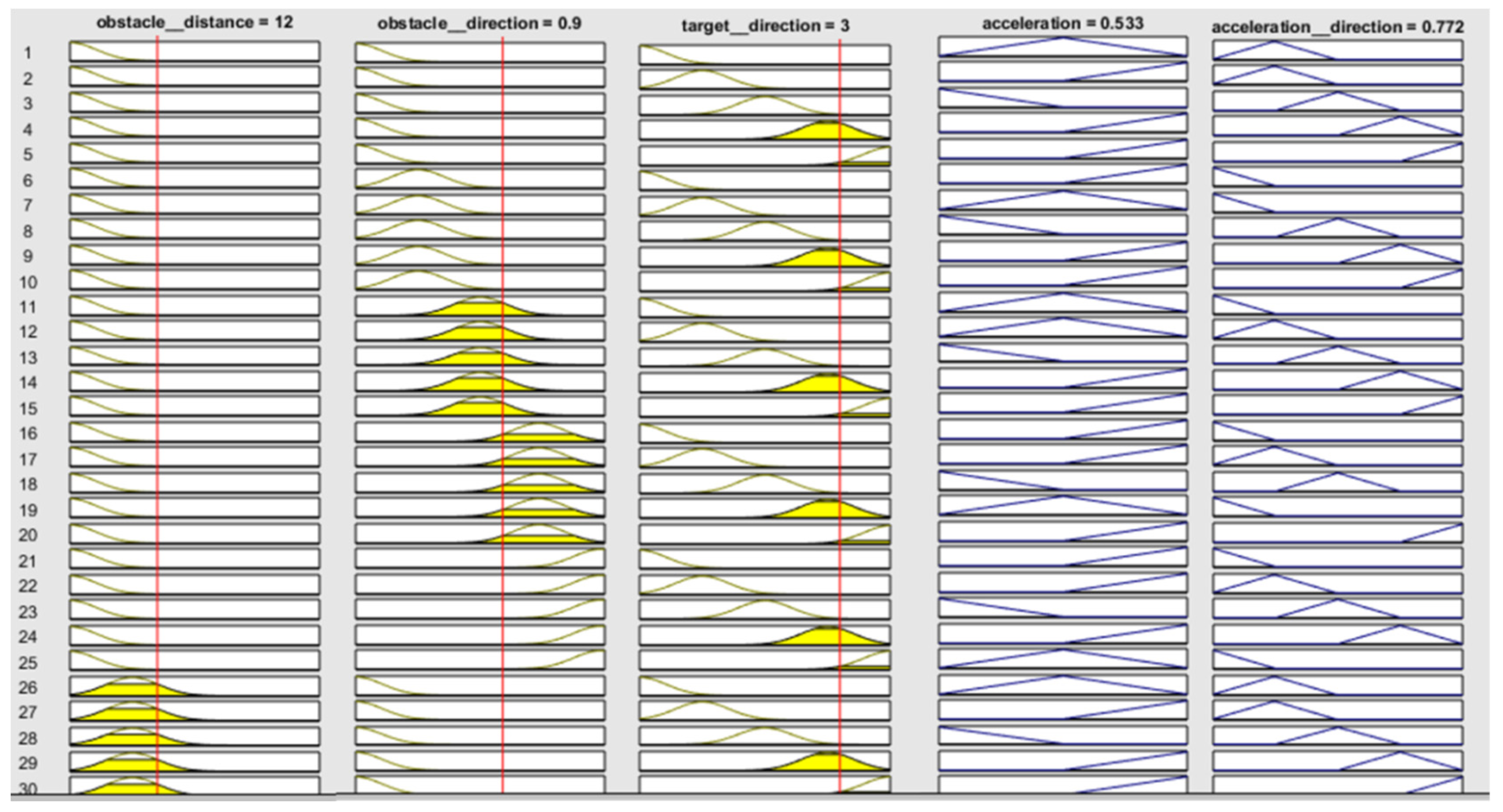
Mamdani’s model has been used for error estimation and comparison of simulation results. Rule viewer graph is shown in Figure 11. From this rule viewer, fuzzy values are selected and further calculations are done.
Figure 11.
Rule viewer plot.
Fuzzy values for all the three inputs are selected. For obstacle distance, the value selected is 12, for obstacle direction, the value is 0.9, and for target selection, the value is 3. After that, the values of membership functions are calculated with the help of Mamdani’s model by the Equations (6) and (7).
are calculated as: max value of input 1—crisp value/max value.
Similarly, the values for are calculated as 0.82, 0.18, 0.4, and 0.6, using maximum value and crisp value for input 2 and input 3, respectively. For calculation of outputs acceleration and acceleration direction, Table 1 and Table 2 are presented with some suitable rules.
Table 1.
Calculations for acceleration.
Table 2.
Calculations for acceleration direction.
The singleton values are calculated by dividing the output values corresponding to selected input values by 100.
The Mamdani model is implemented here and represented in Equation (8).
By using the above formula, calculations have been performed for the minimum singleton values and we calculated , using . The simulated MATLAB value is 0.53. The same has been done for output 2 (acceleration direction). It has been found that the minimum and singleton values are , respectively. The Mamdani expression becomes and the simulated MATLAB value is 0.77.
From the above results, it is clear that the simulated values and calculated values based on the Mamdani model are very close. Hence, IoT-based systems are useful with the fuzzy-based approach to assist blind people for safe movement in a smart home [26,27]. The presented work would provide handy information for the development of a real-time efficient and reliable system for people who cannot survive independently in normal circumstances with ease. In a future work, the implementation of this model will be performed by considering additional vibrational signals, electronic circuits, and IoT device integration. With some extension, the system can be used to provide support to the deaf person, for ease in navigation and communication.
4. Conclusions
Here, a model for smart home using the IoT system is proposed. The IoT system comprising sensors and antennas generates warning signals about the obstacles in the way of users and also navigates the user to move around the house safely. The outputs from the IoT system are used as inputs in the FLC. Thus, in case of multiple behavior inputs, the decision is made with human reasoning and on the basis of likelihood. Fuzzy-based simulation has been carried out. Calculated results are compared with simulated values. It shows accurate processing of data, reliability, and mobility of the blind user indoor.
Author Contributions
Conceptualization, S.T., M.W.A., T.A. and Z.A.; Data curation, Z.A. and S.M.; Formal analysis, S.T., M.W.A., T.A., Z.A. and S.M.; Investigation, S.T., M.W.A., T.A., Z.A. and S.M.; Methodology, S.T., M.W.A., T.A. and Z.A.; Resources, Z.A.; Software, S.T., M.W.A. and S.M.; Supervision, M.W.A.; Validation, S.T.; Visualization, Z.A. and M.W.A.; Writing—original draft, S.T. and S.M.; Writing—review & editing, M.W.A., Z.A. and T.A. All authors have read and agreed to the published version of the manuscript.
Funding
The authors are thankful to the Center for Advanced Materials (CAM), Qatar University for the support during this work.
Conflicts of Interest
The authors declare no conflicts of interest.
References
- Velázquez, R. Wearable and Autonomous Biomedical Devices and Systems for Smart Environment; Wearable Assistive Devices for the Blind; Springer: Berlin/Heidelberg, Germany, 2010; pp. 331–349. [Google Scholar]
- Baldwin, D. Wayfinding technology: A road map to the future. J. Vis. Impair. Blind. 2003, 97, 612–620. [Google Scholar] [CrossRef]
- Shah, C.; Bouzit, M.; Youssef, M.; Vasquez, L. Evaluation of RUNetra tactile feedback navigation system for the visually-impaired. In Proceedings of the International Workshop on Virtual Rehabilitation, New York, NY, USA, 29–30 August 2006; pp. 72–77. [Google Scholar]
- Elmannai, W.; Elleithy, K. Sensor-Based Assistive Devices for Visually-Impaired People: Current Status, Challenges, and Future Directions. Sensors 2017, 17, 565. [Google Scholar] [CrossRef] [PubMed]
- Abdelkader, T.; Mokhtar, K.; Abdelaziz, O. New space time coding for joint blind Channel Estimation and Data Detection through time varying MIMO channels. Int. J. Comput. Sci. Issues 2014, 11, 33–38. [Google Scholar]
- Abuthinien, M.; Chen, S.; Wolfgang, A.; Hanzo, L. Joint maximum likelihood channel estimation and data detection for MIMO systems. In Proceedings of the IEEE International Conference on Communications, 2007. ICC’07, Glasgow, UK, 24–28 June 2007; pp. 5354–5358. [Google Scholar]
- Mezghani, A.; SwindleHurst, A.L. Blind estimation of sparse multi-user massive MIMO channels. In Proceedings of the 21th International ITG Workshop on Smart Antennas, Berlin, Germany, 15–17 March 2017; pp. 2–6. [Google Scholar]
- Seyman, M.N.; Taspinar, N. Symbol detection using the differential evolution algorithm in MIMO-OFDM systems. Turk. J. Electr. Eng. Comput. Sci. 2013, 21, 373–380. [Google Scholar]
- Mahdi Safaa, A.; Muhsin Asaad, H.; Al-Mosawi Ali, I. Using Ultrasonic Sensor for Blind and Deaf persons Combines Voice Alert and Vibration Properties. Res. J. Recent Sci. 2012, 1, 50–52. [Google Scholar]
- Li, S.; Tryfonas, T.; Li, H. The Internet of Things: A security point of view. Internet Res. 2016, 26, 337–359. [Google Scholar] [CrossRef]
- Li, S.; Xu, D.; Zhao, S. The Internet of Things: A Survey. Inf. Syst. Front. 2015, 17, 243–259. [Google Scholar] [CrossRef]
- Hong, T.S.; Nakhaeinia, D.; Karasafi, B. Application of Fuzzy Logic in Mobile Robot Navigation. In Book Fuzzy Logic- Controls, Theories and Applications; Dadios, E., Ed.; InTech: Shanghai, China, 2012; ISBN 978-953-51-0396-7. [Google Scholar]
- Erman, M.; Mohammad, A.; Rakus-Edndersson, E. Fuzzy Logic Applications in Wireless Communications. In Proceedings of the Joint 2009 International Fuzzy Systems Association World Congress and 2009 European Society of Fuzzy Logic and Technology Conference, Lisbon, Portugal, 20–24 July 2009. [Google Scholar]
- Xiong, B.; Shiru, Q.U. Intelligent Vehicle’s Path Tracking Based on Fuzzy Control. J. Transp. Syst. Eng. Inf. 2010, 10, 70–75. [Google Scholar] [CrossRef]
- Ali, B.; Ashraf, M.W.; Tayyaba, S. Simulation, Fuzzy Analysis and Development of ZnO Nanostructure-based Piezoelectric MEMS Energy Harvester. Energies 2019, 12, 807. [Google Scholar] [CrossRef]
- Liao, Y.; Huang, J.; Zeng, Q. Preview fuzzy control method for intelligent vehicle path tracking. In Proceedings of the IEEE International Conference on Informatics and Computing (PIC), Shanghai, China, 10–12 December 2010; pp. 1211–1214. [Google Scholar]
- Omrane, H.; Masmoudi, M.S.; Masmoudi, M. Fuzzy Logic Based Control for Autonomous Mobile Robot Navigation. Comput. Intell. Neurosci. 2016, 2016, 9548482. [Google Scholar] [CrossRef]
- Ghaffari, S.; Homaeinezhad, M.R. Autonomous path following by fuzzy adaptive curvature-based point selection algorithm for four-wheel-steering car-like mobile robot. Res. Artic. Artic. Inf. 2018, 232, 2655–2665. [Google Scholar] [CrossRef]
- Tayyaba, S.; Afzal, M.J.; Sarwar, G.; Ashraf, M.W.; Afzulpurkar, N. Simulation of flow control in straight microchannels using fuzzy logic. In Proceedings of the 2016 International Conference on Computing, Electronic and Electrical Engineering (ICE Cube), Quetta, Pakistan, 11–12 April 2016; pp. 213–216. [Google Scholar] [CrossRef]
- Ali, B.; Tayyaba, S.; Ashraf, M.W.; Nawaz, M.W.; Mushtaq, M.T.; Akhlaq, M.; Wasim, M.F. Fuzzy Simulation, Synthesis, Characterization and Voltage Measurements of Zinc Oxide Nano-Rods Based Nanogenerators. Dig. J. Nanomater. Biostructures 2020, 15, 289–297. [Google Scholar]
- Karakaya, S.; Ocak, H. Fuzzy logic-based moving obstacle avoidance method. Glob. J. Comput. Sci. Theory Res. 2019, 9, 1–9. [Google Scholar] [CrossRef]
- Ilyana, N.; Apandi, A.; Martin, A. The Integration of Fuzzy Logic System for Obstacle Avoidance Behavior of Mobile Robot. Int. J. Electr. Eng. Appl. Sci. 2019, 2, 31–38. [Google Scholar]
- Yamamoto, B.; Wong, A.; Agcanas, P.J.; Jones, K.; Gaspar, D.; Andrade, R.; Trimble, A.Z. Received Signal Strength Indication (RSSI) of 2.4 GHz and 5 GHz Wireless Local Area Network Systems Projected over Land and Sea for Near-Shore Maritime Robot Operations. J. Mar. Sci. Eng. 2019, 7, 290. [Google Scholar] [CrossRef]
- AsadUllah, M.; Khan, M.A.; Abbas, S.; Athar, A.; Raza, S.S.; Ahmad, G. Blind channel and data estimation using fuzzy logic-empowered opposite learning-based mutant particle swarm optimization. Computational Intelligence and Neuroscience. Comput. Intell. Neurosci. 2018, 2018, 6759526. [Google Scholar] [CrossRef]
- Lancu, I. A Mamdani Type Fuzzy Logic Controller, Fuzzy Logic: Controls, Concepts, Theories and Applications; Dadios, E., Ed.; InTech: Shanghai, China, 2012. [Google Scholar]
- Afzal, M.J.; Tayyaba, S.; Ashraf, M.W.; Javaid, F.; Balas, V.E. Chapter 3—A case study: Impact of Internet of Things devices and pharma on the improvements of a child in autism. In Emergence of Pharmaceutical Industry Growth with Industrial IoT Approach; Balas, V.E., Solanki, V.K., Kumar, R., Eds.; Academic Press: Cambridge, MA, USA, 2020; pp. 49–83. [Google Scholar]
- Tayyaba, S.; Khan, S.; Ashraf, M.W.; Balas, V.E. Home Automation Using IoT. In Recent Trends and Advances in Artificial Intelligence and Internet of Things. Intelligent Systems Reference Library; Balas, V., Kumar, R., Srivastava, R., Eds.; Springer: Cham, Switzerland, 2020; Volume 172. [Google Scholar]
© 2020 by the authors. Licensee MDPI, Basel, Switzerland. This article is an open access article distributed under the terms and conditions of the Creative Commons Attribution (CC BY) license (http://creativecommons.org/licenses/by/4.0/).