


Abstract
This paper presents a transient model of streaming potential generated when fluid flows through a porous transducer, which is sintered by glass microspheres and embedded in the circular tube of a liquid circular angular accelerometer (LCAA). The streaming potential coupling coefficient (SPC) is used to characterize this proposed transient model by combining a capillary bundle model of a porous transducer with a modified Packard’s model. The modified Packard’s model is developed with the consideration of surface conductance. The frequency-dependent streaming potential is investigated to analyze the effect of structure parameters of porous media and the properties of the fluid, including particle size distribution, zeta potential, surface conductance, pH, and solution conductivity. The results show that the diameter of microspheres not only affects bandwidth and transient response, but also influences the low-frequency gain. In addition, the properties of the fluid can influence the low-frequency gain. Experiments are actualized to measure the steady-state value of permeability and SPC for seven types of porous transducers. Experimental results possess high consistency, which verify that the proposed model can be utilized to optimize the transient and steady-state performance of the system effectively.
1. Introduction
Compared with angular displacement and velocity, angular acceleration manifests more efficient characterization of the high-order properties of complex systems. The angular accelerometer based on direct measurement of angular acceleration is widely used in rotation control, navigation, and vibration detection [1]. Recently, a new liquid circular angular accelerometer (LCAA) [2,3,4,5,6] was developed based on inertial liquid mass. Compared with other types of angular accelerometers, such as a molecular electronic transducer (MET) based on four electrodes [7,8,9,10], MEMS [11], heat transfer [12,13], and electromagnetic [14], LCAA possesses a balanced performance within the frequency range, accuracy, and space consumption.
The structure of LCAA was introduced by Cheng [4]. The porous transducer is a critical component of LCAA, which is sintered by glass microspheres under high temperature, and it is the only primary difference when compared with MET-based on four electrodes [7,8,9,10]. According to the principle of LCAA [2], the system of LCAA can be divided into two subsystems including a fluidic system and a molecular electronic system. Although, plenty of works on the fluidic system have been conducted and different models for fluid systems have been proposed [3,4,5], there are still many problems in establishing a theoretical model of the molecular electronic system, which is based on the electrokinetic effect [15] generated when fluid flows through a porous transducer. Laboratory experiments were designed to measure the steady-state streaming potential coupling coefficient (SPC) [15,16,17,18,19]. The theoretical model of SPC in porous media was studied and concluded as the Helmholtz–Smoluchowski equation (H-S equation) [15], giving a linear relationship between streaming potential and applied pressure difference. In addition, researchers also conducted in-depth research on factors affecting streaming potential in porous media, mainly analyzing solid-liquid materials and the macroscopic and microscopic parameters of porous media [15,16,17,18,19]. Several equivalent models of porous media were developed to analyze the influence of structure parameters on the electrokinetic effect, specifically the capillary bundle model [20,21,22] and the pore network model [23,24,25]. In order to obtain the mathematical model of a molecular electronic system in LCAA, the dynamic characteristics of streaming potential are intrinsic parts of the theoretical analysis.
For better understanding of the electrokinetic effect in various porous media, laboratory experiments have been investigated [26,27,28,29], which were used for qualitative analysis. Without the consideration of surface conductance [16,18], Packard [30] derived an expression of transient SPC in a circular tube by utilizing the Navier–Stokes equation. In order to simplify the calculation of the Bessel function, Reppert [31] rewrote Packard’s model based on the thin electrical double layer (EDL) assumption, which was corrected by Tradif [26] later. Pride [32] obtained an expression of transient SPC in complex porous media by combining the Navier–Stokes equation with the Maxwell equation, and it was modified by Tradif [26]. After analyzing the assumptions and constraints of the four proposed models [33], Packard’s model was finally selected.
In this paper, we present a modified Packard’s model considering surface conductance, calculated by Revil’s model [16]. Combining the capillary bundle model of a porous transducer in LCAA [34], the modified Packard’s model is extended to the capillary bundle, and the dynamic model of streaming potential in porous media is established and employed to analyze the influence of structure parameters such as the particle size distribution (PSD), and solution properties like the zeta potential, surface conductance, pH, and solution conductivity on dynamic performance. In addition, experiments to measure steady-state permeability and SPC were actualized for seven types of porous transducers with different PSD. Compared with the permeability predicted by the Kozeny–Carman model [35,36], the permeability estimated by the capillary bundle model possesses higher accuracy, specifically lower than .
2. System Structure and Principle of LCAA
The physical prototype and structure diagram of LCAA are illustrated in Figure 1. The main structure [3] is a circular tube made of glass, and the fluid mass flows in this tube. The porous transducer is a critical component of LCAA, which is sintered by glass microspheres and embedded in a circular tube.
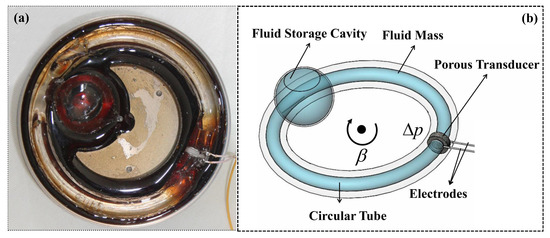
Figure 1.
The physical prototype and structure diagram of the liquid circular angular accelerometer (LCAA): (a) physical prototype; (b) structure diagram.
The principle of LCAA is shown in Figure 2. The circular tube together with the transducer move with external angular acceleration input. The pressure difference between the ends of the porous transducer results from the relative motion between fluid and transducer. After that, streaming potential is generated due to the EDL on the interface between the liquid and solid. The structure of EDL is illustrated in Figure 3. According to the principle, LCAA can be divided into two parts, specifically a fluidic system and a molecular electronic system. The theoretical model of fluidic system was proposed by Cheng [3], which was used to analyze the influence factors such as wave speed, the structure parameter of the circular tube, and the permeability of the transducer. In this paper, a transient model of the molecular electronic system is developed, and its influence factors are analyzed.
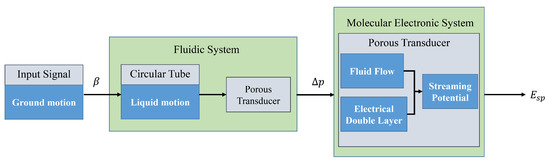
Figure 2.
A block diagram of LCAA.
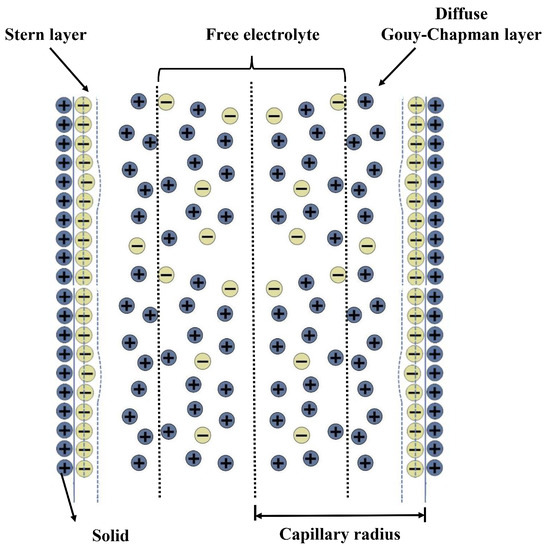
Figure 3.
Structure diagram of EDL.
3. Theoretical Analysis of the Transient Model of the Electrokinetic Effect
This section concerns three aspects of the transient model in the molecular electronic system based on the electrokinetic effect. Specifically, we modify a transient model of the circular tube, establish a transient model of the molecular electronic system, and analyze its influence factors.
3.1. Modifying the Transient Model in the Circular Tube
The electrokinetic effect in a molecular electronic system can be characterized by the streaming potential coupling coefficient , which is the ratio of the streaming potential to pressure difference applied to the flow path. The frequency-dependence of has been studied for capillary tubes [26,30,31] and porous media [26,32].
• Packard’s model:
Packard [30] proposed a transient model of streaming potential for a single circular tube by neglecting surface conductance in EDL and charge distribution in the diffusion layer. Based on the Navier–Stokes equation, is given by:
where is the steady-state streaming potential [30], presents the applied pressure difference, and is the dielectric constant and the dynamic viscosity of the fluid, respectively, means the zeta potential of the bulk fluid, is the fluid conductivity, denotes the radius of a circular tube, and k is given by:
where and and are the angular frequency of the external input and the density of the fluid. denotes the -order Bessel function. The streaming current is given by:
where , and is the actual length of the capillary tube.
• Modified Reppert model:
Packard’s model was rewritten based on the thin EDL assumption, aiming at simplifying the calculation of the Bessel function [31]. After that, it was corrected by Tardif [26], expressed as:
In order to study the frequency-dependent streaming potential for the porous transducer, Packard’s model is modified as:
where is the surface conductivity.
3.2. Establishing the Transient Model of the Molecular Electronic System
3.2.1. Capillary Bundle Model of the Porous Transducer
The steady-state model of the molecular electronic system is presented by employing the capillary bundle model [34], in which the porous transducer is equivalent to a bundle of circular capillaries with the same tortuosity , as shown in Figure 4. The capillary radius distribution (CRD) can be calculated from PSD, and both are lognormal distributions, respectively presented by and [34]. The parameters of CRD can be derived from PSD [34], specifically as:
where , m is the cementation index of the porous media, and presents the formation factor. means the porosity of porous media, calculated by [34]:
The steady-state permeability is derived based on the capillary bundle model [34], presented as,
where the expression of the original moment is:
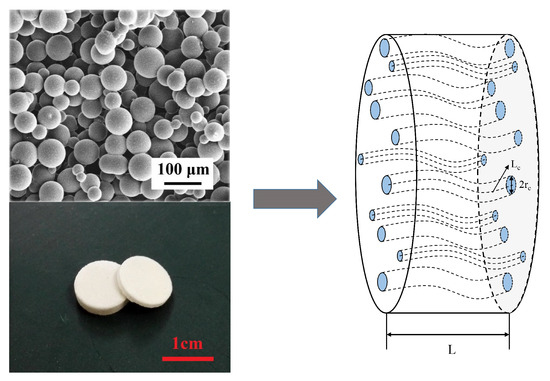
Figure 4.
Porous transducers, their microstructure, and the equivalent capillary bundle model.
3.2.2. Transient Model of the Electrokinetic Effect for the Capillary Bundle
Based on the capillary bundle model, the transient streaming current of the porous transducer can be expressed by:
Considering the dynamic balance of this transient flow, a conduction current is formed to balance the transient streaming current, given by,
where means surface conductance. Thus, the transient streaming potential is expressed by:
In order to simplify the integral operation of the Bessel function, a uniform distribution of the capillary bundle with the same porosity is utilized, and the equivalent radius of the capillary is obtained by:
The equivalent number of capillaries is given by:
Adopting (14) and (15), (13) is rewritten as:
Thus, SPC is derived as:
3.3. Analyzing the Influence Factors of the Electrokinetic Effect
According to (17), the parameters of PSD and the properties of the solution are both influence factors for the calculation of , which are analyzed as follows.
3.3.1. Effect of the Structure Parameters of the Porous Transducer
The main parameter of the porous transducer is the PSD of the microsphere, which is obtained by measurement. The CRD of the capillary bundle is derived by (6) and (7). The equivalent mean radius of the capillaries is expressed by (14). In addition, the permeability of porous media not only affects the fluidic system, but also influences the electrokinetic effect in the molecular electronic system. A transient model of permeability [4] is expressed as,
where is the characteristic length of the porous transducer, which can be calculated by the mean diameter of PSD, specifically as:
Adopting (18), the transition frequency is obtained by:
3.3.2. Effect of the Properties of the Solution
Without considering the effect of temperature, three other properties of the solution mentioned in (17) are considered with dependence on the conductivity of the solution, including permittivity, zeta potential, and surface conductance.
Compared with the correlation fitted by Worthington [37], an empirical correlation [38] is derived and utilized to convert fluid conductivity into electrolyte concentration . This expression is valid for the solution with M.
The permittivity of electrolyte solution can be calculated by employing the following equation,
In addition, the dynamic viscosity was selected to be a constant.
For a brine solution, the dependence of the concentration for the zeta potential and surface conductance was established by Revil [16]. The zeta potential is modeled by,
in which is the Boltzmann constant as , T denotes the temperature of the solution, the elementary electronic charge e is , Avogadro’s constant equals , means the surface site density chosen as , means the disassociation constant, and is the concentration of acid in solution. is the ionic strength of the bulk solution, and is the binding constant for cation adsorption.
Surface conductance is obtained by,
and is composed of three parts due to the ionic conductance of EDL (), the Stern layer (), and proton transfer (). Compared with and , is small enough to be negligible; while can be selected as S.
with:
4. Experiments
As shown in Figure 5a, a SurPASS electrokinetic analyzer [4] is employed to investigate the hydrodynamic and electrokinetic characteristics of the porous sample. The measuring unit illustrated in Figure 5b is constructed by:
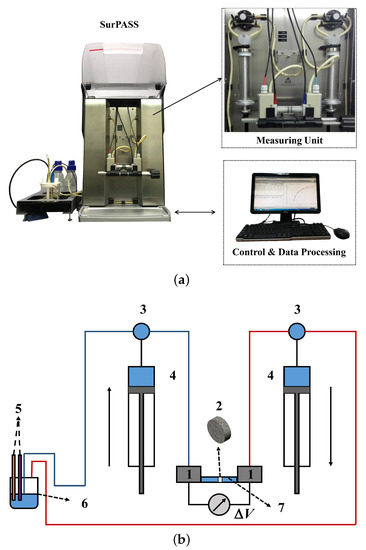
Figure 5.
(a) Experimental apparatus SurPASS; (b) components of the measurement unit in SurPASS.
- Pressure transducers and electrodes;
- Porous sample;
- Three-way valves;
- Syringes for electrolyte transport;
- Conductivity probe and pH electrode;
- Cylindrical measuring slot;
- Reservoir cup.
Seven types of porous transducers with different PSDs were utilized for the test, where the PSDs were controlled by sieves with different sizes. These transducers were made by pouring an amount of glass microspheres in a cylindrical mold and sintered under high temperature. Transducer size and mass were measured, then washed by pure water, and dried in a microwave to avoid the influence of impurities. Finishing the above-mentioned preparation, the transducer was embedded on a cylindrical measuring slot, and solution flowed through it, which was selected as a 0.0115 sodium chloride solution (NaCl). The structure parameters including CRDs are listed in Table 1, where and are the parameters of the microspheres. The porosity was obtained by the weighing method, and was given by . and are parameters of CRD, which were calculated by (6) and (7) separately. Meanwhile, the parameters of the NaCl solution are included in Table 2. Steady-state SPC was directly measured, which was used to calculate the permeability of the transducer [4].

Table 1.
Related parameters of porous transducers.
Table 2.
Related parameters of the NaCl solution in the experimental test.
5. Results and Discussion
In this section, the figures are used to discuss the effect of the porous transducer and electrolyte solution on the electrokinetic process. Meanwhile, the proposed transient model of the molecular electronic system is verified and employed to design the LCAA. Finally, some strategies are given to optimize the transient response and low-frequency gain.
5.1. Variation from Porous Transducer
Based on (6) and (7), the parameters of CRDs for different transducers are shown in Table 1. Specifically, the radius distribution of the capillary bundle is illustrated in Figure 6. The density of each radius is dimensionless, which was divided by the maximum value of the density. Thus, the peak value of each curve equaled one.
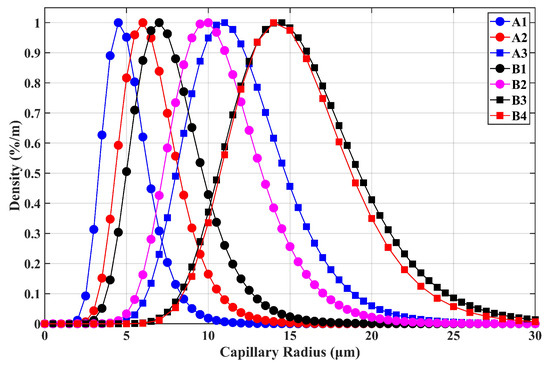
Figure 6.
The CRDs of seven types of transducers.
In order to verify the capillary bundle model of the porous transducer, the permeability predicted by the capillary bundle model was compared with the values estimated by the Kozeny–Carman model [35,36]; while both predicting model were compared with experimental permeability. These results are illustrated in Figure 7. We can conclude that the capillary bundle model possessed higher accuracy when compared with the Kozeny–Carman model. The relative errors of the capillary bundle model for B1–B4 were specifically , , , and .
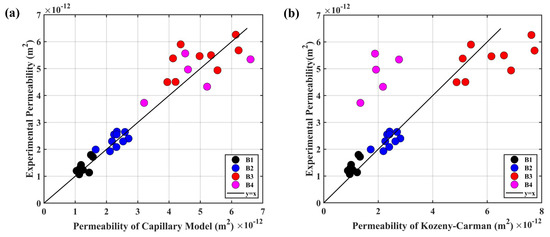
Figure 7.
The relationships between the experimental permeability and permeability predicted by different models: (a) capillary bundle model; (b) Kozeny–Carman.
Packard’s model of the capillary was compared with three other models proposed for capillary or porous media. The parameters used in the modeling of transient are presented in Table 3. The frequency dependence of is illustrated in Figure 8. It can be seen that the magnitude-frequency characteristic of related models was basically the same, but the phase-frequency characteristic diverged. The Pride model and Tardif model possessed a leading phase, while the lag phase was more reasonable in the physical system. In addition, the Reppert model was simplified with the assumption of thin EDL.
Table 3.
The parameters used in modeling with different methods in Figure 8.
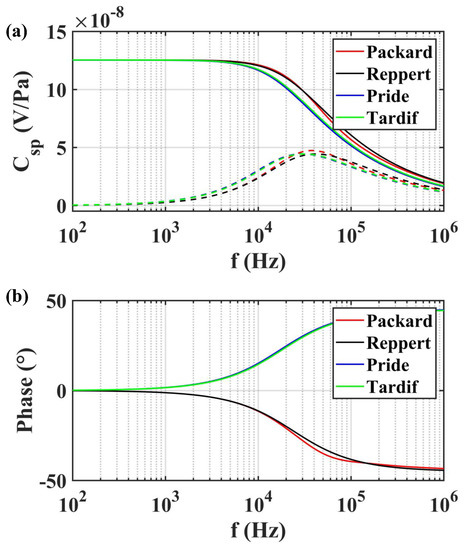
Figure 8.
The frequency dependence of streaming potential coupling coefficient (SPC) estimated by different models: (a) the amplitude of SPC; (b) the phase of SPC.
Moreover, Packard’s model was utilized to estimate for different capillary radii, which is shown in Figure 9. The related parameters are given in Table 4. As shown in Figure 9, the amplitude of was normalized by . Meanwhile, the transition frequency reduced from Hz– Hz, as the radius of the capillary increased from 0.07–70 ; while the effective radius of the capillary in porous transducer varied from 3–15 , as concluded from Figure 6. The effect on the amplitude of was not obtained from Figure 9 due to neglecting the surface conductance.
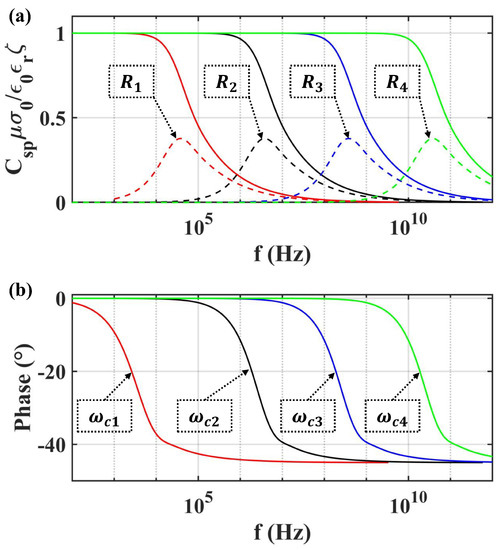
Figure 9.
The frequency dependence of the amplitude and phase for SPC with different equivalent radius: (a) the amplitude; (b) the phase.
Table 4.
The radius of the capillary and related transition frequency used in modeling in Figure 9.
Finally, Packard’s model was selected in this paper and is modified with the consideration of surface conductance in the following.
5.2. Variation from the Electrolyte Solution
Surface conductance was concerned to establish the proposed transient model for different porous samples. The amplitude of SPC was calculated with surface conductance for different samples [39]. A reduced SPC is plotted in Figure 10, where is the permeability of the related sample. As shown in Figure 10, the solid line presents the values calculated with surface conductance, while the dotted line was obtained without considering surface conductance. The experimental data for different samples were measured by Boleve [39]. We can conclude that Packard’s model [30] overestimated for low salinity, especially for pure solvent. According to Figure 10a, the estimation error of the dotted line was about for the electrolyte solution with a conductivity of . As the fluid conductivity becomes more than , the error can be neglected, which is consistency with Revil [16]. Comparing the results of samples with different mean particle diameters , the estimated error decreased with the increase of . Specifically, the error was about for Sample S3 as fluid conductivity was equal to , which is illustrated in Figure 10d.
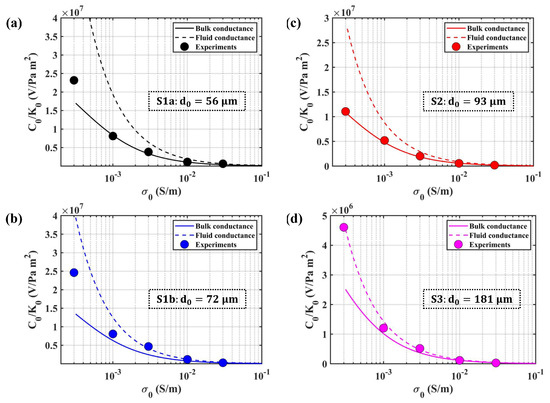
Figure 10.
The influence of surface conductance on steady-state SPC. (a) reduced steady SPC for Sample S1a with the mean diameter as ; (b) reduced steady SPC for sample S1b with the mean diameter as ; (c) reduced steady SPC for sample S2 with the mean diameter as ; (d) reduced steady SPC for Sample S3 with the mean diameter as .
The surface conductivity of sample was given by [39]. The relationship between and is presented in Figure 11 for different surface conductances. Laboratory experiments were actualized as S by Boleve [39], which are also presented in Figure 11. The results show that the surface conductivity of the sample dominated for samples with a small size of particles. Meanwhile, a positive correlation between surface conductivity and surface conductance was observed.
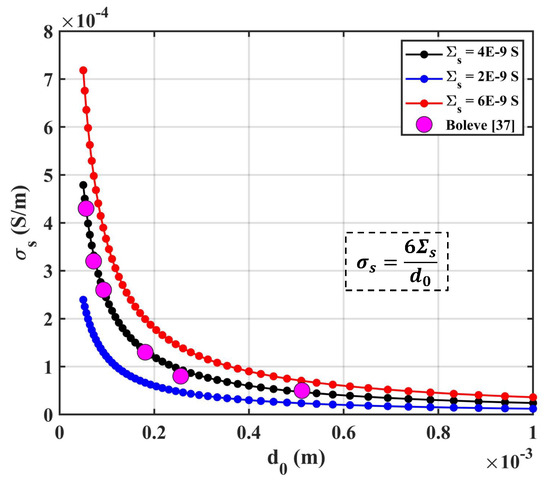
Figure 11.
The relationship between and for different surface conductances: the red line is for S; the back line is for S; the blue line is for S.
As observed from Revil’s model of zeta potential (23) and surface conductance (25), pH is also an important property for modeling SPC in a molecular electronic system. In this paper, the effect of pH on steady SPC is analyzed, which is illustrated in Figure 12. All other parameters of the model are included in Table 2, except pH and fluid conductivity. The amplitude of zeta potential decreased with increasing fluid conductivity or reducing the pH of the solution, which is shown in Figure 12a. Ignoring the surface conductance , the steady SPC is plotted in Figure 12b and possessed the same trend as the zeta potential, which was also concluded by Glover [40]. Combining the surface conductance model illustrated in Figure 12c, the steady SPC showed a different dependency on pH shown in Figure 12d. We should ensure that the pH of the electrolyte solution remains stable in physical applications.
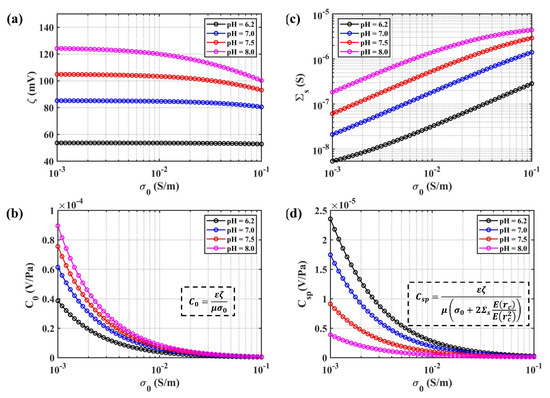
Figure 12.
The pH dependence for different properties: (a) zeta potential for different pH as a function of fluid conductivity; (b) steady SPC without considering surface conductivity for different pH as a function of fluid conductivity; (c) surface conductance for different pH as a function of fluid conductivity; (d) steady SPC with the consideration of surface conductivity for different pH as a function of fluid conductivity.
The zeta potential also contributed to the transient model of SPC, which was investigated with different values for the same transducer B3. The result is illustrated in Figure 13. It is obvious that improving the absolute value of zeta potential was the most effective way to optimize the amplitude-frequency characteristic of . Based on the conductivity dependence of the zeta potential as shown in Figure 12a, we needed to select a pure solvent with a larger zeta potential as the fluid mass of LCAA. In addition, the zeta potential effect on transient performance was not achieved by the proposed transient model (17).
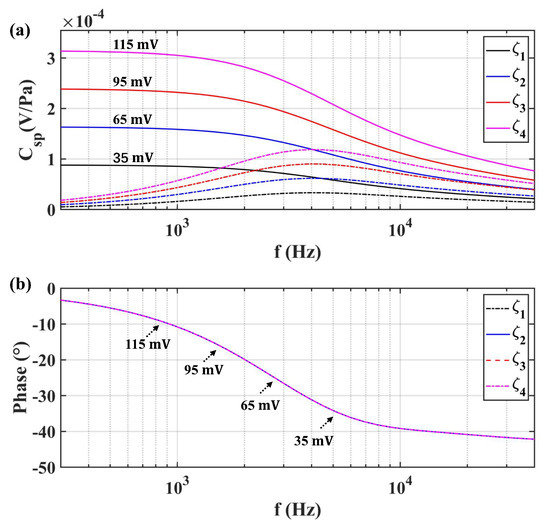
Figure 13.
Frequency dependence of with different zeta potentials for B3: (a) the amplitude of ; (b) the phase of .
The transient model of SPC for the transducer (17) was employed to investigate the influence of the structure parameters of the transducer and the properties of the solution. Meanwhile, the dynamic model of permeability (18) was also analyzed. As shown in Figure 14 and Figure 15, they were different in conductivity. Figure 14 was obtained with S (like pure water), while Figure 15 was given by mS used in the experiment. The results show that the amplitude of increased with increasing equivalent diameter of microspheres in the transducer with the same fluid conductivity, resulting in a reduction of the bandwidth of the molecular electronic system. Besides, the amplitude of also increased with the increase of the equivalent diameter of microspheres, while it reduced the transition frequency of the permeability in the fluidic system. For the same porous transducer, the amplitude of showed a negative dependence on the conductivity of the electrolyte solution. Meanwhile, the effect on bandwidth cannot be concluded by (17).
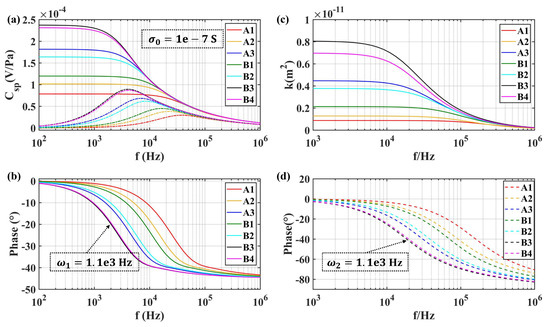
Figure 14.
Frequency-dependence of SPC and permeability for different types of transducers at S: (a) the amplitude of ; (b) the phase of ; (c) the amplitude of permeability; (d) the phase of permeability.
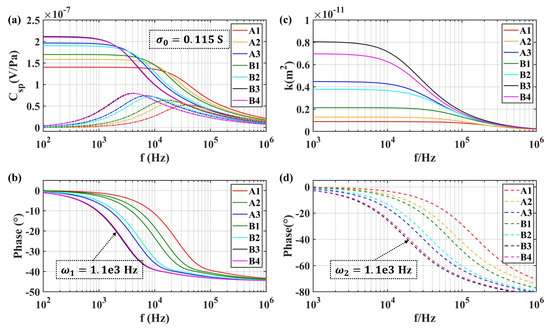
Figure 15.
Frequency-dependence of SPC and permeability for different types of transducers at = 115 mS: (a) the amplitude of ; (b) the phase of ; (c) the amplitude of permeability; (d) the phase of permeability.
The steady-state SPC for four types of transducers was directly measured. The relationship between and the equivalent radius of capillary is presented in Figure 16a. The experimental results were consistent with the predicted results shown in Figure 15a. Specifically, the steady-state SPC increased with the decrease of capillary radius with the conductivity as mS. In addition, the transition frequency was calculated by (20). The relationship between and the equivalent radius of capillary is illustrated in Figure 16b. The variation trend of was the same as shown in Figure 15d, which decreased as the increase of the capillary radius. Hence, there was a “trade-off” between the transition frequency and steady state SPC. We should design an appropriate PSD for the porous transducer to improve the performance of LCAA.
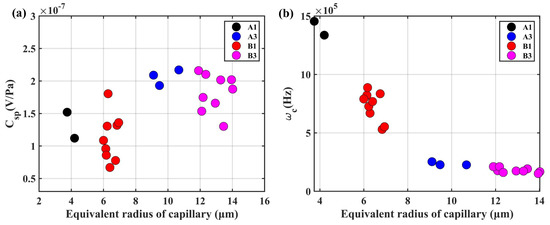
Figure 16.
The experimental results for four types of transducers: (a) the relationship between the equivalent capillary radius and steady-state SPC; (b) the relationship between the equivalent capillary radius and transition frequency.
Combining the transient model of SPC (17) in the molecular electronic system and the dynamic model of the fluidic system [3], we can optimize the low-frequency gain, bandwidth, and dynamic performance of LCAA. The following strategies can be employed to improve the performance indexes of LCAA as listed in Table 5.
Table 5.
Performance indexes of the liquid circular angular accelerometer (LCAA) [3].
- Since wave speed is the most important parameter in a fluidic system, improving the wave speed can extend the bandwidth and optimize the dynamic response, while the low-frequency gain remains the same. At present, it can be achieved only by reducing the gas percentage in fluid and increasing the thickness of the circular tube wall, which both have high technical difficulty.
- In engineering, we can change the radius of a circular tube to improve the bandwidth. However, there is a “trade-off” between low-frequency gain and the performance of transient response. We need to select a suitable value according the requirement of the application.
- Adjusting the PSD of the porous transducer, the transient response of the molecular electronic system and fluidic system both can be optimized, while the low-frequency gain of the molecular electronic system is deduced.
- Reducing the inner radius of the circular tube can improve transient performance.
- The zeta potential is the key property that can effectively increase the low-frequency gain for the molecular electronic system, which can be adjusted by changing the types of solvent or the conductivity of the electrolyte solution.
6. Conclusions
This paper presents a transient model of the electrokinetic effect generated in a molecular electronic system of LCAA. With the consideration of surface conductance, Packard’s model is modified. Combining with the capillary bundle model of the porous transducer, the transient model of the electrokinetic effect is established for the porous transducer. With the application of this model, the effect of the porous transducer and electrolyte solution on dynamic performance is investigated.
Specifically, the low-frequency gain is improved by increasing the effective radius of the capillary, which is obtained by the PSD of the porous transducer or increasing the zeta potential. As for transient performance, it can be optimized by changing the PSD of the porous transducer. We should notice that there is a trade-off between bandwidth and low-frequency gain when adjusting the PSD of the transducer. Thus, we need to design the parameter of the transducer according to the requirements of the application. The experiments of the steady-state SPC and permeability for seven types of transducers were actualized, which verified the capillary bundle model and the proposed transient model. Furthermore, some data given by Boleve [39] were also adopted to investigate the effect from the properties of the electrolyte solution.
Finally, the strategies for optimizing the performance of LCAA are proposed by combining the transient model of the molecular electronic system and the fluidic system. These strategies can be employed to guide the design of LCAA.
Author Contributions
L.M. and M.W. developed this transient model. L.M. and K.N. designed and performed the experiments. L.M. and M.W. wrote this paper.
Funding
This research was funded by the National Natural Science Foundation of China (No. 61427805 and No. 61473040) and the Cheung Kong Scholars Programme of China (Grant T2014224).
Acknowledgments
The authors would like to thank Bengbu Glass Industry Design for the technical assistance and Fei Wang and Xinzhi Wang for the language assistance.
Conflicts of Interest
The authors declare no conflict of interest.
References
- Han, J.D.; Wang, Y.C.; Tan, D.L.; Xu, W.L. Acceleration Feedback Control for Direct-drive Motor System. In Proceedings of the IEEE/RSJ International Conference on Intelligent Robots and Systems, Takamatsu, Japan, 31 October–5 November 2000; pp. 1068–1074. [Google Scholar]
- Cheng, S.; Wang, M.; Xiang, L.; Xiao, M.; Fu, M.; Xin, Z. Transfer function of fluidic system in liquid-circular angular accelerometer. In Proceedings of the Instrumentation & Measurement Technology Conference, Taipei, Taiwan, 23–26 May 2016. [Google Scholar]
- Cheng, S.; Fu, M.; Wang, M.; Xiang, L.; Xiao, M.; Wang, T. Modeling for Fluid Transients in Liquid-Circular Angular Accelerometer. IEEE Sens. J. 2017, 17, 267–273. [Google Scholar]
- Cheng, S.; Fu, M.; Wang, M.; Ming, L.; Fu, H.; Wang, T. Dynamic Fluid in a Porous Transducer-Based Angular Accelerometer. Sensors 2017, 17, 416. [Google Scholar] [CrossRef] [PubMed]
- Fu, M.; Cheng, S.; Wang, M.; Li, M.; Wang, T. Permeability modeling for porous transducer of liquid-circular angular accelerometer. Sens. Actuators A Phys. 2017, 257, 145–153. [Google Scholar]
- Cheng, S.; Fu, M.; Wang, M.; Kulacki, F.A. The influence of tube wall on fluid flow, permeability and streaming potential in porous transducer for liquid circular angular accelerometers. Sens. Actuators A Phys. 2018, 276, 176–185. [Google Scholar] [CrossRef]
- Huang, H.; Agafonov, V.M.; Yu, H. Molecular electric transducers as motion sensors: A review. Sensors 2013, 13, 4581–4597. [Google Scholar] [CrossRef]
- Sun, Z.; Agafonov, V.M. 3D numerical simulation of the pressure-driven flow in a four-electrode rectangular micro-electrochemical accelerometer. Sens. Actuators B Chem. 2010, 146, 231–238. [Google Scholar] [CrossRef]
- Agafonov, V.M.; Zaitsev, D.L. Convective noise in molecular electronic transducers of diffusion type. Tech. Phys. 2010, 55, 130–136. [Google Scholar] [CrossRef]
- Krishtop, V.G.; Agafonov, V.M. Technological principles of motion parameter transducers based on mass and charge transport in electrochemical microsystems. Russ. J. Electrochem. 2012, 48, 746–755. [Google Scholar] [CrossRef]
- Gola, A.; Chiesa, E.; Lasalandra, E.; Pasolini, F.; Tronconi, M.; Ungaretti, T.; Baschirotto, A. Interface for MEMS-based Rotational Accelerometer for HDD Applications with 2.5 rad/s2 Resolution and Digital Output. IEEE Sens. J. 2003, 3, 383–392. [Google Scholar] [CrossRef]
- Lin, J.M.; Cho, K.H.; Lin, C.H.; Lu, H.H. A Novel Wireless Thermal Convection Type Angular Accelerometer Integrated with an Active RFID-Tag. Appl. Mech. Mater. 2013, 284–287, 2005–2008. [Google Scholar] [CrossRef]
- Alrowais, H.; Getz, P.; Kim, M.G.; Su, J.J.; Brand, O. Bio-inspired fluidic thermal angular accelerometer. In Proceedings of the IEEE International Conference on Micro Electro Mechanical Systems, Shanghai, China, 24–28 January 2016. [Google Scholar]
- Zhao, H.; Feng, H. A novel angular acceleration sensor based on the electromagnetic induction principle and investigation of its calibration tests. Sensors 2013, 13, 10370–10385. [Google Scholar] [CrossRef] [PubMed]
- Delgado, A.V.; González-Caballero, F.; Hunter, R.J.; Koopal, L.K.; Lyklema, J. Measurement and Interpretation of Electrokinetic Phenomena. Pure Appl. Chem. 2005, 77, 1753–1805. [Google Scholar] [CrossRef]
- Revil, A.; Pezard, P.A.; Glover, P.W.J. Streaming Potential in Porous Media: 1. Theory of the Zeta Potential. J. Geophys. Res. Solid Earth 1999, 104, 20021–20031. [Google Scholar] [CrossRef]
- Wang, J.; Hu, H.; Guan, W.; Li, H. Electrokinetic Experimental Study on Saturated Rock Samples: Zeta Potential and Surface Conductance. Geophys. J. Int. 2015, 201, 869–877. [Google Scholar] [CrossRef]
- Revil, A.; Schwaeger, H.; Cathles, L.M., III; Manhardt, P.D. Streaming potential in porous media: 2. Theory and application to geothermal systems. J. Geophys. Res. 1999, 104, 20033–20048. [Google Scholar] [CrossRef]
- Zhu, Z.; Toksöz, M.N. Experimental measurements of the streaming potential and seismoelectric conversion in Berea sandstone. Geophys. Prospect. 2013, 61, 688–700. [Google Scholar] [CrossRef]
- Jackson, M.D. Characterization of Multiphase Electrokinetic Coupling using a Bundle of Capillary Tubes Model. J. Geophys. Res. Solid Earth 2008, 113, B04201. [Google Scholar] [CrossRef]
- Jackson, M.D. Multiphase Electrokinetic Coupling: Insights into the Impact of Fluid and Charge Distribution at the Pore Scale from a Bundle of Capillary Tubes Model. J. Geophys. Res. Solid Earth 2010, 115, B07206. [Google Scholar] [CrossRef]
- Khaddour, F.; Greggoire, D.; Pijaudier-Cabot, G. Capillary Bundle Model for the Computation of the Apparent Permeability from Pore Size Distributions. Eur. J. Environ. Civ. Eng. 2015, 19, 168–183. [Google Scholar] [CrossRef]
- Xiong, Q.; Baychev, T.G.; Jivkov, A.P. Review of pore network modelling of porous media: Experimental characterisations, network constructions and applications to reactive transport. J. Contam. Hydrol. 2016, 192, 101–117. [Google Scholar] [CrossRef] [PubMed]
- Chan, B.; Kim, S.J. The Effect of the Particle Size Distribution and Packing Structure on the Permeability of Sintered Porous Wicks. Int. J. Heat Mass Transf. 2013, 61, 499–504. [Google Scholar]
- Zhang, W.; Yao, J.; Ying, G.; Qi, Z.; Hai, S. Analysis of electrokinetic coupling of fluid flow in porous media using a 3-D pore network. J. Pet. Sci. Eng. 2015, 134, 150–157. [Google Scholar] [CrossRef]
- Glover, P.W.J.; Ruel, J.; Tardif, E.; Walker, E. Frequency-dependent Streaming Potential of Porous Media—Part 1: Experimental Approaches and Apparatus Design. Int. J. Geophys. 2012, 2012, 846204. [Google Scholar] [CrossRef]
- Zhu, Z.; Toksoz, M.N.; Zhan, X. Experimental Studies of Streaming Potential and High Frequency Seismoelectric Conversion in Porous Samples; Technical Report; Massachusetts Institute of Technology, Earth Resources Laboratory: Cambridge, MA, USA, 2009. [Google Scholar]
- Tardif, E.; Glover, P.W.J.; Ruel, J. Frequency-dependent Streaming Potential of Ottawa Sand. J. Geophys. Res. Solid Earth 2011, 116, B04206. [Google Scholar] [CrossRef]
- Glover, P.W.J.; Walker, E.; Ruel, J.; Tardif, E. Frequency-Dependent Streaming Potential of Porous Media—Part 2: Experimental Measurement of Unconsolidated Materials. Int. J. Geophys. 2012, 2012, 728495. [Google Scholar] [CrossRef]
- Packard, R.G. Streaming Potentials across Glass Capillaries for Sinusoidal Pressure. J. Chem. Phys. 1953, 21, 303–307. [Google Scholar] [CrossRef]
- Reppert, P.M.; Morgan, F.D. Streaming Potential Collection and Data Processing Techniques. J. Colloid Interface Sci. 2001, 233, 348–355. [Google Scholar] [CrossRef] [PubMed]
- Pride, S. Governing equations for the coupled electromagnetics and acoustics of porous media. Phys. Rev. B 1994, 50, 15678. [Google Scholar] [CrossRef]
- Jouniaux, L.; Bordes, C. Frequency-Dependent Streaming Potentials: A Review. Int. J. Geophys. 2012, 2012, 194–203. [Google Scholar] [CrossRef]
- Cheng, S.; Fu, M.; Kulacki, F. Characterization of a porous transducer using a capillary bundle model: Permeability and streaming potential prediction. Int. J. Heat Mass Transf. 2018, 118, 349–354. [Google Scholar] [CrossRef]
- Carman, P.C. Fluid flow through granular beds. Chem. Eng. Res. Des. 1937, 75, S32–S48. [Google Scholar] [CrossRef]
- Carman, P.C. Permeability of saturated sands, soils and clays. J. Agric. Sci. 1939, 29, 262–273. [Google Scholar] [CrossRef]
- Worthington, A. SCA guidelines for sample preparation and porosity measurement of electrical resistivity samples, Part I—Guidelines for preparation of brine and determination of brine resistivity for use in electrical resistivity measurements. Log Anal. 1990, 31, 20–28. [Google Scholar]
- Esmaeili, S.; Rahbar, M.; Pahlavanzadeh, H.; Ayatollahi, S. Investigation of streaming potential coupling coefficients and zeta potential at low and high salinity conditions: Experimental and modeling approaches. J. Pet. Sci. Eng. 2016, 145, 137–147. [Google Scholar] [CrossRef]
- Boleve, A.; Crespy, A.; Revil, A.; Janod, F.; Mattiuzzo, J.L. Streaming potentials of granular media: Influence of the Dukhin and Reynolds numbers. J. Geophys. Res. Solid Earth 2007, 112. [Google Scholar] [CrossRef]
- Glover, P.W.J. Modelling pH-Dependent and Microstructure-Dependent Streaming Potential Coefficient and Zeta Potential of Porous Sandstones. Transp. Porous Media 2018, 124, 31–56. [Google Scholar] [CrossRef]
© 2019 by the authors. Licensee MDPI, Basel, Switzerland. This article is an open access article distributed under the terms and conditions of the Creative Commons Attribution (CC BY) license (http://creativecommons.org/licenses/by/4.0/).