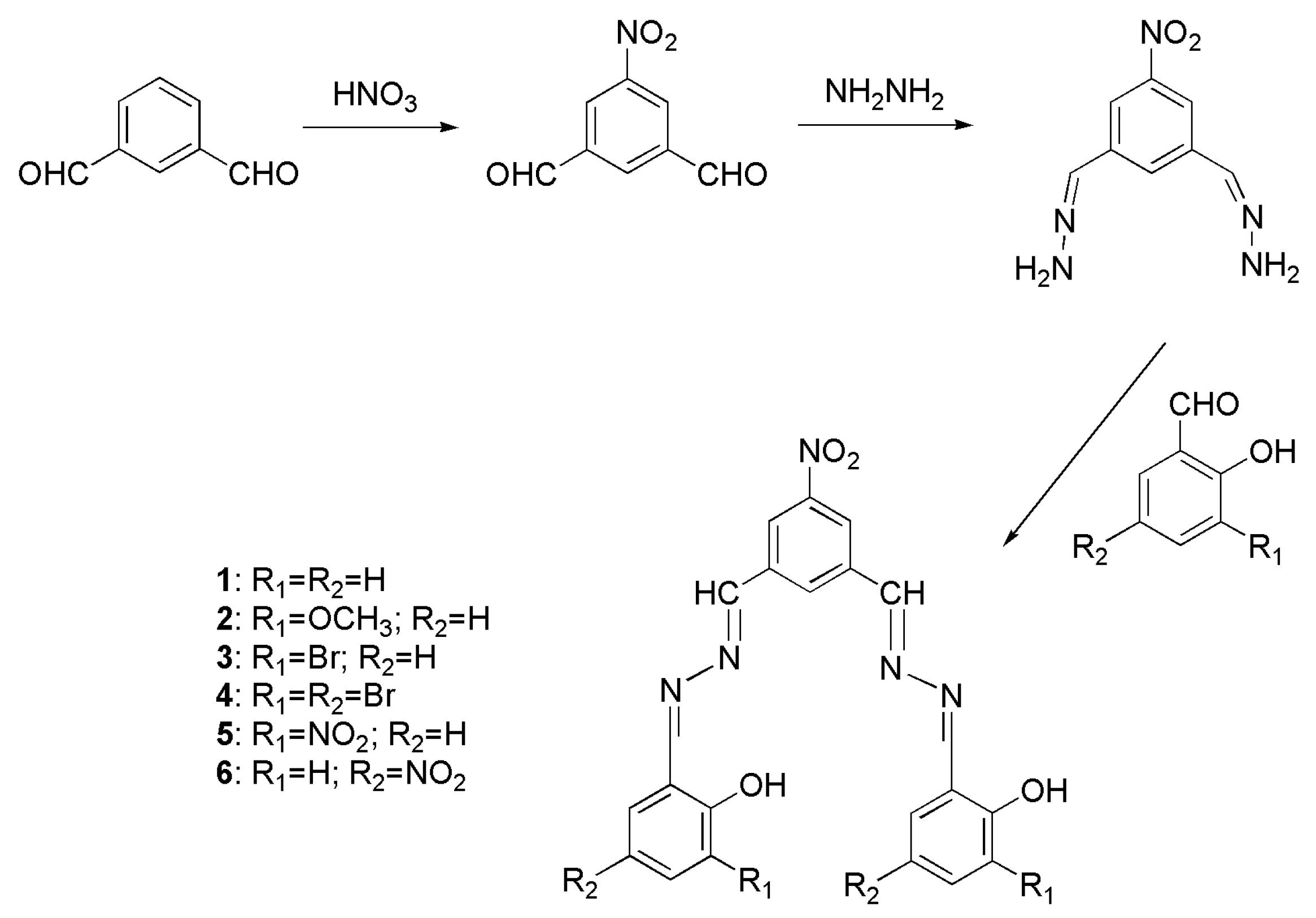
Theoretical and Experimental: The Synthetic and Anion-Binding Properties of Tripodal Salicylaldehyde Derivatives

Abstract
Share and Cite
Xu, Z.-J.; Zhang, L.-R. Theoretical and Experimental: The Synthetic and Anion-Binding Properties of Tripodal Salicylaldehyde Derivatives. Sensors 2016, 16, 733. https://doi.org/10.3390/s16050733
Xu Z-J, Zhang L-R. Theoretical and Experimental: The Synthetic and Anion-Binding Properties of Tripodal Salicylaldehyde Derivatives. Sensors. 2016; 16(5):733. https://doi.org/10.3390/s16050733
Chicago/Turabian StyleXu, Zhong-Jie, and Li-Rong Zhang. 2016. "Theoretical and Experimental: The Synthetic and Anion-Binding Properties of Tripodal Salicylaldehyde Derivatives" Sensors 16, no. 5: 733. https://doi.org/10.3390/s16050733
APA StyleXu, Z.-J., & Zhang, L.-R. (2016). Theoretical and Experimental: The Synthetic and Anion-Binding Properties of Tripodal Salicylaldehyde Derivatives. Sensors, 16(5), 733. https://doi.org/10.3390/s16050733