


Abstract
The unsustainable demand for wildlife and its derivatives poses a threat to global biodiversity, requiring attention and intervention. This study investigates the intent to purchase medicines containing saiga antelope horn among respondents in China. Drawing on an expanded theoretical framework rooted in a planned behavior model, and analyzing 576 valid data points collected through online research, this paper employs a structural equation model to consider influencing factors across six dimensions: attitude, subjective norm, perceived behavioral control, consumption experience, protective cognitive level, and personal characteristics. The findings reveal that 31.25% of respondents harbor a positive purchase intention toward medicines containing saiga antelope horn. Additionally, attitude, subjective norm, perceived behavioral control, and consumption experience exhibit positive associations with the purchase intention, while the protective cognitive level demonstrates a negative impact. A significant gender gap was identified, with women displaying a greater inclination to purchase compared to men. To support the global conservation efforts of the saiga antelope, this paper advocates for strategic interventions. Recommendations include reinforcing public science education, fostering awareness, advancing the research and development of alternative medicines, strengthening internal market controls, and employing targeted marketing strategies to shift consumer preferences. These measures collectively contribute to a holistic approach aimed at reducing the demand for wildlife products and safeguarding the saiga antelope population.
1. Introduction
Wild animals serve as both economic and ecological resources, playing a crucial role in supporting economic and social development as well as biodiversity conservation [1]. In the context of traditional Chinese medicine, wildlife resources have a rich history, exerting a positive influence on people’s well-being and health [2,3]. This paper focuses on the saiga antelope (Saiga tatarica) and aims to understand the individual intention to purchase with an eye toward reducing the demand of medicines containing saiga antelope horn.
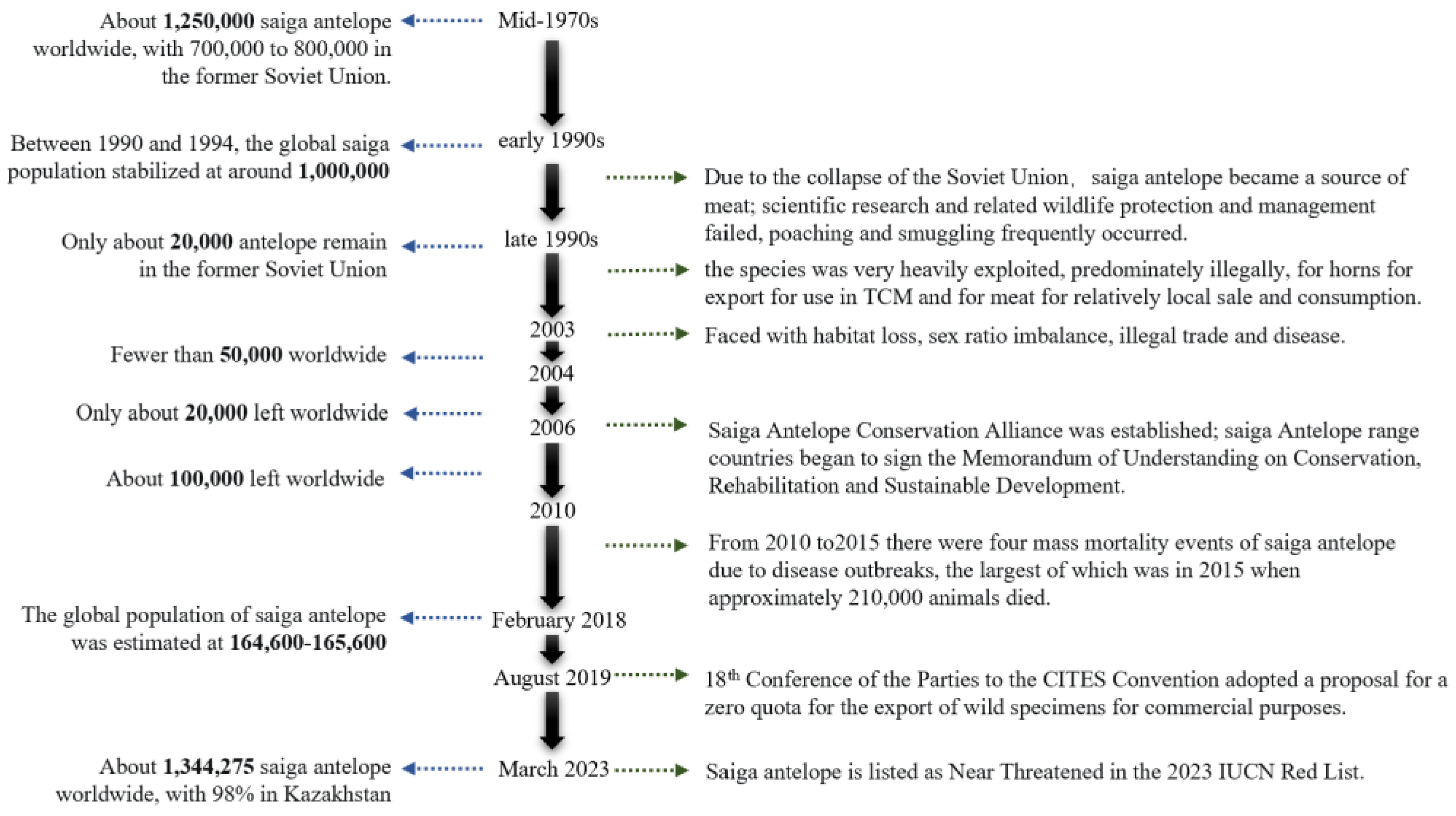
The saiga antelope has held the status of a first-class national protected species in China since 1988 and was designated Critically Endangered in 2002 by the International Union for Conservation of Nature. Since the 1970s, global saiga antelope populations have witnessed a significant decline, plummeting to about 20,000 due to the combined pressures of human demand and environmental factors [4,5,6] (Figure 1). In traditional Chinese medicine culture, saiga antelope horn produces multiple effects, such as sedative and hypnotic, anticonvulsant, analgesic, anti-inflammatory, antipyretic, and anti-hypertensive properties [7,8,9]. Its use in traditional Chinese medicine spans two millennia. Due to difficulties in successfully breeding saiga antelopes in captivity, medicinal horns are exclusively sourced from the wild [10]. Starting in 1995, policy restrictions limited the use of saiga antelope horn in Chinese medicine to existing stockpiles, and authorities implemented regulations that restricted its utilization solely in approved proprietary Chinese medicines, products, or clinical contexts within designated hospitals [11]. In clinical practice, it initiated the gradual substitution of goat horn and Tibetan antelope horn for saiga antelope horn. Accordingly, the number of animal medicines containing saiga antelope horn decreased from 100 in 2002 to 23 in 2020 [12,13]. Despite the fact that the saiga antelope population has increased substantially according to the latest statistics, the export ban on the distribution countries remains in force. Consequently, the sustained utilization of the medicine may encounter additional limitations due to the available quantities of saiga antelope horn in countries beyond the saiga antelope range, where legal trade is authorized, but stocks are diminishing [14].
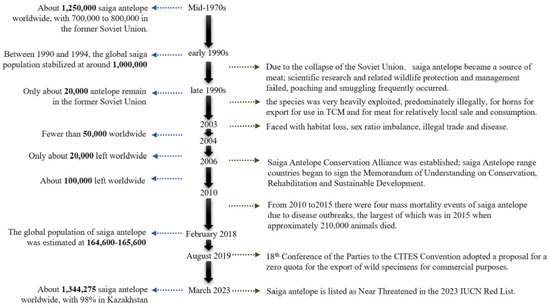
Figure 1.
Time series of saiga antelope population, its main causes of change, and related policies. Source Tompkins and Begon [4], Milner-Gulland et al. [5], Kuehl et al. [6], Doughty et al. [9], Chen and Jiang [10], Wu et al. [12], CMS [14].
Consumer demand is recognized as a significant driver behind the illicit trade and excessive hunting of wildlife [15,16]. Consequently, demand reduction has emerged as an important strategy for species conservation [17,18]. Indeed, effectively managing the demand side has become a focal point in the wildlife conservation discourse [19,20]. The demand for wildlife, as categorized into functional, economic, experiential, social, and spiritual motives, is influenced by an array of factors, including social norms, prices, preferences, habits, and individual characteristics [21,22]. Consumer behavior is further shaped by existing laws and policies [23]. To advance wildlife conservation, interventions on the demand side can be implemented by bolstering public awareness and education, enhancing social influence, refining relevant laws and policies, and introducing behavioral “boosters” [24,25,26,27,28]. These efforts aim to diminish the demand and market value of wildlife and its products [29]. In contrast, prevailing research on animal medicine in China predominantly concentrates on the supply side, encompassing measures like bolstering the protection of medicinal animals [30] and exploring alternative solutions [31,32]. Few comprehensive studies have systematically investigated the demand side of the issue.
Our study employed a structural equation model (SEM) to conduct an empirical analysis, examining the purchase intention toward saiga antelope horn medicine and its influencing factors. This paper subsequently proposes practical countermeasures and recommendations derived from these findings, offering insights for promoting demand reduction. Given the prevalent challenges of raw material scarcity, the analytical framework and research perspective presented in this paper contribute to saiga antelope conservation and also offer reference value for broader studies on the conservation of other endangered species.
2. Theoretical Basis and Research Hypothesis
2.1. Theoretical Framework of Analysis
The theory of planned behavior (TPB) is a prominent social psychological framework employed to elucidate individual decision-making processes. Within the realm of social psychology research, the TPB is widely recognized for its comprehensive examination of the interplay between attitude, intention, and behavior, as posited by Ajzen [33]. Notably, the TPB extends its analytical scope by incorporating perceived intention and behavior, enhancing its prognostic capacity for understanding and predicting individual actions. This theory has gained extensive application in investigating consumers’ motivations across diverse sectors, encompassing areas such as food [34,35], housing [36], automobiles [37], and studies concerning the purchase intention of generic drugs [38], antibiotics [39], and herbal medicines [40]. The act of residents purchasing saiga horn medicine represents the tangible culmination of individual purchasing plans.
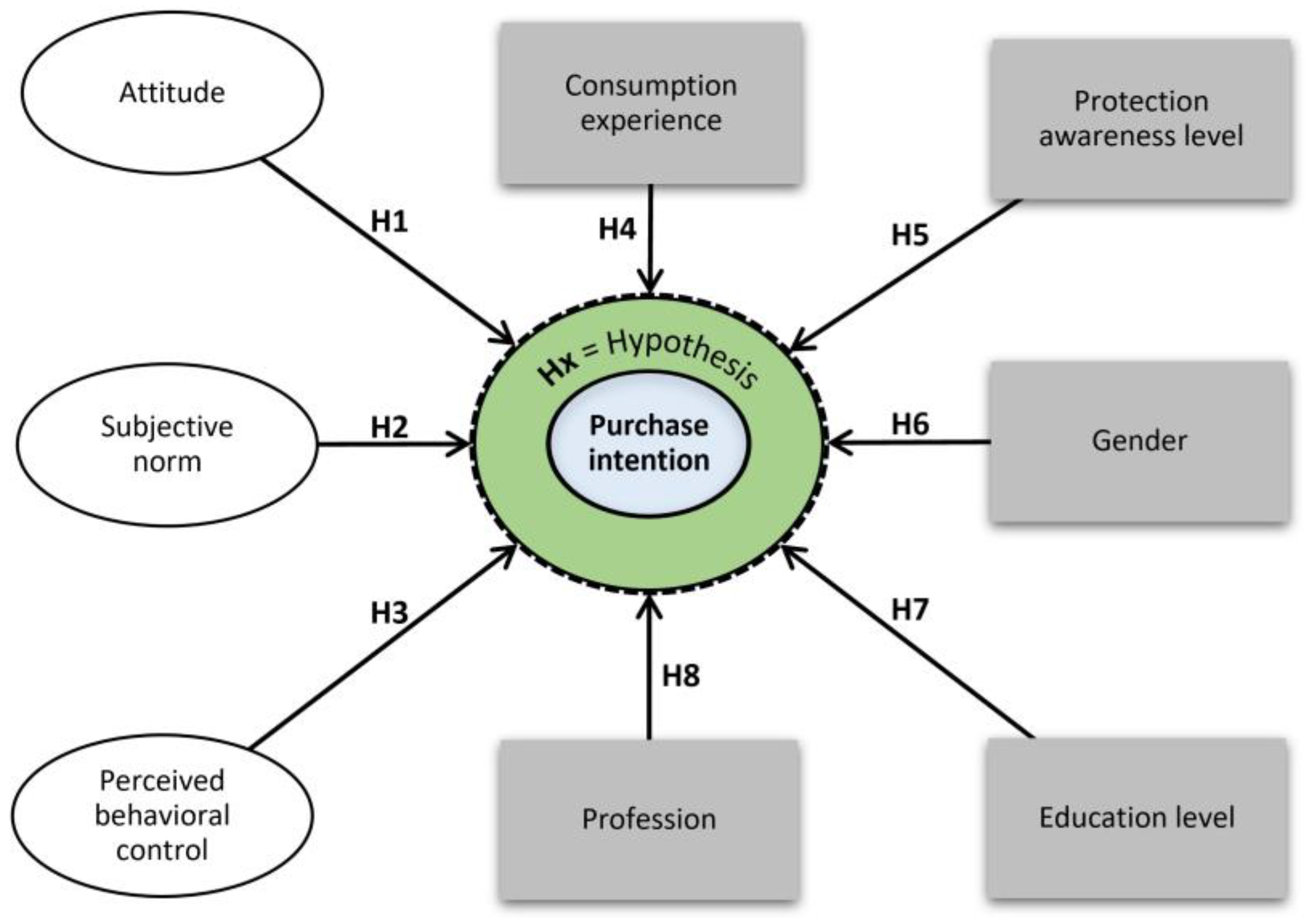
The fundamental components of the TPB encompass attitude, subjective norm, and perceived behavioral control. To fortify the explanatory capacity of these key variables regarding individual behavioral intention, scholars have progressively introduced additional variables to this theoretical model. This expansion aims to enhance the model’s adequacy in both theoretical and practical contexts, ultimately augmenting the explanatory power of the TPB and giving rise to an extended theory [41]. The supplemental variables introduced draw from personal characteristics, behavioral experiences, and anticipated regret [42]. Simultaneously, a survey of the wildlife product consumption literature underscores the influential roles of variables such as socio-demographic characteristics, consumption experiences, and levels of protection awareness in wildlife consumption [43,44]. Building upon these insights, this study further extends its scope by integrating the TPB into the analysis. The result is the formulation of a comprehensive theoretical framework for evaluating the intent to purchase medicines containing saiga antelope horn, as illustrated in Figure 2.
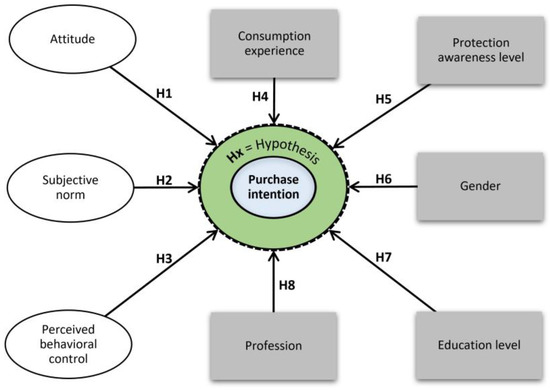
Figure 2.
Theoretical model of purchase intention for medicines containing saiga antelope horn. Ellipses denote latent variables, and gray rectangles represent observed variables.
2.2. Variable Selection and Model Assumptions
This study utilizes seven variables to shape variable selection, establish model assumptions, and formulate hypotheses. The chosen variables stem from a synthesis of the literature explicitly dedicated to the development of the TPB model.
(1) Purchase intention (PI) falls within the realm of consumer behavioral intention, a concept in the TPB which denotes an individual’s inclination to believe that they are likely to engage in a particular behavior in the future [32]. PI plays a pivotal role in influencing the actual adoption and implementation of the behavior, standing apart from the behavior itself [35]. In the context of this study, purchase intention is operationally defined as the subjective probability or likelihood that consumers express in their willingness to acquire medicines containing saiga antelope horn.
(2) Attitude (ATT), a fundamental variable in the TPB, denotes an individual’s subjective assessment of a specific object and the consequent inclination to behave in a certain way. Ajzen [32] asserted that attitude directly impacts behavioral intention, emphasizing that a more positive attitude corresponds to a higher behavioral intention. Consequently, understanding respondents’ attitudes toward animal medicine is critical to designing interventions to influence their purchase intentions and behaviors [45,46]. Our study examines respondents’ attitudes toward the consumption of medicines containing saiga antelope horn across three dimensions: agreement with the efficacy of saiga antelope horn compared to similarly priced medicines; concurrence with the irreplaceability of saiga horn medicine; and the perceived threat of such consumption behavior to the Saiga antelope population. As a result, the following hypothesis is posited:
H1.
The stronger the respondents’ approval of medicines containing saiga antelope horn, the greater their inclination to buy it.
(3) Subjective norm (SN), a fundamental variable within the TPB, refers to the perceived social pressure exerted by individuals or groups when one engages in a specific behavior. In the context of predicting respondents’ willingness to purchase medicine containing animal parts or derivatives, it captures the influence others have on their purchase decisions. The underlying premise is that normative beliefs, originating from the implied or explicit expectations of others, fundamentally shape the subjective norm during individuals’ behavioral decisions. In this study, emphasis is placed on normative beliefs to assess the level of support respondents receive from significant others in their decision to purchase medicines containing saiga antelope horn. The normative beliefs perceived by individuals emanate primarily from sources such as family and friends, doctors, and pharmacists [47]. The measurement of normative beliefs influencing respondents’ intentions to purchase medicines containing saiga antelope horn encompasses four dimensions: (a) the extent of recommendation from doctors and pharmacists; (b) the degree of endorsement from family and friends, (c) the purchasing experiences of family and friends; and (d) the extent of non-objection. Consequently, the following hypothesis is proposed:
H2.
The stronger the expectation from “significant others” that respondents experience when purchasing medicines containing saiga antelope horn, the greater their willingness to make such a purchase.
(4) Perceived behavioral control (PBC), a core variable in the TPB, pertains to an individual’s perception of the ease or difficulty associated with performing a particular behavior. In the context of wildlife and pharmaceutical consumption practices, research indicates that an individual’s perception of the power, opportunity, and resources available significantly influences their perceived control over consumption behavior. Consequently, a higher perceived control corresponds to an increased willingness to engage in the behavior. Our study assesses respondents’ perceived ease of consuming medicine containing saiga antelope horn across three primary domains: (a) understanding medicine containing saiga antelope horn; (b) the convenience of consumption channels; and (c) the accessibility of medicine containing saiga antelope horn. As a result, the following hypothesis is proposed:
H3.
The higher the perceived ease of purchasing saiga antelope horn medicine, the greater the respondents’ willingness to make the purchase.
(5) Consumption experience (CE) considers the significance of behavioral experience as a potent predictor of behavioral intention, particularly when emotional factors are not considered, and behavioral intention serves as the primary measurement variable [48]. Conner and Armitage [49] conducted a comprehensive analysis, utilizing data from 12 sets across 11 studies, and determined that behavioral experience accounts for an average of approximately 7.2% of the variance in behavioral intentions. In light of this, incorporating behavioral experience as an extended variable in the TPB enables a more accurate assessment of behavioral intention. For the purpose of our study, behavioral experience refers to whether the respondent has previously consumed medicines containing saiga antelope horn. Accordingly, the following hypothesis is posited:
H4.
Individuals with experience in consuming saiga antelope horn medicine exhibit a higher purchase intention compared to those with no prior experience.
(6) Protection awareness level (PAL) pertains to the community’s awareness level concerning the current conservation status of the saiga antelope. According to consumer behavior theories, cognition can exert a direct influence on consumers’ behavioral decision [50]. Knowledge surrounding the endangered status of the saiga antelope globally contributes to heightened awareness among respondents and subsequently diminishes the demand for products containing saiga antelope horn [51]. To ensure objectivity in assessing the level of conservation awareness, this study chooses objective questions as a measurement tool. The respondents’ final scores are then utilized to determine their individual levels of conservation awareness. Consequently, the following hypothesis is formulated:
H5.
The more respondents are knowledgeable about the conservation status of the saiga antelope, the lower their purchase intentions.
(7) Personal characteristics serve as a means to categorize consumer groups and are frequently employed in extension models as contextual factors to explain behavioral intention [39]. Scholars investigating the inclination to purchase medicines, wildlife, and their products often integrate demographic characteristics into the analytical framework. For instance, Tan and Freathy [52] discovered associations between gender, education level, and income with consumers’ visits to Chinese medicine shops to purchase over-the-counter products. Fu et al. [42] identified variations in the behavior and willingness to consume Asian horseshoe crabs based on individual occupation and education level. Similarly, in the realm of saiga antelope horn consumption, Doughty et al. [9] noted that gender influenced consumers’ choices in purchasing products containing saiga antelope horn. Therefore, this study incorporates demographic characteristics into the analytical model, specifically selecting three attributes, (a) gender, (b) education level, and (c) occupation, leading to the formulation of the following hypotheses:
H6.
Women exhibit a higher likelihood of purchasing medicines containing saiga antelope horn compared to men.
H7.
The level of education negatively impacts respondents’ willingness to purchase medicines containing saiga antelope horn.
H8.
Respondents engaged in occupations related to medicine, environmental protection, and wildlife preservation are less likely to purchase medicines containing saiga antelope horn.
3. Materials and Methods
3.1. Questionnaire Design
Based on research pertaining to the consumption behavior and willingness related to traditional Chinese medicine and wildlife products, and drawing on the TPB, the initial draft of the questionnaire was formulated. Subsequently, following a preliminary survey conducted among 70 respondents in Beijing, the questionnaire underwent revisions based on actual recovery results and expert opinions, resulting in the creation of the final version (see Supplementary Material File S1 for the English version of the questionnaire). The questionnaire comprised four distinct sections. The first segment primarily focused on data collection for four variables: attitude, subjective norm, perceived behavior control, and the purchase intention of medicines containing saiga antelope horn, all measured on a five-level Likert scale. The second segment gathered information such as consumption paths, frequency, product prices, and reasons. The third section measured respondents’ cognitive levels regarding saiga antelope conservation. Five basic questions were set to make judgments, with one point for each correct answer and zero for each wrong one. Subsequently, the total score (i.e., ranging from 0 to 5) was calculated to reflect the cognitive level. The fourth and final part involved the collection of basic information about the respondents.
3.2. Data Collection
Data were collected in May 2020, using China’s Tencent Questionnaire online platform to distribute questionnaires to participants through Wechat 7.0, a widely used Chinese social media application. A total of 620 questionnaires were gathered, yielding 576 valid samples and an effective rate of 92.90%. To enhance data quality, logical validation questions, as recommended by Yu et al. [53], were incorporated into the questionnaire. Subsequently, 44 invalid samples were excluded due to issues such as missing data, answering time less than 3 min, or a repetition rate of the same option reaching 70% or more. The Ethics Committee of Beijing Forestry University (located at No. 35 Qinghua East Road, Haidian District, Beijing 100083, China) explicitly conveyed that special approval was not deemed necessary for the conduct of this study. Furthermore, it is important to note that this study was executed in accordance with principles of anonymity to protect the privacy and confidentiality of the participants given the sensitive nature of the product.
3.3. Sample Distribution
The sample distribution for the questionnaire is presented in Table 1, comprising 297 male and 276 female respondents, falling primarily within the age range of 19–40 years, representing 80.10% of the total sample size. A notable 23.09% of participants were employed in medicinal, environmental, or wildlife-protection-related occupations. In terms of educational background, 44.96% held high school, technical secondary school, and junior college diplomas, while 41.67% possessed bachelor’s degrees. Geographically, the majority of respondents were distributed across East China, South China, and North China, accounting for 29.89%, 29.51%, and 23.09% of the sample, respectively.

Table 1.
Genger, age, occupation, education, and regional distribution of this study.
3.4. Model Construction
SEM serves as a statistical method for analyzing the relationships among variables based on their covariance matrix. This approach integrates validated factor analysis and causal modeling. Grounded in the TPB, this study considers attitude, subjective norm, perceived behavioral control, and purchase intention as latent variables requiring indirect measurement through observational variables. Thus, an SEM was selected to analyze the primary factors influencing the purchase intention of medicines containing saiga antelope horn. SEM encompasses two key components: (1) measurement equations delineating the relationship between latent and observed variables and (2) structural equations describing the relationship between latent variables. The equations are as follows:
Equations (1) and (2) represent measurement models, where is the observed indicator variable, is the endogenous latent variable (in this study, the purchase intention of medicines containing saiga antelope horn), is the correlation coefficient matrix between the endogenous latent variable and its observed variable. is the observed indicator variable, is the exogenous latent variable (e.g., attitude, subjective norm, perceived behavioral control), and is the correlation coefficient matrix between the exogenous latent variable and its observed variable. Equation (3) is a structural model, linking endogenous and exogenous latent variables through and coefficient matrices and the error term . For analysis, this study employed SPSS Version 25.0 for descriptive statistics and scale reliability testing, and Amos Version 23.0 for validation factor analysis, model fit testing, and model parameter estimation.
3.5. Scale Reliability Test
Ensuring the reliability and validity of this study’s findings necessitates subjecting the scale to rigorous tests. Initially, Cronbach’s alpha coefficient was employed to assess reliability, evaluating the consistency of results when measuring the same object repeatedly using the same method. A Cronbach’s coefficient value of 0.7 is considered acceptable, with higher values indicating greater scale reliability [54]. The reliability analysis results, presented in Table 2, indicate that the Cronbach’s alpha coefficient values for the latent variables of purchase intention, attitude, subjective norm, and perceived behavioral control all exceeded 0.7. The overall scale demonstrated a Cronbach’s alpha coefficient of 0.934, successfully passing the reliability test.
Table 2.
Scale reliability test using Cronbach’s alpha coefficient.
Secondly, the questionnaire’s validity was assessed through the Kaiser–Meyer–Olkin (KMO) test for sampling adequacy and Bartlett’s sphericity test, examining the alignment between the designed items and research expectations. The results revealed a KMO value of 0.939, and Bartlett’s sphericity test yielded an approximate chi-square value of 5582.009 with a p-value of 0, indicating its suitability for factor analysis [55,56]. Subsequently, an exploratory factor analysis was conducted to scrutinize the scale’s factor structure using the Kaiser normalized maximum variance method. Following the final rotation of factor loadings, one observed question item was excluded due to its factor loading being less than 0.6 and having factor loadings in both principal components greater than 0.4. The remaining 14 observed items exhibited factor loadings exceeding 0.6 and aligned with the four extracted common factors, as per the model setting. The final rotated factor loadings squared and variance contribution reached 74.216%.
3.6. Validation Factor Analysis
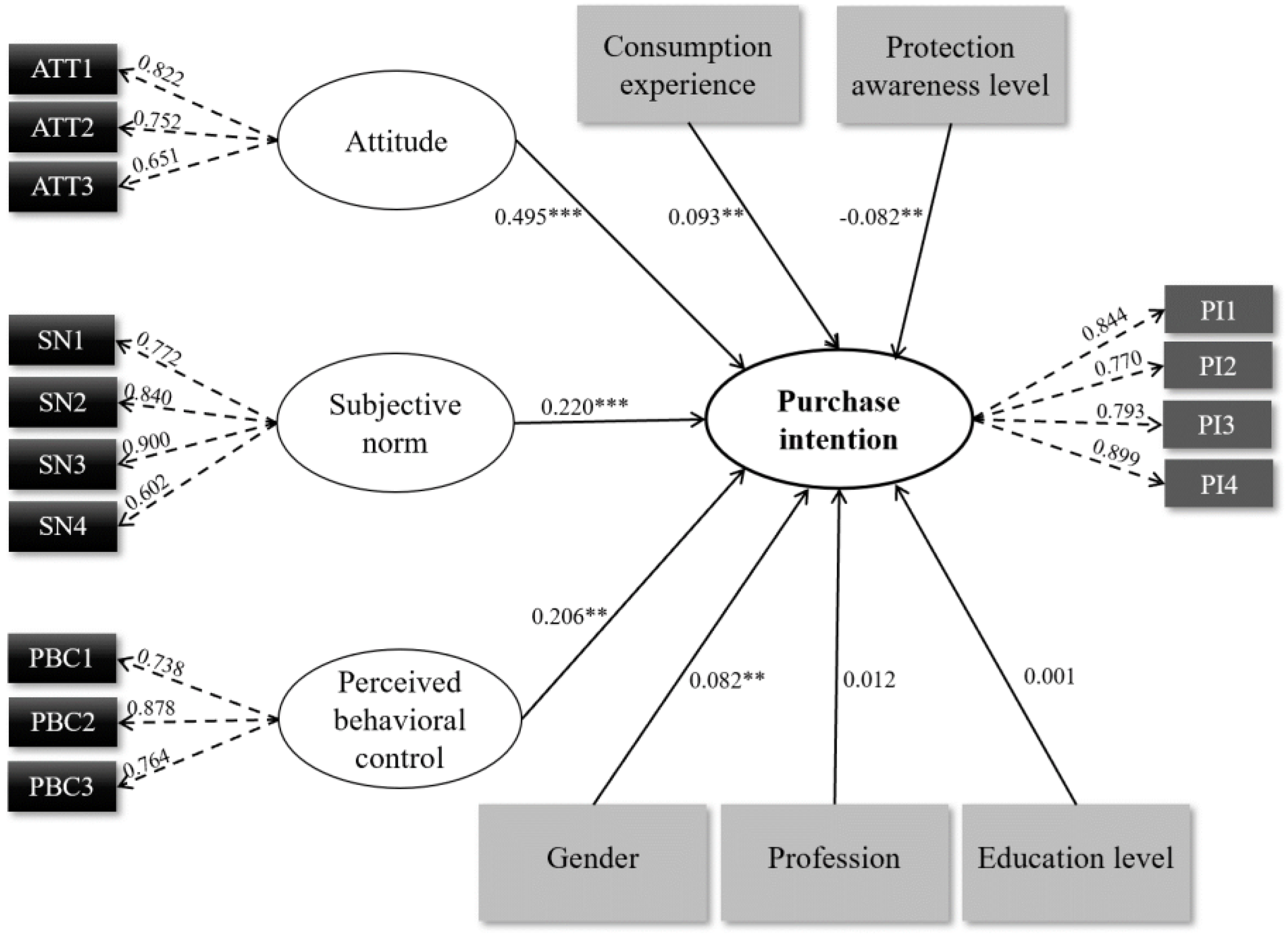
After constructing the model through exploratory factor analysis, it underwent validation and refinement via confirmatory factor analysis. The first step involved testing convergent validity, where the factor loadings signify the contribution of observed variables to the reflective measurement of latent variables. Results indicated that standardized factor loadings exceeded 0.60 for all variables (Figure 3) and were significant at the 1% level. Each latent variable demonstrated a combined reliability surpassing 0.75, denoting a strong internal consistency among the observed variables linked to the respective latent variables [57]. Additionally, the average variance extracted surpassed 0.5, indicating a robust mean explanatory power of each observed variable for the corresponding latent variable and affirming high confidence and convergent validity of the latent variables [58]. Convergent validity was thus confirmed. Subsequently, the Fornell–Larcker criteria were employed to assess discriminant validity, ensuring that items measuring a dimension did not exhibit high loadings on other dimensions, i.e., avoiding cross-loadings. The findings indicated that for one latent variable, the squared average variance extracted value was slightly lower than the correlation coefficient of the corresponding factor, but the other tests were successful. This suggests that the measurement also upholds discriminant validity [59] (Table 3).
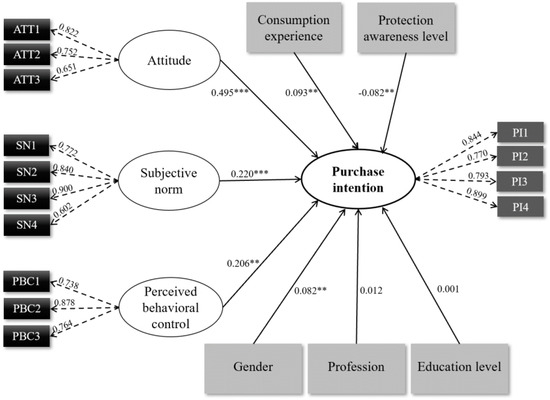
Figure 3.
Standard path coefficients of latent and indicator variables of saiga antelope horn products among respondents. Note: *** p < 0.001; ** p < 0.01.
Table 3.
Discriminant validity test results of the model using the Fornell–Larcker criterion.
3.7. Model Goodness-of-Fit Test
This study employed the classification method of fit indices, as proposed by Marsh [60], to categorize fit indices into absolute, relative, and parsimonious indices. Four indicators from each of these three types were selected for testing the model’s goodness-of-fit [61]. This process aimed to assess the degree of fit between the survey data used in the research model and the TPB model. The overall model fit test revealed that all three types of fit indices met the acceptable criteria, indicating a satisfactory fit between the model and the actual sample data. This suggests that the structural equations exhibited good extrinsic quality [59] (Table 4).
Table 4.
Classification of fit indices of the model in terms of TPB.
4. Result
4.1. Descriptive Statistical Results
The questionnaire results are categorized into the variables outlined in the hypotheses model variables, including item settings, mean values, and standard deviations (Table 5), and additional insights encompassing frequency, price, effect, type, purchasing channels of antelope horn medicine, and reasons for abstaining from acquiring saiga antelope horn products (Table 6).
Table 5.
Hypothesis model variables and measurement values.
Table 6.
Characteristics and reasons of purchasing antelope horn medicine.
4.2. Model Estimation Results
The results of the SEM are detailed in Table 7. Attitude, subjective norm, and perceived behavioral control regarding respondents’ intention to purchase medicines containing saiga antelope horn were 0.495, 0.220, and 0.206, respectively, all attaining significance levels below 0.5%. This confirms the validity of hypotheses H1, H2, and H3. The standardized path coefficients for the extended variables—consumption experience and the level of protection awareness—were 0.093 and −0.082, with corresponding t-values of 2.949 and −2.870, both reaching significance at the 0.5% level. Thus, hypotheses H4 and H5 were substantiated. Among personal characteristics, only gender exerted a significant effect on purchase intention, with a standardized path coefficient of 0.082, meeting the 0.5% significance level, thus supporting hypothesis H6. However, educational level and profession failed to validate hypotheses H7 and H8.
Table 7.
The estimated results of the research models.
The explanatory power of attitude varied, ranking from high to low for drugs containing saiga antelope horn that are highly effective compared to drugs of a similar price (ATT1), for drugs with a weak substitution (ATT2), and for drugs that do not pose a threat to the conservation status of saiga antelope (ATT3). For subjective norm, the explanatory power ranged from high to low for the people close to them buying (SN3) or recommending (SN2) such drugs, for a doctor or pharmacist recommending taking such drugs (SN1), and for the people close to them not being opposed to taking such drugs (SN4). The explanatory power for perceived behavioral control ranged from high to low for knowing the purchase channel (PBC2), financial feasibility (PBC3), and awareness of the ingredients of the drug containing saiga antelope horn (PBC1) (Figure 3).
5. Discussion
5.1. Factors Affecting Purchase Intention
In our study, approximately one third of the respondents expressed a willingness to consume medicines containing saiga antelope horn, and 19.62% reported purchasing experience, aligning closely with findings on the consumption behavior of Singapore-Chinese respondents [9]. In addition, the results of this survey coincided with the early stages of the COVID-19 pandemic. Respondents, influenced by the pandemic, tended to reduce outdoor activities, leading to an increased stockpiling of medicines. Simultaneously, the heightened demand for antipyretics during the outbreak, where saiga antelope horn is a key component in some formulations like antelope horn oral liquid and antelope horn particles, might have contributed to respondents’ inclination to purchase medicines containing saiga antelope horn. The pandemic-related factors could have influenced a slightly higher willingness to purchase medicines containing saiga antelope horn than if the COVID-19 outbreak had not occurred.
Attitude significantly and positively influenced purchase intentions, with respondents’ attitude toward saiga antelope horn medicine being the pivotal factor affecting their willingness to purchase. Given the extensive use of saiga antelope horn in traditional Chinese medicine, people may perceive it as a valuable medicinal resource, acknowledging its therapeutic efficacy. When investigating the purchasing behavior of Singapore-Chinese respondents for saiga products, scholars such as Doughty et al. [9] found that “it works” was the most prevalent cause for respondents. Additionally, positive personal experiences with saiga antelope horn medicine may indirectly bolster the purchase intentions of others as individuals share their positive evaluations. Subjective norm and perceived behavioral control both significantly and positively impacted purchase intentions. The intent to purchase saiga antelope horn is influenced by two categories of “important people”: family and friends, who serve as direct reference groups and information sources [62,63], and doctors and pharmacists, who are highly trusted professionals in medicine-related decisions [51]. Respondents’ willingness to purchase is also influenced by the cost, where lower time and economic costs correlate with a higher purchase willingness [9]. This result is consistent with the 4C theory to a certain extent. It is consumer-oriented and proposes that consumers pay more attention to the purchasing cost and convenience during the purchasing process, which is precisely confirmed by the findings in this study. Consumption experience significantly and positively influenced purchase intention. A habitual consumer behavior psychology tends to form through medication experience, with consumers more likely to choose previously purchased drugs with proven efficacy for secondary consumption [64]. The well-evaluated efficacy of saiga antelope horn, coupled with the convenience of a broader range of related medicines, facilitates respondents in choosing and purchasing saiga antelope horn medicine. The level of protection awareness significantly and negatively influenced purchase intentions. As the awareness of saiga antelope’s conservation status rises, respondents exhibit a stronger protection awareness and lower purchase intentions. This aligns with wildlife conservation studies emphasizing the impact of protection awareness on wildlife consumption behavior. A higher conservation awareness leads respondents to understand the significance of wildlife and the challenges it faces, fostering a tendency to opt for alternatives and reducing their willingness to purchase the medicines containing animal parts or derivatives in question. Also, women are more likely to purchase medicines containing saiga antelope horn, given their pivotal role in health decisions within interpersonal networks [65]. This is further supported by the observation that pharmacies, on average, attract a greater percentage of female patrons compared to male patrons [66]. Women tend to be more attentive to family health than men, who may be more inclined to purchase wildlife products for social or experiential satisfaction [67,68].
5.2. Management Implications
Given the exclusive reliance on stockpiles for saiga antelope horn used in Chinese medicine, ensuring sustainable utilization demands has strengthened related research and heightened public awareness and education. A recommended approach involves developing alternative medicines to curtail the population’s inclination toward antelope horn consumption, focusing on two key areas. First, promoting the research and development of alternatives is crucial for altering consumption preferences. Conducting surveys on saiga antelope horn consumption preferences, for instance, can guide the development of alternative drugs by relevant research institutions and pharmaceutical enterprises. Marketing and promoting new products can encourage consumers to shift their preferences. Accelerating the research and development of synthetic and other alternatives to saiga antelope horn can reduce its frequency in pharmaceuticals, thus addressing the conflict between medicinal material scarcity and demand. Second, strengthening internal market controls for saiga antelope horn, including the registration of stockpiles, the labeling of parts and products, and the registration of manufacturers and traders [14], can assist in reducing illegal trade and promoting sustainable use from the source. Third, there is a need to intensify publicity and education efforts to heighten wildlife protection awareness. Information on the laws, regulations, survival status, and protection measures of endangered wildlife should be actively disseminated on a regular basis. Online platforms and nature education can serve as effective channels for widespread publicity. Trusted professionals, such as doctors, play an important role in effective advocacy, while women, as primary purchasers, should be the central focus for awareness-raising initiatives. Fourth, conducting proper evaluations and publicizing the actual medicinal value of wildlife can support the responsible use of endangered species in medicine. In conclusion, these proposed recommendations underscore the significance of strategic research initiatives and informed public engagement to tackle the sustainability challenges associated with saiga antelope horn consumption. Simultaneously enhancing awareness and fostering alternatives aims to mitigate the impact on wildlife while promoting responsible and sustainable choices in medicinal practices.
5.3. Limitations of this Study
This study acknowledges several limitations arising from its constrained capacity and external factors. Firstly, due to the pandemic’s impact, the distribution of the questionnaire occurred online, leading to a lack of control over sample selection and an unintended deviation from the initially anticipated sample structure. Consequently, the findings of this paper are primarily applicable to the demographic groups represented by the obtained sample, notably the youth. Secondly, while our model’s results were deemed valid, we did not explore potential relationships among explanatory variables within the model’s setting, an aspect that could have been further optimized with a more comprehensive approach. Thirdly, environmental factors may influence respondents’ willingness to purchase medicines containing saiga antelope horn, necessitating a cautionary interpretation of this study’s conclusions. To enhance the research’s universality, it is advisable to confirm findings during non-pandemic periods. These identified constraints and shortcomings will be thoroughly addressed in future research pursuits.
6. Conclusions
This study delved into the analysis of 576 online questionnaires, revealing compelling insights into the purchasing behavior related to medicines containing saiga antelope horn. A noteworthy finding indicated that one third of the respondents expressed a clear intention to acquire such medicines, while a substantial one fifth of them had previously engaged in such purchases. Employing the extended TPB framework and SEM, this paper meticulously examined the influencing factors and subjected the model to empirical testing, confirming its efficacy in elucidating purchase intentions. The results pinpointed attitude, perceived behavioral control, subjective norms, and consumption experience as pivotal determinants, each exerting a positive impact on purchase intention. Significantly, attitude emerged as the most influential factor among them. Conversely, the respondents’ purchase inclination faced some constraints due to a heightened sense of protection cognition. Notably, this study unearthed a gender-based difference, with women exhibiting a greater propensity than men to purchase medicines containing saiga antelope horns. In light of these findings and to advocate for saiga antelope conservation, this paper underscores the importance of reinforcing science-based awareness and education. Additionally, it advocates for the promotion of research and development in the pharmaceutical sector and the leveraging of market mechanisms to reshape consumer preferences, ultimately contributing to the preservation of this endangered species.
Supplementary Materials
The following supporting information can be downloaded at https://www.mdpi.com/article/10.3390/d16010049/s1, File S1. Online questionnaire (English version).
Author Contributions
Conceptualization, M.Z. and Y.X.; methodology, M.Z. and Y.X.; software, Z.Z.; validation, M.Z., Z.Z. and J.C.; formal analysis, M.Z.; investigation, M.Z. and J.C.; resources, M.Z.; data curation, M.Z. and Z.Z.; writing—original draft preparation, M.Z., Z.Z., J.C. and G.T.C.; writing—review and editing, Y.X. and G.T.C.; visualization, M.Z. and G.T.C.; supervision, Z.Z.; project administration, Y.X.; funding acquisition, Y.X. All authors have read and agreed to the published version of the manuscript.
Funding
This research was funded by two commissioned projects of the State Forestry Administration of China (project numbers are 20220601 and 20210501).
Institutional Review Board Statement
Ethical review and approval were waived for this study, due to the authors’ institutions allowing scholars who majored in social science to conduct human studies without special approval.
Data Availability Statement
The original contributions presented in the study are included in the article, further inquiries can be directed to the corresponding author.
Conflicts of Interest
The authors declare no conflict of interest.
References
- Hutton, J.M.; Leader, W.N. Sustainable use and incentive-driven conservation: Realigning human and conservation interests. Oryx 2003, 37, 215–226. [Google Scholar] [CrossRef]
- Alves, R.R.; Rosa, I.L.; Santana, G.G. The role of animal-derived remedies as complementary medicine in Brazil. BioScience 2007, 57, 949–955. [Google Scholar] [CrossRef]
- Jacobo-Salcedo, M.R.; Alonso-Castro, A.J.; Zarate-Martinez, A. Folk medicinal use of fauna in Mapimi, Durango, México. J. Ethnopharmacol. 2011, 133, 902–906. [Google Scholar] [CrossRef]
- Tompkins, D.M.; Begon, M. Parasites can regulate wildlife populations. Parasitol. Today 1999, 15, 311–313. [Google Scholar] [CrossRef]
- Milner-Gulland, E.J.; Bukreeva, O.M.; Coulson, T.; Lushchekina, A.A.; Kholodova, M.V.; Bekenov, A.B.; Grachev, I.A. Conservation: Reproductive collapse in saiga antelope harems. Nature 2003, 422, 135. [Google Scholar] [CrossRef]
- Kuehl, A.; Mysterud, A.; Grachev, I.A.; Bekenov, A.B.; Ubushaev, B.S.; Lushchekina, A.A.; Milner-Gulland, E.J. Monitoring population productivity in the saiga antelope. Anim. Conserv. 2009, 12, 355–363. [Google Scholar] [CrossRef]
- But, P.P.; Lung, T.C.; Tan, Y.K. Ethnopharmacology of rhinoceros horn. I: Antipyretic effects of rhinoceros horn and other animal horns. J. Ethnopharmacol. 1990, 30, 157–168. [Google Scholar]
- Liu, R.; Zhu, Z.H.; Wu, J.; Qian, D.W.; Duan, J.A. Comparison on proteins of Saigae Tataricae Cornu and Caprae Hircus Cornu. China J. Chin. Mater. Med. 2018, 43, 3329–3334. [Google Scholar] [CrossRef]
- Doughty, H.; Veríssimo, D.; Tan, R.C.Q.; Lee, J.S.H.; Carrasco, L.R.; Oliver, K.; Milner-Gulland, E.J. Saiga horn user characteristics, motivations, and purchasing behaviour in Singapore. PLoS ONE 2019, 14, e0222038. [Google Scholar] [CrossRef]
- Chen, J.; Jiang, Z.G. Discrimination of saiga antelope horn from substitutes in “Lingyangjiao” markets by genetic identification technology. Mod. Chin. Med. 2013, 15, 548–551. [Google Scholar] [CrossRef]
- Tang, T. Influence of legislations related to animal on utilization and development of animal traditional Chinese medicine in China. Chin. Tradit. Herb. Drugs 2021, 52, 7718–7727. [Google Scholar]
- Wu, Z.F.; Deng, Z.Y.; Zhen, Q.; Yue, P.F.; Hu, P.Y.; Luo, Y.; Zhu, G.H.; Yang, M. Study on prescription of Chinese patent medicine containing endangered medicinal materials. Chin. Tradit. Pat. Med. 2012, 34, 2264–2267. [Google Scholar]
- Bian, X.F.; Li, J.F.; Jin, L.Q.; Du, Y.J.; Li, Z.C.; Lv, J.P.; Lan, M.; Gao, X.; Wu, N.; Zhang, H. Discussion on the quality standards of animal medicine in Chinese Pharmacopoeia (2020 Edition). Jilin J. Chin. Med. 2021, 41, 809–816. [Google Scholar] [CrossRef]
- CMS. 2021: The Sustainable Use of Saiga Antelopes: Perspectives and Prospects. Available online: https://www.cms.int/saiga/en/publication/sustainable-use-saiga-antelopes-perspectives-and-prospects (accessed on 7 January 2024).
- Veríssimo, D.; Vieira, S.; Monteiro, D.; Hancock, J.; Nuno, A. Audience research as a cornerstone of demand management interventions for illegal wildlife products: Demarketing sea turtle meat and eggs. Conserv. Sci. Pract. 2020, 2, e164. [Google Scholar] [CrossRef]
- Vu, A.N. Demand reduction campaigns for the illegal wildlife trade in authoritarian Vietnam: Ungrounded environmentalism. World Dev. 2023, 164, 106150. [Google Scholar] [CrossRef]
- Zhang, L.; Hua, N.; Sun, S. Wildlife trade, consumption and conservation awareness in southwest China. Biodivers. Conserv. 2008, 17, 1493–1516. [Google Scholar] [CrossRef] [PubMed]
- Schneider, J.L. Reducing the illicit trade in endangered wildlife. J. Contemp. Crim. Justice 2008, 24, 274–295. [Google Scholar] [CrossRef]
- Shairp, R.; Veríıssimo, D.; Fraser, I.; Challender, D.; MacMillan, D. Understanding urban demand for wild meat in Vietnam: Implications for conservation actions. PLoS ONE 2006, 11, e0134787. [Google Scholar] [CrossRef]
- Megias, D.A.; Anderson, S.C.; Smith, R.J.; Veríıssimo, D. Investigating the impact of media on demand for wildlife: A case study of Harry Potter and the UK trade in owls. PLoS ONE 2017, 12, e0182368. [Google Scholar] [CrossRef]
- Thomas-Walters, L.; Hinsley, A.; Bergin, D.; Doughty, H.; Eppel, S.; MacFarlane, D.; Meijer, W.; Lee, T.M.; Phelps, J.; Smith, R.J.; et al. Motivations for the use and consumption of wildlife products. Conserv. Biol. 2020, 35, 483–491. [Google Scholar] [CrossRef]
- Thoma-Walters, L.; Veríssimo, D.; Gadsby, E.; Roberts, D.; Smith, R.J. Taking a more nuanced look at behavior change for demand reduction in the illegal wildlife trade. Conserv. Sci. Pract. 2020, 2, e248. [Google Scholar] [CrossRef]
- Sung, Y.H.; Fong, J.J. Assessing consumer trends and illegal activity by monitoring the online wildlife trade. Biol. Conserv. 2018, 227, 219–225. [Google Scholar] [CrossRef]
- Jenks, B.; Vaughan, P.W.; Butler, P.J. The evolution of Rare Pride: Using evaluation to drive adaptive management in a biodiversity conservation organization. Eval. Program Plan. 2010, 33, 186–190. [Google Scholar] [CrossRef]
- Liu, Z.; Jiang, Z.G.; Fang, H.; Li, C.; Mi, A.; Chen, J.; Zhang, X.; Cui, S.; Chen, D.; Ping, X.; et al. Perception, Price and Preference: Consumption and Protection of Wild Animals Used in Traditional Medicine. PLoS ONE 2013, 11, e0145901. [Google Scholar] [CrossRef]
- Biggs, D.; Cooney, R.; Roe, D.; Dublin, H.T.; Allan, J.R.; Challender, D.W.S.; Skinner, D. Developing a theory of change for a community-based response to illegal wildlife trade. Conserv. Biol. 2017, 31, 5–12. [Google Scholar] [CrossRef]
- Moorhouse, T.P.; Coals, P.G.R.; D’Cruze, N.C.; MacDonald, D.W. Reduce or redirect? Which social marketing interventions could influence demand for traditional medicines? Biol. Conserv. 2020, 242, 108391. [Google Scholar] [CrossRef]
- Liang, Z.J.; Hu, J.B.; Hu, S.F.; Zhao, J.J.; Zhou, K.W.; Jiao, Y.B.; Huang, C.; He, X.; Wan, A.K.Y.; Li, L.; et al. Understanding and changing wildlife consumption behavior from a multidisciplinary perspective. Biodivers. Sci. 2020, 28, 606–620. [Google Scholar] [CrossRef]
- Wallen, K.E.; Daut, E.F. The challenge and opportunity of behaviour change methods and frameworks to reduce demand for illegal wildlife. Nat. Conserv. 2018, 26, 55–75. [Google Scholar] [CrossRef]
- Alves, R.R.N.; da Silva Vieira, W.L.; Santana, G.G. Reptiles used in traditional folk medicine: Conservation implications. Biodivers. Conserv. 2018, 17, 2037–2049. [Google Scholar] [CrossRef]
- Li, S.; Tan, H.Y.; Wang, N.; Hong, M.; Li, L.; Cheung, F.; Feng, Y.B. Substitutes for Bear Bile for the Treatment of Liver Diseases: Research Progress and Future Perspective. Evid.-Based Complement. Altern. Med. 2016, 2016, 4305074. [Google Scholar] [CrossRef]
- Moorhouse, T.P.; Zhou, Z.M.; Shao, M.L.; Zhou, Y.B.; Elwin, A.; D’Cruze, N.C.; Macdonald, D.W. Substitutes for wildlife-origin materials as described in China’s “TCM” research literature. Glob. Ecol. Conserv. 2022, 34, e02042. [Google Scholar] [CrossRef]
- Ajzen, I. The theory of planned behavior. Organ. Behav. Hum. Decis. Process. 1991, 50, 179. [Google Scholar] [CrossRef]
- Wang, S.K.; Cai, Z.; Hu, Y.X.; Cirella, G.T.; Xie, Y. Chinese resident preferences for African elephant conservation: Choice experiment. Diversity 2021, 12, 453. [Google Scholar] [CrossRef]
- Carfora, V.; Cavallo, C.; Catellani, P.; Del Giudice, T.; Cicia, G. Why Do Consumers Intend to Purchase Natural Food? Integrating Theory of Planned Behavior, Value-Belief-Norm Theory, and Trust. Nutrients 2021, 13, 1904. [Google Scholar] [CrossRef]
- Judge, M.; Warren-Myers, G.; Paladino, A. Using the theory of planned behaviour to predict intentions to purchase sustainable housing. J. Clean. Prod. 2019, 215, 259–267. [Google Scholar] [CrossRef]
- De Oliveira, M.B.; da Silva, H.M.R.; Jugend, D.; Fiorini, P.D.C.; Paro, C.E. Factors influencing the intention to use electric cars in Brazil. Transp. Res. Part A-Policy Pract. 2022, 155, 418–433. [Google Scholar] [CrossRef]
- Zerbini, C.; Luceri, B.; Vergura, D.T. Leveraging consumer’s behaviour to promote generic drugs in Italy. Health Policy 2017, 121, 397–406. [Google Scholar] [CrossRef]
- Widayati, A.; Suryawati, S.; de Crespigny, C.; Hiller, J. Beliefs About the Use of Nonprescribed Antibiotics Among Indonesian People: A Preliminary Study in Yogyakarta City Indonesia. Value Health 2015, 13, A550–A551. [Google Scholar] [CrossRef]
- Xia, Y.; Shi, L.S.B.; Chang, J.H.; Miao, H.Z.; Wang, D. Impact of the COVID-19 pandemic on intention to use traditional Chinese medicine: A cross-sectional study based on the theory of planned behavior. J. Integr. Med. 2021, 19, 219–225. [Google Scholar] [CrossRef]
- Tonglet, M.; Phillips, P.S.; Read, A.D. Using the theory of planned behaviour to investigate the determinants of recycling behavior: A case study from Brixworth, UK. Resour. Conserv. Recycl. 2004, 41, 191–214. [Google Scholar] [CrossRef]
- Ajzen, I. The theory of planned behavior: Reactions and reflections. Psychol. Health 2011, 26, 1113–1127. [Google Scholar] [CrossRef]
- Fu, Y.; Huang, S.; Wu, Z.; Wang, C.-C.; Su, M.; Wang, X.; Xu, P.; Huang, X.; Wu, H.; Wang, Y.; et al. Socio-demographic drivers and public perceptions of consumption and conservation of Asian horseshoe crabs in northern Beibu Gulf, China. Aquat. Conserv.-Mar. Freshw. Ecosyst. 2019, 29, 1268–1277. [Google Scholar] [CrossRef]
- Hagger, M.S.; Polet, J.; Lintunen, T. The reasoned action approach applied to health behavior: Role of past behavior and tests of some key moderators using meta-analytic structural equation modeling. Soc. Sci. Med. 2018, 213, 85–94. [Google Scholar] [CrossRef]
- Liu, Z.; Jiang, Z.G.; Yang, A.F. Research progress on trade and consumer behavior of wild animals. Chin. J. Wildl. 2017, 38, 712–719. [Google Scholar] [CrossRef]
- Wang, S.; Tong, Z.P.; Li, Y.; Yu, X.Y.; Sun, Y. Implicit attitudes toward wildlife products. Glob. Ecol. Conserv. 2020, 24, e01358. [Google Scholar] [CrossRef]
- Hamza, A.; Parastou, D. The Validity of the Theory of Planned Behavior for Understanding People’s Beliefs and Intentions toward Reusing Medicines. Pharmacy 2021, 9, 58. [Google Scholar] [CrossRef]
- Ouellette, J.A.; Wood, W. Habit and intention in everyday life: The multiple processes by which past behavior predicts future behavior. Psychol. Bull. 1998, 124, 54–57. [Google Scholar] [CrossRef]
- Conner, M.; Armitage, C.J. Extending the Theory of Planned Behavior: A Review and Avenues for Further Research. J. Appl. Soc. Psychol. 1998, 28, 1429–1464. [Google Scholar] [CrossRef]
- Schiffman, L.G.; Kanuk, L.L. Consumer Behavior, 8th ed.; Pearson Prentice Hall: Upper Saddle River, NJ, USA, 2004. [Google Scholar]
- Theng, M.; Glikman, J.A.; Milner-Gulland, E.J. Exploring saiga horn consumption in Singapore. Oryx 2018, 52, 736–743. [Google Scholar] [CrossRef]
- Tan, J.P.T.; Freathy, P. Consumer decision making and store patronage behavior in Traditional Chinese Medicine (TCM) halls in Singapore. J. Retail. Consum. Serv. 2011, 11, 285–292. [Google Scholar] [CrossRef][Green Version]
- Yu, F.; Hu, P.; Du, S. Research on data quality control of network questionnaire. Stat. Decis. 2019, 35, 10–14. [Google Scholar]
- Cronbach, L.J. Coefficient alpha and the internal structure of tests. Psychometrika 1951, 16, 297–334. [Google Scholar] [CrossRef]
- Russell, W.D. In Search of Underlying Dimensions: The Use (and Abuse) of Factor Analysis in Personality and Social Psychology Bulletin. Personal. Soc. Psychol. Bull. 2002, 28, 1626–1949. [Google Scholar] [CrossRef]
- Biasutti, M.; Frate, S. A validity and reliability study of the Attitudes toward Sustainable Development scale. Environ. Educ. Res. 2006, 23, 214–230. [Google Scholar] [CrossRef]
- Hair, F.J.; Howard, C.M.; Nitzl, C. Assessing measurement model quality in PLS-SEM using confirmatory composite analysis. J. Bus. Res. 2020, 109, 101–110. [Google Scholar] [CrossRef]
- Bagozzi, R.P.; Yi, Y. On the evaluation of structural equation models. J. Acad. Mark. Sci. 1998, 16, 74–94. [Google Scholar] [CrossRef]
- Goo, J. Structure of service level agreements (SLA) in IT outsourcing: The construct and its measurement. Inf. Syst. Front. 2010, 12, 185–205. [Google Scholar] [CrossRef]
- Marsh, H.W.; Hau, K.T. Assessing Goodness of Fit: Is Parsimony Always Desirable? J. Exp. Educ. 1996, 64, 364–390. [Google Scholar] [CrossRef]
- Ganesh, D.; Justin, P. CB-SEM vs PLS-SEM methods for research in social sciences and technology forecasting. Technol. Forecast. Soc. Chang. 2021, 173, 121092. [Google Scholar] [CrossRef]
- Chang, L.; Basnyat, I. Negotiating biomedical and traditional Chinese medicine treatments among elderly Chinese Singaporean women. Qual. Health Res. 2015, 25, 241–252. [Google Scholar] [CrossRef]
- Doughty, H.; Oliver, K.; Veríssimo, D.; Lee, J.S.H.; Milner-Gulland, E.J. Using theory and evidence to design behaviour change interventions for reducing unsustainable wildlife consumption. People Nat. 2021, 3, 469–483. [Google Scholar] [CrossRef]
- Bevan, M.; Ng, Y.C.; Cooper, J.; Robertson, J.; Walkom, E.; Chiu, S.; Newby, D.A. The role of evidence in consumer choice of non-prescription medicines. Int. J. Pharm. Pract. 2019, 27, 501–509. [Google Scholar] [CrossRef]
- Chang, L.; Basnyat, I.; Teo, D. Seeking and processing information for health decisions among elderly Chinese Singaporean women. J. Women Aging 2014, 26, 257–279. [Google Scholar] [CrossRef]
- Shen, L.; Shen, L. Analysis of factors influencing urban consumers’ choice of retail pharmacies in Shanghai. China Pharm. 2004, 2, 60–62. [Google Scholar]
- Curtin, S. Nature, wild animals and tourism: An experiential view. J. Ecotourism 2005, 4, 1–15. [Google Scholar] [CrossRef]
- Drury, R. Hungry for success: Urban consumer demand for wild animal products in Vietnam. Conserv. Soc. 2011, 9, 247–257. [Google Scholar] [CrossRef]
Disclaimer/Publisher’s Note: The statements, opinions and data contained in all publications are solely those of the individual author(s) and contributor(s) and not of MDPI and/or the editor(s). MDPI and/or the editor(s) disclaim responsibility for any injury to people or property resulting from any ideas, methods, instructions or products referred to in the content. |
© 2024 by the authors. Licensee MDPI, Basel, Switzerland. This article is an open access article distributed under the terms and conditions of the Creative Commons Attribution (CC BY) license (https://creativecommons.org/licenses/by/4.0/).