


Abstract
A specimen of the endemic New Zealand lancelet Epigonichthys hectori (Benham, 1901) was found and photographed in the intertidal area of a beach near the Whangarei Heads in New Zealand. This only lancelet species for New Zealand is rarely caught and is known for its specific habitat requirements, demanding clean, coarse sand. The specimen was found in an almost dried-out puddle during low tide on a beach with a lot of human activity. The species is also known to inhabit greater depths, making this observation (together with another recent, unpublished record) a constitution for evidence that it also inhabits tidal areas. Distribution records from the literature are reviewed, plotted on a map, and supplemented by this new observation.
Lancelets (Chordata: Cephalochordata) are filter feeders that burrow into loose sediments. For this reason, most species need specific sediment profiles and are only found in clean gravel or (coarse) sand. The New Zealand lancelet Epigonichthys hectori (Benham, 1901), in Māori called “puhi”, is rarely observed and is the only known cephalochordate species of New Zealand [1]. The specific habitat requirements are thought to make the species susceptible to (human-induced) siltation events [2]. The species appears to be a rare endemic that is only recorded from a few coastal areas of the Northern Island and the northern coast of the Southern Island [1,3]. Where populations are viable, the species can be locally common. An overview of published distribution records [1,2], as well as more recent observations from The Museum of New Zealand Te Papa Tongarewa, NIWA (Wellington, New Zealand) [4], the Auckland War Memorial Museum, and the citizen-scientist observation platform iNaturalist (including the one from this paper) can be found below (Figure 1; Supplementary Table S1).
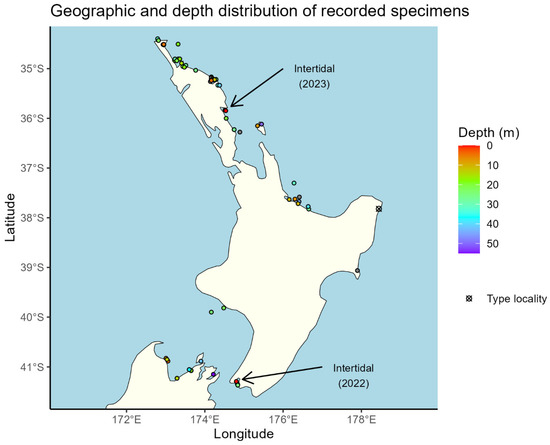
Figure 1.
Geographic and depth distribution records of the New Zealand lancelet, Epigonichthys hectori (Benham, 1901) in New Zealand. Each point indicates a record of one or more specimens; the color indicates the depth; grey points have an unknown depth. The locality of the intertidal specimens from 2022 [5] and 2023 (this study) are annotated.
On 4 June 2023, a vermiform animal was photographed with an Olympus Tough TG6 macro-camera during a tide-pool survey along the coast of Urquharts Bay, near the Whangarei Heads on the Northern Island of New Zealand. On closer inspection of the macro-pictures (Figure 2 and Figure 3), myotomes were observed on the lateral sides of the animal. This, in combination with the absence of eye spots and paired fins, identified the specimen as a lancelet. As there is no evidence of more than one species from New Zealand waters, the specimen was identified as Epigonichthys hectori. The adult specimen was found in the daytime, in the intertidal area of the beach. It was found at low tide, underneath a big but movable rock (approx. 20 cm in diameter), in a small puddle of seawater, >5 m from the shoreline. Upon lifting the rock, the lancelet made ‘fish-like’ (anguilliform) motions, moving in lateral directions, escaping the puddle. The specimen was approximately 5 cm in length, showing a translucent yellow-brown color. Myotomes were present along the entirety of its flanks and a low dorsal fin along the entirety of the body. Neither a caudal fin nor oral hood (including buccal cirri) were observed, possibly due to the animal being out of the water. The characteristic ‘notch’ between the rostrum and dorsal fin also could not be observed, possibly for the same reason. In addition, the full transparency of the animal described by Paulin [2] and Struthers [1] did not match the in-life color observed here. The specimen was released after the pictures were taken. The lancelet shared the habitat with several species of anomuran and brachyuran crabs, a few species of fish, and pistol shrimp.
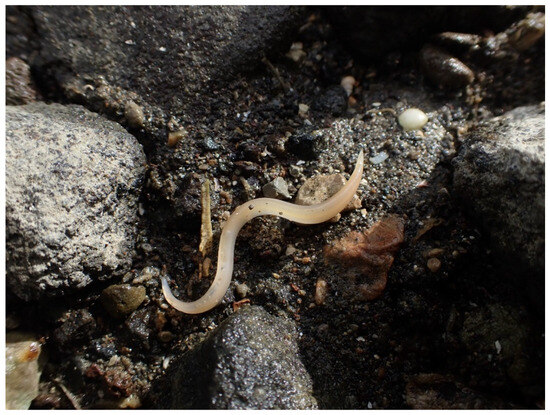
Figure 2.
A New Zealand lancelet, Epigonichthys hectori (Benham, 1901), in situ, after it escaped a puddle. The habitat consists of large rocks on coarse (black, vulcanic) sand.
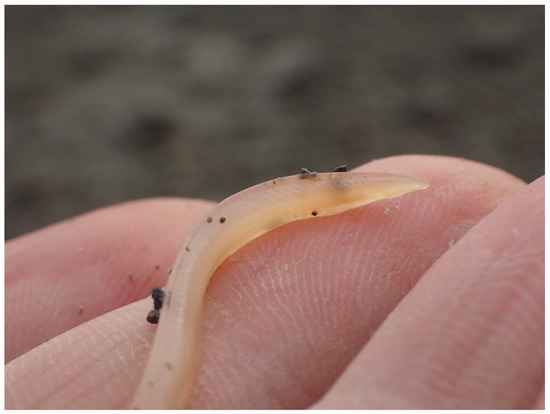
Figure 3.
A close-up of the frontal (oral) region of a New Zealand lancelet, Epigonichthys hectori (Benham, 1901), on the hand of the first author. The oral hood and buccal cirri appear to be retracted.
A previous study [6] suggests that juvenile specimens of the New Zealand lancelet migrate to open water and greater depths at night and retreat to the sediment during the day. Adult specimens are known from depths ranging from 0 to 55 m [1]. The distribution and depth information from this source is based on collection material from Te Papa Tongarewa, but upon closer inspection, no apparent records from the intertidal were found (Supplementary Table S1). Museum specimens (including some loaned materials), which were caught before 1977 and examined by Paulin [2], feature a depth distribution starting at 4 m depth. One exception was found: the holotype was apparently found at “low tide” [2]. However, the original description by Benham [7] does not list any information on the depth of the collected specimens. A few specimens from the Te Papa museum have an unknown depth, but the majority of them have been caught far from the coast or by commercial fishing, which implies that these specimens were not collected in the intertidal (Supplementary Table S1). The two remaining samples, the paratype specimen (NMNZ3263) and one caught by Max Hancock (NMNZ14033) [8] are annotated with an unknown depth range (Supplementary Table S1). This means that these samples may have been caught in shallow water. A few samples from other collections were annotated with a minimum depth of 3 to 5 m, but there is no record of intertidal capture (Supplementary Table S1).
In 2022, Luca Davenport-Thomas shared several in situ photos of specimens on iNaturalist (obs. 123766123). He found the specimens in shallow water of about 10 to 15 cm deep in the intertidal [5]. This makes his record the first but unpublished observation of the species in a very shallow environment. The record from this paper constitutes, together with the observation from 2022, evidence that the species can survive in the intertidal zone, and it is not just an abnormal encounter.
As mentioned before, New Zealand lancelets require certain grain sizes (predominantly > 0.125 mm) for the sediments in which they thrive. In addition, the sediment has to be loose and clean in order for the lancelets to feed [2]. Interestingly, the current specimen was found in the intertidal area of a beach, which was (at the time of capture) heavily used by local fishermen and upturned and pressed by vehicles (including tractors)pulling boat-loaders. Such human activities may be indicative of high levels of pollution in the water and beach of Urquharts Bay (e.g., in 2006) [9]. Water quality has improved since 2006 [10,11], and while the oil refinery at Marsden Point (located on the other side of the channel) was decommissioned in April 2023, the area is still used to import and transfer oil, albeit with strict environmental management [10].
The current state of the beach may give an indication of the apparent resilience of the New Zealand lancelet. We hope that these photos and observation data reignite enthusiasm to search for and photograph rare species for both professional scientists and citizen scientists on iNaturalist. These observations can aid researchers in mapping the distribution of rarely caught species, thereby also improving the knowledge of their habitat requirements.
Supplementary Materials
The following supporting information can be downloaded at: https://www.mdpi.com/article/10.3390/d15091017/s1, Table S1: NMNZ, NIWA, and AWMM holdings of Epigonichthys hectori (Benham, 1901)—with additional records; File S1: R-code to visualize depth and geographic distribution of museum records.
Author Contributions
Conceptualization, W.d.G. and J.H.; validation, W.d.G. and J.H.; investigation, W.d.G. and J.H.; resources, W.d.G. and J.H.; data curation, W.d.G. and J.H.; writing—original draft preparation, W.d.G.; writing—review and editing, W.d.G. and J.H.; visualization, W.d.G. and J.H. All authors have read and agreed to the published version of the manuscript.
Funding
This research received no external funding.
Institutional Review Board Statement
Not applicable.
Data Availability Statement
The data supporting this article can be found in the Supplementary Materials.
Acknowledgments
The authors would like to thank the VLIZ library (Oostende, Belgium) for making the paper by Paulin [2] available. Kareen Schnabel (NIWA, Wellington, NZ) is thanked for her cooperation in getting us into contact with the ichthyology staff at the Te Papa Tongarewa Museum. For sending us the collection records for the specimens at the Te Papa museum, we would like to thank Jeremy Barker (Te Papa Tongarewa, Wellington, NZ), and for the records of the Auckland museum, we thank Severine Hannam (Auckland War Memorial Museum, Auckland, NZ) In addition, we would like to thank Luca Davenport-Thomas for sending us additional information on the specimens photographed in Wellington. Two anonymous reviewers are acknowledged for their thoughtful comments and feedback.
Conflicts of Interest
The authors declare no conflict of interest.
References
- Struthers, C.D. 1. Family Epigonichthyidae, Lancelets; 1.1 Epichonichthys hectori (Benham, 1901). In The Fishes of New Zealand; Roberts, C., Stewart, A.L., Struthers, C.D., Eds.; Te Papa Press: Wellington, New Zealand, 2015; Volume 2. [Google Scholar]
- Paulin, C.D. Epigonichthys hectori (Benham), the New Zealand lancelet (Leptocardii: Epigonichthyidae). Natl. Mus. N. Z. Rec. 1977, 1, 143–147. [Google Scholar]
- King, C.M.; Roberts, C.D.; Bell, B.D.; Fordyce, R.E.; Nicoll, R.S.; Worthy, T.H.; Paulin, C.D.; Hitchmough, R.A.; Keyes, I.W.; Baker, A.N.; et al. Twenty-Four: Phylum Chordata—lancelets, fishes, amphibians, reptiles, birds, mammals. In New Zealand Inventory of Biodiversity: Volume One: Kingdom Animalia; Gordon, D.P., Ed.; Caterbury University Press: Christchurch, New Zealand, 2009. [Google Scholar]
- NIWA. NIWA Invertebrate Collection. v1.1. The National Institute of Water and Atmospheric Research (NIWA). Dataset/Occurrence. 2018. Available online: https://nzobisipt.niwa.co.nz/resource?r=obisspecify&v=1.1 (accessed on 28 August 2023).
- Davenport-Thomas, L. iNaturalist Observation. 2022. Available online: https://www.inaturalist.org/observations/123766123 (accessed on 31 July 2023).
- Crossland, J. Occurrence of the New Zealand lancelet in the plankton. N. Z. J. Mar. Freshw. Res. 1979, 13, 277. [Google Scholar] [CrossRef]
- Benham, W.B. Memoirs: Heteropleuron hectori, the New Zealand Lancelet. J. Cell Sci. 1901, 2, 273–280. [Google Scholar] [CrossRef]
- Gardner, N.; Gardner, N. Poirieria, from the Auckland Institute and Museum, Conchology Section. 7 (1): 1–177. BHL. 1973. Available online: https://www.biodiversitylibrary.org/item/204891 (accessed on 25 August 2023).
- Lynch, B. Contamination Threat ‘Extreme’ in Harbor (News Article: The Northern Advocate). 2006. Available online: https://www.nzherald.co.nz/northern-advocate/news/contamination-threat-extreme-in-harbour/HMJJUB7S4II3KP3PB44C7TDE64/ (accessed on 31 July 2023).
- NIWA. New Zealand Coastal Water Quality Assessment 2021; Prepared for Ministry for the Environment, October, 2021; Fraser, C., White, R., Snelder, T., Stoffels, R., Eds.; National Institute of Water & Atmospheric Research Ltd.: Auckland, New Zealand, 2021. [Google Scholar]
- Tweddle, S.; Eyre, R.; Griffiths, R.; McRae, A. State of Environment Water Quality in the Whāngārei Harbour 2000–2010; Northland Regional Council: Whāngārei, New Zealand, 2011.
Disclaimer/Publisher’s Note: The statements, opinions and data contained in all publications are solely those of the individual author(s) and contributor(s) and not of MDPI and/or the editor(s). MDPI and/or the editor(s) disclaim responsibility for any injury to people or property resulting from any ideas, methods, instructions or products referred to in the content. |
© 2023 by the authors. Licensee MDPI, Basel, Switzerland. This article is an open access article distributed under the terms and conditions of the Creative Commons Attribution (CC BY) license (https://creativecommons.org/licenses/by/4.0/).