Abstract
In Southeast Asia, Cambodia is one of the least studied countries in terms of liverwort diversity. A partial study of about 500 specimens gathered from 2009 to 2013 yielded 66 species new to the country, which raised the number of known species in Cambodia to 210, a number still far below expectations. Twenty genera are new to the country, including Dumortiera, Jackiella, and Lepidozia that are very common and characteristic elements of the mesophytic tropical flora in Asia. The distribution within the country of already known species is supplemented with new data. Two new combinations are proposed: Plectocolea polyrhizoides (Grolle) Bakalin et S.S. Choi comb. nov. and Plectocolea longifolia (Schiffn.) Bakalin et S.S. Choi comb. nov.
1. Introduction
Cambodia is a small country in Southeast Asia and is bordered by Laos in the north, Vietnam in the east, and Thailand in the west. The southern part of the country opens to the Gulf of Thailand (Gulf of Siam). The area of Cambodia is 181,040 square kilometers, which is slightly less than that of Syria (185,180) and slightly larger than that of Uruguay (176,220), or twice lesser than Germany (357,592). A list of the liverworts of Cambodia was published in 2020 by Ingerpuu et al. [1] under the title “The Angkor Wat Kingdom-liverworts from Cambodia”. However, the surroundings of Angkor Wat are too dry for many liverwort species to be found in the country, and other provinces contribute more to the taxonomic diversity of the country. Cambodia is divided into 25 administrative provinces, which have been studied very unevenly. According to the published list [1], out of 138 species, 112 species are known in the province of Kampot, Koh Kong—55, Siem Reap—27, Preah Sihanouk—4, Kampong Thow—1, Modulkiri—1, and Pursat—1. Several species are provided in the checklist without specifying the province.
In general, the country has terrain ranging from plains to hilly landscapes. The western part of the country is bordered by the Cardamom Mts., with the highest point of Cambodia being Mt. Oral (1813 m a.s.l.). Southward of the Cardamom Mts. is the Elephant Range, stretching with a few peaks surpassing 1000 m a.s.l. (including the widely known Mount Bokor). The eastern part of the country possesses the spurs of the Southern Annam Mountains, with the highest peaks at 1100–1500 m above sea level. In terms of relief, Cambodia is much smoother than its neighbors in Indochina: Laos, Thailand, and Vietnam, where the mountains in the northern (and more humid) parts either almost reach, or slightly exceed, 3000 m above sea level. Therefore, while generally agreeing with the authors of the Cambodian liverwort checklist [1] that the 138 species known from Cambodian territory do not reflect the actual diversity, we nevertheless considered it hardly appropriate to compare the potential diversity of Cambodian liverworts with Thailand or, especially, Vietnam.
The diversity of Cambodian liverworts has been studied very unevenly, not only in the territorial sense but also in the systematic sense. Noteworthy are the low numbers of species known for the genera Bazzania (2), Frullania (5), Plagiochila (6), and Solenostoma s.l. (2) with the absence of recorded species from Calypogeia, Riccardia, etc. Apparently, this is because the researcher who made the greatest contribution to the knowledge of the liverworts of Cambodia, Dr. Pierre Tixier (1918–1997), was mainly interested in Lejeuneaceae.
Our studies on the liverworts of Cambodia, carried out from 2009 to 2013, resulted in collecting a significant amount of material, and revealing taxa that were not previously reported for Cambodia. The presentation of these new records is the main purpose of this account.
2. Materials and Methods
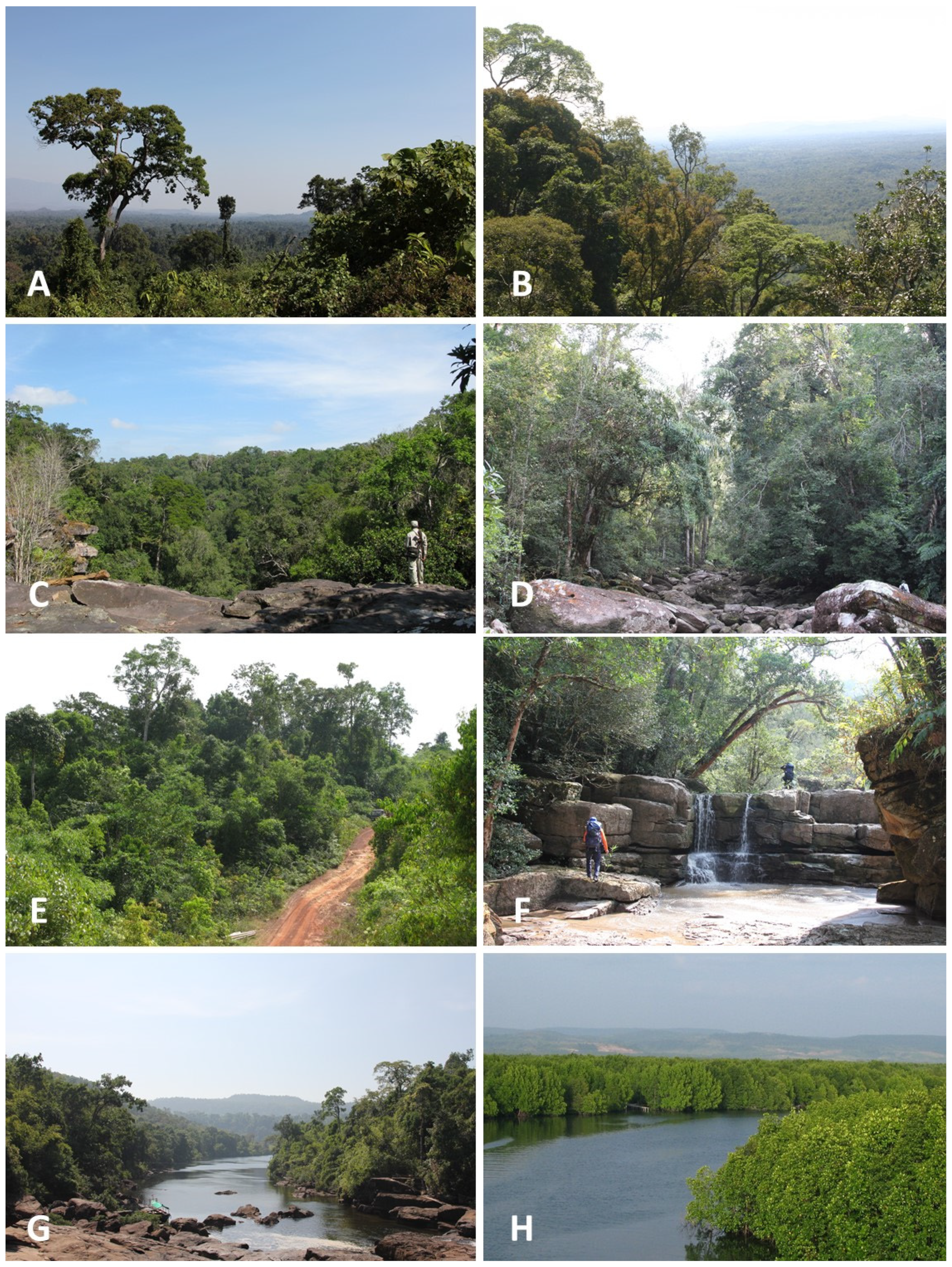
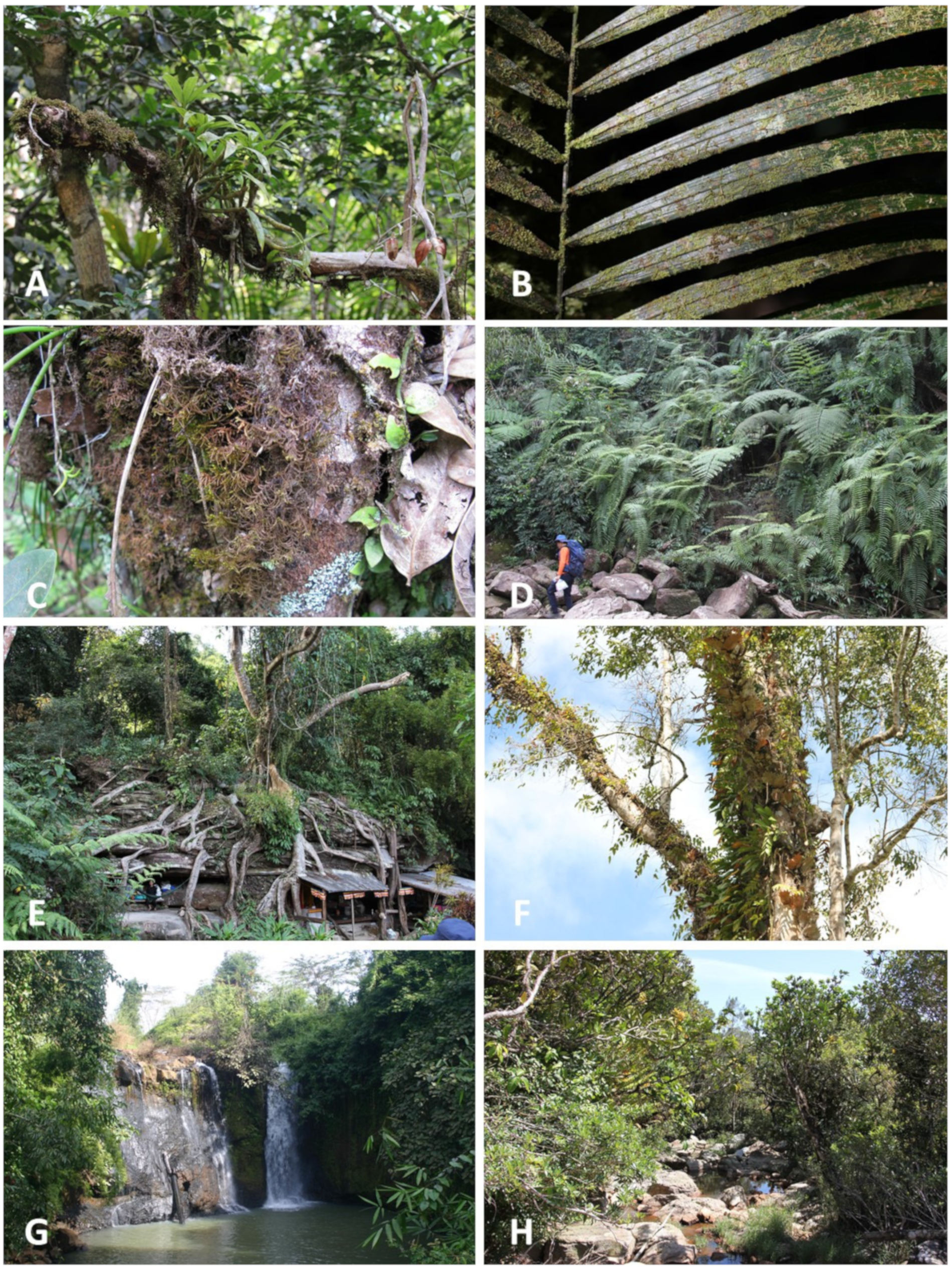
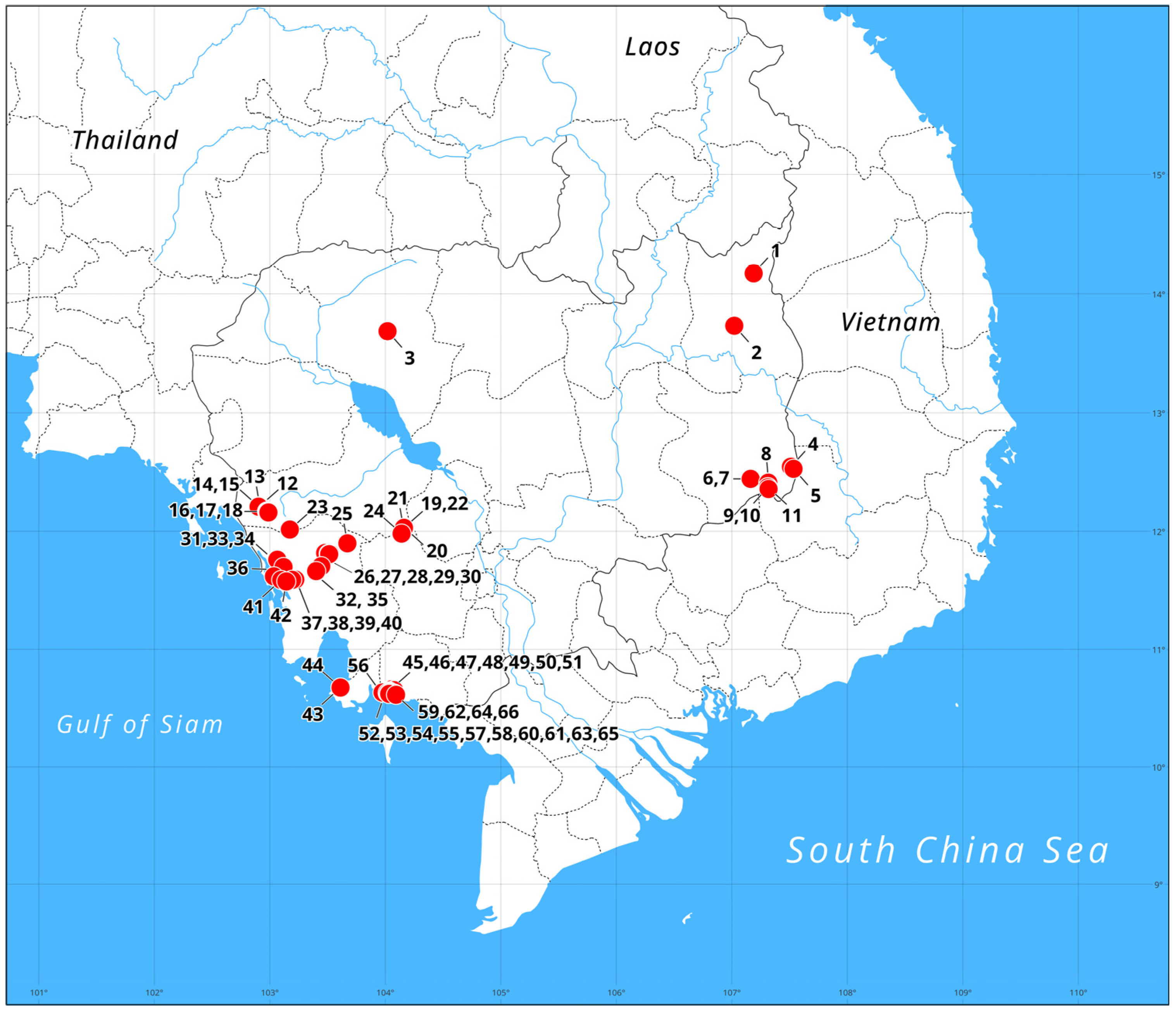
The materials were collected mostly by Seung Se Choi, while Vadim Bakalin took part in field research in December 2011. The distribution by province and dates of collection are shown in Table 1 and Figure 1. Some habitats are shown in Figure 2 and Figure 3. In total, 2606 liverwort specimens were collected. Of this number, approximately 500 have been studied microscopically. Most of the specimens containing representatives of Lejeuneaceae, Plagiochilaceae, and Frullaniaceae have been studied only partially or are currently being studied together with our colleagues. There are significant difficulties in studying these families since, in many cases, there is an unclear status of the taxon and suggestions that many specimens belong to potentially new-for-science species. Since it is not known when the work with these families, as well as with other groups (where specimens are identified only to the genus [potentially new species]), will be completed, we decided to present the entire list of species that are known to date in our collection. A very small part of the species from our collection was published in the Heteroscyphus treatment and Fossombronia for Cambodia [2,3]. We list them in the below list of species but do not indicate them as new to the country.
Table 1.
The data on collections.
Figure 1.
Collecting sites in Cambodia (in accordance to the Table 2 and the checklist).
Figure 2.
Landscapes of field trips in Cambodia. (A) Mt. Samkoh in Pursat Province; (B) Virachey National Park in Rattanakiri Province; (C) Rainforest at Bokor National Park in Kampot Province; (D) Rainforest at Bokor National Park in Kampot Province; (E) Dry forest at Srae Ambel District in Koh Kong Province; (F) Small waterfall and cliffs in Bokor National Park in Kampot Province; (G) Riverbank of Tatai river in Koh Kong Province; (H) Mangrove forest in Koh Kong Province (Photo by S.S. Choi, 2009–2013).
Figure 3.
Some habitats of liverworts in Cambodia. (A) Hanging on orchids and branches at Bokor National Park in Kampot Province; (B) On leaves at Mt. Samkos in Pursat Province; (C) On tree bark at Bokor National Park in Kampot Province; (D) On fern leaves at Bokor National Park in Kampot Province; (E) On tree roots at Bokor National Park in Kampot Province; (F) On tree bark at Phnum Krachau Pramaoy District Pursat Province; (G) Kachanh waterfall at Banlung District in Rattanakiri Province; (H) On rocks near the valley at Bokor National Park in Kampot Province (Photo by S.S. Choi, 2009–2013).
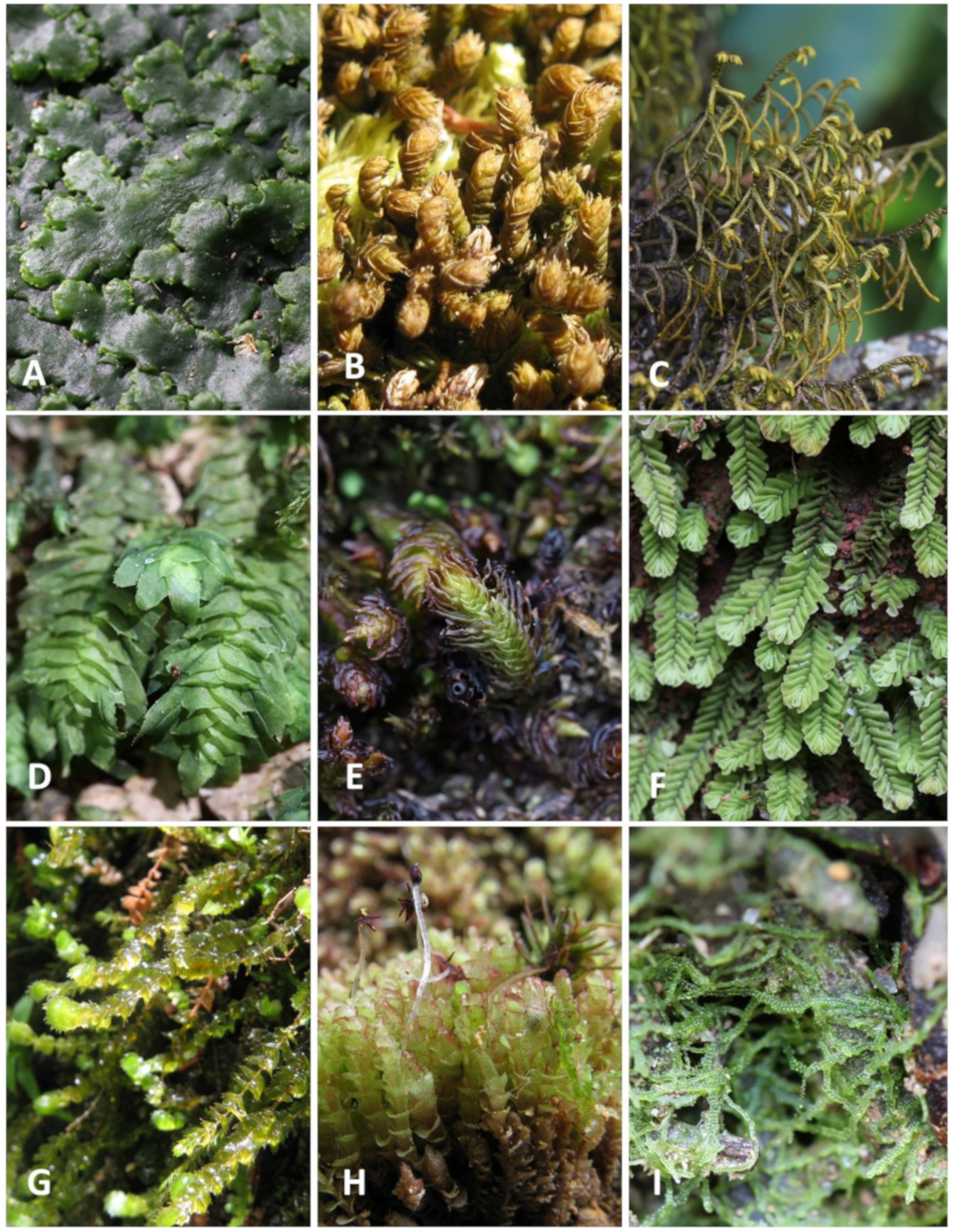
The collection sites for the material summarized in this paper are shown on the map (Figure 1), with the numbering used in the annotation of each species after the species name; the collecting sites are marked in bold font. The geographic coordinates of each locality and the names of the provinces are given in Table 2. In addition to data on collection sites, the annotated list contains data on the elevations in m above sea level at which the species was collected and a list of field numbers for the specimens. The listed annotation categories are separated from each other by a semicolon (;). The names and nomenclature, as a rule, correspond to the World Checklist of Liverworts [4], except for the narrow generic treatment in the family Solenostomataceae, and the acceptance of the genus Asperifolia. The specimens cited in this paper are kept in herbarium JNU, and duplicates of the majority of specimens are in herbarium VBGI. Species reported for the first time from Cambodia are marked with an asterisk. Some species are supplied with nomenclature comments. The taxa in the list are placed in alphabetical order. Some species’ habits are shown in Figure 4.
Table 2.
The collecting localities coordinates and their belonging to the province.
Figure 4.
Some liverworts in Cambodia. (A) Lobatiriccardia coronopus; (B) Anastrophyllum piligerum; (C) Mastigophora diclados; (D) Schistochila aligera; (E) Pleurozia gigantea; (F) Plectocolea comata; (G) Plagiochilion oppositum; (H) Plectocolea ariadne; (I) Zoopsis liukiuensis. (Photo by S.S. Choi, 2009–2013).
The nature environments were previously described in [1]; therefore, only a brief summary seems necessary. Cambodia is a tropical country lying approximately between 14 and 10° N and 102 and 107° E. The altitudes are not high there and rarely exceed 1300–1400 m a.s.l. Phnom Aural is the tallest peak in Cambodia (1813 m a.s.l.). Climate has a very distinct Southeast Asian monsoon character with very minor temperature variations across the year. In Phnom Penh city (weather station on 19 m alt.), the mean monthly temperature varies from 26 to 29 °C, with 1371 mm precipitation per year with a distinct maximum from April to November [5]. In higher elevation, in Sen-Monorom (Mondulkiri Province), at a weather station situated on 695 m a.s.l., the mean monthly temperature varies from 20 to 25 °C, with 2203 mm precipitation per year and with similarly distinct summer maximum [6]. These parameters of annual precipitation in a tropical country, especially in combination with monsoon climate characteristics, suggest the dominance of xero-mesophytic vegetation. Indeed, the dominant forest type is dry evergreen to semi-evergreen forests [1], changing to rain tropical forests only in the southwestern part of the country, where most liverworts are known ([1], also the present paper). Potentially taxonomically rich rain forests in the Southern Annamite mountains located in the northeastern corner of the country are still very weakly explored. The most extent of the area now covered by forests is secondary due to strong human impact (cutting, forest fires), and true primary forests are rare in Cambodia. This especially concern dry evergreen forests [1], while rain forests in the Cardamom Mountains partially belong to rare in Indochina intact rain forests [1]. Mangrove forests scattered along the sea coast were strongly disturbed and still very poorly explored, respecting bryophytes.
The highest liverwort diversity is occurred in epiphyllous habitats and on tree trunks and branches. To a lesser extent, the same should be said about moist and wet stones and cliffs near streams. Other habitats, like mesic and dry cliffs in the forests, roadsides, and decaying wood have taxonomic diversity quite low. However, such relatively liverwort-poor habitats contribute a lot to the taxonomic diversity of the country when being taken together.
3. Results
3.1. Species List
*Acromastigum divaricatum (Nees) A. Evans ex Reimers—33; 289; C9299b
*Anastrophyllum piligerum (Reinw., Blume & Nees) Steph.—20, 25; 1213, 1719; C2057, C5360
*Aneura pinguis (L.) Dumort.—1; 149; C8020
*Asperifolia indosinica Bakalin & A.V. Troitsky—1, 13, 14, 42, 48, 50; 149, 154, 819, 893, 902, 905; C5949, C2144, C3023, C5757, C8013, C8304a
*Bazzania appendiculata (Mitt.) S. Hatt.—45; 872; C2317
*Bazzania asperrima Steph.—21; 1383; C2011, C2012
*Bazzania callida (Sande Lac. ex Steph.) Abeyw.—15, 45, 48; 872, 905, 1003; C2293, C5786, C8309
*Bazzania fauriana (Steph.) S. Hatt.—18; 1285; C2223
*Bazzania loricata (Reinw., Blume & Nees) Trevis.—15, 45; 872, 1003; C2564, C5935, C5938, C5940
*Bazzania oshimensis (Steph.) Horik.—15; 1003; C5903, C5922, C5934—The status of the taxon is questionable. It is commonly treated as a modification within the morphologically malleable B. tridens. However, short, sometimes indistinct, lobation and distinctly convex lobes turned toward the ventral side of the shoot (versus distinctly lobed and more or less plane leaves in B. tridens) may help distinguish this species. A detailed study of the status of this species, preferably using molecular methods, is needed.
*Bazzania semiopaca N. Kitag.—7, 20; 605, 1719; C2069, C5130—Studies of the relationships with B. asperrima are necessary to determine whether the depth of the leaf lobation is a feature that correlates with genetic distinctions.
Bazzania tridens (Reinw., Blume & Nees) Trevis.—15, 18, 19, 21, 22, 24; 526, 865, 1003, 1285, 1383, 1813; C2009, C2010, C2023, C2029, C2120, C2122, C2216, C5922
*Bazzania uncigera (Reinw., Blume & Nees) Trevis.—18, 19, 20; 1285, 1719, 1813; C2061, C2104, C2260
*Calypogeia latissima Steph.—54, 64; 938, 981; C8234, C8238, C9188
*Calypogeia cf. tosana (Steph.) Steph.—33, 64; 289, 981; C9190, C9280—The plants are characterized by very shortly incised leaves (only observable with a microscope). The identification of the material is doubtful because plants without oil bodies were studied.
*Cephalozia hamatiloba Steph.—66; 510; C9217
*Cephaloziella crispata N. Kitag.—12; 816; C8346
*Cephaloziella microphylla (Steph.) Douin—9; 880; Cam-76-1a-11
*Cephaloziella stephanii Schiffn. ex Douin—48; 905; C8271
*Cephaloziella willisana (Steph.) N. Kitag.—48; 905; C8317—The conspecificity of this taxon with Cylindrocolea kiaerii (based on Jungermannia kiaeri Austin with the type from Africa) is questionable due to commonly observed genetic differences between regional populations. Indochinese plants commonly have more transversely inserted leaves, and there is a noticeable difference in distribution.
*Cheilolejeunea boninensis Mizut.—54; 938; C8248a
*Cheilolejeunea kitagawae W. Ye et R.L. Zhu—48; 905; C8290a
Cheilolejeunea trapezia (Nees) Kachroo et R.M.Schust.—39; 363; C8032a
*Chiastocaulon oppositum (Reinw., Blume & Nees) S.D.F.Patzak, M.A.M.Renner, Schäf.-Verw. & Heinrichs—15, 20; 1003, 1719; C2055, C5943, C5943
*Cladoradula campanigera (Mont.) M.A.M.Renner, Gradst., Ilk.-Borg. & F.R.Oliveira-da-Silva—19, 20, 22; 526, 1719, 1813; C2098, C2100, C2101/1, C2124, C2130, C2142
*Cladoradula perrottetii (Gottsche ex Steph.) M.A.M.Renner, Gradst., Ilk.-Borg. & F.R.Oliveira-da-Silva—16, 45; 872, 941; C2201, C2336
Cololejeunea schmidtii Steph.—8; 431; C8074b
Conoscyphus trapezioides (Sande Lac.) Schiffn.—53, 65; 998, 1007; C5458, C8337
*Cuspidatula contracta (Reinw., Blume et Nees) Steph.—19, 20; 1719, 1813; C2057, C2059/1, C2139
*Denotarisia linguifolia (De Not.) Grolle—20, 25, 49; 905,1213,1719; C2059, C5360, C8293
Drepanolejeunea pentadactyla (Mont.) Steph.—8; 431; C8074a
*Drepanolejeunea ternatensis (Gottsche) Schiffn.—54; 938; C8247c
Drepanolejeunea vesiculosa (Mitt.) Steph.—52; 988; C8264
*Dumortiera hirsuta (Sw.) Nees—6; 530; Cam-80-30-11, Cam-80-47-11
Fossombronia japonica Schiffn.—17; 643; C18065
Frullania apiculata (Reinw., Blume & Nees) Dumort.—36, 38, 47, 52, 57, 60, 63; 96, 361, 905, 998, 1034, 1065, 1073; C8175, C8176, C8176a, C8194, C8286, C8330, C8333, C8334, C9046, C9047, C9139, C9145, C9165, C9258/2, C9260, C9270, C9272
*Frullania gaudichaudii (Nees & Mont.) Nees & Mont.—34; 289; C9283, C9283/2, C9283/3
Frullania gracilis (Reinw., Blume & Nees) Dumort.—60; 1073; C8176a
*Frullania serrata Gottsche—52, 59, 63; 988, 1034; C8261, C8326, C9061
*Frullania trichodes Mitt.—48; 905; C8294c
*Fuscocephaloziopsis catenulata subsp. nipponica (S. Hatt.) Váňa & L. Söderstr.—45, 48; 872, 905; C2291, C2312, C8273, C8316, C8317—Cephalozia nipponica S. Hatt. may not be conspecific to Fuscocephaloziopsis catenulata, and should be treated as an independent species. However, we prefer not to create a new combination under Fuscocephaloziopsis until a specific study on this issue is performed.
*Fuscocephaloziopsis gollanii (Steph.) Váňa & L. Söderstr.—48, 61, 64; 905,981, 1073; C8199, C8277, C9186
*Herbertus dicranus (Gottsche, Lindenb. et Nees) Trevis.—48; 905; C8317a
Heteroscyphus argutus (Nees) Schiffn.—3, 4, 6 7, 9, 11, 14 17, 20, 25, 26, 28, 29 38, 51, 56, 63; 171, 232,361, 429, 530, 605, 700, 855, 880,869,900,902,954, 1034,1213, 1121,1719; C2073, C2146, C2148, C2287, C3227, C5014, C5025, C5039, C5123, C5275, C5330, C5337, C5355, C5739, C5742, C8123, C8130, C9083, C9268, Cam-76-44-11, Cam-77-26-11, Cam-79-22-11, Cam-80-27-11, Cam-80-38-11, Cam-81-78-11, Cam-81-79-11, Cam-88-24-11, Cam-88-28-11
Heteroscyphus aselliformis (Reinw., Blume & Nees) Schiffn.—14, 54; 902, 938; C2143, C8247b
Heteroscyphus coalitus (Hook.) Schiffn.—2, 4, 5, 6, 7, 8, 10, 15, 18, 25, 26, 29, 32, 45, 51, 54, 55, 56, 63; 232, 304, 405, 530, 605, 688, 700, 855, 800, 872, 900, 938, 954, 962, 1003, 1213, 1285; C2196, C2264, C2319, C2334, C3047, C5060, C5066, C5092, C5094, C5118, C5122, C5126, C5274, C5275, C5294, C5344, C5519, C5714, C5717, C5719, C5738, C5742, C5787, C5801, C5916, C5946, C8045, C8237, C9113, C9132, Cam-78-9-11, Cam-79-10-11, Cam-79-12-11, Cam-79-14-11, Cam-79-16-11, Cam-79-24-11, Cam-79-25-11, Cam-79-56-11, Cam-79-9-11, Cam-80-12-11, Cam-80-27-11, Cam-80-47-11, Cam-81-79-11, Cam-88-20-11
Heteroscyphus pandei S.C. Srivast. & A. Srivast.—8, 26 27; 431, 700, 800; C8089, Cam-78-9-11, Cam-88-23-11
Heteroscyphus splendens (Lehm. & Lindenb.) Grolle—17, 37, 45, 51, 54, 55, 62, 63, 65; 380, 872, 938, 954, 962,992,1007, 1034,1121; C2281, C2292, C5447, C5448, C5471, C5478, C5515, C5517, C5526, C5561, C5678, C8244b, C9014, C9071, Cam-87-26-11, Cam-87-33-11
Heteroscyphus tener (Steph.) Schiffn.—37, 65; 380, 1007; C5454, C5457, C5471, C5482, C5503, C5507, Cam-87-42-11
Heteroscyphus zollingeri (Gottsche) Schiffn.—8 9, 10 29, 56; 232, 700, 800, 855, 880; C5060, C5275, Cam-76-9-11, Cam-78-10-11, Cam-81-76-11, Cam-81-92-11
*Jackiella javanica Schiffn.—12, 14; 816, 902; C2144, C2146, C8345a
*Kurzia gonyotricha (Sande Lac.) Grolle—48; 905; C8314a
*Kurzia lineariloba Mizut.—48; 905; C8304c
Lejeunea flava (Sw.) Nees—7; 429; C8150c
Lejeunea sordida (Nees) Nees—54; 938; C8248b
*Lepicolea yakusimensis (S.Hatt.) S.Hatt.—25; 1213; C5372
*Lepidozia fauriana Steph.—18; 1285; C2250
Leptolejeunea epiphylla (Mitt.) Steph.—7; 429; C8144a
Leptolejeunea balansae Steph.—6; 361; C9247
*Lobatiriccardia coronopus (De Not. ex Steph.) Furuki—18; 1285; C2253
Lopholejeunea eulopha (Taylor) Schiffn.—54; 938; C8249a, C8250
Lopholejeunea subfusca (Nees) Schiffn.—54; 938; C8246a
*Mastigolejeunea humilis (Gottsche) Schiffn.—24; C2001
Mastigophora diclados (Brid. ex F. Weber) Nees—19, 20, 25, 45, 61; 872, 1073, 1213, 1719, 1813; C2064, C2139, C2356, C5361, C8207
*Microlejeunea punctiformis (Taylor) Steph.—54; 938; C8247b
*Neolepidozia wallichiana (Gottsche) Fulford & J. Taylor—16, 19, 39; 363, 941, 1813; C2104, C2134, C2203, C8028, C8029
Notoscyphus lutescens (Lehm. & Lindenb.) Mitt.—12, 29, 35, 45; 356, 700, 816, 872; C2327, C5201, C8353, Cam-81-122-11
*Nowellia curvifolia (Dicks.) Mitt.—61; 1073; C8289
*Odontoschisma grosseverrucosum Steph.—18; 1285; C2226, C2227
Pallavicinia levieri Schiffn.—3, 18, 30, 33, 35, 40, 41, 44, 63, 64; 171, 289, 981, 1034, 1285; C2196, C3091, C9083, C9190, C9280, C9298; Cam-86-9-11, Cam-78-27-11, Cam-79-11-11, Cam-79-13-11, Cam-81-102-11, Cam-83-37-11, Cam-83-42-11, Cam-83-44-11, Cam-89-5-11, Cam-89-6-11, Cam-89-7-11, Cam-90-2-11
*Plagiochila fruticosa Mitt.—18, 45; 872, 1285; C2250, C2311
Plagiochila sandei Dozy ex Sande Lac.—55; 992; C9001, C9030
*Plagiochila subtropica Steph.—14; 902; C2167
Plectocolea ariadne (Taylor ex Lehm.) Mitt.—13; 819; C5950
*Plectocolea comata S. Hatt.—7; 605; C5124
*Plectocolea hasskarliana (Nees) Mitt.—23; 509; C5950
*Plectocolea longifolia (Schiffn.) Bakalin et S.S. Choi comb.nov. (Basionym: Nardia longifolia Schiffn. Denkschriften der Kaiserlichen Akademie der Wissenschaften, Wien. Mathematisch-naturwissenschaftliche Klasse 67: 189. 1898. Sumatra. In monte Singalang, in silvis primaebis ad decliv. orient. ad terram in ripis torrentis, regio nubium, 2000 m, 24 July 1894, V. Schiffner 437 (FH; isolectotypes G00281102!, S-B38079, not seen)—7; 605; C5120/1—The species is morphologically similar to P. comata, as is also mentioned in the original description by V. Schiffner. However, the name is treated as the synonym of P. truncata by Váňa & Inoue [7].
*Plectocolea polyrhizoides (Grolle ex Amakawa) Bakalin et S.S. Choi comb. nov. (Basionym: Jungermannia polyrhizoides Grolle ex Amakawa Journal of the Hattori Botanical Laboratory 29: 262, f. 7. 1966. Holotype: Nepal, Poelt H145 JE! Isotype HIRO!)—7, 43; 55, 605; C5120, C5125, C5253, C5254—The species is treated as Solenostoma polyrhizoides (Grolle ex Amakawa) Váňa & D.G. Long. Recent literature showed [8], however, that if the narrow genus concept is adopted in Solenostomataceae, then this taxon should be transferred to Plectocolea.
*Plectocolea rosulans (Steph.) S. Hatt.—15; 1003; C5910, C5912, C5916
*Plectocolea setulosa Herzog—14; 902; C2147
*Plectocolea sikkimensis (Schiffn. ex Steph.) Bakalin—48; 905; C8317
*Plectocolea tetragona (Lindenb.) Amakawa—2, 15, 35, 43; 55, 304, 356, 1003; C3051/2, C5227, C5250, C5254, C5799, C5913
Plectocolea truncata (Nees) Herzog—31, 50; 65, 893; C5244, C5749
*Pleurozia gigantea (F. Weber) Lindb.—25; 1213; C5362, C5369
*Plicanthus birmensis (Steph.) R.M. Schust.—48, 54, 58; 905, 938, 1065; C8244b, C8317, C9171
*Ptychanthus striatus (Lehm. et Lindenb.) Nees—15; 1003; C5920
*Radula anceps Sande Lac.—13; 819; C5914
Radula acuminata Steph.—7; 429; C8144b
*Radula apiculata Sande Lac. ex Steph.—15; 1003; C5801
*Radula cavifolia Hampe—19; 1813; C2139
Radula javanica Gottsche—18; 1285; C2279
*Schistochila aligera (Nees et Blume) J.B.Jack et Steph.—18; 1285; C2268, C2272
*Schizophyllopsis bidens (Reinw., Blume & Nees) Váňa & L. Söderstr.—46; 905; C8290
Spruceanthus polymorphus (Sande Lac.) Verd.—39; 363; C8027b
*Telaranea major (Herzog) J.J. Engel et G.L. Merr.—33; 289; C9297
Thysananthus aculeatus Herzog—39; 363; C8330b
Thysananthus spathulistipus (Reinw., Blume et Nees) Lindenb.—55; 992; C9035
*Tricholepidozia neesii (Lindenb.) E.D. Cooper—16, 26; 700, 941; C2203, Cam-88-20-11
Trichocolea pluma Dumort.—18; 1285; C2248
*Zoopsis liukiuensis Horik.—39, 45; 363, 872; C2320, C8035
3.2. Statistics
Data on the occurrence of 100 species in Cambodia are given. Of these, 66 species are listed for the country for the first time. The following genera are listed for the first time for the country: Anastrophyllum, Asperifolia, Calypogeia, Cephalozia, Cephaloziella, Cuspidatula, Denotarsia, Dumortiera, Fuscocephaloziopsis, Jackiella, Lepidozia, Lobatiriccardia, Mastigolejeunea, Neolepidozia, Nowellia, Odontoschisma, Pleurozia, Schistochila, Tricholepidozia, and Zoopsis.
4. Discussion
In the list, we presented species that are both new to the country and already known. This was done to clarify the distribution of species within the country since the knowledge of the latter is very poor. In total, 20 new genera are newly recorded for the country, among which are Dumortiera, Jackiella, and Lepidozia. These must be here, as it is impossible to imagine a mesophytic tropical flora in Asia where these genera would not be distributed. All newly recorded taxa should be expected in the country, taking into account their known occurrence in Vietnam and Thailand.
The number of species listed has a questionable status. For instance, Plectocolea longifolia and Cephaloziella willisana are currently not recognized as ‘good’ species by most researchers. In contrast, we consider these taxa to be good species, especially taking into account that several recent taxonomic revisions based on an integrative approach (combining morphological, molecular, ecological, and geographical methods) led to restoring of forgotten names and revealing new-for-science species, showing that (a) liverworts sometimes have smaller ranges than hitherto assumed and, (b) “semicryptic” taxa are not at all uncommon in Asian liverworts. Recent examples of the latter in Pacific Asia include Blepharostoma [9], Ptilidium [10], Tetralophozia [11], and several other genera.
It is difficult to predict how many more known liverwort species will be in Cambodia if purposeful research is carried out. However, it is clear that knowledge of liverwort diversity is only at the initial stage in the country. In addition to understanding the general diversity, it is necessary to focus on studying the patterns of species distribution throughout the country, which will help form a coherent and adequate concept of the history of the formation (=florogenesis) of the Indochinese liverwort flora.
5. Conclusions
The previously known data on liverwort occurrence in the country were available from 7 provinces, with only two of them counting more than 50 known taxa (Kampot, Koh Kong). The present list provides data on liverworts collected in 8 provinces, including two with the first data published (Stung Treng and Kampong Speu). Therefore, the liverworts are now known from 9 provinces, and this is still quite far from the 25 provinces in the administrative subdivision of Cambodia. We suggest that future research should go the following two ways: (1) exploration of previously unstudied provinces and (2) conducting of research in potentially liverwort promising areas in Southern Annamite Range spurs, Cardamom Range and Elephant Mountains, although these areas were already explored before.
Author Contributions
Conceptualization, V.A.B. and S.S.C.; methodology, V.A.B., S.S.C.; validation, S.S.C. and S.J.P.; formal analysis, V.A.B. and S.S.C.; investigation, V.A.B., S.S.C. and S.J.P.; resources, V.A.B., S.S.C.; data curation, S.S.C. and S.J.P.; writing—original draft preparation, all coauthors; writing—review and editing, V.A.B. and S.S.C.; visualization, V.A.B. and S.S.C.; supervision, V.A.B. and S.S.C.; project administration, S.S.C.; funding acquisition, S.S.C. All authors have read and agreed to the published version of the manuscript.
Funding
The work of V.B. was partially supported by the Russian Science Foundation («The revision of Lepidoziaceae [Marchantiophyta] in Pacific Asia», grant no. 23-24-00029), and is within the framework of the institutional research project “Cryptogamic Biota of Pacific Asia” (no. 1021043000529-9). The work of S.C. was partially supported by a grant from the National Ecosystem Survey of the National Institute of Ecology (NIE-A-2023-01).
Institutional Review Board Statement
Not applicable.
Informed Consent Statement
Not applicable.
Data Availability Statement
Not applicable.
Acknowledgments
We are sincerely grateful to B.Y. Sun, who cared about our work, and significantly helped with permissions and organization of all field trips with the international project dealing with the study of ferns in Cambodia. We are very grateful to Y.S. Mamontov for the identification of Frullania gaudichaudii specimens. We also thank D. Bakalin for typesetting the map of the collecting sites. The work of V.B. was partially supported by the Russian Science Foundation («The revision of Lepidoziaceae [Marchantiophyta] in Pacific Asia», grant no. 23-24-00029), and is within the framework of the institutional research project “Cryptogamic Biota of Pacific Asia” (no. 1021043000529-9). The work of S.C. was partially supported by a grant from the National Ecosystem Survey of the National Institute of Ecology (NIE-A-2023-01) and the National Institute of Biological Resources (NIBR2009-2013), funded by the Ministry of Environment of the Republic of Korea.
Conflicts of Interest
The authors declare no conflict of interest.
References
- Ingerpuu, N.; Vellak, K.; Hagborg, A.; Söderström, L. The Angkor Wat Kingdom—Liverworts from Cambodia. Nova Hedwig. Beih. 2020, 150, 293–316. [Google Scholar] [CrossRef] [PubMed]
- Bakalin, V.; Choi, S.S.; Park, S.J. Review of Heteroscyphus Schiffn. (Lophocoleaceae, Marchantiophyta) in Cambodia. J. Bryol. 2021, 43, 52–61. [Google Scholar] [CrossRef]
- Ellis, L.T.; Ah-Peng, C.; Aslan, G.; Bakalin, V.A.; Bergamini, A.; Callaghan, D.A.; Campisi, P.; Raimondo, F.M.; Choi, S.S.; Csiky, J.; et al. New national and regional bryophyte records, 65. J. Bryol. 2021, 43, 67–91. [Google Scholar] [CrossRef]
- Söderström, L.; Hagborg, A.; von Konrat, M.; Bartholomew-Began, S.; Bell, D.; Briscoe, L.; Brown, E.; Cargill, D.C.; Costa, D.P.; Crandall-Stotler, B.J.; et al. World Checklist of Hornworts and Liverworts. PhytoKeys 2016, 59, 1–828. [Google Scholar] [CrossRef] [PubMed]
- Climate-Data: Phnom Penh. Available online: https://en.climate-data.org/asia/cambodia/phnom-penh/phnom-penh-4857/ (accessed on 6 February 2023).
- Climate-Data: Sen Monorom. Available online: https://en.climate-data.org/asia/cambodia/mondulkiri/sen-monorom-3147/ (accessed on 6 February 2023).
- Váňa, J.; Inoue, H. Studies in Taiwan Hepaticae, V. Jungermanniaceae. Bull. Natl. Sci. Mus. Tokyo Ser. B 1983, 9, 125–142. [Google Scholar]
- Shaw, B.; Crandall-Stotler, B.; Váňa, J.; Stotler, R.E.; von Konrat, M.; Engel, J.J.; Davis, E.C.; Long, D.G.; Sova, P.; Shaw, A.J. Phylogenetic relationships and morphological evolution in a major clade of leafy liverworts (phylum Marchantiophyta, order Jungermanniales): Suborder Jungermanniineae. Syst. Bot. 2015, 40, 27–45. [Google Scholar] [CrossRef]
- Bakalin, V.A.; Vilnet, A.A.; Choi, S.S.; Nguyen, V.S. Blepharostoma trichophyllum s.l. (Marchantiophyta): The Complex of Sibling Species and Hybrids. Plants 2020, 9, 1423. [Google Scholar] [CrossRef] [PubMed]
- Bakalin, V.A.; Vilnet, A.; Klimova, K.G.; Ma, W.Z.; Choi, S.S.; Hentschel, J. Hidden in plain view: An example from Ptilidium (Ptilidiaceae, Marchantiophyta). Phytotaxa 2021, 510, 29–42. [Google Scholar] [CrossRef]
- Bakalin, V.A.; Vilnet, A.A.; Maltseva, Y.D.; Klimova, K.G.; Bakalin, D.A.; Choi, S.S. Hidden Diversity within Tetralophozia filiformis (Marchantiophyta, Anastrophyllaceae) in East Asia. Plants 2022, 11, 3121. [Google Scholar] [CrossRef] [PubMed]
Disclaimer/Publisher’s Note: The statements, opinions and data contained in all publications are solely those of the individual author(s) and contributor(s) and not of MDPI and/or the editor(s). MDPI and/or the editor(s) disclaim responsibility for any injury to people or property resulting from any ideas, methods, instructions or products referred to in the content. |
© 2023 by the authors. Licensee MDPI, Basel, Switzerland. This article is an open access article distributed under the terms and conditions of the Creative Commons Attribution (CC BY) license (https://creativecommons.org/licenses/by/4.0/).