


Abstract
Pteridophytes have been used by humans for millennia, but in comparison to flowering plants, the documentation of their traditional uses is still neglected; as a result, they must be highlighted and popularized. The present study was carried out from January 2019 to November 2021 to gather ecological and traditional use information on pteridophytes from local inhabitants of the Kashmir valley via semi-structured personal interviews and group discussions. We recorded 58 pteridophyte species belonging to 13 families. The distributions of the species among the families were unequal, with four families constituting more than half of the total species (Dryopteridaceae 26%, Woodsiaceae 17%, Aspleniaceae 14%, and Pteridaceae (14%). The highest numbers of species (45%) were found growing on the forest floor, followed by those growing in rock crevices (26%). This was supported further by a cluster analysis, which identified two primary clusters based on the species presence in different habitats. Half of the species (56%) were reported from altitudes below 2000m, followed by 19% from 2001–2500m, and 8% (e.g., Deparia allantodioides, Dryopteris xanthomelas, Asplenium viride) from 3001–3500m. Among the documented species (N = 58), only 28 species had a traditional usage (as medicine, vegetables, for oral hygiene, and for veterinary use). The aerial parts were most commonly used (64%) followed by the rachis (18%). The highest use value was observed for Diplazium maximum and the lowest for Asplenium fontanum. The findings of our study contribute baseline data to fill the existing knowledge gaps on ecological and traditional knowledge of pteridophytes in the Himalayas.
1. Introduction
Pteridophytes are a plant group that falls between non-tracheophytes and spermatophytes and account for over 48 families, 587 genera, and 12000 species worldwide [1,2,3]. The richness of the species is affected by the rainfall, moisture, and habitat availability [4]. Most species are found in tropical and moist temperate regions followed by subtropical regions [5]. They are widely utilized as vegetables, traditional remedies, and for land scaping and gardening [6]. Proteins, vitamins, crude fiber, and minerals are all found in edible pteridophytes, and steroids, terpenoids, phenolic acids, and flavonoids are only a few of the compounds found in them [7].
Pteridophytes were considered a source of medicines in ancient times but remain relatively under explored. However, fern ethnobotany is not new [8], and there is a wealth of information regarding ferns and local cultures in the literature. On a global scale, [8] offered the most thorough analysis of the usage of lycophytes and ferns, but they have also been studied ethnobotanically in South America [9]. Asia has a great diversity of pteridophytes, but their uses have not been well recorded except for a few studies in China and India [10,11].
The Kashmir valley is an integral but geologically younger part of the Himalayan range [12]. Due to topographical, altitudinal, and geographical variation, the valley represents a vast habitat diversity and floristic richness, which is of immense scientific interest and economic potential [13]. The available scientific literature on the flora of the valley indicates that while phanerogams are well documented, little attention has been paid to pteridophytes [12]. Nevertheless, the earliest reported study of the pterido-flora of Kashmir dates back to 1880 [14], and other studies include those found in [15,16,17,18,19,20,21,22,23,24,25,26,27,28]. The valley is inhabited by diverse ethnic people with unique living patterns, and most people reside in rural areas and possess a strong relationship with the natural resources. This relationship with nature has been documented [29,30,31,32].
However, the research on pteridophytes still focuses on taxonomy [12,25,26,27,28] and there are no available studies on traditional use. A few scattered reports are available for ferns and fern-allies from other regions [26,27,28,29]. The present study was designed not only to assess the medicinal importance of pteridophytes but also other uses by the indigenous people, highlighting their economic potential for the area under study. In this regard, the present study aimed:
To document the pteridophyte species with ethno-usage;
To evaluate the ecological knowledge of the local inhabitants of the Kashmir valley regarding the pteridophytes;
To analyze the further distribution of species at different altitudes.
2. Materials and Methods
2.1. Study Area
Kupwara (Figure 1) is a frontier area in the Union territory of Kashmir, which is mainly mountainous with rich flora. The region covers an area of 2379 km2 and this area is mostly rural, including 368 villages with a population of 870,354 persons and a population density of 366 persons/km2 [33].The area is very biodiverse, with dense forests (Himalayan dry-temperate to subalpine forest types) [34]. The climate is of the dfb type, with temperatures falling below −4 °C in winters and reaching 32 °C maximum in summer [35].
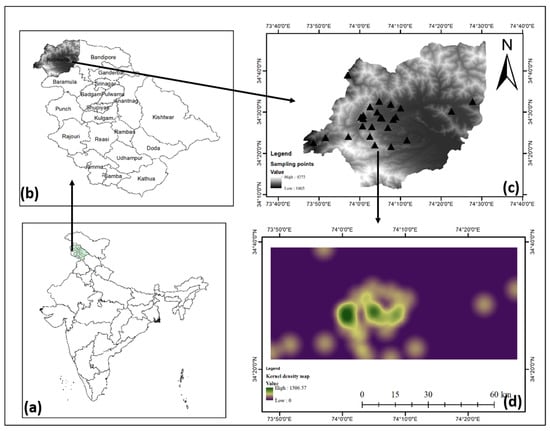
Figure 1.
(a) Map of India, (b) map of Jammu and Kashmir, (c) map showing surveyed villages in the District of Kupwara, and (d) Kernel density map of the sampled villages.
2.2. Survey Methodology
The present study was carried out from January 2019 to November 2021 to gather traditional use reports and ecological information of pteridophytes from the local inhabitants. Ecological data were collected along the altitudinal gradient from 1500–3450 m. During the surveys, data pertaining to the field-based ecological knowledge—such as habitat types of each of the documented species—was collected [36]. The different habitat types included forest floor, rock crevices, grassland pastures, moist paces, and riparian [37]. The ethnobiological information was gathered through semi-structured interviews and group discussions [38,39]. Before interviews, verbal prior informed consent was obtained, and the code of ethics was followed in all aspects of the study (International Society of Ethnobiology. Code of Ethics. 2006) (https://www.ethnobiology.net) (accessed on 28 August 2020). All information was obtained in local language by hiring a translator and local field guide.
2.3. Preservation and Identification of Collected Plants:
The specimens collected from the field were shade-dried and processed into herbarium specimens following standard techniques [40]. The identification was performed with the assistance of Prof. S.P. Kullar (Chandigarh) and Mr. C.R. Fraser-Jenkins (Portugal). Herbarium specimens were deposited in the Department of Taxonomy, University of Kashmir, for future references. The botanical names of the plant species were verified using the Plant List (www.theplantlist.org) (accessed on 28 August 2020. A comparative literature review was conducted to evaluate the possible novelty of the findings.
2.4. Demography of Informants
A total of 58 local individuals, comprising 39 (67.24%) men and 19 (32.75%) women, were selected for the interviews. Due to cultural limitations, the number of male respondents was higher [41,42,43]. Most of the respondents were illiterate (65.51%). Older people (55.17%) had greater traditional knowledge compared to the young (10.34%). The respondents belonged to a variety of professions among which shepherds were the most common (36.20%), followed by skilled laborers (24.13%), farmers (22.41%), and housewives (17.24%) (Table 1).

Table 1.
Demography of informants from the study area.
2.5. Data Analysis
For the dendrogram, presence/absence of data was used to elucidate species distribution in particular clusters based on the same habitat type [44]. The Sorensen’s (Bray–Curtis) distance was used to identify significant differences among diverse habitat types and plant resemblances using Past software ver. 3.14 [45]. A Kernel density map was prepared using ARCGISver.10.5. This depicts hotspots in the landscape, with the darker red color indicating greater species number. We used absence/presence data to depict the distribution of the species on the heat map, and the subsequent cluster analysis will combine species with comparable altitudinal ranges. The program “circlize package” [46] was used to construct chord diagrams in R software 4.0.0. [47]. This graph allows us to see which species in each group and which altitude group has the greatest number of species based on the thickness of each bar [39].
3. Results and Discussions
3.1. Taxonomic Composition
During the present study, we recorded 58 pteridophyte species belonging to 13 families (Figure 2a). The current documentation is the first of its kind from the valley, as no such study related to pteridophytes has been carried out in the region as per our knowledge. Irfan et al [48], who reported 168 taxa belonging to 45 genera and 19 families from Pakistan, Rajput et al. [49] reported 23 species from Gujrat India, Uday et al. [50] reported 77 species belonging to 15 families from Jhargram district of southwest Bengal, and Bibi et al. [51] reported 45 species belonging to 10 families from Ghar KP, Pakistan.
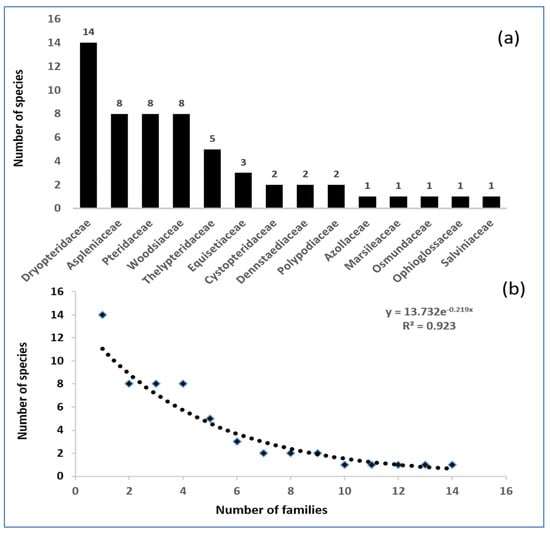
Figure 2.
(a) Percentage of families; (b) species–family relationship of the documented species in the study area.
The distribution of species (Figure 3) in the families was unequal, with four families constituting more than half of the total species (Dryopteridaceae (N = 14), Woodsiaceae, Aspleniaceae, and Pteridaceae (N = 8 each). The family species relationship (y = 13.732e−0.219xR² = 0.923) can be observed (Figure 2b). Our results are similar to Bibi et al. [51], who also reported Dryopteridaceae as the dominant family while evaluating the diversity from Ghar, KP, Pakistan; likewise, Irfan et al. [52] reported Dryopteridaceae as the dominant family from Battargam, KP, Pakistan. Gul et al. [53] also reported Dryopteridaceae as the leading family from Pakistan. Our inventory of the documented flora including the scientific name, local name, family, attitude, habitat, and the 11 villages is presented in Table 2. Among all the study sites, most of the species were reported from Thandipora (31%), followed by Rashanpora-Dutt (14%) and Budnamal (10%) (Table 2).
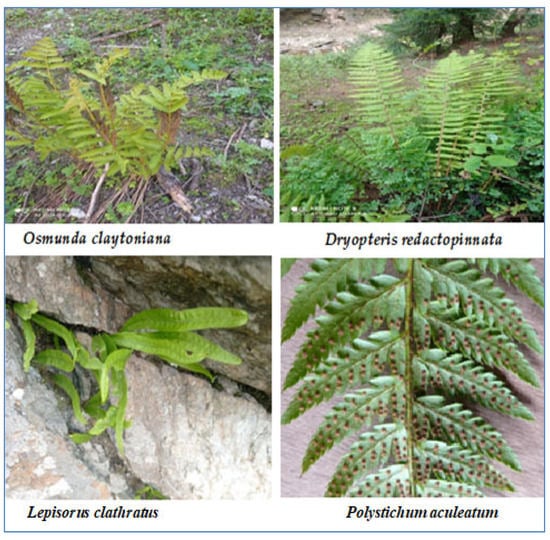
Figure 3.
Representation of the species collected during the field study. (P.C. Aadil Abdullah Khoja).
Table 2.
Inventory of the documented species from the administrative Kupwara district of Jammu and Kashmir.
3.2. Ecological Knowledge
We found that the local people possessed profound ecological knowledge about fern species, e.g., their habitats and altitudinal distribution. The habitats included forest floors, rock cervices, grass land pastures, moist places, and riparian areas. The highest number of species (45%) was found on the forest floor, followed by rock crevices (26%), grassland pastures (17%), moist places (7%), and riparian zones (5%) (Table 2). This was further supported by a cluster analysis in which two primary clusters were recorded (Figure 4): Cluster one included the forest floor, comprising species such as, Asplenium adiantum, Pteridium brownseyi, Dryopteris juxtaposita, and Cluster two included grass land pastures with species such as Pteridium revolutum, Dryopteris barbigera, Dryopteris blanfordii, as well as moist paces with Asplenium dalhousia and Equisetum arvense and riparian zones harboring Marsilea minuta and Salvinia natans. Our results are a similar to Bibi et al. [51] from Pakistan, Arjun et al. [54] from Kerala, and Suneetha et al. [55] from Madhya Pradesh.
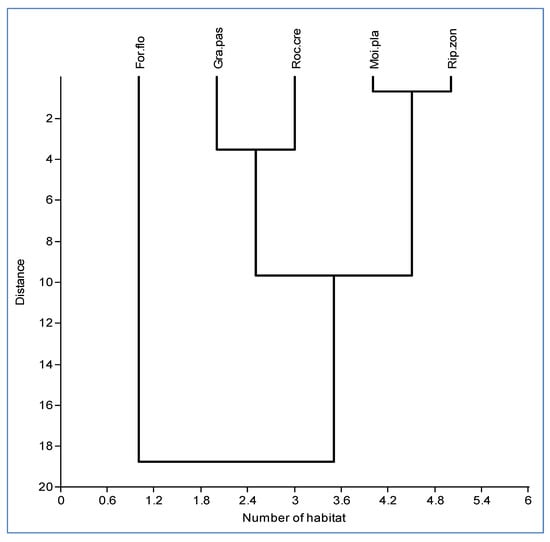
Figure 4.
Clustering of documented species in different habitat in the study area.
More than half of the species (56%), including Pteris cretica, Adiantum tibeticum, Adiantum venustum, and Adiantum capillus-veneris, were reported from altitudes below 2000 m, 19% from 2001–2500 m (e.g., Asplenium fontanum, Thelypteris microstegia, Deparia japonica, Deparia petersenii), 17% of the species (e.g., Athyrium dubium, Lepisorus clathratus) from 2501–3000 m, and 8% (e.g., Deparia allantodioides, Dryopteris xanthomelas, Asplenium viride) from 3001–3500 m (Figure 5). A circular layout of the diagram represents the documented species and altitudinal ranges, and its inner lines represent the relationship between the species and altitude. The lines connecting each species and altitude represent their importance in relation to each other, and the size of the arc reflects the number of species in each category. The histogram illustrates the number of species in the landscape, with the greater species numbers (32) in the lower (below 2000 m) altitudes (Figure 6). When comparing the upper and middle altitudinal regions, the lower areas had higher species numbers. This may be due to the fact that a lower altitude provides diverse, suitable habitats for the growth of pteridophytes.
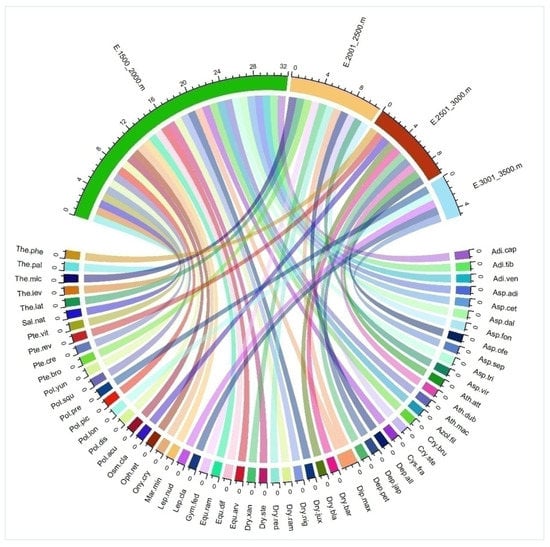
Figure 5.
Percentage of species found in different altitudinal groups in the study area. The direction of the lines shows which species is associated with which type of altitudinal group, and the thickness of each bar shows the number of species in each altitudinal type. The complete name of each species is shown in Table 2.
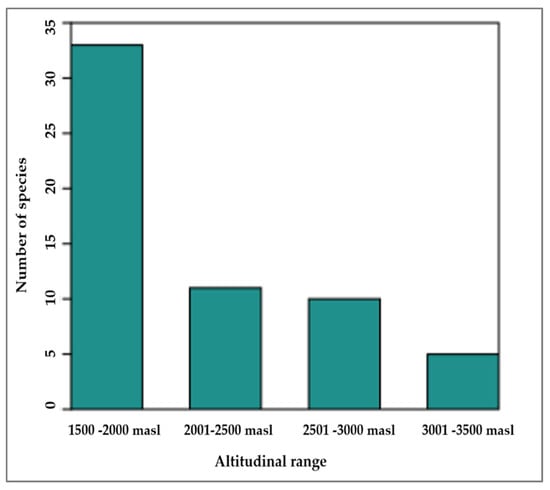
Figure 6.
Altitudinal variations of the documented species in the study area.
3.3. Traditional Knowledge
The use of ferns in ethnomedicine has been studied on all inhabited continents, including the Americas and Europe [8]. However, current and updated information on the medical applications offered in Asia and Africa is not easily available. In Asian traditional medicine, pteridophytes are an important category of plants. Mannan et al. [56] Discussed their applications in homeopathic, ayurvedic, tribal, and Unani medicine. Indian pteridophytes have been widely explored for their ethnomedicinal usage [57]. However, no extensive study has been carried out in the Kashmir Himalaya to document the pteridophyte species with ethno-usage.
Among all the documented species (N = 58), only 28 species were recorded for ethno-usage (Table 2). Our results are inline with Sarker et al. [58] reported the ethno-use of pteridophytes from the mensingh district of Bangladesh, Khullar [5] Dehradun, India, and Lie et al. [59,60] from China. We classified the traditional uses into four categories (Medicine, vegetable, oral hygiene and veterinary use) (Figure 7a), among which veterinary use was dominant (N = 9), followed by medicine (N = 8), vegetable (N = 6), and oral hygiene (N = 6) (Figure 5a). Species such as Dryopteris barbigera, Dryopteris blanfordii, Dryopteris juxtaposita, Dryopteris redactopinnata, and Polystichum discretum were the main species used for ethno-veterinary purposes. The species with medicinal attributions included Asplenium adiantum-nigrum, Asplenium ceterach and Asplenium trichomanes. For oral hygiene, the species employed were Asplenium trichomanes, Equisetum arvense, and Equisetum diffusum. Pteridium brownseyi, Pteridium revolutum, Dryopteris ramose, were used as vegetables. According to [61], eating ferns has a 3000-year history in China, and edible ferns are among the most commonly harvested wild food plants in the world, with the stems, rhizomes, leaves, young fronds, and shoots, as well as whole plants, being utilized for food [62]. Although ferns have long been utilized in traditional cuisines, there is a scarcity of knowledge of their usage patterns, nutritional characteristics, and recipes, and generally ferns are rarely used as a food source, with a few exceptions [56]. It is important to mention that the young fronds of Pteridium revolutum and the aerial parts Dryopteris stewartii are only eaten when boiled first and then properly sun-dried, because the local users know that if they are taken while green, they may cause cancer and vomiting. The dominance of veterinary usage is because the local people employ the maximum documented species as strays for stables (Figure 7) of the domesticated fauna such as goat, sheep, cow, and buffalo. The complete ethno-usage of the documented species is provided in Table 2.
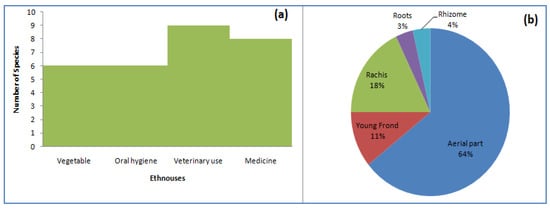
Figure 7.
(a) Different uses of documented species; (b) Percentage of different parts of the documented species for the tradition uses.
The aerial parts of ferns were most commonly used (64%), followed by rachis (18%), young fronds (11%), rhizomes (4%), and roots (3%) (Figure 6b). Giri et al. [61] reported the dominance of aerial parts (the whole plant) in ethno-usage from India; Joshi et al. [63] also reported the dominance of aerial parts (whole plant) from India. The use value ranged between 0.29–0.69 (Table 2): the highest use value was observed for Diplazium maximum and the lowest for Asplenium fontanum. The high UV value for Diplazium maximum was due to its high edible value, with local people consuming it as vegetable. The season for collections runs from March to May, and the collected species is sun dried and made into powder, stored, and used in winters. The local people believed that the species enhances one’s life span, explaining its common use. During harsh winters, the availability of green leafy vegetables is sparse, and the price is also very high in local markets, resulting in the dependence of the local people on wild collected vegetables such as Diplazium maximum. Further, some tribal people collected the Diplazium maximum for commercial purposes. The women from these tribes travel to far off places to sell the collected species and earn decent profits in return. Joshi et al, Shrestha et al. [64,65] reported the commercial value of Diplazium species from Central Nepal. Diplazium is commonly known as the fiddle head fern, including edible species such as Diplazium esculentum, Diplazium sammatii, and Diplazium proliferum. The genus is known to have a unique omega 6 fatty acid (di-homo-gammalinolenic acid) as well as polyphenols, suggesting its possible function as a nutraceutical [7]. According to [7], different leafy vegetables such as Amaranthus, asparagus, celery, spinach, and lettuce are inferior in nutritional quality to ferns.
3.4. Toxicity
In the present study, the local people indicated that certain potentially poisonous ferns (Asplenium dalhousia, Pteridium brownseyi, Pteridium revolutum, Dryopteris barbigera, Dryopteris blanfordii, Dryopteris juxtaposita, Dryopteris nigropaleacea, Dryopteris ramosa, Dryopteris stewartii, Athyrium mackinnoniorum, Polystichum discretum, Polystichum aculeatum, Polystichum squarrosum, Polystichum lonchitis, Polystichum piceopaleaceum, Polystichum prescottianum, and Polystichum yunnanense) are not poisonous if harvested at the inappropriate stage. These potentially toxic species constitute 31.03% of the total documented species and are often the cause of livestock deaths. The toxicity of the plant/part can be ascribed to the alkaloids present at the armature stage.The authorof [66] reported livestock deaths from Indonesia due to plant toxicity.
The existence of rare fern species (Polystichum aculeatum, Pteris vittata, Lepisorus nudus, Ophioglossum reticulatum, Polystichum prescottianum, Pteridium brownseyi, and Dryopteris juxtaposita), which were reported for the first time from this part of the Kashmir Himalayas, was one of this study’s most intriguing findings. Polystichum aculeatum was recently reported from Kashmir Himalayas by [66].
4. Conclusions
The current research is the first comprehensive examination of the ecological and traditional uses of pteridophytes in the study area. We documented 58 pteridophyte species, with Dryopteridaceae being the most common. Most species were found at lower elevations (below 2000m). Among the total number of species reported, 28 species had traditional uses. Veterinary uses were the most common, followed by medical and vegetable uses. Diplazium maximum is a highly-edible species that the locals most commonly eat as a vegetable. Due to an ever-changing physical environment, increasing population pressure, and rapid socio-economic growth, all of these species and their related traditional knowledge are endangered. Since much of the information is still in the hands of the local community without any written documentation, the collection and documentation of such information is critical. Ethnopteridological knowledge needs to be efficiently collected, conserved, and used to benefit the country’s development and conservation.
Author Contributions
Data collection A.A.K.; Data Analysis S.M.H., M.M. and M.W.; Initial original draft S.M.H., M.H., U.Y.: Revision, A.A.K., A.Z.D., M.A.-Y., A.A.; W.Z., H.O.E., K.Y., M.M., U.Y., S.M.H., R.W.B. and M.H., A.A.K., A.Z.D., M.A.-Y., H.O.E., K.Y.; Review, R.W.B. and W.Z. All authors have read and agreed to the published version of the manuscript.
Funding
This research was financially supported by the Deanship of Scientific Research, king Saud University through Vice Deanship of Scientific Research Chairs; Research Chair of Prince Sultan Bin Abdulaziz International Prize for Water.
Institutional Review Board Statement
Not applicable.
Informed Consent Statement
All the participants provided prior informed consent before interviews; also ethnobiology code of ethics was followed (https://www.ethnobiology.net/what-we-do/core-programs/ise-ethics-program/code-of-ethics/).
Data Availability Statement
All data obtained during the study is included in this article.
Acknowledgments
The authors extend their appreciation to the Deanship of Scientific Research, King Saud University for funding through Vice Deanship of Scientific Research Chairs; Research Chair of Prince Sultan Bin Abdulaziz International Prize for Water.
Conflicts of Interest
The authors declare no conflict of interest.
References
- Christenhuz, M.J.; Byng, J.W. The number of known plants species in the world and its annual increase. Phytotaxa 2016, 261, 201–217. [Google Scholar] [CrossRef] [Green Version]
- PPG-1. A community-derived classification for extant lycophytes and ferns. J. Syst. Evol. 2016, 54, 563–603. [Google Scholar] [CrossRef]
- Zaman, W.; Shah, S.N.; Ullah, F.; Ayaz, A.; Ahmad, M.; Ali, A. Systematic approach to the correct identification of Aspleniumdalhousiae(Aspleniaceae) with their medicinal uses. Microsc. Res. Tech. 2019, 82, 459–465. [Google Scholar] [CrossRef] [PubMed]
- Murad, W.H.; Rehman; Khan, M.S. Common ferns and fern allies of Swat. Sci. Khyber 2000, 13, 23–32. [Google Scholar]
- Khullar, S.P. An Illustrated Fern Flora of West Himalaya; International Book Distributors: Dehradun, India, 2000; Volume II. [Google Scholar]
- Ranil, R.H.G.; Bussmann, R.W. Potential uses of lycophytes and ferns in Sri Lanka: An ethnopteridological perspective. Ethnobot. Res. Appl. 2021, 21, 1–11. [Google Scholar] [CrossRef]
- Chettri, S.; Manviannan, S.; Muddursu, V.R. Nutrient and elemental composition of wild edible ferns of the Himalaya. Am. Fern J. 2018, 108, 95–106. [Google Scholar] [CrossRef]
- Keller, H.A.; Prance, G.T. The ethnobotany of Ferns and Lycophytes. Fern Gaz. 2015, 20, 1–13. [Google Scholar]
- Keller, H.A.; Torres, E.I.M.; Prance, G.T. Ethnopteridology of the Guaranís of Misiones Province, Argentina. Am. Fern J. 2011, 101, 193–204. [Google Scholar] [CrossRef]
- Singh, B.P.; Upadhaya, R. Medicinal Pteridophytes of Madhya Pradesh. J. Med. Plant Stud. 2014, 2, 65–68. [Google Scholar]
- Singh, H.B.; Upadhyay, R. Observations on some ferns of Pachmarhi Biosphere Reserve in Traditional Veterinary uses. Indian Fern J. 2010, 27, 94–100. [Google Scholar]
- Dar, G.H.; Bhagat, R.C.; Khan, M.A. Biodiversity of the Kashmir Himalaya; Anmol Publications Pvt Ltd.: New Delhi, India, 2002. [Google Scholar]
- Mir, S.A.; Mishra, A.K.; Pala, S.A.; Reshi, Z.A.; Sharma, M.P. New records of pteridophytes for Kashmir Valley, India. Biodivers. J. Biol. Divers. 2014, 15. [Google Scholar] [CrossRef]
- Clarke, C.B. A Review of ferns of Northern India. Trans. Linnnean Soc. (Bot) Lond. 1880, 1, 425–611. [Google Scholar]
- Beddome, R.H. Supplement to the Ferns of British India, Ceylon and Malay Peninsula; Thacker Spink and Co.: Calcutta, India, 1892; pp. 1–110. [Google Scholar]
- Beddome, R.H. Handbook to the Ferns of British India, Ceylon and Malay Peninsula; Thacker Spink and Co.: Calcutta, India, 1883; Volume 28, pp. 146–147. [Google Scholar]
- Hope, C.W. The ferns of Northwestern India including Afghanistanthe Trans-Indus Protected Areas & Kashmir. J. Bombay Nat. Hist. Soc. 1903, 14, 720–749. [Google Scholar]
- Stewart, R.R. Ferns of Kashmir Himalaya. Bull. Torrey Bot. Club 1945, 72, 399–426. [Google Scholar] [CrossRef]
- Stewart, R.R. The ferns of Pehlgam, Kashmir. J. Ind. Bot. Soc. 1951, 30, 137–142. [Google Scholar]
- Stewart, R.R. The fern and fern allies of West Pakistan. Biologia 1957, 3, 133–164. [Google Scholar]
- Stewart, R.R. An annotated catalogue of the vascular plants of West Pakistan and Kashmir. In Flora of West Pakistan; Remarks on North-West Himalayan Ferns; Nasir, E., Ali, S.I., Eds.; Fakhri Press: Karachi, Pakistan, 1984. [Google Scholar]
- Handa, K.L.; Kapoor, L.D.; Chopra, I.C. Male ferns of Kashmir. Curr. Sci. 1947, 16, 55–56. [Google Scholar]
- Javeid, G.N. Some ferns & ferns allies of Srinagar, Kashmir. Science 1965, 2, 90–100. [Google Scholar]
- Kapur, S.K.; Sarin, Y.K. Useful medicinal ferns of Jammu & Kashmir. Ind. Drugs 1977, 14, 136–140. [Google Scholar]
- Khullar, S.P. An Illustrated Fern Flora of West Himalaya (Botrychiaceae to Aspleniaceae); International Book Distributors: Dehradun, India, 1994; Volume I, pp. 104–113. [Google Scholar]
- Khullar, S.P. An Illustrated Fern Flora of Western Himalaya; International Book Distributors: Dehradun, India, 1994; Volume 1, pp. 114–168. [Google Scholar]
- Mir, S.A.; Mishra, A.K.; Pala, S.A.; Reshi, Z.A.; Sharma, M.P. Ferns and fern allies of district Shopian, Kashmir Valley, India. Biodiversitas 2015, 16, 27–43. [Google Scholar] [CrossRef]
- Kumar, B.; Pande, H.C.; Joshi, P. Pteridophytic flora of Jammu and Kashmir State: A new sketch. In Biodiversity of the Himalaya: Jammu and Kashmir State; Springer: Singapore, 2020; pp. 415–447. [Google Scholar]
- Haq, F.; Irfan, M.; Fraser-Jenkins, C.R. Multivariate statistical analysis of the Pteridophytes diversity of District Battagram, Khyber Pakhtunkhwa, Pakistan. Acta Ecol. Sin. 2022, 42, 322–331. [Google Scholar] [CrossRef]
- Haq, S.M.; Calixto, E.S.; Rashid, I.; Srivastava, G.; Khuroo, A.A. Tree diversity, distribution and regeneration in major forest types along an extensive elevational gradient in Indian Himalaya: Implications for sustainable forest management. For. Ecol. Manag. 2022, 506, 119968. [Google Scholar] [CrossRef]
- Haq, S.M.; Hamid, M.; Lone, F.A.; Singh, B. Himalayan hotspot with alien weeds: A case study of biological spectrum, phenology, and diversity of weedy plants of high altitude mountains in district Kupwara of J&K Himalaya, India. Proc. Natl. Acad. Sci. India Sect. B Biol. Sci. 2021, 91, 139–152. [Google Scholar]
- Haq, S.M.; Hassan, M.; Jan, H.A.; Al-Ghamdi, A.A.; Ahmad, K.; Abbasi, A.M. Traditions for Future Cross-National Food Security—Food and Foraging Practices among Different Native Communities in the Western Himalayas. Biology 2022, 11, 455. [Google Scholar] [CrossRef] [PubMed]
- Aadil, A.; Andrabi, S.A.H. Wild edible plants and fungi used by locals in Kupwara district of Jammu and Kashmir, India. Pleione 2021, 15, 179–189. [Google Scholar]
- Haq, S.M.; Khuroo, A.A.; Malik, A.H.; Rashid, I.; Ahmad, R.; Hamid, M.; Dar, G.H. Forest ecosystems of Jammu and Kashmir state. In Biodiversity of the Himalaya: Jammu and Kashmir State; Springer: Singapore, 2020; pp. 191–208. [Google Scholar]
- Aadil, A.; Syed, A.H.A. An approach to the study of traditional medicinal plants used by locals of block KralporaKupwara Jammu and Kashmir India. Int. J. Bot. Stud. 2021, 6, 1433–1448. [Google Scholar]
- Nafeesa, Z.; Haq, S.M.; Bashir, F.; Gaus, G.; Mazher, M.; Anjum, M.; Rasool, A.; Rashid, N. Observations on the floristic, life-form, leaf-size spectra and habitat diversity of vegetation in the Bhimber hills of Kashmir Himalayas. Acta Ecol. Sin. 2021, 41, 228–234. [Google Scholar] [CrossRef]
- Haq, S.M.; Malik, A.H.; Khuroo, A.A.; Rashid, I. Floristic composition and biological spectrum of Keran-a remote valley of northwestern Himalaya. Acta Ecol. Sin. 2019, 39, 372–379. [Google Scholar] [CrossRef]
- Haq, S.M.; Yaqoob, U.; Calixto, E.S.; Rahman, I.U.; Hashem, A.; Abdallah, E.F.; Alakeel, M.A.; Alqarawi, A.A.; Abdalla, M.; Hassan, M.; et al. Plant Resources Utilization among Different Ethnic Groups of Ladakh in Trans-Himalayan Region. Biology 2021, 10, 827. [Google Scholar] [CrossRef]
- Haq, S.M.; Hassan, M.; Bussmann, R.W.; Calixto, E.S.; Rahman, I.U.; Sakhi, S.; Ijaz, F.; Hashem, A.; Al-Arjani, A.-B.F.; Almutairi, K.F.; et al. A cross cultural analysis of Plant Resources among Five Ethnic Groups in the Western Himalayan Region of Jammu and Kashmir. Biology 2022, 11, 491. [Google Scholar] [CrossRef]
- Jain, S.K.; Rao, R.R. A Handbook of Field and Herbarium Methods; Today and Tomorrows Printers and Publishers: New Delhi, India, 1976. [Google Scholar]
- Fraser-Jenkins, C.R. Rare and threatened Pteridophytes of Asia 2. Endangered species of India-the higher IUCN categories. Bull. Natl. Mus. Nat. Sci. Tokyo B 2012, 38, 153–181. [Google Scholar]
- Asif, M.; Haq, S.M.; Yaqoob, U.; Hassan, M.; Jan, H.A. A preliminary study on the ethno-traditional medicinal plant usage in tehsil “Karnah” of District Kupwara (Jammu and Kashmir) India. Ethnobot. Res. Appl. 2021, 21, 1–14. [Google Scholar]
- Khoja, A.A.; Andrabi, S.A.H.; Mir, R.A. Traditional medicine in the treatment of gastrointestinal diseases in northern part of Kashmir Himalayas. Ethnobot. Res. Appl. 2022, 23, 1–17. [Google Scholar]
- Haq, S.M.; Singh, B.; Bashir, F.; Farooq, A.J.; Singh, B.; Calixto, E.S. Exploring and understanding the floristic richness, life-form, leaf-size spectra and phenology of plants in protected forests: A case study of Dachigam National Park in Himalaya, Asia. Acta Ecol. Sin. 2021, 41, 479–490. [Google Scholar] [CrossRef]
- Wali, S.; Jan, H.A.; Haq, S.M.; Calixto, E.S.; Bussmann, R.W.; Rahim, F. Phyto-ecological study of the forests of ShishiKoh Valley, Chitral, Pakistan. Vegetos 2022. [Google Scholar] [CrossRef]
- Gu, Z.; Gu, L.; Eils, R.; Schlesner, M.; Brors, B. circlize implements and enhances circular visualization in R. Bioinformatics 2014, 30, 2811–2812. [Google Scholar] [CrossRef] [PubMed] [Green Version]
- R Core Team. A Language and Environment for Statistical Computing; R Core Team: Vienna, Austria, 2020. [Google Scholar]
- Irfan, M.; Jan, G.; Jan, F.G.; Murad, W. Floristic diversity and chorotype analysis of the pteridophytes of Pakistan. J. Anim. Plant Sci. 2022, 32, 1–10. [Google Scholar]
- Rajput, K.S.; Kachhiyapatel, R.N.; Patel, S.K.; Raole, V.M. Assessment of pteridophyte diversity and their status in Gujrat state, Western India. Plant Sci. Today 2016, 3, 337–348. [Google Scholar] [CrossRef]
- Uday, K.S.U.; Bhakat, R.K. Pteridophytes composition and conservation status in sacred grooves. Biodiversitas 2021, 22, 3171–3178. [Google Scholar] [CrossRef]
- Bibi, H.; Zada, A.; Alam, J.; Altaf, A. Floristic studies of the pteridophytes of district Tor Ghar KP, Pakistan. Ant. J. Bot. 2021, 5, 1–5. [Google Scholar]
- Irfan, M.; Jan, G.; Murad, W.; Jan, F.G.; Rauf, A.; Alsayarie, A.; Almarhoon, Z.M.; Mabkhogt, Y.N. Ethnomedicinal and traditional uses of the ferns of Khyber Pakhtunkhwa, Pakistan, Braz. J. Biol. 2021, 84, e250256. [Google Scholar]
- Gul, A.; Alam, J.; Majid, A.; Ahmad, H.; Qaiser, M. Diversity and distribution patterns in the Pteridophyte flora of Pakistan and Azad Kashmir. Pakistan. J. Bot. 2017, 42, 83–88. [Google Scholar]
- Arjun, M.S.; Antony, R.; Ali, A.A.; Abhirami, C.; Sreejith, M.M. Diversity of Pteridophyte Flora in Rajamala, Eravikulam National Park, Kerala, India. AsianJ. Env. Ecol. 2021, 15, 28–36. [Google Scholar] [CrossRef]
- Suneetha, C.; Nagesha, N.; Nataraja, A.; Kandpal, K.; Muttu, V.; Hegde, S. Ethnobotanical Importance of Pteridophytes of Agumbe Ghats. Indian Fern J. 2021, 38, 115–124. [Google Scholar]
- Mannan, M.M.; Maridass, M.; Victor, B. A review on the potential uses of ferns. Ethnobot. Leafl. 2008, 12, 281–285. [Google Scholar]
- Benjamine, A.; Mancikam, V.S. Medicinal pteridophytes from the Western Ghats. Ind. J.Tradit. Knowl. 2007, 6, 611–618. [Google Scholar]
- Sarker, S.; Hossani, A.B.M.E. Pteridophytes of greater my mensingh district of Bangladesh used as vegetables and medicines. Bangladesh. J. Plant. Taxon. 2009, 16, 47–56. [Google Scholar] [CrossRef] [Green Version]
- Nwosu, M.O. Ethnobotanical Studies on Some Pteridophytes of Southern Nigeria. Econ. Bot. 2002, 56, 255–259. [Google Scholar] [CrossRef]
- Lie, Y.; Wujisguleng, W.; Long, C. Food uses of ferns in China: A review. Acta Soc. Bot. Pol. 2012, 81, 263–270. [Google Scholar] [CrossRef]
- Giri, P.; Uniyal, P.L. Edible Ferns in India and Their Medicinal Uses: A Review. Proc. Natl. Acad. Sci. India Sect. B Biol. Sci. 2022, 92, 17–25. [Google Scholar] [CrossRef]
- Perumal, G. Ethnomedicinal Use of Pteridophyte from Kolli Hills, Namakkal District, Tamil Nadu, India. Ethnobot. Leafl. 2010, 14, 161–172. [Google Scholar]
- Joshi, N.; Kehlenbeck, K.; Maass, B.L. Traditional, neglected vegetables of Nepal: Their sustainable utilization for meeting human needs. In Proceedings of the Conference on International Agricultural Research for Development, Göttingen, Germany, 9–11 October 2007. [Google Scholar]
- Joshi, N.; Siwakoti, M. Wild Vegetables Used by Local Community of Makawanpur District and Their Contribution to Food Security and Income Generation. N. J. Sci. Technol. 2012, 13, 59–66. [Google Scholar] [CrossRef]
- Shrestha, P. Contribution to the ethnobotany of the Tamangs of Kathmandu Valley. Contrib. Nepal. Stud. 1988, 15, 247–267. [Google Scholar]
- Abdullah, A.; Andrabi, S.A.H.; Fraser-Jenkins, C.R.; Khullar, S.P. Polystichumaculeatum (Dryopteridaceae) in Jammu & Kashmir—A European element previously unnoticed in the Himalaya. Indian Fern J. 2022, 39, 1–15. [Google Scholar]
Publisher’s Note: MDPI stays neutral with regard to jurisdictional claims in published maps and institutional affiliations. |
© 2022 by the authors. Licensee MDPI, Basel, Switzerland. This article is an open access article distributed under the terms and conditions of the Creative Commons Attribution (CC BY) license (https://creativecommons.org/licenses/by/4.0/).