Abstract
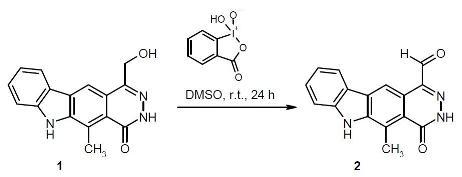
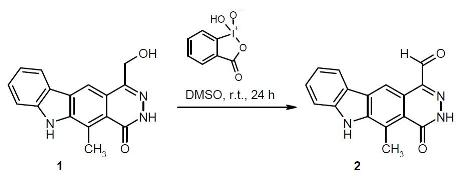
The title compound was prepared in good yield by oxidation of 1-(hydroxy-methyl)-5-methyl-3,6-dihydro-4H-pyridazino[4,5-b]carbazol-4-one with 2-iodoxybenzoic acid (IBX) in DMSO solution under very mild conditions.
In the course of our department’s ongoing research in the field of antitumor agents [1,2,3,4,5,6], we previously reported the synthesis of a novel 3-aza analogue of the antitumor alkaloid, olivacine (1,5-dimethyl-6H-pyrido[4,3-b]carbazole) [7]. One of the compounds prepared in this context was the carbazole-fused hydroxymethylpyridazinone 1, which we had envisaged as a useful intermediate for the synthesis of new functionalized pyridazino[4,5-b]carbazoles with structural similarity to olivacine and related pyridocarbazoles. However, initial attempts to transform the hydroxymethyl group of 1 into an aldehyde or carboxylic acid functionality had given poor results, mainly because of the very low solubility of compound 1 in common solvents except dipolar aprotic solvents like DMSO. We now wish to report the convenient oxidation of 1 into the corresponding aldehyde 2 in DMSO solution, using a hypervalent iodine oxidizing agent.
2-Iodoxybenzoic acid (IBX) was found to be the reagent of choice for this transformation, as it is typically used in DMSO solution at room temperature and permits the oxidation of alcohols into carbonyl compounds under very mild conditions [8]. As the only byproduct, one equivalent of 2-iodosobenzoic acid (IBA) is formed, which either is removed by filtration or is lost during extractive work-up. In the case of our compound, the work-up procedure had to be slightly modified: after completion of the oxidation reaction, dilution of the DMSO solution with water led to precipitation of both the product 2 and IBA (containing also some unreacted IBX). The higher specific weight and larger particle size of the latter, however, permitted the separation from the product (2) simply by decantation of the supernatant fine slurry containing the aldehyde. The structure of the title compound thus obtained in 71% yield clearly follows from its spectral data. The IR spectrum shows a carbonyl absorption of the formyl group at 1694 cm-1 in addition to the pyridazinone carbonyl band at 1642 cm‑1. In the 1H NMR spectrum, the aldehyde proton appears as singulet at 9.83 ppm, the 13C NMR spectrum shows the aldehyde carbon signal at 191.9 ppm. The title compound will be used as building block for further structural modifications at the pyridazine subunit of the tetracyclic system.
Experimental
The melting point was determined on a Kofler hot-stage microscope (Reichert) and is uncorrected. The IR spectrum was recorded on a Perkin-Elmer Spectrum 1000 instrument, 1H NMR and 13C NMR spectra were recorded on a Varian UnityPlus 300 spectrometer. The low-resolution mass spectrum was obtained on a Shimadzu QP5050A DI 50 instrument, the HR-MS was recorded on a Finnigan MAT 8230 at the Institute of Organic Chemistry, University of Vienna. Microanalysis was performed at the Microanalytical Laboratory, Faculty of Chemistry, University of Vienna. IBX was freshly prepared from 2-iodobenzoic acid, following the reported procedure [9].
5-Methyl-4-oxo-4,6-dihydro-3H-pyridazino[4,5-b]carbazole-1-carbaldehyde (2)
To a solution of 1-(hydroxymethyl)-5-methyl-3,6-dihydro-4H-pyridazino[4,5-b]carbazol-4-one (1) [7] (280 mg, 1 mmol) in DMSO (5 mL) was added a solution of 2-iodoxybenzoic acid (IBX) (420 mg, 1.5 mmol) in DMSO (5 mL), and the mixture was stirred in a closed vessel at room temperature for 24 h. Water (50 mL) was added and the fine greenish slurry was carefully decanted from the heavier yellowish precipitate of IBA/IBX. The slurry was filtered and the crude material thus obtained was washed with water and dried in vacuo. It was then purified by repeated washing with boiling methanol to give the aldehyde 2 as light-greenish crystals, m.p. >350 °C; yield: 198 mg (71%).
IR (KBr): 3330, 3166, 1694, 1642, 1500, 1263, 1239, 820 cm-1.
MS (EI, 70 eV): m/z = 278 (20%), 277 (100, M+), 263 (29), 193 (64), 192 (37), 191. (24), 139 (15), 83 (18).
1H NMR (DMSO-d6, 300 MHz): δ = 3.10 (3H, s, 5-CH3), 7.25-7.31 (1H, m, 9-H), 7.53-7.62 (2H, m, 7-H, 8-H), 8.22 (1H, d, J = 7.8 Hz, 10-H), 9.52 (1H, s, 11-H; shows positive NOE on irradiation at 8.22 ppm), 9.83 (1H, s, aldehyde-H), 11.80 (1H, s, carbazole-NH; shows positive NOE on irradiation at 3.10 ppm), 12.99 (1H, s, pyridazinone-NH).
13C NMR (DMSO-d6, 75 MHz): δ = 15.4 (5-CH3), 111.6, 114.1, 119.8, 119.9, 120.8, 121.3, 121.8, 126.4, 128.2, 140.2, 141.0, 141.9, 143.9, 161.5 (4-C), 191.9 (aldehyde-C).
Elemental Analysis: Calcd. for C16H11N3O2 • 0.2 H2O: C, 68.42%; H, 4.09%; N, 14.96%. Found: C, 68.02%; H, 4.17%; N, 15.34%.
HR-MS Calcd. for C16H11N3O2: 277.0851. Found: 277.0857
Supplementary materials
Supplementary File 1Supplementary File 2Supplementary File 3Acknowledgments
We are grateful to P. Unteregger for recording the high-resolution mass spectrum.
References and Notes
- Haider, N. Pyridazine-Fused Carbazoles: Synthesis, Reactivity, and Antitumor Activity. J. Heterocyclic Chem. 2002, 39, 511–521. [Google Scholar] [CrossRef]
- Haider, N.; Kabicher, T.; Käferböck, J.; Plenk, A. Synthesis and in-vitro antitumor activity of 1-[3-(indol-1-yl)prop-1-yn-1-yl]phthalazines and related compounds. Molecules 2007, 12, 1900–1909. [Google Scholar] [CrossRef] [PubMed]
- Haider, N.; Jbara, R.; Käferböck, J.; Traar, U. Synthesis of tetra- and pentacyclic carbazole-fused imides as potential antitumor agents. Arkivoc 2009, 38–47. [Google Scholar]
- Pongprom, N.; Mueller, G.; Schmidt, P.; Holzer, W.; Spreitzer, H. Carbinol derivatives of azanaphthoquinone annelated pyrrols. Monatsh. Chem. 2009, 140, 309–313. [Google Scholar] [CrossRef]
- Shanab, K.; Pongprom, N.; Wulz, E.; Holzer, W.; Spreitzer, H.; Schmidt, P.; Aicher, B.; Mueller, G.; Günther, E. Synthesis and biological evaluation of novel cytotoxic azanaphthoquinone annelated pyrrolo oximes. Bioorg. Med. Chem. Lett. 2007, 17, 6091–6095. [Google Scholar] [CrossRef] [PubMed]
- Spreitzer, H.; Puschmann, C. Dual function antitumor agents based on bioreduction and DNA alkylation. Monatsh. Chem. 2007, 138, 517–522. [Google Scholar] [CrossRef]
- Haider, N.; Sotelo, E. 1,5-Dimethyl-6H-pyridazino[4,5-b]carbazole, a 3-aza bioisoster of the antitumor alkaloid olivacine. Chem. Pharm. Bull. 2002, 50, 1479–1483. [Google Scholar] [CrossRef] [PubMed]
- Frigerio, M.; Santagostino, M.; Sputore, S.; Palmisano, G. Oxidation of Alcohols with o-Iodoxy-benzoic Acid (IBX) in DMSO: a New Insight into an Old Hypervalent Iodine Reagent. J. Org. Chem. 1995, 60, 7272–7276. [Google Scholar] [CrossRef]
- Frigerio, M.; Santagostino, M.; Sputore, S. A User-Friendly Entry to 2-Iodoxybenzoic Acid (IBX). J. Org. Chem. 1999, 64, 4537–4538. [Google Scholar] [CrossRef]
© 2009 by the authors; licensee Molecular Diversity Preservation International, Basel, Switzerland. This article is an open-access article distributed under the terms and conditions of the Creative Commons Attribution license (http://creativecommons.org/licenses/by/3.0/).