


Abstract
The use of potassium tert-butoxide as the base in arylation reactions of an enollactone with a series of benzyl halides was explored. Our work demonstrates that the ratio of C-arylation to O-arylation varies with the substitution pattern of the aryl halide.
Introduction
The alkylation of enolates, derived from 1,3-diketones with alkyl halides, is a well-established method for C-C bond formation [1,2,3]. However, the competing O-alkylation often occurred [4]. In particular, the alkylation of highly enolic cyclic β-diketones leads to the formation of a significant amount of the O-alkylation products.
As part of our ongoing research effort on potential inhibitors of HIV-1 protease [5], various 3- mono-alkylated enol-lactone compounds were designed and synthesized. A variety of basic reagents were screened for selective C-alkylation and potassium tert-butoxide was found to be an appropriate choice [6,7].
Results and Discussion
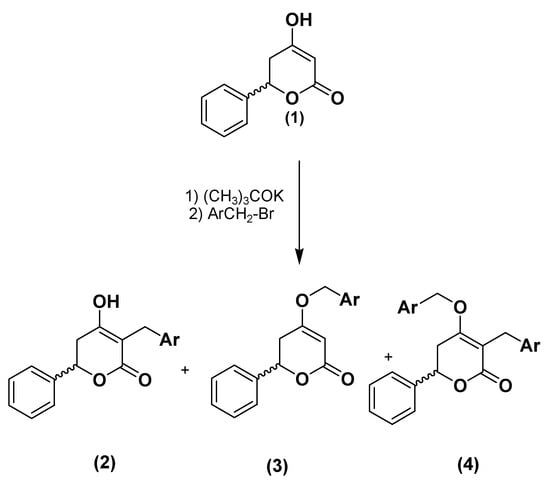
First, an enolate was generated from enol-lactone 1 using, as previously described [8], potassium tert-butoxide (1.1 equivalent) in DMSO (Scheme 1). Subsequent alkylation of this enolate with a variety of substituted benzyl bromides was performed at room temperature. After completion of the reaction, the C-arylated compounds 2 and O-arylated compounds 3, shown in the scheme below, were isolated. Our results are summarized in the Table 1.
Scheme 1.
Table 1.
Yields of C-arylations and O-arylations.
The known principle of hard and soft nucleophiles and electrophiles [9] suggests an explanation for these obtained results. This principle stipulates that hard nucleophiles react faster with hard electrophiles and soft nucleophiles react with soft electrophiles.
Also, enolate ions are known to be the most important ambident nucleophiles. The total charge is localized on the oxygen atom. With charged electrophiles, the site of attack will be oxygen while electrophiles having little charge react at the carbon site. In other words, hard electrophiles react at oxygen and soft electrophiles at carbon [10]. Our reagent is a substituted benzene halide. The benzene ring is also an ambident nucleophile in function of a substitution. There are three common types of substituents, each of which modifies the reactivity of conjugated systems in different ways. These are (A) simple conjugated systems; (B) conjugated systems like formyl, acetyl, cyano, nitro and carboxy and (C) heteroatoms which carry a lone pair of electrons capable of overlap with the benzene ring. The literature includes simple alkyl groups in this category [11].
The results presented in the table below show that for benzyl halides with type (C) substituants on the benzene ring, the major product arises from C-alkylation (entries 1, 2, 3, 4 and 5). However, with type (B) substituants, the O-alkylation product is the major one (entries 6 and 7). In some cases, di-O,C-alkylation product 4 was also formed as a minor product.
Conclusion
The hard center (oxygen of the enolate) is the site of attack by the hard electrophile (benzene substituted with (C) group type) and the soft center (carbon C-2) is the site of attack by a soft electrophile (benzene substituted with (B) group type). The preparation of other O-arylated and C-arylated compounds using this method is presently being carried out in our group and the results of this study will be published in due course.
Experimental
Specters of nuclear magnetic resonance of proton (1H NMR) and carbon (13C NMR) were registered on Bruker ANIX’s instruments of 400MHz (Université de Montréal), 500MHz (Institut Armand- Frappier), and Varian Gemini 300MHz (Université du Québec à Montréal). Melting points were determined on Büchi’s instrument 530. Infrared spectrum (IR) was registered on Bomen Michelson’s infrared-FT spectrophotometer 100.
Products (2-1) and (3-1):
To a well-stirred solution of lactone (1) (50mg, 2.6mmol) in DMSO (2mL), the potassium tert-butoxide (32mg, 2.9mmol) as well as benzyl bromide (32µL, 2.6mmol) were successively added. The reaction mixture was stirred overnight at room temperature and then quenched with brine (10mL). After extracting twice with ethyl acetate, the organic layer was dried in MgS04. After filtration, the filtrate was evaporated under vacuum. The crude is purified by silica gel chromatography to yield the compound (2-1) as a white solid (76mg, 62%) and the byproduct (3-1) as white solid (18mg, 15%).
(6 R,S)-5,6-Dihydro-4-hydroxy-3-benzyl-6-phenyl-2H-pyran-2-one (2-1):
mp. 1760C.
Rf: 0.3 (50 % AcOEt in hexane).
NMR 1H (300MHz, DMSO-d6) δ 2.71 (dd, J1=17.1Hz and J2=4.0Hz, 1H, CHH-C-OH), 2.97 (dd, J1=17.1Hz and J2=11.9Hz, 1H, CHH-C-OH), 3.48 (s, 2H, CH2-Ar), 5.45 (dd, J1=11.9Hz and J2=4.0Hz, 1H, CH-Ph), 7.09-7.50 (m, 10H, H Ar), 11.03 (s, 1H, OH).
NMR 13C (75MHz, DMSO-d6) δ 28.56 (CH2-Ar), 34.62 (CH2-C-OH), 75.26 (CH-Ph), 101.78 (CO-C(Bn)=C-OH), 125.44 (1 x C Ar), 126.36 (1 x C Ar), 127.96 (2 x C Ar), 128.14 (2 x C Ar), 128.24 (2 x C Ar), 128.42 (2 x C Ar), 139.17 (1 x C Ar), 140.96 (1 x C Ar), 166.57 (CO), 167.57 (HO-C-CH).
IR, (KBr): 3036, 2896, 1796, 1590, 1498, 1292, 1008 cm-1.
(6 R,S)-5,6-Dihydro-4-benzyloxy)-6-phenyl-2H-pyran-2-one (3-1):
Rf: 0.4 (50 % AcOEt in hexane).
NMR 1H (300MHz, DMSO-d6) δ 2.69 (dd, J1=17.3Hz and J2=3.9Hz, 1H, CHH-C-OH), 2.89 (dd, J1=17.2Hz and J2=11.8Hz, 1H, CHH-C-OH), 4.97 (s, 2H, CH2-Ar), 5.37 (s, 1H, CH=C) 5.55 (dd, J1=11.7Hz and J2=3.8Hz, 1H, CH-Ph), 7.09-7.50 (m, 10H, H Ar).
Products (2-2) and (3-2):
The compound (2-2) was prepared using the general procedure described for compound (2-1) using α-bromo-p-xylene (51mg, 0.28mmol) to yield the arylated product (2-2) as white solid (38mg, 49%) and by product (3-2) as white solid (21 mg, 27%).
(6 R,S)-5,6-Dihydro-4-hydroxy-3-(4'-methyl-benzyl)-6-phenyl-2H-pyran-2-one (2-2):
mp. 1150C.
Rf: 0.1 (50 % AcOEt in hexane).
NMR 1H (400MHz, DMSO-d6) δ 2.49 (s, 3H, CH3), 2.73 (dd, J1=18.0Hz and J2=3.1Hz, 1H, CHH-C-OH), 2.99 (dd, J1=18.0Hz and J2=12.4Hz, 1H, CHH-C-OH), 3.63 (s, 2H, CH2-Ar), 5.48 (dd, J1=12.4Hz and J2=3.1Hz. 1H, CH-O), 7.34-7.60 (m, 9H, H Ar), 11.25 (s, 1H, OH).
NMR 13C (100MHz, DMSO-d6) δ 28.67 (CH2-Ar), 34.65 (CH2-C-OH), 40.11 (CH3-Ar), 75.41 (CH-Ph), 101.05 (CO-C=C-OH), 124.92 (1 x C Ar), 124.95 (1 x C Ar), 126.44 (2 x C Ar), 126.57 (2 x C Ar),128.36 (1 x C Ar),128.53 (2 x C Ar), 128.98 (2 x C Ar),139.17 (1 x C Ar),146.10 (1 x C Ar),167.27 (CO),167.53 (HO-C-CH).
(6 R,S)-5,6-Dihydro-4-(4'-methyl-benzyloxy)-6-phenyl-2H-pyran-2-one (3-2):
Rf: 0.2 (50 % AcOEt in hexane).
NMR 1H (400MHz, DMSO-d6) δ 2.37 (s, 3H, CH3), 2.64 (dd, J1=16.7Hz and J2=3.5Hz, 1H, CHH-C-OH), 2.85 (dd, J1=17.2Hz and J2=12.2Hz, 1H, CHH-C-OH), 4.93 (s, 2H, CH2-Ar), 5.35 (s, 1H, CH=C), 5.45 (dd, J1=11.6Hz and J2=3.5Hz. 1H, CH-O), 7.34-7.60 (m, 9H, H Ar).
Products (2-3) and (3-3):
The compound (2-3) was prepared by the general procedure described for compound (2-1) using 4-trifluoromethyl benzyl chloride (40µL, 180mmol) to yield (2-3) as a white solid (38mg, 45%) and by product (3-3) as white solid (24mg, 29%).
(6 R,S)-5,6-Dihydro-4-hydroxy-3-(4'-trifluoromethylbenzyl)-6-phenyl-2H-pyran-2-one (2-3):
mp. 1050C.
Rf: 0.4 (50 % AcOEt in hexane).
NMR 1H (400MHz, DMSO-d6) δ 2.71 (dd, J1=17.5Hz and J2=11.5Hz, 1H, CHH-C-OH), 2.95 (dd, J1=17.5Hz and J2=2.6Hz, 1H, CHH-C-OH), 3.50 (s, 2H, CH2-Ar), 5.42 (dd, J1=11.5Hz and J2=2.6Hz, 1H, CH-Ph), 7.02-7.45 (m, 9H, H Ar), 11.05 (s, 1H, OH).
(6 R,S)-5,6-Dihydro-4-(4'-trifluoromethylbenzyl)-6-phenyl-2H-pyran-2-one (3-3):
Rf: 0.5 (50 % AcOEt in hexane).
NMR 1H (400MHz, DMSO-d6) δ 2.65 (dd, J1=17.3Hz and J2=11.5Hz, 1H, CHH-C-OH), 2.93 (dd, J1=17.4Hz and J2=2.7Hz, 1H, CHH-C-OH), 4.79 (s, 2H, CH2-Ar), 5.37 (s, 1H, CH=C), 5.45 (dd, J1=11.5Hz and J2=2.6Hz, 1H, CH-Ph), 7.02-7.45 (m, 9H, H Ar), 11.05 (s, 1H, OH).
Products (2-4), (3-4) and (4-4):
The compound (2-4) was prepared by the general procedure described for compound (2-1) using p-fluorobenzyle (35µL, 0.28mmol) to yield the compound (2-4) (41mg, 53%) as a white solid, mp. 1730C.
Compound (3-4) as well as (4-4) were obtained during the preparation of compound (2-4) and isolated by silica gel chromatography to afford compound (3-4) as a white solid, mp. 1450C (20mg, 26%) and product (4-4) (8mg, 7%) as a white solid, mp. 1250C.
(6 R,S)-5,6-Dihydro-4-hydroxy-3-(4'-fluorobenzyle)-6-phenyl-2H-pyran-2-one (2-4):
Rf: 0.4 (50% AcOEt in hexane).
NMR 1H (400MHz, DMSO-d6) δ 2.71 (dd, J1=17.5Hz and J2=3.1, 1H, CHH-C-OH), 2.97 (dd, J1=17.5Hz and J2=11.5Hz, 1H, CHH-C-OH), 3.53 (s, 1H, CH2-Ar), 5.43 (dd, J1=11.5Hz and J2=3.1Hz, 1H, CH-Ph), 7.00-7.50 (m, 9H, H Ar), 11.05 (s, 1H, OH).
NMR 13C (100MHz, DMSO-d6) δ 28.87 (CH2-Ar), 34.64 (CH2-C-OH), 75.35 (CH-Ph), 101.73 (CO-C(CH2C5H4F)=C-OH, 114.57 (1 x C Ar), 114.73 (1 x C Ar) 126.43 (2 x C Ar), 128.50 (1 x C Ar), 129.84 (1 x C Ar), 129.90 (1 x C Ar), 137.13 (1 x C Ar), 139.20 (1 x C Ar), 159.57 (CF), 166.71 (CO), 167.55 (HO-C-CH2).
(6 R,S)-5,6-Dihydro-4-(4'-fluorobenzyloxy)-6-phenyl-2H-pyran-2-one (3-4):
Rf: 0.5 (50 % AcOEt in hexane).
NMR 1H (300MHz, DMSO-d6) δ 2.71 (dd, J1=16.5Hz and J2=3.2Hz, 1H, CHH-C-OH), 2.94 (dd, J1=16.5Hz and J2=12.1Hz, 1H, CHH-C-OR), 5.05 (s, 2H, CH2-Ar), 5.41 (s, 1H, CH=C), 5.50 (dd, J1=12.1Hz and J2=3.2Hz, 1H, CH-Ph), 7.45 (m, 9H, H Ar).
(6 R,S)-5,6-Dihydro-4-(4'-fluorobenzyloxy)-3-(4'-fluorobenzyl)-6-phenyl-2H-pyran-2-one (4-4):
Rf: 0.6 (50 % AcOEt in hexane).
NMR 1H (400MHz, CDC13) δ 2.84 (m, 2H, CH2-C=C), 3.70 (s, 2H, CH2-Ar), 4.97 (d, Jgem=12.0Hz, 1H, O-CH2-Ar), 5.07 (d, Jgem=12.0Hz, 1H, O-CH2-Ar), 5.33 (dd, J1=10.2Hz and J2=4.7Hz, 1H, CH-Ph), 6.89-7.42 (m, 13H, H Ar).
Products (5-2), (5-3) and (5-4):
Compounds (5-2), (5-3) as well as (5-4) were obtained by the general procedure for compound (2-1) using pentafluorophenyl bromide (42µL, 270µmol). After purification by silica gel chromatography the compound (5-2) was obtained as a white solid, mp. 1680C (56mg, 57%). The compound (5-3) was obtained as white solid, mp. 1560C (20 mg, 21%). The compound (5-4) was also obtained as a white solid, mp. 1500C (14mg, 9%).
(6 R,S)-5,6-Dihydro-4-hydroxy-3-pentafluorobenzyl-6-phenyl-2H-pyran-2-one (5-2):
Rf: 0.1 (50 % AcOEt in hexane).
NMR 1H (400MHz, DMSO-d6) δ 2.72 (dd, J1=16.5Hz and J2=3.1Hz, CHH-C-OH), 2.94 (dd, J1=16.5Hz and J2=11.2Hz, 1H, CHH-C-OH), 3.64 (s, 1H, CH2-Ar), 5.38 (dd, J1=11.2Hz and J2=3.1Hz, 1H, CH-Ph), 7.34-7.42 (m, 5H, H Ar), 11.15 (s, 1H, OH).
NMR 13C (l00MHz, DMSO-d6) δ 16.57 (CH2-Ar), 34.47 (CH2-C-OH), 75.13 (CH-Ph), 98.24 (CO-C(CH2C5F5)=C-OH), 114.44 (CF), 126.24 (2 x C Ar) , 128.18 (1 x C Ar), 128.32 (2 x C Ar), 135.49 (CF), 137.47 (CF), 138.82 (1 x C Ar),143.80 (CF),145.74 (CO),166.53 (CO),167.38 (HO-C-CH2).
(6 R,S)-5,6-Dihydro-4-(pentafluorobenzyloxy)-6-phenyl-2H-pyran-2-one (5-3):
Rf: 0.2 (50 % AcOEt in hexane).
NMR 1H (300MHz, DMSO-d6) δ 2.64 (dd, J1=17.0Hz and J2=3.4Hz, 1H, CHH-C-O-CH2C5H5), 2.94 (dd, J1=17.0Hz and J2=12.1Hz, 1H, CHH-C-OCH2C5H5), 3.35 (s, 2H, CH2-C5H5), 5.50 (s, 1H, CH=C-OCH2C5H5), 5.54 (dd, J1=12.1Hz and J2=3.4Hz, 1H, CH-Ph), 5.58 (s, 1H, CH=C-OCH2C5H5), 7.45 (m, 5H, H Ar).
(6 R,S)-5,6-Dihydro-4-pentafluorobenzyloxy-3-pentafluorobenzyl-6-phenyl-2H-pyran-2-one (5-4):
Rf: 0.3 (50 % AcOEt in hexane).
NMR 1H (400MHz, CDC13) δ 2.96 (m, 2H, CH2-C=C), 3.69 (d, Jgem=14.9Hz, 1H, C-CH2-Ar), 3.76 (d, Jgem=14.9Hz, 1H, C-CH2-Ar), 5.03 (d, Jgem=10.8Hz, 1H, O-CH2-Ar), 5.11 (d, Jgem=10.8Hz, 1H, OCH2-Ar), 5.41 (dd, J1=10.0Hz and J2=4.7Hz, 1H, CH-Ph), 7.33-7.54 (m, 5H, H Ar).
NMR 13C (100MHz, CDC13) δ 17.33 (C-CH2-Ar) , 32.04 (CH2-C-O), 57.33 (O-CH2-Ar), 76.21 (CH-Ph), 106.48 (C=C-O), 108.29 (C Ar), 113.27 (C Ar), 126.01 (CH Ar), 128.87 (CH Ar), 129.02 (CH Ar), 136.25 (CF), 136.65 (CF), 137.76 (C Ar), 138.25 (CF), 138.66 (CF), 144.29 (CF), 144.45 (CF), 146.42 (CF), 164.74 and 165.87 (C=O and O-C=C).
Products (2-6) and (3-6):
The compound (2-6) and (3-6) were prepared using the general procedure described for compound (2-1) and (3-1) using 4-Cyanobenzylbromide (54mg, 0.27mmol) to yield the product (2-6) as white solid (18mg, 17%) and the product (3-6) as white solid (57mg, 53%).
(6 R,S)-5,6-Dihydro-4-hydroxy-3-(4'-cyanobenzyl)-6-phenyl-2H-pyran-2-one (2-6):
Rf: 0.2 (50 % AcOEt in hexane).
NMR 1H (400MHz, DMSO-d6) δ 2.72 (dd, J1=17.9Hz and J2=3.1Hz, 1H, CHH-C-OH), 2.77 (dd, J1=18.0Hz and J2=12.2Hz, 1H, CHH-C-OH), 4.80 (s, 2H, CH2-Ar), 5.45 (dd, J1=12.3Hz and J2=3.1Hz. 1H, CH-O), 7.43 (m, 9H, H Ar), 11.27 (s, 1H, OH).
(6 R,S)-5,6-Dihydro-4-(4'-cyanobenzyloxy)-6-phenyl-2H-pyran-2-one (3-6):
Rf: 0.3 (50 % AcOEt in hexane).
NMR 1H (400MHz, DMSO-d6) δ 2.77 (dd, J1=16.5Hz and J2=3.3Hz, 1H, CHH-C-OH), 2.85 (dd, J1=17.2Hz and J2=12.2Hz, 1H, CHH-C-OH), 5.04 (s, 2H, CH2-Ar), 5.33 (s, 1H, CH=C), 5.55 (dd, J1=11.5Hz and J2=3.4Hz. 1H, CH-O), 7.41(m, 9H, H Ar).
Products (2-7) and (3-7):
The compounds (2-7) and (3-7) were prepared using the general procedure described for compound (2-1) and (3-1) using (59mg, 0.27mmol) to yield the product (2-7) as white solid (18mg, 19%) and the product (3-7) as white solid (45mg, 47%).
(6 R,S)-5,6-Dihydro-4-hydroxy-3-(4'-nitrobenzyl)-6-phenyl-2H-pyran-2-one (2-7):
Rf: 0.1 (50 % AcOEt in hexane).
NMR 1H (400MHz, DMSO-d6) δ 2.77 (dd, J1=16.7Hz and J2=3.6Hz, 1H, CHH-C-OH), 2.97 (dd, J1=17.0Hz and J2=11.9Hz, 1H, CHH-C-OH), 3.65 (s, 2H, CH2-Ar), 5.44 (dd, J1=12.3Hz and J2=3.4Hz. 1H, CH-O), 7.54 (m, 9H, H Ar), 11.21 (s, 1H, OH).
(6 R,S)-5,6-Dihydro-4-(4'-nitrobenzyloxy)-6-phenyl-2H-pyran-2-one (3-7):
Rf: 0.2 (50 % AcOEt in hexane).
NMR 1H (400MHz, DMSO-d6) δ 2.75 (dd, J1=17.1Hz and J2=3.7Hz, 1H, CHH-C-OH), 2.96 (dd, J1=16.9Hz and J2=11.7Hz, 1H, CHH-C-OH), 4.91 (s, 2H, CH2-Ar), 5.36 (s, 1H, CH=C), 5.47 (dd, J1=11.6Hz and J2=3.5Hz. 1H, CH-O), 7.43 (m, 9H, H Ar).
References
- Abell, R.D. J. Chem. Soc. 1912, 101, 989. [CrossRef] [Scilit]
- Clark, J. H.; Miller, J.M. J. Chem. Soc. Perkin Trans. I 1977, 1743. [CrossRef] [Scilit]
- Fedorynski, M.; Wojciechowski, K.; Matacz, M.; Makoska, Z. J. Org. Chem. 1978, 43, 4682. [CrossRef] [Scilit]
- Bedekar, A. V.; Watanabe, T.; Tanaka, K.; Fuji, K. Synthesis 1995, 1069.
- To be submitted.
- Rajamannar, T.; Palani, N.; Balasubramanian, K.K. Synth. Commun. 1993, 23, 3095.
- Ono, N.; Yoshinura, T.; Saito, T.; Tanura, R.; Kaji, A. Bull. Chem. Soc. Japan 1995, 52, 1716. [CrossRef] [Scilit]
- Balog, A.; Curran, D. P. J. Org. Chem. 1995, 60, 337. [CrossRef] [Scilit]
- Fleing, I. Frontier Orbitals and Organic Chemical Reactions; John Wiley & Sons: Chichester, 1976; p. 35. [Google Scholar]
- Fleing, I. Frontier Orbitals and Organic Chemical Reactions; John Wiley & Sons: Chichester, 1976; p. 40. [Google Scholar]
- Fleing, I. Frontier Orbitals and Organic Chemical Reactions; John Wiley & Sons: Chichester, 1976; p. 47. [Google Scholar]

© 2003 by MDPI (http://www.mdpi.org). Reproduction for noncommercial purposes permitted.