Audiovestibular Dysfunction Related to Long COVID-19 Syndrome: A Systematic Review of Characteristics, Pathophysiology, Diagnosis, and Management

 , ,
, ,
Abstract
1. Introduction
2. Methods and Materials
2.1. Study Design and Registration
2.2. Search Strategy
2.3. Eligibility Criteria
2.4. Screening and Selection
2.5. Data Extraction
2.6. Quality Assessment
2.7. Data Synthesis
3. Results
3.1. Epidemiology
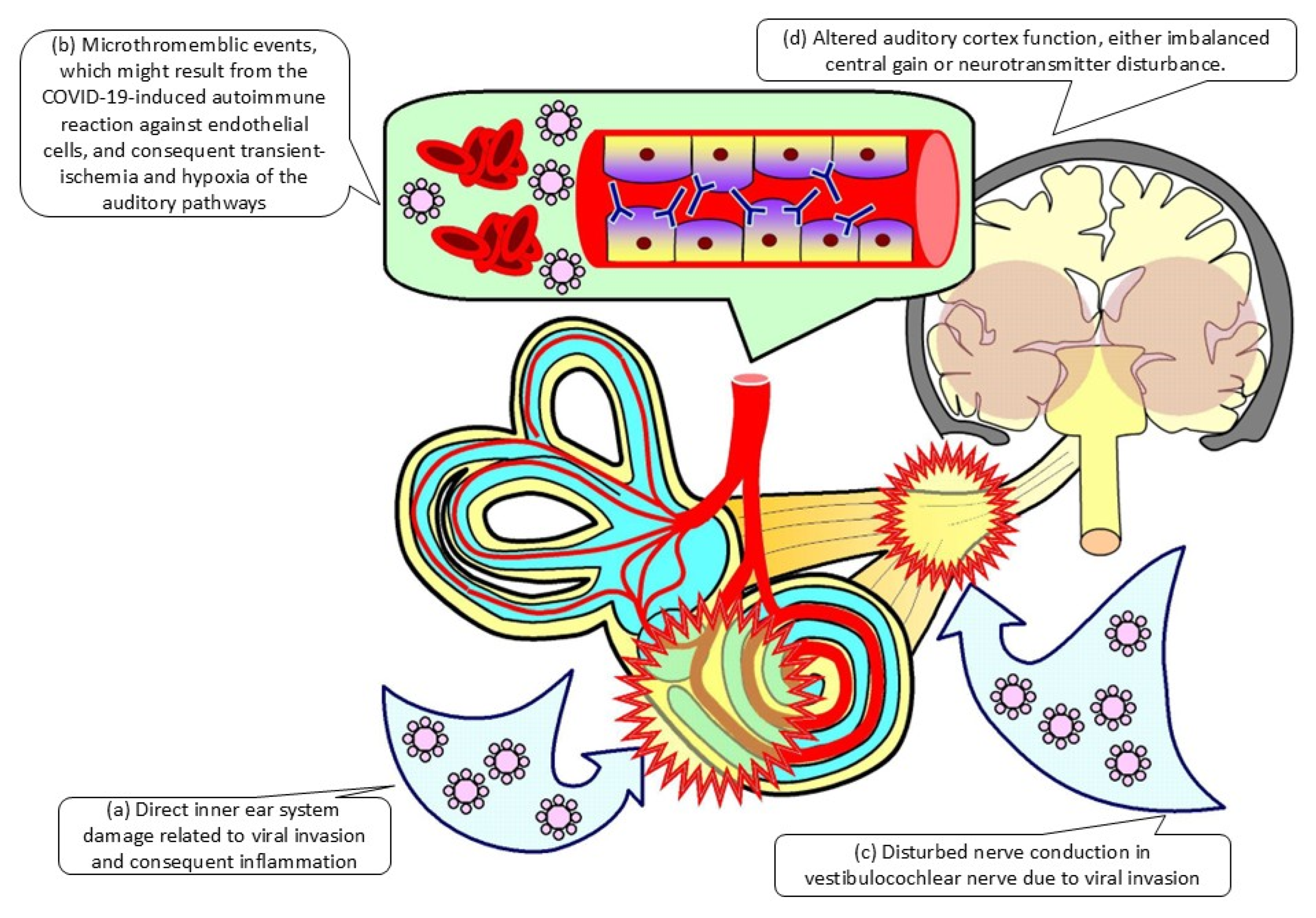
3.2. Pathophysiology: (Table 1)

| Mechanisms | Description |
|---|---|
| Established mechanisms | Hearing loss corelated with the nasopharyngeal inflammation induced by COVID-19 infection |
| COVID-19 entered neuron cells via the mediation of ACE2, transmembrane protease serine 2, and FURIN cofactors | |
| COVID-19 virus spreads up to the olfactory bulb passing through the olfactory epithelium and lamina cribrosa | |
| Reduction in cortical GABA levels in patients with long COVID-19 syndrome | |
| COVID-19 results in pathological changes with features of disseminated encephalomyelitis | |
| Hypothesized mechanisms | Neuropilin-1 worked as a COVID-19 infection mediator in the neurologic system |
| COVID-19 might lead to direct damage to the vestibulocochlear nerve and consequent audiovestibular dysfunction | |
| Micro thromboembolic events related to COVID-19-induced autoimmune reaction against endothelial cells | |
| COVID-19 infection might affect the auditory signal transduction system by damaging the central hearing system | |
| COVID-19 virus spread up to the auditory cortex |
3.3. Diagnostic Approaches
3.4. Treatment
3.5. Prognosis
4. Discussion
4.1. Clinical Recommendations
4.2. Strengths and Limitations
5. Conclusions
Supplementary Materials
Author Contributions
Funding
Institutional Review Board Statement
Informed Consent Statement
Data Availability Statement
Conflicts of Interest
References
- Pokharel, S.; Tamang, S.; Pokharel, S.; Mahaseth, R.K. Sudden sensorineural hearing loss in a post-COVID-19 patient. Clin. Case Rep. 2021, 9, e04956. [Google Scholar] [CrossRef]
- Degen, C.; Lenarz, T.; Willenborg, K. Acute Profound Sensorineural Hearing Loss After COVID-19 Pneumonia. Mayo Clin. Proc. 2020, 95, 1801–1803. [Google Scholar] [CrossRef]
- Sriwijitalai, W.; Wiwanitkit, V. Hearing loss and COVID-19: A note. Am. J. Otolaryngol. 2020, 41, 102473. [Google Scholar] [CrossRef]
- AlJasser, A.; Alkeridy, W.; Munro, K.J.; Plack, C.J. Is COVID-19 associated with self-reported audio-vestibular symptoms? Int. J. Audiol. 2022, 61, 832–840. [Google Scholar] [CrossRef]
- Dharmarajan, S.; Bharathi, M.B.; Sivapuram, K.; Prakash, B.G.; Madhan, S.; Madhu, A.; Devi, G.N.; Aliya, S.A.; Ramya, S.B. Hearing Loss-a Camouflaged Manifestation of COVID 19 Infection. Indian J. Otolaryngol. Head Neck Surg. 2021, 73, 494–498. [Google Scholar] [CrossRef]
- Jafari, Z.; Kolb, B.E.; Mohajerani, M.H. Hearing Loss, Tinnitus, and Dizziness in COVID-19: A Systematic Review and Meta-Analysis. Can. J. Neurol. Sci. 2022, 49, 184–195. [Google Scholar] [CrossRef]
- Viola, P.; Ralli, M.; Pisani, D.; Malanga, D.; Sculco, D.; Messina, L.; Laria, C.; Aragona, T.; Leopardi, G.; Ursini, F.; et al. Tinnitus and equilibrium disorders in COVID-19 patients: Preliminary results. Eur. Arch. Otorhinolaryngol. 2021, 278, 3725–3730. [Google Scholar] [CrossRef] [PubMed]
- Jeong, M.; Ocwieja, K.E.; Han, D.; Wackym, P.A.; Zhang, Y.; Brown, A.; Moncada, C.; Vambutas, A.; Kanne, T.; Crain, R.; et al. Direct SARS-CoV-2 infection of the human inner ear may underlie COVID-19-associated audiovestibular dysfunction. Commun. Med. 2021, 1, 44. [Google Scholar] [CrossRef] [PubMed]
- Hassani, S.; Lazem, M.; Jafari, Z. No lasting impact of COVID-19 on the auditory system: A prospective cohort study. J. Laryngol. Otol. 2021, 135, 1063–1068. [Google Scholar] [CrossRef] [PubMed]
- Nalbandian, A.; Sehgal, K.; Gupta, A.; Madhavan, M.V.; McGroder, C.; Stevens, J.S.; Cook, J.R.; Nordvig, A.S.; Shalev, D.; Sehrawat, T.S.; et al. Post-acute COVID-19 syndrome. Nat. Med. 2021, 27, 601–615. [Google Scholar] [CrossRef]
- Parker, A.M.; Brigham, E.; Connolly, B.; McPeake, J.; Agranovich, A.V.; Kenes, M.T.; Casey, K.; Reynolds, C.; Schmidt, K.F.R.; Kim, S.Y.; et al. Addressing the post-acute sequelae of SARS-CoV-2 infection: A multidisciplinary model of care. Lancet Respir. Med. 2021, 9, 1328–1341. [Google Scholar] [CrossRef]
- Carfi, A.; Bernabei, R.; Landi, F.; Gemelli Against COVID-19 Post-Acute Care Study Group. Persistent Symptoms in Patients After Acute COVID-19. JAMA 2020, 324, 603–605. [Google Scholar] [CrossRef]
- Soriano, J.B.; Murthy, S.; Marshall, J.C.; Relan, P.; Diaz, J.V.; WHO Clinical Case Definition Working Group on Post-COVID-19 Condition. A clinical case definition of post-COVID-19 condition by a Delphi consensus. Lancet Infect. Dis. 2022, 22, e102–e107. [Google Scholar] [CrossRef]
- Alwan, N.A.; Johnson, L. Defining long COVID: Going back to the start. Med 2021, 2, 501–504. [Google Scholar] [CrossRef]
- Davis, H.E.; Assaf, G.S.; McCorkell, L.; Wei, H.; Low, R.J.; Re’em, Y.; Redfield, S.; Austin, J.P.; Akrami, A. Characterizing long COVID in an international cohort: 7 months of symptoms and their impact. EClinicalMedicine 2021, 38, 101019. [Google Scholar] [CrossRef]
- Augustin, M.; Schommers, P.; Stecher, M.; Dewald, F.; Gieselmann, L.; Gruell, H.; Horn, C.; Vanshylla, K.; Cristanziano, V.D.; Osebold, L.; et al. Post-COVID syndrome in non-hospitalised patients with COVID-19: A longitudinal prospective cohort study. Lancet Reg. Health Eur. 2021, 6, 100122. [Google Scholar] [CrossRef]
- Ballering, A.V.; Van Zon, S.K.R.; Hartman, T.C.O.; Rosmalen, J.G.M.; Lifelines Corona Research Initiative. Persistence of somatic symptoms after COVID-19 in the Netherlands: An observational cohort study. Lancet 2022, 400, 452–461. [Google Scholar] [CrossRef] [PubMed]
- Klancnik, M.; Ivanisevic, P.; Golec, N.; Vucemilovic, M.Z. Does Audiovestibular Post-COVID Syndrome Exist? Acta Clin. Croat. 2023, 62, 88–92. [Google Scholar] [CrossRef] [PubMed]
- Dror, A.A.; Kassis-Karayanni, N.; Oved, A.; Daoud, A.; Eisenbach, N.; Mizrachi, M.; Rayan, D.; Francis, S.; Layous, E.; Gutkovich, Y.E.; et al. Auditory Performance in Recovered SARS-CoV-2 Patients. Otol. Neurotol. 2021, 42, 666–670. [Google Scholar] [CrossRef] [PubMed]
- De Sousa, F.A.; Costa, R.P.; Xara, S.; Pinto, A.N.; Almeida, E.S.C. SARS-CoV-2 and hearing: An audiometric analysis of COVID-19 hospitalized patients. J. Otol. 2021, 16, 158–164. [Google Scholar] [CrossRef]
- Gedik, O.; Husam, H.; Basoz, M.; Tas, N.; Aksoy, F. The effect of coronavirus disease 2019 on the hearing system. J. Laryngol. Otol. 2021, 135, 810–814. [Google Scholar] [CrossRef] [PubMed]
- Verma, H.; Shah, J.; Akhilesh, K.; Shukla, B. Patients’ perspective about speech, swallowing and hearing status post-SARS-CoV-2 (COVID-19) recovery: E-survey. Eur. Arch. Otorhinolaryngol. 2022, 279, 2523–2532. [Google Scholar] [CrossRef]
- Almishaal, A.A.; Alrushaidan, A.A. Short- and Long-Term Self-Reported Audiovestibular Symptoms of SARS-CoV-2 Infection in Hospitalized and Nonhospitalized Patients. Audiol. Neurootol. 2022, 27, 297–311. [Google Scholar] [CrossRef] [PubMed]
- Kilic, O.; Kalcioglu, M.T.; Cag, Y.; Tuysuz, O.; Pektas, E.; Caskurlu, H.; Cetin, F. Could sudden sensorineural hearing loss be the sole manifestation of COVID-19? An investigation into SARS-CoV-2 in the etiology of sudden sensorineural hearing loss. Int. J. Infect. Dis. 2020, 97, 208–211. [Google Scholar] [CrossRef]
- Mustafa, M.W.M. Audiological profile of asymptomatic COVID-19 PCR-positive cases. Am. J. Otolaryngol. 2020, 41, 102483. [Google Scholar] [CrossRef]
- Boboshko, M.Y.; Garbaruk, E.S.; Vikhnina, S.M.; Golovanova, L.E.; Ogorodnikova, E.A.; Rabchevskaya, A.V.; Zhilinskaia, E.V. The New Coronavirus Infection (COVID-19) and Hearing Function in Adults. J. Otorhinolaryngol. Hear. Balance Med. 2022, 3, 5. [Google Scholar] [CrossRef]
- Hackenberg, B.; Doge, J.; O’Brien, K.; Bohnert, A.; Lackner, K.J.; Beutel, M.E.; Michal, M.; Munzel, T.; Wild, P.S.; Pfeiffer, N.; et al. Tinnitus and Its Relation to Depression, Anxiety, and Stress-A Population-Based Cohort Study. J. Clin. Med. 2023, 12, 1169. [Google Scholar] [CrossRef]
- Page, M.J.; McKenzie, J.E.; Bossuyt, P.M.; Boutron, I.; Hoffmann, T.C.; Mulrow, C.D.; Shamseer, L.; Tetzlaff, J.M.; Akl, E.A.; Brennan, S.E.; et al. The PRISMA 2020 statement: An updated guideline for reporting systematic reviews. BMJ 2021, 372, n71. [Google Scholar] [CrossRef] [PubMed]
- Greenhalgh, T.; Sivan, M.; Perlowski, A.; Nikolich, J.Z. Long COVID: A clinical update. Lancet 2024, 404, 707–724. [Google Scholar] [CrossRef]
- Wells, G.A.; Shea, B.; O’Connell, D.; Peterson, J.; Welch, V.; Losos, M.; Tugwell, P. The Newcastle-Ottawa Scale (NOS) for Assessing the Quality of Nonrandomised Studies in Meta-Analyses. Available online: https://www.ohri.ca/programs/clinical_epidemiology/oxford.asp (accessed on 12 June 2024).
- Bhatta, S.; Sharma, S.; Sharma, D.; Maharjan, L.; Bhattachan, S.; Sah, M.K.; Singhal, A.; Ghanpur, A.D.; Ganesuni, D. Study of Hearing Status in COVID-19 Patients: A Multicentered Review. Indian J. Otolaryngol. Head Neck Surg. 2022, 74, 3036–3042. [Google Scholar] [CrossRef]
- Lopez-Leon, S.; Wegman-Ostrosky, T.; Perelman, C.; Sepulveda, R.; Rebolledo, P.A.; Cuapio, A.; Villapol, S. More than 50 long-term effects of COVID-19: A systematic review and meta-analysis. Sci. Rep. 2021, 11, 16144. [Google Scholar] [CrossRef]
- Degen, C.V.; Mikuteit, M.; Niewolik, J.; Schroder, D.; Vahldiek, K.; Mucke, U.; Heinemann, S.; Muller, F.; Behrens, G.M.N.; Klawonn, F.; et al. Self-reported Tinnitus and Vertigo or Dizziness in a Cohort of Adult Long COVID Patients. Front. Neurol. 2022, 13, 884002. [Google Scholar] [CrossRef]
- Yamashita, L.D.; Desai, N.; Manning, A.R.; Pileggi, C.; Peskin, S.M.; Sandsmark, D.K.; Kolson, D.L.; Schindler, M.K. Clinical Phenotyping of Long COVID Patients Evaluated in a Specialized Neuro-COVID Clinic. Ann. Clin. Transl. Neurol. 2025, 12, 1126–1134, Correction in Ann. Clin. Transl. Neurol. 2025, 12, 1727. [Google Scholar] [CrossRef]
- Coronado, O.O.R.; Felix, C.A.I.; Flores, G.P.; Marquez, M.E.D.A.; Contreras, C.R.C.; Diaz, E.G.; Paz, A.I.S.; Gonzalez-Lucano, L.R. Post-COVID-19 Syndrome: Audiometric Findings in Patients with Audiological Symptoms. Int. J. Environ. Res. Public Health 2023, 20, 6697. [Google Scholar] [CrossRef] [PubMed]
- Pazdro-Zastawny, K.; Dorobisz, K.; Misiak, P.; Kruk-Krzemien, A.; Zatonski, T. Vestibular disorders in patients after COVID-19 infection. Front. Neurol. 2022, 13, 956515. [Google Scholar] [CrossRef] [PubMed]
- Saniasiaya, J. Vestibular migraine: A manifestation of long COVID syndrome in children. BMJ Case Rep. 2023, 16, e255734. [Google Scholar] [CrossRef]
- Ludwig, S.; Schell, A.; Berkemann, M.; Jungbauer, F.; Zaubitzer, L.; Huber, L.; Warken, C.; Held, V.; Kusnik, A.; Teufel, A.; et al. Post-COVID-19 Impairment of the Senses of Smell, Taste, Hearing, and Balance. Viruses 2022, 14, 849. [Google Scholar] [CrossRef] [PubMed]
- Chen, E.Y.; Morrow, A.K.; Malone, L.A. Exploring the Influence of Preexisting Conditions and Infection Factors on Pediatric Long COVID Symptoms and Quality of Life. Am. J. Phys. Med. Rehabil. 2024, 103, 567–574. [Google Scholar] [CrossRef]
- Davies, J.; Randeva, H.S.; Chatha, K.; Hall, M.; Spandidos, D.A.; Karteris, E.; Kyrou, I. Neuropilin-1 as a new potential SARS-CoV-2 infection mediator implicated in the neurologic features and central nervous system involvement of COVID-19. Mol. Med. Rep. 2020, 22, 4221–4226. [Google Scholar] [CrossRef]
- Hu, J.; Jolkkonen, J.; Zhao, C. Neurotropism of SARS-CoV-2 and its neuropathological alterations: Similarities with other coronaviruses. Neurosci. Biobehav. Rev. 2020, 119, 184–193. [Google Scholar] [CrossRef]
- Angileri, F.; Legare, S.; Gammazza, A.M.; De Macario, E.C.; Macario, A.J.; Cappello, F. Molecular mimicry may explain multi-organ damage in COVID-19. Autoimmun. Rev. 2020, 19, 102591. [Google Scholar] [CrossRef] [PubMed]
- De Luca, P.; Scarpa, A.; Ralli, M.; Tassone, D.; Simone, M.; De Campora, L.; Cassandro, C.; Di Stadio, A. Auditory Disturbances and SARS-CoV-2 Infection: Brain Inflammation or Cochlear Affection? Systematic Review and Discussion of Potential Pathogenesis. Front. Neurol. 2021, 12, 707207, Correction in Front. Neurol. 2023, 14, 1234744. [Google Scholar] [CrossRef]
- Niemczak, C.; Skoe, E.; Leigh, S.; Zhang, L.; Dotzenrod, M.; Kieley, A.; Stone, S.; Parsonnet, J.; Martin, C.; Ealer, C.; et al. Altered auditory brainstem responses are post-acute sequela of SARS-CoV-2 (PASC). Sci. Rep. 2025, 15, 9387. [Google Scholar] [CrossRef] [PubMed]
- Hamdy, M.M.; Hosny, N.A.; Farag, R.G.; Elbohy, Z.M.Y. Assessment of cortical evoked potential (P300) and auditory brainstem response (ABR) in post-COVID-19 patients. Egypt. J. Otolaryngol. 2024, 40, 49. [Google Scholar] [CrossRef]
- Meinhardt, J.; Radke, J.; Dittmayer, C.; Franz, J.; Thomas, C.; Mothes, R.; Laue, M.; Schneider, J.; Brunink, S.; Greuel, S.; et al. Olfactory transmucosal SARS-CoV-2 invasion as a port of central nervous system entry in individuals with COVID-19. Nat. Neurosci. 2021, 24, 168–175. [Google Scholar] [CrossRef]
- Marinkovic, K.; White, D.R.; Myers, A.A.; Parker, K.S.; Arienzo, D.; Mason, G.F. Cortical GABA Levels Are Reduced in Post-Acute COVID-19 Syndrome. Brain Sci. 2023, 13, 1666. [Google Scholar] [CrossRef]
- Reichard, R.R.; Kashani, K.B.; Boire, N.A.; Constantopoulos, E.; Guo, Y.; Lucchinetti, C.F. Neuropathology of COVID-19: A spectrum of vascular and acute disseminated encephalomyelitis (ADEM)-like pathology. Acta Neuropathol. 2020, 140, 1–6. [Google Scholar] [CrossRef]
- Yong, S.J. Persistent Brainstem Dysfunction in Long-COVID: A Hypothesis. ACS Chem. Neurosci. 2021, 12, 573–580. [Google Scholar] [CrossRef]
- Versace, V.; Sebastianelli, L.; Ferrazzoli, D.; Romanello, R.; Ortelli, P.; Saltuari, L.; D’Acunto, A.; Porrazzini, F.; Ajello, V.; Oliviero, A.; et al. Intracortical GABAergic dysfunction in patients with fatigue and dysexecutive syndrome after COVID-19. Clin. Neurophysiol. 2021, 132, 1138–1143. [Google Scholar] [CrossRef]
- Yildiz, E. Comparison of pure tone audiometry thresholds and transient evoked otoacoustic emissions (TEOAE) of patients with and without COVID-19 pneumonia. Am. J. Otolaryngol. 2022, 43, 103377. [Google Scholar] [CrossRef]
- Kokten, N.; Celik, S.; Mutlu, A.; Pektas, E.; Icten, S.; Kalcioglu, M.T. Does COVID-19 have an impact on hearing? Acta Otolaryngol. 2022, 142, 48–51. [Google Scholar] [CrossRef]
- Ozturk, B.; Kavruk, H.; Aykul, A. Audiological findings in individuals diagnosed with COVID-19. Am. J. Otolaryngol. 2022, 43, 103428. [Google Scholar] [CrossRef]
- Dorobisz, K.; Pazdro-Zastawny, K.; Misiak, P.; Kruk-Krzemien, A.; Zatonski, T. Sensorineural Hearing Loss in Patients with Long-COVID-19: Objective and Behavioral Audiometric Findings. Infect. Drug Resist. 2023, 16, 1931–1939. [Google Scholar] [CrossRef]
- Yilmaz, O.; Mutlu, B.O.; Yaman, H.; Bayazit, D.; Demirhan, H.; Bayazit, Y.A. Assessment of balance after recovery from COVID-19 disease. Auris Nasus Larynx 2022, 49, 291–298. [Google Scholar] [CrossRef]
- Figueiredo, R.R.; Penido, N.O.; de Azevedo, A.A.; de Oliveira, P.M.; de Siqueira, A.G.; Figueiredo, G.M.R.; Schlee, W.; Langguth, B. Tinnitus emerging in the context of a COVID-19 infection seems not to differ in its characteristics from tinnitus unrelated to COVID-19. Front. Neurol. 2022, 13, 974179. [Google Scholar] [CrossRef]
- Greenhalgh, T.; Knight, M.; A’Court, C.; Buxton, M.; Husain, L. Management of post-acute COVID-19 in primary care. BMJ 2020, 370, m3026. [Google Scholar] [CrossRef]
- Koumpa, F.S.; Forde, C.T.; Manjaly, J.G. Sudden irreversible hearing loss post COVID-19. BMJ Case Rep. 2020, 13, e238419. [Google Scholar] [CrossRef] [PubMed]
- Lang, B.; Hintze, J.; Conlon, B. Coronavirus disease 2019 and sudden sensorineural hearing loss. J. Laryngol. Otol. 2020, 134, 1026–1028. [Google Scholar] [CrossRef] [PubMed]
- Kelleni, M.T. Repurposing metformin to manage idiopathic or long COVID Tinnitus: Self-report adopting a pathophysiological and pharmacological approach. Inflammopharmacology 2024, 32, 945–948. [Google Scholar] [CrossRef] [PubMed]
- Fancello, V.; Fancello, G.; Hatzopoulos, S.; Bianchini, C.; Stomeo, F.; Pelucchi, S.; Ciorba, A. Sensorineural Hearing Loss Post-COVID-19 Infection: An Update. Audiol. Res. 2022, 12, 307–315. [Google Scholar] [CrossRef]
- Noij, K.S.; Babu, V.; Drews, M.; Lockshaw, S.; Hermann, L.; Malone, L.A.; Jenks, C.M. Persistent postural perceptual dizziness (PPPD) in pediatric patients after COVID-19 infection. Int. J. Pediatr. Otorhinolaryngol. 2024, 184, 112076. [Google Scholar] [CrossRef]
- Gervasoni, F.; LoMauro, A.; Ricci, V.; Salce, G.; Andreoli, A.; Visconti, A.; Pantoni, L. Balance and visual reliance in post-COVID syndrome patients assessed with a robotic system: A multi-sensory integration deficit. Neurol. Sci. 2022, 43, 85–88. [Google Scholar] [CrossRef]
- Chen, J.J.; Zeng, B.Y.; Zeng, B.S.; Chu, C.S.; Liang, C.S.; Wu, Y.C.; Stubbs, B.; Su, K.P.; Tu, Y.K.; Chen, T.Y.; et al. A Systematic Review and Network Meta-Analysis of Efficacy of Postmaneuver Rehabilitation in Benign Paroxysmal Positional Vertigo Treatment. J. Otorhinolaryngol. Hear. Balance Med. 2025, 6, 23. [Google Scholar] [CrossRef]
- Maccarone, M.C.; Contessa, P.; Passarotto, E.; Regazzo, G.; Masiero, S. Balance rehabilitation and Long COVID syndrome: Effectiveness of thermal water treatment vs. home-based program. Front. Rehabil. Sci. 2025, 6, 1588940. [Google Scholar] [CrossRef]
- Erinc, M.; Mutlu, A.; Celik, S.; Kalcioglu, M.T.; Szczepek, A.J. Long-Term Effects of COVID-19 and the Pandemic on Tinnitus Patients. Front. Neurol. 2022, 13, 921173. [Google Scholar] [CrossRef]
- Obeidat, F.S.; Alghwiri, A.A.; Whitney, S.L. Predictors of Dizziness and Hearing Disorders in People with Long COVID. Medicina 2023, 59, 1901. [Google Scholar] [CrossRef]
- Hastie, C.E.; Lowe, D.J.; McAuley, A.; Mills, N.L.; Winter, A.J.; Black, C.; Scott, J.T.; O’Donnell, C.A.; Blane, D.N.; Browne, S.; et al. Natural history of long-COVID in a nationwide, population cohort study. Nat. Commun. 2023, 14, 3504. [Google Scholar] [CrossRef]
- Salehi, P.; Ge, M.X.; Gundimeda, U.; Baum, L.M.; Cantu, H.L.; Lavinsky, J.; Tao, L.; Myint, A.; Cruz, C.; Wang, J.; et al. Role of Neuropilin-1/Semaphorin-3A signaling in the functional and morphological integrity of the cochlea. PLoS Genet. 2017, 13, e1007048. [Google Scholar] [CrossRef]
- Bauer, L.; Laksono, B.M.; de Vrij, F.M.S.; Kushner, S.A.; Harschnitz, O.; van Riel, D. The neuroinvasiveness, neurotropism, and neurovirulence of SARS-CoV-2. Trends Neurosci. 2022, 45, 358–368. [Google Scholar] [CrossRef]
- Harris, K.C.; Dias, J.W.; McClaskey, C.M.; Rumschlag, J.; Prisciandaro, J.; Dubno, J.R. Afferent Loss, GABA, and Central Gain in Older Adults: Associations with Speech Recognition in Noise. J. Neurosci. 2022, 42, 7201–7212. [Google Scholar] [CrossRef]
- Rumschlag, J.A.; McClaskey, C.M.; Dias, J.W.; Kerouac, L.B.; Noble, K.V.; Panganiban, C.; Lang, H.; Harris, K.C. Age-related central gain with degraded neural synchrony in the auditory brainstem of mice and humans. Neurobiol. Aging 2022, 115, 50–59. [Google Scholar] [CrossRef]
- Auerbach, B.D.; Rodrigues, P.V.; Salvi, R.J. Central gain control in tinnitus and hyperacusis. Front. Neurol. 2014, 5, 206. [Google Scholar] [CrossRef]
- Auerbach, B.D.; Radziwon, K.; Salvi, R. Testing the Central Gain Model: Loudness Growth Correlates with Central Auditory Gain Enhancement in a Rodent Model of Hyperacusis. Neuroscience 2019, 407, 93–107. [Google Scholar] [CrossRef]
- Valderrama, J.T.; Beach, E.F.; Yeend, I.; Sharma, M.; Van Dun, B.; Dillon, H. Effects of lifetime noise exposure on the middle-age human auditory brainstem response, tinnitus and speech-in-noise intelligibility. Hear. Res. 2018, 365, 36–48. [Google Scholar] [CrossRef]
- Isler, B.; von Burg, N.; Kleinjung, T.; Meyer, M.; Stampfli, P.; Zolch, N.; Neff, P. Lower glutamate and GABA levels in auditory cortex of tinnitus patients: A 2D-JPRESS MR spectroscopy study. Sci. Rep. 2022, 12, 4068. [Google Scholar] [CrossRef]
- Kaltenbach, J.A. Tinnitus: Models and mechanisms. Hear. Res. 2011, 276, 52–60. [Google Scholar] [CrossRef]
- Vasilkov, V.; Caswell-Midwinter, B.; Zhao, Y.; de Gruttola, V.; Jung, D.H.; Liberman, M.C.; Maison, S.F. Evidence of cochlear neural degeneration in normal-hearing subjects with tinnitus. Sci. Rep. 2023, 13, 19870. [Google Scholar] [CrossRef]
- Shulman, A.; Goldstein, B.; Strashun, A.M. Central nervous system neurodegeneration and tinnitus: A clinical experience. Part I: Diagnosis. Int. Tinnitus J. 2007, 13, 118–131. [Google Scholar]
- Sivagurunathan, N.; Calivarathan, L. SARS-CoV-2 Infection to Premature Neuronal Aging and Neurodegenerative Diseases: Is there any Connection with Hypoxia? CNS Neurol. Disord. Drug Targets 2024, 23, 431–448. [Google Scholar] [CrossRef]
- Ting, K.C.; Chang, C.C.; Huang, C.Y.; Chen, Y.F.; Cheng, Y.F. Are Electrocochleographic Changes an Early Sign of Cochlear Synaptopathy? A Prospective Study in Tinnitus Patients with Normal Hearing. Diagnostics 2022, 12, 802. [Google Scholar] [CrossRef]
- Yong, S.J. Long COVID or post-COVID-19 syndrome: Putative pathophysiology, risk factors, and treatments. Infect. Dis. 2021, 53, 737–754. [Google Scholar] [CrossRef]
- Lyra, E.S.N.M.; Barros-Aragao, F.G.Q.; De Felice, F.G.; Ferreira, S.T. Inflammation at the crossroads of COVID-19, cognitive deficits and depression. Neuropharmacology 2022, 209, 109023. [Google Scholar] [CrossRef]
- Reis, A.C.; Frizzo, A.C.; Mde, L.I.; Garcia, C.F.; Funayama, C.A.; Iorio, M.C. P300 in individuals with sensorineural hearing loss. Braz. J. Otorhinolaryngol. 2015, 81, 126–132. [Google Scholar] [CrossRef]
- Chen, J.J.; Zeng, B.Y.; Lui, C.C.; Chen, T.Y.; Chen, Y.W.; Tseng, P.T. Pfizer-BioNTech COVID-19 vaccine associated tinnitus and treatment with transcranial magnetic stimulation. QJM 2022, 115, 623–624. [Google Scholar] [CrossRef]
- Tseng, P.T.; Chen, T.Y.; Sun, Y.S.; Chen, Y.W.; Chen, J.J. The reversible tinnitus and cochleopathy followed first-dose AstraZeneca COVID-19 vaccination. QJM 2021, 114, 663–664. [Google Scholar] [CrossRef]
- Chen, J.J.; Chen, Y.W.; Zeng, B.Y.; Hung, C.M.; Zeng, B.S.; Stubbs, B.; Carvalho, A.F.; Thompson, T.; Roerecke, M.; Su, K.P.; et al. Efficacy of pharmacologic treatment in tinnitus patients without specific or treatable origin: A network meta-analysis of randomised controlled trials. EClinicalMedicine 2021, 39, 101080. [Google Scholar] [CrossRef]
- Chen, J.J.; Zeng, B.S.; Wu, C.N.; Stubbs, B.; Carvalho, A.F.; Brunoni, A.R.; Su, K.P.; Tu, Y.K.; Wu, Y.C.; Chen, T.Y.; et al. Association of Central Noninvasive Brain Stimulation Interventions With Efficacy and Safety in Tinnitus Management: A Meta-analysis. JAMA Otolaryngol. Head Neck Surg. 2020, 146, 801–809. [Google Scholar] [CrossRef]
- Chen, J.J.; Hsu, C.W.; Chen, Y.W.; Chen, T.Y.; Zeng, B.S.; Tseng, P.T. Audiological Features in Patients with Rheumatoid Arthritis: A Systematic Review. Int. J. Mol. Sci. 2024, 25, 13290. [Google Scholar] [CrossRef]
- Chen, J.J.; Hsu, C.W.; Stubbs, B.; Chen, T.Y.; Liang, C.S.; Chen, Y.W.; Zeng, B.Y.; Tseng, P.T. Audiovestibular Dysfunction in Hyper-IgE Syndrome: A Systematic Review of Characteristics, Pathophysiology, Diagnosis, and Management. Int. J. Mol. Sci. 2025, 26, 9932. [Google Scholar] [CrossRef]
- Chen, J.J.; Hsu, C.W.; Chen, Y.W.; Chen, T.Y.; Zeng, B.S.; Tseng, P.T. Audiovestibular Dysfunction in Systemic Lupus Erythematosus Patients: A Systematic Review. Diagnostics 2024, 14, 1670. [Google Scholar] [CrossRef]
- Chen, J.J.; Hsu, C.W.; Chen, Y.W.; Chen, T.Y.; Zeng, B.Y.; Tseng, P.T. Audiovestibular Dysfunction Related to Anti-Phospholipid Syndrome: A Systematic Review. Diagnostics 2024, 14, 2522. [Google Scholar] [CrossRef] [PubMed]
- Chen, J.J.; Hsu, C.W.; Chen, T.Y.; Liang, C.S.; Chen, Y.W.; Zeng, B.Y.; Tseng, P.T. Audiovestibular Dysfunction in Patients with Hashimoto’s Disease: A Systematic Review. Int. J. Mol. Sci. 2025, 26, 4703. [Google Scholar] [CrossRef] [PubMed]
- Tseng, P.T.; Chen, T.Y.; Lui, C.C.; Chen, Y.W.; Chen, J.J. Tinnitus Associated with Mild Osteomyelitis of the Temporal Bone Reversed after Conservative Antibiotic Treatment: A Case Series. Medicina 2022, 58, 318. [Google Scholar] [CrossRef] [PubMed]


Disclaimer/Publisher’s Note: The statements, opinions and data contained in all publications are solely those of the individual author(s) and contributor(s) and not of MDPI and/or the editor(s). MDPI and/or the editor(s) disclaim responsibility for any injury to people or property resulting from any ideas, methods, instructions or products referred to in the content. |
© 2026 by the authors. Licensee MDPI, Basel, Switzerland. This article is an open access article distributed under the terms and conditions of the Creative Commons Attribution (CC BY) license.
Share and Cite
Chen, J.-J.; Hsu, C.-W.; Wang, H.-Y.; Stubbs, B.; Chen, T.-Y.; Liang, C.-S.; Chen, Y.-W.; Zeng, B.-S.; Tseng, P.-T. Audiovestibular Dysfunction Related to Long COVID-19 Syndrome: A Systematic Review of Characteristics, Pathophysiology, Diagnosis, and Management. Int. J. Mol. Sci. 2026, 27, 1417. https://doi.org/10.3390/ijms27031417
Chen J-J, Hsu C-W, Wang H-Y, Stubbs B, Chen T-Y, Liang C-S, Chen Y-W, Zeng B-S, Tseng P-T. Audiovestibular Dysfunction Related to Long COVID-19 Syndrome: A Systematic Review of Characteristics, Pathophysiology, Diagnosis, and Management. International Journal of Molecular Sciences. 2026; 27(3):1417. https://doi.org/10.3390/ijms27031417
Chicago/Turabian StyleChen, Jiann-Jy, Chih-Wei Hsu, Hung-Yu Wang, Brendon Stubbs, Tien-Yu Chen, Chih-Sung Liang, Yen-Wen Chen, Bing-Syuan Zeng, and Ping-Tao Tseng. 2026. "Audiovestibular Dysfunction Related to Long COVID-19 Syndrome: A Systematic Review of Characteristics, Pathophysiology, Diagnosis, and Management" International Journal of Molecular Sciences 27, no. 3: 1417. https://doi.org/10.3390/ijms27031417
APA StyleChen, J.-J., Hsu, C.-W., Wang, H.-Y., Stubbs, B., Chen, T.-Y., Liang, C.-S., Chen, Y.-W., Zeng, B.-S., & Tseng, P.-T. (2026). Audiovestibular Dysfunction Related to Long COVID-19 Syndrome: A Systematic Review of Characteristics, Pathophysiology, Diagnosis, and Management. International Journal of Molecular Sciences, 27(3), 1417. https://doi.org/10.3390/ijms27031417