Alteration of microRNA Expression Associated with Chronic Back Pain in Patients with Intervertebral Disc Degeneration: A Scoping Review

 ,
,  ,
,  , , and
Abstract
1. Introduction
2. Materials and Methods
- English-language articles,
- Original experimental (preclinical) studies,
- Original clinical studies,
- Assessments of changes in systemic (in blood) and/or local (in IVD and other tissue) levels of miR expression in IVDD, either independently or in comparison with healthy controls,
- Studies that were completed and the results of which were published.
3. Results
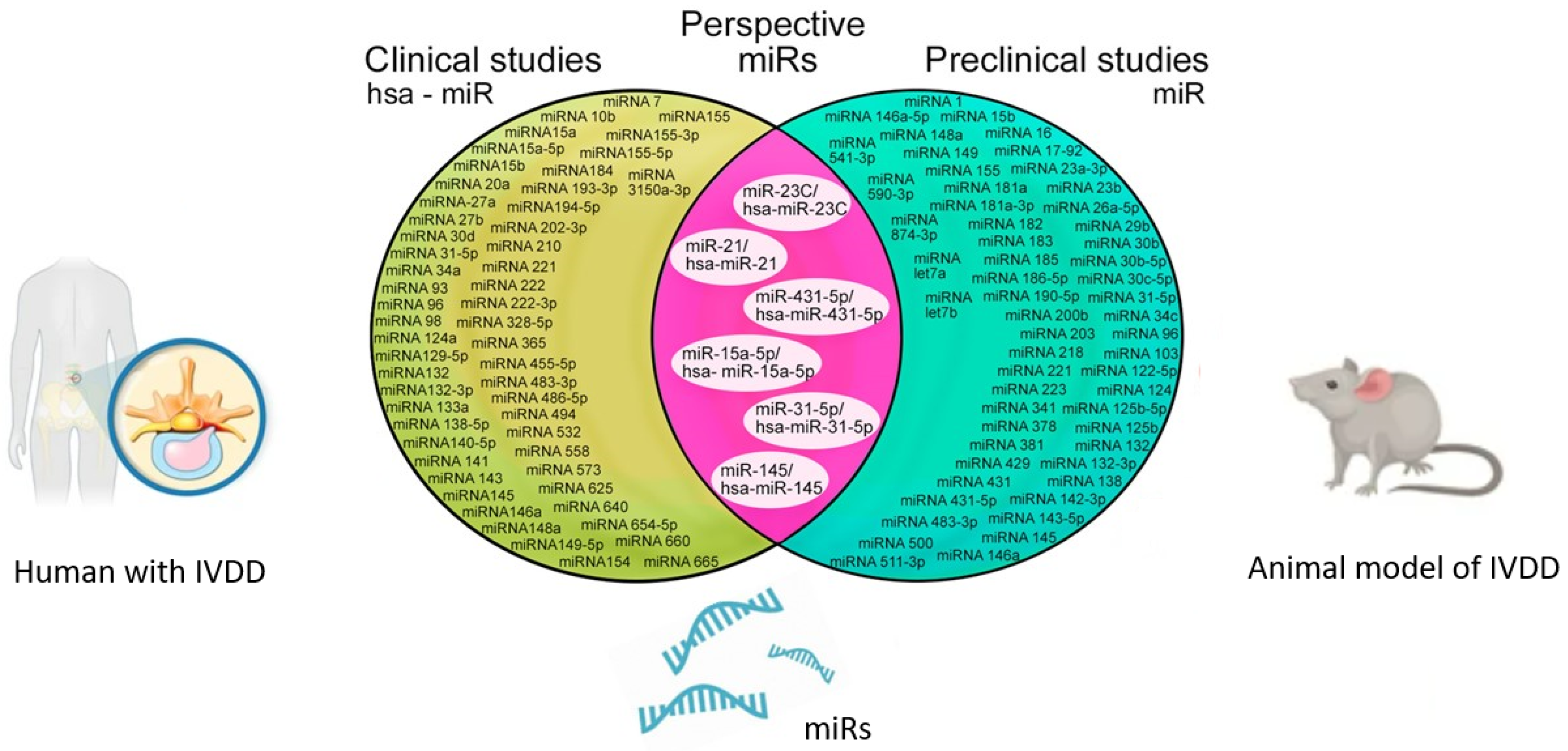
3.1. Preclinical Studies

| MicroRNA | Design of the Study | Tissue (Simple) | General Characteristics of the Sample | Effect of the microRNA | References |
|---|---|---|---|---|---|
| |||||
| Local microRNA | |||||
| miR-15A-5p | Experimental (mice) | IVD tissue | Model of traumatic needle injury | Overexpression of miR-15A-5p facilitates NP cell proliferation and promotes SOX9 expression to suppress inflammatory response and apoptosis via NF-κB signaling pathway. | [41] |
| miR-16 | Experimental (Sprague– Dawley rats) | NP tissue | Model of inflammatory injury | Overexpression of miR-16 modulates the inflammatory response in NP cells stimulated with LPS; miR-16 activates the expression of ECM genes (aggrecan and collagen II), but inhibits the genes of MMP3, MMP13, disintegrin, and ADAMATS4 and ADAMATS5 through the NF-κB and MAPK signaling pathway by targeting their upstream TGF-β-activated kinase 1 and MAP3K7-binding protein 3. | [59] |
| miR-21 | Experimental (Sprague– Dawley rats) | IVD tissue | Surgical model of IVD tissue injury | Overexpression of miR-21 targets PTEN, implicating it in abnormal NP cell proliferation through suppression of the AKT pathway; miR-21 inhibitors can reduce the expression of inducible HIF-1α and VEGF, inhibiting NP cell apoptosis. | [38] |
| miR-31-5p | Experimental (mice) | IVD tissue | Model of traumatic injury | Overexpression of miR-31-5p induces NP cell proliferation, inhibits apoptosis, and promotes ECM formation by regulating the SDF-1/CXCR7 pathway. | [60] |
| Experimental (Sprague– Dawley rats) | IVD tissue | Model of inflammatory injury | Overexpression of miR-31-5p inhibits apoptosis in endplate chondrocytes via regulation of ATF6. | [61] | |
| miR-132 | Experimental (rats) | IVD tissue | Rat tail needle injury model | Overexpression of miR-132 induces ECM degradation by directly targeting GDF5 and leading to increased expression of MMP13 and ADAMTS4 via the MAPK/ERK pathway. | [31] |
| miR-143-5p | Experimental (rats) | IVD tissue | Model of puncture needle injury | Overexpression of miR-143-5p induces apoptosis and proliferation of IVD cells via the AMPK signaling pathway. | [47] |
| miR-145 | Experimental (rats) | NP tissue | Model of oxidative stress in cultured cell lines | Overexpression of miR-145 targeting ADAMTS 17 inhibits NP IVD cell apoptosis in vitro, both in the presence and absence of oxidative stress. | [22] |
| miR-148a | Experimental (Sprague– Dawley rats) | IVD tissue | Model of injection injury | Overexpression of miR-148a induces increased Hotair activity, which in turn increases PTEN expression, leading to the progression of IVDD. | [41] |
| miR-149 | Experimental (rats) | NP cell | Inflammation model using liposomes | Overexpression of miR-149 induces hyperproduction of MMP-3, ADAMTS4, and other inflammatory cytokines via MyD88. | [50] |
| miR-155 | Experimental (rats) | NP cells | Model of inflammatory injury by treatment with TNF-α or IL-1β | Overexpression of miR-155 inhibits ECM degradation via p65/NF-κB signaling. | [33] |
| miR-181a | Experimental (mice) | NP tissue | Model of NP tissue injury by needle puncture | Overexpression of miR-181a inhibits the inflammatory response by inactivating the ERK pathway. | [78] |
| miR-185 | Experimental (Sprague– Dawley rats) | NP tissue | Model of IVDD (unspecified) | Overexpression of miR-185 targets galectin 3, a β-galactosidase-binding protein involved in apoptosis and the Wnt/β-catenin pathway. | [51] |
| miR-431-5p | Experimental (Sprague– Dawley rats) | IVD tissue | Model of traumatic needle injury | Overexpression of miR-431-5p inhibits Circarl15 production in IDD tissues (Circarl15 expression was positively correlated with the DISC1 scaffold protein; Circarl15 suppresses NP cell apoptosis but promotes NP cell proliferation through regulation of the miR-431-5p/disc1 signaling axis). | [42] |
| miR-874-3p | Experimental (rats) | NP tissue | Model of needle puncture trauma | Overexpression of miR-874-3p targets ATF3; inhibits NP cell apoptosis by reducing caspase-3 degradation; inhibits ECM degradation by reducing the catabolic factors MMP2 and MMP3. | [62] |
| Circulating microRNA | |||||
| miR-23C | Experimental (rats) | Blood | Model of IVDD (unspecified) | Overexpression of miR-23c and CTNNB1 is associated with the development and progression of IVDD. | [39] |
| miR-26a-5p | Experimental (mice) | Blood (serum) | Model of traumatic injury IVDD | Overexpression of miR-26A induces the development of IVDD, acting as one of the possible biomarkers of the disease. | [40] |
| miR-483-3p | Experimental (rats) | Blood | Model of IVDD (unspecified) | Overexpression of miR-483-3p and GSK3B induces the development and progression of IVDD. | [39] |
| |||||
| Local microRNA | |||||
| miR-1 | Experimental (rats) | Dorsal spinal root ganglia | Model of unilateral chronic sciatic nerve injury and compression | Overexpression of miR-1 increases Cx43/BDNF expression, which in turn leads to the formation of CBP. | [24] |
| miR-17-92 | Experimental (rats) | L5 posterior spinal root ganglia | Injury model of L5 root ligation; model of mechanical allodynia by local injection of adeno-associated virus vector | Overexpression of miR-17-92 inhibits the expression of potassium channels and reduces extracellular potassium currents (especially A type), alleviating mechanical allodynia. | [64] |
| miR-21 | Experimental (mice) | Posterior spinal root ganglia | Partial ligation model of the sciatic nerve | Overexpression of miR-21 induces IL6 synthesis and the development of neuropathic pain syndrome. | [25] |
| Posterior spinal root ganglia | Model of spinal nerve ligation | Overexpression of miR-21 acts on TLR8 in lysosomes as an endogenous ligand, inducing activation of ECM degradation and production of inflammatory mediators, promoting CBP formation. | [79] | ||
| miR-23a-3p | Experimental (mice) | Mouse spinal cord neurons. Sciatic nerve | Partial ligation/injury model of the sciatic nerve | Overexpression of miR-23a-3p induces neuropathic pain by directly targeting CXCR4 via the TXNIP/NLRP3 inflammasome axis. | [26] |
| miR-23b | Experimental (mice) | Spinal cord (neurons) | Model of chronic spinal nerve injury | Overexpression of miR-23b targets NOX4, which reduces the production of the inhibitory neurotransmitter GABA and promotes the formation of mechanical and thermal hyperalgesia. | [65] |
| miR-26a-5p | Experimental (rats) | Spinal cord (neurons) | Model of chronic spinal nerve injury | Overexpression of miR-26a-5p acts as a negative regulator of neuropathic pain development via targeting MAPK6. | [27] |
| miR-30b | Experimental (rats) | Posterior spinal root ganglia | Model of L5 root ligation | Overexpression of miR-30b reduces neuropathic pain by inhibiting the expression of voltage-gated sodium channels Nav1.3. | [66] |
| miR-30b-5p | Experimental (rats) | Posterior spinal root ganglia | Model of peripheral neuropathic pain (by intraperitoneal administration of oxaliplatin) | Overexpression of miR-30b-5p induces NP degeneration via suppression of Nav1 sodium ion channels. | [67] |
| miR-30c-5p | Experimental (anti-allodyn phenotype of mice) | Spinal cord (neurons). Dorsal spinal root ganglia (neurons). Cerebrospinal fluid. | Chronic sciatic nerve injury model | Overexpression of miR-30c-5p induces the development of neuropathic pain via BAMBI (TGFβ pseudo-receptor). | [28] |
| miR-34c | Experimental (mice) | Spinal cord (neurons) | Model of sciatic nerve constriction/compression | Overexpression of miR-34c inhibits the production of NLRP3, caspase-1, IL1β, and IL18, and reduces neuropathic pain. | [29] |
| miR-96 | Experimental (rats) | Posterior spinal root ganglia (neurons) | Model of chronic sciatic nerve compression | Hypo-expression of miR-96 activates sodium channels Nav1.3, which are involved in the formation of CBP. | [68] |
| miR-103 | Experimental (rats) | Posterior spinal root ganglia (neurons) | Model of chronic injury | Overexpression of miR-103 reduces neuropathic pain through a bidirectional and integrated regulatory role in Cav1.2-LTC calcium channels. | [69] |
| miR-122-5p | Experimental (rats) | Spinal cord (neurons) | Model of chronic sciatic nerve injury | Overexpression of miR-122-5p inhibits the mechanism of neuropathic pain development via PDK4. | [70] |
| miR-124 | Experimental (mice) | Spinal cord (neurons) | Model of peripheral inflammatory hyperalgesia | Overexpression of miR-124 modulates microglial activity by affecting MeCP2 and reducing central pain sensitization. | [43] |
| Umbilical cord (microglia) | IL-1β-induced inflammatory hyperalgesia model in mice with chronic carrageenan-induced hyperalgesia | Overexpression of miR-124 shifts the “pro-inflammatory M1/anti-inflammatory M2” balance toward the anti-inflammatory M2 phenotype and reduces mechanical hyperalgesia and pain behavior. | [80] | ||
| miR-125b-5p | Experimental (rats) | Masseter muscle. Trigeminal ganglion | Model of ligation of spinal roots L4 and L5 | Overexpression of miR-125b-5p induces the development of neuropathic pain by activating TNF and BDNF genes. | [29] |
| miR-125b | Experimental (rats) | Brain (hippocampal neurons) | Model of chronic constriction injury of spinal roots | Hypo-expression of miR-125b induces CBP development in peripheral nerve injury through NR2A regulation by altering BDNF expression. | [44] |
| miR-132 | Experimental (rats) | Brain (hippocampal neurons) | Model of chronic constriction injury of spinal roots | Hypo-expression of miR-132 induces CBP development in peripheral nerve injury via regulation of BDNF and NR2A expression (by altering BDNF expression). | [44] |
| Experimental (MeCP2 transgenic mice) | Spinal cord (neurons) | Model of peripheral nerve injury | Overexpression of miR-132 via the P-Creb/miR-132 signaling cascade induces the development of MeCP2-mediated pain. | [45] | |
| miR-132-3p | Experimental (rats) | Posterior spinal root ganglia (neurons). Spinal cord (neurons) | Model of spinal root and nerve damage | Overexpression of miR-132-3p induces the development of neuropathic pain and CBP via upregulation of AMPA receptor subunits GluA1 and GluA2 in the spinal cord. | [71] |
| miR-138 | Experimental (rats) | Spinal cord (neurons) | Sciatic nerve ligation | Overexpression of miR-138 inhibits neuropathic pain by suppressing TLR4 and MIP-1α/C signaling pathway CCR1. | [46] |
| miR-142-3p | Experimental (rats) | Sciatic nerve. Spinal cord (neurons) | Model of sciatic nerve injury | Hypo-expression of miR-142-3p induces an increase in the expression of AC9 and cAMP, which leads to a decrease in the level of proinflammatory mediators and a decrease in neuropathic pain (due to an increase in the expression of proteins associated with the CAMP/AMPK pathway, which regulates energy and redox homeostasis). | [32] |
| miR-146a | Experimental (rats) | Posterior spinal root ganglia (neurons) | Model of knee osteoarthritis | Overexpression of miR-146a in astrocytes and microglia inhibits the formation of proinflammatory transcripts (TNFα, COX2, iNOS, and IL6) that influence the formation of CBP. | [81] |
| Experimental (rats) | Posterior spinal root ganglia (neurons). Spinal cord (neurons of the dorsal horn). Knee joint (medial meniscus tissue) | Surgical model of osteoarthritis (medial meniscus transection) | Hypo-expression of miR-146a activates proinflammatory pain mediators and induces mechanisms of subsequent loss of glial function. | [48] | |
| miR-146a-5p | Experimental (rats) | Posterior spinal root ganglia (neurons). Spinal cord (neurons of the posterior horn) | Model of chronic sciatic nerve injury | Overexpression of miR-146a-5p regulates neuropathic pain by inhibiting IRAK1 and TRAF6 in TIR; inhibits JNK/CCL2. | [49] |
| miR-155 | Experimental (rats) | Brain (neurons of prefrontal cortex) | Model of peripheral inflammatory hyperalgesia induced by carrageenan injection | Overexpression of miR-155 inhibits CEBPB production but induces GCSF production, which is accompanied by increased immunolabeling of antibodies to myeloperoxidase, which increases inflammation and activates the prefrontal cortex, promoting the formation of CBP. | [82] |
| miR-181a | Experimental (rats) | Posterior spinal root ganglia (neurons) | Model of peripheral inflammatory hyperalgesia using zymosan | Overexpression of miR-181a inhibits transcriptional regulation of the GABAergic system in CBP (post-transcriptional suppression of the developing spinal GABAergic system). | [16] |
| miR-181a-3p | Experimental (rats) | Sciatic nerve | Model of chronic bilateral sciatic nerve compression | Hypo-expression of miR-181a-3p induces the development of neuropathic pain. | [37] |
| miR-182 | Experimental (rats) | Posterior spinal root ganglia (neurons) | Model of chronic neuropathic pain (L5 spinal root ligation) | Hypo-expression of miR-182 induces the distribution of SG and TIA1. | [72] |
| miR-183 | Experimental (rats) | Lumbar spinal roots ganglia (neurons). Spinal cord (neurons of the posterior horn). Knee joint (medial meniscus tissue) | Surgical model of osteoarthritis (medial meniscus transection) | Hypo-expression of miR-183 induces proinflammatory pain mediators and enhances subsequent loss of glial function. | [48] |
| Spinal cord (neurons of the dorsal horn) | Model of chronic injury/compression | Hypo-expression of miR-183 inhibits mechanisms of neuropathic pain development through the blockade of serine–threonine protein kinase receptors mTOR and VEGF. | [23] | ||
| Spinal cord (tissue). Spinal cord (neurons) | Model of chronic sciatic nerve injury | Overexpression of miR-183 targets MAP3K4, which inhibits proinflammatory cytokines (IL-6 and IL-1β) and COX2. | [34] | ||
| miR-186-5p | Experimental (mice) | Spinal cord (tissue). Spinal cord (astrocytes) | Model of spinal root ligation | Overexpression of miR-186-5p inhibits CXCL13 expression, alleviating neuropathic pain. | [52] |
| miR -190a-5p | Experimental (mice BALB/c) | Spinal cord, lumbar level (tissue of dorsal horn) | Model of diabetic neuropathic pain | Overexpression of miR-190a-5p and inhibition of SLC17A6 can significantly attenuate neuropathic pain and reduce the production of proinflammatory cytokines IL1β and IL6. | [53] |
| miR-200b | Experimental (mice) | Sciatic nerve | Model of unilateral partial ligation of the sciatic nerve | Hypo-expression of miR-200b induces DNMT3a production, which is involved in generating dysfunction of the mesolimbic motivation/evaluation circuitry that links prolonged nociceptive stimuli with comorbidities in CBP (anxiety and sleep disorders). | [73] |
| Experimental (rats) | Spinal cord (tissue). Isolated microglial cells | Model of chronic damage and compression of spinal roots | Overexpression of miR-200b inhibits proinflammatory cytokines (IL6, IL1β, and TNFα) by targeting ZEB1. | [54] | |
| miR-203 | Experimental (rats) | Sciatic nerve | Model of chronic bilateral compression of the sciatic nerves | Hypo-expression of miR-203 induces the development of neuropathic pain. | [37] |
| miR-218 | Experimental (rats) | Spinal cord (tissue). Isolated microglial cells | Model of chronic spinal root injury | Hypo-expression of miR-218 inhibits mechanical allodynia, thermal hyperalgesia, and proinflammatory cytokine release via SOCS3, regulates SOCS3 mRNA and protein expression, and inactivates the transducer JNK and STAT3. | [35] |
| miR-221 | Experimental (rats) | Spinal cord (tissue). Isolated microglial cells | Model of chronic spinal root injury | Hypo-expression of miR-221 inhibits mechanical allodynia and thermal hyperalgesia, and inhibits the expression of proinflammatory cytokines (TNFα, IL1β, and IL6) through SOCS1, as well as through suppression of NF-κB activation and the p38-MAPK signaling pathway. | [83] |
| miR-223 | Experimental (mice) | Spinal cord (neurons) | Model of chronic spinal root injury | Overexpression of miR-233 inhibits the mechanisms of neuropathic pain development through inhibition of NLRP3 expression; reduces the levels of NLRP3, ASC, caspase-1, IL1β, and IL18; increases the proportion of M2 macrophages and decreases the proportion of M1 macrophages. | [55] |
| Experimental (rats) | Spinal cord (neurons) | Model of chronic injury/compression/of spinal roots; model of inflammatory-oxidative reaction of NP cells | Overexpression of miR-223 inhibits the expression of NLRP3, associated with apoptosis, as well as caspase-1, IL1β, and IL18. | [23] | |
| miR-341 | Experimental (rats) | Sciatic nerve | Model of chronic bilateral sciatic nerve compression | Overexpression of miR-341 induces the development of CBP. | [37] |
| miR-378 | Experimental (rats) | Spinal cord (neurons) | Model of chronic sciatic nerve injury; models of mechanical and thermal hyperalgesia | Overexpression of miR-378 inhibits CBP by targeting EZH2. | [56] |
| miR-381 | Experimental (rats) | Sciatic nerve | Model of chronic sciatic nerve injury | Overexpression of miR-381 inhibits the development of neuropathic pain by targeting HMGB1 and CXCR4. | [57] |
| miR-429 | Experimental (mice) | Sciatic nerve | Model of partial unilateral ligation of the sciatic nerve | Hypo-expression of miR-429 induces DNMT3a production, which is involved in generating dysfunction of the mesolimbic motivation/evaluation circuitry that links prolonged nociceptive stimuli with comorbidities in CBP (anxiety and sleep disorders). | [73] |
| Experimental (rats) | Spinal cord (neurons). Isolated microglial cells | Model of chronic damage and compression of spinal roots | Overexpression of miR-429 inhibits the production of proinflammatory cytokines (IL6, IL1β, and TNFα) by targeting ZEB1. | [54] | |
| miR-431 | Experimental (mice) | Dorsal spinal root ganglia (neurons) | Model of partial unilateral ligation of the sciatic nerve | Overexpression of miR-431 induces IL-6 release, facilitating the development of neuropathic pain. | [25] |
| miR -500 | Experimental (rats) | Spinal cord (neurons of the dorsal horn). Posterior spinal roots (neurons) | Model of peripheral neuropathy (anterior root L5) induced by paclitaxel | Overexpression of miR-500 induces the development of neuropathic pain and regulates GAD67 levels. Hypo-expression of miR-500 is associated with a deficit of GABAergic synapses and a weakening of sensitized pain behavior. | [74] |
| miR-511-3p | Experimental (mice) | Spinal cord (neurons of the dorsal horn) | Model of partial unilateral ligation of the sciatic nerve | Overexpression of miR-511-3p induces IL-6 release, facilitating the development of neuropathic pain. | [25] |
| miR-541-3p | Experimental (rats) | Sciatic nerve | Model of chronic bilateral compression of the sciatic nerves | Hypo-expression of miR-541-3p induces the development of CBP. | [37] |
| miR-let-7a | Experimental (rats) | Spinal cord (neurons of the dorsal horn) | Model of damage by local induction by an adeno-associated virus vector | Hypo-expression of miR-let-7a induces the expression of the β2 sodium channel subunit protein, which leads to long-term hyperactivity of damaged neurons and the development of CBP | [75] |
| miR-let-7b | Experimental (mice) | Posterior spinal root ganglia (neurons) | Model of formaldehyde-induced injury | Overexpression of miR-let-7b induces inward ion currents through interaction between TLR-7 and nociceptive ion receptor subfamily cation channels, which induces and maintains CBP. | [76] |
| Circulating microRNA | |||||
| miR-30c-5p | Experimental (anti-allodyn phenotype of mice) | Blood (plasma) | Chronic sciatic nerve injury model | Overexpression of miR-30c-5p induces the development of neuropathic pain via BAMBI (TGFβ pseudo-receptor). | [28] |
| miR-124 | Experimental (mice) | Blood (serum, macrophages) | IL-1β-induced inflammatory hyperalgesia model in mice with chronic carrageenan-induced hyperalgesia | Overexpression of miR-124 shifts the “pro-inflammatory M1/anti-inflammatory M2” balance toward the anti-inflammatory M2 phenotype and reduces mechanical hyperalgesia and pain behavior. | [80] |
| miR-221 | Experimental (rats) | Blood (serum, serum exosomes) | Model of diabetic neuropathic pain by administration of streptozotocin | Overexpression of miR-221 inhibits pain associated with proinflammatory mediators (bradykinin, PGE2, IL6, IL1β, and TNFα) by targeting SOCS3. | [36] |
| miR-590-3p | Experimental (mice) | Blood (serum, plasma, T cells) | Model of diabetic neuropathic pain | Overexpression of miR-590-3p inhibits T-cell infiltration by targeting RAP1A, thereby reducing neuropathic pain. | [36] |
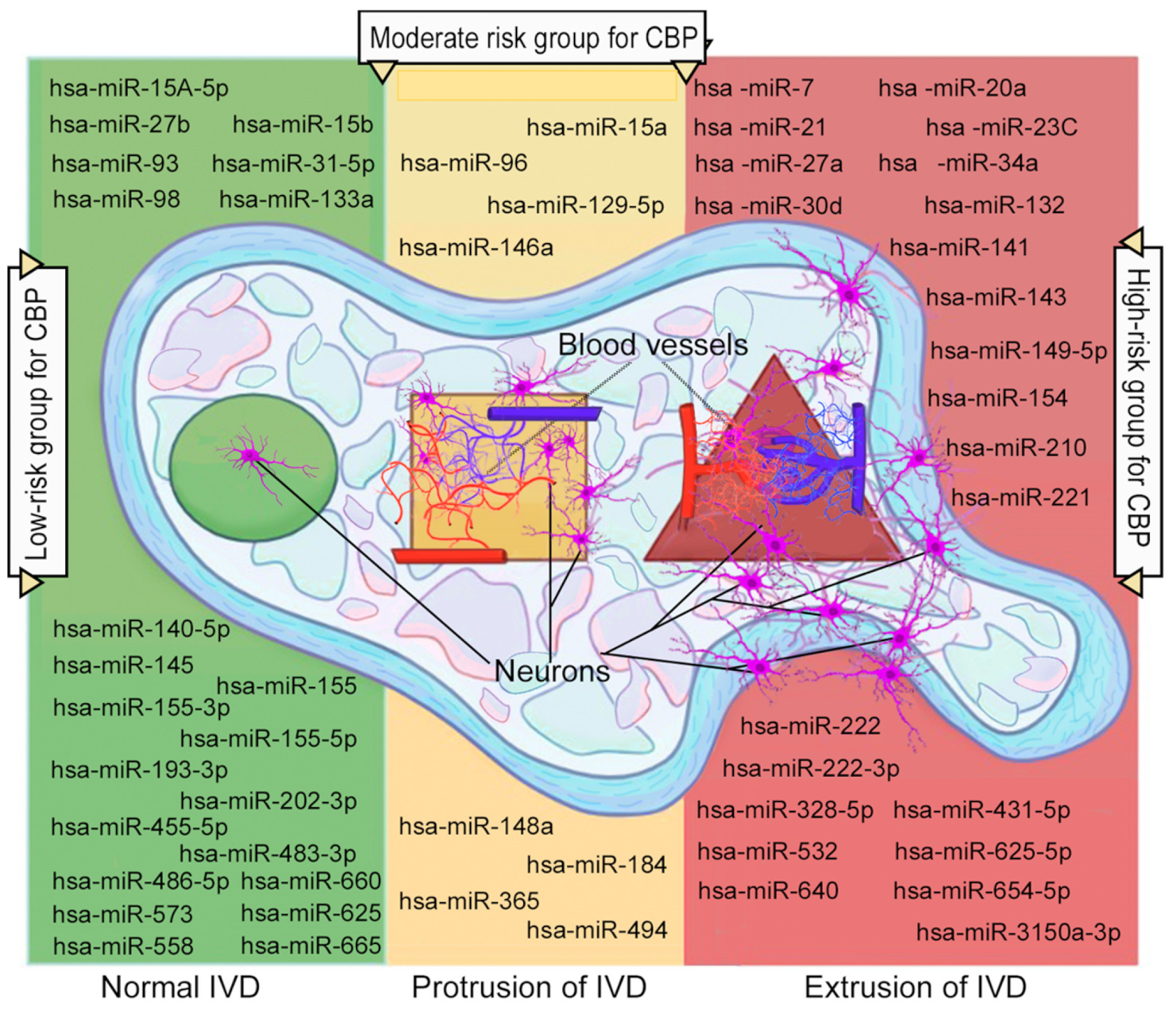
3.2. Clinical Studies
| MicroRNA | Design of the Study | Tissue (Sample) | General Characteristics of the Sample | Effects of the microRNA | References |
|---|---|---|---|---|---|
| |||||
| Local microRNA | |||||
| hsa-miR-7 | Clinical (humans and cell culture) | IVD tissues (surgical material) | Patients with IVDD (main group = 12; age range—20–42 years; mean age = 27.4 years) and patients with idiopathic scoliosis (control group = 8; age range = 18–40 years; mean age = 21.8 years). | Overexpression of hsa-miR-7, targeting IL1β, induces ECM degradation in IVD via targeting GDF5. | [134] |
| hsa-miR-15a | Clinical (humans) | NP tissues (surgical material) | Patients with IVDD (main group = 20; age range = 18–24 years; mean age = 25.4 years) and patients with idiopathic scoliosis (control group = ND; age = ND). | Overexpression of hsa-miR-15a inhibits NP cell proliferation and induces cell apoptosis by targeting MAP3K9. | [97] |
| hsa-miR-15a-5p | Clinical (humans) | NP tissues (surgical material) | Patients with IVDD (main group = ND; age = ND) and patients with lumbar spine fractures (control group = ND; age = ND). | Overexpression of hsa-miR-15A-5p inhibits NP cell proliferation, induces SOX9 expression to suppress inflammatory response and apoptosis via NF-Κb signaling pathway. | [58] |
| hsa-miR-15b | Clinical (humans) | NP tissues (surgical material) | Patients with IVDD (main group = 15; age range = 29–62 years; mean age = 36.2 years) and patients with idiopathic scoliosis (control group = 10; age range = 20–36 years; mean age = 24.3 years). | Hypo-expression of hsa-miR-15b inhibits ECM degradation in NP cells via increased SMAD3 expression. | [120] |
| hsa-miR-20a | Clinical (humans) | IVD cartilage end plate (surgical material) | Adult patients with IVDD (48 participants; age range = 14–71 years; mean age = ND). | Overexpression of hsa-miR-20a inhibits ANKH, which is associated with inorganic phosphate-induced calcification and IVDD progression. | [93] |
| hsa-miR-21 | Clinical (humans) | NP tissues (surgical material) | Adult patients with IVDD (main group = 65; age range = 45–67 years; mean age = 54.6 years) and normal IVD (control group = 45; age range = 17–22 years; mean age = 20.4 years). | Overexpression of hsa-miR-21 induces the Akt/mTOR pathway by suppressing PTEN, leading to overexpression of MMP3 and MMP9 and subsequent ECM degradation in degenerating IVDs. | [86] |
| hsa-miR-23c | Clinical (humans) | NP tissues (surgical material) | Patients with IVDD (main group = 24; age = ND) and patients with spinal cord injury (control group = 16; age = ND). | Overexpression of hsa-miR-23c and CTNNB1 induces the development of IVDD. | [39] |
| hsa-miR-27a | Clinical (humans) | NP tissues (surgical material) | Patients with lumbar disc herniation (main group = 20; age range = ND; mean age = 54.9 ± 7.5 years) and patients with spinal cord injury (control group = 20; age range = ND; mean age = 42.2 ± 8.9 years). | Overexpression of hsa-miR-27a induces the release of proinflammatory mediators in degenerating IVD cells via the MAPK signaling pathway. | [98] |
| hsa-miR-27b | Clinical (humans) | NP tissues (surgical material) | Adult patients with IVDD (main group = 80; age range—48–69 years; mean age = 56.2 years) and adult patients with lumbar vertebral fractures (control group = 76; age range = 18–23 years; mean age = 20.2 years). | Hypo-expression of hsa-miR-27b induces MMP13 production in IVDD. | [89] |
| hsa-miR-30d | Clinical (humans) | NP tissues (surgical material) | Patients with IVDD (main group = 20; age = ND) and patients with idiopathic scoliosis (control group = 10; age = ND). | Overexpression of hsa-miR-30d induces apoptosis and ECM degradation by upregulating SOX9 in NPs of degenerating IVDs. | [99] |
| hsa-miR-31-5p | Clinical (humans) | NP tissues (surgical material) | Patients with IVDD (main group = 82; age range = ND; mean age = 57.6 ± 5.3 years) and patients with traumatic fractures of the lumbar vertebrae (control group = 91; age range = ND; mean age = ND). | Overexpression of hsa-miR-31-5p induces NP cell proliferation, inhibits apoptosis, promotes ECM formation by regulating the SDF-1/CXCR7 pathway. | [60] |
| hsa-miR-34a | Clinical (humans) | IVD cartilaginous endplate tissue (surgical specimen) | Adult patients with IVDD (main group = 12; age range = 61–75 years; mean age = 69 years) and adult patients with idiopathic scoliosis (control group = 4; age range = 19–25 years; mean age = 21 years). | Overexpression of hsa-miR-34a inhibits production of the apoptosis regulator BCL2. | [87] |
| hsa-miR-93 | Clinical (humans) | IVD tissues (surgical material) | Patients with IVDD (main group = 54; age range = 29–64 years; mean age = 48.2 years) and patients with idiopathic scoliosis (control group = 4; age range = 16–20 years; mean age = 21 years). | Hypo-expression of hsa-miR-93 induces MMP3 production and degradation of type II Col in IVD NP. | [115] |
| hsa-miR-96 | Clinical (humans) | NP tissues (surgical material) | Patients with IVDD (main group = 30; age range = ND; mean age = 50 ± 11.7 years) and patients with traumatic lumbar spine fracture (control group = 5; age range = ND; mean age = 21.6 ± 3.8 years). | Overexpression of hsa-miR-96 induces NP cell proliferation by targeting the activation of the AKT signaling pathway. | [100] |
| hsa-miR-98 | Clinical (humans) | IVD tissues (surgical material) | Patients with IVDD (main group = 116; age range = 47–72 years; mean age = 58.2 years) and patients with recent lumbar vertebral fractures (control group = 102; age range = 18–22 years; mean age = 20.3 years). | Overexpression of hsa-miR-98 targets signaling enzymes involved in ECM metabolism and the IL-6/STAT3 signaling pathway, which prevents the development of IVDD and CBP. | [92] |
| hsa-miR-129-5p | Clinical (humans) | NP tissues (surgical material) | Patients with IVDD (main group = 33; age range = 32–56 years; mean age = 45.4 years) and patients with idiopathic scoliosis (control group = 29; age range = 18–24 years; mean age = 21.1 years). | Hypo-expression of hsa-miR-129-5p induces the development of IVDD via inhibition of apoptosis by targeting BMP2. | [101] |
| Clinical (humans) | NP tissues (surgical material) | Patients with IVDD (main group = 30; age range = 26–55 years; mean age = 41.7 years) and patients with idiopathic scoliosis (control group = 30; age range = 20–66 years; mean age = 42.4 years). | Overexpression of hsa-miR-129-5p inhibits the p38-mapk pathway by targeting leucine-rich α2-glycoprotein 1, thereby exerting a protective effect on the development of IVDD. | [121] | |
| hsa-miR-132 | Clinical (humans) | NP tissues (surgical material) | Adult patients with IVDD (main group = 27; age range = 29–70 years; mean age = 44 years) and adult patients with idiopathic scoliosis (control group = 14; age range = 17–34 years; mean age = 20.5 years). | Overexpression of hsa-miR-132 induces ECM degradation by directly targeting GDF5 and leading to increased expression of MMP13 and ADAMTS4 via the MAPK/ERK pathway. | [31] |
| hsa-miR-138-5p | Clinical (humans) | NP tissues (surgical material) | Patients with IVDD (main group = 23; age range = 18–39 years; mean age = 23.4 years) and adult patients with idiopathic scoliosis (control group = ND; age = ND). | Overexpression of hsa-miR-138-5p induces NP cell apoptosis by regulating PTEN/PI3K/Akt signaling or by directly acting through sirtuin 1; hypo-expression of hsa-miR-138-5p inhibits TNFα-induced apoptosis in NP cells through the PTEN/PI3K/Akt signaling pathway. | [135] |
| hsa-miR-140-5p | Clinical (humans) | NP tissues (surgical material) | Patients with IVDD (22 participants; age range = 33–78 years; mean age = 53 years). | Overexpression of hsa-miR-140 inhibits the local inflammatory response and IVD degeneration by reducing the production of proinflammatory cytokines and increasing the production of aggrecan and Col II; inhibits TLR4 expression. | [122] |
| hsa-miR-141 | Clinical (humans) | NP tissues (surgical material) | Patients with IVDD (main group = 82; age range = 18–39 years; mean age = 23.4 years) and patients with recent traumatic lumbar fractures (control group = 68; age range = 18–39 years, mean age = 23.4 years). | Overexpression of hsa-miR-141 induces ECM degradation by targeting and depleting SIRT1 (a negative regulator of the NF-κB pathway). | [94] |
| hsa-miR-143 | Clinical (humans) | NP tissues (surgical material) | Patients with IVDD and herniation at the lumbar spine level (main group = 10; age range = 28–58 years, mean age = 25.8 years) and adult patients with idiopathic scoliosis (control group = 10; age range = 17–40 years; mean age = 22.3 years). | Overexpression of hsa-miR-143 induces NP cell apoptosis through direct action and inhibition of BCL2 (an enzyme that blocks apoptosis). | [95] |
| hsa-miR-145 | Clinical (humans) | IVD tissues (surgical material) | Adult patients with IVDD (main group = ND; age = ND) and adult patients with thoracolumbar vertebral fractures (control group = ND; age = ND). | Overexpression of hsa-miR-145 targeting Adamats17 inhibits apoptosis of degenerating IVD cells in vitro, both in the presence and absence of oxidative stress. | [90] |
| hsa-miR-146a | Clinical (humans) | NP tissues (surgical material) | Patients with IVDD and herniation at the lumbosacral spine level (main group = 5; age range = 50–70 years; mean age = 57.5 years) and patients with lumbar spine fracture (control group = 5; age range = 52–69 years; mean age = 56.6 years). | Overexpression of hsa-miR-146a induces the development of IVDD and a local inflammatory response by increasing IL6 production and activating the STAT3 signaling pathway. | [102] |
| hsa-miR-148a | Clinical (humans) | NP tissues (surgical material) | Patients with IVDD (main group = 30; age = ND) and healthy volunteers (control group = 30; age = ND). | Overexpression of hsa-miR-148a inhibits the production of proinflammatory mediators via the P38-MAPK pathway, regulating the development and progression of IVDD. | [124] |
| Clinical (humans) | NP tissues (surgical material) | Patients with IVDD and herniation at the lumbosacral spine level (main group = 5; age range = 45–58 years; mean age = ND) and patients with lumbar spine fracture or idiopathic scoliosis (control group = 5; age range = 18–20 years; mean age = ND). | Overexpression of hsa-miR-148a induces increased Hotair activity, which in turn increases PTEN expression and leads to increased severity of IVDD. | [41] | |
| hsa-miR-149-5P | Clinical (humans) | NP tissues (surgical material) | Patients with IVDD (main group = 40; age range = ND; mean age = 24.3 ± 5.1 years) and healthy volunteers or patients with idiopathic scoliosis (control group = 40; age range = ND; mean age = 22.4 ± 4.2 years). | Overexpression of hsa-miR-149-5P activates LINC00917; inhibits NP cell proliferation; initiates inflammation and pyroptosis by regulating the pyrin domain containing 1 signaling pathway of the miR-149-5P/NLR family. | [103] |
| hsa-miR-154 | Clinical (humans) | NP tissues (surgical material) | Patients with IVDD (main group = 8; age range = 19–38 years; mean age = 23.1 years) and patients with idiopathic scoliosis (control group = 8; age range = 17–42 years; mean age = 28.3 years). | Overexpression of hsa-miR-154 induces IVDD development by targeting FGF14. | [104] |
| hsa-miR-155 | Clinical (humans and tissue culture) | Synovial fibroblasts and synovial tissue | Adult patients with inflammatory tissue injury IVD (participants = ND; age = ND). | Overexpression of hsa-miR-155 inhibits MMP3 production and reduces the effects of MMP3 and MMP1 on TLR ligands and cytokines. | [136] |
| Clinical (humans and tissue culture) | NP cells (surgical material) | Adult patients with inflammatory IVD tissue injury (participants = ND; age = ND). | Overexpression of hsa-miR-155 inhibits ECM degradation via p65/NF-Κb signaling. | [33] | |
| Clinical (humans) | NP tissues (surgical material) | Patients with IVDD (main group = 3; age range = 65–70 years; mean age = ND) and patients with idiopathic scoliosis (control group = 3; age range = 13–15 years; mean age = ND). | Hypo-expression of hsa-miR-155 inhibits the expression of Col II and glycosaminoglycans by targeting ERK1/2. | [125] | |
| hsa-miR-155-3p | Clinical (humans) | NP tissues (surgical material) | Patients with IVDD (main group = 36; age range = 26–62 years, mean age = 39.43 years) and patients with traumatic lumbar spine fracture (control group = 31; age range = 12–24 years, mean age = 14.76 years). | Overexpression of hsa-miR-155-3p inhibits the expression of KDM3A and HIF1α. | [126] |
| hsa-miR-155-5p | Clinical (humans) | NP and AF tissues (surgical material) | Patients with IVDD and lumbar disc herniation (participants = 6; age = ND). | Overexpression of hsa-miR-155-5p induces the production of proinflammatory cytokines (IL8, IL6); induces BDNF expression; and activates MAPK through increased phosphorylation of p38 and p53. Hypo-expression of hsa-miR-155-5p induces the anti-inflammatory cytokines IL10 and TIMP4. | [127] |
| hsa-miR-184 | Clinical (humans) | NP tissues (surgical material) | Patients with IVDD (main group = 40; age range = 29–57 years; mean age = ND) and adolescents with idiopathic scoliosis (control group = 4; age range = 11–14 years; mean age = ND). | Overexpression of hsa-miR-184 induces IVD cell proliferation via regulation of GAS1, which induces Akt phosphorylation. | [105] |
| hsa-miR-193-3p | Clinical (humans and tissue culture) | NP tissues (surgical material) | Adult patients with IVDD (main group = 128; age range = 45–69 years; mean age = 53.9 years) and patients with recent traumatic lumbar spine fracture (control group = 116; age range = 18–22 years, mean age = 20.6 years). | Overexpression of hsa-miR-193a-3p inhibits IVDD progression in vitro and in vivo. Hypo-expression of has-miR-193a-3p induces MMP14 expression and IVD degradation. | [118] |
| hsa-miR-194-5p | Clinical (humans) | NP tissues (surgical material). | Patients with IVDD (main group = 6; age = ND) and healthy volunteers (control group = 3; age = ND). | Hypo-expression of hsa-miR-194-5p inhibits Cullin family genes (CUL4A and CUL4B). | [133] |
| hsa-miR-202-3p | Clinical (humans) | NP tissues (surgical material) | Patients with IVDD (participants = 40; age range = 23–82 years, mean age = 55.1 years). | Overexpression of hsa-miR-202-3p inhibits IL-1β-induced MMP1 expression. Transfection of cells with an hsa-miR-202-3p inhibitor significantly increases MMP1. | [128] |
| hsa-miR-210 | Clinical (humans) | NP tissues (surgical material) | Patients with IVDD (main group = 45; age range = 38–65 years, mean age = 52.7 years) and patients with traumatic lumbar spine fracture (control group = 5; age range = 16–20 years; mean age = 18.6 years). | Overexpression of hsa-miR-210 induces the development of IVDD; it directly targets ATG7 and then prevents autophagy, leading to increased expression of MMP3 and MMP13 and subsequent degradation of Col II and ECM aggrecan. | [106] |
| hsa-miR-221 | Clinical (humans) | NP tissues (surgical material) | Patients with IVDD (main group = 15, age range = ND; mean age = 48 ± 7 years) and patients with idiopathic scoliosis (control group = 3; age range = ND; mean age = 38 ± 11 years). | Overexpression of hsa-miR-221 targets ERα, which influences the protective effect of estrogen on the development of IVDD. | [107] |
| hsa-miR-222 | Clinical (humans) | NP tissues (surgical material) | Patients with IVDD (main group = 22; age range = 26–62 years; mean age = 39.4 years) and patients with traumatic lumbar spine fracture (control group = 9; age range = 12–24 years; mean age = 14.76 years). | Overexpression of hsa-miR-222 induces local inflammatory response and apoptosis in degenerating IVDs by targeting TIMP3 miR. | [108] |
| hsa-miR-222-3p | Clinical (humans) | NP tissues (surgical material) | Patients with IVDD (main group = 30; age = ND) and patients with lumbar spine fractures (control group = 10; age = ND). | Overexpression of hsa-miR-222-3p induces IVDD development by targeting CdKn1b. | [109] |
| hsa-miR-328-5p | Clinical (humans) | NP tissues (surgical material) | Patients with IVDD (main group = 10; age range = ND; mean age = 41.6 ± 4.8 years) and healthy volunteers (control group = 10; age range = ND; mean age = 38.5 ± 3.5 years). | Overexpression of hsa-miR-328-5p inhibits proliferation and induces apoptosis of NP cells by regulating the expression of Bcl2, Bax, and caspase-3, and promotes the progression of premature aging IVD. | [110] |
| hsa-miR-365 | Clinical (humans and tissue culture) | IVD cartilage end plate (surgical material) | Patients with IVDD (main group = 38; age range = ND; mean age = 58 years) and adult patients with fractures and dislocations of the cervical spine (control group = 20; age range = ND; mean age = 34 years). | Overexpression of hsa-miR-365 targets HDAC4, promoting tissue protection in IVDD. | [119] |
| Clinical (humans) | NP tissues (surgical material) | Patients with IVDD and herniation at the lumbar level (main group = 10; age range = 45–65 years, mean age = 52 ± 10 years) and patients with traumatic lumbar spine fracture (control group = 10; age range = 45–65 years, mean age = 53 ± 11 years). | Overexpression of hsa-miR-365 and MT1DP and hypo-expression of NRF2 are associated with IVDD, apoptosis, and the development of a local inflammatory response. | [111] | |
| hsa-miR-431-5p | Analysis of the GSE67567 gene expression dataset; clinical (humans) | Database Omnibus NP tissues (surgical material) | Patients with IVDD (main group = 5; age = ND) and volunteers with Hirayama disease (control group = 5; age = ND). | Overexpression of hsa-miR-431-5p inhibits Circarl15 production in IDD tissues. Circarl15 expression positively correlates with the DISC1 scaffold protein. Circarl15 suppresses NP cell apoptosis but promotes NP cell proliferation through regulation of the hsa-miR-431-5p/disc1 signaling axis. | [42] |
| hsa-miR-455-5p | Clinical (humans and tissue culture) | IVD cartilage end plate (surgical material) | Adult patients with IVDD (45 participants; age range = ND; mean age = 58.67 ± 10.02). | Overexpression of hsa-miR-455-5p inhibits the development of IVDD via the TGF-β/SMAD signaling pathway by regulating RUNX2. | [85] |
| hsa-miR-483-3p | Clinical (humans) | NP tissues (surgical material) | Adult patients with IVDD (main group = 24; age = ND) and adult patients with spinal cord injury (control group = 16; age = ND). | Hypo-expression of hsa-miR483-3p and GSK3B induces the development of IVDD. | [39] |
| hsa-miR-486-5p | Clinical (humans) | NP tissues (surgical material) | Adult patients with IVDD (20; age range = 18–38 years, mean age = 21.4 years). | Overexpression of hsa-miR-486-5p increases NP cell viability; inhibits proinflammatory cytokines and ECM degradation; and partially inhibits FoxO1 expression. | [129] |
| hsa-miR-494 | Clinical (humans) | NP tissues (surgical material) | Patients with IVDD and herniation at different levels (main group = 29; age range = 15 to 76 years, mean age = 20.6 years) and IVD tissue samples from healthy volunteers (control group = 8; age range = from 1 month to 10 years; mean age = ND). | Overexpression of hsa-miR-494 activates SOX9 and prevents the development of IVDD. | [137] |
| Clinical (humans) | NP tissues (surgical material) | Patients with IVDD (20 participants; age range = 30–58 years, mean age = 46.5 years). | Overexpression of hsa-miR-494 inhibits ECM degradation; inhibits MMP, disintegrin, and ADAMTS activity by directly targeting SOX9. | [96] | |
| hsa-miR-573 | Clinical (humans) | NP cells (surgical material) | Patients with IVDD (main group = 30; age—ND) and patients with idiopathic scoliosis (control group = 30, age—ND). | Overexpression of hsa-miR-573 enhances NP cell viability and inhibits apoptosis in IVDD via targeting BAX. | [130] |
| hsa-miR-625 | Clinical (humans) | NP cells (surgical material) | Patients with IVDD of the cervical spine (main group = 6; age range = 46–62 years, mean age = 52.6 years) and patients with fracture of the cervical spine (control group = 3; age range = 38–58 years; mean age = 47.2 years). | Hypo-expression of hsa-miR-625 induces Fas-mediated apoptosis; inhibits Bcl2 expression. | [133] |
| hsa-miR-625-5p | Clinical (humans and cell culture) | NP and AF cell culture (LPS-induced inflammation model) | Adult patients with IVDD (main group = 72; age range = ND; mean age = 45.3 ± 3.9 years) and healthy volunteers (control group = 24; age range = ND; mean age = 41.7 ± 4.1 years). | Overexpression of hsa-miR-625-5p directly induces damage to the ECM structural protein (Col type I) via NF-kB and TLR4 signaling pathway after LPS stimulation. | [84] |
| hsa-miR-640 | Clinical (humans) | NP cells (surgical material) | Patients with IVDD (main group = 15; age range = 27–46 years; mean age = 34.6 years) and patients with idiopathic scoliosis (control group = 8; age range = 18–33 years, mean age = 24.13 years). | Overexpression of hsa-miR-640 induces IVDD; induces apoptosis of IVD cells; induces MMP3 and MMP9 production; inhibits aggrecan and Col type II through the NF-κB signaling pathway. | [88] |
| hsa-miR-654-5p | Clinical (humans) | NP cells (surgical material) | Patients with IVDD (main group = 54; age range = 31–53 years, mean age = 42.3 years) and healthy volunteers (control group = 4; age range = 24–45 years, mean age = 33.6 years). | Overexpression of hsa-miR-654-5p induces the development of IVDD; induces the production of MMP3, MMP9, and MMP13; inhibits autophagy via the PI3K/AKT/mTOR pathway. | [115] |
| hsa-miR-660 | Clinical (humans) | NP cells (surgical material) | Adult patients with IVD hernia (main group = 3, age range = ND; mean age = 39 ± 10 years) and adult patients with lumbar vertebral fracture (control group = 3; age range = ND; mean age = 36 ± 7 years). | Hypo-expression of hsa-miR-660 inhibits NP cell apoptosis associated with downregulation of C-caspase 3 and C-caspase 7. | [91] |
| hsa-miR-665 | Clinical (humans) | NP cells (surgical material) | Adult patients with IVDD (main group = 35; age = ND) and adult patients with idiopathic scoliosis (control group = 5; age = ND). | Overexpression of hsa-miR-665 induces NP cell proliferation; inhibits the expression of type II Col and aggrecan; induces the expression of MMP3 and MMP13; inhibits the expression of GDF 5. | [132] |
| hsa-miR-3150a-3p | Clinical (humans) | NP cells (surgical material) | Adult patients with IVDD (main group = 20; age range = ND; mean age = 41.15 years) and adult patients with lumbar spine fractures (control group = 20; age range = ND; mean age = 37.75 years). | Overexpression of hsa-miR-3150a-3p induces IVDD by targeting aggrecan in the ECM. | [114] |
| Circulating microRNA | |||||
| hsa-miR-133a | Clinical (humans) | Blood (plasma) | Patients with IVDD (matched group = 45; age range = ND; mean age = 58.4 ± 8.3 years) and healthy volunteers (control group = 53; age range = ND; mean age = 55.1 ± 7.5 years). | Hypo-expression of hsa-miR-133a induces degradation of type II Col via overexpression of MMP9. | [116] |
| hsa-miR-146a | Clinical (humans) | Blood (mononuclear cells) | Adult patients with inflammatory IVD tissue injury (21 participants; age range = 33–73 years; mean age = ND). | Overexpression of hsa-miR-146a induces a systemic inflammatory response. | [138] |
| Clinical (humans) | Blood (plasma) | Patients with IVDD and lumbosacral disc herniation (main group = 21; age = ND) and healthy volunteers (control group = 21; age = ND). | Overexpression of hsa-miR-146a inhibits the production of proinflammatory cytokines (IL1β, IL6, and TNFα) by targeting the TARF6/NF-Κb pathway. | [123] | |
| hsa-miR-148a | Clinical (humans) | Blood (plasma). | Patients with IVDD (main group = 30; age = ND) and healthy volunteers (control group = 30; age = ND). | Overexpression of hsa-miR-148a inhibits the production of proinflammatory mediators via the P38-MAPK pathway, regulating the development and progression of IVDD. | [124] |
| hsa-miR-155 | Clinical (humans and tissue culture) | Blood (mononuclear cells) | Adult patients with inflammatory tissue injury IVD (participants = ND; age = ND). | Overexpression of hsa-miR-155 inhibits MMP3 production and reduces the effects of MMP3 and MMP1 on TLR ligands and cytokines. | [136] |
| hsa-miR-194-5p | Clinical (humans) | Blood (plasma) | Patients with IVDD (main group = 144; age = ND) and healthy volunteers (control group = 24; age = ND). | Hypo-expression of hsa-miR-194-5p inhibits Cullin family genes (CUL4A and CUL4B). | [133] |
| hsa-miR-532 | Clinical (humans) | Blood (plasma) NP tissues (surgical material) | Patients with IVDD (main group = 20; age = ND) and healthy volunteers (control group = 20; age = ND). | Overexpression of hsa-miR-532 induces apoptosis in NP cells, induces the development of IVDD by targeting Bcl9, and inhibits the Wnt/β-catenin pathway. | [112] |
| hsa-miR-625-5p | Clinical (humans and cell culture) | Blood (serum and plasma) | Adult patients with IVDD (main group = 72; age range = ND; mean age = 45.3 ± 3.9 years) and healthy volunteers (control group = 24; age range = ND; mean age = 41.7 ± 4.1 years). | Overexpression of hsa-miR-625-5p directly induces damage to the ECM structural protein (Col type I) via NF-kB and TLR4 signaling pathway after LPS stimulation. | [84] |
| |||||
| Local microRNA | |||||
| hsa-miR-146a | Clinical (humans) | Articular cartilage and synovial membrane (surgical material) | Adult patients with osteoarthritis of the knee (participants = ND; age = ND). | Overexpression of hsa-miR-146a induces a local inflammatory response, leading to the production of proinflammatory mediators (TNFα, COX2, iNOS and IL-6). | [80] |
| hsa-miR-558 | Clinical (humans) | Knee cartilage (surgical material) | Adult patients with osteoarthritis of the knee joints (main group = 20; age range = ND; mean age = 71.23 ± 7.10 years) and healthy adult volunteers (control group = 20; age range = ND; mean age = 72.1 2 ± 9.78 years). | Overexpression of hsa-miR-558 inhibits IL-1β-induced COX2 activation, which promotes systemic inflammatory response. | [17] |
| Circulating microRNA | |||||
| hsa-miR-124a | Clinical (humans) | Blood (primary T cells) | Adult patients with neuropathic pain associated with polyneuropathy, post-traumatic neuralgia, trigeminal neuralgia/neuropathy (main group = 11; age range = ND; mean age = 54 ± 12 years), and healthy volunteers (control group = 9; age range = ND; mean age = 36 ± 9 years). | Overexpression of hsa-miR-124a inhibits SIRT1 production and enhances neuropathic pain. | [117] |
| hsa-miR-132-3p | Clinical (humans) | Blood. Biopsy material of sural nerves | Adult patients with non-inflammatory and inflammatory neuropathy of different origins (main group = 55; age range = 33–84 years; mean age = 66 years), and healthy volunteers (control group = 30; age range = 38–69 years; mean age = 56.5 years). | Overexpression of hsa-miR-132-3p induces the development of neuropathic pain and CBP by upregulating the AMPA receptor subunits GluA1 and GluA2 in the spinal cord. | [71] |
| hsa-miR-155 | Clinical (humans) | Blood (primary T cells) | Adult patients with neuropathic pain associated with polyneuropathy, post-traumatic neuralgia, trigeminal neuralgia/neuropathy (main group = 11; age range = ND; mean age = 54 ± 12 years), and healthy volunteers (control group = 9; age range = ND; mean age = 36 ± 9 years). | Overexpression of hsa-miR-155 inhibits SIRT1 production, increasing neuropathic pain. | [117] |
4. Discussion
4.1. Perspectives of Using microRNAs as Epigenetic Biomarkers of Chronic Back Pain
4.2. Limitations of Using microRNAs as Epigenetic Biomarkers of Chronic Back Pain
5. Conclusions
Supplementary Materials
Author Contributions
Funding
Institutional Review Board Statement
Informed Consent Statement
Data Availability Statement
Conflicts of Interest
Abbreviations
| AF | annulus fibrosis |
| BDNF | brain-derived neurotrophic factor |
| CBP | chronic back pain |
| CGRP | calcitonin gene-related peptide |
| COX-2 | cyclooxygenase 2 |
| GABA-α1 | gamma-aminobutyric acid α1 |
| GM-CSF | granulocyte–macrophage colony-stimulating factor |
| IL1-β | interleukin 1 beta |
| IVD | intervertebral disc |
| IVDD | intervertebral disc degeneration |
| microRNA | small non-coding ribonucleic acid |
| NGF | nerve growth factor |
| NP | nucleus pulposus |
| PGE-2 | prostaglandin E2 |
References
- Kirnaz, S.; Capadona, C.; Wong, T.; Goldberg, J.L.; Medary, B.; Sommer, F.; McGrath, L.B., Jr.; Härtl, R. Fundamentals of intervertebral disc degeneration. World Neurosurg. 2022, 157, 264–273. [Google Scholar] [CrossRef] [Scilit]
- Kang, L.; Zhang, H.; Jia, C.; Zhang, R.; Shen, C. Epigenetic modifications of inflammation in intervertebral disc degeneration. Ageing Res. Rev. 2023, 87, 101902. [Google Scholar] [CrossRef] [Scilit]
- Silwal, P.; Nguyen-Thai, A.M.; Mohammad, H.A.; Wang, Y.; Robbins, P.D.; Lee, J.Y.; Vo, N.V. Cellular senescence in intervertebral disc aging and degeneration: Molecular mechanisms and potential therapeutic opportunities. Biomolecules 2023, 13, 686. [Google Scholar] [CrossRef] [Scilit] [PubMed]
- Cazzanelli, P.; Wuertz-Kozak, K. MicroRNAs in intervertebral disc degeneration, apoptosis, inflammation, and mechanobiology. Int. J. Mol. Sci. 2020, 21, 3601. [Google Scholar] [CrossRef] [Scilit] [PubMed]
- Chang, C.; Xu, L.; Zhang, R.; Jin, Y.; Jiang, P.; Wei, K.; Xu, L.; Shi, Y.; Zhao, J.; Xiong, M.; et al. MicroRNA-mediated epigenetic regulation of rheumatoid arthritis susceptibility and pathogenesis. Front. Immunol. 2022, 13, 838884. [Google Scholar] [CrossRef] [Scilit] [PubMed]
- Shnayder, N.A.; Ashkhotov, A.V.; Trefilova, V.V.; Nurgaliev, Z.A.; Novitsky, M.A.; Petrova, M.M.; Narodova, E.A.; Al-Zamil, M.; Chumakova, G.A.; Garganeeva, N.P.; et al. Molecular basic of pharmacotherapy of cytokine imbalance as a component of intervertebral disc degeneration treatment. Int. J. Mol. Sci. 2023, 24, 7692. [Google Scholar] [CrossRef] [Scilit]
- Shnayder, N.A.; Ashhotov, A.V.; Trefilova, V.V.; Nurgaliev, Z.A.; Novitsky, M.A.; Vaiman, E.E.; Petrova, M.M.; Nasyrova, R.F. Cytokine imbalance as a biomarker of intervertebral disk degeneration. Int. J. Mol. Sci. 2023, 24, 2360. [Google Scholar] [CrossRef] [Scilit]
- Shnayder, N.A.; Ashhotov, A.V.; Trefilova, V.V.; Novitsky, M.A.; Medvedev, G.V.; Petrova, M.M.; Narodova, E.A.; Kaskaeva, D.S.; Chumakova, G.A.; Garganeeva, N.P.; et al. High-tech methods of cytokine imbalance correction in intervertebral disc degeneration. Int. J. Mol. Sci. 2023, 24, 13333. [Google Scholar] [CrossRef] [Scilit]
- Henry, N.; Clouet, J.; Le Bideau, J.; Le Visage, C.; Guicheux, J. Innovative strategies for intervertebral disc regenerative medicine: From cell therapies to multiscale delivery systems. Biotechnol. Adv. 2018, 36, 281–294. [Google Scholar] [CrossRef] [Scilit]
- Clouet, J.; Fusellier, M.; Camus, A.; Le Visage, C.; Guicheux, J. Intervertebral disc regeneration: From cell therapy to the development of novel bioinspired endogenous repair strategies. Adv. Drug Deliv. Rev. 2019, 146, 306–324. [Google Scholar] [CrossRef] [Scilit]
- Li, W.; Gong, Y.; Liu, J.; Guo, Y.; Tang, H.; Qin, S.; Zhao, Y.; Wang, S.; Xu, Z.; Chen, B. Peripheral and Central Pathological Mechanisms of Chronic Low Back Pain: A Narrative Review. J. Pain Res. 2021, 14, 1483–1494. [Google Scholar] [CrossRef] [Scilit]
- De Geer, C.M. Cytokine involvement in biological inflammation related to degenerative disorders of the intervertebral disk: A narrative review. J. Chiropr. Med. 2018, 17, 54–62. [Google Scholar] [CrossRef] [Scilit]
- Fujii, K.; Yamazaki, M.; Kang, J.D.; Risbud, M.V.; Cho, S.K.; Qureshi, S.A.; Hecht, A.C.; Iatridis, J.C. Discogenic Back Pain: Literature Review of Definition, Diagnosis, and Treatment. JBMR Plus 2019, 3, e10180. [Google Scholar] [CrossRef] [Scilit]
- Smith, P.A. BDNF in neuropathic pain; the culprit that cannot be apprehended. Neuroscience 2024, 543, 49–64. [Google Scholar] [CrossRef] [Scilit]
- Michell-Robinson, M.A.; Touil, H.; Healy, L.M.; Owen, D.R.; Durafourt, B.A.; Bar-Or, A.; Antel, J.P.; Moore, C.S. Roles of microglia in brain development, tissue maintenance and repair. Brain 2015, 138, 1138–1159. [Google Scholar] [CrossRef] [Scilit]
- Sengupta, J.N.; Pochiraju, S.; Kannampalli, P.; Bruckert, M.; Addya, S.; Yadav, P.; Miranda, A.; Shaker, R.; Banerjee, B. MicroRNA-mediated GABA Aα-1 receptor subunit down-regulation in adult spinal cord following neonatal cystitis-induced chronic visceral pain in rats. Pain 2013, 154, 59–70, Erratum in Pain 2013, 154, 493. [Google Scholar] [CrossRef] [Scilit] [PubMed]
- Park, S.J.; Cheon, E.J.; Kim, H.A. MicroRNA-558 regulates the expression of cyclooxygenase-2 and IL-1β-induced catabolic effects in human articular chondrocytes. Osteoarthr. Cartil. 2013, 21, 981–989. [Google Scholar] [CrossRef] [Scilit] [PubMed]
- Bourinet, E.; Altier, C.; Hildebrand, M.E.; Trang, T.; Salter, M.W.; Zamponi, G.W. Calcium-permeable ion channels in pain signaling. Physiol. Rev. 2014, 94, 81–140. [Google Scholar] [CrossRef] [Scilit] [PubMed]
- Ni, J.; Gao, Y.; Gong, S.; Guo, S.; Hisamitsu, T.; Jiang, X. Regulation of μ-opioid type 1 receptors by microRNA134 in dorsal root ganglion neurons following peripheral inflammation. Eur. J. Pain 2013, 17, 313–323. [Google Scholar] [CrossRef] [Scilit]
- Im, H.I.; Kenny, P.J. MicroRNAs in neuronal function and dysfunction. Trends Neurosci. 2012, 35, 325–334. [Google Scholar] [CrossRef] [Scilit]
- Tricco, A.C.; Lillie, E.; Zarin, W.; O’Brien, K.K.; Colquhoun, H.; Levac, D.; Moher, D.; Peters, M.D.J.; Horsley, T.; Weeks, L.; et al. PRISMA Extension for Scoping Reviews (PRISMAScR): Checklist and Explanation. Ann. Intern. Med. 2018, 169, 467–473. [Google Scholar] [CrossRef] [Scilit]
- Zhou, X.; Chen, L.; Grad, S.; Alini, M.; Pan, H.; Yang, D.; Zhen, W.; Li, Z.; Huang, S.; Peng, S. The roles and perspectives of microRNAs as biomarkers for intervertebral disc degeneration. J. Tissue Eng. Regen. Med. 2017, 11, 3481–3487. [Google Scholar] [CrossRef] [Scilit]
- Xie, X.; Ma, L.; Xi, K.; Zhang, W.; Fan, D. MicroRNA-183 suppresses neuropathic pain and expression of AMPA receptors by targeting mTOR/VEGF signaling pathway. Cell. Physiol. Biochem. 2017, 41, 181–192. [Google Scholar] [CrossRef] [Scilit]
- Neumann, E.; Hermanns, H.; Barthel, F.; Werdehausen, R.; Brandenburger, T. Expression changes of microRNA-1 and its targets Connexin 43 and brain-derived neurotrophic factor in the peripheral nervous system of chronic neuropathic rats. Mol. Pain 2015, 11, 39. [Google Scholar] [CrossRef] [Scilit] [PubMed]
- Hori, N.; Narita, M.; Yamashita, A.; Horiuchi, H.; Hamada, Y.; Kondo, T.; Watanabe, M.; Igarashi, K.; Kawata, M.; Shibasaki, M.; et al. Changes in the expression of IL-6-Mediated MicroRNAs in the dorsal root ganglion under neuropathic pain in mice. Synapse 2016, 70, 317–324. [Google Scholar] [CrossRef] [Scilit] [PubMed]
- Pan, Z.; Shan, Q.; Gu, P.; Wang, X.M.; Tai, L.W.; Sun, M.; Luo, X.; Sun, L.; Cheung, C.W. miRNA-23a/CXCR4 regulates neuropathic pain via directly targeting TXNIP/NLRP3 inflammasome axis. J. Neuroinflamm. 2018, 15, 29. [Google Scholar] [CrossRef] [Scilit] [PubMed]
- Zhang, Y.; Su, Z.; Liu, H.L.; Li, L.; Wei, M.; Ge, D.J.; Zhang, Z.J. Effects of miR-26a-5p on neuropathic pain development by targeting MAPK6 in in CCI rat models. Biomed. Pharmacother. 2018, 107, 644–649. [Google Scholar] [CrossRef] [Scilit]
- Tramullas, M.; Francés, R.; de la Fuente, R.; Velategui, S.; Carcelén, M.; García, R.; Llorca, J.; Hurlé, M.A. MicroRNA-30c-5p modulates neuropathic pain in rodents. Sci. Transl. Med. 2018, 10, eaao6299. [Google Scholar] [CrossRef] [Scilit]
- Xu, L.; Wang, Q.; Jiang, W.; Yu, S.; Zhang, S. MiR-34c ameliorates neuropathic pain by targeting NLRP3 in a mouse model of chronic constriction injury. Neuroscience 2019, 399, 125–134. [Google Scholar] [CrossRef] [Scilit]
- Bali, K.K.; Hackenberg, M.; Lubin, A.; Kuner, R.; Devor, M. Sources of individual variability: miRNAs that predispose to neuropathic pain identified using genome-wide sequencing. Mol. Pain 2014, 10, 22. [Google Scholar] [CrossRef] [Scilit]
- Liu, W.; Xia, P.; Feng, J.; Kang, L.; Huang, M.; Wang, K.; Song, Y.; Li, S.; Wu, X.; Yang, S.; et al. MicroRNA-132 upregulation promotes matrix degradation in intervertebral disc degeneration. Exp. Cell Res. 2017, 359, 39–49. [Google Scholar] [CrossRef] [Scilit] [PubMed]
- Li, X.; Wang, S.; Yang, X.; Chu, H. miR1423p targets AC9 to regulate sciatic nerve injuryinduced neuropathic pain by regulating the cAMP/AMPK signalling pathway. Int. J. Mol. Med. 2021, 47, 561–572. [Google Scholar] [CrossRef] [Scilit] [PubMed]
- Sun, J.; Hong, J.; Sun, S.; Wang, X.; Peng, Y.; Zhou, J.; Huang, Y.; Li, S.; Chen, W.; Li, C.; et al. Transcription factor 7-like 2 controls matrix degradation through nuclear factor κB signaling and is repressed by microRNA-155 in nucleus pulposus cells. Biomed. Pharmacother. 2018, 108, 646–655. [Google Scholar] [CrossRef] [Scilit] [PubMed]
- Huang, L.; Wang, L. Upregulation of miR-183 represses neuropathic pain through inhibiton of MAP3K4 in CCI rat models. J. Cell. Physiol. 2020, 235, 3815–3822. [Google Scholar] [CrossRef] [Scilit]
- Li, L.; Zhao, G. Downregulation of microRNA-218 relieves neuropathic pain by regulating suppressor of cytokine signaling 3. Int. J. Mol. Med. 2016, 37, 851–858. [Google Scholar] [CrossRef] [Scilit]
- Wu, X.; Wang, X.; Yin, Y.; Zhu, L.; Zhang, F.; Yang, J. Investigation of the role of miR-221 in diabetic peripheral neuropathy and related molecular mechanisms. Adv. Clin. Exp. Med. 2021, 30, 623–632. [Google Scholar] [CrossRef] [Scilit]
- Li, H.; Shen, L.; Ma, C.; Huang, Y. Differential expression of miRNAs in the nervous system of a rat model of bilateral sciatic nerve chronic constriction injury. Int. J. Mol. Med. 2013, 32, 219–226. [Google Scholar] [CrossRef] [Scilit]
- Sheng, X.; Guo, Q.; Yu, J.; Xu, Y. Experimental research on the effect of microRNA-21 inhibitor on a rat model of intervertebral disc degeneration. Exp. Ther. Med. 2018, 16, 67–72. [Google Scholar] [CrossRef] [Scilit]
- Yang, S.; Li, L.; Zhu, L.; Zhang, C.; Li, Z.; Guo, Y.; Nie, Y.; Luo, Z. Bu-Shen-Huo-Xue-Fang modulates nucleus pulposus cell proliferation and extracellular matrix remodeling in intervertebral disk degeneration through miR-483 regulation of Wnt pathway. J. Cell. Biochem. 2019, 120, 19318–19329. [Google Scholar] [CrossRef] [Scilit]
- Su, S.; Zhao, L.; Xie, W.; Yi, D.; He, S.; Chen, D.; Huang, J. Serum miRNAs are potential biomarkers for the detection of disc degeneration, among which miR-26a-5p suppresses Smad1 to regulate disc homeostasis. J. Cell. Mol. Med. 2019, 23, 6679–6689. [Google Scholar] [CrossRef] [Scilit]
- Zhang, S.; Song, S.; Cui, W.; Liu, X.; Sun, Z. Mechanism of long Noncoding RNA HOTAIR in nucleus pulposus cell autophagy and apoptosis in intervertebral disc degeneration. Evid. Based Complement. Altern. Med. 2022, 2022, 8504601. [Google Scholar] [CrossRef] [Scilit] [PubMed]
- Wang, H.; Zhu, Y.; Cao, L.; Guo, Z.; Sun, K.; Qiu, W.; Fan, H. circARL15 plays a critical role in intervertebral disc degeneration by modulating miR-431-5p/DISC1. Front. Genet. 2021, 12, 669598. [Google Scholar] [CrossRef] [Scilit]
- Kynast, K.L.; Russe, O.Q.; Möser, C.V.; Geisslinger, G.; Niederberger, E. Modulation of central nervous system-specific microRNA-124a alters the inflammatory response in the formalin test in mice. Pain 2013, 154, 368–376. [Google Scholar] [CrossRef] [Scilit] [PubMed]
- Arai, M.; Genda, Y.; Ishikawa, M.; Shunsuke, T.; Okabe, T.; Sakamoto, A. The miRNA and mRNA changes in rat hippocampi after chronic constriction injury. Pain Med. 2013, 14, 720–729. [Google Scholar] [CrossRef] [Scilit] [PubMed]
- Zhang, R.; Huang, M.; Cao, Z.; Qi, J.; Qiu, Z.; Chiang, L.Y. MeCP2 plays an analgesic role in pain transmission through regulating CREB/miR-132 pathway. Mol. Pain 2015, 11, 19. [Google Scholar] [CrossRef] [Scilit]
- Jin, Y.; Xu, L.; Xu, Y. Effect of intrathecal injection of miRNA-138 on neuropathic pain in rats undergoing partial sciatic nerve ligation and its underlying mechanism. Ann. Palliat. Med. 2021, 10, 6873–6882. [Google Scholar] [CrossRef] [Scilit]
- Kameshima, S.; Okada, M.; Ikeda, S.; Watanabe, Y.; Yamawaki, H. Coordination of changes in expression and phosphorylation of eukaryotic elongation factor 2 (eEF2) and eEF2 kinase in hypertrophied cardiomyocytes. Biochem. Biophys. Rep. 2016, 7, 218–224. [Google Scholar] [CrossRef] [Scilit]
- Li, X.; Kroin, J.S.; Kc, R.; Gibson, G.; Chen, D.; Corbett, G.T.; Pahan, K.; Fayyaz, S.; Kim, J.S.; van Wijnen, A.J.; et al. Altered spinal microRNA-146a and the microRNA-183 cluster contribute to osteoarthritic pain in knee joints. J. Bone Min. Res. 2013, 28, 2512–2522. [Google Scholar] [CrossRef] [Scilit]
- Wang, Z.; Liu, F.; Wei, M.; Qiu, Y.; Ma, C.; Shen, L.; Huang, Y. Chronic constriction injury-induced microRNA-146a-5p alleviates neuropathic pain through suppression of IRAK1/TRAF6 signaling pathway. J. Neuroinflamm. 2018, 15, 179. [Google Scholar] [CrossRef] [Scilit]
- Qin, C.; Lv, Y.; Zhao, H.; Yang, B.; Zhang, P. MicroRNA-149 Suppresses Inflammation in Nucleus Pulposus Cells of Intervertebral Discs by Regulating MyD88. Med. Sci. Monit. 2019, 25, 4892–4900. [Google Scholar] [CrossRef] [Scilit]
- Yun, Z.; Wang, Y.; Feng, W.; Zang, J.; Zhang, D.; Gao, Y. Overexpression of microRNA-185 alleviates intervertebral disc degeneration through inactivation of the Wnt/beta-catenin signaling pathway and downregulation of Galectin-3. Mol. Pain 2020, 16, 1744806920902559. [Google Scholar] [CrossRef] [Scilit] [PubMed]
- Jiang, B.C.; Cao, D.L.; Zhang, X.; Zhang, Z.J.; He, L.N.; Li, C.H.; Zhang, W.W.; Wu, X.B.; Berta, T.; Ji, R.R.; et al. CXCL13 drives spinal astrocyte activation and neuropathic pain via CXCR5. J. Clin. Investig. 2016, 126, 745–761. [Google Scholar] [CrossRef] [Scilit] [PubMed]
- Yang, D.; Yang, Q.; Wei, X.; Liu, Y.; Ma, D.; Li, J.; Wan, Y.; Luo, Y. The role of miR-190a-5p contributes to diabetic neuropathic pain via targeting SLC17A6. J. Pain Res. 2017, 10, 2395–2403. [Google Scholar] [CrossRef] [Scilit] [PubMed]
- Yan, X.T.; Zhao, Y.; Cheng, X.L.; He, X.H.; Wang, Y.; Zheng, W.Z.; Chen, H.; Wang, Y.L. Inhibition of miR-200b/miR-429 contributes to neuropathic pain development through targeting zinc finger E box binding protein-1. J. Cell. Physiol. 2018, 233, 4815–4824. [Google Scholar] [CrossRef] [Scilit]
- Zhu, J.; Yang, J.; Xu, J. miR-223 inhibits the polarization and recruitment of macrophages via NLRP3/IL-1β pathway to meliorate neuropathic pain. Pain Res. Manag. 2021, 2021, 6674028, Erratum in Pain Res. Manag. 2023, 2023, 9756947. https://doi.org/10.1155/2023/9756947. [Google Scholar] [CrossRef] [Scilit]
- Gao, P.; Zeng, X.; Zhang, L.; Wang, L.; Shen, L.L.; Hou, Y.Y.; Zhou, F.; Zhang, X. Overexpression of miR-378 Alleviates Chronic Sciatic Nerve Injury by Targeting EZH2. Neurochem. Res. 2021, 46, 3213–3221. [Google Scholar] [CrossRef] [Scilit]
- Zhan, L.Y.; Lei, S.Q.; Zhang, B.H.; Li, W.L.; Wang, H.X.; Zhao, B.; Cui, S.S.; Ding, H.; Huang, Q.M. Overexpression of miR-381 relieves neuropathic pain development via targeting HMGB1 and CXCR4. Biomed. Pharmacother. 2018, 107, 818–823. [Google Scholar] [CrossRef] [Scilit]
- Jiang, C.; Chen, Z.; Wang, X.; Zhang, Y.; Guo, X.; Xu, Z.; Yang, H.; Hao, D. The potential mechanisms and application prospects of non-coding RNAs in intervertebral disc degeneration. Front. Endocrinol. 2022, 13, 1081185. [Google Scholar] [CrossRef] [Scilit]
- Du, K.; He, X.; Deng, J. MicroRNA-16 inhibits the lipopolysaccharide-induced inflammatory response in nucleus pulposus cells of the intervertebral disc by targeting TAB3. Arch. Med. Sci. 2018, 17, 500–513. [Google Scholar] [CrossRef] [Scilit]
- Zhou, Y.; Deng, M.; Su, J.; Zhang, W.; Liu, D.; Wang, Z. The role of miR-31-5p in the development of intervertebral disc degeneration and its therapeutic potential. Front. Cell Dev. Biol. 2021, 9, 633974. [Google Scholar] [CrossRef] [Scilit]
- Xie, L.; Chen, Z.; Liu, M.; Huang, W.; Zou, F.; Ma, X.; Tao, J.; Guo, J.; Xia, X.; Lyu, F.; et al. MSC-Derived Exosomes Protect Vertebral Endplate Chondrocytes against Apoptosis and Calcification via the miR-31-5p/ATF6 Axis. Mol. Ther. Nucleic Acids 2020, 22, 601–614. [Google Scholar] [CrossRef] [Scilit]
- Wang, X.; Wang, Q.; Li, G.; Xu, H.; Liu, B.; Yuan, B.; Zhou, Y.; Li, Y. Identifying the protective effects of miR-874-3p/ATF3 axis in intervertebral disc degeneration by single-cell RNA sequencing and validation. J. Cell. Mol. Med. 2024, 28, e18492. [Google Scholar] [CrossRef] [Scilit]
- Ito, N.; Sakai, A.; Miyake, N.; Maruyama, M.; Iwasaki, H.; Miyake, K.; Okada, T.; Sakamoto, A.; Suzuki, H. miR-15b mediates oxaliplatin-induced chronic neuropathic pain through BACE1 down-regulation. Br. J. Pharmacol. 2017, 174, 386–395. [Google Scholar] [CrossRef] [Scilit] [PubMed]
- Sakai, A.; Saitow, F.; Maruyama, M.; Miyake, N.; Miyake, K.; Shimada, T.; Okada, T.; Suzuki, H. MicroRNA cluster miR-17-92 regulates multiple functionally related voltage-gated potassium channels in chronic neuropathic pain. Nat. Commun. 2017, 8, 16079. [Google Scholar] [CrossRef] [Scilit] [PubMed]
- Im, Y.B.; Jee, M.K.; Choi, J.I.; Cho, H.T.; Kwon, O.H.; Kang, S.K. Molecular targeting of NOX4 for neuropathic pain after traumatic injury of the spinal cord. Cell Death Dis. 2012, 3, e426. [Google Scholar] [CrossRef] [Scilit] [PubMed]
- Su, S.; Shao, J.; Zhao, Q.; Ren, X.; Cai, W.; Li, L.; Bai, Q.; Chen, X.; Xu, B.; Wang, J.; et al. MiR-30b Attenuates Neuropathic Pain by Regulating Voltage-Gated Sodium Channel Nav1.3 in Rats. Front. Mol. Neurosci. 2017, 10, 126. [Google Scholar] [CrossRef] [Scilit]
- Li, L.; Shao, J.; Wang, J.; Liu, Y.; Zhang, Y.; Zhang, M.; Zhang, J.; Ren, X.; Su, S.; Li, Y.; et al. MiR-30b-5p attenuates oxaliplatin-induced peripheral neuropathic pain through the voltage-gated sodium channel Nav1.6 in rats. Neuropharmacology 2019, 153, 111–120. [Google Scholar] [CrossRef] [Scilit]
- Chen, H.P.; Zhou, W.; Kang, L.M.; Yan, H.; Zhang, L.; Xu, B.H.; Cai, W.H. Intrathecal miR-96 inhibits Nav1.3 expression and alleviates neuropathic pain in rat following chronic construction injury. Neurochem. Res. 2014, 39, 76–83. [Google Scholar] [CrossRef] [Scilit]
- Favereaux, A.; Thoumine, O.; Bouali-Benazzouz, R.; Roques, V.; Papon, M.A.; Salam, S.A.; Drutel, G.; Léger, C.; Calas, A.; Nagy, F.; et al. Bidirectional integrative regulation of Cav1.2 calcium channel by microRNA miR-103: Role in pain. EMBO J. 2011, 30, 3830–3841. [Google Scholar] [CrossRef] [Scilit]
- Wan, L.; Su, Z.; Li, F.; Gao, P.; Zhang, X. MiR-122-5p suppresses neuropathic pain development by targeting PDK4. Neurochem. Res. 2021, 46, 957–963. [Google Scholar] [CrossRef] [Scilit]
- Leinders, M.; Uceyler, N.; Pritchard, R.A.; Sommer, C.; Sorkin, L.S. Increased miR-132-3p expression is associated with chronic neuropathic pain. Exp. Neurol. 2016, 283, 276–286. [Google Scholar] [CrossRef] [Scilit]
- Aldrich, B.T.; Frakes, E.P.; Kasuya, J.; Hammond, D.L.; Kitamoto, T. Changes in expression of sensory organ-specific microRNAs in rat dorsal root ganglia in association with mechanical hypersensitivity induced by spinal nerve ligation. Neuroscience 2009, 164, 711–723. [Google Scholar] [CrossRef] [Scilit] [PubMed]
- Imai, S.; Saeki, M.; Yanase, M.; Horiuchi, H.; Abe, M.; Narita, M.; Kuzumaki, N.; Suzuki, T.; Narita, M. Change in microRNAs associated with neuronal adaptive responses in the nucleus accumbens under neuropathic pain. J. Neurosci. 2011, 31, 15294–15299. [Google Scholar] [CrossRef] [Scilit] [PubMed]
- Huang, Z.Z.; Wei, J.Y.; Ou-Yang, H.D.; Li, D.; Xu, T.; Wu, S.L.; Zhang, X.L.; Liu, C.C.; Ma, C.; Xin, W.J. mir-500-Mediated GAD67 Downregulation Contributes to Neuropathic Pain. J. Neurosci. 2016, 36, 6321–6331. [Google Scholar] [CrossRef] [Scilit] [PubMed]
- Sakai, A.; Saitow, F.; Miyake, N.; Miyake, K.; Shimada, T.; Suzuki, H. miR-7a alleviates the maintenance of neuropathic pain through regulation of neuronal excitability. Brain 2013, 136, 2738–2750. [Google Scholar] [CrossRef] [Scilit]
- Park, C.K.; Xu, Z.Z.; Berta, T.; Han, Q.; Chen, G.; Liu, X.J.; Ji, R.R. Extracellular microRNAs activate nociceptor neurons to elicit pain via TLR7 and TRPA1. Neuron 2014, 82, 47–54. [Google Scholar] [CrossRef] [Scilit]
- Murphy, C.P.; Singewald, N. Role of MicroRNAs in anxiety and anxiety-related disorders. Curr. Top. Behav. Neurosci. 2019, 42, 185–219, Correction in Curr. Top. Behav. Neurosci. 2019, 42, 259. [Google Scholar] [CrossRef] [Scilit]
- Sun, Y.; Shi, X.; Peng, X.; Li, Y.; Ma, H.; Li, D.; Cao, X. MicroRNA-181a exerts anti-inflammatory effects via inhibition of the ERK pathway in mice with intervertebral disc degeneration. J. Cell. Physiol. 2020, 235, 2676–2686. [Google Scholar] [CrossRef] [Scilit]
- Zhang, Z.J.; Guo, J.S.; Li, S.S.; Wu, X.B.; Cao, D.L.; Jiang, B.C.; Jing, P.B.; Bai, X.Q.; Li, C.H.; Wu, Z.H.; et al. TLR8 and its endogenous ligand miR-21 contribute to neuropathic pain in murine DRG. J. Exp. Med. 2018, 215, 3019–3037. [Google Scholar] [CrossRef] [Scilit]
- Willemen, H.L.; Huo, X.J.; Mao-Ying, Q.L.; Zijlstra, J.; Heijnen, C.J.; Kavelaars, A. MicroRNA-124 as a novel treatment for persistent hyperalgesia. J. Neuroinflamm. 2012, 9, 143. [Google Scholar] [CrossRef] [Scilit]
- Li, X.; Gibson, G.; Kim, J.S.; Kroin, J.; Xu, S.; van Wijnen, A.J.; Im, H.J. MicroRNA-146a is linked to pain-related pathophysiology of osteoarthritis. Gene 2011, 480, 34–41. [Google Scholar] [CrossRef] [Scilit] [PubMed]
- Poh, K.W.; Yeo, J.F.; Ong, W.Y. MicroRNA changes in the mouse prefrontal cortex after inflammatory pain. Eur. J. Pain 2011, 15, 801.e1–801.e12. [Google Scholar] [CrossRef] [Scilit] [PubMed]
- Xia, L.; Zhang, Y.; Dong, T. Inhibition of microRNA-221 alleviates neuropathic pain through targeting suppressor of cytokine signaling 1. J. Mol. Neurosci. 2016, 59, 411–420. [Google Scholar] [CrossRef] [Scilit] [PubMed]
- Shen, L.; Xiao, Y.; Wu, Q.; Liu, L.; Zhang, C.; Pan, X. TLR4/NF-κB Axis Signaling Pathway-Dependent Up-Regulation of miR-625-5p Contributes to Human Intervertebral Disc Degeneration by Targeting COL1A1. Am. J. Transl. Res. 2019, 11, 1374–1388. [Google Scholar]
- Xiao, L.; Xu, S.; Xu, Y.; Liu, C.; Yang, B.; Wang, J.; Xu, H. TGF-beta/SMAD signaling inhibits intermittent cyclic mechanical tension-induced degeneration of endplate chondrocytes by regulating the miR-455-5p/RUNX2 axis. J. Cell. Biochem. 2018, 119, 10415–10425. [Google Scholar] [CrossRef] [Scilit]
- Wang, W.J.; Yang, W.; Ouyang, Z.H.; Xue, J.B.; Li, X.L.; Zhang, J.; He, W.S.; Chen, W.K.; Yan, Y.G.; Wang, C. MiR-21 promotes ECM degradation through inhibiting autophagy via the PTEN/akt/mTOR signaling pathway in human degenerated NP cells. Biomed. Pharmacother. 2018, 99, 725–734. [Google Scholar] [CrossRef] [Scilit]
- Chen, H.; Wang, J.; Hu, B.; Wu, X.; Chen, Y.; Li, R.; Yuan, W. MiR-34a pro-motes Fas-mediated cartilage end-plate chondro-cyte apoptosis by targeting Bcl-2. Mol. Cell. Biochem. 2015, 406, 21–30. [Google Scholar] [CrossRef] [Scilit]
- Dong, W.; Liu, J.; Lv, Y.; Wang, F.; Liu, T.; Sun, S.; Liao, B.; Shu, Z.; Qian, J. miR-640 aggravates intervertebral disc degeneration via NF-kappaB and WNT signalling pathway. Cell Prolif. 2019, 52, e12664. [Google Scholar] [CrossRef] [Scilit]
- Li, H.R.; Cui, Q.; Dong, Z.Y.; Zhang, J.H.; Li, H.Q.; Zhao, L. Downregulation of miR-27b is Involved in Loss of Type II Collagen by Directly Targeting Matrix Metalloproteinase 13 (MMP13) in Human Intervertebral Disc Degeneration. Spine 2016, 41, E116–E123. [Google Scholar] [CrossRef] [Scilit]
- Zhou, J.; Sun, J.; Markova, D.Z.; Li, S.; Kepler, C.K.; Hong, J.; Huang, Y.; Chen, W.; Xu, K.; Wei, F.; et al. MicroRNA-145 overexpression attenuates apoptosis and increases matrix synthesis in nucleus pulposus cells. Life Sci. 2019, 221, 274–283. [Google Scholar] [CrossRef] [Scilit]
- Zhang, H.J.; Ma, X.H.; Xie, S.L.; Qin, S.L.; Liu, C.Z.; Zhang, Z.G. Knockdown of miR-660 protects nucleus pulposus cells from TNF-a-induced apoptosis by targeting serum amyloid A1. J. Orthop. Surg. Res. 2020, 15, 7. [Google Scholar] [CrossRef] [Scilit] [PubMed]
- Ji, M.L.; Lu, J.; Shi, P.L.; Zhang, X.J.; Wang, S.Z.; Chang, Q.; Chen, H.; Wang, C. Dysregulated miR-98 contributes to extracellular matrix degradation by targeting IL-6/STAT3 signaling pathway in human intervertebral disc degeneration. J. Bone Miner. Res. 2016, 31, 900–909, Erratum in J. Bone Miner. Res. 2023, 38, 1904–1906. https://doi.org/10.1002/jbmr.4910. [Google Scholar] [CrossRef] [Scilit] [PubMed]
- Liu, M.H.; Sun, C.; Yao, Y.; Fan, X.; Liu, H.; Cui, Y.H.; Bian, X.W.; Huang, B.; Zhou, Y. Matrix stiffness promotes cartilage endplate chondrocyte calcification in disc degeneration via miR-20a targeting ANKH expression. Sci. Rep. 2016, 6, 25401. [Google Scholar] [CrossRef] [Scilit] [PubMed]
- Ji, M.L.; Jiang, H.; Zhang, X.J.; Shi, P.L.; Li, C.; Wu, H.; Wu, X.T.; Wang, Y.T.; Wang, C.; Lu, J. Preclinical development of a microRNA-based therapy for intervertebral disc degeneration. Nat. Commun. 2018, 9, 5051. [Google Scholar] [CrossRef] [Scilit]
- Zhao, K.; Zhang, Y.; Kang, L.; Song, Y.; Wang, K.; Li, S.; Wu, X.; Hua, W.; Shao, Z.; Yang, S. Epigenetic silencing of miRNA-143 regulates apoptosis by targeting BCL2 in human intervertebral disc degeneration. Gene 2017, 628, 259–266. [Google Scholar] [CrossRef] [Scilit]
- Kang, L.; Yang, C.; Song, Y.; Zhao, K.; Liu, W.; Hua, W.; Wang, K.; Tu, J.; Li, S.; Yin, H.; et al. MicroRNA-494 promotes apoptosis and extracellular matrix degradation in degenerative human nucleus pulposus cells. Oncotarget 2017, 8, 27868–27881. [Google Scholar] [CrossRef] [Scilit]
- Cai, P.; Yang, T.; Jiang, X.; Zheng, M.; Xu, G.; Xia, J. Role of miR-15a in intervertebral disc degeneration through targeting MAP3K9. Biomed. Pharmacother. 2017, 87, 568–574. [Google Scholar] [CrossRef] [Scilit]
- Cao, Z.; Chen, L. Inhibition of miR-27a suppresses the inflammatory response via the p38/MAPK pathway in intervertebral disc cells. Exp. Ther. Med. 2017, 14, 4572–4578. [Google Scholar] [CrossRef] [Scilit]
- Lv, J.; Li, S.; Wan, T.; Yang, Y.; Cheng, Y.; Xue, R. Inhibition of microRNA-30d attenuates the apoptosis and extracellular matrix degradation of degenerative human nucleus pulposus cells by up-regulating SOX9. Chem. Biol. Interact. 2018, 296, 89–97. [Google Scholar] [CrossRef] [Scilit]
- Tao, B.; Yi, J.; Huang, C.; Xu, W.; Qin, C.; Chen, L.; Chen, J.; Gao, Y.; Wang, R. microRNA-96 regulates the proliferation of nucleus pulposus cells by targeting ARID2/AKT signaling. Mol. Med. Rep. 2017, 16, 7553–7560. [Google Scholar] [CrossRef] [Scilit]
- Yang, W.; Sun, P. Downregulation of microRNA-129-5p increases the risk of intervertebral disc degeneration by promoting the apoptosis of nucleus pulposus cells via targeting BMP2. J. Cell. Biochem. 2019, 120, 19684–19690. [Google Scholar] [CrossRef] [Scilit] [PubMed]
- Zhou, T.; Lin, H.; Cheng, Z.; Ji, C.; Zhang, C.; Tian, J. Mechanism of microRNA-146a-mediated IL-6/STAT3 signaling in lumbar intervertebral disc degeneration. Exp. Ther. Med. 2017, 14, 1131–1135. [Google Scholar] [CrossRef] [Scilit] [PubMed]
- Li, T.; Peng, Y.; Chen, Y.; Huang, X.; Li, X.; Zhang, Z.; Du, J. Long intergenic non-coding RNA-00917 regulates the proliferation, inflammation, and pyroptosis of nucleus pulposus cells via targeting miR-149-5p/NOD-like receptor protein 1 axis. Bioengineered 2022, 13, 6036–6047. [Google Scholar] [CrossRef] [Scilit] [PubMed]
- Wang, J.; Liu, X.; Sun, B.; Du, W.; Zheng, Y.; Sun, Y. Upregulated miR-154 promotes ECM degradation in intervertebral disc degeneration. J. Cell. Biochem. 2019, 120, 11900–11907. [Google Scholar] [CrossRef] [Scilit]
- Li, W.; Wang, P.; Zhang, Z.; Wang, W.; Liu, Y.; Qi, Q. MiR-184 regulates proliferation in nucleus pulposus cells by targeting GAS1. World Neurosurg. 2017, 97, 710–715.e1. [Google Scholar] [CrossRef] [Scilit]
- Wang, C.; Zhang, Z.Z.; Yang, W.; Ouyang, Z.H.; Xue, J.B.; Li, X.L.; Zhang, J.; Chen, W.K.; Yan, Y.G.; Wang, W.J. MiR-210 facilitates ECM degradation by suppressing autophagy via silencing of ATG7 in human degenerated NP cells. Biomed. Pharmacother. 2017, 93, 470–479. [Google Scholar] [CrossRef] [Scilit]
- Sheng, B.; Yuan, Y.; Liu, X.; Zhang, Y.; Liu, H.; Shen, X.; Liu, B.; Chang, L. Protective effect of estrogen against intervertebral disc degeneration is attenuated by miR-221 through targeting estrogen receptor α. Acta Biochim. Biophys. Sin. 2018, 50, 345–354. [Google Scholar] [CrossRef] [Scilit]
- Zhang, Y.; Yang, J.; Zhou, X.; Wang, N.; Li, Z.; Zhou, Y.; Feng, J.; Shen, D.; Zhao, W. Knockdown of miR-222 inhibits inflammation and the apoptosis of LPS-stimulated human intervertebral disc nucleus pulposus cells. Int. J. Mol. Med. 2019, 44, 1357–1365. [Google Scholar] [CrossRef] [Scilit]
- Liu, J.; Yu, J.; Jiang, W.; He, M.; Zhao, J. Targeting of CDKN1B by miR-222-3p may contribute to the development of intervertebral disc degeneration. FEBS Open Bio 2019, 9, 728–735. [Google Scholar] [CrossRef] [Scilit]
- Yan, J.; Wu, L.G.; Zhang, M.; Fang, T.; Pan, W.; Zhao, J.L.; Zhou, Q. miR-328-5p induces human intervertebral disc degeneration by targeting WWP2. Oxidative Med. Cell. Longev. 2022, 2022, 3511967. [Google Scholar] [CrossRef] [Scilit]
- Liao, Z.W.; Fan, Z.W.; Huang, Y.; Liang, C.Y.; Liu, C.; Huang, S.; Chen, C.W. Long non-coding RNA MT1DP interacts with miR-365 and induces apoptosis of nucleus pulposus cells by repressing NRF-2-induced anti-oxidation in lumbar disc herniation. Ann. Transl. Med. 2021, 9, 151. [Google Scholar] [CrossRef] [Scilit]
- Sun, Z.; Jian, Y.; Fu, H.; Li, B. MiR-532 downregulation of the Wnt/β-catenin signaling via targeting Bcl-9 and induced human intervertebral disc nucleus pulposus cells apoptosis. J. Pharmacol. Sci. 2018, 138, 263–270. [Google Scholar] [CrossRef] [Scilit]
- Wang, S.; Guo, Y.; Zhang, X.; Wang, C. miR-654-5p inhibits autophagy by targeting ATG7 via mTOR signaling in intervertebral disc degeneration. Mol. Med. Rep. 2021, 23, 444. [Google Scholar] [CrossRef] [Scilit] [PubMed]
- Zhang, B.; Guo, W.; Sun, C.; Duan, H.Q.; Yu, B.B.; Mu, K.; Guan, Y.Y.; Li, Y.; Liu, S.; Liu, Y.; et al. Dysregulated miR-3150a-3p promotes lumbar intervertebral disc degeneration by targeting aggrecan. Cell. Physiol. Biochem. 2018, 45, 2506–2515, Erratum in Cell. Physiol. Biochem. 2020, 54, 1090. https://doi.org/10.33594/000000293. [Google Scholar] [CrossRef] [Scilit] [PubMed]
- Jing, W.; Jiang, W. MicroRNA-93 regulates collagen loss by targeting MMP3 in human nucleus pulposus cells. Cell Prolif. 2015, 48, 284–292. [Google Scholar] [CrossRef] [Scilit] [PubMed]
- Xu, C.; Zhang, H.; Zhou, W.; Wu, H.; Shen, X.; Chen, Y.; Liao, M.; Liu, Y.; Yuan, W. MicroRNA-10a, -210, and -563 as circulating biomarkers for ossification of the posterior longitudinal ligament. Spine J. 2019, 19, 735–743. [Google Scholar] [CrossRef] [Scilit]
- Heyn, J.; Luchting, B.; Hinske, L.C.; Hubner, M.; Azad, S.C.; Kreth, S. miR-124a and miR-155 enhance differentiation of regulatory T cells in patients with neuropathic pain. J. Neuroinflamm. 2016, 13, 248. [Google Scholar] [CrossRef] [Scilit]
- Ji, M.L.; Zhang, X.J.; Shi, P.L.; Lu, J.; Wang, S.Z.; Chang, Q.; Chen, H.; Wang, C. Downregulation of microRNA-193a-3p is involved in invertebral disc degeneration by targeting MMP14. J. Mol. Med. 2016, 94, 457–468, Correction in J. Mol. Med. 2023, 101, 1629–1630. https://doi.org/10.1007/s00109-023-02400-w. [Google Scholar] [CrossRef] [Scilit]
- Zheng, Q.; Li, X.X.; Xiao, L.; Shao, S.; Jiang, H.; Zhang, X.L.; Sun, L.Y.; Xu, H.G. MicroRNA-365 functions as a mechanosensitive microRNA to inhibit end plate chondrocyte degeneration by targeting histone deacetylase 4. Bone 2019, 128, 115052. [Google Scholar] [CrossRef] [Scilit]
- Kang, L.; Yang, C.; Yin, H.; Zhao, K.; Liu, W.; Hua, W.; Wang, K.; Song, Y.; Tu, J.; Li, S.; et al. MicroRNA-15b silencing inhibits IL-1β-induced extracellular matrix degradation by targeting SMAD3 in human nucleus pulposus cells. Biotechnol. Lett. 2017, 39, 623–632. [Google Scholar] [CrossRef] [Scilit]
- Cui, S.; Zhang, L. microRNA-129-5p shuttled by mesenchymal stem cell-derived extracellular vesicles alleviates intervertebral disc degeneration via blockade of LRG1-mediated p38 MAPK activation. J. Tissue Eng. 2021, 12, 20417314211021679. [Google Scholar] [CrossRef] [Scilit] [PubMed]
- Zhang, Q.; Weng, Y.; Jiang, Y.; Zhao, S.; Zhou, D.; Xu, N. Overexpression of miR-140-5p inhibits lipopolysaccharide-induced human intervertebral disc inflammation and degeneration by downregulating toll-like receptor 4. Oncol. Rep. 2018, 40, 793–802. [Google Scholar] [CrossRef] [Scilit] [PubMed]
- Lv, F.; Huang, Y.; Lv, W.; Yang, L.; Li, F.; Fan, J.; Sun, J. MicroRNA-146a Ameliorates inflammation via TRAF6/NF-κB pathway in intervertebral disc cells. Med. Sci. Monit. 2017, 23, 659–664. [Google Scholar] [CrossRef] [Scilit] [PubMed]
- Li, G.; Tang, X.; Chen, H.; Sun, W.; Yuan, F. miR-148a inhibits pro-inflammatory cytokines released by intervertebral disc cells by regulating the p38/MAPK pathway. Exp. Ther. Med. 2018, 16, 2665–2669. [Google Scholar] [CrossRef] [Scilit]
- Ye, D.; Dai, L.; Yao, Y.; Qin, S.; Xie, H.; Wang, W.; Liang, W. miR-155 inhibits nucleus pulposus cells’ degeneration through targeting ERK 1/2. Dis. Markers 2016, 2016, 6984270. [Google Scholar] [CrossRef] [Scilit]
- Zhou, X.; Li, J.; Teng, J.; Liu, Y.; Zhang, D.; Liu, L.; Zhang, W. microRNA-155-3p attenuates intervertebral disc degeneration via inhibition of KDM3A and HIF1α. Inflamm. Res. 2021, 70, 297–308. [Google Scholar] [CrossRef] [Scilit]
- Cazzanelli, P.; Lamoca, M.; Hasler, J.; Hausmann, O.N.; Mesfin, A.; Puvanesarajah, V.; Hitzl, W.; Wuertz-Kozak, K. The role of miR-155-5p in inflammation and mechanical loading during intervertebral disc degeneration. Cell Commun. Signal. 2024, 22, 419. [Google Scholar] [CrossRef] [Scilit]
- Shi, C.; Wu, L.; Lin, W.; Cai, Y.; Zhang, Y.; Hu, B.; Gao, R.; Im, H.J.; Yuan, W.; Ye, X.; et al. MiR-202-3p regulates interleukin-1β-induced expression of matrix metalloproteinase 1 in human nucleus pulposus. Gene 2019, 687, 156–165, Erratum in Gene 2019, 696, 233. https://doi.org/10.1016/j.gene.2019.01.030. [Google Scholar] [CrossRef] [Scilit]
- Chai, X.; Si, H.; Song, J.; Chong, Y.; Wang, J.; Zhao, G. miR-486-5p inhibits inflammatory response, matrix degradation and apoptosis of nucleus pulposus cells through directly targeting FOXO1 in intervertebral disc degeneration. Cell. Physiol. Biochem. 2019, 52, 109–118. [Google Scholar] [CrossRef] [Scilit]
- Wang, R.; Wen, B.; Sun, D. miR-573 regulates cell proliferation and apoptosis by targeting Bax in nucleus pulposus cells. Cell Mol. Biol. Lett. 2019, 24, 2. [Google Scholar] [CrossRef] [Scilit]
- Zhan, B.; Zhan, Y.; Wang, W.; Zhan, Y.; Liu, B. Expression of miR-625 and Fas in cervical vertebral cartilage endplate. Exp. Ther. Med. 2018, 15, 513–519. [Google Scholar] [CrossRef] [Scilit] [PubMed]
- Tan, H.; Zhao, L.; Song, R.; Liu, Y.; Wang, L. microRNA-665 promotes the proliferation and matrix degradation of nucleus pulposus through targeting GDF5 in intervertebral disc degeneration. J. Cell. Biochem. 2018, 119, 7218–7225. [Google Scholar] [CrossRef] [Scilit] [PubMed]
- Chen, Z.; Han, Y.; Deng, C.; Chen, W.; Jin, L.; Chen, H.; Wang, K.; Shen, H.; Qian, L. Inflammation-dependent downregulation of miR-194-5p contributes to human intervertebral disc degeneration by targeting CUL4A and CUL4B. J. Cell. Physiol. 2019, 234, 19977–19989. [Google Scholar] [CrossRef] [Scilit]
- Liu, W.; Zhang, Y.; Xia, P.; Li, S.; Feng, X.; Gao, Y.; Wang, K.; Song, Y.; Duan, Z.; Yang, S.; et al. MicroRNA-7 regulates IL-1β-induced extracellular matrix degeneration by targeting GDF5 in human nucleus pulposus cells. Biomed. Pharmacother. 2016, 83, 1414–1421. [Google Scholar] [CrossRef] [Scilit] [PubMed]
- Wang, B.; Wang, D.; Yan, T.; Yuan, H. MiR-138-5p promotes TNF-alpha-induced apoptosis in human intervertebral disc degeneration by targeting SIRT1 through PTEN/PI3K/Akt signaling. Exp. Cell Res. 2016, 345, 199–205. [Google Scholar] [CrossRef] [Scilit] [PubMed]
- Stanczyk, J.; Pedrioli, D.M.; Brentano, F.; Sanchez-Pernaute, O.; Kolling, C.; Gay, R.E.; Detmar, M.; Gay, S.; Kyburz, D. Altered expression of MicroRNA in synovial fibroblasts and synovial tissue in rheumatoid arthritis. Arthritis Rheum. 2008, 58, 1001–1009. [Google Scholar] [CrossRef] [Scilit]
- Gruber, H.E.; Norton, H.J.; Ingram, J.A.; Hanley, E.N., Jr. The SOX9 transcription factor in the human disc: Decreased immunolocalization with age and disc degeneration. Spine 2005, 30, 625–630. [Google Scholar] [CrossRef] [Scilit]
- Pauley, K.M.; Satoh, M.; Chan, A.L.; Bubb, M.R.; Reeves, W.H.; Chan, E.K. Upregulated miR-146a expression in peripheral blood mononuclear cells from rheumatoid arthritis patients. Arthritis Res. Ther. 2008, 10, R101. [Google Scholar] [CrossRef] [Scilit]
- Tomaselli, S.; Panera, N.; Gallo, A.; Alisi, A. Circulating miRNA profiling to identify biomarkers of dysmetabolism. Biomark. Med. 2012, 6, 729–742. [Google Scholar] [CrossRef] [Scilit]
- Trefilova, V.V.; Shnayder, N.A.; Novitsky, M.A.; Ovdienko, O.A.; Nurgaliev, Z.A. Application of patient-reported outcomes in back pain in adults: Part 1. Pers. Psychiatry Neurol. 2022, 2, 34–46. [Google Scholar] [CrossRef] [Scilit]
- Chen, S.; Wang, Y.; Wu, H.; Fang, X.; Wang, C.; Wang, N.; Xie, L. Research hotspots and trends of microRNAs in intervertebral disc degeneration: A comprehensive bibliometric analysis. J. Orthop. Surg. Res. 2023, 18, 302. [Google Scholar] [CrossRef] [Scilit] [PubMed]
- Yang, F.; Wang, J.; Chen, Z.; Yang, Y.; Zhang, W.; Guo, S.; Yang, Q. Role of microRNAs in intervertebral disc degeneration (Review). Exp. Ther. Med. 2021, 22, 860. [Google Scholar] [CrossRef] [Scilit] [PubMed]
- Guo, C.; Chen, Y.; Wang, Y.; Hao, Y. Regulatory roles of noncoding RNAs in intervertebral disc degeneration as potential therapeutic targets (Review). Exp. Ther. Med. 2022, 25, 44. [Google Scholar] [CrossRef] [Scilit]
- Guo, Y.; Tian, L.; Liu, X.; He, Y.; Chang, S.; Shen, Y. ERRFI1 Inhibits Proliferation and Inflammation of Nucleus Pulposus and Is Negatively Regulated by miR-2355-5p in Intervertebral Disc Degeneration. Spine 2019, 44, E873–E881. [Google Scholar] [CrossRef] [Scilit] [PubMed]
- Song, Q.; Zhang, F.; Wang, K.; Chen, Z.; Li, Q.; Liu, Z.; Shen, H. MiR-874-3p plays a protective role in intervertebral disc degeneration by suppressing MMP2 and MMP3. Eur. J. Pharmacol. 2021, 895, 173891. [Google Scholar] [CrossRef] [Scilit]
- Li, Z.; Tang, Y.; Wang, L.; Wang, K.; Huang, S.; Chen, Y. Tetrahedral framework nucleic acids-based delivery of microRNA-155 alleviates intervertebral disc degeneration through targeting Bcl-2/Bax apoptosis pathway. Cell Prolif. 2024, 57, e13689. [Google Scholar] [CrossRef] [Scilit]
- Li, X.; Hou, Q.; Yuan, W.; Zhan, X.; Yuan, H. Inhibition of miR-96-5p alleviates intervertebral disc degeneration by regulating the peroxisome proliferator-activated receptor γ/nuclear factor-kappaB pathway. J. Orthop. Surg. Res. 2023, 18, 916. [Google Scholar] [CrossRef] [Scilit]
- Shi, J.; Wang, S.; He, Q.; Liu, K.; Zhao, W.; Xie, Q.; Cheng, L. TNF-α induces up-regulation of MicroRNA-27a via the P38 signalling pathway, which inhibits intervertebral disc degeneration by targeting FSTL1. J. Cell. Mol. Med. 2021, 25, 7146–7156. [Google Scholar] [CrossRef] [Scilit]
- Hu, B.; Xu, C.; Tian, Y.; Shi, C.; Zhang, Y.; Deng, L.; Zhou, H.; Cao, P.; Chen, H.; Yuan, W. Inflammatory microRNA-194 and -515 attenuate the biosynthesis of chondroitin sulfate during human intervertebral disc degeneration. Oncotarget 2017, 8, 49303–49317. [Google Scholar] [CrossRef] [Scilit]
- Bin, S.; Xin, L.; Lin, Z.; Jinhua, Z.; Rui, G.; Xiang, Z. Targeting miR-10a-5p/IL-6R axis for reducing IL-6-induced cartilage cell ferroptosis. Exp. Mol. Pathol. 2021, 118, 104570. [Google Scholar] [CrossRef] [Scilit]
- Kong, L.; Sun, M.; Jiang, Z.; Li, L.; Lu, B. MicroRNA-194 Inhibits Lipopolysaccharide-Induced Inflammatory Response in Nucleus Pulposus Cells of the Intervertebral Disc by Targeting TNF Receptor-Associated Factor 6 (TRAF6). Med. Sci. Monit. 2018, 24, 3056–3067. [Google Scholar] [CrossRef] [Scilit]
- Zhang, Q.C.; Hu, S.Q.; Hu, A.N.; Zhang, T.W.; Jiang, L.B.; Li, X.L. Autophagy-activated nucleus pulposus cells deliver exosomal miR-27a to prevent extracellular matrix degradation by targeting MMP-13. J. Orthop. Res. 2021, 39, 1921–1932. [Google Scholar] [CrossRef] [Scilit]
- Lin, X.; Lin, Q. MiRNA-495-3p Attenuates TNF-α Induced Apoptosis and Inflammation in Human Nucleus Pulposus Cells by Targeting IL5RA. Inflammation 2020, 43, 1797–1805. [Google Scholar] [CrossRef] [Scilit]
- Dong, L.; Dong, B. miR-489-3p overexpression inhibits lipopolysaccharide-induced nucleus pulposus cell apoptosis, inflammation and extracellular matrix degradation via targeting Toll-like receptor 4. Exp. Ther. Med. 2021, 22, 1323. [Google Scholar] [CrossRef] [Scilit]
- Zhou, J.; Liang, A.; Hong, J.; Sun, J.; Lin, X.; Peng, Y.; Wang, X.; Sun, S.; Xiao, D.; Xu, K.; et al. MicroRNA-155 suppresses the catabolic effect induced by TNF-α and IL-1β by targeting C/EBPβ in rat nucleus pulposus cells. Connect. Tissue Res. 2019, 60, 165–177. [Google Scholar] [CrossRef] [Scilit]
- Dmitrenko, D.V. Personalized Medicine in Neurology. Pers. Psychiatry Neurol. 2025, 5, 1. [Google Scholar]
- Boon, R.A.; Vickers, K.C. Intercellular transport of microRNAs. Arterioscler. Thromb. Vasc. Biol. 2013, 33, 186–192. [Google Scholar] [CrossRef] [Scilit] [PubMed]


Disclaimer/Publisher’s Note: The statements, opinions and data contained in all publications are solely those of the individual author(s) and contributor(s) and not of MDPI and/or the editor(s). MDPI and/or the editor(s) disclaim responsibility for any injury to people or property resulting from any ideas, methods, instructions or products referred to in the content. |
© 2026 by the authors. Licensee MDPI, Basel, Switzerland. This article is an open access article distributed under the terms and conditions of the Creative Commons Attribution (CC BY) license.
Share and Cite
Ashkhotov, A.V.; Shnayder, N.A.; Trefilova, V.V.; Al-Zamil, M.; Novitsky, M.A.; Petrova, M.M.; Garganeeva, N.P.; Nasyrova, R.F. Alteration of microRNA Expression Associated with Chronic Back Pain in Patients with Intervertebral Disc Degeneration: A Scoping Review. Int. J. Mol. Sci. 2026, 27, 1167. https://doi.org/10.3390/ijms27031167
Ashkhotov AV, Shnayder NA, Trefilova VV, Al-Zamil M, Novitsky MA, Petrova MM, Garganeeva NP, Nasyrova RF. Alteration of microRNA Expression Associated with Chronic Back Pain in Patients with Intervertebral Disc Degeneration: A Scoping Review. International Journal of Molecular Sciences. 2026; 27(3):1167. https://doi.org/10.3390/ijms27031167
Chicago/Turabian StyleAshkhotov, Azamat V., Natalia A. Shnayder, Vera V. Trefilova, Mustafa Al-Zamil, Maxim A. Novitsky, Marina M. Petrova, Natalia P. Garganeeva, and Regina F. Nasyrova. 2026. "Alteration of microRNA Expression Associated with Chronic Back Pain in Patients with Intervertebral Disc Degeneration: A Scoping Review" International Journal of Molecular Sciences 27, no. 3: 1167. https://doi.org/10.3390/ijms27031167
APA StyleAshkhotov, A. V., Shnayder, N. A., Trefilova, V. V., Al-Zamil, M., Novitsky, M. A., Petrova, M. M., Garganeeva, N. P., & Nasyrova, R. F. (2026). Alteration of microRNA Expression Associated with Chronic Back Pain in Patients with Intervertebral Disc Degeneration: A Scoping Review. International Journal of Molecular Sciences, 27(3), 1167. https://doi.org/10.3390/ijms27031167