

Twist-1 Up-Regulation in Carcinoma Correlates to Poor Survival

Abstract
:1. Introduction
2. Results and Discussion
2.1. Description of Studies

| Author (Reference) | Year | Tumor Site | SS | Twist Positive | Antibody Used for IHC | Follow Time |
|---|---|---|---|---|---|---|
| Song LB et al. [8] | 2006 | Nasopharynx | 75 | 44% | Goat polyclonal antibody, Santa Cruz, CA, USA | 1–60 M |
| Kyo S et al. [7] | 2006 | Cervix | 70 | 49% | Twist clone H-81, Santa Cruz, CA, USA | 0.15–8.5 Y |
| Niu RF et al. [9] | 2007 | Liver | 40 | 55% | Rabbit monoclonal antibody, Santa Cruz, CA, USA | 0.15–4 Y |
| Hosono S et al. [2] | 2007 | Ovarian | 82 | 40.2% | Rabbit polyclonal antibody, Santa Cruz, CA, USA | 6–513 M |
| Fondrevelle ME et al. [10] | 2009 | Bladder | 70 | 40% | Twist clone H-81, 1:50, Santa Cruz, CA, USA | 1–89 M |
| Sasaki K et al. [12] | 2009 | Esophagus | 166 | 42% | Twist clone H-8, Santa Cruz, CA, USA | 1–181 M |
| Hung JJ et al. [11] | 2009 | Lung | 87 | 36.8% | Rabbit polyclonal antibo dy ab50581, Abcam, UK | 1–50 M |
| Zhao XL et al. [13] | 2011 | Liver | 97 | 52.6% | Santa Cruz, CA, USA | NR |
| Soini Y et al. [17] | 2011 | Breast | 388 | 47.7% | Mouse monoclonal antibody ab50887, Abcam, UK | NR |
| Lee KW et al. [16] | 2011 | Esophagus | 165 | 51.1% | Mouse monoclonal antibody ab50887, Abcam, UK | 2–155 M |
| Jouppila M A et al. [15] | 2011 | Pharynx | 109 | 27% | Mouse monoclonal antibody, Abcam, UK | NR |
| Jiang W et al. [14] | 2012 | Lung | 137 | 38% | Mouse monoclonal antibody ab50887, Abcam, UK | 2–54 M |
| Wushou A et al. [19] | 2012 | Oral cavity | 60 | 70% | Rabbit polyclonal antibody ab50581, Abcam, UK | 6–59 M |
| Pallier K et al. [18] | 2012 | Lung | 33 | 36.4% | Abcam, UK | NR |
| Yin K et al. [20] | 2012 | Osteosarcoma | 107 | 31.8% | Rabbit monoclonal, R & D Systems, Minneapolis, MN, USA | 2–100 M |
| Zhao M et al. [22] | 2013 | Breast | 126 | 75.5% | Polyclonal antibody, Santa Cruz, CA, USA | NR |
| Hui L et al. [21] | 2013 | Lung | 120 | 38.3% | Twist clone H-81, Santa Cruz, CA, USA | 3–72 M |
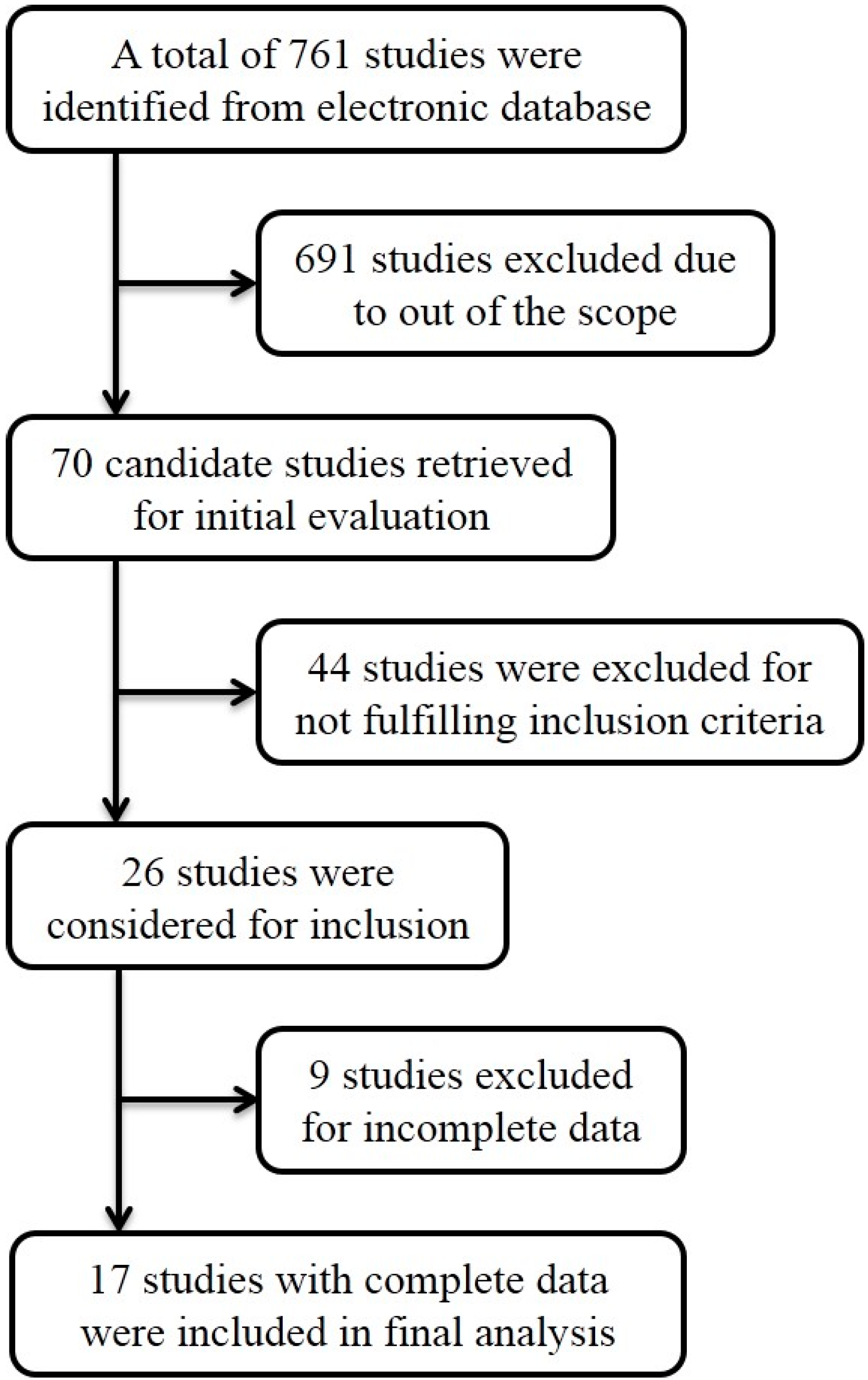
2.2. Association of Twist-1 with Prognosis
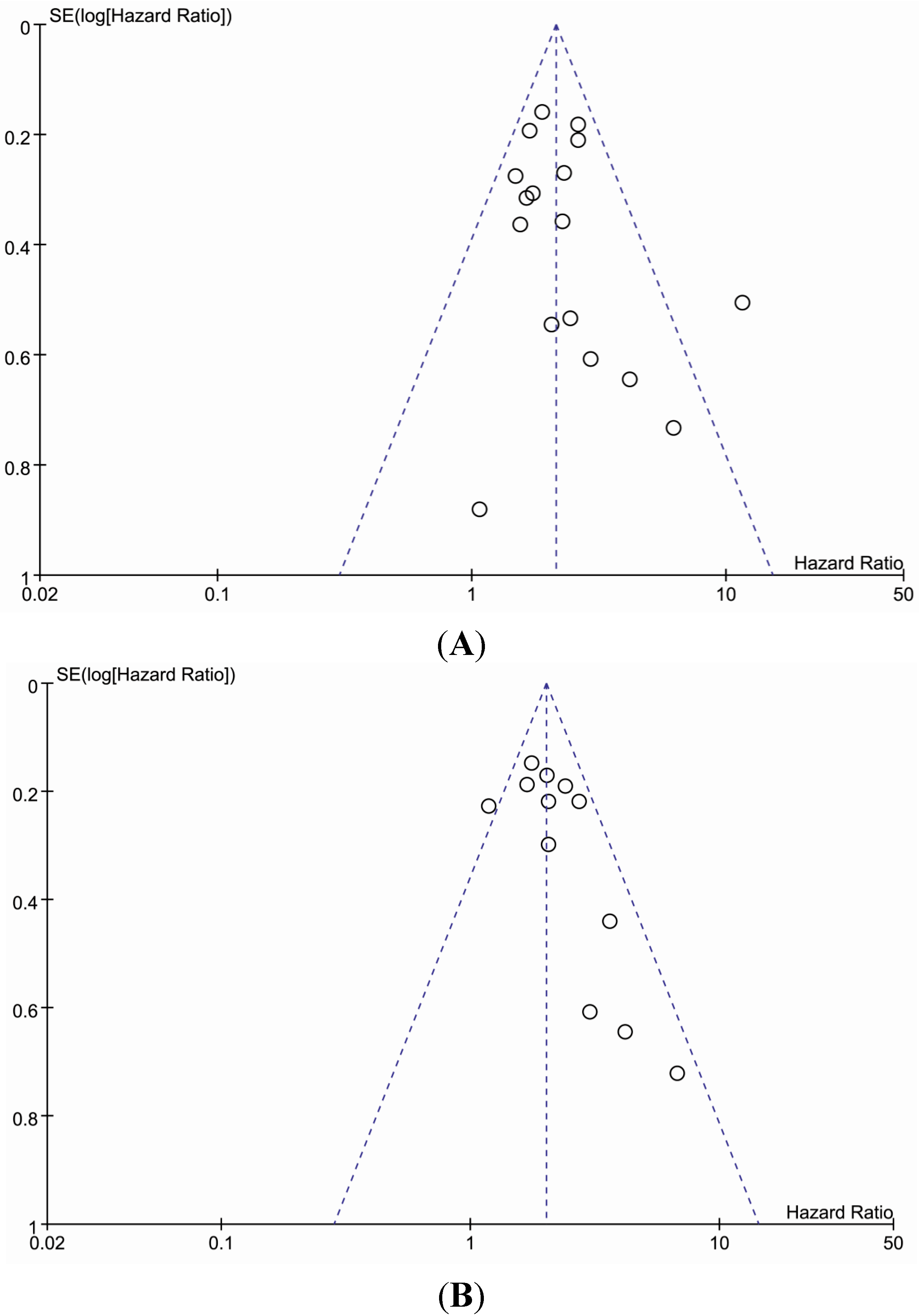
| Studies for 3-Year Overall Survival | Weight (%) | HR 95% CI (Fixed Model ) | Year |
|---|---|---|---|
| Song LB et al. [8] | 3.8% | 1.05 (0.52–2.14) | 2006 |
| Kyo S et al. [7] | 1.4% | 2.95 (0.90–9.67) | 2006 |
| Hosono S et al. [2] | 5.0% | 1.65 (0.89–3.07) | 2007 |
| Niu RF et al. [9] | 5.3% | 1.74 (0.95–3.18) | 2007 |
| Sakaki K et al. [12] | 19.8% | 1.88 (1.38–2.57) | 2009 |
| Fondrevelle ME et al. [10] | 0.9% | 6.22 (1.48–26.18) | 2009 |
| Hung JJ et al. [11] | 3.9% | 2.28 (1.13–4.60) | 2009 |
| Jouppila-matto A et al. [15] | 13.3% | 1.69 (1.15–2.47) | 2011 |
| Soini Y et al. [17] | 2.0% | 11.56 (4.30–31.08) | 2011 |
| Lee KW et al. [16] | 14.9% | 1.87 (1.31–2.68) | 2011 |
| Pallier K et al. [18] | 1.2% | 4.19 (1.18–14.86) | 2012 |
| Zhao XL et al. [13] | 6.8% | 2.29 (1.35–3.91) | 2012 |
| Yin K et al. [20] | 1.7% | 2.04 (0.70–5.95) | 2012 |
| Wushou A et al. [19] | 0.6% | 1.08 (0.19–6.07) | 2012 |
| Jiang W et al. [14] | 1.7% | 2.45 (0.86–7.00) | 2012 |
| Zhao M et al. [22] | 6.5% | 1.49 (0.86–2.56) | 2013 |
| Hui L et al. [21] | 11.2% | 2.62 (1.73–3.96) | 2013 |
| Total (95% CI) | 100.0% | 2.13 (1.86–2.45) | |
| Heterogeneity: Chi2 = 24.75, df = 16 (p = 0.07); I2 = 35%; Test for overall effect: Z = 9.78 (p < 0.00001) | |||
| Studies for 5-Year Overall Survival | Weight (%) | HR 95% CI (Fixed Model ) | Year |
| Kyo S et al. [7] | 1.2% | 3.00 (0.91–9.85) | 2006 |
| Hosono S et al. [2] | 5.1% | 2.05 (1.14–3.69) | 2007 |
| Fondrevelle ME et al. [10] | 0.9% | 6.80 (1.65–27.97) | 2009 |
| Sakaki K et al. [12] | 20.4% | 1.57 (1.17–2.10) | 2009 |
| Jouppila-matto A et al. [15] | 12.8% | 1.70 (1.17–2.46) | 2011 |
| Lee KW et al. [16] | 15.5% | 2.02 (1.44–2.52) | 2011 |
| Soini Y et al. [17] | 9.4% | 2.73 (4.30–31.08) | 2011 |
| Pallier K et al. [18] | 1.1% | 4.19 (1.18–14.79) | 2012 |
| Yin K et al. [20] | 2.4% | 3.60 (1.52–8.53) | 2012 |
| Zhao XL et al. [13] | 9.5% | 2.06 (1.34–3.17) | 2012 |
| Zhao M et al. [22] | 8.8% | 1.19 (0.76–1.85) | 2013 |
| Hui L et al. [21] | 12.7% | 2.42 (1.67–3.51) | 2013 |
| Total (95% CI) | 100.0% | 2.01 (1.76–2.29) | |
| Heterogeneity: Chi2 = 18.00, df = 11 (p = 0.08); I2 = 39%; Test for overall effect: Z = 9.94 (p < 0.00001) | |||
| Cancer Type | Heterogeneity | Pooled HR (95% CI) | p-Value | Reference |
|---|---|---|---|---|
| Breast cancer | 3-year OS: I2 = 92%, p = 0.0004 | 2.39 (1.49–3.85) | p < 0.001 | [17,22] |
| 5-year OS: I2 = 94%, p < 0.00001 | 2.34 (1.72–3.20) | p < 0.001 | ||
| Lung cancer | 3-year OS: I2 = 0%, p = 0.87 | 2.60 (1.18–3.61) | p < 0.0001 | [11,14,18,21] |
| 5-year OS: I2 = 0%, p = 0.41 | 2.52 (1.77–3.61) | p < 0.0001 | ||
| Liver cancer | 3-year OS: I2 = 0%, p = 0.50 | 2.03 (1.36–3.03) | p = 0.0005 | [9,13] |
| Head and neck cancer | 3-year OS: I2 = 0%, p = 0.48 | 1.50 (1.08–2.08) | p = 0.02 | [8,15,19] |
| Esophagus cancer | 3-year OS: I2 = 46%, p = 0.17 | 2.17 (1.72–2.75) | p < 0.00001 | [12,16] |
| 3-year OS: I2 = 75%, p = 0.05 | 2.09 (1.67–2.61) | p < 0.00001 |
2.3. Discussion
3. Experimental Section
3.1. Identification and Selection of Studies
3.2. Data Collections and Analysis
3.3. Statistical Analysis
4. Conclusions
Acknowledgments
Author Contributions
Conflicts of Interest
References
- Jemal, A.; Bray, F.; Center, M.M.; Ferlay, J.; Ward, E.; Forman, D. Global cancer statistics. CA Cancer J. Clin. 2011, 61, 69–90. [Google Scholar]
- Hosono, S.; Kajiyama, H.; Terauchi, M.; Shibata, K.; Ino, K.; Nawa, A.; Kikkawa, F. Expression of Twist increases the risk for recurrence and for poor survival in epithelial ovarian carcinoma patients. Br. J. Cancer 2007, 96, 314–320. [Google Scholar]
- Chiang, S.C.; Han, C.L.; Yu, K.H.; Chen, Y.J.; Wu, K.P. Prioritization of cancer marker candidates based on the immunohistochemistry staining images deposited in the human protein atlas. PLoS One 2013, 8, e81079. [Google Scholar]
- Li, L.; Cserjesi, P.; Olson, E.N. Dermo-1: A novel twist-related bHLH protein expressed in the developing dermis. Dev. Biol. 1995, 172, 280–292. [Google Scholar]
- Rosivatz, E.; Becker, I.; Specht, K.; Fricke, E.; Luber, B.; Busch, R.; Höfler, H.; Becker, K.-F. Differential expression of the epithelial-mesenchymal transition regulators snail, SIP1, and twist in gastric cancer. Am. J. Pathol. 2002, 161, 1881–1891. [Google Scholar]
- Parmar, M.K.; Torri, V.; Stewart, L. Extracting summary statistics to perform meta-analyses of the published literature for survival endpoints. Stat. Med. 1998, 17, 2815–2834. [Google Scholar]
- Kyo, S.; Sakaguchi, J.; Ohno, S.; Mizumoto, Y.; Maida, Y.; Hashimoto, M.; Nakamura, M.; Takakura, M.; Nakajima, M.; Masutomi, K. High Twist expression is involved in infiltrative endometrial cancer and affects patient survival. Hum. Pathol. 2006, 37, 431–438. [Google Scholar]
- Song, L.-B.; Liao, W.-T.; Mai, H.-Q.; Zhang, H.-Z.; Zhang, L.; Li, M.-Z.; Hou, J.-H.; Fu, L.-W.; Huang, W.-L.; Zeng, Y.-X. The clinical significance of twist expression in nasopharyngeal carcinoma. Cancer Lett. 2006, 242, 258–265. [Google Scholar]
- Niu, R.; Zhang, L.; Xi, G.; Wei, X.; Yang, Y.; Shi, Y.; Hao, X. Up-regulation of Twist induces angiogenesis and correlates with metastasis in hepatocellular carcinoma. J. Exp. Clin. Cancer Res. 2007, 26, 385–394. [Google Scholar]
- Fondrevelle, M.E.; Kantelip, B.; Reiter, R.E.; Chopin, D.K.; Thiery, J.P.; Monnien, F.; Bittard, H.; Wallerand, H. The expression of Twist has an impact on survival in human bladder cancer and is influenced by the smoking status. Urol. Oncol. Semin. Orig. Investig. 2009, 27, 268–276. [Google Scholar]
- Hung, J.J.; Yang, M.H.; Hsu, H.S.; Hsu, W.H.; Liu, J.S.; Wu, K.J. Prognostic significance of hypoxia-inducible factor-1α, TWIST1 and Snail expression in resectable non-small cell lung cancer. Thorax 2009, 64, 1082–1089. [Google Scholar]
- Ken, S.; Shoji, N.; Sumiya, I.; Masataka, M. Significance of Twist expression and its association with E-cadherin in esophageal squamous cell carcinoma. J. Exp. Clin. Cancer Res. 2009, 21, 158. [Google Scholar] [CrossRef]
- Zhao, X.L.; Sun, T.; Che, N.; Sun, D.; Zhao, N.; Dong, X.Y.; Gu, Q.; Yao, Z.; Sun, B.C. Promotion of hepatocellular carcinoma metastasis through matrix metalloproteinase activation by epithelial-mesenchymal transition regulator Twist1. J. Cell. Mol. Med. 2011, 15, 691–700. [Google Scholar]
- Jiang, W.; Pang, X.-G.; Wang, Q.; Shen, Y.-X.; Chen, X.-K.; Xi, J.-J. Prognostic role of Twist, Slug, and Foxc2 expression in stage I non-small-cell lung cancer after curative resection. Clin. Lung Cancer 2012, 13, 280–287. [Google Scholar]
- Jouppila-Mättö, A.; Närkiö-Mäkelä, M.; Soini, Y.; Pukkila, M.; Sironen, R.; Tuhkanen, H.; Mannermaa, A.; Kosma, V.-M. Twist and snai1 expression in pharyngeal squamous cell carcinoma stroma is related to cancer progression. BMC Cancer 2011, 11, 350. [Google Scholar] [CrossRef]
- Lee, K.-W.; Han, S.; Sung, C.-O.; Do, I.-G.; Ko, Y.-H.; Kim, S.-H. Twist1 is an independent prognostic factor of esophageal squamous cell carcinoma and associated with its epithelial-mesenchymal transition. Ann. Surg. Oncol. 2012, 19, 326–335. [Google Scholar]
- Soini, Y.; Tuhkanen, H.; Sironen, R.; Virtanen, I.; Kataja, V.; Auvinen, P.; Mannermaa, A.; Kosma, V.-M. Transcription factors zeb1, twist and snai1 in breast carcinoma. BMC Cancer 2011, 11, 73. [Google Scholar] [CrossRef]
- Pallier, K.; Cessot, A.; Côté, J.-F.; Just, P.-A.; Cazes, A.; Fabre, E.; Danel, C.; Riquet, M.; Devouassoux-Shisheboran, M.; Ansieau, S. Twist 1 a new determinant of epithelial to mesenchymal transition in EGFR mutated lung adenocarcinoma. PLoS One 2012, 7, e29954. [Google Scholar]
- Wushou, A.; Pan, H.-Y.; Liu, W.; Tian, Z.; Wang, L.-Z.; Shali, S.; Zhang, Z.-Y. Correlation of increased twist with lymph node metastasis in patients with oral squamous cell carcinoma. J. Oral Maxillofac. Surg. 2012, 70, 1473–1479. [Google Scholar]
- Yin, K.; Liao, Q.; He, H.; Zhong, D. Prognostic value of Twist and E-cadherin in patients with osteosarcoma. Med. Oncol. 2012, 29, 3449–3455. [Google Scholar]
- Hui, L.; Zhang, S.; Dong, X.; Tian, D.; Cui, Z.; Qiu, X. Prognostic Significance of Twist and N-Cadherin Expression in NSCLC. PLoS One 2013, 8, e62171. [Google Scholar]
- Zhao, M.; Hu, H.-G.; Huang, J.; Zou, Q.; Wang, J.; Liu, M.-Q.; Zhao, Y.; Li, G.-Z.; Xue, S.; Wu, Z.-S. Expression and correlation of Twist and gelatinases in breast cancer. Exp. Ther. Med. 2013, 6, 97–100. [Google Scholar]
- 23. Zhang, D.; Sun, B.; Zhao, X.; Ma, Y.; Ji, R.; Gu, Q.; Dong, X.; Li, J.; Liu, F.; Jia, X.; et al. Twist1 expression induced by sunitinib accelerates tumor cell vasculogenic mimicry by increasing the population of CD133+ cells in triple-negative breast cancer. Mol. Cancer 2014, 13, 207. [Google Scholar] [CrossRef]
© 2014 by the authors; licensee MDPI, Basel, Switzerland. This article is an open access article distributed under the terms and conditions of the Creative Commons Attribution license (http://creativecommons.org/licenses/by/4.0/).
Share and Cite
Wushou, A.; Hou, J.; Zhao, Y.-J.; Shao, Z.-M. Twist-1 Up-Regulation in Carcinoma Correlates to Poor Survival. Int. J. Mol. Sci. 2014, 15, 21621-21630. https://doi.org/10.3390/ijms151221621
Wushou A, Hou J, Zhao Y-J, Shao Z-M. Twist-1 Up-Regulation in Carcinoma Correlates to Poor Survival. International Journal of Molecular Sciences. 2014; 15(12):21621-21630. https://doi.org/10.3390/ijms151221621
Chicago/Turabian StyleWushou, Alimujiang, Jing Hou, Ya-Jun Zhao, and Zhi-Ming Shao. 2014. "Twist-1 Up-Regulation in Carcinoma Correlates to Poor Survival" International Journal of Molecular Sciences 15, no. 12: 21621-21630. https://doi.org/10.3390/ijms151221621
APA StyleWushou, A., Hou, J., Zhao, Y.-J., & Shao, Z.-M. (2014). Twist-1 Up-Regulation in Carcinoma Correlates to Poor Survival. International Journal of Molecular Sciences, 15(12), 21621-21630. https://doi.org/10.3390/ijms151221621

