

A Facile High-Yield Synthesis of [10 B]-8-Dihydroxyboryl Harmine, a Potential Agent for Boron Neutron Capture Therapy
Results And Discussion
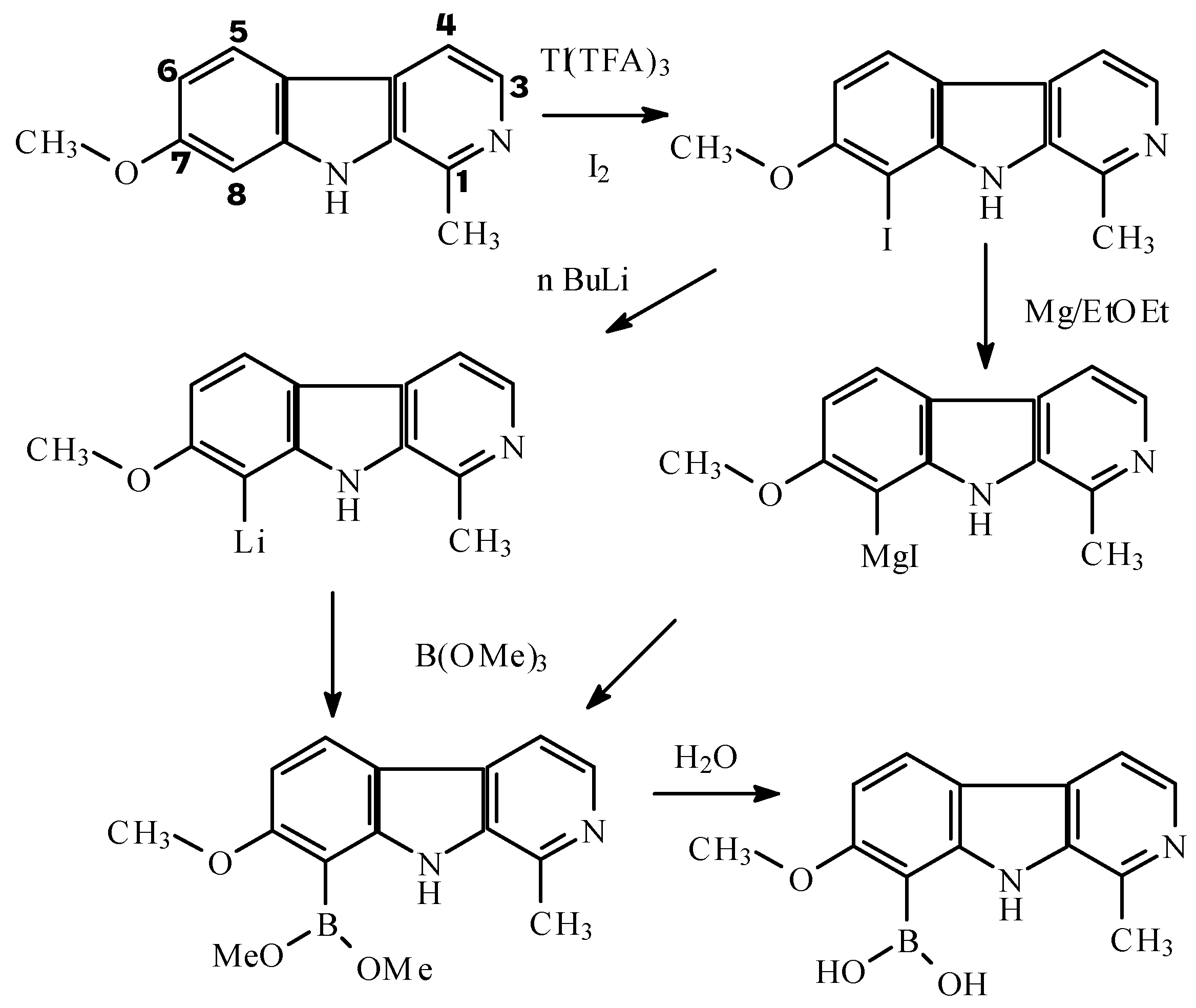
Iodination
Boronation
Summary and Conclusions
Acknowledgments
References and Notes
- Morin, C. Tetrahedron 1994, 50, 12521. [CrossRef]
- Pawlik, M.; Kaulen, P.; Baumgarten, H.G.; Rommelspacher, H. Journal of Neuroanathomy 1990, 3, 19.
- Sintas, J.A.; Vitale, A.A. J. Lab Comp. Radioparm. 1997, 39, 676.
- Sintas, J.A.; Vitale, A.A. J. Lab Comp. Radioparm. 1998, 41, 53. [CrossRef]
- McKillop, A.; Hunt, J.D.; Zelesko, M.J. J. Am. Chem Soc. 1971, 93, 4841. [CrossRef]
- Hawthorne, M.F. J. Org. Chem. 1957, 22, 1001. [CrossRef]
- Koehler, K.A.; Hess, G.P. Biochemistry 1974, 13, 5345. [CrossRef] [PubMed]
- Liao, T.K.; Prodrebarac, E.G.; Cheng, C.C. J. Am. Chem. Soc. 1964, 86, 1869. [CrossRef]
- Schinazi, R.F.; Prusoff, W.H. Tetrahedron Lett. 1978, 4981.
- Schinazi, R.F.; Prusoff, W.H. J. Org. Chem. 1985, 50, 841. [CrossRef]
- Tjarks, W.; Gabel, D.J. J. Med. Chem. 1991, 34, 315. [CrossRef] [PubMed]
- Shlesinguer, H.I.; Browz, H.C.; Mayfield, D.L. J. Am. Chem. Soc. 1953, 71, 213.
- Hall, L.W.; Odon, J.D.; Ellis, P.D. J. Am. Chem. Soc. 1975, 97, 4527. [CrossRef]
Share and Cite
Sintas, J.A.; Macareno, N.J.; Vitale, A.A. A Facile High-Yield Synthesis of [10 B]-8-Dihydroxyboryl Harmine, a Potential Agent for Boron Neutron Capture Therapy. Molecules 2000, 5, 526-528. https://doi.org/10.3390/50300526
Sintas JA, Macareno NJ, Vitale AA. A Facile High-Yield Synthesis of [10 B]-8-Dihydroxyboryl Harmine, a Potential Agent for Boron Neutron Capture Therapy. Molecules. 2000; 5(3):526-528. https://doi.org/10.3390/50300526
Chicago/Turabian StyleSintas, Jose A., Norberto J. Macareno, and Arturo A. Vitale. 2000. "A Facile High-Yield Synthesis of [10 B]-8-Dihydroxyboryl Harmine, a Potential Agent for Boron Neutron Capture Therapy" Molecules 5, no. 3: 526-528. https://doi.org/10.3390/50300526
APA StyleSintas, J. A., Macareno, N. J., & Vitale, A. A. (2000). A Facile High-Yield Synthesis of [10 B]-8-Dihydroxyboryl Harmine, a Potential Agent for Boron Neutron Capture Therapy. Molecules, 5(3), 526-528. https://doi.org/10.3390/50300526

