Boosting the Sustainable Transformation of Cornus mas L. Stones Using a Hybrid Strategy Involving Microwave-Assisted Extraction

 , ,
, ,  , , , and
Abstract
1. Introduction
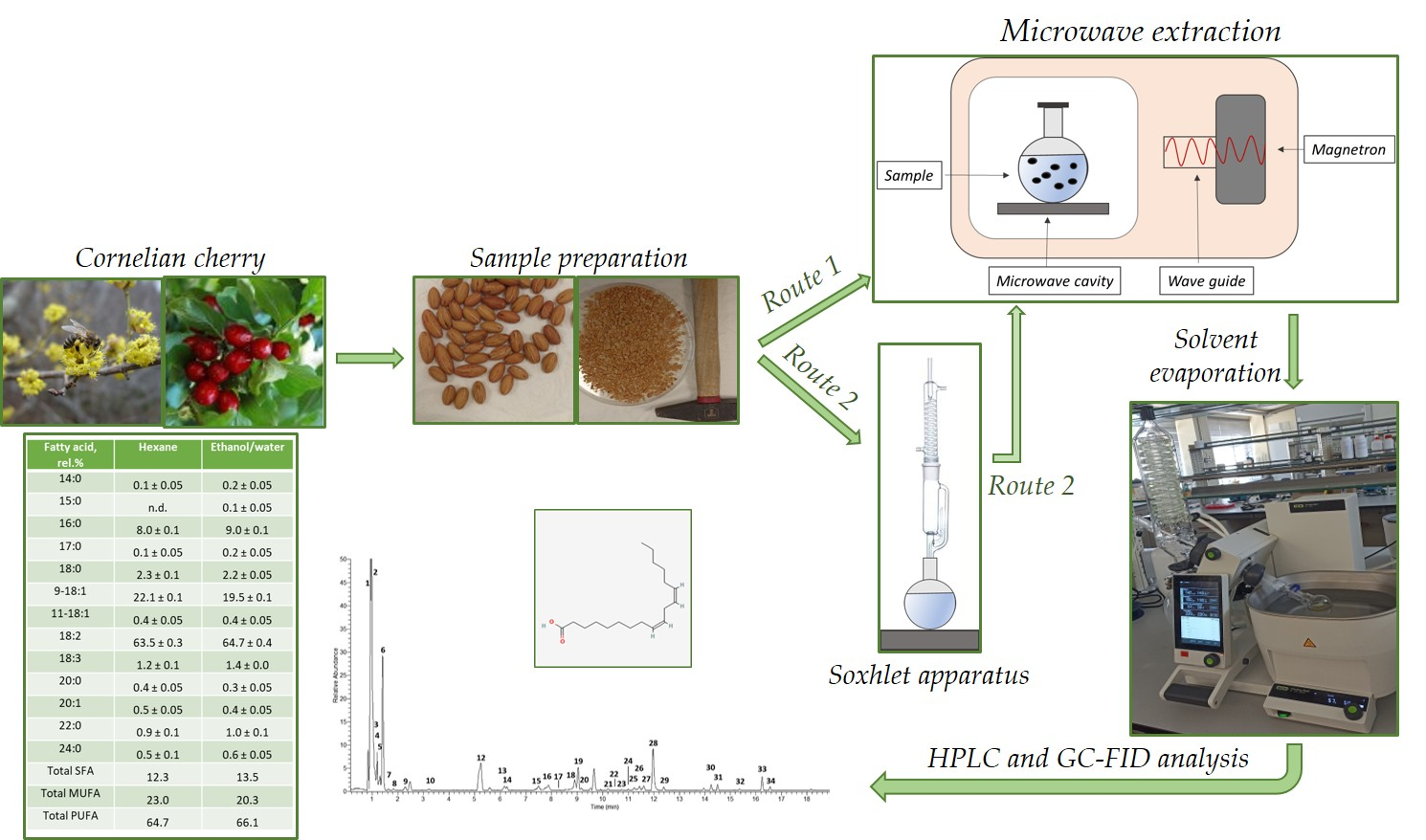
- (i)
- The total polyphenol, flavonoid, and saponin content (TPC, TFC, TSC) and antioxidant activity (AA) of all extracts obtained in Routes 1 and 2;
- (ii)
- The fatty acid composition of MAE (route 1) and Soxhlet n-hexane (route 2) extracts;
- (iii)
- The metabolite composition of MAE extracts recovered in Route 1 and Route 2.
2. Results and Discussion
2.1. Extraction of C. cherry Stones—Route 1 of the Hybrid Strategy
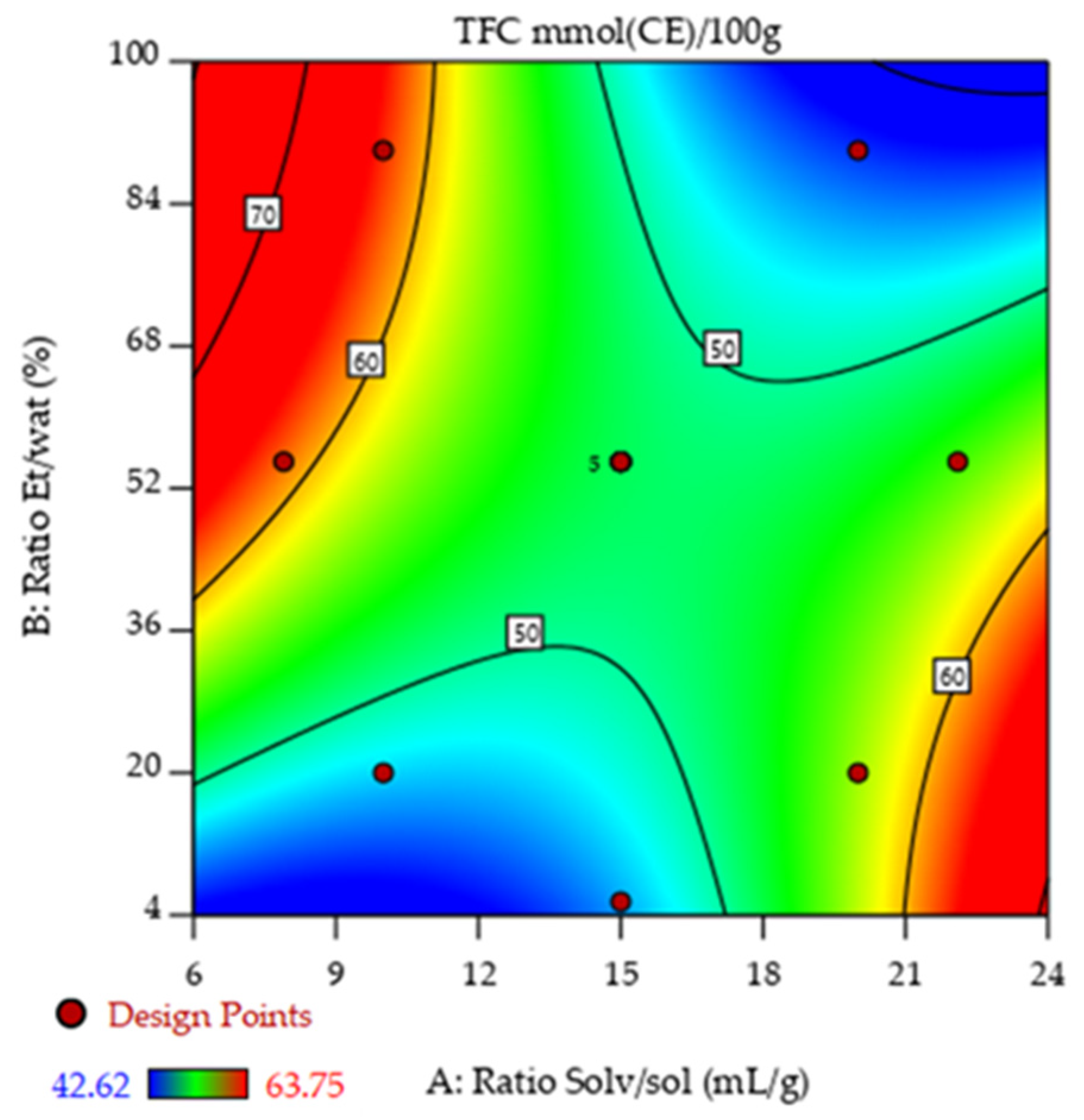
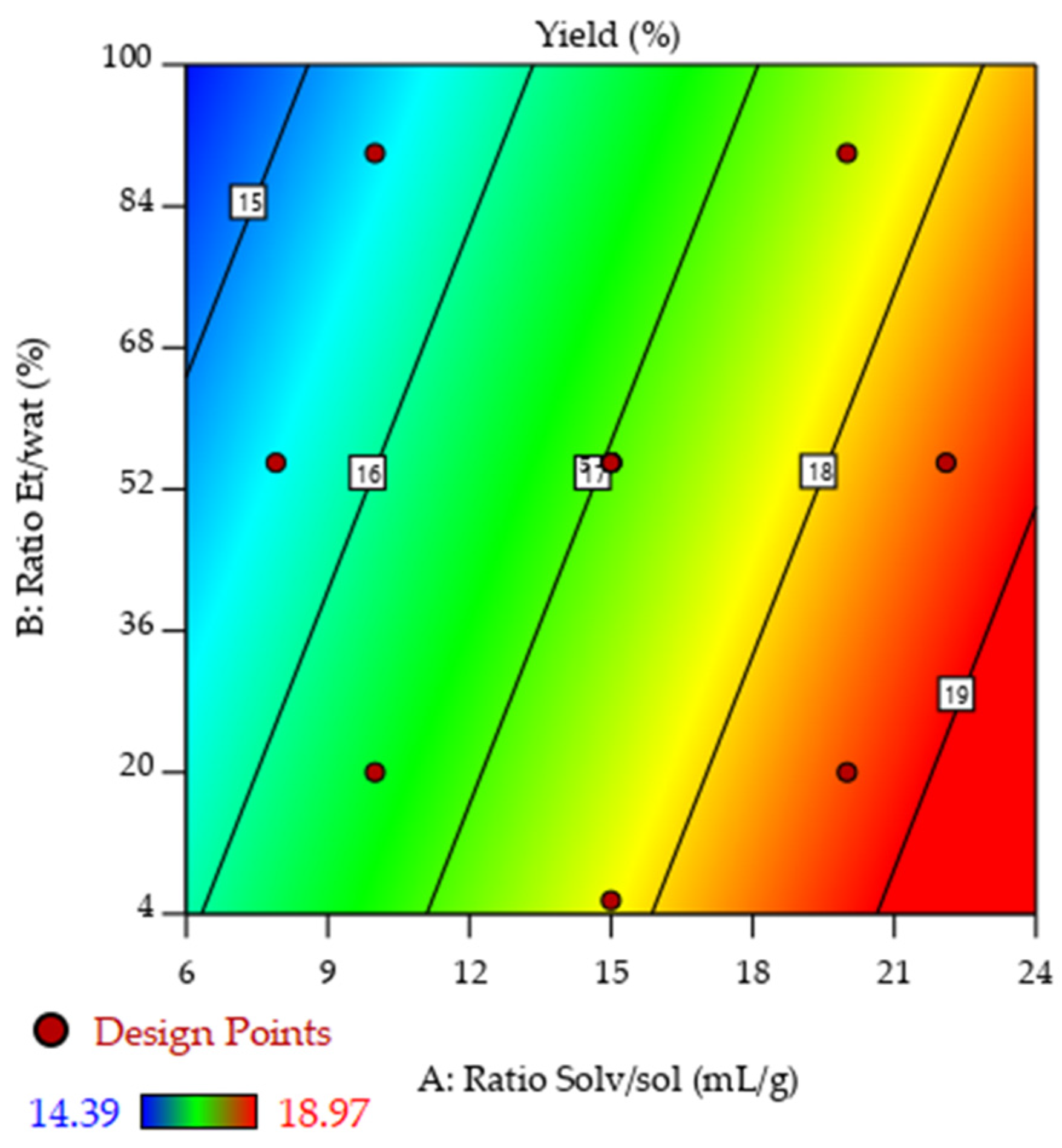
Statistical Analysis of the CCD Experimental Data
2.2. Extraction of C. cherry Stones—Route 2 of the Hybrid Strategy
2.3. Analyses of Route 1 and 2 Extracts
2.3.1. GC-FID Ananysis
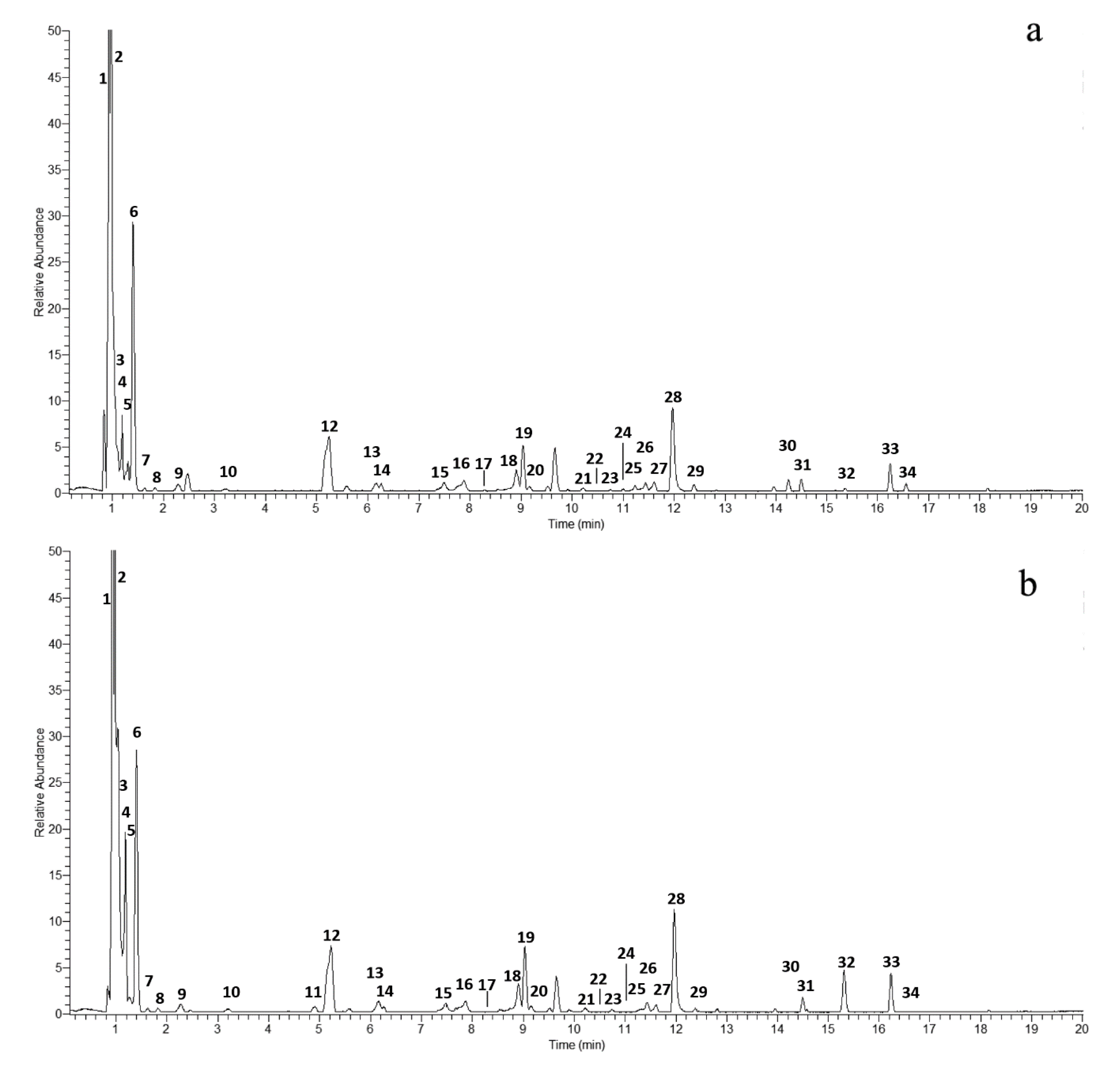
2.3.2. HPLC–HRMS/MS

| Peak | Rt (min) | Compound | Molecular Formula | MW (Da) | m/z | Ion Type | Δppm | Fragments | MAE1 | MAE2 | Ref. |
|---|---|---|---|---|---|---|---|---|---|---|---|
| 1 | 0.93 | Quinic acid * | C7H12O6 | 192.0624 | 191.0551 | [M−H]− | −5.21 | 191, 173 | + | + | |
| 2 | 0.97 | L-Malic acid * | C4H6O5 | 134.0202 | 133.0129 | [M−H]− | −10.09 | 133, 115, 71 | + | + | |
| 3 | 1.20 | L-Citric acid * | C6H8O7 | 192.0262 | 191.0189 | [M−H]− | −4.28 | 191, 111, 87 | + | + | |
| 4 | 1.20 | Mono-O-galloyl-β-d-glucose | C13H16O10 | 332.0745 | 331.0673 | [M−H]− | 0.56 | 331, 211, 169, 125 | + | + | [23] |
| 5 | 1.36 | Gemin D (1) | C27H22O18 | 634.0812 | 633.0737 | [M−H]− | 0.61 | 633, 301, 275, 169, 125 | + | + | [23] |
| 6 | 1.40 | Gallic acid * | C7H6O5 | 170.0204 | 169.0131 | [M−H]− | −6.59 | 169, 125 | + | + | |
| 7 | 1.63 | Gemin D (2) | C27H22O18 | 634.0812 | 633.0737 | [M−H]− | 0.92 | 633, 301, 275, 169, 125 | + | + | [23] |
| 8 | 1.83 | Di-O-galloyl-β-d-glucose | C20H20O14 | 484.0854 | 483.0781 | [M−H]− | 1.83 | 483, 331, 169, 125 | + | + | [23] |
| 9 | 2.28 | Camptothin A (1) | C61H46O40 | 1418.1581 | 708.0718 | [M−2H]−2 | 1.09 | 785, 765, 633, 301, 275 | + | + | [23] [38] |
| 10 | 3.21 | Camptothin A (2) | C61H46O40 | 1418.1581 | 708.0718 | [M−2H]−2 | 1.09 | 765, 633, 301, 275, 169 | + | + | [23] [38] |
| 11 | 4.70 | Methyl gallate | C8H8O5 | 184.0362 | 183.0289 | [M−H]− | −5.33 | 183, 168, 124 | - | + | [39] |
| 12 | 5.23 | Loganic acid | C16H24O10 | 376.1370 | 375.1297 | [M−H]− | 0.00 | 375, 213, 169 | + | + | [29] |
| 13 | 6.17 | Cornusiin A (1) | C68H50O44 | 1570.1695 | 784.0775 | [M−2H]−2 | 1.29 | 765, 301, 275, 169 | + | + | [23] |
| 14 | 6.26 | Tri-O-galloyl-β-D-glucose | C27H24O18 | 636.0967 | 635.0894 | [M−H]− | 0.68 | 635, 465, 313, 169, 125 | + | + | [23] |
| 15 | 7.49 | Cornusiin B (1) | C48H30O30 | 1086.0827 | 542.0341 | [M−2H]−2 | 0.50 | 1029, 765, 301, 229 | + | + | [23] |
| 16 | 7.87 | Cornusiin B (2) | C48H30O30 | 1086.0829 | 542.0342 | [M−2H]−2 | 0.67 | 765, 301, 271 | + | + | [23] |
| 17 | 8.27 | Valoneic acid dilactone | C21H10O13 | 470.0121 | 469.0048 | [M−H]− | −0.06 | 425, 301, 300 | + | + | [29] |
| 18 | 8.90 | Cornusiin A (2) | C68H50O44 | 1570.1694 | 784.0774 | [M−2H]−2 | 1.18 | 935, 785, 765, 301, 275, 169 | + | + | [23] |
| 19 | 9.03 | Loganin | C18H25O12 | 436.1581 | 435.1508 | [M+HCOO]− | 0.04 | 227, 127, 101 | + | + | [25] |
| 20 | 9.16 | Cornusiin A (3) | C68H50O44 | 1570.1698 | 784.0776 | [M−2H]−2 | 1.49 | 785, 765, 301, 275, 249, 169 | + | + | [23] |
| 21 | 10.21 | Cornusiin A (4) | C68H50O44 | 1570.1692 | 784.0773 | [M−2H]−2 | 1.10 | 935, 785, 765, 450, 301, 275, 169 | + | + | [23] |
| 22 | 10.50 | Cornusiin D or Camptothin B (1) | C75H54O48 | 1722.1797 | 860.0826 | [M−2H]−2 | 0.74 | 937, 785, 765, 301, 275, 169 | + | + | [23] |
| 23 | 10.74 | Cornusiin D or Camptothin B (2) | C75H54O48 | 1722.1806 | 860.0830 | [M−2H]−2 | 1.22 | 937, 785, 765, 301, 275, 169 | + | + | [23] |
| 24 | 10.99 | Unidentified A | C41H32O28 | 972.1084 | 485.0469 | [M−2H]−2 | 0.36 | 824, 662, 265, 169, 125 | + | traces | |
| 25 | 11.23 | Tellimagrandin II (1) | C41H30O26 | 938.1028 | 937.0964 | [M−2H]−2 | 1.60 | 838, 782, 392, 301, 169, 125 | + | + | [23] |
| 26 | 11.43 | Cornusiin A (5) | C68H50O44 | 1570.1697 | 784.0776 | [M−2H]−2 | 1.40 | 935, 785, 765, 301, 275, 249, 169 | + | + | [23] |
| 27 | 11.60 | Tellimagrandin II (2) | C41H30O26 | 938.1027 | 937.0936 | [M−2H]−2 | −1.38 | 799, 392, 301, 169, 125 | + | + | [23] |
| 28 | 11.96 | Ellagic acid * | C14H6O8 | 302.0061 | 300.9988 | [M−H]− | −0.68 | 301 | + | + | |
| 29 | 12.38 | Tetra-O-galloyl-β-d-glucose | C34H28O22 | 788.1081 | 393.0467 | [M−2H]−2 | 1.06 | 617, 317, 169, 125 | + | + | [23] |
| 30 | 14.24 | Ellagitannin derivative | C41H30O27 | 954.0977 | 476.0416 | [M−2H]−2 | 0.25 | 597, 301, 247, 169, 125 | + | traces | [40] |
| 31 | 14.50 | Penta-O-galloyl-β-d-glucose | C41H32O26 | 940.1182 | 939.1119 | [M−H]− | −1.60 | 769, 617, 447, 295, 169, 125 | + | + | [23] |
| 32 | 15.32 | Unidentified B | C40H30O26 | 926.1034 | 462.0444 | [M−2H]−2 | 0.29 | 169, 125 | + | + | |
| 33 | 16.24 | Cornuside | C24H30O14 | 542.1637 | 541.1565 | [M−H]− | 0.34 | 541, 169, 125 | + | + | [29] |
| 34 | 16.56 | Unidentified C | C41H34O26 | 942.1344 | 470.0598 | [M−2H]−2 | 0.92 | 587, 378, 247, 169, 125 | + | + |
3. Materials and Methods
3.1. Reagents and Standards
3.2. Raw Material
3.3. Sample Preparation
3.4. Soxhlet Extraction
3.5. Microwave-Assisted Extraction
3.6. Total Polyphenol Content
3.7. Total Flavonoid Content
3.8. Total Saponin Content
3.9. Assessment of Antioxidant Activity by the DPPH Method
3.10. Assessment of Antioxidant Activity by the ABTS Method
3.11. Characterization of the Extracts
3.11.1. GC-FID
3.11.2. HPLC–HRMS/MS Analysis
4. Conclusions
Supplementary Materials
Author Contributions
Funding
Institutional Review Board Statement
Informed Consent Statement
Data Availability Statement
Acknowledgments
Conflicts of Interest
Abbreviations
| MAE | microwave-assisted extraction |
| CCD | central composite design |
| GC-FID | gas chromatography–flame ionization detection |
| HPLC–HRMS/MS | high-performance liquid chromatography–high-resolution mass spectrometry |
| FAME | fatty acid methyl ester |
| TPC | total polyphenol content |
| GAE | gallic acid equivalent |
| TFC | total flavonoid content |
| AA | antioxidant activity |
| DPPH | 2,2-diphenyl-1-picrylhydrazyl |
| ABTS | 2,2′-azino-bis(3-ethylbenzothiazoline-6-sulfonic acid |
| TE | trolox equivalent |
| TSC | total saponin content |
| AesE | aescin equivalent |
| CI | confidence interval |
| QE | quercetin equivalent |
| FRAP | ferric reducing ability of plasma |
| SFA | saturated fatty acid |
| MUFA | monounsaturated fatty acid |
| PUFA | polyunsaturated fatty acid |
| SC-CO2 | supercritical CO2 |
| UPLC-Q-TOF-MS/MS | ultra-performance liquid chromatography–quadrupole time-of-flight mass spectrometry |
| HESI | heated electrospray ionization |
Appendix A
| Yield (%) | TFC (mmol CE/100g) | TSC (mmol AesE/100g) | ||||||||||
|---|---|---|---|---|---|---|---|---|---|---|---|---|
| Source | SS a | MS b | F-Value | p-Value | SS a | MS b | F-Value | p-Value | SS a | MS b | F-Value | p-Value |
| Model | 11.14 | 5.57 | 4.73 | 0.0358 | 382-38 | 76.48 | 4.07 | 0.0473 | 11.21 | 2.24 | 5.60 | 0.0215 |
| A-Ratio (Solv/sol) | 8.83 | 8.83 | 7.50 | 0.0209 | 50.25 | 4.01 | 2.67 | 0.1460 | 0.3006 | 0.3006 | 0.7508 | 0.4149 |
| B-Ratio (Eth/water) | 2.31 | 2.31 | 1.96 | 0.1918 | 4.01 | 4.01 | 0.2135 | 0.6580 | 0.0076 | 0.0076 | 0.0190 | 08944 |
| AB | 206.64 | 206.64 | 11.00 | 0.0128 | 2.45 | 2.45 | 6.12 | 0.0426 | ||||
| A2 | 74.66 | 74.66 | 3.97 | 0.0865 | 5.74 | 5.74 | 14.35 | 0.0068 | ||||
| B2 | 31.78 | 31.78 | 1.69 | 0.2346 | 3.80 | 3.80 | 9.50 | 0.0178 | ||||
| Residual | 11.77 | 1.18 | 131.55 | 18.79 | 2.80 | 0.4003 | ||||||
| Lack of Fit | 6.97 | 1.16 | 1.79 | 0.9684 | 12.23 | 4.41 | 0.1491 | 0.9251 | 1.55 | 0.5150 | 1.64 | 0.3151 |
| Pure Error | 4.80 | 1.20 | 118.32 | 29.58 | 1.26 | 0.3143 | ||||||
| Cor Total | 22.91 | 513.94 | 14.02 | |||||||||
References
- Eyde, R.H. Comprehending Cornus: Puzzles and Progress in the Systematics of the Dogwoods. Bot. Rev. 1988, 54, 233–351. [Google Scholar] [CrossRef]
- Jaćimović, V.; Božović, D.; Ercisli, S.; Bosančić, B.; Necas, T. Sustainable Cornelian Cherry Production in Montenegro: Importance of Local Genetic Resources. Sustainability 2020, 12, 8651. [Google Scholar] [CrossRef]
- Bijelić, S.; Gološin, B.; Todorović, J.N.; Cerović, S. Morphological Characteristics of Best Cornelian Cherry (Cornus mas L.) Genotypes Selected in Serbia. Genet. Resour. Crop Evol. 2011, 58, 689–695. [Google Scholar] [CrossRef]
- Da Ronch, F.; Caudullo, G.; de Rigo, T.H.D.D. Cornus mas in Europe: Distribution, Habitat, Usage and Threats. In European Atlas of Forest Tree Species; Publication Office of the European Union: Luxembourg, 2016. [Google Scholar]
- Karadeniz, T. The Investigations On Pomological Characteristics of Cornelian Cherry (Cornus mas L.) Grown in Ordu. Int. J. Anatolia Agric. Eng. 2019, 2, 1–5. [Google Scholar]
- Szot, I.; Łysiak, G.P. Effect of the Climatic Conditions in Central Europe on the Growth and Yield of Cornelian Cherry Cultivars. Agriculture 2022, 12, 1295. [Google Scholar] [CrossRef]
- Tsolov, T. Large-Fruit Cornelian Cherry; Hristo G. Danov: Plovdiv, Bulgaria, 1983. [Google Scholar]
- Dinda, B.; Kyriakopoulos, A.M.; Dinda, S.; Zoumpourlis, V.; Thomaidis, N.S.; Velegraki, A.; Markopoulos, C.; Dinda, M. Cornus mas L. (Cornelian Cherry), an Important European and Asian Traditional Food and Medicine: Ethnomedicine, Phytochemistry and Pharmacology for Its Commercial Utilization in Drug Industry. J. Ethnopharmacol. 2016, 193, 670–690. [Google Scholar] [CrossRef]
- Novruzov, E.N.; Mustafayeva, L.A.; Zeynalli, A.Z. Comparative Study of the Chemical Composition and Antioxidant Properties of Extracts of Various Cornel (Cornus mas L.). Plant Fungal Res. 2019, 2, 41–48. [Google Scholar] [CrossRef]
- Çevik, K.C.; Akça, K.T.; Suntar, İ. Cornelian Cherry (Cornus mas L.): Insight into Its Phytochemistry and Bioactivity. J. Res. Pharm. 2022, 26, 1493–1512. [Google Scholar] [CrossRef]
- Pantelidis, G.; Vasilakakis, M.; Manganaris, G.; Diamantidis, G. Antioxidant Capacity, Phenol, Anthocyanin and Ascorbic Acid Contents in Raspberries, Blackberries, Red Currants, Gooseberries and Cornelian Cherries. Food Chem. 2007, 102, 777–783. [Google Scholar] [CrossRef]
- Lidiková, J.; Čeryová, N.; Grygorieva, O.; Bobková, A.; Bobko, M.; Árvay, J.; Šnirc, M.; Brindza, J.; Ňorbová, M.; Harangozo, Ľ.; et al. Cornelian Cherry (Cornus mas L.) as a Promising Source of Antioxidant Phenolic Substances and Minerals. Eur. Food Res. Technol. 2024, 250, 1745–1754. [Google Scholar] [CrossRef]
- Sevindik, M.; Khassanov, V.T.; Sevindik, E.; Uysal, I.; Mohammed, F.S. Cornelian Cherry (Cornus mas L.): A Comprehensive Review on Its Usage Areas, Biological Activities, Mineral, Phenolic and Chemical Contents and Applications. Appl. Fruit Sci. 2024, 66, 2061–2071. [Google Scholar] [CrossRef]
- Tenuta, M.C.; Deguin, B.; Loizzo, M.R.; Cuyamendous, C.; Bonesi, M.; Sicari, V.; Trabalzini, L.; Mitaine-Offer, A.-C.; Xiao, J.; Tundis, R. An Overview of Traditional Uses, Phytochemical Compositions and Biological Activities of Edible Fruits of European and Asian Cornus Species. Foods 2022, 11, 1240. [Google Scholar] [CrossRef] [PubMed]
- Szot, I.; Łysiak, G.P.; Sosnowska, B.; Chojdak-Łukasiewicz, J. Health-Promoting Properties of Anthocyanins from Cornelian Cherry (Cornus mas L.) Fruits. Molecules 2024, 29, 449. [Google Scholar] [CrossRef] [PubMed]
- Badoni, S.; Rawat, D.; Mahato, A.K.; Jangwan, N.S.; Ashraf, G.M.; Alexiou, A.; Tayeb, H.O.; Alghamdi, B.S.; Papadakis, M.; Singh, M.F. Therapeutic Potential of Cornus Genus: Navigating Phytochemistry, Pharmacology, Clinical Studies, and Advanced Delivery Approaches. Chem. Biodivers. 2024, 21, e202301888. [Google Scholar] [CrossRef]
- Neculicioiu, V.S.; Colosi, I.; Sevastre-Berghian, A.; Toc, D.A.; Colosi, H.A.; David, L.; Muntean, M.; Moldovan, R.; Vlase, A.-M.; Toma, V.A.; et al. Molecular Effects of Cornelian Cherry Fruit (Cornus mas L.) Extract on Sleep Deprivation-Induced Oxidative Stress, Cytokine Dysregulation, and Behavioural Changes in Wistar Rats. Curr. Issues Mol. Biol. 2025, 47, 399. [Google Scholar] [CrossRef]
- BaSeFood “Sustainable Exploitation of Bioactive Components from Black Sea Area Traditional Foods”, Grant Agreement ID: 227118 Funded Under Specific Programme “Cooperation”: Food, Agriculture and Biotechnology of EU. Sustainable Exploitation of Bioactive Components from the Black Sea Area Traditional Foods. Available online: https://cordis.europa.eu/project/id/227118/reporting (accessed on 18 June 2024).
- Gillani, F.; Raftani Amiri, Z.; Esmaeilzadeh Kenari, R. Assay of Antioxidant Activity and Bioactive Compounds of Cornelian Cherry (Cornus mas L.) Fruit Extracts Obtained by Green Extraction Methods: Ultrasound-Assisted, Supercritical Fluid, and Subcritical Water Extraction. Pharm. Chem. J. 2022, 56, 692–699. [Google Scholar] [CrossRef]
- Juranović Cindrić, I.; Zeiner, M.; Krpetić, M.; Stingeder, G. ICP-AES Determination of Minor and Major Elements in Cornelian Cherry (Cornus mas L.) after Microwave Assisted Digestion. Microchem. J. 2012, 105, 72–76. [Google Scholar] [CrossRef]
- Enache, I.M.; Benito-Román, Ó.; Coman, G.; Vizireanu, C.; Stănciuc, N.; Andronoiu, D.G.; Mihalcea, L.; Sanz, M.T. Extraction Optimization and Valorization of the Cornelian Cherry Fruits Extracts: Evidence on Antioxidant Activity and Food Applications. Appl. Sci. 2021, 11, 10729. [Google Scholar] [CrossRef]
- Kucharska, A.Z.; Piórecki, N.; Sokół-Łętowska, A.; Żarowska, B. Characteristics of Chemical Composition and Antioxidant Properties of Cornelian Cherry Fruit Fermented in Brine. Zesz. Probl. Postępów Nauk Rol. 2011, 566, 125–133. [Google Scholar]
- Przybylska, D.; Kucharska, A.Z.; Cybulska, I.; Sozański, T.; Piórecki, N.; Fecka, I. Cornus mas L. Stones: A Valuable by-Product as an Ellagitannin Source with High Antioxidant Potential. Molecules 2020, 25, 4646. [Google Scholar] [CrossRef]
- Spychaj, R.; Przybylska, D.; Szachniewicz, M.; Piórecki, N.; Kucharska, A.Z. Selection of Roasting Conditions in the Valorization Process of Cornelian Cherry Stones. Molecules 2025, 30, 2900. [Google Scholar] [CrossRef]
- Przybylska, D.; Kucharska, A.Z.; Piórecki, N.; Sozański, T. The Health-Promoting Quality Attributes, Polyphenols, Iridoids and Antioxidant Activity during the Development and Ripening of Cornelian Cherry (Cornus mas L.). Antioxidants 2024, 13, 229. [Google Scholar] [CrossRef] [PubMed]
- Vidrih, R.; Čejić, Ž.; Hribar, J. Content of Certain Food Components in Flesh and Stones of the Cornelian Cherry (Cornus mas L.) Genotypes. Croat. J. Food Sci. Technol. 2012, 4, 64–70. [Google Scholar]
- Kazimierski, M.; Regula, J.; Molska, M. Cornelian Cherry (Cornus mas L.)–Characteristics, Nutritional and pro-Health Properties. Acta Sci. Pol. Technol. Aliment. 2019, 18, 5–12. [Google Scholar] [CrossRef] [PubMed]
- Krzyściak, P.; Krośniak, M.; Gąstoł, M.; Ochojska, D.; Krzyściak, W. Antimicrobial Activity of Cornelian Cherry (Cornus mas L.). Post. Fitoter. 2011, 4, 227–231. [Google Scholar]
- Spychaj, R.; Kucharska, A.Z.; Szumny, A.; Przybylska, D.; Pejcz, E.; Piórecki, N. Potential Valorization of Cornelian Cherry (Cornus mas L.) Stones: Roasting and Extraction of Bioactive and Volatile Compounds. Food Chem. 2021, 358, 129802. [Google Scholar] [CrossRef]
- Jakovljevic, M.; Moslavac, T.; Bilic, M.; Aladic, K.; Bakula, F.; Jokic, S. Supercritical CO2 Extraction of Oil from Rose Hips (Rosa canina L.) and Cornelian Cherry (Cornus mas L.) Seeds. Croat. J. Food Sci. Technol. 2018, 10, 197–205. [Google Scholar] [CrossRef]
- Akalın, M.K.; Tekin, K.; Karagöz, S. Hydrothermal Liquefaction of Cornelian Cherry Stones for Bio-Oil Production. Bioresour. Technol. 2012, 110, 682–687. [Google Scholar] [CrossRef]
- Coelho, J.; Robalo, M.; Boyadzhieva, S.; Stateva, R. Microwave-Assisted Extraction of Phenolic Compounds from Spent Coffee Grounds. Process Optimization Applying Design of Experiments. Molecules 2021, 26, 7320. [Google Scholar] [CrossRef]
- Dupak, R.; Kalafova, A.; Schneidgenova, M.; Ivanisova, E.; Brindza, J.; Capcarova, C. Antioxidant Activity and Hypoglycaemic Effect of Cornelian Cherry Stone in Diabetic Rats. J. Anim. Sci. Biotechnol. 2020, 53, 164–167. [Google Scholar]
- Kucharska, A.Z.; Szumny, A.; Sokol-Letowska, A.; Zajak, K. Fatty Acid Compositions of Seed Oils of Cornelian Cherry (Cornus mas L.). Acta Biochim. Pol. 2009, 56, 21–22. [Google Scholar]
- Antoniewska-Krzeska, A.; Ivanišová, E.; Klymenko, S.; Bieniek, A.A.; Šramková, K.F.; Brindza, J. Nutrients Content and Composition in Different Morphological Parts of Cornelian Cherry (Cornus mas L.). Agrobiodivers. Improv. Nutr. Health Life Qual. 2022, 6, 1–10. [Google Scholar] [CrossRef]
- Min, H.-J.; Lee, M.-S.; Angeles, A.A.; Kim, S.-S.; Bae, Y.-S. Gallotannins from Cercidiphyllum Japonicum Bark. Chem. Nat. Compd. 2020, 56, 139–140. [Google Scholar] [CrossRef]
- Liang, H.; Huang, Q.; Zou, L.; Wei, P.; Lu, J.; Zhang, Y. Methyl Gallate: Review of Pharmacological Activity. Pharmacol. Res. 2023, 194, 106849. [Google Scholar] [CrossRef]
- Hatano, T.; Ogawa, N.; Kira, R.; Yasuhara, T.; Okuda, T. Tannins of Cornaceous Plants. I. Cornusiins A, B and C, Dimeric Monomeric and Trimeric Hydrolyzable Tannins from Cornus Officinalis, and Orientation of Valoneoyl Group in Related Tannins. Chem. Pharm. Bull. 1989, 37, 2083–2090. [Google Scholar] [CrossRef]
- Moussouni, S.; Karakousi, C.V.; Tsatalas, P.; Lazari, D.; Kokkalou, E. Biological Studies with Phytochemical Analysis of Cornus mas Unripe Fruits. Chem. Nat. Compd. 2020, 56, 141–144. [Google Scholar] [CrossRef]
- Romani, A.; Campo, M.; Pinelli, P. HPLC/DAD/ESI-MS Analyses and Anti-Radical Activity of Hydrolyzable Tannins from Different Vegetal Species. Food Chem. 2012, 130, 214–221. [Google Scholar] [CrossRef]
- Tsvetanova, F.V.; Boyadzhieva, S.S.; Coelho, J.A.P.; Yankov, D.S.; Stateva, R.P. Sustainable Transformation of Two Algal Species of Different Genera to High-Value Chemicals and Bioproducts. Molecules 2023, 29, 156. [Google Scholar] [CrossRef]
- Bobo-García, G.; Davidov-Pardo, G.; Arroqui, C.; Vírseda, P.; Marín-Arroyo, M.R.; Navarro, M. Intra-Laboratory Validation of Microplate Methods for Total Phenolic Content and Antioxidant Activity on Polyphenolic Extracts, and Comparison with Conventional Spectrophotometric Methods. J. Sci. Food Agric. 2015, 95, 204–209. [Google Scholar] [CrossRef]
- Ranitović, A.; Šovljanski, O.; Aćimović, M.; Pezo, L.; Tomić, A.; Travičić, V.; Saveljić, A.; Cvetković, D.; Ćetković, G.; Vulić, J.; et al. Biological Potential of Alternative Kombucha Beverages Fermented on Essential Oil Distillation By-Products. Fermentation 2022, 8, 625. [Google Scholar] [CrossRef]
- Markham, K.R. Flavones, Flavonols and Their Glycosides. In Methods in Plant Biochemistry; Elsevier: Amsterdam, The Netherlands, 1989; Volume 1, pp. 197–235. ISBN 978-0-12-461011-8. [Google Scholar]
- V. Le, A.; E. Parks, S.; H. Nguyen, M.; D. Roach, P. Improving the Vanillin-Sulphuric Acid Method for Quantifying Total Saponins. Technologies 2018, 6, 84. [Google Scholar] [CrossRef]
- Momchilova, S.; Kazakova, A.; Taneva, S.; Aleksieva, K.; Mladenova, R.; Karakirova, Y.; Petkova, Z.; Kamenova-Nacheva, M.; Teneva, D.; Denev, P. Effect of Gamma Irradiation on Fat Content, Fatty Acids, Antioxidants and Oxidative Stability of Almonds, and Electron Paramagnetic Resonance (EPR) Study of Treated Nuts. Molecules 2023, 28, 1439. [Google Scholar] [CrossRef]

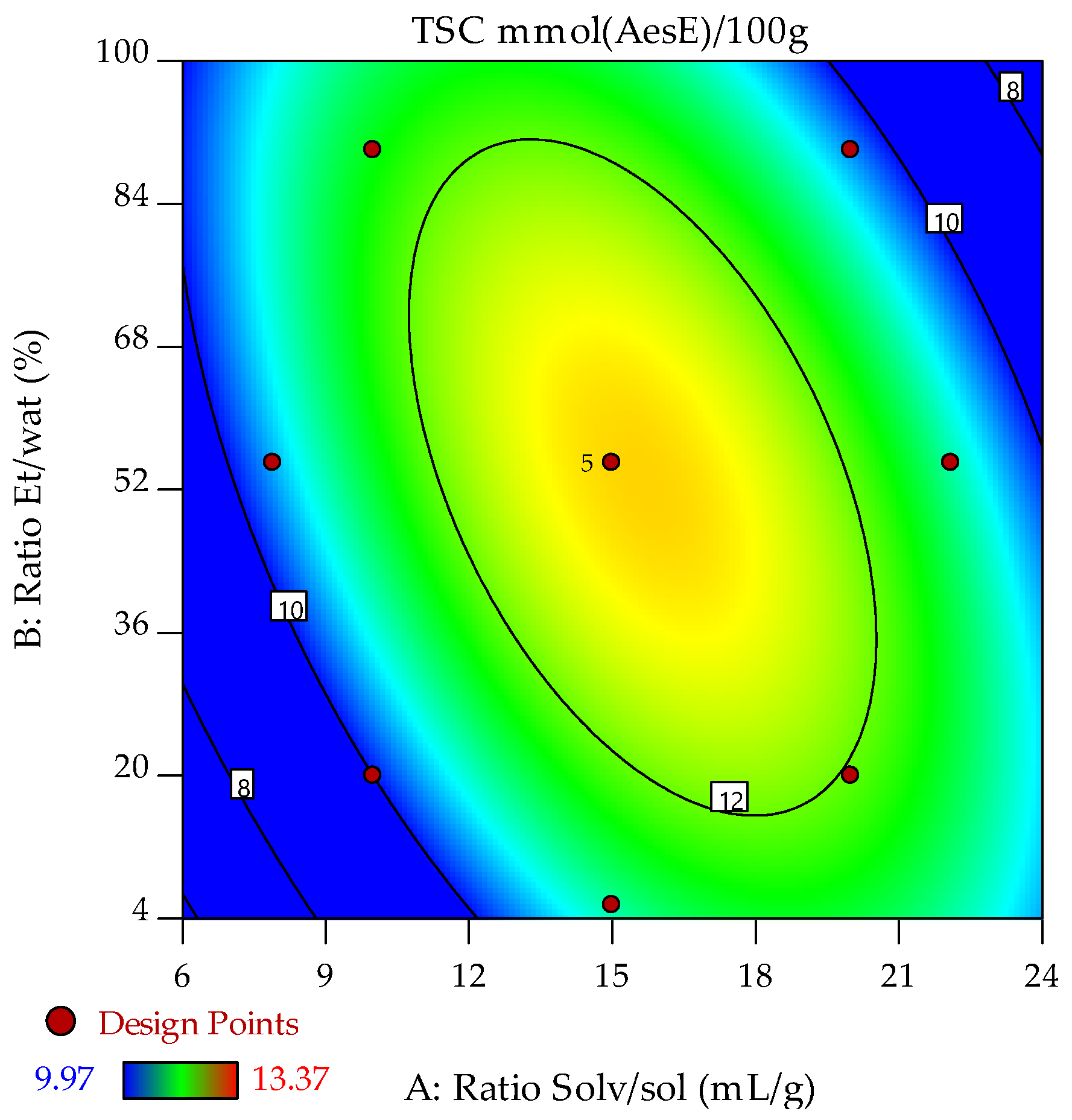
| Factor | Name | Units | Minimum | Maximum | Coded Low | Coded High |
|---|---|---|---|---|---|---|
| A | Ratio (solv/sol) | mL/g | 7.90 | 22.10 | −1 ↔ 10.00 | +1 ↔ 20.00 |
| B | Ratio (Eth/wat) | % | 5.50 | 104.50 | −1 ↔ 20.00 | +1 ↔ 90.00 |
| A-Ratio Solv/Sol | B-Ratio Eth/Wat | Yield | TPC | DPPH | ABTS | TFC | TSC |
|---|---|---|---|---|---|---|---|
| mL/g | % | % | (mmol GAE/100 g) | (mmol TE/100 g) | (mmol TE/100 g) | (mmol CE/100 g) | (mmol AesE/100 g) |
| 10 | 20 | 15.84 | 41.48 ± 1.36 | 205.76 ± 2.58 | 178.59 ± 4.89 | 45.46 ± 1.36 | 9.97 ± 0.79 |
| 20 | 20 | 17.90 | 47.01 ± 0.73 | 213.37 ± 2.17 | 205.52 ± 5.00 | 55.32 ± 4.77 | 11.68 ± 1.00 |
| 10 | 90 | 17.04 | 49.44 ± 1.55 | 215.06 ± 3.46 | 200.70 ± 2.58 | 63.75 ± 6.76 | 12.33 ± 0.46 |
| 20 | 90 | 17.17 | 42.70 ± 0.45 | 214.93 ± 2.08 | 178.403 ± 3.48 | 44.86 ± 4.08 | 10.91 ± 1.07 |
| 7.9 | 55 | 14.39 | 45.03 ± 0.29 | 204.86 ± 4.24 | 192.58 ± 3.62 | 62.06 ± 6.39 | 10.18 ± 0.16 |
| 22.1 | 55 | 18.78 | 48.48 ± 2.20 | 251.13 ± 3.67 | 231.85 ± 10.28 | 54.27 ± 1.53 | 11.07 ± 0.40 |
| 15 | 5.5 | 18.97 | 50.46 ± 3.11 | 207.99 ± 1.37 | 201.25 ± 4.19 | 48.09 ± 2.60 | 11.44 ± 0.13 |
| 15 | 100 | 15.60 | 45.96 ± 0.53 | 205.98 ± 2.41 | 189.062 ± 3.52 | 46.56 ± 2.85 | 10.49 ± 0.23 |
| 15 | 55 | 18.13 | 40.27 ± 1.64 | 205.56 ± 2.85 | 184.59 ± 6.96 | 42.62 ± 1.79 | 11.92 ± 0.80 |
| 15 | 55 | 17.76 | 46.99 ± 2.85 | 205.25 ± 2.67 | 199.07 ± 3.38 | 49.87 ± 6.12 | 12.31 ± 0.52 |
| 15 | 55 | 16.78 | 47.39 ± 1.86 | 231.04 ± 2.77 | 208.26 ± 4.41 | 55.12 ± 2.49 | 12.94 ± 0.48 |
| 15 | 55 | 17.70 | 50.56 ± 1.27 | 217.75 ± 2.54 | 214.53 ± 2.54 | 53.55 ± 2.52 | 12.73 ± 0.78 |
| 15 | 55 | 15.41 | 51.69 ± 2.59 | 219.63 ± 2.83 | 214.53 ± 5.20 | 55.92 ± 8.35 | 13.37 ± 0.68 |
| A-Ratio Solv/Sol | B-Ratio Eth/Wat | Yield | TPC | DPPH | ABTS | TFC | TSC |
|---|---|---|---|---|---|---|---|
| mL/g | % | % | (mmol GAE/100 g) | (mmol TE/100 g) | (mmol TE/100 g) | (mmol CE/100 g) | (mmol AesE/100 g) |
| 15 | 5 | 11.82 ± 0.77 | 55.58 ± 1.53 | 230.59 ± 5.12 | 316.50 ± 21.14 | 56.40 ± 3.82 | 15.16 ± 1.17 |
| 15 | 55 | 17.90 ± 1.05 | 60.31 ± 1.89 | 245.98 ± 1.92 | 330.38 ± 11.93 | 62.88 ± 3.89 | 10.30 ± 0.26 |
| 15 | 100 | 11.24 ± 0.60 | 55.20 ± 1.77 | 242.42 ± 5.70 | 320.98 ± 20.96 | 59.10 ± 5.21 | 12.74 ± 0.40 |
| Fatty Acid, Rel.% | MAE | Soxhlet n-Hexane |
|---|---|---|
| Myristic, C14:0 | 0.20 ± 0.05 | 0.10 ± 0.05 |
| Pentadecanoic, C15:0 | 0.10 ± 0.05 | n.d. |
| Palmitic, C16:0 | 9.0 ± 0.1 | 8.0 ± 0.1 |
| Margaric acid, C17:0 | 0.20 ± 0.05 | 0.10 ± 0.05 |
| Stearic acid, C18:0 | 2.20 ± 0.05 | 2.3 ± 0.1 |
| Oleic acid, C9-18:1 | 19.5 ± 0.1 | 22.1 ± 0.1 |
| Trans vaccenic acid, C11-18:1 | 0.40 ± 0.05 | 0.40 ± 0.05 |
| Linoleic acid, C18:2 | 64.7 ± 0.4 | 63.5 ± 0.3 |
| α-Linolenic acid, C18:3 | 1.4 ± 0.0 | 1.2 ± 0.1 |
| Arachidic acid, C20:0 | 0.30 ± 0.05 | 0.40 ± 0.05 |
| Eicosenoic acid, C20:1 | 0.4 0 ± 0.05 | 0.50 ± 0.05 |
| Behenic acid, C22:0 | 1.0 ± 0.1 | 0.9 ± 0.1 |
| Lignoceric acid, C24:0 | 0.60 ± 0.05 | 0.5 ± 0.1 |
| SFA | 13.5 | 12.3 |
| MUFA | 20.3 | 23.0 |
| PUFA | 66.1 | 64.7 |
| PUFA:SFA | 4.90 | 5.26 |
Disclaimer/Publisher’s Note: The statements, opinions and data contained in all publications are solely those of the individual author(s) and contributor(s) and not of MDPI and/or the editor(s). MDPI and/or the editor(s) disclaim responsibility for any injury to people or property resulting from any ideas, methods, instructions or products referred to in the content. |
© 2026 by the authors. Licensee MDPI, Basel, Switzerland. This article is an open access article distributed under the terms and conditions of the Creative Commons Attribution (CC BY) license.
Share and Cite
Boyadzhieva, S.S.; Tsvetanova, F.V.; Coelho, J.A.P.; Staleva, P.; Kamenova-Nacheva, M.; Taneva, S.; Stateva, R.P. Boosting the Sustainable Transformation of Cornus mas L. Stones Using a Hybrid Strategy Involving Microwave-Assisted Extraction. Molecules 2026, 31, 525. https://doi.org/10.3390/molecules31030525
Boyadzhieva SS, Tsvetanova FV, Coelho JAP, Staleva P, Kamenova-Nacheva M, Taneva S, Stateva RP. Boosting the Sustainable Transformation of Cornus mas L. Stones Using a Hybrid Strategy Involving Microwave-Assisted Extraction. Molecules. 2026; 31(3):525. https://doi.org/10.3390/molecules31030525
Chicago/Turabian StyleBoyadzhieva, Stanislava S., Flora V. Tsvetanova, Jose A. P. Coelho, Plamena Staleva, Mariana Kamenova-Nacheva, Sabina Taneva, and Roumiana P. Stateva. 2026. "Boosting the Sustainable Transformation of Cornus mas L. Stones Using a Hybrid Strategy Involving Microwave-Assisted Extraction" Molecules 31, no. 3: 525. https://doi.org/10.3390/molecules31030525
APA StyleBoyadzhieva, S. S., Tsvetanova, F. V., Coelho, J. A. P., Staleva, P., Kamenova-Nacheva, M., Taneva, S., & Stateva, R. P. (2026). Boosting the Sustainable Transformation of Cornus mas L. Stones Using a Hybrid Strategy Involving Microwave-Assisted Extraction. Molecules, 31(3), 525. https://doi.org/10.3390/molecules31030525