


Error in Figure
In the original publication [1], there was a mistake in Figure 7C as published. The M-T staining pictures of KRG-O 1% and 0.5% were placed in the opposite positions. The corrected Figure 7 appears below.
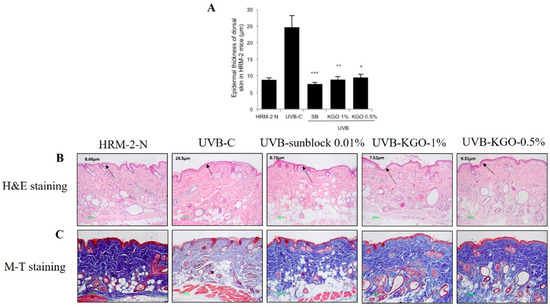
Figure 7.
Effects of KGO ointment on epithelial thickness and changes in collagen fibre in HRM-2 mice. After 5 weeks, the epithelial thickness of the skin was observed after staining with H&E (A,B). A significant reduction was found in the epidermal thickness of the KGO ointment-treated groups. Values in the bar graphs are ± SEM from three independent experiments. *** p < 0.001, ** p < 0.05, and * p < 0.01 when compared with the UVB control. (C) The intensity of M-T staining was decreased in the UVB-control group compared to the normal group, suggesting that collagen fibre degradation progressed, and wrinkle formation accelerated. However, the amount of collagen fibres in the KGO ointments (1 and 0.5%) and positive control group increased, indicating that KGO ointments reduced the amount of collagen degradation. The normal mice are abbreviated as HRM-2 N; the UVB control is abbreviated as UVB-C; sunblock is abbreviated as SB.
Conflicts of Interest
In the original publication [1], the Conflicts of Interest statements of Yi-Seong Kwak and Chae-Kyu Park were not included. The updated Conflicts of Interest should read as follows: Authors Yi-Seong Kwak and Chae-Kyu Park were employed by the company Korean Ginseng Cooperation. The remaining authors declare that the research was conducted in the absence of any commercial or financial relationships that could be construed as a potential conflict of interest.
The authors state that the scientific conclusions are unaffected. This correction was approved by the Academic Editor. The original publication has also been updated.
Reference
- Saba, E.; Kim, S.-H.; Lee, Y.Y.; Kim, H.-K.; Roh, S.-S.; Kwak, Y.-S.; Park, C.-K.; Kim, S.-D.; Rhee, M.H. Anti-Melanogenic Effects of Korean Red Ginseng Oil in an Ultraviolet B-Induced Hairless Mouse Model. Molecules 2020, 25, 4755. [Google Scholar] [CrossRef] [PubMed]
Disclaimer/Publisher’s Note: The statements, opinions and data contained in all publications are solely those of the individual author(s) and contributor(s) and not of MDPI and/or the editor(s). MDPI and/or the editor(s) disclaim responsibility for any injury to people or property resulting from any ideas, methods, instructions or products referred to in the content. |
© 2025 by the authors. Licensee MDPI, Basel, Switzerland. This article is an open access article distributed under the terms and conditions of the Creative Commons Attribution (CC BY) license (https://creativecommons.org/licenses/by/4.0/).