Selected Biochemical Properties of Medicinal Plant (Urtica dioica L.) Leaves in Relation to the Enzymatic Activity of Soils Exposed to the Impact of Road Traffic



Abstract
1. Introduction
2. Results and Discussion
2.1. Activity of Selected Soil Enzymes
2.2. Biochemical Parameters in Common Nettle Leaves
3. Materials and Methods
3.1. Soil and Plant Sampling Location
3.2. Activity of Selected Soil Enzymes
- Catalase (CATs) was determined using the Johnson and Temple method [49] with a 0.3% hydrogen peroxide solution as substrate. The remaining H2O2 was determined by titration with 0.02M KMnO4 under acidic conditions.
- Dehydrogenases (DEH) activity was determined using the Thalmann method [50] after incubating the sample with 2,3,5-triphenyltetrazolium chloride and measuring the absorbance of triphenylformazan (TPF) at 546 nm and expressed in mg TPF kg−1 24 h−1.
- Alkaline phosphatase (AlP) and acid phosphatase (AcP) activity was determined based on the detection of p-nitrophenol (pNP) released after incubation (37 °C, 1h) at pH ~6.5 for acid phosphatase and pH~11.0 for alkaline phosphatase [51].
- Protease activity was determined using the Ladda and Butler method [52], where the concentration of the amino acid tyrosine (Tyr) was determined in soil samples after incubation with sodium caseinate. Absorbance was measured with a spectrophotometer at λ = 680 nm.
- β-glucosidase (BG) activity was measured using the Eivazi and Tabatabai method [53], using p-nitrophenyl-β-D-glucopyranoside as a substrate. The concentrations of p-nitrophenol were determined by direct reading of the sample at 400 nm after alkalization with Tris/NaOH buffer (pH 10.0) and CaCl2.
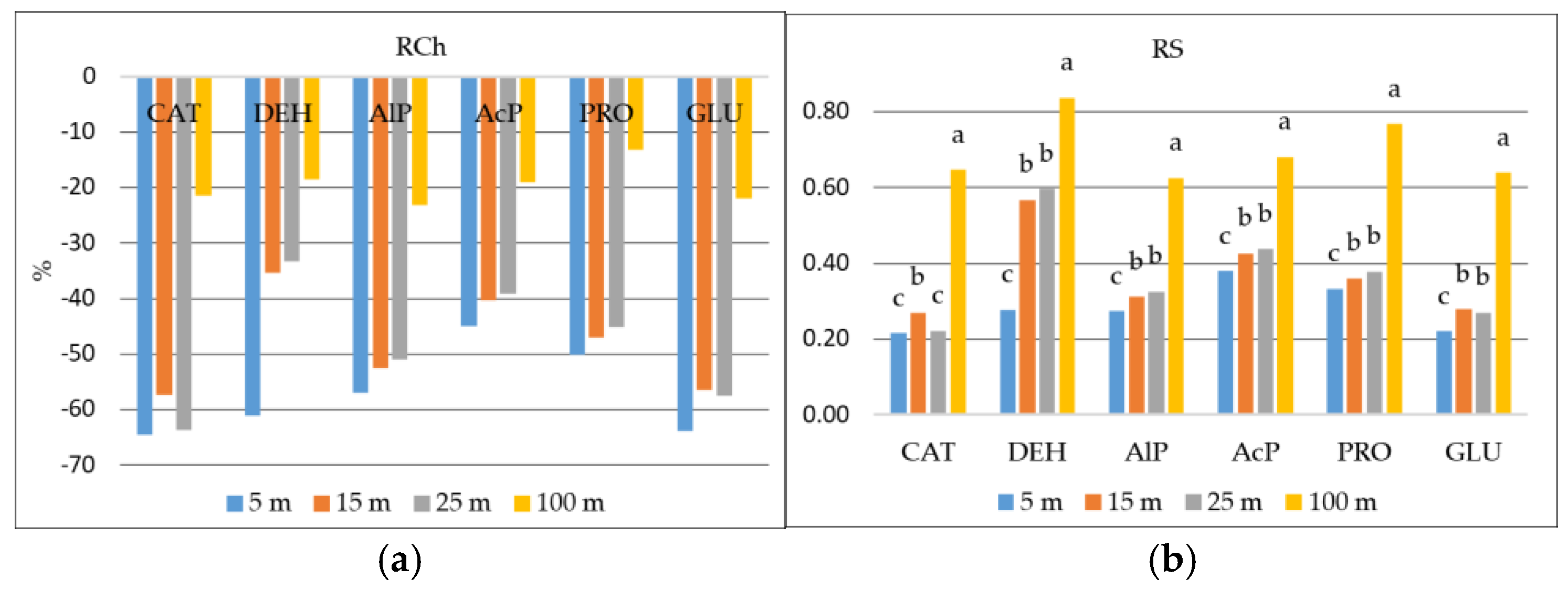
- The actual activity value was given as a relative change (RCh) in relation to the control soil (C) [21]:
- Soil resistance index (RS) is calculated using the formula proposed by Orwin and Wardle [26]:for both indicators: , —enzyme activity in the control soil; —enzyme activity in soil exposed to traffic (5 m, 15 m, 25 m and 100 m). RS is a dimensionless indicator. The RS value is expressed as a ratio of two quantities with the same units and therefore has no unit of measurement.
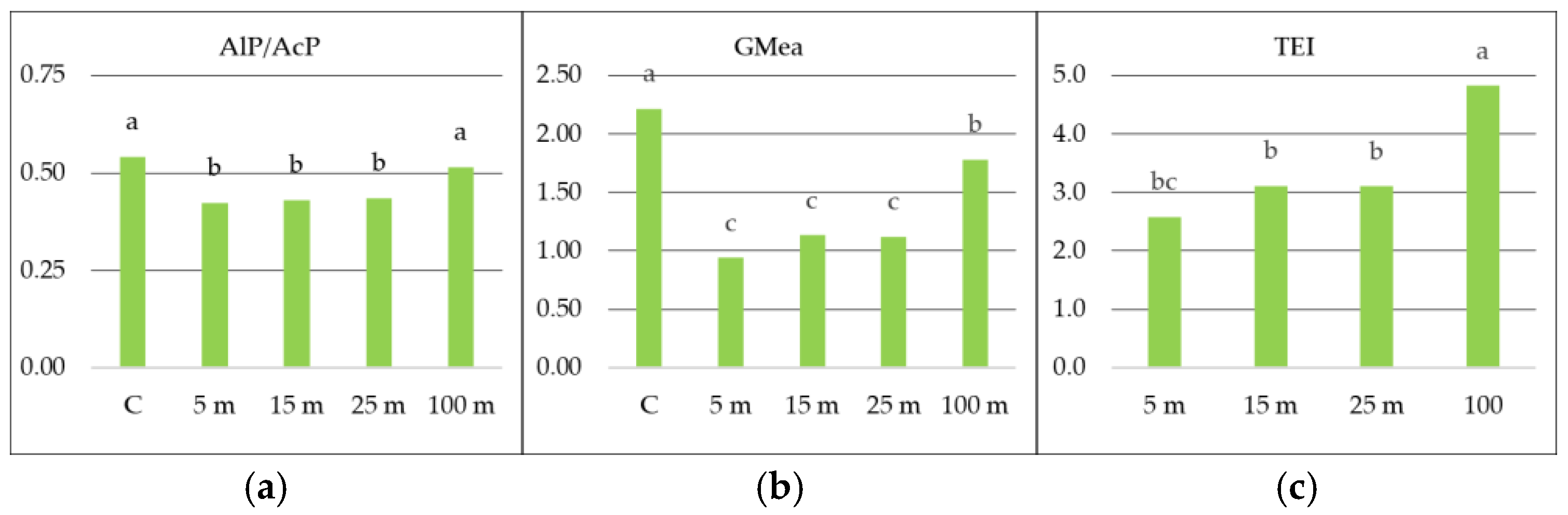
- Enzymatic pH indicator [28]:
- Geometric mean GMea [54]:
- The total activity of soil enzymes (TEI) (total enzyme activity index) was calculated as follows [31]:where Xi is the activity of soil enzyme i, and is the mean activity of enzyme i in all the samples.
3.3. Biochemical Analysis of Common Nettle Leaves
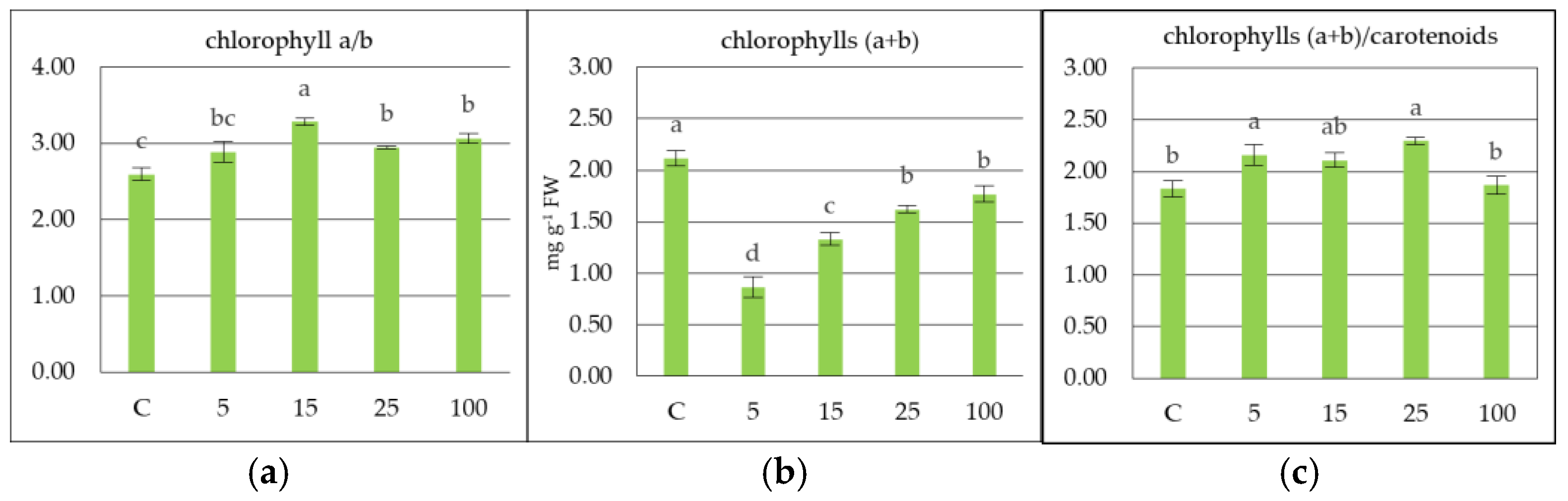
- The content of chlorophyll a (Chl a) and chlorophyll b (Chl b) and carotenoids was determined according to Lichtenthaler [55] and Lichtenthaler and Buschmann [56]. A spectrophotometer was used to measure the content of chlorophyll a, chlorophyll b, and carotenoids at wavelengths (λ max) of 645 nm, 662 nm, and 470 nm, respectively. Based on the Chl a and Chl b content, the ratio of these pigments (Chl a/b), which is an indicator of leaf health, and the total chlorophyll content (a+b) were determined. The value of the ratio Chl (a+b)/Car was also calculated.
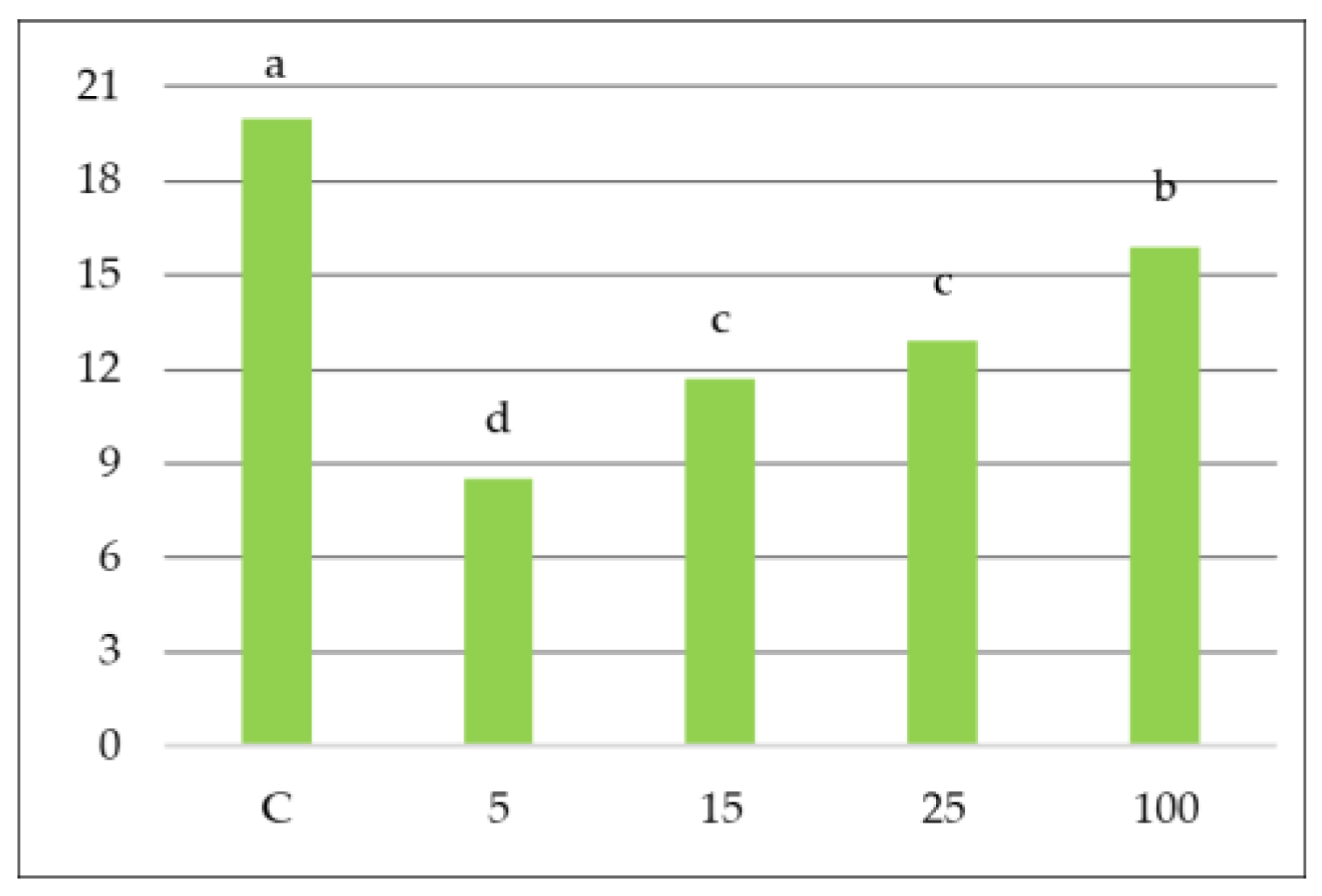
- The content of ascorbic acid (AAC) was determined by titration in an acidic medium with a standard solution until a pink color appeared [57].
- The pH of the leaves was determined potentiometrically after homogenizing 5 g of plant material in 10 mL of deionized water [39].
- Catalase activity (CATp) was determined according to the method of Kar and Mishra [58].
- Superoxide dismutase (SOD) activity was determined according to the method of Beauchamp and Fiodorovich [59], in which the measure of enzymatic activity is the ability to inhibit the photochemical reduction in tetrazolium blue. Absorbance value at a wavelength of 560 nm.
- Based on four biochemical parameters (AAC, Chl a+b, pH and RWC) in common nettle leaves, the air pollution tolerance index (APTI) was calculated according to Prajapati and Tripathi [46].where AAC is ascorbic acid, Chl a+b is total chlorophyll content, pH is leaf extract pH, and RWC is relative water content. The tolerance range of plants is as follows: <1—very sensitive; 1–16—sensitive; 17–29—moderately sensitive; 30–100—resistant to air pollution.
3.4. Statistical Analysis
4. Conclusions
Author Contributions
Funding
Institutional Review Board Statement
Informed Consent Statement
Data Availability Statement
Conflicts of Interest
References
- Devkota, H.P.; Paudel, K.R.; Khanal, S.; Baral, A.; Panth, N.; Adhikari-Devkota, A.; Jha, N.K.; Das, N.; Singh, S.K.; Chellappan, D.K.; et al. Stinging nettle (Urtica dioica L.): Nutritional composition, bioactive compounds, and food functional properties. Molecules 2022, 27, 5219. [Google Scholar] [CrossRef] [PubMed]
- Sharifi, K.; Rahnavard, A.; Saeb, K.; Gholamreza Fahimi, F.; Tavana, A. Ability of Urtica dioica L. to adsorb heavy metals (Pb, Cd, As, and Ni) from contaminated soils. Soil Sediment Contam. Int. J. 2022, 32, 51–84. [Google Scholar] [CrossRef]
- Bhusal, K.K.; Magar, S.K.; Thapa, R.; Lamsala, A.; Bhandarib, S.; Maharjan, R.; Shrestha, S.; Shrestha, J. Nutritional and pharmacological importance of stinging nettle (Urtica dioica L.): A review. Heliyon 2022, 8, e09717. [Google Scholar] [CrossRef] [PubMed]
- Lemanowicz, J.; Bartkowiak, A. Chemical and biochemical properties of common nettle (Urtica dioica L.) depending on various nitrogen fertilization doses in crop production. Sustainability 2025, 17, 6394. [Google Scholar] [CrossRef]
- Toplicean, I.-M.; Ianuș, R.-D.; Datcu, A.-D. An Overview on Nettle Studies, Compounds, Processing and the Relation with Circular Bioeconomy. Plants 2024, 13, 3529. [Google Scholar] [CrossRef]
- Grauso, L.; de Falco, B.; Lanzotti, V.; Motti, R. Stinging Nettle, Urtica dioica L.: Botanical, Phytochemical, and Pharmacological Overview. Phytochem. Rev. 2020, 19, 1341–1377. [Google Scholar] [CrossRef]
- Bartkowiak, A.; Lemanowicz, J.; Breza-Boruta, B. Evaluation of the content of Zn, Cu, Ni and Pb as well as the enzymatic activity of forest soils exposed to the effect of road traffic pollution. Environ. Sci. Pollut. Res. Int. 2017, 24, 23893–23902. [Google Scholar] [CrossRef]
- Jaworska, H.; Lemanowicz, J. Heavy metal contents and enzymatic activity in soils exposed to the impact of road traffic. Sci. Rep. 2019, 27, 19981. [Google Scholar] [CrossRef]
- Kumar, A.; Singh, H.; Kumari, G.; Bisht, S.; Malik, A.; Kumar, N.; Singh, M.; Raturi, A.; Barthwal, S.; Thakur, A.; et al. Adaptive resilience of roadside trees to vehicular emissions via leaf enzymatic, physiological, and anatomical trait modulations. Environ. Pollut. 2022, 313, 120191. [Google Scholar] [CrossRef]
- Bartkowiak, A.; Lemanowicz, J.; Rydlewska, M.; Sowiński, P. The impact of proximity to road traffic on heavy metal accumulation and enzyme activity in urban soils and dandelion. Sustainability 2024, 16, 812. [Google Scholar] [CrossRef]
- Singh, H.; Bandyopadhyay, S.; Kumar, A.; Singh, M.; Malik, A.; Kumari, G.; Raturi, A.; Yadav, S.K.; Kumar, M.; Barthwal, S.; et al. Understanding the physiological and biophysical response of urban roadside plantations for assessing adaptation and mitigation mechanisms toward vehicular emissions. Urban Clim. 2022, 44, 101183. [Google Scholar] [CrossRef]
- Lemanowicz, J.; Haddad, S.A.; Bartkowiak, A.; Lamparski, R.; Wojewódzki, P. The role of an urban park’s tree stand in shaping the enzymatic activity, glomalin content and physicochemical properties of soil. Sci. Total Environ. 2020, 741, 140446. [Google Scholar] [CrossRef] [PubMed]
- Wolińska, A.; Stępniewska, Z. Dehydrogenase Activity in the Soil Environment; InTechOpen: London, UK, 2012; pp. 183–210. [Google Scholar] [CrossRef]
- Nannipieri, P.; Giagnoni, L.; Landi, L.; Renella, G. Role of phosphatase enzymes in soil. In Phosphorus in Action; Bunemann, E.K., Obreson, A., Frossard, E., Eds.; Soil Biology Series; Springer: Berlin/Heidelberg, Germany, 2011; Volume 26, pp. 215–241. [Google Scholar] [CrossRef]
- Mushtaq, N.U.; Saleem, S.; Rasool, A.; Shah, W.H.; Tahir, I.; Hakeem, K.R.; Rehman, R.U. Functional characterization of the antioxidant enzymes in plants exposed to environmental stresses. In Antioxidant Defense in Plants; Aftab, T., Hakeem, K.R., Eds.; Springer: Singapore, 2022. [Google Scholar] [CrossRef]
- Tian, Y.; Li, H.; Li, M.; Guo, X. Physiological changes in shrub species due to different sources of dust pollution in an urban environment. Environ. Sci. Pollut. Res. 2024, 31, 64280–64294. [Google Scholar] [CrossRef]
- Biczak, R.; Pawłowska, B.; Pilis, W.; Szczegielniak, J.; Wróbel, J.; Telesiński, A. Phytotoxicity and effect of ionic liquids on antioxidant parameters in spring barley seedlings: The impact of exposure time. Processes 2020, 8, 1175. [Google Scholar] [CrossRef]
- Nagórska-Socha, A.; Kandziora-Ciupa, M.; Trzęsicki, M.; Barczyk, G. Air pollution tolerance index and heavy metal bioaccumulation in selected plant species from urban biotopes. Chemosphere 2017, 183, 471–482. [Google Scholar] [CrossRef] [PubMed]
- Enitan, I.T.; Durowoju, O.S.; Edokpayi, J.N.; Odiyo, J.O.A. Review of air pollution mitigation approach using air pollution tolerance index (APTI) and anticipated performance index (API). Atmosphere 2022, 13, 374. [Google Scholar] [CrossRef]
- Mehmood, Z.; Yang, H.-H.; Awan, M.U.F.; Ahmed, U.; Hasnain, A.; Luqman, M.; Muhammad, S.; Sardar, A.A.; Chan, T.-Y.; Sharjeel, A. Effects of air pollution on morphological, biochemical, DNA, and tolerance ability of roadside plant species. Sustainability 2024, 16, 3427. [Google Scholar] [CrossRef]
- Chaer, G.; Fernandes, M.; Myrold, D.; Bottomley, P. Comparative resistance and resilience of soil microbial communities and enzyme activities in adjacent native forest and agricultural soils. Microb. Ecol. 2009, 58, 414–424. [Google Scholar] [CrossRef]
- Hazarika, M.; Borah, G.; Singha, W.J.; Deka, H. Metals stress on soil enzyme activities and herbs defense in the vicinity of high traffic roadways. Environ. Monit. Assess. 2023, 195, 1546. [Google Scholar] [CrossRef]
- Li, T.; Meng, L.; Herman, U.; Lu, Z.; Crittenden, J. A survey of soil enzyme activities along major roads in Beijing: The implications for traffic corridor green space management. Int. J. Environ. Res. Public Health 2015, 12, 12475–12488. [Google Scholar] [CrossRef]
- Kondratowicz-Maciejewska, K.; Lemanowicz, J.; Jaskulska, I. Effects of long-term multi-treatment experiments on organic matter and enzymatic activity in sandy soil. Sustainability 2025, 17, 3252. [Google Scholar] [CrossRef]
- Wojewódzki, P.; Lemanowicz, J.; Debska, B.; Haddad, S.A.; Tobiasova, E. The application of biochar from waste biomass to improve soil fertility and soil enzyme activity and increase carbon sequestration. Energies 2023, 16, 380. [Google Scholar] [CrossRef]
- Orwin, K.H.; Wardle, D.A. New indices for quantifying the resistance and resilience of soil biota to exogenous disturbances. Soil Biol. Biochem. 2004, 36, 1907–1912. [Google Scholar] [CrossRef]
- Picariello, E.; Baldantoni, D.; Muniategui-Lorenzo, S.; Concha-Granã, E.; De Nicola, F. A synthetic quality index to evaluate the functional stability of soil microbial communities after perturbations. Ecol. Indic. 2021, 128, 107844. [Google Scholar] [CrossRef]
- Dick, W.A.; Cheng, L.; Wang, P. Soil acid alkaline phosphatase activity as pH adjustment indicators. Soil Biol. Biochem. 2000, 32, 1915–1919. [Google Scholar] [CrossRef]
- Jat, H.S.; Datta, A.; Choudhary, M.; Sharma, P.C.; Dixit, B.; Jat, M.L. Soil enzymes activity: Effect of climate smart agriculture on rhizosphere and bulk soil under cereal based systems of north-west India. Eur. J. Soil Biol. 2021, 103, 103292. [Google Scholar] [CrossRef] [PubMed]
- Jarosz, R.; Klimkowicz-Pawlas, A.; Biel, K.; Mokrzycki, J.; Musiałowski, M.; Dębiec-Andrzejewska, K.; Mierzwa-Hersztek, M. Effect of innovative mineral-organic mixtures on enzymatic activity, ecotoxicity, and microbial communities in contaminated soil. Soil Tillage Res. 2025, 253, 106655. [Google Scholar] [CrossRef]
- Tan, X.; Xie, B.; Wang, J.; He, W.; Wang, X.; Wei, G. County-scale spatial distribution of soil enzyme activities and enzyme activity indices in agricultural land: Implications for soil quality assessment. Sci. World J. 2014, 2014, 535768. [Google Scholar] [CrossRef] [PubMed]
- Yadav, A.; Dixit, A.; Singh, D. Estimation of air pollution tolerance index of plants in selected locations in Kanpur City, India. Mater. Today Proc. 2024, 102, 148–151. [Google Scholar] [CrossRef]
- Agathokleous, E.; Feng, Z.Z.; Peñuelas, J. Chlorophyll hormesis: Are chlorophylls major components of stress biology in higher plants? Sci. Total Environ. 2020, 726, 138637. [Google Scholar] [CrossRef]
- Fu, W.; Zheng, X.; Chen, X.; Wang, W.; Liu, A.; Ji, J.; Wang, G.; Guan, C. The potential roles of carotenoids in enhancing phytoremediation of bisphenol A contaminated soil by promoting plant physiology and modulating rhizobacterial community of tobacco. Chemosphere 2023, 316, 137807. [Google Scholar] [CrossRef]
- Neves, N.R.; Oliva, M.A.; da Cruz Centeno, D.; Costa, A.C.; Ribas, R.F.; Pereira, E.G. Photosynthesis and oxidative stress in the Restinga plant species Eugenia uniflora L. exposed to simulated acid rain and iron ore dust deposition: Potential use in environmental risk assessment. Sci. Total Environ. 2009, 407, 3740–3745. [Google Scholar] [CrossRef]
- Shah, K.; Amin, N.; Ahmad, I.; Ara, G. Impact assessment of leaf pigments in selected landscape plants exposed to roadside dust. Environ. Sci. Pollut. Res. 2018, 25, 23055–23073. [Google Scholar] [CrossRef]
- Döring, A.S.; Pellegrini, E.; Campanella, A.; Trivellini, A.; Gennai, C.; Petersen, M.; Nali, C.; Lorenzini, G. How sensitive is Melissa officinalis to realistic ozone concentrations? Plant Physiol. Biochem. 2014, 74, 156–164. [Google Scholar] [CrossRef]
- Sonobe, R.; Yamashita, H.; Mihara, H.; Morita, A.; Ikka, T. Estimation of leaf chlorophyll a, b and carotenoid contents and their ratios using hyperspectral reflectance. Remote Sens. 2020, 12, 3265. [Google Scholar] [CrossRef]
- Rai, P.; Panda, L.S. Dust capturing potential and air pollution tolerance index (APTI) of some road side tree vegetation in Aizawl, Mizoram, India: An Indo-Burma hot spot region air quality. Air Qual. Atmos. Health 2014, 7, 93–101. [Google Scholar] [CrossRef]
- Paulauskienne, A.; Taraseviciene, Ž.; Laukagalis, V. Influence of harvesting time on the chemical composition of wild stinging nettle (Urtica dioica L.). Plants 2021, 10, 686. [Google Scholar] [CrossRef]
- Skrynetska, I.; Karcz, J.; Barczyk, G.; Kendziora-Ciupa, M.; Ciepał, R.; Nagórska-Socha, A. Using Plantago major and Plantago lanceolata in environmental pollution research in an urban area of Southern Poland. Environ. Sci. Pollut. Res. 2019, 26, 23359–23371. [Google Scholar] [CrossRef]
- Mukhopadhyay, S.; Dutta, R.; Dhara, A. Assessment of air pollution tolerance index of Murraya paniculata (L.) Jack in Kolkata metro city, West Bengal, India. Urban Clim. 2021, 39, 100977. [Google Scholar] [CrossRef]
- Jeddi, K.; Siddique, K.H.M.; Chaieb, M.; Hessini, K. Physiological and biochemical responses of Lawsonia inermis L. to heavy metal pollution in arid environments. S. Afr. J. Bot. 2021, 143, 7–16. [Google Scholar] [CrossRef]
- Grigore, M.N.; Ivan, M.; Verdes, A.; Oprica, L. Enzymatic activity and non-enzymatic antioxidants content in several Plantago species (from Valea Ilenei nature reserve), during different phenophases. Rev. Chim. 2017, 68, 1539–1543. [Google Scholar] [CrossRef]
- Shen, Y.; Li, J.; Gu, R.; Yue, L.; Wang, H.; Zhan, X.; Xing, B. Carotenoid and superoxide dismutase are the most effective antioxidants participating in ROS scavenging in phenanthrene accumulated wheat leaf. Chemosphere 2018, 197, 513–525. [Google Scholar] [CrossRef]
- Prajapati, S.; Tripathi, B. Seasonal variation of leaf dust accumulation and pigment content in plant species exposed to urban particulates pollution. J. Environ. Qual. 2008, 37, 865–870. [Google Scholar] [CrossRef]
- Ward, J.H. Hierarchical grouping to optimize an objective function. J. Am. Stat. Ass. 1963, 58, 236–244. [Google Scholar] [CrossRef]
- PN-R-04031:1997; Protocol. Chemical and Agricultural Analysis of Soil-Sampling. Polish Committee for Standardization. Polish Standard. PKN: Warsaw, Poland, 1997.
- Johnson, J.I.; Temple, K.L. Some variables affecting the measurements of catalase activity in soil. Soil Sci. Soci. Am. 1964, 28, 207–209. [Google Scholar] [CrossRef]
- Thalmann, A. Zur methodic derestimung der Dehydrogenaseaktivität und Boden mittels Triphenyltetrazoliumchlorid (TTC). Landwirtsch. Forsch 1968, 21, 249–258. [Google Scholar]
- Tabatabai, M.A.; Bremner, J.M. Use of p–nitrophenol phosphate for assay of soil phosphatase activity. Soil Biol. Biochem. 1969, 1, 301–307. [Google Scholar] [CrossRef]
- Ladd, J.N.; Butler, J.H.A. Short-term assays of soil proteolytic enzyme activities using proteins and peptide derivates as substrates. Soil Biol. Biochem. 1972, 4, 19–30. [Google Scholar] [CrossRef]
- Eivazi, F.; Tabatabai, M.A. Glucosidases and galactosidases in soils. Soil Biol. Biochem. 1988, 20, 601–606. [Google Scholar] [CrossRef]
- Hinojosa, M.B.; Garcia-Ruiz, R.; Viñegla, B.; Carreira, J.A. Microbiological rates and enzyme activities as indicators of functionality in soils affected by the Aznalcóllar toxic spill. Soil Biol. Biochem. 2004, 36, 1637–1644. [Google Scholar] [CrossRef]
- Lichtenthaler, H.K. Chlorophylls and carotenoids: Pigments of photosynthetic biomembranes. Methods Enzymol. 1987, 148, 350–382. [Google Scholar] [CrossRef]
- Lichtenthaler, H.K.; Buschmann, C. Chlorophylls and carotenoids: Measurement and characterization by UV-VIS spectroscopy. Curr. Protoc. Food Anal. Chem. 2001, 1, F4.3.1–F4.3.8. [Google Scholar] [CrossRef]
- PN A-04019:1998; Food Products—Determination of Vitamin, C. Polish Committee for Standardization: Warsaw, Poland, 1998.
- Kar, M.; Mishra, D. Catalase, peroxidase, and polyphenoloxidase activities during rice leaf senescence. Plant Physiol. 1976, 57, 315–319. [Google Scholar] [CrossRef] [PubMed]
- Beauchamp, C.; Fridovich, I. Superoxide dismutase: Improved assays and an assay applicable to acrylamide gels. Anal Biochem. 1971, 44, 276–287. [Google Scholar] [CrossRef]
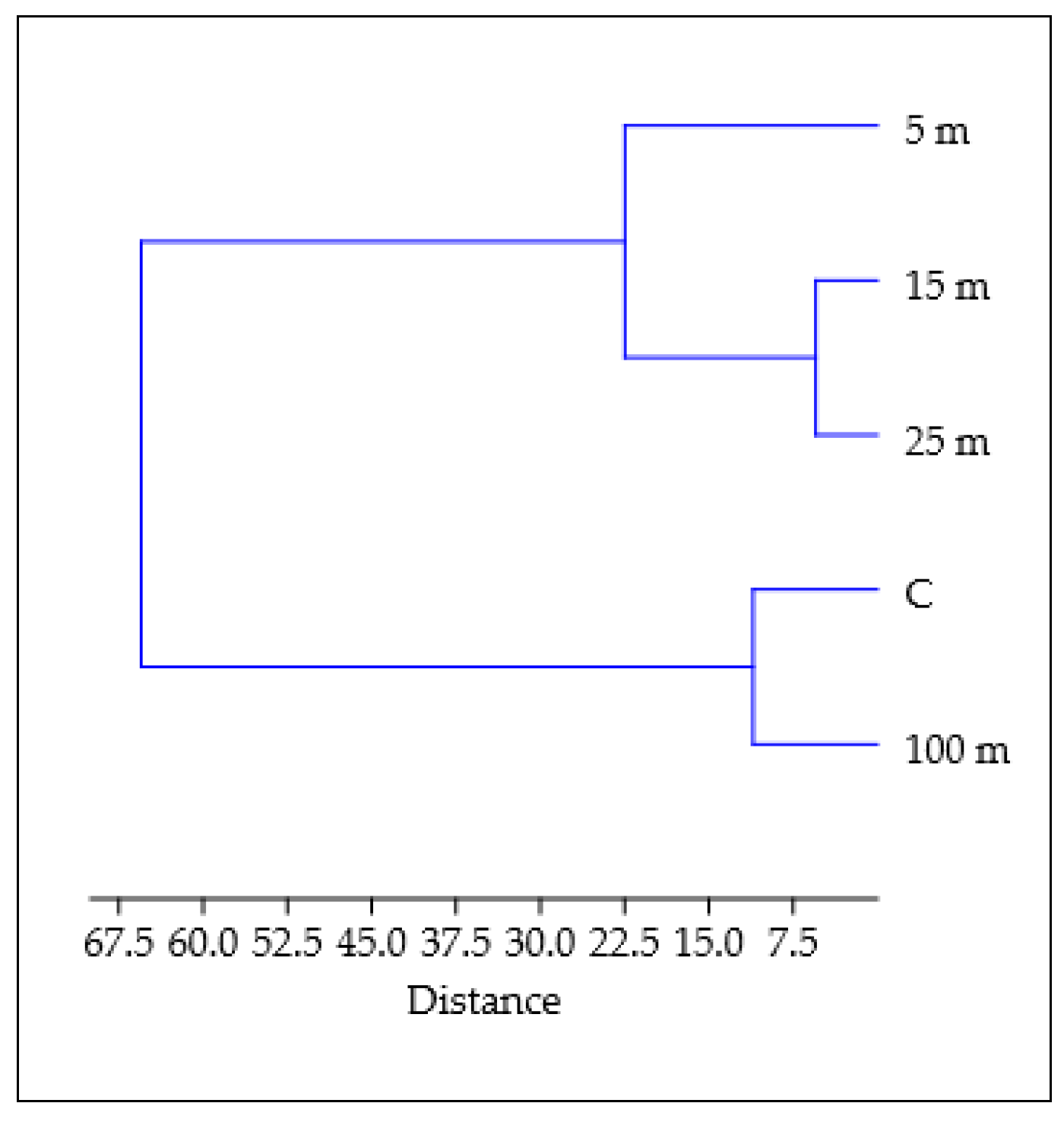
- Hammer, Ø.; Harper, D.A.; Ryan, P.D. Past: Paleontological statistics software package for educaton and data anlysis. Palaeontol. Electron. 2001, 4, 9. [Google Scholar]



| Enzymes | Distance | ||||
|---|---|---|---|---|---|
| C | 5 m | 15 m | 25 m | 100 m | |
| CATs | 0.935 a ± 0.0276 | 0.332 d ± 0.0134 | 0.398 c ± 0.0042 | 0.340 d ± 0.0021 | 0.734 b ± 0.0269 |
| DEH | 1.411 a ± 0.002 | 0.549 e ± 0.0191 | 0.912 c ± 0.0042 | 0.942 c ± 0.0148 | 1.149 b ± 0.0573 |
| AlP | 1.261 a ± 0.0160 | 0.542 e ± 0.0085 | 0.598 d ± 0.0086 | 0.618 c ± 0.0078 | 0.970 b ± 0.0163 |
| AcP | 2.327 a ± 0.0262 | 1.280 e ± 0.0127 | 1.389 c ± 0.0042 | 1.416 c ± 0.0057 | 1.884 b ± 0.0170 |
| PRO | 32.31 a ± 0.7849 | 16.14 c ± 0.2687 | 17.11 c ± 0.0990 | 17.74 c ± 0.7212 | 28.06 b ± 0.5586 |
| BG | 0.939 a ± 0.0212 | 0.340 d ± 0.0163 | 0.410 c ± 0.0035 | 0.399 c ± 0.0049 | 0.733 b ± 0.0290 |
| Equation | r | R2 (%) | p |
|---|---|---|---|
| * CATs = 0.4262 + 0.005x | 0.843 | 71.0 | 0.0730 |
| DEH = 0.8612 + 0.0006x | 0.779 | 60.7 | 0.1205 |
| AlP = 0.6536 + 0.0006x | 0.882 | 77.9 | 0.0476 |
| AcP = 1.4522 + 0.0009x | 0.892 | 79.6 | 0.0476 |
| PRO = 19.0975 + 0.0139x | 0.812 | 65.9 | 0.0420 |
| BG = 0.4464 + 0.0005x | 0.854 | 73.0 | 0.0950 |
| Parameters | Distance | ||||
|---|---|---|---|---|---|
| C | 5 m | 15 m | 25 m | 100 m | |
| Chl a | 1.528 a* ± 0.0283 | 0.642 e ± 0.0141 | 1.021 d ± 0.0502 | 1.210 c ± 0.0021 | 1.333 b ± 0.0078 |
| Chl b | 0.589 a ± 0.0269 | 0.223 d ± 0.0064 | 0.311 c ± 0.0057 | 0.411 b ± 0.0064 | 0.435 b ± 0.0240 |
| Car | 1.156 a ± 0.0438 | 0.400 e ± 0.0127 | 0.631 d ± 0.0042 | 0.706 c ± 0.0092 | 0.947 b ± 0.0410 |
| ACC | 15.78 a ± 0.2899 | 5.775 d ± 0.1485 | 8.085 c ± 0.1768 | 9.040 c ± 0.1131 | 12.17 b ± 0.1131 |
| pH | 5.50 a ± 0.005 | 4.05 c ± 0.002 | 4.75 b ± 0.006 | 4.92 b ± 0.009 | 5.42 a ± 0.006 |
| RWC | 72 a ± 0.259 | 45 d ± 0.158 | 52 c ± 0.189 | 58 b ± 0.186 | 68 a ± 0.208 |
| SOD | 35.96 d ± 1.082 | 72.30 a ± 0.9334 | 65.02 b ± 1.131 | 61.99 b ± 0.3465 | 43.26 c ± 0.3748 |
| CATp | 6.235 d ± 1.4849 | 26.17 a ± 0.0778 | 21.14 b ± 0.5798 | 22.97 b ± 0.8415 | 9.100 c ± 0.4808 |
| Equation | r | R2 (%) | p |
|---|---|---|---|
| * Ch a = 3.5435 + 0.0024x | 0.651 | 72.4 | 0.2342 |
| Chl b = 0.3333 + 0.0003x | 0.827 | 68.5 | 0.0838 |
| Car = 0.6457 + 0.0005x | 0.793 | 62.3 | 0.1095 |
| AAC = 8.4223 + 0.0076x | 0.752 | 56.5 | 0.0672 |
| pH = 7.5283 + 0.0056x | 0.722 | 52.1 | 0.0126 |
| RWC = 18.3588 + 0.0135x | 0.781 | 60.9 | 0.0589 |
| CATp = 20.6141 − 0.0153x | −0.745 | 55.5 | 0.1484 |
| SOD = 61.9933 − 0.0275x | −0.774 | 59.9 | 0.1245 |
Disclaimer/Publisher’s Note: The statements, opinions and data contained in all publications are solely those of the individual author(s) and contributor(s) and not of MDPI and/or the editor(s). MDPI and/or the editor(s) disclaim responsibility for any injury to people or property resulting from any ideas, methods, instructions or products referred to in the content. |
© 2025 by the authors. Licensee MDPI, Basel, Switzerland. This article is an open access article distributed under the terms and conditions of the Creative Commons Attribution (CC BY) license (https://creativecommons.org/licenses/by/4.0/).
Share and Cite
Lemanowicz, J.; Jaskulska, I. Selected Biochemical Properties of Medicinal Plant (Urtica dioica L.) Leaves in Relation to the Enzymatic Activity of Soils Exposed to the Impact of Road Traffic. Molecules 2025, 30, 4298. https://doi.org/10.3390/molecules30214298
Lemanowicz J, Jaskulska I. Selected Biochemical Properties of Medicinal Plant (Urtica dioica L.) Leaves in Relation to the Enzymatic Activity of Soils Exposed to the Impact of Road Traffic. Molecules. 2025; 30(21):4298. https://doi.org/10.3390/molecules30214298
Chicago/Turabian StyleLemanowicz, Joanna, and Iwona Jaskulska. 2025. "Selected Biochemical Properties of Medicinal Plant (Urtica dioica L.) Leaves in Relation to the Enzymatic Activity of Soils Exposed to the Impact of Road Traffic" Molecules 30, no. 21: 4298. https://doi.org/10.3390/molecules30214298
APA StyleLemanowicz, J., & Jaskulska, I. (2025). Selected Biochemical Properties of Medicinal Plant (Urtica dioica L.) Leaves in Relation to the Enzymatic Activity of Soils Exposed to the Impact of Road Traffic. Molecules, 30(21), 4298. https://doi.org/10.3390/molecules30214298