


Abstract
High-pressure synthesis and crystal structures of the homologous series AuBa2(Ca,Ln)n−1CunO2n+3 (n = 1–4; Ln = rare-earth cations) are described. Their crystal structures and superconducting properties are compared with the corresponding members of the Hg-homologous series. Numerous cuprates containing flat structural fragments (CuO4, CO3 and BO3) synthesized mainly at high pressure are compared in terms of structural peculiarities and superconducting properties. Importance and future prospects of high-pressure application for the preparation of new superconducting oxides are discussed.
1. Introduction
Numerous high-temperature superconducting cuprates have complex perovskite-based intergrowth crystal structures. In these structures, it is possible to select different blocks, for example, perovskite-like (CaTiO3), halite-like (NaCl), fluorite-like (CaF2) and/or other ones stacking along the four-fold axis of the perovskite sublattice [1]. The first member of series of Ruddlesden-Popper (RP) phases La2CuO4 has a simple intergrowth structure consisting of perovskite-like and halite-like fragments (K2NiF4 structural type). High-temperature superconductivity at Tc = 36 K was discovered in this material after hole doping by Ba2+ [2]. Tc was shown to increase up to 52.5 K when measured in situ under a hydrostatic pressure of 1.68 GPa [3].
The crystal structures of Hg-containing series of superconducting cuprates, HgBa2Can−1CunO2n+2+δ (n = 1–6), can be described as intergrowth ones [4,5,6,7,8,9]. Defect halite-like fragments and perovskite-like fragments are stacking along the four-fold axis, which coincides with the crystallographic c-axis (Figure 1). Hg2+ cations have typical dumbbell-like coordination with a significant range of oxygen stoichiometries in the HgOδ layers. In the crystal structures of compounds with n = 2–6, the corresponding amounts of CuO2 layers are separated by Ca2+ cations forming repeated perovskite-like blocks. It is important to note that the highest Tc (up to 138 K) was reported for the compound with n = 3. Moreover, at ultrahigh pressures above 20 GPa Tc increased remarkably and reached 166 K in fluorinated Hg-1223 [10,11,12].
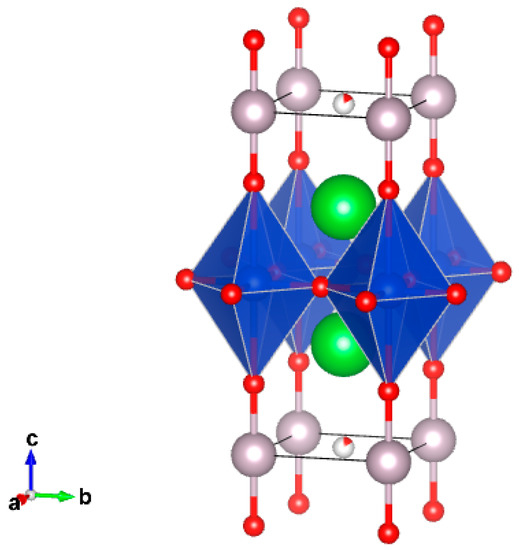
Figure 1.
Crystal structure of Hg-1201. The coordination polyhedra of copper (distorted octahedron) and Hg (dumbbell) are shown.
Since the first high-pressure device was invented by Bridgeman in the 1940s, high-pressure has been extensively used in solid state sciences. It is established that ultrahigh pressure deals with the pressures greater than 1.01 GPa, and now the pressure scale is extended up to 500 GPa at temperatures exceeding 3000 °C. The most frequently used apparatus in high pressure research is the diamond-anvil cell (DAC) in a piston-cylinder design. It allows one to achieve pressures as high as 4 GPa or even more. The disadvantage of the Bridgeman device in a piston-cylinder design is the small sample size. That problem was solved by the belt-like apparatus invented in the 1960s, that can generate 10 GPa at temperatures up to 2000 °C. The modern devices are multianvil cells, where the anvils are usually made from materials with high hardness, preferably from diamond. Detailed descriptions and a comparison of different high-pressure apparatus are given in a recent review [13].
This review is dedicated mainly to the application of high pressure for the synthesis and superconducting properties optimization of layered cuprates. However, superconductivity at Tc > 200 K in H3S (Tc = 203 K at 150 GPa) [14] and in LaH10 (Tc ~ 250 K at 170 GPa) [15] was recently discovered. These new exciting materials belong to conventional superconductors with properties that can be described by the Bardeen–Cooper–Schrieffer and the Migdal–Eliashberg theories. In addition, first-principles calculations based on density functional theory and recently developed non-adiabatic theory are used for explanation and prediction of properties of new superconducting materials [16,17,18,19,20,21,22,23]. The latest results increase significantly interest in high pressure research and one can hope for further rapid progress in this direction.
2. Au-Containing Cuprates: High-Pressure Synthesis and Characterization
High pressure applications is strongly required for the synthesis of these materials because it is only way to stabilize gold oxides which are thermally very unstable at ambient pressures. The general formula of the homologous series is as follows: AuBa2(Ca,Ln)n−1CunO2n+3 (n = 1–4; Ln = rare-earth trivalent cations). The second member AuBa2Y1−xCaxCu2O7 was synthesized in polycrystalline and single crystal form at 1.8 GPa/950 °C and at 6 GPa/1380 °C, respectively [24,25]. Its crystal structure was determined from single crystal X-ray diffraction data in space group Pmmm (Jana 2000 software; R, Rw (I >3 σ (I)) = 0.0260, 0.0219; R, Rw (all data) = 0.0443, 0.0225; the details are given in [25]); a = 3.8260(2) Å, b = 3.8501(2) Å, c = 12.075 (1) Å. The samples exhibited bulk superconductivity with Tc = 82–84 K. The crystal structure of Au-1212 compound is shown in Figure 2.
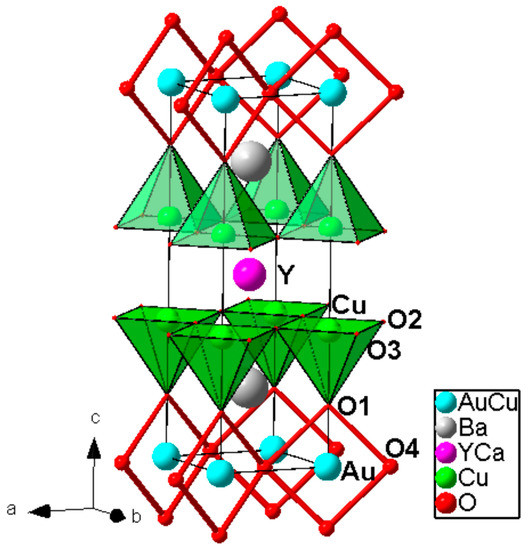
Figure 2.
Crystal structure of the Au-1212 compound. Zigzag chain of AuO4 square-planar units is selected. Reproduced with permission from [9].
The cation stoichiometry Au: Ba: Y: Ca: Cu = 0.8(1): 1.9(1): 0.7(1): 0.4(1): 2.2(1) obtained from electron probe microanalysis (EPMA) data is in agreement with that obtained from X-ray single crystal diffraction, indicating ca. 20% substitution of Cu1+ cations on the Au3+ site, it was associated with approximately the same amount of oxygen vacancies in the corresponding plane. It should be noted that no superstructure related to possible Cu/Au ordering was revealed from the X-ray single crystal diffraction data.
Au3+ is located in square-planar coordination with Au-O distances 1.980 Å and 2.027 Å. AuO4 squares share corners and they are forming zigzag chains along the short a-axis, and that is different from YBa2Cu3O7 where CuO4 squares ran along the longer b-axis. The coordination of the in-plane Cu is square pyramidal with an apical distance of 2.41 Å, it is typical for layered cuprate superconductors.
The third and fourth members of the Au-series, Au1+xBa2Ca2Cu3−xO9 and AuBa2Ca3Cu4O11, were synthesized at 6 GPa and 1250–1300 °C [26]. They crystallize in primitive orthorhombic unit cells with a = 3.8182(4) Å, b = 3.8555(4) Å, c = 15.445(2) Å and a = 3.8266(3) Å, b = 3.8505(3) Å, c = 18.494(1) Å, for Au-1223 and Au-1234, respectively.
A HRTEM image of Au-1223 phase along the b-axis is shown in Figure 3. It is confirmed the 1223 stacking along the c-axis: BaO-AuO-BaO-CuO2-Ca-CuO2-Ca-CuO2. Attempts to synthesize next members (n = 5, 6) were not successful both at 1.8 GPa and at 6 GPa. AuBa2Ca3Cu4O11 showed bulk superconductivity with Tc ~ 99 K, but Au-1223 showed only a weak diamagnetic signal at Tc ~30 K. In order to understand the possible reason, crystal structure of Au-1223 was determined from single crystal X-ray diffraction data (SHELXL-97 software; S.G. Pmmm; R1, wR2 (I > 2 σ (I)) = 0.0188, 0.0437; R, Rw (all data) = 0.0301, 0.0484; the details are available in [27].
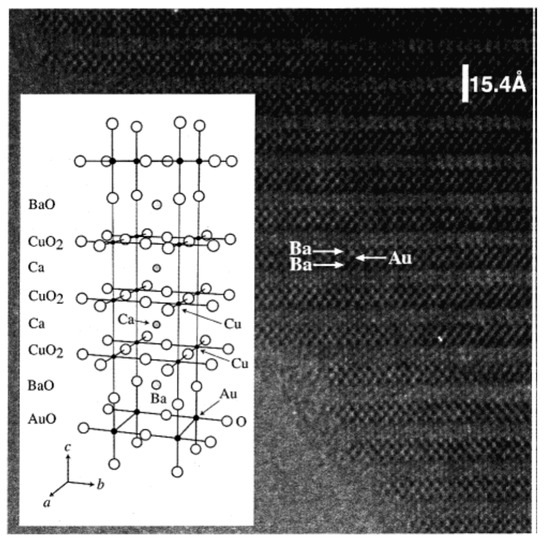
Figure 3.
HRTEM image of Au-1223 phase taken along (100) zone axis. The structure model of Au-1223 is shown in the inset. Reproduced with permission from [10].
The cation stoichiometry Au: Ba: Ca: Cu = 0.9(1): 1.91(6): 2.10(6): 3.1(1) was obtained from EPMA. The crystal structure is similar to Hg-1223, but the cation stoichiometry is indicative of some possibility of Cu/Au disorder. The refinement of the occupation yielded 4.1% of Cu in Au site. Au-O in-plane distance is 2.055 Å and it is noticeably longer than typical Cu-O in-plane distances that correlate with their ionic radii difference.
Contrary to Hg-1223, oxygen in the AuO layer is located at (x,1/2,0), it leads to formation of AuO4 zigzag chains as in Au-1212. Electron diffraction revealed the weak superstructure with bs = 2b in Au-1223, however, the corresponding intensities in X-ray single crystal diffraction data were extremely weak. This suggests no ordering of zigzag-like chains and/or their irregularity.
Related to the suppression of superconductivity, some incorporation of Au for Cu in the CuO2 planes (6–8%) should be taken into consideration. Although the degree of the substitution is very moderate, even this level can lead to superconductivity suppression.
Au-1201 is the less known member of the Au-series. Au(Ba,La)2CuO5±δ was obtained as a principal phase in the polyphasic sample prepared at 6 GPa and 1250 °C [28]. It crystallizes in an orthorhombic primitive cell with the parameters a = 3.7976(3) Å, b = 3.8509(3) Å, c = 8.5749(9) Å. EPMA shown the cation stoichiometry Au: Ba: La: Cu = 0.75(8): 0.8(1): 1.2(1): 1.25(8), therefore, the approximate formula of Au-1201 can be expressed as Au0.75Ba0.8La1.2Cu1.25O5±δ. Therefore, it suggests that ca. 25% of Au positions are occupied by Cu. HRTEM indicated that this is a first member of AuBa2(Ca,Ln)n−1CunO2n+3 series (Figure 4). However, an ED study revealed a weak superstructure with as = 5a, bs = b, cs = 2c. It could be due to possible Au/Cu ordering. Samples of Au-1201 showed a weak diamagnetic signal with Tc = 19 K and low level of diamagnetic Meissner fraction.
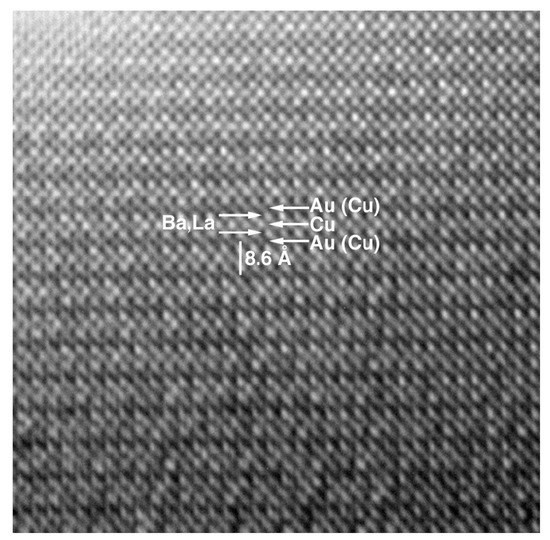
Figure 4.
HRTEM image of Au-1201 compounds taken along (010) zone axis. Reproduced with permission from [12].
3. Au and Hg-Containing Series: Structural Details and Superconductivity
Crystal structures of corresponding members of Au and Hg-series are rather similar (except for the first member), however, there are some important differences. First, maximum Tc was achieved in the Hg-series but not in the Au-series [26,29]. Moreover, only first four members of Au-series were identified in comparison with six members of Hg-series (the n = 7 member was obtained only if doped in the Hg site). The possible reason could be a noticeable mismatch between Au-O and Cu-O in-plane distances that lead to formation of zigzag chains consisting of corner-shared AuO4 square-planar units along a and/or b crystallographic axis. That mismatch can impede the formation of higher members of this series and their synthesis may require higher pressures application.
The extra oxygen in HgOδ layer of Hg-series members is located in the central position (1/2,1/2,0) and is very weakly bonded with Hg. This results in a rather extended oxygen stoichiometry range and a possibility to optimize Tc using various thermal treatments of these materials [4,5,6,7]. Oxygen in Au-containing layers is located in more general positions and the oxygen stoichiometry in Au-series members is practically fixed and can vary in the very limited range only due to some doping caused by Cu incorporation resulting in Au/Cu disorder in Au-O plane. It may create serious difficulties to achieve the appropriate hole concentration, and, therefore, for Tc optimization.
It should be particularly taken into account some extent of Au incorporation in CuO2 layers that was not revealed for Hg in Hg-series. It is a possible reason of suppression of bulk superconductivity in Au-1201 and Au-1223. In Au-1201 it might be also due to an insufficient hole concentration. Additional studies preferably based on X-ray single crystal diffraction data are required to verify these hypotheses.
The ultimate member (n = ∞) of both series, CaCuO2, has so-called “infinite-layer” structure, which is very simple. It contains only corner-shared square planar CuO2 units and its unit cell consists of only two stacking layers (Ca2+) (CuO2) along the c-axis. At ambient pressures, this structure is stable in the very narrow x range of Ca1-xSrxCuO2 solid solution (0.10 ≤ x ≤ 0.16) [30]. High-pressure application results in extension its stability range up to 0 ≤ x ≤ 1. Syntheses of CaCuO2 with “infinite-layer” structure were reported by using a belt-type apparatus at 6 GPa and high Ar pressure of 1,4–1,6 GPa [31,32]. Using the last technique, single crystals were grown. It showed a weak diamagnetic signal at Tc = 78 K, however, superconducting transition was not supported by the resistivity measurements and was attributed to some A-deficient domains. Bulk superconductivity was observed only after the electron doping by large rare-earth cations.
It should be noted that the “infinite-layer” structure was also reported for reduced nickelates as LaNiO2 [33] and Nd1−xSrxNiO2 [34] containing Jahn-Teller cation Ni1+. These compounds were prepared using soft chemistry methods and they did not show superconducting properties.
4. La2CuO4 -Related Superconductors in Sr-Cu-O and Ba-Cu-O Systems
Sr2CuO3 crystal structure is stable at normal pressure and is heavily oxygen deficient. Cu is in square-planar coordination and CuO2 units are corner-shared along the a-axis [35]. At pressures as high as 6 GPa, 800–900 °C and in a strongly oxidizing atmosphere (created by adding KClO4) it was reported to transform into a layered structure of K2NiF4 structural type related to La2CuO4 and, moreover, a new series of copper oxide superconductors Srn+1CunO2n+1+δ was discovered [36]. The initial stoichiometry of the n = 1 member corresponds to Sr2CuO3.1, and the main peaks were indexed in tetragonal unit cell with a = 3.764 Å, c = 12.548 Å. A superlattice with as = 4 × √2a, cs = c was revealed from electron diffraction data. The member with n = 2 was characterized but it was not obtained as single or dominant phase sample. According to X-ray diffraction data, it has a tetragonal unit cell with a = 3.902 Å, c = 21.085 Å. The samples exhibited bulk superconductivity at 70 K and a weak diamagnetic signal at ~ 100 K was attributed to a minor phase, a series member with n = 2. Higher members (n = 4, 5) were identified by electron diffraction but were not reported in bulk form.
Another research group published the synthesis of Sr2CuO3+δ at 5.7 GPa and 900 °C using KClO4 as an internal oxidizer [37]. The as-prepared material was nearly single phase with unit cell parameters a = 3.7556(3) Å, c = 12.521(2) Å (I4/mmm) and it exhibited bulk superconductivity at Tc = 70 K. No X-ray evidence of other series Srn+1CunO2n+1+δ members was found. Heat treatment under flowing N2 and 310 °C for 1 h resulted in enhancement of Tc up to 94 K, unit cell parameters of Sr2CuO3+δ changed to a = 3.7591(1) Å, c = 12.518(9) Å. Based on these data, the as-prepared sample is considered to be in an overdoped state, so δ > δopt [38].
The average crystal structures of superconducting and non-superconducting samples of Sr2CuO3+δ with the tetragonal unit cell were refined using neutron powder diffraction data [39]. Superconducting sample (Tc = 65 K, Meissner fraction volume ~ 6%, δ ~ 0.1) was prepared by treatment of orthorhombic Sr2CuO3 at 6 GPa and 850 °C using an internal oxidizer KClO3. Tetragonal normal pressure phase Sr2CuO3+δ was synthesized in flowing oxygen at 350 °C from hydroxometallate precursor Sr2Cu(OH)6, the obtained material did not show any diamagnetic signal above 4 K. In both crystal structures oxygen vacancies in CuO2 layers were revealed. It can be a reason why both samples did not exhibit bulk superconductivity. A weak diamagnetic signal in the “high-pressure” sample can be attributed to some superconducting clusters without these vacancies. However, more experimental data are required for verification of this assumption.
Another explanation of superconductivity in Sr2CuO3+δ (δ ~ 0.1–0.6) was proposed in later publications [40,41]. Sr2CuO3+δ single phase samples were prepared at 6 GPa and 1100 °C. Only La2CuO4-like phase was detected. As a source of oxygen SrO2 was used instead of KClO4 or KClO3, as it permits one to avoid the formation of another superconducting phase (Sr,K)CuO2Cl2 as an impurity [42]. Then the samples were annealed at different temperatures under flowing N2. The best superconducting properties were achieved for the samples with nominal δ = 0.4 that exhibited the highest Tc = 75 K.
The TEM and electron energy loss spectroscopy (EELS) techniques have been utilized to characterize superconducting Sr2CuO3+δ (with nominal δ = 0.4) samples, both in the as-prepared state and post-annealed at different temperatures in order to reveal the superconducting phases. It was demonstrated that with raising the annealing temperature, Tc increased from 75 K (as-prepared) to 89 K (post-annealed at 150 °C) and 95 K (post-annealed at 250 °C). In the last stage the superconductivity disappeared when the annealing temperature exceeded 250 °C. TEM investigations revealed two types of modulated phase, Fmmm and C2/m, in the sample. The structure phase transitions are as follows. It starting from C2/m modulated phase → Cmmm modulated phase (annealed at 150 ◦C) → Pmmm modulated phase (annealed at 250 ◦C) → unmodulated orthorhombic structure (annealed at 350 ◦C), while no obvious changes are found for the Fmmm modulated phase up to 250 ◦C. The experimental results show that the C2/m modulated phase is responsible for Tc at 75 K, the Cmmm modulated phase exhibited Tc at 89 K, and for the Pmmm modulated phase Tc was observed at 95 K. Fmmm modulated phase is non-superconducting. That was attributed to the oxygen vacancies located at the Cu-O planes. It was concluded that, besides the hole doping level, the reordering of apical oxygen in those superconducting modulated phases is the important factor that governs the Tc in Sr2CuO3+δ. Moreover, Ba-substitution led to increase Tc up to 98 K in Sr1.4Ba0.6CuO3+δ [43].
The detailed analysis of structure and superconducting properties in Sr1−xBaxCuO3+δ system was performed in [44]. The authors pointed out that there is no direct experimental evidence of the absence of oxygen vacancies in Cu-O planes. On the contrary, there is a clear evidence of oxygen vacancies (estimated in ~30%) from neutron powder diffraction data [39]. The simulation of the electron diffraction data also revealed an average commensurate superstructure (Fmmm) with orthorhombic supercell 5√2ap × 5√2ap × cp (p belongs to tetragonal I4/mmm K2NiF4-type structure) and two different Cu-Cu distances in Cu-O plane [45,46]. This is in agreement with the oxygen vacancies in this plane deduced from with the neutron diffraction data. It is remarkable that Tc is almost triple in comparison with La2CuO4-based superconductors [2,47], therefore, the author concluded the existence of an enhancement of superconductivity.
Two new possible mechanisms of enhanced superconductivity were assumed: negative U-centers and optimum inhomogeneity. The concepts of negative U-centers deal with a band of paired electrons formed by the overlap of negative −U oxygen vacancies [48,49,50]. Optimum inhomogeneity considers pairing in the CuO2 layer that may be enhanced by an optimal inhomogeneity distribution of oxygen sites and/or by a clustering of vacancies rich and vacancies poor regions [51,52].
Recently, bulk superconductivity with Tc > 70 K was discovered in a new layered cuprate Ba2CuO4−y (nominal content y ~ 0.8) [53,54,55]. It is synthesized at 18 GPa and 1000 °C in a highly oxidizing atmosphere. It should be noted that this material is very hygroscopic and cannot be prepared at lower pressures. Surprisingly, the exhibited Tc is more than 30 K higher than for doped La2CuO4 and superconducting volume fraction reaches as high as 30%. This evidence for bulk superconductivity was also confirmed by the muon spin rotation (µSR) showing approximately 40% superfluid density and the specific heat measurements. X-ray diffraction showed La2−xSrxCuO4-like structure (I4/mmm) and the Rietveld refinement yields the lattice parameters of the compound with a = 4.003 Å and c = 12.94 Å at room temperature, respectively.
Moreover, it was demonstrated that this new cuprate has some peculiar features making it different from “conventional” cuprate superconductors: (a) the apical oxygen distance is significantly shorter than that known for all other cuprates so far; (b) superconductivity occurs at very high hole doping. It should be considered as strongly overdoped state in comparison to the optimal value of p~0.14–0.15 for the previously known “conventional” high Tc cuprates; (c) its structure contains numerous oxygen vacancies, presumably located in Cu-O plane. Moreover, Cu-O in-plane distances are 2.00 Å and longer than apical ones (1.86 Å), i.e., the defect octahedron is very compressed [56,57,58]. It is shown by X-ray absorption measurement that in the compressed octahedron, the 3dz2-r2 orbital should be lifted above the 3dx2-y2 orbital resulting in significant 3D nature in addition to the conventional 3dx2-y2 orbital [59]. Based on these data, it was suggested that Ba2CuO4-y is a member of a different branch of high-Tc cuprate materials [60,61]. Another example of cuprate synthesized at high-pressure is Cu0.75Mo0.25Sr2YCu2O7.54, it has crystal structure similar to YBCO123 phase and exhibited Tc at ~ 87 K being strongly overdoped (nominal content p ~ 0.46) [62,63].
It can be concluded that further increase of high pressure may result in the discovery not only of higher members of known superconducting series, but also some new superconducting materials with high Tc and possibly new original superconductivity mechanisms.
5. Cuprates with Edge-Shared CuO4 Units in Sr-Cu-O and Ca-Cu-O Systems: Spin-Ladder and Infinite-Chain Composite Structures
Numerous cuprates contain edge-shared (CuO2) square-planar units. An interesting example is the series of so-called spin-ladder cuprates. They belong to the homologous series Srn−1Cun+1O2n (n = 1, 2) [64]. These compounds can only be synthesized under high pressures. It should be underlined that at normal pressure the stable compounds in SrO-CuO system are SrCuO2 [35], Sr2CuO3 [65] and Sr14Cu24O41 [66,67]. SrCuO2 crystal structure is quasi-one-dimensional (1D). It contains Cu2+ in square-planar coordination, CuO2 fragments are only edge-shared forming ribbon-like chains. The Sr2CuO3 crystal structure is heavily oxygen deficient and, therefore, Cu is in square-planar coordination and CuO2 units are corner-shared. Sr14Cu24O41 has a composite crystal structure which consists of two incommensurate sublattices, first contains (Cu2O3) ladders and second contains Cu-O 1D edge-shared chains similar to SrCuO2 (Figure 5). Therefore, it contains spin-ladder fragment as in 80 K superconductor YBa2Cu4O8 [68,69].
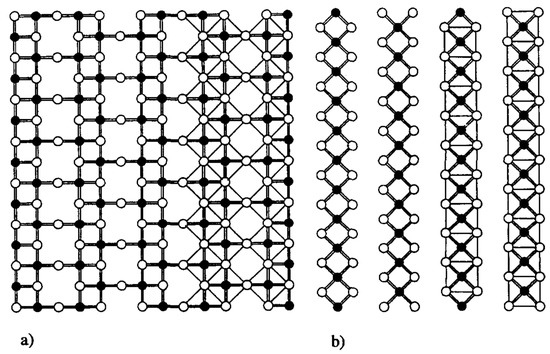
Figure 5.
Two different Cu-O planes in the structure of Sr14Cu24O41: (a) two-leg ladder, (b) simple edge-sharing CuO2 chains. Reproduced with permission from [70], Figure 1.
Members of the spin-ladder homologous series Srn−1Cun+1O2n (n = 3, 5), Sr2Cu4O6 and Sr4Cu6O10, are stabilized by high-pressure because they have elevated crystallographic density in comparison with normal pressure phase Sr14Cu24O41 (5.51 g/cm3, 5.61 g/cm3 and 4.68 g/cm3), respectively.
These first and second series members with n = 3 and n = 5 were synthesized in bulk form at 6 GPa and 1200 °C, the next member with n = 7 was not obtained yet, although it seems that it could be obtained at higher pressures [71]. Refinement of Sr4Cu6O10 crystal structure using neutron powder diffraction data confirmed the 3-leg model (see Figure 6). The Cu-O planes consist of square planar CuO2 units which are linked by both edge- and corner-sharing, corner-sharing chains of CuO2 squares form the legs of the ladder, running in the a-direction. These ladders are connected by edge-sharing forming double chains.
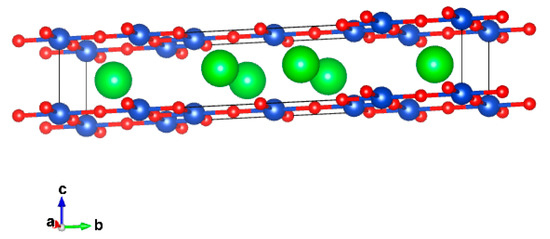
Figure 6.
Crystal structure of Sr4Cu6O10. Sr, Cu and O atoms are shown by green, blue and red circles, respectively.
Single crystals of Sr4Cu6O10 slightly doped by Ca (ca. 4%) were grown using a high argon-gas-pressure technique with an Ar partial gas pressure of 1.82 GPa in a three-zone Canthal furnace [72]. Crystal structure determination using single crystal X-ray diffraction data confirmed the 3-leg model.
Cuprates with ladder structures are of particular interest as so-called spin-ladder compounds. There are theoretical predictions of superconductivity or charge- density-wave properties for properly doped spin-ladder materials with an even number of legs [73,74]. However, up to now, bulk superconductivity was never observed in spin-ladder cuprates. All attempts to induce superconductivity by appropriate electron and hole-doping (by La3+, Nd3+, Na+ and K+) in Sr2Cu4O6 and Sr4Cu6O10 failed to give any positive results. Superconductivity in Ca-doped Sr14Cu24O41 was reported, but never confirmed, at least in the bulk state [75]. AFM transition was observed in the non-doped phase below 60 K and it was attributed to the spin orientation predominantly perpendicular to the 1D CuO2 chains [76]. Therefore, it is still an open question whether is possible to induce superconductivity by the appropriate doping in the parent spin-ladder compounds containing edge-shared CuO2 units even if Cu has the appropriate oxidation state
There is a considerable theoretical interest in one-dimensional 1D Heisenberg spin-1/2 systems because they exhibit a number of properties that are entirely dominated by quantum-mechanical behavior and have no analogues in three-dimensional systems. In particular, it has been shown that the Heisenberg S51/2 chain represents an integrable system characterized by a macroscopic number of conservation laws [77].
Some 1D cuprates showed unusual behavior at low temperatures, particularly the research efforts were focused on interesting quantum magnetic phenomena in copper-oxygen chains with integer spins. It should be mentioned the spin-Peierls transition in CuGeO3 [78] and the Haldane-gap appearance in Heisenberg chains with integer spins [79].
Thermal conductivities of normal pressure 1D spin-chain compounds SrCuO2 and Sr2CuO3 were studied in detail [80,81]. Although the crystal structures of the two compounds are different in the sense that the former contains linear and the latter consists of zigzag Cu-O chains, the thermal conductivity of both materials is remarkably similar. In particular, the heat transport in the directions perpendicular to the chains is dominated by phonons, but along the chain direction and at high temperatures there is a substantial excess contribution related to the transport of energy by spinons. The phonon thermal conductivity is analyzed employing a Debye-type approximation. The main sources of phonon scattering are phonons at high temperatures and lattice defects, presumably dislocations, at low temperatures. The spin-phonon interaction is not seen in the phonon heat transport, most likely because it is masked by other scattering processes.
As was noticed, high isostatic pressure in belt-type apparatus and cubic anvils leads to stabilization of phases with elevated crystallographic densities, but in the case of high partial oxygen pressure of 0.2 GPa in a double chamber gas system, Sr0.73CuO2 was obtained at the temperature range 950–1180 °C, single phase polycrystalline samples and single crystals were obtained [82]. Its cation and oxygen stoichiometry was confirmed by energy dispersive X-ray (EDX) analysis and volumetric determination method [83]. Its incommensurate composite crystal structure belongs to the NaCuO2 structural type and consists of two sublattices, associated with Sr2+ cations and (CuO2)n− edge-shared square-planar units, respectively. First sublattice has an orthorhombic C-centered subcell with a = 3.78 Å, b = 6.82 Å, c = 5.51 Å and second has an orthorhombic F-centered subcell with a = 2.72 Å, b = 6.82 Å, c = 11.02 Å. Therefore, there is a mismatch between them resulting in incommensurate modulations along the a-axis (Figure 7).
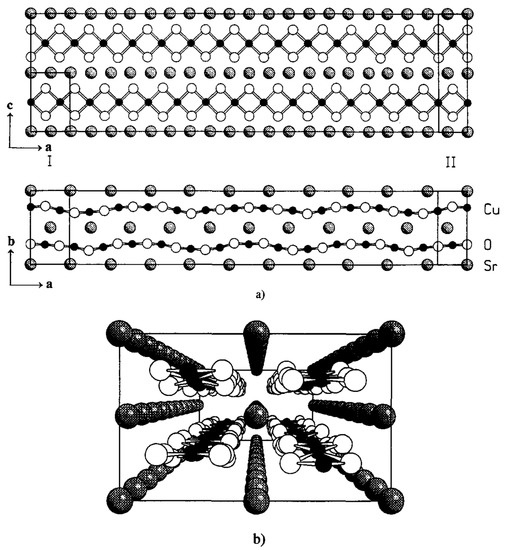
Figure 7.
(a) Structure of Sr0.73CuO2 consisting of one-dimensional edge-sharing CuO2 chains alternating with Sr planes. CuO2 chains are wave-modulated. I: subcell of Sr atoms. II: subcell of Cu and O atoms. (b) Perspective view of the Sr0.73CuO2 structure in a direction.
Ca0.83CuO2 has similar composite incommensurate structure. It was obtained as nearly single-phase polycrystalline sample from precursors of Ca2CuO3 and CuO heated at 1020 °C for 36 h and oxygen partial pressure of 0.174 GPa. The oxygen stoichiometry of Ca0.83CuO2 was confirmed by volumetric titration. Single crystals were grown by using a BaCuO2 + CuO flux [84]. It was shown that Ca-containing phase has an incommensurate composite crystal structure similar to Sr0.73CuO2. However, some peculiarities were manifested. It contains Cu in oxidation state +2.34 that is well below +2.54 revealed for Sr-containing phase. Recently, it was reported Ca0.83CuO2 synthesis at ambient pressure using very effective soft chemistry sol-gel technique in flowing oxygen at 700 °C [85].
Moreover, it was found by electron diffraction that the two sublattices, attributed to (CuO2)n− and Ca2+, have the following unit cell parameters:
- (1)
- monoclinic subcell with a = 3.33 Å, b = 6.32 Å, c = 5.47 Å, ß = 105.0°
- (2)
- monoclinic subcell with a = 2.80 Å, b = 6.32 Å, c = 5.47 Å, ß = 104.9°
The authors used the superspace approach [86]. The whole ED pattern was indexed by adopting the diffraction vector H = ha* + kb* + lc* + mq; q is a modulation vector. The modulation vectors were found to be 1.20144(7) a* − 0.0038(6) c* and 0.83057(7) a* + 0.0032(3) c*, for Ca and CuO2 subcell, respectively.
The powder diffraction data were collected using synchrotron radiation with λ = 0.685 Å. Then the crystal structure was refined using the Jana 2006 software package adopted for composite structure refinement [87].
It is important to note that the CuO4 square-planar units were significantly distorted due to propagation of a tilted wave along the ribbons. Cu-O distances are between 1.85 Å and 2.05 Å with an average value 1.93 Å. Taking into account the mixed Cu oxidation state, the possibility of periodic charge-ordering phenomena along the Cu-O chains is envisaged.
Magnetic properties of Sr0.73CuO2 and Ca0.83CuO2 were studied in details by DC magnetic susceptabilities, EPR, specific heat and elastic neutron scattering on polycrystalline samples, and magnetic torque measurements on single crystals [84,88,89]. It was reported that in Sr0.73CuO2 and Ca0.83CuO2, in contrast to Sr14Cu24O41, long-range 3D AF magnetic order occurs below TN ~ 12 K and ~ 10 K, respectively (Figure 8 and Figure 9). At higher temperatures, Sr0.73CuO2, Ca0.83CuO2 and Sr14Cu24O41 showed similar magnetic properties: CuO2 chains in both compounds are diluted highly magnetically by holes which render the CuO2 unit nonmagnetic.
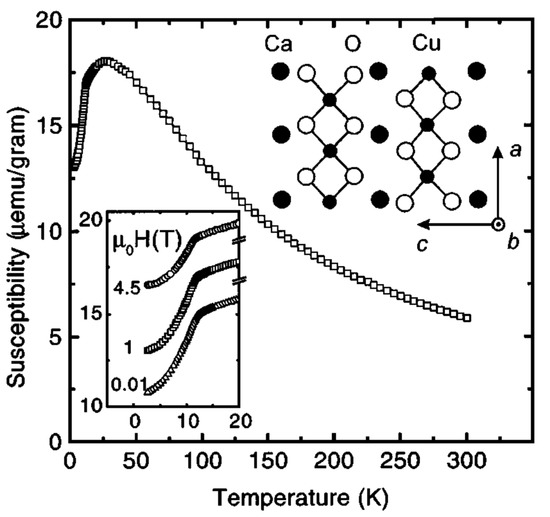
Figure 8.
Susceptibility χ(T) of as-prepared polycrystalline Ca0.83CuO2 at µ0H = 1 T. The χ (T) curves at µ0H = 10 mT and 4.5 T are offset for clarity. The value of χ(T > 15 K) is independent from the applied field. Part of the unit cell of Ca0.83CuO2 is displayed. Reproduced with permission from [84], Figure 1.
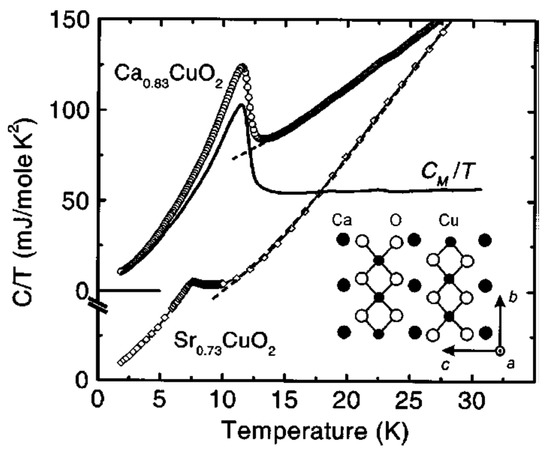
Figure 9.
Specific heat C(T) of Ca0.83CuO2 and Sr0.73CuO2. The curves for Ca0.83CuO2 are offset for clarity. The magnetic contribution CM /T is shown for Ca0.83CuO2. The dashed lines are fits of (CM/CL)/T to the high-T data. Reproduced with permission from [89], Figure 1.
A Ba-containing composite phase was reported as well, its formula was expressed as Ba2Cu3O5+d and the crystal structure was briefly described [90]. It has an incommensurable modulated structure probably similar to Sr0.73CuO2 and Ca0.83CuO2, but the structure details and physical properties still need to be carefully investigated.
6. Importance of High-Pressure for Synthesis of New Oxide Superconductors and Future Prospects
It is particularly important to underline the crucial role of high pressure in the synthesis of layered cuprates. It is briefly summarized in Table 1.

Table 1.
Series of cuprates containing structural flat fragments: high-pressure (HP) synthesis and superconductivity.
In general, solid-state synthesis in most cases can only be performed at high temperatures. That may be a negative factor, in two cases: preparation of low-temperature structural forms and stabilization of metastable materials [91,92]. These problems can be solved by using high pressure, especially if the final product has a smaller volume, negative value of ΔV (and, therefore, higher crystallographic density) that the precursors mixture. Indeed, CaCuO2 with “infinite-layer” structure has slightly higher density than the mixture of precursors Ca2CuO3 + CuO, the difference is about 10%, that’s why this metastable compound is strongly stabilized by high-pressure. Another example is the low-temperature superconductor (Tc = 2 K) KOs2O6 with partially A-deficient cubic pyrochlore-like structure that at 3 GPa and 900 °C transforms into a triclinic structure with higher density [93,94].
It is well known that high-pressure application increases the chemical reactivity of precursors and accelerates the kinetics of solid-state reactions. This is particularly important for the synthesis of higher members of homologous series, because usually the kinetics of these reactions are very slow and occur via formation of lower series members as intermediary products. Moreover, high pressure suppresses the decomposition of thermally unstable precursors. These three important factors, negative ΔV value, increase of precursors thermal stability and acceleration of kinetics of solid-state reactions open large space for synthesis of novel materials. The example can be stabilization of C-containing layered cuprates and synthesis of corresponding homologous series C(Sr2−xCax)2(Ca,Ln)n−1CunO2n+2 (n = 1–4; Ln = rare-earth cations) and similar B-containing series at high pressures. Their crystal structures contain triangular oxycarbonate (CO3)2− and oxyborate (BO3)3− fragments alternate with perovskite-like blocks along the c-axis [95,96,97,98,99,100,101,102]. The first members, CSr2CuO5 (but not CCa2CuO5) and RBaCuO2BO3 (R = La-Eu), were obtained at ambient pressure. They have weak tetragonal superstructure with as = a√2, cs = 2a, due to an ordering of triangular oxycarbonate (CO3)2- and oxyborate (BO3)3− structural fragments with alternating orientation and for that reason it is not detectable from X-ray diffraction data. Structural peculiarities of NdBaCuO2BO3 were revealed from neutron powder diffraction data (Figure 10). It should be noted that the boron atom has an almost ideal triangle coordination with a B-O average distance of ~1.38 Å and it is considerably longer that corresponding C-O average distance equal to ~1.27 Å [95].
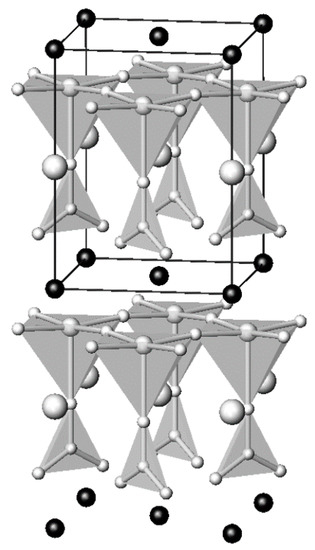
Figure 10.
Crystal structure of NdBaCuO2BO3. Cu (pyramid) and B (triangular) coordination polyhedral are emphasized. Ba and Nd atoms are shown by light and dark circles, respectively. Reproduced with permission from [99], Figure 4.
C and B-contained 1201 crystal structures are similar, but the space group of NdBaCuO2BO3 is non-centrosymmetric P4bm due to an ordering of Nd3+ and Ba2+ cations that was deduced from TEM data.
Moreover, a (Cu,N,C)Sr2Can−1CunOy series with more complicated composition was reported. Its four members (n = 3–6) were synthesized in a belt-type apparatus at 6 GPa and 1350 °C for 1–6 h [103]. It is interesting that only some discreet members (n = 2, 5) were obtained in nitrogen-free systems, and even the small amount of N-doping strongly stabilizes the series.
Incorporation of nitrate to the crystal structures of (Cu,N,C)Sr2Can−1CunOy was confirmed by EELS [104]. It is very interesting that the two different superstructures were observed simultaneously in the case of n = 3, 2a × b × 2c and 4a × b × 2c. For the next member (n = 4) only the first type of superstructure was revealed and no evidence of superstructure was found for the members with n = 5 and 6.
The two first members of this series were synthesized at slightly lower pressure and temperature, 5.5 GPa and 1270 °C [105]. Contrary to non-superconducting CSr2CuO5 and its Ca-substituted analog, the sample with nominal initial composition C0.8N0.2Sr2CuO5.3 exhibited bulk superconductivity with Tc = 33 K, however the doping mechanism is still remains unclear. If we consider the presence of pentavalent nitrogen in nitrate (NO3)− form, it is logical to expect electron doping. However, two known families of cuprate superconductors with electron as a hole carrier are SrCuO2 with infinite-layer structure doped by rare-earth trivalent cation (La-Eu) and R2CuO4 (R = Nd-Gd) doped by Ce4+, so-called T’-phase [106,107,108]. Typical Cu-O in-plane distance is 1.97–1.98 Å. Both contain Cu in a square-planar coordination. In CSr2CuO5 crystal structure copper is in square-pyramidal coordination, Cu-O in-plane distance is much shorter and below 1.95 Å, so the scenario of electron-doped superconductivity seems very improbable in this case.
All reported members of the (Cu,N,C)Sr2Can−1CunOy series exhibited superconducting transitions with Tc = 33, 91, 90, 113, 65 and 52 K, for the members with n = 1, 2, 3, 4, 5 and 6, respectively. It should be pointed out that (Cu,N,C)-1212-Sr phase has a typical 4a × b × 2c superstructure the same as (Cu,C)-1212-Sr originating from Cu-C-C-C-type ordering in the (Cu,C)-plane. However, X-ray single crystal studies of CCa2CuO5 and CSr1.9Ca1.1Cu2O7 did not reveal any additional reflexes corresponding to the above- mentioned superstructures [109]. It would be interesting to grow and study N-doped single crystals and to perform a neutron powder diffraction study to investigate in detail of light atoms coordination and interatomic distances.
It can conclude that the application of high-pressure, indeed, has a large potential for the realization of different compounds of various structure types, some of which can be only stabilized under high-pressure conditions.
However, the principal question is to how define an efficient working tool that will provide a reliable prediction of new compounds with high Tc. Combinatorial solid-state chemistry is proved to be an efficient way to search for new superconducting compounds, but the related problem of identification of diamagnetic phases in polyphasic samples is not easily solved. In [110], samples were synthesized by solid state reactions in a system of randomly mixed starting components (Ca, Sr, Ba, La, Y, Pb, Bi, Tl, and Cu oxides). They showed an onset of diamagnetic transition above 115 K in bulk measurements. Imaging of this diamagnetic response in ceramic samples by scanning SQUID microscopy (SSM) revealed local superconducting areas with sizes down to as small as the spatial resolution of a few micrometers. In addition, locally formed superconducting phases were extracted from polyphasic samples by magnetic separation. The analysis of single grains (d < 80 mm) by X-ray diffraction, elemental analysis, and SQUID measurements allowed to identity Tl2Ca3Ba2Cu4O12, TlCaBaSrCu2O7−δ, BaPb0.5Bi0.25Tl0.25O3−δ, TlBa2Ca2Cu3O9, Tl2Ba2CaCu2O8, and YBa2Cu3O7 well-known superconducting phases with high Tc.
In another publication, the authors introduced two different approaches such as the high-pressure, high-temperature method and ceramic combinatorial chemistry and reported their application to several typical examples [111]. The authors demonstrated that a single sample synthesis concept based on multielement ceramic mixtures can produce a variety of local products. This concept should include local probe analyses and separation techniques to identify compounds of interest. The authors presented the results obtained by applying the new concept to random mixtures of Ca, Sr, Ba, La, Zr, Pb, Tl, Y, Bi, and Cu oxides reacted at different conditions. By adding Zr but removing Tl, Y, and Bi, the bulk state superconductivity got enhanced up to about 122 K.
Another very promising way includes a methodology for crystal structure prediction that is based on the evolutionary algorithm USPEX and the machine-learning interatomic potentials actively learning on-the-fly [112]. It allows for an automated construction of an interatomic interaction model from scratch, replacing the expensive density functional theory (DFT) and giving a speedup of several orders of magnitude. This methodology was successfully tested on prediction of crystal structures of carbon, high-pressure phases of sodium, and boron allotropes, including those that have more than 100 atoms in the primitive cell.
Based on this algorithm, two high-Tc hydride superconductors ThH9 (Tc = 149 K) and ThH10 (Tc = 159–161 K) were predicted and synthesized at 170–175 GPa [113,114]. It is important to note that ThH10 with cubic fcc structure has very wide interval of stability from 85 to 185 GPa.
Moreover, a new non-empirical method for the prediction of material(s) among all possible combinations of all elements has been reported recently [115]. It was stated that this method possesses the best combination of target properties because it combines a new coevolutionary approach with the carefully restructured “Mendelevian” chemical space, energy filtering, and Pareto optimization to ensure that the predicted materials have optimal properties and a high chance to be synthesizable. The approach was supported by the first calculations, in particular, it was found that diamond (and its polytypes, including lonsdaleite) are the hardest possible materials and that bcc-Fe has the highest zero-temperature magnetization among all possible compounds. There is no doubt that these two methodologies are very promising in the search for new superconducting materials.
7. Conclusions
Synthesis, crystal structures and magnetic properties of several families of layered cuprates were discussed. These materials are superconductors or related phases. It is underlined that high-pressure is the most important tool and its application opens large prospects for design and synthesis of new superconducting materials, particularly when used together with combinatorial solid state chemistry and advanced methodologies for prediction of new phases with high-Tc.
Funding
The research receive no external funding.
Acknowledgments
Conflicts of Interest
The author declares no conflict of interest.
References
- Abakumov, A.M.; Antipov, E.V.; Kovba, L.M.; Kopnin, E.M.; Putilin, S.N.; Shpanchenko, R.V. Complex oxides with coherent intergrowth structures. Russ. Chem. Rev. 1995, 64, 719–729. [Google Scholar] [CrossRef]
- Bednorz, J.G.; Müller, K.A. Possible high Tc superconductivity in the Ba-La-Cu-O system. Z. Phys. B 1986, 64, 189. [Google Scholar] [CrossRef]
- Chu, C.W.; Hor, P.H.; Meng, R.L.; Gao, L.; Huang, Z.J. Superconductivity at 52.5 K in the Lanthanum-Barium-Copper-Oxide System. Science 1987, 235, 567–569. [Google Scholar] [CrossRef]
- Putilin, S.N.; Antipov, E.V.; Chmaissem, O.; Marezio, M. Superconductivity at 94 K in HgBa2Cu04+δ. Nature 1993, 362, 226. [Google Scholar] [CrossRef]
- Schilling, A.; Cantoni, M.; Guo, J.D.; Ott, H.R. Superconductivity above 130 K in the Hg–Ba–Ca–Cu–O system. Nature 1993, 363, 58. [Google Scholar] [CrossRef]
- Antipov, E.; Loureiro, S.; Chaillout, C.; Capponi, J.; Bordet, P.; Tholence, J.; Putilin, S.; Marezio, M. The synthesis and characterization of the HgBa2Ca2Cu3O8+δ and HgBa2Ca3Cu4O10+δ phases. Phys. C Supercond. 1993, 215, 1–10. [Google Scholar] [CrossRef]
- Capponi, J.; Kopnin, E.; Loureiro, S.; Antipov, E.; Gautier, E.; Chaillout, C.; Souletie, B.; Brunner, M.; Tholence, J.; Marezio, M. High-pressure synthesis and heat treatments of the HgBa2Ca4Cu5O12+δ and HgBa2Ca5Cu6O14+δ phases. Phys. C Supercond. 1996, 256, 1–7. [Google Scholar] [CrossRef]
- Karpinski, J.; Schwer, H.; Conder, K.; Meijer, G.I.; Kopnin, E.; Molinski, R. High pressure crystal growth of Y2Ba4Cu6+nO14+n and HgBa2Can-1CunO2n+2+δ superconductors. Solid State Ionics 1997, 101–103, 985. [Google Scholar] [CrossRef]
- Schwer, H.; Molinski, R.; Kopnin, E.; Meijer, G.I.; Karpinski, J. Structure and Properties of 1256 and 1267 Type Hg1-xRexBa2Can-1CunO2n+2+4x+d single crystals. J. Solid State Chem. 1999, 43, 277. [Google Scholar] [CrossRef]
- Núñez-Regueiro, M.; Tholence, J.-L.; Antipov, E.V.; Capponi, J.-J.; Marezio, M.; Anderson, P.W. Pressure-Induced Enhancement of Tc Above 150 K in Hg-1223. Science 1993, 262, 97–99. [Google Scholar] [CrossRef]
- Monteverde, M.; Acha, C.; Nuňez-Regueiro, M.; Pavlov, D.A.; Lokshin, K.A.; Putilin, S.N.; Antipov, E.V. High-pressure effects in fluorinated HgBa2Ca2Cu3O8+δ. Europhys. Lett. 2005, 72, 458. [Google Scholar] [CrossRef][Green Version]
- Yamamoto, A.; Takeshita, N.; Terakura, C.; Tokura, Y. High-pressure effects revisited for the cuprate superconductor family with highest critical temperature. Nat. Commons 2015, 6, 8990. [Google Scholar] [CrossRef]
- Liu, X.Y. High pressure synthesis and preparation of inorganic materials. In Modern Inorganic Synthetic Chemistry, 2nd ed.; Elsevier: Amsterdam, The Netherlands, 2017; Chapter 5; pp. 105–141. [Google Scholar]
- Drozdov, A.P.; Eremets, M.I.; Troyan, I.A.; Ksenofontov, V.; I Shylin, S. Conventional superconductivity at 203 kelvin at high pressures in the sulfur hydride system. Nat. Cell Biol. 2015, 525, 73–76. [Google Scholar] [CrossRef]
- Drozdov, A.P.; Kong, P.P.; Minkov, V.S.; Besedin, S.P.; Kuzovnikov, M.A.; Mozaffari, S.; Balicas, L.; Balakirev, F.F.; Graf, D.E.; Prakapenka, V.B.; et al. Superconductivity at 250 K in lanthanum hydride under high pressures. Nat. Cell Biol. 2019, 569, 528–531. [Google Scholar] [CrossRef]
- Pietronero, L.; Strässler, S.; Grimaldi, C. Nonadiabatic superconductivity. I. Vertex corrections for the electron-phonon in-teractions. Phys. Rev. B 1995, 52, 10516. [Google Scholar] [CrossRef] [PubMed]
- Grimaldi, C.; Pietronero, L.; Strässler, S. Nonadiabatic superconductivity. II. Generalized Eliashberg equations beyond Migdal’s theorem. Phys. Rev. B 1995, 52, 10530. [Google Scholar] [CrossRef] [PubMed]
- Wang, H.; Tse, J.S.; Tanaka, K.; Iitaka, T.; Ma, Y. Superconductive sodalite-like clathrate calcium hydride at high pressures. Proc. Natl. Acad. Sci. USA 2012, 109, 6463–6466. [Google Scholar] [CrossRef]
- Szczȩśniak, D.; Zemła, T.P.; Szczęśniak, D. On the high-pressure superconducting phase in platinum hydride. Supercond. Sci. Technol. 2015, 28, 85018. [Google Scholar] [CrossRef]
- Peng, F.; Sun, Y.; Pickard, C.J.; Needs, R.J.; Wu, Q.; Ma, Y. Hydrogen Clathrate Structures in Rare Earth Hydrides at High Pressures: Possible Route to Room-Temperature Superconductivity. Phys. Rev. Lett. 2017, 119, 107001. [Google Scholar] [CrossRef] [PubMed]
- Liu, H.; Naumov, I.I.; Geballe, Z.M.; Somayazulu, M.; Tse, J.S.; Hemley, R.J. Dynamics and superconductivity in compressed lanthanum superhydride. Phys. Rev. B 2018, 98, 100102. [Google Scholar] [CrossRef]
- Szczȩśniak, D.; Szczȩśniak, R. Signatures of nonadiabatic superconductivity in lithium-decorated graphene. Phys. Rev. B 2019, 99, 224512. [Google Scholar] [CrossRef]
- Schrodi, F.; Oppeneer, P.M.; Aperis, A. Full-bandwidth Eliashberg theory of superconductivity beyond Migdal’s approximation. Phys. Rev.B 2020, 102, 024503. [Google Scholar] [CrossRef]
- Bordet, P.; Lefloch, S.; Chaillout, C.; Duc, F.; Gorius, M.; Perroux, M.; Capponi, J.; Toulemonde, P.; Tholence, J. AuBa2(Y1−x, Cax)Cu2O7: A new superconducting gold cuprate with Tc above 80 K. Phys. C Supercond. 1997, 276, 237–244. [Google Scholar] [CrossRef]
- Bordet, P.; Kopnin, E.M.; Sato, A.; Takayama-Muromachi, E. Structure analysis of superconducting Au-1212 cuprate. Supercond. Sci. Technol. 2003, 16, 685–689. [Google Scholar] [CrossRef]
- Kopnin, E.M.; Loureiro, S.M.; Asaka, T.; Anan, Y.; Matsui, Y.; Takayama-Muromachi, E. New family of Au-based supercon-ductors AuBa2Can-1CunO2n+3 (n = 3, 4). Chem. Mater. 2001, 13, 2905. [Google Scholar] [CrossRef]
- Kopnin, E.; Sato, A.; Asaka, T.; Matsui, Y.; Takayama-Muromachi, E. Structure analysis of Au-containing cuprate of Au1+xBa2Ca2Cu3−xO9 (Au-1223). Phys. C Supercond. 2003, 387, 406–410. [Google Scholar] [CrossRef]
- Kopnin, E.; Sato, A.; Asaka, T.; Matsui, Y.; Takayama-Muromachi, E. High-pressure synthesis and characterization of the Au-1201 phase. J. Alloy. Compd. 2003, 361, 28–31. [Google Scholar] [CrossRef]
- Lokshin, K.; Kuzemskaya, I.; Kulikova, L.; Antipov, E.; Itskevich, E. High pressure synthesis of Hg-1234 and strongly-overdoped Hg-1223 phases. Phys. C Supercond. 1997, 279, 11–17. [Google Scholar] [CrossRef]
- Zhao, J.; Dong, C.; Fan, Y.; Wu, F.; Chen, H.; Che, G.; Zhao, Z. Determination of the solid-solution region of infinite-layer compound (SrxCa1−x)CuO2 under ambient pressure by X-ray diffraction. Phys. C Supercond. 1996, 264, 19–21. [Google Scholar] [CrossRef]
- Takano, M.; Takeda, Y.; Okada, H.; Miyamoto, M.; Kusaka, T. ACuO2 (A: Alkaline earth) crystallizing in a layered structure. Phys. C Supercond. 1989, 159, 375–378. [Google Scholar] [CrossRef]
- Kopnin, E.; Schwer, H.; Jun, J.; Meijer, G.; Molinski, R.; Conder, K.; Karpinski, J. Ca1−xRxCuO2 (R = Sr, La) single crystals with infinite-layer structure: High Ar gas pressure synthesis and properties. Phys. C Supercond. 1997, 282-287, 483–484. [Google Scholar] [CrossRef]
- Crespin, M.; Isnard, O.; Dubois, F.; Choisnet, J.; Odier, P. LaNiO2: Synthesis and structural characterization. J. Solid State Chem. 2005, 178, 1326–1334. [Google Scholar] [CrossRef]
- Wang, B.X.; Zheng, H.; Krivyakina, E.; Chmaissem, O.; Lopes, P.P.; Lynn, J.W.; Leighanne, C.G.; Ren, Y.; Rosenkranz, S.; Mitchell, J.F.; et al. Synthesis and characterization of bulk Nd1-xSrxNiO3 and Nd1-xSrxNiO2. Phys. Rev. Mater. 2020, 4, 8. [Google Scholar] [CrossRef]
- Teske, C.L.; Müller-Buschbaum, H.K. Oxocuprate. II. Zur Kenntnis von Sr2CuO3. Z. Anorg. Allg. Chem. 1969, 371, 325. (In German) [Google Scholar] [CrossRef]
- Hiroi, Z.; Takano, M.; Azuma, M.; Takeda, Y. A new family of copper oxide superconductors Srn+1CunO2n+1+δ stabilized at high pressure. Nat. Cell Biol. 1993, 364, 315–317. [Google Scholar] [CrossRef]
- Han, P.D.; Chang, L.; Payne, D.A. High-pressure synthesis of the Sr2CuO3+δ superconductor. Observation of an increase in Tc from 70 K to 94 K with heat treatment. Physica C 1994, 228, 129. [Google Scholar] [CrossRef]
- Geballe, T.H. The Never-Ending Search for High-Temperature Superconductivity. J. Supercond. Nov. Magn. 2006, 19, 261–276. [Google Scholar] [CrossRef][Green Version]
- Shimakawa, Y.; Jorgensen, J.; Mitchell, J.; Hunter, B.; Shaked, H.; Hinks, D.; Hitterman, R.; Hiroi, Z.; Takano, M. Structural study of Sr2CuO3+δ by neutron powder diffraction. Phys. C Supercond. 1994, 228, 73–80. [Google Scholar] [CrossRef]
- Liu, Q.Q.; Yang, H.; Qin, X.M.; Yu, Y.; Yang, L.X.; Li, F.Y.; Yu, R.C.; Jin, C.Q.; Uchida, S. Enrichment of superconducting critical temperature of Sr2CuO3+δ up to 95 K by ordering dopant atoms. Phys. Rev. B 2006, 74, 100506 (R). [Google Scholar] [CrossRef]
- Yang, H.; Liu, Q.Q.; Li, F.Y.; Jin, C.Q.; Yu, R.C. TEM and EELS characterization of a Sr2CuO3+δ superconductor post-annealed at different temperatures: Enhancement of Tc by apical oxygen reordering. Supercond. Sci. Technol. 2007, 20, 904. [Google Scholar] [CrossRef]
- Scott, B.A.; Walker, D.; Kirtley, J.R.; Chen, B.-H.; Wang, Y. Materials analysis by scanning SQUID petrology: Application to high pressure superconducting phase in the Sr-Cu-O-Cl system. Nature 1997, 389, 164. [Google Scholar] [CrossRef]
- Gao, W.B.; Liu, Q.Q.; Yang, L.Q.; Yu, Y.; Li, F.Y.; Jin, C.Q.; Uchida, S. Out-of-plane effect on the superconductivity of Sr2−xBaxCuO3+δ with Tc up to 98 K. Phys. Rev. B 2009, 80, 094523. [Google Scholar] [CrossRef]
- Geballe, T.; Marezio, M. Enhanced superconductivity in Sr2CuO4−v. Phys. C Supercond. 2009, 469, 680–684. [Google Scholar] [CrossRef]
- Wang, Y.; Zhang, H.; Dravid, V.; Marks, L.; Han, P.; Payne, D. A TEM study of the incommensurate modulated structure in Sr2CuO3 + δ superconductor synthesized under high pressure A. Evolution of the incommensurate modulated structure and the electronic structure with post-heat treatment. Phys. C Supercond. 1995, 255, 247–256. [Google Scholar] [CrossRef]
- Zhang, H.; Wang, Y.; Marks, L.; Dravid, V.; Han, P.; Payne, D. A TEM study of the incommensurate modulated structure in Sr2CuO3+x superconductors synthesized under high pressure B. Structural model. Phys. C Supercond. 1995, 255, 257–265. [Google Scholar] [CrossRef]
- Attfield, J.P.; Kharlanov, A.L.; McAllister, J.A. Cation effects in doped La2CuO4 superconductors. Nat. Cell Biol. 1998, 394, 157–159. [Google Scholar] [CrossRef]
- Hirsch, J.E.; Scalapino, D.J. Double-valence-fluctuating molecules and superconductivity. Phys. Rev. B 1985, 32, 5639–5643. [Google Scholar] [CrossRef] [PubMed]
- Varma, C.M. Missing valence states, diamagnetic insulators, and superconductors. Phys. Rev. Lett. 1988, 61, 2713–2716. [Google Scholar] [CrossRef]
- Geballe, T.H.; Hammond, R.H.; Wu, P.M. What Tc tells. Phys. C 2015, 514, 9. [Google Scholar] [CrossRef]
- Matsushita, Y.; Bluhm, H.; Geballe, T.H.; Fisher, I.R. Evidence for Charge Kondo Effect in Superconducting Tl-Doped PbTe. Phys. Rev. Lett. 2005, 94, 157002. [Google Scholar] [CrossRef]
- Berg, E.; Orgad, D.; Kivelson, S.A. Route to high-temperature superconductivity in composite systems. Phys. Rev. B 2008, 78, 094509. [Google Scholar] [CrossRef]
- Li, W.M.; Zhao, J.F.; Cao, L.P.; Hu, Z.; Huang, Q.Z.; Wang, X.C.; Liu, Y.; Zhao, G.Q.; Zhang, J.; Liu, Q.Q.; et al. Superconductivity in a unique type of copper oxides. Proc. Natl. Acad. Sci. USA 2019, 116, 12156. [Google Scholar] [CrossRef] [PubMed]
- Yamamoto, H. Comments on superconductivity in AE2CuO4±δ (AE = Sr, Ba). Proc. Natl. Acad. Sci. USA 2019, 116, 18165. [Google Scholar] [CrossRef] [PubMed]
- Li, W.M.; Zhao, J.F.; Cao, L.P.; Hu, Z.; Huang, Q.Z.; Wang, X.C.; Liu, Y.; Zhao, G.Q.; Zhang, J.; Liu, Q.Q.; et al. Reply to Yamamoto: A cuprate superconductor with unconventional features. Proc. Natl. Acad. Sci. USA 2019, 116, 18166. [Google Scholar] [CrossRef]
- Antipov, E.; Putilin, S.; Kopnin, E.; Capponi, J.; Chaillout, C.; Loureiro, S.; Marezio, M.; Santoro, A. Mercury-based copper mixed-oxide superconductors. Phys. C Supercond. 1994, 235–240, 21–24. [Google Scholar] [CrossRef]
- Huang, Q.; Linn, J.W.; Xiong, Q.; Chu, C.W. Oxygen dependence of the crystal structure of HgBa2CuO4+δ and its relation to superconductivity. Phys. Rev. B 1995, 52, 5639. [Google Scholar] [CrossRef] [PubMed]
- Dabrowski, B.; Wang, Z.; Rogacki, K.; Jorgensen, J.D.; Hitterman, R.L.; Wagner, J.L.; Hunter, B.A.; Radaelli, P.G.; Hinks, D.G. Dependence of Superconducting Transition Temperature on Doping and Structural Distortion of the CuO2Planes inLa2−xMxCuO4(M=Nd, Ca, Sr). Phys. Rev. B 1995, 52, 5639. [Google Scholar] [CrossRef]
- Liu, K.; Lu, Z.-Y.; Xiang, T. Electronic structures of quasi-one-dimensional cuprate superconductors Ba2CuO3+δ. Phys. Rev. Mater. 2019, 3, 044802. [Google Scholar] [CrossRef]
- Scalapino, D.J. A different branch of the Tc family? Proc. Natl. Acad. Sci. USA 2019, 116, 12129. [Google Scholar] [CrossRef]
- Li, W.M.; Zhao, J.F.; Cao, L.P.; Hu, Z.; Huang, Q.Z.; Wang, X.C.; Yu, R.Z.; Long, Y.W.; Wu, H.; Lin, H.J.; et al. The Unconventional Copper Oxide Superconductor with Conventional Constitution. J. Supercond. Nov. Magn. 2019, 33, 81–85. [Google Scholar] [CrossRef]
- Gauzzi, A.; Klein, Y.; Nisula, M.; Karppinen, M.; Biswas, P.K.; Saadaoui, H.; Morenzoni, E.; Manuel, P.; Khalyavin, D.; Marezio, M.; et al. Bulk superconductivity at 84 K in the strongly overdoped regime of cuprates. Phys. Rev. B 2016, 94, 180509 (R). [Google Scholar] [CrossRef]
- Ono, A. High-Pressure Synthesis of Mo-Containing 1212 and 1222 Compounds, (Cu, Mo)Sr2YCu2Ozand (Cu, Mo)Sr2(Y, Ce)2Cu2Oz. Jpn. J. Appl. Phys. 1993, 32, 4517–4520. [Google Scholar] [CrossRef]
- Hiroi, Z.; Azuma, M.; Takano, M.; Bando, Y. A new homologous series Srn-1CunO2n found in the SrO-CuO system treated at high-pressure. J. Solid State Chem. 1991, 95, 230. [Google Scholar] [CrossRef]
- Teske, C.L.; Müller-Buschbaum, H. Uber Erdalkalimetalloxocuprate. V. Zur Kenntnis von Ca2CuO3 und SrCuO2. Z. Anorg. Allg. Chem. 1970, 379, 234. [Google Scholar]
- McCarron, E.M., III; Subramanian, M.A.; Calabrese, J.C.; Harlow, R.L. The incommensurate structure of (Sr14-xCax)Cu24O41 (0 ≤ x ~ 8) a superconductor byproduct. Mat. Res. Bull. 1988, 23, 1355. [Google Scholar] [CrossRef]
- Siegrist, T.; Schneemeyer, L.F.; Sunshine, S.A.; Waszczak, J.V. A new layered cuprate structure type, (A1-xA’x)Cu24O41. Mat. Res. Bull. 1988, 23, 1429. [Google Scholar] [CrossRef]
- Karpinski, J.; Kaldis, E.; Jilek, E.; Rusiecki, S.; Bucher, B. Bulk synthesis of the 81-K superconductor YBa2Cu4O8 at high oxygen pressure. Nat. Cell Biol. 1988, 336, 660–662. [Google Scholar] [CrossRef]
- Bordet, P.; Hodeau, J.; Argoud, R.; Müller, J.; Marezio, M.; Martinez, J.; Préjean, J.; Karpinski, J.; Kaldis, E.; Rusiecki, S.; et al. Single crystal study of the 80K superconductor YBa2Cu4O8. Phys. C Supercond. 1989, 162-164, 524–525. [Google Scholar] [CrossRef]
- Kazakov, S.M.; Pachot, S.; Kopnin, E.M.; Putilin, S.M.; Antipov, E.V.; Chaillout, C.; Capponi, J.J.; Radaelli, P.G.; Marezio, M. Synthesis, neutron diffraction study and cation substitutions in Srn-1CunO2n (n=3-5). Phys. C 1997, 276, 139. [Google Scholar] [CrossRef]
- Schwer, H.J.; Kopnin, E.M.; Jun, J.; Karpinski, J. X-ray Single Crystal Structure Analysis of the Three-Leg-Ladder Compound (Sr,Ca)4Cu6O10. J.Solid State Chem. 1997, 134, 427. [Google Scholar] [CrossRef]
- Karpinski, J.; Schwer, H.; Conder, K.; Löhle, J.; Molinski, R.; Morawski, A.; Rossel, C.; Zech, D.; Hofer, J. HgBa2Can−1CunO2n+2+δ and Y2Ba4Cu6+nO14+n single crystals: High pressure synthesis and propertiess. In Recent Developments in High Temperature Superconductivity; Lecture Notes in Physics, vol. 475; Klamut, J., Veal, B.W., Dabrowski, B.M., Klamut, P.W., Eds.; Springer: Berlin/Heidelberg, Germany, 2006. [Google Scholar]
- Dagotto, E.; Riera, J.; Scalapino, D. Superconductivity in ladders and coupled planes. Phys. Rev. B 1992, 45, 5744–5747. [Google Scholar] [CrossRef]
- Rice, T.M.; Gopalan, S.; Sigrist, M. Superconductivity, spin gaps and Luttinger liquids in a class of cuprates. Europhys. Lett. 1993, 23, 445. [Google Scholar] [CrossRef]
- Ingle, N.J.C.; Beasley, M.R.; Geballe, T.H. Superconductivity in a spin-ladder cuprate. Science 2002, 295, 1967a. [Google Scholar] [CrossRef] [PubMed][Green Version]
- Kataev, V.; Choi, K.-Y.; Grüninger, M.; Ammerahl, U.; Büchner, B.; Freimuth, A.; Revcolevschi, A. Interplay of spin and charge dynamics inSr14−xCaxCu24O41. Phys. Rev. B 2001, 64, 104422. [Google Scholar] [CrossRef]
- Zotos, X.; Naef, F.; Prelovšek, P. Transport and conservation laws. Phys. Rev. B 1997, 55, 11029. [Google Scholar] [CrossRef]
- Hase, M.; Terasaki, I.; Uchinokura, K. Observation of the spin-Peielrs transition in linear Cu2+ (s = ½) chains in an inorganic compound CuGeO3. Phys. Rev. Lett. 1993, 70, 3651. [Google Scholar] [CrossRef] [PubMed]
- Haldane, F.D.M. Nonlear field theory of large-spin Heisenber antiferromagnets: Semiclassically quantized solitons of the one-dimensional easy-axis Néel state. Phys. Rev. Lett. 1983, 50, 1153. [Google Scholar] [CrossRef]
- Sologubenko, A.V.; Felder, E.; Giannò, K.; Ott, H.R.; Vietkine, A.; Revcolevschi, A. Thermal conductivity and specific heat of the linear chain cuprateSr2CuO3: Evidence for thermal transport via spinons. Phys. Rev. B 2000, 62, R6108–R6111. [Google Scholar] [CrossRef]
- Sologubenko, A.V.; Giannò, K.; Ott, H.R.; Vietkine, A.; Revcolevschi, A. Heat transport by lattice and spin excitations in the spin-chain compounds SrCuO2 and Sr2CuO3. Phys. Rev. B 2001, 64, 054412. [Google Scholar] [CrossRef]
- Karpinski, J.; Schwer, H.; Meijer, G.; Conder, K.; Kopnin, E.; Rossel, C. High-oxygen-pressure synthesis, structure and properties of the infinite-chain compound Sr0.73CuO2. Phys. C Supercond. 1997, 274, 99–106. [Google Scholar] [CrossRef]
- Conder, K.; Rusiecki, S.; Kaldis, E. High accuracy volumetric determination of oxygen in Y-Ba-Cu-O superconductor. Mater. Res. Bull. 1989, 24, 581. [Google Scholar] [CrossRef]
- Meijer, G.I.; Rossel, C.; Kopnin, E.M.; Willemin, M.; Karpinski, J.; Schwer, H.; Conder, K.; Wachter, P. Transition from dimeri-zation to antiferromagnetic order in quasi-one-dimensional Ca0.83CuO2. Europhys. Lett. 1998, 42, 339. [Google Scholar] [CrossRef]
- Righi, L.; Merlini, M.; Gemmi, M. High-temperature evolution of the incommensurate composite crystal Ca0.83CuO2. Crystals 2020, 10, 630. [Google Scholar] [CrossRef]
- Petricek, V.; Maly, K.; Coppens, P.; Bu, X.; Cisarova, I.; Frost-Jensen, A. The description and analysis of composite crystals. Acta Crystallogr. Sect. A Found. Crystallogr. 1991, 47, 210–216. [Google Scholar] [CrossRef]
- Petříček, V.; Dušek, M.; Palatinus, L. Crystallographic Computing System JANA2006: General features. Z. für Krist. Cryst. Mater. 2014, 229, 345. [Google Scholar] [CrossRef]
- Shengelaya, A.; Meijer, G.I.; Karpinski, J.; Zhao, G.M.; Schwer, H.; Kopnin, E.M.; Rossel, C.; Keller, H. Spontaneous mag-netization and antiferromagnetic correlations in the CuO2 chains in Sr0.73CuO2. Phys. Rev. Lett. 1998, 80, 3626. [Google Scholar] [CrossRef]
- Meijer, G.I.; Rossel, C.; Henggeler, W.; Keller, L.; Fauth, F.; Karpinski, J.; Schwer, H.; Kopnin, E.M.; Wachter, P.; Black, R.C.; et al. Long-range antiferromagnetic order in quasi-one-dimensionalCa0.83CuO2andSr0.73CuO2. Phys. Rev. B 1998, 58, 14452–14455. [Google Scholar] [CrossRef]
- Thompson, J.D.; Fitz Gerald, J.D.; Withers, R.L.; Barlow, P.J.; Anderson, J.S. The synthesis and structure of Ba2Cu3O5+δ. Mat. Res. Bull. 1989, 24, 505. [Google Scholar] [CrossRef]
- Demazeau, G. High pressures: Recent trends in materials science. High Press. Res. 2006, 18, 203. [Google Scholar] [CrossRef]
- Demazeau, G. High pressures and chemical reactivity: An approach to the synthesis of novel materials. High Press. Res. 2008, 28, 483–489. [Google Scholar] [CrossRef]
- Yamaura, J.-I.; Yonezawa, S.; Muraoka, Y.; Hiroi, Z. Crystal structure of the pyrochlore oxide superconductor KOs2O6. J. Solid State Chem. 2006, 179, 336–340. [Google Scholar] [CrossRef]
- Katrych, S.; Gu, Q.; Bukowski, Z.; Zhigadlo, N.; Krauss, G.; Karpinski, J. A new triclinic modification of the pyrochlore-type KOs2O6 superconductor. J. Solid State Chem. 2009, 182, 428–434. [Google Scholar] [CrossRef]
- Chaillout, C.; Huang, Q.; Cava, R.; Chenavas, J.; Santoro, A.; Bordet, P.; Hodeau, J.; Krajewski, J.; Lévy, J.; Marezio, M.; et al. Synthesis and crystal structure of BaSrCuO2+x·CO3. Phys. C Supercond. 1992, 195, 335–344. [Google Scholar] [CrossRef]
- Li, R.; Kremer, R.K.; Meier, J. LaBaCuO2BO3: A New Single Layer Cuprate Containing BO3-3 Anion Groups as Connecting Elements. J. Solid State Chem. 1993, 105, 609. [Google Scholar]
- Raveau, B.; Huve, M.; Maignan, A.; Hervieu, M.; Michel, C.; Domenges, B.; Martin, C. Copper oxycarbonates with a layered structure, new promising high Tc superconductors. Phys. C Supercond. 1993, 209, 163–166. [Google Scholar] [CrossRef]
- Reading, J.; Weller, M.T. Powder neutron diffraction structural analysis of the lanthanide barium copper oxyborates, LnBaCuO2BO3 (Ln=La, Pr and Nd). Phys. C 2001, 328, 31. [Google Scholar] [CrossRef]
- Kopnin, E.; Bougerol-Chaillout, C.; Belik, A.; Schwer, H.; Böttger, G.; Karpinski, J. Crystal structure of high-Tc related NdBaCuO2BO3: TEM and neutron powder diffraction study. Phys. C Supercond. 2001, 355, 119–125. [Google Scholar] [CrossRef]
- Matveev, A.T.; Matsui, Y.; Yamaoka, S.; Takayama-Muromachi, E. High-pressure synthesis of new oxycarbonate super-conductor CCa3Cu2O7+δ. Phys. C 1997, 288, 185. [Google Scholar] [CrossRef]
- Kawashima, T.; Matsui, Y.; Takayama-Muromachi, E. New series of oxide superconductors, BSr2Can−1CunO2n+3 (n = 3 ∼ 5), prepared at high pressure. Phys. C Supercond. 1995, 254, 131–136. [Google Scholar] [CrossRef]
- Kopnin, E.; Akiyoshi, M.; Sato, A.; Matsui, Y.; Takayama-Muromachi, E. High-pressure synthesis and crystal structures of B2Sr3(Y,Sr)2Cu3O12 and B2Sr3(Ho,Sr)2Cu3O12. Phys. C Supercond. 2003, 391, 245–250. [Google Scholar] [CrossRef]
- Zhigadlo, N.; Matveev, A.; Ishida, Y.; Anan, Y.; Matsui, Y.; Takayama-Muromachi, E. Homologous series of high-Tc superconductors (Cu,C)Sr2Can−1CunOy (n=2,5) and (Cu,N,C)Sr2Can−1CunOy (n=3–6) synthesized under high pressure. Phys. C Supercond. 1998, 307, 177–188. [Google Scholar] [CrossRef]
- Kimoto, K.; Anan, Y.; Asaka, T.; Zhigadlo, N.D.; Takayama-Muromachi, E.; Matsui, Y. Light element analysis in oxycar-bonate superconductors using EELS. J. Electron. Microsc. 2001, 50, 307. [Google Scholar] [CrossRef]
- Zhigadlo, N.D.; Matveev, A.T.; Anan, Y.; Asaka, T.; Kimoto, K.; Matsui, Y.; Takayama-Muromachi, E. High-pressure synthesis and properties of a new oxycarbonitrate superconductors in the Sr-Ca-Cu-N-C-O system. Supercond. Sci. Technol. 2000, 13, 1246. [Google Scholar] [CrossRef]
- Müller-Buschbaum, H.; Wollschläger, M.W. Über ternäre Oxocuprate. VII. Zur Kristallstruktur von Nd2CuO4. Zeitschrift für anorganische und allgemeine Chemie 1975, 414, 76–80. [Google Scholar] [CrossRef]
- Tokura, Y.; Takagi, H.; Uchida, S. A superconducting copper oxide compound with electrons as the charge carriers. Nat. Cell Biol. 1989, 337, 345–347. [Google Scholar] [CrossRef]
- Smith, M.G.; Manthiram, A.; Zhou, J.; Goodenough, J.B.; Markert, J.T. Electron-doped superconductivity at 40 K in the infinite-layer compound Sr 1–y Nd y Cu0 2. Nature 1991, 351, 549. [Google Scholar] [CrossRef]
- Kopnin, E.; Matveev, A.; Salamakha, P.; Sato, A.; Takayama-Muromachi, E. Crystal structures of CCa2CuO5 and CSr1.9Ca1.1Cu2O7 refined from single crystal data. Phys. C Supercond. 2003, 384, 163–168. [Google Scholar] [CrossRef]
- Iranmanesh, M.; Stir, M.; Kirtley, J.R.; Hulliger, J. Scanning SQUID microscopy of local superconductivity in ingomogeneous combinatorial ceramics. Chem. Eur. J. 2014, 20, 15816. [Google Scholar] [CrossRef]
- Zhigadlo, N.D.; Iranmanesh, M.; Assenmacher, W.; Mader, W.; Hulliger, J. Exploring Multi-Component Superconducting Compounds by a High-Pressure Method and Ceramic Combinatorial Chemistry. J. Supercond. Nov. Magn. 2016, 30, 79–84. [Google Scholar] [CrossRef]
- Podryabinkin, E.V.; Tikhonov, E.V.; Shapeev, A.V.; Oganov, A.R. Accelerating crystal structure prediction by machine-learning interatomic potentials with active learning. Phys. Rev. B 2019, 99, 064114. [Google Scholar] [CrossRef]
- Kvashnin, A.G.; Semenok, D.V.; Kruglov, I.A.; Oganov, A.R. High-temperature superconductivity in a Th-H system under pressure conditons. ACS Appl. Mater. Interfaces 2018, 10, 43809. [Google Scholar] [CrossRef]
- Semenok, D.V.; Kvashnin, A.G.; Ivanova, A.G.; Svitlyk, V.; Fominski, V.Y.; Sadakov, A.V.; Sobolevskiy, O.A.; Pudalov, V.M.; Troyan, I.A.; Oganov, A.R. Superconductivity at 161 K in thorium hydride ThH10: Synthesis and properties. Mater. Today 2020, 33, 36–44. [Google Scholar] [CrossRef]
- Allahyari, Z.; Oganov, A.R. Coevolutionary search for optimal materials in the space of all possible compounds. npj Comput. Mater. 2020, 6, 1–10. [Google Scholar] [CrossRef]
- Momma, K.; Izumi, F. VESTA 3 for three-dimensional visualization of crystal, volumetric and morphology data. J. Appl. Crystallogr. 2011, 44, 1272–1276. [Google Scholar] [CrossRef]
Publisher’s Note: MDPI stays neutral with regard to jurisdictional claims in published maps and institutional affiliations. |
© 2021 by the author. Licensee MDPI, Basel, Switzerland. This article is an open access article distributed under the terms and conditions of the Creative Commons Attribution (CC BY) license (http://creativecommons.org/licenses/by/4.0/).