Low-Latency Realism Through Randomized Distributed Function Computations: A Shannon Theoretic Approach †



Abstract
1. Introduction
1.1. Main Contributions
- We establish non-asymptotic inner bounds for the RDP region to quantify the achievable rate requirements at finite blocklengths while ensuring high perceptual fidelity and low distortion;
- We extend these bounds to settings with information-leakage constraints, deriving achievable regions that guarantee strong secrecy without compromising distortion or perceptual performance;
- We identify the corresponding asymptotic secure RDP region under a perfect realism constraint, clarifying how this regime relates to its near-perfect counterpart.
- Establish the non-asymptotic RDP with SI regions, where shared SI is correlated with the encoder input;
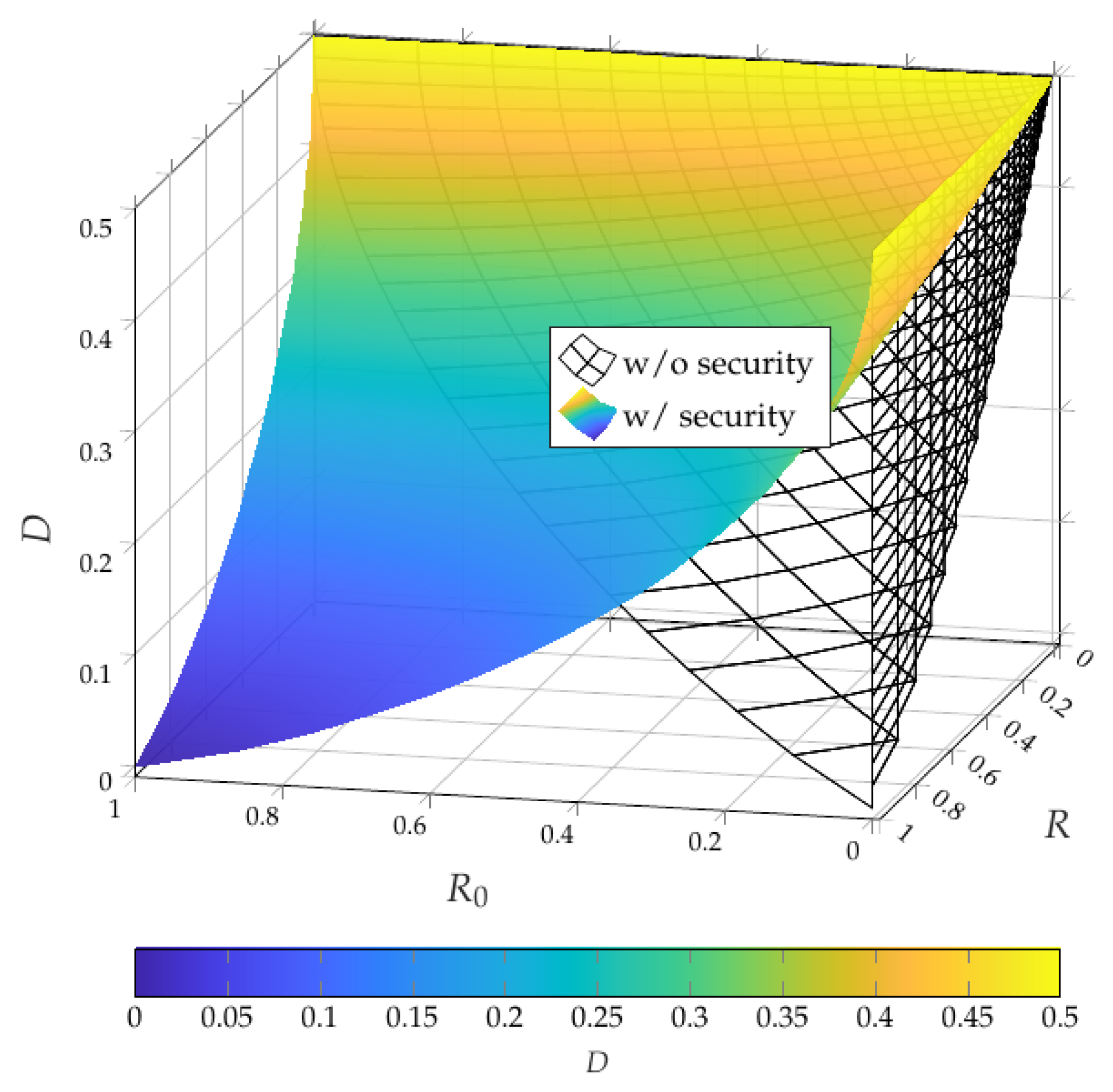
- Consider a binary RDP example to illustrate the significant increase in the required amount of communication and randomness resources when a security constraint is imposed;
- Analyze the resulting rate regions, which includes (i) illustrating significant communication load reductions over classical data compression methods; (ii) identifying the main effects of secrecy constraints on RDP regions; (iii) illustrating significant communication and common-randomness rate gains from available SI; and (iv) highlighting the relationships between non-asymptotic and asymptotic results.
1.2. Paper Organization
1.3. Notation
2. Problem Definitions
- (i)
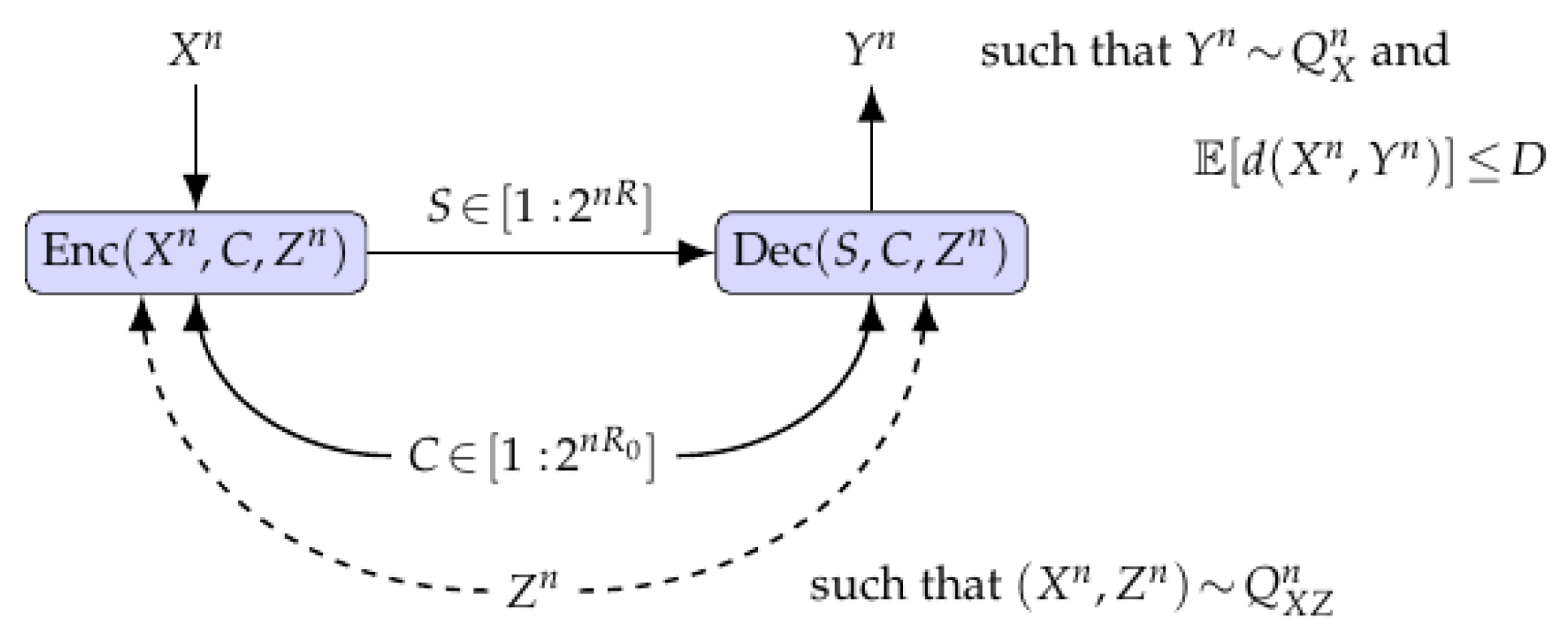
- The induced distribution , where we have , approximates the source distribution ;
- (ii)
- The communication rate R is as small as possible for a given common randomness rate ; and
- (iii)
- The distortion between and is minimized.
3. Main Results
- (i)
- are almost independent of such that we have
- (ii)
- almost recover such that we have
- (iii)
- F is almost independent of such that we have
4. Comparisons and Discussions
5. Conclusions
Author Contributions
Funding
Institutional Review Board Statement
Informed Consent Statement
Data Availability Statement
Acknowledgments
Conflicts of Interest
Abbreviations
| BSC | binary symmetric channel |
| i.i.d. | independent and identically distributed |
| OSRB | output statistics of random binning |
| PLS | physical-layer security |
| RDFC | randomized distributed function computation |
| RDP | rate–distortion–perception |
| SI | side information |
| TV | total variation |
References
- Gündüz, D.; Chiariotti, F.; Huang, K.; Kalør, A.E.; Kobus, S.; Popovski, P. Timely and Massive Communication in 6G: Pragmatics, Learning, and Inference. IEEE BITS Inf. Theory Mag. 2023, 3, 27–40. [Google Scholar] [CrossRef]
- Gündüz, D.; Qin, Z.; Aguerri, I.E.; Dhillon, H.S.; Yang, Z.; Yener, A.; Wong, K.K.; Chae, C.B. Beyond Transmitting Bits: Context, Semantics, and Task-Oriented Communications. IEEE J. Sel. Areas Commun. (JSAC) 2022, 41, 5–41. [Google Scholar] [CrossRef]
- Dobrushin, R.; Tsybakov, B. Information transmission with additional noise. IRE Trans. Inf. Theory (T-IT) 1962, 8, 293–304. [Google Scholar] [CrossRef]
- Berger, T. Rate-distortion Theory. In Wiley Encyclopedia of Telecommunication; Wiley: Hoboken, NJ, USA, 2003. [Google Scholar]
- Csiszár, I.; Körner, J. Information Theory: Coding Theorems for Discrete Memoryless Systems; Cambridge University Press: Cambridge, UK, 2011. [Google Scholar]
- Günlü, O. Randomized Distributed Function Computation with Semantic Communications: Applications to Privacy. In Proceedings of the IEEE International Workshop on Information Forensics and Security (WIFS), Rome, Italy, 2–5 December 2024; pp. 1–6. [Google Scholar]
- Flamich, G.; Havasi, M.; Hernández-Lobato, J.M. Compressing images by encoding their latent representations with relative entropy coding. Adv. Neural Inf. Process. Sys. (NeurIPS) 2020, 33, 16131–16141. [Google Scholar]
- Havasi, M.; Peharz, R.; Hernández-Lobato, J.M. Minimal random code learning: Getting bits back from compressed model parameters. In Proceedings of the International Conference on Learning Representation (ICLR), New Orleans, LA, USA, 6–9 May 2019. [Google Scholar]
- Isik, B.; Pase, F.; Gunduz, D.; Koyejo, S.; Weissman, T.; Zorzi, M. Adaptive compression in federated learning via side information. In Proceedings of the International Conference on Artificial Intelligence and Statistics (AISTATS), Valencia, Spain, 2–4 May 2024. [Google Scholar]
- Hegazy, M.; Leluc, R.; Li, C.T.; Dieuleveut, A. Compression with exact error distribution for federated learning. In Proceedings of the International Conference on Artificial Intelligence and Statistics (AISTATS), Valencia, Spain, 2–4 May 2024. [Google Scholar]
- Shah, A.; Chen, W.N.; Balle, J.; Kairouz, P.; Theis, L. Optimal compression of locally differentially private mechanisms. In Proceedings of the International Conference on Artificial Intelligence Statistics (AISTATS), Virtual, 28–30 March 2022. [Google Scholar]
- Bergström, D.; Günlü, O. Deep randomized distributed function computation (DeepRDFC): Neural distributed channel simulation. In Proceedings of the IEEE International Symposium on Information Theory (ISIT), Ann Arbor, MI, USA, 22–27 June 2025. [Google Scholar]
- Cuff, P. Distributed Channel Synthesis. IEEE Trans. Inf. Theory (T-IT) 2013, 59, 7071–7096. [Google Scholar] [CrossRef]
- Niu, X.; Bai, B.; Guo, N.; Zhang, W.; Han, W. Rate–Distortion–Perception Trade-Off in Information Theory, Generative Models, and Intelligent Communications. Entropy 2025, 27, 373. [Google Scholar] [CrossRef]
- Sayood, K. Introduction to Data Compression, 4th ed.; Morgan Kaufmann: Burlington, MA, USA, 2017. [Google Scholar]
- Günlü, O.; Skorski, M.; Poor, H.V. Low-latency rate-distortion-perception trade-Off: A randomized distributed function computation application. In Proceedings of the 2025 Joint European Conference on Networks and Communications & 6G Summit (EuCNC/6G Summit), Poznan, Poland, 3–6 June2025. [Google Scholar]
- Chen, J.; Yu, L.; Wang, J.; Shi, W.; Ge, Y.; Tong, W. On the rate-distortion-perception function. IEEE J. Sel. Areas Inf. Theory (JSAIT) 2022, 3, 664–673. [Google Scholar] [CrossRef]
- Matsumoto, R. Introducing the perception-distortion tradeoff into the rate-distortion theory of general information sources. IEICE Commun. Express (ComEX) 2018, 7, 427–431. [Google Scholar] [CrossRef]
- Zhang, G.; Qian, J.; Chen, J.; Khisti, A. Universal rate-distortion-perception representations for lossy compression. Adv. Neural Inf. Process. Sys. (NeurIPS) 2021, 34, 11517–11529. [Google Scholar] [CrossRef]
- Blau, Y.; Michaeli, T. Rethinking lossy compression: The rate-distortion-perception tradeoff. In Proceedings of the International Conference on Machine Learning (ICML), Long Beach, CA, USA, 9–15 June 2019; pp. 675–685. [Google Scholar]
- Theis, L.; Wagner, A.B. A coding theorem for the rate-distortion-perception function. In Proceedings of the Neural Compression: From Information Theory to Applications–Workshop@ ICLR, Virtual, 6 May 2021. [Google Scholar]
- Gulrajani, I.; Ahmed, F.; Arjovsky, M.; Dumoulin, V.; Courville, A.C. Improved training of Wasserstein GANs. In Proceedings of the Advances in Neural Information Processing Systems 30 (NIPS 2017), Long Beach, CA, USA, 4–9 December 2017. [Google Scholar]
- Arjovsky, M.; Chintala, S.; Bottou, L. Wasserstein generative adversarial networks. In Proceedings of the InInternational Conference on Machine Learning (ICML), Sydney, Australia, 6–11 August 2017; pp. 214–223. [Google Scholar]
- Goodfellow, I.J.; Pouget-Abadie, J.; Mirza, M.; Xu, B.; Warde-Farley, D.; Ozair, S.; Courville, A.; Bengio, Y. Generative adversarial nets. In Proceedings of the Advances in Neural Information Processing Systems 27 (NIPS 2014), Montreal, QC, Canada, 8–13 December 2014. [Google Scholar]
- Wagner, A.B. The rate-distortion-perception tradeoff: The role of common randomness. arXiv 2022, arXiv:2202.04147. [Google Scholar]
- Hamdi, Y.; Wagner, A.B.; Gündüz, D. The Rate-Distortion-Perception Trade-off: The Role of Private Randomness. arXiv 2024, arXiv:2404.01111. [Google Scholar]
- Bloch, M.; Günlü, O.; Yener, A.; Oggier, F.; Poor, H.V.; Sankar, L.; Schaefer, R.F. An Overview of Information-Theoretic Security and Privacy: Metrics, Limits and Applications. IEEE J. Sel. Areas Inf. Theory (JSAIT) 2021, 2, 5–22. [Google Scholar] [CrossRef]
- Günlü, O.; Bloch, M.; Schaefer, R.F. Secure multi-function computation with private remote sources. In Proceedings of the IEEE International Symposium on Information Theory (ISIT), Melbourne, Australia, 12–20 July 2021; pp. 1403–1408. [Google Scholar]
- Post-Quantum Cryptography. Available online: https://csrc.nist.gov/projects/post-quantum-cryptography (accessed on 21 December 2024).
- Djordjevic, I.B. Physical-Layer Security, Quantum Key Distribution, and Post-Quantum Cryptography. Entropy 2022, 24, 935. [Google Scholar] [CrossRef] [PubMed]
- Kalkhoran, S.A.A.; Letafati, M.; Erdemir, E.; Khalaj, B.H.; Behroozi, H.; Gündüz, D. Secure Deep-JSCC against multiple eavesdroppers. In Proceedings of the IEEE Global Communications Conference (GLOBECOM), Kuala Lumpur, Malaysia, 4–8 December 2023; pp. 3433–3438. [Google Scholar]
- Hamdi, Y.; Wagner, A.B.; Gündüz, D. The Rate-Distortion-Perception Trade-Off with Algorithmic Realism. In Proceedings of the IEEE International Symposium on Information Theory (ISIT), Ann Arbor, MI, USA, 22–27 June 2025; pp. 1–6. [Google Scholar]
- Günlü, O.; Schaefer, R.F.; Poor, H.V. Biometric and Physical Identifiers with Correlated Noise for Controllable Private Authentication. In Proceedings of the IEEE International Symposium on Information Theory, Los Angeles, CA, USA, 21–26 June 2020; pp. 874–878. [Google Scholar]
- Åhlgren, G.; Günlü, O. Secure rate-distortion-perception trade-off over channels: A randomized distributed function computation (RDFC) application. In Proceedings of the IEEE International Symposium on Information Theory (ISIT), Ann Arbor, MI, USA, 22–27 June 2025. [Google Scholar]
- Dziembowski, S.; Faust, S.; Skorski, M. Noisy Leakage Revisited. In Advances in Cryptology-EUROCRYPT 2015; Oswald, E., Fischlin, M., Eds.; Springer: Berlin/Heidelberg, Germany, 2015; Volume 9057, pp. 159–188. [Google Scholar]
- Brian, G.; Faonio, A.; Obremski, M.; Ribeiro, J.; Simkin, M.; Skórski, M.; Venturi, D. The Mother of All Leakages: How to Simulate Noisy Leakages via Bounded Leakage (Almost) for Free. In Advances in Cryptology–EUROCRYPT 2021; Canteaut, A., Standaert, F.X., Eds.; Springer: Cham, Switzerland, 2021; Volume 12697, pp. 408–437. [Google Scholar]
- Wyner, A.D. The Wire-tap Channel. Bell Labs Tech. J. 1975, 54, 1355–1387. [Google Scholar] [CrossRef]
- Polyanskiy, Y.; Poor, H.V.; Verdú, S. Channel Coding Rate in the Finite Blocklength Regime. IEEE Trans. Inf. Theory (T-IT) 2010, 56, 2307–2359. [Google Scholar] [CrossRef]
- Cervia, G.; Oechtering, T.J.; Skoglund, M. (ϵ, n) fixed-length strong coordination capacity. In Proceedings of the IEEE Information Theory Workshop (ITW), Kanazawa, Japan, 17–21 October 2021; pp. 1–6. [Google Scholar]
- Günlü, O.; Bloch, M.; Schaefer, R.F.; Yener, A. Nonasymptotic performance limits of low-latency secure integrated sensing and communication systems. In Proceedings of the IEEE International Conference on Acoustics, Speech and Signal Processing (ICASSP), Seoul, Republic of Korea, 14–19 April 2024; pp. 12971–12975. [Google Scholar]
- Yassaee, M.H.; Aref, M.R.; Gohari, A. A technique for deriving one-shot achievability results in network information theory. In Proceedings of the IEEE International Symposium on Information Theory (ISIT), Istanbul, Turkey, 7–12 July 2013; pp. 1287–1291. [Google Scholar]
- Yassaee, M.H.; Aref, M.R.; Gohari, A. Non-asymptotic output statistics of random binning and its applications. In Proceedings of the IEEE International Symposium on Information Theory (ISIT), Istanbul, Turkey, 7–12 July 2013; pp. 1849–1853. [Google Scholar]
- Kostina, V.; Verdú, S. Fixed-Length Lossy Compression in the Finite Blocklength Regime. IEEE Trans. Inf. Theory 2012, 58, 3309–3338. [Google Scholar] [CrossRef]
- Tan, V.Y.F. Achievable second-order coding rates for the wiretap channel. In Proceedings of the IEEE International Conference on Communication Systems (ICCS), Singapore, 21–23 November 2012; pp. 65–69. [Google Scholar]
- Yassaee, M.H.; Aref, M.R.; Gohari, A. Achievability Proof via Output Statistics of Random Binning. IEEE Trans. Inf. Theory (T-IT) 2014, 60, 6760–6786. [Google Scholar] [CrossRef]
- Renes, J.M.; Renner, R. Noisy Channel Coding via Privacy Amplification and Information Reconciliation. IEEE Trans. Inf. Theory 2011, 57, 7377–7385. [Google Scholar] [CrossRef]
- Hamdi, Y.; Wagner, A.B.; Gündüz, D. Rate-Distortion-Perception Trade-off with Strong Realism Constraints: Role of Side Information and Common Randomness. arXiv 2025, arXiv:2507.14825. [Google Scholar]
- Welling, T.; Günlü, O.; Yener, A. Low-latency secure integrated sensing and communication with transmitter actions. In Proceedings of the IEEE International Workshop on Signal Processin Advances in Wireless Communications (SPAWC), Lucca, Italy, 10–13 September 2024; pp. 351–355. [Google Scholar]
- Gamal, A.E.; Kim, Y.H. Network Information Theory; Cambridge University Press: Cambridge, UK, 2011. [Google Scholar]
- Kramer, G. Multi-User Information Theory; Technical University of Munich: Munich, Germany, 2018. [Google Scholar]
- Saldi, N.; Linder, T.; Yüksel, S. Output Constrained Lossy Source Coding with Limited Common Randomness. IEEE Trans. Inf. Theory (T-IT) 2015, 61, 4984–4998. [Google Scholar] [CrossRef]
- Qian, J.; Salehkalaibar, S.; Chen, J.; Khisti, A.; Yu, W.; Shi, W.; Ge, Y.; Tong, W. Rate-Distortion-Perception Tradeoff for Gaussian Vector Sources. IEEE J. Sel. Areas Inf. Theory (JSAIT) 2025, 6, 1–17. [Google Scholar] [CrossRef]
- Salehkalaibar, S.; Phan, B.; Khisti, A.; Yu, W. Rate-Distortion-Perception Tradeoff Based on the Conditional Perception Measure. In Proceedings of the Biennial Symposium on Communications (BSC), Montreal, QC, Canada, 4–7 July 2023; pp. 31–37. [Google Scholar]
- Verdú, S.; Han, T.S. A general formula for channel capacity. IEEE Trans. Inf. Theory (T-IT) 1994, 40, 1147–1157. [Google Scholar] [CrossRef]


Disclaimer/Publisher’s Note: The statements, opinions and data contained in all publications are solely those of the individual author(s) and contributor(s) and not of MDPI and/or the editor(s). MDPI and/or the editor(s) disclaim responsibility for any injury to people or property resulting from any ideas, methods, instructions or products referred to in the content. |
© 2026 by the authors. Licensee MDPI, Basel, Switzerland. This article is an open access article distributed under the terms and conditions of the Creative Commons Attribution (CC BY) license.
Share and Cite
Günlü, O.; Skorski, M.; Poor, H.V. Low-Latency Realism Through Randomized Distributed Function Computations: A Shannon Theoretic Approach. Entropy 2026, 28, 86. https://doi.org/10.3390/e28010086
Günlü O, Skorski M, Poor HV. Low-Latency Realism Through Randomized Distributed Function Computations: A Shannon Theoretic Approach. Entropy. 2026; 28(1):86. https://doi.org/10.3390/e28010086
Chicago/Turabian StyleGünlü, Onur, Maciej Skorski, and H. Vincent Poor. 2026. "Low-Latency Realism Through Randomized Distributed Function Computations: A Shannon Theoretic Approach" Entropy 28, no. 1: 86. https://doi.org/10.3390/e28010086
APA StyleGünlü, O., Skorski, M., & Poor, H. V. (2026). Low-Latency Realism Through Randomized Distributed Function Computations: A Shannon Theoretic Approach. Entropy, 28(1), 86. https://doi.org/10.3390/e28010086