You are currently viewing a new version of our website. To view the old version click .
Entropy
  • Article
  • Open Access

19 March 2025

Generative Large Model-Driven Methodology for Color Matching and Shape Design in IP Products

,
and
1
Department of Product Design, Dalian Polytechnic University, Dalian 116034, China
2
Department of Industrial Design, Dalian University of Technology, Dalian 116024, China
3
Department of Industrial Design, National Cheng Kung University, Tainan 70101, Taiwan
*
Author to whom correspondence should be addressed.
This article belongs to the Section Multidisciplinary Applications

Abstract

The rise in generative large models has gradually influenced traditional product design processes, with AI-generated content (AIGC) playing an increasingly significant role. Globally, tourism IP cultural products are crucial for promoting sustainable tourism development. However, there is a lack of practical design methodologies incorporating generative large models for tourism IP cultural products. Therefore, this study proposes a methodology for the color matching and shape design of tourism IP cultural products using multimodal generative large models. The process includes four phases, as follows: (1) GPT-4o is used to explore visitors’ emotional needs and identify target imagery; (2) Midjourney generates shape options that align with the target imagery, and the optimal shape is selected through quadratic curvature entropy method based on shape curves; (3) Midjourney generates colored images reflecting the target imagery, and representative colors are selected using AHP and OpenCV; and (4) color harmony calculations are used to identify the best color combination. These alternatives are evaluated quantitatively and qualitatively using a color-matching aesthetic measurement formula and a sensibility questionnaire. The effectiveness of the methodology is demonstrated through a case study on the harbor seal, showing a strong correlation between quantitative and qualitative evaluations, confirming its effectiveness in tourism IP product design.

1. Introduction

With the advancement of intelligent manufacturing technologies, products have become increasingly homogeneous in terms of processes, functions, and performance, while exhibiting greater diversity in visual aesthetic features such as color matching, shape, material, texture, and pattern [1,2,3]. Many scholars argue that products with visual aesthetics that align with consumers’ emotional needs are more likely to attract attention and stimulate purchasing desire, ultimately boosting sales [4,5,6]. Therefore, regardless of the product type, visual aesthetic features should be given significant consideration during the product development phase. Among various visual aesthetic features, shape and color matching are the two core design characteristics in product development [3,7]. For years, both academia and industry have commonly employed Kansei engineering to establish models that link consumers’ emotional needs with product design features, aiming to translate abstract emotional demands into tangible product shapes and color-matching schemes [8,9].
Regarding Kansei design for product shape, Lo et al. [10] used six form aesthetic-related Kansei words as evaluation indicators and combined genetic algorithms with fuzzy theory to create a shape design and evaluation method. Liu et al. [11] proposed a methodology for the shape design of cultural and creative products based on Kansei engineering, factor analysis, and triangular fuzzy numbers. Zhou et al. [12] introduced a car frontal form design and evaluation method using Kansei engineering and convolutional neural networks. Recently, Wu et al. [13] developed an intelligent design system that uses generative adversarial networks to transform product hand-drawn sketches into designs that match the target imagery. Yuan et al. [6] established an aesthetic measurement evaluation index consisting of eight form aesthetics Kansei words, and combined Kansei engineering, genetic algorithms, and eye-tracking technology to propose a design method for automotive forms. Lu et al. [14] introduced an improved form aesthetic quantification formula and combined it with Kansei engineering and the finite structure method to propose a product shape design and evaluation method.
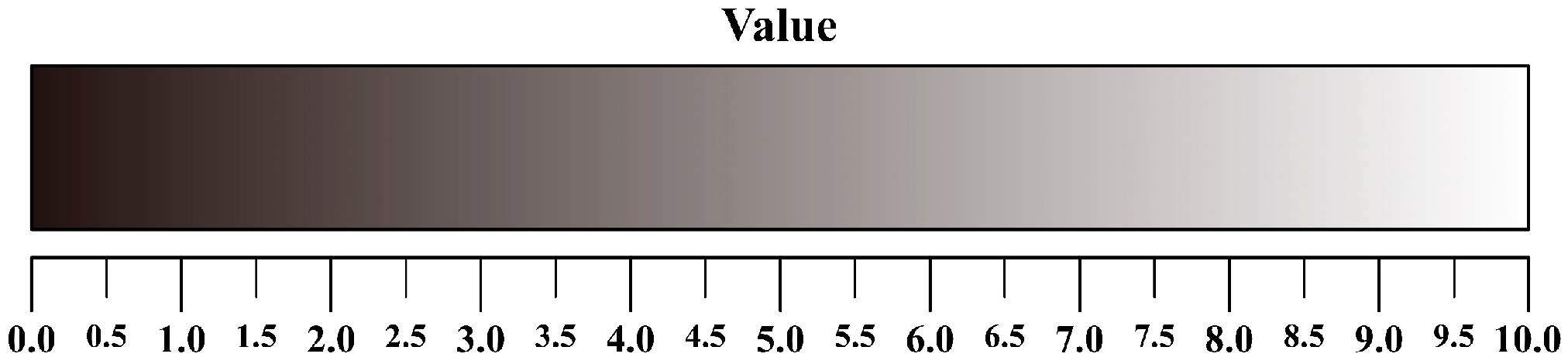
In addition, regarding Kansei design for product color matching, Tsai and Chou [15] proposed a color-matching design method for two-color combination products based on Kansei engineering, color harmony, color association, and genetic algorithms. Hsiao et al. [16] developed a model for quantifying product color-matching aesthetics based on parameters such as hue, value, chroma, and the area of colored regions. This model addressed imagery adjective-guided product color-matching design and was applied to the Kansei design of products [17]. Moreover, Hsiao and Tsai [18] suggested that the color imageries found in colored images (e.g., natural images and works of famous painters) could be transferred to product color matching in Kansei design. They developed a color-matching design system based on Kansei engineering and fuzzy theory, demonstrating its feasibility. Recently, Lu and Hsiao [3] expanded the feasibility of the product color-matching aesthetics quantification model and Kansei design by considering the impact of different observation angles on product color matching. Wu et al. [7] proposed three methodologies to extract colors from natural images for product color matching, utilizing Kansei engineering, AIGC, and color harmony theory. Table 1 presents a concise comparison of the key characteristics of these studies. In these studies, combining Kansei engineering with product color matching and shape design, imagery adjectives are commonly used as a medium to build models linking consumer emotional needs with product design features.
Table 1. Several studies on the Kansei design of product shape and color matching.
In recent years, with the development of artificial intelligence, and big data processing, scholars have constructed generative models to address various specific design problems using machine learning techniques like genetic algorithms and neural networks [13,19,20]. Recently, many emerging tech companies have developed various generative large models based on deep learning networks, such as CNNs, GANs, diffusion models, and transformer models. Specifically, generative large models can be categorized based on different types of generated content (i.e., artificial intelligence generated content, AIGC), including text, image, audio, and video generative models [7]. Currently, the most popular text generative large model globally is ChatGPT (https://chatgpt.com/), with its latest version updated to GPT-4.5 as of March 2025. Due to its use of large language models (LLMs) and advanced natural language processing techniques during training, ChatGPT is capable of handling complex text generation tasks such as writing, translation, programming, and text analysis [21,22].
In addition, Midjourney, Stable Diffusion, and DALL-E are considered the leading image generative large models internationally [23,24,25]. These models are trained using millions of text-to-image examples and complex deep learning networks, enabling them to generate creative and high-quality images. Since the emergence of generative large models, many scholars have actively applied them to product design. Lu et al. [9] proposed an automotive shape design method based on ChatGPT, Midjourney, and Stable Diffusion, demonstrating the feasibility of collaboration between generative large models and Kansei engineering. The results showed that generative large models can not only understand abstract user needs but also translate imagery adjectives into concrete product shapes. Wu et al. [7] proposed several color-matching design methods for household vacuum cleaners based on ChatGPT and Midjourney. The findings revealed that Midjourney could generate colored images that align with the imagery adjectives, providing effective color combinations for target imagery-oriented color design. Du et al. [26] introduced a Kansei design approach for product shape design based on the 2D sketch-to-3D rendering capability of Stable Diffusion, illustrating the effectiveness of the LoRA model (i.e., stylization model) in optimizing design efficiency. Wang et al. [27] used Midjourney to generate a large number of forms for reference in designing female electric scooter shapes, enhancing the efficiency of product shape design. Wang et al. [28] explored the feasibility of applying Midjourney to Ming Dynasty furniture design, paving a new path for the innovative design of furniture shapes. These studies have demonstrated that generative large models positively contribute to product color matching and shape design, optimizing traditional design processes and improving design efficiency.
Based on the aforementioned research background, the motivations for this study are as follows: (1) Although many scholars recognize that color matching [6,10,11,12,13,14] and shape [15,16,17,18] are the two core design features in product development, and various methodologies for color matching or shape design have been proposed based on Kansei engineering, few have addressed both target imagery-oriented color matching and shape design simultaneously [3,7]. Therefore, achieving consistency between color matching and shape toward the same target imagery during product development can significantly enhance the efficiency of Kansei design. (2) Recently, although several scholars have demonstrated the contribution of generative large models to improving product design efficiency through case studies [26,27,28], there is still a lack of examples showcasing collaboration among multiple generative large models. Therefore, presenting a case involving the collaboration of multiple generative large models would help inspire product designers to explore more flexible uses of generative models. (3) In the existing research, whether it is color matching design [7] or shape design [9,26,27,28] based on generative large models, the importance of evaluating the aesthetics of generated content has not been emphasized, nor have practical quantitative methods for aesthetic evaluation been provided to select the optimal shape or color combinations. Therefore, incorporating scientifically valid quantitative aesthetic evaluation methods would enhance the rigor and usability of design methodologies.
In summary, this study integrates the text-generative large model ChatGPT, the image-generative large model Midjourney, color harmony theory, and quantitative evaluation of shape and color matching to propose a design methodology that considers both product color and shape. Given the importance of tourism IP cultural products in promoting sustainable tourism development, this study uses the color matching and shape design of the Harbor Seal IP cultural product in Dalian as a case study. The structure of this paper is as follows: Section 2 introduces the theories and research methods used in this study. Section 3 presents the implementation steps of the generative large model-driven methodology. In Section 4, the Harbor Seal IP cultural product from Dalian is used as an example to demonstrate the proposed design methodology in detail and confirm its effectiveness. Section 5 discusses the research results and analyzes this study’s limitations. Finally, the conclusion highlights the theoretical and practical contributions made by this study.

3. Implementation Procedures

3.1. Defining the Design Problem and Clarifying the Research Objectives

Tourism IP cultural products are goods developed based on intellectual property for specific tourist regions, attractions, or events, and have become an essential force in promoting tourism economic growth and cultural dissemination [43]. Hayden and Dills [44] suggested that tourism IP cultural products are diverse in form, which can be categorized as characters, animals, and symbolic objects. Su and Li [45] pointed out that tourism IP cultural products not only enrich visitors’ experiences but also enhance the development of the local tourism retail industry. Xu et al. [46] argued that high-quality tourism IP cultural products can create a tangible impression of attractions for tourists and contribute to tourism development. Specifically, tourism IP cultural products help convey local culture to visitors and encourage interaction [47]. Notable international examples include the “Bing Dwen Dwen” tourism IP cultural product from the Beijing 2022 Winter Olympics, which attracted significant attention from both domestic and international tourists [48], and the “Kumamon” tourism IP cultural product from Kumamoto City, which drew a large number of visitors [49].
Scholars have recently proposed various design methods to create appealing tourism IP cultural products. Liu et al. [11] proposed a design method for IP cultural products based on Kansei engineering and fuzzy theory. Kang and Nagasawa [50] developed a strategy for optimizing IP cultural product design using Kansei engineering and an interactive genetic algorithm. Liu et al. [51] emphasized that in developing tourism IP cultural products, it is essential not only to integrate local cultural characteristics but also to meet the diverse emotional needs of tourists. In these studies, imagery adjectives are often used to establish models that link tourists’ emotional data with IP cultural product design features, specifically color matching and shape. Additionally, as previously discussed, GLMs are increasingly becoming a new productivity tool in product design. Therefore, to promote tourism development, it is necessary to propose a design methodology for color matching and shape of tourism IP cultural products using GLMs. The research objectives for this design problem are as follows: (1) to propose a Kansei design methodology for tourism IP cultural products that integrates color matching and shape based on GLMs, thereby enhancing the efficiency of Kansei design for tourism IP cultural products; (2) to present a design case involving the collaboration of multimodal GLMs to inspire tourism IP cultural product designers to consider the efficient use of GLMs; and (3) to propose a quantitative evaluation method for GLM-generated content to improve the rigor and practicality of the GLMs-driven design methodology for tourism IP cultural products.

3.2. Planning the Implementation Procedures for the Design Methodology

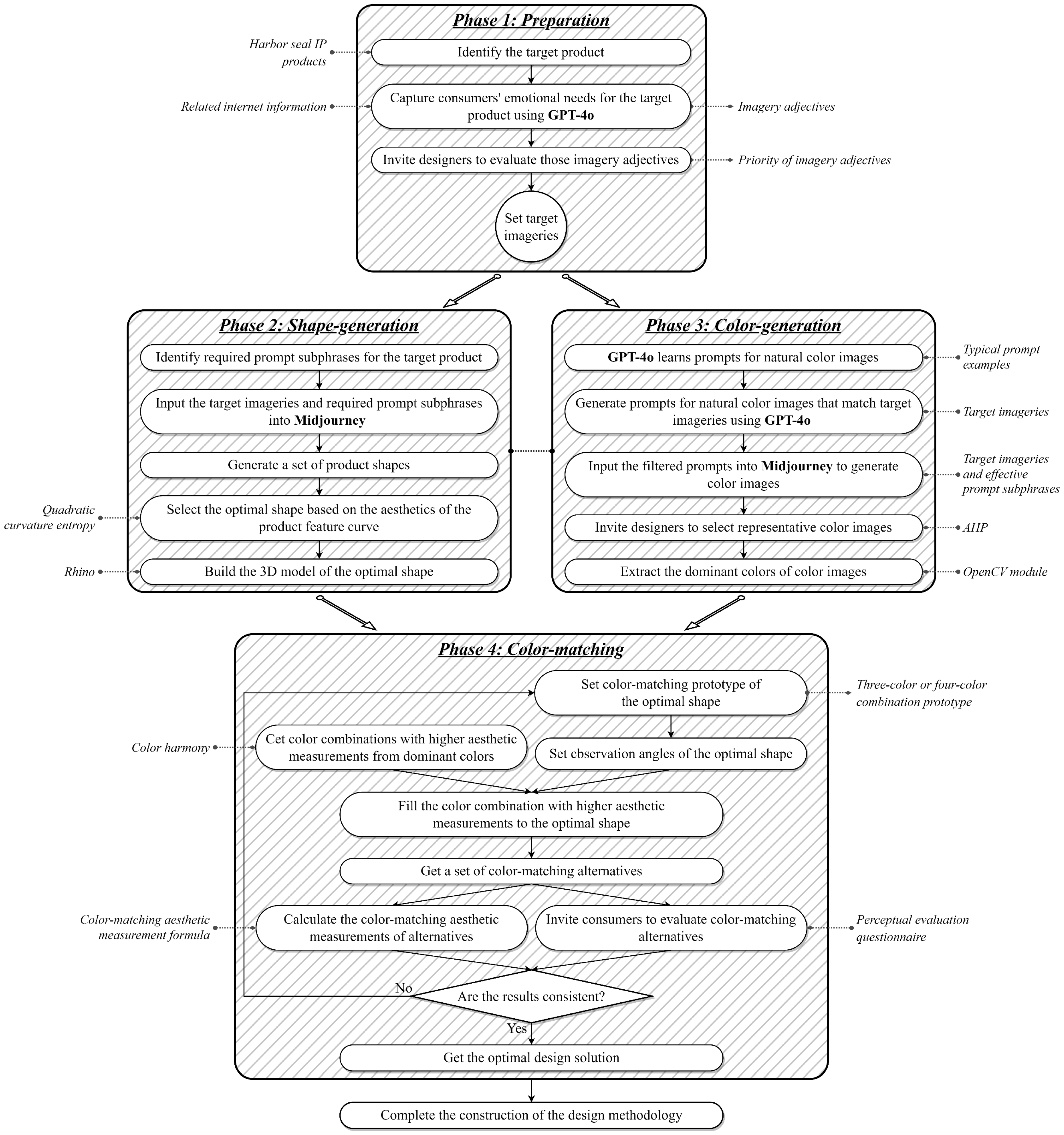
Dalian is a well-known coastal tourist city in China. The harbor seal, a unique marine species in Dalian, is also a Class I protected animal in China. Every year, a large number of tourists from both domestic and international locations visit Dalian to see the harbor seals. Therefore, this study takes the design of Harbor Seal IP cultural products as a case study to demonstrate the implementation procedures of the proposed design methodology and validate its effectiveness. Specifically, drawing on the theories and methodologies discussed in Section 2, this study integrates text-GLM, image-GLM, color harmony, color-matching aesthetic measurement, and quadratic curvature entropy to propose a design methodology consisting of the following four phases: preparation (Phase 1), shape generation (Phase 2), color generation (Phase 3), and color matching (Phase 4). Using the harbor seal as an example, the visual implementation process is illustrated in Figure 4, and the generalized implementation procedures are described as follows.
Figure 4. Flowchart of the generative large model-driven design methodology.

3.2.1. Preparation (Phase 1)

Step 1: Define the target product and summarize consumers’ emotional needs into imagery adjectives using GPT-4o. First, select a symbolic or well-known object from a specific tourist region as the design prototype of an IP cultural product, and consider the evolved IP product as the target product. Then, collect online information about the target product and send its web links as prompts to GPT-4o. Finally, instruct GPT-4o to browse the web links and summarize the positive reviews of the target product into imagery adjectives. In practice, reviews of the target product can be obtained from online forums, special reports, and user comments.
Step 2: Evaluate the imagery adjectives and select the target imagery. Invite designers to participate in evaluating the imagery adjectives summarized by GPT-4o in Step 1 using a perceptual evaluation questionnaire. The evaluation criterion is whether each adjective is suitable as an imagery adjective to describe the target IP product. Based on reliability and validity analysis, prioritize the imagery adjectives according to the questionnaire results and set those with higher scores as the target imagery.

3.2.2. Shape Generation (Phase 2)

Step 3: Generate numerous shapes that match the target imagery using Midjourney. First, use prompt engineering to define the required prompt subphrases for the target IP product. Typically, to use Midjourney to generate shapes that meet user expectations, essential prompt subphrases such as the target object, style type, and observation angle must be provided. Then, set the imagery adjectives as key prompt subphrases and position them as much as possible at the beginning of the prompt. Finally, merge the required prompt subphrases with the key prompt subphrases into a full prompt, then enter it into Midjourney using the “/imagine” command to generate shapes corresponding to the target imagery. The same prompt can be run multiple times to obtain a large number of effective shapes. In addition, to minimize the impact of other abstract terms on the generated shapes, other prompt subphrases should not contain any imagery tendencies.
Step 4: Select the optimal shape using QCE and construct its 3D model. First, invite designers to rate the shapes generated in Step 3 based on the target imagery, thereby selecting typical product shapes. Next, draw the main feature curves of the shape using cubic Bézier curves. Then, calculate the QCE for each feature curve based on the macroscopic aesthetic evaluation method described in Section 2.3. Finally, the shape with the lowest QCE is selected as optimal, and its 3D model is constructed using the Rhino CAD tool. Moreover, when creating the 3D model, the shape’s ergonomics and dimensions should be further optimized and adjusted, considering the product type.

3.2.3. Color Generation (Phase 3)

Step 5: Generate prompts for natural color images using GPT-4o based on prompt examples and select effective prompt subphrases. First, collect quality prompt examples for natural color images from the Discord platform and the Promptalot website. Then, instruct GPT-4o to learn from the collected prompt examples and generate several new prompts that match the target imagery. Finally, select effective prompt subphrases from the generated prompts. Additionally, Midjourney’s “/describe” command can convert natural color images into prompt examples, serving as learning examples for GPT-4o.
Step 6: Generate numerous natural color images using Midjourney and select representative images based on the analytic hierarchy process (AHP). Input the effective prompt subphrases and key prompt subphrases (i.e., target imageries) into Midjourney’s “/imagine” command. Running the prompt multiple times will generate numerous natural color images. Subsequently, invite designers to use AHP to select representative color images from the generated images based on the target imagery.
Step 7: Use the OpenCV module to extract the dominant colors from the representative color images. Write an interactive program with the OpenCV module in Python to extract colors from the images. Input the color images into the program to obtain the dominant colors. Specifically, the program calculates the area occupied by each color and identifies the colors with the largest areas as the dominant colors.

3.2.4. Color Matching (Phase 4)

Step 8: Define the color-matching prototype and observation angles for the optimal shape. Divide the coloring areas based on factors such as the target product’s functional characteristics, shape structure, material, and surface treatment process, thereby forming a color-matching prototype. The color-matching prototype specifies the number of colors used in the color-matching scheme. In addition, suitable observation angles must be set for the target product to facilitate subsequent aesthetic measurements of color matching. The observation angles should reveal as much of the shape information as possible. In practice, different color-matching prototypes and multiple observation angles can be set for the target product.
Step 9: Calculate aesthetically pleasing color combinations from the dominant colors based on color harmony. The color-matching prototype set in Step 8 determines the number of colors in the combination (e.g., three-color or four-color combination). Then, use a pseudorandom approach to reorganize the dominant colors obtained in Step 7 into a series of color combinations. Finally, calculate the aesthetic measurements for all color combinations using Equations (1) to (3) described in Section 2.2.1, and select the combinations with higher aesthetic values.
Step 10: Generate a collection of color-matching alternatives. Fill the color combinations with higher aesthetic values obtained in Step 9 into the color-matching prototype set in Step 8 to obtain a collection of color-matching alternatives. When filling the colors, some basic visual aesthetic principles should be followed, such as placing colors with lower value at the bottom coloring area to create visual stability.
Step 11: Evaluate the alternatives using the color-matching aesthetic quantification formula and a perceptual evaluation questionnaire. Following the calculation steps outlined in Section 2.2.2, apply Equations (4) to (7) to determine the aesthetic measurements of color matching for the alternatives. Additionally, consumers will be invited to evaluate alternatives based on target imagery through a perceptual evaluation survey. In practice, an interactive calculation program can be developed to improve the efficiency of calculating the aesthetic measurements of color matching.
Step 12: Conduct a correlation analysis of the evaluation results and select the optimal design solution. Use Pearson correlation analysis to assess the relationship between the two sets of evaluation results obtained in Step 11. If the correlation is significant, the alternative with the highest score is chosen as the optimal design solution. Otherwise, analyze other potential factors influencing the evaluation results and return to the initial step of this phase.

4. Case Study

Following the implementation steps planned in Section 3.2 and the visual implementation process (Figure 4), this section uses the Harbor Seal IP cultural product design as a case study to address the design problem defined in Section 3.1 and achieve the proposed research objectives.

4.1. Phase 1: Preparation

4.1.1. Capturing Consumers’ Emotional Needs for Harbor Seal IP Products

News’ reports and comments related to the harbor seal were collected from online sources (i.e., special reports and social media) and their links were sent to GPT-4o. GPT-4o was then instructed to analyze the positive content of these online comments and summarize them into abstract adjectives. These adjectives represent tourists’ emotional perceptions of the harbor seal and can be used as references for designing the harbor seal IP product. Specifically, these adjectives serve as the basis for Kansei design of the product’s shape and color matching. GPT-4o ultimately summarized 14 imagery adjectives, namely, dreamy, healing, cute, noble, unique, delicate, dazzling, attractive, cyberpunk, girly, lively, artistic, interesting, and technological.

4.1.2. Setting Target Imageries for Harbor Seal IP Products

Shape and color matching are essential aspects of the design features for IP products. To select suitable adjectives from the 14 imagery adjectives describing the shape and color matching of harbor seal IP products, 20 product designers were asked to assess these adjectives. The evaluation criterion was whether each adjective was appropriate for describing the shape and color matching of the harbor seal IP product, rated on a scale from 0 to 1. The average score from all designers was taken as the effective score, and the top seven adjectives are shown in Table 3. Statistical analysis showed a Cronbach’s α of 0.85, indicating reliable questionnaire results. In this study, the top two adjectives were selected as the target imageries for the Harbor Seal IP product, namely healing and cyberpunk.
Table 3. The top seven imagery adjectives.

4.2. Phase 2: Shape Generation

4.2.1. Setting Prompt for Harbor Seal IP Products

The Harbor Seal IP product prompt consisted of required prompt subphrases and key prompt subphrases. The required prompt subphrases included the harbor seal IP product, style type, and observation angle, while the key prompt subphrases were the target imageries of healing and cyberpunk. As Midjourney prioritizes prompt subphrases that appeared earlier, the key prompt subphrases were placed in the second position. Additionally, the aspect ratio of the output image was set to 3:4, and the model type used was “niji”. The complete prompt was the following: {Harbor Seal IP product, healing/cyberpunk, blind box, POP MART, C4D, front view, high quality, 8K, white background, no color --ar 3:4 --niji 5 --style expressive}.

4.2.2. Generating Harbor Seal IP Shapes Corresponding to Target Imageries

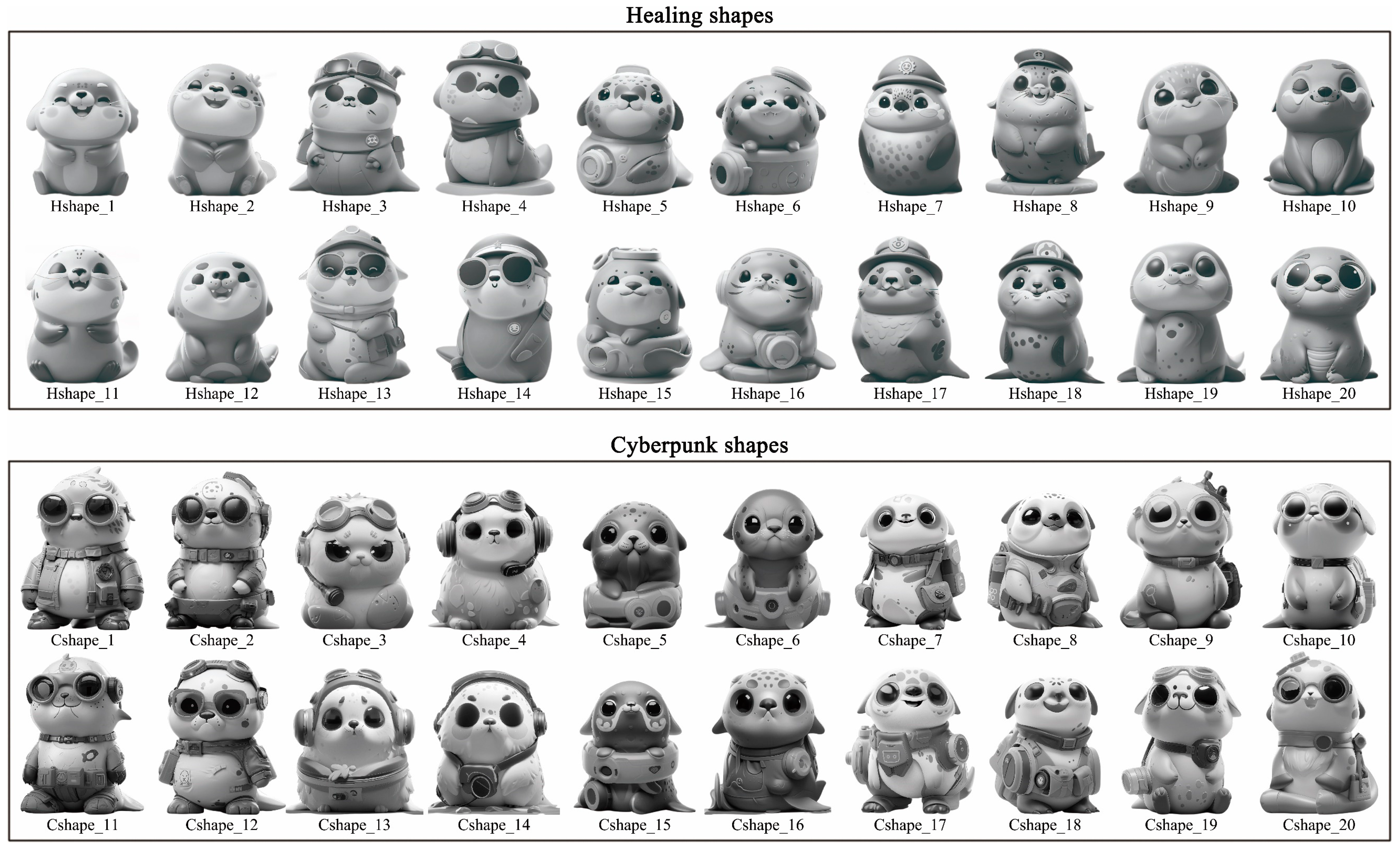
The prompt was entered into Midjourney’s “/imagine” command to generate harbor seal IP product shapes reflecting the target imageries (i.e., healing and cyberpunk). After multiple runs, 20 shapes were created for each target imagery, as illustrated in Figure 5. Hshape_1 to Hshape_20 represent the healing shapes, while Cshape_1 to Cshape_20 represent the cyberpunk shapes. Subsequently, to select shapes that accurately correspond to the target imageries, 20 product designers were invited to evaluate the generated shapes based on the target imagery and select 10 typical shapes. Statistical analysis showed that the top 10 healing shapes were Hshape_1, Hshape_2, Hshape_6, Hshape_7, Hshape_9, Hshape_10, Hshape_11, Hshape_16, Hshape_19, and Hshape_20, while the top 10 cyberpunk shapes were Cshape_1, Cshape_2, Cshape_4, Cshape_5, Cshape_6, Cshape_8, Cshape_14, Cshape_17, Cshape_18, and Cshape_20.
Figure 5. An interface for generating Harbor Seal IP shapes using Midjourney.

4.2.3. Selecting the Optimal Shape Based on Macroscopic Aesthetic Evaluation of Shape Curves

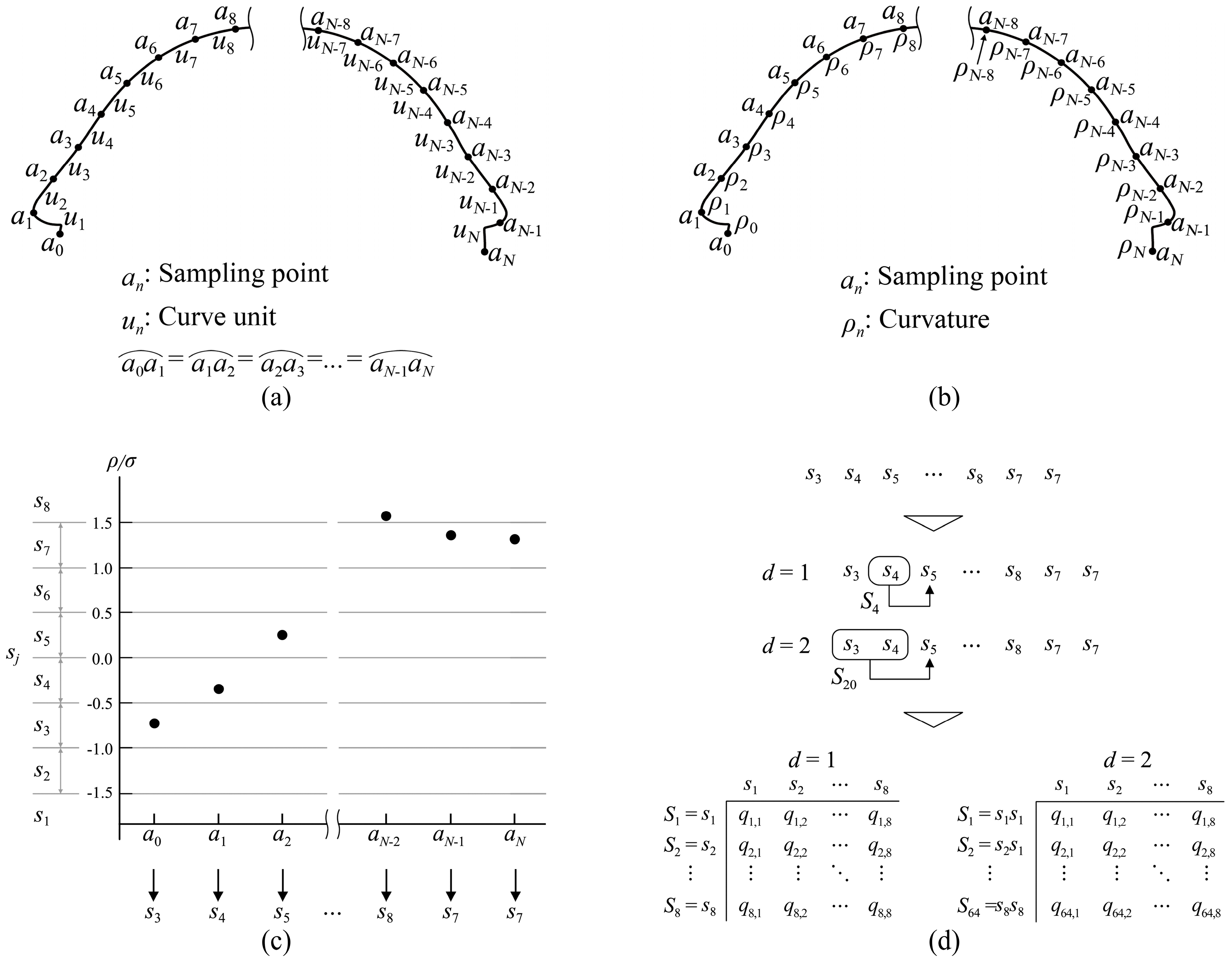
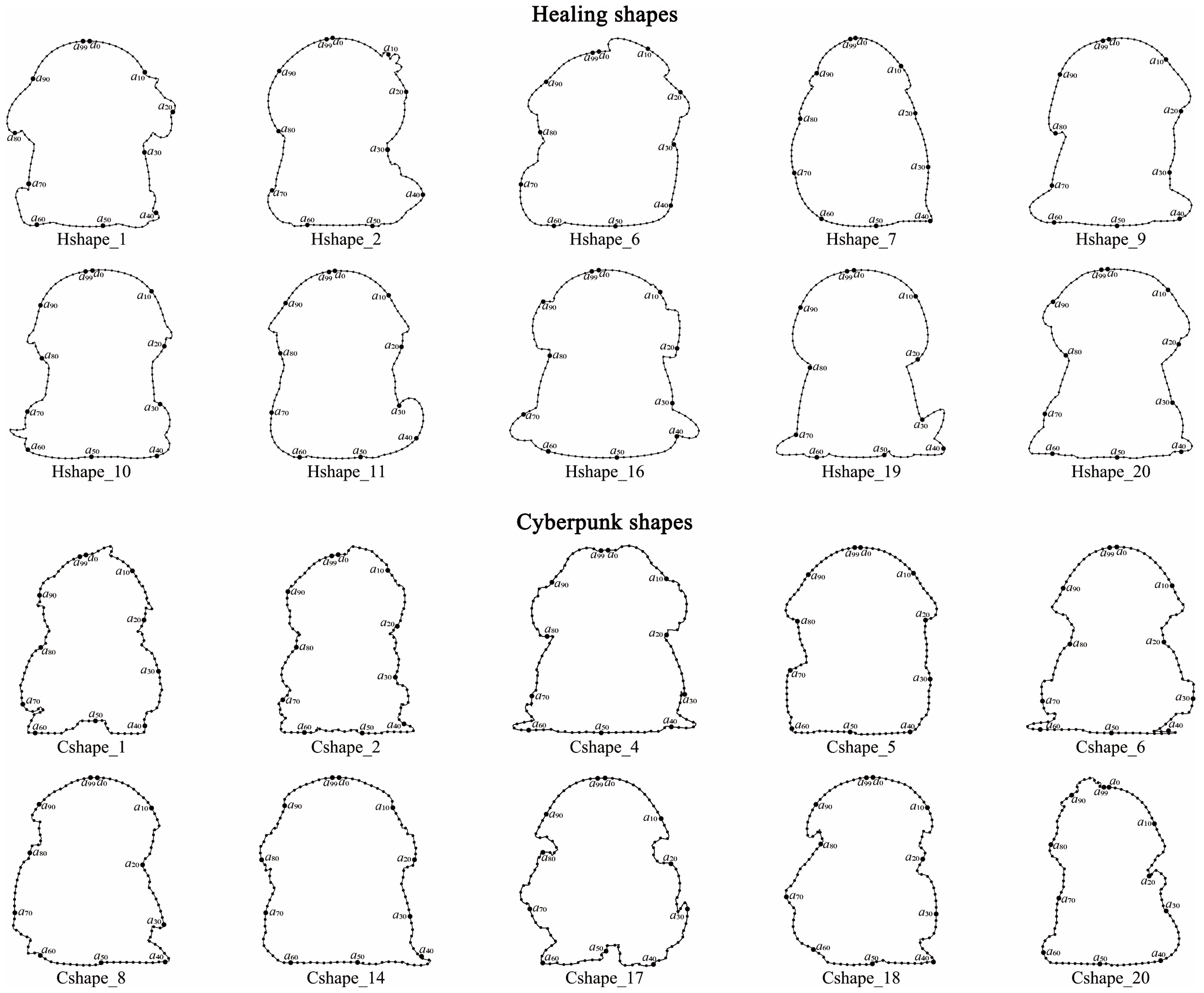
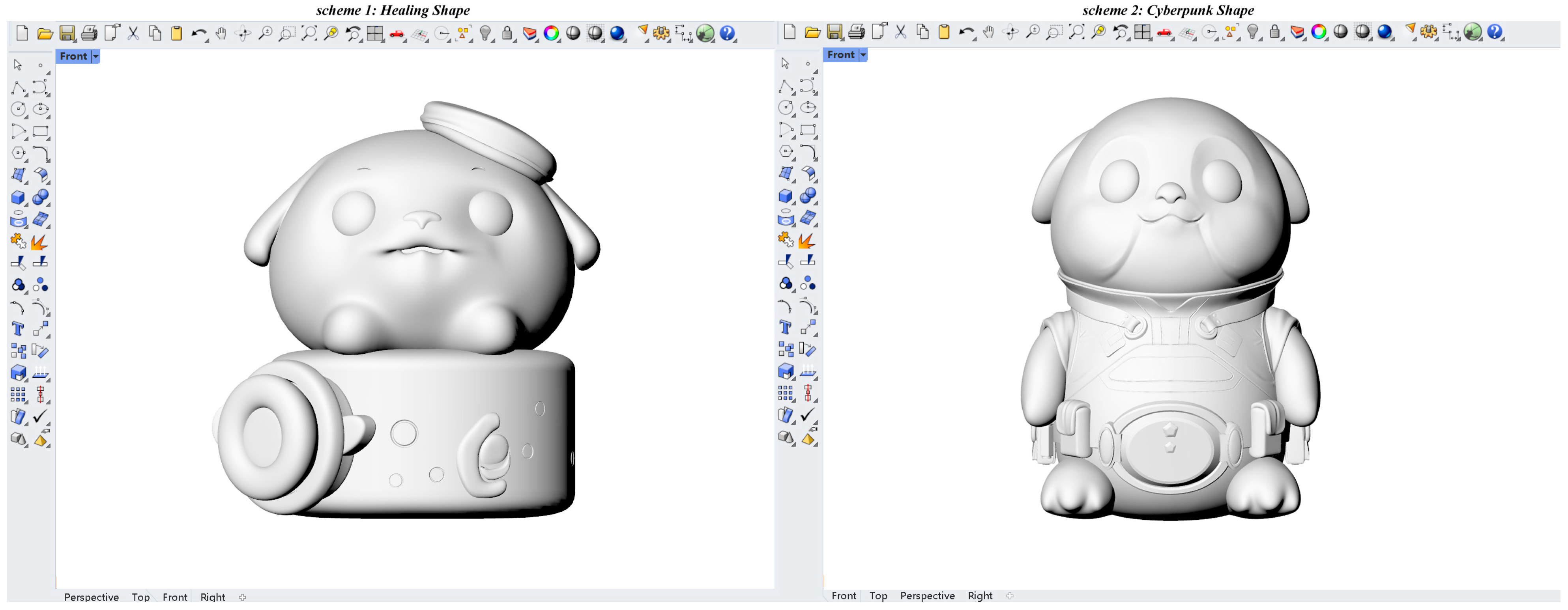
In the previous section, 10 typical shapes were selected from 20 shapes for each target imagery. This section aims to select the shape with the highest aesthetic value as the optimal shape based on the macroscopic aesthetics of shape curves. First, the feature curves of the 10 typical shapes were drawn using differentiable cubic Bézier curves. Second, each feature curve was divided into 100 equal curve units using 100 sampling points (see Figure 6). Finally, the entropy value of each feature curve was calculated based on the QCE calculation steps described in Section 2.3 and Equation (10), as shown in Table 4. The results indicated that the healing shape Hshape_6 had the lowest entropy value (HQC = 0.241), while the cyberpunk shape Cshape_8 had the lowest entropy value (HQC = 0.278). Therefore, Hshape_6 and Cshape_8 were considered the optimal shapes. Additionally, since the entropy value of Hshape_19 was only 0.001 higher than that of Hshape_6, it can be considered a reserve option for the optimal healing shape in practical applications. Subsequently, 3D models were constructed for Hshape_6 and Cshape_8 using Rhino, with optimization of ergonomic dimensions. The 3D models of the two optimal shapes are shown in Figure 7.
Figure 6. Feature curves of healing and cyberpunk shapes.
Table 4. QCE values for healing and cyberpunk shapes.
Figure 7. The three-dimensional models of the two optimal shape schemes.

4.3. Phase 3: Color Generation

4.3.1. Generating Natural Color Images Corresponding to Target Imageries

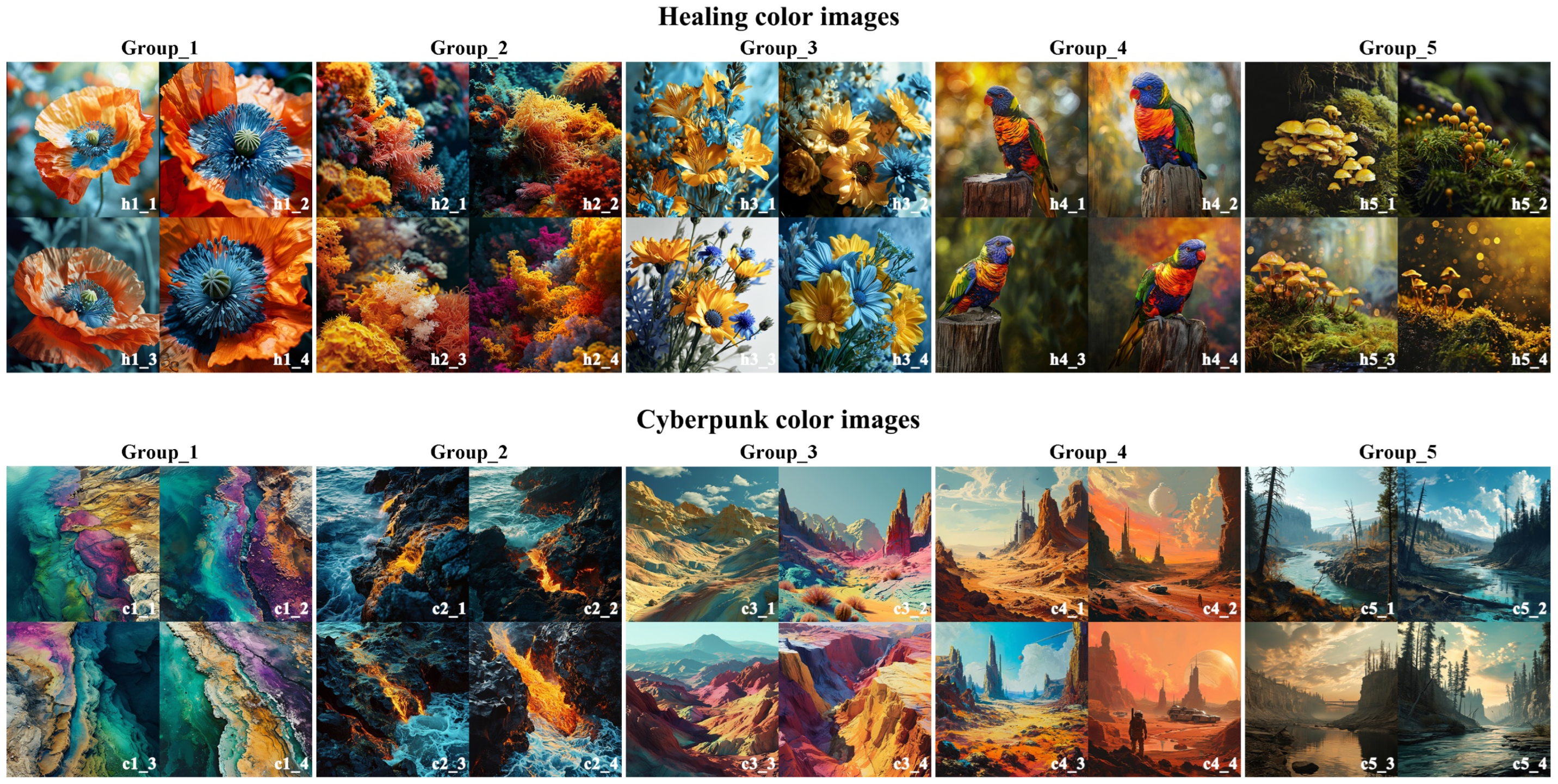
In this section, natural color images corresponding to the target imageries were generated through collaboration between a text-GLM (i.e., GPT-4o) and an image-GLM (i.e., Midjourney). First, quality prompt examples for natural color images were collected from various open prompt-generation platforms. Additionally, high-quality natural color images were converted into prompt examples using the “/describe” command in Midjourney. Second, the collected prompt examples were provided to GPT-4o to learn the structure and phrasing of these prompts. A total of 24 prompt examples were gathered. Third, GPT-4o was instructed to generate five new prompts for natural color images corresponding to the target imageries based on the 24 prompt examples. Effective prompt subphrases were then selected from the generated prompts and, together with the target imageries, were input into Midjourney’s “/imagine” command to generate five sets of natural color images (see Figure 8).
Figure 8. Healing and cyberpunk color images generated by Midjourney.

4.3.2. Selecting Representative Natural Color Images Based on AHP

This section selected representative natural color images from Figure 8 using the AHP. First, 12 designers were invited to construct pairwise comparison matrices between the five sets of natural color images for each target imagery, using the target imagery as the evaluation criterion, as shown in Table 5 and Table 6. Among the five sets for the healing imagery, group_3 had the highest weight, making it the optimal group. Among the five sets for the cyberpunk imagery, group_4 had the highest weight, making it the optimal group. Second, designers were again invited to construct pairwise comparison matrices for the four color images in group_3 of the healing color images and group_4 of the cyberpunk color images, using the target imagery as the evaluation criterion, as shown in Table 7 and Table 8. In group_3 of the healing color images, h3_1 had the highest weight, making it the representative color image. In group_4 of the cyberpunk color images, c4_3 had the highest weight, making it the representative color image. Consistency checks showed that all consistency ratio (C.R.) values for the pairwise comparison matrices were less than 0.1, indicating acceptable evaluation results.
Table 5. Pairwise comparison matrix of the five groups of healing color images.
Table 6. Pairwise comparison matrix of the five groups of cyberpunk color images.
Table 7. Pairwise comparison matrix of the four color images in the group_3 of healing color images.
Table 8. Pairwise comparison matrix of the four color images in the group_4 of cyberpunk color images.

4.3.3. Extracting Dominant Colors from Representative Color Images

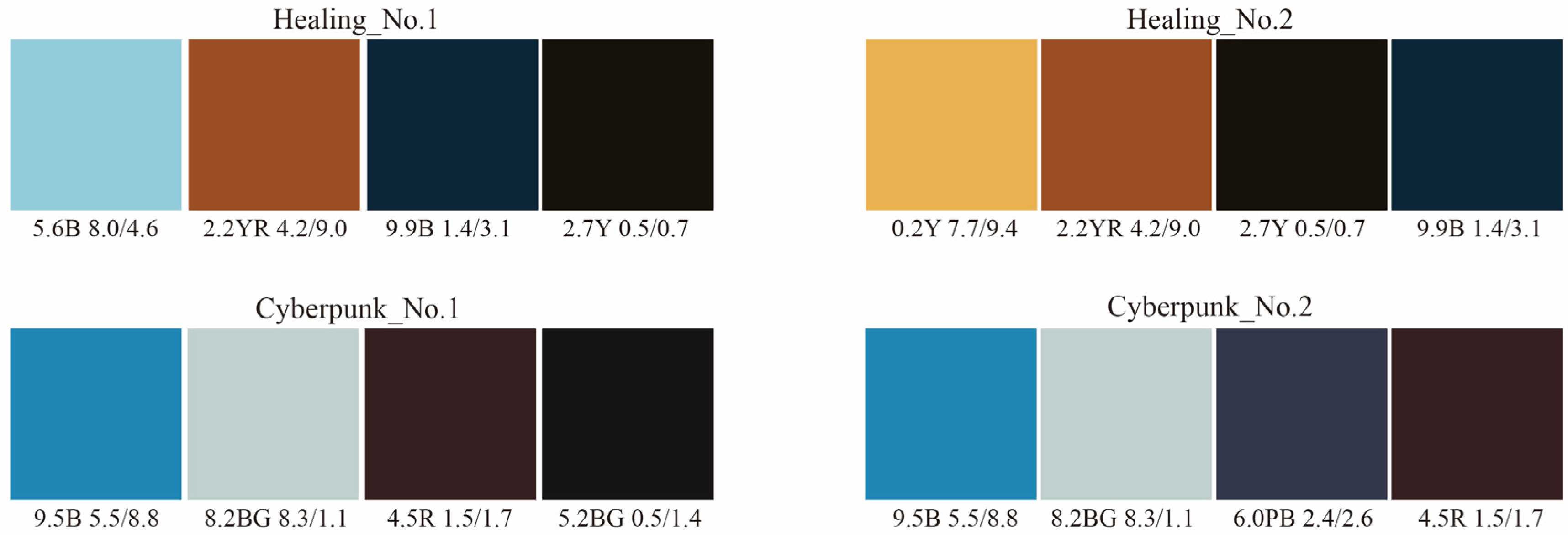
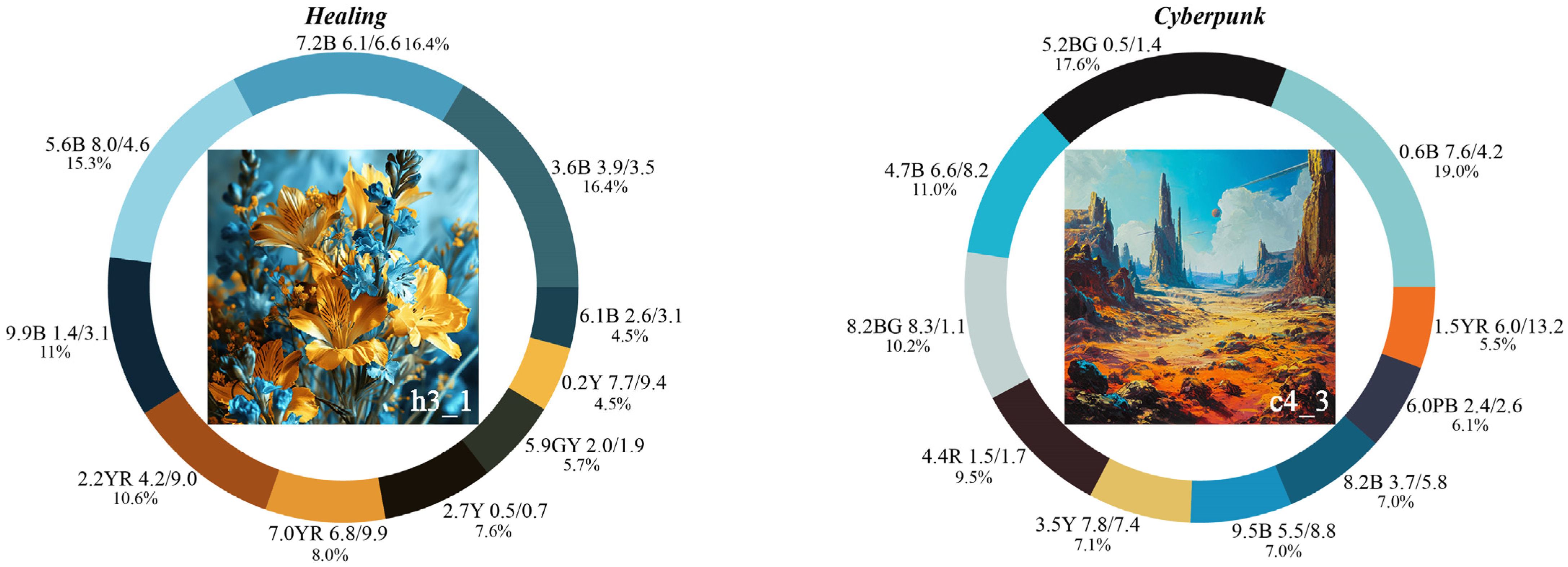
To identify the dominant colors in the representative color images, an interactive program was created using the OpenCV module in Python to calculate the area occupied by each color in the images. Specifically, h3_1 and c4_3 were input into the program one by one to obtain the hue, value, and chroma (HVC) values of the top ten colors by area, which were defined as the dominant colors of the representative color images. The final results are presented in Figure 9.
Figure 9. Dominant colors in representative color images of healing and cyberpunk.

4.4. Phase 4: Color Matching

4.4.1. Setting Color-Matching Prototype and Observation Angles for the Optimal Shape

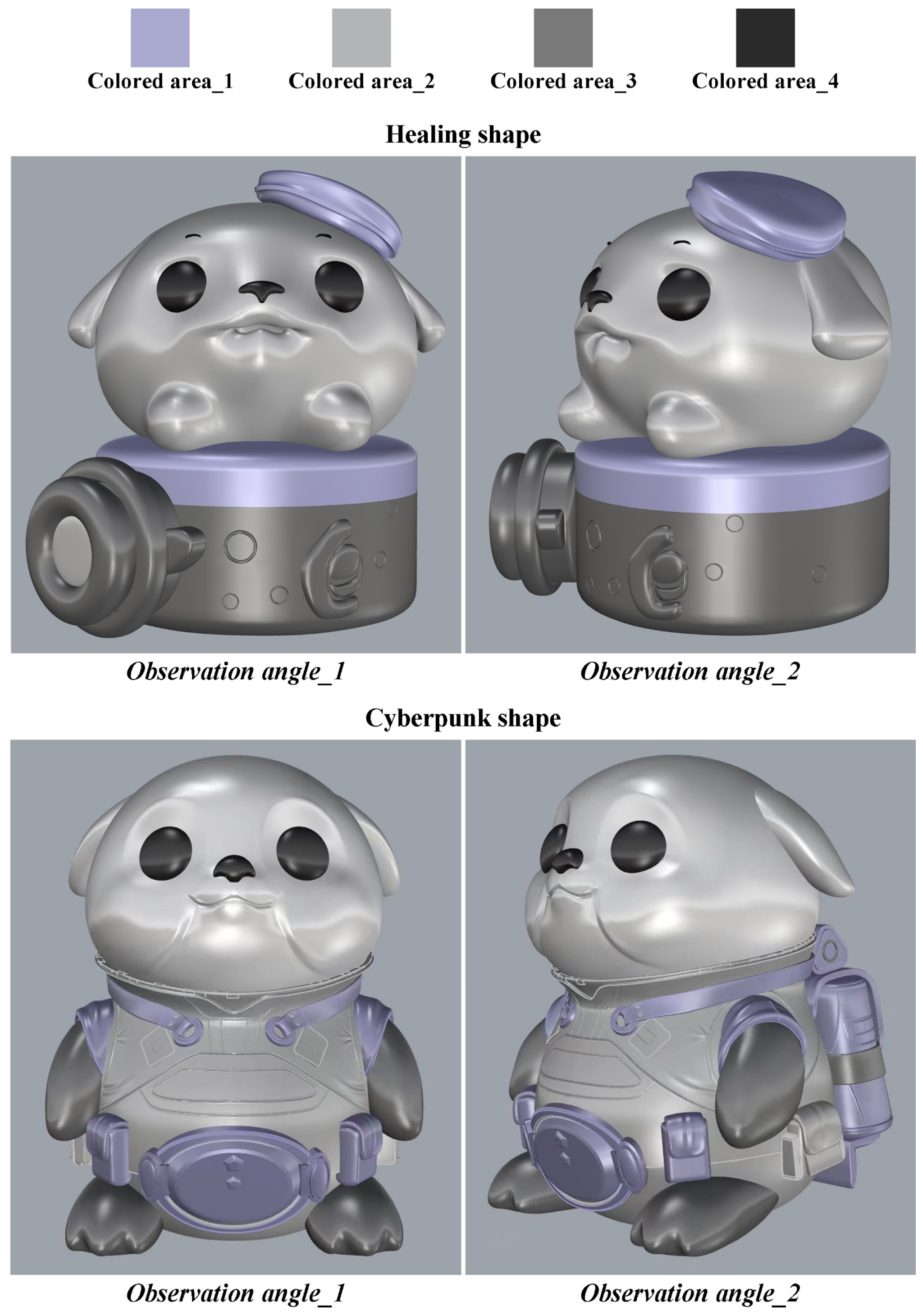
This section sets the color-matching prototype and observation angles for the optimal shapes obtained in Section 4.2.3 (see Figure 7). In this study, the prototype of the target product is an animal (i.e., harbor seal), whose characteristics have been anthropomorphized into an IP cultural product. Therefore, when setting the color-matching prototype, both functional, structural, material, and surface treatment aspects of the product shape and the inherent biological features of the harbor seal were considered. Based on these influencing factors, the color-matching prototypes of the optimal shapes for healing and cyberpunk are shown in Figure 10. The color-matching prototypes include four colored areas (i.e., colored area_1, colored area_2, colored area_3, and colored area_4), indicating that the subsequent color matching requires four-color combinations. Subsequently, two observation angles were set to comprehensively present the harbor seal IP product (i.e., observation angle_1 and observation angle_2). Observation angle_1 is the front view of the harbor seal IP product, containing the complete shape information, while observation angle_2 is a perspective view that supplements the missing shape information from the front view. Compared to color-matching evaluation based on a single observation angle [7], using two observation angles is more rigorous.
Figure 10. Color-matching prototype and observation angles for the Harbor Seal IP product.

4.4.2. Obtaining Four-Color Combinations with Higher Aesthetic Measurements from the Dominant Colors

Theoretically, the ten dominant colors in Figure 9 can form 210 four-color combinations, resulting in 420 combinations from the two sets of dominant colors. Based on the calculation steps described in Section 2.2.1 and Equations (1) to (3), the color harmony aesthetic measurement of each four-color combination was calculated. This study selected the top two four-color combinations with the highest aesthetic measurements for color matching. The top two four-color combinations are shown in Figure 11, and the relevant calculation parameters are presented in Table 9.
Figure 11. The top two four-color combinations with the highest aesthetic measurement.
Table 9. The top two four-color combinations and their calculation results.

4.4.3. Obtaining Color-Matching Alternatives

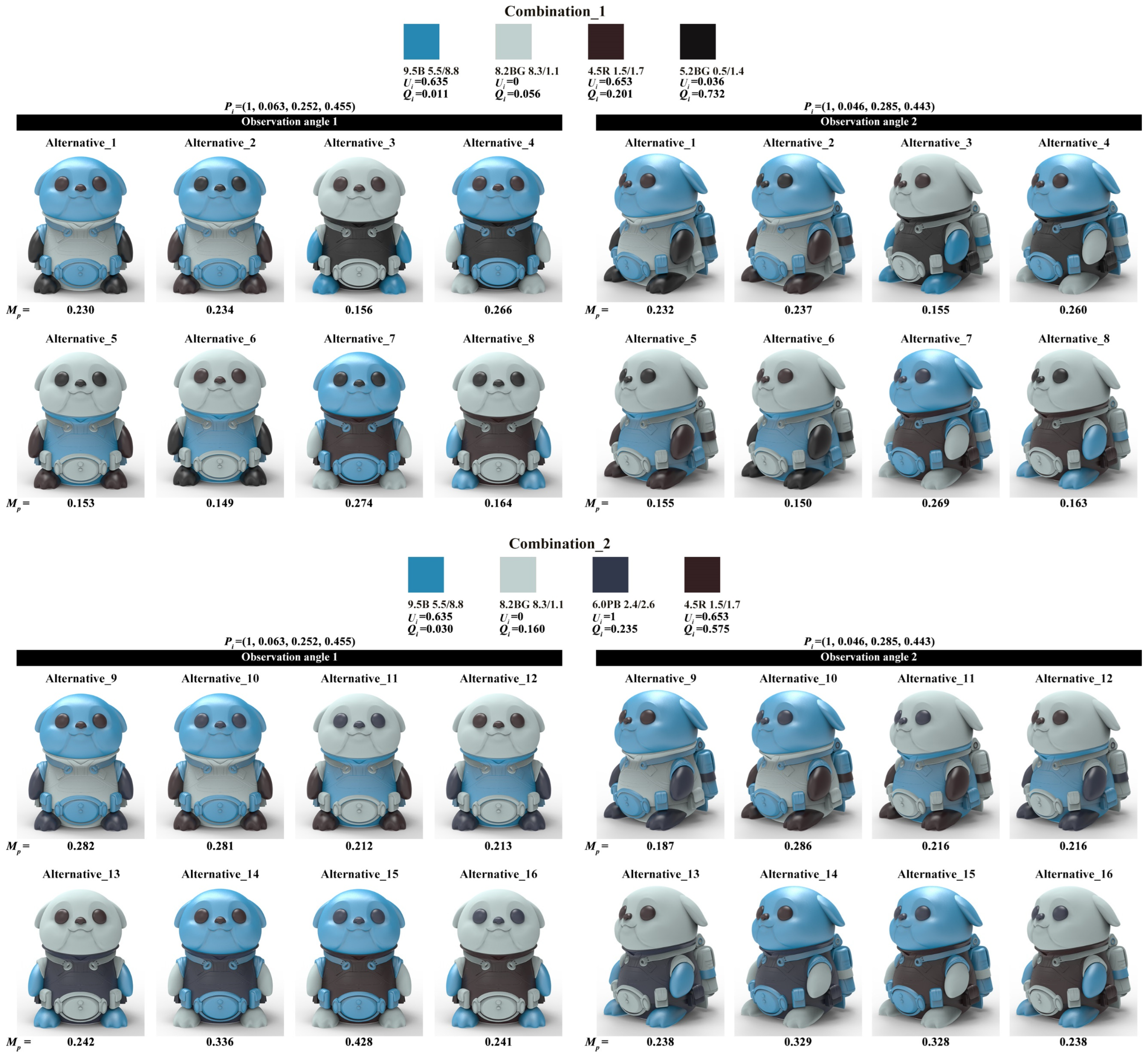
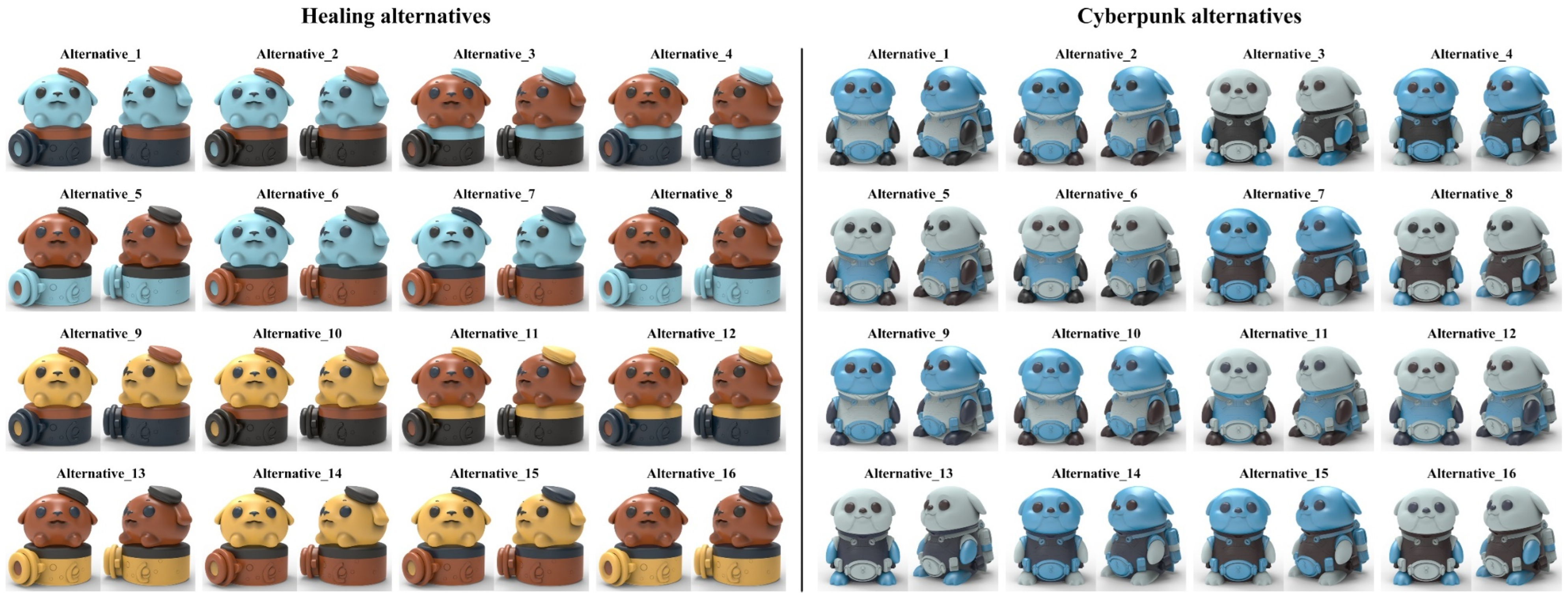
The four-color combinations combination_1 and combination_2 were applied to the two color-matching prototypes of the optimal healing shape, while combination_3 and combination_4 were applied to the two color-matching prototypes of the optimal cyberpunk shape. Considering the anthropomorphized shape features of the harbor seal IP product, the achromatic color or the chromatic color with the lowest value from the four-color combination were filled into the eye area. Given this constraint, one four-color combination could generate eight color-matching alternatives. Combination_1 and combination_2 generated 16 healing alternatives, while combination_3 and combination_4 generated 16 cyberpunk alternatives. Subsequently, the KeyShot was used to render the alternatives with realistic lighting effects, as shown in Figure 12.
Figure 12. Color-matching alternatives for healing and cyberpunk.

4.4.4. Evaluating Color-Matching Alternatives

The alternatives shown in Figure 12 were evaluated using both the color-matching aesthetic quantification formula and a perceptual evaluation questionnaire.
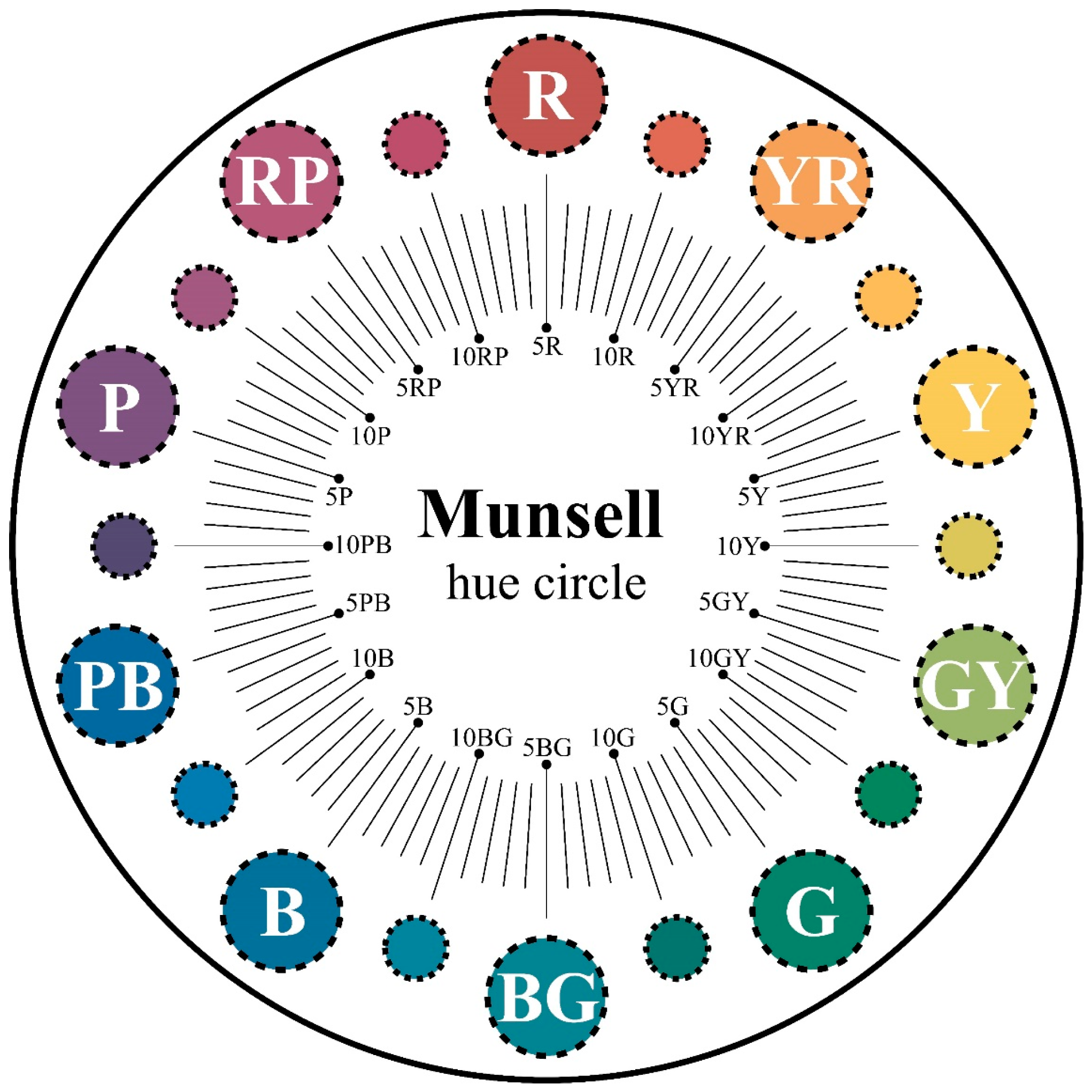
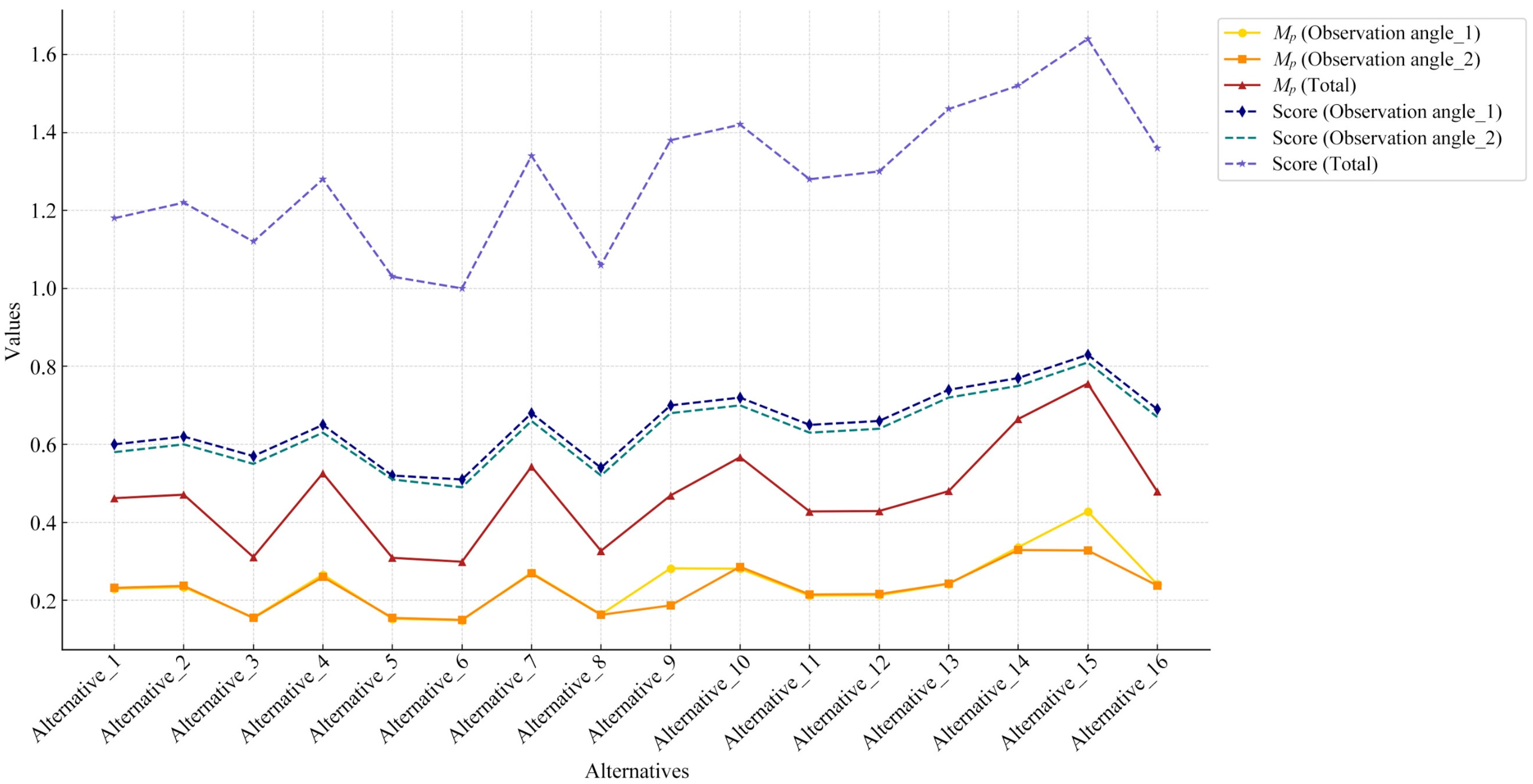
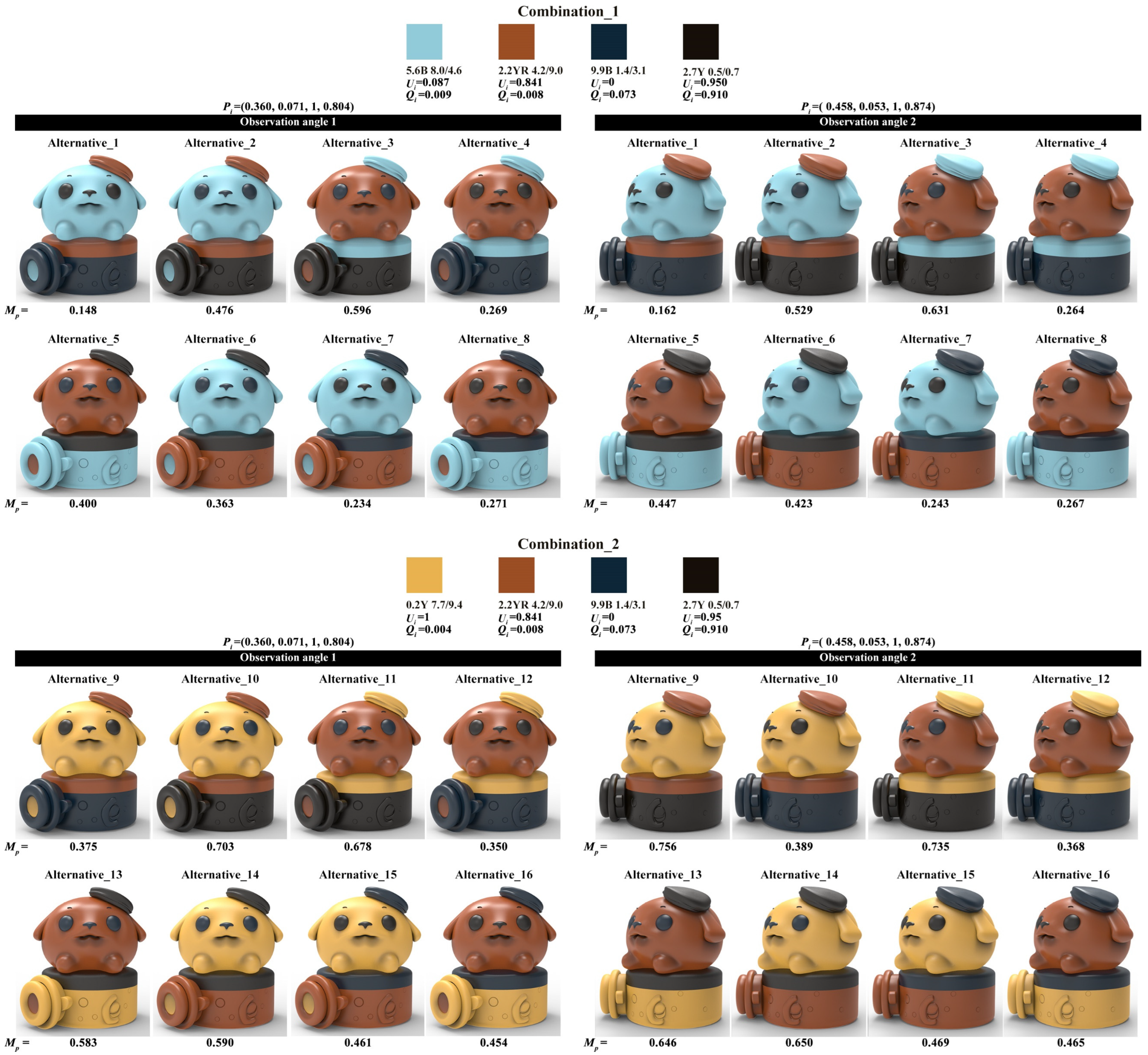
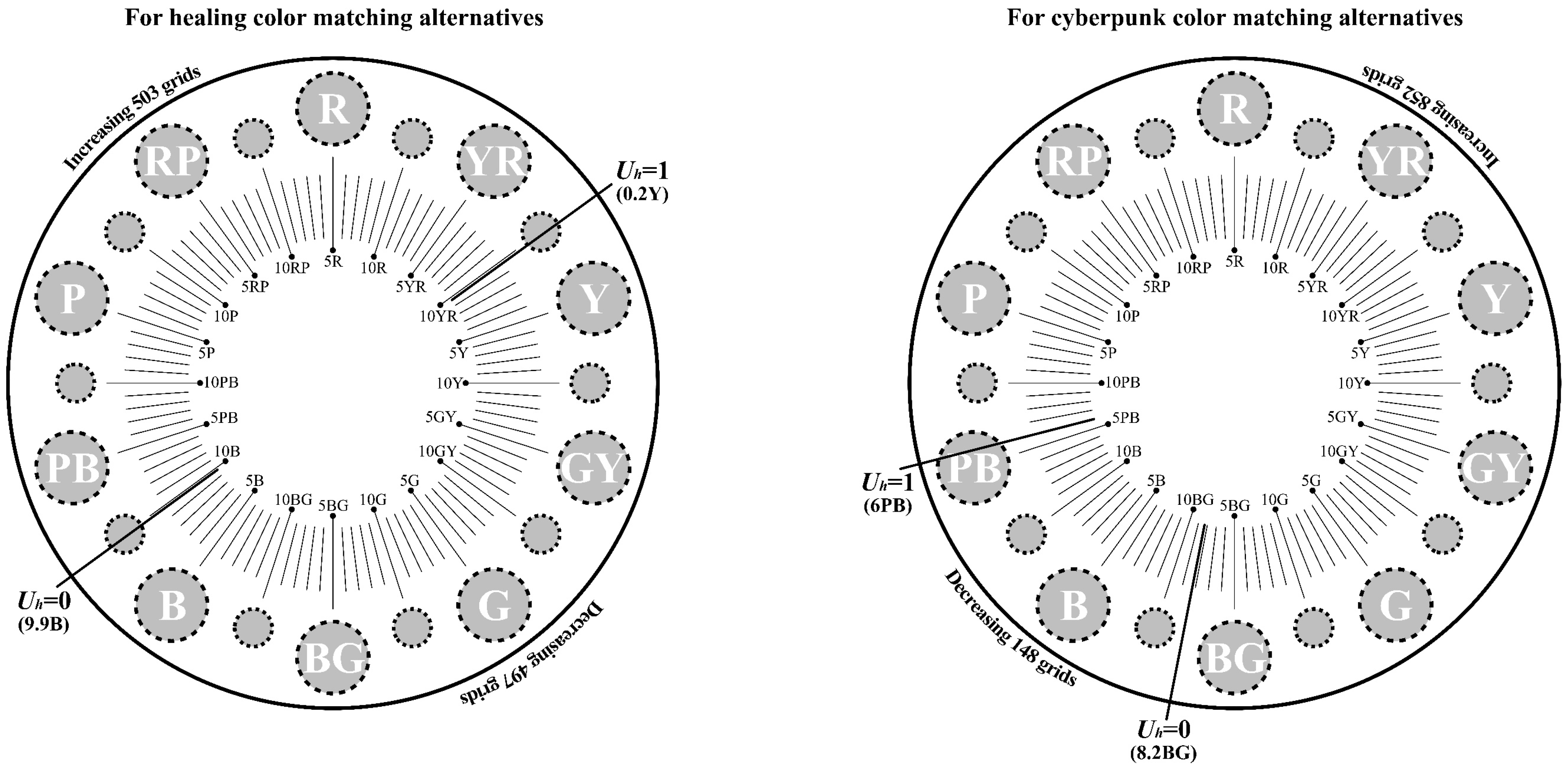
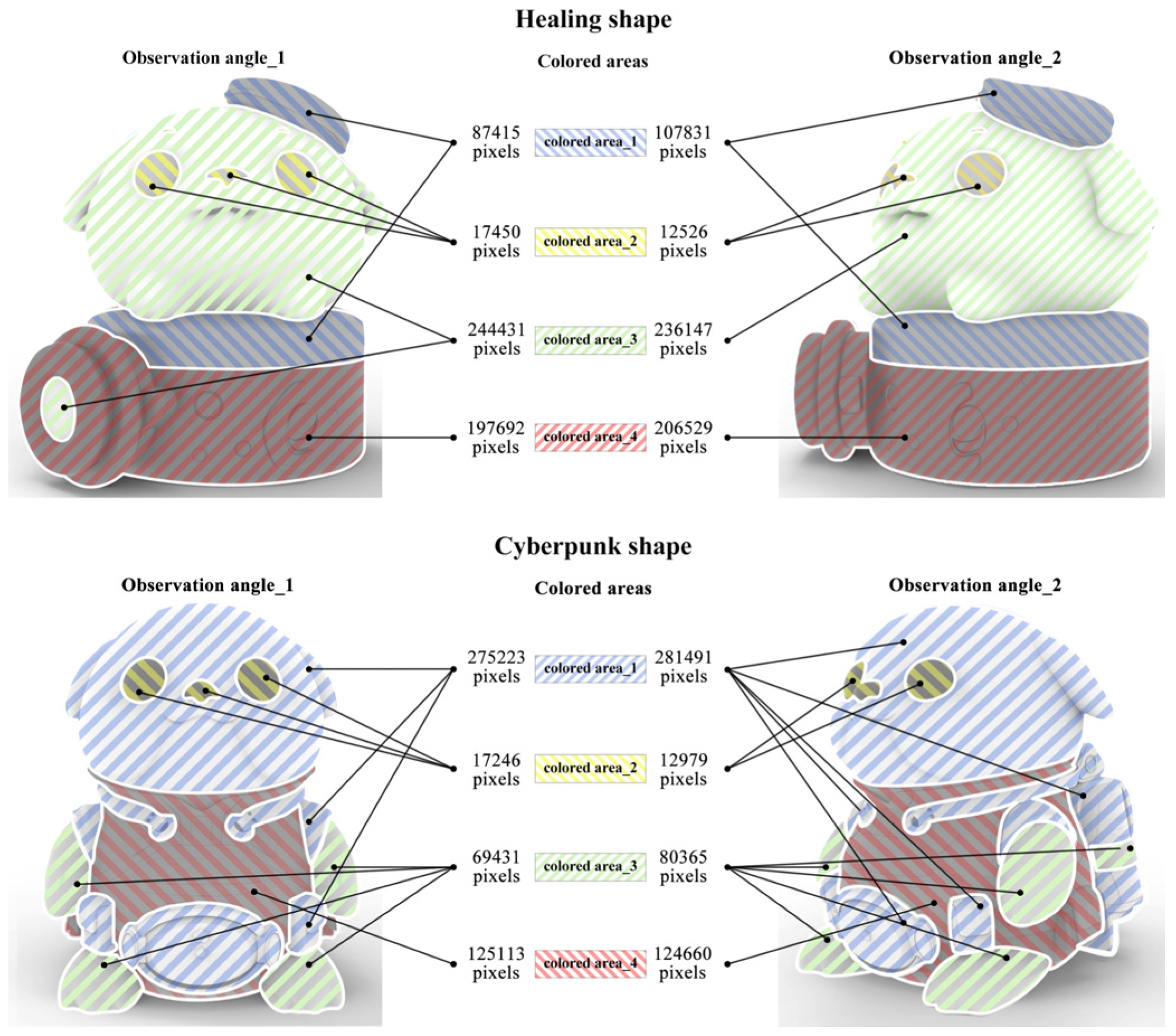
For quantitative evaluation, Equations (4) to (7) introduced in Section 2.2.2 were used to calculate U i , Q i , and P i successively, ultimately obtaining the color-matching aesthetic measurement (Mp) for each alternative. First, students and teachers specializing in design were invited to rate the five healing colors and five cyberpunk colors in Figure 11 based on the criteria of “How healing is this color?” and “How cyberpunk is this color?” The evaluation results showed that the first and last of the five healing colors were 0.2Y 7.7/9.4 and 9.9B 1.4/3.1, respectively; for the cyberpunk colors, they were 8.2BG 8.3/1.1 and 6.0PB 2.4/2.6. The hue values of the first and last colors were used to divide the hue circle into two parts (see Figure 13), and the contribution of each chromatic color to the color-matching aesthetic measurement ( U i ) was determined accordingly. Second, the value and chroma of the colors were substituted into Equation (6) to determine their contribution to the color-matching aesthetic measurement ( Q i ). Third, Photoshop was used to display the number of pixels in each colored area, which was taken as the area of that colored area (see Figure 14). The area parameter was then substituted into Equation (7) to determine the contribution of the area to the color-matching aesthetic measurement ( P i ). Finally, U i , Q i , and P i were substituted into Equation (4) to obtain the aesthetic measurement (Mp) for each color-matching alternative. The calculation results are shown in Figure 15 and Figure 16, and the statistical results are presented in Table 10 and Table 11. After summing the aesthetic measurements for the two observation angles, Alternative_11 had the highest score among all healing alternatives (Mp = 1.413), and Alternative_15 had the highest score among all cyberpunk alternatives (Mp = 0.756). Therefore, based on the quantitative evaluation results, Alternative_11 and Alternative_15 were considered the optimal design solutions.
Figure 13. Schematic diagram of calculating the contribution of hue in chromatic colors to color-matching aesthetic measurement.
Figure 14. The area of each colored area in the shapes of healing and cyberpunk from two observation angles.
Figure 15. Calculation results of color-matching aesthetic measurement of healing alternatives.
Figure 16. Calculation results of color-matching aesthetic measurement of cyberpunk alternatives.
Table 10. Statistical results of color-matching aesthetic measurement of healing alternatives.
Table 11. Statistical results of color-matching aesthetic measurement of cyberpunk alternatives.
For qualitative evaluation, tourists were invited to assess the color-matching alternatives shown in Figure 12. The evaluation criterion was “How healing/cyberpunk is the color matching of this harbor seal IP cultural product?” on a scale from 0 to 1. Out of 140 distributed questionnaires, 128 valid responses were received. Statistical analysis yielded a Cronbach’s α value of 0.82, demonstrating acceptable questionnaire results. Table 12 and Table 13 present the average scores for each alternative under the two observation angles and their total scores. Regarding the total score, Alternative_14 received the highest score (score = 1.64), and Alternative_15 achieved the highest score (score = 1.69). Consequently, based on the qualitative evaluation results, Alternative_14 and Alternative_15 were considered the optimal design solutions.
Table 12. Perceptual evaluation results for healing alternatives.
Table 13. Perceptual evaluation results for cyberpunk alternatives.
Furthermore, Pearson correlation analysis was used to verify whether there was a correlation between the quantitative and qualitative evaluation results. Specifically, the total aesthetic measurements from Table 10 and Table 11 and the total scores from Table 12 and Table 13 were used as analysis data. Statistical analysis showed that the correlation coefficients for both the healing and cyberpunk alternatives were greater than 0.7, with p-values less than 0.05, indicating a significant correlation between the quantitative and qualitative evaluation results (see Table 14). Overall, both Alternative_11 and Alternative_14 ranked among the top in both evaluations with little difference, making either of them suitable as the optimal healing design solution. Alternative_15 ranked first in both evaluations, making it unquestionably the optimal cyberpunk design solution.
Table 14. Analysis results of Pearson correlation coefficient.

5. Results and Discussion

Section 4 implemented and validated the design methodology based on GLMs using the Harbor Seal IP cultural product example. The first three phases of the methodology (i.e., preparation, shape generation, and color generation) utilized the text-GLM GPT-4o and the image-GLM Midjourney. In the preparation phase, GPT-4o analyzed tourists’ emotional needs for the Harbor Seal IP cultural product and summarized them into 14 imagery adjectives through prompt engineering. Compared to traditional methods for collecting Kansei imageries, the intelligent search method based on GPT-4o can quickly gather tourists’ emotional feedback from the provided online information and summarize it into imagery adjectives, thereby reducing user research costs. In the shape generation phase, Midjourney was used to generate shapes for the Harbor Seal IP cultural product that corresponded to the target imagery, thereby forming a shape database (see Figure 5). Compared to traditional Kansei design methods for product shape, the shape generation method based on Midjourney can transform tourists’ abstract Kansei needs into a concrete product shape, laying the foundation for detailed shape design. In the color generation phase, GPT-4o served as the prompt generator for Midjourney, while Midjourney was used to create colored images aligned with the target imagery (see Figure 8). Compared to traditional methods of extracting colors from images for color matching, the color image generation method based on multimodal GLMs can transform abstract target imageries into corresponding natural color images, laying the foundation for color matching design. Overall, in this paper, a Kansei design methodology is presented for both the shape and color matching of tourism IP cultural products based on GLMs, using the Harbor Seal IP cultural product as an example to demonstrate a collaborative design case involving multimodal GLMs. It highlights the empowerment of generative AI for tourism IP cultural product design, promoting the intelligent development of such products.
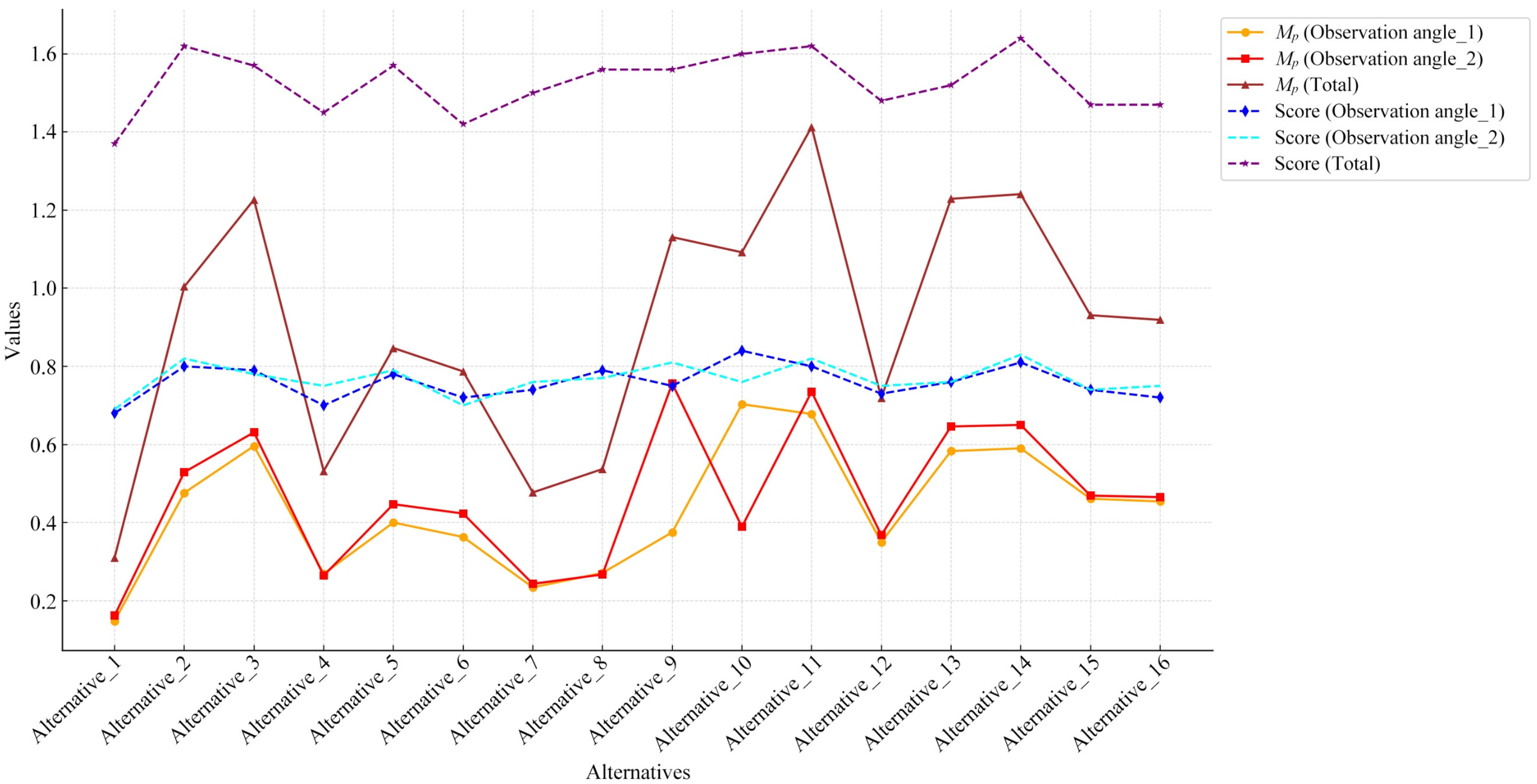
This paper emphasizes the quantitative evaluation process for content generated by GLMs. To select the optimal shape and representative color images from the GLM-generated content, this study employed quantitative evaluation methods based on QCE and AHP. Specifically, QCE was used as an indicator for evaluating shape aesthetics, where the lower the entropy value of the shape curve, the higher the aesthetic measurement. AHP was used to evaluate whether the color images corresponded to the target imageries, where higher weight values indicated better alignment with the target imagery. The quantitative evaluation not only improved the practicality of the design methodology but also ensured its rigor and scientific basis. In addition, a combination of quantitative and qualitative evaluations was used to select the optimal color-matching solution. The quantitative evaluation applied the color-matching aesthetic measurement formula to determine the aesthetic measurement of alternatives from two observation angles (see Table 10 and Table 11). In the qualitative evaluation, a perceptual evaluation questionnaire for tourists was used to obtain scores for the alternatives from two observation angles (see Table 12 and Table 13). Figure 17 presents the scores of the 16 healing alternatives in both quantitative evaluation (i.e., Mp (Observation angle_1), Mp (Observation angle_2), and Mp (Total)) and qualitative evaluation (i.e., score (Observation angle_1), score (Observation angle_2), and score (total)), while Figure 18 shows the scores for the 16 cyberpunk alternatives. In this paper, Pearson correlation analysis was conducted between the total values of the quantitative evaluation (i.e., Mp (Total)) and the qualitative evaluation (i.e., score (total)) (see Table 14). The results showed that the correlation coefficients were greater than 0.7, indicating a statistically significant correlation between the quantitative and qualitative evaluation results. Therefore, the optimal design solutions were selected based on a comprehensive consideration of both evaluation results.
Figure 17. Line chart of scores for 16 healing alternatives based on quantitative and qualitative evaluation methods.
Figure 18. Line chart of scores for 16 cyberpunk alternatives based on quantitative and qualitative evaluation methods.

6. Conclusions

This paper focuses on tourism IP cultural products and proposes an IP product color-matching and shape design methodology building on GLMs, using tourists’ emotional needs as a medium. The Harbor Seal IP product served as a case study, following the process of “preparation—shape generation—color generation—color matching” to demonstrate the implementation of the proposed methodology and validate its effectiveness through both quantitative and qualitative means. Compared with the literature in Table 1, this study makes the following academic contributions: (1) unlike existing design methodologies, the proposed GLM-based methodology considers both color matching and shape, promoting the intelligent development of Kansei design; (2) the different design phases of the proposed methodology utilized text and image-generative large models, presenting a collaborative design case involving multimodal GLMs and inspiring designers to explore the potential applications of other GLMs; and (3) a quantitative evaluation method for GLM-generated content based on the macroscopic shape information of shape curves was presented, enhancing the scientific rigor and practicality of GLM-driven design methodologies. In summary, generative large models improve the efficiency of Kansei design for product color matching and shape, paving a new path for intelligent product design.
Although this paper used the Harbor Seal IP cultural product as a case study to demonstrate the implementation of the proposed methodology and validate its effectiveness through quantitative and qualitative evaluations, some research limitations remain. First, the optimal shape was selected from those generated by the image-generative large model based on QCE and expert perceptual questionnaires; however, some scholars may argue that this approach overly relies on the generative model, thus reducing the designer’s subjective involvement. In future research, a shape elements chart could be constructed based on the generated shapes, and shape elements could be recombined into new shapes under other constraints. Second, this paper introduced a QCE-based method for evaluating shape aesthetics, but the evaluation only considered the external contour curves of the product shape without including other internal shape elements. Although the external contour is the most representative shape curve of tourism IP cultural products, future research should selectively consider representative shape curves based on the morphological characteristics of the target product to ensure scientific rigor in shape evaluation. Third, this study used the top ten colors by area ratio in color images as dominant colors to represent their overall imagery. However, colors with higher chroma and value also significantly contribute to the overall imagery of color images. Therefore, future research should develop a more rigorous strategy for selecting dominant colors to improve the feasibility of color imagery transfer. Finally, compared to other functional products, IP cultural products are more akin to decorative items. While their development does not require extensive consideration of functional components, technical design aspects such as material selection and manufacturing processes remain crucial. Therefore, future research could incorporate a technical design phase into the current framework to enhance the feasibility and manufacturability of product designs.


Author Contributions

All authors contributed to the paper. F.W. wrote the manuscript; P.L. acted as a corresponding author, wrote the manuscript, and modified it; S.-W.H. conceptualized and supervised the writing of the manuscript. All authors have read and agreed to the published version of the manuscript.

Funding

This research was funded by “the National Natural Science Foundation of China (52405252)”.

Institutional Review Board Statement

Not applicable.

Data Availability Statement

The research data supporting this publication are provided within this paper.

Conflicts of Interest

The authors declare that they have no known competing financial interests or personal relationships that could have appeared to influence the work reported in this paper.

References

  1. Law, D.; Cheung, M.C.; Yip, J.; Yick, K.L.; Wong, C. Scoliosis brace design: Influence of visual aesthetics on user acceptance and compliance. Ergonomics 2017, 60, 876–886. [Google Scholar] [CrossRef] [PubMed]
  2. Hsiao, K.L.; Chen, C.C. What drives smartwatch purchase intention? Perspectives from hardware, software, design, and value. Telemat. Inform. 2018, 35, 103–113. [Google Scholar] [CrossRef]
  3. Lu, P.; Hsiao, S.W. A product design method for form and color matching based on aesthetic theory. Adv. Eng. Inf. 2022, 53, 101702. [Google Scholar] [CrossRef]
  4. Toufani, S.; Stanton, J.P.; Chikweche, T. The importance of aesthetics on customers’ intentions to purchase smartphones. Mark. Intell. Plan. 2017, 35, 316–338. [Google Scholar] [CrossRef]
  5. Lu, P.; Hsiao, S.W.; Wu, F. A product shape design and evaluation model based on morphology preference and macroscopic shape information. Entropy 2021, 23, 639. [Google Scholar] [CrossRef]
  6. Yuan, B.; Wu, K.; Wu, X.; Yang, C. Form generative approach for front face design of electric vehicle under female aesthetic preferences. Adv. Eng. Inform. 2024, 62, 102571. [Google Scholar] [CrossRef]
  7. Wu, F.; Hsiao, S.W.; Lu, P. An AIGC-empowered methodology to product color matching design. Displays 2024, 81, 102623. [Google Scholar] [CrossRef]
  8. Lai, X.; Zhang, S.; Mao, N.; Liu, J.; Chen, Q. Kansei engineering for new energy vehicle exterior design: An internet big data mining approach. Comput. Ind. Eng. 2022, 165, 107913. [Google Scholar] [CrossRef]
  9. Lu, P.; Hsiao, S.W.; Tang, J.; Wu, F. A generative-AI-based design methodology for car frontal forms design. Adv. Eng. Inf. 2024, 62, 102835. [Google Scholar] [CrossRef]
  10. Lo, C.H.; Ko, Y.C.; Hsiao, S.W. A study that applies aesthetic theory and genetic algorithms to product form optimization. Adv. Eng. Inform. 2015, 29, 662–679. [Google Scholar] [CrossRef]
  11. Liu, S.F.; Hsu, Y.C.; Tsai, H.C. Development of a new cultural design process using Kansei engineering and fuzzy techniques: A case study in Mazu crown design. Int. J. Cloth. Sci. Technol. 2019, 31, 663–684. [Google Scholar] [CrossRef]
  12. Zhou, A.; Liu, H.; Zhang, S.; Ouyang, J. Evaluation and design method for product form aesthetics based on deep learning. IEEE Access 2021, 9, 108992–109003. [Google Scholar] [CrossRef]
  13. Wu, Y.; Ma, L.; Yuan, X.; Li, Q. Human-machine hybrid intelligence for the generation of car frontal forms. Adv. Eng. Inform. 2023, 55, 101906. [Google Scholar] [CrossRef]
  14. Lu, P.; Tang, J.; Wu, F. Product Form Design and Evaluation Method Based on Improved Form Aesthetic Formula. Symmetry 2024, 16, 883. [Google Scholar] [CrossRef]
  15. Tsai, H.C.; Chou, J.R. Automatic design support and image evaluation of two-coloured products using colour association and colour harmony scales and genetic algorithm. Comput.-Aided Des. 2007, 39, 818–828. [Google Scholar] [CrossRef]
  16. Hsiao, S.W.; Chiu, F.Y.; Chen, C.S. Applying aesthetics measurement to product design. Int. J. Ind. Ergon. 2008, 38, 910–920. [Google Scholar] [CrossRef]
  17. Hsiao, S.W.; Hsu, C.F.; Tang, K.W. A consultation and simulation system for product color planning based on interactive genetic algorithms. Color Res. Appl. 2013, 38, 375–390. [Google Scholar] [CrossRef]
  18. Hsiao, S.W.; Tsai, C.J. Transforming the natural colors of an image into product design: A computer-aided color planning system based on fuzzy pattern recognition. Color Res. Appl. 2015, 40, 612–625. [Google Scholar] [CrossRef]
  19. Oh, S.; Jung, Y.; Kim, S.; Lee, I.; Kang, N. Deep generative design: Integration of topology optimization and generative models. J. Mech. Des. 2019, 141, 111405. [Google Scholar] [CrossRef]
  20. Yoo, S.; Lee, S.; Kim, S.; Hwang, K.H.; Park, J.H.; Kang, N. Integrating deep learning into CAD/CAE system: Generative design and evaluation of 3D conceptual wheel. Struct. Multidiscip. Optim. 2021, 64, 2725–2747. [Google Scholar] [CrossRef]
  21. Thorp, H.H. ChatGPT is fun, but not an author. Science 2023, 379, 313. [Google Scholar] [CrossRef]
  22. Lin, Z. Why and how to embrace AI such as ChatGPT in your academic life. R. Soc. Open Sci. 2023, 10, 230658. [Google Scholar] [CrossRef] [PubMed]
  23. Alışık, E. “All Compressed and Rendered with a Pathetic Delicacy That Astounds the Eye”: Midjourney Renders Ambergris as Constantinople. CyberOrient 2022, 16, 76–88. [Google Scholar] [CrossRef]
  24. Li, Y. “Will artificial intelligence platforms replace designers in the future?” analyzing the impact of artificial intelligence platforms on the engineering design industry through color perception. Eng. Appl. Artif. Intell. 2024, 138, 109369. [Google Scholar] [CrossRef]
  25. Wang, Z.; Pan, H.R.; Li, J.S.; Niu, S.F. Exploring product rendering generation design catering to multi-emotional needs through the Superiority Chart-Entropy Weight method and Stable Diffusion model. Adv. Eng. Inform. 2024, 62, 102809. [Google Scholar] [CrossRef]
  26. Du, Y.; Liu, X.; Cai, M.; Park, K. A product’s Kansei appearance design method based on conditional-controlled AI image generation. Sustainability 2024, 16, 8837. [Google Scholar] [CrossRef]
  27. Wang, C.; Zhang, J.; Liu, D.; Cai, Y.; Gu, Q. An AI-powered product identity form design method based on shape grammar and Kansei engineering: Integrating Midjourney and Grey-AHP-QFD. Appl. Sci. 2024, 14, 7444. [Google Scholar] [CrossRef]
  28. Wang, Y.; Xi, Y.; Liu, X.; Gan, Y. Exploring the dual potential of artificial intelligence-generated content in the esthetic reproduction and sustainable innovative design of Ming-style furniture. Sustainability 2024, 16, 5173. [Google Scholar] [CrossRef]
  29. Xu, D.; Chen, W.; Peng, W.; Zhang, C.; Xu, T.; Zhao, X.; Chen, E. Large language models for generative information extraction: A survey. Front. Comput. Sci. 2024, 18, 186357. [Google Scholar] [CrossRef]
  30. Tao, W.; Gao, S.; Yuan, Y. Boundary crossing: An experimental study of individual perceptions toward AIGC. Front. Psychol. 2023, 14, 1185880. [Google Scholar] [CrossRef]
  31. Bengesi, S.; El-Sayed, H.; Sarker, M.K.; Houkpati, Y.; Irungu, J.; Oladunni, T. Advancements in generative AI: A comprehensive review of GANs, GPT, autoencoders, diffusion model, and transformers. IEEE Access 2024, 12, 69812–69837. [Google Scholar] [CrossRef]
  32. Polak, M.P.; Morgan, D. Extracting accurate materials data from research papers with conversational language models and prompt engineering. Nat. Commun. 2024, 15, 1569. [Google Scholar] [CrossRef] [PubMed]
  33. Birkhoff, G.D. Aesthetic Measure; Harvard University Press: Cambridge, UK; London, UK, 1933. [Google Scholar]
  34. Moon, P.; Spencer, D.E. Aesthetic measure applied to color harmony. J. Opt. Soc. Am. 1944, 34, 234–242. [Google Scholar] [CrossRef]
  35. Moon, P.; Spencer, D.E. Geometric formulation of classical color harmony. J. Opt. Soc. Am. 1944, 34, 46–59. [Google Scholar] [CrossRef]
  36. Moon, P.; Spencer, D.E. Area in color harmony. J. Opt. Soc. Am. 1944, 34, 93–103. [Google Scholar] [CrossRef]
  37. Gong, S.M.; Lee, W.Y. Colour harmony of two-colour combinations using a 3D colour configuration. Color. Technol. 2019, 135, 292–304. [Google Scholar] [CrossRef]
  38. Huang, M.; Cui, G.; Melgosa, M.; García, P.A.; Liu, H.; Liu, Y.; Luo, M.R. Color harmony in two-piece garments. Color Res. Appl. 2017, 42, 498–511. [Google Scholar] [CrossRef]
  39. Harada, T.; Yoshimoto, F.; Moriyama, M. An aesthetic curve in the field of industrial design. In Proceedings of the 1999 IEEE Symposium on Visual Languages, Tokyo, Japan, 13–16 September 1999; pp. 38–47. [Google Scholar] [CrossRef]
  40. Ujiie, Y.; Kato, T.; Sato, K.; Matsuoka, Y. Curvature entropy for curved profile generation. Entropy 2012, 14, 533–558. [Google Scholar] [CrossRef]
  41. Honda, S.; Yanagisawa, H.; Kato, T. Aesthetic shape generation system based on novelty and complexity. J. Eng. Des. 2022, 33, 1016–1035. [Google Scholar] [CrossRef]
  42. Matsuyama, K.; Shimizu, T.; Kato, T. Systematic classification of curvature and feature descriptor of 3D shape and its application to “complexity” quantification methods. Entropy 2023, 25, 624. [Google Scholar] [CrossRef]
  43. Chen, L.; Cao, J.; Wang, Y.; Liang, W.; Zhu, G. Multi-view graph attention network for travel recommendation. Expert Syst. Appl. 2022, 191, 116234. [Google Scholar] [CrossRef]
  44. Hayden, D.; Dills, B. Smokey the bear should come to the beach: Using mascot to promote marine conservation. Soc. Mark. Q. 2015, 21, 3–13. [Google Scholar] [CrossRef]
  45. Su, Q.; Li, F.S. How cute mascots affect relationships with tourism destinations: A moderated mediation model. Tour. Manag. 2023, 99, 104782. [Google Scholar] [CrossRef]
  46. Xu, J.B.; Yan, L.; Pratt, S. Destination image recovery with tourism mascots. J. Destin. Mark. Manag. 2022, 25, 100732. [Google Scholar] [CrossRef]
  47. Radomskaya, V.; Pearce, P.L. Adding character: The role of destination mascots in tourism development. Tour. Manag. 2021, 84, 104248. [Google Scholar] [CrossRef]
  48. Quan, Z.; Qian, W.; Mao, J. The impact of mascot attributes on sponsorship effectiveness the case of “Bing Dwen Dwen” at the Beijing winter Olympics. Asia Pac. J. Market. Logist. 2024, 36, 1024–1042. [Google Scholar] [CrossRef]
  49. Wattanacharoensil, W.; Kantamara, S.; Muangasame, K. An investigation of the Kumamon and Sukjai mascots on destination branding. J. Place Manag. Dev. 2021, 14, 201–221. [Google Scholar] [CrossRef]
  50. Kang, X.; Nagasawa, S.Y. Integrating kansei engineering and interactive genetic algorithm in jiangxi red cultural and creative product design. J. Intell. Fuzzy Syst. 2023, 44, 647–660. [Google Scholar] [CrossRef]
  51. Liu, X.; Li, M.Y.; Ma, Y.M.; Gao, T.H.; Yuan, D.N. Personalized tourism product design focused on tourist expectations and online reviews: An integrated MCDM method. Comput. Ind. Eng. 2024, 188, 109860. [Google Scholar] [CrossRef]
Disclaimer/Publisher’s Note: The statements, opinions and data contained in all publications are solely those of the individual author(s) and contributor(s) and not of MDPI and/or the editor(s). MDPI and/or the editor(s) disclaim responsibility for any injury to people or property resulting from any ideas, methods, instructions or products referred to in the content.

Article Metrics

Citations

Article Access Statistics

Multiple requests from the same IP address are counted as one view.