The Capacity Gains of Gaussian Channels with Unstable Versus Stable Autoregressive Noise



Abstract
1. Introduction
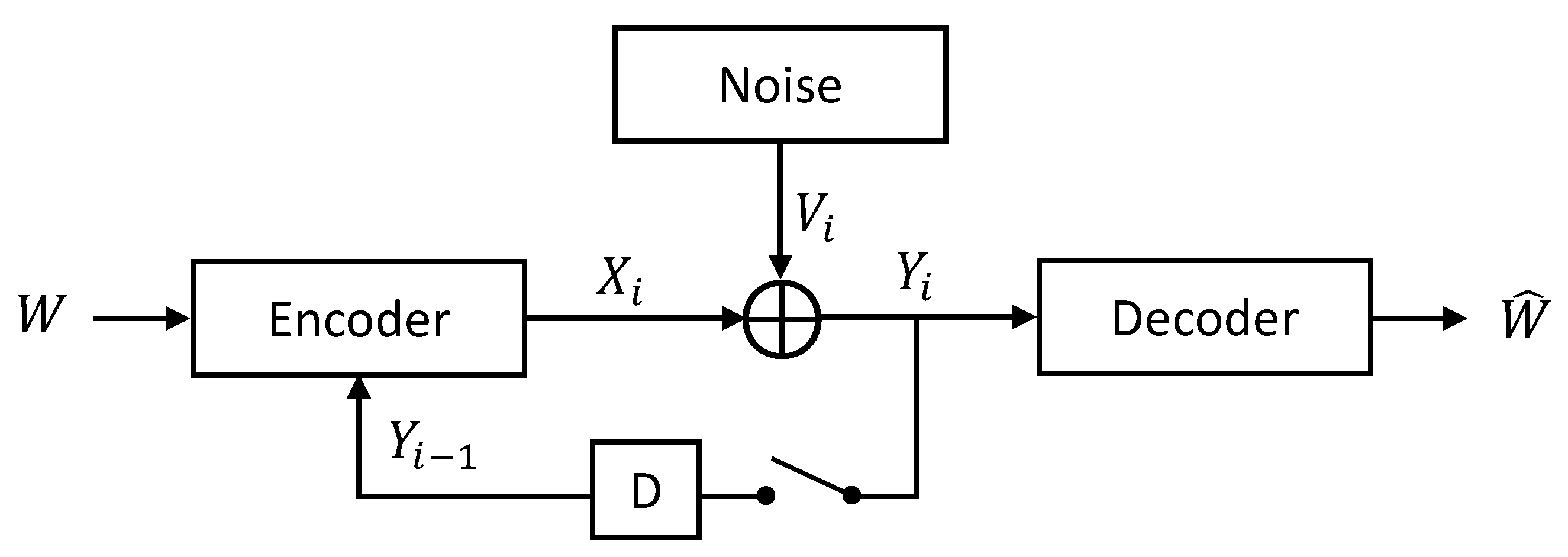
1.1. The AGN Channel with Nonstationary and Nonergodic Noise
1.2. Motivation
1.3. Literature Review
1.4. Main Contributions
2. Main Results, Discussion, Simulations and Relations to the Literature
2.1. Notation and Definitions
2.2. Closed-Form Feedback Capacity and Nonfeedback Capacity Lower Bounds for Stable/Unstable AR Noise
2.2.1. Regime 1: Ergodic Feedback Capacity for Unstable Noise (Theorem 4)
2.2.2. Regimes 2 and 3: Nonergodic Feedback Capacity for Stable/Unstable Noise-Complement of Regime 1 (Theorem 5)
2.2.3. Discussion: Comparison of Regimes 1, 2, 3
2.2.4. Lower Bounds: Lower Bounds on Ergodic Nonfeedback Capacity for Stable/Unstable Noise
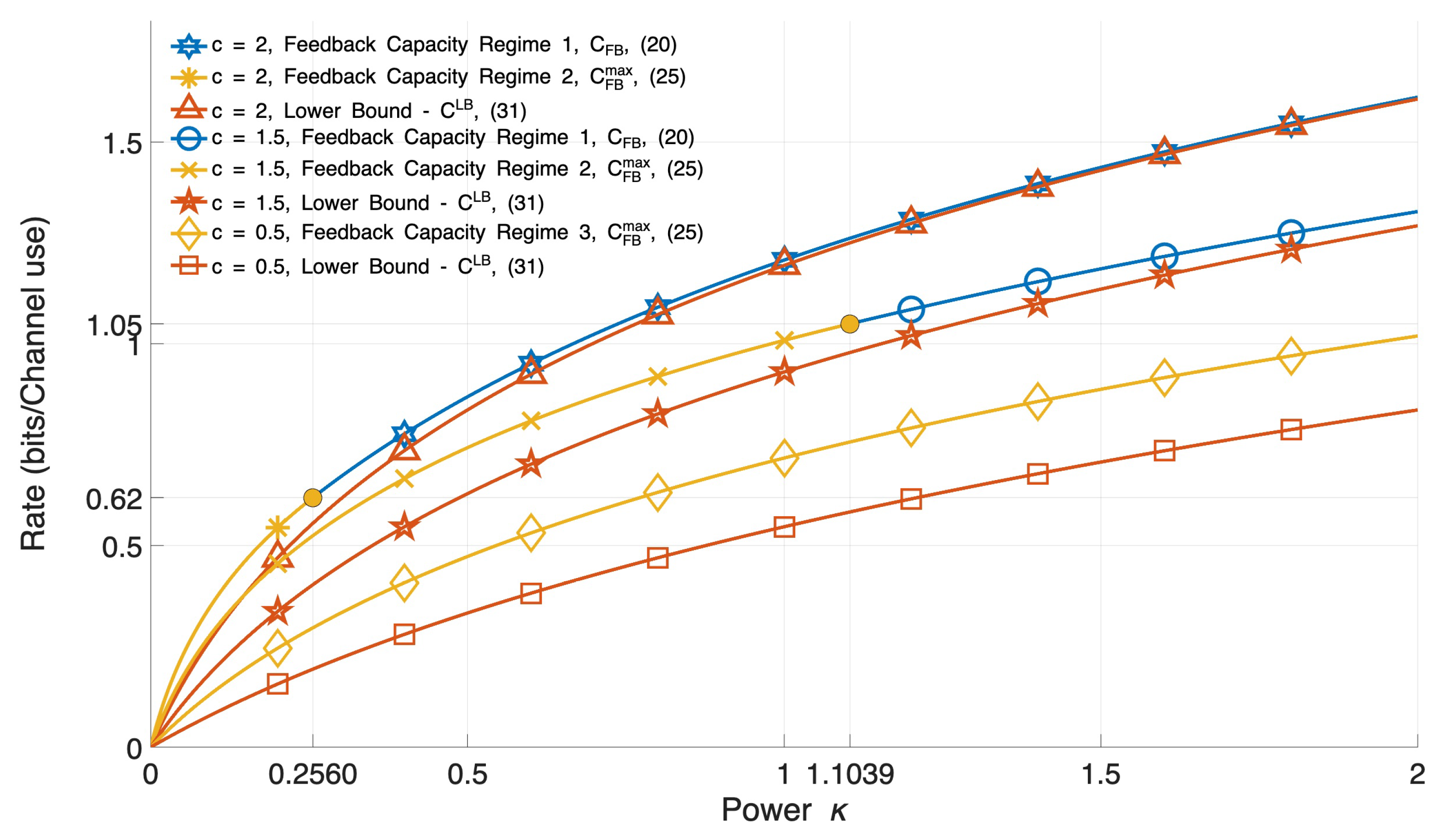
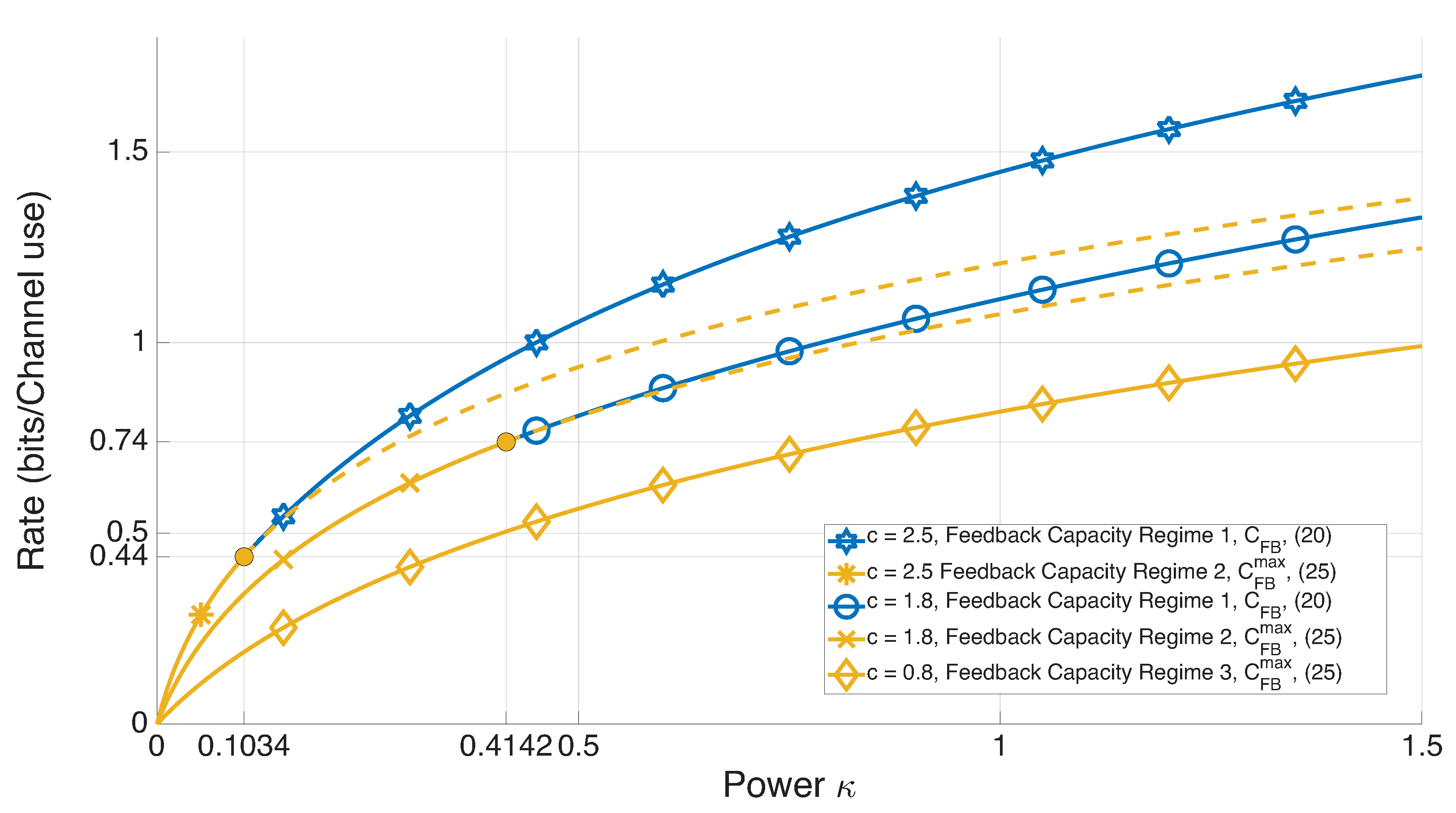
2.3. Numerical Comparisons of , and Lower Bound for Stable/Unstable Noise
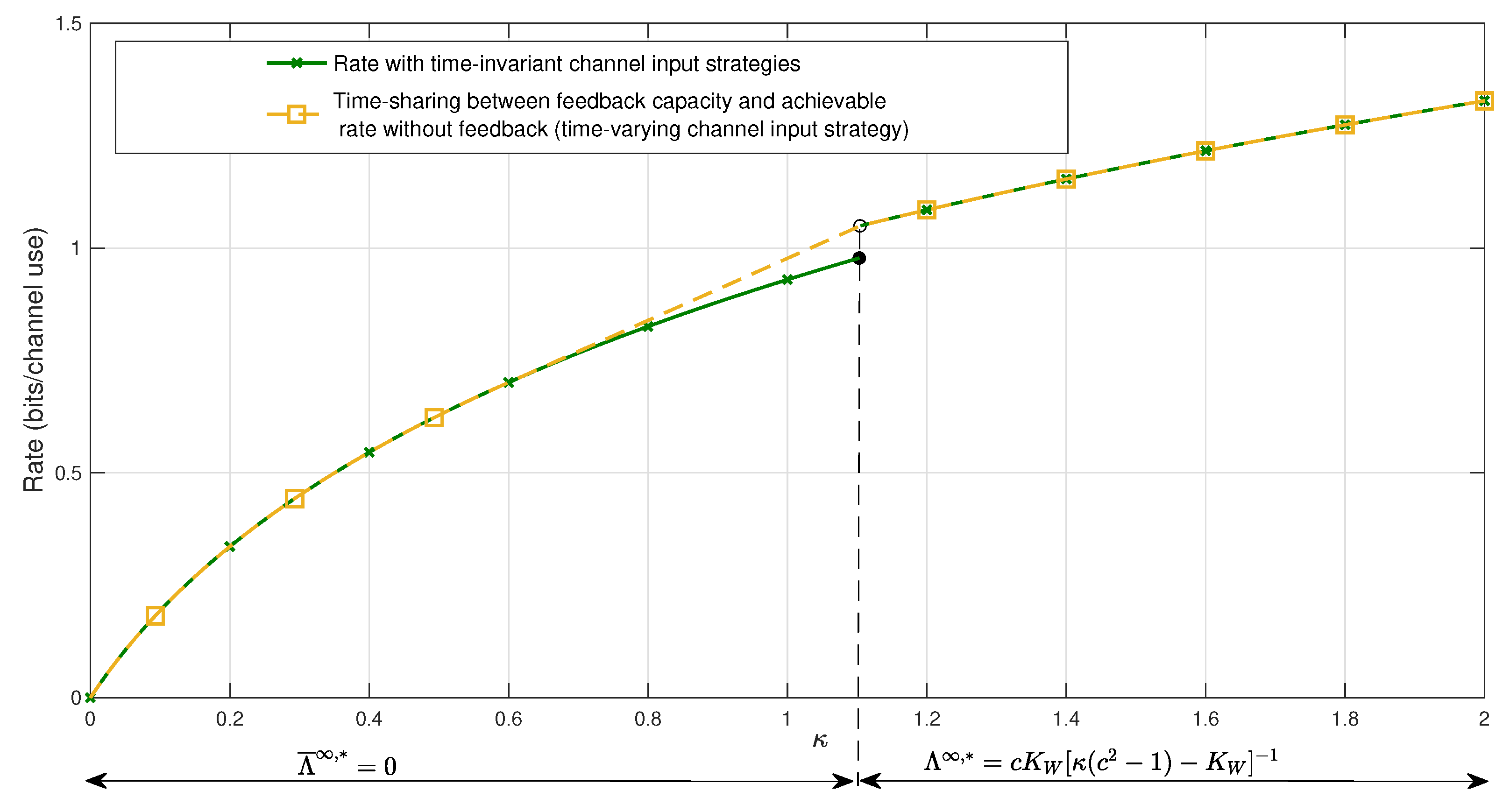
2.4. Time-Sharing Increases Achievable Rates
2.5. Comparison of Closed-Form Formulas and with Numerical Solutions Produced by the Semi-Definite Program of [24]
3. Asymptotic Characterizations of Capacity for Stable and Unstable AR Noise
3.1. Sequential Characterizations of Feedback Capacity and Lower Bounds on Achievable Nonfeedback Capacity for Gaussian Channels Driven by Time-Varying AR Noise
3.2. Convergence Properties of Generalized DREs
3.3. Asymptotic Characterizations of Feedback Capacity Under Detectability and Stabilizability Versus Unit Circle Controllability
3.4. Closed-Form Expressions of Asymptotic Feedback Capacity and Lower Bounds on Nonfeedback Capacity
3.4.1. Closed-Form Expressions of Ergodic Capacity Under Detectability/Stabilizability
- (ii) If then and .
3.4.2. Closed-Form Expression of Capacity Under Detectability/Unit Circle Controllability
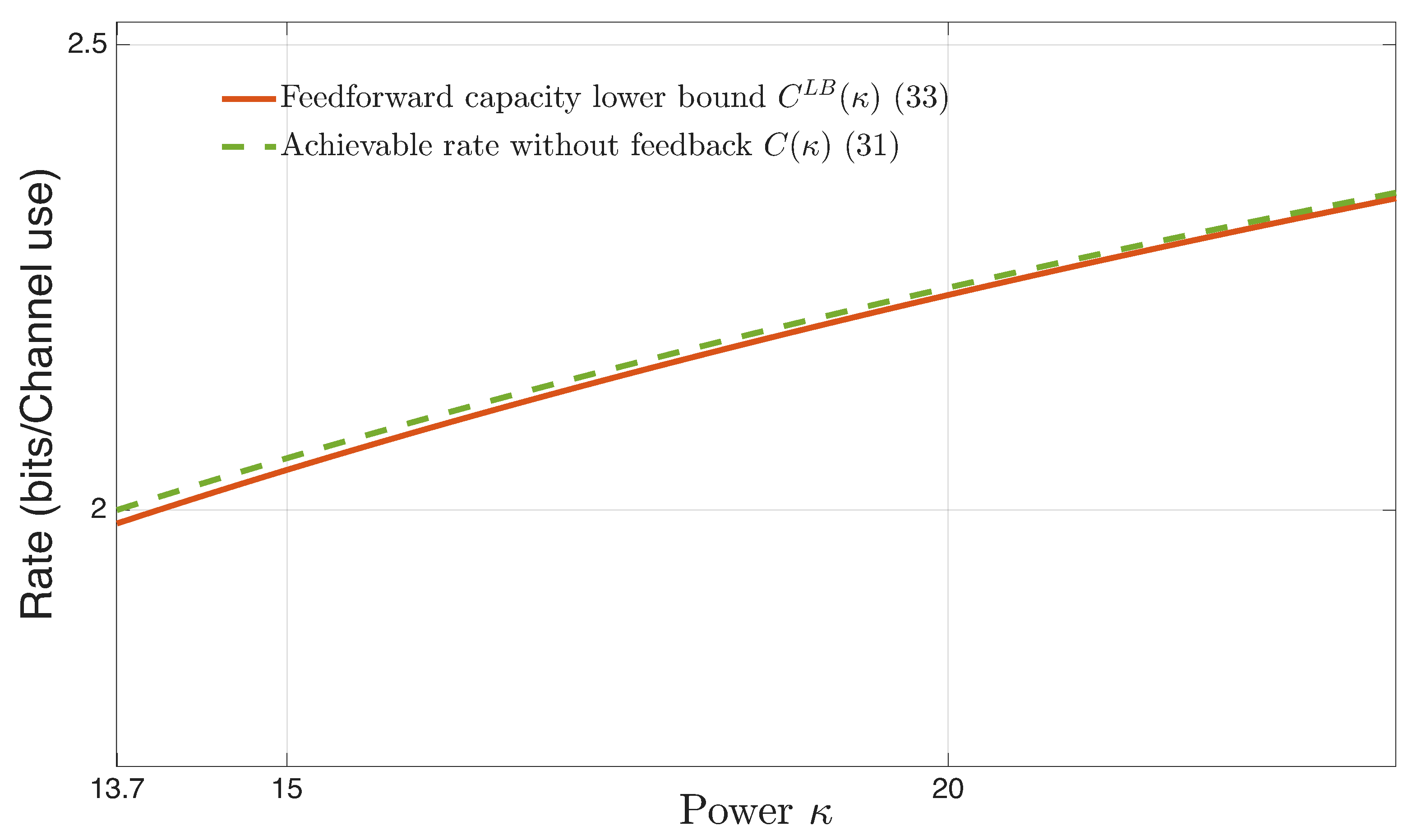
3.4.3. Nonfeedback Ergodic Achievable Rates for Stable and Unstable AR Noise
4. Conclusions
Author Contributions
Funding
Institutional Review Board Statement
Data Availability Statement
Conflicts of Interest
Appendix A
Appendix A.1. Proof of Lemma 2
Appendix A.2. Proof of Lemma 3
Appendix A.3. Proof of Theorem 4
Appendix A.4. Proof of Theorem 5
References
- Derpich, M.S.; Ostergaard, J. Comments on “Feedback Capacity of Stationary Gaussian Channels”. IEEE Trans. Inf. Theory 2024, 70, 1848–1851. [Google Scholar] [CrossRef]
- Kim, Y.H. Feedback Capacity of Stationary Gaussian Channels. IEEE Trans. Inf. Theory 2010, 56, 57–85. [Google Scholar] [CrossRef]
- Cover, T.; Pombra, S. Gaussian Feedback Capacity. IEEE Trans. Inf. Theory 1989, 35, 37–43. [Google Scholar] [CrossRef]
- Gallager, R.T. Information Theory and Reliable Communication; John Wiley & Sons, Inc.: New York, NY, USA, 1968. [Google Scholar]
- Ihara, S. Information Theory for Continuous Systems; World Scientific: Singapore, 1993. [Google Scholar]
- Cover, T.M.; Thomas, J.A. Elements of Information Theory, 2nd ed.; John Wiley & Sons, Inc.: Hoboken, NJ, USA, 2006. [Google Scholar]
- Butman, S. A General Formulation of Linear Feedback Communications Systems with Solutions. IEEE Trans. Inf. Theory 1969, 15, 392–400. [Google Scholar] [CrossRef]
- Tienan, J.; Schalkwijk, J.P.M. An Upper Bound to the Capacity of Bandlimited Gaussian Autoregressive Channel with Noiseless Feedback. IEEE Trans. Inf. Theory 1974, 20, 311–316. [Google Scholar] [CrossRef]
- Wolfowitz, J. Signalling over a Gaussian Channel with Feedback and Autoregressive Noise. J. Appl. Probab. 1975, 12, 713–723. [Google Scholar] [CrossRef]
- Butman, S. Linear Feedback Rate Bounds for Regressive Channels. IEEE Trans. Inf. Theory 1976, 22, 363–366. [Google Scholar] [CrossRef]
- Ordentlich, E. A Class of Optimal Coding Schemes for Moving Average Additive Gaussian Noise Channels with Feedback. In Proceedings of the IEEE International Symposium on Information Theory (ISIT), Trondheim, Norway, 27 June–1 July 1994; p. 467. [Google Scholar]
- Ozarow, L. Upper Bounds on the Capacity of Gaussian Channel with Feedback. IEEE Trans. Inf. Theory 1984, 36, 156–161. [Google Scholar] [CrossRef]
- Ozarow, L.H. Random Coding for Additive Gaussian Channels with Feedback. IEEE Trans. Inf. Theory 1984, 36, 17–22. [Google Scholar] [CrossRef]
- Dembo, A. On Gaussian Feedback Capacity. IEEE Trans. Inf. Theory 1989, 35, 1072–1076. [Google Scholar] [CrossRef]
- Ihara, S.; Yanaki, K. Capacity of Discrete-Time Gaussian Channels with and without Feedback—II. Jpn. J. Appl. Math. 1989, 6, 245–258. [Google Scholar] [CrossRef]
- Yanaki, K. Necessary and Sufficient Conditions for the Capacity of the Discrete-Time Gaussian Channel to Be Increased by Feedback. IEEE Trans. Inf. Theory 1992, 38, 1788–1791. [Google Scholar] [CrossRef]
- Yanaki, K. An Upper Bound on the Discrete-Time Gaussian Channel with Feedback—II. IEEE Trans. Inf. Theory 1994, 40, 588–593. [Google Scholar] [CrossRef][Green Version]
- Chen, H.W.; Yanaki, K. Refinements of the Half-Bit and Factor-of-Two Bounds for Capacity in Gaussian Channels with Feedback. IEEE Trans. Inf. Theory 1999, 45, 319–325. [Google Scholar] [CrossRef]
- Chen, H.W.; Yanaki, K. Upper Bounds on the Capacity of Discrete-Time Blockwise White Gaussian Channels with Feedback. IEEE Trans. Inf. Theory 2000, 43, 1125–1131. [Google Scholar] [CrossRef]
- Yang, S.; Kavcic, A.; Tatikonda, S. On Feedback Capacity of Power-Constrained Gaussian Noise Channels with Memory. IEEE Trans. Inf. Theory 2007, 53, 929–954. [Google Scholar] [CrossRef]
- Liu, T.; Han, G. The ARMAk Gaussian Feedback Capacity. In Proceedings of the IEEE International Symposium on Information Theory Proceedings (ISIT), Aachen, Germany, 25–30 June 2017; pp. 211–215. [Google Scholar]
- Liu, T.; Han, G. Feedback Capacity of Stationary Gaussian Channels Further Examined. IEEE Trans. Inf. Theory 2019, 64, 2494–2506. [Google Scholar] [CrossRef]
- Li, C.; Elia, N. Youla Coding and Computation of Gaussian Feedback Capacity. IEEE Trans. Inf. Theory 2019, 64, 3197–3215. [Google Scholar] [CrossRef]
- Gattami, A. Feedback Capacity of Gaussian Channels Revisited. IEEE Trans. Inf. Theory 2019, 65, 1948–1960. [Google Scholar] [CrossRef]
- Ihara, S. On the Feedback Capacity of the First-Order Moving Average Gaussian Channel. Jpn. J. Stat. Data Sci. 2019, 2, 491–506. [Google Scholar] [CrossRef]
- Charalambous, C.D.; Kourtellaris, C.; Louka, S. New Formulas of Feedback Capacity for AGN Channels with Memory: A Time-Domain Sufficient Statistic Approach. arXiv 2020, arXiv:2010.06226. [Google Scholar] [CrossRef] [PubMed]
- Charalambous, C.D.; Kourtellaris, C.; Louka, S. New Formulas of Feedback Capacity for AGN Channels with Memory: A Time-Domain Sufficient Statistic Approach. Entropy 2025, 27, 207. [Google Scholar] [CrossRef]
- Caines, P.E. Linear Stochastic Systems; Wiley Series in Probability and Statistics; John Wiley & Sons, Inc.: New York, NY, USA, 1988. [Google Scholar]
- Kailath, T.; Sayed, A.; Hassibi, B. Linear Estimation; Prentice Hall: Hoboken, NJ, USA, 2000. [Google Scholar]
- Charalambous, C.D.; Kourtellaris, C.; Louka, S. Sequential Characterization of Cover and Pombra Gaussian Feedback Capacity: Generalizations to MIMO Channels via a Sufficient Statistic. In Proceedings of the 2021 IEEE Information Theory Workshop (ITW), Kanazawa, Japan, 17–21 October 2021. [Google Scholar]
- Kourtellaris, C.; Charalambous, C.D.; Loyka, S. New Formulas for Ergodic Feedback Capacity of AGN Channels Driven by Stable and Unstable Autoregressive Noise. In Proceedings of the International Symposium on Information Theory (ISIT), Los Angeles, CA, USA, 21–26 June 2020; pp. 2073–2078. [Google Scholar]
- Charalambous, C.D.; Kourtellaris, C.; Loyka, S. Control-Coding Capacity of Decision Models Driven by Correlated Noise and Gaussian Application Examples. In Proceedings of the IEEE Conference on Decision and Control (CDC), Miami Beach, FL, USA, 17–19 December 2018; pp. 4967–4972. [Google Scholar]
- Kourtellaris, C.; Charalambous, C.D.; Loyka, S. From Feedback Capacity to Tight Achievable Rates without Feedback for AGN Channels with Stable and Unstable Autoregressive Noise. In Proceedings of the International Symposium on Information Theory (ISIT), Los Angeles, CA, USA, 21–26 June 2020; pp. 2091–2096. [Google Scholar]
- Gelfand, M.I.; Yaglom, M. Calculation of the Amount of Information about a Random Function Contained in Another Such Function. Am. Math. Soc. Transl. 1959, 2, 199–246. [Google Scholar]
- van Schuppen, J.H. Control and System Theory of Discrete-Time Stochastic Systems; Springer Nature AG: Cham, Switzerland, 2021. [Google Scholar]



| Comp. of , and with Numerical Sol. of Semi-Definite Programming (SDP) [24] | ||||
|---|---|---|---|---|
| Reg. 1–3, | SDP [24] | optimal | ||
| 0.01 | no feasible set | 0.0356094122 | 0.0600925515 | 0.0600925523 |
| 0.03 | no feasible set | 0.1000526016 | 0.1539595604 | 0.1539595679 |
| 0.09 | no feasible set | 0.2589485246 | 0.3413268000 | 0.3413268001 |
| 0.19 | no feasible set | 0.4559930447 | 0.5319371043 | 0.5319371060 |
| 0.25 | no feasible set | 0.5547462343 | 0.6183330358 | 0.6183330413 |
| Reg. 1, opt. | Reg. 1–3, | SDP [24] | Reg. 2, not optimal | |
| 0.30 | 0.6740406521 | 0.6193243103 | 0.6740406486 | 0.6726584307 |
| 0.33 | 0.7075908808 | 0.6575848570 | 0.7075908775 | 0.7041839537 |
| 1.51 | 1.4432047194 | 1.4361084033 | 1.4432047188 | 1.2924606576 |
| 3.13 | 1.8963683737 | 1.8942662100 | 1.8963683715 | 1.6247312241 |
| 6.76 | 2.4140154130 | 2.4135010032 | 2.4140154125 | 2.0077561174 |
| Comparison of of , and and Numerical Sol. of SDP [24] | ||||||
| Reg. 1–3, | SDP [24] | Regimes 2, 3, opt. | ||||
| 0.01 | 0 | 0.0102 | 1.0425 | 3.9172 | 1.0425 | 0 |
| 0.03 | 0 | 0.0304 | 1.1126 | 5.5728 | 1.1126 | 0 |
| 0.09 | 0 | 0.0910 | 1.2669 | 3.2046 | 1.2669 | 0 |
| 0.19 | 0 | 0.1920 | 1.4458 | 1.9058 | 1.4459 | 0 |
| 0.25 | 0 | 0.2558 | 1.5347 | 8.6363 | 1.5351 | 0 |
| of Reg. 1, opt. | SDP [24] | Reg. 2, 3, not opt. | ||||
| 0.30 | 1.1575 | 0.1102 | 1.1574 | 0.1102 | 1.5940 | 0 |
| 0.33 | 0.9997 | 0.1668 | 0.9995 | 0.1668 | 1.6292 | 0 |
| 1.51 | 0.1583 | 1.4888 | 0.1582 | 1.4888 | 2.4494 | 0 |
| 3.13 | 0.0736 | 3.1191 | 0.0735 | 3.1191 | 3.0839 | 0 |
| 6.76 | 0.0334 | 6.7621 | 0.0333 | 6.7621 | 4.0216 | 0 |
Disclaimer/Publisher’s Note: The statements, opinions and data contained in all publications are solely those of the individual author(s) and contributor(s) and not of MDPI and/or the editor(s). MDPI and/or the editor(s) disclaim responsibility for any injury to people or property resulting from any ideas, methods, instructions or products referred to in the content. |
© 2025 by the authors. Licensee MDPI, Basel, Switzerland. This article is an open access article distributed under the terms and conditions of the Creative Commons Attribution (CC BY) license (https://creativecommons.org/licenses/by/4.0/).
Share and Cite
Charalambous, C.D.; Kourtellaris, C.; Louka, S.; Loyka, S. The Capacity Gains of Gaussian Channels with Unstable Versus Stable Autoregressive Noise. Entropy 2025, 27, 1264. https://doi.org/10.3390/e27121264
Charalambous CD, Kourtellaris C, Louka S, Loyka S. The Capacity Gains of Gaussian Channels with Unstable Versus Stable Autoregressive Noise. Entropy. 2025; 27(12):1264. https://doi.org/10.3390/e27121264
Chicago/Turabian StyleCharalambous, Charalambos D., Christos Kourtellaris, Stelios Louka, and Sergey Loyka. 2025. "The Capacity Gains of Gaussian Channels with Unstable Versus Stable Autoregressive Noise" Entropy 27, no. 12: 1264. https://doi.org/10.3390/e27121264
APA StyleCharalambous, C. D., Kourtellaris, C., Louka, S., & Loyka, S. (2025). The Capacity Gains of Gaussian Channels with Unstable Versus Stable Autoregressive Noise. Entropy, 27(12), 1264. https://doi.org/10.3390/e27121264