


Abstract
More than 50 years ago, Rufus Bowen noticed a natural relation between the ergodic theory and the dimension theory of dynamical systems. He proved a formula, known today as the Bowen’s formula, that relates the Hausdorff dimension of a conformal repeller to the zero of a pressure function defined by a single conformal map. In this paper, we extend the result of Bowen to a sequence of conformal maps. We present a dynamical solenoid, i.e., a generalized dynamical system obtained by backward compositions of a sequence of continuous surjections defined on a compact metric space Under mild assumptions, we provide a self-contained proof that Bowen’s formula holds for dynamical conformal solenoids. As a corollary, we obtain that the Bowen’s formula holds for a conformal surjection of a compact
1. Introduction and Statement of Results
In 1979, Rufus Bowen [1] noticed a natural connection between the geometric properties of a conformal repeller and the thermodynamic formalism of equation describing this repeller. Bowen proved that for a certain transformation f of the Riemann sphere into itself, there exists a compact f-invariant subset J called a quasi-circle. The Hausdorff dimension t of this quasi-circle is a unique root of the equation where is the topological pressure of the map , and is the geometric potential. In the mathematical literature, the equation is known as the Bowen’s formula or Bowen’s equation. In 1982, Ruelle [2] showed that the Hausdorff dimension of the Julia set of a uniformly hyperbolic rational map depends real-analytically on parameters. The Bowen’s equation has various generalizations and applications in both real and complex dynamics. For example, the result of Barański [3] for some hyperbolic meromorphic maps was generalized by Kotus and Urbański [4] to the case of so-called regular Walters expanding conformal maps. The thermodynamical formalism theory for hyperbolic maps in the exponential family was developed by Urbański and Zdunik [5,6]. Also there is a recent paper by Barański, Karpińska, and Zdunik [7] on Bowen’s formula for meromorphic functions. There are also known generalizations of Bowen’s formula to the case of semigroup; Jaerisch and Sumi [8] obtained Bowen’s formula for a pre-Julia set of a nicely expanding rational semigroups. In [9,10], one can find applications of Bowen’s equation in examples for expanding Markov maps. In 2008, Rugh [11] generalized Bowen’s result and proved the following result.
Theorem 1
(Rugh [11]). Let M be a Riemannian manifold, be an open set, be a conformal map of class and be its repeller. Then, the equation
where has a unique root equal to the Hausdorff dimension of the set
In 2011, Climenhaga [12] presented a generalization of the Bowen’s formula to the case of a continuous map defined on a compact metric space with a nonzero dilatation, denoted here by In Climenhaga’s work, we encounter the following definition of conformality. A map is conformal with dilatation if for any there exists a limit
and the map is continuous. However, this notion is not suitable for our approach. Therefore, in Section 2, we introduce and apply a notion of strong dilatation and strong conformality.
For a conformal map (respectively, for strong conformal map), we define the Birkhoff sum, lower and upper Lyapunov exponents as follows.
The limits
are called the lower Lyapunov exponents, and
are the upper Lyapunov exponents. For a subset we denote by
Climenhaga introduced the set as the set of points for which the condition
holds, and he proved the following theorem.
Theorem 2
(Climenhaga [12]). Let X be a compact metric space, and be a continuous conformal map with dilatation Assume that f has no points of zero or infinite dilatation, meaning that for any the inequalities hold. Then, for any subset the unique root of the pressure function is equal to the Hausdorff dimension of
The rest of this section is devoted to the Bowen’s formula for a dynamical solenoid, i.e., the sequence of continuous surjections defined on a compact metric space In general, a sequence of continuous surjections determines two distinct dynamical systems: nonautonomous dynamical system (when we consider forward compositions of ) and dynamical solenoid (when we consider dynamics determined by inverse limit of the sequence). There are many papers on the dynamics of nonautonomous dynamical systems. The dynamics of dynamical solenoids, which are equally interesting, were studied less intensively (see, for example, [13,14]).
Additionally, we assume that is expanding and strongly conformal; it means that each is a strongly conformal and expanding map (for precise definitions, see Section 2).
We also refer the reader to Section 3 where they will find detailed definitions of the sequence , Lyapunov exponents and in our case.
Our proof of the Bowen’s formula for a dynamical solenoid is inspired by Climenhaga’s paper, where he considered a continuous conformal map on a compact metric space. The main results of the paper are the following two theorems. In Theorem 3, we consider a topological entropy of a dynamical solenoid restricted to a subset and provide estimation of a unique root of its pressure function .
Theorem 3.
Assume that . Let with , be such that for any ,
If or , then there exists a unique , such that . In particular, when , i.e., the Lyapunov exponent is constant on Z, then
In this case,
In case of a dynamical conformal simple and expanding solenoid, called for simplicity a DCSE-solenoid (see Section 5), we show that the Bowen’s formula holds, i.e., we prove the following result.
Theorem 4.
Let be a DCSE-solenoid defined on a compact metric space , and let . Assume that and for some . Then, there exists a unique root of the pressure function with .
Corollary 1.
Let X be a compact metric space and be a strong conformal surjection with strong dilatation a. If f is regular and locally expanding, i.e., for any , then, for any subset where the unique root of the pressure function is equal to the Hausdorff dimension of
The paper is organized as follows. In the Introduction, we provide the motivation of our research, the history of Bowen’s formula, and present main results of the paper. Section 2 is devoted to strong conformal maps and strong dilatation and basic properties of these notions. In Section 3, we introduce a notion of Lyapunov exponent, topological entropy, and topological pressure (in the spirit of Carathéodory structures elaborated by Pesin [15]) of a conformal dynamical solenoid. We prove basic properties of a pressure function of a strongly conformal dynamical solenoid. We also present a proof of Theorem 3. In Section 4, we describe the equivalence of two different approaches to the Hausdorff dimension. Section 5 is devoted to the proof of Lemma 11, the essential lemma used in the proof of Theorem 4. In Section 6, we prove Theorem 4. Finally, in the Section 7, we present an example showing that the notions of conformal map and of strongly conformal map are not equivalent.
2. Conformal Mappings
Let be a metric space. For any and , let denote the open ball centered at point x with radius . We will say that the mapping is strong conformal if there exists a continuous function , called a strong dilatation, such that for any ,
If, for any , , we call f a strong conformal regular mapping.
Lemma 1.
If is a strong conformal mapping with strong dilatation , then f is locally Lipschitz, i.e., for any , there exists and a constant L such that
In particular, f is continuous.
Proof.
Let . Since and (1), there exists such that for , the inequality is satisfied with . This completes the proof. □
Corollary 2.
If is a strong conformal mapping with strong dilatation and X is a compact metric space, then f is Lipschitz on X. In particular, f is uniformly continuous.
Proof.
This follows directly by Lemma 1 and the fact that any locally Lipschitz function is Lipschitz on any compact set. □
Lemma 2.
Assume that is a strong conformal mapping with strong dilatation a. Let . If , then there exists such that whenever and . In other words, f is a one-to-one mapping in some neighborhood of the point .
Proof.
Let . Such A exists due to . From the condition (1), it follows that there exists such that
for any and . □
Corollary 3.
Every strong regular conformal mapping is continuous and locally one-to-one.
Proposition 1.
Let be a strong regular conformal mapping defined on a compact metric space , and let a denote the strong dilatation of f. Then f is uniformly locally one-to-one, i.e., there exists such that for any with diameter , is one-to-one.
Proof.
By Corollary 3 there exists a finite cover of X, such that for any , is one-to-one. Let be the Lebesgue number of the cover . Then, for any set U with diameter , for some i. Consequently, is one-to-one. □
Lemma 3.
Assume that , , are strong regular conformal mappings with strong dilatations . Then, the composition is a continuous strong regular conformal mapping with strong dilalation , i.e.,
Proof.
Notice that is continuous as the composition of continuous mappings. Let be fixed. By Lemma 2, is one-to-one in some neighborhood of . Thus, we obtain
□
Corollary 4.
If , , are continuous strong conformal mappings with strong dilatations , then the composition is strong conformal with strong dilatation
Equip the Cartesian product with the product metric defined by
The diagonal is defined as . The diagonal is a closed subset of , and, in particular, is compact if X is compact. By a neighborhood of the diagonal , we mean any open subset in .
Lemma 4.
Assume that is a compact metric space. Let be a neighborhood of the diagonal . There exists such that for any ,
Proof.
Due to the compactness of the diagonal , there exists such that whenever . From the definition of , we have
This completes the proof. □
Proposition 2.
Assume that is a strong regular conformal mapping with a strong dilatation a. The function ,
is continuous. In particular, is uniformly continuous when X is compact. Moreover, if X is compact, is positive in some neighborhood of the diagonal .
Proof.
The continuity of f implies the continuity of the function at every point where . Let and . From the conformality condition, there exists such that , when , , and . Since a is continuous, there exists such that , when . Consequently, for ,
The definition of the metric yields
This proves the continuity of the function . Since , is positive in some neighborhood of . □
3. Dynamical Solenoids
Let be a (compact) metric space. For any natural number , let . Consider , and let denote the sequence of continuous surjections for . The system is called a dynamical solenoid. If all elements of the sequence are strong conformal mappings, we place where denotes the strong dilatation of . If the sequence consists of strong regular conformal mappings, then is called a regular dynamical conformal solenoid.
For any integers , define
Clearly, . Also, for all integers , let . It follows from the definitions that for any integers
In the case when is a strong regular dynamical conformal solenoid, by Corollary 4, for , each is a strong regular conformal mapping with strong dilatation
Moreover, we can set , which is consistent with the fact that is the identity mapping on , and, thus, conformal with unit dilatation.
For , , and , the n-th dynamical ball is defined as follows
Since,
for any , we have
Let us assume that a sequence of continuous functions is given, which we will call a multipotential. For , we define
3.1. Lyapunov Exponents for Dynamical Solenoids
In the case when is a regular dynamical conformal solenoid, for , we set
More precisely, for , the function , is defined by
For , we also define
Note that
Let . Without any additional assumptions, there is no reason for the sequence to converge. However, there exist the upper limit and the lower limit , called, respectively, the upper and lower Lyapunov exponents. More precisely,
In the case where the sequence converges, its limit is called the Lyapunov exponent and is denoted by , i.e.,
For any , let
In particular, when , we write . In this case,
3.2. Topological Pressure for Dynamical Solenoids
Let . For each natural number and each real number , consider the family of all dynamical balls such that and . Since X is compact, there is a finite or countable set of balls indexed by pairs , which forms an open cover of the set Z. We denote the family of all such countable covers by . We denote the family of all sets indexing these covers by , i.e.,
Let . For and , we define
Note that and . Directly from the definition of the operator , it follows that
Note that every cover belonging to the family , belongs to , i.e.,
As a consequence, we obtain the inclusion
We define
which has values in
Lemma 5.
The function
is nondecreasing.
Proof.
A direct consequence of the inclusion (4) and the properties of the lower bound. □
By Lemma 5, it follows that there exists a limit
This limit is equal to
Lemma 6.
The functions
are nonincreasing.
Proof.
Let . Then, for any integer , . Therefore, using the definition of , we have
Therefore, we have
It follows that
which proves that the first of the functions in the formulation of the lemma is nonincreasing. Next, by passing to the limit in the above inequality with , we obtain
which proves that the second of the functions in the formulation of the lemma is nonincreasing.
□
Lemma 7.
The functions
are nonincreasing.
Proof.
Let . Then, . Hence, and, therefore,
which proves the monotonicity of the first function in the lemma. Next, by passing to the limit in the above inequality with , we obtain the monotonicity of the second function. □
Corollary 5.
- (a)
- The functionwhere , is nonincreasing with respect to s and δ, and nondecreasing with respect to N.
- (b)
- The functionwhere , is nonincreasing with respect to s and δ.
Lemma 8.
Let . Then,
- (a)
- If , then .
- (b)
- If , then .
Proof.
Notice that for ,
or, equivalently,
(a) Using (5), we obtain the following:
Since , . Consequently, assuming that , we obtain
which proves (a).
The proof of (b) is analogous to the proof of item (a). □
The function has a unique critical point which is denoted by (by Lemma 8).
More precisely,
Thus, by Lemma 7, it follows that there exists a limit:
The limit is called the topological pressure of the dynamical solenoid with respect to the subset and the multipotential .
Lemma 9.
If , then
Proof.
It easily follows from the definition and the properties stated above. □
As a corollary, we obtain the following lemma.
Lemma 10.
If is a sequence of subsets of the space X such that and , then
3.3. Topological Entropy and Pressure for Dynamical Solenoids
Recall the definition of topological entropy restricted to a set . Define
Then, we have the following relations:
The quantity is called the topological entropy of the dynamical solenoid restricted to the set Z.
Let denote the multipotential which is the sequence of zero functions. By previous definitions, we immediately obtain
Consequently,
Proposition 3.
Let and . Assume that for any ,
Then
- (a)
- For and ,
- (b)
- For and ,
Proof.
Let . For any natural , let
Directly, for the definition, is an increasing sequence of sets, i.e., . Moreover, . The inclusion “⊃" follows directly from the definition of sets . However, the second inclusion “⊂" follows from the properties of the limit inferior and limit superior of the sequence.
This implies that, by Lemma 10,
(a) Fix and . For and we have the following estimations:
This implies the estimations
If the points and coincide with critical points of functions
then
which leads to the following estimations:
Hence, by (11), passing to the limit with , we obtain (a).
The proof of (b) is analogous to the proof of item (a). □
Remark 1.
The estimation in Proposition 3(b) can be obtained by (a) by taking instead of t. We can do this because t is an arbitrary real number. Then, for , we obtain
which is equivalent to the estimation
Inputting (12) instead of h, we obtain Proposition 3(b).
Notice that
Therefore, taking in Proposition 3, we obtain that the condition (10) is equivalent to the following:
Corollary 6.
Let with . Assume that for any ,
Then
- (a)
- For and ,
- (b)
- For and ,
- (c)
- If , the pressure function is a continuous, strictly decreasing function with Lipschitz constant C.
- (d)
- If , the pressure function is a continuous, strictly increasing function with Lipschitz constant .
- (e)
- If , i.e., the Lyapunov exponent is constant on Z, then the pressure function reduces to a linear function of form . In particular, if , then the pressure function is constant and equal to .
Proof.
Estimations (a) and (b) are a direct consequence of the condition (13) and Proposition 3; where we take take and .
(c) Since , for we obtain . Hence, by (a),
which implies that the function is strictly decreasing. Thus, by (a), we obtain
Consequently,
Therefore, the function is a continuous with Lipschitz constant C.
(d) Since , for , . Hence, by (a),
which implies that the function is strictly increasing. Thus, by (a), we obtain
Consequently,
which yields the Lipschitz continuity of the function.
(e) Observe first that , by (9). The equality implies that and is constant on Z. Combining (a) and (b), we conclude that for any ,
Substituting we obtain
Hence, . □
3.4. Proof of Theorem 3
Proof.
Let
Observe first that whenever or . We know by Corollary 6(c) and (d) that the pressure function is continuous and strictly increasing for while it is strictly decreasing for . In both cases, it follows that there exists at most one root such that .
Consequently, to prove the assertion, it suffices to show that the pressure function has different signs at the ends of the interval , or, equivalently,
If , then . Moreover, by Corollary 6(a) with , we obtain
thus, (14) follows.
If , then . Moreover, by Corollary 6(b) with , we obtain
thus, (14) follows. The proof is complete. □
4. Hausdorff Dimension
Let us recall the definition of the Hausdorff measure and dimension. Let be a metric space and . Let . A family of subsets of the space Y is called a countable δ-cover of the set Z if
- (1)
- The family consists of at most countably many sets.
- (2)
- The family covers the set Z, i.e., .
- (3)
- The diameter of each set in the family is , i.e., for any , .
The family of all countable -covers of the set Z is denoted by . For real numbers and , let us define
The mapping is monotonically increasing with respect to . Therefore, there exists a limit
which is called the s-dimensional Hausdorff measure of the set Z. The graph of the function is symbolically illustrated below.
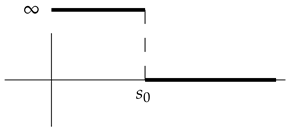
The function has exactly one critical point where it “drops” from infinity to zero. The critical point is called the Hausdorff dimension of the set Z and is denoted by , i.e.,
One may equivalently define Hausdorff measure and Hausdorff dimension using covers by open balls; to this definition, we will refer in the proof of Theorem 4. For a subset , let us define
where I is a set of at most countably many elements. The mapping is monotonic with respect to r. Therefore, there exists a limit
Varying , we obtain a monotonic function . This function has exactly one critical point, denoted by , where it “drops" from infinity to zero, i.e.,
Proposition 4.
For any subset Z of a metric space , the following equality holds:
Proof.
See [12] the proof of Proposition 5.1. □
5. Properties of Dynamical Balls of DCSE-Solenoids
We say that a regular dynamical conformal solenoid is simple and expanding (in short: DCSE-solenoid) if
- (1)
- Each map is a strong conformal map with strong dilatation .
- (2)
- There exists such that for any and any , .
- (3)
- The sequence consists of only finitely many distinct maps.
We will show that Bowen’s formula holds for DCSE-solenoids.
Lemma 11.
Let f be a strong regular conformal map with strong dilatation defined on a compact metric space . We define
Then, there exists a neighborhood of the diagonal , such that is well defined and uniformly continuous on .
Proof.
A direct consequence of Proposition 2. □
Corollary 7.
Assume that is a DCSE-solenoid. Then,
- (a)
- There exists a neighborhood of the diagonal , such that the sequence is well defined and uniformly continuous in .
- (b)
- For any , there exists such that for any natural numberwhenever and .
Proof.
(a) By the definition of a DCSE-solenoid, there exists a natural number such that for any natural number n,
Let be the neighborhood of the diagonal , determined by Lemma 11, for each . Set . In the neighborhood , the sequence is well defined and uniformly continuous since it consists of a finite number of different maps. Thus, is uniformly continuous in .
(b) Choose , determined by Lemma 4, for the neighborhood . Let . From the equality (see the proof of Lemma 4) and the uniform continuity of the sequence , there exists a positive such that for any
whenever . Directly from the definition of the function , inequality (15) is equivalent to the double inequality
Taking the exponential function exp to all sides of the double inequality, we complete the proof. □
Lemma 12.
Assume that is a DCSE-solenoid. Then, for any , there exists such that for any and any natural number
whenever .
Proof.
Take . Choose determined by Corollary 7 (b). Let and . For any point , let , for , n.
In the first step, we intend to prove the inclusion . Consider the dynamical ball
Let and . Then , which means that the second inequality of Corollary 7(b) can be rewritten as follows:
i.e., due to the equalities and , we obtain
Consequently, using the definition of (see Section 3) for , we successively obtain the following.
For ,
For ,
For ,
Taking and applying the equality we obtain
which means that .
In the second step, we are going to prove the inclusion . Since the dynamical solenoid is expanding, , for any . In particular, it follows that for any we have . Setting , we obtain
We fix and consider a point . Applying the identities , and definition of , we have
Due to (16), for any , we obtain the inequality
From the first inequality of Corollary 7 (b), we successively obtain the following.
For ,
For ,
For ,
We have shown that for any the inequality holds, which is equivalent to . □
6. Proof of Theorem 4
Let denote the unique root of the pressure function , which exists and is positive by Theorem 3. Hence, by Corollary 6 (c), we have
First, we will show that . For a natural number and , let us define a set
Since is a DCSE-solenoid, there exists such that . Note (cf. Section 3) that
Directly from the definition of and the inclusion , we obtain
We fix . Due to (17), we can choose , such that
where the second inequality is a consequence of Lemma 9. By Lemma 12, there exists such that for any , , and any ,
This implies that for any and any ,
Note that the first inequality in (21) leads to the estimation
Therefore, for and any applying definitions presented in Section 3, we have
This implies that
Due to the inequality , in the limit with yields
We claim that
Otherwise, if then by Lemma 8,
for all real . This means that
Then, by (8), we have
which contradicts the inequality (20). Thus, we have proven (23).
By properties of Hausdorff measure, we have
which means that for any . Thus, we obtain the inequality .
Let us proceed to prove the inequality . This inequality holds trivially when . Therefore, assume that . Take . Then, due to (18), there exists such that
Hence, by Lemma 5 and the definition of topological pressure, there is such that for any ,
Let . Since is a DCSE-solenoid, . Notice that for any and any ,
For chosen above, we fix given by Lemma 12. Let . For , we set
In particular,
Since, for any natural , , we obtain the estimation
Hence, it follows that for any
Moreover, this convergence is uniform. We have
By the definition of b, we conclude that . Therefore,
Consequently we obtain
Hence, by (25), there exists such that for any and any , there exists , such that
Thus,
or, equivalently (after taking the logarithms of both sides),
where
Note that the function is strictly decreasing with respect to and .
Let . Suppose that is at most countable cover of the set Z with balls of positive radii and centers . Then, due to previous considerations, there exists a sequence of natural numbers such that
where
Hence, by Lemma 12, we obtain the inclusion . This means that the cover is a refinement of the cover of the set Z by dynamical balls. Since , we proceed to the following estimations:
Therefore, we obtain
where the last equality follows from (5) and (7). Therefore, . Since t was an arbitrary number from the interval , we conclude that . This completes the proof of the theorem.
Corollary 1 in Section 1 is a direct consequence of Theorem 4.
7. Apendix: Conformality vs. Strong Conformality
The following example compares dilatation with strong dilatation. On a plane, we consider four points: A(−2,0), B(2,0), O(0,0), Q(0,−2). Let be a segment AB, while a segment OQ. Consider a metric space equipped with the city metric By , we mean the length of the segment PR. In particular, we have
- (1)
- if , then ;
- (2)
- if , then .
Let be a homothety with ratio and fixed point Q; it means that for any , there exists a unique point with . Now we calculate a dilatation for any Notice that for and f, we have
We fix . By the definition of , it easily follows that there exists a neighborhood of x such that for any ,
Therefore, for any , we obtain
so is a conformal map. Consider a function of two variables defined by the formula
We fix . By definition, the function is continuous at if and only if for any sequences and the limit
In particular, for the sequences and we obtain . Moreover, and . Thus, . Consequently,
However,
which yields discontinuity of at the point . Moreover, the strong dilatation of the function is not even defined at It follows that is an example of a conformal map which is not a strong conformal one.
Finally, we note that the strong conformality of f implies that is well defined and uniformly continuous on some neighborhood of the diagonal (see Lemma 11). This fact is a key step in the proof of crucial Lemma 12.
Author Contributions
Conceptualization, A.B. and W.K.; Methodology, A.B. and W.K.; Investigation, A.B., W.K. and A.M. All authors have read and agreed to the published version of the manuscript.
Funding
The first author was partially supported by the inner Lodz University Grant 11/IDUB/DOS/2021.
Data Availability Statement
No new data were created or analyzed in this study. Data sharing is not applicable to this article.
Acknowledgments
It is a pleasure to thank Paweł Walczak and Maciej Czarnecki for the useful discussions and suggestions on the topic of the paper. We are also very grateful to the anonymous referees for their careful reading of the manuscript and for their comments that helped us to improve the paper.
Conflicts of Interest
The authors declare no conflicts of interest.
References
- Bowen, R. Hausdorff dimension of quasicircles. Inst. Hautes Études Sci. Publ. Math. 1979, 50, 11–25. [Google Scholar] [CrossRef]
- Ruelle, D. Repellers for real analytic maps. Ergod. Theory Dyn. Syst. 1982, 2, 99–107. [Google Scholar] [CrossRef]
- Barański, K. Hausdorff dimension and measures on Julia sets of some meromorphic maps. Fund. Math. 1995, 147, 239–260. [Google Scholar] [CrossRef]
- Kotus, J.; Urbański, M. Conformal, geometric and invariant measures for transcendental expanding functions. Math. Ann. 2002, 324, 619–656. [Google Scholar] [CrossRef]
- Urbański, M.; Zdunik, A. The finer geometry and dynamics of the hyperbolic exponential family. Mich. Math. J. 2003, 51, 227–250. [Google Scholar] [CrossRef]
- Urbański, M.; Zdunik, A. Real analiticity of Hausdorff dimension of the finer Julia sets of exponential family. Ergod. Theory Dyn. Syst. 2004, 24, 279–315. [Google Scholar] [CrossRef]
- Barański, K.; Karpińska, B.; Zdunik, A. Bowen’s formula for meromorphic functions. Ergod. Theory Dyn. Syst. 2012, 32, 1165–1189. [Google Scholar] [CrossRef]
- Jaerisch, J.; Sumi, H. Dynamics of finitely generated nicely expanding rational semigroups and the inducing method. Trans. Am. Math. Soc. 2017, 369, 6147–6187. [Google Scholar] [CrossRef]
- Urbański, M. Parabolic Cantor sets. Fund. Math. 1996, 151, 241–277. [Google Scholar]
- Simon, K.; Solomyak, B.; Urbański, M. Hausdorff dimensions of limit sets for parabolic IFS with overlaps. Pac. J. Math. 2001, 201, 441–478. [Google Scholar] [CrossRef]
- Rugh, H.H. On the dimensions of conformal repellers. Randomness and parameter dependency. Ann. Math. 2008, 168, 695–748. [Google Scholar] [CrossRef][Green Version]
- Climenhaga, V. Bowen’s equation in the non-uniform setting. Ergod. Theory Dyn. Syst. 2011, 31, 1163–1182. [Google Scholar] [CrossRef]
- Biś, A.; Namiecińska, A. Hausdorff dimension and topological entropies of a dynamical solenoid. Entropy 2020, 22, 506. [Google Scholar] [CrossRef]
- Biś, A.; Kozłowski, W. Some remarks on dynamical system of solenoids. Taiwan. J. Math. 2018, 22, 1463–1478. [Google Scholar] [CrossRef]
- Pesin, Y. Dimension Theory in Dynamical Systems: Contemporary Views and Applications; The University of Chicago Press: Chicago, IL, USA, 1997. [Google Scholar]
Disclaimer/Publisher’s Note: The statements, opinions and data contained in all publications are solely those of the individual author(s) and contributor(s) and not of MDPI and/or the editor(s). MDPI and/or the editor(s) disclaim responsibility for any injury to people or property resulting from any ideas, methods, instructions or products referred to in the content. |
© 2024 by the authors. Licensee MDPI, Basel, Switzerland. This article is an open access article distributed under the terms and conditions of the Creative Commons Attribution (CC BY) license (https://creativecommons.org/licenses/by/4.0/).